




Abstract
In this article, and based on the theme of economies of writing, I explore writing as a more-than-human or posthuman practice. In particular, I consider the way in which academics curate writing places and spaces and the role of matter (things, natures and technologies) in these assemblages of writing by drawing on a Baradian take on posthumanism. The article utilises empirical data from a qualitative, photovoice study with doctoral students. The aim of the article is to encourage reflection on the way we, as academics, experience and teach writing practice in a more-than-human world, and how these experiences relate to productivity and wellbeing.
Introduction
Academics have not shied away from writing about writing. In recent years, this attention has focused on the concept of writing as a social and political practice (Burford, 2017; Turner, 2018), but with scant attention paid to the materialities of writing. A notable exception is Johanneseen and Leeuwen’s (2018) edited collection, The Materiality of Writing: A Tracemaking Perspective, which includes contributions from linguistics, design and philosophy. Even then, however, the text focuses on the materialities of writing as ‘graphic traces’ or, in other words, ‘enduring marks left in or on a solid surface by continuous movement’ (Ingold, 2007: 43). This approach ignores the practice of writing itself and the way in which writing is experienced in space and place.
In this article, and based on the theme of economies of writing, I explore writing as a more-than-human or posthuman practice. In particular, I consider the way in which academics curate writing places and spaces, and the role of matter (things, natures and technologies) in these assemblages of writing. If we consider the simple definition of an economy as a set of interrelated production and consumption activities, then we can begin to explore the way in which the production of writing comes to be through an entanglement of human and non-human resources. The focus of my article is not the marks then; it is the experience behind making the marks and the intra-actions in their making.
This article draws on empirical data collected for a project concerned with doctoral students’ writing experiences. The original study was approached on the understanding that writing is a high-stakes activity for doctoral students, closely related to perceptions of success and failure (Beasy et al., 2020) and ultimately critical to the completion of the doctorate itself. Where much attention has been paid to supervision practices and to pedagogies of doctoral writing, little attention has been paid to everyday experiences of writing within place. To plug this gap, this article considers how writing comes to be through intra-actions of human and more-than-human parts. I use the stories of two doctoral students to illustrate the importance of place and technologies of matter within these experiences, and invite others to reflect on how these themes may be extended to academic writing more widely.
More-than-human economies of writing
Researchers have previously considered the role of the material environment on academic identities and activities. For example, Dowling and Mantai (2017: 201) consider the spatialities of the PhD experience, stating that the performances and practices of the PhD ‘draw on both the material character of spaces like offices and laboratories and their imagined meanings’. Similarly, Kuntz (2011) explored the impact of the physical environment on academics’ perceptions of what they do, where they work, and who they are. Kuntz (2011: 773) found that academics ‘rhetorically took possession of research and writing activities, to which they referred to as their “own work”, and placed them in off-campus environments’ such as the home. Tusting et al. (2019) found this too, along with a general blurring of boundaries between home and work in academia. Digging deeper, Dobele and Veer (2019) asked academics what their ‘best’ and preferred writing spaces were, creating a typology of ‘co-opters’, those who co-opt space designed for other activities, such as cafes or the bed; ‘worker bees’, who create writing nooks at work; and ‘homebodies’, who write at home. The authors note a tension around scholarly writing practices, where on the one hand there is pressure to publish, but on the other hand, the nature of academic working space is becoming increasingly uncertain as institutions re-structure departments and move to different ways to working (particularly now, in light of COVID-19).
Although the aforementioned literature explores writing spaces, material economies of writing are not solely reserved for physical environments of writing. Understanding relational ontologies of writing goes far beyond place. Yet, efforts to foreground emotion and identity in the analysis of writing have generally not gone as far as to explore affect. For that, it helps to move beyond poststructuralist notions of place and space to the posthuman. Posthumanism enables us to explore meaning–matter entanglements (Barad, 2007) and human–machine interactions (Hayles, 2008). This is necessary, because whilst a 1992 study of postgraduate writing practices distinguishes between writing on a ‘word processer’ and by hand (Torrance et al., 1992), technology is now intricately entwined in our writing practice and wider academic work (Hassan, 2017; Hayles, 2008). Indeed, whilst humans could be considered ‘analogue creatures’, there is no denying the impact of technology in all areas of our lives (Hassan, 2017). In light of this, scholars have attempted to explore how digital work differs from analogue work, and the posthuman ‘cyborg’ (Haraway, 1985) has been a particularly fruitful concept to consider posthuman writing (Muhr and Rehn, 2015; Olson, 1996). Hayles’ (2008) work, for example, centres on human–computer interaction, including digital writing and what this means for the posthuman. In Hayles view, studies of digital writing cannot separate the human from the computer, but rather sees them working together towards a shared aim. This is key to posthumanism; that is, the dismissal of Cartesian dualism and embrace of ontological relationalism.
As an example, Gourlay (2019) explores the writing experiences of adult learners with a focus on mobile devices and screens. Drawing on Latour's conceptualisation of ‘mediators’, Gourlay attempts to illuminate the way in which devices and learners are entangled through human–machine intra-actions – the practice of writing cannot be untangled into human and non-human parts, but rather they work together. Similarly, Allen (2019) explores what he calls a posthuman conceptualisation of writing in a sociomaterial world using the idea of ‘gatherings’ and ‘mediators’ in reference to Law (2004). Gatherings is a metaphor that refers to researching as involving flowing processes of bringing parts of realities together to form our accounts of an emerging world (Law, 2004). Allen uses mediators to help us notice the material and non-human intra-actions. What I found most helpful for my study, however, and where I focus my later discussion, is a Baradian take on posthumanism. According to Barad's theory of agential realism, phenomena or objects do not proceed their interaction, but rather they emerge through intra-actions. Barad (2007) thus argues that all matter (human and non-human) is relational and it is only through intra-actions that agency and its signification is created. I therefore use the concept of ‘assemblage’ to attend to the way agentic forces (intra-actions) come together to achieve something. Deleuze and Guattari (1993) offer, as an example, the way orchids and wasps collaborate or come together to achieve the pollination of plants. I apply this to economies of writing in the sense that writing cannot exist without human–non-human intra-actions, whether the apparatus is a machine (computer, phone, etc.), or an object (Ahmed, 2010).
The study
The study on which this article is based set out to respond to the question ‘how do doctoral students experience writing in time and space’. Whilst I have looked at the issue of time elsewhere (author), here I wish to pick up on the multiple spaces, places and tools of academic writing that, I argue, produce posthuman economies of writing.
The study adopted an online interview technique incorporating photovoice. Photovoice, also known as photo elicitation, is a visual participatory method that uses images (taken by the participant) to stimulate discussion in an interview (Wang and Burris 1997). I used photovoice to capture moments in time related to doctoral students’ experiences of writing and to illuminate the mundane details of these moments that might otherwise be overlooked. Allen (2019: 68) used a similar photographic method to explore posthuman writing in an autoethnographic study. The photographs, Allen professed, offered, ‘glimpses of materialities through which the text is assembled that could relate to objects, places and other peoples’ comments about the developing texts’ (2019: 68). But, whilst Allen focused on the production of text, in my own study, I was more interested in the relational experience of writing.
Eleven doctoral students took part in total, from two UK universities. Participants were recruited through social media and snowball sampling. Participants were asked to take photographs of their writing environments over a 1-week period. Participants ranged from being in year two of their doctoral programme to being post-viva and working on their thesis corrections. Two international students participated; the others were considered home students. Four men and seven women took part and they were based in a range of disciplines – geography, linguistics, computer science and sociology to name some. The online interview comprised a traditional semi-structured interview where participants were asked about themselves and their writing practice, followed by the sharing of the photographs that were used as prompts for further discussion. The interviews took place in May 2020, ∼2 months into the COVID-19 lockdown restrictions in the UK. Participants at the time were thus only able to work at home, but discussing their previous ‘normal’ writing experiences still dominated much of the interview.
Like Barad, I consider these interviews ‘enactments’ or ‘material articulations’ of the world (Barad, 2007: 139). The photographs helped to capture the material articulations of the assemblages of writing I discuss next. After transcribing the interviews, I coded the transcripts using broad themes to support the organisation of the data analysis but was careful not to slice up the data into small fragments. Like Juelskjaer (2013), I looked for evidence of how respondents are situated within assemblages, using ‘affect’ as my unit of analysis as I interpreted the transcripts. Below I have picked out two participants as I attempt to unpack their writing experiences in relation to, first, experience of place, and second, technologies of matter. Each participant has been given a pseudonym.
Experience of place
Katie is a second-year doctoral candidate in sociology and geography. She is a UK student. Katie spoke at length about how the physical environment influences her writing experiences. Katie says: I had a desk in geography but I never used it because I prefer writing at home. So I gave that desk up. However, my PhD is half sociology, so I actually used to go and work in the sociology department because I felt in geography everyone got in at 8am and everyone was like, ready to work. And I never wanted to be in for that time. Whereas in sociology, if I come in at like 9:00 am no one is there, it's only me, so I feel like I’m the most hard-working and I’ve got the whole office to myself. Plus, the office is really big, it's white, whereas I feel like sometimes the geography department is a bit like, dark colours, and I like quite like a bright, colourful workspace. And because it's quiet, I just prefer it, however, even when I use that room, I still work and write a lot at home. But even when I work at home, as you might have seen from the pictures, I kind of like to organise my workspace and have it decorated, if I can, just so that it feels a bit less depressing. I quite like a lot of colour around me and also I really like to mix up my workspace. Which is why I’m like don't like during these [COVID] restrictions because if I’m writing a section and I finished that section, before I start the next section, I would have preferably then moved to new to a different space to approach it because I don't like sitting in the same…doing all my work in the same spot. That's why sometimes I work at my boyfriend's, who I’m at now, sometimes work at my flat, sometimes in the office, sometimes at cafe, because I like the change in scenery.
Katie is probably what Dowling and Mantai (2017) would describe as an ‘isolated researcher’. She is not the ‘PhD worker’ who treats the university as her workspace and her peers as her colleagues; rather, she retreats from the formal workspaces to the home or a cafe, where she can be an anonymous worker and where (at home) she has more control over her environment. Katie struggles to find a place for herself in the university. Perhaps the fact that she straddles two departments has something to do with this, and, unlike other participants, she did not discuss taking part in any social activities that may help her feel connected to the doctoral community. Having control over the physical materiality of the space is something that Katie finds comfort in. This aligns with Dowling and Mantai’s (2017) finding that: For our participants, home at times replaces and extends the traditional PhD office in fostering research work and researcher identifications. This is especially the case with writing, which is seen to require solitude.
At home, Katie worked in her small studio flat or her boyfriend's house. Describing photographs of her normal workspace Katie says: I like to be colourful at least I get quite, um, sounds a bit weird, but, a lot of my concentration or feelings is related to the environments around me. [the next picture] that is the view from if I was working there so I can see the rest of my flat which is quite colourful (Figure 1), you can't really see the rest of my flat, but it's like quite…although I like things tidy, I also like a cluttered feeling I think maybe that's because I live alone so I just feel bit less lonely etc.
This final comment is interesting as Katie is admitting that she can feel lonely as an ‘isolated researcher’. In this case, clutter is seen to take on an affective role – a substitute perhaps for the ‘busyness’ of a shared social space. Other participants had similar accounts of affective spaces, like the participant who felt more ‘social’ when writing in her lounge, compared to her bedroom, even when no one else was home. Geographers have considered, in-depth, the role materiality plays in social relations and the absence–presence evoked by material things, particularly in relation to death and distance (Maddrell, 2013; Owen, 2021), but also in regard to a sense of home and belonging (Hurdley, 2013). Katie later extends her discussion of how material things bring her comfort by discussing personal objects on her desk. She says, ‘[on my desk I have] a card that my boyfriend got me for publishing, a picture of my boyfriend. Yeah, I definitely feel like is more inviting because of that’. Curating her workspace with these personal items creates a connection to her boyfriend which Katie finds reassuring and makes the writing process more ‘inviting’. Perhaps again, even though she is isolated from others, these items help her to not feel alone.
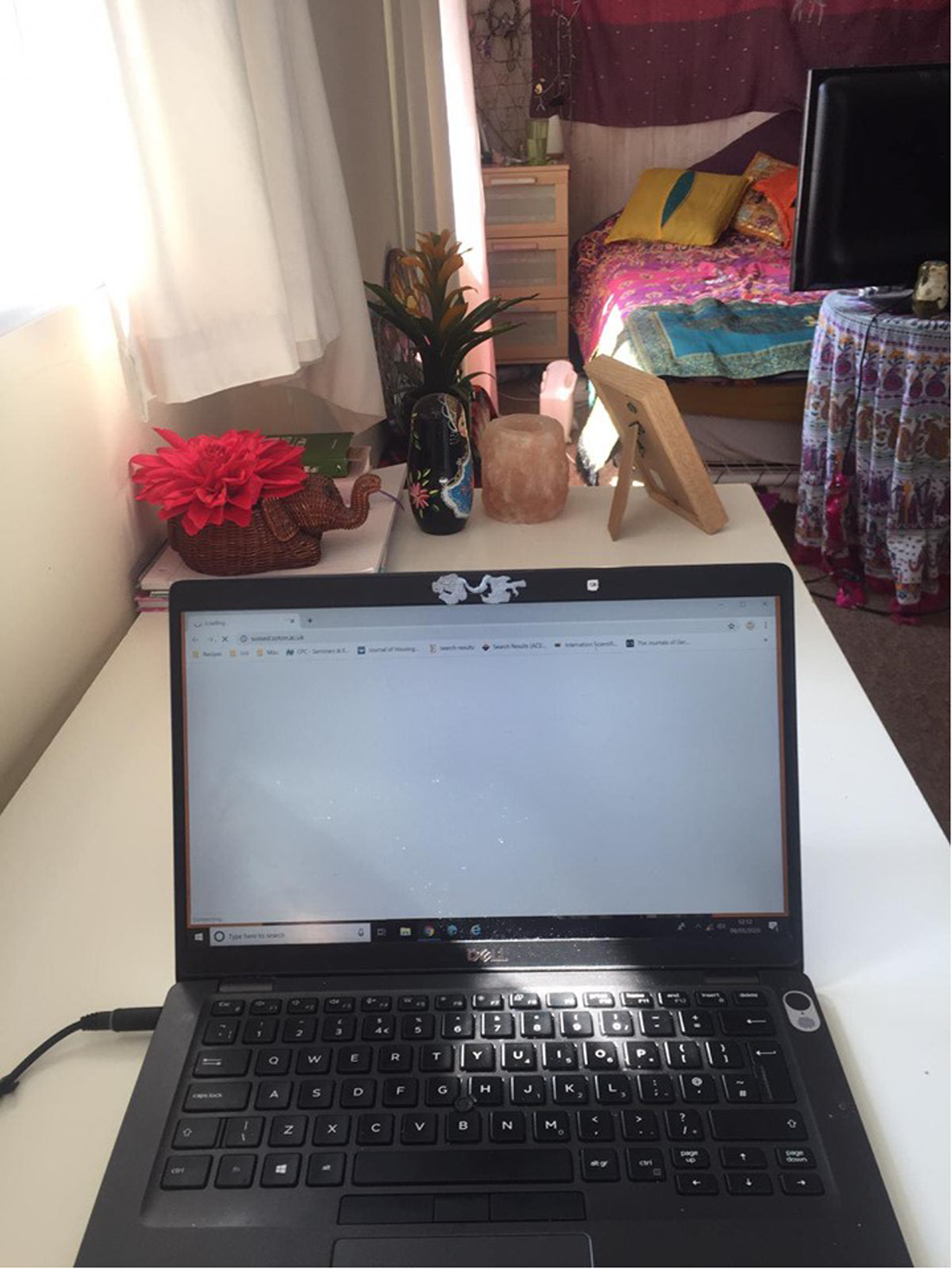
Katie's normal writing space.
Technologies of matter
Graham is a second-year doctoral candidate in physical geography. He is a home student. Unlike Katie, Graham's preferred place of working was the geography department where he had his own desk in a small, shared office. Since the lockdown, and at the time of the interview, he was living back with his parents and working from a spare bedroom. Graham had recently changed desks at the university to one situated next to a window and was pleased that ‘I can smell fresh air when I’m writing and I’m in a room where people tend to be quiet’. His university office was described as a complete contrast to his current workspace, which is my nephew's bedroom, because the desk does not fit into mine, but this is like stuffed toys and teddy bears and things. For example, I have this thing (points at toy) that looks at me from the window and it does not really like give an impression of a working environment.
First, Graham describes how technology enables him to experience writing in a mobile way. Graham says: Trains – I try to make productive use of the time on trains. If I’m travelling to London or somewhere then it might take an hour and a half/two hours. I’ll take my laptop so I can write while I’m on the train.
And also ‘I normally email myself on my phone if I’m out and I’m not on the computer because I’ll probably forget what I was thinking If I try and come back to it at a later time’.
In this latter example, the technology provides a substitute for human memory. It also demonstrates how the process of writing goes beyond the act of actually writing; ideas are being mulled over in our brains, consciously or not, when we are doing other activities. Graham acknowledges this and uses email to send his future self a note. He was not the only participant to write on his phone; another described how she sometimes felt stifled and stressed whilst working at her desk but, when she moved away from that space, ideas could ‘flow’. When this happened, she was able to utilise writing on her phone to capture her thoughts.
Graham also described his experience of using a piece of software designed to support individuals with dyslexia: I don't use it frequently now, but I’m dyslexic, so there was, Read & Write it's called, software but I only use it now for tinting my screen so I can read things easier and type things easier … But before that there was a tool I would use like, when you would type, you’d finish the paragraph and you would highlight it and click this tool and then a woman would speak what you’d written and you can give them accents and stuff so actually sounds more like a person rather than a robot speaking into you, and then you can kind of pinpoint any grammatical errors or words missing from that, and then I would be able to revise what I’d written using that software.
This is a good example of a machine performing the role of a person. In this case, the software technology acted like a tutor or guide to support Graham's writing process. However, there were a number of examples in the interviews of where analogue was deemed superior to the digital. Graham did not generally keep a notebook (and was in the minority amongst the participants for not doing so), preferring the speed of typing instead. Yet, one of his photographs showed a hand-drawn diagram, which he explained he had drawn that week to represent the conceptual framework of one of his chapters. He then translated this hand-drawing to PowerPoint to share with his supervisors (see Figure 2). He said ‘It kind of helps you organise your thoughts, I guess, when it's free hand with a pen’. Others describe physically cutting up drafts to play with a writing structure and using post-it notes to order ideas.
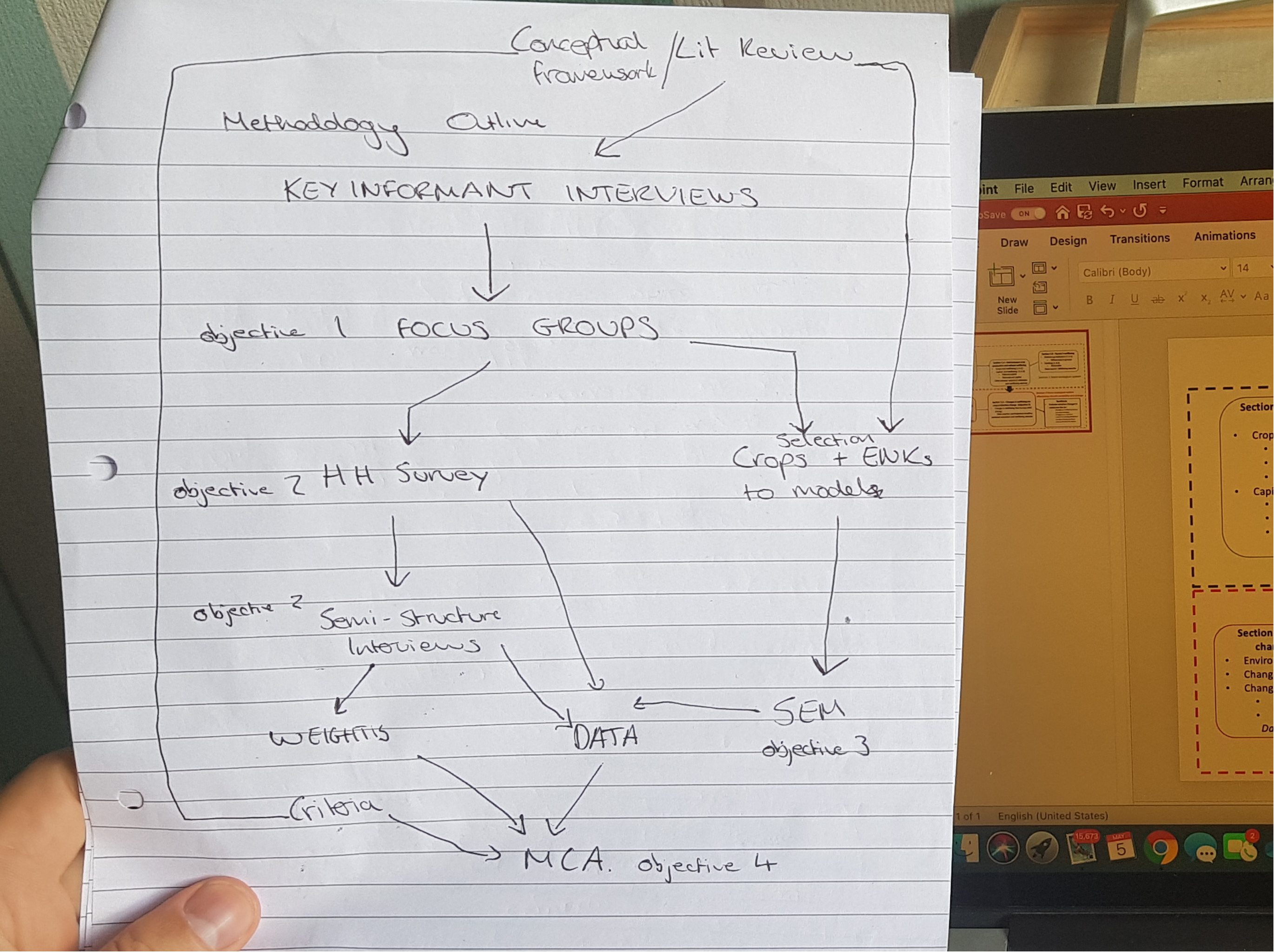
Graham's hand-drawn and digital conceptual drawing.
The extended cognition or extended mind thesis is useful here. This theory suggests that the mind is not purely within the embodied self but extends into the physical world (Cooper, 2005). If the material world is an active agent in our economies of writing, what does this mean for our writing when we increasingly rely on digital practices? This is one of a few questions raised by these two participants that I will now discuss.
Discussion
Katie and Graham provide a number of examples in relation to how place, matter and technology or the materialities of writing, play a part in the writing process. Economies of writing can thus be considered assemblages of writing, where materialities of the human and non-human intra-act (Barad, 2007) to facilitate, and hinder, writing processes. An understanding of the ever-shifting state of these intra-actions is important, because, as the participants describe, it influences how we experience and achieve writing in space and place.
Thinking about place, Graham and Katie both had access to the same workspace – the doctoral hub in the geography department. But although they had access to the same place, their sense of space and the meaning–making connected to that space (Soja, 1989) was very different. Graham felt comfortable there, like he belonged; and Katie did not. The way they experienced affect in that space differed, and this demonstrates the importance of a sense of place within assemblages or economies of writing. As Dobele and Veer (2019) found, academics have different ideas of what makes the ideal writing space. The theory of affect concerns the body's ability to affect and be affected within spatiotemporal arenas (Anderson, 2014) and Katie described at length how colour, light, objects and social others influence her sense of space and her ability to achieve her best writing state. Katie's ability to reflect on her environment was more advanced than many of the participants, but the acknowledgment that a sense of space affects experiences and practices of writing was a central theme throughout the interviews, with all of the participants able to discuss how they curate their environments to a greater or lesser extent.
We also saw in the data above how technology, as a non-human mediator, participates in economies of writing. As Hayles argues, ‘in the posthuman, there are not essential differences or absolute demarcations between bodily existence and computer simulation, cybernetic mechanisms and biological organism, robot teleology and human goals’ (Hayles, 2008: 3). Graham describes how the physical and networked devices (his smartphone and computer) became almost an extension of his mind, allowing him to preserve ideas outside his memory and to support his cognitive processing (his spelling and reading). It is difficult to see where the mind ends and the computer begins; the two are intrinsically entangled through their intra-actions (Cooper, 2005). As Braidotti (2013: 92) states: contemporary machines are no metaphors, but they are engines or devices that both capture and process forces and energies, facilitating interrelations, multiple connections and assemblages.
Agency comes to be as a dynamism of forces, it is not intrinsic to a single object (Barad, 2007). In conceptualizing economies of writing as an assemblage; something both diffractive and affective, we can illuminate the complexities of writing and the way in which we experience it. In the contemporary, neoliberal academy and with a counter drive pushing back to slow scholarship, reflecting on how we experience writing may be beneficial to both productivity and personal wellbeing. It also has implications for how we teach students by offering them the opportunity to contemplate the same.
Concluding remarks
By building on and extending the work of others who have considered spaces of writing (Burford and Hook, 2019; Dobele and Veer, 2019) and the emotional politics of writing (Burford, 2017), in this article, I have applied a posthuman lens to the practice of writing. In doing so, I adopt a Baradian view of posthumanism drawing on the notion of affect and assemblage to consider writing as a more-than-human economy. I demonstrate how writing spaces, matter and technology intra-act to achieve writing, and how the affective state produced creates unique experiences and outcomes. Reflecting on how we experience (and teach) writing as an assemblage within space and place may have a critical impact on our attitudes towards writing, what we write and how we write it.
