




Abstract
Incorporating time as a unit of analysis can enrich the study of agency by showing the specific ways in which actors are temporally constrained when responding to economic disturbances. In this paper, this is done by examining how the behavior of actors is affected by timing norms such as term limits that may be associated with an actor's position, as for example, an elected mayor or university vice-chancellor. Institutions such as timing norms and term limits shape, constrain, and enable actors in their efforts to persuade others to mobilize resources toward collective action and institutional change in regions. This paper shows the value of considering timing norms in the study of agency, by presenting a comparative case study of local actors’ responses to the closure of large research and development facilities in two cities in Sweden. Main findings from interview material and supporting documents show that the possibility to renew term limits shape how actors pursue policy initiatives. These initiatives are found to be in sync with the term limits of these actors, particularly in the schedules of policy milestones and operations. However, this paper also finds that actors actively shape these temporal constructs in order to convince other actors to support collective action efforts. This paper contributes to a more time conscious account of agency, with its cases pointing to the importance of investigating institutions with temporal dimensions that help explain how agentic processes are carried out.
Introduction
Although economic geography has a rich tradition in studying time (Hägerstrand, 1970) and ingraining it in its theoretical and empirical body of work (Henning, 2019), it has not been examined very much at the level of institutional and political actors. The agency strand of the literature shows these actors pursuing purposeful and concerted efforts to react, improvise, and collectivize (Bristow and Healy, 2015) in response to economic disturbances such as plant closures (Beer, 2018). They use available regional resources to push for policy initiatives and implement institutional change (Sotarauta and Suvinen, 2018). However, this agentic process is not static. Patterns of agency are observed to change across time periods (Jolly et al., 2020). Different actors act at different phases (Jolly et al., 2020) and with different coalition partners (MacKinnon et al., 2019). This underscores the notion that actors are temporally embedded (Grillitsch and Sotarauta, 2020) and that agency is best studied “by situating it in the flow of time” (Grillitsch et al., 2021: 308). Thus, examining time and the specific ways it can enable and constrain actors can further enrich the study and understanding of agency.
Actors encounter time as temporal constraints in the form of timing norms that they need to navigate and construct (Granqvist and Gustafsson, 2016). According to organizational studies, timing norms are temporal institutions that are “shared, expected patterns of paced activities” (Ancona et al., 2001: 648) such as schedules, calendars, milestones, and other expected sequences that allow actors to coordinate actions. They also come in the form of term limits that establish spaces for decision-making and policy support (Smart and Sturm, 2013). Term limits can be renewable or nonrenewable and delineates the spaces of time an actor has in pursuing policy initiatives and institutional changes. According to the political economy literature (Besley and Case, 1995; Erler, 2007; Klein and Sakurai, 2015; Persson et al., 2007), the type of term limit encourages actors to take up certain strategies while dissuading others. As such, term limits can have profound consequences on how actors engage in regional economic transformations. Because of its potential significance in explaining agency and why actors behave in the way they do, timing norms such as term limits in relation to agency, need to be examined further.
This paper, then, interrogates the research question “How do term limits affect actors enacting policy initiatives and institutional changes in regions?” This is done by conducting a comparative case study on two sets of actors subject to a renewable and nonrenewable term limit, respectively, while responding to plant closures in different regions in Sweden. In doing so, this paper aims to demonstrate the value of examining time as not only a setting for agentic processes but also time as temporal institutions with which actors actively engage. Section 2 reviews recent work that incorporates time in studying agency and outlines three propositions on timing norms and term limits, and actor strategies; drawing on literature from organizational studies and political economy. Section 3 discusses the comparative case study used in this paper. Section 4 explains the findings, and Section 5 concludes the paper by highlighting its contributions and implications for the agency literature and suggestions for future research.
Results from the comparative case study.
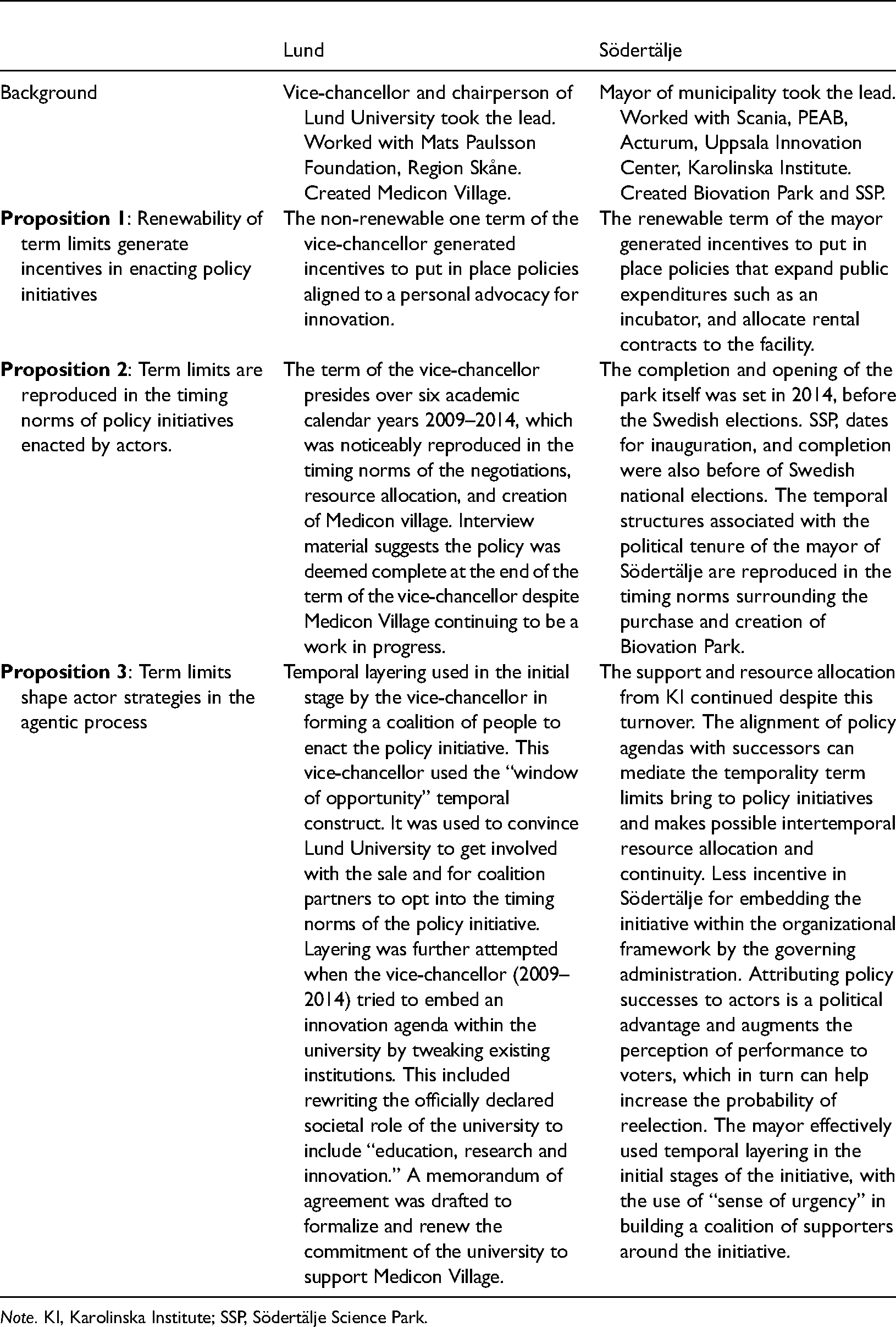
Note. KI, Karolinska Institute; SSP, Södertälje Science Park.
Toward a more time conscious account of agency
In economic geography, “time has often remained in the background, used merely as a way to keep track of a sequence of events, rather than as an active part of change itself” (Barratt and Ellem, 2019: 1557). Recent work on agency is starting to address this and accounts for time more explicitly. It examines roles and actions of actors in places where regional transformations are underway while specifying the temporal relations between phases of development and locates the critical junctures where change happens (Grillitsch et al., 2021). Agentic processes are viewed longitudinally, revealing variations in types of actions and roles that actors take in regional industrial development and path creation (Jolly et al., 2020; Sotarauta et al., 2020; Sotarauta and Suvinen, 2018). This more “time conscious” account of agency conceives of actors as temporally aware, using past observations to inform present and future path development trajectories (Grillitsch and Sotarauta, 2020). Thus, to contribute to this more “time conscious” work on agency, this paper explores the ways in which time affects the behavior of actors engaged in policy initiatives. It does this by locating the temporal constraints actors face in relation to their ability to act, to persuade others, and to mobilize resources toward collective action and institutional change in regions. These temporal constraints come in the form of term limits and timing norms.
Term limits and timing norms
Term limits demarcate and specify the length of time an actor can perform the functions of a position (Smart and Sturm, 2013), including distributing, allocating, and mobilizing resources to particular policy initiatives. Since policy initiatives need opportunity spaces for actors to take action (Grillitsch and Sotarauta, 2020), term limits constitute an important temporal dimension of this space. This is because actors internalize time as a basis for action and imagine the prospects for the future based on their interpretations of the past and understanding and awareness of the conditions of the present (Emirbayer and Mische, 1998). These interpretations can conflict with the temporal understanding of other actors so this necessitates “negotiating and resolving tensions among different understandings of what has happened in the past, what is at stake in the present, and what might emerge in the future” (Kaplan and Orlikowski, 2013: 965). Based on these deliberations and negotiations, actors develop preferences for particular policy choices on issues such as taxes and public expenditures (Besley and Case, 1995).
These preferences for certain policy choices and the decision to act are amplified by the kind of term limits that constrain actors. Term limits are either renewable or nonrenewable. Actors, subject to only one nonrenewable term, tend to incentivize them to support policies more in line with their own personal preferences (Smart and Sturm, 2013). Actors with a renewable term, usually through an election, have an incentive to pursue policies that will help win in the next election to retain mandate (Schedler and Santiso, 1998). This is because, unlike actors subject to a hard limit of one term, voters can punish actors who have the possibility of renewing their term in the next election by not voting for them, if performance is perceived to have fallen short of expectations (Persson et al., 2007). Evidence from the political economy literature shows that politicians seeking to renew their term through reelection tend to launch policy initiatives that increase public spending (Erler, 2007) in a way that is most visible during their term to boost their chances for reelection (Klein and Sakurai, 2015). This behavior of visible public spending, referred to as the “political business cycle,” is an attempt to send signals to their constituency regarding their competence and their policy preferences (Klein and Sakurai, 2015). This body of literature suggests Proposition 1: that the renewability of term limits generate incentives in enacting policy initiatives.
Term limits are examples of a type of institution referred to as timing norms. Timing norms within organizations pertain to elements of its temporal structures to which actors who are members of that organization, adhere (Granqvist and Gustafsson, 2016). “Time is experienced in organizational life through a process of temporal structuring that characterizes people's everyday engagement in the world. As part of this engagement, people produce and reproduce what can be seen to be temporal structures to guide, orient, and coordinate their ongoing activities” (Orlikowski and Yates, 2002: 684). This means that actors tend to organize and schedule how and when their policy initiatives are launched, operationalized, hit milestones, and concluded, in cadence with the time frame of their terms. This synchronization shapes the temporal rhythm and form of actions and structures actors construct, as well as the parameters of how actions and practices are performed (Orlikowski and Yates, 2002).
Empirical evidence from organizational studies shows that actions in a community are formed by and take the form of different temporal structures such as schedules, project deadlines, political tenure and election cycles, and academic calendar years (Granqvist and Gustafsson, 2016). This reproduction of timing norms can be implicit and explicit and is often at the behest of actors who are central to the organization of the activities of a group. Actors have also been found to accelerate the completion of a project of an organization based on their own personal time frames as they enact multiple timing norms from broader temporal structures in their lives (Orlikowski and Yates, 2002). As term limits are the focus of this paper, it is examined as one of the temporal structures that actors enact. This body of literature suggests Proposition 2: that term limits are reproduced in the timing norms of policy initiatives enacted by actors.
Actor strategies
Term limits affect actors in that they encourage certain strategies in mitigating shifts in access to resources while dissuading others. Since term limits establish the periodicity of the functions of governance (Schedler and Santiso, 1998) and facilitate the transfer of agenda setting powers within and between groups of actors across time (Mahoney and Thelen, 2009), term limits introduce temporality to and within the agentic process. Operationally, this means an incumbent actor cannot compel an organization to continue allocating resources to a policy initiative once reaching a term limit unless the actor can renew the term, a successor aligns with the policy, or the organization is formally rule-bound to the policy initiative. If the actor can renew the term, there is an incentive to send signals of competency in order to renew the term by attributing the success of the policy to the actor. If, however, the actor is limited to one term, then there is an incentive to bind the organization and the successor to the policy initiative. This involves attributing the policy to the organization rather than to the actor as well as formally embedding the policy within the agenda of the organization. However, this formal embedding requires institutional change, that is, adjustments, revisions, reinterpretations, transformations, and mediations of existing rules within the organization (Lawrence et al., 2011).
In attempting institutional change, actors tend to employ strategies such as layering (Mahoney and Thelen, 2009) and temporal layering (Granqvist and Gustafsson, 2016). Layering is a strategy involving tweaking rules instead of imposing completely different sets of rules and making revisions to and reinterpretations of existing institutions (Zukauskaite et al., 2017). Layering can, typically, be observed for actors whom are unable to make wholesale transformative institutional changes so amending rules are instead sought (Mahoney and Thelen, 2009). The strategy to attribute policy actions either to the organization or to themselves is a response to the limitations set forth by the designated position, timing norms, and the incentive structures generated by the term limits of actors. Temporal layering is a specific form of layering involving actors shaping timing norms intended to engender a perception regarding the eventuality of a future event (Granqvist and Gustafsson, 2016). Examples of temporal layering are “window of opportunity” and “sense of urgency.” Window of opportunity refers to a temporal construct that encourages action, while a scarce resource is still available (Suarez et al., 2015). Sense of urgency refers to a temporal construct that raises a perception of an imminent period of uncertainty and transition (Granqvist and Gustafsson, 2016). This body of literature suggests Proposition 3: that term limits shape actor strategies in the agentic process.
Research methods
This paper uses the case study method in order to study the actions of actors in times of economic disturbances like plant closures. The case method is useful in examining cases where both the phenomenon and context are tightly linked (Yin and Davis, 2007) and designed comparatively in focus and structure around meaningfully comparable reference points (George, 2019). In this paper, the case is about agentic behavior in response to the announced closure by AstraZeneca, a large pharmaceutical company, and their R&D facilities in Lund in 2010, and in Södertälje, in 2012 (Severinsson et al., 2012). The aftermath in both cities involved different sets of actors from different types of organizations, attempting to shape their regional strategies through policy action. These two different groups of actors, subject to different timing norms and term limits, intervened in the closures and initiated policies to convert former AstraZeneca facilities into science parks. The respective closures in Lund and Södertälje provide an opportunity to observe and compare different types of actors subject to different timing norms enacting policy initiatives, while taking advantage of the parallelism between the two cases to minimize the number of explanatory factors (Teune and Przeworski, 1970). This rich empirical material was used in another paper focused on resilience and general institutions, while this article delves specifically on timing norms and term limits as types of institutions and their effects on agency.
Data collection and coding
To investigate how actors managed their term limits and timing norms, and engaged in layering and temporal layering, this paper draws on varied empirical materials. Qualitative data were collected from several sources. Firstly, desk research was done in order to gather company annual reports from AstraZeneca, as well as reports from different bodies such as universities, municipality, unions, website material, news articles, and pamphlets. News articles and official reports helped identify key stakeholders and central actors as informants. Selection of actors to interview was made based on their reported involvement in the closure of AstraZeneca but also on their reported roles in enacting policies in response to the closures, in both Lund and Södertälje. Secondly, 18 interviews were conducted. Nine of which were done in Lund, four of which with actors from the university, another four from industry, and one from the municipality. Nine interviews were also conducted in Södertälje, three from university actors, three from industry, and another three from the municipal government.
Interviews took place between 2016 and some, for confirmation purposes, in 2018. An unanticipated finding from the first phase of empirical research was how timing norms influenced actors’ behavior. A second round of interviews followed to investigate this more systematically and in-depth in the two cases. Interviews lasted between 45 min and 2 hours using a semistructured approach. Questions were thematically organized around the roles and positions of the actor and their respective organizations, and their involvement and policy responses to the closure. Questions were also made regarding subsequent actions done during and after term limits had expired or extended. This interview method allowed informants to express their views and narrate their experiences but also allowed the interrogation of core themes set forth in the interview guidelines. Successfully recorded interviews have been transcribed, analyzed, and coded in NVIVO. Coding was done in order to track references, mentions, and allusions to conceptual themes in a systematic way. Broad themes used in the coding draw from the conceptual framework in this article, namely, agency, timing norms, term limits, layering, temporal layering, policy initiatives, and regions. When these terms are alluded to and referenced in the text, even if not in name but in meaning, the text was coded accordingly into specific themes.
Findings
This section provides a background on the closures and actors associated with the cases of Lund and Södertälje. This is followed by a discussion of the results for the three propositions and involves comparisons of Lund and Södertälje, in terms of how their respective actors responded to their term limits and timing norms, and if and how they enacted strategies of layering and temporal layering.
Background on Lund and Södertälje
In 2010, Lund was poised to lose 900 jobs as AstraZeneca intended to close their R&D facility (Severinsson et al., 2012). In the Lund case, it was the vice-chancellor and the chairperson of the board from Lund University, who took the lead in responding to the issue. They initiated and orchestrated the eventual purchase of the facility through a coalition of actors, involving partners such as the foundation of Mats Paulsson, philanthropist and founder of a large construction firm called PEAB, as well as Region Skåne, the regional government. The facility was turned into the science park, Medicon Village, managed by an eponymous company, that recruit companies, mainly from the life science industry, to take up residence in the park. An estimated 2200 people are employed in the 150 companies situated there as of 2021 (Medicon Village AB, 2021).
In 2012, AstraZeneca announced it would also be closing its R&D facility in Södertälje. Unlike in Lund, the municipality took the lead in responding to the issue. The political leadership in Södertälje worked with Scania, a large manufacturing firm founded in the region over a century ago, to enable and facilitate the sale and development of the former AstraZeneca facility to a consortium called Acturum, a joint venture between the acquisition arms of the philanthropic organization of the Wallenberg Foundation, and PEAB. They established an incubator in the facility called Biovation Park, and the former toxicology component of the AstraZeneca facility was taken over by SWETOX, a newly formed academically oriented center funded by Karolinska Institute (KI). The Biovation Park initiative has been subsequently scaled up to create the Södertälje Science Park (SSP). It involves more partners and with further support from the Ministry of Education from the national government.
Proposition 1: The renewability of term limits generate incentives in enacting policy initiatives
In Lund's case, the announcement of the closure of the AstraZeneca R&D facility in Lund was made in 2010 as well as the plan for a two-year transition from announcement to actual closure in 2012. One of the leading advocates for purchasing the facility was the vice-chancellor of Lund University for the academic calendar years of 2009–2014, a powerful position in the top management of the university and with a term limit of six years that is non-renewable. The vice-chancellor initiated the process of enabling the purchase of the AstraZeneca facility by consolidating an existing coalition of partners involved in planning, lobbying, and sourcing for funding the purchase.
So when I become president of Lund University, I initiated…an organization with Region Skåne, the municipalities, the universities, and the good people from the business sector to form this research and innovation council for Skåne. And that was just initiated with us taking some formal steps just as we heard that AstraZeneca was going to close down, the site here. (Vice-Chancellor of Lund University 2009–2014)
Key actors in this coalition lobbied the owner of a large construction company to purchase the facility and create a science park in its stead through a philanthropic organization, the Mats Paulsson Foundation. This required the vice-chancellor, however, to allocate university funding to rental contracts to the facility worth 30 million Swedish kronor to help secure bank loans needed for the purchase. Moreover, this vice-chancellor has a record and history of advocating for innovation-oriented policies. He put in place an innovation program at another higher education institution as to its previous vice-chancellor and later on became the director of VINNOVA (the innovation arm of the Swedish government). He also identifies as a personal advocate of the “triple-helix model,” an innovation strategy that centers on the cooperation of universities, industry, and public sector. Thus, the involvement and leadership of this vice-chancellor in the purchase of the AstraZeneca facility and in the creation of Medicon Village, following a “triple helix model,” can be explained by the empirical findings (Smart and Sturm, 2013) from the political economy literature. This is that a non-renewable term limit aligns policy initiatives with the personal advocacies of the actor in position and thus, term limits affect how policy initiatives are enacted.
In Södertälje, on the other hand, it was the mayor of the municipality, who took the lead in initiating a policy response to the closure of the AstraZeneca facility. Unlike the vice-chancellor of the university in Lund, there is a possibility to renew the term of the mayor through reelection, at the party level and at the national level. This mayor initiated the process of finding a buyer for the AstraZeneca facility, enabled the creation of Biovation Park, and lobbied the national Ministry of Education to increase allocation resources to an existing university branch at Södertälje. The mayor also allocated a large government contract to run an incubator for the unfinished scientific research projects of those working at AstraZeneca. This was done with the help of the Uppsala Innovation Center and similar to Lund, guaranteed rental contracts for the facility by moving some of the administrative activities of the municipality there. The goal was to entice potential buyers of the facility.
There is a company Uppsala Innovation Center, Inc. We hired them to take care of the people who wanted to continue their projects that they started within AstraZeneca. AstraZeneca said themselves that they could leave the equipment…so that is what we did. It cost the municipality 3 million a year for 3 years. But that's something we did. We also contacted the unions at AstraZeneca. And also contact with the government immediately. And things like that. (Mayor of Södertälje, 2012–2022)
The case of Södertälje also demonstrates that actors, subject to term limits who have the possibility of renewal, enact policy initiatives that expand public expenditures (Besley and Case, 1995; Erler, 2007). Biovation Park scaled up to SSP. Contracts with the original partners have been further renewed in the subsequent terms of the mayor. Moreover, new partnerships have been made to include more actors in the park such as the municipal hospital, food companies, and even former facility owner, AstraZeneca.
Proposition 2: Term limits are reproduced in the timing norms of policy initiatives enacted by actors
In Lund's case, the term of the vice-chancellor presides over six academic calendar years 2009–2014, which was noticeably reproduced in the timing norms of the negotiations, resource allocation, and creation of Medicon village. The negotiations process for purchasing the AstraZeneca facility and the consultation and approval processes to allot funding to rental contracts of the facility were done within the temporal pace of the academic semesters. It followed the scheduled meetings for the board of directors of the university as well as the meetings with the deans of each school and department because their approval was necessary for substantial university involvement. The handover of the facility to the Mats Paulsson foundation was done in 2012. Medicon Village was operational in 2013 with some 200 Lund University researchers moved to conduct research at the facility and take up an office there.
Despite the underutilized laboratories and unfulfilled vision of being an advanced cancer research facility by 2014, and as such, a work in progress, interview material suggests that this policy initiative was considered a success by the actors involved by the end of the term of this vice-chancellor. This demonstrates how actors negotiate these temporal structures to align them to their own time frames, even as they reproduce broader time frames, such as term limits. To strengthen this claim of success, this vice-chancellor lobbied for a large funding endowment for the medical faculty from philanthropists. This was done in order to show results for the policy initiative despite the park not realizing its full potential at the time.
So I think it takes some time when you buy a facility, housing facility, it takes some time before you get the profit but…in order to get some quick results, we were able to get some direct funding to the university. (Vice-chancellor of Lund University 2009–2014)
What this also demonstrates is that although a single-term actor does not have the incentive that a multiple-term actor has in carrying out and expanding a policy initiative, other incentives seem to be at play. This vice-chancellor considered personal reputational concerns and his legacy after his term finishes, as a motivation to carry out the policy initiative. Reputations matter to actors involved in the coalition to enact this policy initiative in launching Medicon Village, because upon term expiration, they transfer and acquire other top positions within organizations in the region. For example, the vice-chancellor went on to become an investor at Medicon Village and informally, an advisor and negotiator for resolving issues regarding Medicon Village between different stakeholders. Additionally, the leader of Region Skåne, who was involved in the coalition of actors negotiating for the purchase of the former AstraZeneca facility and the creation of Medicon Village, went on to join the top management at ESS, a leading pan-European neutron facility built in Lund.
In Södertälje's case, on the other hand, election cycles are every four years so this is the term limit for politicians in positions of governance in Sweden. Successfully, lobbying the national Ministry of Education resulted in securing funding for the construction of a new university building within Biovation Park. The completion and opening of the park itself was set in 2014, a few months before the Swedish elections. When Biovation Park broke new ground by scaling up to become a larger facility and with more expansive operations as SSP, the target dates for inauguration and completion were also set a few months before the next round of Swedish national elections.
It started with Biovation Park but it wasn’t enough. We wanted this; it wasn’t enough with those two big companies. We wanted more small and medium companies to gather in Snäckviken as it is called. We pointed out three things we wanted to research in and that we could all gather around three words. One of them is sustainable production. You know they were working with LEAN in AZ and Scania. That was one of the words. And all the companies that could find themselves in that and wanted to work with us in different ways, they could come in and be there with the person. We were not there yet but we are now building the company together with the municipality, Scania, AZ, Acturum, and KTH are there too. And we have all put money in it. (Mayor of Södertälje, 2011–2022)
Thus, the temporal structures associated with the political tenure of the mayor of Södertälje are reproduced in the timing norms surrounding the purchase and creation of Biovation Park. This again is explained by the empirical evidence on political business cycles (Klein and Sakurai, 2015) with the milestones of creating Biovation Park and its expansion into becoming SSP following this cyclical pattern.
Proposition 3: Term limits shape actor strategies in the agentic process
The Lund case shows several attempts at layering and at different stages of the policy initiative. Temporal layering was used in the initial stage by the vice-chancellor in forming a coalition of people to enact the policy initiative. In order for resources to be mobilized and unlocked from coalition partners, this vice-chancellor used the “window of opportunity” temporal construct. It was used to convince Lund University to get involved with the sale and for coalition partners to opt into the timing norm of the policy initiative. There is a place-based context imbued into “window of opportunity.” Lund has scarce real estate in terms of large buildings and tracks of land near the center coming up on the market. The vice-chancellor used this context to convince coalition partners of the rarity of the opportunity the AstraZeneca facility presented and its potential for manifesting innovation strategies.
Layering was further attempted when the vice-chancellor (2009–2014) tried to embed the innovation agenda within the university by tweaking existing institutions. The use of layering as a strategy for institutional change is due in part to universities being notoriously rigid organizations with complex bureaucratic procedural rules and norms that are difficult to change wholesale. Early on in his term and even before the AstraZeneca closure, the vice-chancellor (2009–2014) created a new position within the university called the “Dean of Innovation” to attempt to institutionalize and embed the agenda for various innovation activities and projects with the organization. Another attempt at layering was to rewrite the officially declared societal role of the university to include “education, research and
Concerns emerged that opposition to Medicon Village would resurface particularly because the administration of the succeeding vice-chancellor included appointments of actors previously opposed to the large resource allocation to Medicon Village. To allay these concerns, a deputy vice-chancellor, part of the original coalition that advocated for the purchase of the former AstraZeneca facility, drafted a memorandum of agreement to formalize and renew the commitment of the university to support Medicon Village. This was, however, after the term of the vice-chancellor (2009–2014) had expired. This made this a retrospective attempt to embed the initiative further into the organizational agenda of the university. No clear results have come from this instance of layering in terms of further resource allocation by the university to Medicon Village.
Since the expiration of the term of the vice-chancellor (2009–2014), instances of layering he put in place have been subsequently rolled back by the succeeding vice-chancellor (2015–2021), having since rewritten the societal role of the university to “education, research, and But you can’t make everything sustainable. You have to do experiments. You have to have freedom for the next leader, for the next board, the freedom to do good things and to do bad things. (Vice-chancellor of Lund University, 2009–2014)
Södertälje, on the other hand, particularly in the case of the involvement of KI, experienced an unplanned turnover with the vice-chancellor of the university due to a resignation. KI had invested in funding the salaries of the toxicologists who took over the facility in Snäckvikan to start and run SWETOX. Unlike in Lund, the support and resource allocation from KI continued despite this turnover. This is because the successor of the KI vice-chancellor was part of the coalition that launched SWETOX. This suggests that term limits and turnovers do not necessarily lead to an end of support for the policy initiative. The alignment of policy agendas with successors can mediate the temporality term limits bring to policy initiatives and makes possible intertemporal resource allocation and continuity.
The mayor in Södertälje has not faced a turnover yet as Lund has. SSP continues to be one of the policy thrusts of this incumbent political leadership. Unlike in Lund, there has been less incentive in Södertälje for embedding and institutionalizing the initiative within the organizational framework by the governing administration. One reason for this is that attributing the policy and its successes to this mayor and the party seems to be a political advantage and augments the perception of its performance to voters, which in turn can help increase the probability of reelection. However, the mayor effectively used temporal layering in the initial stages of the initiative, with the use of “sense of urgency” in building a coalition of supporters around the initiative. In order to appeal to stakeholders, the “sense of urgency” invoked the heritage of AstraZeneca in Södertälje and the prospect of losing this important regional asset. This “sense of urgency” became a rallying cry by the mayor and her team to get approval for funding an incubator, allocate rental contracts, and acquire lobbying power with other actors. This sense of urgency comes through even in the way the mayoral staff talks about how the policy affected the mayor.
She had been working here one month…it popped right out of the blue…it was one of the worst days of my professional life. She…sent me an email the day before. “You have to clear my schedule in the morning. I have a meeting with AstraZeneca. I can’t tell you what it is but I have to take this” (Assistant to the mayor of Södertälje)
This sense of urgency is based on two specific aspects of their regional context: the prospect of losing AstraZeneca, considered a heritage company having been founded in the region over a century ago, and experiences with criminality and unemployment. The sense of urgency helped to convince coalition partners and the national government to opt into the proposed policy initiative of the science park.
The mental setback for Södertälje was immense…this is our municipality. We have a proud history of being both the home of Scania and AstraZeneca working class city but also one of the prides that we had highly skilled scientists inventing pharmaceuticals right here in Södertälje…And now that would cease to exist and that would be a setback…we had had problems with criminality…and that would be in the mindset of ordinary citizens of Södertälje…it would be one setback after another. (Assistant to the Mayor, Södertälje)
Notably, this sense of urgency was not available in Lund despite similar consequences in loss of jobs due to the closure. Interview material suggests that the Södertälje leadership, relative to Lund, perceived the stakes to be higher. Södertälje was dependent on the AstraZeneca research and development facility as the main source of capabilities in the region while Lund had the university as its main source of capabilities. In the same vein, the “window of opportunity” temporal construct used in the Lund case, would not have been effective in Södertälje to the same extent since Södertälje did not face the same level of scarcity in land and buildings as Lund does. This suggests that temporal layering is highly dependent on regional context for it to be compelling and meaningful.
Conclusion
This paper set out to contribute to a more time conscious account of agency and institutions with the aim of analytically incorporating time, not only as a setting for agentic processes but also time as temporal institutions with which actors actively engage. It draws on ideas from organizational studies and political economy. Bringing these literatures to the study of agency in economic geography is fruitful because it builds on existing and accumulated knowledge on timing norms and term limits as well as the strategies these temporal institutions engender. The agency strand of literature in economic geography benefits from this dialogue with a fuller understanding of how actors react to temporal constraints and how that ultimately affects policies aimed at transforming regions.
The comparative case study of Lund and Södertälje empirically shows different actors negotiating the temporal structures their respective term limits generate. The one-term vice-chancellor of a university pursues his personal advocacy in the policy he helps initiates, whereas the multi-term municipal mayor pursues a policy that expands public expenditures to boost reelection prospects. The university vice-chancellor reproduces the timing norms of his term—six academic calendar years—in the making and completion of a science park. The mayor reproduces the schedules and time frames of her term—four political incumbency years—in the making of a science park, expanding operations with each election season. This points to the need to look at and consider timing norms generated from political and academic calendars as explanatory factors when studying actors such as politicians and university representatives.
However, actors do not merely follow existing temporal constructs. This paper shows that they also actively shape them for their benefit and in support of their policy initiatives. In one case, the university chancellor needed to mediate the intertemporal decline in his access to organizational resources post-term by embedding his initiatives within the organization through attempts at layering for institutional change. In the other case, the municipal mayor strategically ascribes policy success to her party's governance and does not attempt institutional change. This suggests that the temporal constraints actors face are not homogenous and instead, contextual to the type of organization they belong to, the nature of their role within this organization, and its respective temporal structures. Another example of this behavior is temporal layering. When launching collective action, actors are found to actively shape temporal perceptions using “window of opportunity” or “sense of urgency” in order to persuade other actors to join their coalitions and trigger organizations to unlock and allocate resources for collective action efforts.
Although this paper adheres to the view that actors are voyagers in the passages of time (Grillitsch et al., 2021), it would also like to add that empirical findings from this paper suggest that actors are also strategic architects of temporal structures in ways that benefit them in their pursuit of regional transformations. These temporal perceptions actors create are found to be geographically bound in meaning, and persuasive only to those who can identify with the places it represents. Moreover, layering appears across the life of the policy initiative, which suggests that attempts at institutional change are iterative and improvisational throughout the agentic process.
Moreover, this paper contributes an examination of how term limits constrain the ability of university actors to continue to allocate resources to their policy initiatives over time but particularly after their term has expired. This raises the question on whether university actors are the right actors for launching regional policy initiatives given that their leadership, like in the case of Lund, are subject to strict procedural term limits without the possibility of renewal. However, the SWETOX case in Södertälje does demonstrate that continuity in resource allocation is possible within a university but this possibility depends largely on the alignment of successors with the agenda of their predecessors. Political parties, on the other hand, under a renewable four-year term through reelection, seem to be in a better position to take on this role. This demonstrates that temporal structures such as academic calendar years and political election cycles can have a significant influence on regional transformation processes. Future research should account for temporal institutions such as these when studying agency.
Lastly, when observing cases of agency, it is tempting to overestimate the potency of agency for regional transformations. Thus, it is necessary to highlight a key implication of the findings of this paper that the agency generated by a coalition of actors initiating a policy initiative is temporary, and with some actors more prone to this temporality than others. This suggests that agency is not a permanent resource in a region, not an inherent character of a place, and as such, it is not a ubiquitous resource in times of economic disturbances. Future research directions could look into the regional conditions conducive for agency to emerge and flourish. A more time conscious economic geography (Barratt and Ellem, 2019; Grillitsch and Sotarauta, 2020; Henning, 2019) in both methodology and theory has immense potential in aiding this future research agenda and in augmenting how agency and institutions can be explained and understood.
Acknowledgements
The author is grateful to Josephine Rekers, Martin Andersson, Markus Grillitsch, and Markku Sotarauta for their feedback and comments at different stages of drafting this article. All mistakes are the author's own.
Footnotes
Declaration of conflicting interests
The author(s) declared no potential conflicts of interest with respect to the research, authorship, and/or publication of this article.
Funding
The author(s) disclosed receipt of the following financial support for the research, authorship, and/or publication of this article: This work was supported by the Svenska Forskningsrådet Formas.