




Abstract
This article critically investigates the global trend toward urban innovation districts, a distinctly 21st-century spatial form. Innovation districts are a place-based, economic development strategy to concentrate the actors, entities, and infrastructure considered essential to process and product innovation. Built on the idea that today's innovation requires continuous interaction, the design of innovation districts incorporates a density of living and working amenities to accommodate a 24-7 live–work–play environment. At the heart of the innovation district strategies are the entrepreneurs meant to benefit from the built-in supports that help them scale their ideas and introduce products to the market. Despite an embrace by policymakers, to date, there has been little systematic analysis and critique of innovation district strategies or attempts to understand them as tools of neoliberal urban economic development. This article tracks how planners and other city development officials endorsed innovation districts during the Global Financial Crisis. The districts were a stopgap policy measure to accumulate economic benefits while waiting for market activity to resume. Furthermore, this paper argues that the emergence of innovation district strategy points to new governance arrangements that shift the burden of urban revitalization onto entrepreneurs who catalyze growth through their consumption and production activities. The findings are based on content analysis, site observations, and interviews with the creators, implementers, stakeholders, and users of innovation districts in Boston, St. Louis, and Dublin.
Keywords
Introduction
Urban innovation districts have become a core tool of economic development policy for economic developers, planners, and city officials. Inspired by apparent successes in Barcelona (est 2000) and Boston (est 2010), urban stakeholders have embraced innovation districts as a mechanism for generating entrepreneurship, job growth, and accelerating product delivery to the market. More than 80 innovation districts have been identified in cities across the globe, including six UK innovation districts represented by the UK Innovation Districts Group, MaRS in Toronto, the Innovation Campus Bonn in Germany, Medellínnovation District in Colombia, and the High Tech Campus Eindhoven in the Netherlands. Although the exact number of innovation districts worldwide is unknown, the mobility of this policy idea and its implementation in different contexts has given rise to a distinctly 21st-century spatial form.
In a Brookings Institution policy paper, Katz and Wagner (2014) define innovation districts as “geographic areas where leading-edge anchor institutions and companies cluster and connect with start-ups, business incubators, and accelerators. They are also physically compact, transit-accessible, and technically-wired and offer mixed-use housing, office, and retail” (ibid.: 1). Accordingly, the aim of the innovation district is to spur productive, sustainable, and inclusive development.
Despite city builders’ embrace of innovation districts, there has been limited systematic analysis or critique of innovation districts as tools for neoliberal urban economic development. In this paper, I argue that economic developers, planners, and city development officials latched on to innovation district strategies to accelerate economic activity in response to the construction downturn during the Global Financial Crisis (GFC). This strategy attempted to attract local investments by supporting budding entrepreneurial activity. Scrappy and nimble entrepreneurs—a mobile demographic with minimal space requirements—could be fostered toward growth in a moment when cities could not meet the infrastructural and tax demands of large, established companies. However, after the market rebounded, larger real estate development deals displaced the needs of the entrepreneurs, neglecting the core audience of innovation district strategy. This “displacement” of entrepreneurs demonstrates how, despite stated intentions, the innovation districts were less focused on “innovation” than sustaining economic development during and postcrisis.
This paper begins with an overview of innovation district characteristics and the spatial changes, policy arrangements, and agglomeration logics that give rise to their form. This is followed by the methods section and an introduction to the three cases from which insights are drawn (Boston, Dublin, and St. Louis). Each case demonstrates how innovation district stakeholders developed policies to promote entrepreneurship to secure financial resources for urban redevelopment following the GFC and later dropped their support of entrepreneurs to prioritize more lucrative developments once the market stabilized. Through a comparative analysis of the cases, I show how innovation districts became a tool of austerity urbanism serving as an interim policy measure while waiting for “normal” neoliberal urban development to resume. This form of urban development, beyond the visible processes of privatization and gentrification, points to a subtle shift in how cities are being governed and it takes a particular form based on local actors leveraging beyond the state and the market to the individuals who can ignite urban development.
Innovation districts in context
Neoliberal urban development
Innovation district strategies are economic development policies created to leverage the state and market to ignite urban development by directing capital investments into underperforming neighborhoods. An extensive literature on entrepreneurial urban development details how urban actors embrace competitiveness to attract financial capital to their cities as a way of countering financial rollbacks from federal and state governments (see e.g. Mollenkopf, 1983; Harvey, 1989a). The prioritization of growth machine objectives driving development decisions (Logan and Molotch, 2007), the rise of public–private partnerships as the dominant development model (Sagalyn, 2007), and tax exemptions and deregulatory mechanisms undergird the financing of these spaces (Weber, 2002). Place-based financial deregulatory tools for urban revitalization began in the 1950s and proliferated in the 1980s. Tax increment financing (Briffault, 2014; Dye and Merriman, 2006) was followed by federal programs such as empowerment zones and enterprise communities (Boyle and Eisinger, 2001; Hall, 1982), and local efforts such as business improvement districts (Mitchell, 2001). Some of these efforts relied on branding to render a place “safe” for investors (Cuthbert, 2006; Klingmann, 2007) and demonstrate an awareness of knowing the “right” elements for making a city into a destination for tourism and capital investment (Hannigan, 1998; Eisinger, 2000; Loughran, 2014). The innovation district depends on and builds from these existing policy tools.
Characteristics
At their core, innovation districts and their earlier iterations rely on theories of agglomeration (Acs, 2002; Audretsch and Feldman, 1996; Duranton and Puga, 2001; Glaeser, 2011; Jacobs, 1969; Marshall, 1890; Porter, 1990) and reflect a belief in the importance of concentrating individuals in confined spaces to maximize innovation and economic outputs. This focus on both the city as a space of consumption and a place for scientific and technological industrial production taps into existing discussions on the connection between innovation and space. The innovation district is the physical manifestation of abundant academic research (particularly from economic geography) that analyzes the factors that contribute to agglomeration economies such as global pipelines, social networks, lifestyle amenities, universities, and colocation. Such factors are said to create a milieu that can support, generate, and spread innovation (Forsyth, 2014; Moulaert and Sekia, 2003; Simmie, 2005; Storper and Scott, 2009).
To use Katz and Wagner (2014) phrasing, the innovation district is an “urban Silicon Valley.” As a precursor to the innovation district, Silicon Valley represents the prime ecosystem for entrepreneurs in search of venture capital funding and expertise in scaling a start-up, as well as a culture that embraces an ethos of experimentation, normalization of failure, and the aim of accelerating products to the market (Kenney, 2000; Saxenian, 1996). However, the initial rationale behind the innovation district aims to counter Silicon Valley's negative externalities, such as the lack of affordable housing, traffic congestion, and the monotony and lack of “authenticity” of a suburban office park (Packer, 2013; Saxenian, 1983; Zukin, 2009). As such, innovation districts’ strategies incorporate entertainment, retail, and housing amenities in close proximity to work. Fiber-optic cables are embedded in the infrastructure to enable continuous public access to wireless connectivity, while the physical supporting entrepreneurial activity such as incubators and accelerators, research hospitals and universities, and legal and financial services create an amenity-rich, transit-oriented community that attracts younger, high-skilled workers and the firms that employ them (Clark et al., 2002; Florida, 2002; Lloyd, 2008).
The reliance on these amenities to create a live–work–playground means that innovation districts are firmly rooted in demarcated geographical places. The district's border might be a formalized boundary approved through legislative measures, such as St. Louis’ Cortex Innovation District's tax increment finance (TIF) boundaries and Dublin's Silicon Dock's Strategic Development Zone (SDZ). The border could also be an informally marked “soft space of planning” (Ferm et al., 2021), such as the Detroit Innovation District's contested and continuously shifting boundary which is deliberated on by the Detroit Innovation District advisory committee or Boston's Seaport Innovation District boundary which incorporated four existing neighborhoods into a new innovation district designation.
Innovation district strategies rely on networks. Networking assets are made up of strong ties and weak ties (Autant-Bernard et al., 2007; Christopherson et al., 2008; Storper and Venables, 2004). Strong ties occur between people within similar firms and are fostered through industry-specific events. Weak ties exist between people or firms across industries. These are essential for transmitting new information, new contacts, and new business leads. Some innovation districts assign an “innovation district manager” to program the spaces inside buildings and within the innovation district. These individuals market the innovation district brand and activate it by orchestrating work-related events (e.g. seminars to learn from established entrepreneurs, “office hours” with venture capitalists), as well as nonwork-related events (e.g. fun runs, yoga in the park) to provide networking opportunities. Such spatialized programming facilitates the blurring of boundaries between working, living, and playing. In the innovation district, work effectively permeates all aspects of life.
Prior iterations
Manufactured places for the frontiers of science have proliferated across time and space in various permutations. In advanced capitalist nations, the company towns that date back to the early 19th-century are an early progenitor of the innovation district (Green, 2010; Rees, 2012), as are the IBM Watson Research Center, ATT's Bell Labs, and Xerox PARC (Morgan and White, 1993). Earlier iterations also include property-based spaces with formal links to universities and research institutions designed to encourage the growth of knowledge-based businesses. These “high-tech fantasies” are actively engaged in assisting the organizations on-site with technology transfers and the provision of business skills (Massey et al., 1992). The origin of the science park is an outgrowth of the Stanford and Silicon Valley and Boston-Cambridge Route 128 models in which universities, with their focus on scientific investigation and industrial innovation, played a major role. The success of these models shifted the economic developer's tools to incorporate higher levels of innovation, more investment in science and technology, R&D, university connections, and student graduates in science, technology, and mathematics, in addition to a flexible business environment (Turok, 2009). This science and research park model has proliferated in the United States, in Europe, and in many parts of Asia (for an overview, see Komninos, 2011). Innovation districts build from this logic and emerge near universities and research centers.
Similar contemporary innovation-seeking iterations include large tech corporations, such as Google and Facebook. These enormous tech campuses, with a high provision of amenities and an interest in building housing for employees, are today's version of company towns. What differs between this model and the innovation district model is ownership and governance. Whereas tech companies singularly direct development decisions and house employees in the residential units they own, innovation districts are guided by a series of individuals representing various sectors to improve innovation outputs (Carayannis and Campbell, 2009; Etkowitz and Leydesdorff, 1997).
Governance
Similar to other public–private partnerships, innovation district strategies receive the support, leadership, and financial backing of the public and private sectors. Often prominent leaders from the surrounding anchor institutions (i.e. universities, hospitals, businesses, foundations, etc.) and government representatives who direct funding comprise the district's leadership. However, the emergence of innovation districts indicates a new form of governance arrangements. The design of the innovation district assists in obscuring the boundary between work and home life, and between the public and private realm by transforming the urban fabric into a cubicle for continuous on-demand work. This “economization of life” (Murphy, 2017) encourages self-transformation into human capital for financial gain (McRobbie, 2016). Furthermore, innovation districts rely on narrow rhetoric claiming that talented individuals will create new apps for the platform economy, entrepreneurs will ideate and scale, and research laboratories will propel a healthier future. An assemblage of actors, from the state level to local growth coalitions, eagerly encourage “entrepreneurial living,” a practice of self-provisioning that shifts responsibility away from the state and the market to the individual (Lindtner, 2017; Lindtner and Avle, 2017; Rossi and Di Bella, 2017). This “inward entrepreneurial turn” toward self-governance, which is rooted in Foucauldian theory (Brown, 2003, 2015), functions as a type of governing rationality that economizes every dimension of human life. The techniques used in this “art of governing” are implemented in a wide variety of ways with spatially distinct and contextually situated expressions (Brown, 2015; Murphy, 2017; Rajan, 2006). In this paper, I argue that innovation district strategy attempts to generate a home-grown agglomeration economy. Here, the tech entrepreneur plays a critical role as creator and accelerator of products, as well as by activating the space and generating the “buzz” necessary to create an entrepreneurial milieu (Marshall, 1890). In doing so, the innovation district “captures” the enhanced public life generated from the entrepreneurial activity contained within it, and this serves to promote the city for further capital investment.
Research methods
Many innovation districts are in the early stages of their development, and therefore, it is difficult to make any definitive quantitative assessment of their success or failure. This paper adopts a qualitative case–based approach to explore their evolution in several different contexts and to understand how these “tools” become embedded in place. Insights are drawn from research conducted in three innovation districts: Boston, Dublin, and St. Louis. The three cases are not categorized along a continuum of failed versus successful. The two cases highlighted in Katz and Wagner (2014) report, Boston and St Louis, have strong and weak market economies, respectively. A strong market economy has a robust entrepreneurial ecosystem, a strong presence of universities, and an abundance of talent in the form of skilled tech workers. A weak market economy is one with a historically industrial base struggling to transition into a wealth-generating economy (Audirac, 2018; Beauregard, 2013). Whereas Boston is consistently ranked as a top place for entrepreneurs to thrive, St. Louis rarely makes the cut. This does not mean that entrepreneurial supports are absent in St. Louis; however, the amount of venture capital, local expertise, and talent is not nearly as abundant as in Boston. The case study of Dublin, another strong economy, showcases how innovation district strategy is a global phenomenon that can travel across national boundaries (McCann and Ward, 2011; Temenos and McCann, 2013; Ward, 2017).
From March 2015 to April 2017, I visited each case site twice. I conducted a total of 81 semistructured interviews with key supporters of innovation districts to understand the “rise of the innovation district” narrative and how each innovation district came to fruition (for a list of stakeholders, see Table 1). Interviews asked what stakeholders envisioned for the innovation district, who they were targeting, what models they were following, and what they believed the space would look like in the near future. I recorded and transcribed all interviews, coding, and recoding based on emergent themes that helped me derive patterns (Luker, 2008). I supplemented interviews and triangulated findings with a content analysis of architectural renderings, newspaper accounts, Internet media sources, promotional material, webpages promoting the innovation districts, and government documents regulating the planning, financing, and governance mechanism of each innovation district.
Case selections.
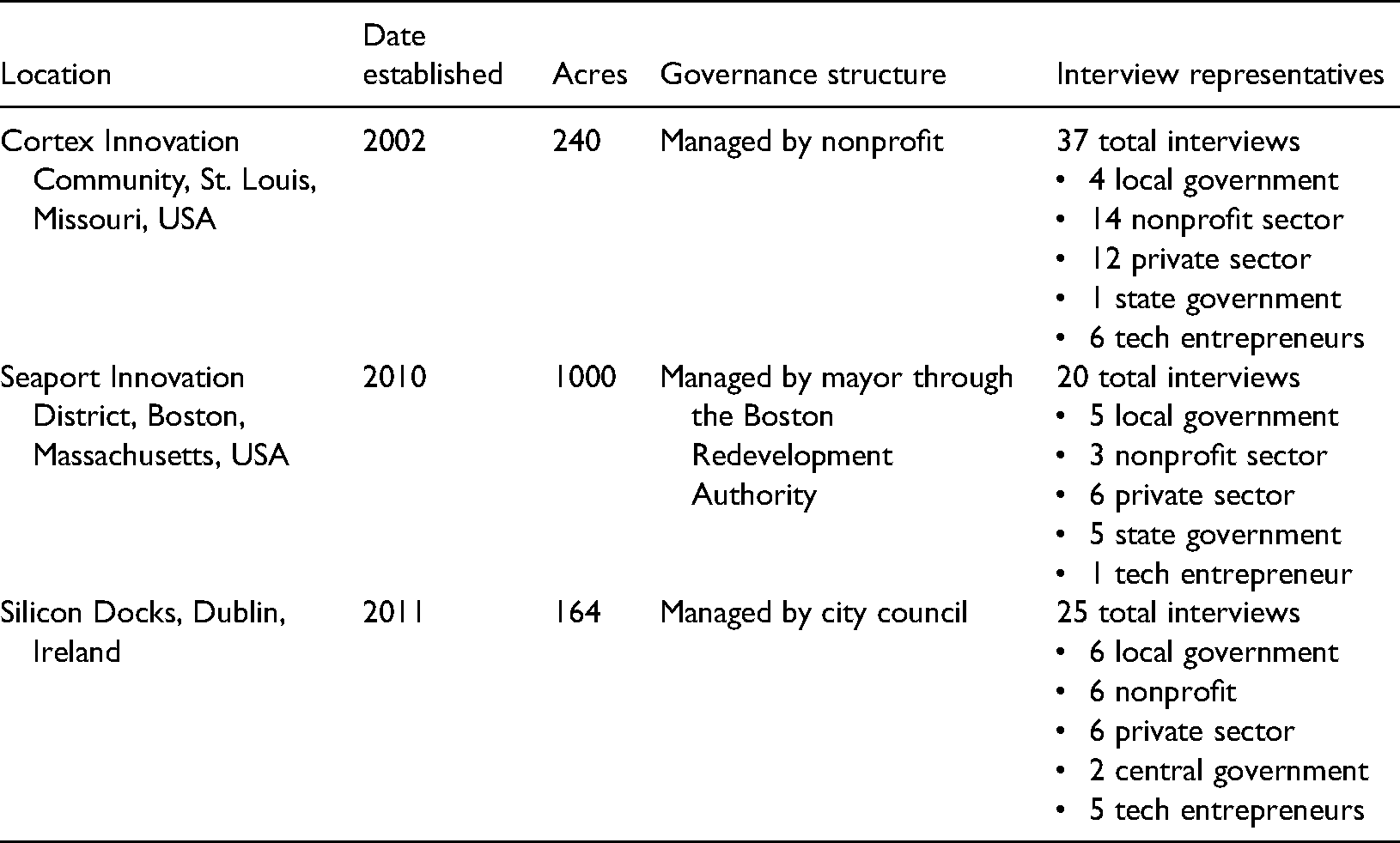
The themes of placemaking, programming, and branding consistently emerged from the content analysis and interviews. Interviews with the tech entrepreneurs using the innovation districts highlighted an excitement to work in such places, but also the negative aspects of anxiety, stress, isolation, long work hours, and the disappointment of not having the necessary venture capital and mentorship supports that would be available in Silicon Valley.
Boston Seaport Innovation district
Established in 2010, the Seaport Innovation District is the first so-called innovation district in the United States. Prior to its declaration, the state of Massachusetts and the city of Boston had allocated billions of public dollars to open the South Boston Waterfront peninsula and connect it to the airport. Growth seemed promising until the GFC froze development.
On 4 January 2010, Boston's Mayor Menino, in his inaugural address, committed to unlocking Boston's potential by converting 1000 acres of the South Boston Waterfront into an innovation district (The Honorable Thomas M. Menino Inaugural Address, 2010: p. 4). Following the public declaration, Menino insisted that the Boston Redevelopment Authority (BRA) would brand the neighborhood the Seaport Innovation District (developer, personal interview, 2016). The rebranding of the South Boston Waterfront is evident in the marketing materials that followed his announcement. The word “innovation” never appears in the 1354-paged version of the 2008 master plan directing development for the peninsula. However, following Menino's declaration in 2010, the executive summary of the rereleased master plan is rife with innovation district rhetoric.
Menino relied on his extensive political capital to finance his exploratory and experimental vision. Central to the concept of a 24-7 neighborhood was the development of District Hall and the inclusion of housing units for artists and entrepreneurs. District Hall is a US$7 m, 12,000-square-foot, free-standing public innovation center built “to foster collaboration among the young businesses and entrepreneurs” by providing a “place for them to gather, innovate, and create jobs” (Farrell, 2013). The BRA reached an agreement with Boston Global Investors to build District Hall as part of its 23-acre development and to lease it to the city for US$1 a year for five years. After five years, the city could renew its lease. District Hall serves as a space to congregate a nexus of activity while also marketing and framing the vision for the district. The design of District Hall allows it to accommodate several possible eventualities, as well as to provide a “hack aspect” feeling. Importantly, District Hall had to be attractive to millennials (government official, personal interview, 2016).
In another savvy investment, Menino secured a location for MassChallenge, a nonprofit accelerator, through negotiation with real estate mogul Joe Fallon. Fallon agreed to lend the city an unoccupied building in the South Boston Waterfront free of charge, but took the premium space back in 2013. The Fallon Company also collaborated with Menino to secure a TIF deal that provided US$12 m in real estate tax breaks to attract Vertex Pharmaceuticals to the South Boston Waterfront.
To create housing opportunities near workplaces, Menino issued new zoning ordinances for InnoHousing units. These units are much smaller (300 sq ft) than the average apartment and feature shared kitchens and communal living spaces (Casey, 2010). Skepticism over this style of living emerged: “They were designed for a start-up crowd but are actually targeting a richer demographic, perhaps one that lives in the suburbs but may want a place to stay overnight now and again” (nonprofit executive, personal interview, 2016).
Menino's vision for the Seaport Innovation District was quickly dropped once the real estate market bounced back. His initial efforts focused on smaller scale start-ups but the prime location of the innovation district and the desire of established companies such as Vertex and General Electrics, to move into the peninsula forced a shift in the strategy. The more intensive space requirements of these companies eventually squeezed out the smaller, more flexible rental needs of the tech entrepreneurs.
By the time of my interviews, parcels in the South Boston Waterfront were already claimed and built out. Developers representing well-established companies looked for new construction opportunities and large floor plans that were conducive to new construction, rather than trying to occupy smaller, multiple floor spaces (nonprofit executive, personal interview, 2016). Additionally, small start-ups in Boston were more likely to use spaces in the financial district which were newly vacant after many financial and legal companies moved to the luxurious South Boston Waterfront (personal interview, 2016). According to a real estate consultant, the majority of the office, residential, and hotels space on the Waterfront is used by traditional business tenants, high-end condos, and high-end retail, not the innovation economy (personal interview, 2016).
Today, the Innovation District (though rarely referred to as such) is an enclave for the wealthy: “the empty nesters, investors, and people who live there five months of the year” (architect, personal interview, 2016). Vacant condos that sell for an average price of US$2117 per square foot are flipped for profits of at least US$500,000 (Logan, 2016). Affordable housing is nonexistent and rents have skyrocketed (McMorrow, 2013). High-end boutiques and destination restaurants line the waterfront as luxury vehicles navigate their streets.
Cortex Innovation Community
St. Louis’ Cortex Innovation Community is a 240-acre innovation district located between St. Louis University and Washington University. The Cortex Foundation, a tax-exempt nonprofit organization set up to manage the innovation district, has succeeded at continuously updating its master plan and acquiring land to expand its boundaries (Feldt, 2018). Since the 1980s, there have been efforts to develop this space into Technopolis, a high-service technology corridor (Winter, 2006). The idea became more concrete in 2002 when representatives from five area institutions (Washington University, the University of Missouri–St. Louis, Saint Louis University, Barnes Jewish HealthCare, and the Missouri Botanical Gardens) collectively raised US$29 m toward funding the vision. However, at this point, the focus was on building a science park, rather than an innovation district.
From 2002 to 2010, Cortex was operating without a formalized staff. Essentially, Cortex was a bioresearch park housed in two buildings with the five founding partners guiding development decisions. With the recession halting development, it became clear that the strategy of attracting large firms to build within the Cortex boundary was no longer a viable solution (Cortex staff, personal interview, 2016). In 2010, Cortex undertook a national search to hire a CEO to manage operations, eventually hiring after interviewing a sizeable population, Dennis Lower was hired. “Dennis was brought on to configure a live-work-play environment as a way to attract more companies rather than just provide buildings” (CET executive, personal interview, 2016). Lower brought with him the experience of having previously built two other research communities, and he contributed his background in assembling property, putting together deals, and bringing in partnerships.
To combat the postrecession halt in development, Lower shifted Cortex's strategy to a live–work–play model by diversifying the portfolio to appeal to all technology sectors. To attract start-up companies and tech entrepreneurs, he prioritized mixed-use development to create a seamless flow between existing incubators and anchor institutions. Hank Webber, the Executive Vice Chancellor for Administration at Washington University, supported the idea explaining, “Our great hope is that our presence in this new space will lead to a major increase in start-up business activity and a more rapid movement of innovations developed by our faculty and students into the marketplace. This will fuel the region's economy and improve our overall quality of life” (Midwest Real Estate News Trends, 2013, p. 28)
To fund this idea, Lower applied for US$158 m in TIF funding to support US$2.2 b in development for a new legal entity: Cortex Innovation District (St. Louis Innovation District Tax Increment Financing (TIF) Redevelopment Plan, 2012). 1 The new plan was to overlay the 2006 boundary with a TIF in order to build connections between the proximate businesses, institutions, and cultural amenities by accessing funds for blight removal and redevelopment. Citing the lack of private development in the area, almost all of the parcels were designed as mixed-use developments to create “a true live/work/shop area that incorporates office/research, retail, hotel, and residential uses” (St. Louis Innovation District Tax Increment Financing (TIF) Redevelopment Plan, 2012: p. 13–14). The plan lists 17 objectives including establishing a new metro stop, creating new jobs, building a “common” outdoor space, and providing a distinctive brand and unifying image. This funding has since paved the way for a destination restaurant and a boutique hotel rather than the originally proposed apartment units. In 2015, Cortex developed a partnership with IKEA, the Swedish home furniture multinational corporation, and approved the development of their store within the TIF.
The decision to switch the strategies—from targeting large pharmaceutical companies to concentrating on nimbler, more flexible firms and entrepreneurs during a market downturn—is evident in campaigns created by innovation district stakeholders to attract entrepreneurs. For example, the tagline on the homepage of St. Louis’ Venture Café exemplifies the glorification of the entrepreneur and innovator: “The future of the world is at stake: You can totally be part of the team that saves society” (St. Louis Venture Cafe Homepage, n.d., italics mine). The focus here is on the “you.” 2 Entrepreneurs are conceptualized by those promoting innovation districts as outside-the-box thinkers who exhibit postrace, post-class, and postgender proclivities (Cortex Innovation Community executive, personal interview, 2016).
One critical component for marketing Cortex to entrepreneurs is the weekly Venture Café event. Every Thursday night, the Venture Café Foundation, a nonprofit organization, holds programs and lecture series targeted at entrepreneurs. Bringing over 500 people together on any given Thursday, St. Louis’ Venture Café in St. Louis brands itself as the “largest weekly event for innovators in the world” (“St. Louis Venture Cafe Homepage,” n.d.). 3
Silicon Docks
Located east of Dublin's city center in what was formerly Dublin's port, the Dublin Docklands, or “Silicon Docks,” is home to many well-known global technology firms such as Google, Facebook, and Airbnb. For decades, the Docklands were consigned to decline and dereliction. The struggle for investment and the turn to entrepreneurial urban growth led to a dependence on local authorities to oversee development (Moore, 2008). Prior to the GFC, the development on the Docklands was steadily increasing, largely as a result of Google's decision to base their European, Middle Eastern, and Asian headquarters there. This move created a path dependency for other multinationals. However, the GFC halted development leaving an array of half-constructed abandoned buildings.
The development of the North Lotts and Grand Canal Docks SDZ in 2012 marked a turning point for the Docklands. The SDZ shifted the responsibility of the Docklands to Dublin City Council (DCC) and secured fast-tracking development within its boundaries. Along with DCC, two other national organizations were pivotal in the SDZ's development: the National Asset Management Agency (NAMA) and the Industrial Development Authority (IDA) (Kayanan et al., 2018). NAMA, as the principal landowner of the developable parcels, used its position to court global capital to the Docklands (Byrne, 2016b). Emphasizing the flexibility of land use in the Docklands, NAMA's subsidiaries successfully removed planning provisions for residential development, including a 50:50 residential/commercial mix on the site (Byrne, 2016a). Once passed, planning decisions within the SDZ could not be contested so as to ensure “planning certainty” (North Lotts and Grand Canal Dock: Planning Scheme, 2014).
The IDA tailored its foreign direct investment efforts toward developing the Docklands into the “Silicon Valley of Europe.” Branding the Silicon Docks as a prime destination, the IDA worked in tandem with urban governance institutions to turn the crisis into opportunity. As a DCC member stated: The whole country was just dying with economic recession. It created a huge opportunity effort [for] the IDA to go and sell Ireland as super competitive [with] great access to talent because people are looking for new jobs, and really cheap office [space]. It was, I think one of the most competitive sites for offices. Gone from one of the most expensive to one of the most competitive in a very short period of time” (DCC, personal interview, 2016).
During the height of the recession, the IDA spent €2 m on a campaign to market Ireland as an innovation and technology hub. The IDA bought targeted messages such as, “Facebook found a space for people who think in a certain way. It's called Ireland” and “Google searched the planet for the perfect location for their business. They came up with Ireland” in a variety of European business publications and public billboards (Newenham, 2015). Expenditure of this kind led one respondent to claim, “They [entrepreneurs] were seen as really important in getting us out of the economic crisis. It was that rhetoric going on that we needed start-up hubs. In a country that had no money, there was a lot of investment in entrepreneurs and start-ups” (university representative, personal interview, 2016).
The total redevelopment of Silicon Docks was aided, in part, by smart city ambitions. New construction, rather than retrofitting of existing buildings, meant that Silicon Docks provided an ideal space for testing smart city applications. In 2018, Silicon Docks launched the Smart Docklands strategy (Smart Docklands webpage: Ecosystem, 2018). DCC selected Silicon Docks for this intervention as it was assumed the residents would accept the nuisances associated with designing a cutting-edge urban space. The overarching assumption was that the technologically literate demographic of the Silicon Docks could withstand change and disruption (DCC, personal interview, 2016). Also in 2018, Trinity College Dublin announced the development of the Grand Canal Innovation District, a multistakeholder initiative overlapping the Silicon Docks and extending its boundary further west toward the Trinity campus. This initiative was another attempt to expand the boundary and to continue catering to a specific demographic.
Case analysis and discussion
Development of the physical landscape
The cases above demonstrated development trajectories, grounded in shared logics that result in the emergence of an innovation district. The first is a belief that density and connectivity are necessary components for today's collaborative, cross-sector, high-tech, open nature of innovation (Castells, 1996; Glaeser, 2011; Knox and Taylor, 1995; Scott et al., 2001). This logic is coupled with the role of the city as the ideal environment for an innovation district, advocating for strategies that capitalize on urbanization and the demographic preferences of knowledge workers migrating into the city.
The need for density and the increasing population of knowledge workers in each city created an opening for innovation district strategies to target underutilized sites for redevelopment. As geographically based spaces, innovation districts serve as a branding mechanism to attract real estate development. Placemaking and branding collectively serve the purpose of replacing an underused “dead zone” (Doron, 2000) to render a place “safe” for investors. Further, the use of the word “innovation” invokes the image of a laboratory where the inventions to address society's ills originate. This invocation helps trigger the financial, political, and popular incentives to back these developments.
Another shared logic is the role of tech culture in permeating the urban realm through reconstructed landscapes that purposely employ design to create a seamless flow of production and make the urban fabric a generator of innovation (Stehlin, 2016). Advances in ICTs have extended the office into the public realm: advanced information communication technologies are implemented for rapid and continuous information exchanges: amenities and housing opportunities in proximity to workplaces enforce the live–work–play mentality; and placemaking principles are applied to manage (and blur) the public/private realm, creating spaces where people can comfortably extend networks and generate new insights outside of the office.
New governance model
Moving beyond physical development, the emergence of the innovation district points to new governance arrangements. Innovation district strategies build upon previous entrepreneurial models but now have an added focus on entrepreneurs themselves. Whereas much literature on entrepreneurialism and urban development has focused on the shift away from managerial governance to more locally based growth coalitions, this research illustrates the growing importance of individual entrepreneurs in realizing these growth strategies.
Innovation districts present an opportunity to regenerate blighted underperforming areas by mobilizing the imagery of entrepreneurial innovators known for being scrappy and thinking outside the box. Innovation district stakeholders position the entrepreneur as a “hero” who collaborates with other like-minded people to revitalize the economy. Entrepreneurship is positioned as a remedy for high unemployment rates, a way to exercise personal freedom, a state of mind, a mode of being in the world, and a tactic to navigate increasing precarity. In relation to urban development, entrepreneurship is seen as a type of hopeful intervention. The hero narrative evokes the idealized version of Silicon Valley and embodies the language of incentivizing risk, testing and scaling ideas, and destigmatizing failure. It also romanticizes the idea of the entrepreneur disrupting social conventions to break new ground while “saving the city.”
The concept and design of the innovation district are spatial manifestations of this form of reason. The compression of time and space (Harvey, 1989b) among knowledge workers works best through the creation of a seamless environment where individuals are encouraged to work throughout the day. Social events are provided to ensure continued interaction with the end goal of spurring innovative ideas. Public space is managed and programmed for additional spontaneous interactions. The innovation district supplies the amenities to meet the needs of the target audience—the highly educated and skilled workforce—while creating an environment that demands constant productivity. Whereas the innovation district might address the congestion associated with Silicon Valley by creating a dense environment where people live and play alongside their work environment, the strategy also extends the ethos of Silicon Valley. A quick, exploratory, innovative, start-up approach to developing products for the market may work for technology firms but runs counter to the long-term sustainability of a neighborhood and entrepreneurial workforce. In Boston, the strategy of attracting entrepreneurs aided in creating an image of public life, but these entrepreneurs could not survive the onslaught of large-scale organized capital (such as financial and legal corporations). In St. Louis, the success of ongoing development depended on state support from the TIF and corralling by the Foundation's CEO.
Innovation district strategy leads to problematic outcomes in cities with both declining and growing economies. Cities that have a robust entrepreneurial ecosystem can adopt this strategy to extend their already existing ecosystem. In Dublin and Boston, the shortage of affordable space for entrepreneurs drove the decision to refurbish dilapidated postindustrial infrastructure to accommodate small start-ups. Many of these small start-ups benefitted from proximity to an established ecosystem where venture capital and entrepreneurial mentorship were readily available. However, problems arose when larger companies wanted to relocate to the innovation district. Although the strategy was meant to support entrepreneurs, these entrepreneurs can no longer afford to live in the innovation district.
Consequently, in Boston, branding efforts using “innovation district” language have ended (Martin, 2016; McMorrow, 2012). Start-up activity is relocating to the buildings once occupied by the legal and financial firms that have moved to the Seaport Innovation District. In Dublin, start-up activity is concentrating in more affordable neighborhoods in the north and west of the city. St. Louis continues to focus on entrepreneurial activity within its innovation district; however, as a declining city, it struggles to attract investment capital. Questions remain as to whether Cortex will continue to support entrepreneurs if demand for development increases.
Conclusion
In this paper, I argue that the innovation district is a 21st-century spatial form brought about by city builders to catalyze growth at a juncture when urban development was in crisis. Although innovation districts succeed in catalyzing growth by attracting entrepreneurs to activate development, they fall short in supporting them. When large development corporations halted construction and firms refused to consider moves, mobile entrepreneurs, with their minimal real estate requirements, proved to be the best candidates to generate some form of economic activity. However, once the economy picked up, city builders refocused the urban strategy to secure more profitable rents by displacing the entrepreneurs who were once the focal point of the innovation district.
The Boston, St. Louis, and Dublin cases each represent a home-grown version of an innovation district. Stakeholders guiding the development in all three cases specified their intent to build an innovation ecosystem and used a combination of zoning regulations and public policies to encourage the innovation district to grow and assume its current form. The location of all three innovation districts prioritized emergent entrepreneurial and start-up activity (i.e. public investment in infrastructure, access to talent, proximity to a university, access to venture capital). Public and private investment branded these spaces into innovation districts. The three cases also have contextual differences. Boston and Dublin both represent strong market economies, whereas St. Louis has a weak market economy. Boston and St. Louis are US innovation districts regulated by a US territorial framework and historical context, while Dublin is a European-based innovation district and the capital of a small island economy. However, regardless of the differences, these three cases illustrate the challenges presented when city builders depend on innovation districts to jump-start renewal.
I also argue that the innovation district as a space to concentrate entrepreneurs assists in perpetuating self-governance. The success of the strategy depends on the excitement of budding entrepreneurs. Innovation district stakeholders attract entrepreneurs through an alluring narrative of entrepreneurship as free-spirited, unhinged, risk-seeking, and a benefit to society. However, the glossy portrayal of this lifestyle fails to convey the precarity assumed by the individual. The predatory innovation district model succeeds on the backs of the entrepreneurs who bear the burden of the ideology of innovation for regional wealth and internalize their role as the entrepreneurial catalytic actor.
Because this research primarily focused on the political mechanisms and stakeholder interventions used to build innovation districts, it does not highlight the perspective of tech entrepreneurs. Further research might conduct interviews, surveys, and/or focus groups with entrepreneurs to learn how they understand innovation district strategies, how they use resources in the innovation district, and if they feel supported or exploited in their efforts. Future analysis could also examine the global scope of innovation districts, the rising cost of land in innovation districts that are not build in abandoned spaces, and the waning support for entrepreneurs after real estate prices increase.
The onset of the COVID-19 pandemic also raises issues for a strategy based on density, proximity, spontaneous interactions, and the potential permanent social scarring that could prevent people from interacting with others (Florida et al., 2020). During the pandemic, St. Louis's Innovation Hall and Boston's District Hall closed their free drop-in workspaces. Programmed events moved to a digital format, with accelerators such as Boston's MassChallenge declaring it will not return to physical only programs. In March 2020, St. Louis’ Venture Café reported a significant revenue loss. A campaign drive to raise US$250,000 to finance rent, salaries, program costs, facility operations, and to prevent services from closing circulated amongst the entrepreneurial community. In Dublin, within the first few months of the pandemic, US cybersecurity firm Tenable placed a hold on development plans for a building that would create 300 new jobs and Google backed out of new development to accommodate 2000 employees. Ongoing remote working restrictions in Ireland have left visibly vacant office buildings in the Docklands. Residential units in the area have also been impacted due to the large quantity of international workers employed by Dockland-based multinational technology firms.
The long-term impact of COVID-19 could potentially be devastating for innovation districts, entrepreneurs, and the surrounding communities. Despite this, rhetoric on the benefits of innovation districts remains intact. A report issued by Brooking’s Global Institute of Innovation District champions innovation districts for being perfectly positioned to address the crisis by leveraging scientific connections to “identify solutions to the pandemic” (Wagner, 2020). Innovation districts are proposed as a way to address COVID-19 and thus remain a worthwhile investment. Undoubtedly, COVID-19 has contributed to the rapid acceleration of digital transformation and forced considerations for hybrid approaches to work. The question remains as to whether policymakers and urban developers will continue to enthusiastically push and fund innovation district strategies to brace for an incoming recession.
Whether innovation district strategy will meet wealth-generating objectives remains to be seen. However, the role innovation districts play in increasing land values and catering to wealthier demographics is evident (Zandiatashbar and Kayanan, 2020). As argued in this paper, the strategy derives profit from the livelihoods of the people who live–work–play within its boundaries. It uses them to generate an image of public life, amplified in marketing materials, to attract capital investment. In this way, innovation districts have not realized the inclusive aspirations that surrounded their inception, and, more problematically, they mirror previous place-based economic development tools that divide the city between the haves and have-nots. This raises important questions about what and who is at stake in contemporary urban development and the siting of scientific industrial activity in the city.
Footnotes
Acknowledgments
The author would like to thank Niamh Moore-Cherry, Martin Murray, the 2019 JPER Summer School organisers and workshop participants, and blind peer reviewers for their insightful comments on earlier drafts of this article. The argument presented is significantly stronger thanks to their suggestions.
Declaration of conflicting interests
The author declared no potential conflicts of interest with respect to the research, authorship, and/or publication of this article.
Funding
The author received no financial support for the research, authorship and/or publication of this article.
