




Abstract
In this article, I take the framework of neuroliberalism as an analytical lens to explore the functioning and implementation of a social impact bond-funded welfare service for young homeless people in the UK. After reflecting on the lines of connections and divergences between social impact bonds and neuroliberal logics, I draw attention to the limitations that exist in welfare interventions inspired by neuroliberal thought. On the one hand, the studied intervention functioned mainly through designing trustful, ideal-type relationships as a means to ‘fix’ people, thereby focusing on behavioural and biographical deficiencies and spreading good life ideals of a marketized world. On the other hand, I demonstrate how this focus on adjusting micro-contexts and tinkering with the affective, relational infrastructure fails to understand systemic constraints. Those were particularly evident with regard to the precarious labour market environment and colliding welfare agendas individuals were confronted with.
Introduction
This article takes the functioning and rollout of a welfare intervention for young homeless people in the UK as a starting point to think about the interrelation of social finance and the growing importance of behaviourally inspired policymaking. For some time now, voices in the academic realm have been drawing attention to a supposed behavioural turn in policymaking in many countries of the Global North and Global South (Berndt and Boeckler, 2017). Particularly in the UK, this is reflected in increasing numbers of social and public policies influenced by behavioural economics and insights from the neurosciences that seek to address the more-than-rational, affective and sentimental register of policy ‘recipients’. Indicative of this shift are, for instance, the emergence of behaviourist pro-government think tanks, ‘nudge policies’ and other concepts that initiate self-management and self-responsibilization among social service recipients and the wider population (Burd and Hallsworth, 2016). Whitehead et al. (2019: 633) have captured these dynamics under the term neuroliberalism, which refers to ‘systems of government that are primarily characterized by the mobilization of novel cognitive strategies, emotions, and precognitive affects as a way of securing preferred forms of social conduct while ostensibly supporting liberal orthodoxies of freedom’.
Focusing on the UK, in this paper I will investigate how neuroliberal logics relate to and play out in welfare services financed by social impact investing concepts. Promoted by the UK Coalition government since 2010, the key idea behind social impact investing was to draw financial market actors into the realm of the welfare system and incentivize them to fund socially oriented projects, charities or social enterprises (Rosenman, 2019). The aim was to reformulate welfare services in terms of market-based logics and financialized valuation to render them more efficient and cost effective for the public (Harvie and Ogman, 2019; Langley, 2018). For this purpose, the government established an expansive impact investing infrastructure, introduced tax incentives and invented specialized financial instruments and market-based policy instruments. An example is a social policy instrument called the social impact bond (SIB), which is celebrated for their supposed efficiency and innovativeness in the fight against poverty (Berndt and Wirth, 2018).
The empirical case studies for this article – a group of youth homelessness projects called the Fair Chance Fund Social Impact Bonds – are good examples to study these conjunctures. The first aim of this article is to critically discuss the design and promises around SIBs against the backdrop of literature on neuroliberalism, highlighting main lines of connections but also divergences. As I will argue, SIBs mostly stand in line with aggregated trends in social and public policymaking that Whitehead et al. (2017) have touted as ‘neuroliberal’. Importantly, however, SIBs also show that these aspects do not exist in isolation from other developments. Second, I demonstrate how the brokering of emotional relationships, the mobilization of affect and biographical messaging in Fair Chance projects crystallized as powerful, yet understudied aspects of neuroliberal governance that aim to ‘fix’ social and emotional contexts of people instead of addressing structural issues. Against this background, in a third argument, I shed light on the discrepancies between imagined and actual outcomes of the scheme, taking seriously the precarious labour market realities service recipients are confronted with. Rather than a straightforward journey towards stable life by means of a ‘biographical fix’, people subject to such services are more likely to be bound to what Michael Denning calls a ‘wageless life’ (2010).
Theoretically, I take inspiration from scholarly work in geography that has conceptualized the recent surge of behaviourally inspired practices and logics in social policymaking. Most useful for this paper has been an intellectual project by Mark Whitehead and colleagues who have proposed to synthesize these variegated shifts under the term neuroliberalism (Whitehead et al., 2017; see also Jones et al., 2013; Jupp et al., 2017; Pykett, 2013; Whitehead et al., 2011). In principle, the term refers to novel modes of government that increasingly draw on ‘behavioural, psychological and neurological insights to deliberately shape and govern human conduct within free societies’ (Whitehead et al., 2017: 1). Importantly, neuroliberalism does not indicate a departure from neoliberal forms of policymaking but is closely interlinked. Thus, it rather makes sense to speak of a ‘neuroliberal’ rearticulation of neoliberal forms, believes and dogmas (Whitehead et al., 2017).
This article is structured as follows. In the ‘From neoliberalism to neuroliberalism? Emerging forms of neuroliberal politics’ section, I will introduce the notion and features of neuroliberalism. Against this background, ‘The SIB and Fair Chance Fund projects’ section examines the extent to which SIBs in general and the Fair Chance Fund SIBs in particular can be considered as ‘neuroliberal’. The ‘Designing affective relationships: biographical messaging and simulating the good life’ section critically discusses the role of compassionate relationship brokering and the mobilization of affect in Fair Chance. The ‘Ongoing crises, exhausted futures’ section, in turn, sheds light on constraints with regard to the labour market realities for the participants. Finally, ‘Conclusion’ summarizes my arguments.
I draw on empirical material derived from fieldwork in three Fair Chance Fund projects. Between 2016 and 2017, I conducted 38 interviews with charity staff, charity management, service recipients, impact investors and council representatives. Additionally, I took part in participant observation during diverse employability and lifestyle workshops, advisory appointments, house visits and so on that charities conducted with Fair Chance participants.
From neoliberalism to neuroliberalism? Emerging forms of neuroliberal politics
At the heart of neuroliberal thought stands a critical engagement with and reformulation of the homo economicus as the central figure of neoclassical theory (Primrose, 2017). While for a long time the fully rational, utility maximizing decision maker served as a legitimate model for human behaviour in mainstream economic theory, emerging behavioural sciences and behavioural economics in the 1950s and 1970s pushed for a revision of this model. Rejecting the ideal of the homo economicus, behavioural economists theorized human behaviour under the aspect of what they called ‘bounded rationality’ (Simon, 1957). In this view, human behaviour is much more characterized by ‘limited intellectual capacities within restricted time-frames while concrete circumstances influence the outcome in ways that are not necessarily accessible’ (Graf, 2019: 24). As suggested by the psychologists Tversky and Kahneman (1974), in this new understanding, people's constrained decision-making processes are subject to a range of ‘heuristics and biases’, that is, often intentional, irrational strategies deployed by people that do not stand in line with standard economic theory. Importantly, however, the figure of the homo economicus was not completely abolished by behavioural economists but continued to serve as a normative yardstick of what people should do (Primrose, 2017). The propagation of behaviour change tools such as ‘nudges’ directly speaks to this fact (Thaler and Sunstein, 2008). Starting from the conviction that human behaviour is flawed due to inner constraints (behavioural economists) and poorly designed environments (cognitive designers), behavioural economics hold that it is through the deliberate construction of corrective choice architectures that people could be subtly ‘nudged’ towards a behaviour that is supposed to be beneficial, that is, utility maximizing, fully rational and so on (Whitehead et al., 2017). Nevertheless, neuroliberalism reflects a ‘desire to move beyond the decontextualized actions of a universalized homo economicus’ and ‘draws attention to the difference that context makes to human action’ (Whitehead et al., 2017: 20).
While for a long time such novel conceptualizations in the behavioural sciences had not much traction outside academia, it seems that with advancing neoliberalization, ‘knowledge of the heuristics and biases of individuals became increasingly important’ for governments (Graf, 2019: 32). Graf notes that after the ‘Keynesian conception of planning had seemingly failed in the 1970s and neoliberal marketization became dominant in the 1980s, behavioural economists now offered a means to increase the state's capacity to regulate and intervene in the economy again’ (Graf, 2019: 33). Looking at recent developments, it appears that these trends have now come to fruition. Today, the political mainstreaming of these ideas has become manifest in new state structures and organizations propelling behaviourally inspired thought and implementing methodological practices of behavioural sciences. In the UK, institutions such as the so-called Behavioural Insights Team, NESTA (National Endowment for Science Technology and the Arts) or the What Works Network – all of which entertain close linkages to the UK government – have become the main hubs for disseminating, promoting and experimenting with behaviour change ideas.
Shifting conceptualizations of human behaviour in mainstream economic theory – the departure from homo economicus in favour of a ‘rationally bounded’ figure – and the political institutionalization of behavioural thought within many states has led to a range of important changes in state practices. A first instance where this can be observed concerns the increasing application of methodological practices of behavioural sciences and experimental economics in social policy design. While neoliberal states in whatever guise have been engaging in ‘trial-and-error’ experimentation and policy experiments for a long time (Peck and Theodore, 2012), experimental attitudes in the context of neuroliberalism have taken a much more formalized and concrete shape. This can be seen, for instance, in the great emphasis that has been placed on policy exploration and the quest for finding and trialling innovative and counter-intuitive intervention models (Whitehead et al., 2017). Connected, this experimental attitude is reflected in the way how policymakers in the Global North and Global South appear to be increasingly attracted to evidence-based social policy designs (Strassheim et al., 2015). Another case in point is the rigorous evaluation of social and public policy interventions, often by means of statistical approaches. Social policy interventions worldwide are increasingly evaluated on the basis of randomized controlled trials (RCTs) or similar evaluative/experimental settings as will be shown in the case of SIBs. In RCTs, the effectiveness of a social policy intervention would be compared between an intervention group (receiving a ‘treatment’) and a control group in order to draw supposedly evidence-based lessons about whether an intervention should be further adopted or rejected (Banerjee and Duflo, 2011). This experimental stance reflects a ‘desire to ground neuroliberalism on a sound evidence base and to characterize associated forms of policy as less a psychological state and more a pragmatic, what works style of government’ (Whitehead et al., 2017: 26). Thus, at least in the Global North, neuroliberal statecraft has proven to be particularly appealing for low-cost and austerity-oriented governments that seem to be less interested in the content of a suggested policy but in its practicality and supposed effectiveness.
A second aspect of neuroliberal forms of government refers to the changing relationship between the state and its subjects. Neuroliberal modes of government are often characterized by experimental and behaviourist microinterventions that seem to directly address and shape individual behaviours and minds (Berndt and Boeckler, 2017). Hence, unlike large-scale economic and social policy interventions in traditional rollout neoliberalism fashion (e.g. activating labour market policies, welfare-to-work schemes) that address aggregate populations, interventions along neuroliberal lines are much more personalized and individualized (Whitehead et al., 2017: 60). The focus lies on the ‘micro-contexts of life’, the more-than-rational and more-than-conscious: proximate social context, physical infrastructure as well as ‘structures of feeling’ become the entry point and target of neuroliberal policy interventions that aim to change behaviours of people (Whitehead et al., 2019). The most famous behavioural policy tool in that regard is the aforementioned ‘nudge’. Not like neoclassical behaviour change devices such as economic incentives that have the rational, utility maximizing homo economicus as underlying figure in mind, nudges are more subtle incentive structures that aim to break non-rational habits. Equally important but less discussed in the literature is the mobilization of affect and emotions as ways to shape conduct (Pykett et al., 2017). In sum, on the basis of those past and recent behavioural insights, neuroliberal governmentality can be summarized as mode of governing that addresses the ‘more-than-rational registers of human action (including habits, heuristics, emotions, affects, and social and environmental contexts)’ (Whitehead et al., 2019: 633). As I will demonstrate in the next sections, the design of SIBs and its concrete implementation in the Fair Chance Fund projects are reminiscent of these aspects.
The SIB and Fair Chance Fund projects
SIBs are market-driven tools and social policy instruments promoted by the UK government since 2010 to reorganize social service delivery and supposedly make it more efficient and entrepreneurial (Berndt and Wirth, 2018). They have become popular in the context of social impact investing: emerging investment practices particularly propelled by successive UK and US governments that envision a ‘new, ‘moral’ financial system where investor dollars fund socio-environmental repair while simultaneously generating financial returns’ (Cohen and Rosenman, 2020: 1259). In principle, an SIB is designed around a payment-by-results mechanism, usually commissioned by a public-sector body that pays for outcomes achieved in the context of a particular welfare intervention. It is based on the idea that impact investors provide upfront funding for a service provider (e.g. a charity) to deliver a service/intervention to a cohort of people in need. If, and only if, the service provider meets predefined, measurable outcome targets, investors would be refunded by the commissioning government agency along with performance-based interest rates. If this was not the case, investors would lose their investment (Rangan and Chase, 2015).
At first sight, the SIB instrument seems to be emblematic for austerity-style government and a mix of roll-back (cuts to services and budget, state downsizing, privatization, etc.) and roll-out (experimental, market-led re-regulation) phases of neoliberalism (Peck and Tickell, 2002). For instance, the SIB's payment-by-results mechanism obliges commissioning government agencies only to pay in case of success of a social service intervention and, in doing so, shifts monetary risks on to investors, which become more influential in matters of welfare provisioning. The financial markets, therefore, are increasingly established as new funders and managers of a welfare system that has gone through several rounds of downsizing and cutbacks in the context of austerity (Harvie and Ogman, 2019). On the grounds of financial market expertise and rigorous performance management, the argument goes, social organisation could tackle social problems much more effectively (Harvie and Ogman, 2019). In addition, the emphasis on monetized outcome metrics and performance management is reminiscent of widespread New Public Management strategies as governing technologies to shape organizational behaviour at a distance (Shore, 2008; Warner, 2013). Following from this, SIBs allow governments to govern through audit and benchmarking, dictating the direction and focus of welfare service interventions in terms of who is going to be addressed by what kind of measures.
However, a closer look at mainstream discourses, designs and implementations of SIBs complicates this picture. While still being closely entangled with neoliberal logics, many aspects hint at the extent to which the concept of social finance and especially SIBs are shot through with but also propel neuroliberal ideas and practices. For instance, this concerns the ways in which SIBs take up some of the methodological practices of behavioural sciences outlined above. Especially in their early days, SIBs were celebrated as explorative social policy instruments to bring about or test innovative and disruptive intervention models to tackle social issues more effectively (Berndt and Wirth, 2018). Praising their entrepreneurial and venture-capitalist spirit, SIBs were depicted as ‘experimental playgrounds’ where creative social enterprises could freely experiment with innovative interventions while not being affected by governmental prescription (Berndt and Wirth, 2018, see also Broom, 2021). At the same time, some SIB-funded projects have become outlets for the latest social policy fads, serving as vehicles for ‘in-vivo’ experiments to further test and expand the evidence base of already existing interventions or therapies (Broom, 2021, see also Muniesa and Callon, 2007). Often these types of ‘therapies’ stand in the tradition of the behaviourist agenda. An example is an intervention called the Adolescent Behavioural Learning Experience, a programme based on cognitive behavioural therapy that was implemented in an anti-recidivism SIB in the USA, or Multi-Dimensional Treatment Foster Care in a SIB project in Manchester addressing anti-social behaviour (Berndt and Wirth, 2018).
On the other side of the coin, a great emphasis lies on the measuring and evaluation of interventions conducted in social impact investing and SIB frameworks in particular. In general, SIBs always come with sophisticated measurement and evaluation infrastructures to produce evidence about the effectiveness of a service intervention and, in extension, the performance of involved service providers. Early SIBs, such as the Peterborough pilot projects or SIBs commissioned by the Department for Work and Pensions were often evaluated on the basis of RCTs or similar arrangements such as the Propensity Score Matching method (Berndt and Wirth, 2018). In these cases, charities would provide services to a defined cohort of service recipients (e.g. recently released ex-prisoners) over a fixed period of time – the intervention group. At the end of the project, the performance of that intervention group would be compared with a control group, that is, a group of people that did not receive a service. If the performance of the intervention group compared to the control group was significantly better and hit a predefined benchmark (e.g. a significant reduction of reconviction events), investors would get refunded and receive performance-based interest rates. While this focus on measuring and evaluation can be attributed to the ideals of a ‘post-ideological’, experimentalist government (Strassheim et al., 2015), it is important to note that particularly the financial markets, that is impact investors, are pushing for such rigorous evaluation methods to assess the impact of their investments (Rangan and Chase, 2015).
In a similar vein, the SIB-funded Fair Chance projects, serving as a case study for this article, revealed some of the characteristics associated with neuroliberalism. Initiated by the Department for Communities and Local Government (DCLG) in 2014, the Fair Chance Fund was a 3-year project launched in response to increasing numbers of young homeless people in British cities as well as an alleged support gap for this group of people (DCLG, 2014). The £15m worth Fair Chance Fund paid the outcomes of seven SIB-funded projects that were granted to seven English charities after an open bidding process. The schemes operated between January 2015 and December 2017 and aimed at bringing cohorts of 18–24-year-old unemployed and homeless individuals into accommodation, employment, education and/or training arrangements. All seven projects were evaluated on the basis of a valuation design that comprised 21 individual outcome targets that could be achieved by young people 1 participating individually. For each outcome target, the DCLG assigned a price that was to be paid to the investors of the SIBs in case participants achieved them and after the service provider proved this via specified evidence material (DCLG, 2014). Table 1 presents outcome metrics and assigned prices as stipulated by the DCLG.
Outcome metrics and corresponding tariffs for Fair Chance projects (DCLG, 2014).
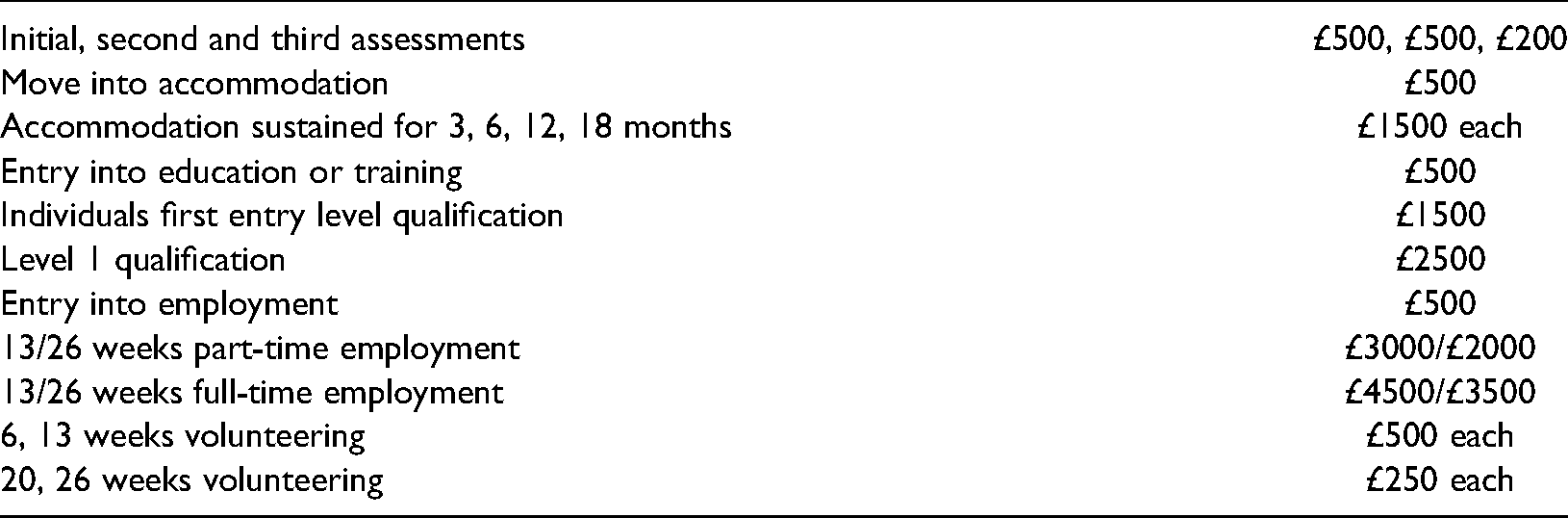
If, for instance, a young person started working full time (defined as working at least 16 h a week) and sustained employment for over 26 weeks in total over the course of the project (cumulatively), investors received a total amount of £8500 from the DCLG: entry into Employment (£500) plus 13 weeks full-time employment (£4500) plus 26 weeks full-time employment (£3500).
This evaluation design is typical for more recent SIB projects that seem to have replaced RCT-based evaluation designs for individualized outcome metric systems. There are two reasons for this. First, in Fair Chance this type of evaluation design was implemented by its designers as a way to de-risk the programme and make it more attractive for financial investors (Wirth, 2020). Contrary to RCT-based designs, where cash flows were only triggered after the projects final evaluation, in this type of arrangement investors were continuously receiving outcome payments upon outcome achievements. This, in turn, required lower investment volumes at the beginning of the projects, making the SIB ‘cheaper’ and less risky, and allowed investors to recycle the capital (interview with investor, d30). Second, and in line with neuroliberal thought, individualized outcome metrics were introduced by Fair Chance programme designers in order to incentivize a certain working style. As an interviewee noted, individual ‘milestone metrics’ were meant to nudge charities to work much more personalized, allowing them ‘to be flexible, shape interventions for individuals’ (interview with person from Fair Chance design team).
This focus on individualization and personalization also ties in with the intervention model in Fair Chance. Building on the London Homelessness SIB, the so-called navigator model was further expanded and tested (DCLG, 2017). Instead of a Housing First strategy (as this is common in homelessness services, see Hennigan, 2017), the model suggests that intense personalized wrap-around support provided by a ‘navigator’ should be prioritized before placing service recipients in permanent housing (Andreu, 2018). The idea was that such a case worker would first deal with ‘soft’ issues, such as mental health, drug abuse, general well-being and budgeting, for instance. Alongside specialized staff (addiction workers, employability coaches, mental health counsellors), navigators were assigned to each participant, providing intense, personalized interventions and sustained support. Hence, they would not only deal with administering ‘hard’ outcomes but, above all, be responsible for trouble-shooting personal problems as they arose in daily life: navigators would ‘offer a single point of contact to guide the participant through the project and provide intensive support, on a flexible basis’ (DCLG, 2017: 18). In addition to this, navigators could make use of the so-called personalization budget – an amount of money reserved for each individual that could be flexibly and unbureaucratically utilized for their personal expenses (e.g. bus tickets, interview or work clothes, fees for dentist's appointments).
Interestingly, the navigator model was first established in the 1990s as evidence-based ‘patient navigator programs’ in the context of cancer and HIV treatment to foster healthier behaviours among racial and ethnic minorities in the USA (Vargas and Cunningham, 2006). A similar model was then for the first time tested as the ‘innovation in practice’ in homelessness services in an SIB in London (Cooper et al., 2016: 70). In a preparatory document for the London SIB-project published by the Young Foundation, homelessness is merely portrayed as a matter of ‘personal problems’. In those authors’ view, the reason for being homeless was seen as a mixture of wrong attitudes and deficient behaviours that would ‘negatively impact on their ability to function effectively in mainstream social and economic life’ (The Young Foundation, 2011: 42). In response, the navigators would offer ‘compassionate, patient-centred’ and trustful care environments in order to ‘discover what problems need to be overcome to achieve behavioural change’ (The Young Foundation, 2011: 42, 64).
In sum, the navigator model is a good example of how ‘the site of policy intervention [has shifted] from the institutional setting (market) to the individual human being (market subject)’ (Berndt and Boeckler, 2017: 296). What is more, the last quote is already a hint at the extent to which the mobilization of passionate relationships and affect might be a relevant but understudied element of neuroliberal governance. In the next section, I will turn to this facet by presenting empirical material from my case study that shows how the navigator model translated from theory into practice.
Designing affective relationships: biographical messaging and simulating the good life
The navigator model laid the groundwork for trustful and emotionalized relationships between support workers and recipients in the studied Fair Chance projects. Only in doing so, it was argued, would service participants keep engaging with the service providers and achieve outcome targets. In the course of the projects, participants became entangled in relationships which at the same time had to be productive (from a financial viewpoint) and caring, therapeutic, motivating, engaging and so on (from a service perspective). In other words, interventions were not based on coercive, disciplining measures but entailed subtle practices of producing (emotional) attachments to achieve the monetized targets (Wirth, 2020). In this section, I will elaborate on the nature of such relationships between support workers and service recipients, arguing that neuroliberalism goes beyond exploiting the unconscious bias via nudging techniques and other corrective choice architectures. While such elements were observable (Wirth, 2020), I want to draw attention to the ways in which relationship design, the mobilization of affect and forms of biographical messaging might be part of a neuroliberal repertoire. This section provides different snapshots of selected stereotypical support worker–participant relationships and highlights the emotional and affective work that attempts to ‘fix’ people.
First of all, a great emphasis in the projects lied on relationship management: optimal ‘matches’ between case workers and young people had to be found. Given the centrality of navigators, it was commonly assumed that only relationships with two characters that chimed well together would guarantee that participants kept engaging with the charity. Yet, finding two matching characters was not easy and required some sort of trial-and-error experimentations. Due to the flexible and deregulated nature of the scheme, staff members used to reassign participants to other navigators – they would ‘swap people around’ or ‘pass them around’ (interview support worker d2) as some staff member put it: ‘If you feel like maybe it's not really working, the relationship, or […] they don't turn up to my appointments, […] they might engage with somebody else’ (Wirth, 2020).
Not surprisingly, recombining pairs of case workers and participants to have ‘matching characters’ was also a question of what kind of people were involved. In other words, personalities, characters, subjectivities of involved staff members mattered in particular. A team manager commented, for instance, that ‘we’ve got […] different personalities within the team and we match clients with a mentor who we think would work best so that personalities don't clash’ (interview support worker b3). Only in doing so, he continued, would participants disengage less and ‘continue coming in and achieving the KPIs’ (Wirth, 2020). Hence, trying out different combinations became, in many cases, a reliable strategy to ensure that there was a ‘buy-in’ (interview support worker b1), that is, that the young people felt more comfortable, opened up, turned up to appointments and continued achieving outcome targets.
This experimental adjusting, optimising and ‘swapping around’, then, paved the way for more meaningful, trustful relationships to build up over time. Interestingly, case workers often seemed to enact ideal character types in their interactions with the young people on the scheme. Three examples were particularly insightful in that regard: the ‘mother’ figure or ‘surrogate mom’, the ‘swaggerer’ and the ‘bro’. Particularly, the figure of the ‘mother’ was a personality or role model that seemed to have a lot of traction and appeared in different variations as a reference point to describe relationships. For instance, a female support worker close to her retirement explained that she would, more or less intentionally, draw on her physical appearance as a more ‘mature lady’ while working with the young people. When being in a public space with a service recipient, she reported,
[…] people look and think I am their mom […]. It's not crossing the professional boundaries but it is treating them almost like that mother figure, because some of them have not had good family backgrounds […]. They know I am not their mom but they respond in a way to that. (interview support worker 20)
Therefore, performing the role of a mother, she continued, would be very beneficial for some of the young people she supported in this project: ‘I have sometimes a different approach and, as I say, if working with somebody who's more… who's older and looks like a mom, you know, […] if it works, let's capitalise on it’ (Wirth, 2020). In a similar way, notions such as ‘mothering’ and ‘surrogate mom’ were used by both staff members and service recipients to illustrate and make sense of the relationship with service recipients (field notes). An interviewed Fair Chance participant, for example, stressed that the fact that she could swear and talk roughly to her assigned support worker, or that she often came to see her for a chat in her apartment almost gave her the impression that she was her ‘second mum’ (interview young person b8). Interestingly, less common was the notion ‘fathering’ when it involved male support workers. Overall, in these examples, the ‘family’ or ‘family values’ served as a point of reference and underlying stereotypical rationale for relationship building (i.e. care, patience, unconditionality, familial reciprocity), fuelled by assumptions about a dysfunctional past and interested in restoring, to some extent, the missed familial space.
Other examples, in turn, were characterized more by material factors, involved particular types of masculinities and were powered by good life promises. For instance, the ‘swaggerer’ represented an ideal-typical (middle-class) male role model who subtly played on the (mainly male) participants’ 2 desires for leisurely consumption and wealth by displaying a certain coolness, lifestyle and upper middle-class status symbols. This became obvious in one example where I discussed with a team leader the role different personalities played in making the young people more committed and engaged in the service.
She takes the example of [Jacob] and states that he embodies this ideal, bigger brother, role model type of guy that would positively influence the young people. He comes across a bit swagger, visits the clients with his BMW. “That's all what they see in TV, that's what they aspire to…” (field notes, 14.12.2017)
For Jacob, the support worker referred to in this example, it was apparently a crucial aspect in his work with young people to capitalize on his subjectivity as a successful middle-class man, to some extent showing that you can ‘be somewhat’, ‘you can achieve something’, as he put it (field notes). In other words, the idea was to conjure up ideals of self-actualization, hope as well as a sense of aspiration: ‘They find it very hard, don't want to pay taxes, don't agree with certain things about resources and capitalism […]. But sometimes you have to remind them: there are some things in our control, […] there's some things that is not in your control […]. Let's just focus on the bits we can control or manage, which is you’ (interview support worker d3). In this example, it is also the communication of good life fantasies (upward mobility, prosperity, security, self-actualization) that characterize the way Jacob relates to Fair Chance participants.
A third example that I found insightful in that regard was the ‘older-brother’ type of role model. That is, a well-balanced subjectivity of fun orientation, coolness and consumerism, on the one hand, and self-restraint, control and empathy, on the other. During my fieldwork, I accompanied a young support worker in his late 30s for a few days on his visits to service participants. He explained to me that for him, the most important thing was to remain authentic and not to draw a line between being professional and private. Being very approachable, behaving, dressing and chatting as casual as possible was his personal signature in the way he engaged the young people he was supporting. As observed during a house visit in a participant's apartment, for instance, he would engage with the service recipient in a playful banter about cannabis consumption and hip-hop music, giving fist-bumps as a symbol of camaraderie to find common grounds and adjusting to the young person's habitus and language. On the other side, however, he kept on highlighting the importance of finding work, having proper working ethics and point to the negative effects of excessive cannabis consumption (field notes). With a side glance on pending outcome targets, he tried to persuade the person to attend a particular education course the charity was offering, commented on the hygienic situation in the apartment or dealt with phone calls from Jobcentre Plus to avoid that benefit payments were stopped (field notes).
A majority of service recipients felt that this closeness and trust was exactly what they needed from a support service. One young woman, for instance, was very content with the fact that she could drop in almost any time she wanted to and thus imagined the place as ‘being my own little escape, like away from everything. This is just like the one place that I can come to and I know it's all mine’ (interview young person d7). For her, the relationship she had with staff members gave her a feeling of unconditionality and patience, and helped her open up: ‘I can just come in and talk to them. I can tell them anything […]. So, it's just nice having someone else that I can talk to, other than my family, about stuff’ (Wirth, 2020). Another young male participant stressed that it was the empathy and care that helped him working towards his personal targets: ‘Fair Chance have motivated me and I have a dream of being an actor. I might not be famous, I might not be wealthy, I might not do anything good in my life, but I will achieve my goals’ (interview young person c11). And there were a lot of others who expressed that they gained a lot of confidence and self-esteem thanks to this closeness. Hence, contrary to a mechanistic critique, these episodes also point to the extent to which the service could be imagined as a temporary ‘escape away’ and a safe space, or a particular support worker as a temporary ‘friend’, ‘brother’ or ‘surrogate’ mom that organized the present and made an insecure and precarious life more endurable.
Overall, however, I conceive of these intimate, affect-based practices as being exemplary for a ‘neuroliberal’ rearticulation of a neoliberal project. Relationship design became a (neuroliberal) experimental technique on the basis of which personalized caring, ‘therapeutic’ relationships could build up that were to temporarily replace allegedly deficient relationships (characterized by a lack of emotionality, care, ambition). These relationships were often of ideal-typical nature, aiming to ‘fix’ troubled biographies, playing on the ideals and fantasies of a marketized world (e.g. status symbols, upward mobility, job security, etc.) and mobilizing affect and emotionality. Since neuroliberalism recognizes that ‘behaviours are shaped to a significant extent by the affective push of the world’, the presented relationship design is an example for how neuroliberalism intervenes via the ‘structures of feeling’ and the tinkering of social context in a more radical and embodied way (Whitehead et al., 2017: 20). It is important to note, however, that the adopted ideal type roles of the support workers were not prescribed by the policy scheme. Rather, these enactments seemed to emerge from below as adaptive features provoked by the neuroliberal hardware and software of a scheme that was characterized by a mix of a strong focus on monetized outcomes, financial scrutiny and pressure, performance management, and a navigator model that allowed a large degree of flexibility and freedom.
Ongoing crises, exhausted futures
In opposition to neoliberal conceptions, neuroliberalism recognizes immediate infrastructural environment, social context and, to some extent, biographical backgrounds of individuals as functions of their behaviour (Berndt and Wirth, 2019). However, critics note that such a focus still runs the risk of decontextualizing human behaviour with regards to class, race, geography and other lines (Carter, 2015). In the case of young homeless people and working-class populations in the UK more generally, re-contextualization and de-contextualization often go hand in hand with widespread stigmatizing discourses, for instance, about family and friends (as dysfunctional, welfare dependent, etc., see Slater, 2012) and local neighbourhoods and towns (as ‘shitholes’, see Butler et al., 2018). Similarly, neuroliberalism's emphasis on the most proximate spatio-temporal determinants, as Whitehead et al. (2019: 641–642) argue, tends to side-line meso- and macro-levels of spatial and temporal contexts as drivers for human behaviour. For example, this refers to the ways in which ‘intergenerational and lifespan contexts’, historical place formations or ‘institutional spatial practices’ are particularly relevant in shaping behavioural patterns and orientations. In the remainder, I will present three interconnected dimensions of such macro-level contextual constraints that speak to the specific geography of the sites of Fair Chance projects: the problem of decent job availability, incompatible workplace cultures and working conditions and disincentivizing welfare regulations.
Although the Fair Chance scheme was celebrated as a success story, only few participants managed a sustainable transition and stabilized their lives, found employment and sustained housing during the 3-year project. Statistical data disclosed in DCLG reports reveal that 33% of all participants (n = 1910) entered an employment arrangement (full time or part time), but that ‘only’ 13% sustained full-time employment for 26 weeks or more (DCLG, 2019: 45). This is not to belittle the charities’ performances and achievements. Yet it points to the fact that many Fair Chance participants returned to or remained stuck in a precarious cycle of low-paid temporary jobs, homelessness shelters and charitable organizations, continuing a ‘wageless life’ (Denning, 2010) with few prospects to escape insecurities and contingencies that characterized their conditions before Fair Chance.
A point that needs consideration is the fact that Fair Chance projects mainly operated in regions of the UK, such as the North of England, 3 that have been subject to macro-economic restructuring processes for many decades. Deindustrialization processes seemed to still have a strong grip on working-class communities. Fair Chance participants, as one interviewee explained, were often the children or grandchildren of workers who were laid off in the course of economic restructuring and were not able to continue working on these traditional working-class jobs: ‘The jobs are no longer here that, historically, these young people's grandparents would have done: mining, textiles, and engineering. […] The traditional industries have gone and not an awful lot seems to be coming in’ (interview support worker d20). Similarly, other interviewees were concerned not so much with the availability of housing but with the lack of reasonably paid jobs and manufacturing employment. Participants were often excluded from the remaining jobs in high-productivity manufacturing due to a lack of skills and education (interview support worker c8).
This lack of traditional jobs was even felt more acutely in more marginalized places such as peripheral urban areas, deprived towns and coastal areas. Particularly in those places, Fair Chance service providers struggled to meet employment outcome targets since for participants, options were often restricted to the few low-paid service sector jobs and customer-facing jobs in the tourist industry (interview support worker f10). But in larger cities similar problems existed because service recipients often lacked appropriate skills, experience and qualifications for jobs in technical, high-productivity manufacturing and well-paid service work (interview support worker c8). Thus, the Fair Chance project was often considered as being not very sensitive in terms of its imagined underlying geographies and sociospatial inequalities (interview support worker f9).
For this reason, participants often had no other choice than looking for work in the low-paid service economy. Many of those who found employment started working in retail, hospitality, call centres, construction, cleaning, warehouses or social care and were employed under precarious conditions (DCLG, 2019). While this was not per se a bad thing, employment in these sectors came with particular downsides.
First, it was often the nature of service sector employment – or workplace cultures – that posed problems for Fair Chance participants. As demonstrated by Linda McDowell's work on young working-class men in the UK, service sector jobs are typical for their interactive and embodied elements: they involve the co-presence of service provider and clients, include bodily attributes as part of the service and, ‘especially at the bottom end, demand care, deference and docility as key attributes of a desirable workplace identity’ (McDowell, 2003: 3). As she demonstrated, it is often those ‘feminised’ qualities of jobs that are a challenge for the imagined masculinity of young working-class men, at the same time as these ‘versions of a street-based, swaggering working class masculinity […] are seldom seen as a positive attribute for employment by putative employers’ (McDowell, 2014: 36).
In a similar vein, Fair Chance participants (male and female) struggled with some of the workplace expectations of the type of jobs they went for. A main issue revolved around the question of presentability and clothing in order to live up to the aesthetical requirements demanded by employers. For this, recipients were often equipped with presentable interview clothing and appropriate work outfits to increase their chances of applying for jobs, or they were appointed to doctors or dentists before job interviews (interview support worker b2, d15, b1). Once on the job, however, participants often struggled with attitudes, punctuality and servility required in service economy jobs. As stressed by support workers, many of them ended up having arguments at work with supervisors or co-workers, giving up work after a few days: ‘A lot of the client groups seem to sort of start work and then, within a couple of days, […] they’ll have a slight disagreement with the manager, or the manager may say something which upsets them. ‘That's it, I’m leaving’. They can't see the bigger picture sometimes’ (interview support worker b2). In turn, support workers complained that employers would often not give much leeway to this people, quickly replacing them after minor misbehaviours and mistakes (interview support worker c8). The young people thus faced a lot of insecurity and considerable competition for these casualized jobs, especially since their class, their ‘laddish’ behaviour, their accents ‘are seen by employers as a challenge to the attributes required in a service economy’ (McDowell, 2012: 581).
A second, widespread issue in service economy jobs is the predominance of zero-hour or casual contracts. Typical to labour market flexibilization and the gig economy (Theodore and Peck, 2014), in zero-hour or casual contract arrangements employers are not legally obliged to grant employees minimum working hours. In turn, working hours and salaries are subject to constant fluctuation under this regime. At first glance, zero-hour contracts jobs were interesting for service recipients and service providers. For instance, staff considered them as a relatively easy opportunity for young people to gain first-hand job experiences. Also, the ways that outcome metrics were set up would even invite/incentivize service providers to bring participants into short-term work arrangements. Yet, for many other reasons, zero-hour contracts were considered as problematic. Interviewees raised concerns that incomes would fluctuate too much and would often not be sufficient for participants to live in apartments on their own. An interviewee noted that ‘people who have sustained work is people who have worked for agencies, who are still living at home’ (interview support worker f10). Therefore, participants who sustained employment on zero-hour contracts were often those who were able to move from the streets back to their families and could count on the social reproductive work of family members.
In contrast, for participants living independently and receiving housing benefit payments, taking on zero-hour contract jobs would negatively impact on those payments. Since payments were stopped once recipients worked more than a given number of hours, it turned out to be problematic when suddenly employers changed schedules and decided to reduce working hours. Often, this resulted in rent arrears, as one support worker explained:
Some young people really want to work but it's just not manageable. Because they couldn't afford to keep the property on a zero-hour contract. […] [T]hen the hours aren't coming in, then they’ve lost their housing benefits, they’ve lost their accommodation, and just going round in that circle. (interview support worker f10)
Against this background, it is also clear why for many Fair Chance participants it made more sense to remain unemployed or to work only few hours in order not to lose benefit payments, trying to avoid the contingencies and insecurities that an employment implied for them. However, this decision would also be associated with stigma, as an interviewee explained:
I have a girl and she's working […] six hours a week. She wants to do more but she will only get six hours […]. So, she says to me, it's better for me not to go to work, but she doesn't want that lifestyle. But she knows that, otherwise, she's gonna get herself into rent arrear, lose the house. So, she's kind of stuck. (interview support worker c3)
From this point of view, then, the choice to remain on benefit payments has nothing to do with an alleged welfare dependency culture or lifestyle, as the stigmatising discourse on the deserving and undeserving poor holds (Slater, 2012). Rather, this ‘cycling the population into and out of institutionalised spaces’ (Baker et al., 2019: 16), from social housing back to sofa-surfing or sleeping rough, was not only caused by precarious job arrangements but also contradictory incentives that kept people in this loop.
For staff members, this proved to be a dilemma. On the one hand, they were required to maximize outcome targets in order to keep the charity's performance at a high level and the project financially afloat. On the other hand, they were aware of the difficulties and contradictions and thus found it ‘kind of hard to say to someone: go to work and be worse off’ (interview support worker c3). Therefore, staff sometimes recommended to service recipients not to apply for zero-hour contract jobs (interview support worker c8), or they advised service recipients who were on Employment and Support Allowance to only work part-time to remain eligible for benefit payments (DCLG, 2019: 49).
In the light of this, charity staff were under no illusions with regard to the life prospects of participants. In contrast to the optimism sparked by Fair Chance promoters, impact investors and the DCLG, many suggested that data on the projects would not reflect reality: ‘A lot of them are found after 12, 18 months things are going really badly wrong. Yeah, we’ve got the outcomes and it looks good on paper […], they got a job and it looks great on paper, but in reality, that's not what's happening’ (interview support worker d2). Some others expressed their frustration with the fact that many participants ‘have been users of services for a very long time and the reality is that they’ll be the users of services for the next however long, till they have breath in their lungs, unfortunately’ (interview support worker d3). Thus, for many service recipients Fair Chance did not mark the endpoint of a journey from poverty to a securitized life as fully functional, self-sustaining market subjects. Rather, it was a stop-over in an exhausting cycle of being homeless, using services of a range of charitable organizations, being part of yet another promising social policy experiment, being a low-paid service economy worker and so forth.
What is more, these last paragraphs demonstrate how personalized, affective relations complicated things for support workers as well. In the light of the precarious circumstances and systemic constraints presented in this section, roleplay or performances turned out to be difficult and emotional, felt sometimes wrong but also needed, and required constant (re)making and (re)drawing of boundaries between professionalism and emotionalization (Wirth, 2020).
Conclusion
In this article, I have critically examined the logics and implementation of a SIB-funded project in the UK in light of a suggested neuroliberal turn. First, I have traced the connections between neuroliberal rationales and the design and implementations of SIBs. These links were particularly evident in the use of methodologies of behavioural sciences and experimental economics in the construction of SIBs (e.g. the sophisticated measurement infrastructures) and their representations either as explorative policy instruments to generate social innovations or as vehicles to further test the evidence base of behaviourally inspired interventions (see also Broom, 2021). Lines of connections were also apparent in the intervention style suggested for the Fair Chance project. The navigator model placed a particular emphasis on the personalization and individualization of service provision, preparing the ground for a more ‘passionate’ and emotionalized type of intervention. It therefore makes sense to speak of social finance and SIBs as concepts that, at the same time, are shot through with and propel neuroliberal logics and practices.
A second objective was to shed a critical light on the ambivalences that exist between the ideational foundations of a ‘neuroliberal’-type welfare service and the actual outcomes on the ground. On one side, the services revolved around designing and managing compassionate, emotionalized relationships that built on biographical messaging and the mobilization of affect. On the basis of the navigator model, interventions in Fair Chance often took the immediate social and affective context of individuals as an entry point to effectuate behaviour change and make financial gains. Supposed deficiencies and flaws (e.g. lacking ambitions, dysfunctional biographies) were addressed by tinkering with the ‘structures of feelings’ and simulating ‘healthy’ and ideal type relationships that were meant to both correct these alleged faults and increase the likelihood that participants achieved outcome targets.
On the other side, I have drawn attention to the shortcomings of a scheme that too narrowly focuses on micro-contexts as a way to achieve betterment. With a view towards the intricacies and contradictions of a local labour market environment and welfare systems in the UK, I have stressed that it is, among other things, the nature of a low-paid service economy, casual work contracts and a lack of well-paid employment options that makes people navigate what Denning (2010) calls a ‘wageless life’. Rather than experiencing a gradual transition towards a stable life, most service recipients seem to be productively and profitably cycled into and out of a precarious and competitive low-paid service economy as more or less disposable low-skilled workers.
In terms of neuroliberalism as an analytical lens, I want to make two final points. First, adding analytical scope to the framework, the study has highlighted that there is more to neuroliberalism than ‘nudging’ and the exploitation of the unconscious bias. My examples have hinted at the mobilization of affect and biographical messaging (in combination with neoliberal logics) as much more embodied and therefore potentially more powerful forms of neuroliberal governance. What is more, neuroliberal scripts, particularly when designed to mobilize affect and sensibilities, seem to be particularly strong in covering up their traces because they blur the lines between cause and effect and co-opt ethics of care and solidarity. Yet, such strategies should neither be exclusively read as cold-blooded instrumentalization of emotionality for financial ends nor as a one-to-one translation of the navigator model. Rather, I see them as a contingent product of a wide range of contributing factors, provoked by the neuroliberal hardware and software of the scheme, including financial pressures, outcomes focus, high flexibility, the navigator model and not least a well-intended ethics of care and solidarity that resisted complete commodification but still became wrapped up in an accumulative regime (Fraser, 2014).
Second, I want to stress again that the SIB is not a singular expression of neuroliberalism, nor is neuroliberalism to be treated as an isolated phenomenon. Neuroliberalism does not exist in total isolation from neoliberal forms of policymaking but stands in close relationship with other issues, for instance, (financial) market logics (e.g. de-risking mechanisms, monetized outcome metrics) and the ideals and promises of a marketized world. In fact, the point was to show how financial logics, neoliberal ideals, methodological practices and insights from behavioural sciences, emotive practices and specific poverty politics are entangled and blended into novel forms of capitalist accumulation under the aegis of social finance. The SIB, then, is a good example for this interplay where ‘even expelled populations are targeted by a panoply of mechanisms and devices that differentially include them in the scope of capital's operations’ (Mezzadra and Neilson, 2019: 89).
Footnotes
Acknowledgements
I would like to thank Jamie Peck and three anonymous referees for their helpful and constructive comments on earlier versions of this paper.
Declaration of conflicting interests
The author declared no potential conflicts of interest with respect to the research, authorship and/or publication of this article.
Funding
The author disclosed receipt of the following financial support for the research, authorship and/or publication of this article: This work was supported by the Doc.CH grant by the Swiss National Science Foundation (grant number POZHP1_168899).