




Abstract
The advent of ‘connected and automated vehicles’ (C/AV) is posing substantial transformation challenges for traditional automotive regions across the world. This article seeks to examine both conceptually and empirically how automotive regions reconfigure their industrial and support structures to promote new path development in the C/AV field. Drawing on recent conceptual advances at the intersection of evolutionary economic geography and innovation system studies, we develop an analytical framework that casts light on how regional preconditions provide platforms for asset modification that underpin different routes of transformation. We distinguish between a reorientation route and an upgrading route. The framework is applied to a comparative analysis of industrial path development and system reconfiguration towards C/AV in two automotive regions, namely Ontario (Canada) and the Austrian automotive triangle.
Keywords
Introduction
Over the last decade, rapid advancements have been made in the field of connected and automated vehicles (C/AV). 1 Together with other mobility innovations such as battery electric engines and car sharing, C/AV pose significant transformation challenges for traditional automotive regions. This article addresses the question of how these regions are reinventing themselves to remain important automotive locales in the era of C/AV. More precisely, our aim is to deepen understanding of the ways in which such transformation processes take place and why they differ across regions.
Arguably, the question of how regions respond to path-breaking innovations has long been on the research agenda in Economic Geography and related disciplines. Recent work has begun to complement conventional Evolutionary Economic Geography (EEG) models, arguing for a systemic approach to innovation-based regional restructuring (Binz et al., 2016; Trippl et al., 2020). This literature shows that regional structural change varies considerably across regions, reflecting highly differentiated opportunities and capacities to adapt industrial structures and the wider regional innovation system (RIS). To advance understanding of variegations in regional capacities to embrace radical change, we develop an analytical framework that places varying regional preconditions at center stage and links them to asset modification processes that underpin new industrial path development and RIS rearrangement. We contrast two routes of transformation, that is, a ‘reorientation route’ and an ‘upgrading route’.
Taking Ontario (Canada) and the Austrian automotive triangle as empirical case studies, the article illustrates the different routes that traditional automotive regions are taking as they strive to cope with the advent of C/AV. Both Austria and Canada are part of the – arguably under-studied – semi-periphery of the global automotive industry (Mordue and Sweeney, 2020; Pavlínek, 2018). According to Pavlínek (2018), such locations are characterized by high levels of foreign ownership and the lack of domestic OEMs, but have relatively high production costs. Due to the move of automobile production to lower labor cost nations, semi-peripheral automotive locations have recorded an absolute or relative (macro-regional or global shares) decline of vehicle production since 2000 and are seeking to redefine their competitive advantage that neither stems from the power of core locations (such as the US or Germany) nor from cost advantages of the integrated periphery (like Mexico or Eastern European countries) (Mordue and Sweeney, 2020). Therefore, Ontario and the Austrian automotive triangle serve as interesting cases for examining how places reposition themselves in times of profound change in the context of global automotive production networks.
This article shows that the reorientation route is found in Austria, where automotive and microelectronic firms pursue path renewal and diversification strategies, backed by re-alignment processes taking place in a well-established innovation system. The upgrading route is prevalent in Ontario, where C/AV development is driven by ICT firms and an expansion of RIS support structures in fields such as IT and artificial intelligence.
The remainder of this article is structured in five parts. The next section synthesizes key propositions of the systemic approach to innovation-based regional restructuring and develops an analytical framework. The following sections present the results of our empirical investigation of C/AV development in Ontario and the Austrian automotive triangle and our comparative analysis. Finally, the last section concludes.
Innovation-based regional restructuring: Systemic conceptualizations and routes of transformation
Expounding how structural change unfolds across space is a major focus of EEG research (Martin, 2010). EEG models assert that new growth paths draw on preexisting technologically or skill-related industrial structures and highlight how firms spur regional structural change by recombining existing regional capabilities (Boschma, 2017). These models have helped to grasp the endogenous and firm-driven dimensions of path development. Yet, they are not without their shortcomings. They have been criticized for neglecting exogenous sources of change, downplaying the role of non-firm actors and power, and ignoring the importance of territorial institutions (e.g. Hassink et al., 2019; Pike et al., 2009).
Systemic approach to innovation-based structural change
In response to the critique leveled against conventional EEG frameworks (see above) recent work has begun to scrutinize new path development activities from a systemic perspective (Binz et al., 2016; Trippl et al., 2020), providing a comprehensive understanding of how technological and other forms of disruptions trigger changes in existing industrial paths.
Systemic perspectives move beyond industry-centered explanations and argue for incorporating changes in the wider RIS into analyses of regional industrial path development. They highlight that regional industrial dynamics promote instability and change in the organizational and institutional support arrangements (Isaksen and Trippl, 2016). Put differently, new path development is often associated with a transformation of the support structures of RISs. Systemic conceptualizations extend firm-led views propagated by traditional EEG frameworks and call for the adoption of a multi-actor approach that brings into focus other actors (such as universities, policymakers, intermediaries) besides firms and centers attention on the manifold roles they play in facilitating new path development and RIS reconfiguration (Hassink et al., 2019). Both firms and non-firm actors (that is, innovation system actors) are said to contribute to the modification of industrial, human, institutional and infrastructural assets (MacKinnon et al., 2019; Maskell and Malmberg, 1999) that underpins the restructuring of industries and RISs.
Arguably, the question of how assets are modified for new path development remains poorly understood. Recent work (MacKinnon et al., 2019; Trippl et al., 2020) has sought to shed light on this issue, suggesting that asset modification may take different forms, including (i) the redeployment of existing assets; (ii) creation or importation of new assets; and (iii) the (strategic) destruction of old assets. Asset modification manifests itself in the generation of new (or re-combination of existing) technological and non-technological knowledge, development of the skill base, unlearning of old practices, adaptation of regulatory frameworks, legitimation efforts, financial investments, and so on.
Unpacking change processes in the industrial and support structures
In line with evolutionary frameworks (Martin, 2010), we contend that the capacity of regions to embrace radical innovations like C/AV is shaped by previous rounds of regional development. Focusing on traditional automotive regions and employing a systemic perspective (see the previous section), this does not only direct attention to the historically grown firm and industry structures in these places but also to the organizational and institutional support configurations inherited from the past (Trippl et al., 2020). We maintain that these historically given industrial and support structures provide platforms for asset modification that undergird distinct outcomes in terms of new regional industrial path development in the C/AV field and RIS reconfiguration (Baumgartinger-Seiringer et al., 2020b).
Lately, various contributions have led to a better understanding of how regional industrial path development and RIS transformation take place. We briefly summarize some key insights from this literature and expound how this work could help to grasp change processes in the industrial and support structures in regions.
Recent work provides a nuanced understanding of regional structural change, distinguishing between different forms of new regional industrial path development. Main forms include (see, e.g. Isaksen et al., 2018) path renewal (referred to as major changes of an existing regional industrial path into a new direction based on the infusion of new technologies and other innovations), path diversification (defined as moves of established firms from other sectors into a new field), and path creation (understood as the rise of new industrial activities through start-up firms). This serves as a stepping stone for a differentiated view of how new path development in the C/AV space may unfold. New industrial activities in the C/AV field and associated asset modification might reflect path renewal activities by innovative automotive firms. Asset modification may also be driven by path diversification endeavors of established firms from other sectors such as the ICT industry, which branch into the C/AV field, or by start-ups and their path creation activities.
As noted above, changes in the organizational and institutional support structures are vital to provide firms pursuing new path development activities with the needed assets. It is argued that – depending on the region under consideration – support structures may be characterized by a high degree of ‘thickness’, that is, the presence of strongly elaborated and dense support configurations, or they may feature ‘thinness’, defined as the absence or weak elaboration of support configurations (see, e.g., Isaksen and Trippl, 2016). What is more, support structures may show different degrees of alignment with the industries located in the region (Baumgartinger-Seiringer et al., 2020a). There are strong reasons to suggest that the reconfiguration of support structures takes place in different forms depending on these characteristics. In regions with highly elaborated and strongly aligned structures, RIS changes unfold mainly through reorientation and re-alignment of existing support elements. In regions with weakly elaborated and/or weakly aligned structures, key processes of change include building up RIS elements and align them to regional industrial paths (Baumgartinger-Seiringer et al., 2020a). These considerations pave the way not only for further specifying the initial conditions in automotive regions but also to reflect upon different ways in which support structures in these places may change in response to the advent of C/AV.
Routes of transformation
Employing a systemic approach as outlined above, we distinguish between two different routes of transformation towards C/AV, namely a ‘reorientation route’ and an ‘upgrading route’. The route taken by traditional automotive regions will depend on initial conditions in the form of the industry mix, the innovation capabilities of domestic and foreign firms and their embeddedness in the RIS. The ways in which regions are inserted into global automotive production networks (MacKinnon, 2012; Yeung, 2015) also matter, shaping the room for maneuver (autonomy over new product and process development) of subsidiaries and the role played by multinational enterprises (MNEs) in asset modification. The quality and alignment of the organizational and institutional support configurations found in traditional automotive regions also form essential initial conditions that influence what is possible (and needed) in terms of asset modification.
Accordingly, the ‘reorientation route’ is expected to be taken in regions hosting a well-established automotive industry that is strongly embedded in elaborated RIS structures. The main impulse for transformation is likely to come from path renewal efforts of automotive firms seeking to reorient themselves to cope with radical change induced by C/AV. This might be complemented by diversification endeavors of firms in other paths such as the ICT sector. On the one hand, the well-developed support structures – often strongly aligned to the needs of established firms – provide assets for new path development activities in the C/AV field. On the other hand, however, the support system itself will require major modification and reorientation. This is because adherence to historically developed assets unable to reorient (Baumgartinger-Seiringer et al., 2020a) and rigid ties between different structural elements might hamper the initiation of change in such settings (Grabher, 1993).
In contrast, the ‘upgrading route’ is expected to be taken by regions that host an automotive path with weak innovation potential (and thus limited renewal capacities) and poor embeddedness in the RIS. Support structures are either well elaborated but weakly aligned or weakly developed altogether. Despite these conditions, such regions might be attractive locations for transformations. The advent of radical innovations like C/AV might open new windows of opportunity and reveal regional potentials (e.g. in the form of an innovative complementary path, previously unexploited assets, etc.). To benefit and draw on new potentials, upgrading and alignment efforts in both the firm sector and the support structures are necessary. Asset modification might reflect diversification efforts of firms in complementary paths (like the ICT industry) and needs to be backed by building up or further strengthening organizational and institutional support structures and aligning them to the requirements of industrial paths in the region.
Coping with the advent of C/AV: Empirical evidence from Ontario and the Austrian automotive triangle
In this section, we analyze new industrial path development activities and processes of innovation system rearrangement towards C/AV in two regions, namely Ontario (Canada) and the Austrian automotive triangle. These regions have been selected for a comparative case study analysis for two reasons. First, they share some important similarities. Both Ontario and the Austrian automotive triangle are traditional supplier regions at the semi-periphery of the global automotive industry. Second, despite these commonalities, the two regions differ in terms of innovation capabilities residing within the automotive sector and – equally important – within complementary industrial paths. They also differ in terms of their historically grown organizational and institutional support structures. This creates varying preconditions for coping with the advent of C/AV, allowing for empirical examination of the conceptual propositions outlined in section ‘Innovation-based regional restructuring: Systemic conceptualizations and routes of transformation’.
Methods and data
The findings from Ontario are based on forty qualitative interviews (including four automotive firms (interview codes OA_1-4), three advanced manufacturing companies (OM_1-3), twelve software firms (OS_1-12), three telecommunication companies (OT_1-3), three representatives from industry associations (OI_1-3), eight government agencies (OG_1-8) and seven representatives from consulting and intermediary bodies (OC_1-7)), participant observation in meetings between various stakeholders and a review of primary and secondary literature over two years (2016–2018). One of the authors also participated in an expert panel reviewing the current and potential impact of the advent of C/AV on the automotive sector. Our empirical analysis of the Austrian case draws on twenty-five in-depth interviews (including three automotive firms (AA_1-3), three microelectronic companies (AM_1-3), three representatives of industry associations (AI_1-3), seven government agencies (AG_1-7), four representatives from consulting bodies and intermediaries (AC_1-4) and five research and educational organizations (AR_1-5)) in the first half of 2019. To complement the interviews, an intensive document analysis has been carried out. Additionally, participant observation in conferences contributed to further robustness.
Even though the interviews were open-ended and adapted to the interviewee’s background, every interview followed a similar structure covering four main areas of inquiry:
The broader picture of the transformation of the automotive industry and its impact on the organization/department and the region (concrete changes within the entity/region in recent years; changes in partnerships and competitors; changing spatial patterns). Enabling and constraining regional conditions (talent, capital, knowledge infrastructure, formal and informal institutional set-ups, government support). Modification of firm-specific and regional assets (ongoing endeavors; bottlenecks). Visions and expectations (perception of future development; opportunities and challenges for the entity/region; common/contested visions).
Interviews were usually around an hour long, with some exceptions lasting up to three hours. Transcribed interviews for both case studies were analyzed using a content analysis of themes that emerged from the interviews.
The case of Ontario
Ontario is a traditional automotive region with considerable strengths in parts production and vehicle assembly. Since early investments by US-American MNEs and conclusion of landmark trade agreements such as the Canada-US Auto Pact in 1965 and the North American Free Trade Agreement (NAFTA) in 1993, the automotive sector has been one of the main drivers of growth in the provincial economy (Anastakis, 2005). Although automotive production has fallen 25 per cent from its peak in the early 2000s, it was still the largest automotive region in North America in 2017, with nearly 2.2 million vehicles produced, accounting for 18.5 per cent of manufacturing GDP. Ontario hosts five original equipment manufacturers (OEMs), over 700 parts producers plus 500 tool, die and mold makers, with 85 per cent of the products exported (Ontario, 2019). Their operations are concentrated in the Greater Toronto Area and the southwestern parts of the province (Rutherford and Holmes, 2007). A series of disruptions in the North American automotive industry since the early 2000s, including the increasing shift of vehicle production to southern US states and Mexico, the impact of the 2008/09 financial crisis and shifts in consumer demand, pose a significant challenge for Ontario’ automotive sector (Yates and Holmes, 2019).
Initial conditions
Historically grown production structures have created rather weak preconditions for path renewal towards C/AV in the region’s automotive industry. The region has traditionally prioritized production over innovation-related activities (Anastakis, 2005). Due to the absence of any domestic OEMs, Ontario’s automotive industry has limited autonomy over new product and process development. Additionally, the region does have a number of leading Tier-one suppliers, including Magna International, Linamar, Wescast, ABC Technologies, and Martinrea. However, these suppliers have thus far performed limited automotive R&D in Ontario and have shown a poor embeddedness in the RIS (Gertler and Wolfe, 2004).
In recent years, however, constraining conditions have gradually been changing towards more enabling ones. On the one hand, the rapid growth of the ICT sector in the region provides new opportunities for renewal activities in the car sector (see below). On the other hand, organizational and institutional support structures have been strengthened through various policy initiatives. In response to the overall decline in vehicle assembly, the policy domain has shifted the focus to expand the research infrastructure for automotive R&D investment. In this regard, the federal government has worked to attract R&D through programs such as the Automotive Innovation Fund and the Automotive Supplier Innovation Fund, which provided financial incentives for MNEs to research greener and more fuel-efficient vehicles in Canada and Ontario (Holmes et al., 2017). Automotive-focused policies were supported by broader funding programs (such as the Network of Centers of Excellence) to incentivize university-industry collaboration (Doern et al., 2016).
Ontario is also home to one of the largest concentrations of ICT firms in North America (Denney et al., 2020). As noted above, this may well benefit path renewal in the automotive sector. At the same time, it creates favorable conditions for diversification activities into the C/AV field by ICT firms themselves. ICT industries are the largest performers of R&D in the Canadian private sector (ISED, 2020). Unlike the automotive industry, ICT clusters emerged by exploiting local knowledge assets to commercialize new products and services (Lucas et al., 2009), featuring a strong embeddedness in the RIS, which is well aligned to their needs.
Ontario’s ICT sector is spatially concentrated in three cities. Ottawa’s digital economy offers access to hardware expertise, which allows companies to develop reliable networking technologies underlying the internet of things. Ottawa hosts R&D and production activities by established foreign firms (Alcatel-Lucent, Cisco Systems Canada, Huawei Technologies Canada, CIENA Corporation and Mitel Networks) as well as a number of newcomers (Corsa Technologies and CENX) and domestic leaders like QNX (Haley et al., 2017). Toronto is a hub for artificial intelligence (AI) with Google, Uber, Nvidia, LG and Samsung all opening labs in the city to tap into its leading position in machine learning and deep learning (Denney et al., 2020). The federal and provincial governments have strengthened this position by providing support for the Vector Institute, designed to expand the depth of research in AI. Finally, Kitchener-Waterloo has strengths in various ICT segments (communications equipment manufacturing, software etc.) and is also home to the headquarters of large domestic technology companies like Blackberry, Open Text and hosts one of the most vibrant start-up scenes in the region (Spigel, 2016). In terms of the support structures, a vibrant system of research universities, incubators and accelerators, large pools of skilled workers and strong civic and industry associations is found, creating good conditions for path diversification (Figure 1).
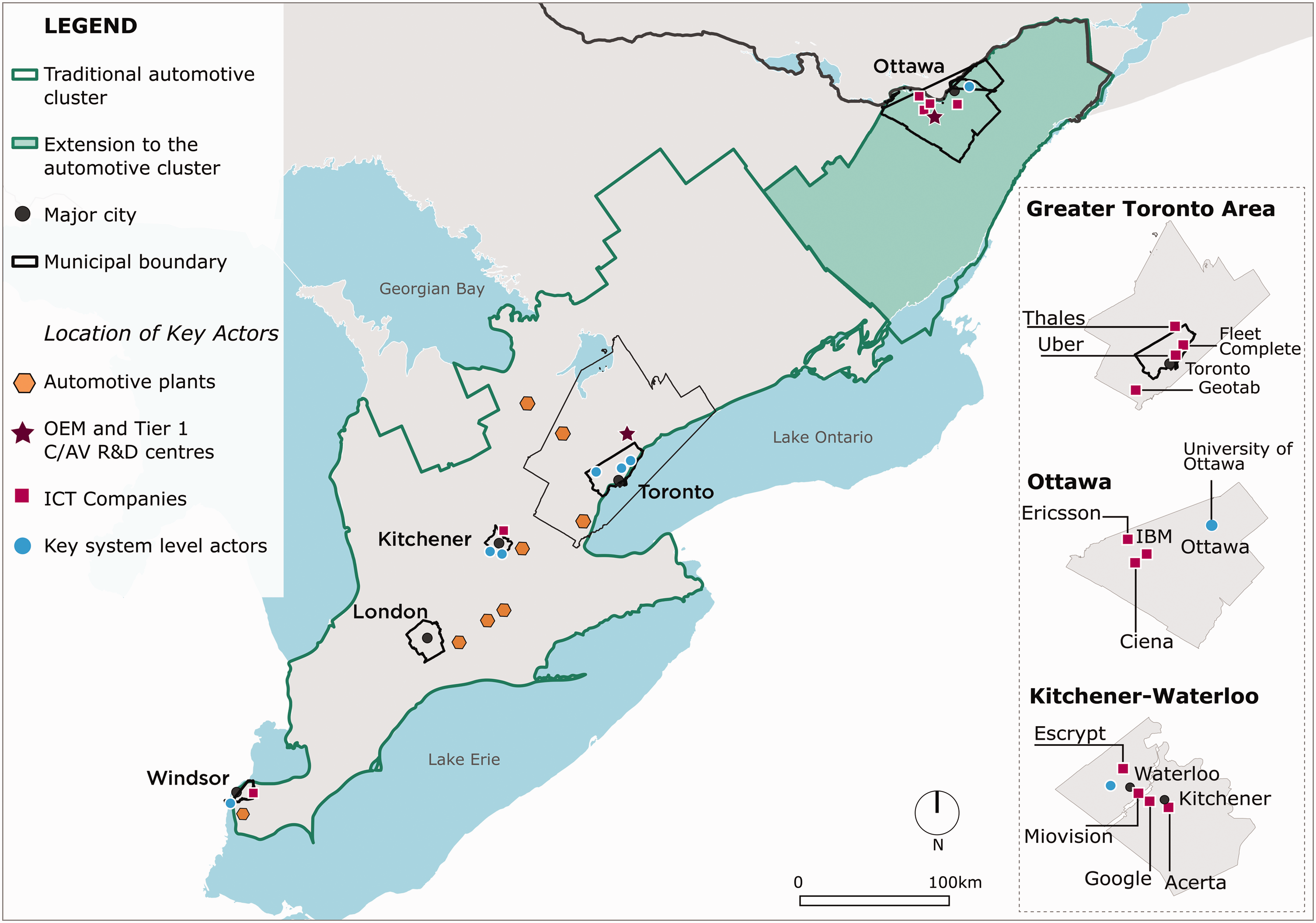
Location of key firm and system level actors in Ontario - Source: authors’ compilation based on Cutean (2017), Ivus et al. (2020), AVIN (2020) and author data.
Asset modification for C/AV: The firm and industry level
Seventy percent of the interview partners (including industry associations, government officials and companies) stated that the future of the automotive industry in Ontario would lie in the region’s ability to capitalize on the expertise residing within the ICT sector (interviews OA_1-4, OS_5-12, OT_1, OI_1-3, OG_1-8, OC_1-5). 2 This would also change the geography of the automotive sector as Ottawa and Waterloo become important players in addition to the traditional automotive clusters around Toronto and the Southwestern parts of Ontario. In other words, the progressive digitization of the automotive industry reveals new potential in Ontario’s asset base for automotive players and entrants from the ICT sector to draw upon.
Asset modification for automotive path renewal includes forging linkages to the ICT sector and enhancing the historically weak embeddedness of automotive companies in the RIS. In order to tap into the region’s ICT assets, the MNEs are forging a growing range of alliances with the numerous ICT start-up and scale-up firms that are developing technologies for C/AV (OA_1-3, OT_1-3). Furthermore, the automotive MNEs are shifting the locus of their regional investment strategy away from vehicle assembly towards automotive and C/AV R&D (OA_1-3). This strategy involves drawing upon the considerable assets found in the region’s research infrastructure and the high quality of labor in fields such as computer science and electrical engineering.
Both GM and Ford are among the more active foreign OEMs who have announced major expansions of their R&D in C/AV related activities and a significant enhancement of the local human asset base. GM is expanding its Canadian Technical Centre in Toronto (in close vicinity to major research centers by IBM, Huawei and others). Its goal is to employ 1,000 research engineers in that centre within the next few years. It recently announced the conversion of its old Oshawa assembly plant to a test center for C/AV and is building a new urban mobility research center in Toronto (Lee-Shanok, 2018). For its part, Ford recently announced the opening of its Ottawa Research and Engineering Centre, staffed with 300 former Blackberry employees, as well as its Waterloo Innovation Centre to help develop connectivity and infotainment software (Davis, 2019; Lord, 2020a). Although the fundamental decisions about future directions of firm strategy and R&D to be allocated to Ontario are made at the MNE corporate headquarters, (e.g. in Michigan), there is growing evidence that the subsidiaries – by drawing on and bolstering ICT assets in the RIS – have enjoyed recent success in expanding C/AV innovation activities.
The weak link within the region’s automotive industry continues to be the domestic Tier-one suppliers who have only allocated 18 per cent of new R&D activities to facilities in Southern Ontario compared with 45 per cent in Michigan and 36 per cent in Germany and Austria (Carey, 2019; Mordue and Sweeney, 2020). Magna, the largest Tier-one supplier, maintains an electronic research center in the Toronto region, but is conducting most of its C/AV research in the US. The exception is Linamar, which recently announced a major investment in a new innovation center working on AI and advanced manufacturing technologies in Guelph, Ontario (Saxon, 2018).
The region’s ICT sector does not only support path renewal in the automotive industry but is also moving itself towards the C/AV space (OS_1-12; OT_1-3). Both domestic and foreign ICT companies have been engaging in path diversification activities, expanding their R&D capabilities in AI and 5 G mobile technologies that are critical for the emerging C/AV field. Blackberry has opened an innovation center for C/AVs and is working with the University of Waterloo to test self-driving technology (Newcomb, 2016). It also performs the majority of its C/AV research in Canada (OS_12). Uber’s AI research lab in Toronto complements this indigenous research, drawing on research strengths at the University of Toronto (McBride, 2019). QNX continues to conduct its world leading research in operating systems in Ottawa, where Apple has also opened a major research center (Gurman and Webb, 2016). Finally, telecom companies in the region have made substantial investments in a $400 million public-private network (ENCQOR) to promote research into 5 G technologies and their adoption in C/AV (OT_1-2; OI_2; Lord, 2020b).
The region also hosts a pool of tech (predominantly SME) companies, who are developing a wide array of new C/AV-related technologies, but who face high entry barriers to new mobility markets (OS_1-12; Bezruchonak, 2018). They don’t just produce in-car technologies but also create solutions for sustainable public transportation systems (e.g. route optimization for fleets) and the intelligent infrastructure needed for connected vehicles (traffic data collection and analysis). One example is Leddartech that recently opened a research lab in Toronto to expand its research on Lidar technology. Our interviews with five of the software companies suggest that in the initial stage they are pivoting between different markets, including intelligent transportation services (ITS) to expand their customer base, since their products and services have broad applicability (OS_1-5).
Asset modification for C/AV: The innovation system level
The success of Ontario in the transformation towards C/AV will not only depend on firm-side asset modification. A wide range of system level actors, including all three levels of government, universities, intermediaries, and industry associations are playing an increasingly active role in shaping asset modification and upgrading the innovation system (KPMG, 2019; Mordue and Karmally, 2020).
Governments at multiple levels have mobilized resources and stakeholders to stimulate concerted action in the C/AV space. One goal of these efforts is to increase the historically weak automotive MNEs’ embeddedness in the innovation system and encourage them, as well the more strongly embedded ICT MNEs, to undertake more of their innovation activities in the C/AV space in Ontario.
Increased investment in the research infrastructure has expanded the base of automotive research capabilities. Their historically weak alignment to the automotive path also gives universities the flexibility to pivot away from traditional automotive engineering and manufacturing to software-driven technological innovation and education (OC_6-7). At present, twenty-four colleges and eleven universities offer auto-related research and training programs, growing the pool of graduates in the region (Ontario, 2019). Subsidiaries exploit the increase in local university research capacity and qualified graduates as well as the region’s status as a tech hub to lobby their parent companies for the additional R&D mandates in Ontario (Goracinova and Wolfe, 2019).
State and non-state intermediaries also initiated local action to develop a new bottom-up socio-technical vision for Ontario, drawing on the strengths of non-traditional automotive locations (OI_1-6). Since 2017, both the Waterloo and Ottawa regions have been framed as Autonomous Vehicle clusters (Region of Waterloo, 2019). In each case, intermediaries are collaborating to deepen connections between companies (OS_1-5; OI_1-6). Waterloo’s economic development agency partnered with Ontario’s automotive parts manufacturer’s association (APMA) and has recently announced Project Arrow to showcase the capabilities of local SMEs in C/AV technology. In Ottawa, the region’s business association (Kanata North) and foreign investment attraction agency (Invest Ottawa) have partnered with QNX, the city and academia to establish Ottawa as Canada’s C/AV capital.
These bottom-up initiatives, along with automotive manufacturing job loss, encouraged a longer-term policy approach on both the provincial and federal level (interviews OP_1-6; OI_1-4). In 2016, Ontario’s provincial government launched a ten-year pilot program to allow the testing of automated vehicles on Ontario's roads. In 2017, it introduced the five year, $80 million, Autonomous Vehicle Innovation Network (Kovacs, 2017). It funds training, later-stage R&D projects and has created six regional technology development sites dedicated to specific aspects of C/AV technology. The federal government has launched the $3 million program to advance connectivity and automation in the transportation system. This funding helps the provincial Ministry for Transportation to plan for the implementation of C/AV in the Greater Toronto and Hamilton areas (WSP and OCE, 2019). Overall, in the absence of strong MNE embeddedness in the semi-periphery, institutional asset modification has taken place to support company entry into emerging mobility market GPNs.
Emerging outcomes and challenges
There are considerable efforts underway to accelerate the transition of Ontario from its historical role as a traditional automotive producing region to a new R&D center for C/AV. Upgrading processes are driven by the diversification activities of a dynamic domestic ICT sector and AI and other capabilities residing within the support system that has been expanded over the past few years. Despite Canada’s low share of traditional automotive R&D, Ontario has produced an increasing volume of C/AV patent applications (Mordue and Karmally, 2020).
There is also evidence of expanded support structures and attempts to align them to the needs of the automotive and ICT paths. Strong policy initiatives have created incentives for different actors to work and partner in the C/AV space. C/AV-related innovation activities by both automakers and ICT entrants are one the rise in Ontario and lead to a growing degree of embeddedness of automotive and in particular ICT firms in the RIS. Changing Ontario’s position in global automotive production networks is a demanding task. Still, the underlying dynamism of the region’s ICT industry and responsive support structures give it a competitive edge that may enable changes. A crucial challenge is to continue to increase the historically low levels of automotive R&D that the OEMs and Tier-one suppliers have performed in Ontario (Gertler and Wolfe, 2004; Mordue and Sweeney, 2020).
The case of the Austrian triangle
The automotive industry is a key engine of the Austrian economy. In 2018, almost 400,000 employees (10 percent of the Austrian workforce) were working in companies directly or indirectly connected to the automotive industry (Kleebinder et al., 2019). The industry shows a strong geographical concentration in the provinces of Styria, Upper Austria and Vienna, here referred to as the Austrian automotive triangle. The Austrian automotive industry counts over 900 companies (including internationally recognized firms such as AVL List, Magna Steyr, KTM and BMW’s engine plant) and covers large parts of the value chain (Schneider et al., 2018). Over the last two decades, Austrian automotive production has tripled (from 6.38 billion in 2000 to 18.5 billion Euros in 2019; WKO 2020). In contrast to many other semi-peripheral automotive regions, vehicle production has increased both in absolute numbers and relative to European production between 2000 and 2018, but its share of global production has declined (Mordue and Sweeney, 2020). Around 82% of revenue is generated by large companies with 250 or more employees (Schneider et al., 2018). With nearly 90 percent of their products being shipped abroad, Austrian automotive firms show a strong export orientation (WKO, 2019).
Initial conditions
Although Austria is not home to any domestic automotive OEMs, there are favorable conditions for path renewal. The Austrian car industry with its historically grown supplier structure and strong ties to German OEMs exhibits a strong innovation capacity. In the period 2011–2015, every 67th automotive patent applied globally was by an Austrian firm (Helmenstein et al., 2016). Austria has the third highest share of business expenditure on R&D of the total value of production in the automotive industry in Europe (Eurostat, 2017). In 2016, not fewer than 62 percent of the automotive firms were reporting research collaborations with universities and other research organizations (Statistik Austria, 2016).
Additionally, there are enabling conditions for path diversification. Austria hosts a dynamic and R&D-driven microelectronics industry that is strongly interwoven with the automotive industry. Per capita and in percentage of total production value, Austrian manufacturers of electronic components and boards are second only to Switzerland in terms of business expenditure on R&D in Europe (Eurostat, 2017). Firms such as Infineon (semiconductors, 44%), NXP (microelectronics, 47%), AT&S (circuit boards, 36% in segment ‘automotive, industrial, medical’), and AMS (sensors and chips, 26% in segment ‘automotive, industrial, medical’) create large shares of their revenue with their automotive segments. 3 These firms recognized early the importance of system understanding and consequently find themselves in promising positions to contribute to and profit from the transformation towards C/AV (Figure 2).
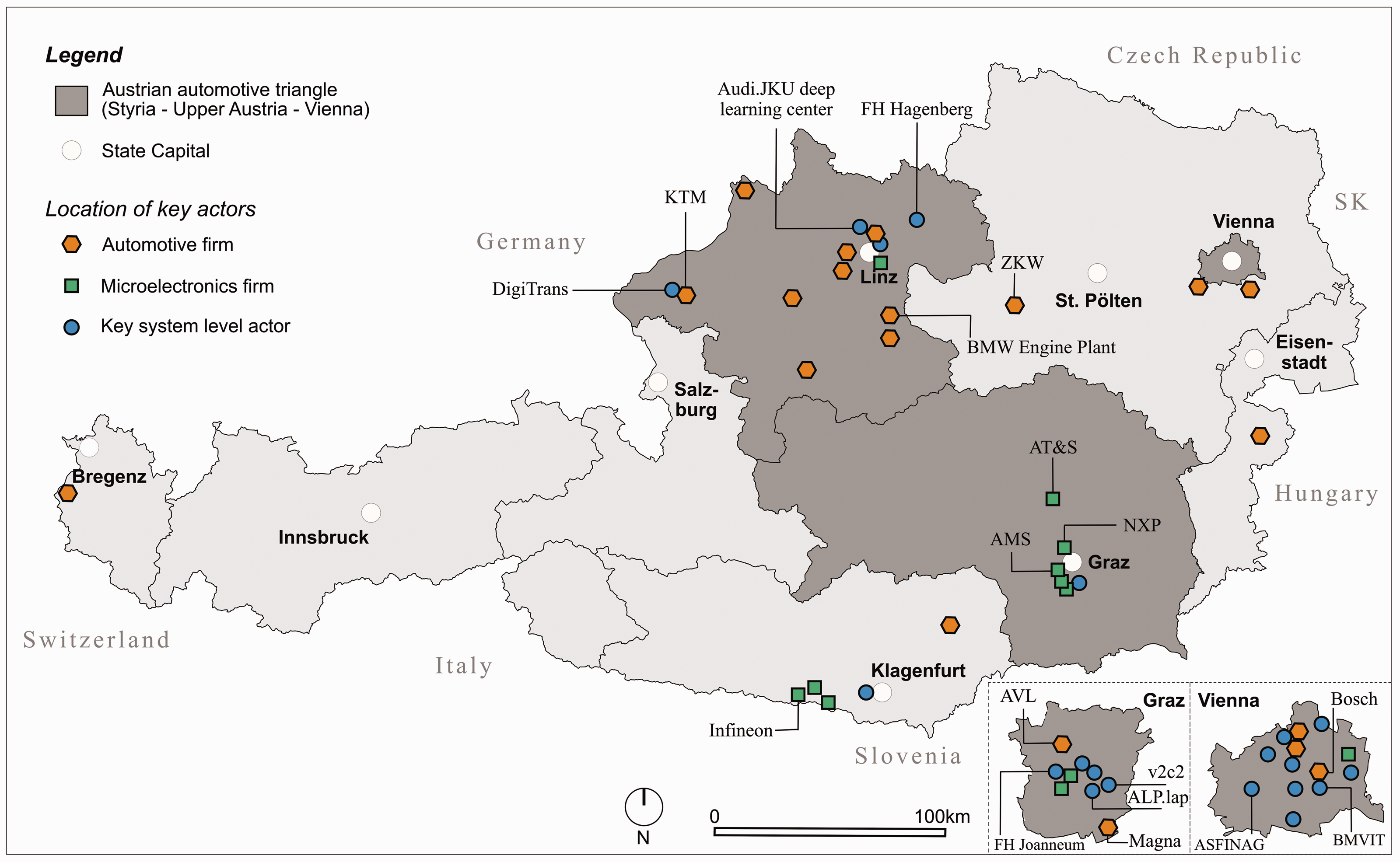
Location of key firm and system level actors in Austria - Source: authors’ compilation based on Industriemagazin (2017), Deutschmann (2018), BMVIT (2018) and author data..
The microelectronics and automotive paths are backed by thick innovation system structures. Especially the automotive industry exhibits a strong embeddedness in a highly elaborated organizational support structure, including research institutes, technical universities, cluster organizations and other intermediaries, lobbying organizations and so on. This holds true for both domestic and foreign players in the automotive field (Trippl and Otto, 2009). Given the large number of employees, policy actors have been showing a strong willingness to support the industry. Many interviewees pointed to a ‘special culture of cooperation’ (AA_1) between automotive firms, support organizations and policy. For example, long-standing relations between firms and universities have led to strong alignment of the research and educational system to the needs of the automotive path. Various networking initiatives like ‘innoregio styria’ and cluster organizations provide platforms for exchange between stakeholders from different domains. While most interviewees emphasized the positive dimension of these strong ties (AA_1-3, AM_1-2, AI_2-3, AG_1&3–5, AC_1&3, AR_1&3–5), others (also) expressed concerns over negative lock-in effects (AA_1-2, AG_6, AC_2) (Grabher, 1993). In relation to the recent emission scandal, our interviews point to a system formed by authorities, firms, engineers and other actors that ‘saw itself in a state of satisfaction’ (AA_2).
Asset modification for C/AV: The firm and industry level
Climate change, the emission scandal and the diminishing importance of cars as a status symbol (AI_3, AC_3, AR_1; Stricker et al., 2018) have led to skepticism about the automotive industry and its future role as a key sector of the Austrian economy. Consequently, many players in the automotive field welcome the advent of C/AV, considering it as a way to cope with the threat of a downturn. Many Austrian suppliers see the shift from hardware and classic mechanical engineering to software as a new growth opportunity and as a chance to reposition themselves within the value chain (AA_1-2, AM_1-3, AI_3). This goes hand in hand with larger trends of de-verticalization and changing relations between assemblers and suppliers, where the former pass responsibilities to the latter due to the increasingly dynamic development of automotive production technologies as well as time and price pressures (Dicken, 2015).
Especially larger R&D-driven supplier firms in both the automotive and microelectronics industry have begun to enter the C/AV field. Arguably, these path renewal and diversification efforts imply the creation and redeployment of human and industrial assets (in form of retraining the work force, recruitment of IT specialists, mergers and acquisitions, etc.). The Styrian firm AVL, the world’s largest independent company for the development, simulation and testing of drive systems, has announced various strategic partnerships (among others with the visual computing company Nvidia, German safety certification TÜD SÜD and the cyber security firm Kaspersky) to deal with challenges such as public acceptance, vehicle certification and security (AVL, 2017, 2018). AVL has also reported high job growth rates in its ICT and C/AV-related fields, but due to a lack of human assets (see also below), AVL is growing faster in other regions than in Styria. The Austrian branch of Bosch (located in Vienna) has recruited a large number of IT specialists and now employs almost 1,000 experts working at the interface between hardware and software domains (Bosch, 2018). Digitalization and transformation towards C/AV and the increasing importance of new powertrains and mobility services force larger suppliers to apply an expensive and high-risk ‘catch-all’ strategy. Even automotive suppliers with expertise in traditional areas of car development and production are increasingly considering themselves as software firms, reporting in our interviews that C/AV would constitute the fasted growing field (in terms of employees) in their firms (AA_1-2, AI_3).
However, such transitions are not frictionless. Concerning informal institutional assets or ‘ways of doing things’, the automotive path and the IT industry are dissimilar. Particularly the historically developed values of predictability and determinism are often incompatible with IT and especially AI methods. Once trademarks of the industry, they are now turning into barriers. After several failures in bringing together these ‘two worlds’, many large companies have recognized the necessity for changes in firm culture (AA_1-2, AM_2-3, AI_2-3). The introduction of flat organizational structures, a ‘trust instead of control’-policy, the elimination of core working hours, self-organization models, and shared desk concepts are just representations of the underlying change in culture.
Small suppliers with limited financial capacities and those that are positioned in value chains connected to traditional combustion engine powertrains face high entry barriers to C/AV-related fields (AI_1-3, AC_3). Therefore, several support organizations have begun to actively shape innovation networks and establish links between less innovative supplier firms and the IT industry. Initiatives like ‘Connected Mobility’ in Upper Austria or ‘AutoContact’ in Styria are just two examples of such efforts, which have however shown limited success to-date (AI_2-3).
Microelectronic firms are strongly engaged in industrial asset modification. Some of them belong to and operate in several industrial paths. In 2019, Infineon generated 44 percent of its revenue in the automotive segment (41% in 2015), reflecting that the increasing use of electronics in cars is the basis for some of the most significant developments in the technology of automotive production (Dicken, 2015). The firm is investing over one billion Euros in new plants in Austria. Parts of this investment are designated to expand development capacities in Linz for driver assistance systems (Infineon, 2019). AT&S has invested 40 million Euros in its sites in Styria and Nanjangud (India) to expand the production of high-frequency printed circuit boards (ATS, 2018). These are used in sensors for distance measurements that are crucial for C/AVs. The Styrian chip manufacturer AMS is among Austria’s most R&D-intensive companies (300 million Euros R&D-expenditures globally in 2019) and has recently announced that – due to the growing demand for sensors for C/AV – the company’s future lies in the automotive segment (Industriemagazin, 2019). Drawing on their experience in system thinking, microelectronic firms are able to reposition themselves and become strategic partners of automotive OEMs.
Asset modification for C/AV: The innovation system level
Universities and research institutes play a pivotal role in ongoing transformation processes. Currently, there are 16 universities in Austria offering automotive-related training programs and more than 20 research organizations are working in the fields of automotive technology, combustion engines and automation technology (Statistik Austria, 2020). These organizations have historically grown links to the firm sector, especially to larger companies. They engage in substantial asset modification processes as evidenced by the establishment of new endowment professorships for automated mobility in Linz, Graz and Vienna, large-scale reorientation in R&D centers like ‘Virtual Vehicle’ in Styria or the creation of the AUDI.JKU deep learning center in Linz. However, research institutes and universities in particular are deeply embedded in the Central European engineering culture (AM_2, AR1-3&5). Engineering curricula still show a strong focus on traditional competencies. IT competencies such as data analysis or software engineering are largely neglected. Furthermore, our interviewees have expressed concerns over missing IT specialists in both academia and industry (AA_1&3, AM_2-3, AI_1&3, AG_1-2&7). Many consider this as a major obstacle for transformation in the Austrian triangle. It is in particular universities of applied sciences (Fachhochschulen, FH) that have begun to respond to this challenge. In 2018, the FH Campus Hagenberg has started the new bachelor’s program ‘automotive computing’ with the goal to bridge the gap between classical software engineering and road-based mobility (FH Hagenberg, 2018). In 2019, FH Joanneum has started Europe’s first master’s program for ‘system testing engineering’. The program is funded by firms (such as AVL, Magna, Infineon, NXP) and designed to address the rising complexity of interwoven software, electronic and mechatronic systems due to automated driving and 5 G (FH Joanneum, 2019). Nevertheless, further asset modification processes in the research and educational system are required.
Moreover, there is a growing awareness of the significance of infrastructural assets for the transformation towards C/AV. Many interview partners have highlighted the importance of opportunities for testing 4 and the digitalization of streets (sensors, high-speed internet, cameras, etc.). This has led to a new role for Austria’s federally owned infrastructural operator ASFINAG. ASFINAG has positioned itself early as an active player of this transformation. Today, Austria is in a pioneering role (AA_2, AG_5, AC_1, AR_1&5) in terms of the adaptation of infrastructure (road network, fiber optics, sensor technology & monitoring, mobile radio, C-ITS). ASFINAG has also become an attractive partner for automotive firms, as evidenced by a recently launched cooperation with the big German OEM Volkswagen to test direct data exchange between infrastructure and cars.
Another central actor is the Federal Ministry of Transport, Innovation and Technology (BMVIT). This is for two reasons. First, the BMVIT is responsible for monitoring necessary adaptations within the legal framework and serves as an important consultant for lawmakers. Second, and more importantly, the federal ministry plays an important role in coordination and vision-building activities (AA_1-2, AI_1&3, AG_2&4&6, AR_1&5). It has established a separate administrative department for automated driving with the main agenda to balance the interests of stakeholders, to reduce ambiguities and to form a shared vision. With the help of an expert board and network meetings, two action plans (2016–2018, 2019–2022) have been developed. Cornerstones are the active role to be taken by the public sector, thematic funding 5 in areas like AI, adaptations of legal framework conditions, information, cooperation and the modification of infrastructure.
Emerging outcomes and challenges
In the Austrian automotive triangle transformation processes towards C/AV are progressing, even though many obstacles remain. On the one hand, C/AV development is driven by path renewal activities by automotive incumbents. However, it is mainly larger firms with strong innovation capacities and financial power that pursue large-scale asset modification strategies, while smaller firms have only limited resources and struggle to enter the C/AV field. On the other hand, firms in the microelectronic industry have begun to diversify into the C/AV segment.
Industry dynamics are supported by changes in the organizational and institutional support structures. Universities and research institutes capitalize on their historically strong ties to the industry to play an active role in transformation processes. However, full adaptation of research and education programs has not taken place yet. Further reorientation of support organizations to re-align to the needs of industrial players remains an important challenge (e.g. to ensure the availability of human assets). Another bottleneck is the slow pace of institutional change. This holds particularly true for the historically grown engineering culture and orientation on determinism, precision and safety.
Comparison
As shown in the previous subsections, both in Ontario and the Austrian triangle there are major efforts underway to cope with the advent of C/AV. However, the routes taken by the two regions differ strongly (Table 1). Ontario seems to be embarking on an upgrading route, while the Austrian case features elements of a reorientation route (see section ‘Innovation-based regional restructuring: Systemic conceptualizations and routes of transformation’).
Regional transformation towards C/AVs: Comparing Ontario and the Austrian automotive triangle.
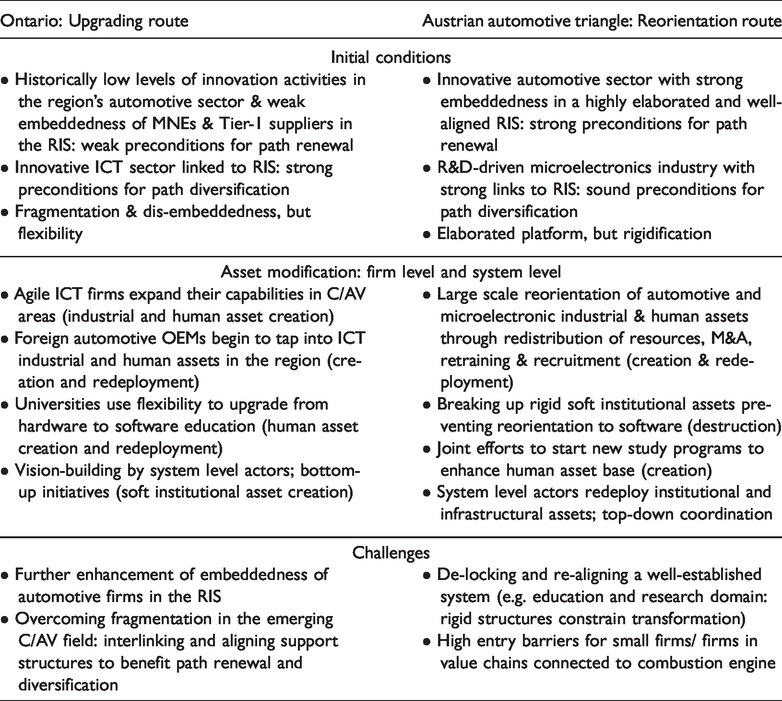
These routes reflect distinct initial conditions. In Ontario, the automotive sector has traditionally prioritized production over innovation-related activities, creating a relatively weak initial base for renewal endeavors. The sector is dominated by foreign subsidiaries with limited innovation mandates and domestic Tier-one suppliers that have most of their R&D located abroad and whose embeddedness in Ontario’s RIS was weak. However, the advent of C/AV has led to a shift of perspective. With its dynamic ICT sector, populated by both domestic and foreign R&D-driven companies and a vibrant start-up scene with capabilities in AI and 5 G mobile technologies, Ontario’s asset base has great potential, not only for the automotive industry to initiate renewal activities but also for the ICT industry to diversify into the C/AV space. Our findings suggest that both sectors are already responding to these new opportunities. While potential for diversification activities (residing within the innovative microelectronics industry) can also be found in the Austrian triangle, initial conditions for path renewal activities in the automotive industry are more favorable when compared to Ontario. This is because many – albeit not all – Austrian automotive suppliers exhibit strong innovation capabilities. Their renewal efforts are backed by but are also partly hindered by a strong embeddedness in highly elaborated RIS structures.
These varying conditions are reflected in distinct asset modification processes. In Ontario, ICT firms in interaction with universities and supported by policy are most actively pursuing asset modification. Additionally, there are first signs that subsidiaries increasingly tap into and modify the regional asset base for their R&D efforts. However, due to the limited autonomy of these subsidiaries, it is the ICT industry’s endeavors that have so far yielded more tangible results. Asset creation and redeployment have been relatively successful, particularly in relation to knowledge, finance, infrastructure and soft institutions like visions. A key challenge is to connect previously unlinked actors and paths and to enhance the historically weak embeddedness of automotive firms into the RIS. In the Austrian Automotive Triangle, asset modification is mainly shaped by established actors, namely automotive and microelectronic firms. They mobilize their longstanding relations with universities and policy makers to embrace C/AV. Asset modification covers both the creation and redeployment of knowledge, finance, infrastructure and legitimacy. One can also find evidence for strategic asset destruction in the field of soft institutional assets. The key challenge is to de-lock and re-align a well-established innovation system. There is clear evidence that not all elements are reorienting themselves at the same pace.
Consequently, our empirical analysis has shown that Austria and Canada – both considered to be part of the semi-periphery of the global automotive industry – find themselves in markedly different situations. Applying a systemic perspective to innovation-based change, we have argued that it is not only the regional automotive path and its position in GPNs that matters. Complementary paths and organizational and institutional support structures also provide platforms for distinct patterns of asset modification, ultimately resulting in different routes of transformation in the Austrian automotive triangle and Ontario.
Conclusions
This article seeks to contribute to a more thorough understanding of how regions respond to potentially path-breaking innovations that pose a threat to their historically grown industries. We assert that this requires scrutinizing the ways in which regions nurture new industrial path development and reconfigure their organizational and institutional support structures. This focus is grounded in a systemic perspective that complements conventional EEG accounts of regional restructuring. Systemic approaches move beyond firm and industry-led explanations and incorporate changes in the wider RIS into analyses of innovation-based structural change.
In order to further unpack the capacity of regions to embrace radical innovations, we develop a framework that contrasts two routes of transformation, a reorientation route and an upgrading route. The article shows that these routes are contingent on specific initial conditions, particularly the existing asset base, which is shaped by historically grown industrial and support structures in the region. Further, routes differ in terms of the dominant types of new industrial path development and the relative importance of adaptation processes of existing support structures and the creation of new ones. This is reflected in distinct asset modification processes by multiple actors and the challenges involved in such endeavors.
The framework has been applied to an empirical analysis of transformation processes towards C/AV in two traditional automotive regions, namely Ontario (Canada) and the Austrian automotive triangle. Our analysis suggests that Austria is embarking on the reorientation route, where innovative automotive and microelectronic firms capitalize on favorable initial conditions and pursue path renewal and diversification activities towards C/AV, supported by re-alignment processes taking place in a strongly elaborated innovation system. The article also throws light on the dark sides of such RIS configurations, revealing that strong ties and mutually reinforcing elements are hampering transformation. Consequently, evidence suggests that not only asset creation and redeployment, but also strategic asset destruction is necessary for further change. The upgrading route prevails in Ontario where weak initial conditions for path renewal activities by automotive companies are found. The digitalization of the automotive industry has revealed new potential in Ontario’s regional asset base, which lies in its dynamic ICT sector and malleable organizations and institutions. This has opened a window of opportunity for the Canadian automotive region to upgrade from a production hub to an R&D center. While there is evidence that some automotive MNEs have begun to draw on the region’s IT and AI capabilities, we also find that asset creation and redeployment for C/AV development are mainly driven by path diversification activities of IT firms, backed by an enormous expansion of organizational and institutional support structures.
Arguably, our analysis is based on two traditional automotive regions only. There is a need to study new path development and system reconfiguration towards C/AV in other automotive regions with different preconditions than those considered in this article. This would also help to refine the conceptual framework proposed here. Future work in the field may also extend the framework to other cases to assess other industries and regional contexts facing disruptive change. This would also allow for a better understanding of the policy implications that result from a systemic perspective of industrial dynamics triggered by path-breaking innovation.
Footnotes
Declaration of conflicting interests
The author(s) declared no potential conflicts of interest with respect to the research, authorship, and/or publication of this article.
Funding
Work on the Austrian Automotive Triangle was supported by the Marianne and Marcus Wallenberg Foundation [grant number MMW 2016.0014].
Work on Ontario was supported by the Social Sciences and Humanities Research Council of Canada [grant number 895-2013-1008].
Acknowledgements
The authors are grateful to two anonymous reviewers and the editor for valuable comments.