




Abstract
Crises of seniors’ care in countries like the UK and Canada, further highlighted by the COVID-19 pandemic, have been connected to processes of privatization and financialization. In this paper I argue that rent theory is important for disaggregating mechanisms, including of accumulation by dispossession, the devaluation of labour, and assetization, that underpin the process of financialization in the sector. Work on rents often divides between critical approaches, especially to land rent, and mainstream institutionalist and public choice approaches to rent-seeking. Critical rent theory is evolving beyond this divide to understand a broader range of types of rent. Yet, despite attention to the increasing importance of economic rents and forms of rentierism, labour and social reproduction are often excluded from the analysis of how rent relations arise. This paper demonstrates the problems with these exclusions. The argument is illustrated through an analysis of the restructuring of eldercare in British Columbia, Canada, in the last two decades, and employs a feminist political economy approach to examine the social production of rent relations.
Keywords
On Monday, Island Health appointed a temporary administrator at Retirement Concepts’ Comox Valley Seniors Village following complaints from family members and multiple investigations into allegations of staffing shortages, neglect, emotional and physical abuse, and disease outbreaks … Retirement Concepts was purchased by Beijing-based Anbang Insurance Group in 2017. Kines (2019), ‘Nanaimo seniors care home ‘beyond crisis,’ union says’
Introduction
In late 2019 some in British Columbia (BC), Canada, worried that the province might be on the verge of a ‘Southern Cross moment’. Southern Cross was the largest chain of long-term care (LTC) home operators in the UK when it went into liquidation in 2011, creating uncertainty about the futures of more than 30,000 residents and resulting in thousands of care worker redundancies (Horton, 2019: 1). After its collapse, research by The Observer revealed that almost 30 percent of Southern Cross facilities had been served with improvement orders by Care Quality Commission inspectors (Wachman, 2011). In BC, between September and December 2019, three long-term care facilities (LTCFs) owned by Retirement Concepts, the province’s biggest provider of seniors’ care services, were put under local authority control for failing to meet minimum standards for staffing and care (Larsen, 2019). 1 Observers wondered if this signaled the imminent collapse of the business, as had falling standards of care at Southern Cross homes, or whether the crisis would be the trigger for Retirement Systems’ parent company to offload the chain of LTCFs.
Retirement Concepts, a for-profit company established in Vancouver in 1988, is owned by the Chinese company Dajia Baoxian, the successor of Anbang Insurance Group (one of China’s largest insurance companies). Anbang bought Retirement Systems as part of a two year “acquisitions binge” that included high profile real-estate such the Waldorf Astoria hotel in New York City and the Bentall Centre, Vancouver’s most valuable commercial property (Bloomberg News, 2019; Zhou, 2018). 2 Concerns about Anbang’s ownership of Retirement Concepts 3 were heightened when Anbang was taken over by the Chinese government in 2018, after its CEO was convicted and imprisoned for fraud, and started to sell off assets like the Bentall Centre.
These concerns, about Anbang’s commitment to continuity of care in the sector and the viability of Retirement Concepts under its ownership, stemmed in part from experiences elsewhere. The administrative takeover of for-profit LTCFs in BC has thus been seen, like Southern Cross’s collapse, as one dimension of a broader crisis affecting publicly-funded seniors’ care. 4 There is an emerging consensus that the model of for-profit operators, on which the provincial government has become reliant, is increasingly financialized and depends on low pay and understaffing (Longhurst, 2017, 2020; Office of the Seniors Advocate, 2020).
As Horton (2019: 2) has argued, the seniors’ care crisis in the UK is in part a result of restructuring in the sector: 5 “over the past two decades, a substantial part of the UK’s care home sector has been taken over by private equity firms and other investment funds, which seek to achieve a return by buying up, restructuring and selling on companies”. Horton’s (2019: 11) analysis highlights that the profit model of investors in the sector has relied on several underlying conditions: a reliable revenue stream (usually public funding for services sub-contracted to the private sector); rising property values that have underpinned the assetization of care companies’ real estate holdings; and the devaluation of a low-paid, feminized, and racialized workforce. Falling standards of care, reduced staffing levels, and low wages are the result of “intensified exploitation imposed by financial pressures” (Horton, 2019: 9).
In this paper I argue that rent theory is both necessary and valuable for disaggregating these important mechanisms, often lumped together under the process of financialization, for generating profits in the seniors’ care sector. In BC, restructuring in the LTC sector has been enabled, as I demonstrate below, by state-led policies of contracting out that entail the de facto socialization of risk (through public funding for care hours and the state as a guarantor of last resort for client care) and the privatization of profits (from revenues that largely derive from that public funding, and from client contributions to the costs of care). Contracting out is the outcome of the marketization of care, and in turn spurs privatization and the growth of financialized business models. Thus, while the assetization of land and related social infrastructures (Lo et al., 2015) has been vital to the realization of profits, so too are the contract relations and associated revenue streams, derived from general taxation, that fund the provision of care. 6
It is the importance of both the locking-in of revenue streams and of the assetization of landed property that support the value of rent theory to help understand the ‘financialization’ of capitalism and urban infrastructures broadly (Anderson, 2014, 2019; Birch, 2019; Christophers, 2016; Felli, 2014; Haila, 1990, 2015; Searle, 2018; Wachsmuth and Weisler, 2018; Ward and Swyngedouw, 2018; Wijburg, 2019), and the financialization of health and social care in particular (Horton, 2017; Hunter and Murray, 2019). At the same time, I follow Horton (2019: 4) in arguing that labour is vital to understanding how profits are generated, “countering claims that financial activities have substantially displaced labour in the creation of value”. Theorists of rent have largely ignored both labour and social reproduction, despite how arguments for the growing importance of rentiership and rentierization rest on the expansion and the subsequent embedding of rent relations across increasingly broad swathes of the economy and society. Feminist political economy (FPE) analyses of social reproduction, carework, and the devaluation of feminized and racialized labour can thus enrich approaches to rent that otherwise miss the salience of labour to the emerging social relations of rent (Arat-Koc, 1989; Baines and Armstrong, 2019; Bakker and Gill, 2004; Bakker and Silvey, 2008; Benoit and Hallgrimsdottir, 2011; England and Dyck, 2012; Fraser, 2014, 2015; Henry, 2018).
Drawing on research undertaken as part of a five-year project on eldercare labour markets in BC 7 (Strauss and Xu, 2018, 2020), and building on recent debates on rent theory, I show that rentierization in the eldercare sector is related to what Bakker and Gill (2004) call the reprivatisation of social reproduction, the devaluation of care labour, and the assetization of social infrastructures. These processes are enabled by accumulation by dispossession (Harvey, 2005), which rent theorists have signaled as a key process in how rents emerge (Kappeler and Bigger, 2011). The BC case study thus supports calls for more research on whether, and in what ways, the rubric of financialization elides more specific processes of rentierization (Christophers, 2019) and rentiership (Birch, 2019) with mechanisms, logics, and impacts that require dedicated analysis. The outbreak of the COVID-19 pandemic in Canada in the spring of 2020 spotlighted the impacts of the restructuring of seniors’ care on workers and care recipients, and such analysis is therefore needed to critically inform proposals for reform that are emerging. Otherwise, the political opening produced by the recognition of “essential workers” in BC will close without substantial changes to address the crisis of seniors’ care provision.
From land rent to general rent theory
As Ward and Aalbers (2016: 1761) argue, critical land rent theory starts from an examination of how landed property rights “command large values, the largest portion of which cannot be attributed to labour or interest on capital investment but seemingly appears for nothing”. Renewed interest in land rent theory relates to trends in urbanization and financialization, but the role and importance of sectors like IT, digital services and biotechnology, and the commodification and financialization of nature, have also spurred an interest in emerging and evolving forms of economic rent. Because of these trends, as recent commentaries have noted (Andreucci et al., 2017; Birch, 2017b; Sadowski, 2020; Ward and Aalbers, 2016), critical rent theory 8 has re-emerged from a period of relative neglect in critical and radical political economy. It has now entered a phase of debate, re-examination and broadening that addresses the increased magnitude and centrality of rents qua value in ‘advanced’ – and not only ‘advanced’ – capitalist economies. From the expanded discussion of forms of economic rent has emerged a general theory of rentierization, which addresses the increasing centrality of income derived from possession or control of scarce assets under conditions of limited or no competition (Christophers, 2019). Haila’s (1990: 276) three main questions on land rent can thus be applied to types of economic rent (rents associated with intellectual property rights, for example, or carbon credits) and to the process of rentierization: how does rent emerge, who or what are its agents, and what is its economic role (e.g. in accumulation or coordination)?
The approach I take in this paper is one that follows heterodox contributions to the broadening of the theory of economic rents, but which grounds that broadening in a Marxian foundation. As part of this analysis, I argue for a dimension of land rent theory that has remained underdeveloped, with a few exceptions (Kaika and Ruggiero, 2015; Katz, 1986; Mutersbaugh and Martin, 2012; Zeller, 2007). That dimension encompasses the social relations of rent beyond landlord-tenant, in which productive and reproductive labour are usually undertheorized. New rent theory is grounded in Marxian value theory, while heterodox approaches align with more institutionalist analyses of changing value regimes. Yet both largely ignore the question of whether and how labour enters rent theory other than at the level of abstraction. This despite the ongoing, and increasing, centrality of rent and rent relations to concrete social struggles and political movements – that is, to capital as a social relation (Harvey, 2018: n.p.).
General rent theory and the question of labour
It has been three decades since Haila (1988) argued for ‘old’ and ‘new’ theories of urban or land rent (see Ward and Aalbers, 2016, for a summary and discussion). The fulcrum of the new rent theory was the shift to a theoretical and analytical focus on the tendency of landowners to treat their property as a pure financial asset (Ward and Aalbers, 2016: 82), attributed to David Harvey’s (2006) discussion of how land becomes fictious capital. This shift contained the germ of general rent theory, which expresses how the current attention to rent is born out of interest in its application to a wider range of processes. These are processes beyond the ones associated solely or primarily with land, that generate revenues from ownership or control of assets. Notable in some recent approaches is the shift from theorizing forms of rent (differential versus monopoly, for example) to processes of transformation (rentierization and the rise of rentierism) and types of assets (e.g., Birch, 2019; Christophers, 2019; Ouma, 2020).
The theorization of forms of economic rent and the general rent framework seek to capture the growing centrality of assetization (Birch, 2017a) and the generation of “putative future income streams” (Ward and Swyngedouw, 2018: 1078) across and within a range of capitalist sectors in contemporary economies. Or, as Ward and Swyngedouw (2018: 1080) describe, “… a shift to asset-based societies in which previously wage-led growth regimes have been reoriented around profit and investment for capital … with expanded reproduction dependent on the capture of, and leveraging against, new income streams.” This shift is implicated both in the tendency of landowners to treat property as a pure financial asset, and in the tendency of different fractions of capital to seek opportunities for capturing economic rents. Thus, as Christophers (2016) argues, much of what has been characterized as financialization is a deepening of rent relations through mechanisms of assetization (see also Felli, 2014). However, while the shift to asset-based societies described by Ward and Swyngedouw does entail a shift away from wage-led growth regimes, labour does not lose its importance, as I demonstrate in the next section (see also Horton, 2019).
It is perhaps because rent is either understood as not producing value, or as generating value through assetization, that Stephen Katz’s (1986) arguments for rectifying the occlusion of labour in rent theory in his review essay on The Limits to Capital have been largely ignored (see also Haila’s (1990: 285) critique). Katz’s essay did spur some of the interest in exploring how workers shape the processes of transformation in urban land markets through the social relations of rent (Herod, 1994; Kaika and Ruggiero, 2015). But it also highlights that when Harvey analyses “the organization of space in terms of the rent relation, land markets, and how these shape space for capital, while also containing the seeds of system-disruptive crises” (Katz, 1986: 68), the focus is solely on intra-capitalist class relations. This focus on agents of rent, in Haila’s words, has continued in recent work on assetization.
While Katz turns his attention to the spatial mobility of labour, the real potential of his approach is the way that it highlights the one-dimensional theorization of how land markets arise, and the functionalist way land prices form signals that coordinate the activities of “economic agents” (who are increasingly compelled to seek ways to transform rents into interest-bearing capital). The state is only significant insofar as it assigns and guarantees property rights. Labour is only relevant to the extent that is a priori present in the conceptualization of productive capital and surplus value production, and social reproduction recedes from sight entirely. Yet Harvey argues that the “… land market shapes the allocation of land and thereby shapes the geographical structures of production, exchange and consumption, the technical division of labor in space, the socioeconomic spheres of reproduction and so forth” (1982: 331, cited in Katz, 1986: 67).
This statement leaves open the door for theorizing the other factors shaping land markets’ formation, and rent as a basis for various forms of social control. If we follow Katz in arguing for the salience of labour to land rent theory, and apply his broad insights to economic and other forms of rent, it becomes apparent that analyses of rentierization or rentierism are incomplete without examining struggles over labour and wages. Moreover, the seeming assetization of everything, or what Andreucci et al. (2017) call “value grabbing” (which seeks to extend rent relations into all domains of life), relies on transformations of the role of the state, capital-labour relations, and norms and institutions of social reproduction.
Social reproduction is a concept that is used variously to describe the [gendered and racialized] domestic work necessary to reproduce labour power and class relations under capitalism, the historical and spatial reproduction of communities and social relations, and the systems and institutions of the state (including healthcare and education) necessary for societal reproduction (Bezanson and Luxton, 2006; Glenn, 1992; Laslett and Brenner, 1989; Mitchell et al., 2004). Crucially, it is a concept that feminist political economists employ to foreground and analyze how reproductive labour, both paid and unpaid, underpins productive labour and the production of value. Eldercare was, and to a large extent remains, feminized unpaid work performed in the private sphere, or paid domestic labour that was racialized and classed (performed by maids or paid companions). Social welfare policy in the twentieth century unevenly decommodified, defamilialized, and institutionalized eldercare through the development of outsourced LTC, at the same time turning unpaid work into wage labour for what remains a gendered and racialized workforce (Chun, 2016). FPE analyses have demonstrated that, since the 1990s, the domain of social reproduction has been the target of austerity policies, the financialization of daily life, and precaritization that have deepened inequalities along classed, racialized and gendered lines (Adkins, 2012; Baines and Cunningham, 2015; McDowell et al., 2009; Roberts, 2015). My argument is that these processes have also produced new rent relations in the eldercare sector.
Bakker and Gill (2004: 18–19) call these economic and societal changes the reprivatisation of social reproduction, which they link (drawing on Gramsci) to wider conditions of primitive or original accumulation. The reprivatization of social reproduction in their account includes the privatization of state assets (and parts of the state itself), and the alienation or enclosure of common forms of property, including social infrastructure such as schools, hospitals, public housing, etc. It also includes the privatization of previously socialized institutions of social reproduction (like public seniors’ care), which encompasses both the creation of markets for for-profit care, and the devolution of responsibilities for care back onto the household. Re-privatization historicises these processes, reminding us that the socialization and decommodification of care are the outcome of historically contingent social struggles and norms (see also Picchio, 1992).
The mechanisms of dispossession described by Bakker and Gill are also theorized by Harvey (2005: 147–148) as accumulation by dispossession, which rent theorists have used to explore socio-ecological struggles over the establishment of property rights and regimes (Andreucci et al., 2017; Zeller, 2007). Andreucci et al. (2017: 30) argue in their work on value grabbing that accumulation by dispossession “… signals the continuous character of capital's “enclosures” that enforces the separation of people from their social means of (re-)production (De Angelis, 2001), while permitting their enrolment as classes of labor in the production of value…”. For them, however, the concept is useful to distinguish rent relations from the social relations of capital valorization in production: the former is distributional, the latter productive. This ignores, however, that accumulation by dispossession spans (and may link) the productive and reproductive domains. Kappeler and Bigger (2011) observe: Some of the mechanisms of primitive accumulation that Marx emphasized have been fine-tuned to play an even stronger role now than in the past … we have to look at the speculative raiding carried out by hedge funds and other major institutions of finance capital as the cutting edge of accumulation by dispossession in recent times … [and] … The reversion of common property rights won through years of hard class struggle (the right to a state pension, to welfare, to national health care) to the private domain has been one of the most egregious of all policies of dispossession pursued in the name of neo-liberal orthodoxy.
From these arguments, then, emerge two main observations. If, how, and in what form property regimes arise is shaped by the balance of social forces and the distribution of social power in society. Not only class relations, not only the conflict between productive and landed capital, but also socially determined norms and levels of social reproduction (Picchio, 1992) shape the emergence and subsequent modalities of rent relations. Second, if the role of rent is coordinative or distributional, then workers and their communities can and do shape and disrupt the process of coordination through class-based and other forms of social struggle. These include demands for the decommodification of housing, education, and healthcare and the public provision of means of collective consumption. Many of these struggles appear to take place in the domain of social reproduction over the production and transformation of use values into exchange values (and vice versa). But they also erupt in the sphere of production, both highlighting the interrelationship of these putatively separate spheres (Winders and Smith, 2019), and drawing attention to how assetization impacts and transforms the labour process (Bryan et al., 2017; Dowling, 2016; Grady, 2017; Roberts, 2015). In this sense, as I demonstrate below, rent relations may indeed contribute to accumulation, precisely because they rely on the extraction and capture of surplus value.
The restructuring of eldercare in BC
Care “whether approached in terms of labour, practices, needs or mortality, is a deeply feminized field of political economy”, which is one of the reasons that the [re]organization of social reproduction and care labour are often ignored or marginalized in accounts of economic and policy change (Vaittinen et al., 2018: 379). And yet, the processes and logics associated with first neoliberalism (Baines et al., 2017), and latterly financialization and rentierization, have in significant ways hinged on social welfare restructuring (Adkins and Dever, 2016; Federici, 2018; Ryan and Young, 2018).
In Canada eldercare services are not covered by the federal Canada Health Act (CHA), which mandates that medically necessary healthcare is free at the point of delivery, and their funding and delivery are devolved to the provinces. For-profit and non-profit operators have therefore always had a role in the provision of eldercare in BC, and because of the residential aspect of long-term care, land and appurtenances (in the language of rent theory) are required for its delivery. As Feng Xu and I have illustrated elsewhere (Strauss and Xu, 2020), the evolution of the eldercare sector in BC in the last century has been a contested one in which defamilialization, institutionalization, and decommodification have mirrored and at some points led broader processes of socio-spatial reorganization at the nexus of social, state, and market forces. In other words, how care is organized, who delivers it, how it is paid for, and where it takes place have changed over time in ways that reflect both the political economy of welfare and social norms of care (Armstrong, 2009; Baines and Cunningham, 2015; Gill and Ingman, 1994).
There is not space to delve into this longer history here; instead, I focus on changes to the sector since the early 2000s. In this period ascendant roll-back neoliberalism and the politics of balanced-budgets drove significant restructuring in the delivery of health and social care (Aguiar, 2004; Chun, 2016; see also Sparke, 2020) and enabled new rent relations. These included the both the creation and embedding of contract rents and the assetization of social infrastructure and related landed property. I follow Christophers (2019) in associating these distinct but interrelated rent relations with increasing centrality of rentierism to the strategies of both the state and for-profit operators. However, while Andreucci et al. (2017: 32) state that “… value grabbing—the appropriation of (surplus) value produced elsewhere through rent —rather than accumulation (the creation of value) is increasingly central to the reproduction of contemporary capitalism”, I argue that rentierization in the eldercare sector was enabled by state-led accumulation by dispossession and the intensification of surplus value extraction from the eldercare labour force.
Cuts, contracting out and the devaluation of care labour
Although the expansion of state-provided and funded eldercare services, including long-term care, was a slow and uneven process that started in the early part of the 20th century, by the 1980s most state investment in LTCFs and home support services was in the public and not-for-profit sectors (Longhurst et al., 2019). In 1999 23 percent of care homes in BC were owned by for-profit operators (representing 23 percent of publicly subsidized beds), 32 percent by the not-for-profit sector (37 percent of beds), and 45 percent by health authorities (41 percent of beds) (Office of the Seniors Advocate, 2020: 9–10). When health transfers to the provinces were cut in the federal ‘austerity’ budget of 1995 (McBride and Whiteside, 2011), BC at first resisted deep cuts to health and social care (Isitt and Moroz, 2007), although some homemaker services were scaled back. By 2016, however, access to publicly subsidized spaces in LTC and assisted living facilities had fallen by 20 percent (Longhurst, 2017: 17), resulting in the increasing rationing of care. By 2019 the for-profit share of LTCF ownership had risen to 34 percent (representing 34 percent of beds), giving the for-profit sector a larger share than either the public or not-for-profit sectors (Office of the Seniors Advocate, 2020).
This restructuring was precipitated by major policy shifts and legislative changes, which occurred on two fronts after a change of government in the early 2000s. First, Bill 29 stripped no-contracting out and job security clauses from the collective agreements of health support workers, and Bill 39 enacted wage rollbacks. The key goal of Bill 29 was to enable the contracting out of ‘non-clinical’ workers (Gillespie, 2007): “The legislation left health care employers free to restructure the workplace with an entirely new workforce paid at much lower rates and with far fewer benefits” (Lee et al., 2005: 9). A new collective agreement imposed on members of the Hospital Employee’s Union (HEU), which represents inter alia licensed practical nurses; care aides; clerical, technical, and support occupations; and tradespeople, included a 15 percent wage cut. Second, Bill 94 “granted new – mainly for-profit – entrants to the LTRC sector the economic advantage of unrestricted rights to subcontract and flip commercial contracts” (Longhurst et al., 2019: 111; see also Stinson et al., 2005). 9
The government’s legislation immediately and effectively cheapened the labour of “non-professional” care workers and the workers who provided clerical support, meals, cleaning and laundry services in community and residential facilities. Community support workers, for example, experienced an immediate wage rollback in 2004, but there were also longer-term impacts. Agencies laid off regular full-time workers, sometimes rehiring them to the same role as casual workers with worse benefits and fewer hours, as casualization in the sector increased (Cohen et al., 2006: 40). Crucially, workers were dispossessed of hard-won collective rights and benefits, including union successorship rights (Longhurst et al., 2019: 109), pensions, and extended healthcare, while private for-profit operators like Retirement Concepts gained an increasing share of LTC contracts. The dispossession of workers opened up a new terrain of accumulation through the creation of contract rents.
The new legislation thus instantiated the interrelated goals of devaluing the labour of eldercare workers, increasing the role of for-profit operators in seniors’ care delivery, and creating lowered expectations about the ability of the government to “afford” publicly funded care delivered by unionized workers. Workers were not passive victims, engaging in major strike action in April 2004 (Lee et al., 2005), nor did care recipients passively accept the weakening of the norms of collective care. If one of the less commented on reasons for Bill 29 was straightforward union busting, the need to check the power of a vocal and militant workers’ organization arose in part because it had achieved significant gains for its membership and thus represented a barrier to accumulation.
Eldercare in BC is a highly feminized, racialized sector: community support workers, residential care aides, and in-home caregivers are majority older women (over the age of 45), many of them first- and second-generation immigrants and former migrant workers (Cohen, 2012; Cohen et al., 2006). A high proportion of those requiring subsidized care in older age are also low-income women. Social and political struggles for publicly funded eldercare that includes decent pay and conditions for workers, against privatization, contracting out, and the rationing of care, found it hard to gain purchase as the norms of social reproduction were reshaped. Balanced budget and low tax orthodoxies, bolstered by rising asset prices, and declining levels of unionization in the private sector, made it possible for the government to paint unionized healthcare and seniors’ care workers as overpaid. As Lee et al. (2005: 7) wrote one year after the strike: “Once the picket lines came down, public attention moved on and memories of the strike faded. Many people, especially those with higher paying jobs, seemed prepared to shrug off the impact of a 15% wage cut [on healthcare workers]”. Meanwhile, cuts in funding for direct care resulted in a 14 percent reduction in between 2001/02 and 2009/10 in clients accessing publicly subsidized home and community care services (Cohen, 2012), leading those who could afford it to increasingly turn to private-pay services.
A 2020 report by the Office of the Seniors Advocate, drawing on BC health authority data not previously public, explicitly illustrates how private for-profit operators in seniors’ care use contract rents to generate profits through the intensified exploitation and devaluation of labour, facilitated by public policy. First, the report notes that publicly funded contracted-out LTC in BC is organized by a block funding business model. Operators (both for-profit and non-profit) receive block funding paid by health authorities (from provincial government funding): “The block funding amount is unique to each care home and it is determined through individual negotiations … health authorities specify the number of direct care hours an operator is expected to deliver, and operators are funded a specific amount of money through their block funding to deliver these hours” (Office of the Seniors Advocate, 2020: 12). Health authorities report block funding as a per diem (representing the amount of daily funding for each bed based on the number of direct care hours a resident receives, and the cost to deliver those hours of care. 10 As the author notes, “[g]iven that contracted care homes are expected to deliver the same complex care services to similar types of residents, one would expect to find that per diems between care homes are similar” (Office of the Seniors Advocate, 2020).
Instead, there is wide variation, with per diems ranging from $171 to $282 in 2017/2018. Yet funded wage rates and benefits are not at the root of this variation. Block funding assumes a “cost worked per hour” of care delivered that starts with a wage rate and adds benefits, staff replacement costs, overtime, etc. The wage rate, benefits and replacement costs are based on the Health Employers Association of BC (HEABC) Health Services and Support Facilities Collective Agreement, also called the Master Collective Agreement or “industry standard” (Office of the Seniors Advocate, 2020: 24). For-profit employers who receive this per diem are not required to be members of the HEABC or to adhere to the collective agreement and pay industry standard wages – an outcome of Bill 94. The Seniors Advocate found that, as a result, for-profit operators are paying up to 28 percent less than the industry standard to care aides who deliver the majority of care in LTCFs (Office of the Seniors Advocate, 2020: 28), yet receiving per diem rates that assume industry standard wages.
Second, the report found that there is no required audited reporting of direct care hours delivered across health authorities in BC. Despite this, block funding is usually renewed annually by effectively rolling over the previous year’s funding with an across-the-board funding lift to address increases in wages, supplies, utilities, taxes, and other costs. This means that operators may be funded on an ongoing basis for care they do not actually deliver, not least because of understaffing and retention problems that flow from low wages, poor benefits, and a lack of full-time hours in some for-profit facilities (Givetash, 2017). Moreover, for-profit operators co-locate private-pay and publicly subsidized beds but are not required to report on or account for the impacts of co-location. This means publicly funded care hours can be used to subsidize private care, allowing operators to hire and pay fewer staff out of the fees paid by private clients while increasing the workloads of the staff who deliver care services to both types of clients. Cross-subsidization results in work intensification. In these ways, profits derived from contract rents in this sector rely at least in part on wage theft and intensified exploitation of careworkers.
Mechanisms of assetization in seniors’ care
The policy changes that created these new contract rent relations in the eldercare sector occurred during a period associated with ‘permanent austerity’ in Canada, which connects the politics of balanced budgets in BC to macro-political policy shifts (Cunningham et al., 2016; Evans and Fanelli, 2018; Whiteside, 2018). 11 These shifts included, on one hand, marketization, cuts, and increased conditionality in social welfare programs; and on the other hand, changes in the structure of the economy and labour markets. As Piketty (2014) famously illustrated in his work on the capital-labour (profit-wage) split, economies including Canada experienced both an increase in the capital share of national income between the 1980s and 2000s, and an increasing proportion of income gains going to the highest earners, of which rents are part of the story.
Data for the period between 1997 and 2015, using the fairly crude metric of gross domestic product (GDP) at basic prices, illustrate these changes over time in the proportion of total GDP by industry. By 2015 real estate, rental and leasing was biggest industry category by GDP, compared with manufacturing in 1997 (Statistics Canada, 2019). The former category includes both real estate-related activities (sales, rental and leasing of property, property management and appraisals) and rental and leasing services (renting or leasing tangible goods like cars). Construction was one of the industries that grew the most by gross GDP during these decades, alongside the more volatile mining, quarrying and oil and gas. Although the dollar amount of gross GDP attributable to the finance sector more than doubled, it did not grow as much as the other three aforementioned industry categories (see also Christophers, 2019). At the sub-national level, for BC, the picture is remarkably similar, although with a less prominent role for mining, quarrying and oil and gas. The level of GDP per industry category was highest in 2016 for real estate, renting and leasing, double the next highest, which was construction (Figure 1). Sustained, if highly uneven and geographically-concentrated, asset price inflation in the real estate sector occurred during this time stimulated academic interest in the relationship between urbanization, financialization, and rents (August and Walks, 2018; Grisdale, 2019; Kalman-Lamb, 2017; Moos, 2014).
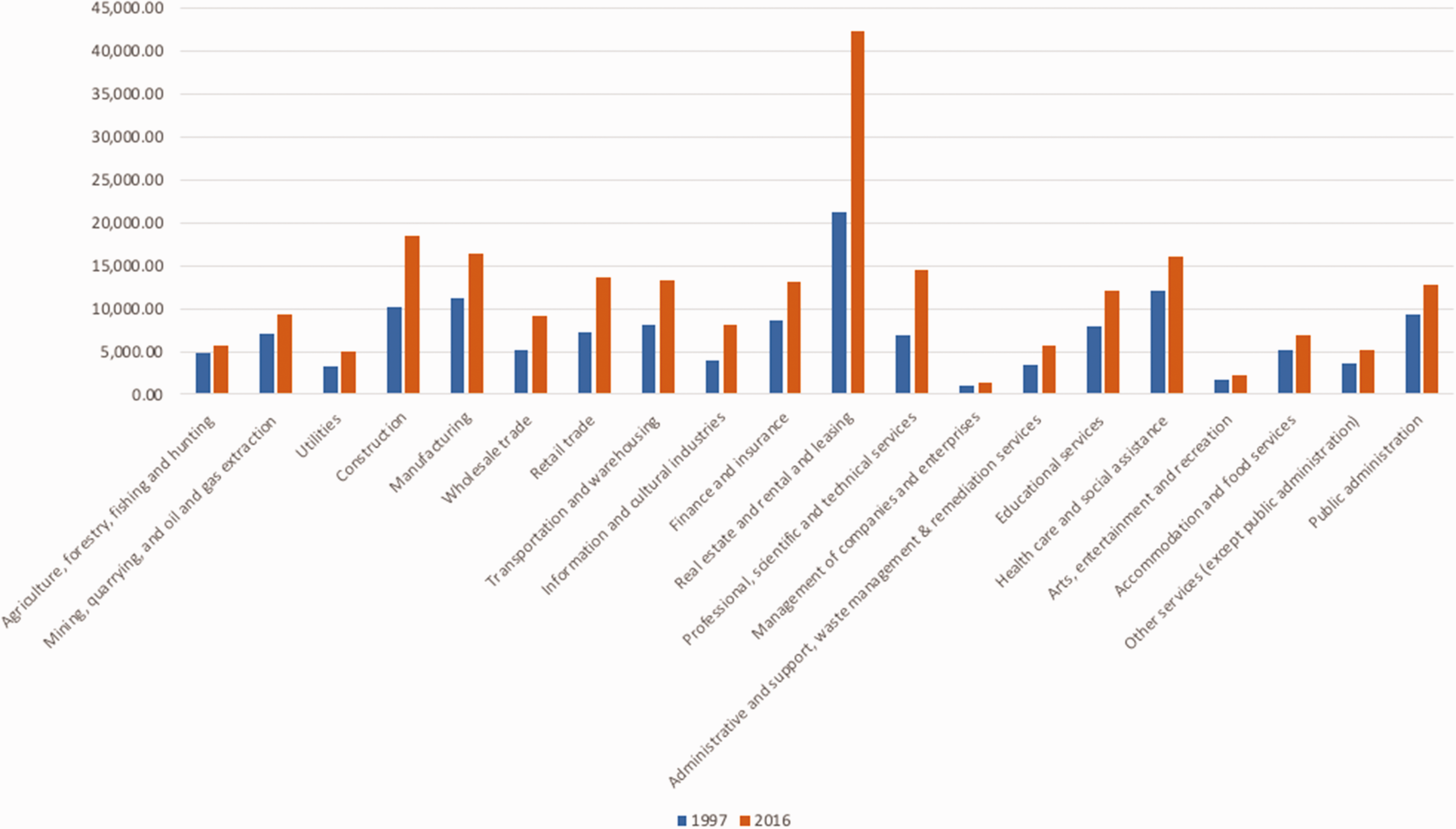
Gross domestic product (GDP) at basic prices, by industry, British Columbia, 1997 and 2016 (x 1,000,000). Source: Derived from Statistics Canada Table 36-10-0402-01 Gross domestic product (GDP) at basic prices, by industry, provinces and territories (x 1,000,000).
As Christophers (2019) points out, data derived from national accounts is at best a rough proxy for the processes that he calls rentierization. And yet, they suggest national and local economies increasingly reliant on rents as drivers of economic growth, and the assetization of landed property across a range of sectors (Horton, 2019; Ouma, 2020; Wu et al., 2020). Rentierization in the care sector in BC has involved accumulation by dispossession of entitlements and rights and the reshaping of norms and institutions of social reproduction. It has also involved the privatization and assetization of social infrastructures of care and related landed property, as described by Horton (2019) in the UK context, through contract rent relations that direct public funds to the creation and maintenance of private assets.
As in the case of contracting out, assetization of property intensified because of government policy explicitly designed to increase the role of the private sector in the delivery of publicly-funded care, and to ensure profitable conditions for those actors, while reducing public investment in care to project a commitment to low taxes and balanced budgets. Contemporaneous with attacks on labour in BC described above was the adoption of New Public Management (NPM) in the public sector. NPM required the opening up of public services and infrastructures to private capital through the implementation of a program of public-private partnerships (P3s), facilitated in BC by the creation of the Capital Asset Management Framework (CAMF) and the agency Public Partnerships BC (Cohn, 2008). A key goal was to reduce capital spending, or get new capital projects ‘off the books’ of the provincial government to make it easier to balance the budget while implementing tax cuts. This goal also implicated the long-term care sector in the assetization of land. There were 293 LTCFs in BC in 2019, the majority in large population centres like the Lower Mainland (the region around and including Vancouver), which experienced some of the biggest increases in land prices and construction activity throughout the 2000s. Health authorities were incentivized to sell and redevelop public land and facilities for major mixed use, high density developments based around condominiums; in other instances private operators were contracted to redevelop their existing LTCF facilities and given permission to include new market-rate residential towers as part of the redevelopment. 12
The land holdings of LTC providers also made them attractive to investors, as in the example of Retirement Systems’ purchase by Anbang Insurance. The leaseback model, under which the “real estate” (property and buildings) of a LCTF or LTC chain is sold and leased to the operating company that provides care services to clients (see Horton, 2019: 7–8 for a discussion), has provided a vehicle for the assetization of property. As the opening quote notes, following Retirement Systems’ acquisition its properties were transferred to Cedar Tree Investment Canada, an Anbang subsidiary, while operational responsibilities remained with the facilities arm of a Vancouver-based investment firm. Complex corporate structures are common among large for-profit healthcare companies (Harrington et al., 2017) and lease-back arrangements are often one in an array of contractual arrangements, including sub-contracting chains for food, facilities services such as cleaning and laundry, and labour. They create opportunities for the extraction of rents throughout the organization of care provision.
The block funding model described above also allows for-profit operators to allocate revenue to property expenses without significant oversight of how public funds are being used in the context of lease-back models, highly leveraged acquisitions, or complex sub-contracting arrangements (including among subsidiaries of multi-national firms). A significant finding of the Seniors Advocate’s report (2020) was large variations in the contracted (for-profit and not-for-profit) sectors in the allocation of revenue. For-profit operators allocated on average 49 percent of revenue to direct care, 17 percent to non-care compensation, 11 percent to supplies, 20 percent to building costs, and 4 percent to profit. Not-for-profit operators, on the other hand, allocated 59 percent of revenue to direct care, 21 percent to non-care compensation, 10 percent to supplies, 9 percent to building costs and less than 1 percent to profit. In other words, in addition to spending less on direct care and allocating more revenue to profit, for-profit operators are allocating double the amount of revenue to funding building costs “with most of this difference attributed to mortgage costs and depreciation” (Office of the Seniors Advocate, 2020: 20). While for-profit providers could have higher mortgage expenses for legitimate reasons, the Senior’s Advocate did not find evidence of higher costs that explained the much higher allocation of revenue to for-profit operators relative to non-profit operators, nor did she find evidence of reporting requirements that required justification of these higher costs. “When capital buildings costs such as mortgages and depreciation are funded it is a form of rent paid to the operator for the use of their building … [which] is reasonable and to be expected. However, the current funding system is not equitable across the contracted sector as a whole [between for- and non-profit operators] and may or may not reflect fair market value” (Office of the Seniors Advocate, 2020: 35).
The report highlights a litany of issues with building costs and huge inconsistencies between the treatment of property expenses (Office of the Seniors Advocate, 2020: 34–35). Some health authorities allow depreciation, mortgage interest, amortization, and replacement reserves to be expensed, while others allow mortgage principal but not depreciation; there is no uniform approach to setting standard amortization periods for calculating depreciation or mortgage payments; the use of amortization and its application as an expense versus revenue is inconsistent; and there is no standard evaluation of reported capital costs for buildings relative to the current value of the building. The cross-subsidization that might occur in single sites with multiple buildings that mix publicly funded long-term care with private independent living and assisted living is not accounted for by most health authorities and, where rent is paid to the owner of the building (and the owner is a related party), there is no auditing of how the rental amount is calculated or the relationship with the related party. In addition, the report explicitly states that profits generated from related businesses owned by care home operators that supply goods and/or services to publicly funded care LTCFs may be hidden or understated in the current funding model and reporting requirements.
All of these dimensions of the current block funding business model allow for-profit operators to pay for expenses related to their property assets out of revenues derived mostly from health authority grant funding and client contributions to publicly subsidized care, which together make up 92 percent of revenues in the contracted LTC sector (Office of the Seniors Advocate, 2020: 19). Yet, the property assets themselves remain privately owned and increases in value are not counted as profits, which allows them to escape scrutiny. Under leaseback models, profits are also derived from the leaseback arrangement itself (as well as from management and transaction fees levied by purchasers, which are often private equity firms, real estate investment companies, or public or private real estate investment trusts (REITs)). As Horton (2019: 8) writes, “Risks are transferred from investors to other actors: a care provider left without its property assets faces less favourable financing terms alongside a new rent bill”. Under BC’s model, in contracted for-profit operations it is public funds that cover these costs to ensure rent relations deliver profits.
The social production of rent relations
The restructuring of seniors’ care in BC in the last two decades was the product of neoliberalization as a class project, through the mechanisms and discourses of balanced budgets and tax cuts (for the well-off), of which the Liberal government was a key agent. In this period accumulation by dispossession of eldercare workers and care recipients, the devaluation of eldercare labour, and normative and fiscal attacks on public institutions supporting social reproduction inaugurated new and expanded rent relations . As I illustrated above, this happened through the creation of new property and regulatory rights, and through a strengthening of the disciplinary, coordinative role of rent, which helps fractions of capital command and control the capture of surplus value and direct the process of accumulation. These processes in turn produce “the rent-based social relation [that] unfolds through struggles over ownership of assets and the payment for right and modalities of their use” (Adreucci et al., 2017: 2017).
Such struggles are not solely intra-capitalist struggles. They involve social and labour struggles across the domains of production and reproduction, including over the intensified exploitation, precaritization, and casualization of labour. Excluding paid and unpaid labour impoverishes our accounts of how rent relations emerge and are institutionalized.
Understanding rent relations in seniors’ care returns us to Haila’s (1990) three questions: how does rent emerge, who or what are its agents, and what is its economic role? It requires broad and equal attention to the first and second questions, as well as an examination of the third – broad and equal attention to what I call the social production of rent relations. I use this term to foreground the socio-political dimensions of how rents arise; their relationship to accumulation, the labour process, and workers’ struggles over norms and institutions of social reproduction; and the role of the state in these processes. To this end, I think there is value in decomposing the category of rent further by distinguishing between: rent-seeking, rentiership and rentierization, and the social production of rent-relations (c.f. Haila, 2015).
Definitions of rent-seeking draw on neo-classical institutionalist literatures, in which rent-seeking is understood as government interference in markets through claiming unearned revenues (taxes, regulations). This body of work is also associated with rational choice theory and work on rent-seeking elites, which rest on assumptions of perfectly competitive ‘free’ markets into which governments introduce ‘rigidities’. Rent-seeking has often been used as a justification for policy approaches like New Public Management that supposedly reduce the role of the state vis-à-vis markets (Tendler and Freedheim, 1994). In fact, as the case of seniors’ care restructuring shows, the role of the state in rent relations is important both in and beyond the establishment of property and regulatory rights (Birch, 2017a: 469). In BC the provincial Liberal government sought opportunities for deriving revenues from rents as a way of decreasing taxation, especially on the wealthy and corporations: the introduction of the flat-rate provincial healthcare levy and the increasing importance of the Property Transfer Tax 13 to provincial coffers are examples. Retaining the concept of rent-seeking highlights the complex relationship of the state at different scales to both capital and an array of social groups making claims to rights and protections (Fraser, 2008). Feminist economists have also extended the concept of rent-seeking to encompass strategies and dynamics that expend resources to create or maintain advantage, regardless of wider social costs, as in the case of gendered and racialized hierarchies of power (see, for example, Braunstein, 2008; Elson, 1999). Given the lack of attention to the production of categories of social difference like race, gender, and class and their relationships with forms of rent and processes of rentierization, this is an entry point. It connects governments, the state, and rent-seeking behaviours with racialized, gendered and classed dynamics of accumulation by dispossession. Moreover, where rent-seeking has direct impacts on the restructuring of the labour process, it highlights how rents may have a role in both coordination and accumulation (through the extraction and capture of surplus value).
If rent-seeking thus highlights dynamics and policies that enable rents to emerge, including through assetization, from policy choices, then the social production of rent relations refers to their contested institutionalization. In other words, the social production of rent relations focuses analytical and theoretical attention on the temporally and spatially-specific rent relations that emerge and attain durability within particular social formations. This is not to advocate a static conception of rent relations, quite the opposite. It is to draw attention to the social, political, and economic forces involved in creating and stabilizing rent relations: it posits rent relations as structural but dynamic. This meso-level conceptualization offers a way of analyzing how the process of rentierization, defined by Christophers (2019: 2) as the “broad-based shift towards economic activities conducted by ‘rentiers’ … structured around the control of, and generation of income (‘rents’) from, scarce assets”, proceeds (see, for example, Kaika and Ruggiero, 2015; Ward and Swyngedouw, 2018). The social production of rent relations highlights how rentiership (Birch, 2017b, 2019), as the spread of practices and norms of assetization and the extraction of rents through different modes of ownership and control, becomes normalized and takes on the coordinative role ascribed by Harvey in a variety of sectors. It also suggests more complex dynamics of capitalistic competition than traditional rent theory allowed. In the case of seniors’ care in BC, accumulation by dispossession produced the conditions through which rent relations are embedded, while simultaneously reshaping social norms through the devaluation of reproductive labour. Care workers, mostly women and many racialized, have borne the costs of the social production of rent relations along with older people reliant on publicly-funded care, while corporations and institutional investors have generated profits.
Conclusion
The election of a left leaning government in BC in 2017 resulted in legislation to nullify Bills 29 and 34 and more investment in LTC care hours, even as concern has ramped up over uncertainty surrounding Retirement Concepts LTCFs. Some health authorities have adopted ‘contracting in’ policies to bring services back under direct public provision, including for eldercare, with the government announcing in 2019 that it would move home support services back under health authority control in Metro Vancouver and southern Vancouver Island (Shaw, 2019). The contradictions in the model of rentierization in the sector are unresolved for LTC and assisted living, however. With the onset of the COVID-19 pandemic, these contradictions shuddered violently into focus for the public and politicians, who have largely chosen to look away from the impacts of restructuring since the early 2000s. The pandemic hit LCTF facilities first and hard (Lindsay, 2020). The BC government reacted to combat the impacts of low pay, casualization, the lack of benefits like paid sick days, and chronic understaffing, introducing wage top-ups and imposing a single site work order. As a result, BC has had fewer deaths in long-term care than other Canadian provinces like Ontario (Liu et al., 2020). There is renewed discussion in BC about the role of for-profit providers in the delivery of publicly funded care (Longhurst and Strauss, 2020), which the industry body (BC Care Providers Association) has vigorously defended. The systemic reliance on for-profit operators, built up in the last two decades, has not decreased, however. These operators are currently benefiting from publicly funded wage top-ups.
Thus, crises tendencies that are produced or deepened by new or evolving social relations of rent, which both depend on and facilitate accumulation by dispossession, are not easily resolved. The forms of property and regulatory relations that underpin them are intentionally durable and link to institutions and regulatory regimes that underpin financialization more broadly. At the same time, an end to role of finance capital in seniors’ care will not automatically banish rent-seeking from the sector. A strength of rent theory is that, through its focus on assetization, it draws attention to those relations and the conditions of their production, rather focusing solely on forms of complex financial engineering or the circulation of finance capital. Both are needed to understand assetization and its implications, including in feminist political economy. And I follow Ouma (2020: 68) in arguing, through my discussion of the social production of rent relations, that “there is an urgent need to unpack and problematize the normative foundations of assetization”.
The literatures on rent and assetization have, however, left labour largely untheorized, with a few important exceptions. Moreover, rent theory has largely failed to take advantage of the insights of feminist scholars (Adkins, 2012; Joseph, 2014; Pollard, 2013, Roberts, 2015) on the financialization of social reproduction, although feminists have returned the favour by also largely ignoring rent theory.There has only been space in this paper to gesture to the role of social difference in structuring the social production of rent relations, and distribution of the risks and costs of rentierization. Much more work could be done to link, for example, racialization in the labour market with the social production of rent relations. Otherwise, however useful a general theory of rent may be in conceptual terms, the political and social implications of rentiership and the social production of rent relations will remain obscured.
Footnotes
Declaration of conflicting interests
The author(s) declared no potential conflicts of interest with respect to the research, authorship, and/or publication of this article.
Funding
The author(s) disclosed receipt of the following financial support for the research, authorship, and/or publication of this article: The research for this project is funded by Social Sciences and Humanities Research Council of Canada (SSHRC) Insight Grant number 35–2016-0872. I would like to thank Feng Xu for her contributions to the paper’s ideas, and Elena Pennell for the work she did as a research assistant on this project.
