




Abstract

Introduction
The implications for energy transition of existing patterns of production, employment and accumulation have begun to emerge as a central concern of public policy. The need to transform high-carbon energy systems in the context of climate change is widely acknowledged, and the last two decades have seen a raft of policy initiatives directed towards expanding renewables. It is increasingly clear, however, that carbon-centric initiatives aimed at switching technologies and resources are insufficient, given the scale and pace of decarbonization required (Galvin and Healy, 2020). Programmes like the US Green New Deal or the European Green Deal (and the subsequent COVID Recovery Plan, Next Generation EU) suggest that a broader and more structural perspective on energy transition is emerging within some policy frameworks. These programmes look beyond specific energy resources and technologies, or the functioning of energy markets, to target net-zero emissions in the context of prevailing patterns of economic production, employment, investment and mobility. Their ‘economy-wide’ perspectives recognize the need for deep decarbonization beyond the energy sector, and typically align decarbonization with broader social goals such as improving societal welfare and reducing socio-spatial inequalities. These initiatives are significant because they open the door to thinking about energy transition in the context of a geographically differentiated political economy. They have the potential to acknowledge, for example, how pathways to decarbonization are conditioned by existing geographies (in relation to legacies of investment in infrastructure, for example) and that carbon-intensive sectors (from energy and heavy industry to food production and housing stock) do not sit ‘on the head of a pin’. Similarly, their recognition of the ways emissions are embedded in prevailing patterns of production and social reproduction has the potential to disclose how certain spaces – the workplace, household, municipality and region, for example – are key sites and scales through which progress towards decarbonization (and more democratic structures of control over energy systems) will be negotiated. In short, the geographical conditions of possibility for energy system transformation are now emerging as a compelling public policy challenge.
The growing salience of a geographical perspective on energy transition within public policy is welcome. At the same time, it invites a response from social scientists who identify with the conceptual and methodological approaches of critical human geography. The papers in this Theme Issue – New energy spaces: Towards a geographical political economy of energy transition – respond both empirically and conceptually. The four papers, initially presented in a session we convened at the 2017 RGS-IBG Annual Conference, examine the unfolding political economy of energy transition through original research closely attuned to transition’s socio-material, territorial and scalar characteristics. Conceptually the papers disclose how energy transition is a space-making process, but one also shaped by spatial contexts. We take forward this perspective in our Editorial, by considering how research on energy transition can productively engage with human geography’s long record of work in geographical political economy. The pay-off, we suggest, is to be able to understand transition as more than a set of socio-technical practices that unfold in different places (cf. Newell, 2019). A geographical political economy of energy transition highlights how transition is shaped by processes (of accumulation, innovation, competition, social mobilization, for example) that are constituted spatially; and, at the same time, it shows how these same processes constitute space through their interactions with one another (i.e. transition as a space-making process). The broad direction of travel here is shared with recent efforts to develop richer accounts of the politics of transition by supplementing socio-technical perspectives with political economy (Lawhon and Murphy, 2012; Meadowcroft, 2009; Murphy, 2015; Newell, 2019; Rutherford and Coutard, 2014; Smith and Stirling, 2010). Our focus on the geographical political economy of energy transition, however, draws attention to the constitutive role of space in energy transition.
New energy spaces signals our focus on the spatiality of energy systems. To be clear, ‘new’ here means the production of novel combinations of energy systems and social relations across space – that is, a process of uneven development – rather than an interest in only certain energy technologies (e.g. those associated with decarbonization). Our focus, then, is as much on spaces characterized by social challenges to high-carbon incumbents as on the proliferation of renewable energy landscapes or marked by the creative–destructive effects of low-carbon innovation. Papers in this Theme Issue evidence some of the diversity of new spaces brought into being by processes of energy transition.
In the next section we make the case for thinking more concretely about what human geography’s accumulated body of research on geographical political economy can contribute to analysing the contemporary experience of energy transition. An explicit focus on the geographical political economy of transition, we think, can contribute to the broad field of ‘energy geographies’ by lending well-formed conceptual tools to its task of disclosing the socio-spatialities of energy system transformation (e.g. Becker et al., 2016; Bridge, 2018; Calvert 2016; Castán Broto and Baker, 2018; Gailing and Moss, 2016; Labussière et al., 2018). In short, the discipline’s record of work in geographical political economy – much of it beyond the field of energy – has something to offer ongoing research in energy geographies on the spatial and ecological politics of energy infrastructures, the governance of novel geo- and bio-energy resource spaces, or the rescaling and re-territorialization of key energy actors. We think there are two significant opportunities here: on the one hand, a field of ‘energy geographies’ more fully infused with and engaged in conceptual debates elsewhere in the discipline; and on the other, the possibility for geographical research on energy system transformation to speak back to broader debates in human geography. The latter, we suggest, may be particularly important as it has the potential to elevate ‘energy geographies’ from a thematic area of human geography (to which a range of conceptual apparatuses developed elsewhere in the discipline are applied) into a primary entry point for understanding and theorizing contemporary geographies of capitalism. The third section reverts to a more traditional orientation for an editorial introduction as we preview the four papers in this Theme Issue.
Geographical political economy and the geographies of energy transition
Socio-technical approaches to energy transition have had something of a political blind spot, downplaying the plural, messy and contested character of its constituent processes (Ahlborg, 2018; Avelino et al., 2016; Baker et al., 2014; Meadowcroft, 2009; Newell, 2019). As Smith and Stirling (2010: 1) put it in an early critique, ‘questions of who governs, whose system framings count, whose sustainability gets prioritized … are all pertinent’ but largely ignored within socio-technical approaches to transition. Over the past decade, a growing body of research has sought to enrich socio-technical analyses of energy system transformation (such as those informed by Geels’ (2005) multi-level perspective (MLP)) by paying more attention to its socially contested and power-laden character (Baker et al., 2014; Geels, 2014; Lawhon and Murphy, 2012; Newell and Mulvaney, 2013; Stirling 2014; Scoones et al. 2015; Power et al., 2016). Transition researchers wanting to admit a greater role for economic and political power into their analyses typically do not start from a systems and technology innovation-centred perspective like the MLP, but begin instead with a society structured around various axes of difference and the always-already character of social inequality. In doing so, they replace transition as a formal and steered mechanism with an emergent, contested processes that emphasizes the ‘collective discovery of preferred social development pathways’ (Meadowcroft, 2009: 42, italics in original; see also Stripple and Bulkeley, 2019). Questions of technological transition become ones of social reproduction and transformation, foregrounding the ‘irreducibly political character of governance for … the long-term transformation of energy systems’ (Meadowcroft, 2009: 323; italics in original). Such an approach is able to show, for example, how the ‘obstacles [to transition] lie more with social and political (rather than physical or technological) obduracies – in intense resistance by incumbent interests, with sunk investments in existing energy sector infrastructures’ (Stirling, 2014: 15).
Over the last decade, energy researchers have moved a long way to acknowledge and incorporate the importance of politics into their analyses of energy transition. However, it has been the research traditions of international relations, international political economy and policy studies that have led the way, rather than geographical political economy. There is, for example, rapidly emerging new work on the geopolitics of energy system transformation that considers the geopolitics of renewables and incumbent fossil fuel producers (and consumers) in the context of growing carbon constraints (Bazilian et al., 2020; Overland et al., 2019; Scholten et al., 2020; Scholten and Bosman, 2016; Vakulchuk et al., 2020). Consequently, research on the political economy of transition has continued for the most part to focus on the national state as the primary spatial unit, via a focus on logics of inter-national competition, collaboration and coordination (but see Kuzemko, 2019). This work shows how ‘energy spaces’ – understood as national territories – are differentiated in important ways, while also bringing this focus on national-level variation into dialogue with bodies of work in economic geography, such as varieties of capitalism (Ćetković and Buzogány, 2016).
There is excellent work on energy from a geographical political economy perspective, as we outline below. But is has not been the primary way by which energy researchers have sought to incorporate a richer sense of the structural, relational and politically contested character of transition processes into their analyses. As far as we can determine, there have been few champions of geographical political economy as a perspective for thinking explicitly about the spatialities of transition, or for strengthening the field of energy geographies. However, existing applications of geographical political economy to themes associated with energy transition illustrate its considerable potential as an approach (e.g. Cumbers, 2013; Dawley, 2014; McCarthy, 2015; Knuth et al., 2019). Indeed, the attentiveness of geographical political economy to the constitutive, multi-scalar character of space, and to the legacies of history in shaping regional development pathways, we argue, is particularly well-suited for analysing the character of transition and its geographical implications. To develop this argument, we use the remainder of this section to outline three contributions of a geographical political economy perspective on energy transition:
Explaining how ‘new energy spaces’ are part of uneven and combined geographical development, a perspective that illuminates how novel energy landscapes – combining both new energy systems and remnants of the old – are continuously produced and reproduced. Situating the evolving spatiality of energy production and consumption within a broader account of dynamics of accumulation including, for example, logics of capitalization and disinvestment associated with energy resources and infrastructures. Analysing how sites, scales and spatialities of energy systems are key contemporary sites of struggle, through which broader questions of political economic governance (and the social relations of capitalism) are being worked out.
We elaborate these three points below in the form of a preliminary framework for thinking about the geographical political economy of energy system transformation. We draw together these three contributions at the end of the section, and bring them into relation with the four papers in the Theme Issue.
Uneven and combined development: The articulation of old and new
A ‘signature move’ of a geographical political economy perspective is to situate energy transition within the wider spatialities of capitalism. Geographical political economy offers a relational perspective on new energy spaces, understanding them as material expressions of uneven and combined development (Sheppard, 2011). Familiar to geographical political economy but less well known in the context of energy geographies, this compound term merits some unpacking. ‘Uneven’ is not merely an observation about the variegated and differentiated character of energy systems: it acknowledges the historic and processual character of spatial difference, and its origins in the dialectical interaction between processes of spatial differentiation and equalization (Smith, 1984). Spatially uneven development occurs, for example, in different ways of infrastructuring (Niewöhner, 2015), the multiple territorializations of energy politics in different nation states or regions, and in the socially and spatially embedded forms of energy-related agency in particular places. ‘Combined’ is just as important, however, and highlights how ‘remnants of previous eras of production are carried over and come into conflict with [the] new’ (Brophy, 2018). It emphasizes the novelty of articulation and recombination, rather than replacement. The relevance of this perspective in relation to energy landscapes and infrastructures is clear: research on energy imaginaries, for example, shows that there are continually evolving ways of producing meaning and identity in relation to ‘new’ and ‘old’ energy spaces (Kuchler and Bridge, 2018), while the social and environmental ‘afterlives’ of coal, oil and gas, for example, frequently shape the futures of the places associated with their extraction and processing (Hudson, 2005; Massey, 1984; Sandlos and Keeling, 2013; Thorsheim, 2002).
Together, ‘uneven and combined’ signal a nonlinear and disequilibrium perspective on the evolution of energy landscapes, and an interest in novelty as an emergent property arising from recombination of old and new. More broadly, it embeds the ‘energy system’ (conventionally abstracted as a set of infrastructures, technologies and social practices) within socio-spatial arrangements of economic and political power. In relation to a particular energy landscape, for example, the key move analytically is to focus on the role of that landscape (e.g. a wind farm or solar park) in reproducing relations of economic and political power, rather than on its spatial form or pattern (e.g. proliferation, diffusion or concentration in space). To argue for a perspective on energy systems that reflects their origins in uneven and combined development, then, is to focus on understanding how ‘energy spaces’ (i.e. the places, networks and scales of energy systems) arise from, reproduce and/or challenge broader spatialities of power.
Regional dynamics of accumulation
A second contribution of a geographical political economy perspective to researching the spatialities of energy transition is to foreground the regional dynamics of accumulation, and the ‘geographically differentiated pathways and institutions’ associated with a region’s economic evolution (Pike, 2020: 15). There is already significant traction within energy geographies on this question around two linked areas of work: on regional clean innovation trajectories, in relation to long-standing questions of path dependency and path creation; and the problem of ‘incumbent energy regimes’ for the process of transition. Regional political economy’s record of work on the local state and its role in urban and regional path creation provides an effective framework for thinking about the emergence of renewable energy spaces, and the links between low-carbon economies and prior regional forms of industrial organization (Affolderbach and Schulz, 2018; Dawley, 2014; MacKinnon et al., 2019; see also Kuzemko, 2019; Kuzemko et al., 2019). As MacKinnon et al. (2019: 115) have argued ‘the adoption of a GPE [geographical political economy] perspective focuses attention on diverse forms of social and economic agency, and the struggles of actors to initiate and reproduce regional paths in the context of broader, spatially uneven processes of production, consumption, circulation, and regulation’. In relation to new energy spaces, for example, path dependency and incumbency highlight the local and regional socio-materiality of energy infrastructures and resource landscapes, territorialized forms of jurisdiction and government and the particularity of local and regional places. Schulz and Bailey (2014) have extended such a perspective to consider the dynamics of post-growth transitions, and whether low-carbon and other ‘green stimulus’ programmes are socially inclusive.
Political economic research on urban and regional regimes offers a spatially sensitive way to think about the problem of incumbency and the policy challenge of dismantling entrenched high-carbon sectors. Calls for research to consider ‘regime destabilization’ are particularly pertinent in the context of the incumbency and enduring social power of fossil fuels (Turnheim and Geels, 2012). Recent work on the devaluations and ‘asset strandings’ in the energy sector ‘being waged in the name of a green economy’ – such as around coal-fired electricity generation in Germany – highlight the regional accumulation consequences of regime destabilization (Knuth, 2017: 100). A growing interest in the ‘exnovation’ required for energy transition – that is, divestment from fossil-fuelled production technologies, infrastructures and social structures (David, 2018) – goes hand in hand, from a geographical political economy perspective, with attention to its spatial consequences. Long-standing questions about the regional development impacts of ‘creative destruction’ are relevant for understanding new energy spaces consequent to the devalorization and unravelling of ‘carbonscapes’ (Haarstad and Wanvik, 2017). Calls for a ‘just transition’ attentive to the regionalized employment consequences of decarbonization, for example, can learn from earlier work on the ‘geographical political economy of closure’ that highlights the ‘conjunctures of structural forces, social agency and particularities of place’ which ‘enable and/or inhibit intervention through public policy and institutional action and political mobilization and resistance’ (Healy and Barry, 2017; Newell and Mulvaney, 2013; Pike, 2005: 95).
The scales and spatialities of governance
A third significant contribution of a geographical political economy perspective is to analyse how the sites, scales and spatialities of energy systems are key contemporary sites of struggle, through which broader questions of political economic governance (and the social relations of capitalism) are being worked out. From this perspective, ‘energy geographies’ refer to the networks of action and scales of governance that produce and sustain concrete landscapes. Power et al. (2016: 17, 12), for example, have made the case for a ‘global and domestic political economy of transitions’ as an alternative to the MLP, arguing it can ‘understand how, where and why transnational actors … shap[e] the regimes, landscapes and niches of … energy systems and with what implications’. More often, however, other scales of action are highlighted: Angel (2019: 338), for example, turns to critical urban theory to analyse the ‘role of urban social movements in remaking energy–society relations’ and highlight the everyday processes of alienation and subjectification that lead to acts of ‘collective defiance’. Van Veelen and van der Horst (2018) similarly examine how social movements articulate local claims for energy democracy to challenge state and market modes of energy governance. Their work explores the role of community-led organizations and the local state in processes of municipalization, while also highlighting how the distributed and networked character of some energy infrastructures can be ‘put to work’ in rescaling governance (van Veelen and van der Horst, 2018, citing Smith and Stirling, 2016).
Others have turned directly to regional political economy to understand the contribution of social movements, the state and public ownership arrangements in enabling new energy spaces such as rapid transitions to renewables. Cumbers (2012), for example, considers the rediscovery of the state in relation to the governance of energy systems in the context of neoliberalism, and the return of public ownership in a localized (municipal or regional) form. This work shows, for example, the decisive role of decentralized and localized forms of collective ownership (around wind turbines and electricity distribution networks) in shifting Denmark towards decarbonization from the 1980s (Cumbers 2013). More broadly, this perspective underpins work on regionally constituted energy cooperatives as ‘diverse economies’ at the ‘interface between state, market and civil society’ (Klagge and Meister, 2018: 697); and an interest in the energy ‘commons’ and alternative property rights arrangements associated with new energy spaces (Magnani et al., 2018; van der Horst and Vermeylen, 2008). As a perspective, geographical political economy is able to show how the governance of new energy spaces via cooperatives and other forms of collective ownership depends, at the same time, on existing and unequal arrangements of power as well as on the financialization strategies of powerful stakeholders (Gailing and Röhring, 2016).
Towards transition as a space-making process
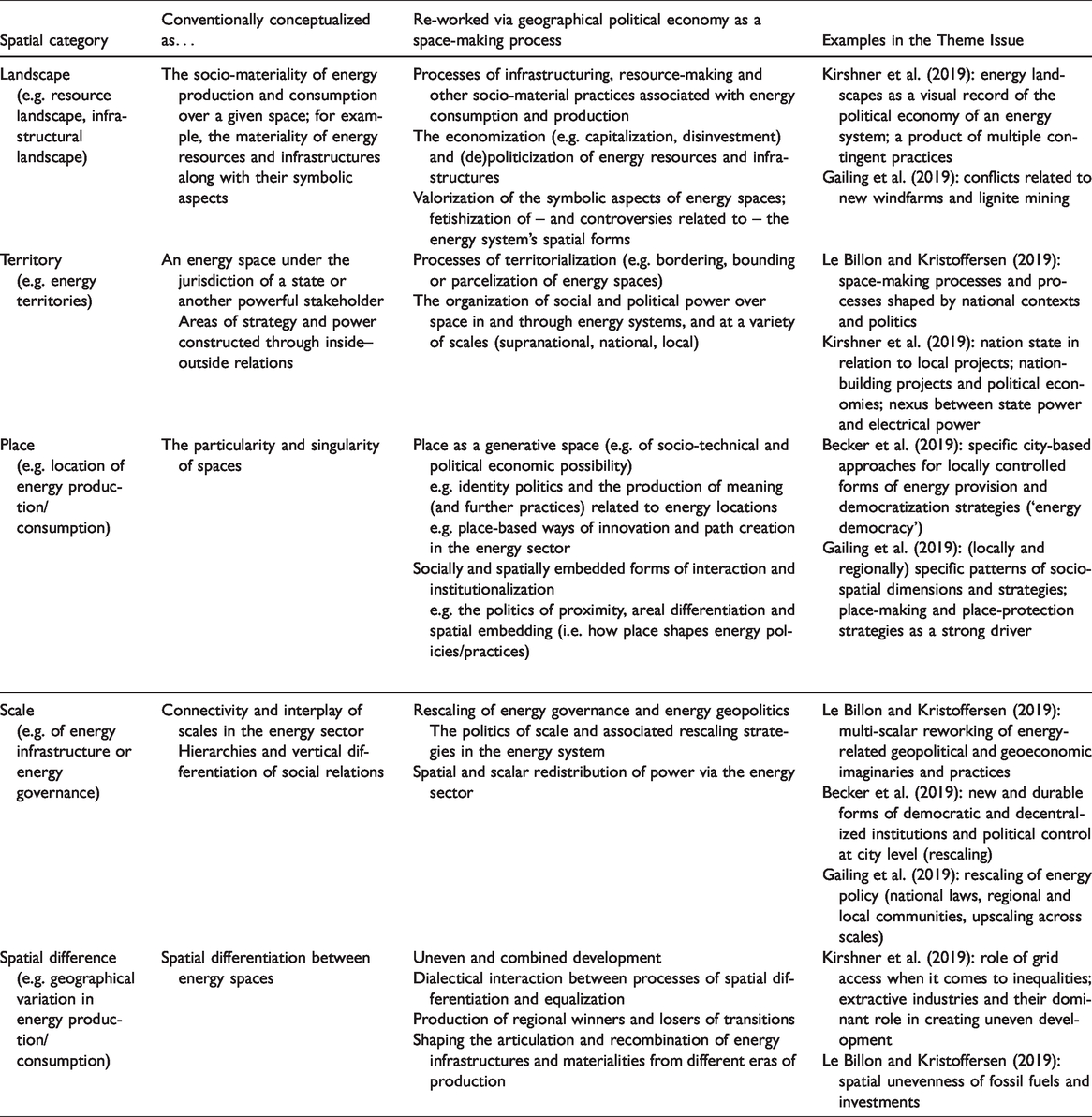
The three contributions we have identified – uneven and combined development, regional dynamics of accumulation, and spatial and scalar aspects of political economic governance – reflect the emergent and relational approach to space that characterizes geographical political economy. Our argument is that this conceptual perspective – which foregrounds transition as a space-making process – can complement the lexicon of spatial categories more often used within energy geographies to describe and analyse ‘new energy spaces’ (e.g. landscape, territory, place, scale, spatial difference). On their own, each of these conventional spatial categories is unable to grasp the complex realities of the geographical political economy of energy transition (an argument that Jessop et al. (2008) have made more generally). Geographical political economy, however, introduces structural and relational perspectives with which to re-work these spatial categories, augmenting their capacity to do analytical work.
Table 1 represents our attempt to systematize this process in relation to some common spatial categories used to describe and analyse energy systems. It shows how the perspective of geographical political economy may be harnessed to re-work these common spatial categories, in order to understand transition as a space-making process. In Table 1, geographical political economy transforms a set of essentialist categories into socio-spatial processes that are uneven, dynamic and contested over time and space. Table 1 is informed by the preliminary framework outlined in this Editorial and by recent work conceptualizing the geographies and dynamics of energy transitions (Balmaceda et al., 2019; Becker et al., 2016; Bridge et al., 2013, 2018; Gailing et al., 2019; Labussière and Nadaï, 2018). We intend Table 1 to be read across rather than down. The table first characterizes how a specific spatial category is conventionally understood, then explains how it may be re-worked through an encounter with geographical political economy to highlight transition in space-making processes, and finally references it to examples in the Theme Issue papers.
Harnessing geographical political economy: from spatial categories to space-making processes.
The Theme Issue papers
In this section, we briefly introduce the papers of the Theme Issue and situate them in relation to the space-making processes outlined in Table 1. The four papers have different empirical foci and adopt varied approaches to the spatiality of energy. Empirically, they are a reminder of the plurality of ‘energy transition’ – its multidimensional character and how the drivers and imagined goals of transition vary spatially.
‘Energy landscapes’ take centre-stage in the contribution of Kirshner et al. (2019), which examines energy landscapes in the post-conflict environment of Mozambique. The paper harnesses the familiar spatial concept of ‘landscape’ to make sense of energy spaces as a result of a multitude of contingent practices, re-tooling it for this purpose by infusing it with an explicitly multi-scalar and political economy perspective. In the authors’ account, energy landscapes become a visual record of the political economy of an energy system. The projects, infrastructures and imaginaries surrounding energy landscapes are shown to be important for centralized nation-building processes in Mozambique; and, at the same time, different models of regionalization in the energy system are an outcome of infrastructural fragmentation and the absence of universal connection. The authors show how at times energy infrastructures in Mozambique have become a means of furthering national unity, but find that the Mozambican state’s efforts to bind territory together via energy provision have increased division between rural and urban areas and among different socio-economic groups. The evolving links between state power and electrical power are also highlighted in relation to new logistical corridors for power export to South Africa, and the export of coal from inland rural centres to the coast.
Whereas Kirshner et al. (2019) show the fragility of the nexus between state power and electricity infrastructure, Le Billon and Kristoffersen (2019) consider the territorial authority of the state and its potential for shaping national and international energy spaces by mandating cuts to fossil fuel production. Their paper explores an emerging range of potential supply-side solutions to limit the production of fossil fuels in the name of a just transition, noting their significant geopolitical and economic consequences. Their analysis opens up questions about transition’s spatial consequences and, in particular, the radically divergent spatial futures arising from apportioning supply-side cuts according to different notions of justice. Le Billon and Kristoffersen’s paper highlights the geopolitical economy of fossil fuel supply-side constraints, and the potential for a radical re-spatialization of global uneven development via changes in major financial flows and international geographies of energy production and consumption.
The rescaling of energy systems is at the centre of Becker et al.’s (2019) paper on new, durable, democratic and decentralized institutions at the city level. The paper represents a creative convergence of work on energy democracy and the right to the city via urban energy struggles. The authors identify these struggles over alternative energy futures in Berlin and London as a contemporary moment for asking about the analytical potential of the ‘right to the city’ and its effectiveness as a political strategy. They discuss specific city-based approaches for locally controlled forms of energy provision and democratization strategies in Berlin (‘Energietisch’) and London (‘Switched on London’). Here, the spatiality of urban infrastructure provides a political opening for recasting social and economic power, as well as for challenging corporate and state power. The authors identify how struggles and initiatives for remunicipalization in the two cities are place-based, linked to broader urban society and developed in relation to the municipal state and bureaucratic governance; at the same time, they show how multiple scales beyond the city are also relevant. This multi-scalar quality raises questions about how to organize locally in ways that challenge and reform wider scales of governance; and about how struggles can be transformative beyond one place and time, particularly when claims for municipalization appear limited as they target the local state in a single city. Becker et al. (2019) show how Berlin and London are embedded in both an internationalized energy system and a global climate justice movement, but initiatives in these cities for energy democracy cannot be understood without taking into consideration socially and spatially embedded interactions and forms of institutionalization in the cities themselves.
These kinds of interactions and connectivities between different spatial categories take centre-stage in the paper by Gailing et al. (2019) on the socio-spatial dimensions of energy transitions. The authors argue that the value of applying Jessop et al.’s TPSN framework (territory, place, scale and network) to renewable energy regions is its ability to show dynamic interactions and interrelations among the four spatial ontologies, and the particularities of specific spatial actor strategies. The paper shows the polymorphic nature of socio-spatial relations, and how space-making within the German energy transition is not a one-dimensional process but is characterized by complex and differentiated dynamics across different fields of action. The paper shows the dialectic relation between different spatial categories (territory, place, scale and network) and strategies and processes (territorializations, place-making, scaling and networking). The authors argue that when it comes to understanding the geographical political economy of energy transitions, however, it is necessary to go beyond the limitations of TPSN. Specifically, it is important to understand how power is embedded in each of these spatial categories, the way processes of politicization and depoliticization occur around each of them, and how space-making processes and strategies are linked to the materiality of resources, infrastructures and physical landscapes.
Footnotes
Declaration of conflicting interests
The author(s) declared no potential conflicts of interest with respect to the research, authorship and/or publication of this article.
Funding
The author(s) disclosed receipt of the following financial support for the research, authorship and/or publication of this article: Ludger Gailing acknowledges a Durham University Senior Research Fellowship (COFUND-Programme of the European Commission, Marie Skłodowska-Curie Actions), April-July 2017.