




Abstract
Entrepreneurship is often seen as the cure-all solution for poverty reduction. Proponents argue that it leads to job creation, higher incomes and lower poverty rates in the cities in which it occurs. Others argue that many entrepreneurs are actually creating low-productivity firms serving local markets. Yet, despite this debate, little research has considered the impact of entrepreneurship on poverty in cities. This paper addresses this gap using a panel of US cities for the period between 2005 and 2015. We hypothesize that the impact of entrepreneurship will depend on whether it is in tradeable sectors, so likely to have positive local multiplier effects, or non-tradeable sectors, which may saturate local markets. We find that entrepreneurship in tradeables reduces poverty and increases incomes for non-entrepreneurs, a result we confirm using an instrumental variable approach, taking the inheritance of entrepreneurial traits as the instruments. In contrast, while there are some economic benefits from non-tradeable entrepreneurship, we find these are not large enough to reduce poverty.
Introduction
Entrepreneurship is sometimes portrayed as a panacea for economic development. The economic benefits are, in general, well established: each successful new venture is often deemed to have a direct effect on the local economy – creating new jobs in the firm itself and introducing new products and technologies into the local economy (Acs and Storey, 2004; Fritsch, 2013; Fritsch and Noseleit, 2013). A positive impact forces a response from other firms, which must adopt new practices, introduce new products or close. This Schumpeterian (1934) process of creative destruction will, in the long-term, lead to economic growth, job creation and higher incomes. It also means that the benefits of entrepreneurship are wider than those experienced by the individual entrepreneur: they affect other workers in the city or region. Because of this, entrepreneurship has become an important tool for policy-makers seeking to create jobs and address entrenched poverty (Storey, 1994). City and regional decision-makers are no exception, frequently enthusiastically launching initiatives to try to stimulate entrepreneurship and, in turn, grow their local economies (Lerner, 2009).
Yet, ‘entrepreneurship’ is a diverse phenomenon and the term is used as shorthand for a wide range of different activities (Fritsch and Storey, 2014; Lerner, 2009; Mason and Brown, 2013; Mayer et al., 2018; Nightingale and Coad, 2013; Storey, 1994). Politicians and the media mostly concentrate attention on start-ups in tradeable sectors, such as digital technology or manufacturing. But most entrepreneurs are replicating existing business models in low-productivity, non-tradeable sectors, like hospitality or retail (Shane, 2009). Firms in the former category are likely to create new jobs and raise incomes directly, in the firm itself, and indirectly, through local multipliers (Moretti, 2010). However, a new venture in a non-tradeable sector may simply saturate existing markets: a restaurant can create new jobs, but competing restaurants nearby will lose out. Other new ventures may be poor uses of the human capital of founders, who would be more productive working in another firm (Vivarelli, 2013). These low-quality start-ups are particularly likely in weaker local economies that lack the favourable ecosystem required to create innovative new ventures (Spigel, 2017). Because of this, certain types of entrepreneurship, in specific local contexts, could actually reduce incomes and cost jobs (see Greene et al., 2004). Mueller et al., (2008: 1) call this the ‘wrong type of entrepreneurship’.
Policy-makers, when promoting new entrepreneurship schemes, usually ignore the potential drawbacks of entrepreneurship and focus on its advantages. They generally argue that entrepreneurship will reduce poverty and increase incomes for disadvantaged groups. US President Barack Obama created start-up ‘accelerators’ with the aim of stimulating growth in lagging regions. His successor, Donald Trump, has supported global entrepreneurship initiatives which, he argues, would mean ‘millions of people will be lifted out of poverty’ (White House, 2017: 1). For policy-makers seeking to address entrenched regional poverty and disadvantage, entrepreneurship is an important, politically acceptable tool. And there is some support for this position in the literature on entrepreneurship, which generally shows a positive, but two-way, relationship with local economic performance (Fritsch and Noseleit, 2013; Fritsch and Schindele, 2011; Glaeser et al., 2015; Lee, 2017; Mueller et al., 2008). Yet the evidence more specifically on its wider impact on disadvantaged groups is relatively weak and focused on the impact on the entrepreneurs themselves (Bruton et al., 2013; Frankish et al., 2014; Fritsch and Storey, 2014). Poverty reduction is an important goal of economic policy because it captures the living standards of the very least well off, rather than gains to those who are already more affluent. Poverty is a reflection of income, rather than just wage rates or unemployment, and so focuses on one important outcome of labour market processes. Yet few studies have considered the distribution of the wider gains from entrepreneurship. Hence, the question remains: Does entrepreneurship reduce poverty?
In this paper, we investigate the impact of entrepreneurship on poverty in a panel of US metropolitan statistical areas (henceforth ‘cities’) for the period 2005–2015. Our primary research question is: (1) does entrepreneurship in a city reduce poverty for non-entrepreneurs? As theory also suggests that new firm creation can vary according to which share of entrepreneurship is in tradeable – which might lead to multiplier effects in local economies – versus non-tradeable sectors – which may saturate local markets and reduce the incomes of incumbents (see North, 1955; Tiebout, 1956) – we address a second research question: (2) does the distinction between entrepreneurship in the tradeable and non-tradeable industries matter? As far as we are aware, we are the first to test the influence of entrepreneurship on poverty in urban areas and also how this potential impact varies according to type of entrepreneurship. Given that entrepreneurship forms an important part of many economic development strategies and that reducing poverty is a key goal of these strategies, this represents a central gap in the existing knowledge.
We focus on cities for several reasons. The first is that entrepreneurship is inherently geographical, with its geography often persistent over time (Fotopoulos and Storey, 2017). Certain cities and regions are considered to have developed local cultures that facilitate entrepreneurship (Huggins and Thompson, 2016), sometimes even at the neighbourhood scale (Andersson and Larsson, 2016). Other areas are, by contrast, considered to have local or regional ‘ecosystems’, which are averse to the creation of new firms (Spigel, 2017; Stam, 2015). Where a potential entrepreneur lives or decides to (re)locate his or her activity is, therefore, essential in determining the likelihood of success. Second, the wider effects of entrepreneurship are likely to be felt in urban labour markets (Fritsch and Noseleit, 2013; Kemeny and Osman, 2018; Moretti, 2010). Because of this, our research investigates the indirect impact of entrepreneurship on non-entrepreneurs.
The results suggest that entrepreneurship is not, in general, enough to reduce poverty. However, entrepreneurship in tradeable sectors does seem to do so. Tradeable entrepreneurship also has a positive impact on overall earnings, with the largest gains accruing to those working in tradeable sectors and to mid-skilled workers. In contrast, entrepreneurship in non-tradeable sectors seems to have no impact on poverty reduction and a small impact on earnings, with the benefits focused on other workers in non-tradeables and associated with high-skilled workers overall. We exploit the tendency of entrepreneurship to be inherited in an instrument which addresses potential causality concerns.
The paper is structured as follows. The next section considers the literature on the economic benefits of entrepreneurship, focusing on the wider benefits in the local economy and the importance of different types of entrepreneurship. After that, we describe the data and present some basic statistics about these measures. The fourth section outlines a series of regression results testing these relationships, and the final section concludes with implications for theory, empirical work and policy.
The wider benefits of entrepreneurship
Entrepreneurship and poverty reduction
The view that entrepreneurship has positive economic effects stems, in part, from Schumpeter (1934). He introduced the idea of creative destruction: the entrepreneur introduces new ideas into the market, forcing a response from other firms which either innovate themselves or close. This triggers economic renewal. The waves of revitalization are part of processes through which local economies reinvent themselves and thrive (Giaoutzi et al., 1988). They suggest both a direct impact of entrepreneurship, the jobs in the new firm, but also an indirect one, as incumbent firms react. Fritsch and Mueller (2004) identify four indirect effects: (a) competition increases efficiency in incumbents; (b) structural change towards more productive sectors; (c) encouragement of innovation; and (d) increased variety in the local economy, leading to additional economic opportunities. High-productivity firms are more likely to survive, meaning that aggregate productivity will increase in the long run (Fritsch, 2013). Entrepreneurship may thus enhance economic development and an established literature suggests that entrepreneurship is associated with job creation and higher wages (Baptista et al., 2008; Lee, 2017; Parker, 2018).
The extent to which the economic benefits of entrepreneurship reach those in poverty is unclear. Unlike wages, poverty is normally measured at the household level. It has two main economic determinants (alongside welfare benefits): (a) wage levels, and (b) work intensity, or the availability of jobs or hours of work. The same mechanisms through which entrepreneurship improves urban economies should, in theory, increase both wages and work intensity. If entrepreneurship creates jobs, this may benefit disadvantaged groups; indeed, it has been suggested that rapid growth forces firms to be more inclusive when hiring (Coad et al., 2014). In the USA, the effect may even increase as employment allows workers to claim some welfare (the Earned Income Tax Credit (EITC)), thus reducing household poverty (Kenworthy and Marx, 2017). At the same time, job creation can increase competition for labour, encouraging employers to raise wages. The assumption behind strategies that use new firm creation to address urban poverty is that the economic effect of entrepreneurship will be both strong enough and well-targeted enough for these effects to lift incomes for those who need it most.
Yet there are also reasons to be sceptical of these mechanisms. In particular, there may be a problem related to the quality of new jobs, with new jobs having low earnings or few hours. In the USA, more than 70% of the working-age poor are already in employment (OECD, 2009). Consequently, increasing employment is not always a guarantee of falling poverty. Second, there may also be allocation problems: if the benefits of entrepreneurship translate into more hours for existing workers (Gerritse and Rodríguez-Pose, 2018) or go to second-earners in already affluent households, the impact on poverty will be limited. This allocation issue is particularly likely given the potential skill bias in employment creation, especially as low qualification levels are one of the key determinants of poverty (Kenworthy and Marx, 2017). Finally, there may be leakage from the local labour market. New jobs can be taken by those living outside the local area, or immigrants, leaving poverty unchanged. In short, while there are likely to be pronounced economic benefits from entrepreneurship, these will not necessarily reach the poor.
Export base theory and the economic effects of entrepreneurship
The term ‘entrepreneurship’ hides a wide range of new venture types – these differ in their growth ambition, chances of success and impact on local economies. The impact of entrepreneurship will, to a large extent, depend on the type of new firm (Dejardin and Fritsch, 2011; Fritsch, 2013; Fritsch and Schindele, 2011). There has been a tendency to regard all entrepreneurship as potentially economically transformative, but many small firms are marginal, undersized, poorly performing enterprises – Nightingale and Coad (2013) call these ‘Muppets’. There have been a number of attempts to differentiate between different types of entrepreneurship (Block et al., 2017). One comes from Baumol (1990), who points out that while many entrepreneurs introduce innovations of some form (productive entrepreneurship), others may simply be rent seeking (unproductive entrepreneurship). For Baumol, the key to a growing economy is that the incentives for entrepreneurial activity should be skewed towards the former. Another categorization comes from the distinction between necessity and opportunity entrepreneurship (e.g. Williams, 2007). Opportunity entrepreneurs are more likely to be classic entrepreneurs in the Schumpeterian mould, identifying an opportunity and creating a new venture to exploit it. In contrast, necessity entrepreneurs are driven to entrepreneurship when they are unable to obtain formal employment at the reservation wage.
Because of our focus on the wider impact of entrepreneurship on cities and regions, we adopt an alternative classification using export base theory. Dating back to the debates between North (1955) and Tiebout (1956), this suggests that the strength of an economy depends in part on the extent to which it is specialized in exporting industries. This idea is one of the foundations of economic development and there has been a resurgence of interest in the topic recently thanks to the work of Moretti (2010) and Moretti and Thulin (2013). In this model, the economy is divided into non-tradeable and tradeable activities. Non-tradeable activities service local demand, with consumption taking place at the point of production. These include restaurants, retail, personal services and construction. In contrast, tradeable activities, such as parts of finance, consultancy or manufacturing, can be performed anywhere.
We can model the impact of entrepreneurship in three stages: the decision to become an entrepreneur; the chances of the firm surviving; and the wider local economic impact of the new venture. Each depends crucially on poverty rates in the local economy.
A new venture in non-tradeables might have a positive effect on the local economy, by introducing new technologies and innovation or by improving productivity and forcing a response from other local firms. But in non-tradeable industries the effect may also be negative: if local demand for a service does not increase, new ventures may saturate local markets. A new firm comes at a potential cost to other local firms. For example, a new restaurant may simply reduce the incomes of other nearby restaurants. In theory, this may be economically efficient if workers transfer from one industry to the other, but in practice workers often remain attached to their business and so the reallocation process will not happen. In contrast, the impact of a new venture in a tradeable sector is more clearly positive. A new tradeable firm may be competing with companies outside of the local economy. In this respect, it reflects one of Schumpeter’s (1934: 66) original insights: ‘The opening of a new market, that is a market into which the particular branch of manufacture of the country of question has not previously entered, whether or not this market has existed before.’ It will also have a multiplier effect locally as increased demand (Moretti, 2010, 2011). For example, a new factory generates jobs in that factory, followed by new jobs locally through the personal spending of the employees or other local services used by the firm itself. These then have an additional impact themselves, eventually creating a knock-on multiplier effect in the local economy. In short, the economic development impact of non-tradeables is ambiguous as it may saturate local markets. But the impact of tradeables is more likely to be positive: a disruptive firm in a tradeable sector may be unsettling markets which are far away. The cost is distant, but the benefits are local.
The empirical evidence generally supports the idea that entrepreneurship has a positive impact well beyond the benefits to the entrepreneur. For example, Baptista et al. (2008) find that the indirect effects of entrepreneurship on employment in Portugal are larger than the direct effects, but occur almost a decade after a new business is created. Studies on wages are often similarly positive. Lee (2017) focuses on US cities in the two decades to 2003, and shows that increases in the number of small businesses are associated with higher employment and wages in around 10 years, with this effect extending beyond those directly employed. Yet this literature offers little guidance on the potential impact on poverty. Some research has analysed the potential for entrepreneurship to get the entrepreneur him or herself out of poverty, with a focus on the ‘base of the pyramid’ and the Global South (Bruton et al., 2013). One exception is Frankish et al. (2014), who consider the residential mobility of entrepreneurs in the UK, showing that business owners are more likely to move from deprived to less deprived neighbourhoods. Other studies have looked at poverty reduction from other, related economic development initiatives. Lee and Rodríguez-Pose (2016) show that high-tech employment in US cities, a tradeable sector, increases wages for low-skilled workers, but that the effect is too small to reduce poverty (Lee and Clarke (2019) and Kemeny and Osman (2018) report similar results). Fowler and Kleit (2014) show that US industrial clusters are associated with less poverty. There has been, however, little systematic research on the relationship between entrepreneurship and poverty.
In summary, there are clearly defined theoretical mechanisms suggesting that entrepreneurship has a positive external effect on workers in the same city. Empirical evidence tends to support this view. Yet there is little specific evidence on whether this reduces poverty. Building on this, our first hypothesis is:
H1. Entrepreneurship will reduce poverty among local non-entrepreneurs.
A second theme in the literature is that ‘entrepreneurship’ is highly diverse – this will be reflected in the economic impact of different types of new ventures. As firms in tradeable sectors are particularly likely to benefit the local economy, we hypothesize that the external impact of tradeable sectors will be higher than that of non-tradeables:
H2. Tradeable entrepreneurship will reduce poverty.
H3. Non-tradeable entrepreneurship will not reduce poverty.
Data and definitions
The American Community Survey
The primary source of data for this study is the American Community Survey (ACS) micro-data for the period 2005–2015, accessed via the University of Minnesota’s IPUMS service (Ruggles et al., 2018). The ACS is the largest Census Bureau-administered survey and includes more than three million households per year, allowing data to be provided for geographical units with above 65,000 resident population (see Spielman and Singleton, 2015). We use the data at the metropolitan statistical area (MSA) level. This is a geographical unit consisting of a central urban core alongside contiguous counties that have close functional or commuting links. US MSAs approximate a functional city economy reasonably well. One variable – population density – is not available for these boundaries. In order to create a viable alternative, we use county-level data and amalgamate it at the MSA level. The final dataset covers the period 2005–2015. To maximize our sample, we use the full period possible resorting to consistent ACS data. Nevertheless, and as definitions change over the period of analysis, some MSAs enter and leave the panel. We present results using the full sample but tested using the unbalanced sample, which led to little change in the core results.
Identifying entrepreneurial activity
Empirical work uses many different definitions of entrepreneurship (Mayer et al., 2018). For this study, our focus is on finding an indicator allowing us to identify the characteristics of the entrepreneur and their firm, but also distinguishing the self-employed from those starting up businesses. 1 One common option – self-employed with employees – is not available in the ACS data. Instead, we define entrepreneurs as those who work for themselves but who are incorporated. The formal step of incorporation allows people to become limited liability, raise capital on public markets and benefit from a corporate structure more generally (Hipple and Hammond, 2016). Guzman and Stern (2015) use incorporation as one indicator in an index of entrepreneurial quality, which they then show predicts firm growth. Similarly, Levine and Rubinstein (2017: 964) focus on the activities performed by different forms of entrepreneur, finding ‘the incorporated tend to engage in activities and open businesses that are more closely aligned with core conceptions of entrepreneurship than the unincorporated’. These activities include using creative, non-routine cognitive skills or managerial skills. Bureau of Labour Statistics (BLS) data for 2015 suggest that around 42% of the self-employed and incorporated have paid employees (Hipple and Hammond, 2016). While this may capture some more traditional self-employed, it will include those who have yet to hire their first employee, but will do so in the future. It also filters out gig-economy workers or the dependent self-employed. One concern is endogeneity with the size of employment (because successful entrepreneurs create jobs), so our variable is the share of the total population in this category. In 2015, around 2.5% of the working-age population, representing 3.2% of the labour force, were in this group.
Categorizing entrepreneurship: Tradeable and non-tradeable sectors
We make a second division to reflect the tradeable versus non-tradeable distinction. We follow recent studies – such as Faggio and Overman (2014), Lee and Clarke (2019) and Kemeny and Osman (2018) – in distinguishing between tradeable and non-tradeable industries on the basis of their geographical concentration. Some industries are broadly geographically dispersed as they must locate close to the point of consumption. For example, food retail or hairdressing will, generally, follow the distribution of the population. In contrast, other industries can be traded across space – for example, televisions can be manufactured in one city but sold elsewhere. Tradeable industries are thus more likely to be geographically concentrated. This intuition forms the basis of Jensen and Kletzer’s (2006) classification of industries in the USA. Most service industries, such as retail, restaurants, healthcare and personal services, are non-tradeable, along with construction and a small proportion of manufacturing sectors, such as cement and concrete production. In contrast, tradeables include non-retail parts of finance, many knowledge-based activities producing intangible goods and most manufactured activity. While all manufacturing is considered tradeable, most advanced service industries, such as research and development (R&D), television and radio and financial services, are also tradeable.
This classification has successfully formed the basis of a number of other studies (Faggio and Overman, 2014; Kemeny and Osman, 2018; Lee and Clarke, 2019). The exact division between tradeables and non-tradeables is, inevitably, fuzzy. Some firms in, for example, specialist retail may serve international markets or tourism. In some sectors, some firms may serve local markets but others international ones. Notwithstanding this, the distinction used here is clear and theoretically intuitive, has been successfully used in other studies and is operationalizable using the detailed industrial classifications available in the ACS data.
Measuring poverty
The main focus (and novelty of the paper) lies on where the gap in our knowledge lies: poverty. We measure poverty using the proportion of the population living in families with incomes below the official poverty line. These data are extracted from the US Social Security Administration. In contrast to wages, poverty is defined at the family level (adults living alone are counted as a family). The US poverty line is based on a historic definition taking into account the availability of food. The poverty line is adjusted over time to account for changes in the cost of living. The adjustment, unfortunately, does not take place at the city level, meaning that we may understate poverty in high-cost regions. Data are equivalized to reflect the number of dependent children up to the age of 17 and the higher living costs associated with larger families. This is a tightly defined measure (Greenberg, 2009) and we follow Lee and Rodríguez-Pose (2016) in reporting our results at different percentiles of the poverty line. This helps to adequately assess the impact of entrepreneurship on extreme poverty (those far below the poverty line) and families on higher incomes. The aim behind the choice of poverty, rather than wages or job creation, as has generally been the case in the past, is to focus on households in need. The benefits of entrepreneurship are mostly translated into higher wages or new jobs. Increases in wages mainly go to those in employment, whereas new jobs frequently go either to fairly skilled individuals or second-earners in already affluent households. None of these groups are necessarily low-income. Hence, it may be the case that entrepreneurship can generate new jobs and higher wages without leading to falls in poverty.
Our main focus does not imply that we disregard wages and job creation. First, wages have been the object of frequent scrutiny in research dealing with entrepreneurship. The ACS data have, nevertheless, two principal advantages that allow us to go beyond past research. One is that we are able to decompose the benefits by sector. As outlined above, new firms in non-tradeables may saturate local markets and lead to a negative impact on wages for other workers in the same sector. The ACS data have top coding – where the very highest incomes are truncated to avoid disclosure – and this may influence our calculation of top incomes. We avoid this problem (and that of extreme outliers) by winsorizing the data at the 5th and 95th percentiles.
Second, regarding job creation, we assess how much of any additional employment generation linked to entrepreneurship benefits new workers or workers already engaged in the labour market. This helps us consider whether any wage effects are due to new entrants into the labour market (Lee and Clarke, 2019). Note that this is not equivalent to the indicator of employment growth used in many studies, as it is the share of the working-age population in employment at any time.
The key relationship of interest for this paper is that between entrepreneurship and the poverty rate. Figures 1 and 2 present scatter plots for these two variables in our final year, 2015. There is a negative and statistically significant relationship between poverty and entrepreneurship of both forms, with a marginally higher correlation for tradeable entrepreneurship (correlation coefficient = −0.37, p < 0.01) than for non-tradeable entrepreneurship (−0.29, p < 0.01). The two forms of entrepreneurship are relatively highly correlated (0.58, p < 0.01). This might be because the two are fuzzily distinct, as set out above, or, alternatively, it might indicate that entrepreneurship in either tradeables or non-tradeables may stimulate further entrepreneurship in the other sector.
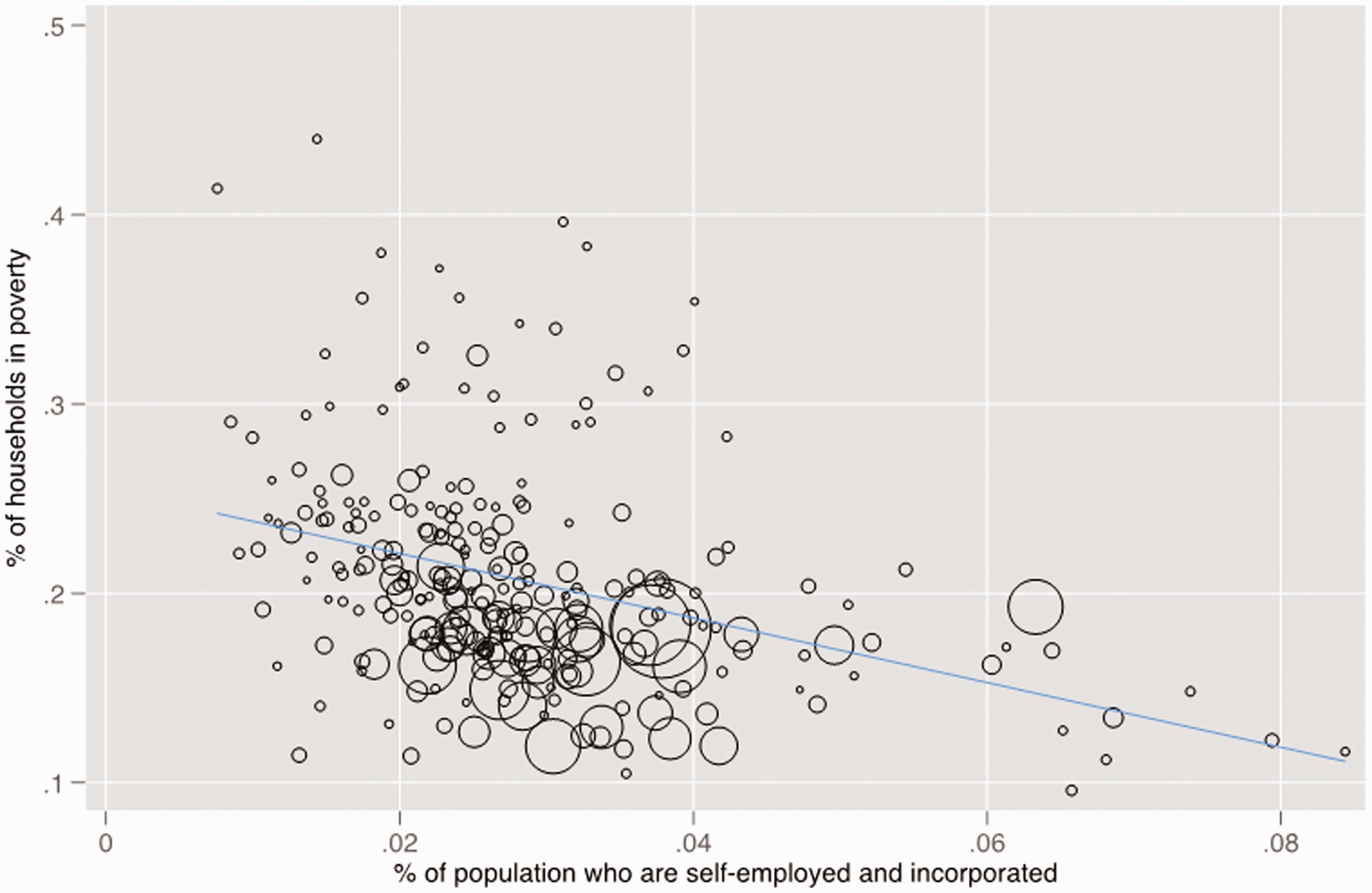
Poverty vs. entrepreneurship in US metropolitan statistical areas, 2015.
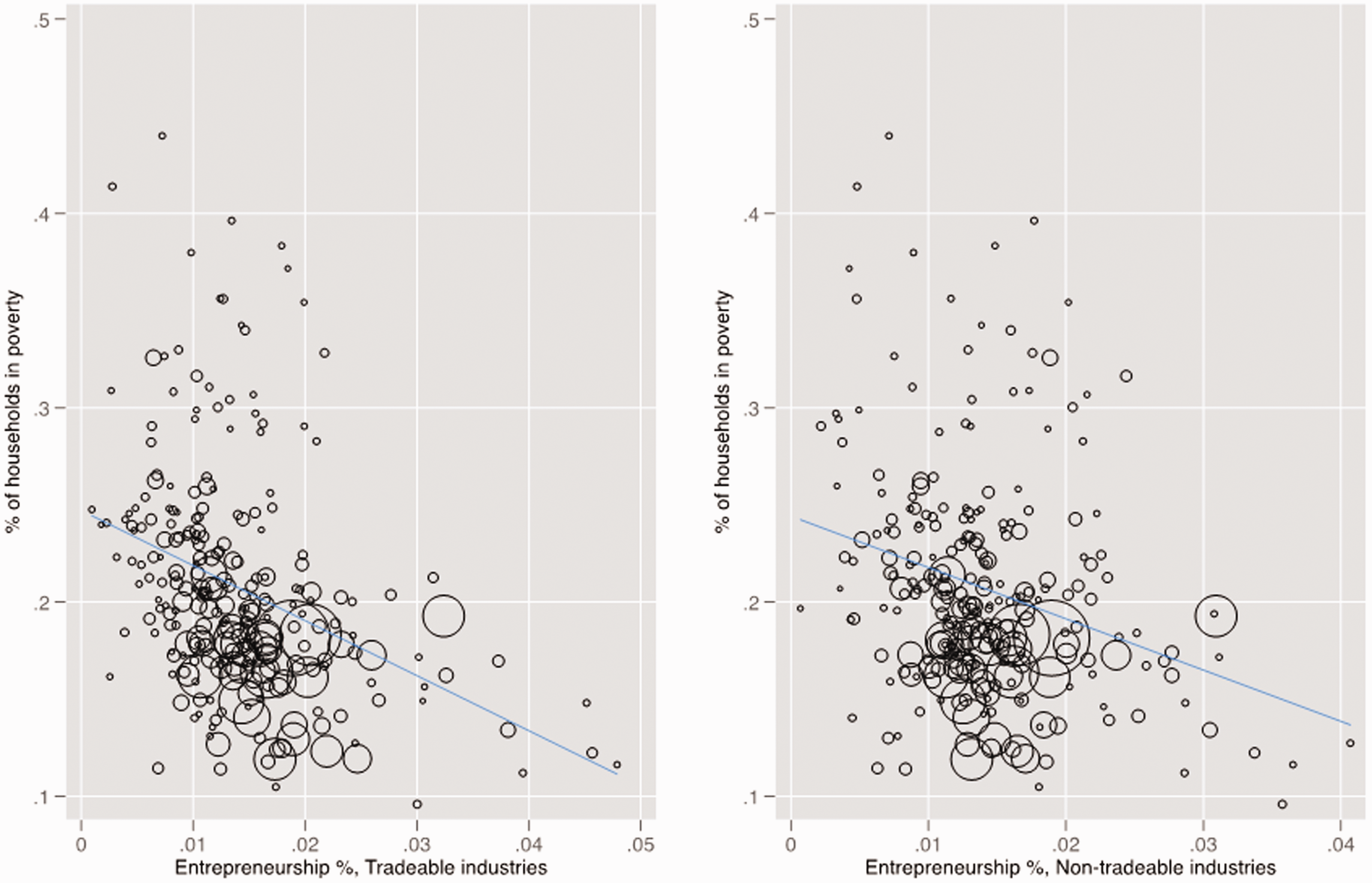
Tradeable entrepreneurship, non-tradeable entrepreneurship and poverty in US metropolitan statistical areas, 2015.
Model and results
Model
To test the basic relationship between entrepreneurship and poverty, we estimate the following panel regression model. We use city fixed effects to account for time-invariant factors, such as location or culture (Huggins and Thompson, 2016). Year dummies account for the cyclicality of the economy and the global financial crisis, which falls mid-way in our period. Our model is specified as:

Where i is one of 290 MSAs and t is a year between 2005 and 2015, the time-invariant error is ε and the remaining error is δ. 2 The dependent variable, POV, is the household poverty rate. The key variable of interest is ENT, which is one of the basic measures of entrepreneurship discussed above, both in the MSA in question and other nearby MSAs. We include vectors of controls for education (EDUC), demographics (DEMOG) and a variable for urban size (CITYSIZE). Summary statistics and variable definitions are given in Table 1.
Summary statistics.
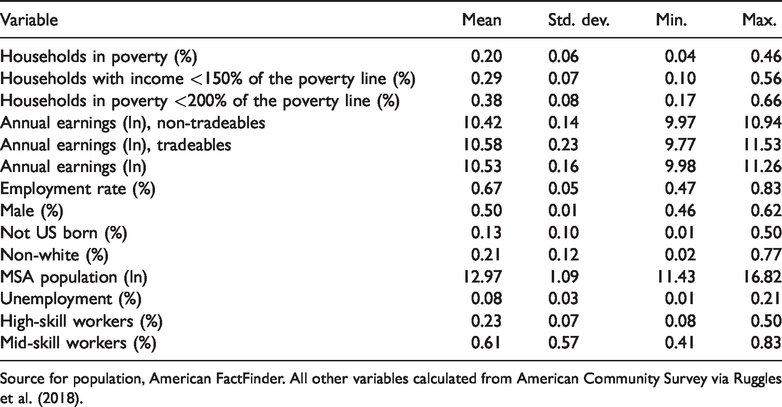
Source for population, American FactFinder. All other variables calculated from American Community Survey via Ruggles et al. (2018).
Control variables
Education (EDUC) is a fundamental predictor of earnings. Education is associated with higher productivity and educated workers are better able to compete in the labour market. In contrast, less well-educated workers face declining labour demand in the context of global competition. To address these concerns, we use two variables. The first is ‘high-skill’ – the share of the population with degree-level qualifications or above. We expect this to be negatively related with poverty. We also control for ‘mid-skill’ workers, which we define as those with a high-school diploma or above, but without a Bachelor’s degree.
Demographics matter for poverty rates, so we include a vector of controls (DEMOG). We first control for the share of non-US born in the population. The reasons for including the share of non-US born are twofold. On the one hand, a wide body of literature suggests a strong positive economic benefit from having migrant-rich populations (e.g. Nathan and Lee, 2013; Rodríguez-Pose and von Berlepsch, 2019; von Berlepsch et al., 2018). On the other hand, migrants tend to have lower incomes than natives. Being new to the local labour market and potential discrimination may be behind their lower wages. The non-US born – and mainly those originating from Latin American countries – sit at the bottom of the income pyramid and are overrepresented among those below the poverty line. We therefore expect a higher share of non-US born to be positively related to poverty. As discrimination often has a racial component, we control for the share of the non-white population. Non-whites – and, fundamentally, the African American and Latino population – fill the poverty ranks, meaning that the coefficient for this control variable is expected to be positively related to poverty.
Age is also likely to influence poverty rates (Fransham, 2019). Having children increases poverty rates as it enlarges the number of people living on a certain income, an issue dealt with through equivalization of income. Age can also influence earnings and labour market participation. Classic studies suggest that the relationship between income and poverty often adopts an inverted U-shape, with poverty higher in childhood, falling through adulthood, and then rising in old age. However, wealth tends to accumulate over a lifetime and older generations are commonly better off than younger ones. We therefore include variables for both average age and the quadratic term. Similarly, gender matters, as women have lower average incomes, are more likely to be responsible for children when separated, and, as a consequence, more prone to be among those at a higher risk of poverty.
We further include a measure for city size (CITYSIZE). Wages in larger cities tend to be higher. The skilled also concentrate there in greater shares (De Blasio and Di Addario, 2005). At the same time, entrepreneurship is higher in urban areas (Fritsch and Storey, 2014). Improved access to employment and sorting into a better range of occupations may benefit workers. To account for this, the log of total city population is included as a control.
One potential problem with the model is that the observations are not independent. This is particularly the case with our variable for tradeable entrepreneurship, which may have an impact on poverty rates in other nearby MSAs. To account for this problem, we include two independent variables for entrepreneurship in tradeable and non-tradeable industries in nearby MSAs. More precisely, we use the spatial lag calculated for the five nearest MSA neighbours (note that testing with two alternative measures – averages of all MSAs within 100 km and first-order contiguity – leads to limited changes in the results). Table 2 reports the correlations between the variables.
Correlation table.
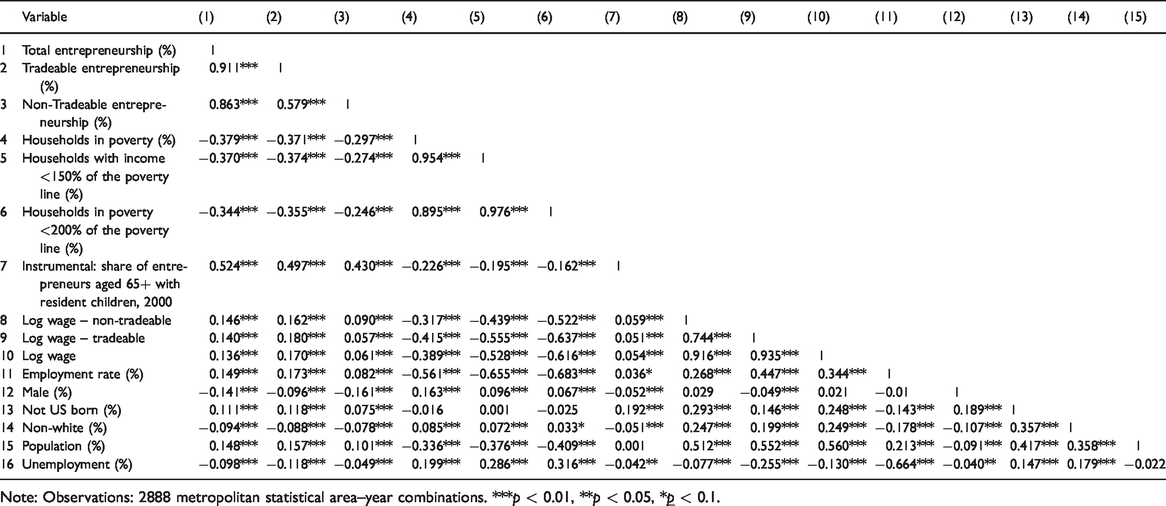
Note: Observations: 2888 metropolitan statistical area–year combinations. ***p < 0.01, **p < 0.05, *
Results: The impact of entrepreneurship on poverty
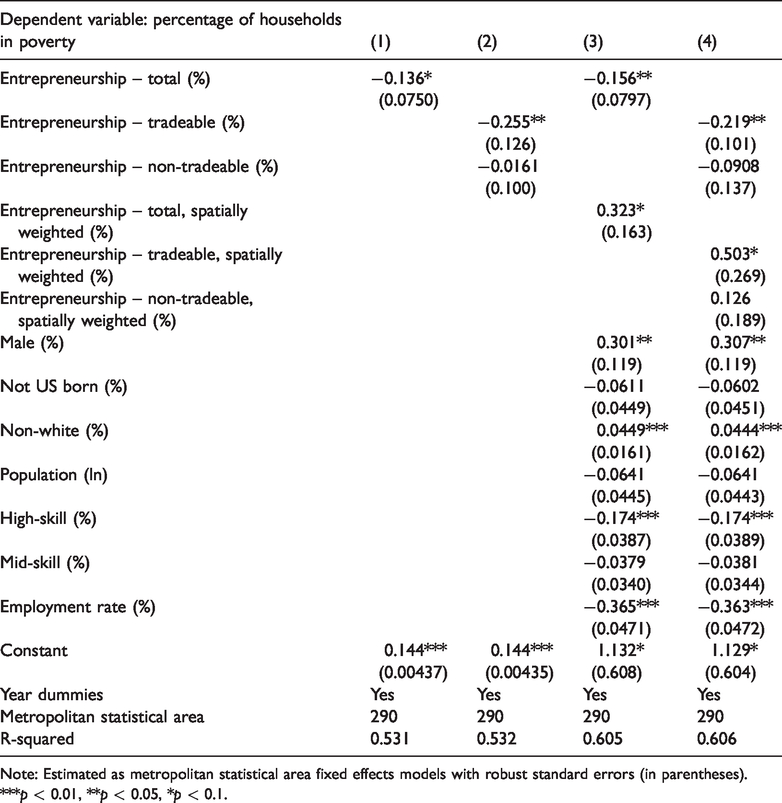
We begin by directly examining the effect of entrepreneurship on poverty. Table 3 gives the results. All models include MSA and year fixed effects, as well as either a variable for ‘total entrepreneurship’ or the two disaggregated entrepreneurship values for tradeable and non-tradeable industries. The primary finding is – in contrast to the literature on the economic benefits of entrepreneurship – that there is weak evidence of a link between the general measure of entrepreneurship and poverty reduction. When we include the general measure of entrepreneurship, we find that it is negative and weakly significant without controls (column 1). When the controls are considered, the relationship becomes somewhat stronger and more significant from a statistical perspective, although this is almost entirely driven by tradeable entrepreneurship. There is, therefore, only limited support for the first hypothesis, that entrepreneurship reduces poverty rates for local non-entrepreneurs.
Entrepreneurship and poverty, 2005–2015.
Note: Estimated as metropolitan statistical area fixed effects models with robust standard errors (in parentheses). ***p < 0.01, **p < 0.05, *p < 0.1.
However, when we disaggregate by type of entrepreneurship, two results emerge: a negative effect of tradeable entrepreneurship on poverty, and no effect from non-tradeable entrepreneurship. This effect remains both without (column 2) and with controls (column 4). Only entrepreneurship in tradeable industries seems to have a poverty-reducing impact, thus strongly supporting the second hypothesis – tradeable entrepreneurship reduces poverty rates among local non-entrepreneurs – and the third – there is no impact from non-tradeable entrepreneurship on poverty.
The control variables are statistically significant. The share of non-white population is positively and statistically significantly related to poverty, as expected given the legacy of discrimination faced by these groups. In contrast, migration – which includes migrants from both Latin America and other more affluent parts of the world – does not seem to matter. Skills are extremely important and the share of high-skilled workers is negatively associated with poverty rates. As expected, higher employment is associated with reduced poverty. But the share of males in the population is also connected with higher poverty. We suggest this is because MSAs with larger male populations are often small and reliant on low-wage manufacturing or extractive industries.
The poverty variable we considered in Table 3 is useful, in that it reflects the incomes of those at the bottom, but limited in that it is a somewhat arbitrary line rather than a continuous variable. This may mean that entrepreneurship increases income just about the poverty line, but does not address the share of households in poverty. To tackle this problem, Figure 3 presents the impact of tradeable and non-tradeable entrepreneurship on the share of the population at different percentages from the poverty line. Essentially, each dot represents the coefficient for either tradeable or non-tradeable entrepreneurship given in column 4 of Table 3. Instead of the standard poverty line, we use alternative poverty lines, which range between 70% and 200% of the existing poverty line (with 100% being the actual poverty line). The top panel gives results for non-tradeable entrepreneurship, and – while each coefficient is negatively related to poverty – the results are so close to zero as to be indistinguishable. One interpretation here is that this is the ‘wrong type of entrepreneurship’ documented by Mueller et al. (2008), among others. By engaging in non-tradeable sectors, entrepreneurs are simply dividing up existing local markets, potentially costing income for other local workers, meaning that this type of entrepreneurship represents a zero-sum game.
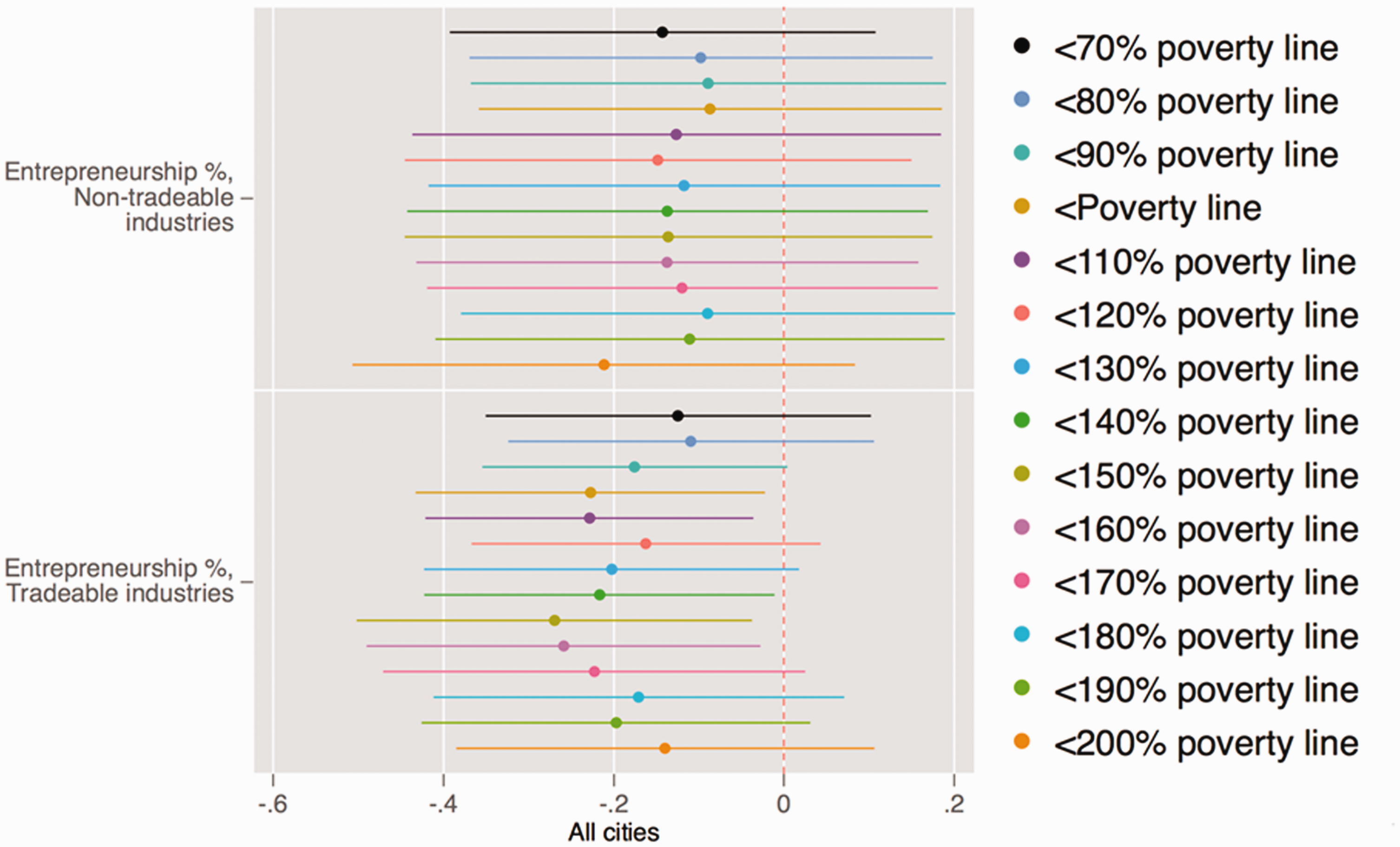
Coefficient plots: Entrepreneurship and different poverty rates.
The panorama for tradeable entrepreneurship is depicted in the lower half of Figure 3 and is a more positive one. The coefficient is negative and statistically significant at incomes just around the poverty line and above – the impact is largest at household incomes of around 150–160% of the poverty line. This implies that, while entrepreneurship reduces poverty, this reduction is most effective at a level considerably higher than the official poverty line. Hence, entrepreneurship in tradeable sectors may actually be increasing the gap between the poorest and mid-income earners. Existing studies show a job creation effect from entrepreneurship (Fritsch, 2013). This may be most successful in bidding up wages for mid-skilled workers, rather than extending the benefits to the most disadvantaged, who are further down the queue.
Instrumental variable analysis
The principal challenge to these results is causality. In particular, we do not know whether the experience of poverty or unemployment affects the type or quantity of entrepreneurship in a local area. For example, in situations of weak labour market demand, workers may set up non-tradeable firms as necessity entrepreneurs rather than face unemployment. We meet two further problems. First, it is hard to find time-variant instruments for panel regression models, pushing us to instead estimate models using the cross-section for 2015. Second, we should preferably find instruments for both tradeable and non-tradeable entrepreneurship.
Our chosen instrument builds on a common finding in the entrepreneurship literature: that the children (or grandchildren) of entrepreneurs are more likely to become entrepreneurs than the children of non-entrepreneurs (see Aldrich and Cliff, 2003; Cowling et al., 2004; Laspita et al., 2012; Lindquist et al., 2015; Parker, 2018). The correlation between parental entrepreneurship status and later entrepreneurial outcomes has been found in a ‘substantial number of studies’ (Laspita et al., 2012: 414). For example, Lindquist et al. (2015) indicate that parental entrepreneurship increases the probability of a child becoming an entrepreneur by about 60%. The effect may be due to parents being role models and passing on values, skills or knowledge to their children; inter-generational transfer of financial resources; or even inherited psychological factors (Laspita et al., 2012).
The instrument needs to successfully identify present-day entrepreneurship, but only operate through its effect on entrepreneurship now, not its impact on poverty. Following this logic, the instrument represents the share of the population in 2000 who fulfil the conditions of being (a) working in their own company but incorporated in either tradeables or non-tradeables; (b) having a resident child (we are not able to observe non-resident children); and (c) being at or over the age of 65. 3 This final condition is important as the great majority of the cohort considered would have left the labour market by 2015. This implies that the instrument satisfies the criteria that its impact on poverty in 2015 comes through entrepreneurship in 2015. We then estimate a cross-sectional instrumental variable (IV) regression where the dependent variable is the city poverty rate in 2015, instrumenting either tradeable or non-tradeable entrepreneurship. The obvious objection is that there may be more entrepreneurs in areas with stronger economies, with this economic success lingering and affecting poverty outcomes now. To address this problem, a control variable for both the employment rate in 2015 and the unemployment rate in 2000 is included (and we also experiment with a ‘correction’ to earlier entrepreneurship rates on the basis of past unemployment rates, with very similar results). This exercise corroborates that the impact we identify is not through the long-term legacy of past economic conditions, but through the effect on entrepreneurship. As the 2000 ACS boundaries do not fully match those for 2015, we estimate this regression in 229 cities.
The results of the IV analysis are given in Table 4. We first note that unemployment in 2000 is positively associated with poverty in all regressions, even in models controlling for current employment rates. Column 1 presents the ordinary least squares (OLS) results and shows that, as expected, in a simple cross-section tradeable entrepreneurship is associated with lower poverty. The IV results are presented in columns 2–6. They generally support our panel results. The instrument performs well in first-stage tests, and the F-test is well over accepted levels. 4 In all regressions, the coefficient for tradeable entrepreneurship is statistically significant and negative. Non-tradeable entrepreneurship is disconnected to poverty reduction: the coefficient is negative in column 1 but statistically insignificant, while it is positive and insignificant in columns 2–6. Overall, the results suggest that poverty reduction is not driven by initial economic conditions stimulating entrepreneurship, but rather that tradeable entrepreneurship has a causal impact on reducing poverty.
Instrumental variable results: Entrepreneurship and poverty, 2015.
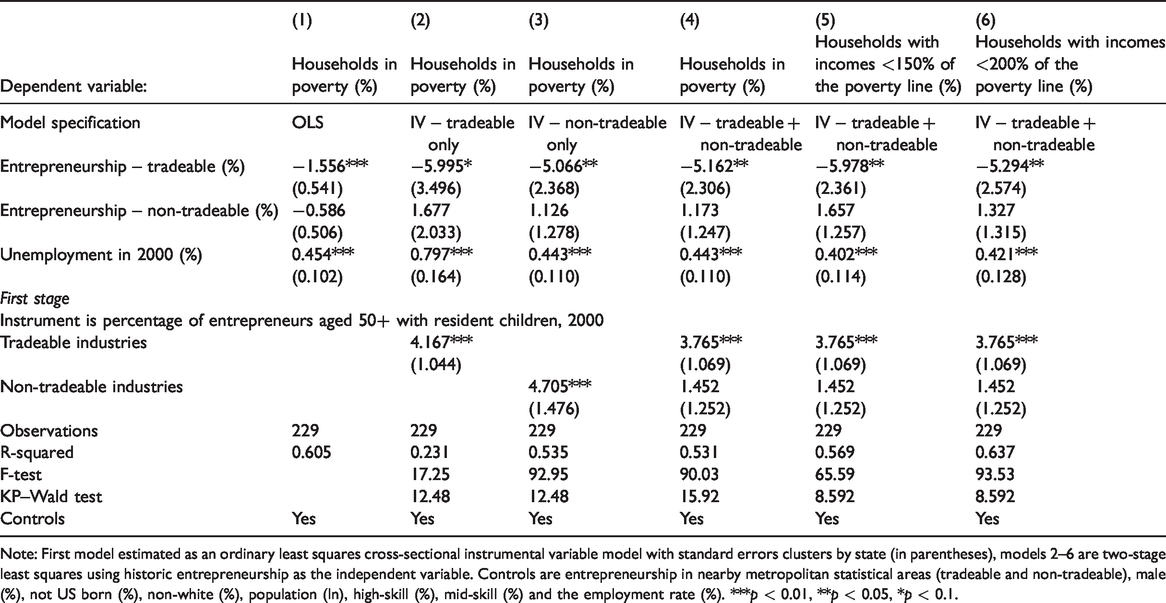
Note: First model estimated as an ordinary least squares cross-sectional instrumental variable model with standard errors clusters by state (in parentheses), models 2–6 are two-stage least squares using historic entrepreneurship as the independent variable. Controls are entrepreneurship in nearby metropolitan statistical areas (tradeable and non-tradeable), male (%), not US born (%), non-white (%), population (ln), high-skill (%), mid-skill (%) and the employment rate (%). ***p < 0.01, **p < 0.05, *p < 0.1.
The labour market impact of entrepreneurship
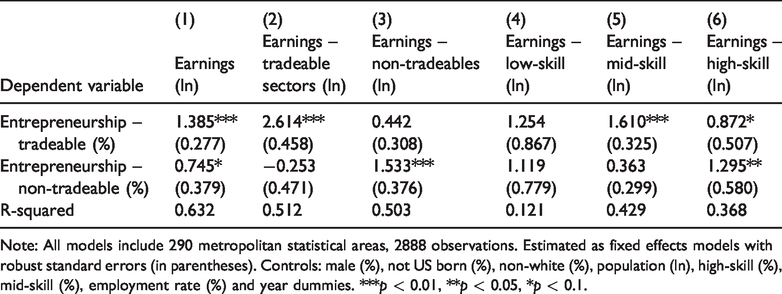
To test the extent to which poverty reduction is driven by job creation or increased wages, and how this is felt by different groups, we next consider the wider labour market impact of entrepreneurship. Table 5 presents the results of the panel regression model where earnings by group is the dependent variable. The first line of each panel gives results for tradeable entrepreneurship, the second for non-tradeables. Overall, we find a positive effect from both kinds on earnings (column 1), although the effect is stronger and larger for tradeables. This suggests the presence of economic benefits from entrepreneurship, although they may either be too small or not reach the right people to reduce poverty. We replicate these results in columns 2 and 3, considering wage income in tradeable and non-tradeable sectors respectively. The primary motivation here is to see if non-tradeable sectors reduce incomes for workers in that same sector if, for example, new firms are simply saturating existing markets. This does not seem to be the case – both types of entrepreneurship are connected with positive wages in the sectors in which workers are employed. However, there is no evidence of benefits spilling over from one into another.
The impact of entrepreneurship on earnings by sector and skill group.
Note: All models include 290 metropolitan statistical areas, 2888 observations. Estimated as fixed effects models with robust standard errors (in parentheses). Controls: male (%), not US born (%), non-white (%), population (ln), high-skill (%), mid-skill (%), employment rate (%) and year dummies. ***p < 0.01, **p < 0.05, *p < 0.1.
Next, we assess the benefits by skill group, considering (a) low-skilled workers with less than high-school diploma; (b) mid-skilled, those with less than a Bachelor’s degree; and (c) high-skilled workers with a Bachelor’s degree or above. Here, the results are more nuanced. Tradeable entrepreneurship has a positive effect in all three skill groups, but the effect is only statistically significant for the mid- and, to a lesser extent, high-skilled levels. This supports the observation in Figure 3 that the effect of tradeable entrepreneurship is largest at the mid-levels. The results for non-tradeables are less clear. The coefficients for low- and middle-skilled workers are not statistically significant. By contrast, a positive, large and statistically significant association with the earnings of high-skilled workers is found. The causality behind this final effect may actually be the reverse, as areas with affluent skilled workers create opportunities for non-tradeable entrepreneurship in shops and restaurants.
Finally, to test whether workers are entering the labour market, Table 6 investigates the relationship between entrepreneurship and unemployment and employment rates for different groups. We consider both unemployment and employment rates as unemployment may be biased by policies that potentially influence labour market entry. In contrast to the results for wages, there is no relationship here – the only statistically significant relationship is between tradeable entrepreneurship and unemployment for high-skilled workers. In short, the benefits of entrepreneurship noted in Table 3 seem to be going to the existing workers, rather than providing new jobs for those outside employment (see also Gerritse and Rodríguez-Pose, 2018).
The impact of entrepreneurship on employment by skill group.
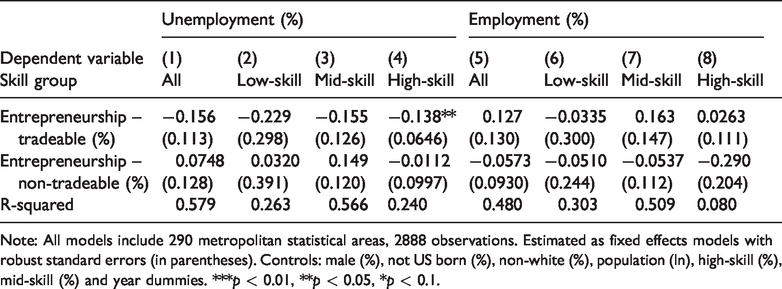
Note: All models include 290 metropolitan statistical areas, 2888 observations. Estimated as fixed effects models with robust standard errors (in parentheses). Controls: male (%), not US born (%), non-white (%), population (ln), high-skill (%), mid-skill (%) and year dummies. ***p < 0.01, **p < 0.05, *p < 0.1.
Conclusions
Policy-makers see entrepreneurship as a cornerstone in the fight against poverty. Yet, despite a wide literature on entrepreneurship, research has ‘paid scant attention to poverty’ (Bruton et al., 2013: 684), and that which has generally focuses on the impact on the entrepreneur themselves (Frankish et al., 2014). This paper has considered the wider impact of entrepreneurship on poverty using a dataset of 290 US cities for the period 2005–2015. We hypothesized that some sorts of productive entrepreneurship are more important than others for poverty reduction. Accordingly, we have distinguished between tradeable and non-tradeable entrepreneurship. We expected entrepreneurship in tradeables to have positive local multipliers, while non-tradeable entrepreneurship could contribute to saturate local markets and reduce incomes for some. The poverty-reducing effect of entrepreneurship would also differ by local area.
Our main result is that while entrepreneurship itself does not reduce poverty, entrepreneurship in tradeable sectors does. This reflects both export base theory, which stresses the importance of tradeable sectors in regional growth, and that in entrepreneurship, which has highlighted the importance of viewing entrepreneurship as a diverse phenomenon that includes both productive and marginal firms (Nightingale and Coad, 2013). It also highlights the problems of considering entrepreneurship as a homogeneous activity. Research on the economic geography of entrepreneurship has often simply focused on the quantity rather than the type of new firm starts. Our paper joins those suggesting a more nuanced view is appropriate (Mason and Brown, 2013; Shane, 2009).
This finding has two major implications for policy-makers. First, economic development efforts should focus on the type of entrepreneurship rather than on its overall levels. The challenge here is that policy-makers generally find it hard to stimulate particular types of entrepreneurship, particularly in lagging regions (Greene et al., 2004). A second implication is that entrepreneurship policy can benefit disadvantaged groups even if it does not address them directly, but only if it is focused on specific sectors. One critique of past policies, which have sought to use entrepreneurship to benefit disadvantaged groups, is that these groups seldom have the characteristics or resources to succeed in entrepreneurship (Frankish et al., 2014). Our research has highlighted that those in or near the poverty line do not have to be entrepreneurs themselves to benefit from entrepreneurship.
This research opens up some important avenues for future work. First, we use a national-level poverty line, which will hide variation in both local wages and prices. Addressing this issue may develop a better picture of poverty. There is also the need to disaggregate further entrepreneurship by sector and, in doing so, develop an improved picture at a local level. Second, we do not consider the real cost of living. Models, such as that developed by Moretti (2011), suggest that the benefits of entrepreneurship may be capitalized into land prices, thus reducing any wage benefits. This has been noted in advanced urban economies, such as that around the Bay Area (see Kemeny and Osman, 2018; Lee and Rodríguez-Pose, 2016; Rodríguez-Pose and Storper, 2020). Further work on the real benefits of entrepreneurship will have to consider this. Second, we pool individual-level data at the city level and, in doing so, ignore variation in individual incomes that may arise. Better individual or household longitudinal data would help investigate the channels through which benefits accrue to particular groups.
Footnotes
Acknowledgements
We would like to thank Enrico Vanino, Josh Siepel, Ross Brown, Ben Spigel and Marc Cowling for useful comments and suggestions.
Declaration of conflicting interests
The author(s) declared no potential conflicts of interest with respect to the research, authorship and/or publication of this article.
Funding
The author(s) received no financial support for the research, authorship and/or publication of this article.
