




Abstract
This article examines the emergence of ‘open’ urban economic projects that promote the transformative potential of social innovation and civic enterprise. By putting the burgeoning literature on an open paradigm of work and innovation within cultural economic geography into dialogue with scholarship on open cities, I problematize the inherently progressive framing of openness. The paper makes two contributions. First, it emphasises how open narratives encourage entrepreneurial communities that manifest as individualization-masked-as-collectivism. It argues efforts to design new spaces of social innovation through the blurring of boundaries simultaneously reproduce social and material exclusions. Second, it demonstrates how the championing of open ecosystems of social innovation intersects with austerity localism. New modes of state withdrawal are facilitated through co-creation, crowdfunding and social enterprise. Illustrated through research into a co-working space in London set up in response to the 2007–2008 economic crisis, I reveal the geographies of exclusion, enclosure and exploitation embedded in the pursuit of openness. Against the claims of enabling conditions for progressive civic futures, I establish the limits to openness whereby such ideas are easily assimilated into the processes of neoliberalisation that they seek to reject.
Introduction
Open innovation, open economies, open working – if business schools and the organisational sciences are to be believed, we are witnessing a new era of openness that is disrupting work, the firm and production and consumption. Knowledge production is said to be moving away from a ‘silo mentality’ of intellectual property and enclosure towards distributed sharing, crowdsourcing and the externalisation of innovation (Baldwin and von Hippel, 2011; Chesbrough, 2003; NESTA, 2010; cf. Ettlinger, 2014, 2017). An emerging open paradigm has been coupled with trends in ‘social innovation’ referring to ‘innovation that is explicitly for the social and public good. It is innovation inspired by the desire to meet social needs which can be neglected by traditional forms of private market provision and which have often been poorly served or unresolved by services organised by the state’ (Murray et al., 2010: 10). Becoming open facilitates enterprising community-oriented approaches to problem solving that achieves local economic development in the name of social inclusion, economic redistribution and empowerment (Chalmers, 2013; cf. Thompson, 2018). Supported by new working practices premised on co-operation, sharing and peer-to-peer networking (Cockayne, 2016; Richardson, 2016), there is growing enthusiasm for open innovation that transcends a focus on individual entrepreneurs and organisations, towards new, predominantly urban configurations of ‘mission-led’ entrepreneurial communities or ecosystems.
Openness has become a keyword for architects, designers, local governments and social enterprises championing the democratisation, adaptation and re-use of urban spaces, networks and infrastructures. 1 Becoming open provides ‘a common language for citizens and investors’ that encapsulates new forms of crowd-financing and platform economies, experiments in urban commoning and community self-organisation, as well as the remaking of vacant buildings and temporary urban spaces (Wagenaar et al., 2015: 578; see also Ahrensbach et al., 2011). Local and municipal governments are prototyping civic initiatives and partnerships that foster social innovation as part of an enterprising open urban agenda (e.g. Bristol is Open, 2019; Civic Futures, 2019; Greater London Authority/Capital Enterprise, 2015). Tracing neoliberal ideas of enterprise and innovation to links with entrepreneurial urbanism of the 1980s, through creative cities agendas to contemporary post-crisis ‘late-entrepreneurial urbanism’ (Peck, 2017), designing for social innovation has gained traction under small-state localism in the years following the 2007–2008 economic crisis, such as the ‘Big Society’ led by the Conservative-led coalition government in the UK (Chalmers, 2013). A proliferation of co-working spaces, fab labs and incubators for social enterprise start-ups, as well as hackathons and open data platforms sit at the intersection of changing work practices, new digital urban infrastructure and localist policy agendas. Taking these ideas to their logical conclusion, there have been calls to ‘open everything’, from urban governance, design and manufacturing, through to venturing, organisational models and the state (Architecture 00:/, 2013: 2).
The purpose of this article is to examine the emergence of ‘open’ urban economic projects that promote the transformative potential of social innovation and civic enterprise. I seek to problematize the inherently progressive framing of openness. I do so first by examining the unevenness and exclusions embedded within the designing and organising of open workplaces that foster social innovation through the blurring of boundaries. Second, I examine how the promotion of open ecosystems of social innovation intersects with austerity localism. This is illustrated through research into a co-working space in London set up in response to the 2007–2008 economic crisis by an architectural practice supported by local government and private property developers. Co-working spaces are hyper-flexible, pay-by-the-hour open plan workplaces associated with communities of creative, self-employed and digital start-ups (Jamal, 2018). With ‘counter-cultural’ origins in San Francisco in the 1990s, co-working spaces are framed as experimental spaces of chance encounter (Hutter and Farías, 2017) that facilitate co-creation, networking and innovation (Fuzi, 2015), and typify what Lange (2011: 202) describes as: the collective-driven, networked approach of the open-source-idea translated into physical space. The creative sharing of space can be seen as an optimistic and self-governed reaction to the often precarious living and working conditions of today’s creative workers, especially in transformative and crisis-driven times.
The paper makes two contributions. First, it emphasises how open narratives support new forms of co-operation and social interdependency among ‘micro-entrepreneurial’ communities. I demonstrate how architectural and material design is used to intensify networking to encourage innovation through the blurring of boundaries, a trend pre-empted by Nigel Thrift (2005, 2006) more than a decade ago. However, by paying attention to the subjectivities and neoliberal economic practices associated with the emerging paradigm of open innovation (Ettlinger, 2016, 2017), I demonstrate how the engineering of spaces for encounter simultaneously reinforces social hierarchies and material exclusions. I reveal how this follows what Mould (2018: 29) calls ‘individualization-masked-as-collectivism’. Second, I move this critique forward to demonstrate that the promotion of open ecosystems of social innovation under austerity localism facilitates new modes of state withdrawal through local government-supported experiments in co-creation, crowdfunding and social enterprise. Against the claims that open urban economic initiatives offer exciting new opportunities for radical ‘mission-led’ civic futures, I demonstrate that these ideas are easily assimilated into the processes of neoliberalisation that they seek to reject.
The paper unfolds as follows. I first situate the current enthusiasm for openness within scholarship on open cities, paying particular attention towards post-Fordism, flexible infrastructure and serendipitous encounters. I then trace connections with the rise of a new open paradigm of work and innovation, making connection with cultural economic geographies of working, collaborating and sharing. My case study and research methods are then outlined. This is followed by two empirical sections on the exclusions and ambiguities of open workplaces orchestrating innovation and how the cultivating of open ecosystems for social innovation supports small-state austerity localism. A discussion of the limits of openness concludes the paper.
Open cities: infrastructure, flexibility and serendipity
A transition from Fordist to post-Fordist systems of production and consumption has had a profound impact on the organisation of capitalist cities. For much of the 20th century in North America and Western Europe, we can observe distinctive features of modern urban planning shaped by the prevailing Fordist regime of accumulation. Land-use zoning, community planning initiatives and standardised infrastructural networks were constructed to embed functions into urban space over decades for industrial mass production and consumption mediated by Keynesian welfare provision, standardised housing and high levels of unionised employment (Brenner and Theodore, 2002). However, shifts towards flexible accumulation in response to the structural crises of Atlantic Fordism in the mid-1970s transformed how cities were organised and developed. Cities have been opened up to the flexibility and adaptability required for entrepreneurial strategies of local economic development prioritising efforts to attract global capital over collective welfare provision (Hall and Hubbard, 1996; Harvey, 1989). By the end of the 20th century, mixed-use developments, high-tech corridors, signature buildings, sports stadia, edge cities and gated communities became familiar features of urban redevelopment (Knox, 1991). Moreover, adaptive capabilities responsive to just-in-time pressures, shifting economic geographies and the new spatial divisions of labour of post-Fordist economies opened up urban infrastructure towards the incremental, flexible and fragmented (Graham and Marvin, 2002).
The fractures and social polarisations of new capitalist urban spaces of consumption in North America became the focus of a series of key urban texts. Attention turned towards landscapes of securitisation and private policing, the enclosures of shopping malls and the Disneyfication of post-modern cities (e.g. Davis, 1990; Sorkin, 1992). Don Mitchell (1995) highlights a tendency towards the end of public space, to be remade instead as open space. Where public spaces are produced through social struggles, this is increasingly replaced by highly ordered open spaces policed for ‘appropriate’ use, closing down political contestation. Likewise, ‘architectural openness’ suggests Goss (1996: 229) ‘is a metaphor for social inclusiveness’. Yet, the sociability of a privately owned open public realm is an illusion reliant on the exclusion of encountering social difference. Returning to the end of public space argument several decades later, Mitchell (2017) reflects on the ongoing struggles over public space that are both closed down and opened up through the contradictory dynamics of the production of capitalist urban space. Crucially, accounts of open space call attention to material exclusions and the right to the city.
Urban space has become fractured through entanglements of the material and the social. The reconfiguration of more or less noticeable webs of infrastructure produce new divisions in what Graham and Marvin (2002) conceptualise as ‘splintering urbanism’. Accordingly, digital technologies are reanimating cities through an expansion of digital infrastructure and networked arrangements organised around smart urbanism (Marvin et al., 2015). Tech-sponsored hackathons have become widespread as part of the smart cities agenda, prototyping entrepreneurial ‘solutions’ to narrowly defined urban ‘problems’, whilst furthering the corporatisation of urban space (Perng et al., 2018). The language of open is evoked in appeals to hack or modify the incomplete city. Openness becomes a way for ‘users’ to ‘talk back’ to – and, by implication, take back – the city (Sassen, 2011). Echoing debates in the geographies of architecture questioning who is involved in the production of architectural/urban space (following Lees, 2001), there are calls to reconfigure the hardware (material) and software (social practices) of urban space, blurring the boundaries between production and consumption. Consequently, Jiménez (2014) calls for ‘the right to infrastructure’ encouraging bottom-up prototyping and democratisation of digitally mediated infrastructures.
Bottom-up conceptualisations of the ‘open city’ get positioned as an ethical remedy to the rigid enclosures and exclusions of top-down state and government-led urban redevelopment (Sennett, 2018). Taking inspiration from Jane Jacobs, assemblage and the open systems thinking of the MIT Media Lab, Sennett (2018) hails openness as a necessary condition for an ethics of dwelling and living in cities packed full of ambiguity, adaptability and informality. The organised complexity of informal urban encounters, non-linearity and incompleteness resemble geographic interest in the conviviality of common ground made through the ‘negotiation of difference within local micropublics of everyday interaction’ (Amin, 2002: 960; 2008). In this way, open cities are said to be those full of possibility, designed for co-existence, perhaps even pure chance, whereby ordinary people can shape and remake how cities are organised.
Attempts to transform urban redevelopment to find ‘practical ways of escaping the forms of “enclosure” which limit what can happen in the city’ have long been of interest to anarchist movements (Bresnihan and Byrne, 2015: 36). Yet, it is the urban commons movement that has galvanised a set of organising logics seeking to move beyond government or corporate-led development towards alternative, even post-capitalist urbanism (Bradley, 2015). Ostrom’s (1990) work on common pool resources and common property regimes is frequently cited as inspiration for opening up cities to new forms of sharing, crowdsourcing and crowd-financing. ‘Bottom-up’ crowd-financing to fund urban infrastructure and development is said to offer a democratic alternative to what Jane Jacobs (1961) calls ‘cataclysmic money’. This is, however, a ‘democratic illusion’, Bieri (2015: 2431) cautions. Rather than rolling back entrepreneurial urbanism, crowdfunding mechanisms extend the financialisation of the built environment, further undermining the right to the city as a collective project. Moreover, short-term renting through platforms such as AirBnB is flourishing under austerity localism, extending the decline of public urban commons through the entrepreneurial monetisation of social relations and livelihoods (Peck, 2012).
Becoming open, then, has a long, diverse history within urban scholarship. I now want to turn to illustrate how enthusiasm for openness connects with an emerging open paradigm of work and innovation.
A new open paradigm: spaces of work, enterprise and innovation
With origins in mid-century research and development, the term ‘open innovation’ was first coined by organisational theorist Henry Chesbrough (2003) to describe a new imperative for profit making through the externalisation of knowledge and the sharing of innovation practices. The term has since gained traction across a range of fields. A language of open ‘platforms’ and ‘ecosystems’ (Nambisan et al., 2018) is used by technology conglomerates, academic gurus and policymakers to promote a new intellectual commons blurring the boundaries between corporates and disruptive start-ups. In fact, the ‘openness industry’ is now big business (Jakobsson, 2012). Even governments are becoming open, ‘unlocking the ideas and creativity of our public sector and opening ourselves up to innovation’ (Barber, 2017: preface). The future, we are told, is open and it is transforming capitalist societies: The world is becoming increasingly interconnected and open. Radically open – manifesting itself in open borders, open culture, open-source, open data, open science, open world, open minds. With the loss of privacy that it implies, openness carries its own dangers. But it breeds transparency, authenticity, creativity and collaboration. All bets are off as to what openness and collaboration in an ultra-connected world will mean for human potential. Traditional top-down models of organization no longer reflect reality. Social capital and influence are becoming stronger currencies than hierarchy and formal power. New, collaborative ways of creating meaning and things are developing at fast pace. Only one thing appears certain: Secrecy is no longer bankable: impact is. The future will be built on great ideas, and for that, great ideas need to circulate freely, broadly and openly. (TED, 2012; cited in Lundgren and Westlund, 2017)
However, whilst the turn to openness may appear to disrupt existing notions of work and employment, rather than cultivating alternatives, digital technologies instead intensify and extend the boundaries of what counts as work (Richardson, 2016), whereby narratives of sharing ‘justify and normalize flexible and precarious work through an ambiguous association between capitalist exchange and altruistic social values’ (Cockayne, 2016: 73). As such, in the ‘social production of entrepreneurial space’ where people become businesses in themselves (Stabrowski, 2017: 331), digitally mediated workplaces help cultivate not only entrepreneurial rationalities, but also entrepreneurial hopes and desires (Cockayne, 2016).
In recent years, there has been a proliferation of ‘open creative labs’ and collaborative workplaces such as co-working offices, living labs, accelerators, makerspaces and incubators (Cardullo et al., 2018; Richardson, 2015) that follow an apparent paradigm shift towards ‘open innovation, boundaryless work and collaboration’ (Schmidt et al., 2014: 236). Such workplaces put a premium on openness whereby random encounters generate ‘transformative experiences’ (Hutter and Farías, 2017: 7). Such workplaces find favour among local and municipal governments as part of post-crisis urban redevelopment strategies. For example, the Mayor of London’s regeneration guide declares that ‘open workspaces have affordable rents, flexible terms and shared facilities. They allow entrepreneurs, creatives and small businesses to grow, network and flourish’ (Greater London Authority/Capital Enterprise, 2015: np).
But is all this enthusiasm for openness simply the latest buzzword? According to Nigel Thrift (2006), this may not be the case. He suggests: ‘open innovation’ cannot be seen only as one of the next big management fads but also as a means of challenging current property regimes by building new kinds of creative commons through a wider culture of knowledge. (Thrift, 2006: 301)
Such account of openness closely resembles those championing ‘successful’ cities that generate urban density, agglomeration and creativity by drawing people to their buzzing atmosphere, clusters and face-to-face encounters (Storper and Venables, 2004). Likewise, it resonates with Florida’s (2005: 3) thesis of creative cities as ‘cauldrons of diversity and difference, creativity and innovation’. In fact, Thrift’s positioning of open innovation mirrors business management scholarship heralding the ‘collision density’ of lab-like cities whereby open innovation meets the collaborative economy to promote urban economic growth as local governments and citizens collide with entrepreneurs and innovators (Cohen et al., 2016: 6). As I shall demonstrate later, the connection between micro-spaces of collaboration and urban redevelopment is important to the rise of open civic projects.
Concerned by the more celebratory tone with which these ideas have been embraced, Nancy Ettlinger (2014) adopts a critical stance towards what she frames as a new ‘openness paradigm’. Ettlinger (2017: 61) defines this paradigm as: an emergent regime of accumulation, overlaying and co-existing with flexible production, and encompassing novel firm-level strategies, new forms of corporate networks, and a disturbing capital-labor relation that informalizes innovative work while cultivating entrepreneurial but self-exploiting subjects.
Whilst drawing on different cultural economic and feminist geographic perspectives, both Thrift and Ettlinger have a common interest in work beyond the capital–labour relation alone, examining capitalist economic geographies not only ‘through the eyes of labour’ (Herod, 1997: 3), but also through people’s working bodies, emotions and subjectivities. However, important distinctions arise in their theorising of openness. As part of Thrift’s wider project, his interest lies in the affective registers and performances of new capitalist economies. Whilst interested in fast managerial subjects, Thrift displays limited interest in ‘workers’. Building on her interest in the micro-spaces of collaborative workplaces (Ettlinger, 2003), Ettlinger, however, calls our attention to the multiple subjectivities of exploited (and self-exploiting) individuals. She encourages us to pay attention to new forms of economic co-production and the further entrenching of precariousness under the banner of open – a concern I take forward in this paper. Before turning to discuss how openness manifests through co-working, I first outline my case study and methods.
Case study and methods
The findings presented are based on 18 months of doctoral research examining the practices and spaces of co-working in the West Midlands and South East England (Lorne, 2015). Here, I focus specifically on Hub Westminster (‘the Hub’) in London, one of the case studies of the doctoral research. Hub Westminster, later renamed Impact Hub Westminster to emphasise its ‘social mission’, was launched in 2011. It is based on the first floor podium of New Zealand House, located at the corner of Haymarket and Pall Mall in central London, in close proximity to Trafalgar Square. According to the Land Registry, the building is owned by The Crown Estate Commissioners and New Zealand Government Property Corporation. The first floor office was vacant, having previously been used by the council for parking permits and fines before being converted into the co-working space.
Impact Hub Westminster forms part of the Impact Hub Network, which as of 2018 consisted of 101 Hubs across five continents, involving 17,000 members. Impact Hub Network (2019: np) states that it is ‘one of the world’s largest networks focused on building entrepreneurial communities for impact at scale – home to the innovators, the dreamers and the entrepreneurs who are creating tangible solutions to the world’s most pressing issues’. Although part of a network with shared goals, each Hub has a different ownership and governance structure. Impact Hub Westminster was initially funded 40% by an architectural practice, 40% by Westminster City Council and 20% by private property developers. Westminster City Council provided a one-off conditional grant of £300,000 and equity and loan finance of £436,000 in order to create a limited shares company under the status of a community interest company alongside the other two shareholders with the intention that it would become self-financing over time. Westminster City Council cited ‘reduced public expenditure’ and the ‘challenging economic climate’ when funding the project.
The architects worked on the business model, membership strategy and redesign of the workplace. Income is generated through pay-per-hour monthly membership packages that also allow access to various events from hackathons to training courses. No deposit or minimum number of months’ rent is required. This is intended to lower the threshold to access, and the Hub was a prototype for developing subsequent crowd-financed initiatives. During the time of my research, there were 465 members of Impact Hub Westminster, of whom 260 worked for social enterprises with the other 205 being individual workers who were self-employed, contract or mobile workers.
Research involved ‘embodied labour as method’ (McMorran, 2012). Over the course of two months, I worked as a part-time ‘member host’ – an informal member of staff who facilitates the day-to-day running of the co-working space. In exchange for working evening shifts in the week, tidying and reorganising the workplace, answering phone calls and locking up at night, I was compensated with a set number of hours each month whereby I could access the co-working space for research. During this time, I undertook 20 semi-structured interviews with co-working members, member hosts and those from the architecture/design practice. Attempts to interview managers from Westminster City Council proved unsuccessful. I maintained a research diary whilst working as a host and when co-working to help capture the many conversations I held with those coming through the doors. My work involved ‘hanging out’ with research participants (Anderson, 2004), often taking me beyond the workplace as I became friends with other co-workers. Additionally, after leaving my role as member host, I continued to attend various events on social innovation and civic enterprise put on by the architectural practice or associated partnership social enterprises. Data from the research were thematically coded in NVivo. For the remainder of the paper, I discuss my research findings.
Designing ambiguity and the exclusions of open workplaces
Although Impact Hub Westminster received funding from Westminster City Council, it is not a public space open to everybody. Mimicking the elite members’ clubs nearby, there is minimal signage to show that this place even exists. In fact, not being immediately visible is important. Situated within New Zealand House in central London, actually getting into the workspace is highly controlled. In order to gain access, you need either a swipe card or to be named on a list of expected guests. If you do not have your name on the list by the evening before, security staff make a phone call to the member hosts who come to collect you. If you do gain entry, you are directed through the swipe-access door towards the lift where you may only go to the lower section of the building where the co-working space is found. Already, you get a sense of the exclusivity; rigid exclusions are reinforced by a series of mundane technologies, security doors and online registration, mediated by the concierge and member hosts. More than this, to join the co-working space, your ‘social and environmental mission’ must be accepted by the hosts of the Hub, and, of course, you must be able to afford to pay. This can reach into £100s per month. Counter to co-working as spaces of serendipity (Merkel, 2015; Schmidt and Brinks, 2017), chance encounters here are demonstrably not with just anyone.
Inside, however, indeterminacy and ambiguity become important for how the workplace is organised and experienced. It is not immediately clear who runs the workplace, who are regulars and who is just visiting. This is part of the logic of blurring boundaries to encourage collective learning and collaboration as members of Hub’s global network drop in, interact and become part of the regular co-working community, however momentarily. A sign outlines their open narrative declaring: ‘CITY=NETWORKS+PROXIMITY’. The architects describe it as an invitational space, pulling people in, akin to what Allen (2006) conceptualises as the ambient, seductive workings of power within quasi-public open spaces. As one of the architects puts it: I think that ambiguity is good. Non-clearly programmed space – speaking of how might architects create possibility, course that’s true – ambiguity invites invitation and invitation is a creative act, so I think the fact the Hub is partially a co-working space, is partially a networking space, is partially also a club. Because it is a club. It is a members’ club, of sorts. And it wants to be. We’re here, the Cambridge Club, the Faculty of whatever, Commonwealth Club, Institute of Directors, of course we’re here for a reason because we want it to be in club land and create an alternative club and a lot of people say the Hub is still exclusive, you’re still behaving like a club. Yeah, so what? It’s pretty open, you know? (8, architect, aged 30–35 years, male, original emphasis)
The Hub is very carefully designed to generate particular kinds of responses and intensities in order to encourage fast-paced interactions (see Figure 1). In a move to celebrate the dynamism of co-working spaces, the Hub Network (2012: np) affirm that you must ‘never call it finished’. They propose that these places of work are not simply office workplaces with tables and chairs, but rather places that prompt ‘collisions, connection and catalyzation … bringing people and their ideas together’. Open-ended design encourages fluidity and flexibility, creating a sense of ownership for members able to rearrange the architectural space continuously according to their changing needs. Furniture is on wheels, and plug sockets can be pulled from the ceiling or the floor. Almost all the furniture is 3D printed and open source, developed through spin-off projects OpenDesk and Wikihouse. As one of the architects (11, male, aged 30–35 years) explains, ‘we kind of came up with a plan which would allow people to use it, iterate it, change it and keep moving it around, and so for example, these high desks were meant for quick meetings, so you don’t sit down’. Continuous interaction is anticipated, and the lack of visual legibility is used to prompt members to circulate. Here, the notion of a club follows Thrift’s (2000: 686) interest in performing cultures in new economies with the ‘construction of office spaces which can promote creativity through carefully designed patterns of circulation’. Indeterminacy is designed into the ‘staging of particular ‘teamspaces’ and other spaces of circulation and interaction so as to produce maximum potential for creativity to unfold’ (Thrift and Dewsbury, 2000: 423). It follows that ever-faster encounters promote ever-more creativity and innovation.
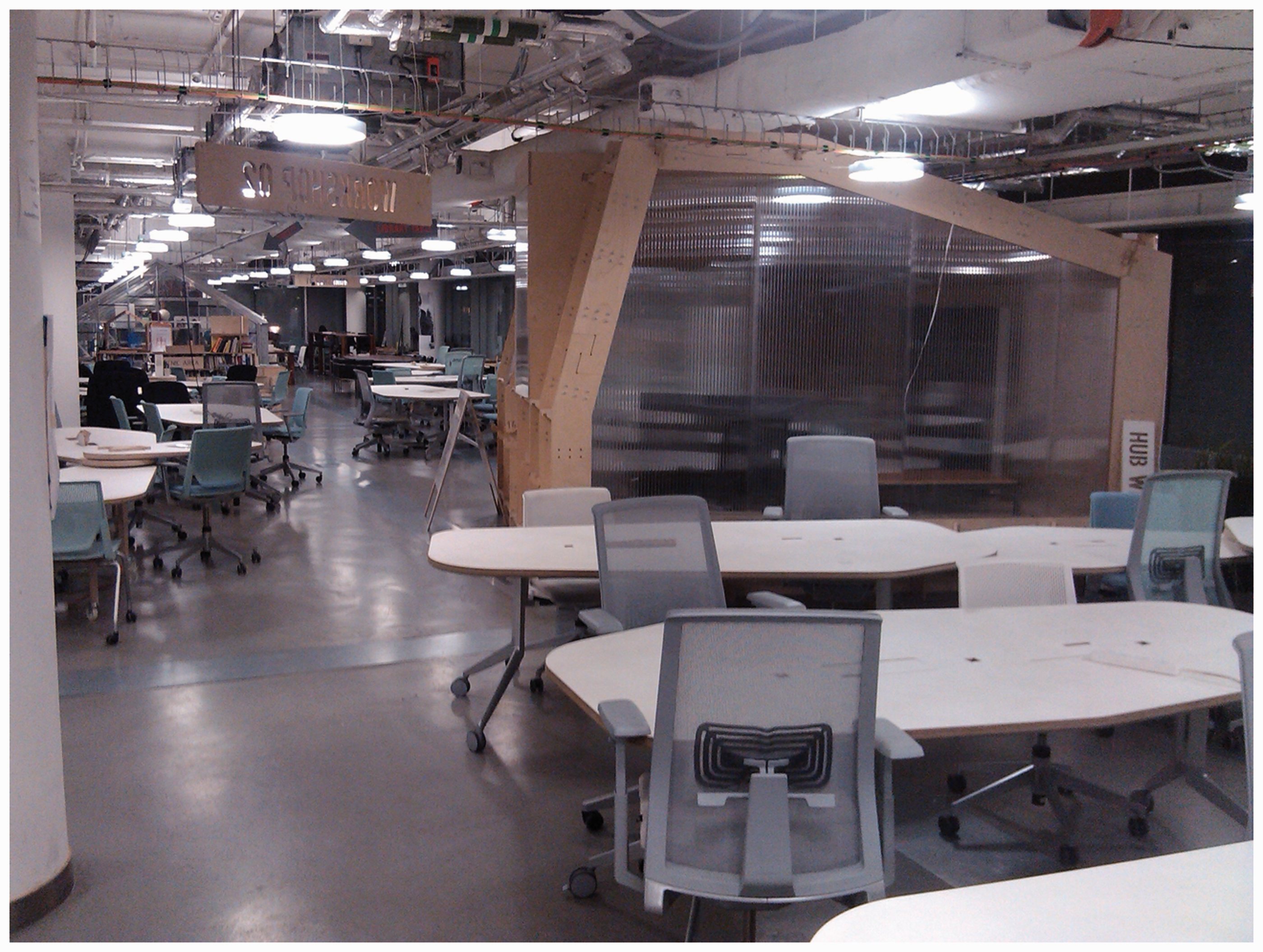
The workplace designed for encouraging circulation and chance encounters.
The architects set up the project as an experimental solution in response to the 2007–2008 economic crisis. The search for serendipity was for a specific purpose: This came at the point just after the crash. So this was all about, instead of talking about potential solutions, it was about actually trying to push them forward very fast, so we tried to create this to look, to feel a bit like a lab. So all the surfaces are hard, everything’s a bit white and that was kind of a deliberate move. It was maybe a bit more fast-paced, the acoustics were meant to be a bit more hard, everything like that, so it was meant to be a fast-paced thing … it’s to give the feeling of a laboratory hence we feel the space, we call it a space where you can incubate your ideas, incubate your business. (18, member host, female, aged 30–35; my emphasis)
Intensified networking among ‘like-minded’ individuals was frequently cited as justification for paying to access the workplace by co-workers. Where networking becomes essential for generating new sources of contract work (McRobbie, 2002), Impact Hub Westminster is no exception: ‘If you are confident in your own abilities and you’re confident speaking to other people, then you’ve got no issues being here at all. I think this place is an actual gem, proper gem!’ (3, co-worker, female, aged 25–30 years). Consequently, as the co-worker elaborates, the diversity of the community is celebrated in terms of the mixture of different businesses present and therefore the potential for new networking opportunities: ‘the diversity levels within here are amazing and you never know who’s going to come through the door’. Entrepreneurial rationalities thus conceal the social relations constituting the ‘community’. As such, fostering new forms of collectivism, social ties and togetherness as a members’ club was certainly not about encouraging unionisation and class solidarity among self-employed, precarious workers (cf. Hotch, 2000). Yet, the prevailing identity of the entrepreneurial individual did not always hold. For instance, in expressing feelings of ‘sticking out like a sore thumb’, one of the co-workers remarked on the like-bodiedness of those he encountered: Obviously I’m going to look at it ’coz I’m Asian and I’m looking round thinking ‘uhh, white middle-class haven!’ [laughs]. Part of me thinks that … I don’t see anyone else’s mum who works in [a department store]. Whose dad works in a … factory like me? Fuck sake, hate this, I’m off! [laughs] …Where’s the normal person? Look at the prices. £300, come on! (20, co-worker, male, aged 25–30 years)
Open ecosystems for social innovation
Setting up Impact Hub Westminster was always about more than creating a co-working space. The Hub became a prototype for facilitating social innovation and civic enterprise. In their Compendium for the Civic Economy, the architects declare: A civic economy is emerging, one which is fundamentally both open and social. It’s an economy which is fusing the culture of Web 2.0 with civic purpose … combining the spirit of entrepreneurship with the aspiration of civic renewal. (Ahrensbach et al., 2011: 1 and 3)
The aim of Impact Hub Westminster was to foster purpose-driven civic institutions, combining venture capitalism with social impact. With reference to Ostrom (1990), its purpose was described as: setting up new social and economic institutions for better behaviour … a different kind of network intensifier. But also, it’s purpose-driven: it uses spatial orchestration in a sort of way to communicate certain values and it drives through a certain aim, one that’s about individual empowerment in interdependence, so individual, but social, empowerment. (8, architect, male, aged 30–35 years)
A range of guests came through the doors at Impact Hub Westminster, from Labour Party Members of Parliament to academics holding workshops, local school visits on Westminster Enterprise Week to entrepreneur Richard Branson launching his latest book on ‘doing good through business’. It was standing on stage at the Hub that then-UK Prime Minister David Cameron declared that ‘open markets and free enterprise are the best imaginable force for improving human wealth and happiness’ (Cameron, 2012: np). In the shadow of the 2007–2008 crisis and subsequent austerity measures implemented by the Conservative-led coalition government, his speech championed a ‘socially responsible and genuinely popular capitalism’. Opening up new urban spaces such as the Hub helps to support ‘adventurous spirits’ who challenge the status quo. It is of course unsurprising that he promotes the idealised citizen-subject of the ‘entrepreneur’, the aspirational, hard-working individual who takes responsibility for themselves, motivated ‘to work hard and get on’ (Williams et al., 2014: 2802). But what is notable is that he was heralding the approach taken by the council as an exemplar in civic redevelopment: The Hub Westminster at New Zealand House is a great idea. Taking a vacant urban space and making it available to entrepreneurs, social enterprises, and start-ups. I encourage more public bodies to follow Westminster Council’s lead in forming innovative joint ventures to develop support structures like this. (Westminster Business Unit, 2018: np) Companies increasingly understand the importance of having an open fringe, right? Google sees the value of Canary Wharf, runs an accelerator in the Canary Wharf floor, level 33, or 39 or whatever. Google, has its campus, Lambeth Council is thinking of setting up a Hub in its town hall, in their town hall! Because they know that they need to get closer to social enterprise for contracting, for new ideas, for innovation and they have way too much space. So they’ve a big redevelopment project to have less space, to concentrate, but also to have social enterprise within the heart of organisations. So, everyone understands an innovation model that brings the outside, in. Or that blurs the boundaries between the inside and outside, right? But that is well understood, corporately, municipally. (8, architect, male, aged 30–35; original emphasis) The idea at the heart of the Big Society is a very simple one: that real change can’t come from government alone. We’re only going to make life better for everyone in this country if everyone plays their part – if change in our economy and our society is driven from the bottom up … it shows the type of entrepreneurship that generates civic action and the Big Society, and what it can achieve. (Ahrensbach et al., 2011: foreword) I describe it like a chain reaction; it’s people going out of their way to do things that they don’t necessarily have to do. Some organisations here have mentor schemes … feeding back into the community, because one of the things that happens here is we’ve got members that link big businesses with small businesses or social entrepreneurs because we can learn a lot from each other … the current government is putting a lot of money into the social economy because it’s only by us creating organisations and businesses that it creates employment for people. (18, member host, female, aged 30–35 years; my emphasis)
Co-workers at the Hub were running their own start-up social enterprises, often alongside other forms of temporary paid employment to supplement their income. This was accepted as the ‘new normal’. Through working flexibly, paying to access the ‘open institution’ of places like the Hub, they had the chance to network with others also pursuing their ‘social mission’. And in the words of a co-worker (20, male, aged 25–30 years), ‘There’s no job for life, unless you make that job yourself, then you’ll never be employed for life’.
Discussion and conclusion: the limits to openness
‘Success in business’ writes The Economist (2010: np), ‘increasingly depends on chance encounters’. In the search for serendipity, becoming open has become a new ‘kind of grammar of business imperatives’ (Thrift, 2001: 416). When Thrift was writing about soft capitalism a decade or so ago, drawing parallels between business and academia, his accounts of innovation and invention, the affective push and pull of workplace design and the fast circulation of subjects for knowledge economies all now seem rather prescient. Taking inspiration from publications such as the Harvard Business Review, the architects who set-up the co-working space in this study were more interested in designing new civic institutions and innovation ecosystems than the materiality of buildings (Lorne, 2017). Openness, as I have illustrated, is a guiding principle for engineering laboratory-like incubators that speed up and intensify informal encounters and blur the boundaries between start-up social enterprises, businesses and local government. The business imperatives of open innovation that Thrift anticipated now inform those seeking purpose-driven social innovation and civic enterprise.
There is a certain intuitive appeal to becoming open. Yet, I insist that there is a pressing need to contest the language of openness as inherently progressive. The rise of open workplaces reinscribes many of the exclusions identified in the shift from public to open space (Mitchell, 1995). Chance encounters and invitational design relies on various material and social exclusions, and through co-working, the ‘conviviality’ of a ‘common ground’ made through encounters with strangers is commodified (Amin, 2008). In fact, encountering ‘difference’ within such hubs of innovation rather easily slips into celebration of the self-motivated entrepreneur who ‘ceaselessly establishes connections’ (Deleuze and Guattari, 1987; cited in Bissola et al., 2017) instead of the rich textures of urban living and dwelling to which its proponents aspire. The open logic of emergence, incompleteness and creativity lends itself rather easily to capitalist imperatives of becoming entrepreneurial across organisational boundaries, leaving attention to the structures of (self-)exploitation to one side. Pay-by-the-hour workplaces thus encourage informal working practices and champion the encountering of narrowly defined difference through promoting enterprise-friendly individualization-masked-as-collectivism (Mould, 2018).
It is along these lines that I concur with the concerns raised by Nancy Ettlinger (2016, 2017) with regards to the openness paradigm in that whilst ‘conventional’ capital–labour relations might have blurred through novel platforms and modes of organisation, they do not remove the existing neoliberal regime of accumulation. Taking her ideas forward, we can see how the openness narrative obscures the political implications of an expansion of quasi self-employed workers who are paying to access new urban spaces engineered to intensify their precarious and tired selves. Diverging from Thrift’s accounts of affective registers and circulation of bodies at work, we can observe the importance of multiple subjectivities and differences that reproduce social inequalities through co-working. Rather than operating as an open/closed binary, designing for open innovation through invitation and ambiguity constitutes various forms of social and material exclusion in ways that, at times, some of the co-workers and architects themselves felt uneasy about.
The rise of open social innovation taps into notions of community, co-creation and sharing, evoking the ecosystem innovations of the MIT Lab or Silicon Valley bazaar (Sennett, 2018), or new digital commons as institutional spaces (Ostrom, 1990). However, counter-cultural or romanticised notions of community are highly problematic (Joseph, 2002). Economic co-production premised on openness actively supports, rather than contests, the reproduction of social inequalities. Open labs designed to blur the boundaries between production and consumption expand trends in adaptable urban infrastructures and flexible working, networking and ‘entrepreneurial’ contract work (Cockayne, 2016). Through the language of openness, neoliberal economic practices combine with visions of ‘mission-orientated’ civic futures and civic localism premised on social innovation, with new purpose-driven providers of local services ran by the activist-cum-CEO.
Open is not the same as public. The co-working space in this study was a prototype for experimenting with new open social infrastructure. Becoming open is said to enable civic alternatives to either corporate or state-led initiatives, with crowdsourcing and crowdfunding a way of democratising new civic localism. Following Bieri (2015), given the claims of bottom-up democratisation through blurring the boundaries between who produces and consumes urban space – and here we can include social infrastructure – might the emergence of open projects be ushering in new tendencies towards crowd-financing in the post-crisis city? Certainly, open civic projects fit rather closely with the prevailing vision of small-state, entrepreneurial commons, coinciding with shrinking state funding under austerity localism. Future research might focus on the social and political implications of local government turning to open civic localism amidst sustained austerity. Enthusiasm abounds for building new open institutions as catalysts for innovation in a whole host of areas, from libraries, civic data, collaborative workspaces and childcare arrangements. Quasi-public incubator spaces are even being set up to accelerate digital technology-orientated social innovation in areas such as public health care, fostering partnerships of designers, not-for-profits and start-ups (Health Foundry, 2019). Universities teach courses linking design, enterprise and social innovation. Critical geographers and others should therefore pay close attention to emerging connections between collaborative and sharing platforms, the designing of new civic urban infrastructures, and local and municipal government policy supporting experiments in open innovation ecosystems.
Open solutions seem to be everywhere of late: from open cities, open innovation and open government, to open data, open platforms and, of course, open source. In the face of the most divisive aspects of capitalist societies, the appealing, malleable language of openness would seem hard to resist. Yet, as I have demonstrated, despite the seductive accounts of new urban projects fostering social innovation, these ideas constitute new geographies of exclusion, enclosure and exploitation in the pursuit of openness. Coalitions of local government, corporates and social enterprises are championing ambiguity, blurred boundaries and chance encounters in the apparent democratisation and rejuvenation of urban spaces. But the promotion of open ecosystems of social innovation under austerity localism legitimises new forms of informality in support of enterprise-friendly individualization-masked-as-collectivism, further eroding state responsibility for collective welfare and provision. Rather than fostering progressive civic futures, I have demonstrated the limits to openness whereby such ideas are easily assimilated into the processes of neoliberalisation that they seek to reject.
Footnotes
Acknowledgements
I would like to thank Phil Emmerson, Carla Maria Kayanan, Phil Jones, Lloyd Jenkins, Gillian Rose and Jessica Pykett, as well as Jamie Doucette, Cristina Temenos and the Cities, Politics and Economies Group at the University of Manchester for commenting on earlier drafts. Thanks, too, to the very helpful comments from the peer-reviewers and editor as well as all participants in the research.
Declaration of conflicting interests
The author(s) declared no potential conflicts of interest with respect to the research, authorship and/or publication of this article.
Funding
The author(s) disclosed receipt of the following financial support for the research, authorship and/or publication of this article: This paper is based on work initially undertaken at the University of Birmingham, funded by the Economic and Social Research Council [grant number ES/J50001X/1].