




Abstract
A decade ago, in their article on ‘variegated neoliberalization’, political geographers Brenner, Peck and Theodore proposed what has become one of the leading theoretical conceptualizations of neoliberalism. By developing a process-based account of neoliberal transformations, they successfully trace neoliberalization across geographies and temporalities, accounting for both its systemic and contingent qualities. In this paper, I suggest that the variegated neoliberalization approach would benefit from contributions made by the French Régulation school, particularly those that introduce the institutional complementarity/institutional hierarchy as crucial components for understanding institutional configurations of diverse capitalist economies. Namely, I point to the fact that shared institutional hierarchies underpin different regimes of accumulation (e.g. Fordist, neoliberal), allowing us to study patterns of accumulation despite evident variation across contexts. By drawing on these insights, it becomes possible to deepen our understanding of the patterned structural traits preceding the onset of neoliberalization and how they shape various courses of institutional differentiation, thereby taking the variegated neoliberalization framework one step further. In the final section, I sketch the neoliberalization of two cities – New York and Johannesburg – to illustrate how legacies of preceding institutions played a role in generating differential neoliberal landscapes.
Introduction
In the most general sense, neoliberalism has been understood as a set of policies that prioritize privatization, deregulation, trade liberalization and restrictive fiscal and monetary policies (Cahill et al., 2012; Harvey, 2005; Knio, 2017). Over the years, however, these broad features have seldom appeared in a static or uniform fashion across geographies (or within the same geography over a period of time). Instead, they have adapted to pre-existing institutional arrangements and have been differentially contested by countervailing forces, producing neoliberal landscapes that are inherently multifarious, path-dependent and contested (Brenner et al., 2010). One of the key dilemmas in the study of neoliberalism has therefore been accounting for the systemic nature of neoliberalism while simultaneously being able to explain the institutional diversity that it engenders across time and space.
Over the years, accounting for both the systemic and varied nature of neoliberalism has caused theoretical dissent among scholars across the board, eliciting a number of important questions. For instance, how can we speak of an all-encompassing ‘neoliberalism’ if what we mean by the term varies considerably depending on the geographic or temporal context? Is it even possible to speak of one ‘neoliberalism’ or should we refer to multiple ‘neoliberalisms’ instead? To what extent is using the term neoliberalism still meaningful for scholarly research? While certain scholars have opted to abandon the term altogether (Dunn, 2017; Venugopal, 2015), others have remained committed to a number of existing lines of analysis.
One of the most well-known approaches emerging at the forefront of these debates is the Variegated Neoliberalization approach. Pioneered by Brenner, Peck and Theodore in their immensely influential 2010 article, the Variegated Neoliberalization thesis (VNLT) has by now shaped common sense understandings of the concept, traversing a variety of disciplines and thematic concerns. VNLT treats neoliberalism as a process with a variegated character, entailing a ‘politically guided intensification of market rule and commodification’ (Brenner et al., 2010: 184). In order to understand the variegated nature of neoliberalism and the reason it has unfolded in a ‘sporadic, yet wave-like, non-linear sequence’, the authors propose two distinct analytical moments in the development of neoliberalism: the uneven development of neoliberalization (i.e. disarticulated neoliberalization), followed by the neoliberalization of regulatory uneven development (i.e. deep neoliberalization) (Brenner et al., 2010: 185). 1
This paper will argue that drawing on the ontological foundations and analytical tools of the French Régulation (FR) approach can help us deepen our understanding of the production of systemic differentiation in neoliberal contexts. In particular, I refer to the regulationist concept of the ‘institutional hierarchy’ which is used to denote that one institutional form lends a dominant tone to an entire institutional configuration (allowing us to identify patterns across contexts), whereas the remaining institutions mutually adjust and form complementarities. Drawing on the concept of institutional hierarchy in the context of neoliberalism would allow us to identify the institutional arrangements in place prior to the crisis in late Keynesianism, and the path-dependent role these arrangements have played in shaping differentiated pathways of neoliberalization across contexts. The first section of this paper will therefore explore some of the main theoretical contributions of the VNLT and how it has advanced the study of neoliberalism. Next, I will take a closer look at the ways in which FR can help advance the problematique of the VNLT. The third section will refer to New York City and Johannesburg (and the respective origins and pathways of their neoliberal restructuring) to demonstrate the added value of using an FR-based understanding of institutions.
Variegated neoliberalization and its discontents
The VNLT is a culmination of the individual and joint research endeavours of three scholars concerned with the question of capitalist diversity and the role of space and scale in its articulation. Through their critique of the varieties of capitalism literature (Peck and Theodore, 2007) and prevalent understandings of neoliberalism as an immutable ideology (Brenner and Theodore, 2002), Brenner, Peck and Theodore have developed a nuanced understanding of neoliberalism as an ‘actually existing’, variegated and path-dependent process. In the VNLT perspective, neoliberalization is therefore understood as ‘successive rounds of distinctively patterned, market-oriented regulatory restructuring, each of which is predicated upon, but also partially transformative of, inherited institutional landscapes at various spatial scales’ (Brenner et al., 2010: 209, emphasis in original). Neoliberal processes are then inherently incomplete, contradictory and flawed (Brenner et al., 2010: 209). This conceptualization resists efforts to encapsulate neoliberalism either as a monolithic entity – imposed top-down in various contexts, destroying prior institutional arrangements in its wake – or as a mutable assemblage, migrating fleetingly from context to context.
As previously mentioned, neoliberalization proceeds in two analytical stages, through (a) the uneven development of neoliberalization and (b) the neoliberalization of regulatory uneven development (Brenner et al., 2010: 207). The first stage of neoliberalization refers to (a) the initial regulatory restructuring of the crisis-ridden contexts of late Keynesianism. During this time, neoliberal economic doctrines (e.g. liberalisms of the Austrian school, Chicago school and German Ordoliberalism) were strategically selected and customized to various instances of regulatory failure, advancing pro-market incursions and experimentation (Brenner et al., 2010: 213). At this stage, neoliberalism was disjointed, ideationally varied and context-specific. The second stage – (b) the neoliberalization of regulatory uneven development – entailed a deepening of these initial processes. At this stage, neoliberalism acquired an articulated and tendential quality, resulting in the ‘naturalized popular acceptance [of neoliberal processes] as necessary adjustments to ineluctable economic laws’ (Brenner et al., 2010: 214). In this way, neoliberal incursions were embedded into pre-existing rule regimes, thereby becoming locked-in and, in a sense, acquiring a life of their own.
In this context, VNLT scholars point to cities as ‘strategically crucial geographical arenas’ for the articulation of ‘neoliberal forms of policy experimentation and institutional restructuring’ (Brenner and Theodore, 2002: 351, 357). They argue that cities have undergone a number of crucial changes over the past several decades, encouraged by an increasingly financialized global context (subjecting cities to the movement of speculative capital), a marked decline in the welfare state, budgetary cuts transposing social ills to other scales and sectors, as well as an increase in interlocality competition and place-marketing in order to attract transnational corporations (Brenner and Theodore, 2002: 367). At the same time, however, VNLT does not analytically treat cities as isolated from processes occurring on other scales. Rather, its aim is to develop an understanding of urban transformations in the context of broader interscalar dynamics that essentially ‘exceed the city as such’ (Peck, 2015: 168).
While the overall contribution of this approach is immense, I argue that it would significantly benefit from a deeper exploration of the conditions out of which neoliberalism emerged. As Huw Macartney (2011: 25) points out, when studying neoliberalism, the primacy of structure must be emphasized to lend clarity to the onset of neoliberalization. In doing so, it becomes possible to identify why a specific set of ideas emerged in response to the crisis in Keynesianism, as well as trace the path-dependency exerted by institutions that were in place prior to the crisis. In my view, engaging with these conditions on a deeper level would allow us to advance our understanding of neoliberalization, stressing the crucial role played by initial institutional diversity in shaping divergent pathways of neoliberalization across geographies.
Namely, according to the VNLT, various structures of crisis-ridden Keynesianism in the first stage of neoliberalization have facilitated differentiated forms of regulatory experimentation, drawing on a variety of contextually bound market-oriented ideational resources (Brenner et al., 2010: 212). At this stage, localized crises of late Keynesianism are indeed treated as significant, but they are insufficiently explored due to an increasing focus on the ‘diverse post-Keynesian forms of regulatory experimentation’ (Brenner et al., 2010: 212). The ideas that emerge (vis-à-vis regulatory experimentation) at a particular time and place are attributed a causal role, as diverse institutional contexts are produced based upon the chosen logic of governance. What this approach tends to obscure, therefore, is the particular structure (i.e. late Keynesianism) that has allowed one set of ideas to emerge, rather than another – and why.
Building on this, I will now turn to the FR approach. I argue that FR’s dynamic understanding of institutions allows us to go further in our analysis of neoliberalization tendencies and their systemic variation across different socioeconomic contexts, expanding the explanatory capacity of the VNLT framework.
Moving forward with French Régulation
Chief analytical tenets of the French Régulation approach
Over the past several decades, FR has emerged as one of the leading critical approaches concerned with capitalist variety over time and space. As Jessop points out, FR theorists have advanced the study of capitalist diversity since the 1970s, emphasizing the role of ‘institutional forms, societal norms and patterns of strategic conduct’ in ensuring the persistence of capitalism given its inherent contradictions and antagonisms (Jessop, 1988: 149). Aiming to understand the diversity of architectures generated by capitalist modes of production, FR focuses on the various institutionalized patterns that facilitate accumulation in a specific historical and spatial context, between structural crises (Boyer, 2005a: 5; Boyer and Saillard, 2002: 38).
The two core analytical components that form the backbone of FR analysis are the ‘regime of accumulation’ (RoA) and the ‘mode of régulation’ (MoR). The RoA serves to identify the overall components that exist within a given accumulation regime (i.e. economy); these are material regularities that facilitate coherent capital accumulation over a period of time (Boyer, 1990: 35–36). The MoR on the other hand represents the institutional arrangements that condition the behaviour of individuals and collectivities, allowing the reproduction of fundamental social relations (Boyer and Saillard, 2002: 41, 341). The MoR dynamically functions to ensure that a range of decentralized decisions end up being mutually compatible, ensuring stability within a particular system and reducing the disequilibria constantly caused by accumulation (Boyer and Saillard, 2002: 41). Each MoR is characterized by a cluster of institutional forms (IFs) that exist in a variety of arrangements depending on the social context. These forms are the codification of social relations at a specific point in time and they are ‘given; social individuals do not choose them, nor do states impose them’ (Nadel, 2002: 33).
Five different IFs form the core of any MoR at a given point in time: (a) the wage-labour nexus; (b) forms of competition; (c) the monetary regime; (d) the relational configuration between the state and the economy, as well as (e) the modalities by which the economy is inserted into the system of international relations (Boyer, 2005a: 13). I will now briefly turn to each of these individual forms in more detail.
The wage-labour nexus refers to the configuration of relations resulting in different types of work organization, workers’ lifestyles and the mechanisms through which the labour force is reproduced (Boyer and Saillard, 2002: 345). Forms of competition describe the ways in which relations are structured between different producers within the economy (Boyer and Saillard, 2002: 345). These can either be competitive or monopolistic (Boyer and Saillard, 2002: 338). The monetary regime should be understood as ‘establishing relations between the centre of accumulation, wage earners and other merchant subjects’ (Boyer and Saillard, 2002: 341). The modalities through which it is created and circulated help determine the growth pattern of the economy (Guttmann, 2002: 58). The relational configuration between state and economy refers to the various institutionalized compromises through which the state has an impact on the economy. In other words, the state and the national economy can exist in a variety of configurations. The form of insertion into the international regime refers to the rules that define the relationship between a nation state and the rest of the world (Boyer and Saillard, 2002: 339). This refers to the variety of institutional arrangements that define trade, direct investment and exchange as well as financial flows of a particular country at a given point in time (Boyer and Saillard, 2002: 40).
Thus, IFs are useful analytical tools for clarifying the various institutional arrangements that exist in a given time and place, lending stability to a particular RoA. For instance, during the post-WWII Fordist period, the wage-labour nexus was complemented by a credit-based monetary regime and an oligopolistic mode of competition (Boyer and Saillard, 2002: 39). The neoliberal institutional configuration, on the other hand, has been characterized by a conjunction between the financial monetary regime and internationalization of competition (Boyer and Saillard, 2002: 39). In order to deepen their analysis of institutional dynamics, FR scholars therefore draw on the institutional complementarity hypothesis (ICH), to which I will now turn.
The institutional complementarity hypothesis
In 1996, economist Masahiko Aoki formulated the concept of ‘institutional complementarity’ to describe how particular configurations of institutions can produce more optimal outcomes within a given economy (Amable, 2015: 81). This particular understanding of institutional complementarity has had a considerable influence on comparative capitalisms research, shaping a number of stylized typologies of capitalist models (Deeg and Jackson, 2007: 150). The best-known approach to employ the ICH has been the Varieties of Capitalism (VoC) approach, proposed by Hall and Soskice (2001) for the purpose of lending clarity to the incentives firms have for coordinating within the economy (Hall and Soskice, 2001: 151). The premise is that different sectors within a given economy develop complementary practices, resulting in institutional convergence across national capitalisms (Hall and Soskice, 2001: 18). However, the VoC’s focus on firms and business associations as central actors in the political economy, as well as its understanding of institutional complementarity in terms of increasing returns and efficiency (Hall and Soskice, 2001: 4, 7), has been the target of numerous critiques. 2
Unlike VoC scholars, regulationists have employed the ICH to capture the core of a MoR (Boyer, 2005b: 18), tracing the various conjunctures between different IFs in a particular time and place. Furthermore, as Crouch points out, FR succeeds in overcoming many analytical pitfalls as it employs the concept of complementarity in conjunction with the concept of ‘institutional hierarchy’ (Crouch, 2010: 130). This is an adjacent concept employed to refer to one or more institutions that guide the development of other institutions, ‘lending their dominant tone to the mode of régulation’ (Boyer, 2005b: 18; Boyer and Saillard, 2002: 339). Unlike the VoC version, institutional complementarities à la FR therefore do not necessarily produce the most efficient outcome, but rather entail a process of co-evolution whereby institutions undergo mutual adjustment ‘until they are “made” compatible with each other’ (Crouch, 2010: 130–131). This dynamic reading of the ICH implies that individual IFs should not be understood as static or fixed, but rather as reinforcing each other or weakening the overall coherence of the structure over time (Amable, 2000: 658). Additionally, hierarchically superior institutions align with a dominant social group’s interests and are able to preserve its stability (Amable, 2015: 95). Complementarity as formulated by FR should therefore be understood ‘in reference to the stability of the dominant bloc’ (Amable, 2015: 95) as well as the socio-political compromises that have been crystallized in an attempt to produce social equilibrium (Boyer and Saillard, 2002: 37). In sum, the FR take on the ICH then allows the researcher to map existing IFs in a given economy and understand their clustering, as well as the ways in which dominant institutions have emerged and shaped the socio-political compromises within a given context at a specific time.
If we turn back to the example of the post-WWII Fordist institutional arrangement, it becomes clear that the wage-labour nexus played a central role in guiding the development of the entire institutional architecture (Amable, 2000: 665). As Amable points out, this institutional form: permeated the whole economic system via a new style for state intervention, a certain form of oligopolistic competition, a particular credit regime and a stable international regime. The capital/labor compromise allowed the implementation of Taylorist methods in the factories in exchange for a certain sharing of the productivity gains thus obtained, a certain degree of employment stability, and the social protection offered by the welfare state. This led to a coordinated expansion of supply and demand and moderate competition between national producers, best characterized as oligopolistic behavior. Inflationary pressures which may result are dealt with by an international regime that permitted discrete currency adjustments, and an accommodating monetary policy’ (Amable, 2000: 665).
Employing FR and institutional complementarities in the study of neoliberalism
In FR terms, the cluster of neoliberal IFs has generally been conceptualized via a hierarchically dominant financial monetary regime (Boyer and Saillard, 2002: 39). While this dominant institutional form is consistently positioned in a superior fashion within each neoliberal institutional context, the remaining forms (competition, wage-labour nexus, relational configuration between state and economy and modalities for the state’s insertion into the global economy) are contingent and form various complementary configurations among each other, contributing to diversity across a variety of institutional contexts.
In order to methodologically operationalize an FR-inspired study of variegated neoliberalization, I propose a focus on the institutional hierarchies in place prior to the moment of disarticulated neoliberalization, as well as an investigation of how these hierarchies have shifted following the moment of deepening neoliberalization (Figure 1). This approach would allow us to retain our focus on the disarticulated and wave-like nature of neoliberalization, while simultaneously emphasizing the primacy of structure and the contradictions inherent within the Keynesian mode of production. Thus, I will be focusing on three distinct analytical moments: (a) the Fordist institutional configuration, as well as the nature of its crisis tendencies and contradictions; (b) the uneven development of neoliberalization – and the ensuing break in the preceding institutional configuration – followed by (c) the neoliberalization of regulatory uneven development, characterized by the entrenchment of a new set of neoliberal institutional complementarities. By supplementing the two stages of neoliberalization (à la VNLT) with the institutional complementarity hypothesis, it becomes possible to delve deeper into a study of the origins and pathways of neoliberalism, accounting for the path-dependence of the institutions in place prior to the onset of neoliberalism.
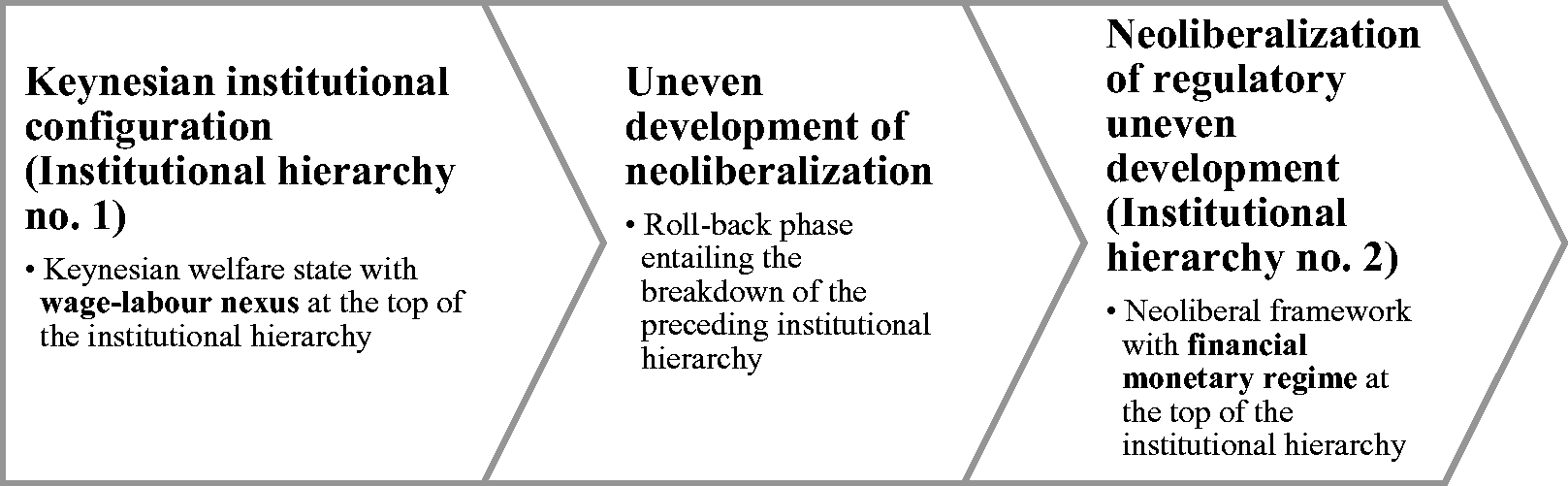
Movement from the Keynesian institutional hierarchy to the neoliberal institutional hierarchy.
A note on FR institutional forms and scale
Before proceeding, I will briefly turn to the persistently contentious relationship between FR – and its understanding of IFs – and scale. One of the major critiques of FR analysis has been addressed at the approach’s methodological nationalism and its ostensibly undertheorized understanding of scale (Birch, 2017: 87; Peck and Theodore, 2007: 740–741). Indeed, much research on institutions originating from the FR camp has retained a distinct focus on the nation-state, often without any specific justification as to why this seems to be the ‘“natural” space for validating régulation theory’ (Gilly and Pecqueur, 2002: 202). However, while certain comparative capitalisms approaches (e.g. VoC) have insisted on the primacy of the national scale in examining institutional dynamics, FR’s focus on the nation-state rather appears to be an analytical remnant of the fact that ‘the tools of regulationist analysis were forged in studies of Fordism’; that is, when the state had a much more tangible role in capitalist dynamics (Tickell and Peck, 1995: 370).
In the wake of neoliberal restructuring, it has become necessary to account for the fact that ‘national macroeconomic coherence – at least of the kind seen under the Fordist regime – may itself be a thing of the past’ (Peck and Tickell, 1995: 26, emphasis in original). In order to resolve this dilemma, Tickell and Peck (1992) have proposed treating each RoA as exhibiting a distinctive economic geography, such that the transition from one regime to another is accompanied by a ‘neo-Schumpeterian round of creative destruction and reconstitution of space’ (Scott, 1988, cited in Tickell and Peck, 1992: 197). In addition, they argue that social regulation is unevenly articulated, such that regulatory processes are situated at different spatial scales, and that outcomes of these processes, in turn, also exhibit spatial variation (Peck and Tickell, 1995: 28).
It is in this context that Peck and Tickell (1995) introduce the ‘local MoR’, a term denoting a local system which is defined by its mode of integration into wider systems (whereby these wider systems are also ‘partly constituted of, and by, local systems’) (Peck and Tickell, 1995: 27). ‘Local MoRs’, therefore, should not be regarded as ‘mesocosms’ of national [MoRs] (performing the same functions, but at a lower spatial scale), nor [are] a clear-cut division of responsibilities between the local and the national scales of regulation likely to be found (in which local [MoRs] have exclusive responsibility for some functions, national [MoRs] for others) … Although some regulatory functions and practices may be anchored at the local level, others will articulate in different ways in different places … Local [MoRs] should not, then, be seen as the domain of exclusively local regulatory practices (though these may play some small part in their definition), but as regulatory systems distinctive more for their unique position within wider (national and international) structures of accumulation and regulation (Peck and Tickell, 1995: 27, emphasis in original).
This particular analysis will focus on two cities – New York City and Johannesburg – that have over the past several decades become crucial neoliberal nodes in manifestly different ways. While New York is considered one of the foremost bastions of neoliberalism in the western hemisphere and globally, Johannesburg is less of a prominent symbol, but nevertheless emblematic of neoliberal trends experienced by the developing world. In spite of their shared neoliberal pathways, however, these two cities are contextually very different. There is no denying that South Africa’s colonial past as well as its apartheid legacy has rendered it ‘unique’, and that any interpretation of neoliberalization in Johannesburg (or South Africa as a whole) must take this into consideration. Similarly, the sheer size of New York City, its central position within the former heartland of Fordist production, and its role as a forerunner of neoliberalization has rendered it unique in its own terms. Nevertheless, by adopting a variegated understanding of neoliberalism and situating its origins within a specific institutional hierarchy, I argue that it is possible to adopt a comparative approach and trace how a systemic process such as neoliberalism has developed alongside various contingencies (e.g. apartheid).
For the purposes of this paper, I will limit my focus on the complementarity between the wage-labour nexus and the oligopolistic competition in the Fordist institutional hierarchy, and the complementarity between the financial monetary regime and the internationalization of competition in the neoliberal hierarchy. Of course, a complete analysis would have to take into account all five IFs at each stage of the movement from one hierarchy to the other. This study would also benefit from a more in-depth focus on the role of agency in articulating both disarticulated and deepening projects of neoliberalization. Nevertheless, the objective in deploying these case studies is not to provide a detailed and conclusive analysis of the processes through which New York and Johannesburg were neoliberalized, but rather to provide a qualitative account of the usefulness of employing an FR-inspired understanding of institutional hierarchies in studying variegated neoliberalization.
Neoliberalization of New York City
Keynesian status quo
Following WWII, the United States was a pioneer in implementing Fordist production methods in return for sharing productivity gains. At the core of this compromise was the wage-labour nexus, which through a set of norms and regulations codified a new relationship between labour and capital, facilitating mass production and mass consumption (Boyer and Saillard, 2002: 39). The wage-labour nexus generated a strong internal market for US industry, particularly the automobile industry and a range of other large-scale enterprises that engaged in demand-driven activities, such as cost-plus pricing, price leadership and competition through advertising (Jessop, 1992: 44). The wage-labour nexus therefore exhibited a very strong institutional complementarity with oligopolistic competition.
In spatial terms, Fordism was predicated upon the existence of strong IFs that prioritized the national and regional scales. Throughout the Fordist period, economic activity agglomerated in expansive industrial regions in the US manufacturing belt – from the north-eastern states of New York and Pennsylvania through to Illinois and Wisconsin. While small towns and rural areas were appealing sites for large scale, labour intensive industries, larger metropolitan areas proved more attractive for small scale, capital intensive industries (Moriarty, 1983: 61). The institutional compromise between capital and labour – in the form of the wage-labour nexus – was differentially distributed across space: it was strongest in the industrial states where oligopolistic competition was concentrated, while it was comparatively much weaker in less industrial regions (Peet, 1983).
During this period, New York City acted as a major regional centre for industry and a leading manufacturing city nationwide. It had a highly diversified manufacturing sector that acted as a ‘nursery’ for small startup manufacturers (Wagner, 1961: 6–7); in 1974, it was responsible for generating 43% of the total revenue of the 48 largest cities in the country (Judd, 1984: 214). Its comparative advantage was a flexible pool of resources: ‘materials in any stage of manufacture, skilled labor, the services of commercial and technical specialists, and easily available markets’ in addition to 190 million square feet (17.7 million m2) of specialized factory buildings for the small firms (Wagner, 1961: 6–7). Additionally, New York City – historically known as the ‘cradle’ of the American labour movement (Greenhouse, 1996) – established itself as a crucial anchor for the Fordist wage-labour nexus. Unions in the city wielded considerable power and the position of workers was institutionalized through extensive benefits and a generous social welfare system: This New York social democracy, which encompassed housing, health care, education, the arts, and civil rights, was intensely urban in its origins, strategies, and beliefs. Integral to it was the labor movement, a civilizing force in a city dedicated to wealth and power, and one that remained relatively strong even as unionism elsewhere weakened (Freeman, 2001: 334).
The 1960s and 1970s saw a major dislocation of industry from the manufacturing belt in the north to states in the south and south-west. One of the major factors behind this dislocation, as Peet argues, was the increasing cost of accommodating labour in the northern centres of production – ‘capitals which move to regions of low-intensity class struggle are then able to out-compete capitals which remain in regions of high-intensity struggle’ (Peet, 1983: 129). Much of the job growth during this period was therefore at the expense of unionized workers in the comparatively more organized states in the north and west of the country, while non-unionized, southern workers benefited from increasing employment (Peet, 1983: 129). Gradually, it started to become clear that oligopolistic competition and the wage-labour nexus were no longer viable in their original conjunction.
New York City was one of the first loci where tensions in the Fordist institutional hierarchy were manifested. Deindustrialization caused a massive population shift in the form of ‘selective suburbanization’, a process whereby middle class citizens fled to the suburbs, leaving a large number of ‘the young, the old, the unskilled and the poor in the central city’ (State Study Commission, 1973: 1). Aside from causing a major demographic change, ‘selective suburbanization’ also placed a significant strain on the city’s budget, eroding its main source of income: real estate and income taxes (Temporary Commission on City Finances, 1966: 21–22). From 1961 onwards, the city experienced a consistent current account deficit; annual deficits from 1961 to 1966 averaged over US$100m (Temporary Commission on City Finances, 1966: 1).
New York City always had a strong tradition of fiscal autonomy, 3 relying primarily on raising its own revenue (rather than transfers from the state or federal government) to meet its expenditures. Large public projects, such as infrastructural developments, were funded by floating municipal bonds. However, throughout the 1960s, under the strain of an expensive welfare apparatus, the city increasingly started to rely on investment banks not to finance major projects or smooth out seasonal fluctuations in revenues and expenditures, but to bridge the aforementioned current account deficit (Gramlich, 1976: 415). In particular, the city started to employ new, riskier short-term borrowing techniques such as ‘anticipatory notes’ which initially enabled the government to stay solvent. However, as borrowing increased throughout the early 1970s and it became clear that the city’s debt was unsustainable, the city’s bond rating was downgraded, resulting in a massive increase in borrowing costs (Gramlich, 1976: 421–422). Wholly dependent on the terms that Wall Street lenders were willing to offer, in December 1974 the city was compelled to accept a 9.476% interest rate on a US$500m loan needed to bridge its deficit (Alcaly and Bodian, 1977: 31). By spring, the city was unable to market a new note issue, spiralling it into a major crisis. No one believed that the federal government would allow a major city such as New York to default, but the Ford administration insisted on framing the crisis as an urban one – caused by irresponsible fiscal management and a bloated welfare apparatus (Tabb, 1982: 27–28). In reality, however, the New York City fiscal crisis should be understood as one of the first cracks in the crisis-ridden Fordist system on the national scale.
Uneven development of neoliberalization
In 1975, negotiations took place between the federal government, the city, municipal unions and Wall Street lenders with the purpose of finding a solution for the city’s fiscal crisis. At this stage, Wall Street banks were already favourably positioned relative to other actors because of the significant power they wielded in relation to the city’s fiscal management. Therefore, when they refused to lend any further funds to the city until it dismantled its costly social service programmes and collective bargaining provisions – institutions forming the core of the wage-labour nexus – the city acquiesced. Initial restructuring, and one of the first instances of neoliberal regulatory experimentation in New York City, was implemented through the establishment of the Municipal Assistance Corporation (MAC), an interim borrowing agency led by a group of influential investment bankers (Alcaly and Bodian, 1977: 31). The MAC acquired extensive authority to ‘reorganize’ the city’s finances – by enacting layoffs to public employees, raising public transportation fees, cutting budgets for public hospitals and schools as well as the public university system (Alcaly and Bodian, 1977: 31–32). During this time, the MAC ensured the city’s month-to-month fiscal solvency, but as Alcaly and Bodian (1977: 33) argue, one of its main accomplishments was making the public ‘accustomed to their city being managed by creditors’.
The subsequent neoliberal regulatory offensive by city government took the form of an emergency measure to freeze wages for municipal workers. This important win for Wall Street allowed the MAC and the city government to exert further pressure on unions. Under the premise of helping the MAC restore ‘investor confidence’ in its bond issue, unions were pressured into using municipal workers’ pension funds to purchase municipal bonds intended for debt servicing. Following extensive negotiations, workers agreed to lend over US$2.5bn dollars in pension funds to the city – one of the crucial compromises that enabled the city to avoid default (V Gotbaum, 1975, personal communication
Another crucial neoliberal ‘experiment’ conducted in the same year was the establishment of the Emergency Financial Control Board (EFCB). The EFCB was an independent agency that removed all financial management of the city’s affairs from democratically elected government. All of the city’s revenue was henceforth deposited into the EFCB and disbursed according to the agency’s own spending plans (Morris, 1980: 233). Once these measures had been implemented and a compromise was achieved, attention was turned on President Ford whose intervention remained necessary to help the city avoid default. After a month of additional concessions by the workers, the federal government finally agreed to provide a three-year ‘moratorium’, marking a formal end to the crisis (Morris, 1980: 234).
Neoliberalization of regulatory uneven development
Finally, neoliberalization of uneven development in New York occurred during the three-term mayoralty of Ed Koch, between the late 1970s and late 1980s. During this time, deepening was enacted through various long-term strategies of ‘market-driven institutional reinvention’ (Brenner et al., 2010: 212), systematically transferring the city’s key public services to the private sector. As Samuel Zipp (2010) points out, New York under Ed Koch came back to life, but as a different city, one where private entities like the Central Park Conservancy made decisions over public parks, real estate developers enjoyed a raft of government entitlements and Wall Street ascended to the symbolic perch from which it has only lately been dislodged.
As Harvey points out, the management of the New York fiscal crisis paved the way for the introduction of neoliberal practices both domestically under Reagan and internationally through the IMF (Harvey, 2005: 48): it established the principle that in the event of a conflict between the integrity of financial institutions and bondholders’ returns, on the one hand, and the well-being of citizens on the other, the former was to be privileged. It emphasized that the role of government was to create a good business climate rather than to look at the needs and well-being of the population at large. The politics of the Reagan administration of the 1980s … became ‘merely the New York scenario’ of the 1970s ‘writ large’.
The breakdown of the Fordist hierarchy and the emergence of a new, neoliberal hierarchy was accompanied by a parallel process entailing the recalibration of scale. Throughout this process, the national state was restructured from what Jessop has termed the Keynesian National Welfare State (KWNS) – that is, the ideal-typical Fordist state – to the Schumpeterian Workfare Post-National Regime (SWPR), a form of state engaged in promoting innovation and flexibility through supply-side intervention and by subordinating social policy to the demands of labour market flexibility and competition (Jessop, 2013: 15, 24). In conjunction with this, neoliberalization has given New York City a newfound importance, elevating its role on both a national and an international level.
Neoliberalization of Johannesburg
Keynesian status quo
The institutionalization of segregation in South Africa in 1948 through apartheid went hand-in-hand with the establishment of what Gelb (1991) has termed ‘racial Fordism’. 4 This particular variant of Fordism shared the technology and labour process of Fordism – enabling mass production – but failed to establish mass consumption norms as consumption was limited to a privileged stratum of white labourers. At the core of ‘racial Fordism’ was an intricate web of institutions favouring white labour – preferential labour market policies allowed white labourers access to well-paid, skilled jobs and their position was further strengthened by strong collective bargaining rights and a racialized welfare system. Non-white workers, on the other hand, had highly restricted access to the labour market due to the ‘colour bar’, 5 virtually no access to collective bargaining mechanisms or strike action. In other words, the racial wage-labour nexus institutionalized wage suppression for one segment of the population while it ensured the other, privileged segment would have easy access to secure, well-paid employment. This institutional form then not only played a role in establishing a variant of Fordism in South Africa, but also in institutionally entrenching the dominance of white citizens over black and ‘coloured’ through apartheid. The subsequent struggle against apartheid must therefore also be understood as a working-class struggle, as institutions propping up the apartheid regime overlapped those instituting a particular wage-labour nexus.
Throughout the 1950s and 1960s, racialized labour arrangements in apartheid South Africa supported the tariff-protected and subsidized industries that revolved around a Mineral-Energy Complex (MEC). 6 Historically, the MEC was defined by large-scale capital holdings and concentrated ownership structures. The big mining houses forming the core of the MEC established a variety of informal relations with public authorities and benefited from different protectionist government policies. South African industry also traditionally enjoyed a very close relationship with the banking sector through overlapping ownership structures (Ashman and Fine, 2013: 160–161). Under the influence of British imperial capital, and later Afrikaner finance capital, a small group of conglomerates emerged, controlling both finance and the major corporations (Ashman and Fine, 2013: 146). Abundant and cheap labour, guaranteed through the wage-labour nexus, therefore existed in a complementary relation with oligopolistic competition.
In spatial terms, ‘racial Fordism’ was predicated upon the existence of strong IFs that prioritized the national scale. A dominant MEC relied on an extensive system of cheap migrant labour that powered the mines, as well as regulations preventing African land ownership except within confined reserves (also known as ‘Bantustans’). However, as the share of manufacturing in the South African economy grew, the country experienced steady urbanization, drawing workers away from rural mines and into factories located within the city (Crankshaw and Parnell, 2004: 357). Access to urban areas was traditionally limited to white citizens, so increasing urbanization called for the establishment of a new set of regulations: Apartheid has meant an extension to the manufacturing economy of the structure of the gold-mining industry. In the towns, all remnants of African land and property ownership have been removed, and a massive building programme of so-called ‘locations’ or ‘townships’ means that the African work force is housed in carefully segregated and police controlled areas that resemble mining compounds on a large scale (Legassick, cited in Wolpe, 1972: 427).
Throughout the 1970s, cities emerged as crucial sites for the articulation of dissatisfaction with labour – and living – conditions, shaking up the dominance of the wage-labour nexus. Some of the first labour strikes, following the wave of union suppression in the 1960s, took place in Durban in January 1973 marking the resurgence of union activity among the black working class. In Johannesburg, tensions in the ‘racial Fordist’ institutional hierarchy were articulated through various protest actions supported by the Black Consciousness movement, the most notable of which was the Soweto uprising of 1976, which took place in the southern Johannesburg township. Uprisings such as these were compounded by a range of external tensions – in particular, the oil shock of 1973 and the drying up of foreign capital inflows in the mid-1970s (Marais, 2011: 29) – which produced major stagflation in the economy and spiralled the apartheid regime into crisis.
Uneven development of neoliberalization
In order to cope with the gradual breakdown of ‘racial Fordism’, the apartheid regime sought to formulate new policy solutions – largely in cooperation with capital (Marais, 2011: 42–43). The narrative that emerged out of these efforts was that an introduction of pro-market policies and a devolution of service provision to the private sector would permit a retreat of the central state apparatus from the day-to-day lives of black citizens, defusing discontent (Marais, 2011: 43). It was this narrative that facilitated the implementation of initial, disarticulated neoliberal experiments, ‘keyed into’ localized crises (Brenner et al., 2010: 212) in the late apartheid period.
Efforts were directed at two of the key aspects of the crisis – urbanization policy and the labour regime (Marais, 2011: 43). In 1977, immediately following the Soweto uprising, representatives of the Anglo American Corporation established the Urban Foundation, a privately funded think-tank intended to formulate pro-market urbanization policies. With the aim of preventing another Soweto uprising, some of the first neoliberal experiments took place in the Johannesburg townships. A range of initiatives were taken to privatize both township housing and public transportation (McCarthy, 1992: 29). The administration of black townships was offloaded onto new township councils which, unable to finance service provision, passed on the cost of services to residents, sparking widespread dissatisfaction (Marais, 2011: 45). As Marais (2011: 45) points out, these initial rounds of neoliberal restructuring, rather than consolidating control over African urban workers, were the basis for renewed strikes and boycotts throughout the 1980s. In many ways, urban life in Johannesburg and the activism it generated ‘deepened a groundswell of popular opposition to apartheid rule’ (McCarthy, 1992: 29) and, as Oldfield and Stokke (2007: 139) argue, were key to ending apartheid.
At the national level, disarticulated neoliberal solutions also emerged to address a variety of symptoms of the breakdown of oligopolistic competition. In 1985, the De Kock Commission made a series of major recommendations intended to restructure the financial sector through liberalization (Ashman and Fine, 2013: 163). A range of privatizations and commercializations of large state enterprises was conducted, most notably of Eskom, Telkom and Iscor – the electricity, telecommunications and steel giants (Hentz, 2000: 214). These actions were perceived as marking the breakdown of apartheid and the denouement of National Party rule (Hentz, 2000: 221). During this time, the financial sector also grew exponentially so that by 1981 eight conglomerates controlled more than 60% of assets in the private sector (Marais, 2011: 32). In the 1980s, neoliberal governance came to be overtly promoted in a series of white papers 7 as a broad solution to the country’s crisis. Throughout the late apartheid period, however, neoliberalization remained disarticulated and unable to attain a systemic character because of the persistence of the wage-labour nexus; it was therefore only during the post-1994 democratic transition that it became consolidated and further deepened within a new institutional hierarchy.
Neoliberalization of uneven development
Following the unbanning of the African National Congress (ANC) in 1990, the party’s economic policy was vague, but distinctly socialist in character (Williams and Taylor, 2000: 25). In one of its earliest documents, entitled Ready to Govern, the ANC outlined the broad economic policy that it aimed to adopt following the 1994 election – this policy rejected ‘trickle-down’ thinking, advocating growth through redistribution instead (Williams and Taylor, 2000: 25). However, the ANC’s economic programme was vehemently attacked by actors with a neoliberal agenda who were at this time already scattered throughout positions of influence (i.e. universities, economic institutes, think tanks) (Williams and Taylor, 2000: 25). In 1991, the Financial Mail, South Africa’s authority on business matters, argued: ‘the ANC is muddled and confused. It needs to be guided and educated – taught to face harsh economic reality and the need to modify the expectations of its cadres’ (Financial Mail, cited in Williams and Taylor, 2000: 25).
Several months prior to the 1994 democratic election, a joint transitional government was established incorporating representatives from both the National Party and the ANC. One of the first acts of this government was to accept an US$850m loan from the International Monetary Fund (IMF), agreeing to the usual terms on the structural adjustment repertoire: lowering import tariffs, cutting state spending, decreasing the size of the public sector and so on (Bond, 2004: 45–46). Continuity with the neoliberal policies of the previous government was further secured when the newly elected ANC government, under IMF pressure, appointed two of the foremost apartheid-era advocates of neoliberal restructuring: Central Bank Governor Chris Stals and Finance Minister Derek Keys (Bond, 2004: 46). In 1996, neoliberal economic policy became firmly entrenched through the adoption of the Growth, Employment and Redistribution (GEAR) strategy (Hentz, 2000: 219). GEAR was a five-year macroeconomic policy framework that was drafted in relative secrecy and, as Gelb argues, had a close affinity with the Washington Consensus through its prioritization of lowering inflation, liberalizing capital flows and removing trade barriers (cited in Marais, 2011: 112). It formed the ‘centerpiece of South Africa’s growth path and, consequently, its broader development path’ (Marais, 2011: 112).
Therefore, although the 1994 elections and the breakdown of apartheid produced fundamental social change, they also paved the way for a deepening of neoliberalization in the South African context. This is the moment when the ‘series of “implants” of market-friendly experimentation and selective deregulation’ began to ‘reconstitute the host organism itself’ (Brenner et al., 2010: 215). As actors became reflexive relative to the emerging neoliberal ‘rules of the game’, they embarked upon long-term projects that favoured market-driven institutional reform (Brenner et al., 2010: 212). Eventually, a new institutional hierarchy emerged: the financial monetary regime secured itself at the top of the institutional configuration, forming a complementary link with the internationalization of competition. The country’s financial sector grew from 6.5% in 1994 to 12% in 2007 and nearly 20% in 2009 – an unusual increase in a country that is not a net exporter of financial services, as Marais points out (2011: 130). This has been coupled with the transnationalization and restructuring of South African corporations; the large minerals and energy conglomerates – bound to the South African market during the apartheid period – eagerly ventured into global markets (Marais, 2011: 123).
Much like in the case of New York, the breakdown of the hierarchy of ‘racial Fordism’ and the emergence of a new, neoliberal hierarchy entailed a process of scalar recalibration. Neoliberal pressures to decrease the size of the state apparatus coincided with widespread distrust of the state, which had for a century been a symbol of oppression and control. In this context, cities emerged as crucial sites for the provision of most basic services (e.g. water, electricity, sanitation, emergency assistance), rendering them central for responding to issues such as poverty alleviation, redistribution and economic growth (van Ryneveld, 2006: 157). Johannesburg acquired a particularly significant role in this respect, acting as the locus for much of South Africa’s economic activity under the new, neoliberal institutional hierarchy.
Conclusion
Both New York City and Johannesburg, embedded in different national contexts, experienced a transition from one institutional hierarchy (wage-labour nexus) to another (financial monetary regime) in the process of neoliberalization. However, the structural conditions – as articulated in the initial hierarchy – played a substantial role in guiding the evolution of IFs and contributing to the overall diversity of their emergent neoliberal frameworks. In New York, one of the crucial specificities that guided the outcome of the crisis was the central role played by Wall Street financiers in restructuring the city’s fiscal affairs throughout the Fordist crisis. In spite of the key institutional compromise between labour and business during the Fordist period, New York’s long tradition of fiscal autonomy enabled the financial sector to play a central role in the city’s fiscal management in the decades preceding the crisis, placing it in a strategically influential position once the crisis occurred. In Johannesburg, on the other hand, the racialized institutional architecture of apartheid left a strong legacy that nurtured distrust in government structures and, in certain cases, supported the pro-market discourse underpinning neoliberal restructuring. Additionally, liberalization was facilitated by the strong role played by the MEC-finance nexus which pushed to reorganize holdings and operations on a transnational level in the early 1990s.
By employing an approach grounded in an FR understanding of institutions, it therefore becomes possible to deepen our understanding of the production of systemic differentiation across neoliberalized geographies. On a second level, this paper also argues that this approach allows us to trace the scalar recalibration of IFs in the wake of the emergence of neoliberal processes, moving past a common understanding of cities as crucial nodes in the neoliberal financial architecture. While New York City and Johannesburg have certainly acquired more consequential roles relative to their respective national scales in the wake of neoliberalization, these roles are neither uniform nor comparable to each other in scope or significance. Through a closer focus on institutions and their arrangements at particular times and in particular places, it becomes possible to develop a more complex understanding of the impact of accumulation regimes on transformations in scale and space. This allows us to further advance the research program of VNLT and its concern with ‘cumulative interrogation of common or connective processes, in conversation and combination across multiple sites’ (Peck, 2015: 168).
However, it could also be argued that the introduction of institutional hierarchies into an analysis of neoliberalization is accompanied by an entirely new set of analytical problems in its own right: for instance, how can we account for further waves of neoliberalization following the ‘deepening’ stage, particularly instances of what has come to be known as ‘authoritarian neoliberalism’ (Bruff, 2014; Bruff and Tansel, 2018)? 8 In what way can Amable’s (2015) concept of the ‘dominant bloc’ help us further advance our understanding of agency at various stages of neoliberalization? How can we methodologically operationalize the concept of the ‘local MoR’ and its relationship to regulation at other spatial scales? While these questions are certainly relevant and warrant further research on the topic, in this paper I show that an FR understanding of institutional hierarchies can act as a viable complement to the VNLT approach, deepening our understanding of systemic differentiation across neoliberalized geographies.
Footnotes
Acknowledgements
I would like to thank Karim Knio, as well as three anonymous reviewers for their thoughtful and engaging comments. I would also like to thank Robert Boyer for commenting on an earlier version of this paper. All errors and omissions are my own.
Declaration of conflicting interests
The author(s) declared no potential conflicts of interest with respect to the research, authorship and/or publication of this article.
Funding
The author(s) received no financial support for the research, authorship, and/or publication of this article.