




Abstract
Urban interventions, such as state-led housing provision in India and South Africa, establish new legal landscapes for urban residents (formerly slum/informal dwellers), who become home owners, legal occupiers of spaces, ratespayers and visible citizens although not in ways that are necessarily contingent. These material-legal processes are also acutely gendered underscoring wider calls for a feminist approach to legal geographies. Informed by a comparative empirically driven study, this paper explores how in both contexts, urban interventions work to enhance gender equality through improving women’s material shelter in the city, and introduce tenure security, often prioritising very poor women. Yet, their implementation is riddled with slippages as well as operating within a broader poverty–patriarchy nexus. This means that these legally framed benefits have occurred alongside complex and perverse outcomes including unemployment, gendered tensions and acute loss of privacy for some. Housing interventions produce uneven legal geographies, with persisting gendered inequalities and poverty distorting residents’ abilities to benefit from material-legal interventions aimed at improving their lives.
Introduction
The paper analyses the social relations of housing upgrading/relocation as a material-legal process drawing on concepts of feminist legal geography to inform its claims (Brickell and Cuomo, 2017). This conceptual position asserts that ‘the gendered power dynamics of law and their intimate and everyday manifestations and contestations has not received adequate attention in geolegal analyses’ (Brickell and Cuomo, 2017: 4). The paper’s contribution is to achieve and extend this objective through an empirically derived comparative analysis of two contemporary housing programmes (in South Africa and India) which have housed former ‘slum’/informal settlement residents.1 The cases were selected on the basis of evidencing recent but very different state interventions in urban housing, where one focused on in-situ upgrading (India), while the other on relocation from informal into formal housing (South Africa). The cases’ contrasting locations, relative to their city centres and employment opportunities, were also important for stretching understandings of the urban geography of gender, place, work and housing change. Cases were also selected because of existing links with community leadership facilitating smoother access and prior knowledge. Drawing on resident and key informant views, the paper assesses the impact of these different housing interventions on gender relations more broadly, foregrounding that law is ‘constitutive of space’ and is ‘implicated in social spatialisations’ (Delaney, 2015: 99). Crucially, it identifies how these are gendered in particular and that the ‘material’ is central to these social spatialisations. In doing so, it contributes to a growing scholarship on land and housing and their legality from a gendered perspective, specifically in the urban global South placing poverty and patriarchy at the centre of the analysis.
National programmes of urban development, which incorporate housing formalisation, are driven by multiple motivations (see Patel, 2016) including welfare and poverty concerns, sometimes overlain by wider neoliberal agendas to enhance the economic competitiveness of cities (Patel, 2016). Similarly, they may be driven by politically informed promises of (perhaps) new regimes following periods of discrimination and marginalisation of particular bodies (Brickell and Cuomo, 2017) and finally motivations can be driven by a desire ‘to manage informality’ (Patel, 2016: 104) with a mix of all these motivations evident in both contexts.
Whatever their rationales, such programmes are profoundly gendered (although not necessarily in conception), assembled in contexts of extreme gendered inequalities in the ownership of, access to, and rights over assets, particularly land and housing, which they commonly seek, in principle, to overturn. Furthermore, they operate in settings of historical-legally-enforced cultural norms about marriage, decision-making, inheritance and uneven patterns of gendered dependency revealing stubborn patriarchal relations. Legal codes, as well as illegal and extra-legal practices, including un- and informal employment, operate alongside evolving justice mechanisms and symbolic desires to attain urban and political formality and aesthetic decency in contexts of widespread poverty.
To interrogate the gendered implications of spatial changes, this paper employs and develops four key arguments from feminist-legal/legal geography literature. First, it advances the idea of complexity in relation to legal geographies as articulated by Delaney (2015) who states that ‘spatio-legal events are not simple one-shot “inscriptions”’ … there are ‘contradictions, gaps, and slippages in how “law makes space”’ (100). An analysis of the gendered trends in these ‘slippages’ is key to understanding how law and policy are practised. Second, the paper reveals how gendered outcomes of urban interventions are contradictory and at times, but not always contingent. This develops Delaney’s (2015) notion of socio-spatial contingency in relation to the application of legal geographies, where the practices of ‘numerous actors, divergent institutional settings, competing ideologies, interests, motivations, and capacities’ mean that events ‘could have been otherwise’ (101). But it places centre-stage the role of patriarchy and the reality of poverty in repeatedly shaping these contingencies, rather than viewing more indiscriminate actors and practices, as fundamental to, and constitutive of, the gendered workings of legal geographies. Third, the arguments here share Brickell and Cuomo’s (2017) calls for the ‘geolegal’ to use a feminist intersectional analytic (following Crenshaw, 1989) to understand how ‘law dehumanizes certain bodies’ (Brickell and Cuomo, 2017: 4) but it argues and reveals how such an intersectional analytic (poor, black, female) can work as a logic underpinning more progressive legal and informal practices of urban intervention. Finally, the paper supports the recognition of legal pluralism as central to understanding ‘women’s experiences and encounters with law… particularly but not exclusively in non-western contexts’ (Brickell and Cuomo, 2017: 14), but it asserts an even wider frame which incorporates multiple manifestations of the legal. It turns to Baruah (2007) who argues that interpreting the legal terrain (in India) is not about identifying ‘a system of laws and rules’; rather practices are shaped by cultural, economic, legal, political and ideological processes which ‘more closely resembles a continuum with many intermediate positions than a dichotomy of what is legal or illegal, formal or informal’ (2107). This framing speaks across the Indian and South African context, defining and documenting the il/legal geographies through which women experience exclusion but also gains in urban access to housing.
Bearing these advances to feminist legal geography concepts in mind, the wider literature on gender, housing and land in the Indian and South African contexts is first discussed before turning to a contextual overview of the two particular case study settlements at the heart of this Indian–South African comparison, locating them within a gendered interpretation of their housing histories. The methodology informing the research is detailed before moving onto four areas of analysis drawing on empirical research. Here, the heart of the argument is advanced, revealing the complex and contradictory gendered legal geographies informing, and informed by, housing change in poor urban settlements against a backdrop of poverty and embedded patriarchy.
Gendered geographies of housing in a comparative global South context
There is a strong body of literature in both the Indian and South Africa contexts (and elsewhere in the global South) which delineates the legal and gendered tensions associated with programmes of development, power relations over land ownership and control and housing change and form. Our paper seeks to develop this scholarship through its urban, comparative focus on state-directed interventions.
Much of the work on gender and land has focused on the rural, including key authors such as Walker (2003) debating the inadequacies of post-apartheid land reform policy in the South African context. Baruah (2007) criticises gendered research in South Asia for being primarily focused on rural women and agricultural land. Our paper contributes to an urban analysis but draws on key ideas developed in the rich rurally orientated field. Assumptions about overcoming unequal gendered access to land through land rights provisions are questioned by Cecile Jackson (2003), who critiques such a policy reduction. She argues this risks overlooking wider social changes and diverse ‘subject positions … of women’ recognising the enduring significance of marriage (2003: 477) centring the social alongside the legal. Behrman et al. (2012), through a gendered critique of literature on large-scale land deals, note it is not only ownership which fosters gendered impacts. Instead, inheritance practices, land-uses, gendered uses of common or ‘waste’ lands, access to water, and the ancestral significance of land are all important. Wider cultural practices are key and they commonly work to ‘deny [women] inheritance or management rights’ (Baruah, 2007: 2100). Izumi (2007) in the context of various African countries identifies ‘property grabbing’, often brutal, afflicting women in particular, by extended family members. Widows, particularly if HIV positive, are especially vulnerable, as social stigma compounds relatives’ sense of rights over the women’s property. Widows historically had rights to use husband’s property, but such norms are gradually being eroded, and further undermined if they do not have male children (Izumi, 2007). Examples of gendered violences associated with claims over property are explored in this paper in urban contexts and the use of progressive legal mechanisms alongside informal practices are shown to sometimes support particularly vulnerable women.
The gendered workings of legal pluralism (Brickell and Cuomo, 2017) are critical. Across sub-Saharan Africa, where customary land rights are common with women accessing property through their relations with men, shifts to statutory rights do not always work to secure land for women, with men often obtaining legal title (Behrman et al., 2012: 55). In India, religious law is a key factor limiting women’s access to property through inheritance evident in both Hindu and Muslim communities. In Baruah’s work, only 7 of around 139 female participants inherited parental property; in all cases no male siblings existed (2007: 2104). ‘Legal’ code interweaves with cultural explanations for such trends which are related to the practice of ‘patrilocality and operational problems associated with managing the property once a women moves to her marital home’ (Baruah, 2007: 2104).
The ownership and control over land and property across the urban global South are highly iniquitous in gendered terms, among others, including caste and race. This highlights the intersectional nature of how law is used to ‘dehumanize’ particular bodies (Brickell and Cuomo, 2017), but this paper reveals how this is also fluid and open to some progressive change. An intersectional analytic sensitive in particular to ways in gender, race, class and caste work in combination, is central to understanding the dynamics of current urban spaces, including, as illustrated in this paper, those ‘formalised’ spaces produced through state-directed interventions. Such spaces exist alongside, and in conjunction with informal spaces and work to produce these informal urban spaces. Gendered power relations are commonly tied to place, with their particular materialities (a key focus of this paper) and characteristics shaping outcomes. Informal settlements exhibit a range of tenure relations, and resultant property rights, including what Nakamura (2016) calls formal, informal and perceived property rights. The latter rests on a mix of politico-legal practices such as ‘slum declaration, zoning for residential use, political patronage, possession of ration cards, and access to individual water taps’ (2016: 161). Furthermore, in low income and informal areas, women and girls are particularly affected by the lack of access to healthcare, schools and housing, and proximate services, affecting girls’ attendance at school because of their time spent sourcing water and other daily needs. It is likely therefore that if interventions occur, women and girls ‘will reap greater benefits from the provision of services’ (Parikh et al., 2015: 468). Women’s positioning in relation to the specificities of informal spaces affects their abilities to thrive in such contexts. In South Africa, ongoing shortages in affordable housing alongside an expanding state-sponsored formal housing sector has fuelled the growth of female-dominated backyard shacks (Lemanski, 2009). These offer poor living conditions. In East London’s case for example, where women are more numerous, residents share 1.2 rooms on average with 3.2 tenants (Bank, 2007: 214). More generally, women’s relatively weaker social status shapes their access to property in poor urban contexts. They consistently occupy what are considered the lowest-ranked types of accommodation, including lodging with a family, informal renting, sharing and subletting (Baruah, 2007: 2102) with landlords actively discriminating against rentals to female tenants in the Indian context (Baruah, 2007). Yet, changing urban forms presents new opportunities for power which can also be gendered. Lemanski (2009) reveals that some tenants (often women) squatting in yards occupy positions of relative financial power in contrast to home owners who are ‘cash-poor and asset-rich’ (474). Landlords can also be female, with Bank (2007) noting an equal gendered split in his case study. Bank claims that difficulties arise for older female landlords controlling larger families living in their yard, particularly over weekends as alcohol consumption fuelled fighting, including domestic violence, eliciting responses to this (2007: 219).
Women’s status within their extended families and the complex formations of households in cities also influences their abilities to access housing and to achieve security of tenure. The gendered politics of micro practices is central, but more work is needed which explores this alongside the material realities of urban housing. In the Indian context – where the norm is for women to move to their husband’s property – divorced, single or widowed women are particularly vulnerable, even more so when living temporarily with their sister’s families, where their ‘kinship entitlements… were even more tenuous’ (Baruah, 2007: 2103). In South Africa, this same gendered spatial norm exists but because of declining marital rates, migration, urban poverty and the limited availability of housing, household composition is often non-nuclear or simply extended, producing different patterns of power relations. In Doornkop, South Africa, nearly 50% of households consist of single carers living with children alongside other relatives, because of the need to pool resources in contexts of scarcity (Patel, 2012). The work of Ross (2015) in Cape Town supports this, pointing to diverse rationales for absorption into households as: ‘lovers, laborers, boarders, and fictive kin, among others. Children may be absorbed informally or formally’ (S101). Such household formations are significant for shaping gendered relations, blurring questions of access, control and responsibility and planners’ ideas of the ‘household norm’ (Ross, 2015), but they also produce particular gendered spatialities as a result of their material realities including a loss of privacy and overcrowding, as explored in this paper.
Finally, urban interventions affect men and women differently, with women’s greater benefit from infrastructure changes to housing and water for example, noted above (Parikh et al, 2015). These differential impacts are not simply a function of enduring patriarchy but also an outcome of effecting change in poverty contexts. Examining the mutually reinforcing impacts of this poverty–patriarchy nexus is a key contribution of this paper. Upgrading programmes or other urban interventions are often informed by gendered concerns. Yet, as Walker (2003) argues in relation to rural land reforms, connecting lofty principles of gendered equity with on-the-ground implementation is challenging. Programmes of upgrading can discriminate against women, through offering property titles to household heads, commonly men, denying married women a significant opportunity to access control over property. This was the case in India where legal restrictions prevent women from including their names on property titles if the titles are already in their husband’s name. Name inclusion is treated as a sale or transfer of property, thereby incurring substantial charges: stamp duty at 10% of the property’s value, registration fees, surcharges as well as bribes and informal payments (Baruah, 2007: 2106). Improvements in facilities, services and tenure security can cause rising costs and also values in rent for properties in informal areas. Given the dominance of women living informally, this risks sharpening ‘the status distinctions between owners and renters and ironically reproducing the very dependency relationships that such interventions were designed to erase’ (Baruah, 2007: 2103).
Developmental changes such as housing and service provision can also shift the positioning of urban men and women vis-a-vis worsening or improving power relations as explored in this paper. These changes might occur between landlords and tenants or for those previously occupying positions of power such as ‘big men’ in poor community contexts who may go on to have their power bases threatened: ‘Upgrading [can result] in shifting power relationships, and these may also be a cause of conflict’ (UN Habitat, 2011: 28) supporting wider arguments which signal increasing violence alongside the empowerment of women (World Bank, 2012: 31). Hackett explores the statistical relationship between developmental changes in India in relation to domestic violence arguing that ‘The influence … may be dependent on the process of change’ (Hackett, 2011: 285). Where changes such as rising employment do not necessarily test and destabilise gender relations, due to Kerala's more “advanced gender norms”, domestic violence levels are lower; however, in situations where there are ‘…challenge[s] to traditional gender roles’, for example through contestation or changes to gendered property ownership, this ‘may provoke domestic violence in the family’ (Hackett, 2011: 285). This supports South African findings regarding rising tensions in contexts of gendered asset gains (see Meth, 2015) and Baruah’s claim that land redistribution will likely ‘be contested since men stand to lose their traditional control over the resource’ (Baruah, 2007: 2107). The potential for violence and the use of ‘illegal’ forms of coercion to manage tensions around gendered access to housing are critical, but as argued in this paper, these are contingent upon complex, fluid legal landscapes (e.g. slum formalisation) which include ‘slippages’ in practice and contradictory outcomes.
Comparative contexts and cases: Hammond’s Farm, South Africa and Kulamnagar, India
South Africa and India share histories of significant gendered inequalities in access to, and ownership of, land and housing for women. Women have been discriminated against because of their gender but also their class, caste or racial characteristics underscore the intersectional nature of legal measures. Both contexts contain a suite of recent legislative interventions seeking to overturn these challenges, but not necessarily comprehensively.
South Africa’s current extensive state-subsidised housing programme is a direct response to the historical racialised inequities of land and housing ownership and occupation, shaped by colonial settlement and apartheid. Black citizens were historically excluded from urban housing markets, but more specifically, the housing divide was acutely gendered: ‘[b]efore 1994, [non-white] women were not allowed to legally buy or own a home and land’ (RSA, 2014: 73–74) illustrating Delaney’s argument that law ‘underpins spatial tactics’ (2015: 99) and Brickell and Cuomo’s point that ‘certain bodies’ are dehumanised through law (2017: 4). Through the ‘coerced mobility’ (Delaney, 2015: 99) of the Group Areas Act (in 1950) and resultant forced relocations, and migrant labour system, the elderly, young and many women remained in rural ‘homes’ while men migrated to cities for work although some women moved to cities in search of their husbands and work. As urban employment for women grew, particularly in the field of domestic work, female-headed households moved into, and at times dominated, urban informal settlements, or joined husbands in townships (urban areas declared legal settlements for black residents).
Overcoming this legally enshrined legacy is a stated policy objective of the current government. Since 1994, the housing programme claims the delivery of nearly four million formal houses (DHS, 2016). Targeting the very poor, housing is constructed either in situ, replacing informal housing, or on green-field sites that residents are relocated to. Housing is provided free-of-charge but beneficiaries face rates and services costs. The Housing Act prevents residents from selling their properties within eight years of occupation, although ‘illegal’ sales occur. Eligibility criteria include, among others: citizenship or permanent residency, legal competency, not yet benefitted from government funding, a first time property owner, married or with dependents, and with a gross monthly income of less than ZAR3500 (Tissington, 2011: 15, 22–23). The framing of eligibility criteria worked to enhance black women’s access to housing: ‘housing subsidies were restructured to enable access by “person plus dependent” as opposed to an assumed male head of household’ (Beall et al., 2011: 98). The programme’s conception was inherently gendered, aiming to ‘support the role of women in the housing delivery process’ (RSA, 1994, Section 4.4.6). There is some evidence of gender gains through housing in implementation too, although this is more mixed with an emphasis on women’s engagement in construction rather than occupation (Charlton, 2004). Chenwi and McLean (2009) note ongoing socio-legal constraints which undermine women’s access to housing.
These legally inscribed gendered interventions are explored through the case of Hammond’s Farm (HF) (see Figure 1). This green-fields settlement is recently built, in around 2011, and located to the north of the city of eThekwini, in close proximity to the city’s new airport and the formerly Indian town of Verulam. The settlement is substantial, with a total of 1800 double-storey row-housing units. Design is identical. Properties contain two upstairs bedrooms and a kitchen/lounge with separate bathroom on the ground floor. Properties were allocated to residents from various locations, but the majority hailed from a single very disadvantaged informal settlement called Ocean Drive In (ODI), located 17 kilometres further north, which had suffered decades of contestations over residents’ illegal occupation of the land (see Sutherland and Buthelezi, 2013).
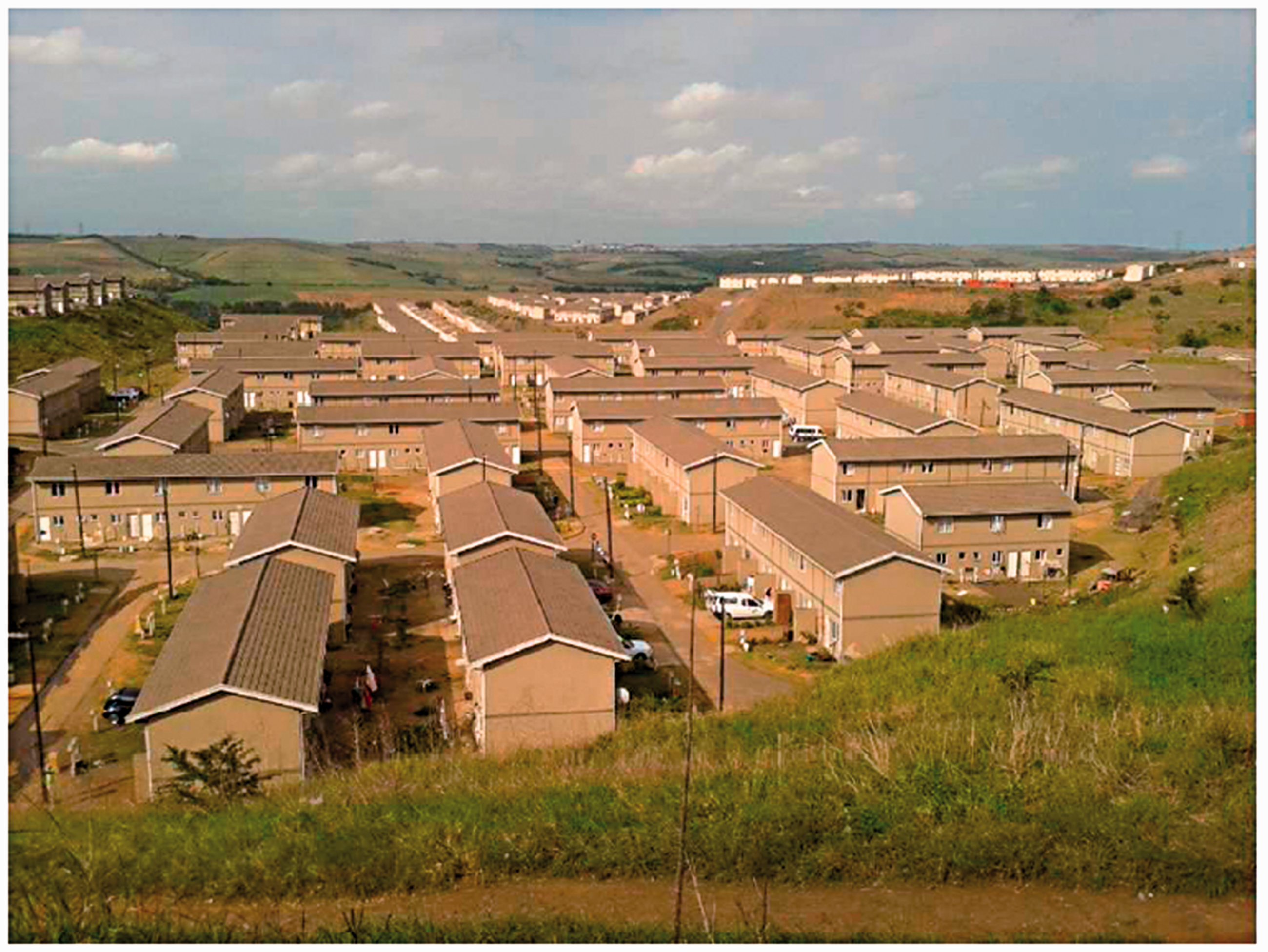
Hammond’s Farm, South Africa, Source: Meth, 2014.
India’s history of urban slum development differs significantly from South Africa’s. In terms of gendered make-up, Indian slums show evidence of a more rapidly improving sex ratio compared with the national urban trend (Nagarajan, 2013) of a disproportionate number of male versus female residents (a function of higher male migration and sex-selective abortions) (Khosla, 2009: 18) but slums still have higher male populations: 922 girls: 1000 boys in 2013 (Nagarajan, 2013). Nationally, there has been a growing tolerance of poor migrants to Indian cities in the post-independence era. An acceptance of the need to provide for poor residents resulted in the ‘emergence of an entire substructure of para-legal arrangements, created or at least recognized by the governmental authorities’ (Chatterjee, 2004: 137). However, from the 1990s onwards ‘a desire to rid the city of encroachers and polluters’ (Chatterjee, 2004: 140) called for the use of legal mechanisms to regulate the use of space and ‘government policy has rapidly turned away from the idea of helping the poor to subsist within the city’ and instead focused on enhancing conditions for private sector investment (Chatterjee, 2004: 144). This frames the introduction of the programme of housing upgrading in the case study settlement of Kulamnagar 2 which forms part of the wider JNNURM (Jawaharlal Nehru National Urban Renewal Mission) programme aimed at the transformation of urban areas, formulated in 2005. JNNURM relies on two sub-missions to achieve its aims, namely Urban Infrastructure and Governance and the Basic Services for the Urban Poor (BSUP) (Patel, 2016: 106) of which the interventions in Kulamnagar are an example. The BSUP focuses on either relocation of residents or the in situ upgrade of poor-quality housing, the provision of services as well as secure tenure (Patel, 2016). JNNURM is not explicitly gendered in focus with Khosla (2009) claiming that it has been ‘overlooked’ and that guidelines do not accommodate women’s representation or issues (6, 9).
In the state of Kerala and the city of Trivandrum, the settlement of Kulamnagar was selected as a key area for investment of BSUP funding. It is a long-standing poor-quality slum colony suffering from chronic environmental conditions as a result of its location at the confluence of Trivandrum’s sewage outlet, exacerbated at times of flooding. It is arguably well located, adjacent to the city’s key commercial market, critical for employment opportunities, particularly for men. The area has attracted poorer residents often outcast socially through divorce, low-caste, Muslims in a Hindu-dominant city, poverty, etc. Devika (2015) describes the settlement as suffering abjection in multiple ways including physical, cultural, social, moral and ecological (77).
Since 2008, proposals to build 560 new flats replacing the existing slum housing have proceeded, with building work progressing through Phases 1 and 2, then stalling for several years, continuing with Phase 3 in 2016 (see Figure 2). Design and building were undertaken by a locally reputable non-profit organisation SUSTCO 3 who proposed the demolition of all slum housing and the build of a number of walk-up apartments adopting the low-impact cost effective, sustainable and vernacular architectural style of Laurie Baker (Williams et al., 2015: 1119). Flats are one-bedroomed, with a hall and kitchen and a separate bathroom. Unlike in South Africa, part payment of around INR25,000 is required.
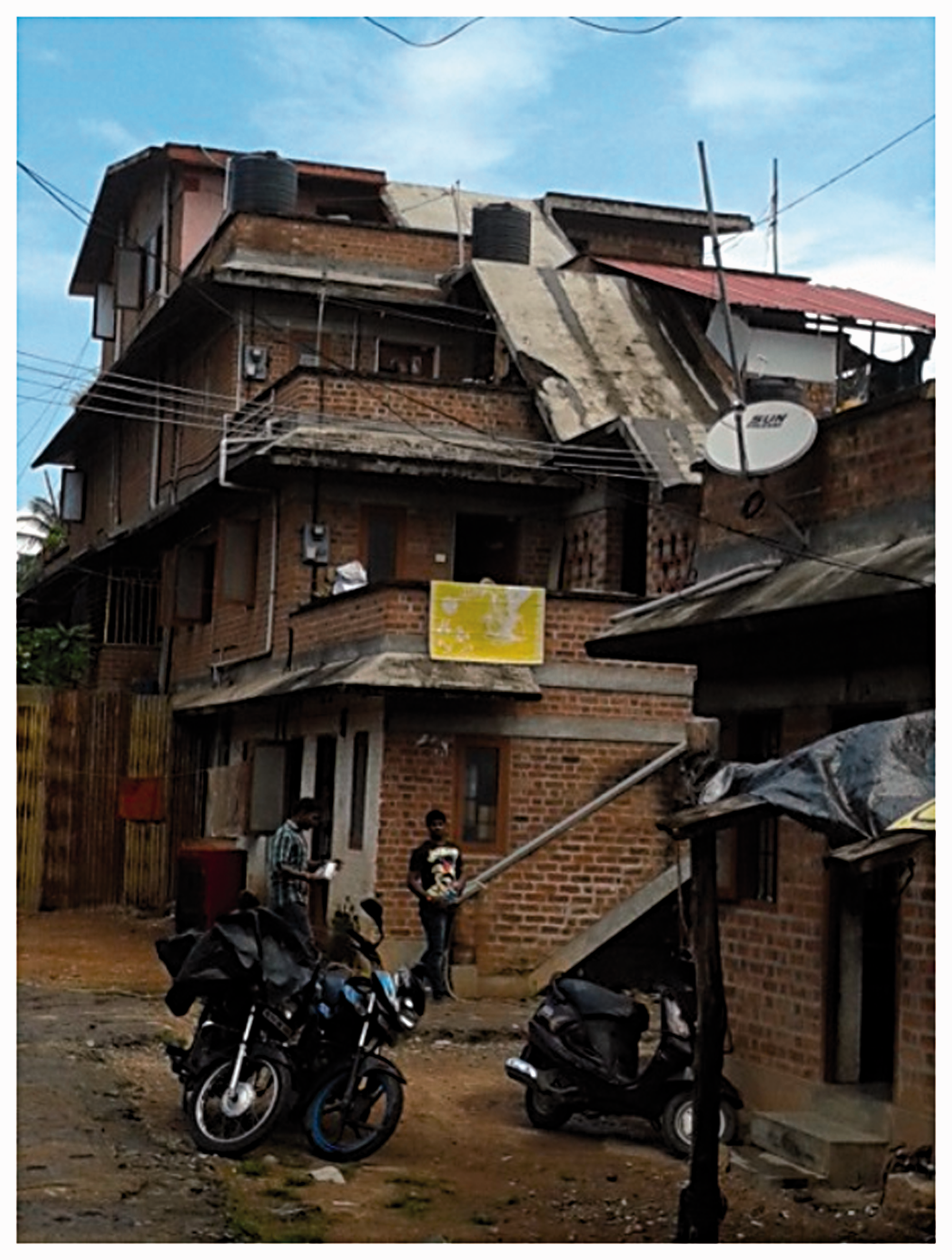
Kulamnagar, India, Source: Meth (2016).
Upon receipt of the property, residents were issued a written document of ownership, the legal status of which is only useful in terms of proof of address. Residents must wait for seven years before they are awarded legal title, which can be used as collateral to secure bank loans. To date, no residents have yet received titles to their property. A significant number of residents are living in the local community hall which was provisionally converted by the state to house beneficiaries waiting for the completion of their flats. This temporary solution is exceptionally problematic, with great suffering reported. Units have no internal bathroom facilities and very small cramped living quarters. The allocation of the new flats in Kulamnagar has been part-managed through the female-led Kudumbashree programme 4 which was tasked to sit on the committee responsible for completing the list of beneficiaries, in consultation with officials at the municipal level resulting therefore in ‘local women [playing] a key role in identifying legitimate claimants’ (Williams et al., 2015: 1120). A beneficiary list of 560 households was eventually determined, albeit through much contestation, discussed below (see Williams et al., 2015 for details).
Methodology
Attending to a gendered analysis of the legal geographies of housing interventions with a focus on material realities and everyday experiences is achieved here through a multi-method qualitative and comparative methodological approach. In doing so, it is the voices of both men and women living with housing change and their daily encounters with legal and illegal practices and structures that are privileged here. Focus groups with six groups of women and three groups of men were conducted in eThekwini (South Africa) in HF, and with seven groups of women and one group of men in Trivandrum (India) in Kulamnagar. Groups consisted of four to five participants, all adults ranging in age from early 20s to 60s. Participants discussed their housing histories including experiences of upgrading or relocation from informal to formal properties and the associated material, social and economic outcomes. Pilot work in South Africa (see Meth, 2015) using various qualitative methods revealed that focus groups worked effectively to elicit discussion on this topic; participants supported each other through conversation and were open about relatively private experiences.
In eThekwini, because of additional time and money, eight participants from the focus groups (split evenly between men and women) were also solicited to complete diaries supplemented by auto-photography by phone, transmitted via WhatsApp. These diaries further detailed their lives post-housing occupation, examining household relationships in these new contexts and exploring experiences of crime and conflict. Their photographs were of events or spaces which illustrated their experiences of housing change and social processes and worked to bolster diary entries. Wider structural and policy-related insights were accessed through six key informant interviews per city, including committee representatives, housing officers, the police, health workers, activists and local councillors. This research relied on the expertise, local knowledge and contacts of two research assistants (Buthelezi and Rajasekhar), one based in each country. Focus group and diary data were collected in the local languages (isizulu and Malayalam) and transcribed and translated into English transcripts. Author, Meth, was present for most key informant interviews but not for the focus groups. The authors shared and discussed general overviews of key findings, and transcripts were analysed focusing on thematic codes tied to research questions and the wider literature, as well as searches for absence and presence of themes. Further interpretation of core findings occurred through the joint production and distribution of resident-facing dissemination pamphlets summarising key findings in each case study settlement (Meth, Buthelezi and Fleetwood, 2016; Meth and Rajasekhar, 2016) alongside country-specific research presentations with local experts and stakeholders which shaped understanding. The paper turns now to consider four key findings relating to the gendered legal geographies of housing formalisation.
Partial gains in gendered security
Housing upgrading and the provision of new housing through relocation programmes restructure residents’ security in significant and gendered ways. Nearly all women in HF stated that they felt safer in their new houses compared with their previous shacks (see Meth and Buthelezi, 2017 for details), which is significant given the relatively high levels of violence in urban South Africa. Kulamnagar’s residents had mixed views on the benefits of upgrading in terms of crime, tied to changes in alcohol and drug abuse in the settlement and the power and reach of their local community organisation. Following a history of excessive crime as a result of substance abuse, they pointed to a period of relative peace and crime-reduction effected by the rise of a powerful community body which overturned criminal practices. More recently, however, this trend had reversed, as changes in local policing staff, the decline of the community organisations’ power and coherence, alongside rises in drug misuse, meant that crime appeared to be on the rise. In this fluid context, the changes to housing appeared less significant.
Nonetheless, the formal materiality of the structures and buildings in both contexts facilitated the use of burglar guards, gates and proper locks. Housing now contains an internal toilet and water source – a critical gain, particularly for women. Previously in Kulamnagar, residents had to make use of a single block of public toilets, and in the settlement ODI, residents were forced to use surrounding sugarcane fields, as their shack housing lacked internal or publically provided toilets. Women and children were particularly vulnerable to rape, exacerbated by the dense and unplanned layout of shack housing which offers easy refuge for criminals and reduces policing capacities. Former ODI residents explained: ‘People experienced incidences in the sugarcane [field]. Some children were raped in the sugarcane [field] at ODI and the person just ran away and hid … At [the] mjondolo 5 there was no structure, people built [houses] wherever they saw a space’ (♀ FG6, HF, 2014). A further significant gain in material terms for residents in Kulamnagar was the relief from the vagaries of repeated flooding and environmental destruction of properties suffered in their former slum housing. Residents often lost all their possessions, including materials used in informal economic activities. This threat was gendered, as it was commonly women who used their homes for income generation including food preparation for sale, only to lose their provisions: ‘We had no place to store our provisions safely and every time the water rose up – and this was frequent, whenever it rained – we lost all our provisions, which inevitably got soggy and rotted’ (Interview with Rahila, cited in Devika, 2016: 207). In Rahila’s case, she was unable to repay her food business loan as a result. However, despite gains in moving into flood-proof flats, municipal rules aimed at ‘convert[ing] the area into a “respectable locality”’ (Devika, 2016: 207) meant residents were advised against selling vegetables from home or raising goats, although such rules are blatantly being ignored in the interests of securing livelihoods.
Across both case studies, moving into new housing generally fostered higher levels of privacy for most as a result of the increase in floor space, but also as a consequence of new formalised internal divisions of space and clearer boundaries between neighbouring properties. The party walls in the flats in Kulamnagar were constructed with a thickness of nine inches (Interview with a housing provider, 2016) and these gains in privacy served to improve neighbourly relations and reduce tensions, as previously in the Indian slum-colony: ‘Neighbours could hear any small sound which was produced from our house. There were so many problems between people when they were living very closely’ (Interview with a Health Worker, Trivandrum, 2016). Some residents claimed that such material changes also reduced incidences of domestic violence, suggesting that gains in space and subsequent privacy are critical in shaping gendered household relations.
Losses in gendered security including contradictory outcomes for domestic violence
Contradictorily, numerous beneficiaries in Kulamnagar found moving into the flats decreased their levels of space and privacy. The relatively small perceived size of the flats (30 m2 in contrast to HF’s 40 m2) was a significant concern for residents, and the one-bedroomed design was considered a key failing. Many residents claimed their new flats were smaller in size than their original slum properties, although some found them bigger and better laid out in terms of material divisions. In part, the small size of flats was a function of having one bedroom and a small floor space, but also a function of excessive overcrowding relating to allocation practices of flats which resulted in some extended families only getting one flat despite containing multiple family units. The politics of allocation are detailed later, but essentially they resulted in a crisis of space, with extreme overcrowding: ‘We are 13 members in our family. My children and their family do not have a convenient space to sleep at night’ (FG6, ♀ Kulamnagar, 2014). The small size impacted on internal household privacy. It affected couples’ abilities to practise sexual relations, and produced difficulties for parents who have to share rooms with elderly relatives, as well as children and young adults, some of whom are married themselves. Women felt they suffered the consequences of these spatial changes acutely, as this affected their abilities to parent effectively and their children’s rights to privacy: ‘Mothers like us can’t be with [married children] in their private moments’ (♀ FG6, Kulamnagar, 2014). Residents felt that their children were exposed to ‘unnecessary scenes’ (♀ FG2, Kulamnagar, 2014). Women also expressed concerns about their capacity to sexually satisfy their husbands in such living environments, noting the likelihood for men to seek sexual attention elsewhere, a probable outcome and source of marital tension: ‘She and her husband are sleeping in the hall which is very open to all who enter … So how can they get the chance for physical relations? … Some men can’t adjust to this situation…’ (♀ FG5, Kulamnagar, 2014).
Kulamnagar’s findings contrast with those in HF where residents were allocated a two-bedroomed property and where privacy complaints were far lower. Also, as a result of the gendered politics of housing allocation (discussed below), this particular housing intervention in South Africa did not seem to yield the same challenges of overcrowding witnessed in the Indian case. This seemingly has had a positive impact in the South African context on domestic violence noted to be partly fuelled by the stresses of spatial constraints and lack of privacy suffered in informal housing (Meth, 2015). However, across both cases, there was consistent evidence that movement into formal housing reduced the ability to hear adjacent disturbances as a result of formal walls, and locked doors, suggesting that a reduction in sound travelling had a perverse tendency to reinforce the possible silences of domestic violence. At ODI, ‘[i]t was very easy to hear if people are fighting’ (♀ FG3, HF, 2014) and neighbours would respond (supporting Bank, 2007 in relation to backyard shacks). LS, a male resident, first explained why he thought domestic violence levels had improved at HF, but then reconsidered: ‘…maybe we do not know as the people are sitting in their houses and at mjondolo was very easy for the people to hear if partners are misunderstanding each other’ (♂ FG3, HF, 2014). This was reinforced in the Indian case by professionals and residents: We don’t know anything when we get inside the flat and keep the door closed. We can’t hear any noise… In older times, if there were any issues of quarrels between people, it would be directly in front of our house. (FG1, ♀, Kulamnagar, 2014) we can’t hear anything from outside when we closed the door… even if a war happened on our door step. (FG2, ♀, Kulamnagar, 2014)
Professionals working with the residents of Kulamnagar as well as with the residents of the settlement identified cultural barriers shaping the practice of domestic violence as a ‘normal’ act which should be dealt with privately by husband and wife. Because of these culturally inscribed attitudes, the role of neighbours as potential supporters of domestic violence victims was viewed with much scepticism, including by women who suffered abuse themselves. Essentially, many residents felt it was inappropriate to interfere, although some evidently did intervene and support their female neighbours in times of crisis. In Kulamnagar, justice mechanisms were positively regarded, with both the police and the courts seen to offer good support to women, encouraging them to report all instances of violence. Relevant professionals, including the police and social workers, however, were frustrated with women’s regular resistance to taking legal action against their husbands. Women instead encouraged the police to scold or beat the accused men and frequently protected their husbands from legal action by withdrawing reports of violence: ‘Men brutally attack their wives. However, those women are living with them. I don’t know why. They are not even ready to give a complaint against him…’ (Interview with a Social Worker, Trivandrum, 2015). Women’s capacities to leave violent men are circumscribed by their financial dependence on men, and anxieties over child responsibilities. Locally, efforts by representatives of Kudumbashree and social workers to educate women about their rights in terms of domestic violence, to understand the role of the police and the courts, and to provide awareness class for men, were proving successful. Women noted the advantages of mediation services in addressing tensions and violence for some couples. These responses to gendered violence reflect the myriad il/legal practices underway and the rejection of particular legal avenues for redress.
In HF, domestic violence incidences were seemingly tied to rises in economic insecurity between men and women. Employment opportunities had significantly declined upon movement into HF as a result of increased distance from previous informal work (as construction labourers for example) enjoyed by residents when living at ODI. This shift occurred alongside male dissatisfaction about wider constitutional changes to domestic violence legislation (Meth, 2009) where women gained legal rights around violence and were better protected through justice and welfare mechanisms, including the police. The local Social Worker explained that residents in HF were more informed about their rights, and how to ensure they were upheld, in contrast to when previously living as squatters where they were largely viewed by the state as ‘illegal’ occupiers, but were also spatially distanced from welfare services (Interview with a Social Worker, HF, 2014).
In addition, the acquisition of a house is a significant asset which shapes relationship dynamics, in a context of very high unemployment. In HF, there were rising tensions between partners in relation to uneven gendered outcomes in gaining financial security: ‘[with] my boyfriend things are not going well, he thinks that I am going to change or leave him because I own the house. Some men are jealous if they see women succeed in life’ (♀ FG6, HF, 2014). These concerns are underscored by men’s beliefs that women seek financial security in men who have assets, and arguably lose respect for unemployed men without assets. Men also noted rising tensions upon moving into new housing: To stay in HF has had a negative impact between [us]… At ODI we did things together, helping each other … [here] … she started comparing our lives with other people … [and] asking for things which I can’t afford to do to my house because of financial problems. Those things bring tension between us. (TN, ♂ Diary, HF, 2015)
Legal title in a South African context of gendered inequality and poverty
The South African housing programme is explicitly framed in terms of improving gendered outcomes for women. By exceeding the national achievement of delivering 56% of housing to women (RSA, 2014: 68), the case of HF sits within a larger northern eThekwini housing delivery department where officials claim to be delivering around 70% of all subsidised housing to women (Interview with a Housing Officer, 2014): ‘most of the houses are owned by the women… everywhere’ (Assistant to ANC Ward Councillor, 2015). Women were more likely to be poor, shack owners or constructors, and hence met the eligibility criteria. This policy achievement is likely to improve unequal trends of housing ownership and tenure security which has historically eluded women, and benefit women greatly as a result of their wider domestic responsibilities (Assistant to ANC Ward Councillor, 2015).
Women now possess a transferable asset which can be held in their names and inherited by their children. However, alongside this high proportion of delivery to women, the general process of housing allocation is different to that in India and rests fundamentally on commonplace knowledge of the instability of relationships and the asset-related and legal risks of separation, particularly when couples are not legally married. Significantly declining marriage rates are a feature of post-apartheid South Africa relating to women’s rising (although unstable) economic independence and men’s inabilities to pay bride-wealth because of persistent unemployment (Hunter, 2006: 152–153). In this context, unmarried couples are advised to apply for two separate houses in efforts to circumvent contestations over property ownership in cases of relationship breakdowns (Interview with a Housing Officer, 2014): ‘… yah [the women] have to [be smart] … They see other women register their boyfriend and after a few months the boyfriend kicks out the women from the house and gets another girlfriend, so they learn from that….’ (Interview with Housing Officer, 2014). This advice is predicated on women’s domestic responsibilities and assumptions about gendered priorities, where it is believed that men view property as leverage for accruing capital, whereas women use houses to care for children (Interview with Housing Officer, 2014). Housing officials’ advice was reinforced to residents through meetings with the local Ward Councillor and Area committees: The councillor told us that if you decided to [move in to a new house] with someone you must not come to him if things are not going well there. Everyone must register her/his house unless you are married. If you are not married you must not share ownership with a girlfriend or boyfriend. (♂ FG1, HF, 2014)
The acquisition of property was decisive in relationship breakdowns: ‘It is not a good thing to see people fighting [here] while they were together for many years in their shack’ (M, Diary, ♂, HF) and although couples lived together at their mjondolo ‘once the woman gets the house the man starts fighting. When men are here [having received a house] they chase away their old girlfriends’ (Interview Assistant to ANC Ward Councillor, 2015). When relationships break down, conflicting couples experience various housing outcomes depending on their legal marital status, knowledge of their rights, ability to access a social worker or housing officer for advice, and support from local governance figures, e.g. the Ward Councillor or committee representatives. Common Law declarations by couples at the time of application for housing were utilised by unmarried couples; however, the legal status of this is unclear, with the Housing Officer declaring this grounds for an equal split in property assets, but legal sources indicating such practices have no legal basis (Hesse, 2014) meaning divisions of assets are legally unenforceable. Vulnerability of women in situations of infidelity or relationship breakdown is compounded by their poor understanding of their rights, but legal advice from governance representatives can resolve this. For example, after a married man gained a new girlfriend, the wife: just decided to leave the house and move out with the children. The house belongs to them both because they are married in community of property. She came here and we told her that she has a right to the house even if she divorced [him] she has a right to the house…. (Interview with a Social Worker, HF, 2014) I heard many stories that if the man owns the house there is always a problem. I don’t know why, because they were living together at mjondolo and once they are here they fail to tolerate each other and are not respecting [each other] because they are owning a house. (♀ FG2, HF, 2014) We saw daily the police come here and ask the man to leave the woman in the house. That thing is painful because the police are protecting only the women. … The problem is that the women have children and they said the women will not be made to leave the house because they have children. (♂ FG1, HF, 2014) It happened to one of my friends. After few months the lady wanted a divorce and she knows now that she has a share of the ownership of the house…. It is so sad because my friend has moved out of his house and left that lady… (TK ♂ FG3, HF, 2014)
Gendered politics of allocation and legal title in India
The politics of allocation draw on a model of governance adopted by the Keralan state, whereby the female-led Kudumbashree organisations are given responsibility to generate allocation lists of beneficiaries at the micro-local scale, i.e. the slum-colony settlement, although the ultimate decision-making about who receives housing lies with the municipal officials at the Trivandrum Corporation. Here, gendered governance mechanisms, promoted to enhance women’s development, capacity building and empowerment, weave together with municipal and state-directed targets around infrastructure and housing provision. Women on the frontline become symbolic representatives of a state-wide programme of urban change, upgrading and tenure legalisation, opening women up to aggression from aggrieved non-beneficiaries. The unit of allocation is primarily that of one flat per ‘married unit’, targeting married couples, where households moved as a whole. Single flats were allocated to female-headed households, in cases where women are widowed, separated or divorced. Such allocations, however, were ‘proof of heading a family [which] pitted state ideals (a married husband, his wife, and their heirs) against Kulamnagar’s realities of separation, cohabitation, and filial abandonment of aged mothers … natural justice often clash[ed] with patriarchally informed “official” status’ (Williams et al., 2015: 1122). There is also a tendency for parents to marry off adult children in the hope of securing future access to the flats (Williams et al., 2015: 1124), posing risks and vulnerabilities for young girls who may have little choice over such decisions.
This process of identifying the married unit informed cases of separation or divorce, whereby if a couple were officially separated or divorced at the time that the list was prepared, they were legally entitled to two separate homes (FG2, Kulamnagar, 2014). This ‘married unit’ status at the time of list preparation impacted negatively on women living with husbands where separation was desired but not possible, often a function of women’s economic dependency on men and the substantial social stigma which follows divorce. I can’t avoid my husband in the new flat even when he becomes a drunkard or a worse person. I can avoid him only in the case that I am legally divorced from him. They need legal proof to know that I am divorcee. We, the women are responsible to get all slaps and suffering from men, because they are the husband [said angrily]. (♀ FG5, Kulamnagar, 2014)
Finally, recognising that female ownership of property and land in the Indian context reduces risks of marital violence (Panda and Agarwal, 2005), decisions over how to determine title have not proved progressive in this case, e.g. through offering joint title (after Baruah, 2007). Legal title and ownership of the new flats were in the name of the household head only, which in most cases was the husband, if he was present. Headship was primarily gendered, and usually a function of whoever possessed decision-making powers, often culturally determined, and usually men. Women who lived without male partners, claimed ownership of their flats in their own names.
Concluding comments
Using an empirically grounded comparison, which places housing materiality in the urban global South centre-stage, this paper reveals how the twin elements of persistent poverty and embedded patriarchy shape the intended progressive interventions of housing formalisation in India and South Africa in gendered terms. The paper employs and extends work on legal and feminist legal geographies to examine how the outcomes for women (and some men) are contradictory and complex. Il/legal codes and practices experience slippages (Delaney, 2015) analysed here as inherently gendered. These are a result of various factors including: multiple interpretations of what is legal, possible and appropriate varying between ministers, housing officers, the police, community workers and residents; cultural adaptations shaping norms over stigma, marriage, parenting, status, desirability, the use of force and divorce; rights awareness-raising tied to housing formalisation, access to institutions and localised gendered empowerment; local-level policy implementation mediated by corrupt practices and the shifting power of local leadership; variable community instabilities as a result of wider temporal trends in drug use and crime; worsening employment opportunities which are also gendered and location sensitive; and spatial-design limitations of size and scale confounded by environmental challenges and limited supplies of affordable land. These points of ‘slippage’ work variously to enhance women’s vulnerabilities but also produce progressive gendered outcomes.
National policies and their legal expression are shown to be relatively contingent (Delaney, 2015), with on-the-ground outcomes diverted through such slippages in unexpected ways; yet, this paper repeatedly reveals how the ongoing backdrop of the poverty–patriarchy nexus regularly impacts on such outcomes in ways which challenge the benefits of housing formalisation for many women, although rates of female home ownership in the South African case and the strength of the Kudumbashree programme in India prove this nexus to be potentially unstable too. The importance of an intersectional analytic within feminist legal geographies (Brickell and Cuomo, 2017) underpins the significant gendered histories of exclusion from land and housing in both India and South Africa which frame both cases. Intersectionality also speaks to the more recent construction of particular beneficiaries of these national housing programmes which work to include and exclude particular bodies in complex ways and where the opportunities for ‘intersectional gains’ are sometimes thwarted. More work is required to understand the challenges of securing female or joint ownership in poverty contexts in India particularly where caste and religion are significant. Additionally, poor black men’s experiences of the South African housing programme (see Meth and Charlton, 2016) are not understood, and this paper calls for more work on men’s encounters with gendered legal geographies.
Finally, the recognition of legal pluralism as central to gendered experiences of the law (Brickell and Cuomo, 2017) is extended here, following Baruah (2007) to reveal how legal terrains are continuums and not simply dichotomous systems of legal versus illegal, and that gendering occurs across this continuum. Customary, religious but also neo-colonial laws all shape/d women’s exclusion from and control over urban housing in India and South Africa. Recent housing programmes in both countries rest on formal legal frameworks to effect change, but as the discussion of slippages above reveals, these do not proceed in neat discreet ways but instead are mediated through legal, semi- and illegal practices, all of which work to produce gendered outcomes – how housing is actually allocated in both contexts being a critical example of this.
To conclude, this paper has shown that material-legal processes and interventions such as upgrading and or relocation into new housing are critical for fostering security and producing new legal landscapes. The legal status of home ‘owner’ can transform and unsettle power relations, assisting women, but it can also fuel violence particularly when poverty and unemployment are present. When title is withheld from women due to culturally informed legal norms and allocation is poorly managed, it can entrench exclusion. Title and allocation are distinct across the cases, but both suffer from high levels of gendered violence and gendered unemployment, revealing that gendered legal geographies are always context-specific, and that material-legal interventions can only assist gender equality if they are bolstered by cultural, political and economic transformations which are sensitive to context.
Footnotes
Acknowledgements
The authors are grateful to the residents of Kulamnagar, India and Hammond’s Farm, South Africa, for sharing their experiences with us, as well as key informants working locally who agreed to be interviewed. We take full responsibility for all arguments herein.
Declaration of conflicting interests
The author(s) declared no potential conflicts of interest with respect to the research, authorship, and/or publication of this article.
Funding
The author(s) disclosed receipt of the following financial support for the research, authorship, and/or publication of this article: The research discussed in this paper was funded by the British Academy, reference SG133010, the authors gratefully acknowledge this funding.