




Abstract
The contemporary marketplace for cultural products, such as music, fashion and film, features an abundance of goods, services and experiences. While producers struggle to differentiate and monetize their offerings, some consumers are overwhelmed by the amount of choice and information available to them. As a result, many consumers are turning to a range of intermediaries who help them make sense of the marketplace. While intermediation is nothing new, its value is increasing and there has been a shift in relative importance from those who create products to those who curate products. As curation remains a ‘fuzzy concept’ – with definitions and connotations that vary by industry and occupation – this paper aims to contribute to existing conceptualizations by focusing on the case of recorded music. Based on interviews and observation with a subset of curators, including record shops and music writers, the paper provides a typology of curation-related activities and highlights the range of economic and non-economic rewards that motivate different actors to perform curation. It also interrogates the importance and role of space by identifying physical, temporary and virtual spaces where curation is performed and relationships between specific spatial dynamics and curation-related processes.
Introduction
Driven by the forces of globalization, digital technologies, declining entry barriers and intensifying competition, the contemporary marketplace for cultural products features an abundance of goods, services and experiences (Hracs et al., 2013). Consider, for example that in 2017, Netflix offered over 8000 movie and television titles, Apple offered 2.2m ‘apps’, Amazon offered 33m fashion-related items, Etsy offered 35m craft-related items and Spotify offered 30m songs. Existing literature has explored the causes of market saturation and consequences for producers, including how global firms and local entrepreneurs try to brand, differentiate and create value for their products (Anderson, 2006; Hracs et al. 2013; Crewe, 2010; Pike, 2011; Power, 2010). One outcome is that traditionally fixed positions associated with ‘buyers’ and ‘sellers’ have broken down and the lines between production and consumption have become blurred (Aspers, 2010; Lange and Bürkner, 2013; Lury, 2004; Winter, 2012). Yet, while scholars have looked at how the processes of co-creation and co-promotion are redrawing analytic boundaries and recasting our understanding of entrepreneurship, creativity and consumption (Potts et al., 2008; Hracs et al., 2013) much less is known about how consumers or ‘prosumers’ are reacting to the abundance of choice and information about choices and competing products (Barna, 2017; Bhaskar, 2016; Glückler and Sanchez-Hernandez, 2014; Joosse and Hracs, 2015). While some consumers struggle on their own, others are turning, or returning, to a range of intermediaries who help them ‘navigate’ the marketplace (Ashton and Couzins, 2015; Barna, 2017; Bruns, 2011; Glückler and Sanchez-Hernandez, 2014).
While intermediation, which refers to all activities linking producers and consumers, is nothing new (Bourdieu, 1984), its value is increasing and there has been a shift in the relative importance from those who create products to those who curate products (Ashton and Couzins, 2015; Balzer, 2014). By identifying what is valuable and excluding what is not, for example, Bhaskar (2016) asserts that ‘curators’ benefit consumers by cutting down complexity, saving time, freeing up cognitive resources, finding quality and ultimately overcoming ‘information overload’, which Glückler and Sanchez-Hernandez (2014) argue is a pervasive problem in the modern economy.
So, who or what is a curator and what activities constitute curation? As a concept, curation has transitioned from a Latin verb ‘curare’, with a specific meaning – to care for – to a widespread contemporary condition described by Balzer (2014) as ‘curationism’ (see also Hoare et al., 2016). While most people have a general understanding of what curation involves, including activities such as sorting, evaluating and recommending, we argue it remains a ‘fuzzy concept’ (Ashton and Couzins, 2015). Indeed, curation has a wide range of definitions and connotations depending on where you look and who you ask, from art worlds and food markets, to museum curators, and clerks at indie fashion boutiques (Concha, 2017; Hawkins, 2017; Leslie et al., 2015). While this fuzziness threatens to reduce curation to a hollow buzzword, we believe that it is too central to understanding the contemporary marketplace to dismiss. Therefore, this paper aims to join the conversation in a constructive way by trying to conceptualize these widely practiced yet poorly understood processes.
Instead of trying to grapple with curation across the highly complex and dynamic marketplace for cultural products, this paper focuses on one central and illustrative context: recorded music (Lange and Bürkner, 2013; Winter, 2012). With the rise of digitally driven independent music production and new channels of music promotion and distribution, such as streaming services, consumers enjoy, but also struggle with, an unprecedented supply of recorded music (Hracs et al., 2016; Leyshon, 2014). As a result, the marketplace for recorded music now features a mix of traditional and emerging curators, from record labels to social media, who operate in a range of physical, virtual and temporary spaces (Barna, 2017; Bruns, 2011; Lange, 2016). By identifying and examining a subset of these curators, the paper contributes to our understanding of ‘what’ curation is, as well as ‘why’ and ‘where’ it is performed.
In particular, the paper provides a novel typology of curation-related activities and highlights the range of economic and non-economic rewards that motivate different actors to perform curation. It also interrogates the importance and role of space by identifying physical, temporary and virtual spaces where curation is performed and relationships between specific spatial dynamics and curation-related processes.
Literature review
Cultural intermediation
In the marketplace for cultural products, the value of specific goods, services and experiences often rests on their symbolic rather than material properties (Hracs et al., 2013). As a result, the values of cultural products are socially embedded, constructed and constantly negotiated (Navis and Glynn, 2010; Negor et al., 2010). Because it is difficult to fully understand product qualities (Callon et al., 2002) or predict consumer tastes and preferences (Caves, 2000), the marketplace also features a high degree of uncertainty (Aspers and Darr, 2011). These conditions have long necessitated the involvement of cultural intermediaries who Bourdieu (1984) defined as market actors, existing in-between producers and consumers, involved in the framing, qualification and circulation of symbolic goods, services and experiences (Maguire, 2014). These individuals share common characteristics, including high levels of cultural capital, and positions within subcultures, scenes, industries and organizations, which contribute to and validate their legitimacy and authority (Maguire, 2014). In the 1960s, when Bourdieu was writing, these professional taste-makers included the producers of cultural programs in radio and television, advertising and marketing creatives, critics, museum curators and gallery directors. Today, the range of actors operating in specific fields such as art, literature, journalism and music has expanded (Ashton and Couzins, 2015).
The concept of cultural intermediaries or cultural intermediation has become an umbrella term for a variety of actors and activities (Barna, 2017; Webster et al., 2016). Indeed, existing literature describes intermediaries as co-producers, gatekeepers, brokers, agents, match makers and taste makers (Barna, 2017; Foster et al., 2011; Glückler and Sanchez-Hernandez, 2014; Hracs, 2015). Thus, the exact nature of the positions that intermediaries hold within value chains and networks and the functions they perform within the marketplace remain ambiguous (Foster et al., 2011). As intermediation has rarely been studied systematically, there is a need for situated case studies that explore and attempt to differentiate their work practices in specific spatial contexts and industries – especially those being rapidly restructured by digital technologies (Anderson, 2006; Hracs, 2015; Lange and Bürkner, 2013; Winter, 2012).
Curation
Curation is one potentially distinct subfield of intermediation (Balzer, 2014; Baker, 2012; Hendricks, 2015; Hracs and Jansson, 2017; Joosse and Hracs, 2015). Traditionally associated with art and museum collections, over time the role of curators has expanded beyond preserving and archiving art to include selecting, evaluating, displaying and framing pieces (Balzer, 2014). By extension, curators are increasingly involved in creating economic, as well as cultural, values – a trend associated with the ‘financialization of art’ (Velthuis and Coslor, 2012). Spatially, curation has moved beyond the confines of museums and galleries to include homes, high streets and mobile phones (Ashton and Couzins, 2015; Hawkins, 2017). The concept has extended to other fields such as fashion (Leslie et al., 2015), food (Concha, 2017; Joosse and Hracs, 2015), craft (Shultz, 2015) and music (Bartmanski and Woodward, 2015; Hendricks, 2015; Hracs and Jansson, 2017). More broadly, curation has been connected to existing literature on brands and branding (Dommer et al., 2013; Lury, 2004; Pike, 2011). As some curators, such as the ‘Michelin Star Guide’, may be understood as brands in their own right, an important function of curation may be to help producers to counter the deflationary effects associated with globalized markets by creating trusting relationships and educating consumers about their existence and qualities.
These studies highlight some of the overlapping types and characteristics of curators but also how curatorial processes and imperatives can differ across fields. This literature also identifies several important knowledge gaps and reinforces the need for further research to develop a more nuanced understanding of curation.
In particular, the question of who or what a curator is has been raised (Webster et al., 2016). In their study of food-related curation, Joosse and Hracs (2015) provide a typology of curators with five categories (individuals, communities, businesses, spaces and technology) who exhibit specific characteristics and approaches. In so doing, they demonstrate the need to look beyond the human actors originally identified by Bourdieu (1984). Work on food markets also demonstrates that these spaces should be considered curators in their own right (Concha, 2017; Joosse and Hracs, 2015). There is also a growing awareness that ‘complex sociotechnical systems made up of people, technologies, knowledge, data, algorithms and other heterogeneous actors’, such as music recommender systems serve as curators (Lange, 2016; Webster et al., 2016: 138). Together, these studies highlight the fluid and dynamic nature of the contemporary marketplace and remind us that traditional or professional curators, such as magazines and cultural institutions, are being challenged and complemented by new or less formal actors like entrepreneurs, algorithms, amateurs, users and social media platforms (Ashton and Couzins, 2015; Aspers, 2010; Barna, 2017; Bruns, 2011; Lange, 2016; Potts et al., 2008).
As existing studies associate curation with a growing range of activities, from legitimising to translating (Baker, 2012; Hawkins, 2017; Hendricks, 2015; Hracs and Jansson, 2017; Joosse and Hracs, 2015), there is also a need to better understand what curators do, what curation is and how curation-related processes are shaped by specific contexts including scale, location and industry.
There is also a need to consider why curation is performed. Existing literature reminds us that cultural producers, including craftsman and small-scale entrepreneurs, are not solely motivated by economic profit but rather a combination of psychic rewards ranging from the intrinsic joy of creating a piece of art to the extrinsic peer-recognition from performing (Anderson, 2006; Caves, 2000; Hracs et al., 2013; Sennett, 2008). Yet, few studies have explicitly considered the motivations of intermediaries. While Joosse and Hracs (2015) demonstrate how different food-related curators are motivated by economic and non-economic imperatives such as building communities, encouraging sustainable food practices and promoting cultural heritage, the ‘why’ question remains understudied in many markets including music. Thus, research which identifies the factors that motivate curators and how different imperatives shape curation-related activities is needed to improve our understanding and conceptualization of curation.
Finally, beyond recognizing spaces as curators, the relationships between spatial dynamics and curation have been largely neglected by existing literature. However, the notable exceptions demonstrate that spaces, including physical shops, temporary events and virtual platforms, not only contain but shape the nature, qualities and outcomes of curation (Concha, 2017; Hracs and Jansson, 2017; Joosse and Hracs, 2015). Indeed, such spaces may function as branded curators, involved in processes of inclusion and exclusion (Dommer et al., 2013; Pike, 2011). Importantly, while they may exert influence, because of their positions within markets, like other actors such as fashion bloggers (Aspers, 2010; Brydges and Sjöholm, 2018), the legitimacy of spaces may be called into question based on whether they are independent or engaged in incentivized collaborations with other brands (Lury, 2004).
The findings on curatorial processes are underpinned by broader work in geography which asserts that specific spatial dynamics facilitate and enhance the effectiveness of interactions and transactions between intermediaries and consumers (Hracs, 2015; Leslie et al., 2015; Power and Hallencreutz, 2007). Beyond the tendency to focus on the role of face-to-face interactions and local environments, including neighborhoods and scenes, it is important to acknowledge that curators also contribute to and participate in global and trans-local flows (Bathelt et al., 2004; Hracs and Jansson, 2017; Lange and Bürkner, 2013). Moreover, with ongoing developments in communications technologies and immersive virtual environments (Grabher and Ibert, 2014), there is a growing need to consider how curation is performed and experienced through virtual channels including apps, websites and social media platforms. Indeed, these channels create entirely new opportunities for producers, consumers and prosumers to act as and interact with curators (Winter, 2012). While this raises the potential for established curators to be bypassed, traditional industry hierarchies to be undermined, and markets to be democratized, well-entrenched players, including global firms, can also harness these technologies and leverage their scale and resources to protect their control and authority.
This review highlights several gaps in our collective understanding and the challenge of corralling the complexity of curation across the entire marketplace. Therefore, this paper will now focus on unpacking ‘what’ curation is and ‘why’ and ‘where’ it is performed within the narrower field of recorded music. In so doing, it will pay particular attention to analyzing the relationships between specific spatial dynamics and curation-related activities and processes including the acquisition and dissemination of knowledge, the generation of trust and the construction of space as a valuable ‘quality stamp’.
The case of music and the evolving role of music curators
The marketplace for music has long relied on a range of curators to find, evaluate, promote and sell the oversupply of musical talent and music-related goods and services. During the corporate era (1978–1998), major record labels deployed talent scouts (A&R) to discover and ‘sign’ promising talent (Hracs, 2015). Because of their scale, capital and vertically integrated systems, the labels also strongly influenced what music was produced, promoted and sold to consumers (Lange and Bürkner, 2013; Hracs, 2012). As the supply of recorded music increased music journalists, radio DJs, and record store clerks also emerged as influential sources of information and advice for consumers (Barna, 2017; Lange, 2016).
In the late 1990’s, new digital technologies, including Napster, sparked the so-called ‘MP3 Crisis’ in the music industry, weakening the power of record labels and altering the nature of music production, distribution and consumption (Hracs, 2012; Lange and Bürkner, 2013; Leyshon, 2014; Winter, 2012). Inexpensive computers, software and equipment have democratized the production of music by allowing recording, editing, mixing and mastering to be performed in home studios instead of capital-intensive recording studios (Watson, 2014). Digital technologies and online retail spaces have also allowed musicians to enter the world of marketing, fundraising and distribution for the first time (Hracs et al., 2016; Langley and Leyshon, 2017). This resulted in declining entry barriers, the profusion of independent music production and a wave of disintermediation which allowed consumers to circumvent traditional producers, curators and distributors and to get directly involved through co-creation and co-promotion (Hracs et al., 2013; Lange and Bürkner, 2013; Potts et al., 2008; Winter, 2012).
As a result, more recorded music is being produced and made available than ever before through Apple’s iTunes music store and streaming services such as Spotify. Beyond these channels, online radio stations and platforms such as YouTube and SoundCloud, which let anyone upload their songs, add millions of additional and free options (Bhaskar, 2016; Potts et al., 2008; Winter, 2012). Faced with such abundance, connected listeners are searching for ways to narrow the field and figure out what to listen to. On Spotify, for example, users, who have been enrolled into the curation process, have created over 1.5b playlists (Bhaskar, 2016). Yet, many consumers are also seeking advice from a range of curators including music writers, algorithms and radio DJs (Barna, 2017; Lange, 2016; Hracs and Jansson, 2017). Whilst selling recorded music used to generate the most value, curating recorded music has become a key source of distinction, value and loyalty for competing distribution channels including record shops and music streaming services. Indeed, with similar music catalogs and price structures, competing firms like Spotify, Apple and Deezer have started a curation arms race to attract and retain listeners by investing heavily in their proprietary platforms and recommender systems, but also in human music experts (Bhaskar, 2016; Dredge, 2015).
Research design
The empirical material presented in this paper comes from a case study of recorded music in Sweden which constitutes one strand of a larger research project which examines the processes and spatial dynamics of curation.
Sweden is a well-established player in the global music industry and Stockholm features a strong export-oriented music cluster which includes production and curation-related activities and actors (Power, 2002; Power and Hallencreutz, 2007; Power and Jansson, 2004). With respect to the digital transition, Sweden is an extreme and illustrative case (Musiksverige, 2015). Due to the presence of high-tech companies (e.g. Ericsson) and internet-friendly policies, Sweden was an early adopter of internet technology and features high levels of internet penetration. As a result, Swedish music consumers have been at the forefront of adopting digital practices such as illegally downloading music, and Swedish entrepreneurs have developed ground-breaking legal digital distribution systems like Spotify which launched in 2008. This has given music streaming services a relatively high share of the market – 86% in 2016 – and ultimately furnished the Swedish marketplace with an abundance of recorded music, information about that music and curators to help consumers (Ifpi Sweden, 2016).
Given the exploratory nature of the project, the study on recorded music involved a mix of qualitative methods including interviews, observations and secondary material. These methods contributed a deeper understanding of the complex phenomena of curation by providing rich data but also facilitated triangulation during the analysis. Table 1 describes the sample of curators and how the research questions were operationalized through the different methods used to gather the empirical material.
Sample and data collection themes.
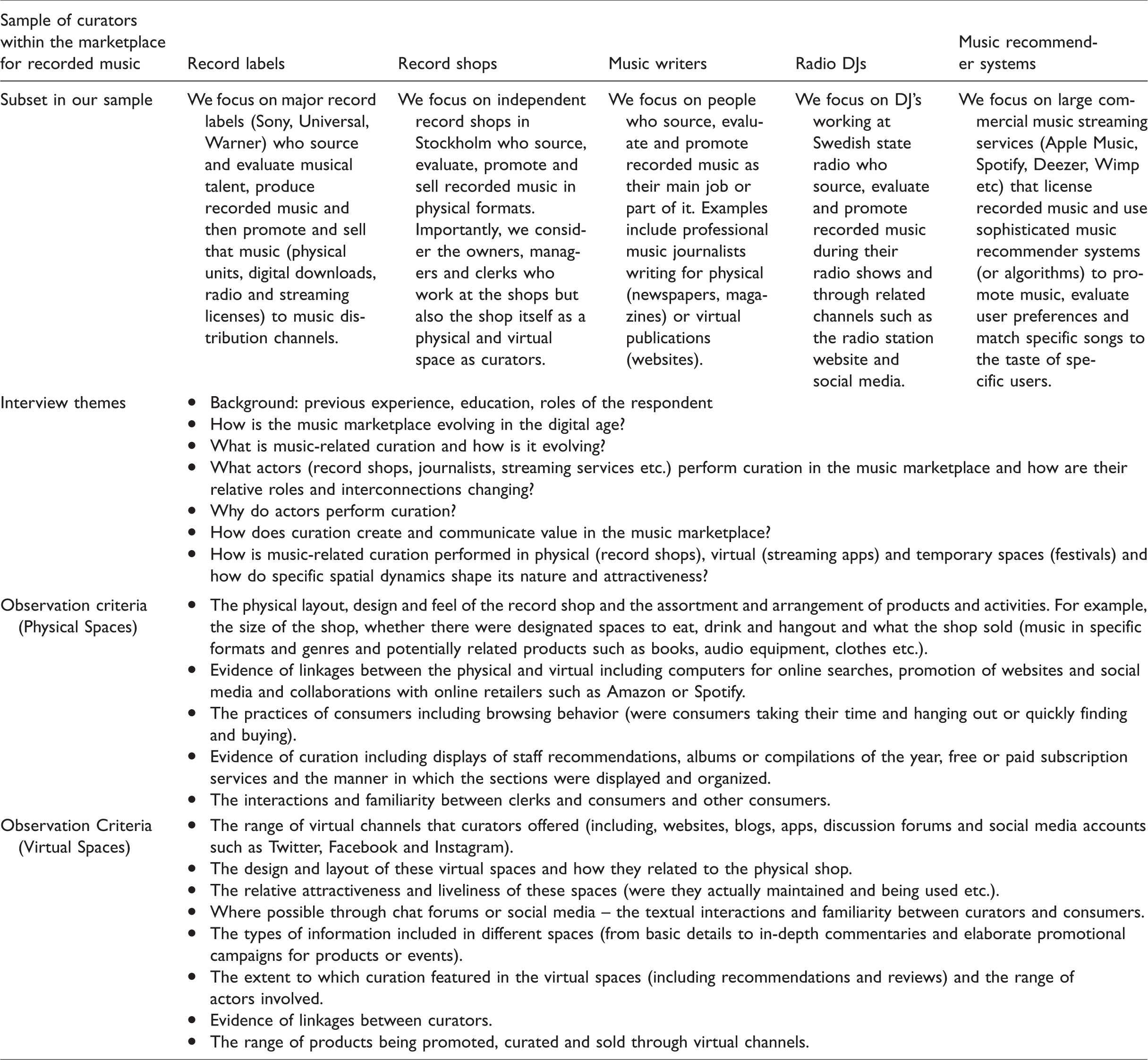
We conducted 20 in-depth semi-structured interviews lasting between 45 and 90 minutes with key informants who occupied a range of relevant positions within the marketplace. The interviews generated detailed data and allowed respondents to express experiences and opinions in their own words. Yet, because curatorial processes are tactile, aesthetic and experiential in nature and cannot be fully understood through mere description (Bartmanski and Woodward, 2015), we supplemented and triangulated our interview data with observation. We spent time in physical spaces, including record shops, observing, taking photos and writing field notes about specific dynamics, interactions and activities as well as virtual spaces including websites, blogs, online magazines and streaming service platforms (O’Brien, 2014). Secondary materials such as promotional texts and images from websites, blogs, online forums and record shops were also collected.
A wider and ongoing set of projects which examine the impact of digitization on the nature of music production, distribution, curation and consumption also informed the paper. These projects involve 95 in-depth interviews with musicians and key informants within the music industry and participant observation at live performances and music studios. Each author has also engaged directly in the industry and this familiarity proved useful in establishing rapport with respondents and interpreting the rich results of the interviews and observation.
The process of analyzing the interviews involved a systematic process of coding and re-coding (Crang, 2005; James, 2006; O’Brien, 2014). Each transcript was analyzed phrase by phrase while thematic codes, annotations and reflective notes were added. After this ‘open coding’ (Crang, 2005), the data was organized into categories which corresponded to the themes and questions from the interview guides, observation criteria and literature or that emerged from our annotations and reflective notes (O’Brien, 2014). A process of axial coding followed through which connections between and within categories and subcategories were made. At this stage, some codes and subcategories ‘broke down’ while others emerged as more pervasive or poignant across the sample (Crang, 2005). We then moved toward identifying preliminary theories and collapsing categories into overarching themes through an iterative process of moving back and forth between the data and the research questions, interview guides, observation criteria and literature (James, 2006; O’Brien, 2014).
‘What’ is curation?
While it is possible to explain curation in simple terms such as ‘acts of selecting and arranging to add value’ (Bhaskar, 2016: 85), such simplicity does not allow sufficient nuance to accurately reflect how curation is practiced and understood in specific contexts. Yet, too much nuance and complexity turns curation into a catch-all concept that is devoid of meaning and easy to critique, deride or dismiss (Ashton and Couzins, 2015).
To move towards a more concrete conceptualization, while laying the foundation for the subsequent consideration of space, this section focuses on ‘what’ curators do in the real world (Maguire and Matthews, 2012). It presents a novel typology based on an iterative analysis conducted from two directions. We started with existing literature and the ways in which curation is described, defined and contextualised. This review helped us understand the history of the concept and how it is applied to different activities within a range of fields including art, food, fashion, craft and music. It also allowed us to identify and extract over 80 terms (see Table 2) associated with ‘curation’ or the umbrella concept of ‘cultural intermediation’.
Range of curation-related activities.
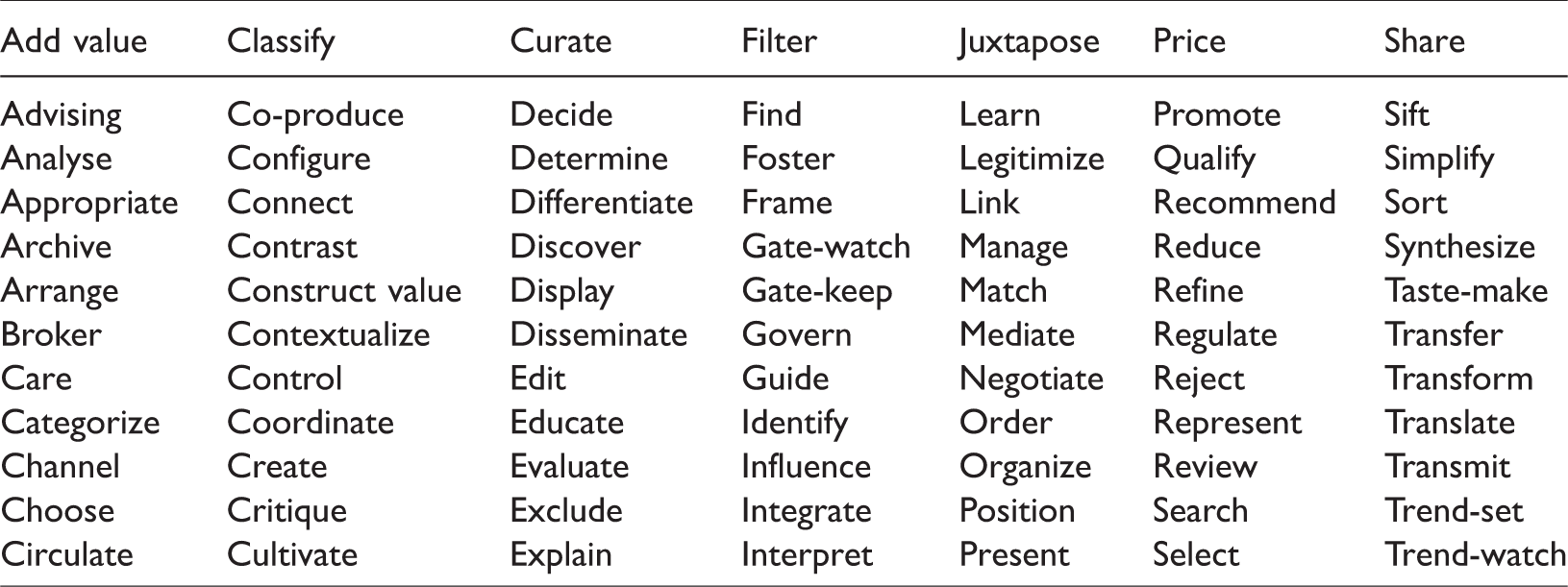
In analyzing our empirical data, we checked to see if the respondents used any of these exact terms or described related activities or processes without using the term. After removing the activities that were not addressed, we put the remaining terms into five categories which we developed based on the explanations and examples given by our respondents and our wider knowledge of the music marketplace (Hracs et al. 2016). This process allowed us to develop a better understanding of how, why and where curation-related activities are practiced and understood within our sample. The typology below (Table 3) contains these actions but we have also included a set of outcomes to provide a rationale for the groupings and simplified examples from each actor to provide context.
Typology of curation-related activities.
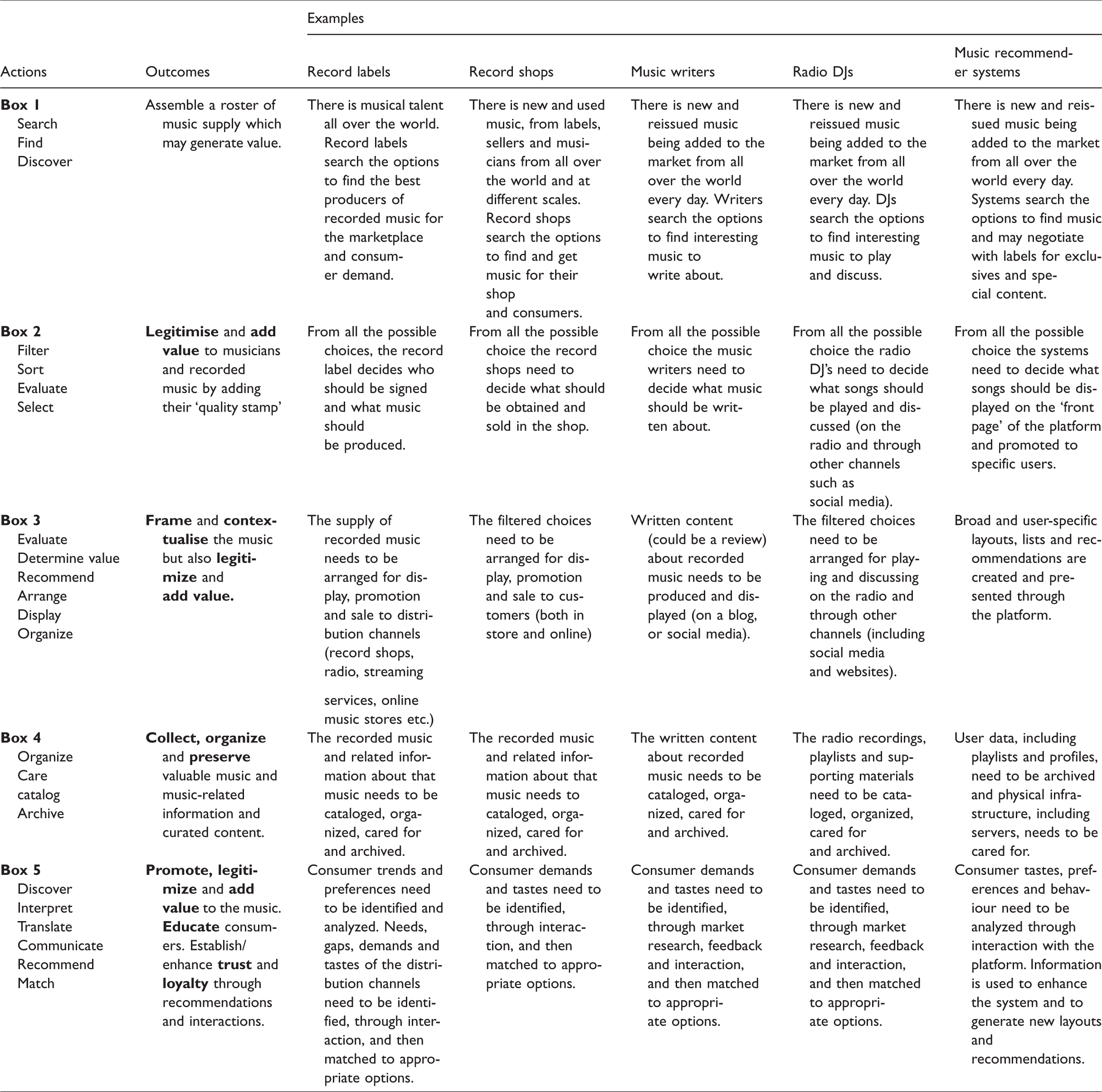
As we have not found anything comparable in the existing literature on music or other sectors, we believe that the typology makes a valuable contribution to our understanding of curation. However, some important caveats and clarifications need to be acknowledged. There are overlaps between some actions, and both the categories and the examples should not be considered comprehensive or the only possible interpretation. Moreover, the categories are not meant to represent a linear set of actions and some appear in more than one category depending on the actors involved and outcomes. For example, record shops may ‘discover’ a supply of music (Table 3, Box 1) and ‘discover’ a consumer’s taste (Table 3, Box 5).
To further unpack elements of the typology, a useful way of understanding the difference between the overlapping actions, such as ‘organize’ is to think of Box 3 (in Table 3) as representing ‘customer facing’ activities, including displaying physical and digital content to customers, and Box 4 (in Table 3) as representing ‘back room’ activities such as caring for and archiving physical and digital content. In addition to helping to expose and explain these kinds of subtle variations, the empirical data also highlight a division of labor within and between actor categories. Within organizations, different individuals or systems may specialize in and perform different actions. For example, different staff members within record shops may be responsible for selecting, displaying, selling and caring for the music. Equally, although many record shops discover and select music on their own, some ‘outsource’ part of this process to other trusted curators including sales representatives from record labels who offer them a pre-curated set of options or music writers who provide inspiration and ideas (Joosse and Hracs, 2015). This suggests that actors can have multiple positionalities and may shift from being producers, consumers or curators depending on stage and context (Potts et al., 2008). Thus, the marketplace for recorded music should be understood as an ecosystem where a set of interconnected curatorial actors oscillate between collaborating and competing with each other and between challenging and reinforcing the legitimacy of others (Aspers and Darr, 2011; Lange and Bürkner, 2013).
‘Why’ is curation performed?
As this section demonstrates, curators within our sample are motivated to perform the activities outlined above for a range of reasons including the pursuit of economic profit, to exert influence or to gain psychic rewards. By offering an original account of music-related curators, these findings nuance our limited understanding of how and why firms, institutions, organizations and individuals perform curation. They reinforce recent work on curatorial motivations within the food marketplace (Joosse and Hracs, 2015) while also highlighting areas of divergence and specificity across industries and scales.
In the broader marketplace, there is evidence that providing curation can generate additional income for part-time bloggers, professional-level salaries for workers, sustainable livelihoods for entrepreneurs and even millions of dollars for YouTube stars and celebrities like Zoella and PewDiePie. Although a detailed review of the economic viability of curation is beyond the scope of this paper (for an account of fashion see Brydges and Sjöholm, 2018), to some extent, all of the actors in our sample perform curation for economic motivations.
However, placed on a spectrum, it is clear that as global firms, record labels and music recommender systems are more narrowly and strongly motivated to curate the supply of recorded music to make money by maximizing sales and subscribers, respectively. Indeed, given that most music streaming services have similar prices and music catalogs, curation is regarded as a prime source of distinction and economic value. Yet, the pursuit of economic profits goes hand in hand with expanding market share and competing successfully with rivals in the marketplace (Aspers, 2010). Thus, record labels and music streaming services also perform curation to strengthen their brands (Lury, 2004) and to exert influence, in the form of power and control, over other actors within the global music marketplace. For example, cultivating the best supply of recorded music allows record labels to dictate terms to music distributors, including record shops, and building the best recommender system and biggest subscriber base allows streaming firms to dictate terms to music suppliers including musicians and record labels (Aspers, 2010; Hracs, 2012; Lury, 2004).
However, influence, in the form of shaping tastes and shaping scenes, can be exerted at other scales and for other reasons. As a publically funded institution, for instance, Swedish state radio is not driven by economic profits but rather a specific mandate to promote Swedish culture through music and to ensure the viability of radio as a format by attracting and retaining listeners. As one respondent explained: ‘The listeners are our coins…It’s not a commercial thing. It’s not about selling… It’s really about the passion that we have for music….It’s about the love for the sound and the creativity that comes out’ (Interview).
Likewise, as independent businesses, many record shops endeavor to contribute to locally embedded cultural scenes and wider trans-local movements. Indeed, while selling vinyl may be a smart commercial strategy, it also helps to ‘preserve' and promote a traditional or ritualized way of listening to music associated with materiality, symbolic value and intangible experiences (Bartmanski and Woodward, 2015; Sonnichsen, 2017).
At the micro scale, individuals, including music writers, radio DJs and record store clerks, may perform curation to establish or reinforce their positions and value within local scenes while also brandishing and enhancing their own brands and social and cultural capital (Bourdieu, 1984; Maguire and Matthews, 2012). As one respondent put it: ‘I have never made money from anything I’ve done…But what people do get is a lot of attention…It is like getting paid in attention’ (Interview).
Echoing Sennett’s (2008) description of contemporary craftsmen who endeavor to do a job well for its own sake, the findings suggest that non-monetary or psychic rewards also serve to motivate actors to perform curation. Working as a music writer, for example, is highly precarious yet our respondents explained that the intrinsic joy of engaging with music helps to offset the hardships. As one argued: ‘Almost every music journalist I know does it because they love music and they think about music a lot and because they want to do something with that creativity’ (Interview). Similarly, although running or working in a record shop often involves long hours and low pay, it is often described as a ‘labor of love’ that offers a range rewards including dynamic forms of work, making exciting discoveries and interacting with people. As one respondent explained: ‘If you give someone some recommendations and they come back and they’re happy, that makes you feel good.’
Beyond demonstrating the broad spectrum of economic and non-economic rewards that motivate curators to perform curation, these findings highlight how motivations are shaped by the positions actors hold within the marketplace (Aspers, 2010).
‘Where’ is curation performed and how is it shaped by space?
As the number and diversity of actors who perform curation in the recorded music marketplace continues to increase, it is important to consider the growing range of spaces where curation is performed and experienced. In the digital age, it is also imperative to look beyond traditional physical sites of curation, such as record shops, to interrogate how curation plays out in virtual forums and app-based platforms (Grabher and Ibert, 2014; Webster et al., 2016). Table 4 demonstrates that actors in our sample perform curation-related activities, such as discovering, organising and recommending in a variety of physical, temporary and virtual spaces. While identifying ‘where’ curation occurs is valuable, this section aims to go further by providing a deeper analysis into the relationships between spatial dynamics and curatorial processes. While often neglected by existing literature, we assert that spaces should be viewed as vital elements of curation that do not merely contain or host specific activities but rather shape these activities and the exchanges between curators, producers and consumers as well as the dynamics and outcomes of such interactions (Hracs and Jacob, 2015; Lorentzen and Jeannerat, 2013; Pani, 2017).
Where is curation performed?
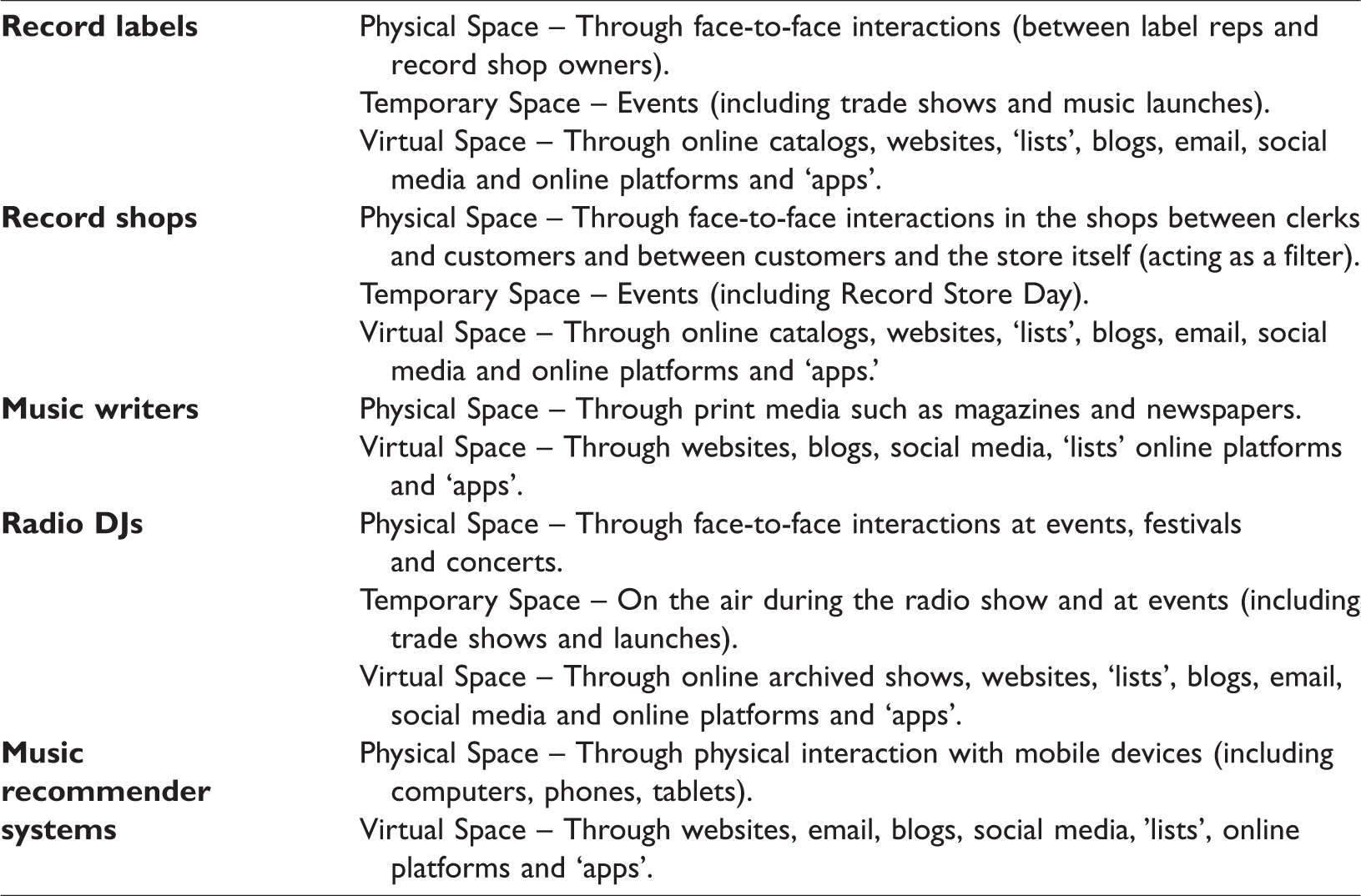
Discovering knowledge, content and practices through multiple spatial channels
The acquisition or dissemination of information, including curation-related knowledge, has traditionally involved a trade-off between richness (associated with greater depth, validity, relevant and reliability) and reach (associated with wider access). Yet, increasing possibilities for physical mobility and new technologically mediated communication technologies, such as video conferencing and social media, provide new channels which enhance interactions and knowledge flows across time and space (Grabher and Ibert, 2014; Lange and Bürkner, 2013). As a result, Glückler and Sanchez-Hernandez (2014) argue that rich information can be transferred across much greater distances. But as the distinct trade-offs are reduced or even eliminated, there is a need to investigate the subtleties of specific channels, formats and spaces and how they are being matched strategically, based on their strengths, with specific activities such as searching for or displaying content.
Within our sample, curators use different spaces and channels for different activities and this section unpacks these practices using some illustrative examples. A key finding is that specific activities may be performed in one well-suited space or in a range of complementary spatial contexts. For record labels, discovering talent is crucial. Respondents explained that A&R staff spend considerable time ‘looking’ and ‘scouting’ by using virtual channels such as YouTube and online repositories where artists can upload their songs as useful filters to narrow the options before going to physical venues to experience and evaluate live performances. Radio DJs also dedicate time to discovering new music and information about music; however, there is much greater focus on the use of virtual channels which offer maximum reach. As one DJ put it: Every day when I wake up I start looking at my Twitter and Instagram feed… I follow tons of artists, both international and Swedish, all kinds of producers and DJs. [I want to know] What’s happening? Has anything popped up during the night in America? What’s trending?… Then I go to my SoundCloud feed and listen to whatever is a new or interesting…I also have a Feedly account where I just follow any kind of music or pop culture related magazine or blog or site or whatever. I scan this everyday too. When I get into the office I continue to listen to everything, read blogs and check my feeds. We also have a system with the record labels where they can upload songs to our database and we can go in and listen to all kinds of new music.
For record store clerks, the process typically involves regularly reading music magazines, checking out trusted websites and blogs, listening to relevant new releases and physically meeting with musicians and record labels. But a two-way flow was also noted as customers (often regulars) play a vital role by making their own suggestions to clerks about things to check out either in the store or through social media channels (Lange and Bürkner, 2013). This supports the concept of networked value creation put forward by Winter (2012) in which prosumers may contribute their own cultural capital in the form of knowledge, intuition for trends and tastes.
For record shops that sell new CDs or vinyl, once decisions about what to sell and recommend have been made stock can be easily ordered online and delivered. For those focussing on used vinyl, however, clerks must literally sort, evaluate and select records in a range of physical spaces. Often sellers bring records or whole collections into the shop but clerks also go to people’s houses across Stockholm and sift through wardrobes, garages and attics to find valuable items. On-site evaluations and purchasing decisions are made in real time and this requires knowledge and experience. As one respondent put it: You have to able to grade and price the records. Is it worth [$12] or [$60]? Is it a first pressing or a second pressing? Which country does it come from? In this job, knowledge is power…You have to know that a Beatles record with one special word on the label will sell for [$600] instead of [$30].
Thus, the ways in which curation-related activities are performed and experienced are shaped by the content being curated and different spatial dynamics. But these examples also highlight how engagement with other actors in the marketplace can vary.
Recommending and interacting in different spatial contexts
With respect to interacting with consumers who may be readers, listeners, collectors or distributors, some curators still appear to favor one dominant or traditional type of space while others are experimenting with new spaces and layering multiple channels. Record labels, for example, still emphasize the value and effectiveness of face-to-face interactions in physical spaces. As one respondent explained: As a sales representative, I go visit record shops all over the country. I travel to Gothenburg every 2 weeks…I go up to Uppsala and Gävle…Today I have been in three shops in Stockholm…I repeatedly visit the customers… We sit down together to listen to and talk about forthcoming music.
As the nature of music distribution, curation and consumption continues to evolve, however, we found that the most successful record shops are taking their expertise and credibility online and using virtual channels to interact with a global consumer base. Instead of competing ‘to the death,’ for example, one record shop decided to cope with market change and uncertainty (Aspers and Darr, 2011) by working with Spotify to co-create an app that allows people to listen to their recommendations and curated playlists through Spotify. The respondent explained that this collaboration adds much needed ‘soul’ to Spotify and encourages local and global listeners to patronize his shop in person or online. Another respondent spoke of the complementarity of spaces and channels: The shop was the first Swedish online record store…I have a blog and I give recommendations on our website…We also promote events and reviews by putting links on Facebook…We want people to be aware that we exist online…The idea is that both spaces should complement each other and work together. If someone sends an e-mail while I’m on air, I instantly see it and I can reply right away or later on…I have an official Twitter account and anyone can follow me. The station also has an app for Spotify so I have two playlists there that I update…I also have an account on SoundCloud where I do lists sometimes.
The persistent importance of proximity and trust in the digital age
Beyond facilitating different forms of interaction, how do these understudied spatial and temporal dynamics influence the levels of trust and value that are created? Based on existing literature within economic geography, we might expect that face-to-face interactions between human curators and consumers will generate more trust, richness and valuable forms of information or curation (Aspers and Darr, 2011; Glückler and Sanchez-Hernandez, 2014; Storper and Venables, 2004).
To some extent, the findings support these assumptions. For example, it appears that consumers are willing to seek and accept the advice of record shop clerks because of their position in the marketplace, experience and personal biographies which might also include being musicians, DJs, collectors or hard-core fans (Hracs and Jansson, 2017; Maguire, 2014; Webster et al., 2016). As one respondent explained: ‘For most people the trust comes from the fact that I am standing behind the counter at this record store and I’m surrounded by music-related stuff’. In record shops, trust is also strengthened over time through repeat interaction (Storper and Venables, 2004). As one respondent explained: ‘I have some regulars who come in to get my suggestions…and they really love the idea that I know what they bought last time’.
These sentiments were largely echoed by curators working in record labels. As one sales representative explained: From my own experience, I think humans are better. I think it is rare that good recommendations come from just knowing what else they bought or listened to…People buy from people like this: record shops buy from sales people and customers buy from record shops in person. The human side is very important. I have been around for a while so I build relationships over time. I have worked with some record shops for over 20 years. But even when I meet customers for the first time it is really good to meet face-to-face and they can trust me over time. If I recommend that they buy 50 copies of an album and it works for the shop, they come back and say ‘he was right’ and they will take more recommendations. After a while they get really satisfied and buy even more from me because of the trust. I also broadcast from music festivals and there is a lot of interaction…I want to be out there where the people are so that I can talk to them and answer their questions and listen to their comments or criticism…We can be there for them. This is also about the human factor, to show them that we are human beings and we do everything live. We hear you, we see you. We might not always be able to acknowledge you, but we do have the ambition to do it.
Even without face-to-face interaction, over time the personal nature of Radio DJ shows can create high levels of trust and familiarity with listeners and DJs can become highly influential. As one respondent put it: A Spotify playlist is one thing but people listen to the radio for what is called a para-social relationship with the host. People want good music but what makes them think the show is great is the relationship with the DJ. It's live, you can relate to it and when DJ’s talk a bit between the songs listeners are going to get more value than from a simple playlist.
Physical and virtual spaces as ‘quality stamps’
In the absence of interaction between curators and consumers, spaces can serve as trusted quality stamps or brands. By offering a limited, or pre-curated, supply and enabling physical browsing, for example, record shops can serve as valued filters. Trust may be generated through repeat visits and positive experiences over time or conferred by reputation and notoriety (Lange and Bürkner, 2013). As Sonnichsen (2017) notes, specific record shops, recording studios and music venues can achieve legendary status and symbolic value within music communities which encourage forms of music-related tourism and consumption. Yet, historical and contemporary music scenes embedded within specific neighborhoods or entire cities can also act as quality stamps (Barna, 2017). Like farmer’s markets where some consumers assume products to be of quality because they are sold within the physical confines of the market, record shops, radio stations and music publications operating within certain scenes benefit from spatially entangled brand affiliations (Joosse and Hracs, 2015; Jansson and Power, 2010; Jansson and Waxell, 2011; Pike, 2011). As with scenes such as the Northern Quarter in Manchester and Queen West in Toronto, Södermalm in Stockholm hosts a dense network of diverse record shops and music venues as well as fashion boutiques, art galleries and cafes which attract locals and tourists. One respondent who helped build up the scene talked about its complementary nature and cumulative attractiveness: ‘It’s a win-win situation for us because we don’t overlap and we don’t really steal customers from each other. We all help to bring people in who will come and look at records for a day and go to all the shops. So Södermalm is the place for records’. As Sonnichsen (2017) argues, however, the ways in which consumers manifest their emotional attachments to places can be concrete or more imagined. Thus, alongside physical pilgrimages to shops, landmarks and scenes, curation and products may also be consumed from a distance through virtual channels and this allows some record shops to join and succeed in global markets. As one respondent asserted: ‘We have customers all over the world. We have many European, American and Japanese customers…Most of the mail-order stuff is sold outside of Sweden’.
As a result, activities associated with organizing, arranging and displaying content in physical spaces are being adapted or re-worked for the micro-geographies of virtual spaces including online retail platforms and apps on mobile devices such as tablets and smart phones. Despite the capacity to display millions of songs and an unlimited number of playlists and recommendations, music streaming services like Spotify and Apple Music strategically manipulate what users see on their ‘home screens’ to enhance engagement, personalization and satisfaction. Importantly, much like the decision to put an album in the front window or display of a physical shop, putting a song, artist or album on the ‘front page’ of a virtual platform is often driven by commercial considerations and power-laden relationships between music producers and music distributors. As one key informant explained: The major labels pay for the promotion to have their artists and albums put on the front page of Spotify or iTunes…You can’t buy a place on their ‘top charts’ but you can do other promotion which increases the number of ‘plays’ which gets that artist on their charts. Spotify wants to present what people frequently listen to, not some niche hidden music, so it is really commercial. So of course you can find the independent songs on Spotify, it is on there, but consumers already need to know about it and how to go look for it.
Beyond the practice of displaying similar content in different ways depending on different spatial dynamics, the findings also suggest that different kinds of spaces and platforms require different kinds of content. As one respondent argued: We have an app for phones where you can listen to the whole [radio] show. Like if you’re commuting and want to listen to last night’s two-hour show with [DJ] you can do that. The problem is that it doesn't make a very good Tweet. So we try to optimize everything for mobile users to make the content adapt to the medium. Because if you’re on Twitter you don’t want to have to try and find the right timestamp in a two hour radio broadcast. I handle the social media and online presence for eight radio shows at the station… We use social media to promote the full shows but I need to find a way to make it attractive…It’s not very effective to put two hours of radio on the web, so I pick out three minutes here, three minutes there and try to make a digital version…For example, I might take different shorter segments like a band playing live in the studio or something…
Conclusion
This paper contributed to existing theory and the ongoing process of conceptualizing curation by looking at the illustrative context of recorded music. By identifying and examining a subset of traditional and emerging curators, it considered ‘what’ curation is as well as ‘why’ and ‘where’ it is performed. It also paid particular attention to the relationships between specific spatial dynamics and curation-related activities and processes including the acquisition and dissemination of knowledge, the generation of trust, and the construction of space as a valuable ‘quality stamp’.
Based on an iterative review of existing curation-related terminology and analysis of interview data, the paper distilled a list of 80 actions into a novel five-part typology. Crucially, the empirical data highlighted a division of labor within and between actor categories whereby different individuals or systems within organizations, from global firms to local independent shops, may specialize in and perform different actions. As a result, the paper asserted that the positionalities of producers, consumers and curators are fluid and that the marketplace for recorded music should be understood as an ecosystem where interconnected curatorial actors may challenge or reinforce each other by collaborating or competing.
Building on existing literature and the notion that curators have fluid positions within the marketplace, the paper identified a range of rewards and imperatives that motivate actors to perform curation. In addition to obvious economic rewards such as pay and profit, exerting influence was shown to be an important motivator. Here, the paper provided nuance by demonstrating the importance of market position and scale.
The paper also stressed that examining the spaces where curation is performed is vital to understanding curation-related practices and processes. It highlighted the range of physical, temporary and virtual spaces where curation occurs and asserted that far from being a mere container of activity, specific spaces and spatial dynamics shape these activities as well as the exchanges between curators, producers and consumers and the dynamics and outcomes of such interactions. As the array of channels expands, different curators appear to choose specific spaces for specific activities in strategic ways. Indeed, the evidence that curators use face-to-face and asynchronous interactions to create and maintain trusting relationships as well as temporary events and social media platforms to discover new music and practices, demonstrates that they are acutely aware of the relative strengths of different spaces and how to optimize them. It also reminds us that in the digital age, physical, temporary and virtual spaces complement rather than replace each other.
To suggest a few potential avenues for further enquiry, it would be useful to examine how music-related curators interact with each other as well as producers and consumers in greater detail. There is also a strong need to examine how and why producers and consumers choose to work or interact with different curators. By extension, it would be useful to investigate the ways in which individual consumers are enrolled, either consciously or unconsciously, in curation-related processes through different channels including social media. Furthermore, whether the growing supply of actors and channels in the marketplace results in the need for curators to be curated and how this happens. More broadly, there is a need for a closer investigation of how curators create and communicate values in the marketplace not only for themselves but for producers, consumers, specific products, platforms and spaces including shops, neighborhoods and cities. Finally, beyond developing more robust conceptualizations of curation within specific contexts, a more complete picture may be produced by comparing and contrasting curation-related activities, processes, motivations, values and spatial dynamics across different industries and markets such as music, food, fashion, media and art.
Footnotes
Acknowledgements
We thank the anonymous reviewers and journal editor Trevor Barnes as well as Jack Webster for helpful comments. An earlier version of the paper was presented at the 5th European Colloquium on Culture, Creativity, and Economy in Seville, and we are grateful to our discussants Paz Concha, Tina Haisch, Oliver Ibert, Max-Peter Menzel.
Declaration of conflicting interests
The author(s) declared no potential conflicts of interest with respect to the research, authorship, and/or publication of this article.
Funding
The author(s) disclosed receipt of the following financial support for the research, authorship, and/or publication of this article: This article is an outcome of the research project “Intermediation, place and value creation: Exploring the processes and spaces of curation” which is funded by Riksbankens Jubileumsfond in Sweden (project ID: P14-0547: 1), and we want to thank our fellow investigators Dominic Power (Stockholm University), Jenny Sjöholm (Linköping University), and Anders Waxell (Uppsala University).