




Abstract
In this paper, we conduct a detailed examination of the effects of Foreign Direct Investment (FDI) and the technology gap on local technology dissemination and spillovers. Using unique firm level data from surveys among FDI firms and domestic producer firms and a random sample of their suppliers in the North East of Mexico, we present new evidence showing that the effects of FDI and the technology gap are multi-faceted. FDI firms are significantly more involved in technology transfers. Their suppliers are more likely to experience positive spillovers, even when we control for the support that they receive. A large technology gap has a negative effect on technology diffusion. However, suppliers of FDI firms are more likely to receive several types of technology transfer when the technology gap with their client firms is large. As for local spillovers, we find that a large technology gap fosters positive spillovers, especially among suppliers of FDI firms and among those suppliers that are best suited to absorb new technologies.
Introduction
Multinational enterprises (MNEs) are a key driving force behind the international dissemination of new technologies (Iammarino and McCann, 2013; Keller, 2010). By engaging in Foreign Direct Investment (FDI), MNEs introduce new technologies into many developed and developing economies (Dunning and Lundan, 2008). Not only do FDI firms enhance the technology stock of a host economy, additional positive effects arise when FDI firms generate positive spillovers. Through channels including demonstration effects, inter-firm linkages and labour turnover domestic firms can absorb new technologies from FDI firms, culminating into positive productivity effects (Blomström and Kokko, 1998; Görg and Greenaway, 2004).
Despite the growing belief that FDI spillovers constitute an important source of new technologies, the evidence from traditional econometric studies is very mixed. There is little consensus on the prevalence of intra-industry spillovers (Hanousek et al., 2011; Irsova and Havranek, 2013). Evidence on inter-industry spillovers is more prominent, as several studies report a positive relation between FDI and productivity of domestic firms in upstream industries. This suggests that positive spillovers are likely to materialise among suppliers of FDI firms (Blalock and Gertler, 2008; Jordaan, 2008a). However, the evidence is far too heterogeneous to conclude that such inter-industry spillovers occur automatically or in all settings.
Recent research is characterised by several approaches that try to obtain more evidence and a better understanding of FDI spillovers. One line of investigation that focuses on the geographical dimensions of these externalities finds that FDI spillovers are more pronounced at the regional than at the national level (Driffield, 2006; Menghinello et al., 2010; Monastiriotis and Jordaan, 2011). Importantly, the positive effect of regional proximity applies in particular to inter-industry spillovers between FDI and local suppliers (Blalock and Gertler, 2008; Jordaan, 2008b).
A second research line is characterised by using case studies or small scale surveys to identify the size and nature of linkages between FDI and local suppliers. These more qualitative studies often provide detailed information on the types of linkages that FDI firms create and the nature and degrees of technology transfers that their suppliers may benefit from (e.g. Domanski and Gwosdz, 2009; Liao and Wei, 2013; Potter et al., 2002, 2003). A recent example is Ivarsson and Alvstam (2011) who provide detailed interview-based evidence showing that a large Swedish home furnishing retailer provides a variety of types of support to its suppliers in China and South-East Asia.
The technology gap between FDI and domestic firms receives only limited attention in these research lines. This is striking, as it is traditionally seen as a potentially key factor influencing spillovers (Crespo and Fontoura, 2007; Sjöholm, 1999). Furthermore, studies that do consider the technology gap as a driver of FDI spillovers usually analyse its effect on intra-industry spillovers. Its effect on inter-industry spillovers to local suppliers, the type of externalities that is believed to be more prominent, has received much less attention in the literature.
In this context, the purpose of this study is to examine whether and how FDI and the technology gap affect technology transfers and spillovers among local suppliers in a developing country setting. Our contribution to the literature is three-fold. First, we use data obtained from detailed surveys among producer firms and local suppliers in the North East of Mexico. This allows us to study the effects of FDI and the technology gap both on the creation of technology transfers and on spillovers among local suppliers. Second, the heterogeneous nature of the evidence on FDI spillovers indicates that it is not clear whether FDI firms necessarily differ from domestic firms in their degree of technology dissemination. The rich nature of the dataset allows for a consistent comparison of FDI and domestic firms, enabling us to shed new light onto this issue. Third, we re-examine the concept of the technology gap and conduct a detailed analysis of its effects on both technology transfers by producer firms and inter-industry spillovers among local suppliers.
The paper is constructed as follows. Section “FDI spillovers and the technology gap” presents a selective review of the literature on the technology gap and FDI spillovers which we use to inform our research questions. Section “Technology dissemination and spillovers: Is foreign ownership important?” describes the dataset and investigates whether foreign ownership matters for local technology diffusion and spillovers. Section “FDI, technology gap and technology dissemination” presents a multivariate analysis of drivers of local technology dissemination, focusing on the effects of FDI, the technology gap and their interaction. In section “FDI, technology gap and spillovers”, we use data from the supplier survey to identify and examine the main drivers of local spillovers. Section “Summary and implications for theory and policy making” summarises our findings and discusses implications for theory and policy making.
FDI spillovers and the technology gap
Technology gap, technology absorption and catch up
The origins of the interest in the technology gap can be traced back to research from the 1950s–1960s that established that capital and labour accumulation explained only a limited part of economic growth in the major developed economies (Abramovitz, 1989). Instead, technological change became progressively seen as the key factor in processes of growth and development (Fagerberg, 1994). Although neo-classical economics acknowledged the importance of technology, it was perceived as growing at a non-variable rate and available to all countries as a public good (Solow, 1957). Another interpretation deviated strongly from these assumptions, arguing that countries differ markedly in their levels of technology creation, adoption and usage, making international technology gaps a common feature (Fagerberg, 1987).
Accepting the existence of international technology gaps generates the question whether such gaps affect processes of growth and development (Kemeny, 2011). Gershenkron (1962) introduced the concept of “relative backwardness”, suggesting that countries that are technologically backward can achieve higher growth rates due to their initial disadvantage. 1 By adopting new technologies from leading countries, lagging countries can benefit from large productivity improvements (Abramovitz, 1989). Baumol (1986) and Abramovitz (1986) provide early corroborating evidence of the existence of such catch up effects. However, their findings also show that these effects materialised mainly among the more developed economies, suggesting that these processes do not occur automatically. Also, Kemeny (2011) presents findings suggesting that the technology gap between advanced and lagging countries may not have decreased since the 1970s, questioning the prevalent nature of international processes of technological catch-up.
Nelson and Phelps (1966) represent an early recognition of the notion that the technology gap fosters catch up processes under certain conditions. In their model of technology diffusion, the effect of the technology gap is specified as interacting with the level of human capital of the technology adopter. When a country possesses a limited level of human capital, it will be less able to benefit from technology diffusion, possibly preventing catch up processes to materialise. In broader terms, this suggests that lagging countries will be better able to benefit from relative backwardness when they possess a high level of absorptive capacity (Abreu, 2011; Cohen and Levinthal, 1989, 1990). Absorptive capacity reflects “the capacity to identify, assimilate and exploit knowledge from the external environment” (Cohen and Levinthal, 1989: 569). 2
Technology gap and FDI spillovers
In contrast to the original interpretation of the technology gap in the literature on international convergence, the standard interpretation in the FDI spillovers literature argues that a small rather than a large technology gap favours spillovers. This interpretation follows Cantwell (1989), who studied the effects of US firms in the UK for the 1950s–1970s. His findings show that only those domestic firms that were technologically advanced were successful in competing with and benefitting from the presence of US firms. From this, the technology gap has come to be interpreted as a direct inverse indicator of the level of absorptive capacity of domestic firms. Small technological differences are taken to imply that domestic firms can absorb and implement new technologies, allowing positive spillovers to materialise.
Some studies present evidence in line with the notion that a small gap favours spillovers. Kokko (1994) estimates FDI spillovers in Mexican manufacturing industries and finds that positive spillovers only materialise in industries with a small productivity gap between domestic and FDI firms. Kokko et al. (1996) and Taki (2005) present similar evidence for Uruguay and Indonesia. Girma and Görg (2007) estimate FDI spillovers in the electronics and engineering industries in the UK and find that a decreasing technology gap may favour FDI spillovers. Liao and Wei (2013) present findings from a firm level survey of the ICT industry in Suzhou, China that indicate that the technology gap may lower the occurrence of technology linkages.
These findings notwithstanding, it seems clear that the notion that a small technology gap favours FDI spillovers is strongly at odds with its original meaning in the literature on technological catch up. Applying the original interpretation of the technology gap as reflecting the degree of relative backwardness, technological differences between FDI and domestic firms can be seen as an indicator of the potential scope of positive spillovers (Findlay, 1978; Wang and Blomström, 1992). When the technology gap is large, there is a large potential for domestic firms to learn and benefit from new technologies, fostering positive spillovers.
Incorporating absorptive capacity directly into the concept of the technology gap is also not in line with the literature on international convergence. As Nelson and Phelps (1966) and Cohen and Levinthal (1989, 1990) clearly argue, positive catch up effects from large technological differences may be conditional or at least facilitated by the capacity of countries or firms to absorb new technologies. However, this is very different from treating the size of technological differences as a direct inverse indicator of the level of absorptive capacity of technology receiving countries and firms.
Furthermore, one could argue that large technological differences generate incentives for domestic firms to try and absorb new technologies. As Blalock and Gertler (2009) for instance argue, a large technology gap implies that domestic firms can start absorbing new technologies by picking “low hanging fruits”, technologies with relative low marginal costs and high marginal returns. It may also be the case that domestic firms are incentivised to absorb new technologies in response to the increase in competition that the entry of FDI firms creates. With respect to inter-industry spillovers, domestic firms may try to become suppliers to FDI firms that are technologically advanced, given the substantial benefits that they may obtain from learning new technologies from their client firms.
Several studies present findings that support our alternative interpretation of the expected effect of the technology gap on FDI spillovers. Jordaan (2005, 2008b), Sjöholm (1999) and Imbriani et al. (2014) estimate FDI spillovers in Mexico, Indonesia and Italy and find that positive spillovers only occur in industries with a large technology gap. For Mexico, Blomström and Wolff (1994) present evidence of a direct positive effect of the productivity gap between FDI and domestic firms on productivity of domestic firms. Békés et al. (2009) and Peri and Urban (2006) similarly report a direct positive productivity effect of the technology gap for Hungary, Italy and Germany. In extension of this, some studies examine the interaction between the presence of FDI and the technology gap. Jordaan (2005, 2008b) finds for Mexico that FDI spillovers are enhanced in industries that are characterised by a large technology gap and a high FDI presence. Similar findings of positive interaction effects between technological differences and FDI are presented by Blalock and Gertler (2009) and Blalock and Simon (2009) for Indonesia, Girma (2005) for the UK and Castellani and Zanfei (2003) for France, Italy and Spain.
Research questions
We distil the following three research questions from the selective literature review. First, do FDI firms create positive spillovers? Given the considerable degree of heterogeneity of the evidence, this is a matter of empirical verification. In line with recent research, we focus on inter-industry spillovers that may occur between FDI firms and local suppliers. Second, does the technology gap between FDI firms and their suppliers foster spillovers? In contrast to the traditional interpretation of the technology gap in the FDI spillovers literature, we interpret the technology gap as reflecting the scope for positive spillovers to materialise. When the technology gap is large, suppliers of FDI firms have ample opportunity and scope to learn and benefit from new technologies that are incorporated into the production processes of their client firms. Third, do the effects of type of ownership and the technology gap on local spillovers interact? If FDI and the technology gap influence spillovers, it may be that there are additional positive effects on spillovers through their interaction. It may even be the case that such interaction effects are required for any positive spillovers to materialise.
Technology dissemination and spillovers: Is foreign ownership important?
Data
For our empirical analysis, we use data that was obtained through two surveys among producer firms and local suppliers. The main aim of these surveys was to obtain detailed information on the scale and nature of inter-firm linkages between producers and local suppliers and the impacts that these linkages create among suppliers. The surveys were carried out in 2000–2001 in the Metropolitan Area of Monterrey in the state of Nuevo Leon, constituting the main agglomeration of economic activity in the North East of Mexico. This regional economy has a long history of manufacturing activity and is characterised by a substantial level of foreign participation in modern and trade oriented industries, offering a good setting to study the operations and effects of FDI firms (Jordaan, 2011a, 2009).
The producer survey was carried out among both FDI and domestic producer firms. 3 Using information from local industry organisations and the American Chamber of Commerce in Mexico, 180 large producer firms were identified. Of these firms, 32 Mexican and 50 FDI firms completed the survey. Second, the dataset contains information from a survey among a random sample of local suppliers. To prevent the construction of a biased sample, the producer firms were not used to obtain contact details of their suppliers. Instead, a list of 1100 manufacturing firms employing fewer than 150 employees was created, representing the potential pool of local suppliers. A telephone survey was carried out among these firms to identify firms that operate as supplier to the producer firms. After a three-month period, all the firms had been contacted and 356 firms had participated. Of these firms, 300 indicated to operate as supplier to the producer firms. All these firms were invited to participate in the supplier survey and 100 firms completed the survey. 4
Comparing FDI and Mexican producer firms
Earlier studies that have used the dataset compare degrees of local sourcing and frequencies of support provided by FDI and Mexican producer firms (see Jordaan, 2011a, 2011b). These studies find that FDI firms are significantly more engaged in the provision of several types of support to their local suppliers. In the present study, we extend upon these earlier findings in two ways. First, we rely on data from the supplier survey to determine the effect of FDI on technology transfers. Data from the producer survey may contain biases as it consists of self-reported indicators of technology dissemination. By using information from the firms that are on the receiving end of the technology transfers, such biases are avoided. Second, we use propensity score matching techniques to ascertain the effect of foreign ownership. Unconditional comparisons of frequencies of support may be biased when there are supplier characteristics that are related to a firm being a supplier to FDI firms and the receipt of support. The use of propensity score matching techniques allows for a more unbiased identification of the effect of foreign ownership on local technology transfers.
To determine whether FDI firms differ from domestic firms in local technology dissemination, we estimate the average treatment effect of a local supplier producing for FDI client firms. The problem that we face is that for a given outcome variable Y, we only observe outcome Y (1) if a firm is a supplier to FDI firms or Y (0) if the supplier produces for Mexican firms. If we could observe both outcomes for the same supplier, the average treatment effect would resort to the supplier sample average Y (1)-Y (0). In the absence of this, we need to obtain an indicator of Y (0) that allows us to identify the treatment effect. To do so, we use propensity score matching techniques (Heckman et al., 1997; Rosenbaum and Rubin, 1983). This involves estimating the probability (propensity score) that a firm is a supplier to FDI firms according to a set of co-variates. Firms in the group of suppliers to FDI firms are then matched to firms in the group of suppliers of Mexican firms, using the propensity scores as matching criterion. The average treatment effect of being a supplier to FDI firms is then obtained as the average difference in the outcome variable between the two matched sets of firms (Abadie and Imbens, 2016; Caliendo and Kopeneig, 2006).
Findings on the effects of foreign ownership
Technology transfers and spillover impacts.
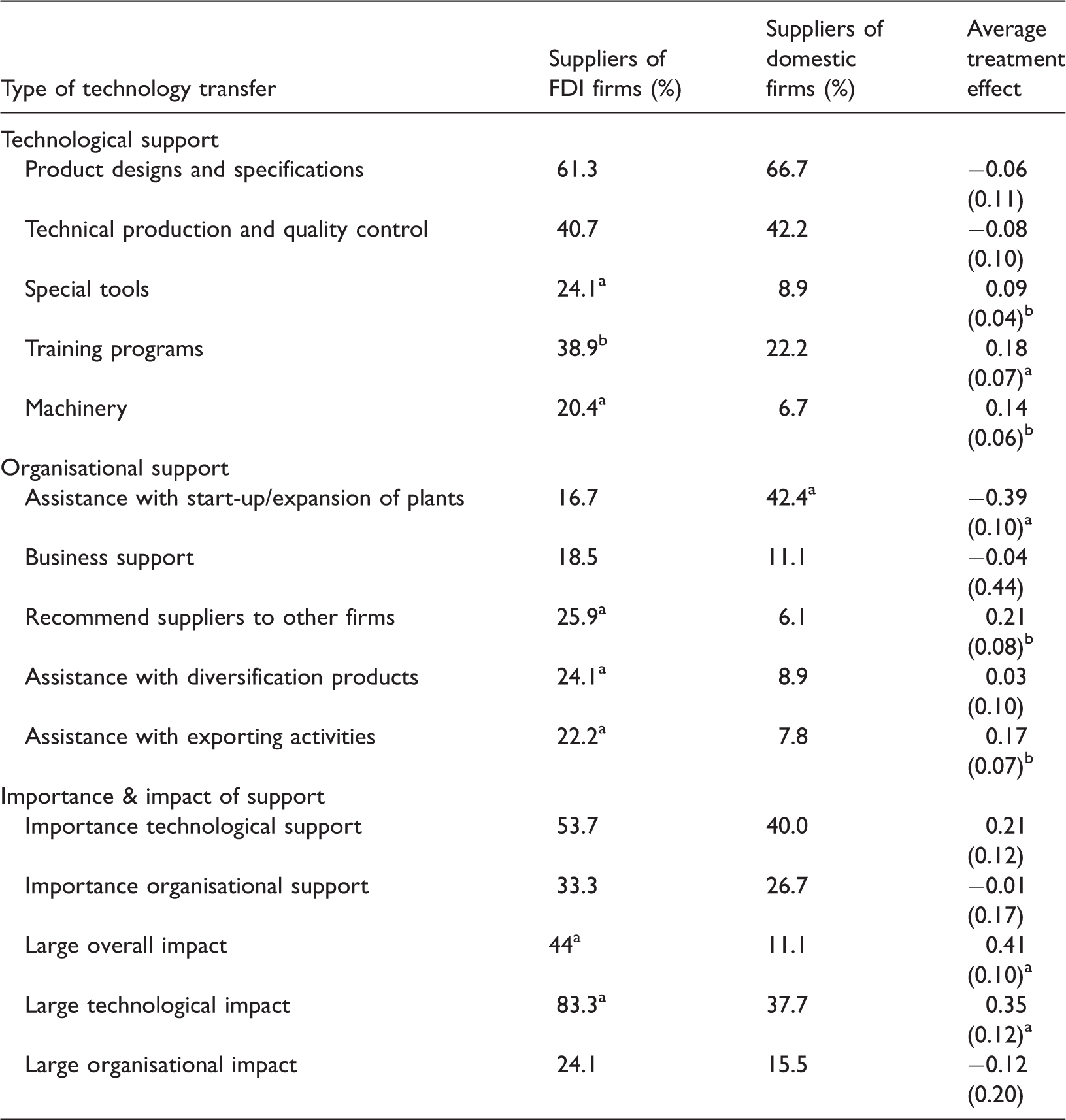
Columns labelled “Suppliers of FDI firms” and “Suppliers of domestic firms” report percentage of firms that receive support frequently. Heteroscedasticity-robust standard errors of average treatment effects in parentheses.
Significance levels of 1 and 5%.
Next, the findings from the unconditional comparisons between suppliers of the two types of producer firms indicate that FDI firms are more supportive. Looking at technological support, the percentage of suppliers of foreign-owned firms that receive special tools, machinery and training is significantly larger than among suppliers of Mexican firms. The findings for organisational support also show that FDI firms are significantly more supportive in several cases. The exception is assistance with start-ups and expansion of existing plants, where suppliers of Mexican firms benefit more often.
The last column of Table 1 presents the average treatment effect of being a supplier to FDI firms. 6 The impression that FDI firms are more engaged in technology transfers is clearly confirmed. Looking at the results for technological support, the size of the estimated treatment effect indicates that the effect of foreign ownership is the strongest for training programs, followed by the provision of machinery and special tools. For organisational support, we identify a positive treatment effect regarding recommending suppliers to other firms and assistance with exporting activities. Again, the only type of support where being a supplier of Mexican firms generates a positive effect is support with start-ups and business expansion.
The second part of Table 1 presents findings on the importance of technological and organisational support. The survey enquired about the importance of the support that a firm received for being a successful supplier to the producer firms. The motivation behind this is to assess whether there is a bias caused by suppliers self-selecting into becoming a supplier of FDI firms. It may be that firms that need support try to become a supplier of foreign-owned firms, when they believe that these firms offer more support. If this is the case, the identified higher level of supportiveness of FDI firms can be partially explained by this selection effect. The findings suggest that such a bias is absent, as there are no significant differences between the two groups of suppliers regarding the importance of technological or organisational support.
The last rows of Table 1 report findings on the overall spillover impacts that suppliers experience. A significantly larger percentage of suppliers of FDI firms indicate to have experienced a large positive impact on their performance from their business dealings with their client firms. When distinguishing between a large technological or organisational impact, the results show that foreign ownership matters only for creating large technological improvements among the suppliers. 7 These findings are corroborated by the estimated treatment effects. There is a clear positive treatment effect regarding overall performance improvement for suppliers of FDI firms. Comparing the treatment effects concerning organisational and technological improvement shows that only the latter effect is positive and significant.
FDI, technology gap and technology dissemination
The findings in the previous section provide clear indications that foreign ownership matters for technology dissemination and local spillovers. To obtain evidence on the effects of FDI, the technology gap and their interaction, we turn to multivariate analysis. In this section, we use data from the producer survey to identify drivers of technology transfers. Section five presents our analysis of drivers of spillovers among local suppliers.
Regression model
As dependent variable, we use a dummy variable that takes the value of 1 if a producer firm offers a type of support frequently and 0 otherwise. The binary nature of this variable requires the use of logistic regression techniques. The odds that producer firm i provides support can be defined as the ratio of the probability that the firm provides support (P)i over the probability that the firm does not offer support (1–P)i. The log of this ratio, the logit, can be used as dependent variable in a regression model that can be estimated with maximum likelihood techniques:

The variables FDI, TechGap and their interaction are the main variables of interest. FDI is a dummy variable taking the value of 1 when a firm is foreign-owned. TechGap captures the technology gap between a producer firm and its suppliers, measured on a Likert scale as the degree that technological differences with suppliers prevent a producer firm from increasing its level of local sourcing. 8 The interaction term between FDI and TechGap tests whether foreign firms differ from domestic firms in their response to a technology gap with local suppliers.
The vector Xi contains a set of additional control variables. We control for the age and size of producer firms as modern and larger firms may be more supportive (Jordaan, 2011a). We also control for the level of local sourcing and the importance of material inputs in a producer firm's production processes. A high level of local integration into the local economy may foster the provision of support. Similarly, producer firms that rely heavily on using material inputs may be more inclined to offer support to suppliers that produce this type of input.
Next, we control for the nature of the production process of the producer firms. We include the share of blue collar workers in a firm's labour force to capture the overall reliance on assembly style production (Robertson, 2007). In relation to this, we also control for effects of the Maquiladora program (Ramirez, 2003). First generation Maquiladora firms are primarily geared to benefitting from tax breaks on imported inputs and focusing on labour intensive activities. More recently however, second and third generation Maquiladora firms are characterised by a stronger reliance on local suppliers (Sargent and Matthews, 2008). To capture these two opposing features, we add a dummy variable labelled Maquiladora to capture the effect of a firm participating in the Maquiladora program. To capture first generation Maquiladora firms, we include a dummy variable that identifies those Maquiladora firms that have been participating in the program for at least 15 years.
Empirical findings on drivers of technology dissemination
We confine our analysis on drivers of technology dissemination in three ways. First, we are primarily interested in technological support. This type of support is directly linked to actual production processes of suppliers and the findings in Table 1 show that suppliers of FDI firms are significantly more likely to experience large technological improvements. Second, although we have data for 82 producer firms, several firms did not complete all the sections in the survey on the various types of technology transfer that we identified. As we are unable to assess whether the non-response of these firms reflects the non-importance of technology dissemination or an unwillingness to reveal this type of information, we use data for the 66 firms that answered all the relevant survey questions. Third, local suppliers consist of two different types. Suppliers of material inputs produce inputs that producer firms purchase to integrate directly into their production processes. Suppliers of production services perform a variety of treatments on intermediate inputs that are sent to them by producer firms. After treatment, the inputs are returned and re-integrated into the production process of the producer firms. We confine ourselves to discussing the results for drivers of technology dissemination to suppliers of material inputs, as this type of local supplier is used more heavily by the producer firms. Also, suppliers of material inputs receive support more frequently (Jordaan, 2011a), suggesting that producer firms assess technological improvement of these suppliers to be more important. 9
Drivers of local technology dissemination.
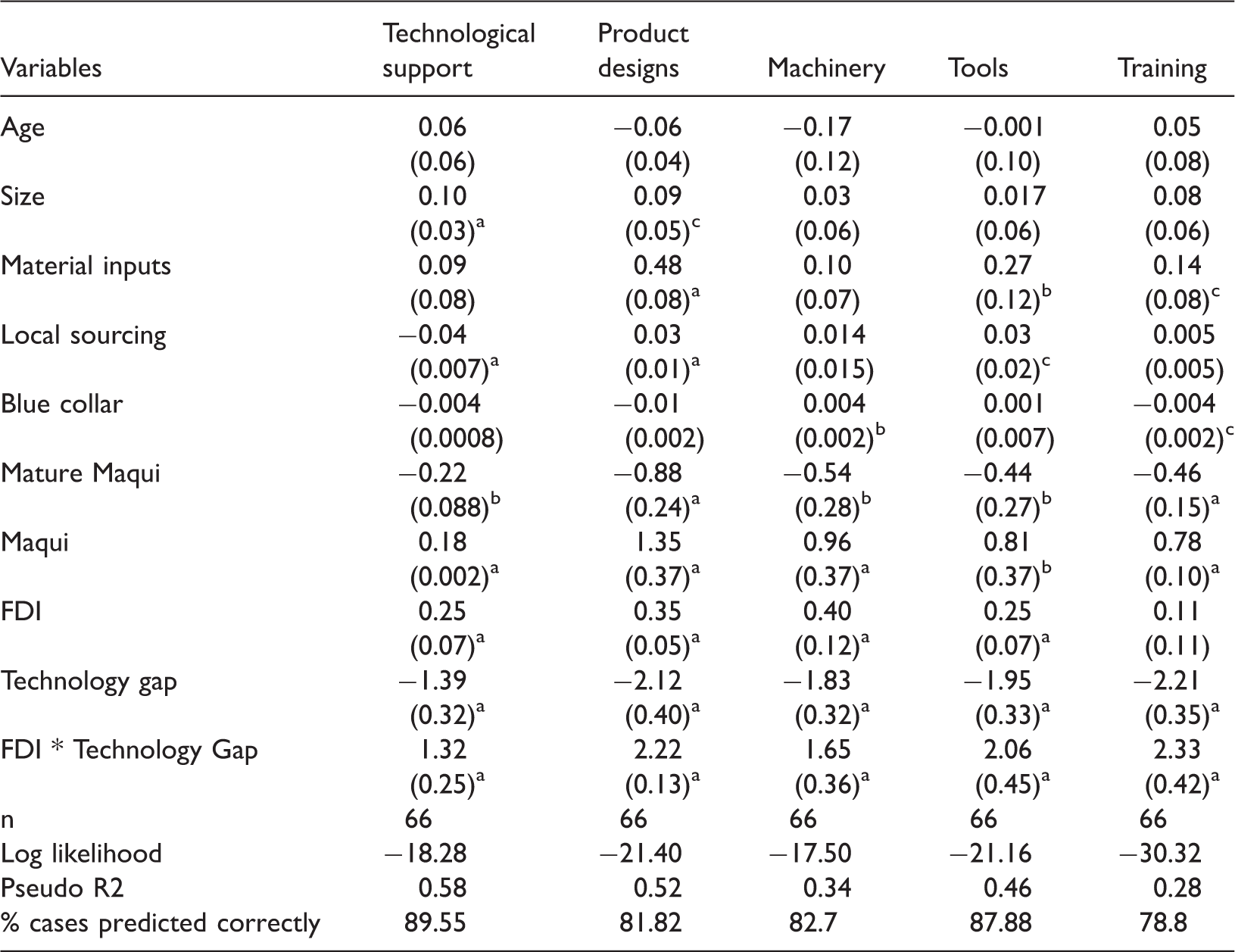
Significance levels of 1, 5 and 10%.
Heteroscedasticity robust standard errors in parentheses. R square is McFadden's R square. All coefficients represent average marginal effects. All estimations contain industry dummies.
Turning to the main variables of interest, the positive effect of foreign ownership confirms that FDI firms are more likely to offer technological support. 11 The estimated effect of TechGap is negative, indicating that a large technology gap lowers the likelihood that technological support is offered. This may explain findings from econometric studies that identify a negative effect of the technology gap on spillovers. However, rather than that a large technology gap reflects a low level of absorptive capacity of domestic firms, our findings indicate that a large gap lowers the provision of technological support, resulting in lower spillovers.
In contrast, the estimated effect of the interaction between FDI and TechGap is positive. This suggests a difference in the effect of the technology gap on the supportiveness of FDI and Mexican firms. Adding the negative coefficient of the technology gap to the positive coefficient of the interaction variable indicates that the supportiveness of FDI firms is negatively affected by the technology gap. However, the positive coefficient of the interaction variable shows that the negative effect of the technology gap on supportiveness is smaller among FDI firms than among domestic firms. 12
The next set of findings concerns drivers of various types of technological support. The estimated effects of FDI, TechGap and their interaction are similar for these different types of support. FDI firms are more likely to offer support, whereas the technology gap lowers the probability of support. The effect of the interaction variable indicates that the technology gap has two distinct effects on technology dissemination by FDI firms. Regarding the provision of machinery, the negative effect of the technology gap on technology dissemination is less strong among FDI firms. For the other three types of support, the positive interaction effect between the technology gap and FDI is larger than the negative effect of the technology gap. This indicates that when it comes to the provision of product designs, special tools and training, FDI firms interpret the technology gap as an indicator of the scope of suppliers to improve, leading them to offer more support. This provides an explanation for findings in econometric studies that identify a positive effect of the interaction between FDI and the technology gap on productivity spillovers.’13,14
To further assess the effects of the technology gap we examine whether the likelihood that producer firms provide support changes under increasing sizes of the technology gap. The findings are presented graphically in Figure 1. The top left of Figure 1 shows the findings for overall technological support. The difference between FDI and Mexican producer firms is evident, with FDI firms always being more likely to offer support. However, the figure also shows that the likelihood of providing support decreases when the technology gap becomes larger. The likelihood of FDI firms providing support decreases faster than that of Mexican firms. At the largest size of the technology gap, the difference between the two types of firm has disappeared.
Type of ownership, technology gap and technology transfers.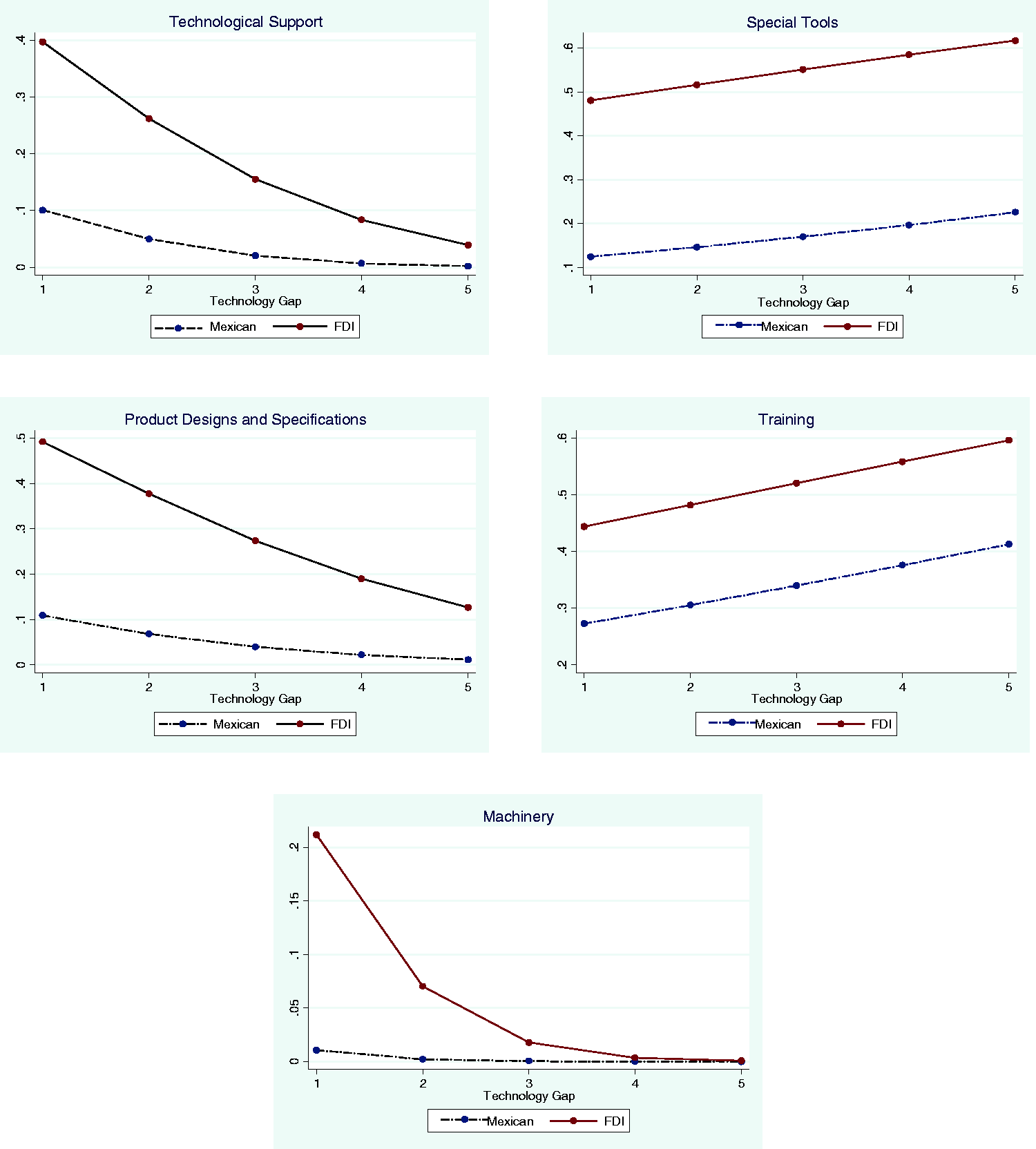
Looking at the findings for the various types of technological support, the results for the provision of product designs and specifications and machinery are similar to what we find for overall technological support. The findings for special tools and training are very different, however. Again, FDI firms show a higher likelihood of providing support.
However, the likelihood of providing these two types of support increases (for both types of firm) when the technology gap becomes larger. This suggests that producer firms use these two types of support to bridge large technological differences with their suppliers. 15
FDI, technology gap and spillovers
We use data from the supplier survey to identify drivers of local spillovers. The dependent variable is a dummy variable capturing whether a supplier has experienced a large positive impact from its business dealings with its client firms. Defining (π)i as the probability that a large positive impact has occurred and (1−π)i as the probability that supplier i has experienced either a small or no positive impact gives the following regression model:

The variables Techsupport and Orgsupport control for the levels of support that a supplier receives. FDIsupplier is a dummy variable capturing whether a supplier works for FDI or Mexican client firms. As Blomström and Kokko (1998) note, FDI firms benefit from the support that they offer when the suppliers improve their performance. However, it is unlikely that FDI firms will be able to reap all the benefits from the support that they provide, resulting in positive spillovers among their suppliers. By controlling both for the level of support that suppliers receive and their supplier status, we ensure that FDIsupplier picks up pure spillover effects. The inclusion of the variable TechGap controls for the possibility that suppliers experience larger positive effects when the scope for improvement is large. We also include the interaction variable between FDIsupplier and TechGap to test whether FDI spillovers are magnified under large technological differences.
Next, we include controls for the type of contract and the degree of own investment that suppliers make to benefit from relations with their client firms. The dummy variable Contract takes the value of 1 when client firms only purchase inputs via purchasing orders, not requiring the exchange of information, mutual coordination, etc. The dummy variable Owninvestment takes the value of 1 when a supplier indicates that own investments have been important to benefit from its dealings with its client firms.
The vector Supplier contains several firm characteristics that are related to a supplier's capacity to absorb new technologies. We control for firm size under the assumption that a large supplier has more resources to absorb new technologies. We control for the age of the suppliers and expect a positive effect, as experienced suppliers may have developed skills and experience in identifying and absorbing new technologies. We also include a variable capturing the degree of specialisation of a supplier's production processes. We expect that specialised suppliers are better able to identify and absorb new technologies. Finally, we include interactions terms between the technology gap and these supplier characteristics. By including these interaction terms, we test the ideas proposed by Nelson and Phelps (1966) and Cohen and Levinthal (1989, 1990) that the capacity to absorb technologies facilitates the occurrence of spillovers when the technology gap is large.
Empirical findings on drivers of local spillovers
Drivers of local spillovers.
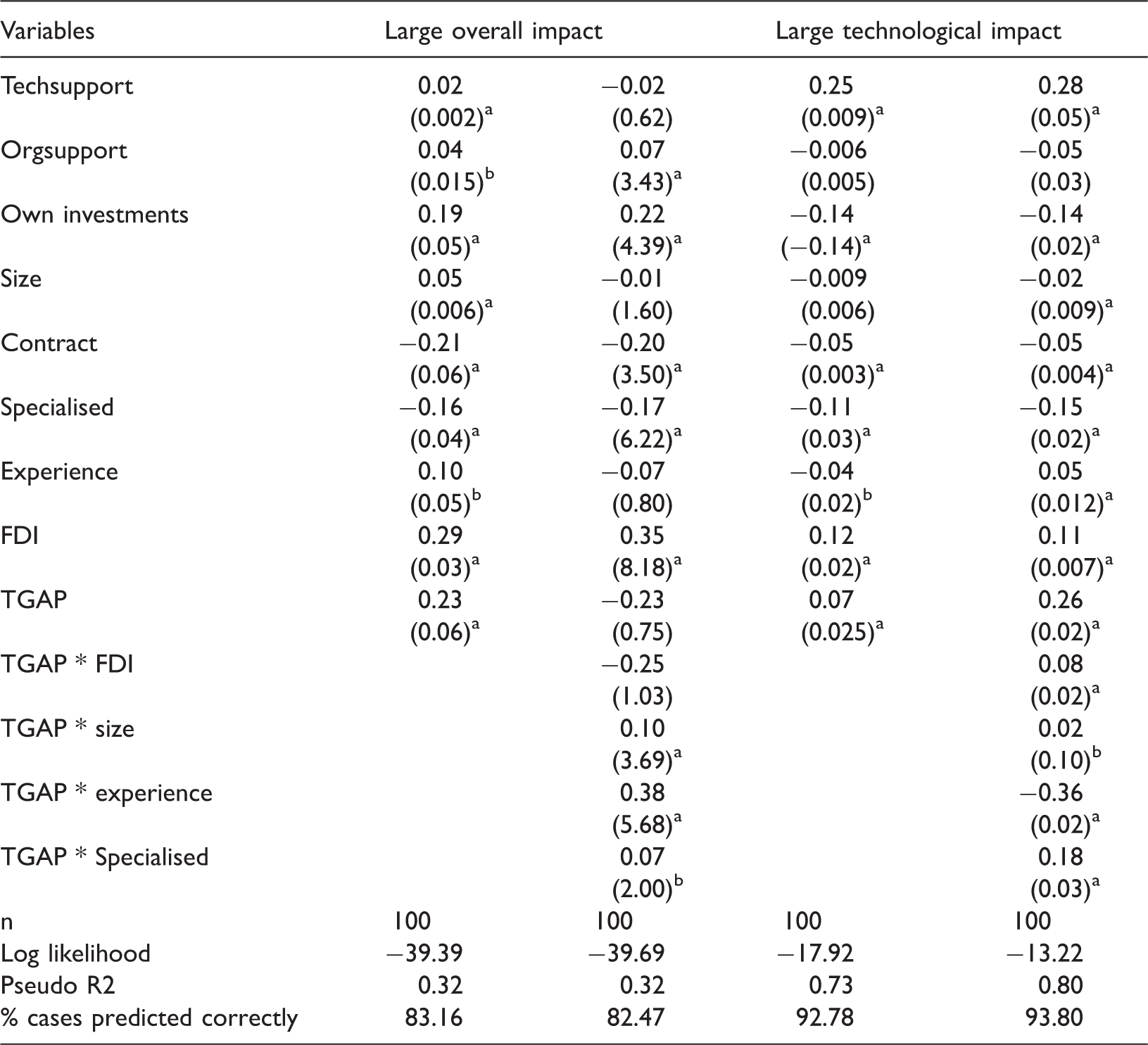
Significance levels of 1 and 5%.
Heteroscedasticity robust standard errors in parentheses. Coefficients represent average marginal effects. R square is McFadden's R square. Large Overall Impact captures large improvements in overall performance. Large Technological Impact captures large improvements in production processes.
The estimated effect of FDIsupplier is positive. This constitutes strong evidence that FDI firms generate positive spillovers, given the inclusion of the other control variables. The estimated effect of the technology gap is also positive. Again, this goes against the standard interpretation of the technology gap and suggest that positive spillovers are more likely to arise when there is a large scope for suppliers to improve.
The next column shows the findings from estimating the model with the interaction terms. The positive effect of being a supplier to FDI firms persists. Looking at the estimated effects of the technology gap and the interaction terms suggests that large technological differences only foster spillovers among those suppliers that possess a sufficient capacity to absorb new technologies. The effect of the technology gap has turned negative and insignificant. In contrast, the effect of the interaction variables between the technology gap and firm size, experience and specialisation are significant and positive. This indicates that firms that possess these characteristics can benefit from the large scope for improvement that is captured by the technology gap. There is no additional positive effect of the technology gap among suppliers of FDI firms, however.
The second set of findings in Table 3 contains the results from estimating the model with an alternative dependent variable capturing whether suppliers have experienced large improvements that are directly linked to their production processes. The results from the model that omits the interaction terms confirm the positive effects of being a supplier to FDI firms and the technology gap. The main change in findings that results from using the alternative dependent variable is revealed in the findings from the model that includes the interaction variables. The inclusion of these variables does not affect the significant positive effect of the technology gap. This suggest that there is an independent positive effect of the technology gap on spillovers, but only when we consider spillovers that are directly related to a supplier's production processes. The estimated effect of the interaction between FDIsupplier and the technology gap is also positive, indicating that suppliers of FDI firms experience additional spillovers when there is a large scope to improve. These findings are in line with results from econometric studies that identify positive productivity effects from FDI, the technology gap and their interaction. In addition, large and specialised suppliers are also more likely to experience a positive technological impact when the technology gap is large.
To complete the analysis, we examine whether the likelihood that spillovers occur is affected by different sizes of the technology gap. The findings are presented graphically in Figure 2. The left-hand side of the figure shows the results for the model that uses a large general positive impact as dependent variable; the right-hand side shows the findings from the model with a large technological impact as dependent variable. Suppliers of FDI firms are more likely to experience spillovers at all the sizes of the technology gap, irrespective of the type of spillovers. However, the relationship between the technology gap and the likelihood that spillovers materialise differs between the two models. The likelihood that a large general positive impact occurs decreases when the technology gap increases in size. In contrast, the likelihood of a large technological impact increases when the technology gap becomes larger. This underlines the findings in Table 3 that the technology gap exercises an independent impact on spillovers, conditional on the type of impact. Our findings indicate that the positive effect of the technology gap is particularly pronounced when we consider spillovers that have a direct impact on production processes of the suppliers.
17
Type of ownership, technology gap and spillovers.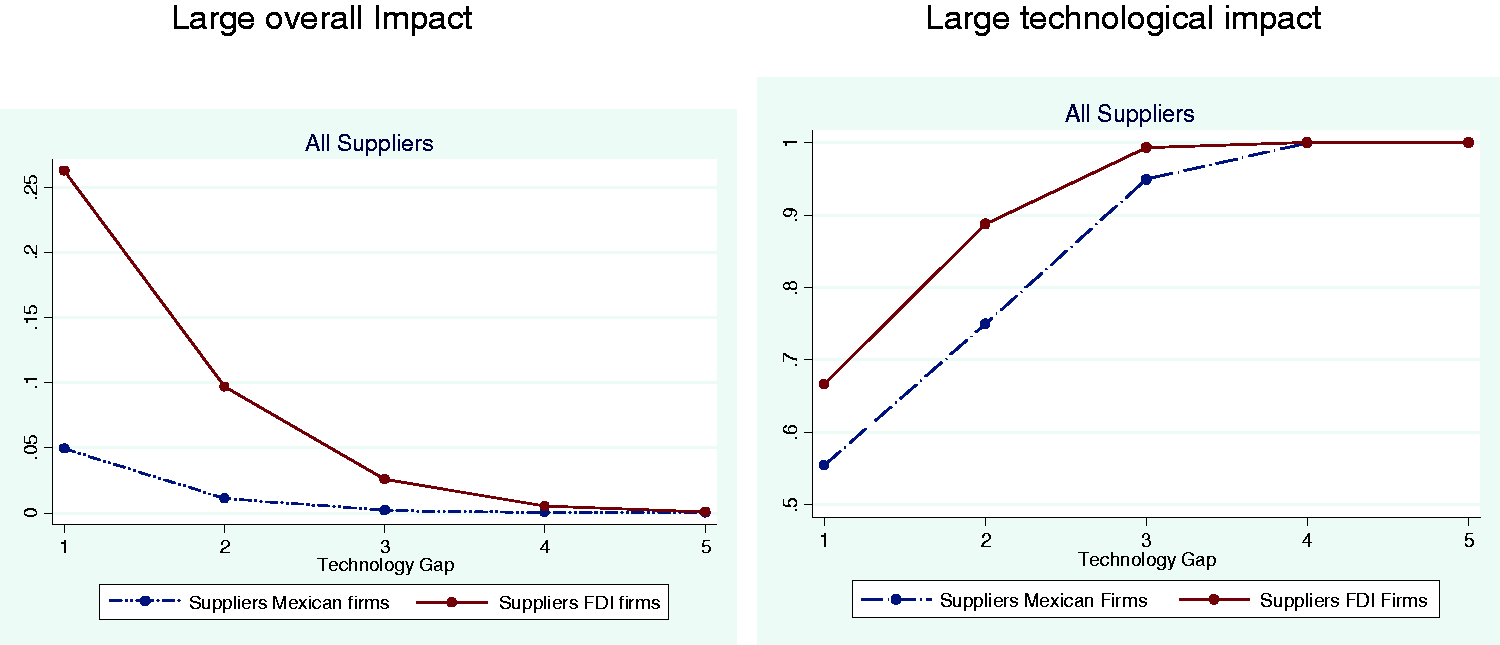
Summary and implications for theory and policy making
In this paper, we provide novel evidence on the effects of FDI, the technology gap and their interaction on local technology dissemination and spillovers. We find that foreign ownership is important, as FDI firms are significantly more involved in the creation of technology transfers and their suppliers experience positive spillovers. Regarding the technology gap, we find that large technological differences lower technology transfers. In contrast, a large technology gap fosters positive spillovers, especially among suppliers that are best suited to absorb new technologies. As for interaction effects, FDI firms are more likely to offer several types of support to their suppliers when the technology gap is large. Also, positive spillovers of a technological nature are fostered when there is a large technology gap between FDI firms and their suppliers. Importantly, most of the findings support our alternative interpretation of the technology gap. In contrast to the standard interpretation of the technology gap as a direct inverse indicator of absorptive capacity of domestic firms, the technology gap is better interpreted as reflecting the scope for learning and improvement among suppliers.
Our findings contain several implications for theories on FDI, technology dissemination and spillovers. First, FDI spillovers are generally explained by foreign-owned firms possessing better or more modern technologies, which generate positive productivity effects among suppliers that absorb these technologies. Our estimations corroborate the presence of such effects. However, we also find that FDI firms are significantly more engaged in actively transmitting new technologies to their suppliers. More work is needed to explain why this is the case. FDI and domestic producer firms both seem to share the same motive in improving their suppliers, as it results in better inputs. Therefore, next to the possession of higher levels of technology, foreign ownership must be connected to other motives that can explain why FDI and domestic firms differ in technology dissemination.
Second, our findings indicate the importance of a better understanding and analysis of inter-firm linkages. Irrespective of type of ownership, we find that inter-firm linkages between producer firms and suppliers are characterised by the transmission of a variety of types of technology. More theory making is required to identify conditions that drive supportive inter-firm linkages. Most research on FDI that looks at local linkages focuses almost exclusively on how being part of a multinational organisation affects the use of local suppliers and technology dissemination. Although clearly important, our findings indicate that type of ownership is only one of several variables that are related to local technology transfers. Therefore, the effects of a range of firm level characteristics on the level and nature of inter-firm linkages need to be examined more closely. In doing so, the creation and effects of technology transfers need to be examined for both technology sending and receiving parties. A second avenue of research is to improve our understanding of how the regional economic environment creates the right setting to allow supportive linkages to materialise. This involves an analysis of a range of regional economic, industrial and institutional characteristics that is likely to influence supportive inter-firm linkages.
Third, with the necessary caveats, our analysis provides clear evidence that a large technology gap fosters technology dissemination and spillovers. This clearly challenges the theoretical interpretation of the technology gap as being directly and inversely linked to absorptive capacity of domestic firms. Not only do our findings indicate that the technology gap should be reinterpreted, they also imply that the absorptive capacity of spillover-receiving firms should be treated as a separate concept. Our findings suggest that a large technology gap fosters positive spillovers. Although this effect may be conditional or at least fostered by a high level of absorptive capacity of domestic firms, this does not mean that absorptive capacity should be directly incorporated into the concept of the technology gap. Instead, more work is needed to establish conditions under which the technology gap exercises positive effects and to identify and understand firm level characteristics that improve the capacity of firms to absorb and implement new technologies.
Finally, our findings have several implications for regional policy making. Many regional governments actively attract FDI firms in the expectation that these firms foster local technological development. Although our results provide general support for such expectations, it is important to recognise that our findings are obtained in a regional economy with mature industries and a sufficiently large local supplier base. Attracting FDI into regions where industries have not reached a sufficient scale or maturity will not generate similar effects, at least not in the short run. In such cases, long term regional development policies will need to be deployed to facilitate the development of these industries, which at some stage can foster the development of inter-firm linkages and technology dissemination.
Our results on the effect of the technology gap indicate that regional governments need to have a clear understanding of regional industries and their technological development. Overall, our findings suggest that the best strategy to promote technology dissemination is to attract FDI firms that are technologically more advanced than domestic firms. The problem with this policy is of course that technologically more advanced firms are less inclined to locate in regions with a lower level of technological development. On the other hand, technology dissemination by foreign firms that are at the same technological level of domestic firms will be much more limited. This indicates the need for a solid understanding of both the processes of technological development that regional industries are experiencing and the level of technology incorporated in FDI firms. Regional governments will therefore have to actively screen potential new inward FDI for their capacity to disseminate local technologies and contribute to overall regional technological development. Strategic decisions whether to incentivise individual FDI firms to locate in a particular region should be based on such screening.
In relation to this, regional governments will also need to provide a set of policies that aid domestic firms in the absorption and implementation of new technologies. Governments can implement policies to increase the effectiveness of the support that FDI firms offer their suppliers. For instance, governments could work together with regional industry associations to collect and share information on the capacity of FDI firms to provide support and to identify the technological needs of local suppliers. The justification of such policies would not only be that they would improve the functioning of inter-firm relations between suppliers and FDI firms, but also that other firms and industries in the regional economy would benefit from local technology absorption and implementation. Another type of policy would be to design programmes that actively help local suppliers improve their capacity to absorb and implement new technologies. The importance of local technology dissemination may warrant regional governments to take an active role in this. Given our findings, such a policy would need to extend beyond general development programs at the industry and/or regional level and focus specifically on firm level characteristics of local suppliers. Contemporary thinking on drivers of regional development is strongly focused on the dynamics of regional industries and their interconnections. Our findings indicate that additional policies are necessary, targeting individual FDI firms and suppliers to improve the effectiveness of technology dissemination and absorption through inter-firm linkages.
Footnotes
Acknowledgements
I would like to thank Adriaan Kalwij, Joep Steegmans, Marc Schramm, Remco Oostendorp, the editor and the three referees for their valuable and constructive comments and suggestions. The usual disclaimers apply and all remaining errors are mine.
Declaration of conflicting interests
The author(s) declared no potential conflicts of interest with respect to the research, authorship, and/or publication of this article.
Funding
The author(s) received no financial support for the research, authorship, and/or publication of this article.
Notes
References
Supplementary Material
Please find the following supplemental material available below.
For Open Access articles published under a Creative Commons License, all supplemental material carries the same license as the article it is associated with.
For non-Open Access articles published, all supplemental material carries a non-exclusive license, and permission requests for re-use of supplemental material or any part of supplemental material shall be sent directly to the copyright owner as specified in the copyright notice associated with the article.
