




Abstract
This article takes a fresh look at the multiple power relations between state, capital and labor in global production networks. Moving beyond debates about public vs. private governance, it brings together Antonio Gramsci’s concepts of hegemony and the integral state with Michel Foucault’s concepts of governmentality and the “dipositive” in order to analyze the power topologies that permeate global production networks. Using the Cambodian garment production network as example, we scrutinize the discourse of “decent work” and “ethical manufacturing,” exemplified by the Better Factories Cambodia program, and discuss the implications for labor agency, power and political contestation. The article concludes with reflections on “governmentalizing Gramsci,” thinking power topologically and the value of a cultural political economy in the analysis of global production networks.
Introduction
Wages, working conditions and enabling rights in global production networks (GPNs) continue to be areas of serious concern across the global garment industry. While in Cambodia there have not been deadly incidents at the scale seen in Bangladesh, recent labor unrest concerning minimum wages and the violent reaction from state authorities show that there is still some way to go in achieving positive social development. There is now a large body of work on the firm and industry-level dynamics of GPNs that shows a growing awareness of the different forms of labor enrolled in them (Coe and Hess, 2013), but until recently, it has been largely separate from work on labor agency (Selwyn, 2012) and theoretical work on the state in GPNs (Smith, 2015). That gap has been addressed by studies seeking to investigate the potential for social upgrading in GPNs (cf. Rossi et al., 2014) rather than focusing predominantly on the economic dimensions of development.
The goal of social upgrading and improving conditions for workers in the global South has been at the center of state-led, private and multi-stakeholder initiatives (MSIs) for a considerable time now, with mixed results. A prominent example of MSI efforts to address labor issues in global garment GPNs is the Better Factories Cambodia (BFC) program, set up under the auspices of the ILO and including government agencies, labor unions and employer associations. Established in 2001, many contend that it has led to improvements in working conditions for hundreds of thousands of garment workers (Polaski, 2009; Rossi, 2015), but the labor unrest in 2013–2014—sparked by poverty wages—was met with military violence, leading to renewed questions on the distribution and exercise of power, and the capacity to achieve positive social outcomes in manufacturing enclaves branded as “ethical.” Where improvement in labor rights and working conditions has been slow, absent or gone into reverse gear, this is usually attributed to a governance deficit including the lack of governance capacities in “weak” or failed states. In this paper, we argue that in order to explain the social outcomes of GPN integration, a different understanding of power and governance in GPNs is needed, one that better recognizes the diffuse nature of power, the multiple roles of the state and politically contested state–capital–labor relations.
Thus, the paper makes three contributions to the literature: Moving beyond more conventional accounts of governance, it pushes GPN analysis
towards a stronger theorization of power relations; It develops a topological account of power that draws on and brings together insights
from both Gramsci and Foucault; Applying this to the case study of Cambodia, it unveils the power topologies of
state, capital and labor in recent struggles over “decent work.”
In what follows, we first revisit the evolving body of literature concerned with public and private governance in GPNs and discuss the limits of more orthodox forms of network governance analysis. From this, we develop a dialogue between Gramscian and Foucauldian ideas of power and hegemony, exercised at the interface of political and civil society, which opens up more conceptual space for labor agency and counter-hegemonic possibilities. In doing so, we highlight the material as well as discursive nature of GPNs, shaped by various agencies of states, capital and labor and the topologies of power that together produce the formation and developmental outcomes of “decent work” and “ethical” garment manufacturing GPNs. The case study of BFC is then used to illustrate how insights from such a conceptual approach to power and governance can be mobilized to explain the emergence of hegemonic projects of win–win development through GPNs and the ongoing contestation of such projects in the form of labor struggles for living wages and collective action. The article concludes with reflections on the conceptual and analytical possibilities of reconciling Gramsci and Foucault and understanding GPN governance through the lens of power topologies, the integral state and dispositives, as well as the implications for labor agency and political contestation.
The empirical research for this paper utilizes the extended case method. Through participant observation with a Phnom Penh-based trade union confederation that began in 2006, one of the authors has observing numerous factory-level and nation-wide strikes. Fieldwork for this particular paper took place between September 2013 and January 2015, comprising three two-three-month stays in Phnom Penh with field visits to industrial zones and workers’ housing in Phnom Penh vicinity and Bavet, and observation of the strike case study detailed below. Alongside participant observation, in-depth interviews were conducted with stakeholders from the Cambodian government, Garment Manufacturers Association of Cambodia representatives, ILO staff and NGO staff. The author, in cooperation with a Phnom Penh-based research organization, also carried out a detailed livelihood survey among 250 workers from garments, construction and street vending, the findings of which are not specifically addressed yet inform contentions made herein. In addition, this paper was informed by compliance data analysis and discussions with staff at the ILO/IFC Better Work Programme over three months in 2011, while the second author held a visiting scholarship at their head office in Geneva.
Governance, power and “ethical” GPNs: Gramsci meets Foucault
Alongside the categories of value and embeddedness, power is a key element in the analysis of GPNs and their implications for working conditions and labor rights. In its original formulation, the GPN framework conceived of power as a capacity of actors involved in the formation and functioning of global production networks, including lead firms and suppliers, but crucially also state agencies and civil society actors – non-governmental organizations, labor unions, and others—to shape the economic and social outcomes for firms and workers (Henderson et al., 2002). The notion of power in GPN research has since been refined and elaborated on (Coe and Yeung, 2015; Hess, 2008), yet in our view, is still insufficiently theorized to fully grasp the tensions and struggles in GPNs. Levy’s (2008) critique that the ideologies and discourses legitimizing particular forms of governance and its developmental outcomes are underplayed in GPN analysis still holds. Therefore, we explore the ways in which a different understanding of power and governance as put forward by Antonio Gramsci and Michel Foucault might improve our understanding and explanation of “ethical” production by considering not only the social and material but also the discursive dimensions of GPN emergence and its workings.
As Sum and Jessop (2013) argue,
both Gramsci and Foucault see power as operating at multiple scales, stressing its
contingent and diffuse nature. Power relations are conceptualized by Gramsci (1971: 180–183) as relations of (social,
political and military) forces, that dialectically integrate polarities of
stability-instability in a dynamic theory of political transformation of capitalist
socio-economic systems (Thomas,
2013). For him, hegemony rests on the permeation throughout a social formation […] of a system of
values, attitudes, beliefs and morality that supports existing power relations. It is an
‘organizing principle’ […] that diffuses into daily life and becomes part of common
sense. (Sum and Jessop, 2013:
208)
Foucault also views power as relations of force operating at multiple levels, albeit in a much more decentered and diffused way than Gramsci’s dialectical method (rulers vs ruled, governors vs governed etc., see Daldal, 2014). While therefore there is a clear tension between Gramsci’s and Foucault’s analyses of (class) power, the latter nevertheless provides a useful and complementary lens on power particularly in his work on governmentality, defined by Sum and Jessop (2013: 210) as “the multi-scalar ensemble of governing rationalities and technologies that facilitate the governance of social relations at a distance.” This provides a different and, arguably, more nuanced concept of how power operates in and through GPNs. A second source of tension between Gramsci’s and Foucault’s approaches to power is the role of the state which in Foucault’s work was largely absent or obscured by his focus on the micro- mechanisms and technologies of power. In his late work, he began to recognize the state as actor but did not theorize it further. As Davies (2011: 73) argues, the Foucauldian concept of power consequently needs to be reinforced by bringing in the state as a strategic and “powerful” actor comprised of contingent social and class relations, something that a (neo-)Gramscian perspective provides.
As GPNs expanded in scale and scope over the last three decades as a result of neoliberalization and deepening globalization, the attention of academics as well as campaigners and activists began to focus on the social implications for workers embroiled in this form of global economic organization. It also brought back into sharp relief the relationship between state and civil society and their roles in GPNs. In this context, some observers have argued that a “global governance deficit” (cf. Mayer and Gereffi, 2010) has emerged where (lead) firms try to hide or dissociate themselves from exploitative and harmful practices that violate human rights (e.g. child labor) and led to a race to the bottom in terms of wages and working conditions. Given the increasing complexity and fragmentation of global value chains, it therefore has become more complicated to attribute responsibility for social outcomes at various, often distant points in the production system to the market actors (firms) in such systems. Consequently, state agencies and civil society actors have been called upon to fill this (perceived) gap. However, at the core of this assumption is a clear delineation between public governance, as being the domain of state regulation, and private governance as the realm of varying, and often adversarial non-state institutions self-governing the social conditions of production (Hess, 2013). Mayer and Pickles (2010) quite usefully frame this relation between public and private through the lens of Polanyi’s (1944) notion of the “double movement,” where attempts by market actors to dis-embed economy from society are met by complex counter-movements on the part of non-market actors to re-embed market systems in society. As a result, the double movement creates an ongoing struggle between public and private governance which rather than shifting from marketization to social re-embedding and back produces constant tensions between various governance institutions and markets. What is less clear cut in the double movement, however, is the role of the (capitalist) state as both enabler of market systems and capital accumulation and guarantor of social and individual (human) rights. This is especially pertinent in an age of neoliberalization when state power and state capacity for governance has been “hollowed out,” epitomized by waves of privatization and de-regulation (cf. Tickell and Peck, 2003). The rise of private governance mechanisms, especially corporate social responsibility (CSR) and corporate codes of conduct, therefore comes as no surprise.
Gond et al. (2011) discuss two different assumptions with regard to the emergence and role of CSR in governing social aspects of global production. On the one hand, CSR activities can be considered as a deliberate attempt to create a “smokescreen” which is then used to call for and justify deregulation by the state. Hence, it resembles much less an emancipatory social project, but rather constitutes an effort on the part of private corporations to produce an image of morality and responsible or “ethical” capitalism, deflecting from the systemic problems of the capital-labor relationship. Consequently, the “development and diffusion of CSR would achieve a ‘silent takeover’ by corporations of political and social spheres” (Gond et al., 2011: 644). On the other hand, CSR can be seen as representing voluntary attempts to address social concerns by private corporations, outside or beyond the requirements of law. In other words, it represents a form of self-governance alongside state regulation.
In a recent paper, Smith (2015) provides a different way of thinking about world markets and accumulation strategies, realized through GPNs, and the role of state–market interactions in attempts to generate particular models of development. To this end, he identifies five sets of social relations crucial for understanding the constitution of export-led development models: the wage relation; relations between different fractions of capital; the division of labor between productive units; firm-state relations; and relations between different, multi-scalar state strategies (Smith, 2015: 300). The emergence of “ethical” (i.e. responsible) GPNs as a developmental idea and increasingly influential development policy model (for a more detailed critique, cf Fernández, 2015) needs to be seen against this background of wider state–market relations in contemporary global capitalism. Sum (2010), in her analysis of Wal-Mart’s international expansion and CSR activities, provides an instructive example of the relation between state and market actors and their strategies, which Sum refers to as “new constitutionalism” and “new ethicalism.” The former comprises of international juridico-political strategies (for example, in the form of WTO-devised global trade agreements and rules) that constrain domestic institutions and “lock in” neoliberal reforms favoring international trade and transnational investment; the latter captures the efforts and managerial strategies by private actors, seeking to reconnect economic policies with “moral norms” that are dominated by managerialized and technicalized practices such as certification and auditing. Consequently, creating “ethical” GPNs involves the deployment of state competitiveness policies, firm accumulation strategies and varying multi-stakeholder governance mechanisms.
As Levy (2008: 954) argued, “GCC/GPN analysis has brought attention to the importance of market power in the distribution of rent and governance but has neglected discursive dimensions and wider structures of power,” while institutional theory has neglected the role of the material realm with regard to structuring social relations. To address this shortcoming, a neo-Gramscian approach to GPNs offers a perspective that draws out both the material and discursive dimensions of power and highlights the role of hegemonic political projects as well as political contestation in and of GPNs rather than focusing on economic coordination as the main object of enquiry. Perhaps the most useful element of a neo-Gramscian approach to GPN formation is his concept of the integral state (Davies, 2011). While the heuristic framework of GPN has long recognized the role of the state as an active shaper of global production systems rather than a mere institutional environment for corporate activities (Coe and Yeung, 2015; Henderson et al., 2002), it nevertheless has conceived of state power mostly as centralized within the state apparatus and—crucially—has viewed the state as an actor distinct from civil society actors like NGOs, labor unions or consumers. Gramsci’s integral state, on the other hand, conceives of the state and state power as both centralized and diffuse (Ekers and Loftus, 2008), as both “political society” and “civil society.” Through the lens of the integral state, hegemony is constructed through material-discursive mechanisms whereby intellectual, moral and self-leadership are practiced in diverse political economic fields. It is achieved through coercion and consent, where political society operates through the exercise of coercive force, and civil society is the mechanism of domination that functions through consensus (Daldal, 2014). Indeed, “this dialectical integration of hegemony with domination, of consent with coercion, united in their distinction, was Gramsci’s true ‘starting-point’” (Thomas, 2009: 164). Hegemonic imperatives in GPNs are maintained through the coercive authority of the state, dominance in the economic sphere and—importantly—the legitimacy accorded to it by civil society. The balance between coercion and consent may vary considerably between different territories connected by GPNs, with coercive power more frequently exercised in authoritarian states where fewer concessions are made to labor in terms of working conditions and labor rights (Levy, 2008). In sum, for Gramsci, hegemony emerges as a power relation in which consensual political practice is distinct from coercion, but, like civil society which is integrally linked to the state, hegemony’s meaning only becomes apparent in its dialectical distinction of coercion. Hegemony in civil society is utilized as the social basis of dominant classes’ political power in the state apparatus, thus, the integral state as understood in these terms comprises the condensation and transformation of these class relations into institutionalized forms (Thomas, 2013).
A neo-Gramscian perspective in our view has a lot to offer the study of “ethical” GPNs, and by drawing on the concept of the integral state, it helps to more directly engage the discursive as well as the material dimension of GPNs. It provides an optic for the analysis of hegemony and its (re-)production in complex and unequal social formations. Where a Gramscian approach is arguably less effective, though, is in theorizing the mechanisms and practices of governance that permeate GPNs, such as the various technologies of CSR strategies. Here, we see bringing Foucault’s ideas on governmentality into dialogue with neo-Gramscian theorizing—in effect “governmentalizing Gramsci” (Sum and Jessop, 2013: 207)—as a productive way to better understand power relations and their associated practices in GPNs. Despite the tensions in Gramsci’s and Foucault’s work, there are significant commonalities that shed light on political-economic structures and wider power relations, and the micro-politics of power and resistance (Ekers and Loftus, 2008). Sum and Jessop (2013) identify four issues worth exploring, the first two of which are of particular relevance for our aims and purposes outlined earlier: Gramsci’s conceptions of the world in relation to Foucault’s notion of truth regime and the theoretical affinities regarding the diffuse and contingent nature of power relations.
As noted above, Gramsci’s analysis of hegemony is based on the idea of the integral state
as political-cum-civil society. This resonates with Foucault’s regimes of truth, which
emerge through the discursive selection and problematization of particular challenges or
urgencies that pose social problems. In the case of “ethical” GPNs, this is usually framed
as the problem of “social upgrading.” In response to such challenges, knowledging
technologies are developed that produce forms of knowledge and power instrumental to
creating what Foucault calls a dispositive, defined by Sum and Jessop (2013: 208) as a problem-oriented, strategically selective ensemble or assemblage of (1) a distributed
apparatus, comprising institutions, organizations and networks; (2) and order of
discourse, with corresponding thematizations and objectivations; (3) diverse devices and
technologies involved in producing power/knowledge; and (4) subject positions and
subjectivation.
We will draw on these characteristics in our discussion of the BFC program and the recent labor struggles for a living wage.
Conceiving of GPNs and the territories they connect as an assemblage or dispositive, also defined by Foucault as “a kind of—let’s say—formation the main function of which at any given historical point in time is to respond to an ‘urgence’” (Foucault, 1978: 120, author’s translation) is helpful when looking at power and governance in and through “ethical” GPNs. Drawing on both Gramsci and Foucault is also useful in better understanding the emergence of “ethical production” discourses, institutions, and practices (and their successes and failures) as effects of power relations within the production system rather than just a lack of law enforcement by government agencies or insufficient implementation of codes of conduct or CSR programs (Hess, 2013). It opens up more conceptual and analytical space for labor agency as well as state–labor relations at multiple scales and—to paraphrase Ekers and Loftus (2008)—both can offer us a stronger sense of how particular ideologies, knowledges and (government) rationalities are immanent and internalized within the material practices of hegemonic apparatuses such as GPNs.
Passive revolution and topologies of state–labor relations
As alluded to above, attempts to create “moral leadership” under the general rubric of “ethical GPNs” are a prominent response to the legitimacy crisis of neoliberal globalization. Such initiatives to maintain hegemony of the neoliberal project have been promoted by transnational elites as an ethico-managerial strategy to reconnect economic policies with moral norms and to reconfigure them into managerial visions and practices. Sum and Jessop (2013: 347) argue that this constitutes an example of passive revolution in the search for a more stable social basis for global capitalism that can mobilize civil society as well as the labor movement and state authorities to defuse the growing resistance to disparities in contemporary capitalism at the micro- and macro-scales.
In its broadest sense, the notion of passive revolution for Gramsci constituted a process of political economic modernization that lacked the meaningful participation of subaltern classes in undertaking and consolidating social transformation (Thomas, 2013). A passive revolution, Morton (2010) explains, can be a technique of statecraft which an emergent bourgeois class may deploy by drawing in subaltern social classes, in other words, the road to modernity taken by ruling classes attempting to disaggregate and dominate subaltern classes. Gramsci develops the concept of passive revolution in order to analyze a decisive stage in the production of hegemony, yet it was an intermediary stage in his research on hegemony as a political practice (Thomas, 2013). As an analytical concept, then, passive revolution was “a strategic intervention that aimed to highlight an historical failure of hegemony […] passive revolution represents a deformation of hegemonic politics, or as a precise organizational obstacle to its extensive practice” (Thomas, 2013: 29), in situations where the ruling class lacks strong hegemonic capacity to acquire the subordinate class’s consent to the capitalist development project (Sio-ieng Hui, 2017). What makes revolution passive is the situation where “a state replaces the local social groups in leading a struggle for renewal” (Gramsci, 1971: 109, c.f. Nash, 2013), requiring the bureaucratic state to affirm its weakened hegemonic control by selectively meeting demands from civil society (Nash, 2013). According to Stephen Gill (2008: 58), the concepts of passive revolution and hegemony should be thought of as “end-points in a continuum of actual historical (and indeed possible) transformations,” referring less to the strength of a dominant class, but rather the weakness of subaltern classes in forming alternatives (Hesketh, 2017).
The case of Cambodia, as discussed in more detail below, is instructive in terms of the seeming contradiction of fostering, on the one hand, a comprehensive labor rights monitoring regime that ostensibly sets out to meet select civil society demands for “ethical GPNs,” and on the other, an authoritarian and regularly violent state that utilizes the monitoring regime to bolster its own hegemonic project. What is needed, then, is theoretical elaboration on how both discursive and material practices of “ethical GPNs” articulate with the hegemonic ambitions of Cambodia’s dominant classes in a manner that leaves the exploitative global apparel business model and power relations intact. Attention to topology and topography contributes to efforts to scrutinize the nuances of spatialities and forms of power in the globalized economy and “ethical GPNs.” Our objective here is to utilize topology as “middle range” theoretical tool that helps to grasp more general mutational parameters of power in the global economy, that allow us to make sense of particular “patterns of correlation” in which heterogeneous elements are configured, as well as the “redeployments” and “recombinations” through which these patterns are transformed (Collier, 2009).
John Allen suggests that power is a relational effect of social interaction that may bridge the gap between “here” and “there” through successions of mediated relations or by establishing simultaneous presence (c.f. Allen, 2003). States are simultaneously confronted by and co-constitute geographies of power in which territorial control is just one of many core characteristics (Häkli and Kallio, 2014). Indeed, state power may comprise both extensive arrangements of power over defined physical distances and populations, whereas intensive arrangements work through relational distances, not confined by space and time. He argues that power is characterized by modalities including authority, domination, seduction, consent or coercion, all of which have unique relational spatialities (Allen, 2011).
In a topological approach to the reworking of state scalar spatialities, what comes to the fore, Allen (2011: 291) asserts, “is the interplay between the different institutional interests and authorities involved where agendas are mediated for specific political economic objectives through a mix of distanciated and proximate actors.” Power here is not something that flows through networks but is an effect of the social interactions, discourses and material relations holding a network (or dispositive) together. Stabilization, in such contexts, is a tenuous, volatile achievement (Allen, 2016). A topological approach, therefore, provides a more nuanced contribution to the relations between scalar and networked power relations, and crucially for our purposes, understanding class struggle and workers’ counter hegemonic struggles.
States and capital, Mezzadra (2011) suggests, constitute the overarching reference of modern political economic concepts. In general terms, they both require specific relations to subjectivity in order to exist and reproduce—citizenship and labor are the primary subjectivities under the hegemony of state and capital. To cut a long history short, Mezzadra (2011) tells us that the citizen-worker became an ideal-typical model after Second World War, whether Stakhanovism in the USSR, male blue-collar workers in US industrial towns, or the disciplined subject of the Nehru plans. The recognition of the power of the working class anchored access to socio-economic entitlements in the era of Fordist mass production.
A new configuration of knowledge and power that sustained the political economic institutions of Fordism has re-emerged, in mutated form with its topological unfolding, in the non-Western world through economic development (Sanyal, 2007). Its promise lay in presenting wage labor and “full employment” as conditions for the full activation of national citizenship, yet typically without the Fordist “compromise” for the family wage associated with the potential for wages to rise in step with increases in productivity, thus garnering workers consent to their exploitation. In an ironic leap away from early proletarian protests against “wage slavery” and the “tyranny of work over life,” the hegemonic discourses of laborism and productivism have made waged employment the basis of development, dignity and socio-economic rights (Barchiesi, 2012). Demonstrating the centrality of work in the late-neoliberal era, the World Bank’s 2013 World Development Report, Jobs, asserts that jobs are “transformational,” and it is “jobs that bring together” the three transformations of “living standards, productivity, and social cohesion” (p. 36).
These developments require an interrogation of contemporary imageries of development that, as pointed out earlier, promote the notion of competitiveness in the global economy as the best route to growth and development, keeping economic activity and labor market participation as decontextualized signifiers of socio-economic empowerment and social morality (Barchiesi, 2012). In the encounter, demands for “decent work” are backward looking in terms of idealizing a past Euro-Atlantic Fordist era where capitalism had allegedly been more attuned to social justice (Munck, 2013)—overlooking the fact that it was largely restricted to white males in select countries of the wealthy North. Precarious jobs—a category the ILO links to the decent work agenda, and of which the BFC program is a part—are perhaps best viewed as a social condition shaped by the divergence between, on the one hand, the declining potential for work to be the foundation of decent life, and on the other, its normatively enforced centrality in a social order averse to social equality and redistribution of wealth and power (Barchiesi, 2012).
The decent in “decent work” derives from a traditional Christian notion later associated with corporatism, which hinged on notions that the laborer is worthy of a fair day’s wage for a fair day’s work (Spooner and Waterman, 2015). Central to the decent discourse are the governmental effects structuring social conflicts under the corporatist banner of “social dialogue” rather than confrontational labor relations (Barchiesi, 2012). Social dialogue sets out to displace adversarial bargaining, thus working in the interest of global capital to curtail labor unrest (Standing, 2008). Capitalism becomes invisible and glaring disparities in wealth are discursively flattened at a historical conjuncture in which there has perhaps never been so much in contention. As such, workers’ agency may be theorized as varyingly embedded in context-specific formations of capital, state, labor market and community (Coe and Jordhus-Lier, 2011), yet mobilizations and negotiations remain largely constrained within neoliberal capitalism’s ideological framework. Social dialogue, as we return to later, has delimited the capacity to make claims independent of neoliberal logics. The notion hinges on and assumes benevolent capital and state hegemons that in fact have been demonstrating continued or increasing antagonism to labor and pro-worker mobilizations and trade unions (Hauf, 2015). The notions of social dialogue and decent work are an instance of a passive revolution of the bourgeoisie and its intellectuals engaging in an ongoing attempt to preserve its established power (Thomas, 2009). Hesketh (2017) asserts that it is useful to think of passive revolution as emanating from what Gramsci referred to as multiple centers “of formation, of irradiation, of dissemination,” rather than “organic diffusion from a homogenous center and a homogenous way of thinking and acting.” Indeed, the prevention of the emergence of competing (organized and institutional) perspectives, or the de- politicization of politics and the conversion of formerly expressly political debates into purely bureaucratic or technical questions, plays a central role in these processes (Thomas, 2009). In this sense, the passive revolution is abetted by the topological reach of discourses and practices that comprise “ethical GPNs,” as an atomizing measure that sets out to molecularly absorb key figures of the subaltern classes and oppositional social movements (Thomas, 2013) into a consolidating state–capital apparatus in which the consent of civil society organizations is central to the hegemonic project.
In sum, looking at jobs and decent work from a topological perspective elicits the interplay between the different institutional interests (World Bank, ILO, national governments, trade unions, business) where agendas are mediated for specific political economic ends—economic growth leading toward “full employment”—through a mix of distanciated and proximate actors (Häkli and Kallio, 2014). Sub-hegemonic calls for a more humane capitalism, combined with the ontological givenness of the necessity of jobs, may contribute to holding the network, in our case, the “ethical” or “CSR-friendly” GPN, together. The forces of such networks are delimited by acceptance of the possibility that globalization can be given a “human face,” and that capital can be persuaded that workers are vital to its reproduction (Munck, 2013) and by extension deserving of socio-economic rights. Yet, as demonstrated in the subsequent case study, capital does not give gifts, and garnering workers’ consent to their exploitation is a tenuous, volatile achievement imbricated with coercive tactics.
Making better factories: The Cambodian experiment
Cambodia was ravaged by nearly three decades of inter-state and civil war, ending in the years following a 1991 UN-mediated peace settlement. Consequently, the country entered the neoliberal global economy with an eviscerated state, initiating export garment production from 1994 onwards, with production, exports and job numbers accelerating rather quickly in the subsequent years from some 14,000 workers in 1994, to over 700,000 in 2016 (Arnold, 2017). The economy still lacks diversity, relying on four so-called economic growth pillars, namely textiles and garments, construction, agriculture and tourism.
Cambodia became appealing to global apparel manufacturers in the early stages of export garment production because the country was not party to the WTO’s Multi-Fiber Arrangement (MFA) quota system. As a consequence, there were no limits for exports to the US and other markets, providing an opportunity for buyers to diversify sourcing and circumvent existing MFA restrictions (see Polaski, 2009 for a detailed account of the BFC program’s evolution). Cambodia’s exports to the US grew to the point that in 1998 the domestic US textile and apparel manufacturers associations called for import restraints (Polaski, 2009). Requests for interventions also came from US trade unions and from anti-sweatshop groups alarmed by reports of widespread abuses against workers in Cambodia’s factories (Arnold, 2014). These protectionist and labor rights concerns led the US government to introduce safeguard quotas, and eventually the US and Cambodia signed a preferential trade agreement in 1999 stipulating increasing quota allocation on the condition that factories in Cambodia complied with newly established national labor laws that reflected international labor standards (Rossi, 2015). This can be seen as the beginning of a unique multi-scalar governance experiment that eventually would garner much international attention as a new governance effort combining both public and private actors. In 2001, it was further institutionalized with the initiation of the ILO-led Better Factories Cambodia (BFC) program. Essentially, the BFC program was initiated to monitor factories to inform US quota allocation decisions.
The previous section asserted that the decent work program proclaims the right to decent work for all, yet without challenging the structural mechanisms underlying poor working conditions (Hauf, 2015). The Better Factories program is interesting, among other reasons, because it sets out to embed the decent work agenda in place through GPN regulation. The program is rooted in a set of core activities. The broader “win–win” aim is to devise public policy initiatives to articulate with textile and garment supply chain actors’ demands for quality, on-time delivery, and rapid response to order changes (Rossi et al., 2014), while addressing factory level work conditions.
At the national level, a tripartite project advisory committee comprising government, employers’ associations and trade unions advise the BFC program. At the global level, the ILO’s Better Work program, of which BFC is the flagship, has established “partnerships” with prominent buyers in the garment industry. The strategy is to demonstrate to manufacturers that improved compliance with labor standards does not come at the expense of sustained sourcing relations (Rossi, 2015). However, whereas the employers have organized through the Garment Manufacturers Association of Cambodia, a defining feature of labor politics is the institutional overcrowding of unions – there are thousands of plant-level unions competing with one another, with over 90 trade union federations, up from 24 in 2008, roughly 90% organize primarily in the garment sector (interview, Ath Thorn, Cambodian Labor Confederation, 17 January 2014).
The BFC is an institutional arrangement that sets out to mediate a range of hegemonic and sub-hegemonic claims and concerns. In Sum and Jessop’s (2013) terms, BFC is a distributed apparatus, or dispositive, comprising a variety of organizations and actors including the US Department of Labor, and donor agencies such as the Australian Government (AusAID) and Korea’s Ministry of Strategy and Finance, alongside a range of buyers who together are funding the program. With such a configuration comes the problem of integrating disparate and increasingly inconsistent perspectives regarding labor regulation. For instance, from 2008 the ILO’s key partner organization in the program, and key funder, is the World Bank’s International Finance Corporation, whose mandate is to promote private sector-led development. The IFC does so through promotion of, among other financial intermediation projects, public–private partnerships whose aim is to realize an “enabling environment” for capital accumulation, while also addressing the continuing crisis of legitimacy for neoliberalism as a development strategy (Carrol, 2015). The neoliberal legitimacy crisis, as Arnold and Toh (2010) point out, was a central concern when initiating the US-Cambodia trade agreement and the BFC monitoring program.
In sum, the Better Factories program has promoted Cambodia’s national space as “brand” of least developed countries “modernizing with a human face” (Arnold, 2017). As Bair (2017: 182) points out, while select reputation-conscious brands may make commitments to participating in the Better Work programme at a global level, “they are continuously reconfiguring their sourcing networks, and therefore are highly unlikely to make any concrete commitments to continue purchasing from particular factories, or even from a particular Better Work country.” Within this wider configuration of GPN-sourcing practices, Hughes (2007) asserts that the potential for Cambodian trade unions to organize around a redistributive agenda has been limited, and radical action has been subordinated to a cautious, atomizing, problem-solving neoliberal order that constitutes a moment in the passive revolution in broader reform agendas in post-conflict Cambodia. It is an effort to achieve developmental catch up and thereby transform social relations, but without significant input from below (Hesketh, 2017). This “revolution from above” sets out to remake state–society relations in a manner that reorganizes and restores power of transnational elites with appeals to social harmony—via discourses and practices of social dialogue and “decent work”—rather than emphasizing class differences.
Within the BFC governance system, there are several mechanisms into which the discourse of labor rights, economic development and national competitiveness have been “translated,” producing particular forms of governmentality that contribute to comprising an evolving dispositive (Hess, 2013). First, BFC acts as an apparatus that aims at bringing together state–state trade and investment policy initiatives oriented on economic development, with labor and social protection policies. The rationale for this strategy lies with the developmental ideology of promoting job-led growth through facilitating deeper integration with global value chains.
Second, the program effectively seeks to harmonize buyers’ CSR department procedures with the sourcing departments’ demands for high quality, prompt delivery, and “fast-fashion-” driven rapid order turnover rates. The “business case” mediates factory-level adherence to national labor standards and corporate concerns by harmonizing “local” BFC factory-level monitoring with global apparel capital’s business concerns. The transactional benefit for manufacturers is framed as sustained orders from buyers, not price premiums. The program thus embeds the discursive “business case” for labor rights in the power technologies of factory monitoring, reinforcing the hegemonic codes of neoliberalism by espousing competitiveness and voluntary CSR as part of transnational value chain management (Hauf, 2015). In this sense, it is a standards-centered approach that “re-ethicalizes” GPNs (Sum, 2010) while fulfilling global garment firms’ need for low cost and highly precarious yet “ethical” labor.
Third, and related, in terms of the public face of private sector power relationships, through buyer and manufacturer stakeholder meetings the BFC attempts a folding of East Asian transnational manufacturers’ productivity concerns into international buyers CSR discourses on labor rights and working conditions. The day-to-day technology that regulates non-compliance by garment manufacturers, operating on razor thin profit margins compared to the buyers, has been the disclosure of monitoring reports. The detailed reports are directed at buyers and civil society organizations, to alert them of labor rights violations. Public disclosure, or in effect disclosure to civil society, was discontinued in 2006 then renewed in 2014 due to decreasing legitimacy of the BFC program. In this respect, the BFC has developed a set of diverse technologies involved in (re-)producing power/knowledge (Sum and Jessop, 2013) on how labor rights are selectively translated, practiced and disclosed.
In sum, the evolution of BFC from a state-led to a multi-stakeholder, multi-scalar governance model has shown that garment GPNs can be seen as problem-oriented, strategically selective assemblages of multiple power relations, discourses and “programs of government” that dissolve any binaries such as public vs. private regulation or buyer vs. producer driven value chains (Hess, 2013). From a micro perspective, the processes of worker-citizen subject formation requires that individuals internalize particular “truth” claims—particularly the “rightness” of rule of law, civilization, and capitalism and convert them into rules of conduct (Springer, 2013). This arrangement produces a global garment manufacturing enclave that is a unique case of neoliberal articulations with anti-sweatshop campaigns. This arrangement, however, does not address the power relations between global buyers and Cambodia-based manufacturers, much less the state and workers. As a result, it reinforces the neoliberal passive revolution cum hegemony by folding-in criticism rather than challenging the power relations that contribute to the high social costs of the neoliberal project.
Yet, Cambodia’s garment sector is a precarious balancing act between the micro-powers of compliance branding, and the necessity to suppress wages and legitimize excessive over-time to maintain investments. Thus, the integral state (endogenous actors in ILO parlance) is central to the long-term “sustainability” of the program. Yet, this arrangement is fraught due to the fact that while BFC adopts a technicist understanding of labor rights, it sidesteps core issues of labor politics and class relations. Most importantly for workers themselves, real wages in Cambodia have declined throughout much of the BFC program, the core concern of the following section.
Labor struggles and state responses
The previous section demonstrated that new spaces for workers’ participation in Cambodia’s monitoring regime are not necessarily transformative, rather, new institutions of labor governance have resulted in the reproduction of existing social relations in which Third World workers labor for a pittance while profit margins of international buyers have soared (c.f. Arnold, 2017; Nash, 2013). In the early years of the BFC program, international actors’ role in steering Cambodia’s passive revolution to establish capitalist hegemony was pronounced, as the country lacked a dominant capitalist class exercising moral or ethno-political leadership over subaltern classes (Sio-ieng Hui, 2017). Indeed, the Cambodian state was too weak to ensure the political rule of capital. It thus “required” elements of both revolution from above in terms of transforming the social relations of production in the post-war years, and restoration in terms of maintenance of power structures without significant subaltern empowerment. A central feature of the passive revolution is statization, with the Cambodian state replacing social groups in leading the process of renewal (Hesketh, 2017) in a manner that seeks to both forestall and at the same time adopt subaltern demands, yet without bringing those subaltern groups into the ruling historical bloc (Gray, 2010). This section discusses how the Cambodian state has navigated a largely international-led passive revolution to reinforce its own hegemony, utilizing both naked coercive power to put down protests, while also relying on consent-building among civil society actors to maintain investor confidence and thus reinforce the country’s export-led development model.
From 2001, steadily declining purchase prices from international buyers (Figure 1, below) have effectively forced
the Cambodian government and the quite closely allied Garment Manufacturers Employers
Association of Cambodia (GMAC) to privilege wage suppression as the country’s primary
competitive advantage, with ethical branding acting as supplement (Arnold, 2017). Indeed, as demonstrated in Figure 2 below, real wages have declined
between 2001 and 2013, reaching a low point in 2008–2010—with Cambodia’s first major
nationwide strike occurring in 2010 (Arnold, 2014). Despite these declining real wages, workers are still expected to
keep sending home remittances, leading to increasing hardships among the garment workforce.
Cambodia garment export price index (per dozen) to its major markets (Index,
2001 = 100). Nominal and real minimum wage of garment and footwear sector, 2000–2015 (US$ per
month).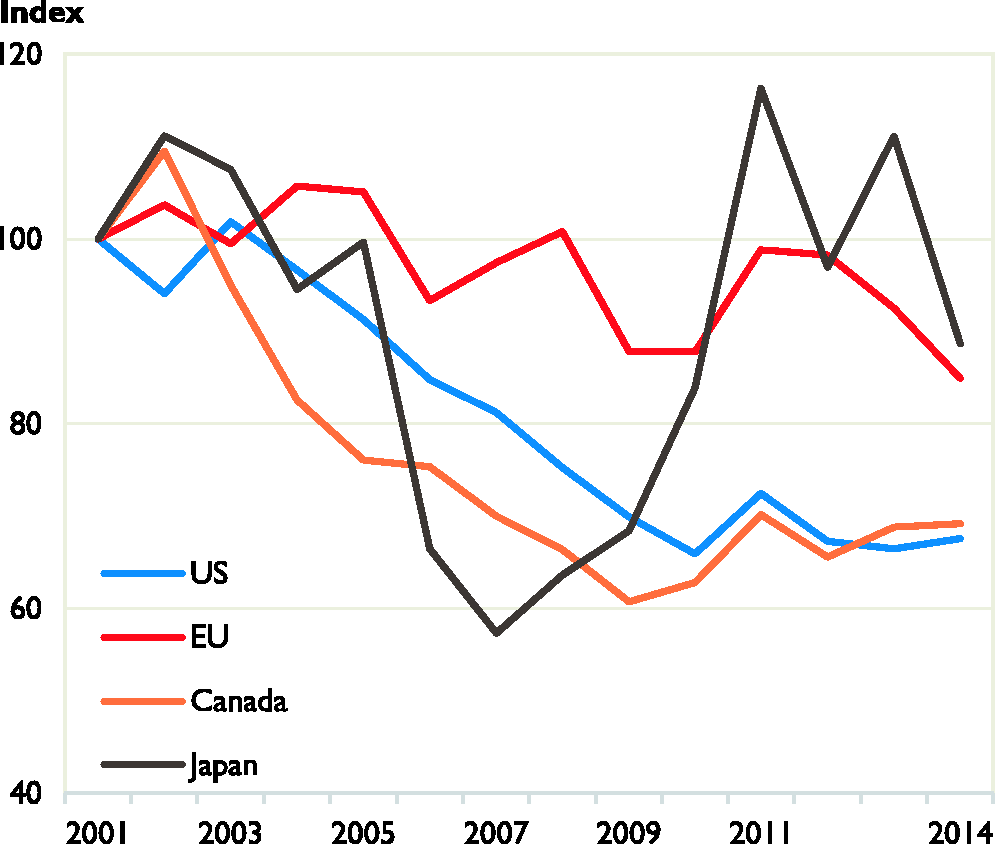
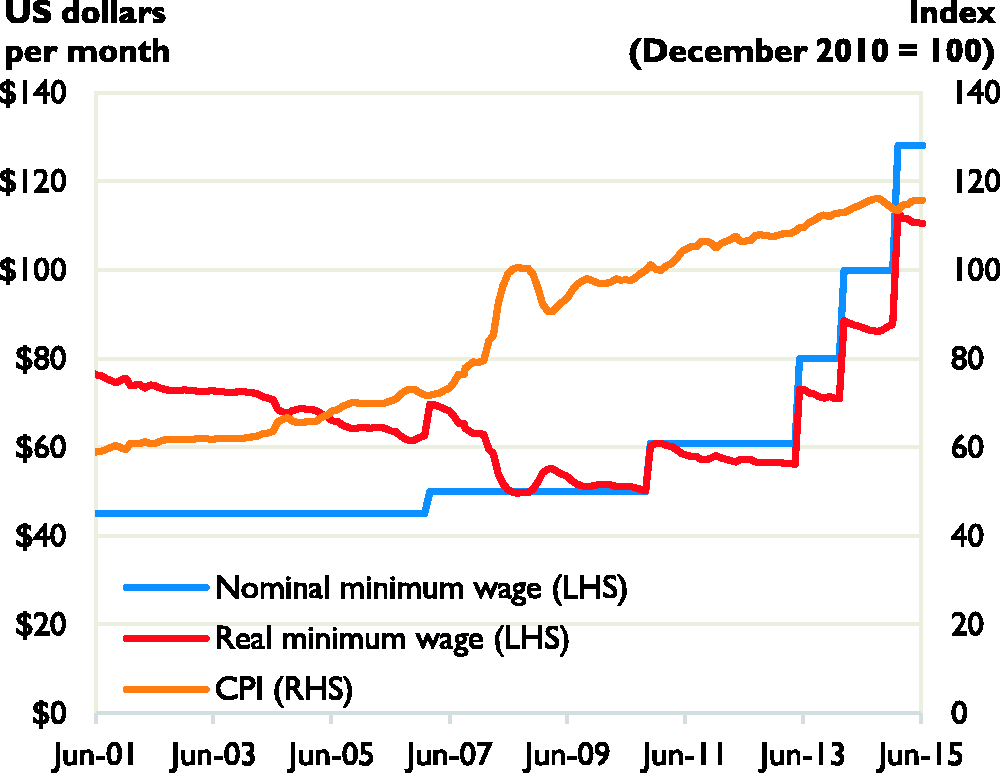
In this context of wage suppression as comparative advantage and growing social unrest, in May 2013, Cambodia’s tripartite Labour Advisory Committee increased the monthly minimum wage from $61 to $80 per month. This was the largest minimum wage increase that garment workers had seen in more than a decade, yet it simply restored purchasing power wages to the 2000 level (WRC, 2014), prior to the advent of US/ILO-led “ethical” practices when the country was a quintessential global garment sweatshop. In response to contentions that this was not enough, in December 2013, the Labour Advisory Committee re-convened. The head of the Labour Advisory Committee announced the plan to increase the minimum wage from $80 to $95. Still unsatisfied with the ruling—workers and pro-worker unions were calling for roughly $160—a wave of worker-led strikes shut down Cambodia’s entire garment industry between 24 December 2013 and 3 January 2014.
Around the same time, garment workers’ concerns had become increasingly politicized and
central to the populist campaign platform of the opposition Cambodia National Rescue Party
in the lead up to July 2013 elections and subsequent protests from August to January 2014
over perceived electoral irregularities—with opposition leader Sam Rainsy promising a US$160
per month minimum wage if elected (Arnold, 2017). Furthermore, reports in the Cambodian and Korean press asserted
that the South Korean Embassy in Phnom Penh, at the request of local Korean factory owners,
actively lobbied the Cambodian military to intervene against the wage protests (AMRC, 2014; WRC, 2014). Heng Sour of the Ministry of Labour confirmed, … investors and diplomats complain [about labor unrest], like the Korean investor who
asked for protection of their property. But [these] governments cannot say so publicly,
if they do then they will deny it. In reality diplomats in Cambodia are influential
behind the scenes, they cannot be public about it, don’t want to upset local people.
(interview, January 2015)
According to journalists, “Korean Embassy representatives acknowledged that they had made direct overtures to the head of the Cambodian Army’s Counter-Terrorism Unit and other top army officials,” and that these overtures led to Korean factories at the Canadia Industrial Park receiving special protection by military units (WRC, 2014: 26). The South Korean Embassy also reported that the Korean Ambassador had pointed out to the Cambodian Vice Minister of Foreign Affairs, Outch Borith, that “the current situation is much more a cause for concern than past strikes” and encouraged the Cambodian government to “make a concerted effort to solve the problem for the safety of our [Korean] apparel companies” (WRC, 2014: 27).
Thus, recognizing failed efforts at tripartite consent, an emerging alternative political voice and under pressure from the South Korean embassy and investors to end the protests and resume production, the Council of Ministers issued a letter to urge the Ministry of Labour to send an ultimatum to striking workers that they must return to work by 2 January 2014 (AMRC, 2014). Workers refused to accept the Ministry of Labour’s modified proposal to increase the minimum wage to US$100 and continued to protest. The first violent crackdown occurred in front of the gate of Yakjin, a Korea–US-owned company. A Korean newspaper reported that the manager of Yakjin, “called for the army’s intervention using his personal relationship with army personnel” (AMRC, 2014: 13). On 2 January, the Military Special Command Unit 911 was called in and attacked workers with iron bars. In total, 23 were arrested, 21 were held in prisons until April 2014. Next, the military cracked down on protesters at the gates of the Canadia Industrial Zone. The military fired at unarmed protesters with AK-47s at around 2 a.m. on 3 January. Five garment workers were killed and 25 protesters suffered bullet wounds, while another 13 had other types of serious injuries (AMRC, 2014). Thirteen more were arrested.
A handful of “pro-worker” trade unions in Cambodia involved in the case described above
campaign for decent wages both nationally and internationally, yet their capacity is
limited, since the ruling Cambodian People’s Party has effectively extended their reach in
and through labor politics over the past decade by bringing a majority of federations into
the integral state fold, leaving a handful of pro-opposition and politically independent or
“pro-worker” unions in the minority (see Arnold, 2017 for elaboration). One “independent” federation, the Coalition of
Cambodian Apparel Democratic Workers Union (CCAWDU), has been effective at maintaining an
extensive network of international alliances. In September 2014, CCAWDU, in cooperation with
groups including the International Trade Union Confederation (ITUC), IndustriAll and Clean
Clothes Campaign, initiated an international campaign calling for a living wage of $177. The
strategy entailed international alliances pressuring buyers to commit to higher wages in
their supply chains, while Cambodian workers and unionists appealed to both buyers and the
government for a living wage (interview, December 2014). Thus, the objective was to pressure
the Cambodian government from below, while also opening space for them to raise wages
without the threat of capital relocation. This campaign drew the ire of employers and
government, however. From their perspective, CCAWDU is following directives of international
alliances. For instance, Ken Loo of the GMAC contends, The ITUC feeds into the minds of unions that it’s feasible [to keep increasing the
wage]. In my view they’re willingly and knowingly trying to destroy the industry
here … even a layman must realize that Vietnam has higher productivity, and cheaper
everything else, so how can we pay a higher minimum wage than them? (interview, December
2014)
Heng Sour of the Ministry of Labour asserts, the … ITUC is pushing Cambodia alone … What we see is unions in other countries don’t push,
they don’t mirror the demands of the ITUC and other international actors … If you look
at the Facebook page of the ITUC, they only praise Cambodian unions, not Indonesia and
Bangladesh. Cambodia [trade unions] is 100% following international praise. (interview,
January 2015)
Heng asked “Why is Cambodia the case all the time?” He went on to state that international actors [f]ocus a lot on labor compliance and trade. To me, it’s useless if there’s no
supporting policy. Why do the US and others want better factories if they do not
differentiate us from others in terms of tariffs? If a trade policy is linked to BFC,
then fine, but if there is no differentiation then what’s the point of looking at links
between trade and compliance … Better Work sells itself via Cambodia … the ILO [just]
wants their fame.
In this constellation of relations, the “ethical GPN” is a mirage, but one the Cambodian state has become adept at manipulating in a manner that demonstrates the dialectical relation between consent and coercion, dominance and hegemony. Union membership has expanded considerably, thus demonstrating adherence to rights to organize and bargain collectively in tripartite forums, and importantly, real wages finally rose above their 2001 level after the violent crackdown in 2014, standing at $153 per month in 2017. However, particular groups (independent unions and workers demonstrating for higher wage) are increasingly marginalized, the violent-coercive hand of the state is ever-present, while the Cambodian government has also been maneuvering to restrict independent union activity through a controversial new trade union law, which may hinder the process of forming a union, allows for whole unions to be dissolved if individual officials act illegally—which technically is the case for nearly all the unions involved in recent wildcat strikes and imposes onerous restrictions on the right to strike (ITUC, 2015).
This points to the dysfunctional nature of social dialogue in contemporary capitalism in which vastly unequal “social partners” reproduce a particular GPN. By extension, this relationship between a particular national state formation within the international context, demonstrates a degree of “success” in reproducing its fragile (authoritarian-neoliberal) hegemonic status by meeting select demands from civil society while sidestepping challenges to the social relations on which it is founded (Nash, 2013). The experiences of Cambodia’s subaltern classes confined to the terrain of a “civil society” through factory monitoring and tripartitism, and subjugated by the existing “political society” of the dominant classes in the pursuit of Cambodia’s low value-added development model is one of continual disaggregations that decrease the capacity to act of both the individual and the class to which they belong (Thomas, 2009). Plant-level and nation-wide strikes are regular yet ephemeral, and point to the need to fundamentally rethink discourses and practices associated with decent work and “ethical GPNs” as they play out in authoritarian contexts like Cambodia.
Conclusions
Cambodia, we have shown, is promoted as an “ethical” garment manufacturing enclave, yet state–society relations are characterized by violent neoliberalism and an authoritarian, neopatrimonial state (Springer, 2013). The garment sector union density of 60% is unusually high, yet real wages steadily declined for over a decade. These and other contradictions provided the empirical grounding for our assertion that GPN governance analysis must move beyond binary notions of institutional “constraining” and “enabling” to encompass more contested, topological fields of struggle over development projects and capital accumulation.
By “governmentalizing Gramsci,” we have contributed to a growing dialogue that, at its core, asserts that the two writers complement one another, and they present a more powerful perspective taken together than each does on his own, particularly when studying multi-scalar state–labor relations imbricated in GPNs. To mediate the productive tensions between their work, we have utilized a topological approach to socio-spatial relations, drawing on Foucault’s notion of dispositive as well as Gramsci’s concepts of the integral state and passive revolution. This elicits the contingent nature of power, the multiple struggles over its force, and especially the ways in which micro-forms of governmentality scale up and are foundational elements of macro-notions of hegemony. In doing so, the objective is to move beyond “soft” notions of assemblage that lend itself to a joining-up exercise, but rather aiming at developing “middle range” theoretical tools that help us grasp the general mutational parameters of power in global production networks.
A topological “take” on state-labor relations in GPNs thus comprises discursive “truth” claims from jobs as the fulcrum of discussions around dignity, rights and empowerment to sub-hegemonic claims on the necessity of a decent work agenda conducive to win–win arrangements. Such discourses are often held together by international organizations such as the ILO, yet the force “behind” such claims is operationalized by powerful transnational corporations strategically appealing to social dialogue and social partners without sufficiently addressing disparities or challenging capital’s hegemony. This plays out differently depending on the context. In Cambodia, we find a state clearly limited in what it can concede to labor given manufacturers’ slim profit margins and the limited bargaining potential of states hosting export enclaves vis-à-vis major garment brands and buyers. Workers, for their part, have the capacity to withdraw their labor from the production process challenging both state and capital hegemonic projects. Thinking power topologically also brings into sharp relief that state violence—while exercised in particular territories—may be the result of multiple and contested state–state power relations. This has been evidenced recently by the police and military crackdown of wildcat strikes in Cambodia, particularly in relation to Korean manufacturers who called on the Korean government to influence Cambodian state action.
Our analysis generates questions for future research, beyond the present scope. Concerning GPN analysis, a challenge lies in posing questions that sharpen, rather than add to an already extensive and ambitious research agenda. Thus, we may ask, given the shortcomings of governance “gaps” analysis, what kinds of cross-border topological workers’ solidarity may re-orient GPN analysis around notions of living wage, social welfare and other forms of social guarantees? A critical cultural political economy of GPNs (Hudson, 2008; Sayer, 2001) may provide the necessary analytical tools to address that question. After all, as Hauf (2015: 151) rightly states, we cannot not want better working conditions, living wages, and stronger labor rights. Initiatives like BFC have achieved select improvements in terms of measurable working conditions (Polaski, 2009; Rossi, 2015), but at the same time, we have demonstrated that the program contributes to reproducing a hegemonic project geared against the realization of redistribution of wealth and power in the global economy.
Footnotes
Acknowledgements
This paper is a truly joint effort and in its various iterations has benefitted greatly from constructive feedback by a number of our colleagues. In particular, we would like to thank Jonathan Darling, Jamie Doucette and Rory Horner, as well as Trevor Barnes and three anonymous referees for their helpful and critical comments and suggestions. Select interviews were conducted as part of an unpublished research project Dennis Arnold conducted for the Christelijk Nationaal Vakverbond; analysis in this article does not reflect project report contents. Martin Hess would also like to thank the ILO/IFC Better Work Programme for the opportunity of a Visiting Scholarship in Geneva. However, the views and opinions expressed in this article are those of the authors.
Declaration of conflicting interests
The author(s) declared no potential conflicts of interest with respect to the research, authorship, and/or publication of this article.
Funding
The author(s) disclosed receipt of the following financial support for the research, authorship, and/or publication of this article: Dennis Arnold's work was supported by the Netherlands Organisation for Scientific Research [Veni grant no. 016.135.215].