




Abstract
This paper addresses the social and cultural significance of convenience food, often regarded as among the least healthy and most unsustainable of dietary options, subject to frequent moral disapprobation. The paper focuses, in particular, on the relationship between convenience and care, conventionally seen in oppositional terms as a culinary antinomy. Informed by a ‘theories of practice’ approach, the paper presents empirical evidence from ethnographically-informed research on everyday consumption practices in the UK to demonstrate how convenience foods can be used as an expression of care rather than as its antithesis. The paper uses Fisher and Tronto’s theorisation of caring about, taking care of, caregiving and care-receiving to draw out the dynamics of this morally contested social practice.
Introduction
This paper addresses the contemporary social and cultural significance of convenience food, the consumption of which has increased rapidly in recent decades as a response to the exigencies of modern life (Scholliers, 2015). Convenience food is a sprawling category, encompassing a very diverse range of goods (Jackson and Viehoff, 2016). Commonly disparaged as among the least sustainable and most unhealthy of dietary choices, the use of convenience food is frequently ‘tinged with moral disapprobation’ (Warde, 1999: 518). For example, work by the UK Department for Environment, Food and Rural Affairs concluded that convenience foods such as ready-meals typically include resource-intensive ingredients, responsible for high greenhouse gas emissions, consuming large volumes of energy, land and water with high transportation costs (Defra, 2012), while research published in the British Medical Journal reported that none of the 100 supermarket ready-meals it tested fully complied with WHO dietary guidelines (Howard et al., 2012). Significantly, however, the same paper found that home-made meals, following recipes from TV celebrity chefs, were even less likely to meet WHO guidelines, challenging any simple distinction between the relative merits of home-made and convenience food.
As a marketing category, ‘convenience food’ encompasses a wide variety of processed and semi-processed food including bagged salad leaves, peeled and chopped fresh fruit and vegetables, fresh deboned, filleted and skinned fish and meat, bread and baked goods, jars of sauces and preserves, frozen, canned and dry goods, sandwiches, pies, pizzas and fresh or frozen ready meals. Simplified, these might be categorised as items which are ready to cook, ready to heat or ready to eat (see Pfau and Saba, 2009). Often used as an analytical category by academic researchers and as a more-or-less self-evident category in food retail and marketing, convenience food is a clear example of what Sayer (1992: 138) calls a ‘chaotic conception’, which arbitrarily divides the indivisible and/or lumps together the unrelated and the inessential. Such concepts are relatively unproblematic in everyday usage and when used in scientific discourse for descriptive purposes, but, as Sayer suggests, they become problematic when explanatory weight is placed upon them.
In practice, most households combine fresh and convenience foods without making a strong distinction between the two categories (cf. Carrigan and Szmigin, 2006; Short, 2006), not least because many convenience foods have been normalised as staples (Lavelle et al., 2016). In this context, the perceived benefits of cooking ‘from scratch’ (advanced by the nutritionist lobby) often overlook the use of processed ingredients, suggesting that the distinction between scratch cooking using fresh ingredients and a reliance on convenience food is frequently overdrawn (cf. Moisio et al., 2004; Slocum et al., 2011; Wolfson et al., 2016). Nonetheless, cooking from scratch is often presented as an inherently more caring, healthy and sustainable alternative to the use of convenience food – a view that this paper seeks to challenge.
Convenience and care as culinary antinomies
The negative moralization of convenience food can be related to the contrast that is commonly drawn between convenience and care. This opposition is one of the four ‘culinary antinomies’ that Alan Warde (1997) identifies in his sociological account of food, consumption and taste. Derived inductively from his analysis of social survey data and coverage of food issues in women’s magazines, Warde identified four ‘longstanding structural oppositions’ between novelty and tradition, health and indulgence, economy and extravagance, and convenience and care (Warde, 1997: 55). 1 While Warde outlines the structural opposition between each pole of these antinomies and the social anxieties to which they give rise, we wish to explore how such contradictions are reconciled in the practices of everyday life, taking up Halkier’s argument that in order to avoid making normative judgements about the nutritional, environmental or moral implications of convenience food, social scientists should seek to understand how its use ‘is embedded in the complex practices, processes and conditions of … everyday life’ (2013: 123).
In his book Consumption, Food and Taste (1997), Warde identifies four ‘culinary antinomies’ which he suggests can be used to make sense of the apparent contradictions and inconsistencies contained in government, mass media and social commentary on food and taste. Warde’s ideas have been widely adopted, employed in a variety of different empirical settings (see, for example, Karisto, 2013; Mäkelä, 2002; Schneider and Davis, 2010). But, for all their elegance and economy as theoretical constructs, the epistemological status of Warde’s antinomies is not entirely clear. They are presented as ‘deep-rooted’ and ‘probably irresolvable’ contradictions, as ‘permanent features of the modern predicament’ and as ‘irreducible and irreconcilable oppositions’ (Warde, 1997: 55–56). Yet, in everyday practice, he suggests, they are used to legitimize the choice between foodstuffs and to decide between alternative courses of action. Despite their apparently contradictory nature, Warde accepts that people can appreciate the attractions of both poles of each antinomy and that they may serve as guides to practical conduct (Warde, 1997: 56). We are interested in pursuing this argument in terms of oppositions that appear to be irreconcilable in abstract (structural or theoretical) terms and how they are resolved in everyday life at the level of practice. While Warde’s analysis is divided into discussions of ‘convenience or care’ and ‘convenience and care’, we explore a third option, examining the way that care can be expressed through the use of convenience food (‘convenience as care’).
Having discussed the nature of Warde’s culinary antinomies, we now outline our adoption of a ‘theories of practice’ approach in understanding the place of convenience food in everyday life. Drawing on our ethnographically-informed fieldwork with UK households, we propose to show how consumers resolve the apparent contradictions between convenience and care in practice. The analysis uses the work of feminist theorists Berenice Fisher and June Tronto (1990), including the distinction they make between caring about, taking care of, caregiving and care-receiving. This enables us to avoid the tendency to frame convenience food in negative terms, showing how, in many different circumstances, our participants are able to express care through the use of convenience food, articulating the notion of convenience as care.
Theory and methods
We have found a ‘theories of practice’ approach useful in understanding contemporary consumption practices. These theories draw inspiration from a wide range of sources, as outlined by Reckwitz (2002) and in application to consumption studies by Warde (2005). For Schatzki, practices are at the centre of the social world, constituting the ‘site of the social’, and providing a conceptual middle ground between individual action and social order (Schatzki, 2002). Practices are constituted of both ‘doings and sayings’ (Schatzki, 1996: 86), avoiding the over-privileging of text or discourse and opening up a space for the observation of the doings of practice as well as participants’ discursive reflections on their practices. Practice theory also encourages us to examine how specific practices such as cooking and eating are negotiated within a wider set of domestic routines and responsibilities (cf. Wills et al., 2015). We have pursued these arguments through our ethnographically-informed work in Northern England, undertaken between 2010 and 2016 with ethical approval from the University of Sheffield. Our research addresses various issues including consumer anxieties about food (CONANX) and the relationship between food, convenience and sustainability (FOCAS). 2 In each case, we have sought to understand how consumer practices are situated within the dynamics of everyday life through close observation of people’s doings and sayings. Our participants, all of whom are represented via pseudonyms, varied in terms of age, socio-economic status and ethnic background, household composition, education and occupation. They included retired people, working families, households with dependent and/or adult children, students, unemployed people, single-person households, lone parents, couples, and people in house-sharing arrangements, including individuals seeking asylum.
Methodologically, our work brings together different combinations of techniques. Since CONANX was a multi-generational study involving reflections on the practices of other family members (including the deceased), food-focused life history interviews were undertaken. The more specific focus of the convenience food study meant that these interviews were semi-structured in nature. In both studies, the first author/researcher (Meah) undertook a series of kitchen visits which involved cupboard and fridge rummages (cf. Evans, 2011) as a means of starting conversations about various types of food practice. Additionally, we conducted provisioning ‘go-alongs’ (Kusenbach, 2003) including – in the CONANX study – garden and allotment tours, as well as video-recorded cooking observations. During the FOCAS project, the researcher sometimes interviewed people while they were cooking, setting the video-recorder up whilst simultaneously taking photographs and chatting to participants. She also disclosed some of the particularities of her own practices and experiences where this was felt to be appropriate and to avoid the appearance of being judgemental.
As our familiarity with these methods and awareness of the possibilities they afford increased over time, some participants in the FOCAS study were offered the opportunity of keeping self-directed video diaries. Our use of this method in a previous study (Meah and Jackson, 2016) revealed that handing over control of the camera meant that what we saw of the household was not restricted to particular ‘snapshots’ when a researcher could be present. Indeed, a much more nuanced picture of household practices emerged over the space of a week or more, enabling us to better understand the motivations behind individuals’ practices, as well as how cooking and eating are fitted into the exigencies of everyday life (cf. Warde, 2016). This does not mean, however, that we had unmediated access to participants’ kitchen practices. On numerous occasions, the researcher’s ‘absent presence’ (Gibson, 2005) was evident either in self-conscious discussions between members of the household, or through dialogue directed at the camera which was a proxy for her presence.
In what follows, we draw on our data to examine how the use of convenience foods can be understood as a vehicle through which care can be expressed. In doing so, we draw on Fisher and Tronto’s (1990) model of the components of care as an interpretive framework enabling us to demonstrate the circumstances in which (various kinds of) convenience foods can be used as an expression of (different forms of) care.
Care and caring
An examination of the literature on care and caring reveals that these are deeply contested concepts. Care and caring are notoriously difficult to define and may be understood simultaneously as concept, emotion, practice and moral exhortation (Atkinson et al., 2011). While conventionally concerned with systems of social support and health care, the concept has also been mobilised in feminist theory, moral geographies and post-colonial theory, as well as in reflections on academic practice (cf. Barnett, 2014).
Since the practical and emotional responsibilities of caring are acknowledged as being disproportionately met by women (cf. DeVault, 1991; Finch and Groves, 1983; Hochschild, 1983), feminist geographers have explored the complex spatialities and practices of care, as well as the formal and informal contexts in which this work is undertaken (England, 2010; Milligan, 2005; Parr, 2003). Within such scholarship there has been a concern with what Popke (2006: 506) has referred to as ‘care ethics’, wherein caring is conceptualised not so much as an activity, but as a way of relating to others (see, for example, Held, 2006; Smith, 2005; Staeheli and Brown, 2003) or as relation and flow (Atkinson et al., 2011). Research has also focused on the geographies of ‘caring at a distance’ via ethical consumption practices (e.g. Cox, 2010; Popke, 2006). While others have politicised the concept of care in asking ‘who cares for whom?’ (Tronto, 1993), we demonstrate the value of a practice-theoretic perspective in extending the parameters of this debate by asking how is this done?
Reflecting on the embodied intersections of caring and eating, Lavis et al. (2015) suggest that ‘care’ is not necessarily a benign concept when deployed via discourses of ‘good’ food and ‘proper’ eating which utilize – and potentially manipulate – the concept of care to alter the eating practices of others. The authors note that ‘thinking through care is a slippery exercise not only because care is diversely experienced, conceived of and applied to food and eating, but also what “to care” means is widely contested’ (Lavis et al., 2015: 5) involving dimensions of caring ‘for’ and caring ‘about’. Indeed, consumers may feel pulled in different directions regarding who to care for, with differing concerns competing with each other (Meah and Watson, 2013; Morgan, 2010). Moreover, while individuals may care about distant farmers or the environment – driven by the affective dimension of caring which might also be translated into something more practical, for example, in making particular types of provisioning decisions – caring for is deemed to be more personal and embodied (Tronto, 1989). Indeed, it is characterised by relations that ‘if not defined by love, are frequently associated with and energized by it’ (Twigg and Atkin, 1994: 8). Consequently, as Miller (2001) has noted, consumers frequently articulate a wider ethic of care invoked by a range of social inequities and environmental injustices, but their actual purchasing practices are more likely to focus on ‘local’ concerns such as the moral imperative to provide for one’s family within specific resource constraints.
This is an appropriate point at which to begin our exploration of where care meets convenience since the materialities of care in action (McEwan and Goodman, 2010) are embedded in everyday food practices regardless of whether these are motivated by a concern with the health and well-being of one’s immediate family, a wider concern with the environment, or the livelihood of distant strangers. As we aim to show, care can be manifested in diverse ways, not all of which conform with normative beliefs concerning, for example, how to look after one’s health or the future of the planet. Indeed, as Fisher and Tronto (1990: 40) have suggested, human ‘needs’ change with different contexts involving power relations that ‘affect the content, definition, distribution and boundaries of caring activities’. In these circumstances, Fisher and Tronto argue, the caring process is not a gracefully unfolding one, but one where different components often clash with each other. It is via these different components – identified by Fisher and Tronto as caring about; taking care of; caregiving and care-receiving – that we frame the remainder of our discussion concerning the possibilities of expressing ‘convenience as care’.
Convenience as care
Caring can be seen as a process having four intertwining phases: caring about, taking care of, caregiving, and care-receiving … Caring about involves paying attention to our world in such a way that we focus on continuity, maintenance and repair. Taking care of involves responding to these aspects – taking responsibility for activities that keep our world going. Caregiving involves the concrete tasks, the hands-on work of maintenance and repair. Care-receiving involves the responses to the caring process of those toward whom caring is directed. (Fisher and Tronto, 1990: 40)
In their widely referenced feminist theory of caring, Fisher and Tronto (1990) acknowledge that caring is a practice that relies on particular factors, including time, material resources, knowledge and skill, which – they suggest – may contradict as well as complement each other (Fisher and Tronto, 1990: 41). For instance, caregivers may have knowledge and skills but limited financial resources, or have greater financial resources but limited time in which to do care. These kinds of dilemmas can be observed in the context of household food provisioning where, it has been argued, ‘good’ and ‘bad’ food choices must be understood in the broader context in which they are made (Schaefer et al., 2016). In her work with low income mothers in the US, for example, Chen (2016: 165) illustrates how poverty prevents mothers from putting their nutritional knowledge to work. Likewise, in earlier work, we reported how some individuals indicated that caring for the environment was perceived to be ‘a privilege of the rich’ since the cost of organic or animal-welfare friendly produce was felt to be prohibitively expensive (Meah and Watson, 2013). Whether the emphasis is on the health of the individual, the welfare of distant others or the future of the planet, it is clear that consumers care about these issues, even if they lack the capacity to enact their perceived responsibilities.
Caring about
Despite the fact that convenience foods are often regarded as being among the least sustainable of dietary options in terms of wasteful packaging, intensive production processes and reliance on imported ingredients, some of our participants justified their use of particular types of convenience foods on environmental grounds. For example, Edward (White British, 47) described his use of pre-prepared packs of stewing vegetables in terms of his commitment to reduce waste: It has everything you want in, so there’s no waste … it’s got everything you need … I don’t like to waste things … it’s disgusting throwing food away when some people are hungry. No, I can’t stand it.
Similarly, Ted (White British, 68) also expressed concern regarding the management of the world’s food resources. While Edward’s comments focus on matters of food justice, Ted explained his use of tinned tomatoes in terms of his objection to the cost of imported, out of season, perishable food, the price of which was prohibitive for many people: I think it’s disgraceful … it’s a waste of the world’s resources to bring food, perishable food, a long way in an expensive aeroplane to sell at inflated prices to people that can’t afford it. If everyone ate what they had locally there wouldn’t be a lot of the problems that we have with managing the world’s resources … you don’t have to send food half way across the world, people have plenty of food to begin with anyway … it’s a, it’s a great problem I have with managing the food, it’s [about] air miles I suppose, but it’s not … in an ecological sense, it’s just a waste of resources, it’s not the best way … There’s lots of food around, local food, and if you’re not in the tomato season, eat something else.
Taking care of
The preceding examples indicate that while one can care about someone or something, this orientation does not necessarily require any kind of overt action. This situation changes when, for example, one has responsibility for taking care of household provisioning and the feeding of one’s family. Fisher and Tronto (1990: 42) explain that this dimension of caring implies having responsibility for initiating and maintaining caring activities which involve a capacity to anticipate or predict the outcome of one’s interventions which necessarily implies accountability for their consequences.
If we look at how food choices are currently framed amid growing concerns about obesity, overweight and diet-related ill health, it is easy to see how parents – mothers in particular – have been subject to moral censure as overweight children are judged to be evidence of a failure to uphold socially constructed expectations of ‘good’ parenting (see, for example, Chen, 2016; Fox and Smith, 2011; Rich, 2011; Slocum et al., 2011). But as Fisher and Tronto explain, caring is a complex business within which a key skill is the ability to make judgments about what might be the best course of action in view of the resources available. This is particularly evident, for example, in low-income households among which ‘poor’ dietary decisions should not be assumed to emerge from either a dearth of cooking skills or poor health literacy (Henderson et al., 2009). Indeed, Chen (2016) reports that mothers in her study were more likely to emphasize feeding their family on a limited budget rather than the nutritional quality of the food they eat.
Within our own research, several households indicated that cost was a factor in the use of convenient alternatives to fresh, raw ingredients. Among them was Tameka (British Black African/Black Caribbean, 28), who combined fresh, frozen, dried and canned ingredients in her cooking. Frozen vegetables, including chopped onions, were experienced as a boon within her domestic economy since they enabled her to provide her five-year old daughter with vegetables throughout the month knowing that they would not perish in the way that fresh ingredients might if unused before her next monthly online shop. It was clear from her interview and video-diary that Tameka did not lack knowledge, skill or willingness to cook. In her video-diary she explained: I’m in love with using frozen veg as I find I don’t waste vegetables and they don’t go off … it really hurts me when I waste vegetables. … it was in the paper, they said frozen vegetables are more healthy, because they had an experiment, because they were picked and frozen very quickly.
Although financial resources featured in the provisioning decisions of even the most affluent households in the FOCAS study, it was clear that money was not the only resource constraint experienced by participants. Indeed, among those households occupied by adults employed outside the home, time emerged as a particularly salient concern (cf. Warde, 1999). While mothers are often the focus of academic commentary regarding the management of trade-offs between financial and time poverty (Bava et al., 2008; Szabo, 2011), within our research some men also reported feeling pulled in different directions when presented with the problem of how best to ‘care’ for their families. James (White British, 49), for example, had been a single father with sole custody of his eldest daughter and equal-shared care of her sister. Prior to the elder daughter going to university, James had to travel to work in other parts of the country, meaning that he was often away overnight, or arrived home very late. While he expressed guilt at having to be away from home, James nonetheless had to make judgements about how best to meet the range of caring obligations he had to his family, as without the financial means to do so, he would not be able to take care of either of his daughters.
What James reported of his provisioning practices at that time is revealing of the ways in which individuals ‘make love in supermarkets’ (Miller, 1998). He explained that in addition to buying fresh ingredients which his elder daughter was unlikely to bother using, he would also buy high-end, gluten-free ready-meals for her as a way of ensuring ‘that she’d always got some meals to look after herself with’. He recognised that had he not done this, his daughter – who has coeliac disease – ‘would just have eaten rubbish’. Like other parents with slightly younger children who took part in this study, in this instance, James saw himself as facilitating his daughter in being able to take better care of herself in his absence. Other examples included pizza, soups and instant snacks such as Pot Noodles which children could prepare as a stop-gap before parents arrived home from work. Similarly, while James acknowledged that ready-meals are not something he would choose to eat if it could be avoided, he felt that they have a place ‘when time’s against you’, offering more variety and being more healthy than a takeaway meal for example. In this assessment, there is evidence of a hierarchy in the way that different kinds of convenience foods are perceived by consumers with some being more acceptable than others (cf. Carrigan and Szmigin, 2006). Although they may fall short of normative expectations of a ‘good’ diet, James nonetheless endeavoured to provide ‘proper’ meals for his daughter even when he could not be physically present to cook them.
Variety and healthfulness also featured in James’s justification for introducing his elderly parents to a specialist frozen ready-meal supplier which provides doorstep deliveries. Living some distance from his parents, James was unable to contribute directly to caring for his father who is in the advanced stages of dementia and was being cared for at home by his wife – James’s mother – with very little statutory support. His father also has Type-2 diabetes and James suggested that his mother’s approach to cooking ‘isn’t good for my father … she hasn’t cottoned on to the fact [that] food is directly reflected in your health, certainly in the case of diabetes’. Ordering ready-meals that were low in fat and sugar enabled James to feel that he was contributing something positive to his father’s care, and in a domain overlooked by his mother who was struggling with the physical and emotional demands of caring for someone who is very confused, housebound and increasingly immobile.
He acknowledged that his mother had initially been resistant, intimating that ‘people would think that she wasn’t caring for dad properly by not cooking’. Clearly, his mother’s anxiety arose from a perception of this type of convenience food as evidence of a lack of care on her part, at least in the eyes of others. To deflect these concerns, James reported: I sold it to her on the basis that it gave her more time to spend with my dad and gave her the choice, the variety of different types of meals.
James’s narrative illustrates how – both for him and his mother – judgements must be made regarding their households’ caring needs and the resources they have at their disposal. The challenge they each face is not a dearth of material resources but time – and, in his mother’s case, emotional energy – with which to take care of their loved ones’ nutritional needs. However, for James, the decision to purchase ready-meals – initially for his gluten-intolerant daughter, and then for his diabetic father – was not premised upon a desire to meet a basic human need via the easiest or most ‘convenient’ means possible. His actions were motivated by specific concerns about diet and wellbeing and the adverse health implications of the choices his daughter and mother might opt for in the absence of carefully selected alternatives. While work obligations undermine James’s capacity to be involved in more direct forms of caregiving, the provision of ready-meals nonetheless enabled him to take care of his daughter and his parents in an indirect way. These examples are revealing of the complex landscape of care in which domestic food practices are situated and confirm that both caring about and taking care of are – as Milligan and Wiles (2010: 742) suggest – not necessarily reliant on physical closeness, but should be understood as an ‘embodied phenomenon rather than disembodied experience, even where care is physically distant’. They also provide further evidence of the use of convenience food as a form of care, tailored to people’s specific circumstances.
Caregiving
In each of the examples above we see that ‘caring well within one’s own family’ (Tronto, 2002) is a matter of interpretation. This becomes even more apparent when we explore the practices that constitute direct caregiving which, as Fisher and Tronto (1990: 43) observe, involves more continuous and dense time commitments than ‘taking care of’, and consequently requires a greater level of responsiveness to the unfolding exigencies of everyday life. A grandmother, for example, might find grandchildren arriving for an unexpected visit on their way home from school, requiring skilful improvisation using items from the freezer, combined with tinned and/or fresh ingredients to provide a hot meal. Indeed, some participants reported having convenience foods in the house for such occasions ‘just in case’.
But greater demands – and resourcefulness – were observed in households with resident dependent children, particularly where the mothers were also involved in paid employment outside the home. Here, again, time featured in their narratives, but in these situations, convenience foods are not deployed simply because there is a lack of time to cook, but rather because the use of these foods either facilitates the redistribution of time to spend on other caring activities or enables them to combine cooking with childcare in more imaginative and less onerous ways. Indeed, although some mothers expressed anxiety concerning the incorporation of convenience foods in their family’s diets, practices such as a Friday evening take-away curled up under duvets in front of the television, or the use of particular ingredients, were self-consciously rationalised as serving a wider goal of facilitating ‘family time’: moments during which intimacy – as another dimension of caregiving – was shared with children, unencumbered by other demands. In these examples, the use of convenience foods helped create ‘quality time’ to spend with their families (cf. Brembeck, 2005; Carrigan and Szmigin, 2006; de Boer et al., 2004).
These arguments are particularly applicable to young mothers, such as Hannah (White British, 35), with whom fieldwork was undertaken over an eight-month period. When she was first interviewed, Hannah was still breastfeeding her youngest child and explained how, since ‘babies … dominate your whole world’, cooking had become characterised by compromise, including the use of convenience items that did not require standing over while involved in physically demanding breastfeeding. While being compromises that she learned to accept, items such as frozen ‘rainbow veg’ and fish-fingers helped Hannah to accomplish – rather than undermine – her desire to be a good mother. Eight months later, the first author spent an afternoon with Hannah and her daughters, Beatrice and Daisy. She explicitly drew attention to how much the context of her cooking had changed now that her younger child was more independent. However, although Hannah’s cooking had become more involved, as can be seen in Figure 1, combining cooking and childcare remained challenging. Certain convenience items, such as ready-made, pre-rolled pastry and a carton of chopped tomatoes helped make this process less difficult since both can be used with one hand should the other be occupied in carrying a small child on her hip.
Convenience foods facilitate one-handed cooking.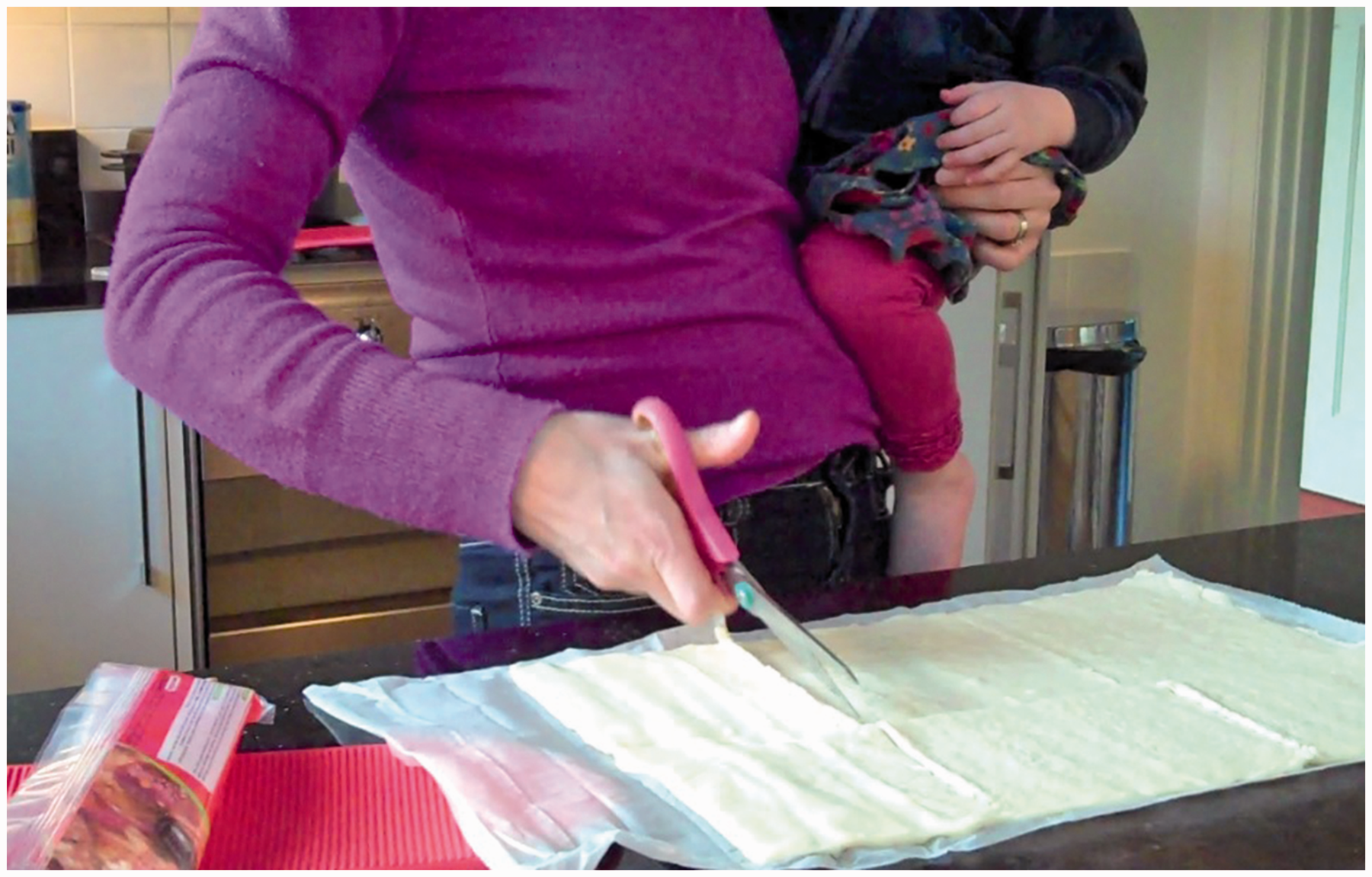
Additionally, convenience items are explicitly utilised in the dynamics of childcare. During an after-school cooking observation, the first author witnessed how processed items including ready-made pastry, canned sweetcorn, cured ham and tomato paste enabled the children to make their own evening meal (a ‘home-made’ pizza) without mess or drama, consequently allowing Hannah to combine cooking and childcare (see Figure 2). The products serve a range of functions in this scene: facilitating togetherness as a family, avoiding Hannah having to find alternate activities to oversee which will occupy her daughters while she tries to prepare the meal. They enable them to feel a sense of accomplishment and ownership over their culinary creation, and they provide an opportunity for Hannah to begin to teach her children a new life-skill – preparing them to cook and be able to make positive food choices for themselves which Hannah sees as an important part of taking care of her children. As observed by Carrigan and Szmigin (2006: 1127) in their discussion of mothers’ inventive combination of convenience and fresh foods, the use of convenience products may be no less eloquent a statement of maternal love and care for family members than the cooking of fresh food from scratch. In these circumstances, the use of such foods may be a strategy for parents to enhance (rather than detract from) their devotion to their families.
Hannah, Daisy and Beatrice making pizza.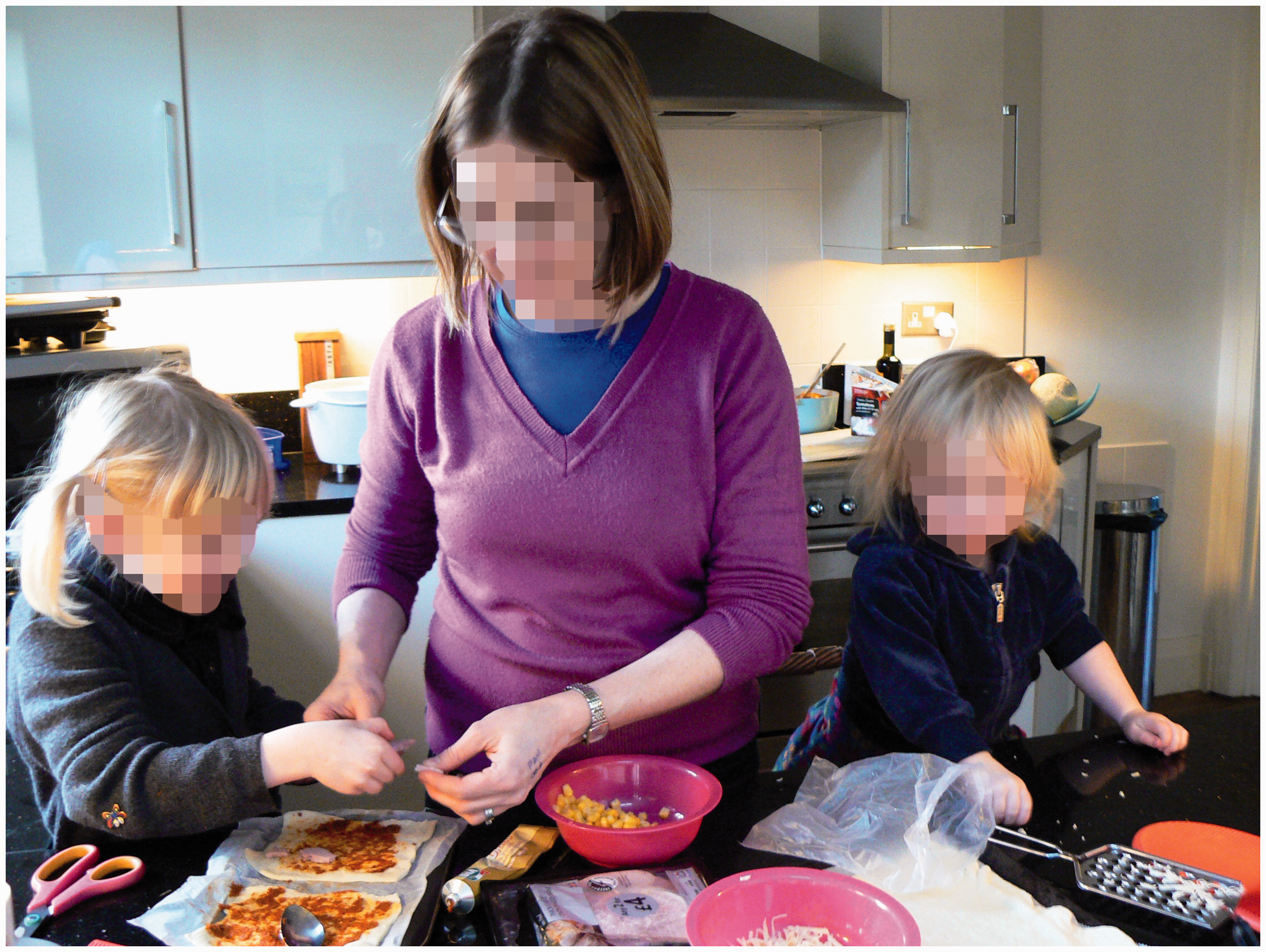
It is also worth noting that even among those individuals who lived alone, the use of convenience foods was sometimes articulated as a way of caring for oneself. Tony (White British, 56) had recently separated from his wife. He reported that the sorry state of his marriage prior to their separation was reflected in empty cupboards and a reliance on ready-meals and take-away food. He described how they used to cook ‘in a slightly sort of (…) not in a very caring or careful way’ and reflected: ‘it’s interesting just how broke, without realising it, things had broken down a bit just in terms of normal behaviours’ such as shopping and cooking. Rather than being a comfort or a means through which care could be expressed, food was constructed here as a cause of antagonism, while an empty fridge and unfilled cupboards were a source of anxiety for someone who grew up in relative poverty. Now living on his own, with his 13-year old daughter staying a couple of nights a week, Tony no longer had to worry about running out of food as his kitchen is well-stocked with cans of soup, instant noodles, microwavable rice and ready-meals which he described as a ‘war-chest’.
Tony’s self-recorded video footage included an evening when, having returned from the pub extremely drunk, he proceeded to knock up a quick meal. This consisted of two (different flavoured) cans of soup, some instant noodles and their flavour sachet, and some pre-grated cheese. When asked about this footage in a subsequent interview, Tony explained: I used to do that a lot when I was married, if I did go out and I came in late on my own, I’d like doing that … that was kind of like my (.) private space, it was a way of creating a space for me … just for me, the sort of thing nobody else would want to share particularly, or approve of either, it was my little world … and on top of that, the food itself is (…) quite, basically, elementally psychological, comfort food, it’s gooey, it’s like kids’ food almost, y’know, it’s a very oral experience (.) maybe there’s something almost foetal about (.) curling up on the couch with the telly on, spooning this gunge into my mouth.
Care-receiving
Fisher and Tronto (1990: 44) assert that because caregiving acts upon something or someone else, there will necessarily be a response to it. However, since caregiving is dependent on the identification of ‘needs’ which recipient and caregiver may not agree upon, how care is received may not be consistent with the spirit in which it was intended. We have already indicated – via the example of James ordering frozen ready-meals for his father – that good intentions may not, initially, be welcomed by the recipient. In James’s case, he was able to avert his mother’s anxieties about how the use of ready-meals might be judged by outsiders, reframing it as a means with which to redistribute her energies into other acts of caregiving. But attempts at caregiving or taking care of family members through food are rarely so straightforward and are not infrequently met with resistance (cf. Ochs and Beck, 2013).
Such is the experience of many households with children of all ages, particularly those who might be deemed as ‘fussy’ eaters. Consequently, responses to one’s efforts at being a ‘good’ and responsible parent who takes care in providing meals that are fresh, sustainable and nutritionally balanced are not infrequently undermined by children’s (or adults’) responses, thus determining what people feed their families. Indeed, Engster (2005) advocates that caring not only involves meeting the basic needs of others, but that this must also be done in an attentive and responsive manner. Seen in this light, it becomes possible to understand how – as Fox and Smith (2011: 409) suggest – parents might construct their own discourses of ‘care’ and good parenting through the provision of unhealthful food that their loved ones are willing to eat, rather than morally-approved alternatives which they will not. Here, healthy eating is balanced with – or traded off against – pleasure and practicality, and dietary concerns are subordinated to other imperatives.
In several of our households, participants justified their choice of foods about which others might disapprove because of the specific needs of their children. For those who were underweight or reluctant to eat in ways that are conventionally regarded as healthy, some participants resorted to convenience foods that they knew their children would eat. This would sometimes result in disagreement among the parents over what their children should eat but was, in all cases, regarded by the giver as an expression of care. For example, while Maryam would prefer that her 15 year old son ate her home-cooked food, she reported that her husband allows him to eat chocolate or biscuits on the way to school, justifying the decision on the grounds that these will ‘give him some energy … and at least he’s eating something’.
Our studies include numerous examples of parents providing children with cake-bars, biscuits, shop-bought desserts and crisps, and grandparents who – sometimes against the parents’ wishes – fed visiting grandchildren processed foods and other treats. Additionally, parents of older children also used ready-meals as a way of introducing them to unfamiliar dishes, or different ways to eat vegetables. These are all examples of how caring with and through food has to be negotiated with the recipients of care against a backdrop of evolving tastes and preferences which could easily be met with rejection or resistance. In such cases, care may be received with an absence of complaint rather than with overt appreciation (Burridge and Barker, 2009; Charles and Kerr, 1988; DeVault, 1991). It is part of the normal negotiations of family life, and making it successfully through meal-times without major complaints or hysterical outbursts may be a significant achievement. In such circumstances, high-minded dietary advice about ‘healthy eating’ can therefore seem hopelessly unrealistic.
Conclusion
It is clear from the preceding discussion that ‘care’ and ‘convenience’ are both slippery terms whose meanings and the values attached to them are acquired in specific social contexts. While reference to ‘culinary antimonies’ may imply that convenience and care are opposed in structural terms, our evidence shows how they are routinely combined in the practices of everyday life. As our research demonstrates, consumer practices should not be understood in terms of the either-or character of convenience and care, nor even in terms of their complementarity, but rather as mutually constitutive. Clearly, caring is not a one-off event or isolated activity but – as Fisher and Tronto acknowledge – a dynamic process consisting of intertwined phases involving orientation, responsiveness to needs and hands-on work as well as responsiveness to care, all of which must take place within the limitation of factors such as time, material resources, knowledge and skill. Moreover, even when taking place within the privacy of individual households, caring is a complex business since practicing care through the feeding of one’s family has become a matter of public scrutiny, subject to normative expectations regarding who does caring through food and how it is done. Indeed, consumers are continually exposed to public discourses concerning health and nutrition, as well as the claims of food campaigners and advertisers, all of which offer competing perceptions of what counts when attempting to serve up ‘care’.
Rather than seeing convenience and care in oppositional terms, many of our participants displayed considerable adeptness in their practices, utilising different types of foods which offer practical solutions to the challenges of feeding family members with different tastes and preferences and who may eat at different times, all of which must be achieved with constrained material resources and time pressures. Rather than articulating convenience foods as the antithesis of care, we have explored how convenience can be reframed as central to care-ful practices directed at the self, one’s loved ones, distant others or more abstract concerns such as the environment. Our data reveal that participants’ use of convenience foods is often unreflexively routine but can also be self-consciously rationalised precisely on the grounds of enabling them to care for, and about, their loved ones in a range of different ways. This may involve the successful management of their household economy, allowing them to take care of family members who are not in close proximity, providing children with ‘unhealthy’ processed food to meet their needs and preferences, providing a vehicle around which other dimensions of caregiving can be organised, or facilitating the caring of oneself in situations wherein the social dynamics of mundane caring have broken down. 3 Our findings support the argument that ‘convenience’ and ‘homemade’ foods should not be regarded as mutually exclusive categories, with the latter perceived as inherently more indicative of care than the former, but should instead be understood in terms of the values which they are subjectively intended to achieve (cf. Bugge and Almås, 2006). Convenience foods can thus be reconceptualised as a vehicle through which care can be deployed in ways that sometimes challenge normative beliefs about individual health or environmental sustainability.
Taking Warde’s (1997) argument as a starting point, this paper has sought to examine how the conceptual opposition between convenience and care is resolved in the routine practices of everyday life. Using ethnographically-informed methods and a ‘theories of practice’ approach, the paper has explored a variety of circumstances in which caring relationships can be expressed through the use of convenience foods. While qualitative research does not lend itself to statistical generalization, all of the households in our research used some kind of convenience foods as part of their regular diet. The examples reported here are not rare exceptions that ‘prove the rule’ about the moral derogation of convenience food. Even where participants had a good working knowledge of what is conventionally regarded as ‘healthy eating’, they frequently used (different kinds of) convenience food to meet their own and their families’ dietary needs. Framing ‘convenience as care’ is not just an academic argument to be defended in theoretical terms or tested against empirical evidence. It has additional significance insofar as it helps avoid making negative moral judgments about social practices whose logic can be understood quite differently when approached in less pejorative terms.
Footnotes
Acknowledgements
In addition to the participants who opened up their homes to us and gave so generously of their time, we would like to thank David Evans and three anonymous referees who commented on earlier drafts of this paper.
Declaration of conflicting interests
The author(s) declared no potential conflicts of interest with respect to the research, authorship, and/or publication of this article.
Funding
The author(s) disclosed receipt of the following financial support for the research, authorship, and/or publication of this article: The authors would like to thank the European Research Council and the ERA-Net SUSFOOD programme who funded the CONANX and FOCAS projects on which this paper draws. We are grateful to the ERC-funded ‘OverheaTing Project’ and the Wenner Gren Foundation which funded a workshop on ‘Food’s entanglements with life’ at the University of Oslo (5–7 September 2016) where some of these ideas were first presented.