




Abstract
This paper is an attempt to reassess the role of failure in policy mobilities. Empirically, this paper examines the various aftermaths of, and the continuing trans-local connections originating from, the prominent but un-materialized Sino-British Shanghai-Dongtan eco-city—with a particular consideration on its relation with a subsequently realized project—the Sino-Singapore Tianjin eco-city. The findings reveal that despite its apparent failure, Dongtan eco-city established a set of urban planning procedures adopted by many, including those who designed and delivered the Tianjin eco-city. Meanwhile, Dongtan’s failure to materialize motivated the Chinese government to pursue collaboration with the Singaporean government over the increased involvement of private Western partners. The intent to avoid association with Dongtan’s failure also fostered a new eco-urbanism model based on rebranding the planning practices of Singapore’s public housing. Parts of Dongtan eco-city have also lived on through the international circulation of a piece of planning software that was first developed for the failed project. This paper contributes to the policy mobilities literature by challenging its dominant focus on successful exemplars and exploring how a project fails in implementation yet parts of it remain mobile, influential and present in other developments. This paper also advances the understanding of contemporary urban sustainability by revealing how eco-urbanism models are co-produced in this globalizing era between the global North and South, as well as within the global South.
Introduction
In May 2004, planners from the London-based urban planning and engineering firm Arup met with Chinese local officials at Dongtan, Chongming island, a piece of mostly undeveloped wetland at the outskirts of Shanghai, to discuss an ambitious urban development project. At the meeting, the Arup delegation presented a proposal to make Chongming island into a world-leading model for future urban living. Specifically, they proposed to build an ecologically friendly and self-sufficient city that features, inter alia, zero carbon emission, state-of-the-art urban agriculture technologies, and a power system exclusively supplied with alternative energy sources. From this meeting emerged the world’s first eco-city project, later known as Shanghai’s Sino-British Dongtan Eco-city (Dongtan hereafter).
While the construction of Dongtan was suspended in 2008 for a number of reasons I will outline below, all the work devoted to the project nevertheless created an influential model. Dongtan was praised as a “best practice” example during its planning stage, and one of its legacies has been that some of the visions and techniques used in the project continue to be present in other projects around the world. Before the suspension, cities both inside and outside of China sent planners and policy makers to the project site to learn from Dongtan. Notably, Ken Livingstone, the then mayor of London, visited Dongtan and announced that Dongtan's visions and ideas could inspire sustainable planning at London Thames Gateway development (Tylor, 2008). 1 This underlying inter-referencing between the Global North and South reconstituted the notion of “imitative urbanism” (Clarke, 2012a; Robinson, 2006), which for much of the twentieth century had been almost only applied to cities in the Global South learning from cities in the Global North.
Although Dongtan is now regarded as a failed project, its experience in various ways still influences many other eco-city experiments both in and outside China. Especially in China, since Dongtan, the development of most Chinese eco-cities has had some degree of international collaboration. International actors, including governments, planning firms, planners, architects, have been attracted by China’s large market of sustainable urban development, while Chinese local governments seek sustainable planning expertise and/or development funding from the international actors (Wu, 2012). This mutual interest generally leads to Sino-foreign collaborations with various actors at different levels. Some collaborations are driven by the Chinese urban entrepreneurialism since the fiscal reform in the 1990s with strong presence of the “global intelligence corps” (Olds, 1997; also see Rapoport and Hult, submitted for publication, in this special issue), while some are dominated by semi-public firms and different tiers of governments; some collaborations are limited to the master planning stage or focus on technological assistance, but some are developed under very close international partnership from planning to implementation (see also de Jong et al., 2016). Through the collaborations, Chinese eco-city models are embedded in the circulation of global capital and assisted by consulting agencies and technical support (Neo and Pow, 2015; Pow and Neo, 2013). Various study trips, bi- or multi-lateral meetings among Chinese and foreign actors are held to facilitate trans-local knowledge sharing in urban planning professional communities and policy networks. Along with these eco-city models are a variety of technical objects being generated in the process, such as masterplans and urban design blueprints. The trans-local knowledge sharing and the technical objects together contribute to the constructing and implementing a vision of Chinese eco-friendly urban future.
Eco-city planning and implementation in China is therefore embedded in a globalizing city-making process—a process characterized by the policy mobilities literature as the assemblage of various actors, and complex social and material relations connecting places near and afar, shaping contemporary urbanism and urbanity (McCann and Ward, 2011, 2012a). However, research on the making of urbanism in China from such a relational approach is limited, and even harder to come by is research examining the trans-local social and material connections that constitute the making of eco-urbanism. The majority of studies on eco-cities in recent years focus mainly on reviewing the general state of eco-city development (for example, see Joss, 2011; Joss et al., 2012, 2013; Rapoport, 2014), analyzing the mode of governance and the frameworks for evaluation (de Jong et al., 2016; Joss et al., 2015), or revealing the gaps between ideas and realities in individual cases (for example, see Caprotti, 2014; Caprotti et al., 2015; Chang and Sheppard, 2013; Cugurullo, 2013; de Jong et al, 2013; Joss and Molella, 2013; Shwayri, 2013). Some scholars have indeed noticed the transnational dynamics between Chinese eco-cities and their foreign partners in adopting foreign-born urban sustainability ideas (Hult, 2015; Pow and Neo, 2015a), but their works engage more with sustainability discourses, general visions, or the business relationships between foreign consultants and Chinese clients. How Chinese eco-city projects connect with one another both socially and materially, and embed themselves in the wider trans-local eco-urbanism planning networks, is still largely unknown.
In this paper, I first situate Chinese eco-urbanism within complex trans-local relations and the general genealogy of eco-cities. Following the lead of policy mobilities literature, I explore the various connections between Dongtan eco-city and China’s current national eco-city model, the Sino-Singapore Tianjin eco-city (Tianjin thereafter). These two eco-cities are the exemplars and reference points behind the emergence of Chinese eco-city “best practice” principles (Chang et al., 2016; Miao and Lang, 2015; Pow and Neo, 2013). I also explore Dongtan’s connections with other eco-city experiments outside China. These connections not only reveal the intricacies of how eco-urbanism models are co-produced through the wider trans-local connections, but also address how a project, considered failed and not materialized, facilitates the creation of a new planning routine, reassembles existing practices, and casts influence over other projects inside and outside China. This latter focus also contributes to the debates on presentism and failure in the literature of policy mobilities (McCann and Ward, 2015; Peck and Theodore, 2015; Temenos and McCann, 2012), providing insights into the paradox that a model may not be successful in its implementation but remains successful in its mobility. Discussion and conclusion are provided at the end to synthesize empirical findings and indicate future research directions.
This paper is based on a multi-sited, mixed-method study between 2010 and 2014. Data were collected through archival research, textual and discourse analysis, in-person semi-structured and open-ended interviews and participant observation at four cities: Shanghai, Tianjin, London, and Singapore. The archival materials included government publications, sustainability and eco-city brochures and educational booklets, press coverage, related online resources, and academic publications. I analyzed these documents to assess the rationales and thinking in the making of eco-urbanism models, especially with respect to the Dongtan and Tianjin eco-city projects. I also interviewed 38 planners, consultants, and national and local government officials involved in the two projects. To ensure anonymity, their names and positions are presented in codes in this paper.
Building eco-cities in a globalizing China: Assemblage, mobility, and mutation
The eco-city idea has roots in Ebenezer Howard’s garden city movement in the early twentieth century, which promoted urban designs that are locally oriented, small in scale, and with deliberate balance between green belts, residential areas, and diverse economic activities (White, 2002). Richard Register (1987, 2002) coined the term “eco-city,” originally made in reference to a visionary city that is physically compact and fitted into the bioregion, minimizes its resource input and waste output, and serves as home to a vibrant egalitarian civil society. Since the 1990s, the eco-city idea began to adopt the language and elements of the emergent narrative of sustainable development. This discursive shift freed the eco-city idea from the original vision and associated the idea with a wide range of progressive polices, including wetland restoration, urban eco-diversity preservation, public transportation, automobile dependence reduction, affordable housing, economic prosperity, new green technologies and more (Kenworthy, 2006; Roseland, 1997; Suzuki et al., 2010). This expanded, more lenient concept enabled many more urban sustainable projects to be branded as eco-cities.
Today, eco-city is one of the mainstream models embraced by professional communities of green urban planning and development. Yet in practice, eco-city is far from a singular model. In two global surveys (Joss, 2010; Joss et al., 2011), Joss and his colleagues find that urban projects featuring the eco-city idea vary greatly in sizes, and consist of initiatives to build new cities, expand existing cities, and retrofit urban space to adhere to eco-city principles. This finding indicates the elusiveness of the eco-city model. Indeed, Joss suggests that eco-city has become an “umbrella term that covers various notions of and approaches to sustainable urbanism, rather than a conceptually coherent and practically uniform phenomenon” (2012: 5; also see Rapoport, 2014). Eco-city, from this perspective, acts as a signifier that opens room for actors to fluidly interpret the meaning of “eco-city-ness,” to (re)assemble normative and practical ideas serving specific agendas, and to reconcile different imaginaries about future urban living. It is hence unsurprising that various sets of technologies, frameworks, and indices have been proposed by different actors and institutions in recent years, all under the label of “eco-city” to tackle various challenges in urban development.
The proliferation of eco-city technologies, frameworks, and indices has also co-evolved with the internationalization and trans-localization of eco-urbanism. Joss et al. (2013) find that eco-city development after the millennia has been heavily shaped by international policy and knowledge transfer, particularly through the work of international consultants, partnership with foreign governments, and references to leading international environmental organizations. These trans-local exchanges are almost always between the Global North and South.
China is an indispensible part of this global proliferation of eco-city technologies, frameworks and indices, and their various manifestations. The enormous boom of eco-city construction in China since the mid-2000s has been promoted by a series of initiatives under the names, or the combination of, “eco-cities”, “low carbon cities”, and “knowledge cities” (Chang et al., 2016; de Jong et al., 2016) Although the initiatives with names of low carbon cities and knowledge cities emphasize CO2 emission and the importance of knowledge-based economic development respectively, these initiatives substantially center around the planning agenda of eco-city (de Jong et al., 2016). While being test beds for urban sustainability practices, these eco-city themed initiatives are also driven by the ideologies of pro-growth entrepreneurial development and weak ecological modernization, focusing on “technocratic” approaches towards sustainability (de Jong et al., 2016; Neo and Pow, 2015). Urban sustainability becomes a modernization project. In this context, learning knowledge from abroad, especially from countries believed to be “developed,” often also in the Global North, to boost scientific and technological urbanization is a key element in China’s eco-city development (de Jong et al., 2016: 211; also see Chang et al., 2016).
The state of eco-city development within and outside China can be both informed by and informative to the current research on global urbanism. Contemporary urban development is deeply embedded in trans-local circuits of knowledge production (Healey, 2013; Roy, 2009, 2011), and the North–South partnership has continued since the urban modernization projects in the mid-twentieth century (Clarke, 2012b). Until recently, these dynamics in urbanism were only narrowly theorized at the national scale under the frames of international knowledge or policy “diffusion,” “dissemination,” and “learning,” which likened knowledge or policies to packages of expertise “parachuted” from the North to the South (Dolowitz and Marsh; 1996; Dussauge-Laguna, 2012; Peck, 2011).
In recent years, however, a school of researchers proposed to focus on cities, rather than nations, and their interrelationships under the framework of “policy mobilities.” This approach focuses on trans-local relations across different scales. It conceptualizes new urban planning and design strategies as social products that move across places and constantly evolve with diverse actors and their respective rationales and interests (McCann, 2008, 2011; McCann and Ward, 2010, 2012a, 2012b; Peck and Theodore, 2010; Temenos and McCann, 2012). Meanwhile, the “worlding” theory (Roy and Ong, 2011), which view cities in the global South as important nodes of an emergent global order driven by flows of capital, labor, ideas, and vision, has upended the long-held assumption of unidirectional North-to-South exchanges (McCann et al., 2013). This results in the assembling of “parts of elsewhere” (Allen and Cochrane, 2007: 1171) in contemporary urbanism, in discourses, imaginaries and the episteme of urban planning, architecture and design. Through this lens, cities are viewed as “globally distributed centers and relays of expertise from which urban actors draw ideas in order to define and secure a particular future” (McCann et al., 2013: 586).
From the approach of policy mobilities, urbanism models can be conceptualized as bundles of expertise, techniques, learning, and knowledge brought together for particular purposes, and codified in the forms of policy, planning, or design strategies (cf. Cook and Ward, 2012: 779). The focus in this approach is on the actors, practices, and representations that constitute and intermediate the (re)production, adoption, (re)assemblage, and travel of policies, especially when policies become the “best practice.” Heterogeneity, multiplicity, emergency, contingency, and the relative incoherent nature of the social formation of policy are at the center of analysis (Anderson and McFarlane, 2011). Specifically when a policy is “in motion,” the pathways and mutations as it travels are as important as the policy itself and the places it influences (McCann, 2011; McCann and Ward, 2010; 2011; Temenos and McCann, 2012). Therefore methodologically, the approach of policy mobilities stays “close to practice” in following the mobile actors and urbanism models, and their related activities, such as study trips, meetings, conferences and informal dinners, among many others (McCann and Ward, 2012a). Research of policy mobilities thus highly relies on interviews with key actors, and often deploys genealogical and discourse analysis to study which policy technologies and text have traveled, and through what networks (Peck and Theodore, 2012: 23–24, 2015). In addition, the associated analysis focuses on the “double movement” of policies—how policies circulate between cities and change in content to translate into different socio-economic contexts (Clarke, 2012b: 28).
One major challenge to research under the approach of policy mobilities is the issue of “presentism” (McCann and Ward, 2015; Temenos and McCann, 2012). The selection of empirical case studies often favors successful contemporary urban models and policies that have prevailed across places. The bias towards successful examples is understandable. The learning from successful cases is more often highlighted in the press coverage and promoted by political leaders. Data to study such cases are abundant, and actors are more willing to share their experiences with researchers. But such bias can lead researchers to overlook important trans-local connections present in other forms. While some works considered how historical exemplars (Harris and Moore, 2013; Healey, 2013) or future imagination (see McCann, 2013 on policy boosterism) reshaped urban policies, yet few have paid attention to failed policies. Since learning from failed cases receives less publicity and is far less politically favored, the mobility of such cases, if it does happen, tends to operate in more subtle and indirect fashions.
The limited, mainly conceptual, discussion of failed policies suggests multiple types of potential influences on policy mobilities. McFarlane (2011: 373), for example, maintains that failed policy experiments can help tactical learning by “[beginning] a formal relationship that may introduce new habits of working and challenging regimes of truth, as well as building capacity of engagement.” In comparison, Peck (2011) argues that the failure of labor-market reforms in Eastern European in the 1990s was, through maneuvering, blamed on the local conditions rather than the policy design. Through establishing such reasoning, policy makers and experts used failure to justify the push for more fundamental institutional reforms. Recently Stein et al. (2015) examined the failed transfer of Business Improvement District to Germany, suggesting that failure is a contested, fractured, and contradictory process of policy (im)mobilities, and can provide a new opportunity to explore various situated understandings and interpretations.
McCann and Ward (2015) call for critically reflecting on the mutually constituted relationship between success and failure, and considering the absence in the presence. Still, very few empirical studies have focused on the mobility and mutation of so-called failed projects. This paper is an attempt to fill this gap. In this study, I traced the genealogical connections between two flagship Chinese eco-city projects and the movement of the involved actors, and teased out the situated contexts and the politics that facilitate the making of exemplars. In finding multiple influences of a failed project on the subsequent urbanism model, I also challenge the widely held understanding that Chinese cities always emulate successful urban models as a mode of national governance (Hoffman, 2011; Zhang, 2012).
With more than 230 eco-cities identified in China alone (Chinese Society for Urban Studies (CSUS), 2011), a study on two of its internationally influential eco-city exemplars will add to our understanding of the proliferation of eco-cities, and the complex social and material relations underlying this proliferation process. Meanwhile, as most leading urban sustainability planning and designs are never materialized (Rapoport, 2015), relationally studying Dongtan and Tianjin eco-cities help us unpack the politics of the best practice urbanism models: namely, how certain design features become prioritized in eco-cities, whether and how these urbanism models evolve and mutate, and assemble and reassemble as they travel, how the making of eco-urbanism is embedded in the larger structure of contemporary globalizing urban development, and how urbanism models fail in implementation but remain successful in trans-local mobilities.
The two models: Sino-British Dongtan eco-city and Sino-Singapore Tianjin eco-city
With rising concerns over severe pollution after more than two decades of rapid manufacturing-based economic growth, China began promoting eco-urbanism in the mid-2000s as part of the nation’s “ecological civilization” political campaign. Dongtan eco-city was proposed against this backdrop. Following an initial development assessment conducted by McKinsey in 2004, the London-based transnational engineering and design firm Arup was invited to design a master plan on Shanghai’s last undeveloped peri-urban area on Chongming island. This project became Dongtan eco-city, on which Arup partnered with the Shanghai Industrial Investment Company (SIIC, a semi-public pharmaceutical and real estate company controlled by the Shanghai municipal government), and other Chinese and British state agencies, universities, as well as planning institutions. To complement the project, the Chongming county government (reporting to the Shanghai municipal government) set up real estate development firms to build “eco-housing” in and around the project site.
In 2005, Arup put together an international team headed by its leading sustainable urban planner, Sir Peter Head. Drawing from previous sustainable research, Head devised the new planning concept of “integrated urbanism” for Dongtan. This concept envisions incorporating human activities and the physical environment into a self-sufficient eco-system with a low ecological footprint. Adhering to this principle, Dongtan’s master plan featured a city of 500,000 people with integrated infrastructures connecting various material flows. The city would generate local jobs in businesses, ecotourism, ecological and environmental related education institutions, and research and development firms. Only 40% of the project site was planned for urban use; the rest was reserved for agricultural or fishery production. The electricity would come exclusively from on-site solar panels, wind turbines, and power plants that burns rice husks. The blueprint depicted a compact city, with low-rise condominiums and high-tech energy-saving homes interspersed among green fields and well integrated into the natural wetland landscape. The city was planned to grow along transportation corridors to promote public transit and restrict car use, all as parts of a zero carbon emission design (Arup, 2008; SIIC, 2006).
This ambitious and widely publicized master plan was never materialized, however. As early as in 2006, it was known in the Chinese planning communities that Dongtan’s plan would not be carried out. 2 The official suspension was announced in 2008, with no actual construction other than a lone conference center completed. Although some parts of the vision (such as wetland conservation and eco-tourism) would later be adopted by a local and scaled-down Chonming eco-island project (Chang and Sheppard, 2013), the master plan produced by Arup was mostly abandoned.
No definitive reason for the abrupt policy change can be identified, but the narrative in China mainly points to three issues. One is the “inappropriate location.” Dongtan was planned on wetland and farmland with high agricultural productivity, and development became prohibited after the area was re-designated for natural conservation and farmland protection. The change in political leadership also appeared to have major impact. Dongtan was launched under the auspices of Shanghai’s Party Secretary Chen Liangyu, who left the post in 2006 and was subsequently convicted on high-profile corruption charges in 2008. His successor did not offer the same level of support. Lastly, Dongtan’s innovative design incorporated many experimental untested technologies in actual urban development, which made the project unaffordable (May, 2010; Qiu, 2009, 2011; Wu, 2012). Along with these issues, criticisms also came against the Sino-British public–private collaboration. The Anglo-American vision of lower population density and the entrepreneurial real-estate oriented development driven by a prestigious international firm were deemed incompatible with the Chinese path towards sustainability (also see Chang et al., 2016; more details in “Shifting international partnerships” section).
In spite of Dongtan’s failure to materialize, the number of China’s eco-city initiatives continued to grow substantially, from 82 in 2005 to 230 in 2011 (CSUS, 2011). In 2007, China announced a second flagship eco-city project located at the Binhai New Area in Tianjin. The first construction phase of Tianjin eco-city concluded in 2011, making it the first newly built eco-city in China. The project was collectively designed by the China Academy of Urban Planning and Design, the Tianjin Urban Planning and Design Institute, and a Singapore planning team headed by its governmental Urban Redevelopment Authority. In contrast to Dongtan’s intended location on greenfield land, Tianjin eco-city sits largely on non-arable grey and brown fields. This choice helped circumvent the farmland protection rules and minimize the number of residents needed to be relocated for the project. Tianjin eco-city adopted Singaporean style high-rise residential towers, and was planned to ultimately house 350,000 permanent and 60,000 temporary residents on 34.2 km 2 of land by 2020, a medium size city by Chinese standards (Sino-Singapore Tianjin Eco-City Administrative Committee (SSTECAC), 2009).
Adopting the integrated urban planning approach developed for Dongtan, Tianjin eco-city designed linked infrastructures enabling self-circulating metabolism to insulate the city from its unfavorable natural environment (Chang et al., 2016). This design came from the unifying concept of its master plan, “eco-valley,” which was proposed by Jeffery Ho from Surbana Consultancy (a semi-governmental Singaporean planning and design firm). Using a landscape design metaphor, Ho linked high-rise buildings to hills in a natural environment. He deemed a connecting valley, to which all the residents of the high-rise can “come down” for various activities, as necessary to connect the hills into an integrated region. 3
Hence the focus of the Tianjin eco-city’s master plan is a central connecting greenway, the “eco-valley,” along which transportation and other infrastructure are allocated. The eco-valley connects four residential districts, three city centers, and multiple recreational parks together. The residential districts consist of aggregated housing blocks known as “eco-cells,” each occupying a 400 meters by 400 meters area that contains four or five 20-to-30-story high-rise residential towers and shared infrastructure, schools and businesses. Four of these eco-cells make an “eco-neighborhood,” and four or five eco-neighborhoods constitute an “eco-district” that also includes a business center (Figure 1) (SSTECAC, 2009).
Eco-cell.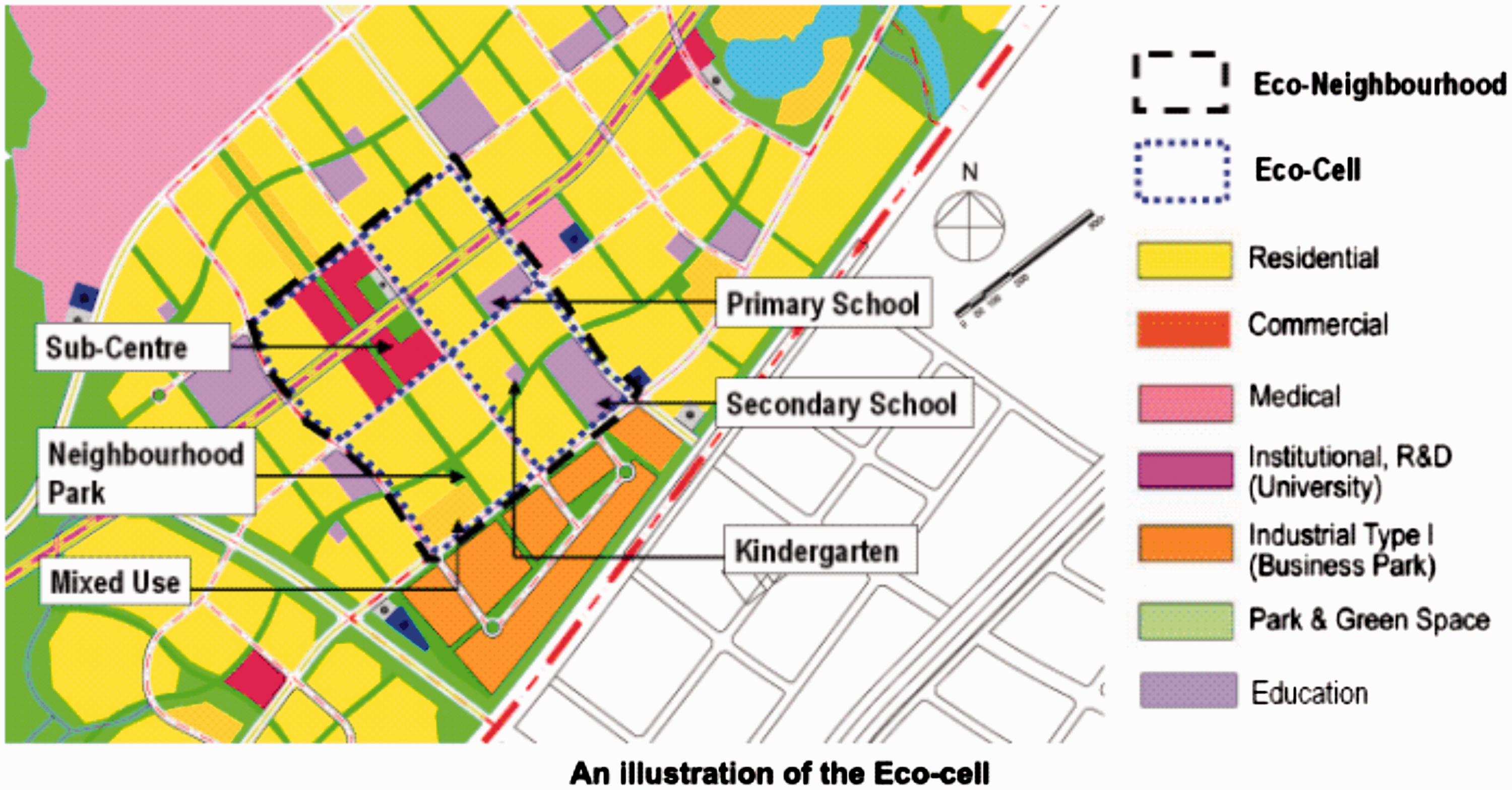
In contrast to Dongtan, Tianjin eco-city never expressed the ambition to reach zero carbon emission, self-sufficient food production, or 100% renewable energy marks. Rather, it has featured technologies that are practical, replicable, and affordable (SSTECAC, 2009, n.d.). Wind turbines and solar panels are proposed to supply renewable energy for up to 20% of the total energy consumption; the rest will come from two combined heating and power plants outside the city. The project features green transportation, including rail transit, slow mobility systems, separation between pedestrian and motor traffic, and the development of electric cars. Yet Tianjin eco-city also allows conventional automobiles. The eco-city only aims to have half of the water supply come from collected precipitation, distilled seawater and reclaimed wastewater by 2020. Economically, Tianjin eco-city plans to specialize in service industries, and become an educational and research and development center for environment-related technologies. It has been soliciting investment for software, animation, and pharmaceutical industries, and aims to expand tourism and education-related services (SSTECAC, 2009; World Bank, 2009).
Learning from the “failed” example: From Dongtan to Tianjin
These two projects now have contrasting reputations. Compared to Tianjin eco-city’s success story, Dongtan has been publicly denounced as a “counterfeit” eco-city in China (Qiu, 2011), whereas the World Bank (2009) has recommended future projects avoid its mistakes. Dongtan’s once highly acclaimed designs are now perceived as environmentally insensitive, financially unsustainable, and politically unfavorable. Chinese eco-cities initiatives nowadays typically cite Tianjin eco-city as their reference model, and none claims to be inspired by Dongtan.
Existing studies treat Tianjin and Dongtan as unrelated projects, but their connections can be revealed through examining practices shared by the two projects, and overlapping professional and personal networks of sustainable city planners. From studying the actors, planning methods, and practices of collaboration with foreign partners, I argue that, notwithstanding its failure to materialize, Dongtan has continued to influence ecological urbanization experimentation in China and beyond.
Traveling planners and traveling ideas: Water front development, practical “eco-city-ness,” and policy boosterism
An often overlooked role of Dongtan eco-city was how it served as a major study trip destination for eco-city planning. As many policy mobilities studies reveal, study trips are a crucial channel for learning in urban planning industries (for example see Rapoport, 2015). A government official on Chongming island recalled that between 2006 and 2010, his office had received four or five requests per month to arrange study trips. 4 This number did not account for trips directly planned by the Shanghai municipal government or the SIIC. Some of these trips were arranged for foreign groups, but most were for Chinese government leaders or planners from other domestic cities. The number of requests dropped after the project was suspended, and dipped further after late 2010 when Tianjin eco-city started to host visitors.
Importantly, the Chinese and Singaporean planners and government officials who worked on Tianjin eco-city also went to Dongtan in 2008. In my interviews, the planners and political leaders indicated that the trip influenced their thinking on eco-urban living, and hence shaped the planning of Tianjin eco-city. For one thing, planners and leaders of Tianjin eco-city decided to incorporate waterfront development, a main feature of Dongtan, into their project, even though natural surface fresh water in the vicinity was limited. According to the interviews, the idea of planning a recreational island, wetland parks, and man-made waterways in Tianjin eco-city came about “naturally” in the visit to Dongtan’s project site. 5 Likely also because of the trip, some planners during a point in the planning process even insisted on directly implementing the detail plans of Dongtan at Tianjin, ignoring the two locations’ vastly different social and natural conditions. Evidently, such desire was not unique. In their study on Dongtan eco-city, Pow and Neo (2013) document a similar copying attempt proposed by planners from Urumqi, one of the cities that competed with Tianjin for the Sino-Singapore eco-city construction.
The other often noted influence of Dongtan on Tianjin concerned the conceptual issue of constructing “eco-city-ness.” In the interviews with planners of Tianjin eco-city, an interesting comment repeatedly made was how the trip to Dongtan had helped them realize building an eco-city was “not a hard thing to do.” One planner detailed his exchanges with planners of Dongtan over how much “eco-planning” would make an urban construction qualify as an eco-city. Their exchanges focused on how featuring only one eco-friendly strategy in each urban sector or infrastructure system would suffice. “After returning [from the trip], I realized eco-city planning does not have to be an entire new way of planning. Dongtan fell apart because it tried to achieve too many things at once. Tianjin needs to avoid it. Of course there are always new sustainability approaches, but we can still plan the bus routes as we have done in other places. Simply replacing regular buses with hybrid or electric buses will do the trick; housing, water treatment, garbage recycling, all [can be made “ecological” with] the same idea.”
6
Other gains from the learning trip included the marketing strategies and professional networks. Arup had been in charge of Dongtan’s international marketing, and the experiences were passed on to Tianjin. Tianjin learned how to, for example, invite key eco-city professionals and activists to the project site, hold conferences and workshops, and contact foreign media outlets to sell its futuristic visions and raise the visibility of the project—a form of policy boosterism (McCann, 2013). The connections with influential professionals involved in eco-city planning and building from the Dongtan project were also passed onto the Chinese and Singaporean planners at Tianjin. These connections promoted the international visibility of Tianjin eco-city, and later provided channels for its planners to seek support with challenges in planning and implementation.
A new planning routine
Another influence of Dongtan was a paradigmatic shift in how Chinese urban planners perform their work. For decades, urban planning in China served mainly as a supportive institution that allocated space needed for centrally planned economic policies. While the City Planning Act of 1989 introduced multi-level planning procedures to include district, control and detailed site plans (Figure 2), urban planning in China functioned less as an independent regulatory institution and more as an arm of the economic development machine (Abramson, 2006; Wu, 2015; Yeh and Wu, 1999). Typically, the planners responded to a top-down chain of commands, and spent no more than a few weeks to produce the master plans and district plans, needed to accommodate economic development goals set by local government leaders. The standard pre-master plan steps in modern planning, like local surveys of the natural, social and economic conditions and feasibility studies, were largely absent. Without investigating the actual conditions, the final detailed control plans, site construction plans, and actual implementation often deviated from the master plan at the later stage of development projects.
Conventional project-based planning procedure after the 1989 City Planning Act (Source: prepared by author).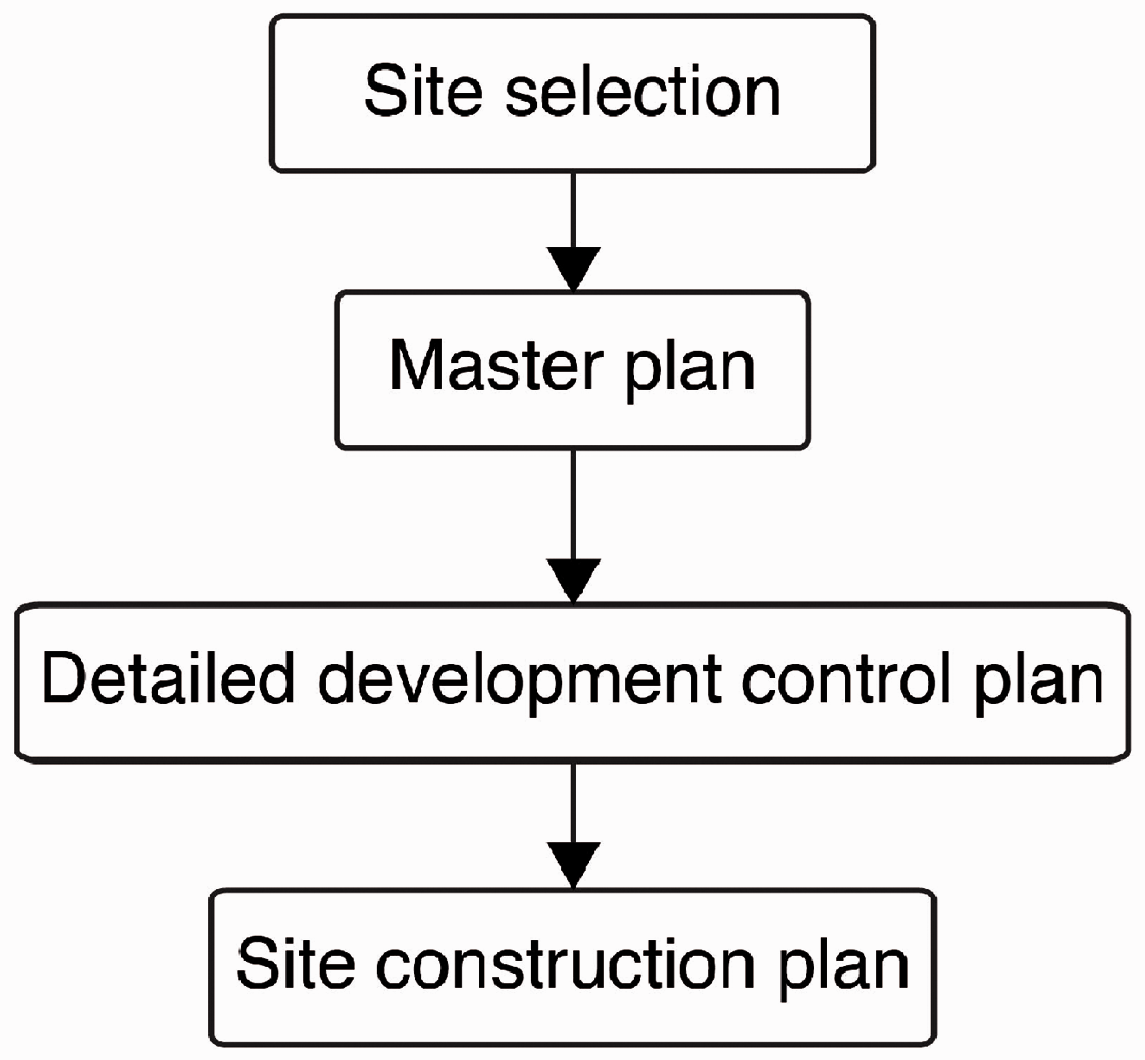
The planning model introduced by British planners at Dongtan challenged this Chinese convention. The planners took six months, not a few weeks, to design a city that fits into Dongtan’s local eco-system. Their workflow started with a detailed survey of the construction site’s natural, social and economic conditions. The quantified data were then used to develop a tentative plan, and put into computer programs to simulate different development scenarios. A series of back-and-forth changes in the master plan were made to optimize the simulation results. The detailed control and site construction plans were made at the same time as, and in coordination with, the master plan (Figure 3). The Integrated Resource Management (IRM) model planning software, which I discuss below, was created to integrate this process.
Dongtan eco-city’s planning workflow (Source: prepared by author based on interview data).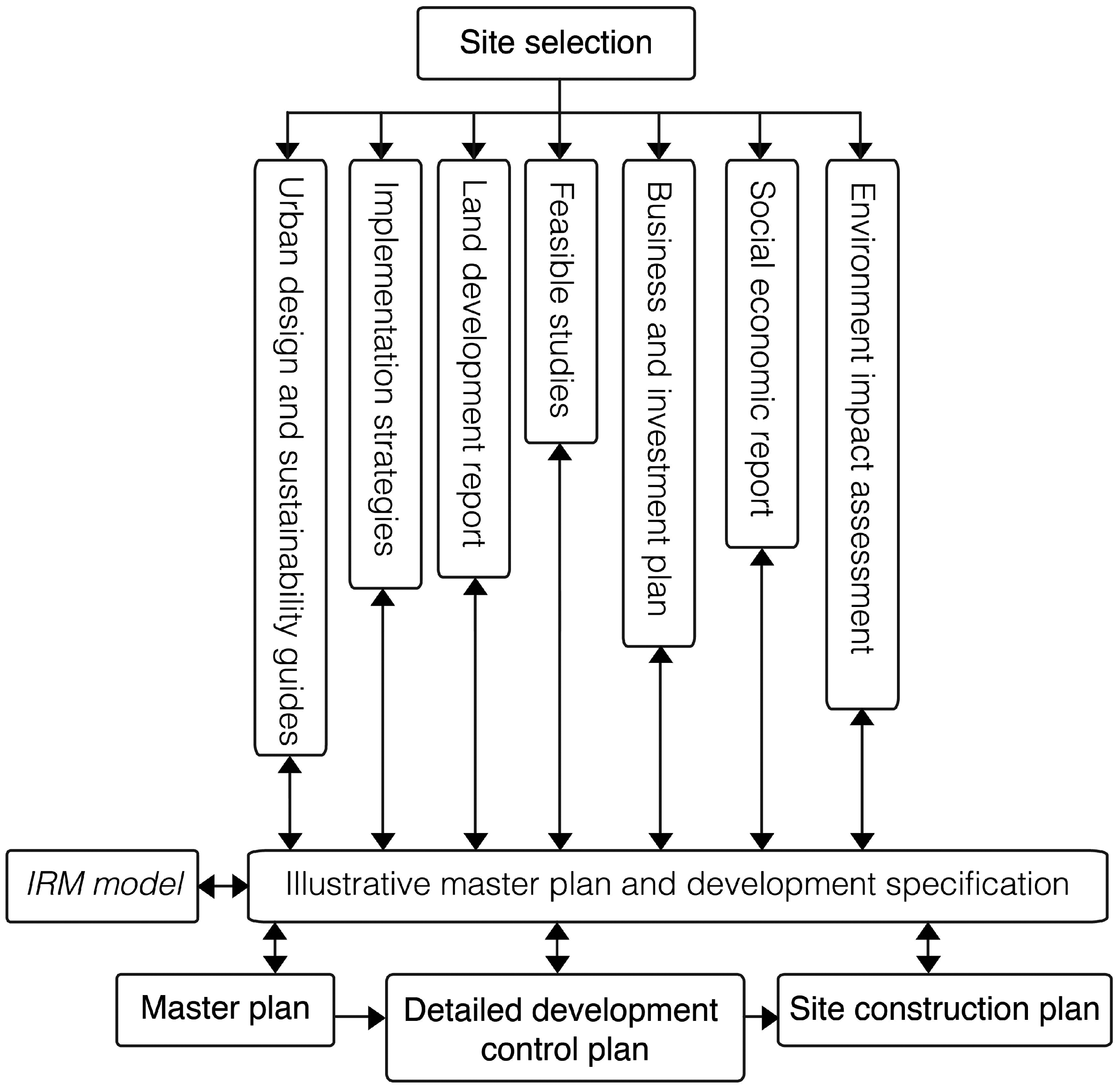
These planning procedures may be common to urban planners in some countries, but they were revolutionary for most Chinese planners in the mid-2000s. One planner from the Shanghai government’s planning institute described the modus operandi prior to Dongtan: “We generally finished a master plan in less than a week or two. Leaders told us what this place is going to be [used for]; we circled the site on a map, plotted a master plan, and sent it to the construction bureau.”
7
Professional networks formed as a result of the Dongtan project also provided critical support to Tianjin eco-city. Specifically, Tianjin eco-city signed a consulting contract with Bluepath City Planning, a new consulting firm founded by Shanfeng Dong, a Chinese planner who had worked closely with Peter Head at Arup on Dongtan. Whenever issues on Tianjin’s planning or implementation emerged, Bluepath was among the first experts to be consulted. 10 Bluepath would then either provide recommendations, or bridge Tianjin’s planners with other foreign companies. 11 According to my conversation at the end of 2011 with two consultants who had worked with Bluepath, Tianjin eco-city had inherited many of Dongtan’s planning and policy connections, particularly those through Arup. Bluepath also published guidelines on eco-city planning process for Tianjin eco-city, and provided similar consulting services for many other Chinese eco-cities. These traces of influences demonstrate that the institutional and organizational basis of Dongtan has continued to impact other eco-city projects, primarily through promoting a new set of planning routine and (re)assembling the professional expertise of eco-city planning in China.
Shifting international partnerships
Paradoxically, the perceived causes of Dongtan’s failure also became a pathway through which the project influenced Tianjin and other eco-cities. Why the once highly anticipated Dongtan eco-city failed to materialize has long been of interest to planners and officials in charge of later projects, and one narrative publically expressed by many Chinese government officials and commentators asserts that the Anglo-American eco-city vision and development method used in Dongtan are incompatible with the Chinese society. Specifically, some suggest that the low-density design of Dongtan was unsuited for the massive population and rapid pace of urbanization in China (Qiu, 2009, 2011). Others blame the collaboration with Arup, which was a result of the unrealistic belief in public–private partnership and entrepreneurial urban development strategies that had been embraced by many Chinese local governments since the nation’s economic reform. As Arup provided no funds to support the Dongtan project, some concluded that a foreign private company lacked the political and financial wherewithal to build China’s flagship eco-city (de Jong et al., 2013).
By the mid-2000s, a prevailing political narrative in China had been urging the local governments to ditch the supposedly questionable Western modes of development and find a “Chinese model” (Chang et al., 2016). Singapore appeared as an ideal partner for China’s next national flagship eco-city project against this backdrop, for the two nations share the same political context of one-party rule (despite Singapore’s popular election) and strong government control over the economy. The two also seemed culturally compatible since the Singaporean population has a predominate share of ethnic Chinese. In addition, Singapore had earned the reputation of the “Garden City of Asia” since the 1990s, which appeared to make it a qualified alternative to Western partners on green urban construction. No less important from a practical point of view was the fact that Singaporean planning agencies are affiliated with their government and can secure financial support for oversea mega-projects. It likely also helped that China and Singapore had partnered on the China-Singapore Suzhou Industrial Park in the 1990s. Even though this earlier venture apparently did not leave both sides satisfied, the precedence nevertheless provided an institutional framework for the two national governments to collaborate again (de Jong et al., 2013). 12
According to interviews with Chinese and Singaporean senior planners, high-level Chinese officials met with Singapore’s officials several times at the end of 2006 to discuss transplanting Singapore’s garden city model to China, a relationship framed as learning from an “advanced Chinese society.” 13 The official inter-governmental agreement on collaboration on the second national flagship Tianjin eco-city was signed at the end of 2007 (SSTECAC, 2009, n.d.).
Rebranding Singaporean public housing practices
Planning features of the two eco-cities.
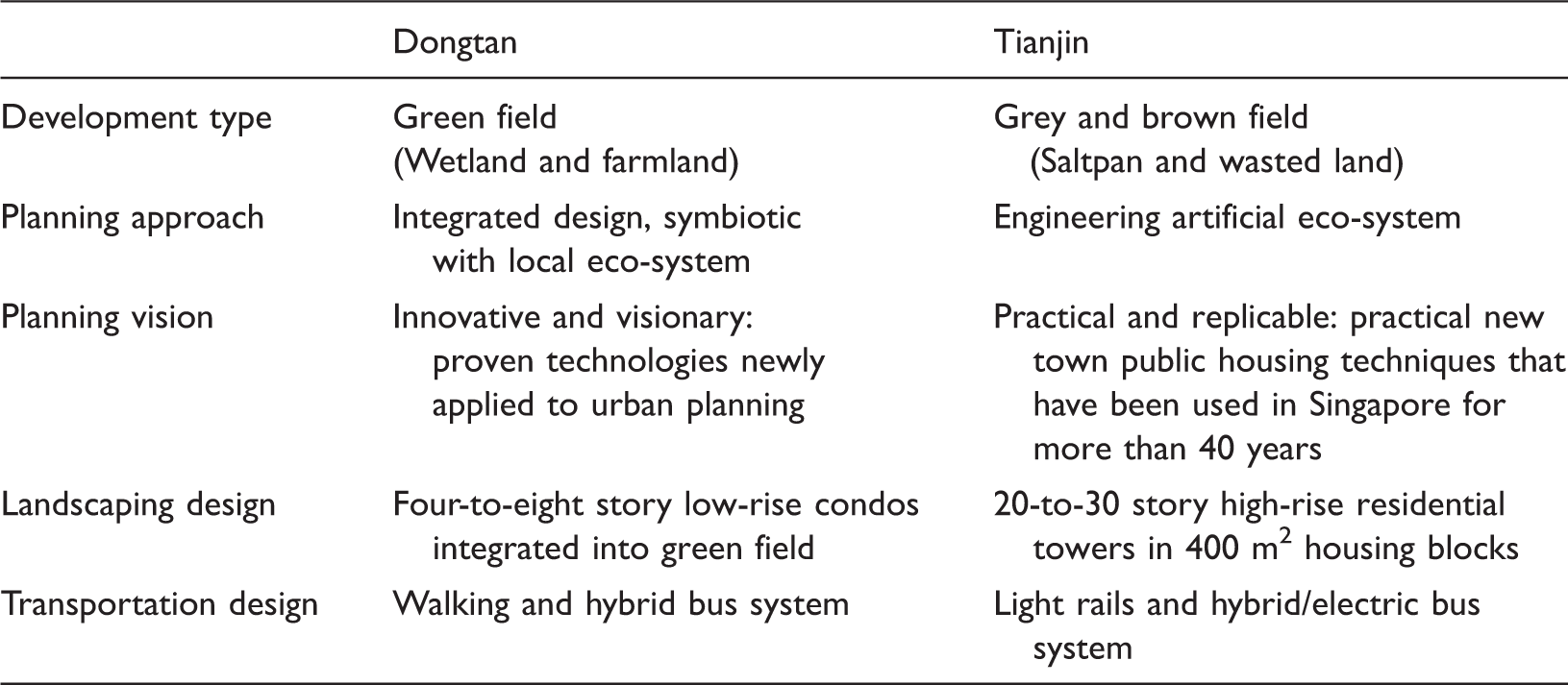
In discussing these differences, a leading Singaporean master planner candidly acknowledged that Tianjin’s design had deliberately approached urban sustainability differently from Dongtan to avoid resemblance. “It is probably not that I intended to completely avoid planning elements that were used in Dongtan’s master plan [because I couldn’t], but our team did work to focus on featuring different aspects of urban sustainability [compared to Dongtan].”
15
To address this seemingly impossible challenge, Singaporean planners drew on their more than 40 years of experiences of urban planning. They rebranded their long-standing public housing planning model as “eco,” and exported this product to their Chinese partner. In Singapore, this planning model builds towns using an aggregate method, starting with a basic unit of a small patch of land and high-rise residential towers (Eng, 1986). This highly flexible aggregated planning method is well suited for policy transfer because it is not particularly tied to local eco-systems, and can be scaled to any desired size. Under the rebranded scheme at Tianjin, the corresponding building blocks were named, respectively, “eco-cell,” “eco-community,” and “eco-district” (Figure 4). And to justify this rebranding strategy, Singaporean planners further claimed that the mixed ethnic and economic composition in public housing would increase social harmony and social sustainability and consequently promote “eco-city-ness” (World Bank, 2009). The relevance of this claim might be questionable, as ethnic relation is not as salient an issue in most Chinese cities as it is in Singapore, and pubic housing only accounted for 20% of Tianjin’s housing units in the master plan (Chang et al., 2016). Nevertheless, Singapore’s aggregated planning method was still adopted at Tianjin and became a major approach in the designs of subsequent Chinese eco-cities.
Rebranding Singaporean public housing model.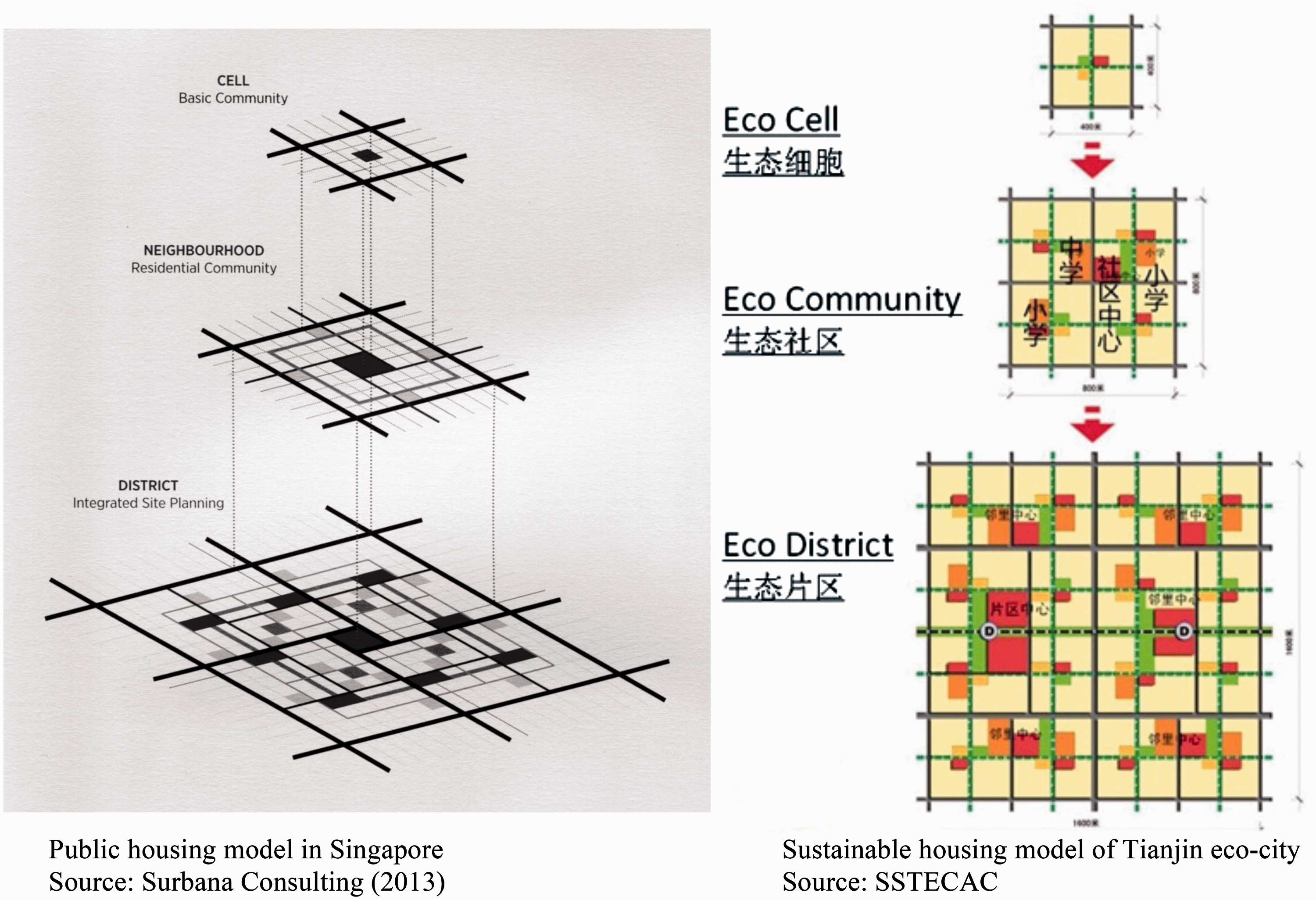
In short, the intent to avoid similarities with Dongtan conditioned Tianjin eco-city’s planning design, which led to the rebranding of regular Singaporean planning practices as “eco.” This rebranding strategy has implications beyond Tianjin. Since 2008, the Singaporean Ministry of National Development and its subordinate Urban Redevelopment Authority have been promoting the work on Tianjin eco-city as a new Asian approach to eco-city planning in their publications, exhibitions, and their internal staff seminars. Because of Tianjin’s model eco-city status, the rebranded Singaporean practices used in the project have also become the standard sustainable planning repertoire used in other Chinese cities. The Singapore government signed another sustainable eco-city development contract in 2009 with the Chinese government to build the third flagship eco-city project: the Sino-Singapore Guangzhou Knowledge City, a city that combines an eco-city with the most advanced ICT technologies and digital infrastructures. The knowledge city would both adopt Tianjin eco-city’s master planning style, and replicate its governance and financing structures. Such continued collaboration keeps justifying the rebranded public housing practice as an element of eco-urbanism and further solidifies the influence of Singaporean public housing planning in China’s sustainable urban practices.
Dongtan’s influence over other sustainability practices
Tianjin is not the only place through which Dongtan’s influence has survived. After Arup worked on the Dongtan project in late 2004, many Chinese cities also contacted Arup for consulting and planning contracts. Between 2005 and 2009, Arup signed development agreements and contracts with these other Chinese eco-city projects: Changchun, Changsha, Changxin, Chongqing, Huzhou, Qinddao, Tangye, Tongshan, Wanzhuang, Wuhan, Wuxi, Zhenzhou, Zhujiajao, and Zhuzhou (Arup, 2009). Some contracts asked for new eco-city designs. Others requested revision to pre-existing urban sustainability master plans. The details of these projects are under non-disclosure agreements, but there is evidence linking them to Dongtan. In interviews with Arup planners on how Dongtan informed these other projects, some noted that the experience of Dongtan set up a template for business and planning practices to follow and ensured that Arup would continue to be involved in the booming eco-city construction of China. 16
The Dongtan project also served as an “incubator” for planners of Arup. Many employees of Arup’s urban planning branch in China were recruited and trained between 2005 and 2006 during the planning phase of Dongtan before moving onto other projects. For example, a former Arup planner commented that, “most people working on the Wanzhuang eco-city also worked in Dongtan; the practices at Dongtan were replicated even though the condition and context of the two projects are very different.” 17 Arup also stored the entire planning record of Dongtan in its internal library, making the materials available to all employees regardless of branches or world regions. These materials continue to be widely cited in Arup’s workshops with new clients inside and outside China.
Another influence on other projects of Arup is a planning tool the company originally designed for Dongtan: the Integrated Resource Management (IRM) model. The planning team invented this software to put Peter Head’s integrated planning approach into practice. The IRM model is a computer software that uses GIS data and simulates various data input/output under different scenarios. The types of data this program can incorporate include information of landscape design, socio-economic indicators, transportation, logistics, building design, energy supply and consumption, water system, and waste management (Page et al., 2008; Roberts, 2010). The most important contribution of the IRM model is its integrated, systematic platform that enables real-time communication and evaluation. This platform facilitates coordination between different planning sectors, as experts can see how changes in the design of one sector may affect other sectors and the final master plan (Figure 5). The IRM model can also run various scenarios for clients to see how, and what kinds of, plans can produce particular quantified sustainable indicators, an aspect highly valued among Chinese eco-cities. With the IRM model, Dongtan’s urban planning moved away from the traditional, linear planning routine dominated by iconic architectural planning or urban spatial arrangements, to a dynamic procedure that coordinates between multiple designs and focuses on the input and output flows.
Integrated Resource Management Model. (Source: Page et al., 2008).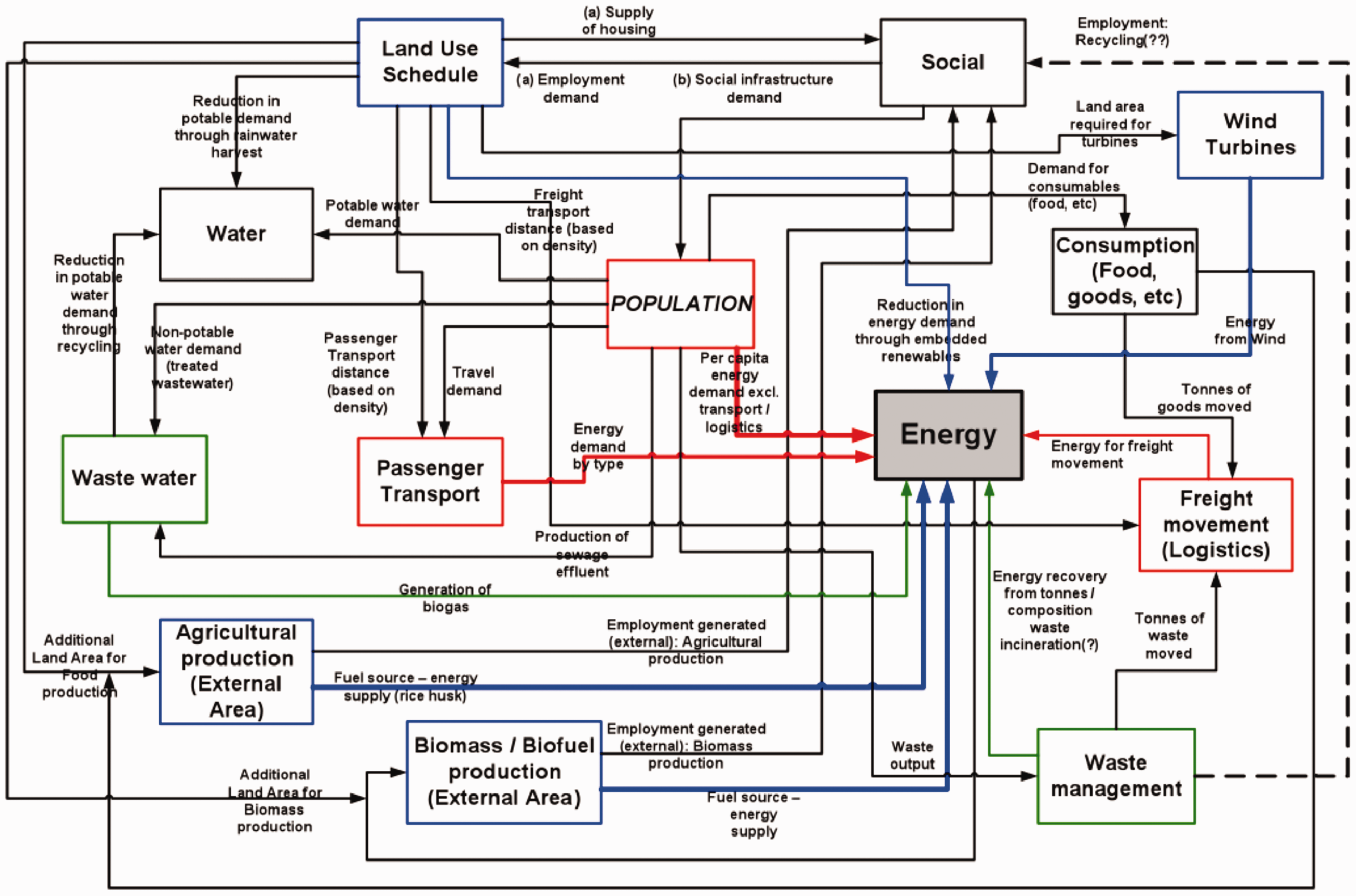
Since the development of the IRM model in 2005, Arup has continued to market and circulate the program. The company advertises the IRM model in media outlets and professional conferences, promoting the idea that integrated eco-city planning requires meticulous and comprehensive modeling of input and output data. The IRM model's capacity to simulate different scenarios also allows Arup to market this software as a flexible planning toolkit for either developing a sustainable city with material flows integrated with the local eco-system, or planning a sustainable city based on pre-set, quantified key performance indicators. In theory, this latter application guarantees that a new sustainability plan will satisfy any of the several existing urban sustainability accreditation systems (from green buildings ranking systems to citywide sustainability performance requirements) as well as comply with any national regulatory schemes. In this sense, the IRM model is a versatile planning tool that can satisfy the diverse needs of international clients.
The promotion appeared to achieve some success. In addition to Arup’s other projects in China, the IRM model has also been applied to projects in the UK, including the Northstowe eco-town and the Ebbsfleet Valley, as well as initatives in the US. The tool was also shared with the Clinton Climate Initiative C40 network to help participating cities develop their urban sustainability plans. 18
Discussion and conclusion
Underlying contemporary city-making involves a diverse collaboration of actors, agents and activities that connect through global networks, exchange ideas rapidly between places, and also modify these ideas in the process; cities are therefore constituted through their relations with other places and across scales (Massey, 2005, 2011). In this paper, I demonstrate how the Chinese eco-urbanism models are embedded and constituted in a trans-local network. Traveling actors, and the ideas they carry, operate in complex international, national, and local contexts that constantly shape and reshape the actors’ rationales and the ideas themselves. In this process, different technologies and practices are assembled and reassembled, dynamically creating the current eco-city model in China and also influencing urban sustainability projects outside China. This is a globalizing process weaving together multi-scalar forces with the “politics of elsewhere.” I draw four conclusions, each bringing different aspects of the Chinese eco-city experience into conversation with the literature of policy mobilities.
First, my findings demonstrate that how the un-materialized Dongtan was perceived, contested, and reinterpreted by various actors in different contexts. The failed Dongtan eco-city has shaped subsequent Chinese eco-urban experiments, as well as the sustainable planning industry. Specifically, the planning procedure and technology invented for Dongtan have fostered a gradual reform in China’s sustainable urban planning routines. The IRM model challenged the dominant role of master planning in China’s top-down urban planning system and contested its linear workflow, transforming the centralized system into dialectical relationships between material flows and more detailed plans. This change may weaken Chinese municipalities’ power in making land use decisions, which have often been based on the growth-first intentions. As the Chinese government pledged all new urban development to be green, eco-friendly and sustainable in its National New-Type Urbanization Plan in 2014, 19 the new sustainable urban planning routine launched by the IRM model may be increasingly influential in the future.
The multifaceted and lasting influences of Dongtan call for reconsidering unsuccessful projects in the literature of policy mobilities. These findings also lend credence to McFarlane’s (2011) argument that failed projects can build engagement capacity through new relationships and new working habits. Indeed, the influence of Dongtan altered the planning routines in Chinese cities, and reorganized the relationships between different phases of urban planning. Nevertheless, Peck’s (2011) illustration about redoubled efforts to carry out a policy after its initial failure is not supported in the case of Dongtan: the overall eco-city vision of Dongtan was largely not adopted in other Chinese eco-cities. This might be related to the elusive nature of eco-city urbanism, as there was no one prototype for redoubled reform. This could also be a result of the shift in China’s urbanization policy agenda after the mid-2000s, which now prefers easily replicable high-density urbanism models for rapidly urbanizing mid-size cities (Chang et al., 2016; Miao and Lang, 2015).
Nevertheless, the effort of China’s national government to promote eco-cities has also not been deterred by Dongtan’s unsuccessful implementation. Rather, the failure conditioned and helped facilitate the development of a new national exemplar, Tianjin eco-city. While the failure of Dongtan was widely blamed on the location choice on arable land, lack of political support and Westernized, ambitious planning features that are not financially feasible, such discourse makes Dongtan live on as a negative reference point for Tianjin eco-city. Dongtan’s failed experience helped facilitate and justify the partnership change from a North–South collaboration, mostly with European countries, to a South–South collaboration with Singapore. The intention to not make Tianjin ostensibly look like or associate with Dongtan prompted the search for a new eco-city model. This contrarian position shaped the choice of location of Tianjin eco-city on grey and brown field and contributed to Singaporean planners’ decision to rebrand high-rise public housing blocks into a signature feature of Tianjin eco-city.
Second, policy mobility depends heavily on de-territorialized technologies, regardless of the success or failure of individual projects. The developing of both the Dongtan and the Tianjin projects has generated eco-urbanism products that can be flexibly taken apart and re-assembled for policy transfer. Originally tailored made for Dongtan, the IRM model has mutated into a piece of more general-purpose software for conducting planning assessment and scenario simulation based on input and output material flows. The product now helps new urban master plans fit into any local eco-systems, and satisfy a number of quantitative indicators as well as urban sustainability accreditation systems at different scales. As the proliferating use of the IRM model shows, it has been de-territorialized from Dongtan, and rendered the mobility to travel internationally. The residential blocks at Tianjin eco-city are similarly flexible. As the model is scalable and not particularly tied to local eco-systems, it can be easily de-territorialized and then re-territorialized. In practice, the model can be applied in different environments and aggregated to any city size depending on the clients’ needs. Singaporean planners have taken advantage of this flexibility, and circulated the “eco-cell” model to other Chinese cities. These findings suggest that de-territorialized technologies are the key for urbanism models to remain successful in their mobility.
Third, I find that following the traveling actors is as important as following urbanism models for understanding policy mobilities. When tracing the genealogical connections of Chinese eco-urbanism models and their trans-local relations, I discovered that as eco-urbanism models move spatially with planners and policy makers, the models are also interpreted and re-interpreted to better meet context-specific considerations. This finding suggests two related research agenda that have not been well explored in the literature of policy mobilities, especially in the context of China’s urban development. For one, how study trips and other forms of “policy tourism” shape policies deserves further investigation. In traveling to acquire first-hand information about the development of different urbanism practices, urban policy makers and planners are involved in power-laden relations (Cook and Ward, 2012; Temenos and McCann, 2012). Who are invited, for which study trip, to where? What is made visible to them? What is presented as best practice? These programs and the presented materials are selectively arranged and packaged by the organizers, with specific goals to influence what is prioritized in mobile eco-urbanism models. These questions are particularly important in the Chinese context, as emulating other model cities is so often a guiding principle in China’s urban development (Hoffman, 2011; Zhang, 2012).
At the actors’ end, it is also important to understand how policy makers and planners perceive the best practice models. As argued by McCann (2013) in his study of urban boosterism through Vancouverism, the “mental maps” of exemplars conceived by policy makers and planners are important for understanding the global-relational urbanization process. These “mental maps” of where to visit and what to learn are not only conditioned by the institutional culture and infrastructure that facilitate trans-local learning, but also by the “micro-spaces” and mundane practices of planners’ and policy makers’ daily encountering (Prince, 2012). Policy makers and planners constantly evoke connections and comparisons between cities when crafting urban landscape, assembling and re-assembling best practices, and translating urbanism from far away into their own cities. Particularly when these connections and comparisons straddle along the global South–North or East–West divides, the inter-referencing of urbanism ideas requires negotiation between different urban imaginaries and realities (Roy, 2011; Roy and Ong, 2011). This is evident in China’s search for its national eco-city exemplars. Further untangling such nuanced and complex processes of policy mobilities calls for more in-depth investigation of policy tourism and the key actors’ micro-spaces in the proliferation and globalization of Chinese eco-city models.
Finally, it is important to acknowledge the practical limitations of studies in the policy mobilities tradition. Researchers generally need to move with and after actors and policies, through inter-connecting webs of social and material relations. But this research method is always constrained by time, funds, and researchers’ social resource. It is virtually impossible to fully map all the traveling and mutating trajectories. As a result, researchers need to acknowledge their work can only be a partial “commodity chain” of an urbanism model or policy, conditioned by specific spatiality and temporality. This is also what I present here. The connections I depict constitute an incomplete map of Dongtan and Tianjin’s trans-local relations from 2004 to 2014; and these relations are still evolving, and can be subject to new interpretations.
Still, even an incomplete map of urban connections can offer important insights. Through viewing cities as sites constituted by the relations, we read cities, and their urbanism models, as heterogeneous associations held together by both diverse actors, urban technologies, and other social and material relations (Murdoch, 1997). What is important here is not how complete our stories about urbanism are. It is, as Latour (2005) argues, how the connections are held together, and how they break apart. In other words, we should be most concerned about how different elements of an urbanism model are sewn together and then disassembled for the next journey. In this sense, eco-urbanism is never just a technical sustainable development model. As this paper shows, it is a set of urban practices intertwined in a globalizing city making process, conditioned by China’s specific planning regime, reassembled, and rebranded through a specific spatiality and temporality. In such process, a traveling model can fail in its implementation yet remains successful in its mobility.
Footnotes
Acknowledgements
I would like to thank Eric Sheppard, Helga Leitner, P. Aspen Chen, Michael Goldman, Brenda Kayzar, Kevin Ward and Eugene McCann for their comments on the earlier drafts of this paper, and the three anonymous reviewers and the guest editors for the constructive comments and suggestions for the final revisions. I also sincerely appreciate Tim Bunnell, Jun Zhang, Victor Savage, Tai Chee Wong, and YiHsiu Michelle Kung for their assistance with the field research, and all the interview participants for sharing their perspectives with me. Any mistakes or omissions are my own.
Declaration of conflicting interests
The author(s) declared no potential conflicts of interest with respect to the research, authorship, and/or publication of this article.
Funding
The author(s) disclosed receipt of the following financial support for the research, authorship, and/or publication of this article: the National Science Foundation (USA) Doctoral Dissertation Research Improvement Grant (grant number 1234033).