




Abstract
This study explores the current neighbourhood cohesion in Chinese cities and how it might be affected by the influx of migrants. Our multilevel analysis is based on a 1420 sized household survey conducted in Shanghai in 2013. The results reveal that the influx of migrants does not generate all negative results contrasting existing literature where migrants tend to reduce cohesion in the neighbourhoods. Neighbourhoods with a higher share of migrant residents between 20 and 50% have the strongest cohesion potentially because local residents have adjusted to their migrant neighbours. Neighbourhood cohesion is also stronger in migrant-dominated enclaves with more than 50% migrants as migrant residents may have formed their own in-group community. Comparatively, local-dominated neighbourhoods are still adjusting to the gradual influx of migrants and therefore residents tend to have lower levels of social solidarity, sense of belonging and informal social control. Nevertheless, the strongest deterrent of cohesion is the prospect of displacement and lack of resources since low-income areas and traditional courtyard neighbourhoods, which face demolition and redevelopment, have the weakest cohesion.
Keywords
Introduction
In Chinese cities there is growing concern, in particular, that the influx of migrant residents has led to the decline of social cohesion. This worry is reflected in the government’s attempt to strengthen social cohesion at the grassroots level through policies such as community construction (Shieh and Friedmann, 2008) or the ‘urbanising’ (shiminhua) of migrant residents (Wu, 2012). Existing studies on urban China often report conflicts between migrants and native residents (Cheng and Selden, 1994; Roberts, 2002; Solinger, 1999) and the increasing transience and anonymity of social relations in general (Forrest and Yip, 2007). Housing reforms and the subsequent proliferation of private commodity estates are said to have significantly altered interpersonal relations as neighbourhood-based ties are diminishing (Hazelzet and Wissink, 2012; Li et al., 2012; Wu and Logan, 2016; Yip, 2012). In the Global North, low-income neighbourhoods and areas with many minority residents have traditionally been associated with weaker neighbourhood cohesion although there is no clear consensus on their respective effects (Gijsberts et al., 2012; Mennis et al., 2013; Putnam, 2007; Stafford et al., 2003; Tselios et al., 2015; Twigg et al., 2010). Migrant-dominated neighbourhoods and migrant enclaves are also forming in many Chinese cities due to the privatisation of housing and hukou restrictions preventing migrants from accessing public housing (Liao and Wong, 2015; Li and Wu, 2008). Moreover, many migrants choose to live alongside low-income native residents in dilapidated neighbourhoods, which emerged due to the closure of numerous state-owned enterprises and the retreat of work-unit-based governance (Wu et al., 2010). Although scholars are aware of such spatial transformations in China, few have questioned whether and how these neighbourhood changes may affect the neighbourhood cohesion of residents.
The purpose of this paper is to fill this knowledge gap and explore how the share of migrant residents in a neighbourhood and area poverty may be associated with neighbourhood cohesion in China. We rely on a randomly sampled survey of 1420 migrant and local residents in Shanghai during the summer of 2013 and conduct a multilevel analysis to examine the significance of both neighbourhood and individual-level factors. To better assess the multifaceted concept of neighbourhood cohesion, our study measures neighbourhood cohesion from five different aspects, namely, social solidarity, common values, social networks, sense belonging and informal social control (Forrest and Kearns, 2001). The novel contribution of this paper is twofold. First, whilst most studies have paid little attention to the influx of migrants this paper is the first to directly assess how the share of migrant residents may affect neighbourhood cohesion in urban China. Second, using Poulsen et al.’s (2001) absolute thresholds of minority segregation we classified neighbourhoods with varying degrees of migrant concentration into three types: isolated host communities, non-isolated host communities and migrant-dominated neighbourhoods. Interpreting migrant concentration as different types of neighbourhoods rather than a continuous rate, which is the prevalent method, helps to shed a new light on the relationship between residential diversity and neighbourhood cohesion in terms of their underlying mechanisms.
The paper is organised as follows. The next section reviews the significance of social cohesion and its mechanism and then moves on to discuss cohesion in Chinese cities, its potential determinants and how the increasing number of migrant residents may be related. The fourth section reports on the data and research method and in the following section the results of the multilevel model are presented. Finally, sixth section discusses the key findings and concludes with a contribution towards the debate surrounding the effect of migrant diversity on cohesion.
Neighbourhood cohesion and neighbourhood characteristics
There is no consensus regarding the definition of social cohesion although it is universally accepted that cohesive societies perform better compared to societies that lack cohesion (Fukuyama, 1999). It usually refers to ingredients that allow a society to ‘hang together’ and enables everyone to work towards collective well-being (Kearns and Forrest, 2000: 996). Forrest and Kearns (2001: 2128) suggest that such ingredients include shared sense of morality and common purpose, social control and social order, social solidarity, social interaction within communities or families, and a sense of belonging to the locality. Whilst Kearns and Forrest (2000) believe that the domains of social cohesion are associated with different geographic scales, many studies focused on the neighbourhood level as an important arena for measuring social cohesion (Mennis et al., 2013; Twigg et al., 2010). To avoid ambiguities, our study uses the expression of neighbourhood cohesion to refer only to cohesion at the neighbourhood level.
The current debate on neighbourhood cohesion revolves around whether it is residential diversity or neighbourhood deprivation or both that lead to its decline (Mennis et al., 2013; Putnam, 2007; Stafford et al., 2003; Tselios et al., 2015; Twigg et al., 2010). Increased competition for limited public resources and fears of being discriminated against or being exploited are the main reasons why residents in poor neighbourhoods feel less cohesive (Gijsberts et al., 2012; Putnam, 2007; Stafford et al., 2003). On the other hand, there are three explanations regarding the negative effect of ethnic diversity. First, native residents feel threatened from minority residents who they assume will compete with them for limited resources (Putnam, 2007) and second associate the increase of ‘outsiders’ with liabilities of increased crime, deterioration and instability (Gijsberts et al., 2012). Finally, residents in more diverse neighbourhoods tend to have stronger feelings of anomie due to lack of shared experiences and diversity in social norms and practices (Alesina and La Ferrara, 2002; McPherson et al., 2001). Although claims from different studies are often contradictory, the majority of studies found that both diversity and deprivation are negative determinants, whereby the effect of poverty is comparatively more detrimental (Stafford et al., 2003; Tselios et al., 2015; Twigg et al., 2010). In the UK, Twigg et al. (2010) found that social cohesion is negatively affected by higher ethnic diversity and stronger deprivation of a neighbourhood although poverty is of greater significance. Tselios et al. (2015), on the other hand, found that community engagement and sense of belonging are negatively affected by both ethnic diversity and poverty and that native residents are more affected compared to immigrants.
So far the majority of studies have examined minority concentration as a continuous variable focusing on the overall effect of minority concentration on cohesion. The outcome is often explained through one set of mechanism that is universally applicable to all neighbourhoods. A potential drawback of this approach may be that it ignores how the relationship between concentration and cohesion may be different in neighbourhoods with varying degrees of concentration. Increasingly some evidence signal that the relationship between minority concentration and cohesion may be fundamentally different depending on the actual intensity of minority concentration. For instance, studies on migrant enclaves, which have an extremely high share of migrant residents, suggest that enclaves do not necessarily lack cohesion amongst its residents as migrant residents have formed their own in-group community, which is more pragmatically oriented and based on solidarity and mutual support (Kempen and Özüekren, 1998; Logan et al., 2002). On the other hand, studies from countries with moderate levels of ethnic segregation such as the Netherlands reveal that the minority concentration of a neighbourhood hardly affects the social and economic integration of ethnic minorities, such as education level and labour market participation (Musterd, 2003). Such findings may signal that the absolute threshold of ethnic segregation (Poulsen et al., 2001) within a neighbourhood could play an important role in whether and how migrant concentration may affect neighbourhood cohesion.
Migrant influx and social cohesion in Chinese cities
The concept of social cohesion has not appeared much in the urban China literature but some of its indicators have been explored. For instance, as part of a neighbourhood’s sense of community Yip (2012) examined the sense of belonging and neighbourly relations of residents. Yip (2012: 233) found that middle-class residents in commodity estates have left state-governed neighbourhoods such as work-unit estates and formed a different kind of community. The purpose of such communities is often to defend against larger market actors such as private developers and property management agencies. Findings further show that commodity neighbourhoods have higher level of residential satisfaction and attachment (Breitung, 2012; Li et al., 2012; Zhu et al., 2012). This is usually fostered by a shared social identity as middle-class homeowners belonging to a ‘civilised’ neighbourhood (Pow, 2007). Neighbourly relations, on the other hand, tend be more frequent in older neighbourhoods such as traditional courtyard estates where residents still retain some habits from China’s pre-transition era (Forrest and Yip, 2007; Li et al., 2012; Wang et al., 2016a). The general consensus is that China’s abolishment of the work-unit system and the privatisation of housing provision have created communities that rely on a common social identity, attachment to the physical qualities of private estates and collective actions against other market actors (Breitung, 2012; Li et al., 2012; Xu et al., 2010; Yip, 2012; Zhu et al., 2012). Social cohesion therefore continues to exist in a commoditised China but simply in a different form. Aspects such as neighbourly relations are diminishing with the demolition and redevelopment of old neighbourhoods (Wu and He, 2005) and will naturally fade away along with the socialist legacy of the work-unit system.
Whilst we agree with the existing literature, we contend that community studies so far have not paid enough attention to the influx of migrant residents as a form of neighbourhood change that may affect social cohesion. The emergence of commodity estates has freed middle-class residents from neighbourhood-based communities governed by the state (Li et al., 2012) but also led to a residential segregation based on tenure and socio-economic status (Li and Wu, 2008). Recent evidence from the sixth census indicates that the demolition of poor and old settlements in inner cities has considerably reduced the number of affordable migrant accommodation and has led to the emergence of migrant-dominated neighbourhoods (Liao and Wong, 2015). Although so far no study on urban China has examined how cohesion may vary across neighbourhoods with different levels of migrant concentration, some initial studies conducted in urban villages show a less straightforward relationship between migrant influx and social cohesion. Migrants living in urban villages tend to have very close relations with other migrant neighbours due to the need for self-help whilst being isolated from the native population (Chung, 2010; Liu et al., 2012). However, despite poorer intergroup relations migrants living in urban villages have fairly high residential satisfaction (Li and Wu, 2013). Local villagers in urban villages, who are the landlords and make up the other major resident group, tend to have a very close-knit relationship with fellow villagers but have little interaction with migrants (Chung, 2010). Other research (Cheng and Selden, 1994; Roberts, 2002; Solinger, 1999) also suggest that urban residents feel the city has become more dangerous due to the influx migrants, which is why migrants are actively being discriminated against by native residents. Such evidence may signal that the influx of migrants has negatively affected the cohesion in Chinese neighbourhoods. Consequently, our first hypothesis assumes that neighbourhoods with higher shares of migrant residents have weaker neighbourhood cohesion.
However, similar to multiethnic societies, it is important to take into account the often intertwined factors of migrant concentration and neighbourhood poverty (Mennis et al., 2013; Stafford et al., 2003; Tselios et al., 2015; Twigg et al., 2010) since in Shanghai migrants often live in low-income settlements. The retreat of the state as a service provider meant that numerous work-unit-owned estates deteriorated due to lack of housing maintenance (Wu et al., 2010). The resulting lower rents in low-income neighbourhoods attracted a substantial share of rural migrant residents to live alongside natives who cannot afford to move out (Wu and He, 2005). Using data collected in low-income neighbourhoods from six different Chinese cities, Wu (2012) found that compared to the working population, unemployed residents are significantly less likely to feel attached to the neighbourhood, signalling that poverty reduces the sense of belonging of residents. In addition, migrants are also less likely to feel attached to the neighbourhood although they express the wish to stay in the locality. Similar to empirical evidence from the Global North (Tselios et al., 2015; Twigg et al., 2010), Wu’s (2012) findings indicate that neighbourhood poverty is a negative indicator of social cohesion in urban China. Based on international and Chinese findings, our second hypothesis is that low-income neighbourhoods are negatively associated with the neighbourhood cohesion.
Data and methods
Our analysis relies on a survey conducted in 2013 in Shanghai, which is amongst the cities most challenged by the large influx of migrants as more than 40% of the total population are migrants (NBS, 2010). Furthermore, Shanghai’s diverse neighbourhood types such as traditional courtyards and commodity estates accommodate varying shares of migrant residents (Migrant Population Commission, 2012) and are thus useful for the purpose of this study. Professionally trained former staff members of the Shanghai Statistical Bureau (SSB) carried out the household survey and were led by a former survey officer of the SSB urban livelihood survey team. The survey adopted a two-stage sampling strategy so as to maximise the representativeness of the sample. For the first stage, all sub-districts (both jiedao and zhen) were categorised into three areas for stratified sampling: the inner city (inside the inner ring road), the inner suburb (between inner and outer ring roads) and the outer suburb (outside the outer ring road). The number of sub-districts selected in each category was proportional to the size of each area’s population (the data are based on the 2010 Shanghai population census). In each category, sub-districts were sorted according to their income per capita, population size and the proportion of local hukou population. We used the probability proportionate to size method to select sub-districts. Our final sample of 35 sub-districts was chosen out of a total of 225 sub-districts from 12 districts in Shanghai (see Figure 1). In each sub-district, one juweihui was chosen out of the total number of juweihuis of the respective sub-district. For the second stage, we sampled households in each selected juweihui at a fixed interval, beginning from a random street number in order to approximate the sample’s distribution to the locality’s actual population. We used an address-based selection approach instead of the official registration list because the official registration list does not include temporary and migrant residents.
Distribution of sampled neighbourhoods in Shanghai.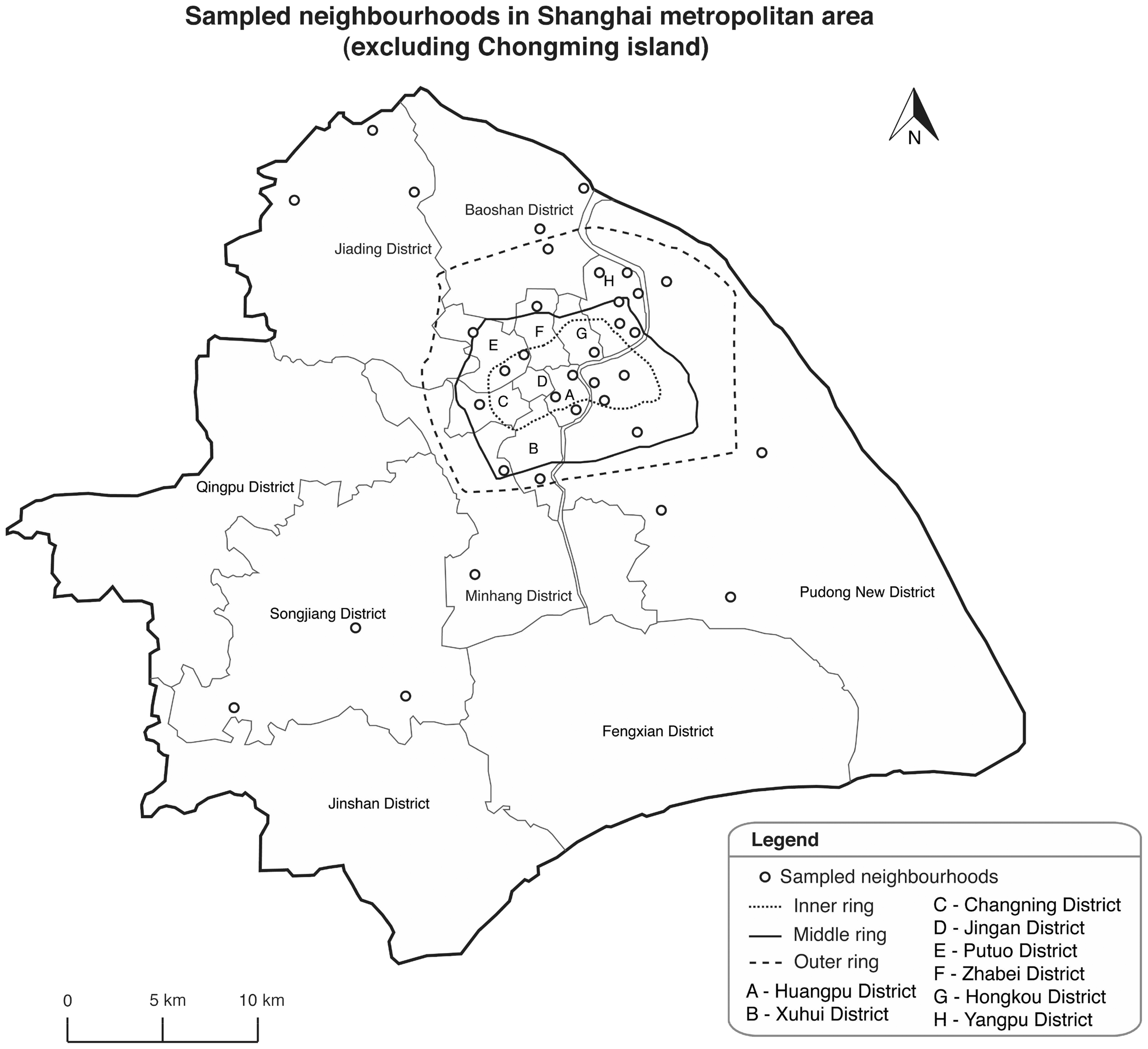
Forty questionnaires were distributed for each neighbourhood. Although the population of each juweihui is fairly similar, there are still outlier cases. Therefore, to avoid any biases due to varying population sizes of juweihuis, our analysis weighted for the total population in each respective neighbourhood. The head of household answered the survey and members of the residential committee helped introduce surveyors to interview households, resulting in a high success rate (95%). A total of 1420 valid samples were produced in total whereby 1046 are residents holding an urban hukou, 128 Shanghai rural hukou holders (i.e. rural villagers) and 244 migrant residents amongst which 86 were urban migrants and 158 were rural migrants. Due to irregular and long working hours, surveyors were unable to interview sufficient migrant households. To ensure that there is no systemic lack of any migrant group, we revisited several neighbourhoods where the share of migrant respondents was considerably lower than the official data and interviewed 100 extra migrant respondents. A comparison of our sample with the official statistics (Appendix 1) shows that our survey sample is still fairly representative and that this drawback does not significantly impede on our objective to examine whether the influx of migrants has affected the social cohesion of local residents.
We employ a mixed effects linear regression also known as multilevel modelling. Multilevel modelling is preferred over an OLS model as it decreases correlation errors and biased estimates of parameter caused by the grouping of variables at higher levels (Raudenbush and Bryk, 2002). Furthermore, a multilevel model allows the exploration of both individual and neighbourhood variances (Raudenbush and Bryk, 2002). Previous studies researching contextual determinants have also adopted the multilevel approach due to these substantial advantages (Mennis et al., 2013; Tselios et al., 2015). Our study’s purpose is to explore how the share of migrant concentration and neighbourhood deprivation therefore calls for a multilevel approach. The mixed effect linear model used in this study can be expressed as the following equation

β2x2j are neighbourhood level predictors such as the poverty rate of the area or the migrant concentration of an area. uj is the level 2 residual and eij is the level 1 residual.
Defining neighbourhood cohesion
Dependent variables: The domains of neighbourhood cohesion.
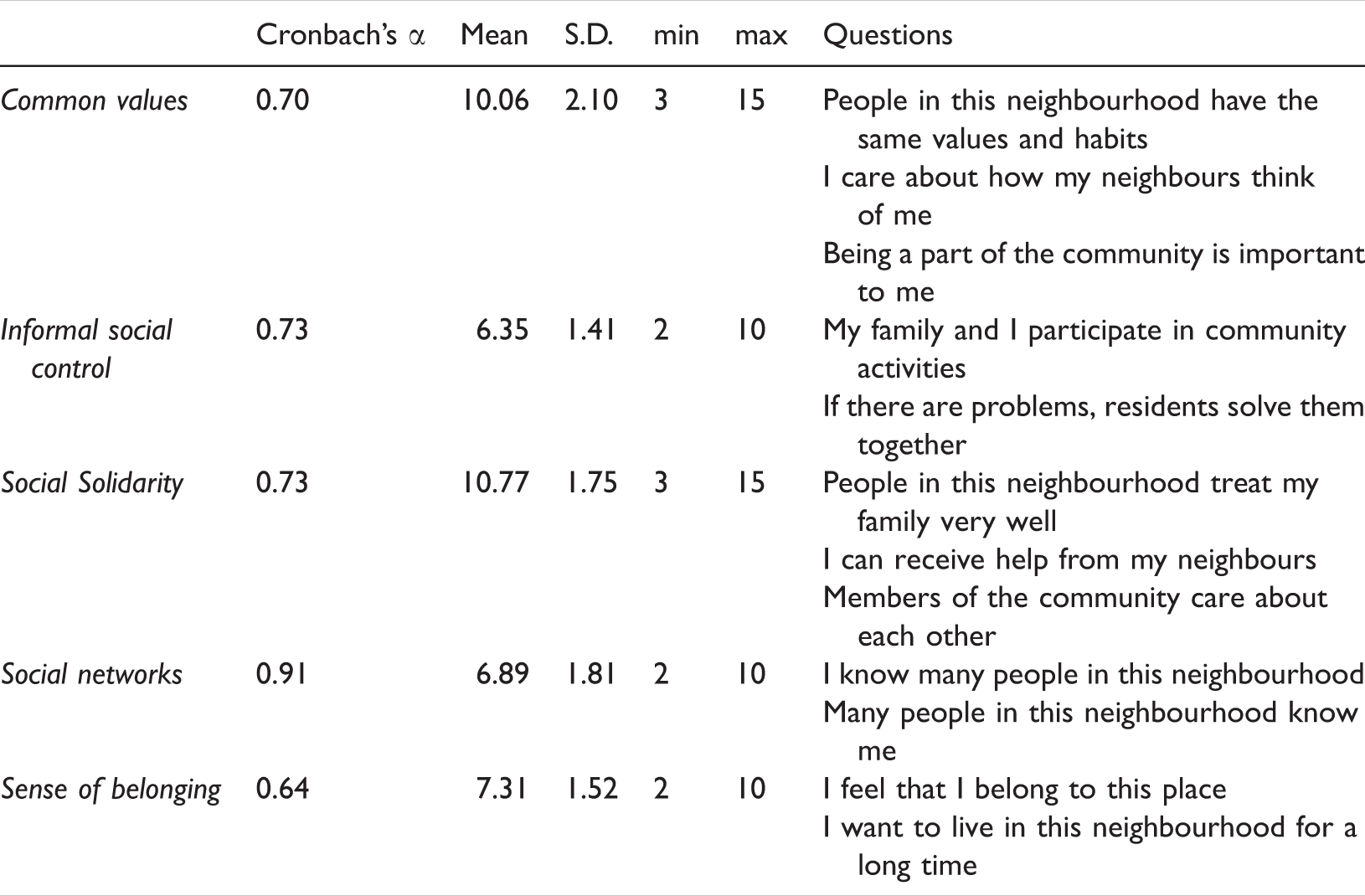
Common values refers to how much residents share similar values and belief, which in turn helps local communities to work towards shared goals and to foster a civic culture (Kearns and Forrest, 2000: 997). Questions related to similar values, caring of one’s reputation amongst neighbours and the importance of being a part of the community were thus assigned to this section. Informal social control refers to residents’ willingness to act collective and solve problems together (previously adopted by Twigg et al. (2010)). Variables concerned with community participation and perceived collective action taking were grouped together. Social solidarity relates to a resident’s interest in their neighbours’ well-being and willingness to provide assistance when necessary (Kearns and Forrest, 2000: 999), thus we grouped questions on mutual care, support and friendliness. In our study social networks refer to the number of people a respondent knows and how many neighbours know the respondent as an indication of one’s local network size. The assumption is that the more people one knows, the more likely the individual is to feel social solidarity towards their neighbours and participate in collective actions (Kearns and Forrest, 2000: 1000). Finally, we asked respondents about their sense of belonging and willingness to stay in the neighbourhood to represent sense of belonging. The general assumption is that a stronger sense of belonging contributes positively towards common values and willingness to invest into the neighbourhood (Kearns and Forrest, 2000: 1001).
Neighbourhood attributes
The three neighbourhood variables used in this study were acquired from the respective juweihui, which is the de facto local government and in charge of collecting local statistics. To explore neighbourhood poverty, we follow Wu et al. (2010) and measure the number of minimum living standard support (MLSS) recipients in each juweihui. The variable neighbourhood type was included as earlier studies showed that they are significantly associated with social cohesion and neighbourly relations (Li et al., 2012; Yip, 2012) and is categorised into the following: traditional courtyard housing, relocation settlements, work-unit housing, urban villages and commodity neighbourhoods. A further purpose of including neighbourhood type is because the number of MLSS does not fully reflect urban poverty, as only residents with a Shanghai hukou are eligible for MLSS. Using urban villages as a proxy for the poverty of rural migrants is therefore necessary (Wu et al., 2010: 140). Finally, to measure the influx of migrant residents we use the percentage of migrant residents in the juweihui. It is important to note that the neighbourhood type refers to the actual residential neighbourhood (xiaoqu) visited whilst the other two are at the juweihui level. The reason is because data regarding migrant concentration and MLSS recipients were only available at the juweihui level. Our final sample yielded 35 housing types (i.e. one housing type per juweihui). In most cases, the housing type of juweihuis is relatively homogeneous and it is relatively rare that one juweihui is in charge of several neighbourhood types. For instance, new commodity housing estates usually require a new juweihui to be created. Consequently, we believe that the housing type we collected is representative of their respective juweihuis and that in statistical terms there is no significant difference between the three contextual variables. Nevertheless, future studies can aim to acquire even finer resolution data. To analyse how neighbourhoods with different levels of migrant concentration may affect neighbourhood cohesion, we adopt Poulsen et al.’s (2001) classification of ethnic segregation to the Chinese context. Since our primary interest is the influx of domestic migrants, we altered Poulsen et al.’s classification and divided neighbourhoods according to three levels of migrant segregation. Neighbourhoods with a migrant share between 0 and 20% are isolated host communities, 20 and 50% are non-isolated host communities and from 50% onwards we classify them as migrant-dominated enclaves (Poulsen et al., 2001). The rationale to divide neighbourhoods into three categories is based on earlier studies which suggest that migrant enclaves in China such as urban villages differ greatly from mainstream neighbourhoods in various aspects including its residential composition and neighbourly relations (Chung, 2010; Forrest and Yip, 2007).
Individual level control variables
Individual level variables include demographic (age, gender; number of family members) and socio-economic characteristics (education, income, tenure, hukou status) and the length of residency. All variables have been standardised. Hukou status is categorised as native urban (local non-agricultural), native rural (local agricultural), rural migrant (non-local agricultural) and urban migrant (non-local non-agricultural). We defined migrants as those who do not hold a local hukou although we also differentiate between urban and rural hukou migrants. However, we distinguish between urban migrants from other cities and rural migrants due to their potentially different socio-economic status. For our analysis, we also added interaction terms between hukou status, income, area poverty and migrant concentration. This is to take into account the possibility that migrant residents may have different underlying dynamics with regards to social cohesion.
Multilevel modelling results
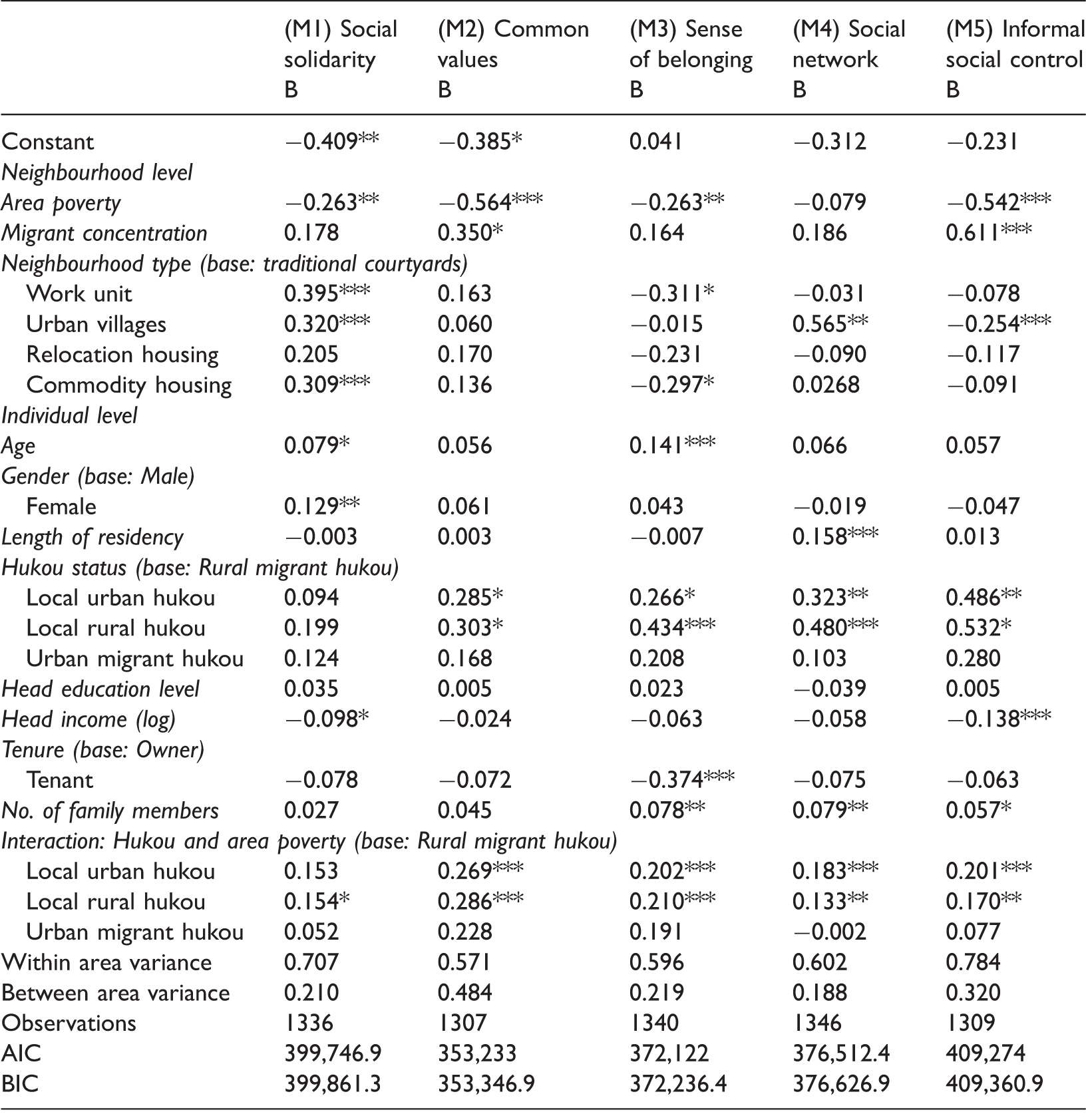
A mixed effects linear regression of determinants of neighbourhood cohesion (migrant concentration as a continuous variable).
AIC: Akaike’s Information Criteria; BIC: Bayesian Information Criteria.
Notes: *p < 0.1; **p < 0.05; ***p < 0.01; significance p < 0.001.
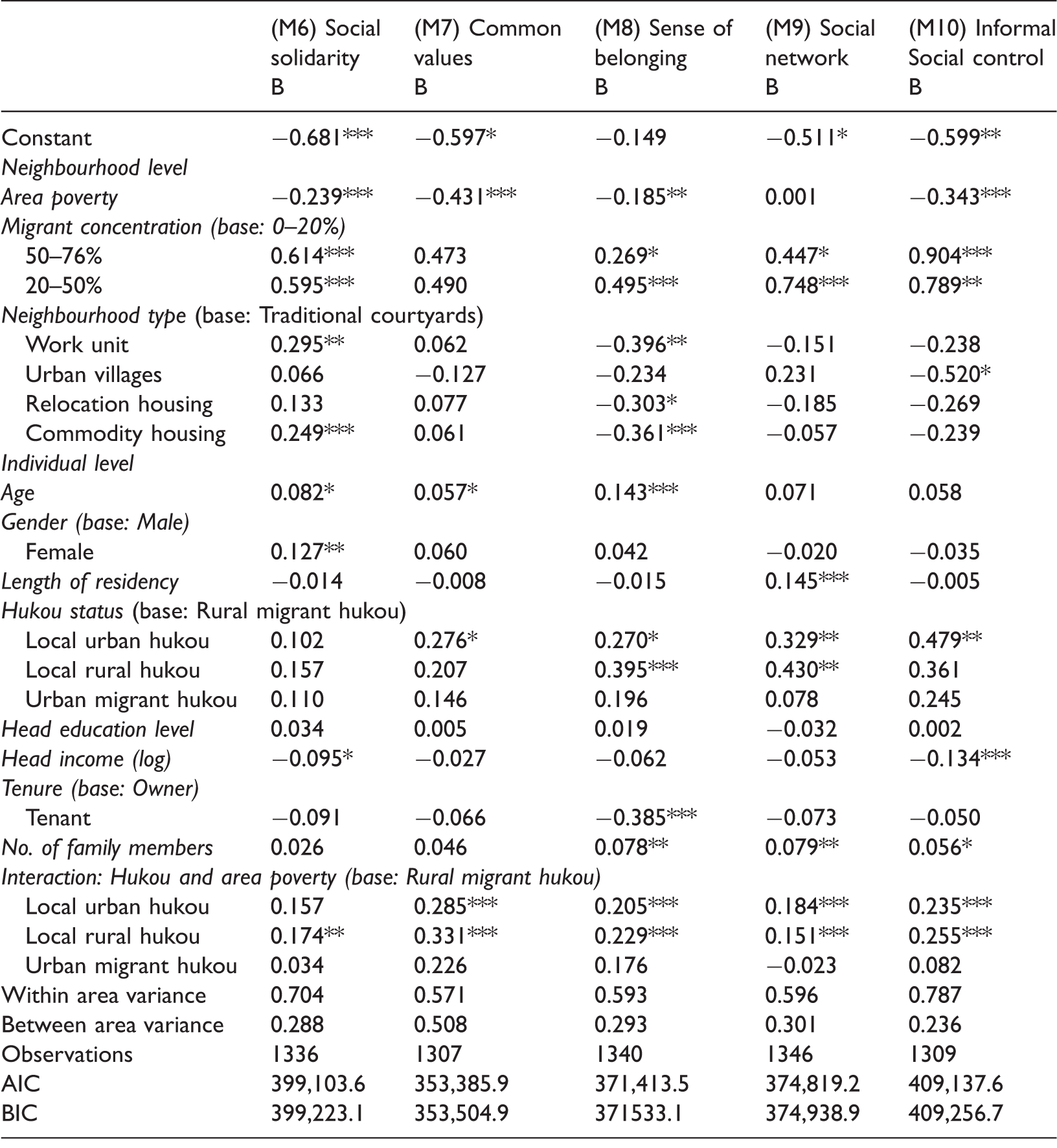
A mixed effects linear regression of determinants of neighbourhood cohesion (migrant concentration as an ordinal variable).
AIC: Akaike’s Information Criteria; BIC: Bayesian Information Criteria.
Notes: * p < 0.1; **p < 0.05; ***p < 0.01; significance p < 0.001
Individual determinants
Most of the significant individual determinants of neighbourhood cohesion conform to existing studies. Older age and homeownership are associated with more cohesive communities (Mennis et al., 2013; Tselios et al., 2015; Twigg et al., 2010). Female residents tend to feel stronger social solidarity (Mennis et al., 2013), whilst native residents generally have stronger social cohesion compared to rural migrants (Wu, 2012). Length of residency is positively related to social network whilst the rest have insignificant and negative values. Earlier studies found that length of residency is either negative (Twigg et al., 2010: 1431) or insignificant (Yip, 2012) signalling that longer residency only ensures a wider social network but not necessarily stronger sense of belonging or collective action taking. Higher income is negatively associated with neighbourhood cohesion, contradicting with some recent studies in America and Britain (Mennis et al., 2013; Twigg et al., 2010) but confirming studies on urban China (Li et al., 2012). The reason could be that affluent Chinese residents tend to be less involved in the locality due to their existing citywide social network and their stronger preference for privacy when at home. Our finding on affluent Chinese residents resembles (Baumgartner, 1989: 8) observation of American suburbanites who tend to be of higher social class and less locally involved.
Migrant concentration and neighbourhood cohesion
Overall, the association between migrant concentration and neighbourhood cohesion is positive as models 2 and 5 (Table 2) reveal that the overall impact of migrant concentration is positive for common values (p < 0.1) and informal social control (p < 0.01). Moreover, models 6 and 8–10 show that concentration threshold is also highly significant as compared to isolated communities (0–20%); non-isolated host communities with a migrant resident share between 20 and 50% have the most significant association with higher neighbourhood cohesion. Models 6 and 8 show that living in a non-isolated host community neighbourhood increases social solidarity amongst residents by 0.595 unit (p < 0.01) and the sense of belonging by 0.495 unit (p < 0.01). Model 9 reveals that the likelihood that most residents know each other is highest in non-isolated host neighbourhoods (p < 0.01) whilst higher informal social control is also positively associated with non-isolated communities (Table 3). We speculate that the higher presence of migrant residents in non-isolated neighbourhoods may have increased the interaction between local and migrant residents due to higher chances of encounter. Moreover, the high share of migrant residents indicates that the influx of migrant residents must have taken place over a longer time period and allowed local residents to adjust to their migrant neighbours. In contrast, residents in isolated host neighbourhoods may have just begun to experience the influx of migrant residents and therefore feel more threatened by the residential change in their neighbourhood. This in turn may have reduced the social solidarity and social network of existing residents.
On the other hand, compared to isolated host neighbourhoods, migrant-dominated enclaves (50–76%) are less significantly associated with higher neighbourhood cohesion, with the exception of social solidarity (p < 0.01) and informal social control (p < 0.01). Considering the high presence of migrants, this outcome may signal that migrant residents have created their own enclave community. Existing studies confirm this speculation as residents in migrant enclaves often rely on the social network with fellow migrant residents (Kempen and Özüekren, 1998; Logan et al., 2002). This would also explain why informal social control and social solidarity are significantly related to migrant enclaves since in China such neighbourhoods tend to be more informal and less controlled by the state. Consequently, the governance and day-to-day maintenance of such neighbourhoods require more collective input from residents who are also more dependent on local social relations.
Difference between migrant concentration as a continuous and as an ordinal variable
Overall Poulsen et al.’s (2001) classification of migrant concentration has a better fit than a continuous variable (except for common values) which can be seen by the smaller AIC and BIC values. Only informal social control (p < 0.01) and common values (p < 0.1) are significantly related with migrant concentration as a continuous variable (see models 2 and 5) whilst neighbourhood type plays a more significant and potentially inflated role in the continuous models (Table 1). Compared to traditional courtyards, urban village has a significantly positive relationship with social solidarity (model 1, p < 0.01) and social network (model 4, p < 0.05) and a significantly negative relationship with informal social control (model 5, p < 0.01). This significance drops considerably once migrant concentration is treated as an ordinal variable. We speculate that cohesion may be only stronger in urban villages that have a high concentration of migrant residents (50–76% migrants). Urban villages with fewer migrant residents and inhabited by other types of residents (i.e. students or white-collar residents) do not significantly differ from traditional courtyards. The reason could be because rural migrants are more likely to form local relations with fellow migrants than, for instance, students and white-collar residents who have a more dispersed social network. The same explanation may also apply to the change in significance of work-unit neighbourhoods on social solidarity (model 1) and sense of belonging (model 3) as well as commodity estates on sense of belonging. Finally, the significance of local rural hukou holder is also higher in the continuous models (models 2, 4 and 5), whereas their significance drops in the ordinal models (models 7, 9 and 10). The reason could be because most local rural hukou holders living in urban villages still have a tight-knit community whilst relocated residents are less involved in the community (Liu et al., 2016).
Controlling for neighbourhood poverty and neighbourhood housing type
Almost all domains of social cohesion, apart from the social network of residents, are negatively associated with the poverty of a neighbourhood at a very significant level. The result confirms our second hypothesis since residents living in poorer areas are significantly less likely to feel a strong sense of belonging to the neighbourhood (p < 0.05) or share any common values and habits with their neighbours (p < 0.01). For instance, a 1 unit increase in the number of MLSS recipients in an area is significantly correlated with a 0.43 unit decrease of shared values amongst residents. Informal social control (p < 0.01) and feelings of mutual solidarity (p < 0.01) are also significantly lower in more deprived areas signalling that residents in poorer areas feel more isolated from their immediate surrounding possibly due to a heightened sense of competition for limited resources.
The interaction between hukou status and area poverty further reveals that in poor neighbourhoods rural and urban Shanghai residents tend to have higher levels of informal social control, shared common values and a sense of belonging to the locality compared to rural migrants. This is of little surprise when considering that migrants often choose to live in poor neighbourhood due to their affordability and proximity to work (Li and Zhu, 2014). Time and energy investments into the neighbourhood are thus scarce compared to local residents. Moreover, local residents in low-income neighbourhoods also tend to be poorer and are therefore more dependent on localised forms of social networks.
With regards to the neighbourhood types, overall, the relationship is significant although its effect differs considerably depending on the domain of cohesion. Sense of belonging tends to be considerably stronger in traditional courtyard neighbourhoods compared to work-unit and commodity estates (model 3) whilst informal social control is also stronger in traditional courtyards compared to urban villages. Results also show that social solidarity is the weakest in traditional courtyard neighbourhoods (model 6). The long existence of traditional courtyards and the high share of older long-term residents may explain why sense of belonging and the informal social control are strong in traditional courtyards. However, weak social solidarity may appear counter-intuitive as earlier studies (Forrest and Yip, 2007; Wu and He, 2005) found that older neighbourhoods tend to have the highest level of mutual support. A more recent study on Shanghai reported similar results and suggests that the new governance system in commodity neighbourhoods based on ideals of a ‘civilised community’ and collective actions of residents against poorly performing property management agents have strengthened its residents’ sense of community (Yip, 2012: 231). For work-unit neighbourhoods, there may be other reasons as they still retain a strong work-unit governance system and residents tend to be co-workers from the same danwei therefore increasing the social solidarity of residents. Lastly, the prospect of redevelopment (Wu and He, 2005), particularly in the case of Shanghai (Zhu, 2016), may have led to a high residential turnover, which in turn led to the residents’ unwillingness to invest more effort into the locality.
Conclusion
The purpose of this study was to explore how the influx of migrants has affected the social cohesion in urban neighbourhoods using the case study of Shanghai. Before discussing the implications of this study, some cautionary remarks are necessary. The cross sectional data does not show the residential turnover of neighbourhoods although by including different neighbourhood housing types into the model, it was still possible to reveal some information in this respect. Nevertheless, for future studies it would be helpful to employ panel data to directly measure changes to the residential composition of neighbourhoods. Furthermore, in this study we focused only on the number of internal migrants of the Han ethnicity rather than ethnic minorities in Shanghai, which make up 1.2% of the total Shanghai population according to Shanghai’s sixth population census (NBS, 2010). Unfortunately, our survey did not have access to the share of ethnic minorities in each juweihui but we believe it is important for future studies to explore inter-ethnic relations, which are becoming increasingly more influential in China.
Bearing in mind these caveats, our results show several important findings. Overall, traditional courtyards and low-income neighbourhoods appear to have the least cohesive communities. Both neighbourhood characteristics, which sometimes coincide with each other, suggest that residential instability and lack of resources are the main causes for the lack of neighbourhood cohesion. For traditional courtyards, the prospect of demolition and relocation (Wu and He, 2005) and fast residential turnovers due to the departure of affluent residents (Wu, 2012) may have reduced the willingness of residents to invest any further into the neighbourhood such as reaching out to new neighbours. The government’s recent emphasis to construct a post-industrial globalising metropolis (Wu, 2015) has further accelerated the regeneration of old neighbourhoods such as traditional courtyards in inner city of Shanghai (Zhu, 2016). Compared to traditional courtyards, only urban villages fare even worse in terms of informal social control potentially because of the even higher residential turnover. Moreover, since urban villages belong to and are managed by the rural collective (Chung, 2010), there may be little incentive for tenants to participate in community affairs. Low-income communities often suffer from lack of resources such as limited living space and employment opportunities, which force residents who lost their job due to the restructuring of state-owned enterprises and work units (Wu et al., 2010) to compete with neighbours for jobs. Moreover, the dilapidated quality of shared facilities in Shanghai's low-income neighbourhoods such as the kitchen or other communal areas may lead to more neighbourly conflict. In contrast, neighbourhoods with a more organised governance system and a stronger shared social identity such as commodity estates and work-unit neighbourhoods tend to have higher levels of social solidarity. These findings would also confirm earlier studies that private commodity estates do not lack social cohesion amongst its residents (Li et al., 2012; Pow, 2007; Yip, 2012; Zhu et al., 2012; Wang et al., 2015, 2016b).
Returning to this study’s key objective, our findings show that the impact of migrant influx on neighbourhood cohesion in Shanghai is more positive than evidence from multiethnic societies (Stafford et al., 2003; Tselios et al., 2015; Twigg et al., 2010). Previous studies on migrants in urban China (Roberts, 2002; Solinger, 1999) created the impression that urban neighbourhoods have become less cohesive due to the influx of migrant residents but our study reveals that the overall picture may be less bleak. Non-isolated host neighbourhoods with shares of 20–50% migrant residents are positively associated with social solidarity, sense of belonging and informal social control as compared to isolated host neighbourhoods (0–20%). Since non-isolated neighbourhoods must have experienced the influx of migrant residents over a longer period of time, local residents may have come to terms with living with migrant residents. Rather than isolating themselves, more frequent encounters and interaction may have improved neighbourhood cohesion. Moreover, the profile of migrants has changed considerably since Solinger’s (1999) study in the 1990s. Younger migrants born since the 1980s have much more in common with urban residents in terms of lifestyle preferences but also in terms of socio-economic status (Yue et al., 2010). Native residents may therefore feel less alienated from migrant neighbours. On the other hand, residents in isolated host neighbourhoods may be less cohesive due to the perceived threat of migrants who recently moved in and because many native residents are no longer bound to the local neighbourhood (Wu and Logan, 2016). In comparison, the higher level of cohesion in migrant-dominated enclaves (50–76% migrants) may be because migrants have formed their own community, which is strongly based on social solidarity. Informal social control is also higher in migrant enclaves partly due to the absence of a formal state governed system, which forces migrants to take matters into their own hands. The downside of migrant enclaves could be the lack of intergroup relations between migrants and locals, which may prevent migrants from further socially integrating into the host society (Kempen and Özüekren, 1998; Logan et al., 2002). It is important to note the difference between migrant enclaves and urban villages as can be seen from the positive effect of migrant enclaves and the negative effect of urban villages on informal social control. The increasing concentration of migrant residents in certain neighbourhoods within and outside the inner city of Shanghai indicates that migrant enclaves do not only emerge in urban villages but also in other types of low-income neighbourhoods (Liao and Wong, 2015: 117).
With respect to our study’s contribution to the current theoretical debate, we found that in Shanghai interpreting migrant concentration as different types of neighbourhoods (Poulsen et al., 2001) instead of a continuous rate offers a more nuanced understanding of the relationship between migrant concentration and neighbourhood cohesion. Our analysis shows that the underlying mechanism between cohesion and minority concentration differs considerably between the three thresholds of concentration. Non-isolated host communities have the strongest level of cohesion potentially due to more frequent intergroup encounter and interaction. In contrast, migrant-dominated neighbourhoods may have stronger cohesion because its residents rely more on in-group social relations. Our empirical evidence therefore supports the often forgotten but crucial argument that the actual intensity of minority segregation plays a great role in affecting social cohesion (Musterd, 2003). Nevertheless, our approach does not mean the dismissal of the conventional approach of treating migrant concentration as a continuous variable. The conventional method’s strength of revealing the overall effect of migrant concentration on cohesion remains important. Poulsen et al.’s (2001) classification should be treated as a complement to the existing method rather than a substitute.
In conclusion, our study reveals that in Shanghai, social cohesion tends to be higher in neighbourhoods with a more balanced mix of migrant and local residents as compared to neighbourhoods that just started receiving migrants and therefore have less experience in living with migrant neighbours. Cohesion also exists in migrant enclaves, which are more characterised by informality, since migrants have built up their own migrant community in order to provide mutual support. These results signal that the influx of migrant residents may initially reduce neighbourhood cohesion, but over time both local and migrant residents get used to each other’s presence and are able to rebuild their cohesion. Furthermore, communities are forming in middle-class-dominated commodity neighbourhoods, while a strong state presence continues to hold together working class residents in work-unit compounds. These neighbourhoods are often characterised by strong common values and social solidarity due to a shared class belonging as either fellow work-unit colleagues or members of a private and ‘civilised’ community (Pow, 2007). Instead, it is the prospect of displacement and demolition coupled with a lack of local resources that leave a negative impact on the cohesion between residents (Liu et al., 2016; Wu and He, 2005). Future development policies therefore need to move away from demolishing older and poorer neighbourhoods to remedy the fear of displacement but also to prevent the intensification of migrant residential segregation.
Footnotes
Declaration of conflicting interests
The author(s) declared no potential conflicts of interest with respect to the research, authorship, and/or publication of this article.
Funding
The author(s) disclosed receipt of the following financial support for the research, authorship, and/or publication of this article: This research is supported by the UK Economic and Social Research Council (ESRC) – Sustainable urban and village regeneration in China: implications for the Global South (ES/N015185/1), and a key project of the Ministry of Education of the People’s Republic of China (11JJD840015).