




Abstract
Following recent calls for the development of a more embedded sense of labour agency, this paper focuses on the scale of the workplace which is largely absent from recent labour geography debates. Drawing on studies in the labour process tradition, the paper presents empirical research on call centre work in Glasgow, utilising this to revisit the concept of local Labour Control Regimes. We argue that rather than being simply imposed by capital and the state ‘from above’, workplace control should be seen as the product of a dialectical process of interaction and negotiation between management and labour. Labour's indeterminacy can influence capital in case specific ways as firms adapt to labour agency and selectively tolerate and collude with certain practices and behaviours. Workers’ learned behaviours and identities are shown to affect not only recruitment patterns in unexpected ways, but also modes of accepted conduct in call centres. Accordingly, the case is made for the influence of subtle – yet pervasive – worker agency expressed at the micro-scale of the labour process itself. This, it is argued, exerts a degree of ‘bottom-up’ pressure on key fractions of capital within the local Labour Control Regime.
Introduction
Recent reviews of labour geography have pointed to the need to develop a more conditional and embedded notion of agency (Coe, 2013; Coe and Jordhus-Lier, 2011), moving beyond the emphasis on labour agency in general that defined much of the foundational work in this field (see Herod, 2001). One prominent sphere that has been largely absent from such discussions is the workplace. This is an important omission, given that workplaces are key sites at which labour agency is exercised and expressed on a day-to-day basis (Rutherford, 2010). Adopting a workplace focus in this paper leads us to engage with industrial sociology and labour process theory (LPT) which has been centrally concerned with the dynamics of managerial control and employee ‘resistance’ at the point of production (Thompson and Smith, 2009a). The persistence of autonomous labour practices in the face of various modes of technical, bureaucratic and normative control is a recurring theme of this literature (Callaghan and Thompson, 2001; Edwards, 1979; Taylor and Bain, 2003), resonating with the labour geography problematic of worker agency (Coe and Jordhus-Lier, 2011). In this paper, we invert the typical direction of analysis in LPT research, starting from the rationales and social backgrounds of workers and relating this to labour practices and managerial control strategies.
While representing the central focus of LPT, the micro scale of the workplace is not, of course, autonomous of broader social forces (Jaros, 2010: 81). This underlines the continuing need to situate workplace-based accounts of labour agency in the context of local social relations and labour market conditions (Lund-Thomsen, 2013). In order to provide a theoretical framework for understanding the geographies of labour control, we turn to Andrew Jonas's (1996) theory of the local Labour Control Regime (LCR). This is defined as a ‘stable local institutional framework for accumulation and labour regulation constructed around local labour market reciprocities’ (Jonas, 1996: 323). Our primary focus in this paper is the reciprocities negotiated between labour and capital at the site of production itself, rather than the broader reciprocities between production, reproduction and consumption highlighted by Jonas. We aim to present ‘a more nuanced view of the role of labour and struggle in the development of local LCRs’ (Jonas, 1996: 332) through a grounded analysis of workplace agency and control. This is designed to redress the rather ‘top-down’ account of control that the local LCR concept has fostered. Informed by LPT research, we argue that rather than being simply imposed by capital and the state ‘from above’, workplace control should be seen as an on-going process of interaction and negotiation between management and labour. This involves firms adapting to labour agency and selectively tolerating and colluding with certain practices and behaviours (Nyberg and Sewell, 2014). As such, local LCRs are subject to a range of influences that include the agency of labour as well as that of capital and states.
We utilise a case study approach based on investigations of worker agency within three call centres operating in Glasgow's LCR. Both analytically and empirically this involves a return to the point of production which Jonas originally vacated in favour of a broader institutional perspective. Geographically, it represents a shift of spatial scale from local labour market structures and institutions to individual workplaces as the primary units of analysis, although we link this to aspects of the local LCR. The remainder of the paper is structured as follows. First, we assess key strands of literature from labour geography, LPT and local LCR research. This is followed by an outline of the empirical context of call centres in Glasgow's local LCR and the research methods employed. The remainder of the paper presents the case study findings. The fourth section focuses on questions of labour supply and recruitment, based upon compromises between management needs and labour availability and skills. This is followed by an account of the effects of worker backgrounds and social attributes on labour relations. The penultimate section discusses systems of discipline and reward within each call centre case study, aimed at securing the longer term consent of core workers. Finally, we draw out the broader implications of our findings in conclusion.
Agency, labour process theory and local Labour Control Regimes
The agency of workers to influence and shape space is at the heart of labour geography (see Herod, 2001). This provided a necessary corrective to the pre-occupation with the power of capital to make and break geographical landscapes that characterised earlier Marxist work (see Harvey, 1982). As Castree (2007) argued, however, agency remained rather under-theorised and under-specified in much labour geography, providing something of a catch-all term that underpinned various forms of action. Castree's call for a more discriminating grasp of worker agency is echoed by more recent arguments for the re-embedding of such agency (Coe, 2013; Coe and Jordhus-Lier, 2011). These seek to re-embed labour agency in broad social arenas such as global production networks (GPNs), the state, community politics and labour market intermediaries. One crucial absence from these debates is the workplace (see Cumbers, 2015; Hastings, 2016; Newsome et al., 2015; Rutherford, 2010). Accepting the argument that ‘labour agency is always relational, and never completely autonomous’ (Coe and Jordhus-Lier, 2011: 221), this paper contends that the social, technical and organisational arrangements of the workplace play an important role in shaping the routine operation and expression of such agency. This is based upon an expanded conception of labour geography that draws upon LPT to provide a more nuanced account of the local geographies of control (Bridi, 2013).
The roots of LPT lie in Braverman's (1974) deskilling thesis, which fostered a broader narrative of the degradation of work (Thompson and Smith, 2009a). The indeterminacy of labour power is a core assumption of LPT, reflecting its embodiment in individual workers. The imperative of releasing this power through productive labour underpins managerial control strategies (Thompson and Smith, 2009a: 12). Smith (2006) adds a second indeterminacy in the form of labour mobility between firms, creating additional uncertainty for management (see Kiil and Knutsen, 2016). A second wave of studies were conducted from the late 1970s to the mid-1980s, emerging out of the responses to Braverman and providing rich accounts of innovative control typologies and forms of resistance (Edwards, 1979; Friedman, 1977). More recent work has broadened the scope of analysis, reflecting changes in the organisation of work and the influence of ‘new economy’ narratives emphasising knowledge, empowerment and consumption (Thompson and Smith, 2009a). This has resulted in a growing cross-fertilisation of core LPT and post-structural themes around questions of changing worker identities, power and the effects of new modes of normative and cultural control (Jaros, 2010).
Recent work in the LPT tradition highlights how managerial control strategies tend to come into contact with autonomous labour practices and behaviours (Ackroyd and Thompson, 1999; Edwards et al., 2006; Mulholland, 2004; Taylor and Bain, 2003), providing a deeper and more nuanced sense of workplace agency. In an important contribution, Ackroyd and Thompson (1999: 24) redefine the traditional notion of resistance as ‘misbehaviour’, encompassing a range of ‘non-compliant’ or ‘counter-productive’ practices. 1 These are viewed as acts of appropriation by employees against four main targets: work itself; materials used in work; time spent on work; and work identity (Ackroyd and Thompson, 1999). In Mulholland's (2004) call centre study, for instance, the appropriation of work translated into ‘slammin’ by workers, involving the faking of sales, while the appropriation of work time was described as ‘scammin’. The commandeering of work materials corresponds not only to traditional concerns about ‘pilfering’, but also the use of work equipment such as computers for non-work purposes (Ackroyd and Thompson, 1999), while the appropriation of employee identities is more concerned with symbolic resources, based upon the identities carried into or developed in the workplace. This often requires firms to adapt and (at times) accommodate labour relations in view of social traits and attitudes developed outside the economic sphere (Peck, 1996; Rainnie et al., 2010). In addition, several studies have emphasised the importance of workplace humour in the development of organisational sub-cultures that often conflicts with corporate aims and priorities (Taylor and Bain, 2003; cf. Ackroyd and Thompson, 1999).
The autonomous agency of labour in the workplace does not, however, necessarily translate into ‘misbehaviour’ or opposition to management. Instead, as Edwards et al. (2006: 126) argue, conflict and co-operation are ‘two sides of the same coin’ with managers and workers having a shared interest in the prosperity of their enterprise. Subsequently, Nyberg and Sewell (2014) identify three types of compromise between management and labour in call centres. First, collaboration involves workers sharing management's frame of reference and is associated with a less intrusive form of control and greater worker discretion, although this is ultimately viewed as an ‘illusory class compromise’ since collaboration brings no discernible reward for call centre agents. Second, co-operation is based on a recognition of a diversity of interests within an organisation, offering possibilities for the pursuit of shared objectives. In their research this was evident in terms of how call centre agents accepted surveillance and reduced discretion in exchange for the protection it offered against customer complaints, alongside opportunities for management training. Third, collusion requires both parties to deviate from the formal obligations of their positions, with supervisors accepting a degree of rule-breaking in the interests of harmony and continued production. Examples of such collusion included agents monitoring their own performance to challenge official figures, the testing of new managers and the presence of a strong workplace union in the support section of the call centre.
While recent reviews of LPT have rightly emphasised what Lund-Thomsen (2013) terms the ‘vertical’ dimension of GPN governance in shaping the labour process (Taylor, 2015), it is important to also emphasise the ‘horizontal’ dimension of local social relations and labour market contexts, reflecting the local embeddedness of labour (Rainnie et al., 2010). This informs our engagement with the local LCR concept which provides a spatial understanding of labour control absent from LPT (Bridi, 2013). Closely informed by the regulation approach (see Goodwin and Painter, 1996), Jonas's local LCR theory built on the growing call for more local analysis of labour-capital relations and regulatory experimentation (Goodwin and Painter, 1996; Storper and Walker, 1989). It focuses on problems of controlling workers not only at the point of production, but also in the linked spheres of reproduction and consumption (Jonas, 1996; Helms and Cumbers, 2006; Cumbers et al., 2010). By way of solution, local LCRs provide stable, local institutional frameworks for accumulation and labour regulation which are constructed through reciprocities between these spheres (Jonas, 1996: 323). 2 Jonas acknowledges the role of labour agency through his notion of resistance, suggesting that it is often more evident at sites of reproduction and consumption than places of production (Jonas, 1996: 328).
Although the local LCR framework has received largely intermittent attention within labour geography, it has been the subject of some theoretical critique (Ellem and Shields, 1999; Helms and Cumbers, 2006). Ellem and Shields (1999), for instance, identified several shortcomings in Jonas's account, including the treatment of capital as the prime agent of change and the underplaying of the role of both the state and organised labour. Labour agency is reduced to resistance to local control practices, neglecting the more subtle forms of non-oppositional agency uncovered by labour process research. The local LCR model fails to incorporate the motivations and practices of workers in production who are present only as passive subjects of control (Kelly, 2001).
At the same time, three approaches to the deployment of the local LCR concept in empirically grounded research can be identified. The first is concerned with the relations between mobile capital and workers in the Global South. For instance, Kelly and Coe's work in South-East Asia emphasises the fluid mechanisms of worker control that are enacted by local and national state actors to attract and service mobile capital (Coe and Kelly, 2002; Kelly, 2001, 2002). At the same time their emphasis on structural constraints and the organising power of firms, recruitment agencies and local governments under-plays the role of worker agency in inhabiting, adapting and at times challenging the local LCR from below. Following Jonas's original conception of labour resistance, a second strand is concerned with tensions and discontents across the spheres of production, reproduction and consumption (see Ellem, 2003; Helms and Cumbers, 2006; Wills, 2001).
A third set of studies are more concerned with labour processes at the workplace scale in the context of local social relations. For example, Bridi (2013) shows how migrant agricultural workers in Ontario use game-play and competition to mitigate their experience of control. Another study argues that factory workers utilise connections with the church to undermine quality controllers in the firm (Neethi, 2012). In addition, Sportel's (2013) account of coconut workers in India demonstrates how workers operating in marginal enclaves rework caste identities to adopt forms of work beyond their traditional social roles. Through these practices, workers can carve out sufficient space within local LCR arrangements to meet their needs, helping to limit and at least partly defuse class antagonisms in the local LCR (Kelly, 2001). Informed by this broader discussion of the geographies of labour control, we now turn to our study of call centres in Glasgow.
The Glasgow local LCR and call centres
Critical academic appraisals of call centre work have emphasised issues of low pay, unstable conditions and the stressful nature of the work, based upon close technological and bureaucratic control of the labour process (Taylor and Bain, 1999; Taylor and Bain, 2003). At the same time, call centre work typically requires emotional labour which, like much customer facing work in the new service economy, is seen to favour certain segments of the labour force (in particular female and younger workers). Complimenting these findings, comparative cross-national institutional analysis has underlined the low pay and mundane nature of UK call centre work in particular (Batt et al., 2009; Doellgast et al., 2009; Lloyd et al., 2010). Lloyd et al. (2010: 43) attribute this to national-level institutions and regulatory frameworks with the presence of trade unions and work councils viewed as the key to developing higher skilled labour processes and securing better rates of pay (Taylor and Bain, 2001).
In pursuit of low cost and abundant pools of labour, call centre work has become concentrated in many of the old industrial areas of the UK, superseding the previous layers of investment based upon branch plant manufacturing and heavy industries (Bishop et al., 2003; Richardson et al., 2000). Reflecting this broader trend, call centres have developed a strong concentration in Glasgow, spurred also by financial incentives and the availability of low-cost accommodation (Taylor and Anderson, 2012: 24). A ‘critical mass’ of 117 centres were recorded in the broader ‘travel-to-work’ area in 2011, employing 31,405 workers which is estimated to account for 12.2% of Glasgow's total employment (Taylor, 2015; Taylor and Anderson, 2012).
Accordingly, the industry has emerged as a strategic component within Glasgow's increasingly workfare-oriented local LCR (Helms and Cumbers, 2006), with call centres promoted as a means of absorbing segments of the local workless population. For instance, Cumbers et al. (2009) have shown how jobcentre staff have sought to promote call centre work to job-seekers, addressing the ‘cultural lag’ of continued aspirations for traditional ‘blue collar’ manual work among young males in particular (see Hudson, 2005). In addition, economic development agency Scottish Enterprise pioneered the Calling Scotland and Calling Glasgow job fair campaigns in the early 2000s in order to improve the local image of call centres. This included the targeting of residents in areas of high unemployment.
Call centre case studies.
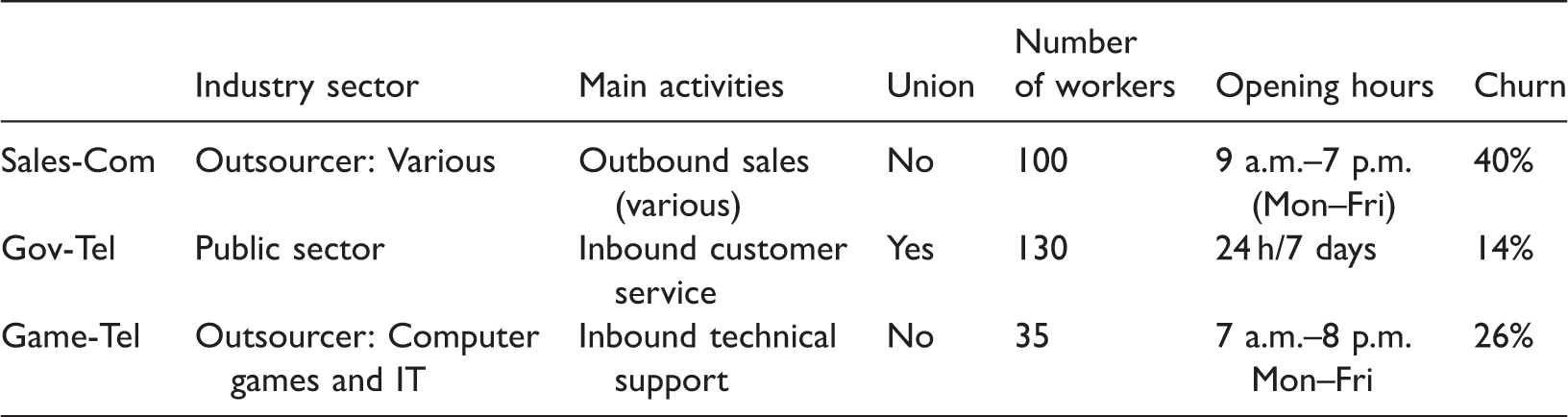
With this in mind, a case study methodology was adopted to address questions of workplace agency and control in Glasgow call centres, primarily from the perspective of workers. 4 The selection of case study centres was based on access and sectoral considerations. ‘Candidate’ cases were identified from discussion with contacts representing key sectors of the local call centre industry. 5 Initial access hinged on preliminary discussions with management from eight call centres, with those offering the greatest levels of access preferred over those imposing access restrictions. 6 The three cases selected for in-depth study were: a public sector/ local authority call centre, ‘Gov-Tel’ (a sector representing 13.4% of Scotland's total call centre workforce); a ‘high end’ computer/information technology (IT) support centre, ‘Game-Tel’ (representing 3.9% of the total call centre workforce); and a telesales operation supporting a variety of industry clients, ‘Sales-Com’ (a grouping which covers 13.3% of the Scottish call centre workforce under the ‘various’ label) (see Table 1). Of the three, Gov-Tel was the most locally rooted and least spatially stretched supply chain model, operating as a local service centre for Glasgow residents. In contrast, Game-Tel and Sales-Com performed a remote customer service for third party clients with customers and sales leads drawn from across the UK and Europe.
A total of 69 interviews were conducted with staff across the division of labour, though mainly telephone agents, in addition to non-participant observation based on repeat visits to each operation. We now turn to examine labour practices in the three call centres, beginning with a discussion of recruitment patterns and the motives of staff.
Staffing Glasgow's call centres
In contrast to the perception of staffing patterns in the call centre industry as generic and standardised (see Connell and Burgess, 2006; Davies, 2010), divergent forms of recruitment were evident in each centre. Game-Tel placed the greatest emphasis on traditional indicators of human capital and recruited on a basis of IT work experience, qualifications and the language ability of candidates. Conversely, the main skill sought in Sales-Com staff was the ability to ‘push’, persuade and sell to customers. This resulted in staffing criteria based not on conventional human capital requirements, but on attitudinal factors associated with enthusiasm and tenacity to sell (Callaghan and Thompson, 2002). By contrast, management at Gov-Tel sought emotional attributes associated with ‘caring’ so as to respond effectively to the queries and needs of service users (authors’ interviews). Both Game-Tel and Sales-Com utilised recruitment agencies to screen for these abilities and, in theory, to allow for fast replacements of staff where necessary. Corresponding interview assessment techniques focused heavily on the speaking skills of applicants.
Call centre core staff, norms, and inducements.
While workers' motives for selecting call centre work have received limited attention in the literature, our research uncovered specific subjective rationales that were often associated with the places workers came from and their life-stage (Munro et al., 2009). Explaining the uptake of call centre work by both genders, and those with contrasting class backgrounds, requires an understanding of both place-specific influences and broader structural determinants (Hanson and Pratt, 1995). One common view held by male workers with limited qualifications and work experience was succinctly put by Leon of Sales-Com: You come out of school so you've got to work somewhere, in unskilled work, so what options have you got in Glasgow? You could work restaurants … but you're always going to get minimum wage for that. You could work bar work – but that's the same again, and that's long unsociable hours where you're working Saturdays … or you could work in a shop, which is bollocks … and you're not gonna go anywhere with that. (Leon, Agent, Sales-Com)
Contrary to the ‘ideal’ candidates sought by management, recruitment patterns reflected supply-side difficulties operating beneath the surface of the local LCR. These difficulties meant that management often had to compromise its standards in practice: At the moment it's a trade-off … even if they're pretty poor at what they're doing the fact we need the language means they've got the job. If we had to replace them, we then have to pay a recruitment fee, train them up and whatever, so there's that short term cost of recruitment and training time – and probably we'd rather save that. (Manager, Game-Tel)
This discussion of staffing compromise is significant in the context of local LCR theory, challenging assumptions that capital and the state determine patterns of recruitment and employment in key sectors of the local economy (Helms and Cumbers, 2006; Jonas, 1996). A labour-centred account which incorporates both the motivations of workers and management's responses offers a more balanced account of the job-filling stage of the employment relationship. It also provides a more concrete and spatialised understanding of worker's rationales and social backgrounds relative to the rather abstract and placeless accounts of labour agency and opposition often found in LPT (Bridi, 2013; Sportel, 2013). In the following sections, we develop this perspective on worker-management relations at the point of production. This involves a return to the notion of a necessary reciprocity between capital and labour negotiated on an ongoing basis (Jonas, 1996).
Workplace practices and behaviours
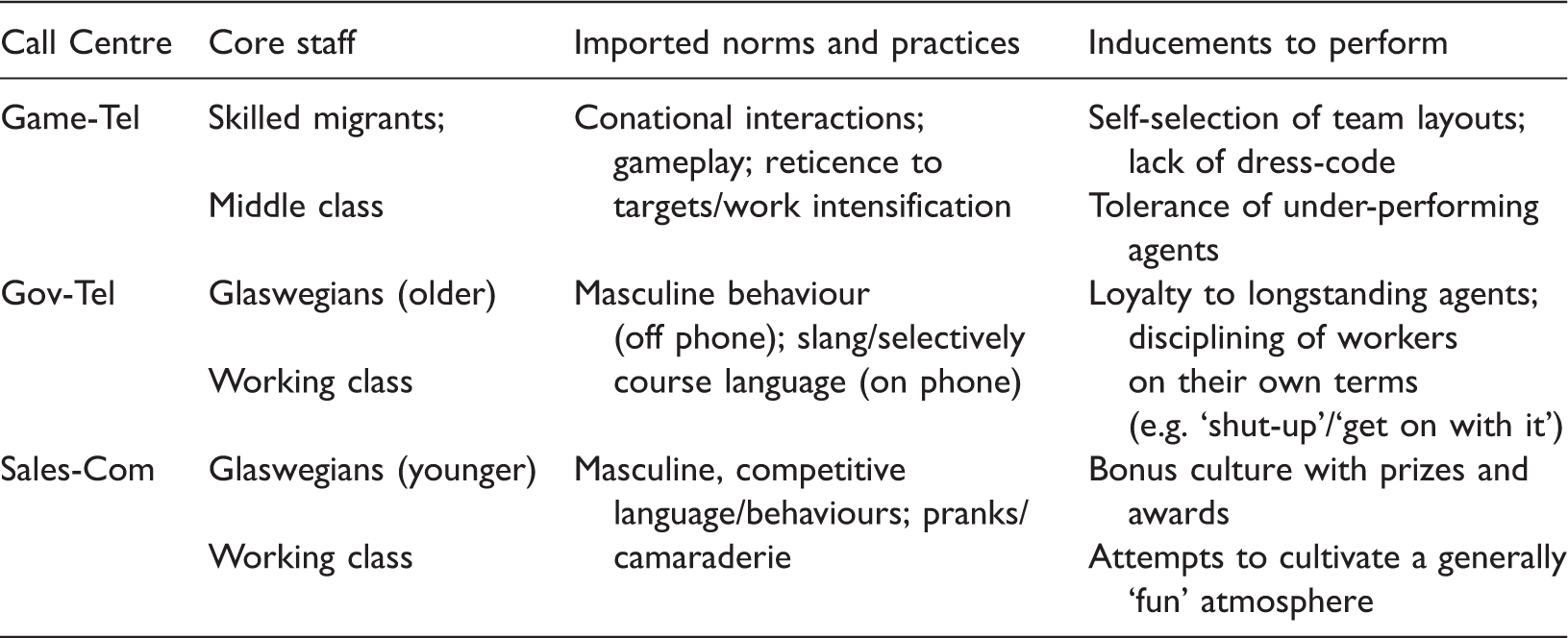
Observations of staff behaviour in each centre captured a range of informal practices and norms within the call centre labour process. In both Gov-Tel and Sales-Com, these included forms of masculine behaviour that fitted uneasily with the feminine stereotype of call centre work (Table 2) (Russell, 2008: 207). In the case of Gov-Tel, masculine performances both ‘front’ (i.e. on call) and ‘back’ stage (Crang, 1994; Goffman, 1990) echoed practices more akin to manufacturing work. Male agents from working class backgrounds engaged in activities such as ‘slaggin’ off the lassies’ to help the passage of time, in addition to other loutish practices such as shouting, swearing and impersonating (typically upper-class) customers on a regular basis off-phone (Mulholland, 2004; Taylor and Bain, 2003). While the workers engaged in such acts typically failed to gain promotion from a role on the phones, the durability of these practices is indicative of management's struggle to impart ‘idealized’ standards of etiquette from above (Callaghan and Thompson, 2001), pointing to the existence of distinct sub-cultures in the call centre (Taylor and Bain, 2003).
Practices in Sales-Com also bore the hallmarks of masculine behaviour, due primarily to the reliance on young working class males with ‘Glaswegian patter’ applied to the cause of selling. As with McDowell's (1997) experience of masculine work culture in merchant banks, several male agents here utilised sexualised and sporting language to describe their role and mark the centre as one congruent with male traits of ‘individualism, aggression, competition, sport and drinking’ (Table 2) (Collinson and Hearn, 1994: 4; McDowell, 1997). Accordingly, one team leader remarked: I would say if I was going to stereotype it's a lot like a football team. You wouldn't have a girl in a guy's dressing room during a football match, you know what I mean? It's a lot of … (Pauses and makes a straining noise as if pushing) ‘Come on!’ … .you know what I mean? (Male team leader, Sales-Com)
Management's tolerance of this overtly masculine behaviour (in two of the three centres) reflects a form of adaptation by capital to labour in an effort to forge reciprocities at the workplace scale (Jonas, 1996). Management's struggle to impart cultural norms in a ‘top-down’ fashion stemmed from difficulties dictating work behaviours to core staff members with learned behaviours, subjectivities and non-work identities. These behaviours reflect place-based, non-work attachments and norms, which often require firms to adapt to, and even accommodate, work practices based on social identities and attitudes developed outside the economic sphere (Peck, 1996; Rainnie et al., 2010). As Maguire (1988) notes: It is the interaction between ‘work’ and ‘non-work’ which is important. In the study of social control in the workplace it is neither solely the external environment nor the ‘internal state’ of the workplace which requires examination, but the interpenetration of the two. (Maguire, 1988: 72)
Control, discipline and reward
Reflecting the behavioural practices outlined above, this section extends the analysis of adaptation and collusion, arguing that labour agency contributes to the coproduction of control relations vis-à-vis discipline and reward structures (see Table 2). This again reflects capital's need to accommodate and retain potentially mobile workers through forms of workplace compromise (Kiil and Knutsen, 2016 8 ; Smith, 2006). In general, adjustments to regimes of discipline and reward may be interpreted to have ‘mellowed’ in line with the improved contractual status of workers in Scotland's call centre industry as a whole (Taylor and Anderson, 2012). Neither Gov-Tel nor Game-Tel placed strong emphasis on targets when assessing staff performance (for example, in judging call quality or number of calls taken), focusing instead on attendance and timekeeping. This move was designed, in the words of one manager, to make the operation ‘less like a call centre’, and more in line with dignified forms of office work in which older workers in particular would not feel patronised or pressurised to perform (see Mulholland, 2004).
Similarly, workers at Game-Tel were not incentivised on the basis of performance, a factor which one agency recruiter put down to management's respect for cultural differences between British and (continental) European workers: Well, this whole thing about being ‘seller of the week’ and getting some booze for it, or a little medal – I think foreigners are not receptive to that. I think we take that as a little bit patronising and British people probably less so. In Game-Tel it's an incentive they wouldn't do, we would have run away thinking ‘what the hell is this?!’ (Former Agent, Game-Tel) Sometimes when you've actually needed to be quite rough, to meet the results or the requirements and to get things done. Then it's not as good because they're not used to it and they all get really pissed off – and leave … I don't care if people come in in half ripped jeans but when they're sitting at work I would like them to do their job more of the time than sitting talking to their friends or playing internet games. (Team Leader, Game-Tel)
By contrast, Sales-Com's culture made direct linkage to the youthfulness of the workforce, as epitomised by a culture of ‘fun’ and reward delivered most overtly via quarterly themed events and award ceremonies (see Kinnie et al., 2000 and Table 2). Through these events, top performers were rewarded with trophy shields, bottles of alcohol and a limited number of holiday prizes. While several workers – notably those male agents on the most prestigious sales team – spoke positively of these efforts, other interviewees also spoke of ‘gimmicks’ designed to generate enthusiasm, loyalty and consent from younger segments of the workforce (Mulholland, 2004). Ultimately these efforts reflect a strategy on the part of management to both encourage sales and exercise control through the creation of a stimulating work environment geared to the core workforce, without causing significant costs for the centre (for example, through wage increases).
While this approach was ostensibly tailored to a younger workforce, with rewards associated with achievement against objective sales targets, staff in Sales-Com continued to detect the influence of shared social identities and place attachments on progress within the centre. Several agents thought that non-work backgrounds mattered in determining patterns of promotion, a factor seen to benefit working class males over other segments of the workforce. Interviewees spoke of the difficulty of breaking into higher end sales campaigns (i.e. more autonomous and financially rewarding roles) based upon social relations and identities developed both outside and inside the call centre: I went to him (a campaign manager) ‘I’m struggling, I’ve got a new flat, I need a better wage’ – he was a St. Mirren fan and I’m a [Partick] Thistle fan, so he was thinking ‘oh fancy West-Ender’ – and he just put me straight back on the phones, he didn't even give me the option … . (Agent, Sales-Com)
9
It's very hard to get in (the top sales campaign), and it's ‘jobs for the boys’ almost, you’ve got that coming in … you’ve got to be kind of friendly with them (management) and work your way in … Personalities go a long way. (Agent, Sales-Com)
In Gov-Tel, adaptations of work organisation and culture were deemed necessary by management to integrate workers with distinct (and arguably ill-fitting) class backgrounds, work histories and corresponding attitudes to customer facing service work. For example, rather than disciplining the masculine and working class practices invoked by agents, Team Leaders in Gov-Tel were expected to show ‘street smarts’ by treating indiscretions through similarly boorish rebuttals (see Table 2). In order to match the lexicon of agents, in Gov-Tel this often translated as Team Leaders telling agents to ‘shut up’ and ‘get on with it’. Management actively encouraged supervisors to deal with rowdy agents in this fashion, often to the chagrin of those workers (both agents and supervisors) with ‘white collar’ work histories and expectations of office work demeanour. This incorporation of, and collusion with, core worker habits (Nyberg and Sewell, 2014) would seem to be preferable to ‘despotic’ forms of control (e.g. disciplinary action for unprofessional conduct) which arguably contributed to the higher rates of labour turnover emphasised by Helms and Cumbers (2006) in the initial round of call centre growth in the local LCR. This illustrates the point that labour segmentation not only creates distinct organisational sub-cultures in the workplace, but also that segments of the workforce (in particular core workers) can shape workplace norms and influence associated control relations (Taylor and Bain, 2003).
Like several of the call centre agents, many of the managers in Gov-Tel held long histories of local authority/council employment, and empathised with working class agents from similar backgrounds. In addition, working class (predominantly male) agents brought both quantitative flexibility (e.g. a willingness to switch shifts/work extra hours at short notice) and a ‘cultural congruence’ (Taylor, 2015) to the customer interaction, incorporating both practical local knowledge and related class and place-based rapport with customers. Management cited these workers as loyal to the operation, underscoring the point that labour mobility remains a threat to call centre efficiency which management are prepared to counter through elements of collusion with apparent ‘misbehaviour’ (Ackroyd and Thompson, 1999; Nyberg and Sewell, 2014). This involved a degree of acceptance of unorthodox norms and practices by management, and inadvertently allowed a working class identity to carry over into Gov-Tel as a whole. As one trainer remarked, ‘it all comes down to background … it's very difficult to try and coach someone out of their own personality’ (authors’ interview).
In addition to more formal forms of conflict between labour and capital, some labour process research suggests that workers compete to imprint their own subjective cultural visions on the workplace (Hodson, 1995; Roy, 1973). The above points are indicative not only of the struggle to align different worker backgrounds and associated etiquettes (Ackroyd and Thompson, 1999), but also of Herod's contention that workers conflict with one another to produce economic space in their desired image (Herod, 2001; Hastings, 2016). From a local LCR perspective, this point again underscores the decisions that firms may take to adapt and alter labour control practices ‘to fit the dominant social relations and power structures of the locality’ (Jonas, 1996: 331). In this case, accounts of collusion with worker habits in the labour process (Nyberg and Sewell, 2014) also help to indicate how fresh layers of service capital encounter and negotiate pre-existing social relations and class identities inherited from the preceding era of industrial capitalism (Hudson, 2005).
Conclusion
In response to recent calls for a more conditional and embedded notion of agency in labour geography (see Coe and Jordhus-Lier, 2011), this paper has examined how labour agency operates at the scale of the workplace (Rutherford, 2010). While capital may ultimately secure a substantial degree of control in workplaces, we have shown how this practice is at least partly co-produced with labour and shaped by contingent local conditions. As Storper and Walker (1989: 166) argue, ‘workers and managers together manufacture social worlds in miniature in the workplace, the firm and across industries. No one creates these worlds entirely by design’. In practice, this paper has shown that both control and work experience emerge out of a dialectical process of interaction between management practices and worker expectations, attitudes and social backgrounds. With call centre management unable (or unwilling) to invest in a thorough training or ‘re-socialising’ of labour, workers are allowed to reproduce incongruent behaviours, based upon the need to create ‘tolerable conditions under which employees and employers can rub along together without the whole edifice collapsing into acrimony and open conflict’ (Nyberg and Sewell, 2014: 327). This may lead firms to collude with tolerable forms of apparent misbehaviour and adapt their modes of labour control to accommodate the attributes of core workers recruited locally (Nyberg and Sewell, 2014).
The above discussion has pointed to the benefits of a more spatially enlivened LPT analysis, illustrating (some of) the ways in which geographic inquiry can enrich understandings of labour process struggles and worker agency. Building on previous calls for spatial analysis in LPT (Coe, 2015; Rainnie et al., 2010; Thompson and Smith, 2009b), we have shown how local labour market conditions and workers’ backgrounds, reflecting different degrees of local social embeddedness, can affect both work performance and labour practices. This highlights the variety of ways in which different groups of workers engage with what has been seen as a standardised call centre labour process (Callaghan and Thompson, 2001; Taylor et al., 2002). Our analysis has shown not only the distinctiveness of a ‘Glasgow workforce’, but also the diversity of workers’ motives for undertaking call centre work, reflecting their work histories and perceptions of local labour market conditions. In turn, this diversity – involving the integration of workers from different places and backgrounds – complicates the notion of a ‘generic’ form of work integral to the local LCR. While call centres have been promoted as a means of absorbing workers from across the social spectrum, particularly in old industrial areas (Cumbers et al., 2009), in practice these social backgrounds influence the labour process and workplace relations in unexpected ways.
While we have unpacked the Glasgow LCR by showing that it is far from singular and subject to worker-driven change at the micro-level, this should not be taken to imply that it is unstable ‘as a whole’. On the contrary, the focus on the micro-practices of workers allows us to better identify subtle adaptations on the part of capital which may actually help to reinforce the coherence of the local LCR by developing stronger relationships with core workers. This is a part of the process of capital embedding itself in the locality which arguably provides for longer term stability in the local LCR. While labour exploitation undoubtedly persists in a range of forms (for example, low autonomy, poor wages and job insecurity), there is evidence of capital accommodating core workers’ attributes and practices. As emphasised earlier, this is more apparent for the day-to-day labour process than broader modes of work allocation and career progression which are controlled by management. Nonetheless, worker agency involves more than simply coping with the lived realities of call centre work; labour's social nature influences capital in locally specific ways as part of the on-going process of embedding particular fractions of capital in specific places.
Footnotes
Acknowledgements
We thank the editors associated with this publication and the three anonymous referees for their helpful comments in response to earlier manuscript drafts. Thanks also to Andy Cumbers and Jon Shaw for constructive and enlightening discussions in the earlier writing stages in particular. All remaining errors remain the authors' own. We extend our sincere appreciation to the interviewees who gave up their valuable time.
Declaration of conflicting interests
The author(s) declared no potential conflicts of interest with respect to the research, authorship, and/or publication of this article.
Funding
The author(s) disclosed receipt of the following financial support for the research, authorship, and/or publication of this article: Sincere gratitude to the Economic and Social Research Council (award PTA-031-2006-00461) for the funding received which made the research possible.