




Abstract
Reducing carbon emissions from the transport sector has become a critical imperative for public policy as our understanding of the impacts of the mobility system on the environment has developed. This paper contrasts policy development in three cities (Aberdeen, Bremen and Malmö) that collaborated as part of a European Union knowledge exchange programme designed to share innovative approaches to carbon reduction in the transport sector. We identify a number of critical aspects of governance, including the approach to policy formulation and implementation, and the status of consensus and cohesion, as key determinants of transport outcomes. We conclude that the degree of institutional alignment evident in each city’s governance network is crucial in explaining their appetite for the pursuit of low carbon policies, and in turn the real potential for policy transfer to occur as envisaged by European Union collaboration frameworks.
Introduction
Transport is responsible for approximately 25% of greenhouse gas emissions in Europe and therefore represents a key domain for policy action if international targets for decarbonisation of the economy are to be met (Banister et al., 2012). Recognising the supra-national nature of the challenge, the European Union (EU) has promoted numerous policies and measures designed to stimulate decarbonisation efforts as part of its ‘EU climate and energy package’ which aims to reduce carbon emissions by 20% by 2020 (based on 1990 levels), raising the share of EU energy from renewable sources, and improving energy efficiency by 20%.
The best known EU initiatives to reduce the environmental impact of transport are the regulatory strategies designed to limit emissions from road traffic through the adoption of strict engine emissions standards for new vehicles, and to require public authorities to recognise whole life transport and energy use when procuring their fleets (see Merkisz et al., 2014). But the EU also has an established tradition of encouraging policy transfer through specific collaborative research and policy programmes, such that it has ‘evolved into a “massive transfer platform” for disseminating different aspects of policy among member states’ (Radaelli, 2000 quoted in Benson and Jordan, 2011). Significant components of many of the EU’s largest research and policy development programmes (such as Interreg, the Framework programme and its successor, Horizon 2020) support efforts towards the transfer and diffusion of ‘successful’ policies across the environmental domain, such as reducing the importance afforded to the private car vis à vis other transport modes in urban and regional planning strategies, and the promotion of behavioural change initiatives.
Our interest in European programmes as mechanisms of policy exchange arises because ‘little is known about the relative importance of different parts of the transfer process or the extent to which learning about policies in other areas can influence the effectiveness of policy design in the transport arena and/or policy outcomes’ (Marsden and Stead, 2011: 492). The implicit assumption underpinning these programmes is that there will be policy transfer between partners (Dolowitz and Marsh, 1996; 2000), so that the interventions being pursued in municipalities, regions and countries that are ‘leading’ on a particular agenda (in this case low carbon transport) will be adopted and implemented in those which are ‘lagging’ behind. Based on observations and interviews carried out in three cities – Aberdeen, Bremen and Malmö – that collaborated in two successive European projects (the Interreg IVb projects CARE North and CARE North+), this paper will critically reflect on this model, and explore whether ‘lagging’ municipalities really have the institutional alignment required to absorb and reproduce best practice in low carbon transport.
The paper proceeds as follows. First, we review some key ideas on governance and institutional dynamics relevant to the broad context of environmental policy, and how these illuminate different policy approaches to the decarbonisation of the transport sector to date. We then describe the research methodology and present evidence from our three cities about the differing extent to which they were able to address the challenge of decarbonising transport, and the importance of institutional alignment in explaining this. We conclude with some thoughts on the gap between the rhetoric and reality of European policy transfer made possible through EU collaborative programmes.
The context for environmental governance and policy transfer
European policy transfer programmes are an important element of the highly complex multi-level governance arrangements that have evolved to promote lower carbon choices in transport and other related domains such as planning and housing. Paavola (2007: 93) states that understanding the efficacy of these arrangements requires ‘analysis (that) can gain resolution by looking at the functional and structural tiers, organization of governance functions, and formulation of key institutional rules as key aspects of the design of governance institutions’. Bulkeley (2005) also called for a critical approach towards emerging models of environmental governance that addresses the politics of both scale and networks, and in particular the importance of power hierarchies and clearly defined territories for action in explaining policy priorities.
These frameworks for approaching environmental governance are consistent with Chhotray and Stoker’s wider (2009) review of governance dynamics which focused on network management theory and the notion of ‘delegation’ between different governing organisations and territories. Within network management theory, two principal approaches to the task of managing governance networks are apparent: game management (that is the management of the often-conflicting priorities and relationships in a network) and network structuring (changing the arrangement of participants in a network, or the actual participants that make up the network themselves). Managing the ‘game’ of bringing interests with (sometimes diametrically) opposing views sufficiently close together to take policy decisions underpins the idea of ‘partisan mutual adjustment’ on which the classic model of incremental policy development and ‘muddling through’ (Lindblom, 1959; 1979) to an improved policy posture are based.
In his review of such management techniques as practised in sustainable transport, Stead (2016) lists policy transfer from the outside as one of five key processes for policy development within governance networks for sustainable transport, the others being the use of policy indicators and targets to measure progress, benchmarking against current or aspirational peers, policy experimentation, and the use of visioning exercises. The extent to which networks are actually able to develop agreed policy outcomes depends on the skill in prioritising and implementing these different network management devices displayed by those charged with its ‘metagovernance’ (Sørensen, 2006), a task that requires both ‘hands-on’ management of the network as an administrative entity, and ‘hands-off’ framing of the network’s task through devices ranging from legislation to softer, fuzzier techniques such as storytelling such that a narrative is created to define the network’s purpose clearly.
The key to effective governance put forward by delegation theorists relates to the operation of the power hierarchy between governing tiers. The underlying premise is that the most powerful tier or institution – the ‘boss’ – can either retain or delegate control over a particular policy responsibility to its subordinate entity, which can then in turn choose to either ‘shirk’ or ‘work’. In practice, the choice of whether and how to delegate responsibility for a particular policy problem is a delicately balanced one, hinging around the question ‘is the gain produced by delegating the decision to a more informed party worth the loss produced by having someone with different preferences make the choice?’
Whilst delegation theory is relatively optimistic about the solutions it offers to the management of thorny policy problems, it faces some rather obvious criticisms regarding its desirability and effectiveness in real world situations. For example, Meadowcroft (2002:171) notes that it is ‘important to appreciate just how much of political life cuts across the “vertical” divisions of the formal hierarchy’ in policy making, neatly exemplifying what Chhotray and Stoker themselves define as the ‘sheer messiness’ of the interactions between different state actors making up the governance network (see also MacKinnon et al., 2008). This complexity, and the fact that the boss and subordinate tiers may have quite different formal legal powers, constitutions and electoral mandates, leads to deeper critiques about the implications for accountability and democracy of the ad hoc reallocation of policy responsibility to governance entities implied by delegation (see, for example, Bendor et al., 2001; Héritier and Lehmkuhl, 2008; Sørensen and Torfing, 2009).
Recent research on the progress of decarbonisation policy across Europe explores how these institutional dynamics of network governance are playing out in practice, addressing the recurring key question of who learns from whom and why (Dolowitz and Marsh, 1996). Gustavsson et al. (2009) analyse the development of policy networks for climate change mitigation in two small Swedish cities, Sundsvall and Växjö. In the former, the network is clearly hierarchical and rather instrumentally focused on business opportunities, with the municipality building public–private partnerships in response to incentives from a central government that adopted a ‘hands off’ approach. In contrast, policy elites in Växjö chose to restructure their network and open it to international partners in order to challenge the vertical and territorially bounded form of central–local government relationship on which climate policy had been based, since such networks are vital sources of new ideas and knowledge, have the power to influence local and national government, are arenas where you can advertise your city and establish contacts to the benefit of local industry; and are platforms for establishing additional networks, projects, and funding. (Gustavsson et al., 2009: 70)
Marsden et al. conclude that the mediation of ambitious decarbonisation targets set at European and member state levels can differ substantially between places with different socio-economic needs and capacities to act, reflecting De Jong and Geerlings’ (2005) findings that policies do not necessarily transfer seamlessly between highly similar settings. Indeed, the realities they describe illustrate the conflicts apparent in the boss–subordinate relationship between governing tiers, especially given the strong preference for delegation of policy responsibility for decarbonising transport by the UK central government. They thus identify a ‘rhetoric: reality gap’ given that the delivery of appropriate policies has been far from universal despite some impressive policy rhetoric from all concerned. This is consistent with much earlier work on the delivery of sustainable transport in the UK, with only a few wealthy places with rich civic–political engagement, such as Bristol, Cambridge, Edinburgh and – on the back of exceptional financial resources – London, able to establish policy frameworks that are similar to those much more commonplace in other comparable northern European countries that have generally achieved significantly greater progress towards similar goals, and have been doing so for some considerable time (see Bratzel, 1999).
Three cities in a European programme: Aberdeen, Bremen and Malmö
The locus for our research is the EU’s CARE North and CARE North+ programmes, which like many comparable initiatives were designed to bring together cities from different member states grappling with similar problems so that they might engage in policy exchange with a view to learning and diffusion of the ‘best practice’ evident across Europe. Macmillen and Stead (2014: 79) set out the underpinning logic thus: Information regarding successful policy initiatives may facilitate the efforts of those undertaking similar projects, allowing policy actors to draw conclusions as to what to do, what not to do, and hence aid their ability pursue a successful course of action themselves.
This strategic need reflects a longstanding perceived gap between the success of the vast majority of British local governments in implementing not just low carbon policies, but effective transport policies more generally, in comparison to their continental peers (see Docherty and Shaw, 2011). Any analysis of the UK’s approach to transport policy compared with its continental neighbours must recognise Britain’s attempts to reconcile its twin primary external influences of Atlanticist, neo-liberal approaches prioritising laissez-faire and minimalist regulation, with the more avowedly social-democratic, interventionist perspective of the European centre(left) mainstream (see Grengs, 2005; Jessop, 2002; Keeling, 2009).
One of the most important implications of this split personality in policy making in the UK is that although the central state has remained relatively consistently committed to a neoliberal approach of expanding transport provision in pursuit of economic growth, the task of dealing with the negative externalities of the UK’s transport system is often delegated to local government, especially as these externalities are most immediately apparent through phenomena such as traffic congestion and air pollution, which manifest themselves at the local (primarily urban) scale. This leads to a vibrant debate at local level about which potential policy solutions can make everyday life better for citizens (see Xenias and Whitmarsh, 2013), and also about how best to implement decarbonisation strategies since much of the political activism on carbon arises at the urban scale (see While et al., 2009). In order to legitimise their role and approach, a common tactic for British local governments is to turn to international policy transfer mechanisms to both justify their level of professional expertise and connectedness, and to legitimise their political challenge to the centre by attempting to ‘Europeanize’ local policy responses and hence hold out the prospect that the more positive (perceived) outcomes commonplace on the continent – better public transport, more cycling and walking, improved public realm and so on – can be delivered in the UK, in spite of central government policy (see Timms, 2011).
Governance and policy contexts
Transport in German cities is highly planned, with the first special-purpose authority being established in 1965. Each of the principal metropolitan areas in Germany, including the example of Bremen 2 in this research, has its own authority focused around the local bus system and in most cases regional surface tram, rail and/or underground networks. These authorities (Verkehrsverbunde) have political and executive structures drawn from elected regional government and local municipalities within their boundaries, and have advisory boards representing operator and passenger interests. Their powers are extensive and they enjoy direct control over the regulation, co-ordination and integration of public transport across modes, setting service standards for operations, strategic network planning, timetabling and multi-modal ticketing and fares. This structure is especially strong in Bremen since, along with Hamburg and Berlin, the city forms its own federal state or Land.
At the other end of the spectrum lies the highly deregulated and almost completely privatised system of public transport provision in the UK. Starting with coach and local bus services in the 1980s, and followed by the railways in the 1990s, the vast majority of public transport in the UK is now operated on a commercial basis, the ‘marketization transition’ (Geels et al., 2011) designed to reduce public subsidy and stimulate innovation in service provision having been a major objective of government policy for almost 30 years. Outside London, where for particular network and political reasons there remains a strong set of governing institutions similar to the German model (see Vigar, 2013), governance oversight of urban transport planning and operations is very weak by global standards. In Scotland, the transport governance is based on a minimalist structure of Regional Transport Partnerships (RTPs), which are effectively special joint committees of regional groupings of local authorities. Unlike in the other two case study examples, this governance mechanism cannot coordinate transport services, nor impose integrated ticketing between operators. Scottish local authorities also have very little fiscal autonomy compared to their continental peers, being dependent on central government for around three quarters of their funding.
Transport governance in Sweden forms something of a ‘third way’ between the German and UK models. Although the Swedish national government has undertaken a comprehensive process of transport liberalisation over the last 20 years, this has been a relatively controlled series of reforms based on the competitive tendering of specific routes by public authorities, rather than the ‘big bang’ deregulation and privatisation of public transport operations seen in the UK. Public transport operations therefore remain coordinated by special transport boards of the county (regional) governments across the country, which are directly elected and have responsibility for a range of planning and environmental functions, plus health care. In the case study city of Malmö, the regional Skånetrafiken board is responsible for the tendering of local and regional bus and train services, and coordinates fares and ticketing as part of its strategic planning responsibilities. Swedish municipalities are relatively autonomous entities, drawing between half and three quarters of their income from local taxation streams.
Key city and transport statistics.
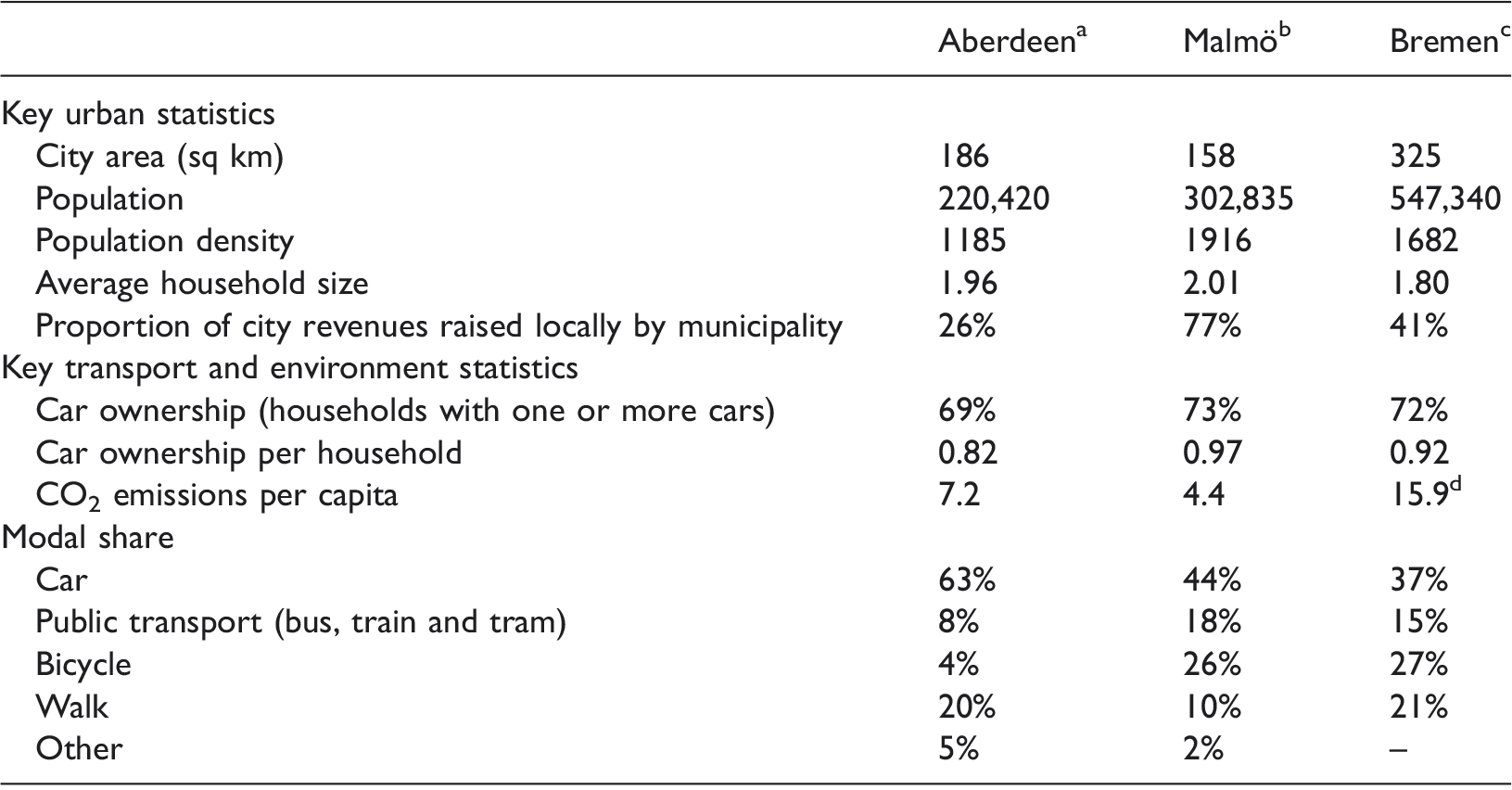
Aberdeen City Unitary Authority.
Malmö Stad Municipality.
Bremen Free State (Federal Land of Bremen).
This is a high figure by European standards as is ascribed by the German Green City Index to the high level of industry and port activity in Bremen.
Sources: Aberdeen Climate Change Declaration Report, 2012; Aberdeen Information on Council Tax and Council Spending 2015–2016; German Green City Index, Scottish Transport Statistics, 2012; Malmö Travel Survey, 2008; Malmo Stad Annual Report and Statement of Accounts, 2015; Municipality of Bremen Survey ‘Mobilität in Städten’, 2008; Bremen Free State Finance Summary, 2015.
Research methodology
This paper is an outcome of two successive Interreg IVb projects focusing on ‘Carbon Responsible Transport Strategies for the North Sea Region’ (CARE North+, 2013). Our three case study municipalities of Aberdeen (Scotland, UK), Bremen (Germany) and Malmö (Sweden) are project partners. Two of the authors of this paper are also academic partners. Our involvement in these projects has afforded the authors a unique ‘active research’ standpoint, allowing us to witness at first-hand how local authority officers from three different municipalities in three different countries go about ‘doing’ policy transfer and in turn trying to deliver low carbon transport from the lessons learned. We have done so over a period of four years, which enables at least something of a longitudinal insight into the manner in which they approached their objectives, and the extent to which they succeeded in delivering on them.
Our work included literature reviews and semi-structured interviews with key decision makers and other key stakeholders from each city, with a set of research questions designed to identify which particular transport policies had been most successful in delivering reduced carbon emissions, but also which aspects of governance in each city have been the most important in creating the necessary strategic capacity to translate plans into action. In total we interrogated 10 people from each city either in one-to-one interviews or in small group sessions held as part of participatory workshops for the project. The final stage of the work involved some additional validation interviews with the senior stakeholders engaged from each of the three cities to test our emerging conclusions. Reflecting the contextualisation of European policy exchange programmes presented above, we focused on three strategic research questions:
What exactly is it that defines some cities as ‘lagging’ in comparison to others with which they might engage in a collaborative policy transfer exercise? Do ‘lagging’ municipalities have the potential to demonstrate the same holistic and integrated approach as the ‘high achievers’ representing ‘best practice’ in low carbon transport, and if not, what are the key barriers to doing so? If ‘lagging’ municipalities lack the potential to catch up through policy transfer, what are the implications for the ‘dissemination of best practice’ model that is the cornerstone of so many European funding programmes?
Implementing low carbon transport policies
The ‘hardware’ of governance and the ‘software’ of policy toolkits
Our research revealed plenty of evidence for Aberdeen’s self-reported status as ‘lagging’ in the implementation of low carbon transport policies in comparison to Malmö and Bremen. In many ways, the latter two cities had succeeded in applying the standard policy ‘toolkit’ for moving overall transport provision away from car dependence to a system that relies substantially on more sustainable modes (see Banister, 2008) including improvements to the urban realm and prioritisation of space for public transport systems, walking and cycling; integrated transport plans; improved public transport and integrated ‘smartcard’ tickets; reduced speed limits; and car sharing initiatives based on innovative ICT solutions.
The policy debate in Aberdeen, in contrast, remained dominated by the perceived need for more road capacity, primarily in the form of the Aberdeen Western Peripheral Route (AWPR). When the first serious planning and technical work on the potential for an outer bypass was done in the 1990s, there was strong recognition that such a project would need to be accompanied by a range of complementary policies to ‘lock in’ its benefits, and to avoid generating negative or perverse outcomes such as land release in green field locations contrary to local planning strategies. Key here were the ideas that the AWPR should be part of a wider Modern Transport Strategy for the city region, in which urban road capacity released by the new route would be reallocated to non-car modes, with substantial investment in the bus network, cycling infrastructure and facilities for pedestrians in the city centre.
Consequently, a vision for transport in the city was developed which, although not explicitly low carbon, at least in many respects resembled the standard sustainable transport toolkit successfully implemented in many European cities including Bremen and Malmö. In Aberdeen, however, this ‘software’ did not load properly: the Modern Transport Strategy was ‘cherry-picked’ (Shaw et al., 2006) so that that AWPR and other road schemes were pursued with vigour, while little or no priority was given to the potentially unpopular complimentary polices of road space reallocation and bus and cycling priority.
Thus, important though such ‘software’ might be, it is only as effective as the institutional ‘hardware’ will allow. As one respondent from Bremen put it, ‘There is no silver bullet. It needs a composition of hardware (infrastructure and services) and software (image, perception etc.) – and of carrots and sticks’.
The implementation of low carbon transport policies in practice therefore requires robust hardware in the form of strong institutional structures and capacity, and the presence of vision, commitment and stamina across the local political leadership. In both Bremen and Malmö, several key elements of this mix are evident: strong city and/or regional governments with substantial fiscal autonomy; clear leadership from senior politicians setting out a vision for change and a credible pathway along which to achieve it; and perhaps most importantly of all, a constructive relationship between politicians and professional officers that generated alignment and mutual reinforcement between professional and political groups. Whilst ‘the importance of committed politicians in the first place’ (Malmö respondent) cannot be underestimated, the kind of executive governance based on a ‘joint elite’ (Dacombe, 2011; Stoker and Wilson, 1986), identified in both cities has long been argued to set the foundations for substantive policy change, and in our cases at least, appears to remain a convincing analytical perspective. As one of our Bremen respondents said, ‘we are not just executing the decisions of the politicians, although that might be the theory … there is a more proactive role (than in the UK) of professional people in the administration’.
The actual capacity of the Aberdeen governance network to act was very limited in comparison. Whilst the Scottish Government has sought to differentiate itself from its UK counterpart in its pursuit of ambitious sustainable transport and carbon reduction targets and policies ever since representative devolution in 1999 (MacKinnon et al., 2008; Scottish Government, 2011), it has delegated very little real power to achieve these targets to the local level. Genuine multi-level governance in Scotland has often failed to materialise in practice, with many local decision makers noting their marginal involvement in policy at a strategic level.
Thus, although there might superficially appear to be a substantial degree of institutional isomorphism (DiMaggio and Powell, 1983; Radaelli, 2000) between the Aberdeen governance network and it continental counterparts – each with their municipalities with strong links to a range of local stakeholders, overarching regional transport authority and encouraging ‘boss’ tier of central government – this hides a huge gulf in the institutional capacities of each network to implement politically challenging policies in practice. As one of our respondents noted: ‘Greater integration between national policy and local delivery is needed … The Scottish Government could and do more to support local implementation of national initiatives’.
An example of this is Scotland’s national cycling target for 10% of journeys to be made by this mode by 2020. However, direct funding for active travel (cycling and walking) remains at less than 1% of the Scottish transport budget in 2014, compared to around 9% in Sweden, and despite its prominence there is little sense of the target being embedded into policy priorities of local authorities in any meaningful way (Marsden et al., 2014b).
Decision makers in both continental cities were well aware that their cities’ ability to adopt policies such as shifting resources to cycling was in large part due to their (much) more powerful local and regional institutions than was the case in Aberdeen, especially in terms of their relative fiscal autonomy from central government. Indeed, they argued that this autonomy enabled policy implementation for pro-environment and sustainable transport policies that was greater than that evident even in their respective national governments.
Political mainstreaming of low carbon narratives
Our respondents in Bremen and Malmö were also conscious that their journey towards the acceptance of low carbon policy choices had involved the ‘mainstreaming’ of formerly quite ‘radical’ political views within their robust local/regional institutions. In Malmö, transport interventions had been framed in a much wider narrative of profound structural change borne out of the scale and pace of decline of the heavy industry in the 1980s and the need to reconstruct the city’s economic and cultural place in the world as a result. Influential voices, including the city’s mayor, engaged in a process of restructuring of the local policy network, articulated through a distinctive ‘stadspolitik’ (Dannestam, 2009) based on a vision to redevelop Malmö through a set of explicitly entrepreneurial, post-industrial development policies with a focus on sustainable living and quality of life. Low carbon transport policies were therefore a sectorial manifestation of a wider aspiration to redevelop Malmö through renewed communities, new urban neighbourhoods and the visible greening of the city. Thus as one respondent said, ‘the city was in transition from late 80s, (with) the idea of sustainability as part of post-industrial identity: it (sustainability) was a search for something new, and it fitted well with the vision of the future’.
In terms of implementation Malmö’s approach was deliberately pragmatic, focusing on the Western Harbour, as a ‘pilot’ project that would demonstrate the potential for such policies to create highly attractive, liveable communities that ‘embodied’ the city’s post-industrial vision before rolling out this approach to other development opportunities. Critically, initial implementation of car restraint policies was limited to a small defined geographic area, so that ‘new development was not imposing on existing mobility patterns’ (Malmö respondent) as a means of minimising political resistance to change. Such resistance was also limited by presence and pressure from the Greens in elected positions, who were particularly active in helping to promote the formal adoption of pro-cycling policies in the city. The extent of Green representation was also speculated to be a major indicator of ‘how well prepared is the public is to accept certain policy measures’ such as car restraint (Malmö respondent).
The participation of Greens at the heart of policymaking was also important in Bremen. One respondent recounted that, Bremen was the first German Land (state) parliament with Green parliamentarians, in 1979 – the Green List was founded as an initiative against the former urban highway plans. From 1991–1995 there was also a Green participation in the (Land) government – and since 2006 we have a coalition of the SPD and the Green Party ruling the state and city. The last election in May 2011 brought a strong increase in the number of green voters (to 22%). This ‘red-green’ government worked so far quite smoothly – even in the field of transport.
In both our continental case studies, respondents recognised that their respective cities benefitted from the presence of a ‘radical’ or ‘alternative’ political culture that helped support and legitimise change. Both cities have seen the establishment of modern universities (1960s in Bremen and 1990s in Malmö), with radical student culture making a significant contribution to local politics. The key factor was the ability of the local governance network to engage in sufficient ‘game management’ such as these perspectives became genuinely influential in the wider mobility politics debate. As one Bremen respondent noted, in the transport domain, this alternative culture meant that the potential to move towards lower carbon choices could be socially legitimised by the idea that the bicycle was ‘cool’, and so, In terms of cycling for instance, Bremen always had cycle paths and the bicycle had never had the image of the poor man’s mode of transport … so the new image of cycling met in Bremen an already existing infrastructure – not in best shape, but at least something. Even though the number of cyclists was lower than today, we always had the ‘critical mass’ of cyclists.
The kind of road space reallocation or more general shift in policy (and resource) attention to public transport and the active modes seen in Bremen and Malmö would appear so far removed from the political and policy narrative in Aberdeen to be almost impossible. In contrast to such mainstreaming of the low carbon agenda in Malmö and Bremen, the issue in Aberdeen is often simply seen by politicians as a straight vote loser: ‘there are opportunities for change but politicians do not want to be seen as anti–car. While they support the promotion of more sustainable transport, they have no appetite for “big sticks”’ (Aberdeen respondent).
In recent years, the construction of the AWPR (which is funded by the Scottish Government) has dominated debates to such an extent that wider discussion on sustainable transport related issues such as land use planning strategies and urban regeneration has been significantly stifled. A consistent narrative emerged whereby the local authority’s proposed policies seeking to manage traffic (to the benefit of more sustainable modes) were painted in the media as ‘anti-car’, and – given significant overt opposition from local interests such as the media and powerful property developers – politicians have increasingly regarded such policies with suspicion due to the media opprobrium they attract. Local green groups’ focus over several years on trying to stop the AWPR project – which had widespread public support – meant that they became ever more marginalised in wider policy discourses rather than part of the mainstream (see Tiesdell and Allmendinger, 2004). Although there are a number of local champions of sustainable transport (including some politicians), with a hostile media setting the agenda, there was no clear consensus for promoting cycling, walking and public transport among policy makers, local institutions and stakeholders or among the general public.
Institutional alignment for low carbon transport delivery
In setting out our research questions, we asked whether ‘lagging’ municipalities really have the capacity to demonstrate the same holistic and integrated approach as the high achievers from whom they are expected to learn in the low carbon transport arena, and if not what the key barriers to doing so might be. Our findings suggest there is a significant gap between Aberdeen on the one hand and Bremen and Malmö on the other in terms of the extent to which vision, strategy, budgets and action are aligned towards a single holistic outcome, and in the extent to which politicians, and local authority officers and departments are working together towards this common goal. In Bremen and Malmö, key players at the heart of the local governing networks were able to ‘manage the game’ and move policy action towards low carbon interventions by generating sufficiently strong alignment across aspiration, rhetoric, policy, strategy and action and between politicians, transport officers and – because of the successful loading of policy software discussed above – the public, making the introduction of meaningful low carbon policies possible. This meant that the governing network was able to overcome objections to a change in policy direction towards lower carbon priorities.
The situation in Aberdeen could not have been more different. There are various reasons for Aberdeen’s inability to deliver on a low carbon transport agenda, including the weakness of the resource base (both in financial but also technical terms) of Aberdeen’s system of transport governance in comparison with Bremen and Malmö. But our interviewees expressed little doubt that the most important factor was the inability of the local governance network in the city to do as its partners had done and ‘manage the game’ such that Aberdeen had enough influential voices lined up in support of a wider politics of mobility that took low carbon policies really seriously. Given that many low carbon transport policies are actually very inexpensive to implement – the reallocation of road space from car to buses and cycles requires little more in capital investment terms than some signposts and paint, after all – it is the lack of institutional alignment, we conclude, that is key to Aberdeen’s inability to do more on the low carbon agenda.
The extent to which such institutional alignment is apparent is therefore crucial because moving towards the goal of low carbon transport is a difficult policy transition requiring active management of the ‘game’ between interests seeking change and those favouring the status quo. The transition to what is currently framed as ‘low carbon transport’ is in many respects one phase in a consistent, if faltering, trajectory away from (over)reliance on hydrocarbons that can be traced back to the energy crisis of the mid 1970s (see, for example, Tapio et al. 2007; Zachmann et al., 2012). The policy imperative driving this shift has changed over time – from early worries over resource scarcity and the price of fuel for end users to the externalities of local air pollution and subsequently climate change – but the overall trajectory is nonetheless identifiable.
Each phase of this transition has required governance networks to display sufficient institutional alignment to move beyond mere recognition of the need to change so that transport and related policies are actually revised to become more conducive to decarbonisation. Thus the ‘predict and provide’ approach of accommodating the car through road space expansion, together with support for low fuel taxes and the consequent acceptance (or even encouragement) of urban sprawl eventually gave way (at different times and to different extents in different countries) to policies in which public transport, active travel and alternative fuels are strongly promoted, alongside planning policies designed to (re)concentrate urban development. What might be termed the contemporary ‘European model’ of low carbon development incorporates all of these elements in order to maximise transport’s contribution to the EU’s policy visions for wider decarbonisation.
But as our research has demonstrated, Bremen and Malmö can be considered ‘leaders’ in the adoption of contemporary low carbon transport policies because they have made considerable efforts over time to ‘manage the game’ so that their governance networks have become sufficiently aligned in order to actually deliver a range of specific low carbon transport interventions that match the overarching policy rhetoric of decarbonisation. ‘Lagging’ Aberdeen, however, has been largely unable to translate the same rhetoric about the need to deliver lower carbon transport into policy actions that match this rhetoric (Marsden et al., 2014b). The critical implication of this for notions of policy transfer is therefore that it is not because cities such as Aberdeen necessarily lack the vision, plans and/or institutional capacities to deliver low carbon policies per se (although deficiencies in any of these may well be a barrier to implementation), but rather that there is a mission critical institutional misalignment between different elements of the governance network, representing the wider political economy of mobility in the city, that prevents sustained action towards the implementation of low carbon policies in practice.
Conclusion: What, then, is the point of policy transfer programmes?
Policy transfer through the sharing of best practice may have become ‘accepted wisdom’ in the minds of many participants and the sponsors of European programmes that facilitate it (Bulkeley, 2006), but it remains highly problematic in practice. For example, Bulmer and Padgett (2004: 103) suggest that the most successful transfers sponsored by the EU are actually the coerced and negotiated ones regarding macro level finance mechanisms, which occur in the ‘more highly institutionalized governance regimes’ in which the central governments of member states thrash out compromise. Undertaking real policy transfer is much more difficult for networks of lower tier governments at smaller spatial scales, which despite the efforts they put in, remain relatively ‘weakly institutionalised’, and for which ‘extant policy preferences and practices may play a more decisive role’ (Bulmer and Padgett, 2004: 124), something that Marsden and Groer (2016) also identified in their work on cross-cutting carbon management practices in the UK and Germany.
As we have seen, the research on policy transfer identifies a complex range of factors that together shape how cities and their governments seek to learn from each other. Much of it comes from an institutionalist perspective, with debates such as whether institutional isomorphism is a necessary condition for effective transfer, and if so, whether this phenomenon is to be welcomed. But what our research demonstrates is that the process of policy transfer is problematic even between European governance networks that are expected to be institutionally similar enough to achieve such transfer. This is because, accounting for the organisational heterogeneity that Macmillen and Stead (2014) identify, there is an underpinning assumption that there is sufficient scope for European policy programmes to actually ‘work’ in the sense of achieving policy transfer and thus better policy outcomes in those places that are identified as ‘lagging’ and in need of an injection of best practice in the first place, whatever the local institutional geometry might be.
Bulkeley (2006) notes that the value created through policy learning and transfer is often manifest in terms of the discursive nature of the process, and the reframing (or network restructuring) of the problem that can emerge. This raises some interesting and important questions about why we engage in European policy transfer programmes, such as the low carbon transport example under scrutiny here. As we noted in the Introduction, these programmes are designed and justified around the notion of the ‘dissemination of best practice’, i.e. that what is required for more places to be able do policy better is for them to learn about which policies have worked elsewhere. But our research demonstrates that it is not a lack of understanding about what policies exist, or which are more likely than others to work, that lies behind the paucity of examples of real, effective policy transfer in the literature. Rather, many ‘lagging’ city authorities know precisely what they want to (or even should be) doing, but unless the different organisations that make up the wider network of governance around them agree such that there is real alignment towards the delivery of these goals, then policy implementation will not happen in practice.
This suggests to us that policy transfer of the kind envisaged by European programmes between cities at different points on a policy development trajectory, such as the one we have illustrated for low carbon transport policy here, is likely to be very difficult if not impossible. This is because it is not really the transfer of discrete ‘best practice’ policy choices that needs to happen; rather, cities need to engage in the kind of hard thinking, ‘game management’ and network restructuring required to either reflect what is already known by some members about alternative policy choices, or shake the system up sufficiently for a radical reappraisal of policy trajectory to occur. For many cities, the most valuable lessons might be about how other places were able to engineer the kind of complete positional reanalysis of their approach to a particular policy domain that our respondents described as having happened in Bremen and Malmö with regards to transport and mobility.
We are therefore drawn to Macmillen and Stead’s (2014) categorisation of the purposes of policy transfer, since our work provides examples of each of the outcomes they set out. Whilst there is undoubtedly the desire for ‘heuristic policy learning’ across all partners, the other outcomes were differentially distributed across the collaborating cities. For the ‘lagging’ authority, Aberdeen, the benefits of ‘strategic articulation’ of the local authority’s aspirations to implement lower carbon transport policies were clear given the level of dissent to such a policy posture apparent in elements of the local community, particularly the development sector and the press. The ‘affiliative justification’ of the council’s approach made possible through participation in the CARE North network therefore provided an important degree of political justification for the authority’s position on decarbonisation, with the promise that such activity might assist in realigning sceptical voices towards low carbon policy objectives.
For Bremen and Malmö, however, participation in the network not only facilitated policy learning and justification of their successes, but it also provided the opportunity for ‘self-promotion’ given that they played the role of exemplars in the collaboration. Further, even if these municipalities do not set out to do so explicitly, the very fact that their actions represented the ‘best practice’ that the network was set up to disseminate means that they enjoyed the opportunity to leverage the effort involved in participation to achieve ‘discourse manipulation’.
Indeed, collaborative policy transfer projects might actually widen existing gaps between ‘leading’ and ‘lagging’ cities. The competition frameworks for such programmes need to identify leading places for policy to be transferred from, and therefore those cities that are deemed to be ‘leading’ by virtue of their efficient and effective delivery in a particular policy domain have an easier entry into the relevant discourses underpinning European funding programmes. For example, we found that Malmö is sufficiently well engaged with European objectives on a range of climate change and energy issues to be involved in around 50 European projects at any one time, compared to 2 or 3 in Aberdeen.
All of this raises important questions about the future purpose of European best practice sharing initiatives. If the benefits from participation in them vary according to the starting point of the cities concerned in terms of the extent to which they already ‘lead’ or ‘lag’, then the real scope for direct policy transfer is probably more limited than is assumed in the initiatives’ rhetorical packaging, and so the objectives and form of such networks must surely be re-evaluated. At the fundamental level, there might have to be some difficult thinking undertaken about the extent to which some policy tools can ever be transferred between places, and therefore what the purpose of such programmes is per se. Equally, if, as we found, there is nonetheless some value to be had in the practice of network relations, such that municipalities are able to gain from the potential local network restructuring and position reappraisal made possible by exploring the discourses of policy transfer, then the goals of the collaborations might simply need to be made more prosaic: perhaps the most important policy lesson is simply that change is possible if enough people agree to make it happen.
Footnotes
Declaration of conflicting interests
The author(s) declared no potential conflicts of interest with respect to the research, authorship, and/or publication of this article.
Funding
The author(s) disclosed receipt of the following financial support for the research, authorship, and/or publication of this article: The research reported in this paper was funded by the CARE North project, which was co-financed by the European Union and European Regional Development Fund (ERDF), within the Interreg North Sea Region IVb programme.