




Abstract
This article explores ‘integrative encounters’ between immigrants and Polish people in Warsaw. Rather than focus on new arrivals we pay attention to the integration experiences of the host population in recognition that this is a group who have been relatively neglected in the literature. Post-socialist European countries where population mobility was circumscribed during the communist era and as a consequence became perceived as relatively homogenous white societies but which are now seeing a rise in immigration, have been largely neglected by non-domestic scholars. In Poland organised group activity is an important means to provide the established population with an opportunity to encounter migrants because such encounters are less likely to occur in everyday spaces. Drawing on research with a Warsaw based NGO which runs a football league to bring Polish people and immigrants together, we argue that attention needs to be paid to the issue of ‘motivation' to participate in integration projects and to the significance of sociality. In doing so, we suggest that creating the conditions for spontaneous connections to develop, even in contrived projects, is a way to overcome indifference to difference. Here, we highlight the qualities of football as a bridging activity to facilitate integrative encounters.
Introduction
In this paper we focus on the integration of migrants in a national context which has received little attention within the English language literature: Poland. In the post-war period Poland has been a country of net emigration, rather than immigration. Consequently, where the Polish have appeared in the migration literature they commonly feature as migrants, rather than as hosts. However, within the context of Poland’s accession to the European Union the character of migration flows in and out of the country is changing rapidly. Though it remains a country of low immigration, there are growing numbers of immigrants, and they tend to be clustered in large urban centres. Scholars within Poland have begun to draw attention to these groups and some of the local consequences of their arrival (e.g. Grabowska-Lusińska et al., 2010). This literature, however, tends to take its cues from macro-statistics and thus focuses on certain nationalities, who are commonly represented in official data, and who are also traditional immigrant groups within Poland, namely, Chechen refugees, Russians, Ukrainians, and others from the near East, plus Vietnamese 1 (Halik, 2007; Łotocki, 2005). This obscures the presence of other undocumented migrant groups resident in the country (Duszczyk and Góra, 2012) as well as the wider dynamics of ‘difference'.
Rather, we investigate what we term ‘integrative encounters’ – interactions between immigrants and Polish citizens – which might be seen to contribute to positive social relationships between these communities. In doing so, we include both legal migrants – those who have been granted the right to live in the country (cf. Samers, 2010), and undocumented migrants (see Bloch and Chimienti, 2013) who have entered the country undetected or have overstayed their visas. We also draw no distinction between those whose mobility has been ‘forced’ (i.e. fled significant danger) or ‘voluntary’ (i.e. economically motivated) recognising that this distinction is commonly overdrawn given extreme poverty and unemployment can also force desperate responses (Samers, 2010).
Integration and spaces of encounter
The term integration is used in different ways and as such its meaning is often muddied or unclear. It is commonly employed by European governments to describe strategies to promote the inclusion of minority ethnic groups. While intended to be progressive, following 9/11 the war on terror has prompted a reassertion of national identities in many western societies in response to perceived external and internal threats. Integration strategies have come to include compulsory courses on ‘national values’, integration contracts and citizenship and language proficiency tests to ensure migrants conform to the imagined normativities of majority citizens (see Anderson, 2013 for a reflection on the British context). As such, this understanding of integration has become characterised as neo-assimilationist (Kofman, 2005).
Integration is differently conceptualised in structural terms to refer to migrants’ rights to access: education, training, employment, healthcare and housing (Ager and Strang, 2008). For such rights to be fully realised however, it requires migrants to develop ‘a sense of belonging in the host community’ (Phillimore, 2012: 527). This in turn is necessarily predicated on the growth of social and cultural relationships between new arrivals and the established resident population (Ager and Strang, 2008; Alba and Nee, 1999; Waite, 2012). Here, the ‘contact hypothesis’ is regarded as a foundational theory for understanding the development of mutual respect across ‘difference’. It originates from the work of Allport (1954) who recognised that bringing people from different groups together enables them to learn about ‘others' which can challenge stereotypical attitudes; build trust and social capital (bridging through connections to other communities, and sometimes bonding capital within ethnic groups) (cf. Putnam, 2000); and encourage majority groups to reappraise their ‘norms' and to be more inclusive of minorities. A number of studies of integration have highlighted that for contact to be successful it must be a two-way process, requiring a willingness to engage, and change, by the host society as well as new arrivals (e.g. Alba and Nee, 1999; Cook et al., 2011; Waite, 2012). As such the optimum definition of integration – though one less commonly achieved – is the production of new multi-cultural forms of living together as a result of a mutual openness to change, the breaking down of boundaries, and the mixing or hybridisation of cultural practices (Cantle, 2012).
While the question of how to develop the capacity to live with difference is one confronting all countries of the EU, the extent to which national communities are currently characterised by mobility and diversity varies. Many studies of integration focus on ‘Western’ societies – notably Western Europe. Here, the historical legacy of colonialism has been the internal globalization of these societies and the consequent need to address the challenges of multiculturalism since the post-war period (e.g. Dwyer and Bressey, 2008). Indeed, the scale of recent immigration into western societies means that encountering difference in everyday public spaces has become regarded as a mundane, unremarkable part of everyday life (Amin, 2002; Rogaly and Qureshi, 2013). This has led to speculation that such mixing in public space might dissolve cultural differences and that low levels of sociability which characterise many everyday interactions might have the potential to be scaled-up into new forms of living together.
Yet, there is increasing evidence that contact with ‘others' does not necessarily translate into the respect for ‘difference' necessary to achieve integration (Valentine et al., 2015). Not everyone chooses to participate in interactions with people different from themselves when opportunities occur. Both majority and minority groups still (un)intentionally self-segregate or resist mixing (Andersson et al., 2012; Phillips et al., 2014) and even intimate contact with difference within extended families does not necessarily change attitudes towards ‘others' in public space (Valentine et al., 2015). Recognising that proximity on its own is not enough to bring about integration, some scholars have begun to reflect on the types of encounters which produce ‘meaningful contact’: that is contact which breaks down prejudices and produces a more general respect for others (Valentine, 2008). Here, attention has been paid to what Amin (2002: 959) terms ‘micro-publics' namely, sites of purposeful organized group activity where people from different backgrounds are brought together in ways that provide them with opportunities to learn new ways of relating. In particular, neighbourhoods have been identified as important contact zones where immigrants and settled residents come together (Robinson, 2010) and thus as a key setting where intercultural dialogue might be fostered to build bridges between new and settled groups and achieve genuine integration (e.g. Phillips et al., 2014). Here, micro-spaces where such purposeful contact might be achieved have been identified as, for example: libraries, drama groups and youth participation schemes (e.g. Askins and Pain, 2011; Fincher and Iveson, 2008; Mayblin et al., 2015a, 2015b).
In contrast, to the picture of superdiversity in Western Europe, the Socialist era (1945–1989) which followed World War II severely circumscribed population mobility, and as a consequence opportunities to encounter ‘difference' in Eastern Europe for nearly half a century. As such, the context for contemporary immigration into countries like Poland is very different from that experienced in most Western European societies (Burrell, 2013; Burrell and Horschelmann, 2014; Mayblin et al., 2014). Immigrants have not been the subject of intense media attention, and concern amongst members of the public about immigrants' formal status and claims on the State are fewer than in Western European societies (Vermeersch, 2005). The relatively low level of immigration means that ‘difference' is much less common in public and institutional spaces (Burrell and Horschelmann, 2014; Piekut, 2012). This absence of regular encounters with ‘difference' can make Polish people vulnerable to absorbing stereotypes, and to miss out on understandings of ‘other' cultures and identities which can be picked up through everyday life in superdiverse societies. Rather, in the Polish context, purposeful, organised, group activity is a particularly important means to provide people with an opportunity to encounter migrants and to promote integration, precisely because such encounters are less likely to occur in neighbourhoods or the workplace.
In the remainder of this paper we focus on the potential of a city-wide football league to bring people together in what we term here ‘integrative encounters’. Sport in particular has been considered by European policy makers as an ideal ‘neutral’ (i.e. predicated on interest/ability rather than identity) means to promote social integration (Muller et al., 2008). For example, 2004 was designated the European Year of Education Through Sport with a stated aim to promote multicultural understanding (Amara et al., 2004; Walseth, 2006). Yet, to-date there has been little empirical work conducted to assess the role of sport in integration. Most of the studies undertaken have concentrated on the experience of minority ethnic groups rather than majority citizens, identifying benefits such as exposure to role models and the development of transferable skills (Walseth, 2006). Success as a player and recognition from team members have also been credited with facilitating minority participants’ to experience ‘belonging’ and to escape experiences of marginalisation in everyday life (Elling et al., 2001). Although, it is also worth noting that a study of a one-day football tournament in Amsterdam – hosted to promote integration – found that minority players identified participation as a way to improve the image of their own community, and it supported intra-group bonding and inter-group bridging with immigrants from other communities but it did little to facilitate integration with the majority population or to challenge problematic dominant discourses and social relations (Muller et al., 2008). Other studies have raised concerns that sport can potentially reproduce stereotypes of some minorities particularly in the context of well-documented racist, homophobic and sexist cultures in professional sports such as football (Elling et al., 2001).
In response to the lack of attention which has been paid to the motivations and experiences of majority populations in studies of ‘integrative’ encounters our research focused on this group. For if integration in the truest sense – rather than merely assimilation – is to be achieved it requires the majority population to be willing to have contact with immigrants, to be critically self-reflexive and to accommodate change. One criticism of third sector initiatives to create integrative encounters – such as asylum seeker befriending schemes – is that they tend to attract participants from the majority community who already have progressive attitudes towards ‘difference’ rather than a more representative cross-section of the population. As such, while enabling immigrants to establish relationships with the settled community these activities do not contribute to challenging those who may have more prejudicial attitudes. However, because football is a transnational sport – and indeed has a reputation for racism, sexism and homophobia (Elling et al., 2001) – a citywide league includes participants with a range of social attitudes towards ‘difference’ who are attracted by the desire to play, rather than only those who are already predisposed to form intercultural relationships.
The paper begins by summarising the context of immigration to Poland and its formal programmes for integration. It then outlines the research design, before going onto explore the experiences of majority participants in the League, identifying the significance and potential of what we term ‘spontaneous integrative encounters’ and some of the barriers to achieving intercultural relationships. It concludes by demonstrating the original contribution of this research to literatures on integration, sport and geographies of encounter through its attention to a post-socialist context; its focus on football as a non-neighbourhood based integration initiative; and its consideration of majority rather than minority participants’ experiences.
Immigrants in Poland
The democratic Republic of Poland was created in 1918 as a result of the First World War peace process. It was characterised by diversity – approximately one-third of the population were ethnic or religious minorities with the current Polish–Ukrainian–Slovakian border area including German, Jewish, Ukrainian, Slovakian, Belarusian, Lithuanian and other minorities (Davies, 1981). Yet, by the end of the World War II as a result of the conflict Poland had become (at least officially) an ethnic (Poles) and religiously (Catholic) homogenous State (Jasińska-Kania and Łodziński, 2009). The holocaust alone led to the death of 90 per cent of Polish Jews as well as thousands of Roma and other minorities.
In the post-war Socialist period (1945–1989) population homogeneity was an official aim of the State as part of a nationalist ideology. Ethnic Germans were ejected from former German territories; an anti-Semitic campaign of expulsions reduced the Polish Jewish population to less than 10,000; and Roma people were subjected to an oppressive policy of assimilation. Despite this Polish people still had some contact with ‘difference’ in the form of dual/multiple heritage families; as a consequence of the movement of people between the Soviet bloc nations on state-sponsored holidays and seasonal work programmes; and through connections with ex-patriate family members despite the difficulties imposed by the Socialist regime (Taylor and Sliwa, 2011). However, until the end of the Socialist era multiculturalism was absent from public discourse and in the context of state surveillance and a distrust of any form of otherness the expression of ‘difference’ was largely reduced to the private sphere (Burrell, 2013; Jasińska-Kania and Łodziński, 2009).
As a consequence, Poland is often regarded by scholars within, and outside, of the country as a relatively cohesive and homogenous ‘white’ society. Immigration is commonly considered temporary (i.e. to work for short periods before returning home, or moving onto another destination), reducing the significance of integration in the Polish literature (Kindler and Szulecka, 2013). Mass permanent immigration is frequently externalized as a phenomenon of Western postcolonial societies, and one which often gives rise to social tensions, insecurity and discomfort on the part of those who do not come into regular contact with immigrants (Bojar, 2004).
However, one of the many consequences of the events of 1989, alongside the growth of metropolitan spaces and their attendant diversity, has been the arrival of immigrants, which has inevitably raised issues of contact and integration (Horschelmann and Stenning, 2008; Burrell and Horschelmann, 2014). A small but growing number of studies evidence the fact that in recent years Poland has become a country of growing immigration as well as experiencing intensified contact with ‘difference’ through social networks with Polish citizens who have migrated elsewhere or returned to Poland (some with dual heritage families) after a period overseas (Gawlewicz, 2014). ‘Foreigners 2 are no longer ‘exotic and unusual guests; they live amongst us, even become “our” citizens’ (Jasińska-Kania and Łodziński, 2009: 10). Against this backdrop, Poland has been described as potentially at the threshold of multiculturalism (Kempny et al., 1997).
Joining the European Union accelerated this process, though emigration from Poland post-accession has tended to be the primary focus of both the public and political decision-makers (Duszczyk and Góra, 2012). A tendency amongst migrants to settle for short periods of time, leave and return again, also decreases the sense of urgency around issues of integration in Polish public debates (Górny et al., 2012). Immigration to Poland remains low in comparison with western European countries, although the number of foreigners resident in Poland almost doubled between the 2002 census (n = 64,600) and the 2011 census (n = 111,700). Stefańska and Szulecka (2013) classify foreigners living in Poland into four socio-legal categories: i) insecure legal status: those whose stay is undocumented (i.e. they have no visa or other permit) and have no legal access to work, or social/health benefits; ii) relatively insecure legal status: those who can stay on the basis of a visa or temporary residence permit, have no legal access to work or social benefits but can access the health service; iii) relatively secure legal status: those with a temporary residence permit which provides access to work for some groups (e.g. spouses of Polish citizens, full-time students) the health service and unemployment benefit but not to social benefits; iv) relatively secure legal status those with a permanent residence permit (issued after a five-year documented stay in Poland subject to proof of income) or long-term EU-resident permit who have access to work, the health service and unemployment/social benefits.
Foreigners possessing valid residence cards in Poland, as at 30 June 2013 (in numbers).
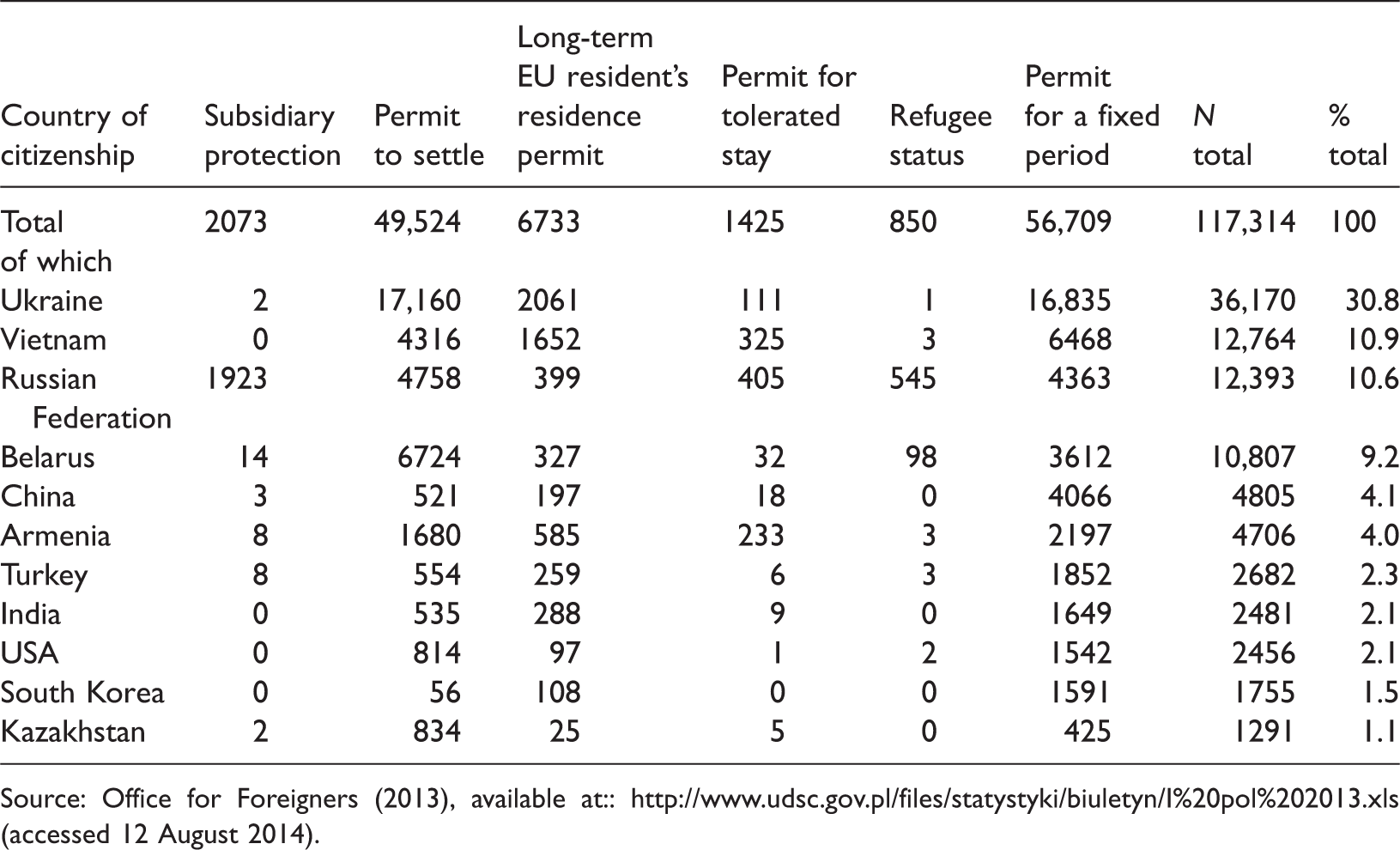
Source: Office for Foreigners (2013), available at:: http://www.udsc.gov.pl/files/statystyki/biuletyn/I%20pol%202013.xls (accessed 12 August 2014).
The response of Polish people and the Polish State to immigrants is mediated by the political, economic and social history of the country, and in the post-1989 period by the challenges of transition and accession to the EU (Burrell and Horschelmann, 2014; Horschelmann and Stenning, 2008). If we are to take seriously the need to consider integration as a two way process this specific context must be taken into account in the outcomes of integrative efforts. Sadowski (2007: 42) has argued that societies where cultural diversity increases as a result of implementing democracy are not usually prepared to cope with encountering difference. The lack of experience and socially acceptable models of reaction leads, according to some, to ‘defensive intolerance’ (Łodziński, 1990) that in the course of time turns into ‘façade tolerance’ (Krzemiński, 2007: 47). Nevertheless, in recent years public opinion polls (Centre for Public Opinion Research (CBOS), 2005, 2008) suggest that the acceptance of immigrants in Polish society has generally increased, although there is often a social expectation that immigrants will adapt (and assimilate into) to Polish norms and values (Nowicka and Łodziński, 2006).
Grzymała-Kazłowska and Weinar (2005) suggest that the official Polish approach to integration is a policy of assimilation via abandonment. There has been little co-ordination between agencies and until recently no single policy document or department has been responsible for dealing with the issue. In 2012 the Polish government released a Polish Migration Policy which states that ‘the integration of foreigners in Poland at present is not a significant political or social problem’ and ‘actions in regard to integration in Poland are at an initial stage of development’ (p. 70). The document focuses mainly on recommendations concerning the structural and systemic aspects of integration as well as counteracting potential discrimination. Concurrently, the Ministry of Labour and Social Policy is in the process of producing a ‘Polish Policy on the Integration of Foreigners’ which will take into account the social aspects of integration. It should be stressed however that policies concerning the integration of immigrants in Poland actually in force are selective and targeted exclusively at refugees and repatriates (Górny et al., 2012). While these policies are relatively comprehensive (at least on paper), including Polish language classes, financial assistance, health insurance contributions and help from a social worker, there are large groups of immigrants (such as undocumented migrants) who do not have access to these services.
In light of this deficit, an increasing number of NGO projects in Poland, and in Warsaw particularly, are focused on promoting intercultural contact and communication as part of social integration. As a consequence there is a network of activists and third sector actors working at the grass roots on integration, even as the Government is slow to take up this issue. In this context, we focus on a Warsaw-based NGO which runs a football league with the explicit aim of bringing Polish people and new immigrants together.
Methodology
The Football League project both promotes bonding connections with those from the participants' own communities (often defined here in terms of nationality), and bridges with others. Linkages may be fostered as a consequence of participation but are not a direct outcome of involvement. The aim, to use our terminology, is to engineer ‘integrative encounters’. Central to the project is a commitment to anti-racism, anti-sexism and anti-homophobia. The League was chosen as a case study because it is a space in which the organisers create the conditions of possibility for ‘integrative encounters’; it is a grass-roots project which does not target a particular immigrant status or nationality, and numbers of participants have been expanding rapidly.
Qualitative fieldwork took place over the course of the 2013 spring season (May-June), which was the fifth season of the tournament and the largest so far: 20 teams registered, consisting of 260 participants from 44 countries. The key rules of this tournament were that each team should consist of people of at least three nationalities and at least two women/two men. In this season the teams played on a school field in a peripheral district of Warsaw.
Thirty people took part in the research, which included two focus groups and 22 individual interviews. We also interviewed two of the organisers. In addition, around 12 hours of participant observation were conducted at the tournament and supplementary materials collected, as well as online activities related to the tournament monitored. As the focus of this study was on the experiences of majority citizens rather than immigrants in integrative encounters we focused on identifying Polish interviewees.
The participants were recruited by a member of the research team who is a native Polish speaker. Having established agreement from the organisers to carry out the research, she built up a relationship with players by spending an intensive period of time with them as they trained, played and socialised afterwards. The interviews were conducted in Polish, recorded, transcribed, translated into English and analysed using qualitative data analysis software. Other non-Polish members of the research team contributed to the analysis of the data. The research findings were presented at an international workshop on Sport for Dialogue organised by the League which resulted in the publication of a European good practice guide (Zaborowska, 2014).
Creating integrative encounters
Though Poland is rarely depicted as a country which is diverse the League was extremely so by any standard, with 44 nationalities registered in the season we undertook fieldwork, and others represented in earlier seasons, with various categories of status. Indeed, their stories resemble those of migrants across Europe and are not unique to Poland. For example, respondents told stories of fellow players from all over Africa, from Afghanistan, Chechnya, Georgia, Pakistan, Argentina, and India. One man came from the Congo on the promise of a football contract which did not exist, stranded, he started to teach dance. Another came to play in a band and stayed, working at an ice-cream parlour. Chechen refugees come from the shelter where they are housed by the State, and others from Iran, Iraq, Afghanistan and Pakistan, are thought likely to be refugees but rarely disclose their status to fellow football players. These stories at once complicate the image of Poland as a strictly homogenous society, as well as the idea that, following official statistics, Poland’s immigrant population is narrow and primarily of Slavic origin.
The organisers of the League were not interested in engaging with official categorisations assigned to migrants (undocumented, refugee, citizen, etc.). Rather, they questioned the migrant/citizen binary which is implicit in discussions of integration. The distinction between ‘host’ and ‘guest’ does not hold in the localised activities of the League (cf. Squire and Darling's, 2013 observation of the UK City of Sanctuary movement). Indeed, some players had partial Polish heritage or were married to Polish citizens. What is fostered, then, is an atmosphere of equality in which sporting ability provides the only basis for hierarchy, and bonds can be formed across lines of official distinction.
Of course, the ‘integrative encounters’ which are made possible within this context are both imbued with other power relations (around gender and race for example), and, importantly, cannot eschew state categorisations of immigrant and citizen. This approach has therefore at times come into conflict with the expectations of funders. Some grants or donations are given, on the condition that the status of migrants, or the nationality of all participants, is monitored. Here, the pragmatic necessity of obtaining funds has clashed with a broader ethos of eschewing official categorisations. This tension is clear in the following extract from an interview with one of the organisers: I think some of them [immigrants] don't want to sign anything. Some of them are probably in Poland illegally. That doesn't interest me, but for them it's mportant of course, and for a government office, it would be a problem that they're in some kind of ambiguous situation, they just don't want to reveal themselves…I know that a couple ran away from [the law], but not because they committed some crime, just because they were here illegally. So there's a group of people who hide. For example, a lot of Africans don't want to give their date of birth. (Male, Polish, 33)
It is significant that the interviewee suggests that staying in Poland illegally is not a crime. In doing so, he ignores the fact that staying illegally is an immigration offense, and one which Poland is under pressure to address as a European member state. Distinctions are made, implicitly contained in the tournament rules around diverse nationalities forming the membership of teams, and explicitly in the integration aims which form the core of the League’s purpose. Yet, while the organisers took a loose ‘migrant’/‘citizen’ approach to the categorisation of participants in the League, and focused more on cultural differences, the stakes were high for immigrant participants who risked being made visible to the State. In this regard, there were a number of stories of non-Polish participants who suddenly stopped playing through fear of surveillance. Yet, others clearly exploited ambiguities about their identities to participate: There were these situations where they were pretending to be someone else. Because there were two Afghan teams last year, AfghanPakistani, and they changed… I said: “You played at the last match”… last year we had a list because it was required for the project. And they signed for someone else. I said: “But what, are you pulling my leg? That's not you” “What do you mean, that's me”. They could dress as someone else, stubbornly insist that he's him even though I know perfectly well what that guy's name is… I mean, I don't imagine a Polish person doing that. Because he's an Afghan, so he can pretend that he doesn't understand what I'm saying to him. (Male, Polish, 33)
Polish participants, generally described non-Polish people either as ‘foreigners’, or in terms of their nationality. Whether they were conscious of the possible implications of the immigration status of their fellow players is not clear. What was evident, however, was that the League had a de-segregating effect by making migrants visible to Polish people who were often unused to encountering ‘difference' in their daily lives (cf. Piekut, 2012).
There is a body of literature which links sport to positive personal and community development (see Coakley, 2011). This suggests that outcomes are contingent and context specific. Often, the social capital (Putnam, 2000) formed in connection with sports is characterized by intragroup bonding rather than intergroup bridging (Coakley, 2011). As most people ‘naturally' seek out or cluster with those like themselves, the competitive nature of sport means that divisions risk being enhanced if teams are allowed to be mono-national. To prevent this, the League developed rules to reduce the possibility of only bonding capital being fostered. Namely, there must be at least two women on the pitch at all times (or two men if the team is female dominated), and the team must include at least three nationalities, though they do not need to be on the pitch simultaneously. In other words, it is not just enough to bring different groups together for ‘meaningful contact' to occur rather it is important that such encounters are structured and facilitated to ensure genuine engagement.
Our research found that many Polish people had little other opportunity aside from the League to encounter non-Polish people, unless their work was unusually multicultural (e.g. one worked for an NGO). Both residential concentration and segregation in other areas of life, such as at work, reduce the number of opportunities for many Polish people to meet ethnic minorities, which impedes integration (Vervoot and Dagevos, 2011). What arose from encounters with immigrants at the League were new ways of thinking, and categorising which questioned some of the participants’ previous assumptions. The two interview extracts below are indicative of Polish participants' reflections on how their attitudes changed as a consequence of being involved in the League:
Considering your experience here, has your perception of certain things changed?
I’ve never had any prejudices against people of different origins, religion or orientation. But the fact that foreigners live in Poland, for various reasons, I’ve become more familiar with that and it’s more tangible, there is an opportunity to have direct contact with these people, and find out about their problems and their situation. (Polish, male, 32) …people from different cultures and you, how to put it, I adjusted to them, you know, these are normal people…
Did you have contact with such people before?
With foreigners in general? No, not even in school or somewhere.
So it was the first time here?
My first change of attitude… It’s difficult to find understanding on the pitch because everyone played a match and took off. But later on you know, when there were presentations, or other activities then you were sitting and making friends […] it got easier. (Polish, male, 28)
Like the first interviewee, quoted above, not many respondents openly self-identified as prejudiced. This is not surprising as previous research suggests that the social stigma which has developed around this concept is so powerful that it is rare even for those with very negative attitudes to recognise themselves as such (Valentine et al., 2015). However, most participants suggested that diversity, in terms of cultural, ethnic, religious or racial difference had become more real to them as a consequence of their encounters in the League. While immigrants in Poland clearly have a great deal of opportunity to encounter Polish people, Polish people are less likely to have the opportunity to encounter immigrants. This is particularly the case for the non-traditional immigrant groups from Africa, Latin America and the Middle East. Where the integrative encounter was most beneficial, then, was in exposing Polish people to immigrants, and in starting to normalise their presence – with the possibility of forming cross-cultural friendships, and to educate them in some of the challenges faced by immigrants.
Not all Polish participants had ‘integrative encounters’ (see barriers below), but a number of accounts indicated that the League had been successful in this regard. For example, one organiser reflected on changes he had observed amongst participants who came to the League with very crude racist attitudes (which he explains through the use of the pejorative term ‘savages'): …there are some people who are less educated, they're kind of on the fringes of Warsaw, they don't have much education and they come from these environments […] these are football hooligan environments, so not so tolerant, and these people have changed since they took part [in the League] they're probably unaware that they're changing. When I think of two or three people, for example, that have contact with Africans, I think they kind of changed, I mean they stopped perceiving them as savages […they’ve] definitely changed. In the sense that they don't perceive them by their skin colour, they just have individual relationships. (Male, Polish, 33)
One of the individuals from the background to which this organiser (above) referred reflected on how his behaviour has changed and how he now reacts differently to banal forms of prejudice in his neighbourhood: Well, there's this trend in Poland for some, tongue-in-cheek, jokes, sexist ones about women, racist ones about black people. They're always tongue-in-cheek. Now these jokes are starting to irritate me more and more. Before it was like, well you know, a joke's a joke. No one takes it seriously […] And now the jokes are starting to irritate.
Do you bring that up with your friends?
[…] Even if I wanted to react, the response is always the same, leave it, they're just jokes, no one takes it seriously, right? But I definitely try to limit these jokes now. (Male, Polish, 23)
Here, it is clear that for this individual the experience of taking part in the League has involved ‘integrative encounters’ which have forced him to rethink his behaviours vis-à-vis immigrants, even though this challenges dominant ways of seeing the world in his social milieu. A key theme in our data was the perception amongst participants that football has the potential power to bring people together across difference, and that it is the fact that this is a football league which has facilitated its success. The sport itself in this sense facilitates the conditions or possibility for ‘integrative encounters’ because this common enterprise creates an emotional bond between participants which some likened to familial intimacy: …we come here to play. Football is kind of a connector in this initiative, people who are passionate come here and help this passion develop, some other people came, it’s nice they are totally different, different in quotation marks, of different nationality, different culture. It's a common idea, common development of skills, watching together and one big football family, that’s for sure. (Female, Polish, 32) …people who are hard, hooligan-like, you can see these people changing their attitudes, you notice that he gets on well with a black person and this must translate into his perception of other black people. And you can notice that some people, hooligans so to speak, who came here either to brawl, or to participate aggression in general, and it’s nice because I noticed that these tough people loosen up…Because this common passion, that is football, will connect us all (Female, 25, Polish)
While these participants claim that meaningful encounters in the League will be translated beyond this space into their wider social relations, we have no collaborative evidence to support this. Indeed, the interviewees' observations about the prejudical language and practices they have witnessed in spaces beyond the League (and from Polish people when they first join) suggest that wider societal change is a significant transformational project. Nonetheless, the data is indicative of the fact that such cross-cultural sporting encounters have the potential to foster a broader conceptualisation of Poland as a potentially multicultural space provided the personal transformations described here can be significantly scaled up over time. In the next section we reflect on some of the barriers to achieving change and possible solutions.
Barriers to integration
While the literature on integration has dealt, if not systematically, then implicitly, with immigrant motivations to engage with host communities (Recchi and Favell, 2009), the motivation to embrace encounters with difference amongst majority populations is something which has received remarkably little attention. In the context of superdiverse Western societies Amin (2012) suggests that some groups are more able to disengage from encounters with difference than others: living in gated communities, protected by surveillance technologies and avoiding public transit systems. In a national context where everyday encounters between Polish people and migrants are relatively uncommon we found the motivation to take part in organised activities to be critical to the success of ‘integrative encounters’. Yet, apathy or an indifference to difference was commonplace.
Some Polish interviewees wanted to take part in the League because they loved football and participation was free rather than because they intended to seek out intercultural encounters. They did not express prejudice towards non-Polish people in their interviews but they claimed to be uninterested in, or did not have time for, integration. As such, they exploited the opportunities provided by the League without embracing its ideals: [our team] treat [the League] as a way to play football, we are not looking for social contacts, I don’t know, it’s not because of some racist reasons, we just consider it a form of doing sport and a good opportunity, I don’t know, maybe it’s not fair, we take advantage of everything, this infrastructure, we don’t try to follow the ideal [the organisers] try to put forwards. (Female, Polish, 28)
Although, in keeping with the League's rules this participant plays for a team which contains three nationalities, these people all originate from other European countries and have lived in Poland for a long time, and so are relatively well integrated. In short, they are not the unintegrated immigrants with whom the organisers imagined Polish participants would form new bonds.
Another interviewee likewise observed that while bonding strongly within their own teams, nonetheless some participants failed to bridge out and to engage with ‘difference' within the broader framework of the League and its activities. There are teams which know each other very well, those which integrated before, and it’s so strong that it hinders integration with others. When matches end, they thank each other and go away to spend their spare time with other team members. (Male, Polish, 30)
Bridging ties are important for integration, however, because they provide almost unique opportunities for upward social mobility amongst migrants as well as increasing tolerance and reducing prejudice amongst majority citizens (Vervoort and Dagevos, 2011). If the desire to want to make contact with ‘others’ is a prerequisite for success within this kind of project, the central question is therefore how to foster such motivation amongst the majority population and maintain it in the form of commitment? In other words, how to break through apathy or disengagement given the incentives for bridging are lower for the majority population than immigrants in a context where everyday encounters with difference are still relatively uncommon.
Here, the research suggests that it is important to put the conditions of possibility for ‘integrative encounters’ in place. Rather than try to artificially induce or force relationships where individuals have little self-motivation to pursue intercultural encounters they must be allowed to emerge ‘spontaneously’ as this interviewee describes: There are Poles, they come at ten in the morning, even though they have their match at 3 in the afternoon, they grab some beer and barbeque equipment and integrate with others who have come earlier. They complement teams who don’t have players and it’s happening…I know more and more of them, it’s just spontaneous
But do you talk… in what circumstances do you get to know each other?
Yes. For example we sit, watch a match, comment and we get to know each other, next week it’s like: 'Oh hi, how are you, mate, how was your match? Oh good, one player is missing today, why don’t you play with us?' 'All right, nice, why not'. It’s spontaneous, nobody truly cares to meet somebody else, it’s just happening. (Male, Serbian/Polish, 28)
In this sense, the critical factor in stimulating ‘spontaneous integrative encounters’ to occur is the creation of an appropriate multicultural space which will attract diverse participants (albeit motivated by their different personal agendas) and which provides an appropriate framework – the conditions of possibility – for new forms of relationship to emerge.
One of the barriers to mixing identified in the literature is the language ability of immigrants (Halik, 2007; Van Oers et al., 2010). While the organiser of this League suggested that an inability to speak Polish was a barrier to communication and therefore integration, this was not an insurmountable problem in the context of football. Rather, he argued the solution was to find a shared language, even if that language was not Polish: Usually they speak different languages among themselves, even African languages. Of course, French, English and Russian, those are the basic languages, Spanish and Portuguese come up. But with us, well we speak Polish most often, for example, with the Latinos, many of them don't speak Polish, so we have to talk in Spanish or English…it's not that it's really an impassable barrier, just that it sometimes prevents people from making contact. (Male, Polish, 33)
Likewise, players argued language was rarely a barrier to communication in practice. Indeed, the spontaneous way players pooled linguistic skills in diverse teams represents an intercultural way of communicating. While others suggested that football itself was a universal language which needed no translation, and ‘naturally' facilitated a connection. You can communicate in English, a bit in Spanish, a bit in French. And I translate when guys from Spain were swearing, he translated it to us [laughs]...in general, there are no problems. (Ukrainian, male, 22)
But on the pitch, normally people usually speak Polish, right, so do you understand each other or does it vary?
Usually. There are players who don't understand Polish, but there's no problem then. The language of football is universal, after all. (Polish, male, 23)
Language was a barrier to integration in terms of the Polish players' perceptions that immigrants intentionally self-segregated into their own language communities. While, immigrants of all backgrounds are often required to perform a balancing act between integration and maintaining transnational ties (Erdal and Oeppen, 2013), other studies (Phillips, 2010) have also suggested that language use can be read as a sign of cultural distance and a lack of willingness to integrate. There are also those who don't try to assimilate at all. They keep to their own group, only speak in their own language. Well, and it's hard to get close to them, maybe there's a bit of fear around them, people worry about approaching them because as far as I know, they're not too friendly towards Poles. (Polish, male, 23) I wonder if broader culture is significant here. I think that sometimes you feel this distance…it varies, but let's say to Vietnamese or Chechens. Well people feel like it's harder to enter their group, they keep to themselves. Even the Latinos, they keep to themselves, speak Spanish among themselves. And actually you don't know, how to approach them and what to talk about. So, when people meet individually then yes, but often the whole team comes to the match so then it's harder to make contact with each other in that kind of situation. (Male, Polish, 33)
What these discussions importantly bring out are educational disparities in terms of the ability of Polish people to communicate, and therefore integrate with, non-Polish residents. Those who spoke not only their native Polish but also English and possibly one or more other European language were at a distinct advantage. For those who were not from a socio-or educational context in which they were accustomed to language diversity, nor expected to have second language ability, the problems created by immigrants’ lack of Polish were heightened. There are clearly implications for integration here, in terms of the differential capabilities of individuals and groups to engage in organised encounters. Activities like the League can bring different groups together who would not normally have the opportunity to meet and create the possibility for intercultural dialogue and understanding to develop, but they cannot overcome structural inequalities (e.g. differential educational opportunities) between immigrants and majority communities (see also Phillips et al., 2014).
Conclusion
This article has investigated ‘integrative encounters’ between immigrants and Polish people in Warsaw. Rather than focus primarily on accounts of new arrivals we have paid attention to the integration experiences of the host population in recognition that this is a group who have been neglected in academic literatures (on migration and on sport) to-date. Moreover, while previous research has suggested that the potential for settled populations to accommodate newcomers varies by locality because of the specificity of local histories and politics, much less attention has been paid to differences in the reception conditions in non-Western European contexts. To-date most work has focused on post-colonial Western European societies with long and complex migration histories who are considered to be ‘super-diverse'. Post-socialist European societies, such as Poland, where population mobility was circumscribed during the communist era and as a consequence became perceived as relatively homogenous but which are now seeing a rise in new immigration, have been largely neglected by non-domestic scholars. Yet, the response of countries like Poland (where cultural diversity is increasing as a result of implementing democracy) to a growth in immigration will not necessarily follow that of European countries with a colonial history.
Berg and Sigona (2014) have pointed out that there are three diversity tropes. Diversity as a public narrative (usually celebrated as a positive); as policy (i.e. initiatives to manage equality and social cohesion) and as social fact (in terms of the characteristics of the population). Following accession to the EU in 2004, Poland has acknowledged diversity as a public narrative and in policy terms. European anti-discrimination directives have been implemented, in 2011 an Act on Equal Treatment was also introduced, and the Office of the Ombudsman was established in the role of an equality body (Bojarski, 2011). Yet, diversity is not yet a social fact. Difference is not very obvious in public and institutional spaces. Many of the Polish interviewees had little contact with immigrants in their personal biographies or daily lives, and consequently had little consciousness of Poland as a country where immigrants from outside of Europe, broadly conceived, would settle. While few approached ‘immigrants’ as a negative category, as interviewees in some other European counties might, they expressed surprise that their own sense of Poland would need to be rethought in this new circumstance. In the Polish context therefore purposeful, organised group activity is a particularly important means to provide the established population with an opportunity to encounter immigrants and to promote integration, precisely because such encounters are less likely to occur through chance in everyday spaces.
Research in the UK has suggested that the neighbourhood is an important scale at which to promote such bridge-building between settled and migrant populations because it is the site where difference is most commonly negotiated and through which shared concerns about the local environment and aspirations for its future can become a foci for organised efforts to work together. Yet, in the Polish context where immigrants are not as numerous nor as concentrated into specific localities, the neighbourhood is a less effective scale at which to establish such purposeful activities. Rather, integration initiatives are more appropriately co-ordinated at a city-wide scale.
The motivation to embrace encounters with difference amongst majority populations is something which has received little attention in the academic literature. Yet, it is a particularly important factor in the Polish context where such encounters are rare in everyday spaces, and so opportunities for what we term ‘integrative encounters' must be deliberately sought out in the city, but where the incentives for engaging in such ‘bridging' activities are much lower for the majority population than new migrants. We found apathy or indifference to difference was commonplace amongst our interviewees. It was the attraction of the activity – football – rather than the encounter which motivated members of the host society to become involved.
In this sense, we understand our case study of ‘integrative encounters' to be spontaneous. That is they emerged as a product of the participants' self-motivated, and shared, desires to play football, rather than being artificially induced as a consequence of the more contrived activities of the League. As such, the evidence of our research is that in contexts where individuals have little self-motivation to pursue intercultural encounters attempts to stimulate them need to be predicated on creating spaces for spontaneity which motivate diverse people to engage with each other because they appeal to shared interests, rather than just because they offer a simulated opportunity to encounter difference. Moreover, we argue that such spontaneity can be supported in contrived projects provided space for sociality is facilitated alongside more managed or formal activities.
This research makes an innovative contribution to literatures on integration, geographies of encounter and sport by evidencing the ability of football to provide the conditions of possibility necessary for spontaneous integrative encounters to take place. Namely, it is a transnational sport which provides, in effect, a universal language. Participants from most countries of the world understand its rules, there are shared terms of reference given football's global nature (e.g. players they admire or clubs they follow), and a common passion for the game. Football attracts a cross-section of the population with a range of social attitudes rather than only those predisposed to engaging across ‘difference’. It is relatively cheap and easy to facilitate – which is significant given other studies have highlighted cost and organisational difficulties as barriers to establishing successful integration projects (e.g. Phillips et al., 2014). Football's team-based nature promotes mutuality or bonding around a common goal – the desire to win – which can overcome perceived differences and the complexity of identifications between participants. Finally, a league structure creates continuity by establishing regular and repetitive encounters (within a season, and over seasons) which are facilitated or managed in controlled circumstances but alongside this it provides space for sociality during training, in the dressing room, in post-match celebrations and on the pitch side amongst spectators.
Our research provides an evidence base that ‘integrative encounters’ do have the power to break down preconceived notions of ‘otherness’ amongst populations less familiar with immigration, and can certainly facilitate relationships which move beyond ‘façade tolerance’. For example, we identified Polish language and cultural acquisition on the part of immigrants, as well as a new-found consciousness of, and knowledge about diversity amongst the host population and friendships developing which bridged ‘differences'. Although, it is also important to acknowledge that wider structural constraints (e.g. educational or socio-economic inequalities) and unfavourable dynamics of power between migrant and established groups can undermine or hinder the possible long-term effectiveness of intercultural social projects (Phillips et al., 2014).
In sum, our findings have clear implications for nascent integration policies in post-socialist countries like Poland, highlighting the importance of strategies to foster ‘spontaneous’ integrative encounters between residents and immigrants as numbers increase and nationalities diversify.
Footnotes
Acknowledgments
We wish to thank Jamie Peck and the three anonymous referees for their very helpful comments on the original manuscript.
Declaration of conflicting interests
The author(s) declared no potential conflicts of interest with respect to the research, authorship, and/or publication of this article.
Funding
The author(s) disclosed receipt of the following financial support for the research, authorship, and/or publication of this article: the European Research Council which funded this research through an Advanced Investigator Award to Gill Valentine (grant agreement no. 249658) entitled Living with Difference in Europe: making communities out of strangers in an era of supermobility and superdiversity.