



Abstract
In this article, I express profound scepticism about recent theories that de-emphasise the centrality of procreation and shared blood in the determination of kinship. These theorists posit that in many ethnographic situations the incarnation of spirits, the sharing of names, coming of age in the same house, and joint consumption of certain foods may be more important criteria. Contra these theorists I suggest that these are more likely to be complementary than alternative modes of relatedness. The challenge is to conceptualise their coexistence. Ethnographically, I explore how blood, spirits and names interweave in the social biography of the Monareng family in the South African Lowveld. I show that while kinship was modelled on an ideology of descent and shared blood, connections were also forged through the reincarnation of ancestors within children and through naming. These spiritual modes of relatedness reinforced the credentials of marginal kin to lineage membership. I also highlight the salience of witchcraft as the ‘dark side of kinship’. Whereas the invocation of ancestors connected individuals to lineages, the accusation of in-marrying wives of witchcraft disconnected people and led to the segmentation of lineages. My analysis concludes by reconceptualising the concepts of the lineage. In contemporary South Africa, as elsewhere, it is more appropriate to conceptualise the lineage as a line on a map of social relations than as a corporate grouping.
In 1968, David Schneider challenged the central premise of descent-based theories, which had, until then, been predominant to understanding kinship. Based on the pathbreaking work of British social anthropologists, these theories relied to great extent upon field research in Africa, where they had significant analytic power. In his cultural account of kinship in the United States, Schneider (1968) claims that sex and blood are more significant as symbols than substances. As symbols, they stand for ‘erotic’ and ‘cognatic’ love and represent ‘enduring and diffuse solidarity’. He argues that the acceptance of adopted children is premised on the American valorisation of culture over nature. Schneider (1984) later argued that societies such as the Yap of Micronesia did not have kinship in the Western sense. The Yap believed that men had nothing to do with procreation. Instead, ghosts of dead members of landholding groups gave children life. People did not claim rights to these groups through descent but rather by working the land and consuming its products.
Schneider’s cultural analysis of kinship has proved extremely influential. Anthropologists observed that in the societies of South Asia, Alaska and Oceania common residence, shared names and the joint consumption of food appeared to have greater salience in determining relatedness than shared blood. Carsten (1993) maintains that the Malay of Lankjani Island became related by growing up together in the same house, drinking milk from the same woman’s breasts, and jointly eating hot rice. Bodenhorn (2000) observes that for North Slope Inuit names have greater force than natal bonds, and children become part of the families of their namesakes. Bamford (2009) argues that in some New Guinean societies, relatives were those who consumed grease and fat from the same soil. The father’s semen, the mother’s breast milk, and food such as pork and sweet potatoes alike conveyed these substances (Bamford, 2009). In addition, the study of the role of new reproductive technologies in kinship broadened the need for new categories (Carsten, 2004).
Towards the end of his extraordinary productive career, Sahlins (2013) sought a theoretical redefinition of kinship. Though less radical, his approach is largely sympathetic to that of Schneider. Like Carsten (1993), he does not wholly reject kinship but defines it more flexibly. Rather than assume that kinship is based on procreation and biology, he argues, we should begin with emic categories of relatedness. Drawing on the above-mentioned cases, he argues, that kinship implies a ‘mutuality of being’ and sharing of a ‘common substance’. Identity is not confined to the limits of the self: persons are divisible and distributed among others and at the same time, persons incorporate aspects of others. Hence, there is a sense of interdependence and participation, as evident in the sharing of existence, behaviour, appearance and speech (Sahlins, 2013).
Like earlier critics (Kuper, 1999, 2018; Scheffler, 2001), I believe this line of argument goes too far in exorcising biology from kinship. 1 I remain unconvinced that notions of procreation and blood were absent from any of the ethnographic situations Schneider (1984) and Sahlins (2013) describe. 2 For me, a much older debate on the nature of kinship illuminates present concerns. In response to Malinowski’s (1913, 1922, 1927) claim that Australian Aboriginal people and Trobriand Islanders were ‘ignorant of paternity’, Alfred Radcliffe-Brown (previously Brown, 1912; Radcliffe-Brown, 1938) 3 argues that the belief that women became pregnant because spirits entered their wombs did not preclude people from connecting coitus and pregnancy. He observes that Australian Aboriginal people associated pregnancy with the life-giving power of rain and with food, dreams, ancestors, and totemic rituals to multiply babies. This notion of multiple causes was also evident among Catholics, who believed in spiritual creation but did not deny that pregnancy resulted from the fertilisation of an ovum by spermatozoa. ‘What consistencies and inconsistencies there are must be studied in the minds of natives, not in terms of our conceptions’ (Radcliffe-Brown, 1938: 264). 4
The lesson I take from Radcliffe-Brown’s intervention is that different modes of relatedness are more likely to be complementary than alternative possibilities. This is especially so in Southern Africa, where I believe, descent-based theory still has considerable explanatory value. In this article, I contribute to this line of argument by exploring how blood, spirits and names interweave in the ‘social biography’ (Werbner, 1991) of the Monareng family in Bushbuckridge, South Africa. My account is based on multi-temporal research in the village of Impalahoek and on interviews and conversations with several lineage members since 1990. Impalahoek 5 has a population of about 24,000 Northern Sotho and Shangaan speakers. During the era of apartheid, Bushbuckridge formed part of the ethnic-national ‘homelands’ of Lebowa and Gazankulu. Households relied on remittances sent home by migrants employed in South Africa’s mining and industrial centres. After South Africa’s first democratic elections in 1994, Bushbuckridge became a municipality in the newly constituted Mpumalanga Province. Democratic governance facilitated the growth of a small middle class and has brought shopping malls, social housing, and improved welfare. But villagers also had to contend with the HIV/AIDS pandemic, with de-industrialisation and job losses. Impalahoek still had a distinctive rural appearance. Roads were of gravel and sand and were poorly maintained. There was no garbage removal system, and homes were likelier to have fridges and television sets than on-site water and sewerage. Goats grazed on unoccupied residential stands and cattle on grass on the outskirts of the village.
Residents of Bushbuckridge modelled kinship and on procreation and blood and derived kin terms from the person’s position in a descent-based structure. As elsewhere in South Africa, children were never illegitimate: they belonged to the mother’s father’s lineage with the mother’s brother (malome) as their guardian, but where bridewealth had passed, they affiliated to the father’s lineage (Kuper, 1982a). Descent is thus, in a qualified sense, patrilineal. Only in the rare cases where the identity of the man who paid bridewealth diverged from the progenitor, did a social arrangement over-ride a blood relationship. 6 One indication of the tenacity of biological descent is the disapproval of Western-style adoptions. In our conversations about this topic, research participants often cited the proverb: ‘A cow does not lick another cow’s calf’ (Kgomo ga e letswe namanne ga a ngwa). This means that one should only care for related children. I obtained information about 63 AIDS orphans whose parents died during the HIV/AIDS pandemic. Only one orphan was cared for by a friend of the deceased mother; 10 were fostered by older siblings, 9 by paternal kin, and 43 by maternal kin (Niehaus, 2018: 142). The diffusion of parenthood between uterine siblings facilitated such fostering. The Northern Sotho model of kinship is classificatory, with the father’s brothers called ‘younger-’ or ‘older father’ (rangwane or ramogolo), and the mother’s sisters called ‘younger’ and ‘older mother’ (mangwane or mamogolo) (Niehaus, 2018: 134–5). In rare cases, such as incestuous marriages between distantly related kin, residents could ritually undo the blood relations. To remedy this situation, the couple slaughtered a goat, knelt on either side of the kitchen door and tore apart the bloody goat’s liver with their teeth.
In addition to ties of blood, relations were constructed through the reincarnation of ancestors and through naming. A baby’s incessant crying might indicate that the spirit of a forgotten ancestor wants to manifest in their body. In this case, a diviner would determine the ancestor’s identity, and the parents would name the baby after them. Such naming forged a special bond between the child and the ancestor: the child would assume the ancestor’s personality and the ancestor’s spirit would protect the child (Niehaus, 2012: 32). The spiritual relationship coexists with ties of blood.
My analysis of the biography of the Monareng family also highlights the salient and recurring presence of witchcraft as a ‘dark side of kinship’ (Geschiere, 2013). In local nomenclature, witchcraft (loya) denotes the perpetration of harm by mystical means. Villagers believed that witches attacked by using poisons and potions and by sending familiars such as the ape-like tokolotši and snake-like mamlambo to attack and sexually molest kin and neighbours. They also asserted that there was a biological aspect to witchcraft: that witchcraft was located in the blood, and that children inherited it from the mother (Niehaus, 2001: 25). Although witchcraft was an invisible source of malevolence, accusations of witchcraft had visible and profound social effects. While the invocation of ancestors could forge connections between kin, accusations of witchcraft were bids to disconnect kin and split lineages into smaller segments.
The descendants of Kgerišhe and Khaledi Monareng
Senior members of the Monareng family told me that Phelephele, Mthatnyane, and Shai were the first three male ancestors in their lineage. But beyond reference to their names, they could not recall any details of their lives. The first memories are those of Shai’s son, Kgerišhe, from whom many Monareng residents of villages and towns in northeast South Africa and of cities in Gauteng claimed descent. Kgerišhe was reportedly born in the latter half of the nineteenth century and was remembered for his fierceness rather than kindness and generosity. Kgerišhe, I was told, was ill-tempered and cruel. When his young sister eloped with a young man, he beat her so severely with a stick that she succumbed to the wounds. Police arrested Kgerišhe and imprisoned him in the colonial settlement, Sabie. But Kgerišhe’s only surviving sister pleaded with the authorities to release him, threatening to starve herself to death. Her appeal was reportedly successful, but other factors, not mentioned in these narratives, might have been decisive in their decision to release her brother.
Kgerišhe married two wives and fathered eight children. His senior wife, Khaledi, was always secretive about her origins. However, she once told her oldest daughter she was a BaChopi from the Mozambique/Malawi borderland. When Khaledi returned from the girl’s initiation, she found that her parents had been displaced by war (possibly the Luzo-Gaza war at the end of the nineteenth century). Khaledi travelled far, unsuccessfully searching for them. Eventually, she became a servant for the household of Santjane Maatsie, an unrelated man living near Tzaneen. Men often married women refugees as secondary wives, but Santjane considered Khaledi to be too young to be his wife. Kgerišhe met Santjane when he visited Tzaneen and paid him bridewealth so that Khaledi could become his first wife (Figure 1). The descendants of Phelephele Monageng.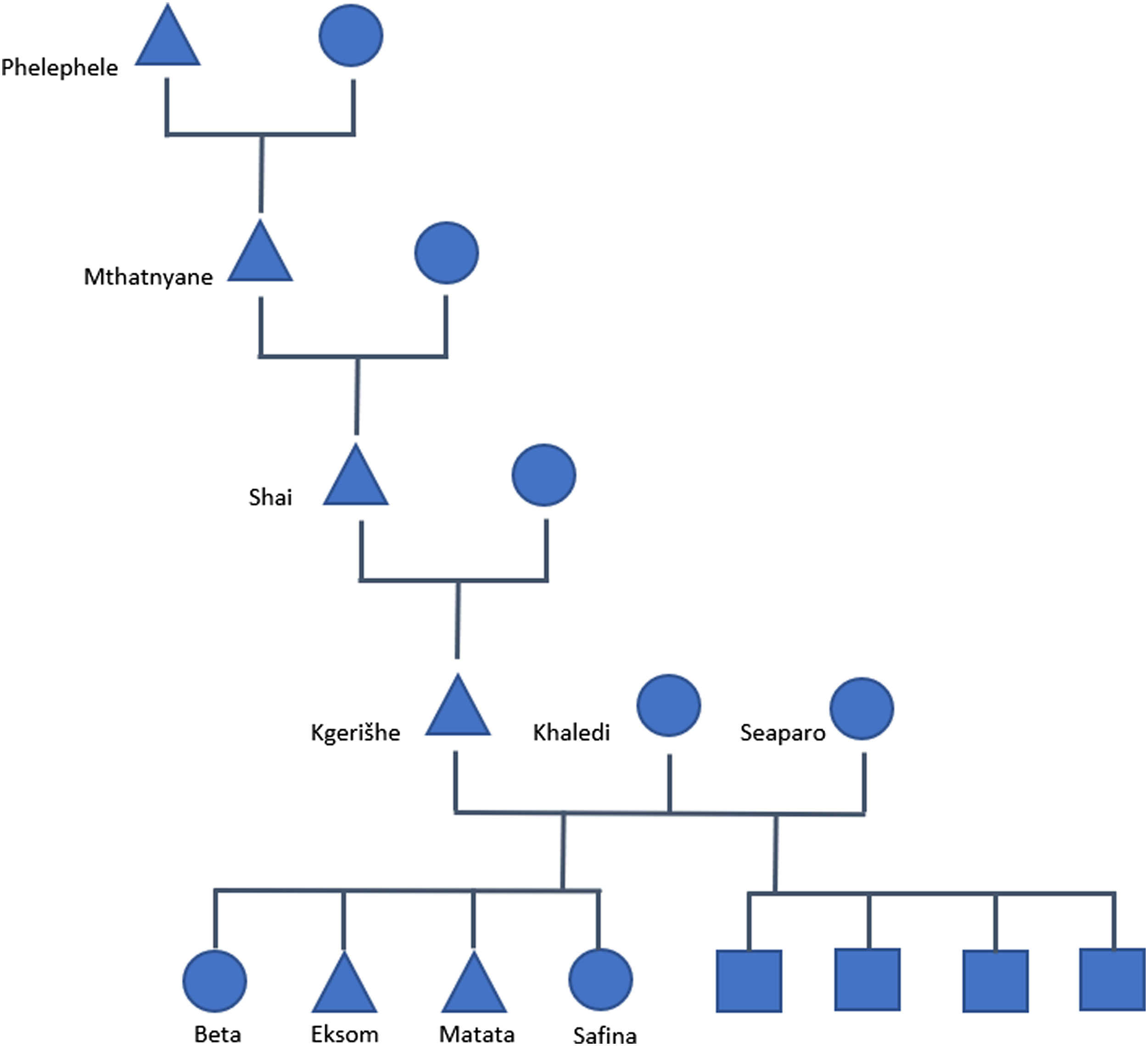
Khaledi was dark, and large holes decorated her earlobes. She is remembered as quiet, humble, resilient and hardworking. She could reportedly hoe for an entire day, resting only once to drink water. Kgerišhe’s second wife, Seaparo, was known more for her beauty, and he was exceptionally jealous of her. He reportedly beat any man who approached her and slapped her if she displayed the slightest interest in them. On these occasions, Seaparo would return to her parents’ home, and Kgerišhe would plead for forgiveness and slaughter a cow to entice her to return.
Kgerišhe lived as a rent tenant in Bushbuckridge, an area then reserved for the exclusive occupation of black people under the provisions of the 1913 Land Act. He kept a large cattle herd, and each of his wives had their own homes, gardens, and maize fields. However, he and Khaledi were more renowned as ritual experts than as farmers. He fortified circumcision lodges against witchcraft, and she worked as a diviner and herbalist. She also tutored numerous apprentices (matwasane) in the arts of healing.
In the 1930s Kgerišhe left his wives and became a wage labourer on Fleur De Lys, a large commercial citrus farm owned by a wealthy Englishman. At the time, subsistence farming had become increasingly difficult. Hundreds of households, displaced by the creation of game reserves in the east, the afforestation of mountain slopes in the west, and the mechanisation of white-owned commercial farms in the north, moved into Bushbuckridge (Carruthers, 1989; Harries, 1989; Niehaus, 2001). These migrations brought great pressure to bear on rural resources. Kgerišhe now stayed on a labour compound on the farm and only occasionally visited his wives and children in the reserve.
In his absence, Khaledi moved into the home of her youngest son, Matata, near present-day Ludlow. While Matata worked on the Pilgrim’s Rest gold mines, Khaledi helped his wife raise their children. However, in 1948 Matata died after complaining of excruciating stomach and chest pains. Khaledi accused her daughter-in-law of having bewitched her son with sejeso, a potent poison, and relocated to the household of her oldest son, Eksom. This accusation effectively split Kgerišhe’s lineage. Neither Khaledi, nor Eksom’s children again set foot in Ludlow, and they were completely alienated from Matata’s descendants. Kgerišhe died in 1952, and the family had to wait three days for Eksom to return from work for the funeral. While waiting, they used river sand and wet hessian bags to cool his corpse. They buried Kgerišhe on Fleur De Lys under a large tree not far from the national road. Khaledi followed her husband to the spiritual realm in 1966. Following BaChopi custom, Eksom wrapped her corpse in cowhide and buried her in the centre of his cattle kraal.
The descendants of Josephina and Eksom Monareng, 1952–1971
Eksom was substantially wealthier than his father – not only in money and cattle but also in people. He headed a large agnatic cluster at Metsi Mogoro (‘rusty water’). Eksom worked throughout his adult life – as a general labourer on the Pilgrim’s Rest mines, driver on Fleur De Lys, and later as leader of a team of road construction workers. Despite doing menial jobs in an economy governed by white men, he enjoyed considerable status at home and urged his children to study earnestly and work hard so that they did not have to rely on government handouts like white railway workers.
Like his father, Eksom married two wives. His senior wife, Josephina Shubane, bore nine children (seven sons and two daughters), and his junior wife, Letty Mashego, three (two sons and one daughter). But even before her first pregnancy, Josephina began to foster her deceased sister’s six-year-old boy, Toni, and three-year-old girl, Bafatiye. Toni and Bafatiye’s father suffered from mental sickness and could not take care of them.
Eksom built extraordinarily large kraals, which, at one stage, sheltered about sixty cattle and more than one hundred goats. During winter months, the household left their cattle at large. From May to June, they grazed on dry maize stalks in the fields and from July to September on grass next to the riverbanks. During October, Josephina’s sons and foster children used a team of six oxen to plough their father’s maize field. Then, during summer, from November through to April, the young men herded the cattle further afield to ensure that they did not destroy people’s fields and gardens (Figure 2). The descendants of Eksom Monageng.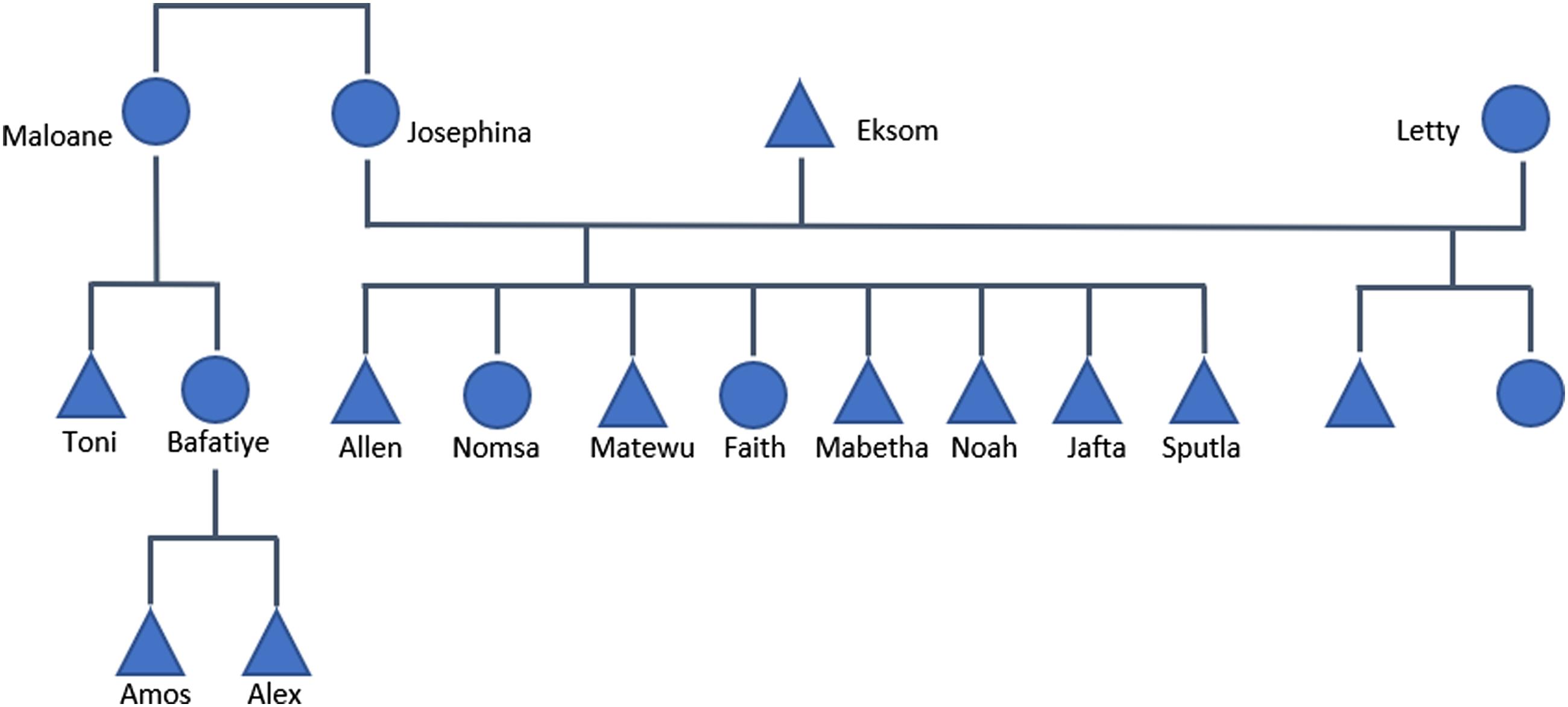
Farming was a profitable corporate enterprise. Eksom’s cattle produced about twenty gallons of milk each day. The young men gave some to nearby relatives and neighbours and used the rest to make fermented, sour milk. Eksom’s sons also transported up to ten wagonloads of cattle manure to fertilise their fields. He once sold a white farmer 30 goats to reduce their number and, on another occasion, three large truckloads of cow dung.
Agricultural labour was divided by degrees of biological relatedness. Josephina’s sister’s son, Toni, herded Eksom’s cattle while her children attended school. He later worked for wages on a white-owned commercial farm and was murdered by thieves in 1961. Toni never married and bore no children, so his herding duties devolved to his sister’s sons, Amos and Alex. They preferred to live with Josephina, their maternal aunt (MMZ) rather than with their father, a migrant labourer in Gauteng. Amos and Alex incorrectly had the name Monareng recorded in their identity documents and, when not herding cattle, attended school with Josephina’s younger sons.
In a drastic break from his father’s worldview, Eksom converted to the Zion Christian Church (ZCC) after ministers cured his second wife, Letty, of sickness. He later co-founded a church congregation. As a Christian modernist, Eksom refrained from sacrificing to the ancestors. Instead, in times of misfortune, he organised all-night prayers called mpogo. On these occasions, the local congregation assembled at his home to sing hymns, dance, and pray that his family may be reconciled with God and their ancestors. Eksom would slaughter a blessed beast in the morning, but this was only to feed the congregants.
From Metsi Mgoro to Impalahoek, 1971–2008
In 1971, officials of the Native Affairs Department relocated the Monareng household from Metsi Mogoro to Impalahoek, 3 kilometres away. This was under the apartheid government’s agricultural betterment schemes, reorganising the use of land in the ‘homelands’ (De Wet, 1995). Native Affairs officials demarcated residential stands, arable areas, and grazing camps in the reserves and prohibited individual households from owning more than ten cattle (Niehaus, 2001). Eksom obtained six adjacent stands, one for each of his sons, who were all married by now; and a new field, which was much smaller than the one at Metsi Mokgoro. Eksom and Josephina constructed a small, corrugated, iron-roofed home on the stand of their third-born son, Mabetha, and Amos and Alex lived in the home of Josephina’s second-born son, Matewu. This new agnatic cluster kept cattle and goats as corporate assets. Their field only took three days to plough. This gave Eksom’s sons enough time to also plough the fields of Josephina’s sister, their sister Nomsa, who resided elsewhere in Impalahoek, and of their herd boy’s father.
Eksom died in 1977, and his sons demolished his small homestead and built a new thatched-roofed house for Josephina and her sister. The sister previously resided with her daughter, but found her son-in-law impertinent and rude. Josephina died from bowel cancer in 1982. Allen, Matewu, Mabetha, and Sputla continued to reside in their stands with their wives. Allen and Matewu became migrant labourers, Mabetha a primary school teacher, and Sputla a technician at a nearby sawmill. But Jafta and Noah both left the agnatic cluster. Jafta obtained work as a traffic official at Phalaborwa, a copper mining town about 120 kilometres north, and Noah, a bank teller, obtained an independent residential site, in another village section. Amos and Alex left Imapalahoek, and severed all ties with the Monareng family.
Over time, corporate assets diminished. There were 40 cattle when Eksom died, and when Beselina died there were still 30. But in 1986, 15 cattle disappeared. The Monareng sons searched all grazing areas with a van and blew whistles, the sound of which they hoped the cattle would recognise, but found only one decaying cow head. They concluded that a prosperous butcher had stolen their cattle. Later, three more cows disappeared, a truck killed another, and the family slaughtered another at their aunt’s funeral. By 2002, the family loaned out their last two cows to a neighbour since no Monareng children wished to herd them. Without cattle, their fields went unploughed, and agriculture ceased to be a source of income.
In this context, joint participation in family associations and death rituals became essential to creating agnatic solidarity. During the 1990s, those who bore the Monareng surname formed a clan association. Its members wore red skipper shirts decorated with an emblem of a buffalo (their totem), relayed myths about their ancestors, and discussed matters of mutual aid. Ben Monareng, a former lecturer at a Teacher’s College, chaired the association and implored all members to support the enterprises of Monareng businesspeople. Eksom and Josephina’s descendants also formed a family burial society. The society held a corporate bank account to assist bereaved persons financially, did all the cooking at funerals, and formed a special choir to sing hymns.
Josephina’s children were still devout church members and occasionally held all-night prayers. However, they also paid greater attention to their ancestors than their parents did. In compliance with government legislation, the Monareng sons buried Eksom and Josephina in the village graveyard. This accorded with ZCC practice, which posited that home burials might pollute the stands of surviving kin. Although the Monageng children regularly visited their parent’s graves, they could not locate those of their grandparents, Kgerišhe and Khaledi. They no longer visited Fleur De Lys and could not recall the location of the cattle kraal where their father had buried his mother. In 1971, Eksom brought poles from the kraal to Impalahoek, and termites destroyed the remaining ones. Some grandchildren wished to build a tombstone for Khaledi at Metsi Mokgoro. Others argued that they should exhume and rebury her remains in the Impalahoek graveyard. They dug for her remains after the summer rains but found only red soil.
While Eksom gave his children biblical names, his sons and daughters often named their restless babies after their ancestors. Allen named his second-born son Mabunda (the name of Khaledi’s father) and his third-born son Kgerišhe; Faith and Noah both called their daughters Khaledi; Matewu, his son, Eksom; and Mabetha his daughter, Josephina. The ancestors also manifested in the dreams of their descendants. For example, when Mabetha’s youngest son, Thabo, was fourteen years old, he dreamed that an elderly man stood in his parent’s yard. The man carried a walking stick and wore khaki shorts and an oversized coat. The man asked Thabo, ‘Do you know me?’, laughed and walked away. Thabo’s mother told him that the man was his grandfather, Eksom. This experience prompted Thabo to be baptised in the ZCC. After that, he occasionally heard Eksom’s voice, giving instructions.
The Monareng children tended to see ancestral displeasure as a source of personal misfortune. This was particularly evident during the national presidencies of Nelson Mandela (1994–98) and Thabo Mbeki (1999–2008) when, despite democratisation and sustained economic growth, expectations of prosperity failed to materialise. In 2000, a Christian prophet instructed Allen’s daughter, Rita, Matewu’s daughter, Doris, and Mabetha’s daughter, Faith, to acquire cattle for Eksom and build a new home for Josephina. He said the family should not have demolished her home but should have allowed it to decay naturally. Although Rita was employed by the Independent Electoral Commission (IEC) and lived in a comfortable home with her husband, she experienced many misfortunes. She suffered miscarriages, and her husband assaulted her and refused to support their children. In addition, thugs robbed her of R700 and an expensive smartphone. These instructions reminded the three young women, who were all married, of the security they could find among agnatic kin.
After having left the Monareng family, Amos and Alex experienced great difficulties. Amos was dismissed from work, Alex suffered from severe alcoholism, and many of their children could not find employment. A diviner revealed that they experienced misfortune because they failed to thank Josephina for having taken care of them and left her home without saying farewell. In 2006, the two brothers visited her grave, apologised for their past indiscretions, and gave their cousins two calves as a token of gratitude. They also sponsored a feast, providing her descendants beef, maize porridge, vegetables, and drinks.
Lucky, Allen’s third son qualified as a panel beater at a trade school, married, and fathered a child. But in 2003, he was twice imprisoned in White River, first for fighting with a security guard at a fruit market and second after being misidentified as a rapist. Fortunately, police released Lucky before the trial, presumably because they lost his docket. Lucky’s wife and child left him the following year, and he was dismissed from work for insulting his employer.
Feeling depressed and suicidal, Lucky returned to his father’s home in Impalahoek in 2006. Here he built a one-room home in the backyard for Mabunda (his FFMF), occupied it, and purposefully kept it sparsely furnished. But Lucky was still plagued by nightmares. In one dream, a python wrapped itself around his body and squeezed all air from his lungs. In another, he stood with Kgerišhe, next to Kgerišhe’s grave. Lucky’s dreams convinced him to construct a shrine for his great-grandfather (FFF).
In 2010, the Monareng family decided to fetch Kgerišhe’s spirit from Fleur De Lys. Fortunately, a son of Kgerišhe’s second wife, Seaparo, could pinpoint the precise location of his grave. After obtaining permission from the current farm owner, Allen slaughtered a goat beside the tombstone. They gathered its blood in an enamel basin, poured some onto the grave, and rubbed some onto its hide. Allen then asked Kgerišhe’s spirit to accompany them, wrapped the spirit in the goat’s hide and white cloth, and transported it to Impalahoek in a van. Upon arrival at Allen’s home, Lucky held the hide and cloth in his arms and crawled from the gate to Mabunda’s room. The next day at sunrise, he buried the goat’s hide beneath a marula tree, and, in the afternoon, the family roasted and ate the goat’s meat.
After relocating Kgerišhe’s spirit, Lucky re-established contact with his wife and daughter and obtained a business licence to do panel beating. He cultivated a small cannabis garden and regularly smoked weed next to Kgerišhe’s shrine. ‘Kgerišhe’, he said, ‘smokes with me.’ Each year, Lucky cleansed the shrine and placed sorghum beer next to it.
The descendants of Martha and Mabetha Monareng, 2009–24
There were, however, simmering tensions beneath the appearance of agnatic solidarity. The tensions were not between Eksom and Josephina’s sons, who were of the same blood, but between their wives. Allen’s wife, Lofi, and Matewu’s wife, Kedibone, resented Mabetha for marrying Martha Mnisi, rather than one of their sisters. They were also envious that Eksom and Josephina chose to live on Martha’s residential stand. Josephina once warned Martha that Lofi’s mother had a reputation for practising witchcraft. In 1986, when the Comrades (young members of the national liberation movements) burnt the homes of alleged witches throughout Bushbuckridge (Niehaus, 2001; Ritchken, 1995), Lofi and Kedibone fled. This was seen as evidence of their culpability. Years later, Martha heard strange noises on her rooftop at night, and after Mabetha bought a WiFi, his children suffered mysterious sickness. A diviner told Martha ‘There’s a noise at your house! Neighbours are listening! Watch out! Witches are on your heels!’
The loss of the Monareng cattle exacerbated these tensions. Lofi and Kedibone blamed Martha’s sons for failing to herd them. Later, when Allen worked as a migrant labourer in Tzaneen, Mabetha disciplined his daughter, Maria, for eloping with young men. He beat her so severely with a stick that she left home for Johannesburg. Years later, Maria died from AIDS-related sicknesses. Lofi said that if Mabetha had not punished her daughter, she might not have left home and might still be alive (Figure 3). The descendants of Martha and Mabetha Monareng.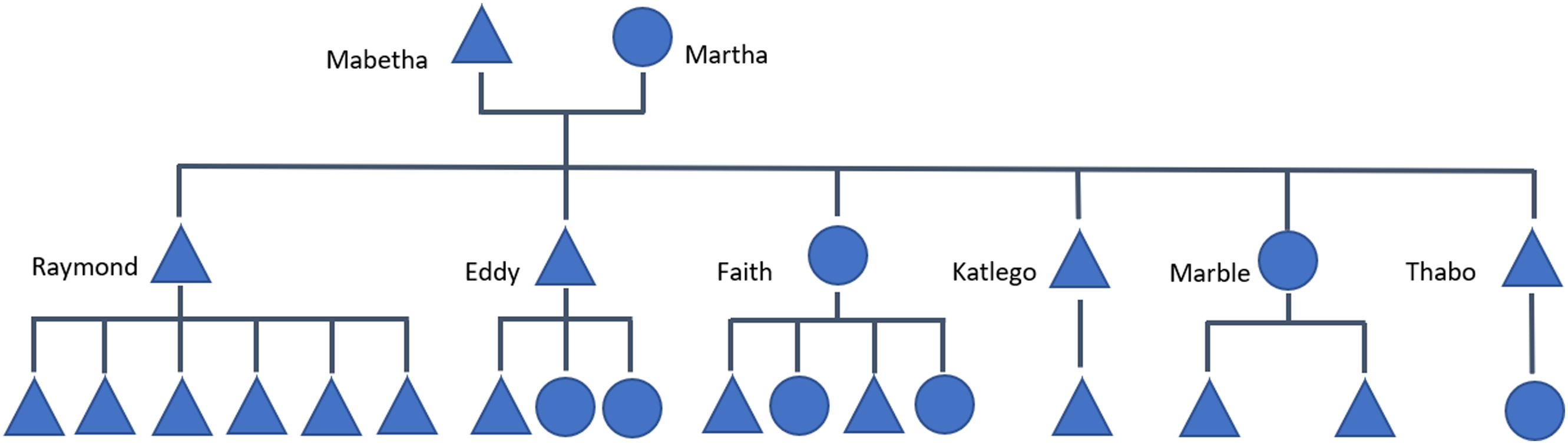
In 2012, Mabetha retired from work and used his pension to build a sizeable ten-roomed house on a vacant site across the road. He also sunk a 60-metre-deep borehole to ensure a reliable supply of water. The spatial separation of Mabetha and Martha’s home from that of his brothers led to the construction of new forms of sociality. While most of Lofi and Kedibone’s children were employed and had left home, Martha’s sons and daughters each occupied a room in her new home. Only her second-born son, Eddy, desired to live independently.
Martha’s children came of age during the period of economic downturn, when, under Jacob Zuma (2009–18) and Cyril Ramaphosa’s presidencies (2018–present), the national and youth unemployment rates escalated to 32.9% and 59.7%, respectively. 7 Many faced hardship and divorce, and were unable to establish independent households.
Raymond, Martha’s oldest son, had fathered six sons from four different women and was thrice divorced. He stayed at his mother’s home with Kagiso, a son from his second marriage. Raymond drove to Bushbuckridge each day, where he worked as a parole officer for the Department of Prisons and Correctional Services. His current wife lived and worked in Hazyview, and they only saw each other on weekends. Martha’s daughters, Faith and Marble, both preferred to live with her rather than with their affines. Faith moved back home with the three youngest children after her husband, a police lieutenant, died of oesophageal cancer, and she lost her position at the National Youth Commission in Mbombela. Marble had given birth to two children but asked her boyfriend to delay paying bridewealth because she still wished to assist her mother at home. Martha’s sons, Katlego and Thabo, were unemployed but had fathered children with working women. Katlego sent his partner’s parents R2,500 plus a Blackberry phone to build a friendship. He looked after their nine-year-old son, KJ, while his wife worked at a local supermarket and lived with her grandmother. Katlego did not ask her to live with him because he feared she might quarrel with her sisters. Thabo, the youngest son, operated a small tiling business while his girlfriend worked at the Kruger National Park. Solidarities between consanguines, related by ties of descent, over-rode those between affines, established by marriage.
The construction of a new home gave rise to renewed tensions between Martha and the wives of her husband’s brothers. When her water pump broke, all neighbours who fetched water from her tank pooled money to purchase a replacement. Lofi and Kedibone also fetched water from her home, but did not contribute. They were also envious of any success by Martha’s children. When Faith purchased a car, Lofi and Kedibone asked her where she had obtained the money. Immediately after Martha’s children bought a plasma television, Lofi, too, purchased one. There were also tensions between Martha’s children and Kedibone’s daughter, Mbali. They found Mbali’s conduct overbearing. She once rudely commanded Katlego to fetch water during a family prayer and always decreed which songs the family choir should sing. Mbali also raised suspicions when she washed in a zinc basin, surrounded by candles outside her home at midnight. She probably did this to cleanse herself of misfortune. But Martha’s children believed something more sinister was at play.
On Sunday morning, 19 November 2017, Mabetha died of a stroke. His sons consulted an Apostolic prophet on the evening of the night vigil before his funeral. The prophet revealed that a male neighbour and two family members had bewitched Mabetha and sought to transform his spirit into a nocturnal servant (setlotlwane, sometimes translated as ‘zombie’). To retrieve Mabetha’s spirit, the prophet surrounded his grave with white candles, struck a whip five times, and buried black salt and the whip in the soil. 8
There were further misfortunes. During the Covid shutdown, Martha’s daughter, Marble, lost her job as a secretary at a local construction company, and Thabo was severely injured in a motor vehicle accident. In 2020, Sputla’s son, Thuso, who worked as a diesel mechanic in a town called Belfast, became seriously ill. He lost weight, and his testes became severely swollen. Therefore, Thuso returned to his father’s home to consult a private clinician and diviner. The former drained fluids from his testes and prescribed powerful painkillers; the latter revealed that relatives had bewitched him.
The diviner dug two large holes. At the gate of Sputla’s home, he excavated a black cloth containing a mayonnaise pot. Inside the pot was a baboon’s hand, potions, razors, nails, and silver coins. These, he said, had been planted by witches. The black cloth spread misfortune, the pot trapped people so they could not progress, and the baboon hand took their money and dragged their spirits underground. At an opening in the flower bed next to Mabetha’s fence, the diviner unearthed the bottom half of a two-litre plastic Coca-Cola bottle containing a sizeable dead snake. The snake, he said, had bitten Mabetha on the morning he suffered a stroke and ensured that his children remained impoverished.
The diviner burnt the dead snake and took Thuso and the other witchcraft substances to a river about 2 kilometres away. Here, he washed the misfortune from Thuso’s body and cast the baboon’s hand and black cloth into the water so the river could wash them away. The diviner also sprinkled blessed water throughout Martha and Sputla’s yards, and treated all members of their families in the sequence of age, using herbs to strengthen their bodies. After the diviner’s departure, Thuso made the anticipated recovery. But the very next week, Kedibone’s daughter, Mbali, died. She contracted Covid, and being overweight and diabetic, struggled to breathe. Some believed that she had assisted her mother in witchcraft and fell victim to vengeance magic.
The accusations of witchcraft drove a wedge between the households of Eksom and Josephina’s daughters-in-law. The households of Mabetha and Sputla dissociated themselves from those of Allen and Matewu. Martha’s children no longer visited the shrine that Lucky maintained for Kgerišhe, and doubted whether he really possessed their great-grandfather’s spirit. They invoked different ancestors. In 2022, only five years after Mabetha’s tragic death, his spirit began to manifest among his descendants. Faith’s daughter, Kago, dreamed of her grandfather. In her dream, Mabetha appeared happy, chatted, and laughed. Later, when Kago suffered from an excruciating migraine, she invoked Mabetha’s spirit at a spot in the veld and found an instant cure. Subsequently, Marble’s two-year-old son cried incessantly. She gave the child two names – those of his paternal grandfather and of Mabetha. But naming alone did not have the desired effect. The boy’s crying intensified; he slept poorly, and at night, his body became as cold as a corpse. Only after Marble and her mother took the baby to Mabetha’s grave and asked his spirit to assist did the child recover. Marble told me that Mabetha’s spirit punished her because she had not informed him of his grandson’s birth.
During September 2023, Mabetha’s widow and descendants reaffirmed his status as a lineage ancestor by unveiling an ostentatious tombstone, which cost R45,000 (about £2,250). About 200 kin and neighbours attended the event. They read verses from the Bible, sang hymns, took photographs at the graveyard, and then enjoyed a meal at the Monareng home. Martha made matching dresses and shirts for Mabetha’s surviving siblings, children and grandchildren to affirm their unity. In her speech, she said that she had erected the tombstone to demonstrate her love for her deceased husband. On Easter Friday, 2024, the Monareng children again visited the graveyard to cleanse Eksom, Josephina and Mabetha’s graves and addressed their spirits, requesting assistance to find stable jobs.
Rethinking the lineage
The experiences of the Monareng family, clearly contradict the assertions of theorists who seek to disconnect procreation, blood, descent and kinship. All members of the Monareng residential units that we traced over eight generations were related by blood or marriage. They were direct offspring of the father and mother, in-marrying spouses, and maternal relatives who had fallen on hard times. The latter included Josephina’s orphaned nephew, Tomi and niece, Bafatiye, her sister’s grandsons, Amos and Alex, and her sister. However, maternal kin were marginal household members who did the most unrewarding tasks, such as herding cattle. In determining kinship, descent was more significant than criteria such as co-residence, as Carsten (1993) claims is the situation among Malay people of Lankjani Island. Descendants who had left their natal homes felt obliged to continue participating in broader kinship and descent networks. Migrant labourers sent remittances essential to household reproduction; married women living elsewhere with their spouses continued to act as guardians to their siblings’ children, and sons who had established independent households continued participating in social events, such as death rituals.
Only after 1971, when Eksom’s descendants moved to Impalahoek, did we witness the formation of a broader ‘agnatic cluster’. We can see these broader solidarities as attempts to cope with the effects of oscillating labour migration by young men and, later, to mitigate the worst effects of high unemployment. In Impalahoek, Eksom’s sons occupied adjacent residential stands, and continued to own stock and a field as corporate assets. The erosion of these rural resources saw the rise of new solidarities, including establishing a Monareng clan association and burial society with a corporate bank account. Rituals like all-night prayers and funerals also became a means of animating broader kinship networks. After 2009, a new agnatic cluster emerged as Mabetha Monareng’s sons, daughters, and grandchildren occupied different rooms in the home he built on a new residential stand. Co-residence was partly a consequence of declining and unstable marriages (Pauli and Van Dijk, 2017). Mabetha’s unemployed sons could not afford to set up independent households; and his daughters preferred not to marry and leave their natal home for those of their in-laws (James, 2016). In this situation, grandchildren frequently moved back and forth between the homes of their biological parents, who might well reside separately.
Nonetheless, the evidence presented does not merit seeing the Monareng lineage as a corporate group. Hammond-Tooke (1984, 1985) finds no ethnographic support for the contention by Marxist historians that a ‘lineage mode of production’ or hierarchically arranged corporate territory-owning lineages characterised pro-colonial social formations in Southern Africa. Lineages appear to have had little significance in political and economic processes. Among Nguni-speaking people, the prime residential units were small agnatic clusters, comprising of six to eight homesteads of men descended from a common father or grandfather. Senior men arbitrated in the case of disputes. Yet these clusters did not collectively own stock or land. It seems more likely that independent households were the prime economic units. Work parties, which involved broader cooperation comprised neighbours – no kin. Even in the case of ritual, the ‘congregation’ was not the lineage – but a clan section, which invoked a collective of dead ancestors (Hammond-Tooke, 1985: 317).
These observations are particularly apt among Northern Sotho people, whose domestic units are generally smaller and whose genealogies are generally shallower. Pedi-speaking households in the former Lebowa ‘homeland’ expected sons to marry in sequence of age, and expected the older son to set up an independent household when his younger brother’s wife took up residence with his parents. This has led to a system of ultimogeniture, in which the youngest son and his wife cared for his ageing parents and inherited their plot (James, 1988).
It would be deeply misleading to reify the concept of the lineage. But at the same time, I cannot agree with Kuper’s (1982b) assertion that the lineage model invariably diverges from folk models, and that lineage theory has no value in anthropological analysis. It seems to make greater sense to see the lineage differently – not as a corporate grouping, but as a line of descent on a genealogical map. In this usage, the lineage is a conceptual model or ideological charter individuals use to claim status, resources, and social support in the domestic domain. This usage closely approximates the folk model in Bushbuckridge. My research participants often used the metaphor of a tree to conceptualise kinship relations: its roots symbolising the ancestors and its branches and leaves their descendants. They used the Northern Sotho word lebokola to denote specific lines of descent.
Conclusions
While the history of the Monareng family shows the centrality of procreation and blood in the determination of kinship, it also reveals the co-presence of non-biological modes of relatedness. These include the manifestation of ancestral spirits among descendants and the forging of spiritual connections through names. The ancestors seemed to have gained greater prominence through time. Eksom’s children and grandchildren were more likely than earlier generations to name babies after troublesome ancestors, invoke the assistance of their ancestors, and tend to their graves. The apotheosis of the ancestors corresponds to the formation of broader agnatic clusters and more eclectic cosmological beliefs. However, the invocation of the ancestors was seldom a public event that enacted broader kinship solidarities, such as in Xhosa sacrifices and beer drinks (McAllister, 2006). Several descendants participated in relocating Kgerišhe’s spirit and unveiling Mabetha’s tombstone. But the invocation of ancestors was largely an individual experience. It validated the decision of young men such Lucky, who failed to establish an independent homestead, and Faith, who was unwilling to reside with her affines, to return to their natal households. Amos and Alex re-established connections with their forgotten maternal cousins through the invocation of Josephina’s ancestor. Of significance to broader debates is that spiritual relatedness formed an additional, rather than an alternative, means of relatedness. The ancestors, it is believed, only assist biological descendants. This differs from other ethnographic situations, such as ‘siblings by recognition’ among the Truk of Micronesia (Scheffler, 2001) and ‘godparents’ in Andalusia (Pitt-Rivers, 1977). 9
The lineage history also highlights the agency of in-marrying women in an ostensibly patrilineal system. Scholars have drawn attention to the existence of a ‘house property complex’, in which wives of polygamous families separately held their own houses and property (Kuper, 1982a). Women were also crucial as progenitors, and there is a powerful bond between those ‘born from the same womb’ (ba thari e tee). The children of single women belonged to their mother’s descent group. KJ was the only extramarital child to reside with his father. My research participants regularly invoked maternal and women ancestors. Two Monageng men were named after maternal male ancestors – a grandfather (MF) and a great-grandmother’s father (FFMF). Three women were named after paternal women ancestors – one after her paternal grandmother (FM), and two after their paternal great-grandmothers (FFM). A fourth woman was given the name of her maternal great-grandmother (MFM).
In-marrying women created narrower and more intimate solidarities within broader networks of descent and were agents for the fission or fragmenting of larger agnatic clusters. This process, so crucial to Northern Sotho kinship systems, was often ignited by enmities and accusations of witchcraft between the wives of brothers. Given that witchcraft is transmitted maternally through the mother’s breast milk, an allegation against the father’s brother’s wife may also lead to the severing of relations with her sons and daughters. The situation differs from that in Botswana, where competition between uterine brothers underlay the divisiveness of agnatic kinship (Comaroff, 1982:151). Kinship remains patrilineal, although matrilineal elements might well intrude in future. In the Monageng family, Faith and Marble’s children might claim the right to continued residence in their maternal grandmother’s home. In Bushbuckridge, as elsewhere, kinship networks can provide social security: they can deliver daily bread, emotional support, favours, and a sense of identity. Yet what kinship does in this context, depends on what kinship is. Here, the mutuality of being to which (Sahlins, 2013) refers is centred on procreation and blood, which are more powerful and durable symbols than co-residence, spiritual connections, or the sharing of names. In a precarious world, where mobility is essential to survival, common descent connects kin dispersed between villages, towns and cities.
Support for this observation comes from Bähre’s study of Xhosa-speaking settlements in Cape Town. Here too, in matters of the ancestors, biological fatherhood takes precedence. A prime participant in his study argued that one cannot pretend that a social father is a biological father. ‘One cannot fool the ancestors’, she said. But these examples do not establish a universal. There remains an urgent need to explore the coexistence of biological and non-biological forms of relatedness in other ethnographic and historical contexts.
Footnotes
Acknowledgements
I presented an earlier version of this article at the Annual Conference of the Southwest Popular/American Culture Association in Albuquerque, New Mexico in 2024. I wish to thank all attendees, particularly George Sieg, for their comments. The article also benefitted from ongoing discussions with Bruce Kapferer and Adam Kuper, and from Robin Zingarelli’s help with the design of kinship diagrams. I am most indebted to my field assistants, the late Mahlatsi Mohlala, Thuso Mohlala, and Keletso Shokane. I dedicate the article to the memory of Mahlatsi, whose excellent humour brightened my days.
Declaration of conflicting interests
The author declared no potential conflicts of interest with respect to the research, authorship, and/or publication of this article.
Funding
The author received no financial support for the research, authorship, and/or publication of this article.
