



Abstract
The anthropology of international experts and their respective communities – Peaceland, Aidland, and Conservationland – have focused on international–local encounters in local contexts. What have been under-represented in the literature are encounters taking place in international contexts. In this article I discuss the similarities and differences between these ‘-lands’. I conceptualize the international conference sphere of Conservationland as a ‘no-man’s-land’ to provide a space to contextualize conservation bureaucrats attending such meetings. Building on ethnographic fieldwork and interviews conducted during conferences of the Convention on Biological Diversity between 2018 and 2024, I showcase how bureaucrats across government levels (international to national) view their roles in the broader context of biodiversity conservation. I contribute to a growing conversation on the anthropology of professionals in global biodiversity conservation and highlight how global conferences as sites of encounters among bureaucrats set Conservationland apart from its neighbouring ‘-lands’.
Keywords
Introduction
The 21st century has seen a growth in managerialism in politics and the role of experts in a globalized world, which has translated to an anthropological focus on international–local encounters. Conservationland (Kiik, 2019; Pietilä, 2021), Aidland (Apthorpe, 2005; Mosse, 2011), and Peaceland (Autesserre, 2014) (henceforth referred to as the ‘-lands’) are three examples of empirical conceptualizations of the transnational social worlds of international elites and experts that have created spaces for analytical work on the lives of such professionals. Thus far, the ‘-lands’ have largely focused on international experts travelling to foreign contexts to work on development, peacekeeping, or nature conservation. The emphasis has been on encounters between international experts and locals, in places (which ‘belong’ to the locals, and) where experts are either temporarily visiting while working on a fixed-term project or living in their own expatriate communities.
While the ‘-lands’ share similarities with one another, each also tells a story bound to a place and a context – including the history, politics, customs, etc. – tied to that place, which the international experts navigate. However, a current gap in the ‘-lands’ literature is the encounters that take place in the international context, which are not contextually bound to any specific place. The international sphere is particularly pronounced and significant in Conservationland, where bureaucrats from governments and governmental organizations come together to negotiate universal goals and targets for conservation. This article expands Conservationland beyond the international–local dynamic and sheds light on multilevel bureaucrats representing governments and governmental organizations in international negotiations as individuals, rather than as agency-less cogs in the machine of government.
Though the values behind these three ‘-lands’ are universal – human rights, peace, environment as common good – what separates Conservationland from its neighbours is the universalist nature of agreeing upon something that is applicable to everyone domestically, too. Together with the ever-changing locations of the conferences, this contributes to a sense of placeless-ness for global conservation, which exacerbates the appearance of political neutrality and technicity. I conceptualize the global conference context as ‘no-man’s-land’ to emphasize global biodiversity conferences as spaces of power, despite giving the impression of neutrality and equal access for all contributing Parties.
Specifically, this article advances our understanding of Conservationland and the previously under-examined international aspects of it: the bureaucrats who gather at international biodiversity conferences. The process of negotiating and agreeing global conservation goals and targets is a political one. Yet, the outcomes of these conferences are often taken at face value when translated into conservation action on the ground. This is why the negotiators themselves matter, as they have agency in forming the shape and substance of these universal conservation goals and targets: it is the national representatives to international conservation agreements – with support from international bureaucrats from governmental organizations – who negotiate the global commitments that frame conservation and trickle down across continents to regional, national, subnational and local levels for implementation.
I use one of the most prominent conservation agreements, the Convention on Biological Diversity (CBD), as a case study 1 to guide this investigation. The research builds from my ethnographic fieldwork with conservation bureaucrats across government levels conducted in the margins of ten conferences of the CBD between 2018 and 2024. In addition to the international level, this data was gathered primarily with a focus on two regions and their national representatives: the Pacific Islands and the European Union (EU) and its Member States. Conservationland provides a conceptual home to discuss and consider this heterogenous group of conservation professionals.
First, I outline the specific context in which key encounters between conservation bureaucrats from national to international level take place by contrasting Conservationland to the two closely related ‘-lands’ of international expert communities: Aidland and Peaceland. Second, I provide empirical context to the CBD and discuss a facet unique to Conservationland as I conceptualize global conservation conferences as ‘no-man’s-land’. In the third section, I showcase the personal views of international and national bureaucrats of global conservation and discuss anti-politics in Conservationland. Here, I build on the existing ‘-land’ framing and show how the global playing field of Conservationland is neither an equal nor a neutral place. The fourth section draws conclusions on the underlying dynamics in Conservationland.
Commonalities and unique features of the ‘-lands’
Conservationland, Aidland, and Peaceland each have their own unique features, yet there are commonalities that make them recognizable as ‘-lands’: namely, the centrality of expertise, technicity, and bureaucracy. In this section, I draw out these similarities and differences to contextualize Conservationland against its neighbours. Understanding these differences and similarities enables the exploration of a gap in the literature, namely encounters in the international context.
Recent decades have witnessed a growing anthropological interest in ethnographies of experts (Carr, 2010) and the institutions where they work (Larsen, 2016; Larsen and Brockington, 2018), particularly in the field of development. Peaceland focuses on international peace interventions, peacebuilding in conflict zones, and the lives of peacebuilders (Autesserre, 2014) while Aidland examines international development and aid workers (Mosse, 2011). A key feature of, and commonality between, Peaceland and Aidland is their emphasis on the local level, whereby international experts visit local communities and contexts. Conservationland, conversely, focuses on the experiences of conservation professionals in international–local encounters (see Kiik, 2019, for literature review).
There is a shared understanding between the different ‘-lands’ on the political nature of the work of these bureaucratic professionals, despite their technical appearance. Each ‘-land’ and its empirical focus is inherently a political project, though frequently veiled as apolitical. By apolitical in this context, I mean that international development, peacebuilding, and conservation interventions have predetermined parameters which are not open to discussion and political contestation. Rather, they are (pre)framed as solutions that must be implemented and managed. Yet, each of these interventions carries diverse dynamics that are woven in complex webs of politics, interests, and power with global and multilevel dynamics which remain hidden due to the lack of contestation.
Harrison (2013) criticized the notion of ‘Aidland’ (Apthorpe, 2005; Mosse, 2011) for focusing on ‘the personal’ instead of providing an analysis of institutional processes. Yet, particularly in Conservationland and its global negotiations, it is the individuals representing governments who negotiate, not the processes. It matters who the negotiators are, as the negotiators are not passive actors enacting pre-set procedures; rather, they shape the processes they are embedded in. Moreover, Harrison (2013) argues that focusing on the viewpoint of international experts and development professionals risks shifting attention away from the material realities of development interventions, thereby potentially strengthening the dichotomy between those who develop and those who receive.
This critique applies to the other ‘-lands’, too. In Conservationland, for example, international environmental funding (such as the Global Environment Facility’s grants) often follows a similar dichotomy of givers and receivers. Global (biodiversity) commitments are referenced in the tenders for application for funding for conservation projects, and funding often requires a link to a global commitment. Herein lies one overlap between Conservationland and Aidland, as aid-related funding has in recent years been consciously directed towards achieving global environmental commitments (Arndt and Tarp, 2017).
Further parallels can be drawn between the global conservation conference environments and Peaceland’s ‘peacebuilder’s bubble’ conceptualized by Autesserre (2014). Both are uniquely isolated, disconnected and removed from the surrounding reality. While the ‘peacebuilder’s bubble’ is tied to a specific time and place, often intended to be a temporary project, the global ‘no-man’s-land’ of Conservationland is rebuilt whenever, and wherever, the next conference is held. There is a degree of abstraction at the global level, which blurs the on-the-ground realities of biodiversity loss, and distances them from those responsible for negotiating the overarching global commitments for tackling the current biodiversity crisis.
The global biodiversity conferences and their negotiations in Conservationland require countries to look inward, too: what one negotiates is meant to also be applied ‘at home’. Each country negotiates for themselves, with their own domestic contexts in mind, though foreign policy is important for many. While there are global conferences for sustainable development and peace, Global North countries do not negotiate with their domestic policies and applicability in mind. In this way, the ideal of universalism is more pronounced and sets Conservationland apart from the other ‘-lands’. At the same time, if drawing from the critiques provided by both Autesserre (2014) and Mosse (2011) that the respective projects of aid and peacebuilding fail because of a lack of attention given to local circumstances, one could question whether the literal and figurative distance between local to global levels is contributing to the continued collective global failure to meet global environmental commitments, within and beyond conservation.
Finally, when comparing Conservationland to Aidland and Peaceland, it is the existence and prominence of global governance conferences gathering all kinds of actors that sets Conservationland and its multilevel conservation bureaucrats apart from other international professionals, and, as such, I call this international sphere of events a ‘no-man’s-land’. In the next sections, I provide context on the CBD before developing the concept of ‘no-man’s-land’ in Conservationland.
The Convention on Biological Diversity and its governmental participants
The CBD is one of the key international agreements for the environment. It falls under the UN system, and consequently has a Western bias built into it (see Galtung, 1987, on the UN and its Western bias). Agreed at the Rio Earth Summit in 1992, the Convention has 196 signatories, known as ‘Parties’, with the notable absences of the Holy See (the Vatican) and the United States of America (CBD, 2024). The Parties meet biennially at a Conference of Parties, better known by its acronym, COP. In addition to the COP meetings, there are three types of subsidiary body meetings: the Subsidiary Body on Scientific, Technical and Technological Advice (SBSTTA) and, since 2016, the Subsidiary Body on Implementation (SBI). The Subsidiary Body on Article 8(j) and Other Provisions of the Convention related to Indigenous Peoples was established in 2024. The meetings of these bodies vary in their schedule; typically, there has been one SBSTTA per year while the SBI schedule has not been running long enough for a pattern to emerge. The subsidiary bodies are significant because, although the COP is the formal decision-making body, the majority of the CBD’s agenda items are negotiated under these subsidiary bodies, which pass ‘recommendations’ for the COP to approve. In addition to the recurring meetings, the CBD process hosts open-ended and ad hoc working groups when necessary. There are significantly more participants in COPs than in other kinds of CBD meetings. To illustrate the differences in scale, the 16th COP of the CBD in Cali, Colombia, in 2024 was attended by approximately 23,000 people (IISD, 2024) while the 22nd SBSTTA in 2018 was attended by 800 (IISD, 2018).
As Conservationland expands beyond its traditional scope – from protected areas and restoration for example – to the CBD agenda, collecting under its umbrella a range of biodiversity-related issues from biodiversity mainstreaming to finance, science and technology cooperation, gender, and traditional knowledge, so too does the question of who ‘counts’ or ‘qualifies’ as a conservation professional. There is considerable variation among Parties as to what type of actors they send as representatives. For example, Brazil and Argentina are typically represented by career diplomats, while the EU and its Member States have civil servants and some subject experts in their delegations. Most of the Pacific Island states’ representatives are civil servants. The civil servants are usually based in ministries of environment, agriculture, forestry, fisheries and, in some cases, in ministries of health, transport, and finance, among others. Some work solely on the CBD and perhaps other international environmental conventions, while for others the CBD and its negotiations are only a small part of their job responsibilities. In either scenario, these bureaucrats exercise significant power in directly shaping conservation work globally, which in the expanding Conservationland, I argue, qualifies them as conservation professionals.
In this article, I discuss regional and international bureaucrats together, as both groups support national bureaucrats. Yet, regional and international bureaucrats differ in their scope and purpose. For example, the Secretariat of the Pacific Regional Environment Programme (SPREP) is the primary regional governmental organization supporting the Pacific Island negotiators at the CBD meetings. Outside of the CBD conferences, they facilitate regional cooperation, forming shared negotiation positions to the CBD, and support the Pacific Island states in translating the CBD objectives to the national level. As a group, international bureaucrats are more diverse than any single regional organization, and so are their reasons for participating in the conferences. Involved in a range of organizations, from UN programmes to the Global Environment Facility, World Health Organization and beyond, they provide countries with information, sometimes lobby for specific outcomes, but also assist with how to use specific tools for implementing the CBD.
Each Party to the CBD decides for themselves how many delegates to send to attend each conference. Yet the resources between Parties vary greatly. The Secretariat of the CBD provides financial support to developing country Parties to send 1–2 representatives to participate in the Convention processes, while wealthier countries can count their delegation sizes in the dozens. For example, at the CBD COP15 in 2022, the EU and its 27 Member States altogether totalled a crowd of bureaucrats in the hundreds – Germany alone counting for approximately a hundred – while the 14 Party delegations from the Pacific Islands, together with regional governmental organization staff from the SPREP, were fewer than the German delegation alone.
Delegation size is a concrete and quantitative indication of inequality in the CBD processes. Size is significant because of the structure and organization of the negotiations. There can only be one Plenary session at a time to ensure everyone can participate (a Plenary is where decisions are finalized), but negotiating primarily takes place in smaller Working Groups, two of which can run in parallel. Further, Working Groups are often divided into Contact Groups, of which four can run in parallel. Contact Groups can establish smaller, more focused ad hoc negotiation groups (‘Friends of the Chair’) as needed, which are scheduled around the other sessions. Figure 1 outlines a typical opening day at CBD conferences. Most other conference days are comprised of four parallel Contact Group meetings in the morning, day, and evening sessions, with a small number of Plenary or Working Group sessions scattered across a two-week-long conference for stocktaking. A typical two-week conference includes one negotiation-free day. Structure of opening-day negotiations at CBD conferences.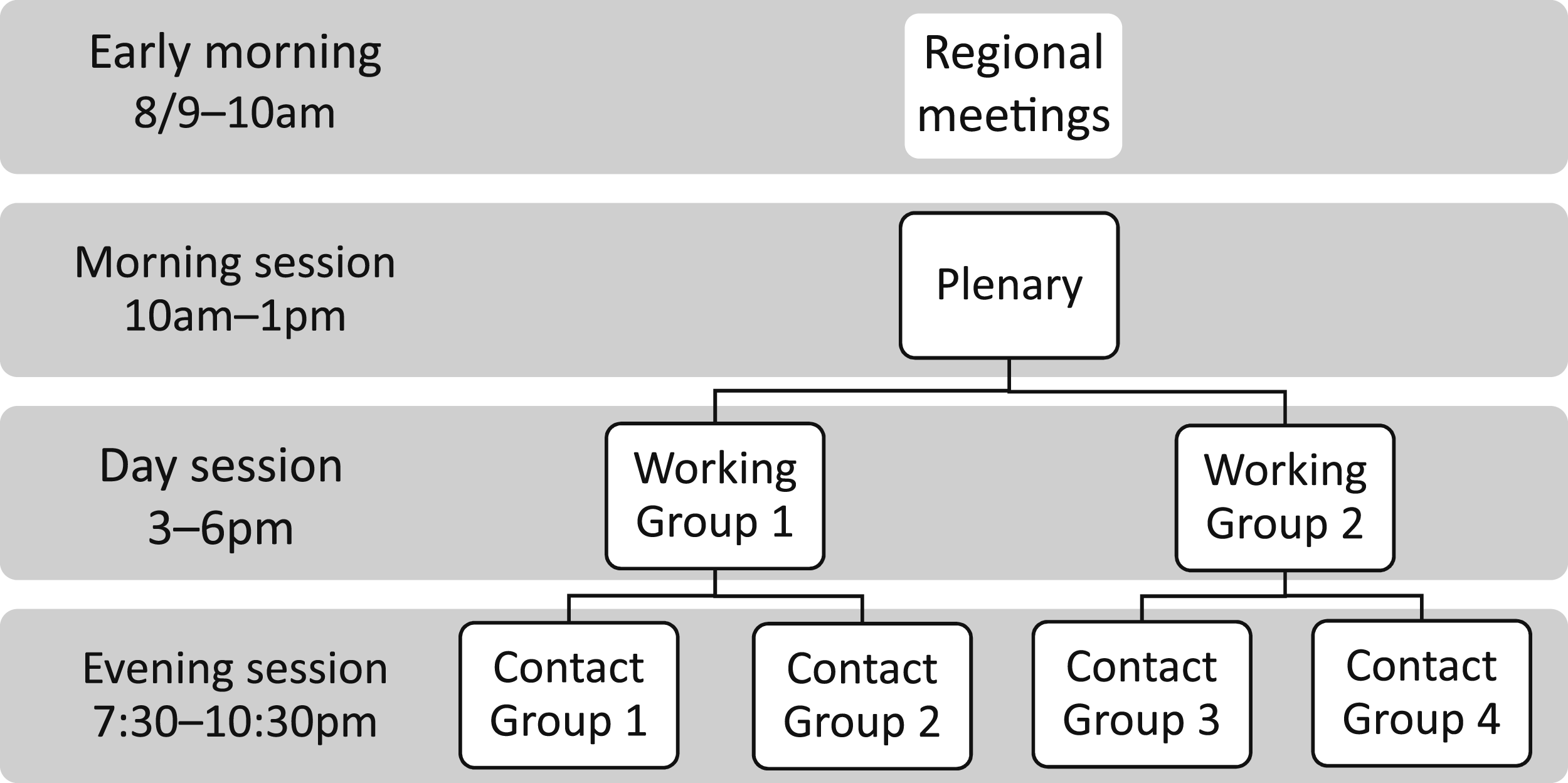
Preceding and during COP15, held in Montreal in 2022, which marked the culmination of four years of negotiating towards a new set of biodiversity targets (the Kunming–Montreal Global Biodiversity Framework), the evening sessions regularly continued past 10:30pm. Around 10:30pm, either the chairs of the negotiations would propose a new ending time, or negotiators would prompt the chairs to open a conversation about when to close the meeting if the chairs took no initiative to do so. Frequently, I observed negotiation rooms slowly empty the later the negotiations ran, especially if the agreed closing time was particularly late, for example 3am. It is mentally and physically taxing to participate actively in daily negotiation meetings for 10–18-hour days over a period of two weeks. Consequently, seeing negotiators nodding off was not unusual.
Though some EU Member States send delegations of approximately five representatives, the EU and its Member States coordinate their positions and negotiate as one: one negotiator speaks on behalf of all. This means that an EU Member State representative does not need to attend all Contact Group meetings. However, for the Pacific Island states, for example, with many having delegations of one to four representatives, it is impossible to cover four parallel sessions. Even though the decisions are formally finalized in the Plenary, it is highly discouraged for a Party to object to a decision at Plenary when it has been negotiated for long hours in the Contact Groups. The assumption here is that if Parties have strong views on a topic under negotiation, they will participate in the Contact Group. In practice, however, this is not an equal opportunity.
Lastly, delegation size not only enables or disenables presence and influence in negotiation rooms but also indicates whether there are domestic experts on-site to support the delegation with subject specific knowledge. This is significant for individual Parties because domestic experts offer the ability to apply what is being negotiated to one’s domestic context. Simultaneously, EU Member States benefit from the expertise, institutional memory, and know-how of all experts in EU delegations as they negotiate together, thus, amplifying the existing advantages of their well-resourced delegations. Small delegations with fewer resources often depend on international expertise, which may lack understanding of domestic contexts.
Global biodiversity events as ‘no-man’s-land’
Typically, the COP location and host rotates from continent to continent.
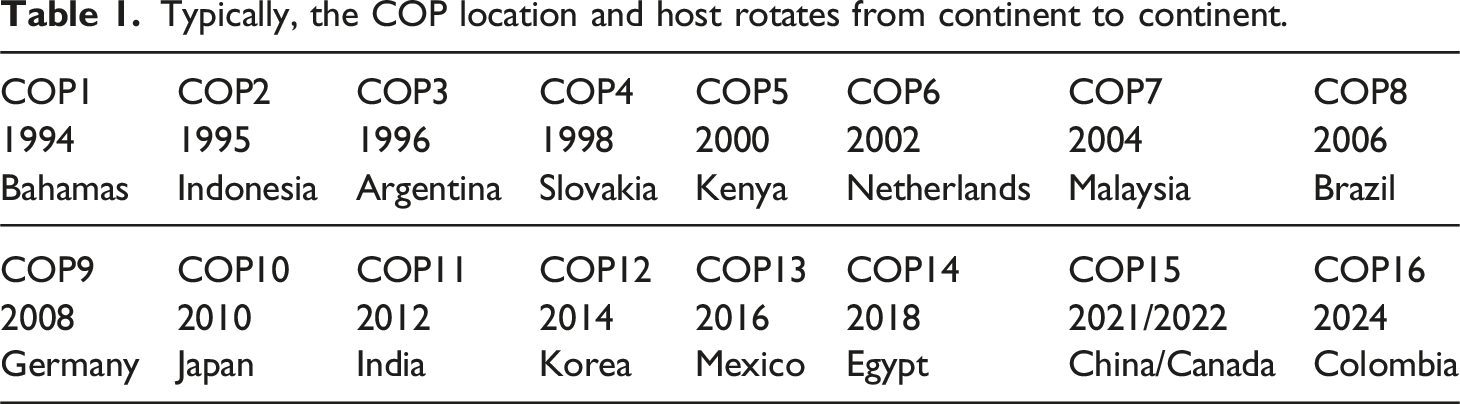
The ever-changing locations of the global biodiversity events contribute to a lack of place-basedness and a sense of ‘no-man’s-land’. Here, I use the concept of ‘no-man’s-land’ to mean the simultaneous experience of being somewhere while you could be anywhere. The impact of this is significant upon Party representatives and the negotiations, because it implies the equality and neutrality of such conferences, which is anti-political by default. Yet no space is neutral as power is always embedded in any given space: the physical location is not empty but filled with relations and power dynamics between individuals and, in the case of global biodiversity conferences, countries (Massey, 1991, 1993, 2005).
These meetings and their spatial and temporal realities are where countries come together to negotiate conservation and biodiversity. This process includes discussing what kinds of biodiversity issues and natures matter, and who should take action to improve the state of the environment. National Focal Points to the CBD, and their respective delegations, are supported and lobbied by a wealth of other actors: international and regional governmental organizations, non-governmental organizations (NGOs) of different sizes and levels, stakeholder groups, Indigenous Peoples, academia, business, and others. The conceptual use of ‘no-man’s-land’ to frame sites of international conference encounters helps unpack the dynamics of such temporary, ‘placeless’ conference venues, drawing out such controversies and oxymorons.
Typically, anthropology and policy literatures have focused on the lack of or restricted accessibility and participation of NGOs, Indigenous Peoples (Parks and Schröder, 2019), youth (Thew, 2018), and civil society actors (Uhre, 2014) within these global governance conference sites. This focus has been supported by the assumption that bureaucrats representing countries (either directly or via regional or international governmental organizations) face no barriers to participation. Yet to call such international conferences ‘no-man’s-land’ implies that all participants are on an equal footing; that such sites and venues of encounter are neutral and equally accessible to all those who participate. A key question which presupposes any actor’s participation is that of their access and ability to participate. This question is an exclusionary one from the start, though the CBD conferences tend to be more transparent and open in comparison to other international environmental governance conferences (for an example from the UN Climate Convention, see Gupta and Mason, 2016; Lakhani, 2021). Another form of alienation with regard to participation comes in the form of online and hybrid modes (Langlet et al., 2022; Vadrot and Ruiz Rodríguez, 2022), as some regions do not have sufficient internet speed and access, while for others the reduced cost and ability to participate from home has led to improved access.
The CBD conferences provide a space for countries to come together to negotiate. In this context, space should be understood as a process, rather than static and stagnant (Massey, 1992, 2005). Global biodiversity events follow a similar pattern from conference to conference, but take place in different parts of the world, each time with a different crowd, albeit with many returning participants. In this way, each CBD conference is new, each composed of different individuals, and yet, for those returning to such events, there is a ‘progressive sense of place’ (Massey, 1991, 1993). Applying the ‘progressive sense of place’ (Massey, 1991, 1993) concept to global biodiversity events helps illustrate why experienced negotiators are better placed to participate, and hold power, in the negotiations. One can only gain a ‘sense of place’ for the CBD events and Conservationland’s ‘no-man’s-land’ by attending. While the number of representatives per Party is significant in enabling or preventing effective participation, one experienced CBD country representative argued that attending at least two CBD COPs is necessary for any conference-goer to get sufficient understanding of the conference procedures and environment to participate effectively in the negotiations. From their perspective, at the first COP, one must just observe, because attending the conference is overwhelming, given the steep learning curve involved: how to use the conference website to find the correct negotiation documents and supporting materials; how to read the schedule of the negotiations; as well as needing to learn the map of the conference centre and how to find the correct negotiation rooms, etc.
Navigating the volume of negotiation-related information, and being able to see what is relevant and most time sensitive, takes practice. In addition, there are informal matters to learn, too, such as what is the rhythm of the negotiations, since it can vary between different negotiation events; when is the best time to take a break for lunch or dinner; the ‘who’s who’ and what are they seeking to achieve at the COP; and learning how to anticipate the way negotiations will unfold, among many others. By the second COP, one has learned enough to follow the negotiations and understand what is happening, where, and why, but there may still be limitations related to how to negotiate. Experience in being present in these events and meetings makes one more ‘at home’, because it enables gaining a ‘sense of place’, even when the physical locations change. As such, I use the term ‘no-man’s-land’ to describe the international conference environment of multilevel conservation bureaucrats with all its complexity: while nobody lives there permanently, participants are not there on an equal footing, and neither is it neutral, nor a vacuum free of (pre-)existing power relations.
Conservation bureaucrats in ‘no-man’s-land’
I examine conservation bureaucrats’ views through a lens of anti-politics, as it is the lack of open contestation and political contingency that creates ‘apolitical’ solutions in global biodiversity governance. Global governance – of which the CBD conferences are an example – is anti-political, as expertise and science reduce and frame political problems as managerial and knowledge-based (Stone, 2017). Drawing on anthropology of experts and political ecology, I frame conservation as an anti-political project. As such, viewing government-associated conservationists as bureaucrats enables considering them as agents for a ‘conservation anti-politics machine’ (following the anti-politics machine for development in Ferguson, 1990). Yet, showcasing the views of these conservation bureaucrats sheds light on their personal motivations, their understanding of themselves as professionals working in conservation (Boyer, 2008), and allows us to analyse the role, meaning, and understanding of politics in their work.
Between 2018 and 2024, I conducted participant observation at ten CBD events (including COPs, SBIs, SBSTTAs, and open-ended Working Group meetings). 2 At the margins of conferences, I conducted 31 semi-structured interviews with multilevel conservation bureaucrats, ranging from national representatives from the Pacific Island states, to the staff of the Pacific regional governmental organizations, and UN-affiliated staff with experience working with the Pacific Islands. Aside from a few interviewees with a diplomatic background, the majority were civil service bureaucrats and experts. Below, I use the abbreviations NB, RB, and IB to differentiate between the national, regional and international bureaucrats I interviewed. In these discussions, the bureaucrats elaborate on two different types of politics. The national bureaucrats spoke to a traditional understanding of politics as domestic electoral politics and of being constrained by it as civil servants. The other type, echoed in the views of regional and international bureaucrats, speaks of depoliticization of biodiversity governance, in which the work is strictly technical, and the support and expertise provided are seen neutral.
When contextualizing conservation bureaucrats in ‘no-man’s-land’ and writing about international conferences and Conservationland, I am also writing about myself. This is due to my positionality as a researcher and the roles I held while conducting this fieldwork. When attending CBD events in 2018, I was an academic observer, on the outside looking in at the negotiations. I was making sense of what was happening, where and why, connecting with negotiators who shared their views and impressions, and wondering what went on in the spaces reserved for negotiators only. In contrast, the next time I participated in-person – following the easing of Covid-19 pandemic restrictions in March 2022 – I wore a Party badge as a member of the Finnish delegation. Though employed by a government research institute at the time, the purpose of my participation was not to conduct an ethnography but to represent my government in the negotiations as a bureaucrat. I conducted interviews both as an observer in 2018 and as a delegate in 2022 and did not find meaningful differences in how interviewees reacted to me with or without a Party badge.
In 2022, as part of the government delegation, my conference schedule was determined based on when and where representation by a Finnish delegate was needed. In practice, this meant I spent several nights in negotiation rooms until 2am, to then wake up for an internal meeting at 7am the following morning. In my 2018 fieldnotes I wrote how tired I felt after observing the negotiations all day. Yet, until I was in the position myself in 2022, I had not fully understood the reality of multiple negotiations taking place at the same time, the need to rush from one room to the next, the ongoing struggle to find food (and time) to eat, and the sheer exhaustion that other negotiators had spoken of in 2018. In 2022, the Party badge came with benefits: quite literally, all doors were then open to me. From an ethnographic perspective, one key benefit of participating as part of a Party delegation was hearing multiple other negotiators’ personal perspectives, analyses, and updates on the negotiations daily. As a Finnish delegate, most of these perspectives came from a European positionality. My experiences as an observer together with the views I had been exposed to through my interviews enabled me to remain aware and critical of this, despite being deeply embedded in an insider position. As a result, my data is richer and more multifaceted than had I attended all conferences as an observer.
While nobody lives in Conservationland’s ‘no-man’s-land’, some feel more ‘at home’ than others because of a previously gained ‘sense of place’. This is a view I heard from many conference participants, and it was an experience I realized myself. From Canada to Egypt to Switzerland to Kenya: the physical venues changed, but there was something very familiar, too.
Global conferences are a major part of many conservation bureaucrats’ job responsibilities, for which some prepare and wait a long time to attend. Across all levels of bureaucrats, there was a similar feeling of enjoyment and pride in attending major biodiversity conferences. Over the years-long process of fieldwork I noticed a change in my mindset about attending CBD conferences: there was still excitement, but by the latest conference I attended in 2024, it was mixed with the knowledge of how exhausting the trip would be, and much less of a sense of excitement than I experienced in venturing into something and somewhere new in 2018. This is my first experience of COP, which is very big.… Um, it’s tiring, but I guess you, if you are attending a COP you are sacrificing for your country, right? You are the ambassador. Representing your country so … if it’s tiring, you still do it for the love of your nation. (NB) I remember the first time I attended, is just like the giggling that you’re here at this huge meeting with all these countries, somewhere you never thought you’d end up. Yeah, working across the whole scale in seeing how it all links and works together. It keeps the job very interesting. (RB) It’s so nice to meet colleagues when you go to big conferences like that, and everyone. It’s a small family in the end. (IB)
The sense of ‘a small family’ became more concrete the more I went to CBD conferences. It did not take long to recognize familiar faces. I found myself wondering ahead of the meetings whether I would see certain people I had met at previous conferences, and often did. While each conference is unique in its composition of participants, there is enough overlap that personal ties can develop and be maintained within the frame of a biennial COP meeting schedule. In-person trust-building is essential for the success of the negotiations, which the lack of progress made over remote negotiations during Covid-19 demonstrated (personal observation; see Langlet et al., 2022).
While previous literature on conservation professionals (e.g. Kellert and Wilson, 1995; Milton, 2002; Takacs, 1996; Vivanco, 2007) has suggested that they are primarily ‘motivated by a desire to help not people but animals and other nonhumans’ (Kiik, 2019: 393), this view is not supported by my interviews with the conservation bureaucrats. There are a few potential explanations. One is that the emphasis in past literature has been on natural sciences professionals, whereas conservation bureaucracies attract a range of social scientists and humanists. Moreover, while it can be assumed
3
that an interest in nature has been a source of motivation for seeking a career in conservation bureaucracy, it is possible the literal and figurative distance of these bureaucrats to on-the-ground, hands-in-the-mud conservation work is too great for them to verbalize it as a primary source of enthusiasm in their jobs. Instead, what appeared to give great job satisfaction was what most of them do day-in, day-out: working with people. I adore what I do. I love this. I love working with the people. I love figuring out, like I said, the connections. I love the diversity of the questions and the topics that we addressed. I like the tangible outcomes. I like being able to see where we are going and how we’re pressing towards things. (IB) It’s [conservation] very human and a lot of people deeply care about what they do. (IB)
Among the international bureaucrats, such tasks include, for example, teaching national-level practitioners how to use a new online platform, running workshops, and providing background documents, while the national bureaucrats have their usual domestic policy related tasks and responsibility for translating global commitments to national contexts and planning implementation with local communities. It’s interesting that we work with people.… Just the global coordination team from across different parts of the world, and being able to look for times, specific times within their schedule, to have meetings and actually to discuss the project. That for me shows the level of commitment. And it gives me the motivation that there’s a purpose in this. (IB) For us, we need to re-evaluate, assess our successes, and put in new plans, realign, realignment with government policies. Of course, cross-sectoral approach is very important. It needs everybody, all the sectors to be part of it to make sure that we achieve the goals. Then we can be comfortable to be reporting back in the next COP. Although in-country, in all, some of our plans, we’ve got our own targets as well that we’ve put in there. (NB)
Consequently, there is a stark difference in how the bureaucrats from different levels view politics and their role in it. The national-level representatives of the CBD made direct references to constraints of national-level politics and the impact of conservation in their respective national contexts. All Pacific Island representatives pointed out the lack of resources as a major constraint in achieving their biodiversity policy goals, while many EU Member State representatives speculated on upcoming elections and domestic politics. I realize I really don’t like a lot of [domestic] politics. (NB) We have so much to achieve and so very little workforce, and so many demands on us. We have so many limited resources they give us to work, and yet, the population is going up every year, and the resources stand still, but the demands on our work delivery, outputs, is so high or so, on us … (NB)
The international bureaucrats viewed themselves as neutral technical experts in more mediatory roles who play no part in politics. Yet it would be misleading to argue that the international-level bureaucrats are naïve in their approach and understanding of their interactions with the national level: instead of imposing some universal and context-independent global agenda, many highlight the importance of ‘national ownership’ – namely, that the support they provide is requested by the national-level representatives and it is what they want. [countries] might have different agendas definitely to what I was believing at the time, but it doesn’t matter because now my role is to try and help everyone in their needs, and their priorities, and their … I don’t know, areas of work.… but I still think that if you can help them, but in the end the one that makes the decision is the person sitting under the flag [the national bureaucrat]. (IB)
‘National ownership’ is a narrative fostered by international organizations (Auld and Morris, 2021; UN, 2012). How it was understood varied greatly among the interviewees, revealing a contradiction. In some interviews, international bureaucrats noted that it is common for the national representatives to be so busy and overwhelmed in their national-level, day-to-day work that they have no time to consider what support they want and need, in which case international bureaucrats offer their services and suggestions on what may be useful. So, while the ideal model is national-level bureaucrats requesting specific support from international bureaucrats, and thus showing national-level ownership, encounters in practice do not always follow this model.
Some Pacific representatives noted that international bureaucrats’ well-meaning support can be ill-advised. For example, there are many communities with traditional land tenure in the Pacific, to which the ‘neutral’ (Western) international support tools do not typically apply. In 2018, I observed a discussion between a CBD Secretariat staffer and the Pacific Island representatives during which the Secretariat bureaucrat proposed to hold a similar workshop in the Pacific on island-related matters that had previously been held in the Caribbean. The Pacific representatives noted that while the Pacific and Caribbean are both regions with small island states, they are very different in biogeography (from atolls to volcanic islands), size of the region (in-person meetings are difficult to arrange because of long distances and flight connections), and diversities of culture (comprising three sub-regions: Melanesia, Micronesia and Polynesia). After this conversation, the Pacific representatives explained to me that this was a typical interaction in which international bureaucrats offer support without having considered the needs and realities of the Pacific. This phenomenon predominantly affects developing countries that rely on support from international bureaucrats. Here, Pacific representatives navigate the complex reality of depending upon international support and expressing gratitude for receiving it – while simultaneously being aware that some support is ill-advised.
Adding to this paradox, a sense of ‘being on the national representative’s side’ and ‘being in this together’ came through in the international representatives’ views in the interviews. Bureaucrats across all levels formed personal ties over multi-year projects and, with time, gained an in-depth understanding of the various special circumstances in the countries they worked with. Being here with the 14 delegations from the Pacific Islands, it’s really enjoyable, and the interactions with, between them and us, it’s really nice. Everything here at the COP is enjoyable when you have a huge, um, people from the Pacific Islands where you can share amongst yourselves and the Pacific Islands’ people. (RB) We’re always coming in as partnership, you know, and the national-level ownership is also really important, again, because we.… It’s often through the ministry of the environment, parks service, something like that. That is actually, you know, that has a real value to me in.… If we’re trying to make kind of long-term systemic change. (IB)
While national bureaucrats often brought up their task of translating global commitments to the national level and, particularly in the Pacific contexts, doing so with local communities, the international bureaucrats described their work first and foremost as technical. It’s technical, right? But on the other side, it’s very human and a lot of people deeply care about what they do. (IB) I think it’s the diversity that you work from anywhere: from being in-country and supporting them with technical aspects of doing a biodiversity survey and mobilizing, like, scientists from around the world with the expertise to come in, and you have this team assisting do a survey and you’re out there working with the community. It’s always going to be about capacity-building and ensuring that the local community’s involved plus the local government, environment officers. So, it’s never just about going in with outsiders to come up with the data. It’s about always capacity-building. So that sort of work. That’s really great. Hands-on technical stuff. (RB) One of the things I really enjoy in this project is, it’s as human as technical.… It can be very challenging to get all those data layers from all the partners, and politically challenging also to cooperate with so many big agencies. And it’s very technical, it takes a lot of energy to get there. And then countries preparing maps and using spatial data. After that, you really need to make relevant decisions based on what you see, and how you can put quantitative data on it. (IB)
The emphasis on technicality in the international bureaucrats’ views is in interesting contrast to the national-level actors and leaves room for arguments that anti-politics in encounters between international and national bureaucrats (Ferguson, 1990) has not radically changed. This is where the three ‘-lands’ come together: such non-national-level bureaucrats consider themselves as apolitical technical experts, providing technical support and capacity-building outside the realm of politics, merely helping their national-level governmental counterparts meet the requirements of the apolitical international commitments placed upon them. In Conservationland, international commitments are well-established and universal in nature, which perhaps makes the understanding and view of technicity as apolitical more prevalent: the national context (let alone the local context and implementation) for conservation is, on paper, beyond the international bureaucrats, as they work primarily with national bureaucrats. However, in practice, the apolitical technical support and capacity-building trickle down –whether into national and local policy documents (e.g. to the main national-level policy tool for implementing the CBD National Biodiversity Strategy and Action Plan – NBSAP) or practical conservation grassroots projects via funding applications meant for meeting global conservation commitments (e.g. Global Environment Facility funding).
Despite this trickling down, and particularly in the sphere of international negotiations, national bureaucrats and their domestic institutions and governments have more power in terms of what is agreed at the global level. In Aidland and Peaceland, the focus is on specific national and perhaps subnational contexts, while Conservationland is in a sense more varied and pluralistic in its (idealistic) universality.
This is an intentional oxymoron and relates to whether it makes sense to view Conservationland via vertical top-down power structures. Because national bureaucrats are the individuals negotiating global commitments in international negotiations, they are better able to apply at home what has been agreed at the international level. The ‘national ownership’ that the interviewees spoke of can hold true, but manifests differently to different actors. To national-level bureaucrats, it is about translating global commitments to national policies that match the local contexts, while to international-level bureaucrats, the emphasis is placed on global-to-national implementation.
Overall, different kinds of anti-politics are at play at different levels of governance. The prominence of the global governance dimension in Conservationland, the global biodiversity commitments, and the politics that come with it set Conservationland apart from Aidland and Peaceland. Global biodiversity commitments, like the Kunming–Montreal Global Biodiversity Framework (CBD, 2023) negotiated during my fieldwork, apply universally and are intended to be implemented by all Parties to the CBD. However, not all countries need support or assistance from the international bureaucrats. Unequal power dynamics persist and follow a similar pattern in all the ‘-lands’, despite the disguising neutral appearance of ‘no-man’s-land’.
Conclusion
Conservation bureaucrats represent a heterogeneous group of civil servants and experts from national to international levels, which has so far not been paid much attention in anthropological literature on international experts. In this article, I argue for a nuanced approach to examining Conservationland and for special attention to be paid to the international context producing ‘universal’ global biodiversity goals and targets.
First, there is a different kind of everyday politics at play in the ‘no-man’s-land’ of global conservation conferences compared to the other ‘-lands’. While, on paper, these conferences appear to be neutral places for international negotiations, with each country having an equal ability to influence the negotiations, this impression only works to veil the underlying networks of power. The equivalent ‘local context’ in Conservationland is not a specific cultural community or a geographical place, but any given conference venue tasked with hosting the negotiations where the relations and networks of power travel from one conference to the next.
Second, my interviews with various conservation bureaucrats across governance levels reveal complex motivations and views. Essentially, all international bureaucrats considered themselves experts and technical actors while downplaying their role in shaping global policy, consequently framing themselves as neutral actors. In contrast, national bureaucrats reflected on how they see politics and their role in it, the pressures of negotiating internationally and implementing the Convention domestically.
This research has begun to unpack the complex power dynamics in the international conference spaces. Variations in delegation size and expertise influence how these dynamics manifest within these spaces. While power asymmetries are clearest between representatives of different nations, the ‘neutral’ support from international bureaucrats affects national representatives differently, depending on how much they rely on it. Further research into the extent that the international bureaucrats facilitate pluralism of values and worldviews would add to the literature on transnational professionals in international context.
Footnotes
Acknowledgements
I would like to thank the two anonymous reviewers for their constructive feedback which radically strengthened this article. I am also grateful for the guidance of Ari Jokinen, Pekka Jokinen, Catherine Corson, and Megan Resler. All mistakes are mine.
Ethical Statement
Declaration of conflicting interest
The author declared no potential conflicts of interest with respect to the research, authorship, and/or publication of this article.
Funding
The author disclosed receipt of the following financial support for the research, authorship, and/or publication of this article: This work was supported by the Maj and Tor Nessling Foundation, grant number 3520. Fieldwork was supported by the Grantham Centre for Sustainable Futures, UK; Ministry of the Environment, Finland, in relation to project funding VN/8103/2022; and the EU Horizon project ‘Co-operation for the Convention on Biological Diversity’ (CO-OP4CBD), Grant agreement No 101081778.
Ethical considerations

Data Availability Statement
The datasets generated during the current study are not publicly available due to confidentiality of participants but are available from the corresponding author on reasonable request.