



Abstract
Feminist scholarship has often been profoundly ambivalent about maternalist political mobilisations, seeing them as posing dangers of essentialising motherhood and of colluding with male-centred social orders, conservative politics and top-down state projects. This article looks at the complex and fluid politics of protest groups adopting familial kinship maternalist identities to militate politically for refugees and people seeking asylum, with particular reference to the Australian Grandmothers for Refugees organisation (G4R). A regular purple presence at demonstrations and on social media, the group’s 2000 members’ activities include vigils at ministerial and parliamentary members’ offices and detention centres, webinars, letter campaigns, petitions and parliamentary submissions. The G4R grandmothers’ role in the protests against the Australian asylum regime is part of a wider pattern of female predominance in contemporary organisations involved in such support and activism both locally and globally. The Grandmothers also exemplify the often-overlooked political energy of older women. The discussion explores questions about politicised kinship positionings, maternalist framings and mobilisations, and the cosmopolitan hospitality they offer. I am especially interested in how invocations of kinship-based location operate within these organisations, assuming ‘familial’ responsibility for and care of ‘Others’ within and beyond state and nation. Kinship tropes and imaginaries, while on occasion exclusionary and contradictory, arguably work to achieve a linking of political, ‘enraged’ affect with solidarity with the oppressed, enacting a transformative ethics in the public through effective political mobilisations of fictive kinship, responsibility, kindness, empathy and care.
Introduction
Feminist scholarship has often been profoundly ambivalent about maternalist political mobilisations, seeing them as posing dangers of essentialising motherhood and of colluding with male-centred social orders, conservative politics and top-down state projects (for references see Carreon and Moghadam 2015; Stephens, 2019). Arguing with Carreon and Moghadam (2015) for a need to explore the many possible manifestations and interpretations of such complex and fluid politics, this article looks at these debates in relation to Australian groups adopting familial kinship-based maternalist identities to militate politically for refugees and people seeking asylum. From 2015 on I have been researching the politics of several female-dominated groups involved in these activities. I had become especially interested in the prevalence of women both in these specific groups and other organisations supporting political struggles against the Australian asylum regime (see Stivens, 2018). As a number of writers have stressed, internal displacement and refugee issues are deeply gendered. Women and children constitute most IDPs (internally displaced people) globally, women suffer gender discrimination and violence at all stages of the refugee experience (Freedman, 2015; Laurie and Petchesky, 2008) and, as I argue here, women are a strong presence within refugee advocacy worldwide. A key feature of the Australian female-dominated advocacy groups has been the familial kinship-based maternalist identities adopted by the groups: the chosen names include: ‘Mums for Refugees’; ‘Grandmothers Against the Detention of Refugee Children’, later (2019), renamed ‘Grandmothers for Refugees’; ‘Kindred Kindness’ (originally AMBER – Australian Mothers Building Empathy and Respect); and ‘Tassie (Tasmanian) Nannas’. 1 I will be concentrating here on the activism of the ‘Grandmothers for Refugees’ groups, among whom I have been conducting participant observer research: they appear to be part of growing numbers of older women engaged in such social activism both locally and globally, a much under-appreciated and under-studied phenomenon. Indeed, I could have subtitled this piece ‘insurgent grannies’. Grandmaternalist naming in Australia is not confined to the asylum seeker/refugee movement advocates and supporters, however, but includes other groups of older women involved in various activisms, like the Grandmothers Against Removals (of First Nations children) and Knitting Nannas Against Gas and Greed (climate-change focused). In this they are part of a global phenomenon: overseas organisations invoking the grandmaternal trope include, among many, the Raging Grannies (Canada, US) and Raging Grannies International (Sawchuk, 2009); the Society of Fearless Grandmothers, Grandmothers for Peace and the Granny Peace Brigade (USA); Omas Gegen Rechts (Grandmothers Against the Right, Austria and Germany; Schmid, 2019); Grandmothers to Grandmothers (African AIDS orphans); the ‘Grandma Benches’ of Zimbabwe (local-level mental health providers); and climate activists the OmasForFuture.de (Grandmothers for the Future, Germany) and Grandmothers Act to Save the Planet (GASP, Canada). As I shall discuss, I have been especially interested in the ways in which such invocations of kin-based location – especially as ‘grandmothers’ ‘grannies’ ‘nannas’ – operate within these organisations, assuming both an overt symbolic and actual ‘familial’ responsibility for, and care of ‘Others’ and their futures within and beyond state and nation.
Mandatory detention of refugees and people seeking asylum in Australia, and its critics
The mandatory detention of anyone entering the country without a visa was introduced by the Australian Labor Party in 1992 (initially directed at Cambodian ‘boat people’), followed by the development of ‘offshore’ detention centres on Christmas Island, Nauru and Manus Island (the ‘Pacific Solution’, 2001–7, resumed in 2012; see Marr and Wilkinson, 2003; Mountz, 2010; Neumann, 2015; Neumann et al., 2014). Such detention is nominated as ‘administrative (immigration) detention’, with no inbuilt right of appeal for those detained. People seeking asylum have faced narratives from both the Liberal (conservative) and Labor parties, as well as media and popular discourses, that represent them as ‘illegal’, ‘irregular’ arrivals. Since 2013 Australia has maintained a ban on settlement in Australia by asylum seekers who arrive by boat, even though under international law such arrivals are entitled to claim asylum. In spite of being granted refugee status, a number were held in indefinite detention for 10 years, a process denounced by many local and international bodies as cruel and inhumane, and as flouting international legal norms. Billions have been spent on onshore and offshore ‘processing’ of people seeking asylum, embedded within an ‘asylum industrial complex’; this has involved detention management contracted at vast expense to global and local private companies, including Broadspectrum, Canstruct, G4S, Paladin, Serco, Transfield (the latter subcontracting to the Wilson group) and, most recently, the US-based prison operator Management and Training Corporation (MTC). 2 Onshore hotels have been used as ‘alternative places of detention’ (APODs) – ‘prisons’– for refugees who were ‘medevacced’ (the Home Affairs term for medical evacuation) to Australia from offshore detention for treatment. Such treatment was often not forthcoming, with some refugees not receiving care for up to a year or two after being moved to Australia.
Under this regime, detainees have faced extensive difficulties obtaining legal advice, as well as alleged ill-treatment, inadequate medical attention, and physical and sexual abuse. Agamben (1998) has termed such spaces ‘zones of exception’, sites of ‘bare’ and precarious life. An ongoing government culture of extreme secrecy meant that whistleblowers have faced jail terms. This has all occurred against a background of decades-long, ever-increasing securitisation and militarisation of border controls in Australia (Nethery, 2009), part of global trends (Mountz, 2010; see Stivens, 2018 for further references).
In April 2022, the Liberal Minister for Home Affairs released hotel inmates in Melbourne into the community with a range of visas, including Temporary Protection Visas (TPVs). It is not clear if activist pressure was at least partly responsible for this. In December 2022, in apparent response to activist demands, however, the new Labor government promised a transfer from TPVs and Safe Haven Enterprise Visas (SHEVs) to permanent settlement for 19,000 refugees who had arrived in Australia by boat before 2014 (but not after). The remaining long-term detainees on Nauru were moved from the island in June 2023, but the centre remains operational and, as of October 2023, a small number of new ‘boat arrival’ detainees reportedly have been placed there. Some former detainees are also languishing in Papua New Guinea. In November 2023 the High Court of Australia declared indefinite immigration detention of those with no real prospect of removal from Australia in the reasonably foreseeable future to be unlawful and unconstitutional.
Grandmothers for Refugees (G4R), formerly Grandmothers Against Detention of Refugee Children
The Australian asylum regime has produced a surge of passionate oppositional politics in Australia, with the Grandmothers for Refugees 3 prominent among them. The Grandmothers were founded by a group of early childhood educators in 2014 who were especially concerned about children being held in detention, especially in the offshore ‘processing centres’/camps of Nauru and Manus Island. As Clare Forbes, a founding member, said, ‘The whole tenor of the original meeting was outrage and appalledness … we wanted to get the children out of detention…. Our focus was to change policy.’ 4
I have been involved in my local Grandmothers for Refugees group in Melbourne as a participant and latterly as a researcher since 2015. The membership comprises predominantly retirement-age, middle-class, mostly Anglo-Saxon women, active in the Australian states of Victoria, NSW and more recently Western Australia. All branches of the Grandmothers for Refugees are strategically based in federal electorates, aiming to directly influence their federal MPs (House of Representatives) and Senators. Electorate groups meet monthly, and there is now a national executive and electoral representative committee. My informants are all well-educated, formerly active members of the workforce, with experience in various community and political organisations. Being retired means they have the time to devote themselves to such activity, with many using their professional skills within the organisation.
The Grandmothers’ activism includes letter-writing campaigns, a regular presence at demonstrations, and vigils, often outside ministers’ and MPs’ offices, detention centres and APODs as well as in various community settings, meetings with MPs, the organisation of consultations and webinars with immigration law experts, petitions and submissions to parliament and a very active social media presence. Earlier campaigning was especially directed at the ‘mandatory’ detention of children: in 2016, for example, 200 plus Grandmothers bussed on a ‘freedom ride’ to the national capital in Canberra to plant 1000 small white cardboard child figures in front of Parliament House. 5 One should emphasise that the membership comprises a range of political viewpoints, from the ‘middle-of-the road’ to quite a few who want more radical action: ‘Emotional labour [protest] is not going to change an Act of Parliament!’, one Grandmother said.
While the Grandmothers see themselves as a campaigning group rather than a social services provider (cf. the Mums 4 Refugees’ slogan ‘Advocacy, Solidarity, Assistance’), individual members have also been involved in visiting detainees and providing practical and financial aid to refugees released into the community on problematic visas. Some Grandmothers have also helped a number of former detainees from Manus and Nauru denied settlement in Australia to obtain refugee resettlement places in the US, under an agreement with President Obama, and latterly in New Zealand, as well as sponsoring refugees’ resettlement in Canada.
The Grandmothers are highly visible on the public occasions that they attend through their adoption of purple clothing items, insignia and banners: the founding members chose the colour for its links to suffragette colours, and because ‘it’s a colour of courage’. Members talk gaily about ‘purpling up’ and ‘getting out there’. The local branches of Grandmothers for Refugees that I have met up with have a considerable esprit de corps, and the kind of spirited energy that one of anthropology’s founding mothers Margaret Mead noted when she observed in a frequently cited quotation: ‘There is no greater power in the world than the zest of a postmenopausal woman.’ Indeed, in January 2023 a member of another prominent refugee organisation at a demonstration described the Grandmothers as a ‘force of nature’. Their activism has also been explicitly noted in federal parliament, including in speeches about the mandatory detention of people seeking asylum, and the tabling of petitions.
6
Recently the Minister for Home Affairs reportedly told a Grandmothers delegation that she regarded them as very effective politically. This new visibility of women from an age group which often complains about being socially invisible has also been underlined by refugees themselves, like those detained in the Mantra and Park Hotels APOD ‘prisons’ in Melbourne until 2022. Detainees often conveyed on Facebook and Twitter their thanks, and the comfort they derived from seeing ‘caring Grandmothers’ dressed or accessorised in purple turning up regularly. (The Park Hotel APOD, in Carlton in central Melbourne, attracted worldwide attention in January 2022, when tennis player Novak Djokovic was detained there prior to his deportation for being unvaccinated) (see Figure 1). Grandmothers for Refugees at the Park Hotel APOD, Melbourne, 9 January 2021. Source: Copyright Jane Touzeau, permission granted to reproduce.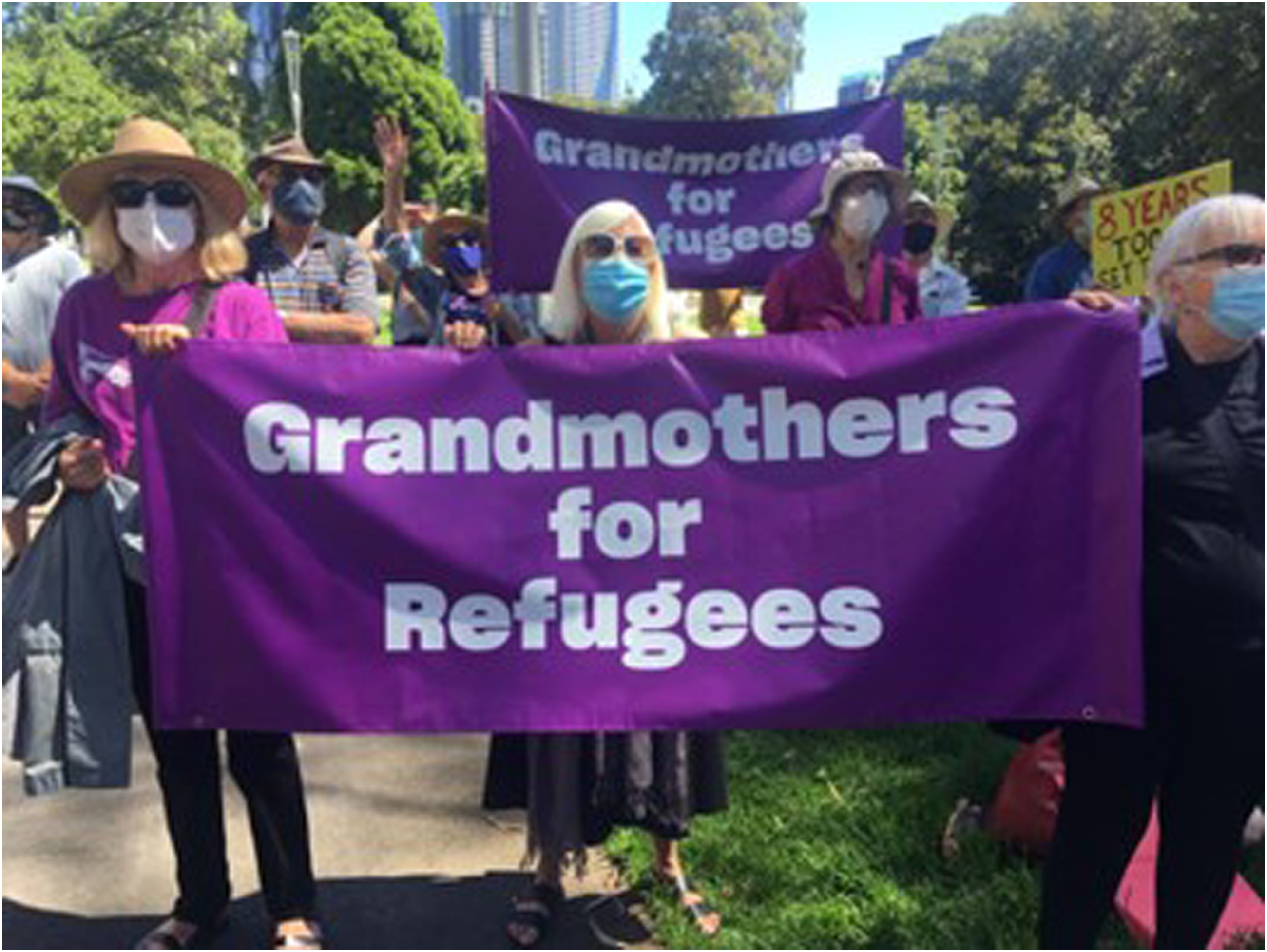
Comments on Grandmothers’ Facebook site, 20 February 2021: Lots of purple at the rally today that started at the State Library in Melbourne then went as a group to the Park “Prison” Hotel in Carlton. It was heartbreaking to hear from 2 of the men who are still trapped inside after being on Manus Is. and then transferred to Australia for medical treatment, only to have their torture continue. Yay Grannies! … Love the purple and thank you for being there.
7
During the various Covid-19 pandemic lockdowns, the right to assembly in Australian cities was highly contested, with no vigils and demonstrations permitted. But with the country’s successful control of community transmission of the virus until the end of 2021, there were ongoing energetic protests by the Grandmothers, joining other groups in their daily protests outside two ‘prison hotels’ in Melbourne: large numbers of honks from passing cars signalled to the protesters and the men inside the drivers’ approval (see Figure 2). Grandmothers for Refugees at World Refugee Day rally, State Library, Melbourne, 19 June 2021. Source: Copyright Jane Touzeau, permission granted to reproduce.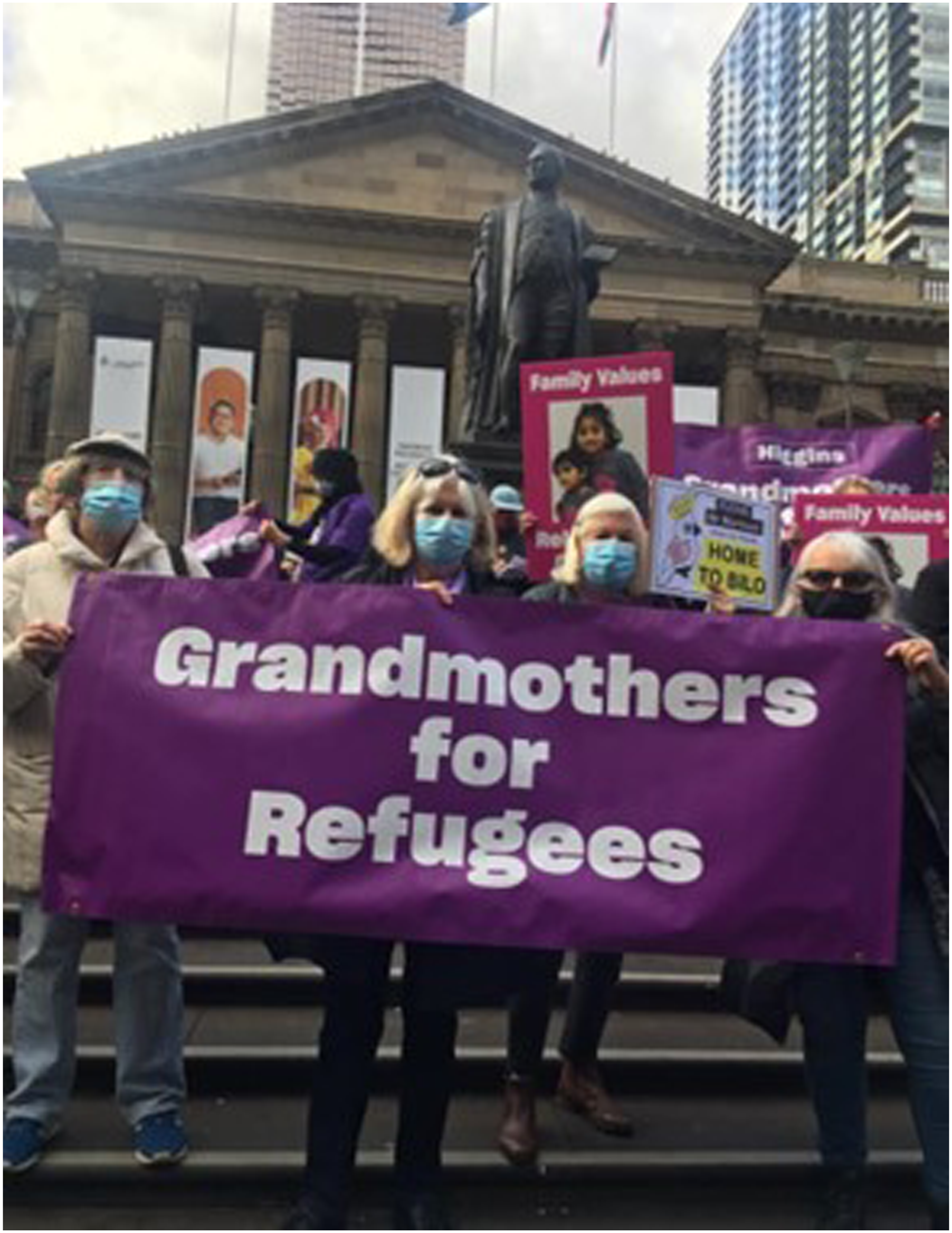
The Grandmothers (and the Mums 4 Refugees and Kindred Kindness) are part of the wider significant female presence at Australian actions advocating for refugees, a noteworthy dimension of the gendered character of refugee issues noted above. At one 2021 strategy meeting outside one of the ‘prison’ hotels, for example, the (young male) facilitator from one of the refugee collectives was seeking ideas for getting more people involved in protests. I pointed out to him that over 80 per cent of those attending were women and suggested he might work to get more men interested (!). He replied that he had ‘sort of noticed’ this preponderance of women, but it had clearly not registered with him. Noticed, or not, I would suggest that this female predominance reflects Australian women’s documented greater openness towards ‘Others’ and the cosmopolitan hospitality – in its (neo)Kantian sense – that they offer them (see Høy-Petersen et al., 2016; Stivens, 2018). Eighty per cent of both employees and volunteers at the largest, most prominent NGO, the Melbourne-based Asylum Seeker Resource Centre (ASRC), have been women (personal communication, Pamela Curr; see Stivens, 2018).
The Grandmothers members’ accounts of being grandmothered and of their own grandparenting defined what being a grandmother meant to them and spoke to the varying ways in which lived experiences inflected their activism. For some, there were warm memories of an archetypal grandmother’s kitchen: Elaine recalled, ‘I especially remember her meringues’; other members’ grandparents had died early, or were somewhat distant geographically or emotionally. But while their past experiences of ‘family’ had been varied, and members reported diverse marital patterns and statuses, most reported relishing their present status as grandparents.
Wendy thought it was ‘very empowering to be a grandmother’: I have a background in children’s services for a great deal of my professional life. I was really horrified to find young children were being incarcerated and I was delighted to find there was a group [dealing with this]…. It depends on how you see a grandmother, but I think that you can be seen as something of a guardian of your family and your society. I don’t claim to be a wise woman (!), but you have the experience of having lived a lot of years and seen quite a lot. I think one of the things about this particular group is that it was an opportunity for grandmothers to be seen as somewhat activist and not as passive recipients of their lot in life! (Interview, 3 August 2022)
Like many, she referenced the Mothers of the Plaza de Mayo (Argentina) as an ‘inspiration’, although there was not detailed knowledge of the Madres (for a developed analysis, see Day and Goddard, 2010). Several also noted the Australian Save Our Sons movement of the Vietnam War era (see Collins, 2021).
But Julia, with a background in education, added a cautionary note: I did have some reservations about the term ‘grandmother’, I have to say, because I have some reservations about me being a grandmother, you know the sort of … expectations that people have about either me as a grandmother or about grandmothers in general. I squirm when I think of people I know assuming all grandmothers are cuddly and kind and self-sacrificing … putting their grandchildren above everything in their life, it’s never appealed to me…. On the other hand, I think older women can be a source of great wisdom. (Interview, 1 August 2022)
Fictive kin ties have been prominent both in members’ accounts and in everyday practice. One Melbourne electorate group member, Janet, and her fellow members, had helped two detainees sent to the US at the height of the pandemic who had met a chaotic reception by dysfunctional refugee settlement services. The Grandmothers went online to find a grocery store near the men’s Californian residence and organised a food delivery, as well as subsequent, quite substantial monetary assistance. As Janet offered: The sense I get from them [the refugees] is that [there is] the idea that there are Grandmothers behind them, supporting them. Just the sense of ‘family’ as well as caring. (Electorate meeting, 9 August 2020)
Another man, detained for eight years, has texted back and forth with Elaine, a Grandmother with extensive community development experience, who had been visiting him in a detention centre in Melbourne after he was medevacced there. He often sent her a message before going to sleep, saying, ‘Good night, Mum!’ While this mode of address is of course a translation into English of a culturally specific respectful naming practice used for those of one’s mother’s age, it also points to a form of fictive kin relationship. The texts continued more intermittently after he was resettled overseas.
An idea of kin relations being central to imaginings of a better, kinder, non-oppressive future was an explicit theme in Elaine’s observations: ‘We’re grandmothers, we’re future looking, that’s what we must pass on…. Everything has to start with this voice coming out of the community … a voice that gradually found itself’ (Interview, 2 August 2022; cf. Donner and Goddard's Introduction to this issue, 2023; and the contributions by Strang, 2023 and Loning, 2023).
Everyday lived experiences of kin relations are important here, underlying my informants’ political actions. In contemporary Australian society grandparents, including members of the Grandmothers, provide extensive assistance to actual kin. They regularly care for grandchildren, including after-school care, and there are large flows of financial aid to the younger generation: the deposit from ‘the (middle-class) bank of Mum and Dad’ is a well-established component of house hunting in the Australian capitalist market, driven by ever-spiralling prices. Grandparents’ company and support was greatly missed during pandemic restrictions, and the isolation from grandparents, both those in the city, and further away within the country or overseas, 8 was a prevailing feature of the losses imposed by pandemic travel bans.
In a similar mobilisation of affect directed at the state, although contrasting with the kinship tropes, some other – younger – refugee advocates outside the ‘prison’ hotels often produced an alternative imaginary: carrying placards adorned with hearts, they called for the release of their’ ‘friends’ inside, sending ‘love’ to the men.
Discussion
There are many dimensions in exploring these Australian protests about the treatment of refugees. The ‘Grandmother’ groups can be seen to embody a number of intersecting forces: a passionate ‘purple’ politics, performing grand/maternal kin-based affect in the public; a fiercely protective maternal rage; an ethics of care that conforms in some of its manifestations to the assumptions of orthodox femininity embedded in many ideas of such ethics (see discussions in Engster and Hamington, 2015; Held, 2006); and a version of cosmopolitan hospitality reaching out to the ‘Other’ (Stivens, 2008, 2018). Carreon and Moghadam (2015) argue, in relation to maternalist politics, for a need to explore the many possible manifestations and interpretations of such a highly complex and fluid politics. They propose a typology of maternalism-from-above and maternalism-from-below to demonstrate how maternalist frames may ‘serve [either] patriarchal or emancipatory purposes with implications for gender justice and the expansion of citizenship rights’ (Carreon and Moghadam, 2015: 19). Like Stephen (1997), Jetter et al. (1997), Werbner (1999: 221), Day and Goddard (2010), Mhajne and Whetstone (2018) and Stephens (2019), among others, they see considerable potential in deployments from pre-established cultural domains of female power and rightful ownership or responsibility to create the conditions of possibility for women’s civic activism.
I have argued elsewhere for seeing the embrace by Australian refugee advocacy and support groups of maternal/grandmaternal and kinship-based nominalist identities as a version of a gendered, grounded cosmopolitan hospitality, reaching out to the oppressed in an explicitly antiracist project: one can, following some feminist philosophers, see an embedded maternal imaginary within this hospitality (Stivens, 2018; cf. Aristarkhova, 2010; Parker, 2012). I see this imaginary as also directly expressed in some of the relationships between individual refugees and Grandmothers that have assumed a fictive kin character. Maternalist namings and maternalist politics play on the enduring global significance of the ‘mother’ in images of domesticity, marriage, family and childhood (see Stivens, 2018).
Andrew Parker (2012: 20), quoting Levinas, suggests that the maternal body – at once host and hostage to an internal Other – can be seen as the universal model for ethical responsibility. For many members of the Grandmothers, the idea of a grandmother exemplifies the kindness, responsibility and care that the country should be offering refugees, people seeking asylum and those in precarious post-detention situations, mostly far from their own kin. Placing their grandmotherly bodies out there, ‘purpled up’ and passionately protesting, the Grandmothers use the cultural meanings and idioms surrounding kin relations and grandmotherhood – a potent kinship imaginary – to rally against the ruling powers’ uncaring – and worse – treatment of people who had managed against all odds to arrive on Australia’s shores seeking safety. (See Strang's, 2023 and Loning's, 2023 discussions of kindness in this issue).
Australian culture enshrines assumptions about women and mothers/grandmothers in particular as ‘naturally’ nurturant and caring, with greater capacities for ethical behaviour embedded both in their status as ‘women’, and in their kin positionings (albeit mostly within a binary heterosexual normativity): these positionings, however, can allow older women activists to claim the symbolic power of grandmothers within political struggles, even if some might feel ambivalent about their personal position as grandmothers. This embedded kinning acts as a symbolic base for political action, both resisting the state policing of family within border politics (see Turner, 2020) and ‘the intimacies of exclusion’ produced by refugee family separation (Mountz, 2011). (Activists also feel that their age protects them in possible confrontations with the police.) As such, they can carry both the potential to be a positive force for ethical and responsible behaviour and to assume the mantle of caring for succeeding generations from a grandmotherly subject position. I noted how the cultural imaging of the grandmother is underlain by real patterns of everyday support and help for actual kin in contemporary Australia.
But such positioning can of course produce problems. Stephens (2012, 2019) has written about how the term ‘mother’ has always borne the weight of cultural ambivalence and tension (in Australia), and about the profound ambivalences and contestations surrounding maternalism in the country. Cultural imaging of the mother/grandmother – and familism as well – can pose a problematic exclusionary association of the feminine with ‘care’. Some of my informants in the research project, like Julia above, shared these anxieties about essentialism, worrying about being reduced to a narrow subject position of ‘caring’ mother or grandmother (see Stivens, 2018; Ruddick, 2009).
Indeed, speaking about this project at several Australian university seminars, I was struck by the way some younger feminists visibly bristled at discussion of the political effectiveness of versions of maternalist/grandmaternalist politics, which they saw as embracing a pro-maternity ‘caring’ positionality and ‘traditional’ gender binaries. I saw this as a clear sign of the profound ambivalence within Euro-American feminist scholarship about maternalist political mobilisation. Such scholarship, drawing on histories of welfare in the West, has often seen versions of maternalist politics as problematic, risking essentialism (and heterosexual binary normativity), and, as noted, colluding with male-centred social orders, conservative politics and top-down state projects (see inter alia Jetter et al. 1997; Klein et al., 2012; Stephens, 2012, 2019). Yet such ambivalence ignores how maternalist politics in this Australian case is a highly oppositional, ‘maternalism-from-below’ exercise of an energetic, spirited, cosmopolitan, antiracist and often ‘enraged’ politics; this politics draws on an extensive history of activist women’s organisations both in Australia (Lake, 1999) – like the ‘Save Our Sons’ movement noted above (Collins, 2021) – and beyond. Notably, there has been a strong maternalist vein in Indigenous rights activism in Australia, including ideas about a ‘First Nations Matriarchy’ and a ‘Blak Matriarchy’ movement (see, for example, Reid, 2022; see also Pol and Baxter, 2022).
Positionings as mothers/grandmothers among the Australian protest groups nonetheless open up intriguing questions about kinship-based and maternalist framings and the cosmopolitan hospitality offered from within such imaginaries of ‘maternal’ responsibility and care. The debates about familism illustrated its essentially paradoxical character as both inclusionary and exclusionary (see Barrett and McIntosh, 1982 and their interlocutors on familism, and the Introduction to this issue). In its most positive forms, familism involves moral and ethical care for familial others. As Tilbury (2007) argues for refugees in Western Australia, the attribution of a familial-like role to both those helping refugees and to the refugees themselves directly challenges the negative dehumanising representations of ‘illegal’ (sic) migrants within national rhetorics (cf. Altman, 2019). But by the same token, those who are not ‘family’ can be excluded from such care. Other exclusions can be at work here. Frazer (2020) points to the possible limits on the care of refugees, describing the class and racial tensions that can exist between well-meaning humanitarian-motivated Anglo-Saxon volunteers and their refugee resettlement clients in an Australian city (see also Stock, 2019). This ‘white saviour’ phenomenon will be familiar from critiques of many humanitarian projects globally, not least in many white Australian approaches to justice for the continent’s original inhabitants.
One of the more prominent metaphorical uses of ideas of family and kinship that exemplifies this double character of familism and kin imaginaries is of course their deployment within nationalist rhetoric. The nation is posed as ‘family’, with the maternal body often located as an imagined symbolic site of nation, like the earlier, more ‘maternal’ ‘Mariannes’ gracing French town halls nationwide. The ‘national family’ – often explicitly a ‘Motherland’ – offers familial sustenance and care while simultaneously excluding those outside the imagined community of nation.
To conclude: I have been interested in the ways in which invocations of kin-based location – especially as ‘grandmothers’/‘grannies’/‘nannas’ – operate within the Grandmothers for Refugees organisation. Members assume both an overt symbolic and actual ‘familial’ responsibility for, and care of refugee ‘Others’ and their futures within and beyond state and nation. For many members, the idea of a grandmother exemplifies the kindness, responsibility and care that the country should be offering refugees, people seeking asylum and those in precarious post-detention situations.
I have shown how the kinship-based, the domestic, the intimate and the affective imaginaries associated with the Grandmothers operate within the public, powerfully opposing Australian border politics (see also Stivens, 2018): they transgress both ideas about supposed public/private divides and stereotypes of ageing women within public discourse. In ‘purpling up’, the Grandmothers exert what some would term ‘agency’, but which I prefer to term ‘political effectivity’. They have been shaping new cosmopolitical spaces produced and grounded in everyday material acts of fictive kin relations, kindness, empathy, friendship, compassion and care, but also an impassioned political outrage and rage (see also Stivens, 2018). Amidst plutocracy and growing authoritarianisms, such spaces propose and explore new political bases for claims and practices of solidarity and possible reimaginings of a more ethical future (see Glick Schiller, 2020). As such, they point to the emergence of important new political actors – older women – who have been invisible in most of the literature on social movements
Australian politicised grandmotherhood militating on behalf of refugees underlines just such political possibilities, effecting in the process a transformative ethics through highly particular political mobilisations of fictive kinship and everyday care. Kinship tropes and imaginaries, while on occasion exclusionary and contradictory, arguably work here to achieve one version of a linking of political, enraged affect with solidarity with the oppressed. Through an extension of fictive kin ties to encompass those othered by the Australian asylum regime the Grandmothers enact what Judith Butler (2015) has termed the potential power of the collective assembly to embody and express an opposing form of ethics and responsibility.
Footnotes
Acknowledgements
The author wishes to thank her informants in this study, Ruth Fitzgerald and Maree Pardy for earlier input to the project, Janet Carsten, the present special edition editors Henrike Donner and Victoria Goddard, and the anonymous reviewers for their generous and interesting comments. (University of Melbourne Ethics ID 1646188.1).
Declaration of conflicting interests
The author(s) declared no potential conflicts of interest with respect to the research, authorship, and/or publication of this article.
Funding
The author(s) received no financial support for the research, authorship, and/or publication of this article.
