



Abstract
This article seeks to ethnographically highlight the multiple uses of gene/alogy (as explored by Franklin and McKinnon in the 2000s) in the context of the Bangladesh war of 1971, and hence maps out the range of violence and ambivalences at the heart of kinship. It aims to do so by exploring the process through which disrupted kinship futures are seen as a cornerstone for discourses of war and sovereign practices to justify sexual violence during wars. The formation of Bangladesh in 1971 coincided with the rape of 200,000 (contested and official numbers) Bengali women perpetrated by the Pakistani army and its local collaborators. The article explores the occupation of the womb, that is, the connotation of genetic or ethnic fixing through sexual violence by the Pakistani army, which is apparently an attempt to disrupt the kinship futures of East Pakistan (that later became independent Bangladesh). The sovereign logic of disrupting kinship futures of those that one feels the need to attack, weaken and annihilate (in this case East Pakistanis) is, however, based on a process of naturalisation of inequalities drawn from historical and racialised accounts. The article argues that the sovereign belief in being able to genetically and behaviourally ‘fix’ East Pakistanis through wartime sexual violence, and to instil fear, is possible through the sovereign inhabitation of the inhumanity of sexual violence. Therein lies the vulnerability of sovereign power, the paradox of kinship and its processes of inclusions and ruptures in the future. In seeking to develop a wider theoretical contribution about kinship as the cornerstone of statecraft and wars, the article also seeks to show how military rape alters the grounds of the nation itself, the experiences and imaginations over a period of half a century, and instils various forms of ambiguities about the history of wartime sexual violence.
Dear friend Ikram, I am not surprised with the news that Rashid has been able to tame the Bengali tigresses It is of utmost need to alter their succeeding generations…. In the meantime you must carefully make plans to tame some wild bitches. Yours affectionately, Sakib (quoted in Rahamana, 1982: 761–3)
The letter quoted above, written by a Pakistani army major to his friend stationed in occupied Bangladesh, is included in volume 7 of the 16 volumes of the Manuscripts of the Liberation War of Bangladesh as documentary evidence of the premeditated rape of East Pakistani women by the West Pakistani army during the nine-month Bangladesh war of 1971. An estimated 200,000 (the official number is contested) 1 East Pakistani women were raped by soldiers of the Pakistani army and by the Razakars (local Bengali and non-Bengali collaborators), purportedly in pursuit of their mission to ‘improve the genes of the Bengali people’ (Ali, 1983: 91) and thus populate Bangladesh with ‘pure’ Muslims.
During the Bangladesh war, women who were detained in bunkers and ‘camps’ were released only after they conceived and it was ascertained that they could no longer terminate their pregnancies (Siddiqi, 1998) – a phenomenon referred to as ‘forced pregnancy’ (ICC, 1998). In similar accounts of mass rape against women in Bosnia ‘women were released only in her seventh month’ (Stiglmayer, 1994: 118). Over the years, it has become evident that in the context of wartime rape, perpetrators sometimes confine women, until it is too late to terminate their pregnancies. In such cases of ‘forced pregnancy’, women’s access to abortion is severely restricted. The United Nations Commission on Human Rights and the Rome Statute of the International Criminal Court have condemned ‘forced pregnancy’ as a ‘crime against humanity’ (ICC, 1998).
An insight into the various acts of sexual violence perpetrated by the Pakistani army during 1971 is available in the secret documents of the Hamdoodur Rahman Commission of Enquiry [2000 (1971)], made public only in August 2000. The commission was appointed in 1971 by the President of Pakistan to inquire into the circumstances of Pakistan’s surrender. This Pakistani government document provides ‘damaging evidence’ regarding Pakistani Lt. Gen. A.K. Niazi ‘in sex matters and his association with women of bad repute’. The remarks of Lt. Col. Aziz Ahmad Khan, witness no. 276, are also deemed by the commission to be ‘highly significant’. Khan says that: ‘the troops used to say that when the commander [Lt. Gen. Niazi] was himself a raper, how they could be stopped?’ Niazi defended himself by saying that he had commanded that all ‘loot, rape, arson, killing of people at random must stop and a high standard of discipline should be maintained’. He admitted that there were a few cases of rape, but asserted that around 80 guilty persons were duly punished. He added that these things ‘do happen during wars’.
I have explored the public memories of wartime sexual violence extensively in my book, The Spectral Wound: Sexual Violence, Public Memories and the Bangladesh War of 1971 (Mookherjee, 2015), where I discuss the historically unprecedented decision of the Bangladesh government that women raped during the Bangladesh war of 1971 should be referred to as birangonas (war heroines) (Purbodesh, 23 December 1971). However, further reflection is required on the bio-political modalities (that is, the different kinds of political power through which the reproduction of a population is regulated; see Foucault, 2008 [1976]: 138) of the sexual violence perpetrated by the Pakistani army. The oft-cited quote with which I started this article reminds us of the need to map the relationship between politics and kinship when thinking through the contentious sovereign logics (here of that of the West Pakistani army, like ‘that image of the consuming conqueror’; Bloch, 1992: 49) that lie at the heart of sexual violence during conflict. Yet the sphere of kinship and that of wars and the politics of fear are deemed separate spheres: ‘The exclusions we are witnessing in Europe may seem less about kinship than about warfare, economics, and the politics of fear’ (Carsten, 2017: 192)
This makes it imperative to explore the relationship between the discourses on sexual violence during conflict inflicted by state actors and their implications for kinship through three interrelated arguments. First, the article explores the occupation of the womb, that is, the connotation of a genetic or ethnic fixing through sexual violence by the Pakistani army which is apparently (according to the quote) an attempt to disrupt the kinship futures of East Pakistan, which later became Bangladesh. If, following Agamben (2002), the sovereign has the capacity to kill in order to make live, here the ability of the Pakistani army – as the sovereign – to decide the right to life or death of birangonas needs further reflection. The attempt to change the women’s succeeding generations through sexual violence seems to locate the birangona at the crossroads between/along with life and death so that they and their pregnancies can disrupt the kinship futures of independent Bangladesh. This article shows how military rape alters the grounds of the nation itself and has impacted on its experiences and imaginations relating to sexual violence over a period of half a century. The article traces the particular kinds of rupture, ambivalence and disconnections that are engendered as a result of the attempts to disrupt kinship futures, and how the aftermath of violence in relation to kinship is continuing, particularly around gender norms. Overall, the article seeks to develop a wider theoretical contribution about kinship as the cornerstone of statecraft and wars.
Second, the article explores how the enactment of the power of sexual violence over East Pakistani women is based on a process of naturalisation (MacCormack and Strathern, 1989; Yanagisako and Delaney, 1994) of inequalities, based on historical and racialised accounts, manifested through differences in physiology, behaviour, weather and terrain. Naturalisation is often constructed as scientific knowledge and, in the process, engenders power. I attempt to track the various historical and political naturalised inequalities of wartime sexual violence and provide a multifaceted, grounded account of these manifestations beyond their abstractions.
Third, in exploring the idea of ‘altering generations’ through sexual violence and genetically, ethnically, fixing their futures, the article also highlights the vulnerability of sovereign logics. It shows that the seemingly racially superior and overdetermined West Pakistani army believes that it can genetically, behaviourally, ‘fix’ the perceived racially inferior and malleable East Pakistani ethnicity through wartime sexual violence. This racial hierarchy is enabled through the aforementioned naturalisation of inequalities, which is linked to historical narratives. In the process, the West Pakistani army, as sovereign, can instil fear through the threat of disrupting kinship futures. In reality, the sovereign can only feel powerful through rape, which necessitates its inhabitation of the viciousness of sexual violence, and therein lies the vulnerability of its sovereignty. This vulnerability is also hinged on the ‘paradox of kinship’ (Carsten, 2021) – its processes of inclusions and ruptures in the future – and the ‘public fictions of kinship’ (Gallo, 2021). Referring to the kinship relations accepted in the public sphere in the case of inter-caste/religious marriages in Kerala, but which are denied affective and material foundations in everyday life, Gallo shows how the public fictions of kinship here limit the flow of affective bonds and generational support. In following Gallo, I seek to show how discourses of wartime sexual violence create ‘a recurrent process of distance making’ (Gallo, 2021) by attempting to disrupt kinship and genealogical futures of East Pakistan, later Bangladesh, through proposing to change the successive generations via rape. Kinship has been seen predominantly as an after-effect of the ‘natural’ facts of sexual reproduction and has been emphasised in anthropology as a form of connection and solidarity. Its contribution to acts of disconnection or rupture is being increasingly theorised. This article seeks to highlight ‘the multiple uses of gene/alogy for discrimination and subordination’ (Franklin and McKinnon, 2002) in the context of the Bangladesh war of 1971 and hence maps out the range of violence and ambivalences at the heart of kinship.
Along with Gallo’s public fictions of kinship I find Carsten’s formulation of the ‘paradox of kinship’ instructive for addressing the inclusions and ruptures, the imagined affective and practical implications of disrupted kinship futures in the context of wartime sexual violence. To follow Donner and Goddard (2023, this volume) much of this power stems from the future orientation of disruptive kinship, genetic links to future generations which connect discourses of marriage, parenting, nation, presumed personhood and genetics as part of kinship to a collective future (as apparent in the way nationalism depends on the idioms of kinship to imagine a collective future). Drawing from anthropological and political theory literature on state, kinship and sovereignty, I primarily attempt to theoretically explore the process through which disrupted kinship futures are seen as a cornerstone for state discourses to justify sexual violence during wars. This shows how ‘outside forces like state institutions are deeply entwined with kin roles and meanings, and determine how apparently autonomous and salient idioms of kinship are shaped, transmitted and enacted’ (Donner and Goddard, 2023: 350).
This article is based on ethnographic research in Bangladesh in 2013 with around 30 members of civil society and organisations working with children conceived as a result of the sexual violence of East Pakistani women during 1971. These included liberation fighters, feminists and human rights activists, representatives of various governmental and non-governmental organisations. I also examine various secondary sources, including archival, government documents and press reports after the war. Notable among these secondary sources are the Bangladesher Swadhinota Juddho Dolilpotro (Documents of the Bangladesh Independence War; Rahmana,) and the secret documents of the Hamdoodur Rahman Commission of Enquiry [2000 (1971)]. The latter was appointed in 1971 by the President of Pakistan to inquire into the circumstances of Pakistan’s surrender and the documents were made public only in August 2000. The Documents of the Bangladesh Independence War were edited by the renowned poet Hasana Hafizura Rahmana and other eminent historians and academics. This constituted a collection of documents which were not analysed (only 21% of collected documents used), ‘leaving interpretation in the domain of the reader’ (Rahmana,, vol. 1: 3).
My research on this sensitive topic with my interlocuters was facilitated by my long-term relationships from when I was investigating public memories of sexual violence of the Bangladesh war of 1971 (Mookherjee, 2015). This article highlights the ethnographic understandings of wartime sexual violence among members of civil society as well as a community where birangonas live. As a result of my pre-existing relationships, my multiple subjectivities (as a middle-class UK-based Indian, Hindu academic, working for over two decades in Bangladesh on 1971) were not interrogated and instead this project was seen as in a continuum with my earlier research among the birangonas. I have explored the varied ethical dimensions of such research extensively in my book. Ethical approval was also received from the Chair of the Ethics Committee of Durham University.
In the next section, the article ethnographically explores the various reasons cited as to why sexual violence occurs during wars. This is juxtaposed in the subsequent section with the historical discourses naturalising the ‘occupation of the womb’, that is, the connotation of genetic, ethnic fixing through sexual violence by the Pakistani army. The article further unravels the two sovereign logics: first, that of the idea of altering generations through sexual violence and, second, that of ‘taming tigresses’ and the resulting ruptures, which continue to be evident in contemporary Bangladesh.
‘The streak of lightning in the eyebrows’: Ethnographic reflections on wartime sexual violence
Spectral Wound (Mookherjee, 2015) highlights the public memories of wartime sexual violence through ethnographic research among birangonas and their family members in Enayetpur (a pseudonym), in western Bangladesh, who were publicly speaking about their wartime experiences for various reasons. The book shows that, instead of the silence assumed to surround this subject, there exists an extensive public memory of the histories of wartime sexual violence, which primarily imagines the birangona as an iconic horrific figure – either being physically ‘wounded’ or socially kinless as a result of wartime rape. The book argues that identifying raped women only through their suffering creates a homogeneous understanding of gendered victimhood. The book instead highlights the socialities of violence through which various birangonas experience their ‘event’ of 1971. Addressing how the experiences of 1971 manifest today among women themselves and their families, the book triangulates the narratives of survivors with various representations (state, visual and literary) as well as contemporary human rights testimonies. The book thereby examines the circulation of press articles, a range of oral accounts (interviews, discussion, observation, rumours and gossip), images, literary representations, and testimonies of rape among survivors of sexual violence, their families, and communities, left-liberal civil society, different governments and state actors. I want to highlight here the various ethnographic reasons cited as to why sexual violence occurs during wars.
In Enayetpur, everyone had a story of gondogoler bochor (the year of chaos, that is, the war of 1971) which they spontaneously shared. Thus, the local events of the war, the role of liberation fighters, military training, stories of valour, arson, killings, bombings, ambushes, the everyday travails of survival, displacement, floods, hardships, food scarcity, were vividly narrated. Within these narratives, generic accounts of nari nirjaton (literally torture of women, that is, rape) were always present. In my conversations I would ask people in the area about their experiences of war and not about wartime sexual violence. However, narratives of sexual violence during the war would abound in our conversations. Liberation fighters commonly held that it was only when people saw their sisters being raped in front of them that their spirit rose to fight against the Pakistani army. This conceptual and abstract imagination of, and fixation on, the ‘permanent rape’ (Butalia and Sarkar, 1995: 76) of women enabled the mobilisation of passions to go to war. Enayetpur villagers would say that because the Pakistani military started raping, it brought Allah’s wrath upon them and hence they were defeated within a short span of time, despite the strength of the army. A school teacher, reasoned that the rapes distortedly used the religious discourse of mal-e-gonemat (booty during the war). An elderly man recited this local saying to explain the rapes: ‘The streak of lightning in the eyebrows, the mark on the forehead, flowers in the hair bun, seeing so one loses all control.’
Hence greed for ‘beautiful Bengali women’, Islamic discourses and revenge on the families of Muktijoddhas (liberation fighters) were the reasons cited for rape. Some believed the grabbing of a stray goat or a woman was a violent random act in wartime, rather than an intentional act of sovereignty over the women and future kinship relations. Many felt that during wars, since soldiers are far from their wives, they committed rape due to lack of sexual activities. ‘Don’t you know the principles of men?’ said Shajeeda, a poor, single mother living on the outskirts of the village, a view also shared by wives of local leaders. 2
In initial conversations with villagers, allusions to rape were about events in neighbouring villages, but never about Enayetpur (see Butalia and Sarkar, 1995: 62). The abundance in village narratives of accounts of man ijjot mara (beating/stealing of honour) or nari nirjaton (torture of women) – phrases used as euphemisms for rape – highlights the narrative trope through which fear of rape is captured in the local imagination. A few common anecdotes, each occurring in the locality of narration, are reiterated when the events of rape are narrated. Muktijoddhas would talk about how women would cover their face with soot so as to make themselves unattractive whenever they heard of the army’s arrival. 3 Another common tale is that during 1971, when the military enquired about lakri (‘wood’ in Urdu), that was misunderstood as their need for larki (‘girl’ in Hindi) and this led to total chaos, with the local East Pakistani men asking the women to flee their homes and hide in the sugarcane fields. This anecdote works as an ‘organizing image’ (Das, 1990: 28) of the metathesis of chaos and chance encoded in the threatening, disorienting fear of rape. It re-enacts an environment of pervasive fear, and such fear also serves to maintain the coherence and continuity of state institutions and further reproduces them.
In Enayetpur, group dynamics, as well as comments from audiences during conversations relating to the war eventually prompted speakers to talk about specific events in Enayetpur (Mookherjee, 2006). In trying to explain the reasons for rape, a poor but philosophical liberation fighter, blamed it on the mentality of war, which attempts to occupy everything forcefully. He compared military activity to ‘shontrashi’ (anti-social) activities (referring to underground Marxist-Leninist parties operating in the area), whose propensity is for forceful seizure, be it that of a goat, a cow, or a beautiful girl.
In the next section, the article explores these propensities enabled by the naturalisation of historical discourses relating to the ‘occupation of the womb’ – that is, the connotation of genetic, ethnic fixing through pregnancies made possible through sexual violence inflicted by the Pakistani army.
Occupation of the womb and its naturalised historic account
In 1947, the independence of India from British colonial rule resulted in the creation of a new homeland for the Muslims of India by carving out the eastern and north-western corners of the country, which came to be known as East and West Pakistan respectively. Thus, in the formation of Pakistan, Islam was one of the main principles of nationhood unifying two widely disparate units, separated not only geographically but by sharp cultural and linguistic differences. The practice of ‘Islam’ among the Bengali Muslims bore the imprint of different historical and social forces and was fused with popular beliefs and practices, which represented the popular culture of Bengal. ‘Orthodox’ Muslims in other parts of South Asia interpreted the practice of Islam in Bengal as too Bengali (perceived as Hinduised) (Ahmed, 2001). In the light of these religious dynamics, successive regimes in Pakistan embarked upon a strategy of forcible cultural assimilation of Bengalis. It is important to note that Bengali Muslims are differentiated among themselves and, at different points in time, various aspects of their multiple identities are stressed on the basis of diverse classes, ethnicity, use of language and practice of religion. 4 West Pakistani antipathy to Bengali culture was also nourished by the suspicion that, although they were nominally Muslim, their ‘relatively recent’ conversion from low caste Hindu status made them unreliable co-religionists (Ali, 1983). Thus, reluctant to rely on religious allegiance alone, successive regimes in Pakistan embarked on a strategy of forcible cultural assimilation towards the Bengalis by targeting the Bengali language and attempting to replace it with Urdu as the only state language, so as to purge Bengali culture of its perceived Hindu elements. This forcible linguistic kinning did not work and was felt as an attack on the identity of East Pakistanis. Over the years, various such impositions, as well as West Pakistani administrative, military, civil and economic control led to the nine-month long liberation war in 1971. Thereafter, East Pakistan became independent from West Pakistan and Bangladesh was formed.
Here the act of rape is intertwined with sexuality and masculinity and, following Catherine Mackinnon (1987), rape here is not only a matter of individual lust but also an affirmation of women as objects of pleasure which underlines the power of men. If women as gender female are defined as sexual beings and violence is eroticised, then men violating women has a sexual component. If we extend this argument to understand the silence about rape of men by men during conflicts, the link between sexuality and the state in relation to masculinity would be clearly identified (Mookherjee, 2012). However, when the historical context and identity politics of sexual violence is considered, it highlights that feminist theorisations of rape can provide only part of the picture in times of collective violence. Various feminist theorisations of rape, which see the female body as the sole focus of rapes, cannot address the issue when dramatic episodes of violence against women during collective violence bring to the surface savagely and explicitly familiar forms of sexual violence now charged with a symbolic meaning, a meaning conveyed by the canonical 200,000 rapes in Bangladesh. As a result, it becomes important to map out the historical dynamics which are foundational to the discourses of wartime sexual violence perpetrated by the Pakistani army and their East Pakistani collaborators.
As mentioned earlier, in the context of West Pakistani perceptions of ‘Islam in danger’ (Kabeer, 1989) in Bangladesh, one of the oft-cited reasons for the prevalence of rape of Bangladeshi women by soldiers of the Pakistani army was purportedly to ‘improve the genes of the Bengali people’ (Ali, 1983: 91), as Pakistan apparently considered the practice of Islam in Bengal as ‘inferior and impure’ (Ahmed, 2001). The aim was also to populate Bangladesh with a new race of ‘pure’ Muslims and dilute, weaken and destroy Bengali nationalism (Guhathakurta, 1996). A prevalent anecdote states that Pakistani soldiers were instructed by the army to ensure that a Pakistani child was there in each Bengali womb. This point is borne out in my interview with the wife of a British MP who visited Bangladesh after the war, during 1972. She affirmed that that some Pakistani soldiers were promised promotion if they fathered a Bangla baby and ensured the unity of Pakistan. Women who were detained in bunkers and ‘camps’ were released only after they conceived and it was ascertained that they could no longer terminate their pregnancies (Siddiqi, 1998). As mentioned earlier, there were similar instances in Bosnia and in other contexts. In East Pakistan, the imposition of religious, territorial, racialised and gendered boundaries was primarily marked on women’s bodies and the womb. Rape of women was apparently justified by the notion of maal-e-gonemat (the booty of war) (Pasha, 1976: 27).
5
As mentioned in various discussions with civil society members, it became the essential means to change the racial make-up of the ‘small-boned, short, dark, lazy, effeminate, bheto (rice and fish-eating and cowardly) half-Muslim Bengalis of the river plains’ to the ethnographically oft-repeated descriptions of the ‘broad-boned, tall, fair, wheat-eating, warrior-like, brave, resilient, manly, Muslims of the rough topography of Pakistan’. The collapsing together of these structural, behavioural and religious discourses is also evident in other existing accounts. Parallels to this discourse may also be found in the account of Pakistani journalist Anthony Mascarenhas (1971) of the Bangladesh war as the story of simple, gentle Bengali people persecuted by more aggressive, militant and more Islamic Pakistan. He states: In West Pakistan, nature has fostered energetic, aggressive people – hardy hill men and tribal farmers who have constantly to strive for a livelihood in relatively harsh conditions. They are a world apart from the gentle, dignified Bengalis who are accustomed to the easy abundance of their delta homeland in the east.
In his novel Shame, Salman Rushdie (1983: 13), in attempting to portray the West Pakistani disposition towards East Pakistanis, writes: Savages, breeding endlessly, jungle-bunnies good for nothing but growing jute and rice, knifing each other, cultivating traitors in their paddies … the appalling notion of surrendering the government to a party of swamp aborigines, little dark men with their unpronounceable language of distorted vowels and slurred consonants; perhaps not foreigners exactly, but aliens without a doubt.
This collapsing together of the tropes of food, landscape and physicality to differentiate Bengali Muslims from the Pakistani army is discursively similar to, and resonates with descriptions from centuries earlier. In 1579, when Mughal imperial forces took over Bengal, it was equated to a site of socio-political decay (Eaton, 2001: 27). Its ‘enervating’ climate, and its livelihoods based on fishing, were seen to corrupt men and pave the way for conquest by more ‘virile’, ‘manly’ races. This linkage of Bengal’s climate with the ‘debased’ behaviour of the people exposed to it was later adopted by British officials. As a result, Robert Orme writing in 1763 noted that: the abundance of advantages peculiar to this country have concurred with a languor peculiar to the unelastic [sic] atmosphere of the climate, to debase all the essential qualities of the human race and notwithstanding the general effeminacy of character which is visible in all the Indians throughout the British empire, the natives of Bengal are still of weaker frame and more enervated disposition than those of any other province. (Eaton, 2001: 45)
An exploration of these historical and colonial discourses allows us to map their links to the two sovereign logics (mentioned earlier) governing the practices of sexual violence, so as to think through the implications of kinship, as the cornerstone of statecraft and wars in the following sections.
Sovereign logic of sexual violence during Bangladesh war of 1971
Disrupting kinship futures
Over the years I have carried out research in Bangladesh, I have found that in various interviews and discussions various individuals would often reiterate that the aim of the Pakistani army was to: ‘make a Pakistani in the womb of every Bengali woman’. My Bangladeshi feminist and activist friends would also add that, ironically, in the 1980s, in an effort to suppress the resistance in Chittagong Hill Tracts among the indigenous communities, the Bangladeshi army is alleged to have raped many pahari (hill/indigenous) women, with the intention of ‘creating a Bengali in the womb of every pahari woman’. There is no doubt that the act of sexual violence is primarily aimed at attacking the victim and, as elaborated earlier, the exercise of power is intrinsic to this violence. However, the issue of birth becomes central to the phenomenon in instances in 1971, where some women were not allowed to leave the camps where they were held until they were in the advanced stages of pregnancy (Rahamana, 1982; for Bosnia, see Stiglmayer, 1994: 118). This attempt at forced pregnancy is one of the clearest indications of a perpetrator seeking to disrupt the kinship futures not only of the women but also of the community and nation within which they belong . In the case of Bangladesh, the pregnant birangona and the possibility of the birth of her child became coterminous with the birth of the nation. This makes it clear that the continuation of a West Pakistani paternal lineage in East Pakistan/Bangladesh was meant to coincide with the independence of Bangladesh, and was a punishment for this. The tenacity of this continuing sovereign logic aimed at disrupting the kinship futures of those it seeks to attack and annihilate, is worth theorising. Could the Bengali liberation fighters similarly raping non-Bengali ‘Bihari’ communities (who are considered to be collaborators with the Pakistani army) during the war, be invested in such disruptive kinship futures? Maurice Bloch’s (1992: 2) idea of ‘rebounding violence’ might be applicable in terms of a quasi-universality of what he refers to as ‘minimal structure’ in the context of religious rituals. This universality is based on a basic understanding of biological processes of life present in all cultures, as well as problems intrinsic to the human condition. However, even though in various instances of conflict, perpetrators might inflict sexual violence as form of exercising power, creating fear among victims and their communities, there are specific naturalised historical and racialised discourses that precede this violence.
As we all know, the aforementioned racialised constructions of East and West Pakistanis are absolutely flawed as a homogeneous constructs. However, we also see the enduring nature of such constructions, how easily they circulate and how they seem to legitimise the rapes as a weapon, since ‘it is of utmost need to alter their succeeding generations’ (Sakib, quoted in Rahmana, 1982: 761–3). The purification of the ‘tainted’ blood of the ‘lesser’ Bengali Muslims aims at the rupture, refixing and coinciding of religious and territorial boundaries, possible only through a biological, genetic occupation of the wombs of Bengali women, which thus absolutely necessitates rape and becomes a reminder of indignity for the Bengali nation. As a result, ‘Pakistani soldiers sometimes saw themselves as physically introducing Islamic substance into perceived non-Islamic bodies’ (Mookherjee, 2012). This is the manifestation of biopolitics and operation of a different kind of political power, through which the reproduction of a population is regulated [Foucault, 2008 (1976): 138]. 6
I unpack here the first sovereign logic – that of disrupting kinship futures – and map its impact in independent Bangladesh. Central to this disruption is the gendered racialisation of, and inferior position accorded to, East Pakistanis by West Pakistani soldiers. Within this conjuncture, East Pakistani ethnic identity is deemed to be inferior and pliable, and their successive generations easily altered. The discourse of genetic inscription and transference through the act of sexual violence seems to suggest an attempt to transform the very substance and personhood of Bengali Muslims into ‘pure’ Muslims. Alongside it is also an attempt to leave behind a trace of the Pakistani soldier in Bengal, with the hope that these children would reflect later, in independent Bangladesh, the characteristics of their biological father and of the father embodied in the nation of Pakistan. As result, East Pakistani kinship futures are meant to be disrupted through these West Pakistani genetic imprints, which will apparently improve genes, make pure Muslims, change generations with the hope of generating more loyalty for West Pakistan, and create disloyal Bangladeshi citizens. The assumption here is that the possibility of this behavioural transmission is based on the substances passed through the blood, as human nature is deemed to be constituted by behaviour and substances passed between generations through sexual reproduction. This suggests that the act of sexual violence is an exercise of power over the woman as well as her community. It is also deemed to be an act of genetic transference on the part of the perpetrator, and maybe also the victim and her community. At the same time, East Pakistani genetic pliability is juxtaposed to the illusion of a superior West Pakistani heritable fixing through sexual violence, which would seemingly change succeeding generations and disrupt the kinship futures of East Pakistan/Bangladesh.
The striking circulation of this discourse of the effeminate, dark, lazy, Bengali Muslims has a remarkable parallel and a reverse manifestation in the Hamitic hypothesis which has ‘contributed to the recurrent violence in central Africa’ (Taylor, 1999: 55, 61), and in the Rwandan genocide. The Hamitic hypothesis (introduced by anthropological writers, specifically, British explorer John Hanning Speke in the 19th century) led to the creation of Hutus and Tutsis, so as to delineate the groups as ‘races’ with varying intellectual capacities. This led to lingering political divisions along ethnic lines (exacerbated by competition for resources and power) which shaped the conflict. Like the West Pakistani discourses about the physiological and spatial inferiority of East Pakistanis, Hutu constructions of Tutsis in Rwanda also projected that Tutsis were devious and given to ruses and stratagems. According to the Hamitic hypothesis, which conflated race, language and culture (Taylor, 1999: 61), the Tutsis were deemed to have putative biological superiority based on higher intelligence and greater physical beauty. Based on anthropometric measurements, Tutsis were seen to be superior. Like the East Pakistanis, the Hutus, are described as being inferior, less attractive ‘negroids’, of moderate height, stocky, with coarse features, not overly intelligent and having physical strength which made them born servants and suited for agricultural labour (Taylor, 1999). This discourse shifted in the 1950s, when Belgian colonial officials referred to the Tutsi as lazy oppressors and Hutus as serfs, slaves and victims; the discourse was then used by the Hutus against the Tutsis when they took power in 1959. While espousing the Hamitic thesis, they inverted its moral valuation: to them it appeared that the Tutsis used their intelligence for evil and took recourse to trickery and malignancy towards the Hutus. Similarly, Tutsi women, who were considered to be more beautiful than Hutu women – a perception held by Tutsis, Hutus and Europeans alike – and were deemed to use their beauty to trick Hutu men into servitude. It was the perceived beauty and deceit of the Tutsi women that made them seem legitimate targets for rape in the 1994 Rwandan genocide. So, in the case of Rwanda, under Belgian rule, the long-term and continuous disavowal of what were seen as positive attributes among the Tutsis made them legitimate target for the Hutus in the genocide in the 1990s. At this juncture it is important to track how the discourse of disrupting kinship futures through sexual violence manifested in the everyday life of birangonas and worked as a legitimating framework. This will also allow me to map the particular kinds of rupture, ambivalence or disconnection brought about by this phenomenon of disrupted kinship future.
This article has primarily focused on the West Pakistani army as the sovereign and its logics for perpetrating sexual violence. Apart from them, various other sovereigns worked with the birangonas in independent Bangladesh. Spectral Wound (Mookherjee, 2015) explored the bio-political modalities of the Bangladesh government in dealing with post-war rehabilitation of the survivors of wartime sexual violence. Along with the violation endured during contexts of conflict, in post-conflict situations the situation of women is exacerbated as various other sovereign powers – their own governments, social workers, doctors and national laws – might restrict/expedite their access to clinics for termination of their pregnancies, engendered through wartime rape. Thus the politics of sovereignty, in terms of determining the right and power over life and death, can also come to operate in instances of humanitarian intervention. This can occur through the provision of rushed and often non-consensual access to intervention by abortion, whether the women want this or not, specifically in the context of forced pregnancies during times of conflict, as was the case in Bangladesh (Mookherjee, 2007, 2015).
Behind extensive programmes of rehabilitation lay the raw wounds of innumerable birangonas and the choices they had been confronted with, which influenced their life trajectory. Some women had gladly gone through abortion, relieved to not have to bear a Pakistani baby, while some who might have wanted to keep their baby also had to undergo abortion. There were those who had borne a baby for nine months with intense hatred towards it, or who had given birth but been separated from their babies due to various practical exigencies of becoming part of the mainstream of life. Women had or had not been accepted by their families, and were living in various women’s hostels, disconnected from their kinship structures and their known worlds, working in various government jobs. They might have been accepted by their families or married a sensitive man, or they might have encountered the nightmare of being rebuked after marriage.
The disruption of kinship futures, as envisaged through the acts of sexual violence, is even more pronounced in the case of the children conceived as a result of rape. The national practices of rehabilitation ensured that children were either aborted or adopted abroad, as they were considered to be children of rapist Pakistani soldiers. This means the state ascribes only the father’s identity to the child, as Delaney (1994: 190) found in Turkey, and is the reason children in Rwanda are deemed to be children of killers (Loning, 2023, this volume). It is the state’s notion of polluted blood and, above all, citizenship, which insists on the purification of the nation through the obliteration of the children. Hence we see the tactical collusion between the state, social workers, orphanages and international organisations, all acting as surface mechanisms to consign to oblivion the visible marks of sexual violation, absorb the unwanted and ‘polluted’ foetus and children through ‘medical treatment’/abortion, and also act as conduits for adoption on behalf of the state. Inherent in this obliteration of the children is the logistical issue of separating them from the women and freeing the latter from motherhood of these babies so that they could be reinstated as mothers and wives in legitimate alliances. Social workers felt that their main task was to ‘protect the women from the emotions of motherhood’ (Mookherjee, 2015).
The disruption of kinship through wartime rape not only fragmented the futures of many birangonas and their children conceived through rape. It also impacted on the way their life trajectories were imagined at large in Bangladesh over a period of half a century after the war. This is evident from the questions I was asked about the poor, landless women, with whom I did my ethnography and who have lived since 1971 with their husbands and children in villages in a western district in Bangladesh. During my fieldwork, when I returned to the capital, Dhaka from Enayetpur, people – NGO activists, human rights lawyers, intellectuals, writers, journalists, academics, feminists who knew about my research – would invariably ask the following questions about the war heroines: Are they married? Do they have a family, children, kutumb? Did their husbands know of the incident of rape? My answer to these questions would amaze them: the poor, rural and illiterate women continue to be married to their landless husbands to whom they were married even before 1971, in spite of the rape. These frequently occurring, repetitive questions among the activist community point to a sedimented horrific imaginary of the war-heroine as being ‘abnormal’ or socially kinless. In the next section I wish to explore the second sovereign logic implied by the quote that exited among the Pakistani soldiers, and to explore how gender is enfolded within these simultaneously practical, symbolic and imaginative processes of kinship.
Domesticating ‘tigresses’ and ‘wild bitches’
I mentioned earlier how Tutsi women were deemed to be beautiful and deceitful and that it was these stereotypes that made them legitimate targets of rape during the Rwandan genocide of 1994. A similar disavowal maybe identified in the case of East Pakistan/Bangladesh. The second sovereign logic refers to East Pakistani women being discussed as ‘Bengali tigresses’ and ‘wild bitches’ who need to be tamed and domesticated – as seen in the quote at the start of the article. Explorations of the role of gender within colonialism have shown how gender constitutes a trope for race and sexuality through the feminisation of the colonised (Mitra, 2020; Nandy, 1983; Sinha, 1995). However, the animalistic and bestial construction of East Pakistani women is not only misogynistic and a form of sexualisation, but also a sign of a prior animal existence that continuously threatens the West Pakistani army and hence must be tamed and domesticated.
The rape of the women, seen as Other, ensures the elimination of their child resulting from rape as future citizens and yet fulfils the imaginaries of West Pakistani security and sovereignty. In the case of the Bosnian genocide, a Serbian perpetrator of rape similarly describes the women in depersonalised terms. For Borislav Herak, a Serb rapist, they are always ‘tall, dark haired, and between twenty and twenty-five years of age’ (Stiglmayer, 1994: 155). These depersonalised constructions allow violence to be perpetrated in absolute lawlessness, in denial of a bond of humanity. If, following Agamben, sovereignty is the will and capacity to kill in order to make live, and the subjugation of life to the power of death, the raped woman is also the Muselmann (Agamben, 2002: 48) here. Muselmann were those prisoners in Nazi camps who were resigned to their death. Agamben describes the Muselmann as: At times a medical figure or an ethical category, at times a political limit or an anthropological concept, the Muselmann is an indefinite being in whom humanity and not only non-humanity but also vegetative existence and relation, psychology and ethics continuously pass through each other. (Agamben, 2002: 48)
As ‘tigresses’ and ‘wild bitches’, the raped women are also banned from human existence by the Pakistani army. Situated at the threshold of being both included and excluded from the realm of power (Agamben, 1998: 71–4), she is an outcast whose presence nevertheless is perceived as a threat obstructing the sovereign order of Pakistan and whose rape is deemed to obstruct conjugality and citizenship in independent Bangladesh. She is thus in a situation of being abandoned, a state of being exempted from the domain of the law and ethical responsibility (Agamben, 1998) by the Pakistani army. Achille Mbembe (2003: 17) notes that: ‘In the economy of biopower, the fact of racism is to regulate the distribution of death and make possible the murderous functions of the state (i.e. conditions for the acceptability of putting to death).’
However here, instead of the relation of enmity providing the normative basis of the right to kill, instead of the politics of race being linked to politics of death, instead of the sovereign determination to decide the right to life or death, the attempt to change succeeding generations through sexual violence seems to locate the birangona at the crossroads between/along with life and death, so that the Pakistani soldiers could disrupt the kinship futures of independent Bangladesh. Here the misogynoir in operation is intricately linked to othering, speciesism and racist ideologies. Kinship is no utopian, egalitarian panacea here but is the tool through which disruption is meant to be wrought in postcolonial Bangladesh. Instead of an interspecies kinning (Strang, 2023, this volume), what exists here is a relationality of naturalised racism made possible through interspecies hierarchies.
‘Don’t you know the principles of men?’ asked Shajeeda, a poor, single mother living on the outskirts of the village in Enayetpur (an attitude shared by wives of local leaders) when explaining the reasons for wartime rape (see note 2). While Shajeeda’s comments point to the everyday harassment faced by a single woman, they also remind us how the sexualisation of the birangona has continued in independent Bangladesh. Through an analysis of the figure of the birangona as a sensual figure in various films (Mookherjee, 2015), I have argued that the frequency of this kind of portrayal shows how eroticism is essential for recreating the pleasures of the nation and its asexual chasteness. In fact, the modalities of eroticism highlight the ambivalence of nationalism towards birangonas, who exist in the interstices of the devotion to the nation.
Scholars have shown how the colonial project sought to survey and order deviant female sexuality (through the image of the ‘prostitute’) to bring literal and symbolic order to a land/colony that was imagined as lacking it (Mitra, 2020). Here sex workers might be seen to disrupt the patrilineal kinship logics of nation-making, though with every military operation, the presence of brothels becomes important for the entertainment of soldiers (Enloe, 2000). Heterosexual needs of soldiers can also be ‘outsourced’ by the state in times of conflict. Nonetheless, my research with a sex worker Chaya (see Figure 1, an image from Mookherjee and Keya, 2019) shows how wartime sexual violence disrupts her futures. She voluntarily takes up sex work in order to sustain herself in ‘society’s last horizon’ – an extremely marginalised space, but one which also absorbs those who don’t fit with normative social norms. She also hopes to find in the brothel a good man with whom she can set up home. The prevailing ambiguity in Bangladesh towards the errant sexuality of a birangona shows how wartime rape has not only disrupted kinship futures for many, but continues to impact life trajectories to the present. It is worth noting the different forms of naturalisation herein, which are intrinsic to an understanding of kinship (including state effects). Birangona Chaya Rani Dutta. Source: From Mookherjee and Keya (2019).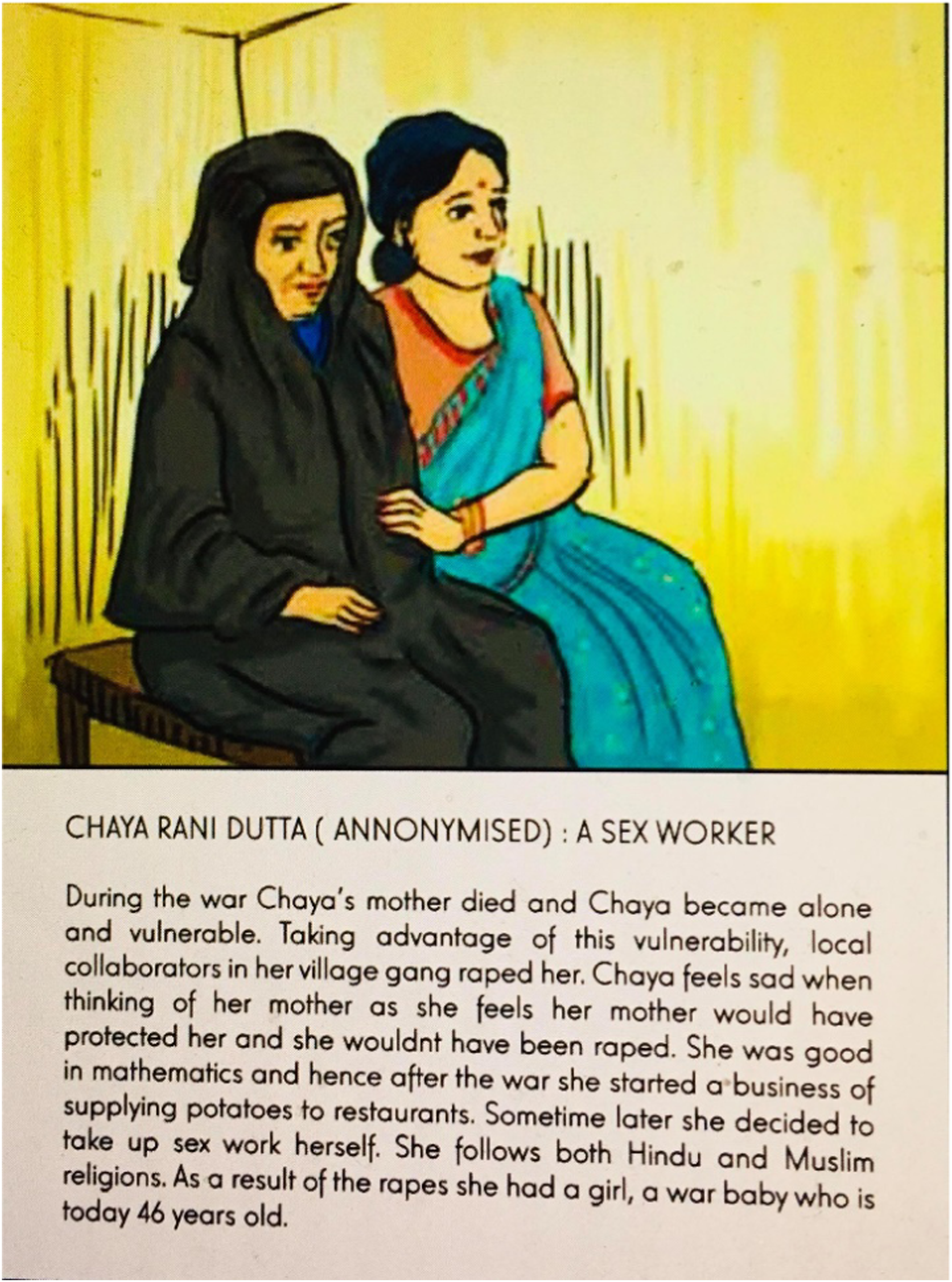
Conclusion: Dekinning birth from state?
‘Forced pregnancy’ means the unlawful confinement of a woman forcibly made pregnant, with the intent of affecting the ethnic composition of any population or carrying out other grave violations of international law. This definition shall not in any way be interpreted as affecting national laws relating to pregnancy. (ICC, 1998)
7
The recognition by the Rome Statute in 1998 of the intent of forced pregnancy to affect ‘the ethnic composition of any population’ reflects Sakib’s quote from 1971 (at the start of the article) of the ‘utmost need to alter their succeeding generations’. Here, what becomes important to note is that both these quotes are hinged on the idea of birth in order to bring about changes in ethnicity or succeeding generations – here, the birth of a birangona’s child conceived by rape coinciding with the birth of the independent nation of Bangladesh. Political theorist Jackie Stevens (1999: 49) has rightly said that ‘nation is and always has been a concept tied to ideas about birth and ancestry’.
The article first shows that the wartime rape, and its attempt to change the ethnicity of future generations through children conceived by rape – what I have referred to as the disruption of ethnic futures – continues to have an impact on experiences, life trajectories, as well as the nation’s imagination of the birangona, 50 years later. I then highlighted how a naturalised historical and racialised narrative normalises these acts of sexual violence. Wartime rape and sexual violence can be discussed in generic terms – in all contexts, in all battles, as a means of physically acting out power relationships in a manner designed to disempower an ethnic group. The details of how that disempowerment is understood and experienced is grounded firmly in the very particular framework of historical and racialised differences as they have evolved in a society and space at that time. The article shows that rape and sexual assault are not only acts which humiliate and disempower victims, but seem to provide a way of acting out historically established notions of power relationships and identities that are normally discussed and represented in less physical, material ways. These naturalised connections concerning procreation, nature, gender, bodily matter, land and soil (Carsten, 2017; MacCormack and Strathern, 1989; Yanagisako and Delaney, 1994) show how hierarchy and exclusion are intrinsic to kinship and gender. I have identified two forms of sovereign logic within these debates of naturalisation: first, the intention to change future generations through sexual violence and, second, to tame the Bengali tigresses, thereby sexualising East Pakistani women and legitimising their ‘domestication’. Thus, gender is enfolded within these simultaneously practical, symbolic, and imaginative processes of kinship.
Along with providing an important critique and counterpoint to simplistic conceptions – especially regarding normative and reified concepts of gender, sexuality, family and kinship – the article shows the intrinsic relationship between kinship, warfare and the politics of fear. While showing that the disruption with regard to violence and kinship is ongoing, the article has specifically set out to demonstrate how the principle of wartime sexual violence is based on the ideas of disrupting kinship futures of the dominated as their make-up is deemed to be pliable. This hinges on the contradiction of the dominating state trying to imprint their own ‘mark’, as if their identity was fixed and unmoving, which also highlights the weakness of the sovereign. In reality, the West Pakistani army as sovereign could only exercise control and feel powerful over East Pakistani women through rape. This, however, necessitates that the sovereign inhabit the viciousness of sexual violence, and therein lies the vulnerability of its sovereignty. This vulnerability stems from ‘paradox of kinship’ (Carsten, 2021) – its processes of inclusions and ruptures in the future, and the ‘public fictions of kinship’ (Gallo, 2021). The ethnographic accounts of the varied lives of the war heroines and the children conceived of rape attest to these disrupted kinship futures.
Feminist theories of rape (Mardorossian, 2002) have successfully complicated the universalising tendencies in feminist analysis, which comprehend rape as ‘a conscious process of intimidation by which all men keep all women in a state of fear’ (Brownmiller, 1975: 15). Examples of sexual violence in times of conflict show how the violent encounter brings together the institutionalised forces sanctioned by various modes of social power linked to discourses of nationalism, religious identity, caste, ethnicity, sexuality and politics. 8 Rape during conflicts becomes an ‘explicitly political act, a ritual of victory, the defilement of honour and territory of the enemy community’, as explored in the context of sexual violence inflicted in the Indian city of Surat in the context of post-Ayodhya communal, inter-community riots in 1992. Through this, a violent dialogue between men is conducted – this being the other side of ‘the matrimonial dialogue between men in which women are exchanged as signs’ (Lévi-Strauss, 1969; see also Das, 1995). Agarwal shows how the disrobing of Draupadi in the Hindu epic Mahabharata is an instance of how political discourses constructed by collectivities have consciously contextualised rape exclusively in the problematic of the contest between two nations or communities, thus transforming it into a morally defensible act, in fact into a much-needed political strategy.
The use of racialised and behavioural stereotypes to explain violent events is not new in anthropology. Evans-Pritchard (2002 [1940]: 38), explaining violence among the Nuer in Sudan, characterised them as being ‘easily roused to violence’ and said they had ‘an ordered anarchy which fits with their character’. Such descriptions have parallels with the aforementioned racialised and behavioural stereotypes we find in the case of East Pakistanis and in Rwanda. Sharon Hutchinson (2000), on the other hand, studied the conflict between Nuer and Dinka within the political economy of oil. In examining their changing ethics of war, she has rightly referred to these stereotypes of Nuer ethnicity as being ‘militarised’. She shows how the earlier prevailing performative ethnicity allowed a porosity of membership for women and children, hence they were not attacked. As the ethics of war changed with the introduction of guns, this performative ethnicity became reified to a primordial ethnicity along blood lines, which fixed the membership of women and children in each group. Hence, they became a target for sexual violence by other communities and domestic violence from within, and the natalist pressure to reproduce Nuer children became so intense that they became unable to nurse their children from consecutive pregnancies. Here again we note how the fixity of genetic inheritances is deployed to legitimate violence.
Given the West Pakistani army did not reside in East Pakistan, any coercive social bond inherent in ethnic nationalisms was not feasible. The attempt at linguistic kinning, through the imposition of Urdu instead of Bangla, was an attempt at homogenisation and assimilation but was also met with resistance by East Pakistanis. The West Pakistanis’ wartime normative acts of sexual violence might also show their vulnerability in being far from home, in a land and climate they were not used to, the fear of losing the war and hence the need to instil fear and create obedience in the population. In Enayetpur, it was often repeated that the military were scared of the monsoons, and most of the instances of sexual violence happened in the autumn of 1971. Instead of the sovereign deciding who should live or die, something else is at play in the biopolitics of the wartime sexual violence analysed in this article. If biopolitics can be understood as a political rationality which takes the administration of life and populations as its subject: ‘to ensure, sustain, and multiply life, to put this life in order’ [Foucault, 2008 (1976): 138], here the process of ethnic cleansing and the administration of life seeks to conjure a disruption of future citizenships, conjugality and kinship in independent Bangladesh through the alteration it imagines it would make to succeeding generations by means of wartime rape. This conjured impact, however, is made on the assumption of primordial, essentialised and reified ideas (Denich, 1994, noted the same in the case of Bosnia) of an East Pakistani personhood which needs to be altered. This is similar to Hutchinson’s analysis of Nuer ethnicity, and of how the fixity of primordial attributes makes Nuer women a target for sexual violence. The animalistic characteristics attributed to East Pakistani women also show how othering, speciesism and racism are closely intertwined with gender ideologies and legitimise the subjugation through ‘taming’ of specific subjects.
The kinship ideologies foundational to wartime rape here are informing practices around irresponsibility as they are hoping for a disruptive future for Bangladesh and highlighting the violence and ambivalences at the heart of this relationship between kinship and politics. Sovereign powers precisely use kinship futures with the aim of creating discord and unrelatedness. Following Gallo (2021) and Carsten (2021) the ‘public fictions of kinship’ and ‘paradox of kinship’ seek to limit, the flow of affective bonds and generational support needed by those whose futures are potentially disrupted by sexual violence. As long as the concept of the birth of children plays an important role in the birth of a nation, stories of a political community’s origins will be closely linked to darker sides of kinship engendered by the state. This is because ‘birth is deeply connected to a web of gendered associations’ (Stevens, 1999: 34) and, as anthropologists, we need to dekin birth from the state, so as to ensure that a woman’s body does not become a reified site for sexual violence. This alone can ensure that disrupted kinship futures are no longer seen as a cornerstone for state discourses justifying sexual violence during war.
Footnotes
Acknowledgements
Thank you to the Institute of Advanced Studies Christopherson Knott Fellowship and British Academy Mid-career Fellowship (MD130051) which funded this research. Thank you to all my research interlocutors and to birangona chachis and their families for their long-term engagements. Thoughtful feedback by two reviewers and the editors, Henrike Donner and Victoria Goddard, has strengthened this article.
Declaration of Conflicting Interests
The author(s) declared no potential conflicts of interest with respect to the research, authorship, and/or publication of this article.
Funding
The author(s) disclosed receipt of the following financial support for the research, authorship, and/or publication of this article: This work was supported by the Institute of Advanced Study, Durham University and British Academy (MD130051).
Notes
Author Biography
 ), and received the 2019 Praxis Award. She has published extensively on the anthropology of violence, ethics and aesthetics, and she carries out research on gendered violence during wars, irreconciliation and transnational adoption. She has recently published a volume, On Irreconciliation (2022) and, as a British Academy fellow, is researching children born of sexual violence in conflict, and adoption.