




Abstract
The figure of the middle-class housewife or ‘rabbat bayt’ emerged in the late 19th-century Arabic-language public sphere amidst the colonial encounter. This gendering of middle-classness responded to a perceived cultural ‘lag’ yet now itself increasingly signifies backwardness in relation to ideals of middle-classness emphasizing women’s education and community service over older norms of purity and propriety. Today, amidst unemployment, discrimination, lack of childcare, lack of safe and reliable public transportation and a highly suburbanized built environment catering to male breadwinners, contemporary Jordanian families must navigate multiple class and gender paradigms. Against a tendency towards salvage ethnography that misrecognizes these constraints as manifestations of deeply held ‘traditional’ values, I emphasize their historicity, arguing that it is only by recognizing housewifery itself as a state project characteristic of the 20th century that we can appreciate how state-building projects drive the gendering of class roles – and the classing of gender roles.
From my first encounters with state projects for the transformation of gender roles in Jordan, I was not just interested but also deeply implicated. As a Peace Corps volunteer with a background in anthropology, I was cynical when low-level Bush Administration officials from the embassy made paeans to Jordanian women’s rights as they led an all-out culture war for the ‘traditional’ family in the US. It recalled Lila Abu-Lughod’s (2002: 784) description of Lord Cromer decrying the benighted state of women in the Middle East while opposing women’s suffrage at home. Yet whereas the self-styled women’s rights activists of the colonial era were concerned with extracting women from harems and other extended kin arrangements and placing them in a ‘nuclear’ family with breadwinner, housewife and children, I was supposed to be educating and empowering women to throw of the shackles of that very family to compete as individual workers in a ‘knowledge economy’. It seemed that people in the region couldn’t win: the success of one development fashion eventually becomes evidence of backwardness.
According to official statistics that were recently profiled in the New York Times, only 14% of Jordanian women participate in the workforce (Sweis, 2021), giving Jordan the lowest rate of women’s workforce participation of any country in the world not at war (World Bank, 2018: 4). This framing of women’s employment is itself a testament to the transformation of housewifery, which was once a marker of a prosperous national bourgeoisie, into a hallmark of relative abjection and state failure. Yet far from straightforwardly reflecting ‘conservative’ Jordanian societal values, women’s absence from the workplace is a source of growing consternation, even national shame. The same World Bank report found that 96% of Jordanians approved of women working outside of the home, over 60% of women out of work wanted to work – and 24% of women out of work were actively seeking work (World Bank, 2018: 4–6). For many Jordanian women, forms of labour (or, more precisely, perceived withdrawal from labour) that once signified refinement increasingly signify backwardness. This has made Jordan seem like an ideal laboratory for social engineering projects working at the intersection of gender and development against an objectified notion of ‘tradition’ viewed as backward.
However, as Jacob Gruber (1970) warned, in coining the term ‘salvage ethnography’ for this tendency to reify an imagined cultural purity in the face of colonial expansion and rapid social change, this uncritical attempt to recover an objectified ‘tradition’ risks merely confirming its own assumptions. While I have written extensively elsewhere about how this ideal of middle-class housewifery is enacted in the ethnographic encounter (Hughes, 2015, 2021), here I emphasize the dangers of taking such data at face value without properly engaging with historical evidence. Inspired by a growing literature that leverages archival evidence to emphasize the historicity of globally circulating ideals of bourgeois domesticity and gendered middle-class comportment (Dejung et al., 2019; Doumani, 2017; Ferguson, 1999; Lentz, 2020), this article will emphatically not be an investigation into any sort of ‘time lag’.
Instead, I build on the work of more historically informed scholars like the economic sociologist Rania Salem (2012), who demonstrates that the demographic shift towards the nuclear family in Jordan has been relatively recent, as well as ethnographers exploring how contemporary Jordanian women are struggling with the limitations of this emerging social settlement as they increasingly enter the formal workforce (Ababneh, 2016; Adely, 2020; MacDougall, 2019a, 2019b). Drawing on MacDougall’s conceptualization of a ‘felt unfreedom’ (2019a), where reflexivity emerges for Jordanian women between normative gender roles and their lived experience of political and economic realities, I explore how the decay of particular globally circulating institutions for large-scale population management is mediated by historically contingent political choices at a range of scales. To draw another parallel with archaeology, I try to develop a more taphonomic sensibility (as in the study of decay) that can recognize the layering of past state social engineering projects in different states of ruination in place of reified ‘tradition’.
Strikingly, despite marrying, growing older and growing closer to families, it has become more challenging to elicit positive (auto-)biographical accounts of housewifery – especially from women. My first encounters with Jordanian gender discourses were in a tourist boomtown where mothers of the leading families were keen to put me to work as an English tutor in the hopes of realizing ambitions for sons, but especially daughters, that they could never pursue. However, most of my actual fieldwork in Jordan has been in rural communities around Madaba and Karak, dependent on government employment (especially in the security services), where a stricter separation between the genders prevailed. There, where previously women without education and employment were most desirable, suitors were increasingly keen to have the extra salary as wages (especially in the public sector) increasingly stagnated (cf. Schielke, 2012: 37).
When I conduct interviews with women about their lives, they increasingly centre their relationship to emerging forms of prestigious professional employment, letting other facets of their lives remain implicit and, in a sense, unspeakable. This account from a woman I will call Umm ‘Assam gives a sense of why: For 25 years, I was outside: Kuwait, the Emirates…. I was a teacher and then a principal. For 25 years, I was outside: working at the school all day and then going home to cook and clean. It was tiring, but I’m a hard worker. I’m not like those other women who just sat inside.
While highlighting the familiar ‘double shift’, where women who join the workforce remain saddled with the same housekeeping and childcare duties, I also want to emphasize the implicit moral and class distinctions that lay beneath the complaint. Her phrasing implied she was afraid I would mistake her for a housewife and wanted me to know that she was not only a professional but a manager. Her status here was tied to her legitimate circulation in the community, whereas those who ‘just sat inside’ were relegated to menial labour with diminishing social prestige in an era when housewifery is no longer a marker of middle-class status but rather of lacking that status. 1
In what follows, I draw on archival, oral historical and ethnographic evidence collected over the past fifteen years to trace these changing judgements about the class character of specific constellations of gender and work. Beginning with the efflorescence of writing about gender that defined the Arabic-language print trade during the colonial period, I show how the Arabic-language concept of the rabbat bayt emerged from an international milieu that was deeply concerned with forging a new sort of class identity within emerging state formations. I then shift to the emergence of ‘Jordan’ itself in the 20th century: a relatively marginal hinterland that was increasingly constituted as a state in its own right amidst the break-up of the Ottoman Empire. Focusing in particular on the role of the military, Sharia Courts, property registration and housing policy, I show how Western and Jordanian state institutions forged new gender roles – despite their criticism of the fruits of their own efforts today. I then show how early liberalization initiatives (especially around housing) began to undermine this social settlement. I conclude with a consideration of how contemporary academic knowledge production cannot fully escape its own implicatedness in these gendered labour dynamics.
Housewifery and the modern Arabic-language public sphere
The modern concept of ‘housewife’ (rabbat bayt) emerged in some of the earliest published writing in Arabic by women, about women and for women. It developed first in the genre of biography and life-writing, and then in women’s magazines, including didactic ‘how to’ guides. Jordan did not exist yet, though. The concept instead emerged from the tensions between Western and Ottoman imperialism, with Cairo serving as its crucible. As the cliché goes, ‘Cairo writes, Beirut publishes and Baghdad reads,’ reflecting a regional division of labour itself grounded in hierarchies of civil society freedoms, cultural prestige, education, disposable income and leisure time. Yet as Sherene Seikaly writes, the Zionist-Palestinian conflict also fostered a distinctly Palestinian public as well through the 1920s and 1930s – though it could only trickle down to the masses orally via a small reading public until the arrival of radio in 1933 (Seikaly, 2015: 55), with present-day Jordan to the east even more marginal and disconnected. The transnational elite of literate women moving between ‘East’ and ‘West’ but also – notably – the major metropoles of Cairo, Baghdad and Beirut, would try to fashion a distinctly Arab and, later, Muslim model of housewifery for the entire region, valorizing what Seikaly (2015: 58) calls ‘the model middle’.
With Abu-Lughod’s edited volume Remaking Women (1998) serving as a formative interdisciplinary collaboration, recent scholarship shows how the conscription of women into state-building projects accelerated rapidly in the late 19th century. Lisa Pollard writes that, ‘from the 1890s onward, the Egyptian press was full of columns, articles, and advertisements attesting to the relationship between the condition of the family and the shape and function of the state’ (2005: 5). Much of this would focus on the figure of the ‘housewife’, which would be imported from the West but also back-projected onto Arab and Islamic histories. Marilyn Booth traces much of this discourse to Zaynab Fawwaz’s Scattered Pearls on the Generations of the Mistresses [Rabbat] of Seclusion. 2 Herself drawing liberally on older traditions of life-writing and especially the genre of sira or biographies of the early Muslim community, Fawwaz’s magnum opus would model a new way to write about the private in public that would be wildly influential – where she was not outright plagiarized in the popular press (Booth, 2001: 1–5).
The term rabbat bayt can be traced at least back to Abbasid period poetry, thanks to still well-known poems like those my colleagues Asma Char and Afaf Khushman kindly shared with me. It is the female counterpart of ‘lord’ (rabb), and more exalted and poetic than the terms for elite women preferred in pre-modern Sharia discourse like sitt and khatun, and the lower-class hurma (cf. Tucker, 1998: 206–8). The connection to the house (bayt) ties the term to deep histories of ‘public’ and ‘private’ domains so central to feminist theorizing of women’s historic subordination to patriarchy (Kandiyoti, 1988). Yet first through the works of ‘compilers’ of ‘exemplars’ like Al-Fawwaz (Booth, 2001: 17–21), and then through even more didactic ‘how to’ guides in the women’s press of the 1920s and 1930s, the concept of the housewife began to take on a new prominence and meaning.
The housewife would become the feminine complement to the modern male industrial worker. Drawing from advice columns in the Egyptian women’s press of the 1920s and 1930s, Rebecca Joubin (1996) emphasizes how Taylorist notions of labour organization shaped notions of housewifery amidst the nationalist struggle for independence. Reflecting an enthusiasm for the labour-saving products of their advertisers, these publications encouraged the organization of the kitchen and household on the model of a factory. There was an emphasis on constant ‘forward motion’, optimized organization of tools, highly regimented clean-up strategies (Joubin, 1996: 27–32) and of course efficiency (1996: 10). Even where particular ‘traditional’ concepts like ta‘a (obedience) (1996: 20) were invoked, they often received new support from Western formulations that transformed their meaning. For instance, Amira Sonbol (2008) argues in her analysis of Egyptian marriage contracts that the Napoleonic code’s focus on wifely ‘obedience’ had an outsized influence on Egyptian family law, both directly via the brief French colonial occupation and then indirectly via French influence on Ottoman reforms, especially during the Tanzimat (reorganization) of the mid-19th century. Sonbol argues there was a profound shift from seeing marriage as a matter of ‘having legitimate children’ to ‘the creation of a nuclear family’, complete with ‘state laws’ ‘guided toward keeping this family together’ where the ‘roles of the husband and wife were seen as biologically determined by God’ (2008: 112).
This reification of gender roles in relation to the household division of labour was certainly not unprecedented, but it was notably at odds with older peasant lifeways. This meant that it could usefully play off older notions of women’s confinement as elite ‘inconspicuous consumption’ (Hughes, 2021: 49), but it sutured these notions of modesty to an industrial political economy. In his classic ethnographic work on rural Jordan in the 1960s, Richard Antoun argued that, ‘the norm of seclusion is adhered to more faithfully among non-agricultural families living in villages and among Bedouin’ (1968: 678). Yet while the peasantry could aspire to the ‘positive model’ of ‘the store-keeper, the teacher, the petty bureaucrat, and the prosperous peasant who no longer tills his land or lives in the village’ (1968: 678), they were stymied by the structure of agricultural labour regimes. Antoun reported, ‘men carry out all tasks requiring appearance in public places’, meaning that, ‘Only men handle the oxen and plow the fields, construct houses and roof them, and work with the sickle during the harvest period.’ At the same time, Antoun went on to admit, ‘Women help in specified tasks even when the job is mainly men’s’, including, ‘harvest’, ‘ploughing’, ‘olive picking’ and ‘quarry[ing]’. He reported that, in peasant households, ‘the labour contribution of the woman is always important and could be overwhelming’, including a household where eight of ten workers were women (1968: 682). Antoun’s ethnography attests to a situation where only the most elite families could boast of true ‘women of the house’. Naturalizing the social order, the dependence of peasant men on women’s labour beyond the home could serve as proof of their moral inferiority.
However, as Jordan became an independent nation-state in the 20th century, there was increasingly a potential path forward towards modernity and incorporation into the growing ranks of the state and its functionaries for those who could conform to the gendered demands of the emerging socio-political order. The new gender roles pioneered in the Arab press of the late 19th and early 20th century might not always have eclipsed peasant lifeways in practice, but they exerted a growing ideological pull. Simultaneously, as Sally Howell (2003) notes in her study of Jordan’s national dish mansaf, Jordanian men and women were also experimenting with a distinctly Bedouin national culture in the early 20th century. Especially after the loss of Jerusalem and the West Bank in 1967, the state itself pivoted sharply towards a more Bedouin national identity (Howell, 2003: 223–4). Howell’s account of the dish and its characteristic heaps of bread, rice, meat and yoghurt broth offers a striking means of tracking wider shifts in gender and class relations, shifting over time from a feast dish often prepared by (male) slaves or other dependents to a virtual staple of every Jordanian woman’s culinary repertoire when entertaining and, since the 1990s, a form of catered food marketed towards overworked professional women with families (Howell, 2003: 234–7).
New notions of middle-class femininity shaped Jordan via a whole range of vectors. While an emerging public sphere would play a key role, it would be a public sphere itself fundamentally dependent on an emerging state and a literate community of schoolteachers, storekeepers, soldiers, petty bureaucrats and landlords with common concerns about the state and its relationship to broader colonial and civilizational struggles. Particularly notable is a shift from the valorization of elite tastes in favour of what Seikaly (2015: 58) terms the ‘model middle’, which would become central not just to the emerging Palestinian press’s notion of gender roles but also in the wider region. As Toufoul Abou-Hodeib argues, from the case of late-Ottoman Beirut, the increasing ambivalence about hierarchies of taste within a colonial context led elites to attempt a sort of synthesis not only between East and West but also between their own rich and poor. Increasingly repulsed by the shortcomings of each, these intellectuals would come to pin their hopes for national and civilizational salvation on those of ‘middling means’ (Abou-Hodeib, 2011: 480–2) like their counterparts elsewhere in the world (Dejung et al., 2019; Lentz, 2020).
Carving out Jordan, carving up gender roles
Jordan emerged in the aftermath of the First World War amidst the partitioning of the Ottoman Empire. With the Balfour Declaration and Sykes-Picot Agreement, the French and British Empires designed Lebanon and Palestine as Christian and Jewish homelands, with the Emirate of Transjordan serving as a buffer between them and Iraq and Saudi Arabia to the East. They installed kings of the Hashemite dynasty in Iraq, Jordan, and Syria (though only Jordan’s Hashemite monarchy would survive) and dispatched civilian and military advisers to assist in the formation of a modern state (Barr, 2011). Gender would prove to be just as crucial to the emerging regime as it would be in neighbouring countries, with the military (Massad, 2001), Sharia Courts (Hughes, 2021), and schools (Adely, 2012) serving as key arenas of struggle. British officials would intensify efforts to modernize the country that had begun under Ottoman Tanzimat reforms, including new regimes of property and personal status and what Abou-Hodeib (2011: 478), following Zaynab Çelik, has called ‘the logic of the “straight line”’, with its distinctive aesthetics, morality, logistics and politics. 3
Perhaps no one captures the spirit of syncretism and experimentation with which Ottoman and then British officials would work to forge the emerging figure of the middle-class housewife better than the British military adviser John Glubb, known locally by the Ottoman honorific ‘Glubb Pasha’. His memoirs offer a rich source of historical material dramatizing how modern gender roles were forged by the emerging Jordanian state. As Joseph Massad (2001) shows in Colonial Effects, Glubb exemplified the racialized colonial rule of difference. Glubb’s anthropology reckoned the Bedouin closer to the honour-loving Englishman than the supposedly servile, sedentary peasantry over which the Bedouin styled themselves a sort of aristocracy. Massad writes extensively of Glubb’s role in creating what Massad sees as an ersatz national martial culture and accompanying vision of masculinity. Yet while Glubb certainly ‘fancied himself a cultural passer’ (Massad, 2001: 122), he also tended to project his own social mores onto those he sought to imitate. Reflecting on his 17 years organizing Jordan’s military, Glubb wrote: When we have studied all the history, the folk-lore, and the religious precepts of the Arabs, we find to our surprise that, inside the Bedouin tent, the relations of man and wife are more like those of Mr. and Mrs. Smith of Tooting than we had visualized. (Glubb, 1948: 150)
He enthused that the Bedouin even shared the English appreciation for good breeding, writing: the Bedouins considered themselves as the élite of the human race. They referred to each other as ‘thoroughbreds’ – the same word as they used for their horses. It was this strong feeling that they alone were gentlemen, which caused them to observe so many rules of honour in fighting one another. (Glubb, 1948: 149).
For Glubb, this made them the perfect soldiers and, by extension, the ideal nucleus of a new modern nation-state.
British military advisers had defeated Ottoman forces in part by making common cause with the primarily nomadic pastoralists who evaded taxation on the fringes of the Ottoman Empire and now sought to prevent that dynamic from being turned against them. At least for the most immediately responsible colonial officials on the ground like Glubb, the Bedouin love of raiding and lawlessness was seen as an understandable outgrowth of their love of freedom. Glubb explained: ‘Men who own houses or land regard war with horror and dread…. Not so the Bedouin. War is his favourite occupation…. When occasion offers, he will slip away … until he once more feels himself a free man’ (Glubb, 1948: 149). First colonial and then postcolonial state policy emphasized sedentarization, education, and especially the provision of housing because, despite talk of freedom, Glubb was building, ‘not so much a police force as a patriarchy’ (1948: 166).
Yet while Glubb makes for a colourful figure embodying the gendered contradictions of the colonial encounter, understanding the state’s investment in new notions of gender requires digging deeper into the archives, with a special emphasis on the growing obsession with individuation in personal status law, property law, and housing policy. In each case, British and later Jordanian officials could only develop forms of statecraft that were already emerging in the late-Ottoman period. However, this would require the institutional growth of the Sharia Courts alongside the creation of a robust private property regime underwritten by international development organizations like the World Bank and an expanding security apparatus for enforcement.
Institutionalizing housewifery
The 19th century saw the expansion of Ottoman rule into what is now Jordan, as Circassian, Chechen, and other refugees were relocated from land ceded by the Ottomans to Russia and settled previously marginal agricultural lands on the Jordanian frontier. These communities were provisioned by primarily Nablus-, Jerusalem- and Damascus-based merchant networks and soon came to support their own Sharia Courts, first in Salt, then Amman and later across the kingdom. However, it was the rapid growth of the state, especially following independence, that would bring people flocking to Sharia Courts as they were integrated into a larger infrastructure of tutelage including the Ministry of Interior’s ID cards and family registers. 4 These forms of identification in turn increasingly mediated access to a growing menu of government services like schooling. Similarly, the erosion of communal property rights in favour of individual property rights that began under the Tanzimat would accelerate following the British cadastral survey before reaching a crescendo in the 1980s under a World Bank squatter settlement standardization scheme designed to accommodate the massive influx of Palestinian refugees in prior decades. Engaging with archival sources like marriage contracts, property titles, and housing policy documents reveals how personal status law, property law and housing policy all came to reify a model of gender relations in which a male breadwinner housed a wife.
Sharia Courts
Jordan’s Sharia Courts present an especially intriguing archival source for understanding the changing nature of gender roles in this time period because they potentially reflect the nexus of state-building and the engineering of gender roles so intimately. However, the mere existence of Sharia Courts need not compel people to use them – or provide them with accurate information. As Judith Tucker reports in a study of court records in Nablus (population 8000) between 1720 and 1858 just to the west of Jordan in Palestine, she only found 107 marriages – demonstrating that most urbanites (to say nothing of those in Nablus’s extensive hinterlands) did not register their marriages at court (Tucker, 1998: 191). However, the courts played an important role in mediating conflicts. For instance, if men failed to pay women their required nafaqa (support) in keeping with her social class, the court could authorize the wife to take out loans in the market in her husband’s name according to his social class – which he would be responsible for repaying (Tucker, 1998: 60). Over time, though, the Sharia Courts have become involved in almost all citizens’ relationships, a move which has followed an increasing emphasis across the region on marriage as an exchange of male support (nafaqa) for wifely obedience (ta‘a). With the establishment of the first courts in present-day Jordan in Salt in the late 19th century, the Ottoman system for registering and regulating marriages was further extended. This included sajjilat (registers) that had been kept in major urban centres like Jerusalem since the 16th century, along with a new bureaucratic technology: the form marriage contract administered by a peripatetic, religiously trained notary known as a ma’dhun. The contracts in particular represent a new modernist and statist enthusiasm for categorization – especially with regard to gender roles (Figure 1). Example of a marriage contract from the 1920s that uses ditto marks for religion and the men’s occupations, but – notably – not the wife’s occupation. Source: Synthesized by the author from a contract from the Amman courthouse archive.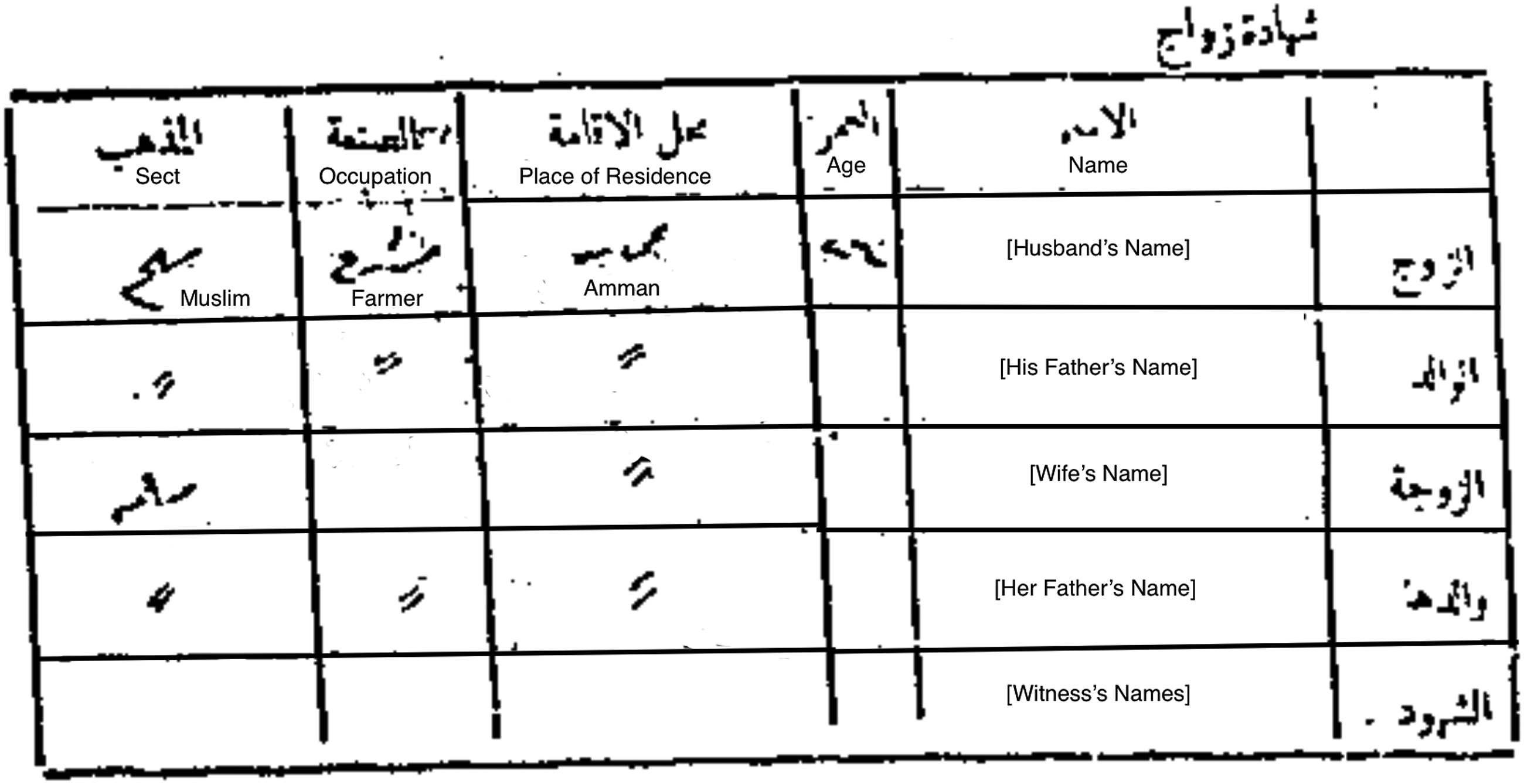
Thanks to the support of the Sharia Courts, I was able personally to collect a sample of marriage contracts from their archives that document the expansion of a shifting state regime of officially endorsed gender roles. I describe some of the challenges of sampling and interpreting them in a footnote.
5
The most striking aspect of the early form contracts is how they mixed older models of Sharia-based ethics emphasizing communal identities and distinct social estates and an increasingly individuating set of administrative sensibilities. For instance, while the forms asked for the occupations of husbands, wives and their respective fathers, they also arranged the fields in descending columns that invited notaries to assimilate all four into a single occupational category and social estate. This is indicative, of course, of the general notion that men should support women, but also a more practical preoccupation with upholding class-appropriate sumptuary standards for the women and children in case of later conflict over support. This issue figures prominently in both Tucker’s (1998: 43) findings for the Ottoman period as well as my own conversations with contemporary judges. Out of a sample of 376 contracts from the Amman courthouse contracted between 1926 and 1953, all but 19 men had occupations listed. In contrast, only three ‘seamstresses’ had discernibly female-gendered occupations. The vast majority (268) had no occupation at all – and almost all the rest were assimilated into the social estate and status of their husbands via ditto marks (‘ ‘), with a handful of women explicitly referred to as peasants or farmers alongside their husbands (Figure 2). The top 20 men’s and women’s occupations as recorded by notaries in a sample of 376 marriage contracts from the period 1926–53, collected from the Amman courthouse. The carelessness with which women were often assimilated into the occupation or social estate of their husbands is indicative of how much less contentious women’s employment was in this time period (with the assumption that this would be in accordance with their social class and not a matter of rights for the court to adjudicate). Source: Compiled by the author from Amman courthouse archive.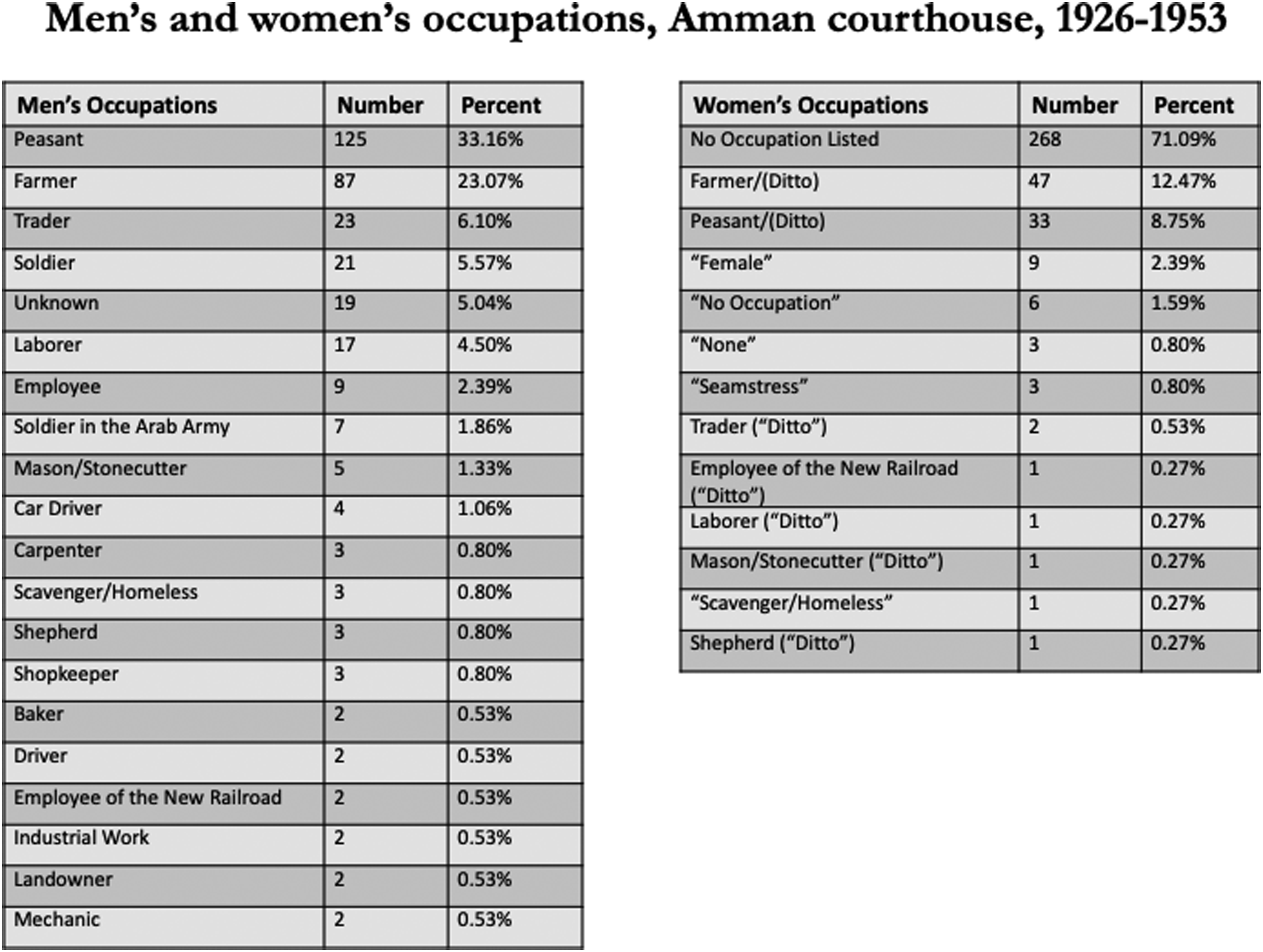
With independence, Jordan saw the rapid growth of the state and, especially in rural areas, state employment for men.
6
The Amman contracts, covering a wide swath of urban and rural Jordan at a time of relatively low engagement with the courts between 1926 and 1953, list over half of couples as peasants or farmers. In contrast, in the post-war period even the relatively rural governorate of Madaba has seen a rapid shift away from agriculture: out of a sample of 355 contracts spanning from 1953 to 2011, only 17.5% of men are farmers while almost a third of men are government employees (mostly in the security apparatus). With the new constitution, the peasant (fellah) immediately ceased to be used as an employment category – even if sharecropping arrangements persisted. However, the transformation of a predominantly peasant society into one centred around public sector employment would also bring these issues to the surface for women, more slowly leading to the concept of rabbat bayt becoming the predominant label for women’s occupation by the late 20th century. While 59 of the sample of 355 contracts listed no occupation for women, starting in the 1960s and taking off in the 1970s, the ‘housewife’ would become the predominant way of conceptualizing women’s work, accounting for 248 of the women in the sample or almost 70% (Figure 3) All women’s occupations and the top ten men’s occupations as recorded by notaries in a sample of 355 marriage contracts collected from the Madaba courthouse. The most obvious development here is the complete and almost immediate abandonment of the category of ‘peasant’ with the arrival of the new constitutional order and the slower emergence of the category of ‘housewife’ where women’s employment had previously not been a matter of concern. Source: Compiled by the author from Madaba courthouse archive.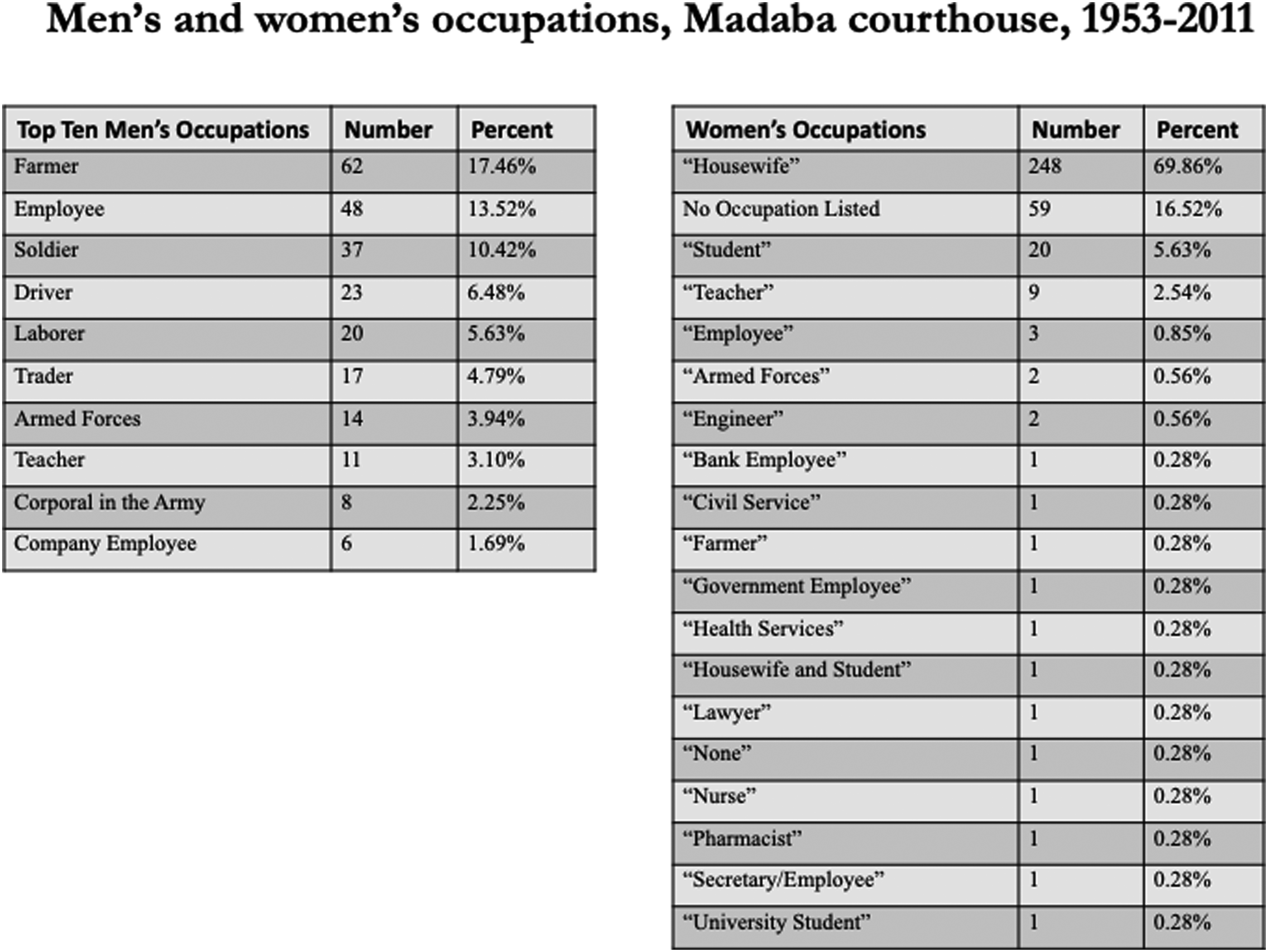
However, these categories tell us little about the lived realities and material conditions of housewifery. For instance, while the marriage contracts say a lot about women’s ‘bridewealth’, there is a lively discourse about how much of this money women ever actually received. It was often said (with a hint of scandal), ‘maybe the man gives the woman a thousand dinar in front of the people, and she returns it to him on Sunday’ (Hughes, 2021: 204). And while the marriage contracts do reveal an increasing concern for women’s employment in other ways (most notably in the ‘stipulations’ field), only 18 out of the 877 contracts I sampled had any stipulations – and the vast majority of those concerned the woman having an ‘autonomous house’ (6) and where the couple would live (7). Only two stipulated that the woman must be allowed to work and two stipulated that the woman must be allowed to finish university. Since the man’s violation of such stipulations are grounds for an immediate divorce, it is a serious matter and many argued that one should never marry anyone if they felt the need for stipulations. Nonetheless these traces of relationships past reveal how government Sharia Courts have become a site of struggle over women’s work. It also emphasizes the importance of housing and, moreover, property.
Property
As I have suggested, the forms of individuation that were embodied in the emerging bureaucratic genre of the form marriage contract were part of a much larger shift in governmental sensibilities that has already been the subject of intensive study among those interested in the rise of the administrative state (Burchell et al., 1991; Donzelot, 1997). In Jordan specifically, first leaders of the Ottoman Tanzimat and then British authorities pursued a very similar agenda in introducing a more individuated property regime. As Michael Fischbach (2000) argues in his study of land rights in Jordan, especially with the arrival of the British, there were ‘two fundamental assumptions. The first was that all land was owned by someone. The second was that land should be managed efficiently in order to maximize its productive potential’ (Fischbach, 2000: 79). Starting in 1928, the Mandate government conducted a cadastral survey of the most arable portion of the country to facilitate its registration and taxation (Fischbach, 2000: 87). The new system of land tenure unmoored land from its historic connection to patrilineages and placed it in the hands of individual men from those lineages: at first primarily the most powerful men, but over time producing a substantial middling stratum of small property-holders.
For instance, a single man who lived near where I conducted my dissertation research (whom I will call ‘Salim’) managed to claim most of what is now multiple villages housing thousands of people on the suburbanizing fringe of the capital city of Amman in the early 20th century. During fieldwork, I was duly honoured with hospitality in his descendants’ spacious stone-faced mansions, regaled with litanies of successful kin with important government jobs, and even shown glimpses of old documents attesting to Salim’s official title to hundreds of hectares in the area in the 1930s. King Abdullah I set the tone by building the would-be-sheikh a house in the area, complete with a dedication carved into stone. Salim may have been able to pass on many of the benefits of his close relationship with Jordan’s king to his descendants in the form of nice houses and government jobs. Yet his more distant kinsmen (who tell a much darker story of a vain and bullying loanshark and aspiring tax-farmer) have subsequently managed to wrest much of this land away in later rounds of registration, inheritance disputes and often by simply buying it. Increasingly, men in the area come into legal possession of their lands with the passing of the father (though heirs may not legally divide property for years despite efforts of the Sharia Courts). These men in turn build houses for their sons, representing a major inter-generational transfer of wealth in itself and a strong claim to land rights. In doing so, they make those sons much more eligible for marriage to the degree that they can house and support a wife (and perhaps even provide the same opportunities to their own sons and grandsons). Meanwhile, those without land are pushed into urban areas, where they face steep rents and hyper-competitive (if also more remunerative) private sector labour markets.
With the emergence of the Jordanian state, even men of middling status now have access to cash (via – often state – employment) and property, while women tend to remain dependent on men for access to both. As is often noted, women in Islamic law are entitled to half of the share of their brothers in inheritance and, as a number of ethnographers have documented, those women often trade their share in return for a sort of moral claim on their male relatives (Moors, 1995; Mundy, 1979). In fact, rural housewives were often eager to tell me just this when the topic of inheritance came up, in doing so helpfully reminding their husbands and brothers of how central they were to keeping productive property together – and what they expected in return. Yet as Annelies Moors shows, this may betray a type of middle-class noblesse oblige that need not apply to either the most elite of large landowners now moving to dominate the professions (1995: 235–40) nor the most proletarianized segments of society (1995: 186–9). Where poor and wealthy women are seen to resemble each other in their direct involvement with money and property, middle-class housewives can assert their moral superiority by claiming to have male relatives they can trust to protect their respectable detachment from such matters. Nevertheless, given the context of sedentarization and urbanization, relinquishing property claims increasingly means relinquishing housing claims – all the more for Bedouin women given the transition from goat hair tents (women’s wealth) to stone houses envisioned by local and Euro-American planners alike as men’s wealth.
Housing policy
Here, I turn to my third and final major archival source: the Housing and Urban Development Corporation in Amman. First conceived of as a vehicle for building housing, the corporation followed the World Bank’s neoliberal turn in the 1980s in heavily promoting a model of home-ownership and house construction in which the wife was housed by a male breadwinner (referred to in policy documents as an ‘individual owner-builder’). Through a policy of ‘squatter settlement standardization’, previously marginal agricultural land that had been untaxed would be titled, provisioned with infrastructure, and subject to government control – especially on the margins of the country’s major refugee camps as they overspilled their original boundaries. As land prices rapidly inflated, single-income middle-class families would be priced out of working in most government jobs while living in urban areas, increasingly pushed to a suburban-rural fringe. This attempt to segment the population between urban and rural areas and public and private employment mirrors and further develops older strategies of colonial divide and rule, but with increasingly unsustainable class contradictions as the government has been forced to inflict austerity on its own conservative rural power base to maintain the patronage of its international financial and military backers (Baylouny, 2008).
Amidst influxes of refugees and significant endogenous population growth, housing policy has long been instrumental to regime stability in Jordan. Over time, however, this has shifted from attempts to house refugees in immediate need (usually in partnership with international organizations like the United Nations Refugee Works Administration) to a more abstract quest to create a ‘housing market’, with organizations like the World Bank at the forefront. As James Ferguson’s (1994) study of the World Bank, The Anti-Politics Machine, might predict, the authors felt moved to explicitly deny they were weighing in on ‘political questions’ precisely where they were being most political: transforming the country’s refugee camps into residential real estate (Shelter Unit, 1987c: 32) using the standard, supposedly ‘technical’ interventions of ‘roads, markets, and credit’ (Ferguson, 1994: 71).
The resulting National Housing Strategy (Shelter Unit, 1987b), however, is ultimately more notable for what it did not do: support the construction of public housing, public transport and related public goods. Instead, it focused on discouraging urbanization and the development of informal settlements, putting its faith in the ordering effects of private property, markets, and the ‘individual owner-builder’. In contrast, veterans of the era within the Housing and Urban Development Corporation who worked there in the 1980s told the same story as everyone else I spoke with in Jordan. Having watched a parallel state emerge in the camps before the expulsion of the Palestine Liberation Organization (PLO) in 1970, officials were eager to prevent a new Palestinian political movement from emerging there – to say nothing of concerns that the increased mixing of Palestinians and the rural Jordanian poor, who were then moving into the camps, might radicalize the latter. Less interested in the property relations, veterans of that era instead emphasized ‘straightening out the lines’ and ‘making things orderly’. It is in this context that, for instance, the National Housing Strategy’s praise for the Military Housing Corporation becomes intelligible. The National Housing Strategy enthused that it: allowed [the soldier] to move back to his own village environment where he could contribute to the socio-economic standards of his own people, who usually have the same affinities and aspirations…. Better still, it re-ordered social groups in a more natural fashion, although on a limited scale. (Shelter Unit, 1987a: 24)
The Bank-funded consultants from the consultancy Padco, who wrote the strategy, struggled to reconcile these political realities with their own assumptions about proper gender roles and property relations. They wrote of their idealized, notably male owner-builder implicitly responsible for housing his wife: he is an individual who is managing the production of housing unit(s) primarily for his own or family use. He will secure land and plan and finance the production of the unit(s). He may employ a general contractor but it is more likely he will organize all aspects of the process itself, employing subcontractors directly for the construction and finishing. He may even contribute his own labour or skills or those of his family or relatives. (Shelter Unit, 1987d: 5)
Yet first the Bank would have to ensure that land was actually treated as the kind of commodity that could be bought and sold – something that has been contested since the Ottoman period. As Jordan’s prime minister from 2018 to 2020, Omar Razzaz (1991) details in his Harvard PhD Dissertation, Law, Urban Tenure and Property Disputes in Contested Settlements: The Case of Jordan, this was especially fraught further east of the arable zone, where the arrival of the refugee camps transformed untaxed tribal pasture into valuable real estate. He details a process that is still the stuff of local folklore: of an alliance between Bedouin tribesmen and the refugees to occupy land the government had claimed, often by building houses collectively between the time when the police inspectors went home for the weekend and when they returned to work. As I was often told: if you could pour a concrete roof, the authorities would not tear it down.
Clear limits to this gendered social settlement have emerged as Jordan’s population has more than tripled since this document was written. It has created a largely suburban and exurban middle class of public sector employees who exercise an outsized political and cultural influence in the country, but who are also are targeted by regular austerity measures (Baylouny, 2008). Increasingly, a middle-class lifestyle requires two incomes, not only in the city but even in rural areas – especially where the only viable employment is with local government institutions like schools, or those more distant state employers that provide their employees with barracks or dormitories. This suburbanization also seems to play directly into the specifically gendered barriers over and above high unemployment rates that now keep women out of the workforce, including a lack of childcare, lack of transportation, and harassment where transportation is available. By further separating people from family, work, and educational institutions, suburban sprawl makes it harder to balance work and care responsibilities (especially for middle-class families unable to afford multiple cars), leaving housewifery as one of the few remaining options for women outside of the most privileged urban areas.
Conclusion: Jordan’s gendered paradoxes
In an ethnographic investigation of a rural girl’s school in Jordan, Fida Adely (2012) notes how their lives complicated what the World Bank identifies as a ‘paradox’. While the World Bank’s metrics reckon Jordanian women (like women in the ‘MENA’ [Middle East and North Africa] region more generally) to be equivalent to or even better off than their counterparts in other lower middle-income countries in terms of health and education, the Bank argues they ‘lag behind’ (World Bank, 2005: 4) in employment. Adely counters that her interlocutors’ aspirations are multifaceted, encompassing community service, faith and family as well as paid employment. Largely passing over debates about whether women’s employment is in itself liberating (Weeks, 2011), the Bank has continued to focus on primarily ‘cultural’ explanations for low rates of workforce participation as exemplified by the title of their recent report, Hashemite Kingdom of Jordan: Understanding How Gender Norms in MNA Impact Female Employment Outcomes. In this framing, the primary barrier to women’s employment becomes male relatives. Yet in light of the preceding, it seems remarkable how easily decades of social engineering aimed at fostering the conditions of possibility for middle-class housewifery (including by the World Bank itself) are not only erased but transmogrified into evidence of an inborn cultural backwardness. Instead of a country with a particular history of economic, political, and infrastructural development, Jordan becomes little more than an exemplar of ‘Gender Norms in MNA [Middle East and North Africa].’
However, by listening to Jordanian women talk about their employment struggles, the authors end up proposing a set of policy changes that would, ironically, roll back earlier Bank initiatives. In response to the current car-centric suburban sprawl premised on the division of labour between a highly mobile breadwinner and a stationary housewife, they call for ‘affordable and reliable transportation’, ‘financial inclusion of women’, more direct cash transfers to woman-headed households, and more action against wage discrimination – especially in the education sector. They even raise a more general issue about how women’s needs should be taken into account in ‘infrastructure … and urban planning’ (World Bank, 2018: 14–15). Nevertheless, the general emphasis is still on ‘changing mentality’ through the education system, the media, and public awareness campaigns, envisioning ‘aspirational videos’ featuring ‘relatable women’, ‘media campaigns targeting men’ and ‘soap operas’ (World Bank, 2018: 17–18). Though the authors admit that ‘structural barriers … contribute more significantly than expected in preventing women’s participation’ (World Bank, 2018: 12–13), they see mentalities as easier to change.
The Western agenda for women and development has clearly come a long way from the days of Lord Cromer and Glubb Pasha (or even the men from Padco), but future generations may yet look askance at this approach someday. I am particularly reminded of a line of questioning I often received – especially a particular case where, characteristically, an older woman was keen to be interviewed but then quickly flipped the script on me, peppering me with questions about my own family and the benighted condition of the ‘Western woman’ in a gravelly, world-weary voice: Umm Rakan: Where’s your mother? Did she let you come all this way alone? Doesn’t she love you? Don’t you love her? Me: She’s in America. We talk regularly, but of course we miss each other. Umm Rakan: I would NEVER let my son go so far away [gesturing at her adult son sitting deferentially to her right]. He sleeps with me every night like this [clasping her hands to her bosom for dramatic effect]. Every night until they’re married. I keep my children close. Does she work? Is she an employee too? Me: Yes, but she’s retired now. She worked as a teacher like my father. She took care of me when I was little, but when I went to school she returned to work. Umm Rakan [dismissively]: God watch over you.
While Umm Rakan was uncharacteristically proud and forthright in her challenge to the gender mores I represented to her, I would argue that these tensions between different values may be less straightforwardly ‘cultural’ than dominant discourses might suggest. At the time, her questions cut a bit deep – and not simply because I was lonely and ambivalent about the balance between my professional commitments and the bonds of kinship – perhaps just a hint of MacDougall’s (2019a) ‘felt unfreedom’. I was also confronted with my mother’s own struggles with ‘binding constraints’ that so closely mirror those of Jordanian women: working for low pay on short-term contracts, commuting, arranging childcare, all manner of discrimination, and all of the other sacrifices she made for me. I have no doubt that Jordanian families (not unlike mine) will go on remaking their gender roles and that this will be fraught and filled with conflict and resentments, but scholarship on these struggles must better historicize and contextualize them.
Footnotes
Acknowledgements
This research would have been impossible without the contributions of my Jordanian interlocutors and especially the support of Jordan’s Sharia Courts and Housing Corporation, who generously provided me with access to their archives. I would also like to thank Maxim Bolt and Jon Schubert for encouraging me to develop this material and organizing a panel to discuss these ideas at the American Anthropological Association in 2017. Susan MacDougall, Blaire Andres, Charlotte Bruckermann, Asma Char, Afaf Khoshman and Matan Kaminer offered useful feedback as well.
Declaration of conflicting interests
The author(s) declared no potential conflicts of interest with respect to the research, authorship, and/or publication of this article.
Funding
The author(s) disclosed receipt of the following financial support for the research, authorship, and/or publication of this article: This work was supported by the National Science Foundation, the National Endowment for the Humanities, the University of Michigan, the London School of Economics, the Council for British Research in the Levant, and the American Center of Oriental Research in Amman, Jordan.
