



Abstract
This article initiates a comparative anthropological analysis of the legacies and endurances of socialism in two different European contexts. It draws on ethnographic and historical material relating to the UK and Romania, 40 years after the first efforts to privatize central elements of the welfare state in the UK and 30 years after the collapse of state socialism in central and eastern Europe. Rather than restricting our analysis to the ‘East’ and the 20th century, as is often the case in the literature on post-socialism, we argue for the need to attend to socialism’s historical border-crossings as well as its persistence today as a set of practices and imaginaries which are not wedded to one historically existing state form. Through controversies around the demolition of council (public) housing estates in London and exploration of work practices in cooperatives of production in Romania this article illustrates such historical border-crossings, and comparatively analyses the contemporary curation of what we call ‘socialist fragments’ at both these sites.
Keywords
When we cross the border separating the Germany of Helmut Schmidt and the Germany of [Erich Honecker] the question every good Western intellectual asks himself is, of course: Where is true socialism? Is it where I have just come from, or there where I am going? Is it on the right or the left, on this side or the other? Where is true socialism? (Foucault, 2008: 93)
‘Post-socialism’ is the predominant theoretical and conceptual frame for anthropologists working in former state-socialist countries in central and eastern Europe (Bridger and Pine, 1998; Burawoy, 2000; Hann, 2002; Humphrey and Mandel, 2020; Verdery, 2012). It designates a period of upheaval and adjustment after the fall of state-socialist regimes and has structured anthropological attempts to capture the ramifications of these tumultuous events in the everyday social worlds of these territories. However, the tendency to see ‘socialism’ as synonymous with one single regionally and historically located state formation often excludes consideration of historical and contemporary border crossings, continuities of practices and the possibility that ‘socialism’ itself may be a living and diverse political tradition spanning ‘East’ and ‘West’. In the recent volume Ethnographies of Grey Zones in Eastern Europe, Knudsen and Frederiksen (2015) reference a desire–common to much anthropological work on post-socialism in central/eastern Europe–to ‘break away from misleading dichotomies, such as [...] “west or east” or “Soviet and post-Soviet”’ (Knudsen and Frederiksen, 2015: 3). Their notion of ‘grey zones’ intends to problematize a teleological notion of post-socialist transition to capitalism proposing that eastern Europe is neither one nor other. For them ‘greyness’ represents the centrality of ambiguity and uncertainty to everyday life in eastern Europe in this moment of seemingly never-ending transition. Yet, while we share these authors’ commitment to overcoming such dichotomies, we are not convinced that such a regional approach is likely to achieve this aim–particularly one that, in the choice of the colour ‘grey’, potentially reinforces unhelpful stereotypes associated with both socialism and eastern Europe (Nicolescu, 2017, 2018). Instead, as a means of moving beyond dichotomies and stereotypes, and developing new lines of enquiry within the literature on ‘post-socialism’, we advance a broader comparative analysis of the legacies, endurances and reanimations of socialism across Europe.
Socialist practices, imaginaries and aesthetic forms developed and took root through state practices, both within and beyond the Soviet sphere. In this article we look at the European dimension of these crossings (although this approach could also be applied beyond Europe). Drawing on historical and ethnographic material pertaining to socialist material forms and practices from Romania and the UK, we ask: What becomes visible when we compare socialism across ‘East’ and ‘West’? What similarities and differences can be seen in how socialist ideas were put into practice? And how do socialist fragments–memories, materials, attitudes, imaginaries–resonate (or not) in the contemporary?
We combine materials from two case studies in Europe which are significantly marked by histories of socialism and interconnections across ‘East’ and ‘West’. One, researched by Robert Deakin, concerns council housing estates in London, which are testament both to histories of state ownership and provision in western Europe and–in design and architectural terms–the mobility and exchange between architects and designers across East and West. The second, researched by Gabriela Nicolescu, is about cooperatives of production owned by the socialist state in Romania, where artisanal handicraft was produced mostly by women according to standardized designs and quality for markets in western Europe. In both cases, we observe attempts to implement socialist ideas, but within different political formations: one a capitalist liberal democracy–where self-professed socialist political parties governed at both national and municipal levels for substantial periods during the 20th century, and where self-professed socialist architects, planners and designers had a significant impact on the urban landscape; the other a single-party socialist state overseeing a centrally planned economy. But more than such a comparative historical analysis, we are interested in contemporary resonances of these socialist histories amid a contemporary re-posing of the question ‘What is socialism?’ among political actors of the left in many places around the world–and particularly Britain, the location from which we write. 1 The comparative anthropological analysis we develop here demonstrates one future direction for post-socialist theory that is attentive to socialism not just as something historical and fixed, but rather a more open-ended question, posed today among the material remainders of socialisms past.
Comparison in global socialism
Socialism as a political ideology dates back as far as the early 19th century in critiques of the Industrial Revolution in western Europe, but here we are primarily interested in socialism as a state practice. The USSR and its satellite states in eastern Europe represented the centre of ‘socialist worldmaking’ in the 20th century (Stanek, 2020), with the establishment of the first self-professed socialist state after the 1917 Russian Revolution. However, socialist practices have been adopted by states far beyond these territories, in the realms of industrial production, health care, transport, urbanism and architecture–both within self-professed socialist states and liberal capitalist states in which socialist political parties and social movements have operated. While the anthropological literature on ‘post-socialism’ often equates ‘socialism’ with the former, we take a more expansive conception. Following Foucault’s (2008: ch. 4) analysis in his 1979 lectures at the Collège de France, we think of socialism–for our purposes here–not as a state form, but a set of state practices. This provides a basis for comparing socialism across territories marked by histories of socialism, if not by the presence of self-professed (Marxist-Leninist) socialist states.
Anthropologists have explored post-socialist contexts in eastern Europe, Africa and Latin America. However, while some have analysed the extent to which the boundary between ‘socialist’ and ‘capitalist’ practices is much more fluid than is commonly assumed (Pine, 1998; Yurchak, 2006) and how socialist forms and practices endure in post-socialist contexts (West and Raman, 2009), there has been little attempt within anthropology to make ‘socialism’ itself a point of comparison across the boundary dividing a putatively ‘capitalist’ West and ‘socialist’ East.
The literature which attends to the global mobility of socialism and the interconnection of capitalist and socialist modernities provides a starting point for such a project. Via accounts from the fields of economy, demography, theatre and historical studies, Iacob et al. (2018) show socialist experts’ contributions to international debates and institution building in the post-Second World War era. Other researchers have been interested in analysing the contacts and knowledge transfers within international organizations (Iriye, 2002), and between socialist countries and the so-called ‘developing’ or ‘Third’ world (Apor and Iordachi, 2013; Sluga, 2013). Scholars of architectural history and aesthetics have also carried out instructive work in this area. Stanek (2020) analyses the exchanges, transfers and architectural mobilities between eastern Europe and Africa, Asia and the Middle East during the Cold War period under the rubric of ‘global socialism’. He shows how urbanization in these locales was shaped through the forging of cooperative links between state-socialist eastern Europe and non-aligned governments in the Global South. Meanwhile, Moravánszky and Hopfengärtner (2016) examine the exchanges and mutual influences in architecture and urban planning across western and eastern Europe in the post-Second World War period, where governments of different stripes were engaged in modernist and modernizing urban projects.
However, in describing the contours of ‘global socialism’ it is important to be mindful of the limits to this mobility and exchange. For instance, Zarecor (2017) cautions against an over-eagerness to flatten out differences between socialist and non-socialist cities, arguing that while ambitious infrastructural projects were devised in western Europe, none were implemented to the degree that they were in the state-socialist eastern Europe where there was a conception of cities as nodes within a larger planned entity–or what she calls the ‘socialist scaffold’. The work of comparison within global socialism requires identifying specific objects to be compared. To take another example focused on architecture and urban planning: in an edited special issue Murawski and Rendell (2017) take up the Soviet constructivist architectural concept of the ‘social condenser’, ‘un-anchoring’ it from its context in the post-revolutionary Soviet Union to analyse a range of historical and contemporary urban contexts ‘both within and outside of the second world’ (Murawski, 2018: 927). Contributions span from the Narkomfin communal houses and the Warsaw Palace of Culture to the post-war network of state-funded arts centres in the UK and Aylesbury council housing estate in south London. Decentring–to some degree–state-socialist eastern Europe from their conception of socialism allows for a different comparative project to emerge, one from which we draw inspiration in this article.
Socialist fragments, socialist heritage
In this article we compare two ‘fragments’ of socialist material culture across settings that are not like-for-like: council housing in Britain, and artizanat 2 blouses produced in cooperatives in Romania. Our use of the term ‘fragments’ reflects the fact that, in both cases, the socialist practices and property regimes that they were once embedded within have, over the last few decades, been progressively undone. At the same time, and in keeping with recent critiques of a pervasive discourse of ‘socialism failed’ within the social sciences and humanities literature on socialist architecture and urban planning (Murawski, 2018), our concept of socialist fragments emphasizes the simultaneous endurance of these material forms within these markedly different social and political contexts, and their enrolment within contemporary contestation around socialist legacies.
Both of our case studies engage contexts where socialist material culture has become the subject of discourses and practices of heritage. As critical scholarship has shown, heritage is far from ‘a passive process of preserving things from the past […] but an active process of assembling a series of objects, places and practices that we choose to hold up as a mirror to the present’ (Harrison, 2013: 4, emphasis added). The fact that heritage is ‘chosen’ makes it an important site for discerning underlying social agendas, processes and forms of contestation. Research in eastern Europe and elsewhere has shown how heritage functions as a shifting form of power (particularly state power), whereby–for example–the history of a place is rewritten over time alongside changes in the political context to emphasize some stories over others (Grama, 2019). But at the same time, everyday memory and heritage practices often exceed or counterpose dominant or official formulations, and what is considered ‘heritage’ will shift over time (Carsten, 2007). Our concept of ‘socialist fragments’, then, refers to material objects–council housing and artizanat blouses–the practices, forms of life, imagination and labour that are attached to them and the various ways in which they are ‘curated’, by individuals, groups and institutions, and which may or may not attain the status of ‘heritage’ in an official sense.
In what follows we present our two case studies one after the other. Our ‘curation’ of these socialist fragments opens up an opportunity for comparison, which we undertake in the conclusion, but also functions as a kind of montage. Museum objects, as Kirshenblatt-Gimblett (1998) suggests, function as fragments, capable of indicating the presence of an ampler reality, a reality whose edges or limits are uncertain and open to questioning. Seen like this, our ethnographic objects work like filmic ‘cuts’ unsettling pre-existing normative standards and definitions and allowing the question ‘What is socialism’ to be posed afresh.
Reanimating the socialist history of British council housing
In the summer of 2018, fragments of a former London ‘council estate’ (municipal housing complex)–‘Robin Hood Gardens’–were reassembled as part of an exhibit at the Venice Biennale–an international exhibition of art and architecture. Since 2017, and ongoing at the time of publication, the estate is being gradually demolished as part of a ‘regeneration’ scheme which will see 214 formerly municipally owned and managed flats and maisonettes replaced with a taller, denser development with a majority of units for private sale. The exhibit was curated by the large, publicly funded Victoria and Albert Museum (V&A) and was a prelude to the planned exhibition of a larger, three-storey piece of the estate–including a complete maisonette interior–in their new East London gallery space. Over a period of a few months, visitors to the exhibition were invited to climb up onto one of Robin Hood Garden’s famous wide ‘street decks’; views across the Venetian waterways substituting for the views of London’s former docklands more familiar to former residents of the estate (Figure 1). ‘Streets in the sky’ at Robin Hood Gardens, photo by Robert Deakin, February 2020.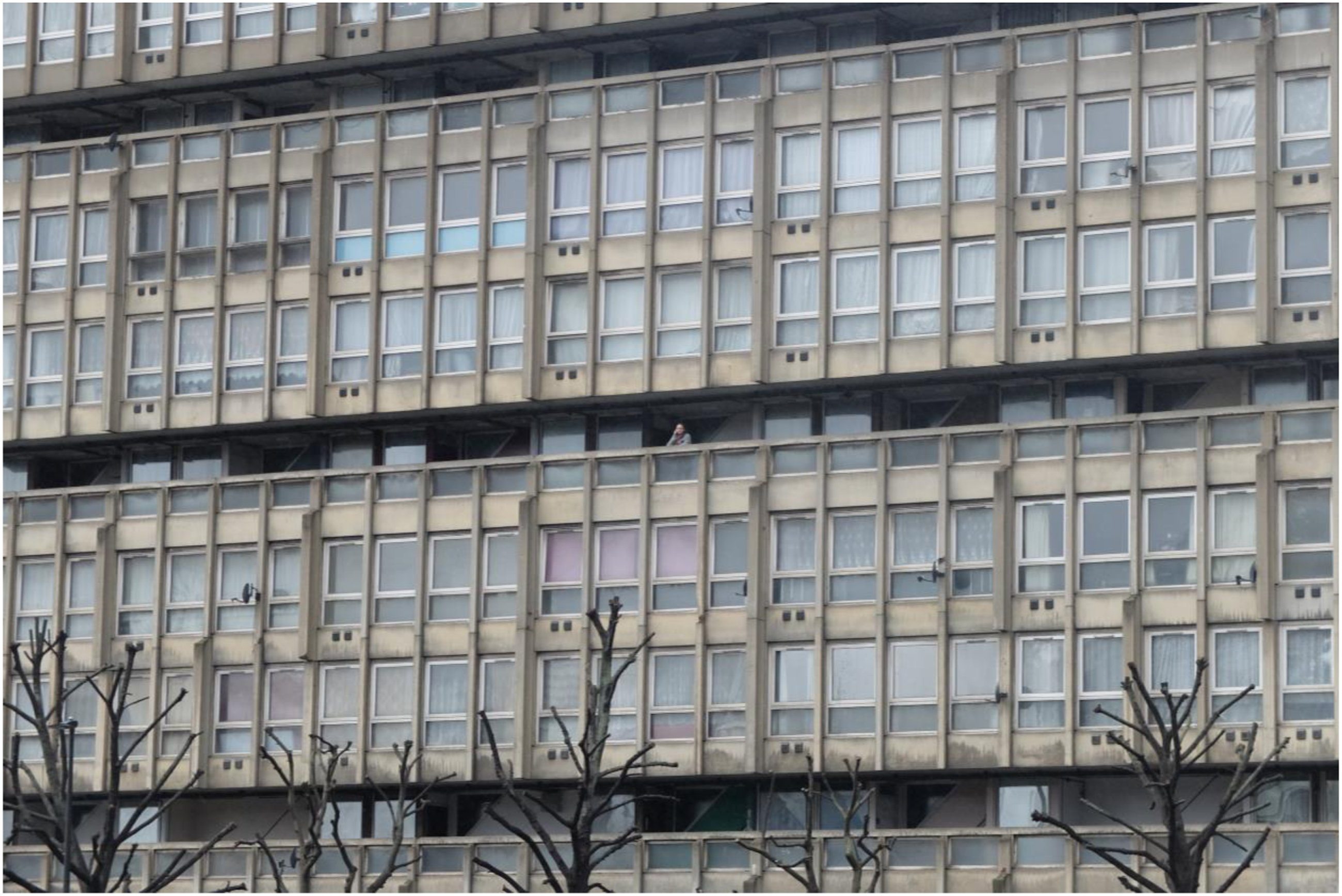
Robin Hood Gardens was completed in 1972, at the high point of British council housing. From scattered experiments during the late 19th century, council housing evolved to being the main plank of reconstruction after the Second World War, driven forward by Britain’s first Labour government, committed in its constitution to ‘the common ownership of the means of production, distribution and exchange’ (Gani, 2015). By 1979, nearly one third (32%) of the housing stock in Great Britain was council owned (Ministry of Housing, Communities and Local Government, 2012). In the East London borough of Tower Hamlets, where Robin Hood Gardens stands half-demolished, 82% of households rented from the council in 1981 (Watt, 2009: 231). However, starting in the early 1980s, with the election of Margaret Thatcher’s first Conservative government, this system of direct state provision of housing has been gradually dismantled through privatization and heavy constraints placed on councils’ ability to build new housing.
The undoing of the economic basis for council housing was accompanied by a sustained maligning of its predominant post-war modernist and brutalist aesthetics in media discourses. An especially important vector for these ideas, which took hold in the US and the UK at around the same time, was the architect and planner Oscar Newman who argued that the design of modernist estates contributed to crime and anti-social behaviour due to their lack of a clear delineation between public and private space–or what he called ‘defensible space’. Therefore, the aspirational, socialist ‘publicness’ of modernist council housing design itself was identified as a reason for the purported failure of the system of council housing as a whole (Campkin, 2013). From the 1980s until the present, housing has largely been left to the private sector, with ownership of inner-city council estates like Robin Hood Gardens handed over to ‘Registered Social Landlords’ with more freedom to access private finance for redevelopment.
How, then, are we to understand the exhibition of a fragment of Robin Hood Gardens at the Venice Biennale? While the director of the V&A presented it as a bold move to acquire an object that many consider ‘was part of a failed social experiment of inhuman modernism’ (Hunt, 2018), these exhibitions are in fact only one instance of a broader array of discourses and practices of ‘heritage’ connected to Britain’s inter- and post-war modernist council estates. No longer only the subject of negative representations, select examples of British modernist and brutalist council housing are today being celebrated through a plethora of recently published coffee table books, Instagram accounts and even a ‘Build Your Own Brutalist Great Britain’ themed paper cut out kit. 3 Many of the most celebrated estates are located in London, home to both the biggest-budget council housing construction projects historically and the dearest ex-council properties now bought and sold on the open market. A two-bedroom flat on the Alexandra and Ainsworth estate in the London Borough of Camden–completed in 1978 and considered one of the most expensive estates ever built in Britain (Kyriacou, n.d.)–sold in March 2021 for £525,000 (HM Government Land Registry, n.d.).
This revival of interest in brutalist and modernist council housing is accompanied by two countervailing trends. On the one hand, campaigns to have specific estates ‘listed’ and therefore protected from demolition by law have been initiated. This is driven by a mixture of heritage enthusiasts, estate residents and housing activists. On the other hand, forms of gentrification are evident, whereby estates escape demolition but are privatized in the process. This can occur gradually, for example through the sale of individual units on the property market (made possible through the 1980 ‘Right to Buy’ legislation), or in a wholesale manner, such as the case of the recent privatization of the Grade 2 listed Balfron Tower (1965–7). In 2015 plans were approved to transform this 28-storey modernist council block in East London into luxury private flats with no right of return for the existing tenants, the developers describing themselves as working to ‘comprehensively and sensitively restore Balfron Tower … serving as guardians to reinvigorate one of London’s best post-war buildings’ (Londonewcastle, 2019). Figure 2. Balfron Tower undergoing refurbishment. Photo by Robert Deakin, 2020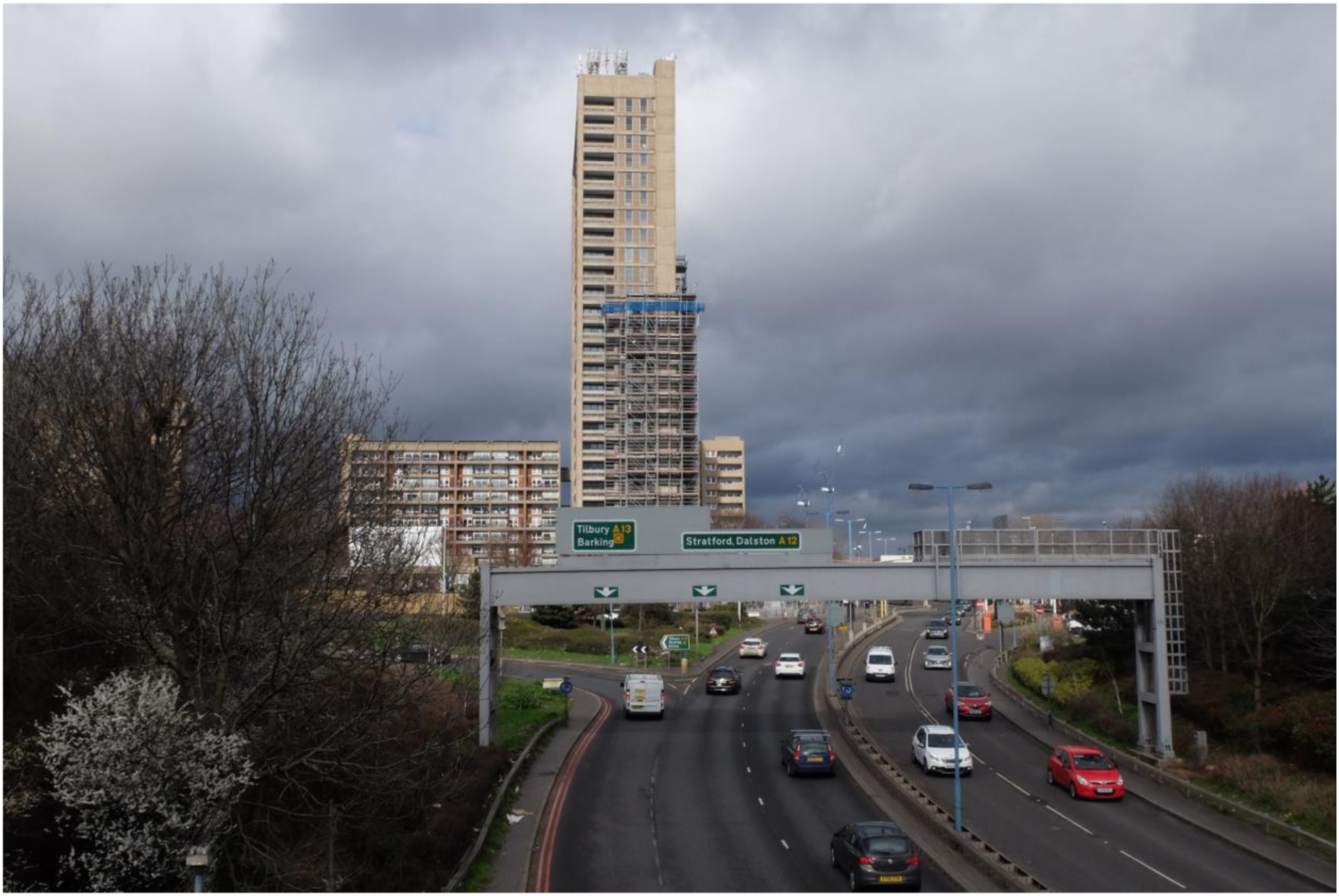
It is in the context of this tension–between heritage as a means of protecting council housing as a form of state and social provision, and heritage as a mode of gentrification and privatization–that the exhibit of the V&A needs to be understood. The V&A has come under severe criticism from some quarters for not lending its institutional support to the campaign to prevent Robin Hood Gardens being demolished, only to then salvage a valuable fragment for their own purposes after demolition had commenced (Mould, 2018). The developers and housing association overseeing the refurbishment of the Balfron Tower have been similarly criticized: Roberts (2017: 123) argues that heritage practices should not merely ‘pay tribute to the egalitarian principles at their [modernist council estates] foundations, it must enact them’.
In his performance-research project ‘Make public: Performing public housing in Ernö Goldfinger’s Balfron Tower’, Roberts (2017) explores the possibility of reanimating the socialist history of the Balfron Tower in the face of a regeneration proposal threatening to evict and disperse the resident community. For Roberts, an architectural historian, this socialist history is as much an architectural feature of the building as a question of state ownership and administration. He stresses its egalitarian ‘purpose’ and the ‘idealism’ in evidence in the generous layouts of the flats, the attention to detail and finish, and the provision of communal eating rooms and other communal leisure facilities. How–he asks–might archival materials relating to the design and construction of Balfron Tower be ‘embodied’ and ‘[augmented] with residents’ voices today’ in order to ‘reactivate their affective possibilities together’ (Roberts, 2018: 130)?
Roberts organized a series of historical re-enactments with participation of the residents of the building centred on the charismatic figure of Ernö Goldfinger–the Hungarian-born architect of the Tower and one of several so-called ‘émigré’ architects who came to Britain from central and eastern Europe in the mid-20th century who had a significant influence on the development of modernist architecture in Britain (Benton, 1995). Soon after the completion of the building in 1968, Goldfinger and his wife Ursula moved into a top-floor flat for a few months to experience living in the building themselves and to gather feedback from residents. In 2013 Roberts re-enacted a ‘Champagne Party’ that the Goldfingers had hosted for Tower residents, adorning the flat with photographs, drawings, correspondence, interviews and other archival materials associated with the building and its architect. Actors playing the Goldfingers circulated through the party, interviewing the residents about their experiences of living in the Tower. The materials generated through the workshops then formed part of a submission to the planning committee ruling on the regeneration plan, leveraging the Goldfingers’ legacy to argue for a right of the residents to return to their homes after the refurbishment was completed. They also formed part of a submission to Historic England requesting the listing status of the building be upgraded to confer more protection as well as amended to recognize that ‘Balfron Tower was designed as a social entity to re-house a community, according with Goldfinger’s “socialist thinking”’ (Roberts, 2017: 145). Evaluating his project, Roberts states that: The workshop opened a social, discursive and imaginative space that brought different residents from different tenures together into one space to talk to one another. In this sense, our restaging touched on the spirit of the original endeavour; a community wasn’t just re-enacted but, if only temporarily, reconstituted. (2017: 140)
Indeed, the (re)creation of a ‘community’ is perhaps the central element of what, for Roberts, it might mean to ‘reactivate [… the] affective possibilities’ of the Balfron Tower archive: a ‘community’ that breaks down divisions between residents of different tenures (those on ‘social’ rents, those renting from private landlords, leaseholders, etc.).
4
Such an emphasis on ‘community’ and its relationship to architecture is also a feature of the campaign against the privatization and demolition at the Cressingham Gardens estate (1967–79) in south London. Built only a few years later, Cressingham Gardens is in many ways the architectural antithesis of the Balfron Tower: its ‘Arts and Crafts’ inspired, low-rise estate of terraced, brick-built blocks are set against plentiful gardens and mature trees, organized around a central ‘rotunda’ community centre. But while its architectural aesthetics are on the surface very different from Balfron Tower’s high-rise, high modernist raw concrete construction, the centrality of communal/community space to their designs is common to both, as is the way in which campaigning at both sites has emphasized the existing estate community as something of a living architectural ‘proof of concept’. Figure 3. Campaigners against the demolition of Cressingham Gardens gather in front of the ‘rotunda’ community centre before marching to Lambeth Town Hall. Photo by Robert Deakin, 2017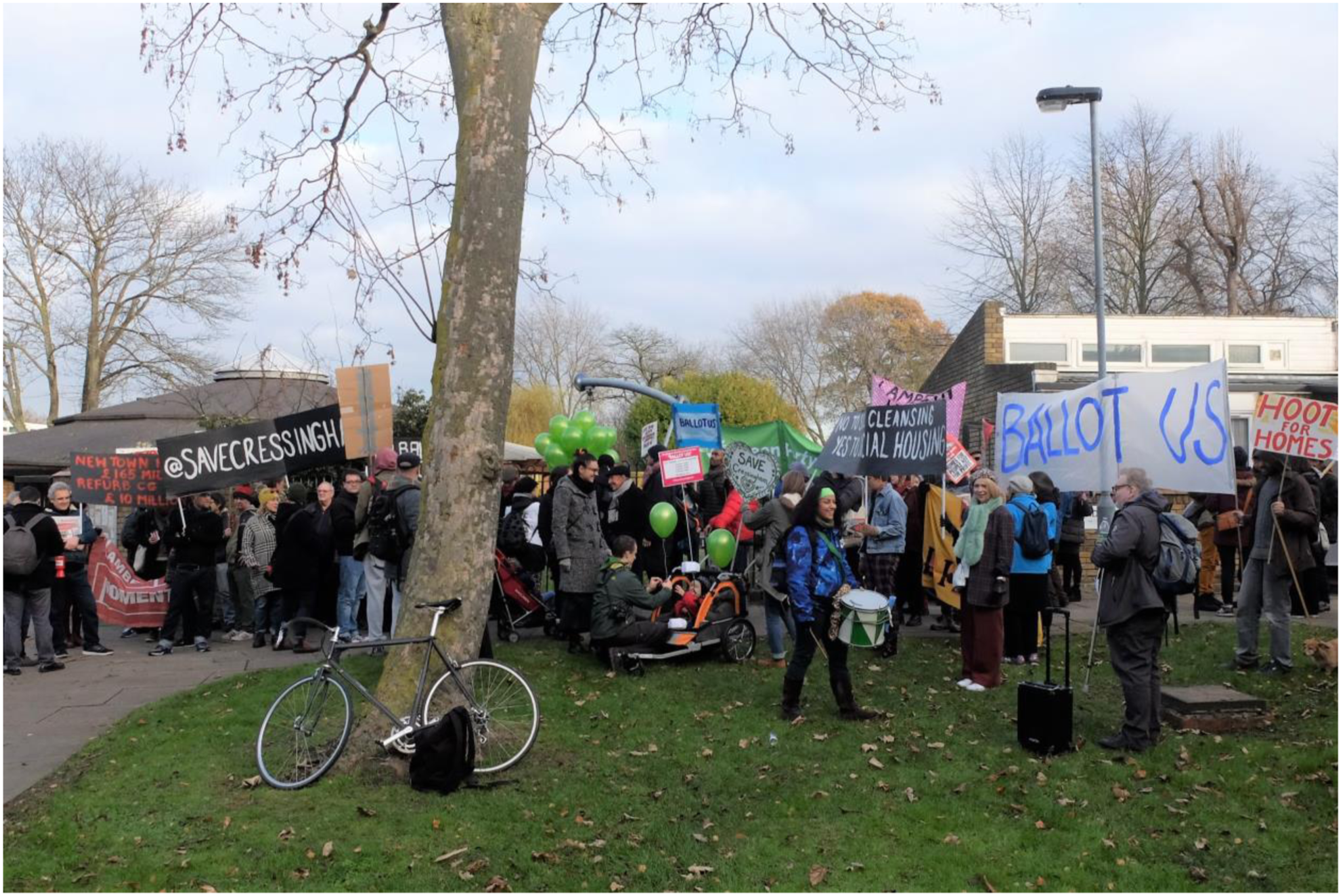
As part of their campaigning efforts, residents have been conducting guided tours, attempting to show outsiders why ‘Cressingham’ is a successful estate, deserving of protection. In August 2017, Roberts met with two residents involved with the campaign for a personal tour: Anne Enith Cooper, a poet who had recently run a series of writing workshops with estate residents resulting in the book 306: Living Under the Shadow of Regeneration (Cooper, 2017), and Helen Carr, a ceramic artist and former teacher. It was a hot and sunny day. Walking about the estate, occasionally stopping to admire a garden, an artwork, or to chat to one of the other neighbours passing by, Anne spoke about the importance of community to her experience of living at Cressingham. She paraphrased Nye Bevan, the Minister for Health in the post-war Labour government, who had declared in a speech in 1949 that, rather than only provide for the poor or so-called ‘working classes’, the tenants of council housing ‘should be all drawn from the different sections of the community and we should try to introduce in our modern villages what was always the lovely feature of English and Welsh villages, where the doctor, the grocer, the butcher and farm labourer all lived in the same street’ (Hansard, 1949): There’s that [Nye Bevan] quote that I’ve seen all over the place … the ideal is to have the street with the butcher and the banker and … and I was reading that and thinking–that’s what we’ve got actually … please don’t take it away!
Anne and Helen attributed much of the success of the estate as being down to its design, which facilitated communication and interaction between residents. Front doors and kitchen windows facing onto communal pathways mean that residents often see each other going to and from their flats. Anne expressed fears that this would be removed in the proposed new development. She cited the ideas of American urbanist Jane Jacobs (2016) about the importance of having ‘eyes on the street’ for establishing a successful and safe community and her critique of the design of ‘the projects’ in the US: They removed having people on the street seeing each other and being able to watch over each other and just put them ‘up’ [in towers], and that’s what if we’re not careful is going to happen here. People have said to me, ‘I notice when your blind’s up or down’ and that means they are actually looking and thinking ‘is she OK?’ […] I see my neighbours first thing in the morning, put the blind up, put the kettle on, have a little watch who’s going up and down. Other people are present all the time, the kitchens are at the front you see? You see what’s going on.
Standing in the shade of a mature tree at the end of the tour, Anne and Helen emphasized how the architect has sought to create a community, and had been successful in this endeavour: Robert: Do you think it’s a well-designed estate? Helen: The estate design is absolutely brilliant. Anne: Ted Hollamby wanted to design a community, and he has–it works.
Anne and Helen’s comments complement the text of the ‘Cressingham People’s Plan’–a resident-led alternative proposal for the estate which argues for a programme of infill building and refurbishment rather than blanket demolition and rebuilding. The ‘People’s Plan’ describes Hollamby as a ‘committed socialist […] a follower of William Morris’s beliefs in good design, art for the masses and social improvement’ (Keene and Plant, 2016: Appendix D: 6) and cites Hollamby’s ambition to: ‘[build] a community. We don’t look at this in terms of so many houses. Rather we think of things in terms of the functions of a community’ (Hollamby cited in Keene and Plant, 2016: 34).
At Cressingham Gardens, as at the Balfron Tower, activists and estate residents seek to mobilize the socialist history of council housing in their protests against attempts at its demolition and gentrification; a socialist history that is as much about the ethos, values and practices of the architects and urban planners as it is a question of state ownership and planning. Such ‘western’ histories of socialist political movements and state ownership have been little considered in the anthropological literature on ‘post-socialism’. But with ‘socialist heritage’ itself becoming a point of contention and political elaboration in the context of council estate regeneration in London, there is much to warrant a geographical extension of the concept, beyond Cold War divides.
Socialist artizanat: clothing cooperatives of production owned by the state
In the winter of 2013, the online community La Blouse Roumaine proposed 24 June–midsummer–as the International Day of the Romanian Blouse.
5
Two years later, in the capital city of the United States, the Mayor of Washington Muriel Bowser proclaimed the same day as the Universal Day of the Romanian Blouse, as a sign of respect for the Romanian community in the US, and after lobbying by the Romanian embassy. Over the last decade, the celebration of these blouses, Ie, has gained much popularity. Festivals dedicated to the Romanian Blouse have started to be organized in many Romanian cities with new designers promoting the making and wearing of them.
6
Since 2013, on the same day, Romanian communities all around the world, from Antwerp, Beijing, Warsaw, Verona, Paris and London to Washington and New York have gathered in central squares and parks, or on online social media platforms, to celebrate this symbol of national heritage. Figure 4. The Celebration of the Universal Day of the Romanian Blouse, Antwerpen, Belgium. Photo credit Bianca Stoicheci/La blouse roumaine, 2019.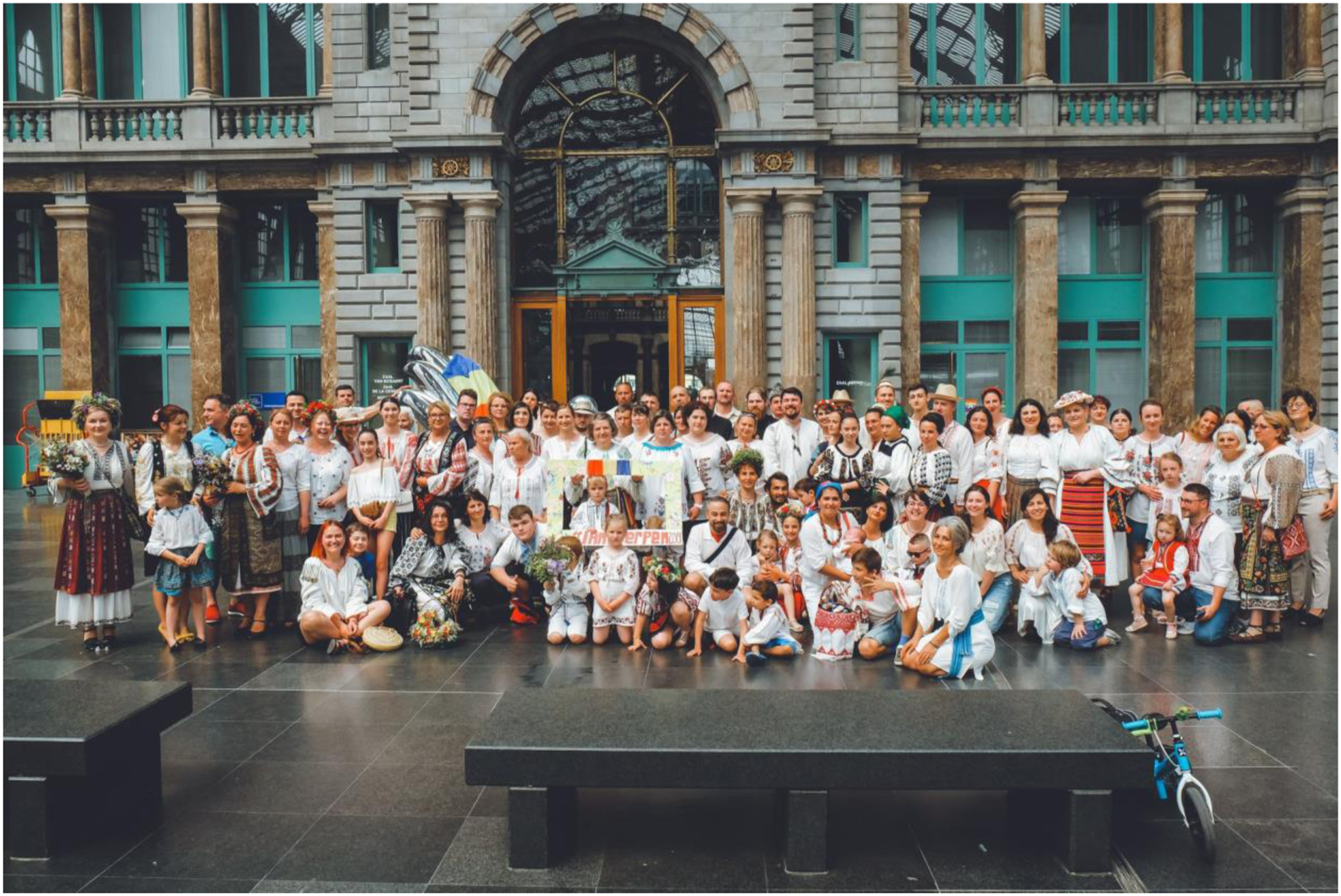
Most Ie that Romanians wore at these gatherings were made by various hands and machines at work in Romania, India or China. Production of this so-called ‘traditional blouse’ has evolved from 19th-century manual household production in villages of textile, sewing and intricate embroidery, to urban expensive manual adaptations of such blouses for the aristocracy in the inter-war period in Romania and then, in the socialist period, partly mechanized and partly handmade socialist interpretations of ‘folk art’, manufactured in cooperatives of production. 7 By 1989 nearly the entire production of Ie in Romania was owned by the state, through cooperatives of production such as Arta Casnică Cooperative (Home Art Cooperative) in Breaza, 70 km from the capital city. This state-owned cooperative was the first to open after the Second World War in 1948 and became one of the biggest producers of Ie. In some rural areas however, production remained manual and private, but these cases were rare. Ie were therefore recognized by the socialist state as traditional items of value. This becomes even clearer when we consider the many local and regional folk museums in the country, established during the socialist period, which curated what they considered to be the most valuable blouses. Exhibitions of Ie were also frequently put on in factories, schools, houses of culture in both rural and urban areas and would be regularly visited.
Since 1989, with the fall of the socialist regime in Romania, the system of state-owned cooperatives of production has been gradually dismantled alongside the remainder of the socialist economy. For example, in Breaza, out of 4000 people who worked to make blouses like those presented in Figure 5, only 20 still work in a cooperative. Many others left the cooperative and work individually, now once again as a family business; others emigrated abroad. Imports from India or China mix with new and old, locally produced, authentic or fake artizanat products on the contemporary market. (a), (b) and (c): Covers of fashion magazines kept in the private archive of Olga Horșia. Photos by Gabriela Nicolescu, 2010.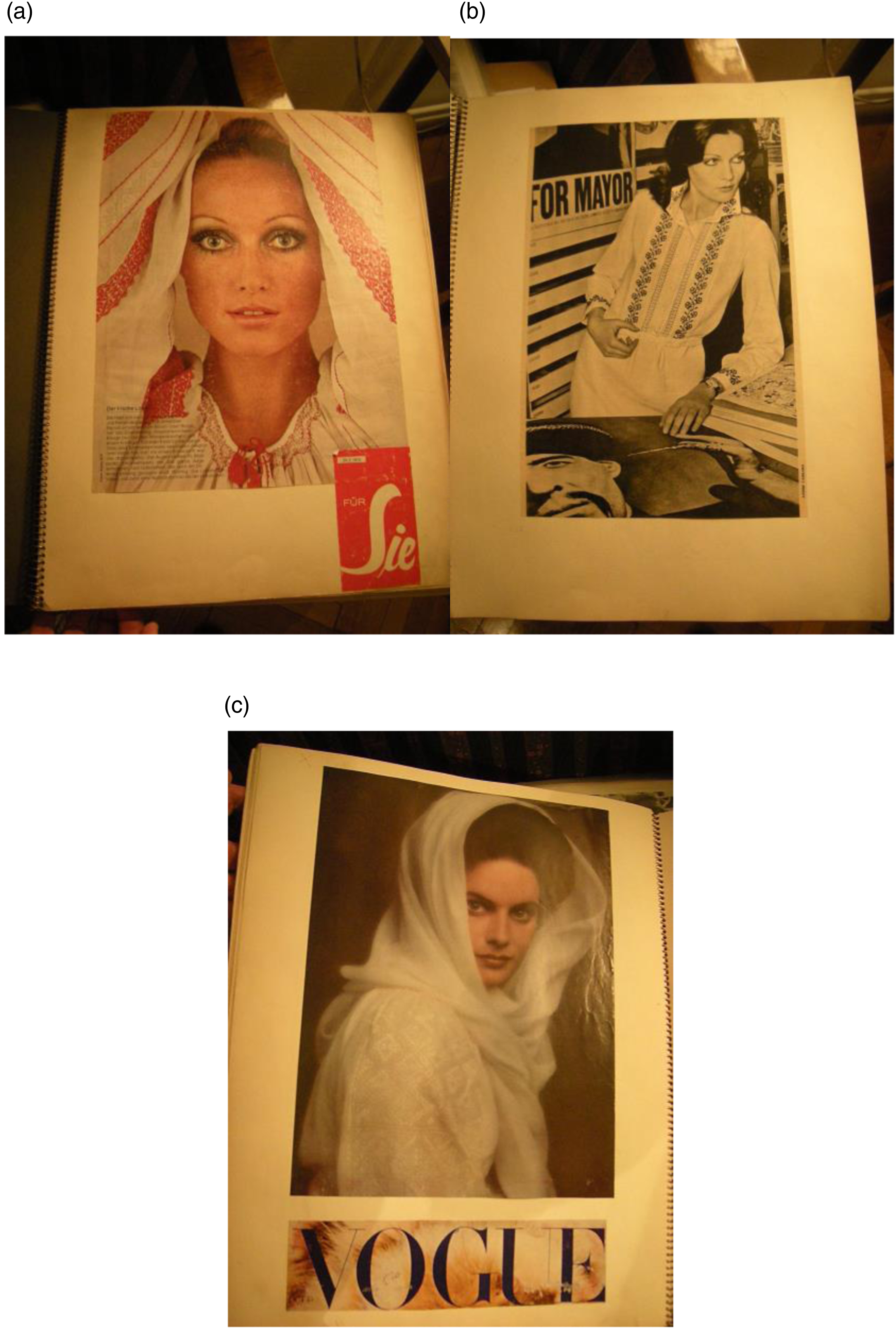
The undoing of the economic base for socialist factories and cooperatives of production was accompanied by the erasure of the modernist and socialist manufacture and aesthetics of artizanat and Ie in media discourses. In contemporary accounts of the glorious past of Ie, personalities such as Queen Marie of Romania, the painter Henry Matisse or the designer Yves Saint Laurent and his 1999 collection ‘La Blouse Roumaine’ are mentioned (Gheorghită, 2018), but very rarely is the socialist past of Ie, or the relation of these blouses to nationalism in 1970s and 1980s Romania referred to. Omitted from contemporary accounts are the number of folk museums opened during the socialist period, and annual festival celebrations of artizanat as part of the ‘Song to Romania Festival’. There is a powerful tension between socialism–portrayed only in negative terms or not mentioned at all–and acknowledgements of the materiality of socialism and its effects on people’s livelihoods and practices, both during and after the dissolution of state socialism in Romania.
While some literature shows the importance of ‘traditional’, folklore culture to the socialist state’s efforts in nation-building (Jones, 1994; Roth, 1990), the large-scale, cooperative production of artizanat objects in Romania also materialized fast-paced socialist modernization. They were expressive of collectivization, centralization and industrialization, as well as growing mass consumption. Not only was land nationalized, but also peasant handicraft and creativity. Cooperatives of production, where artizanat products were made, were opened in many regions of the country under the umbrella of the National Union of Handicraft and Production Cooperative (Uniunea Naţională a Cooperatiei Mestesugăresti, henceforth UCECOM). UCECOM, like many other state companies, resulted from the nationalization of private property, such as agricultural land and factories, and of the workforce.
From the 1960s to the 2000s, UCECOM employed approximately 50,000 people, of whom 75% were women. In an interview with Capital magazine in 2002, Elena Pavelescu, a former director in UCECOM, explained that: ‘before 1989 UCECOM had 40 cooperatives of production specialized in artisan handicraft, plus another 80 sections in other cooperatives’ (quoted in Capital magazine, 2002). A quarter of these employed women could work from home–combining traditional and modern production practices. They would make tapestries, and do hand knitting and embroidery. During the socialist period, the state would often simplify the models and would give to the workers the cotton base textile (pânză de bumbac), which was produced mechanically in a cooperative of production in a different part of the country, and not manually in the home (pânză de casă), like it was in the past (see Arta Casnică SCM Breaza, n.d.). Educated women joined this industry too, not as manual workers but as experts in the field of design or of folklore.
Olga Horșia was one such woman. In 1968 Olga Horșia decided to quit her job for the Museum of Folk Art in Bucharest, where she had worked as an ethnographer and museum curator, and started working for UCECOM. After 20 years of employment in UCECOM, she was appointed head of the Centre for Artizanat and Handicraft Production. During two visits to her flat in central Bucharest in 2010 and 2011, Horșia told me what she considered success stories about her work at UCECOM. With classical music playing in the background, Horșia gave details about the Home Art Cooperative in Breaza where around 4000 women worked, sewing blouses and embroidering them manually: ‘These women made use of materials supplied by the state, and invented models together with museum specialists and designers.’
To show what kind of products were made by these women’s hands during the 1970s and 1980s, Horia brought out two catalogues. There, on each of the pages, she had glued images collected from covers of western newspapers such as ELLE, Vogue, Für Sie and Jasmin. The UCECOM products were sold on western markets and appeared in famous western magazines. The three magazine images look very different from each other. In Vogue, the woman dressed in the white Romanian embroidered blouse, had her head partially covered (Figure 5(c)). This image resembled the famous paintings of peasant women by Nicolae Grigorescu, a Romanian painter trained in Paris in the 19th century. In Grigorescu’s paintings, peasant women covered their heads with white scarves, thus conveying an idyllic and mysterious look. The German newspaper, Für Sie (Figure 5(a)), in contrast to Vogue, portrays a hippie look of the 1970s and early 1980s which traversed all of Europe. Looking at this image, one remembers the dynamism and the lyrics of Abba, popular in both eastern and western Europe. The UK magazine, with an unknown title and a background inscription (‘For Mayor’), shows a more classical outfit (Figure 5(b)). There, the woman stands and seems to dominate the surroundings, while around her, the image captures other global references like elephant tusks, bourgeois bohème and a Latin American style downturned moustache. Figure 5(a), (b), (c).
The multiple references that one can pick up when looking at these images added to Horșia’s pride. On the one hand, it was pride in the aesthetic form, and national pride at the global reach of this product during socialism. On the other hand, it was personal pride and satisfaction that during her directorship she managed to attain a high number of export contracts. The work put into making these blouses belonged not only to the women who embroidered them manually, but also to the experts who provided mechanized textiles and ensured fidelity to the original. This was indeed an important point in state socialism, as she explained to me. Horșia pointed out that during the first 20 years, she provided much guidance to the craftsmen and women. Her advice, in turn, came from art specialists in the field of crafts. ‘The balance between innovation and rigour was in the hands of the specialists,’ she said, ‘people who graduated from the Institute of Fine Art or who had experience in field research and museum work.’
Horșia would meet these specialists regularly and discuss with them when to let the artisans innovate, and when to tell them to stick with what they believed to be the ‘authentic’ patterns in each ethnographic area. After mentioning several times the words ‘authority’ and ‘rigour’ she added: ‘[during socialism] it was a good kind of rigour. We would enter people’s traditional atelier/studios and tell them–after looking at each of the things they produced–if it was good or not; which was traditional enough, and which was not.’ After a break she added: ‘I do not think I could do the same thing nowadays.’
Horșia’s allusion to a contemporary absence of top-down aesthetic control makes us think of state power and authority. As Horșia affirmed, during socialism state control over aesthetics
Horșia’s preservation of advertisements from western magazines also indicates an appreciation of ideas of cosmopolitanism and openness in a socialist state where elites maligned liberalism and cosmopolitanism for their capitalist and colonial roots (Tismăneanu, 2008: 30). Romanian blouses spread through the western world–and Horșia was always proud of this–at a time when few Romanian citizens were allowed to do so.
Horșia explained that during socialism, individual craftsmen and women were not able to promote their own work outside of their communities. According to her, it was UCECOM that promoted the blouses and sent them to different international fairs and events to represent Romania abroad. Those trips were associated with feelings of privilege. As Light and Dumbrăveanu (1999) note, during state socialism, Romanians were encouraged to travel within their own country and were heavily restricted from visiting western European countries. All face-to-face and written contacts with ‘foreigners’ were supposed to be reported to the police. But while most people were banned from travelling, UCECOM Romanian products were heavily exported. According to Pavelescu (in Capital magazine, 2002), almost half of UCECOM handicraft production would be sold to the USA, Great Britain, Italy, France, Sweden, Germany and Greece.
At my intervention over the meaning of the word ‘cooperative’, Horșia responded in the form of a story. Travelling between New York and Bucharest during the early 1990s, she got into conversation with a professor of economics working in America. When the professor asked her about her work, she told him that she had worked for a national cooperative of production. After more discussion of this, she complained that after the change of regime in 1989 ‘fewer and fewer people trusted the idea of cooperative, while in western countries it is still very valued’. The economist replied: It is because people are infuriated that cooperatives of production were established using the nationalized agricultural lands and private factories. It is one of the reasons why people in Romania rarely believe in coops nor want to associate with each other.
This reaction is important because it sets out the premise of associative and cooperativist work under state rule in Romania. It positions cooperative forms of production as state regimented rather than favouring free associations (Curl, 2009; Parker et al., 2014). In contemporary Romania, cooperative work and work in association remains difficult to attain (see also Mihăilescu, 2016). During fieldwork further interviews showed that work in cooperatives of production in socialist Romania was indeed far from ideal. Gheorghe Ecaterina Oproiu, daughter-in-law of a former member of the Arta Casnică (Home Art) Cooperative in Breaza, said that due to the high production targets during socialism a number of women, usually from the same family, would join forces to cover one full-time job. Two grown-up daughters and their mother would work together in order to embroider the large number of blouses requested by the state-led cooperative. The rest of the time, they would do agricultural and household work to raise their children.
At UCECOM, people try to remember the socialist history of the production of Ie, which are now considered a national and ‘international’ symbol. Their testimonies discuss the values and practices of manual workers and experts, as well as the impact of state ownership, planning and rigour on products sold on international markets. These histories show multiple forms of continuity with ‘western’ forms of modernity.
Conclusion: Reassembling the fragments
The two ‘fragments’ of socialist material culture presented here–British council housing and Romanian artizanat blouses–are, on the surface, very different. Houses and blouses: Isn’t it like comparing ‘apples and pears’, as the saying in Romania goes? Or–as they say in Britain–‘apples and oranges’? While dissimilar on the surface, we suggest that these two objects can be used as an entry point for a comparison of pan-European socialist material culture. In this article we only open up the possibility for such a comparison, demonstrating in relation to each object, (1) histories of socialism spanning eastern and western Europe; (2) the complex interconnections between them; and (3) contemporary controversies over socialist legacies and futures.
The anthropological literature on post-socialism has been mainly focused on territories administered by self-described socialist states and their subsequent dissolution. The socialist histories of territories in the nominal ‘West’ have been little considered within this frame. This reproduces a binary which–30 years after the end of the Cold War–is well worth questioning. The British welfare state which emerged in the post-war period was not socialism as it was practised in the Soviet sphere, but it was strongly shaped by socialist movements and ideas. By moving beyond Cold War binaries, new opportunities for anthropological comparison emerge.
To what extent do socialist forms and practices in eastern and western Europe belong to separate socialist traditions? This question extends well beyond the remit of this article, but from the materials presented here we do gain some insight into the similarities and differences between manifestations of socialism across these two locales, as well as the exchanges between them. For example, with regard to aesthetics, within the Romanian cooperatives of production there was a strong emphasis on the standardization and serialization of form. Meanwhile, though council housing is often stereotyped as grey and monotonous, the three estates presented here are a testament to a strong tendency for experimentation in the delivery of council housing in London–where resources were more plentiful, individual borough architecture practices were able to develop their own distinctive approaches, and councils worked with both public and private architecture practices (Bullock, 2010). There are also convergences. Both examples illustrate a shared commitment to a distinctly socialist modernization: through the requisitioning of private land for state-owned initiatives, through experimentation with new production techniques and materials, and through attempts at the inculcation of a collectivist ethic through material culture (although there are further differences across our examples with regard to the extent to which this collectivist ethic had a strong nationalist element, with this arguably more the case with artizanat than council housing).
Finally, our case studies allow us to compare how the legacies and futures of socialism are remembered and imagined. In both cases, the items we call socialist fragments index a way of life and labour that has been lost or is under threat, and which is lived as heritage (with its socialist aspect recognized or erased). In the Romanian case, the socialist history of the artizanat blouse is completely erased from public discourse, emerging only in private recollections of cooperative production. While Horșia demonstrates a sense of pride about her role in overseeing the production of national symbols (artizanat) and the socialist-period rigour and work ethic of the cooperatives, this is out of step with the dominant view–captured in her conversation with the economist–which associates cooperative production with oppressive, top-down state control. In the case of council housing in London, the socialist ‘heritage’ of council housing has become a public rallying point for campaigners who wish to prevent its demolition and (further) privatization–even as they see ‘heritage’ feeding into further forms of commodification and gentrification. Through artistic performances, alternative plans and proposals for regeneration, and architectural walking tours, campaigners make the case against demolition and privatization, partly through demonstrating–in a practical and embodied manner–how these buildings retain the capacity to form specific types of community, in line with the original, socialist, intentions of their architects. While the making of council housing into a contested object of heritage poses questions about the socialism of the past, it also indexes a socialist futurity that would seem almost impossible in the Romanian case.
This special issue addresses the theoretical legacies and conceptual futures of ‘post-socialism’ as an anthropological concept. We have argued that a productive avenue for the anthropology of post-socialism is to expand the concept both geographically and temporally. This involves engaging more seriously with the global reach of socialism; those socialist histories and legacies to be found in places not normally considered to have been ‘state-socialist’, but which nonetheless have rich histories of socialist state practices at the municipal and/or national level. It also involves putting parentheses around the prefix ‘post’, loosening the habit of situating socialism as a historical epoch confined to a few parts of the world rather than a living and pluralistic tradition with global reach. In this way an anthropology of global (post-)socialism promises new comparative and historical lines of inquiry and opens up further consideration of socialism’s contemporary endurances, living presents and possible futures.
Footnotes
Acknowledgements
We thank Anselma Gallinat, Deema Kaneff and two anonymous reviewers for their extremely valuable and stimulating feedback on various drafts of this article. We also thank the residents of Cressingham Gardens estate in south London and former museum employees of the Museum of Folk Art in Bucharest for their collaboration and support. Robert would also like to thank Gabriela for the invitation to collaborate on this article.
Declaration of conflicting interests
The author(s) declared no potential conflicts of interest with respect to the research, authorship, and/or publication of this article.
Funding
The author(s) disclosed receipt of the following financial support for the research, authorship, and/or publication of this article: For Gabriela Nicolescu, the final stages for writing this article were supported by Disobedient Buildings Project, funded by the Arts and Humanities Research Council AH/T000082/1. The research was supported by the Dinu Patriciu Foundation (Open Horizons Grant). For Robert Deakin, the research and writing were supported by a studentship from the Arts and Humanities Research Council AH/L503861/1.
