



Abstract
This article uses work and state relations at a Nepali electricity office as a staging ground for bringing the labour of repair squarely into focus in the ethnography of infrastructure. A trio of electricians at the office had a torrid time trying to address an ever-increasing number of complaints. Customers were under the impression that the electricians were both lazy and slow, despite even compromising safety regulations to get more work done. Although the electricians’ jobs may be comparatively stable and privileged, they put their bodies on the line to service an often-unappreciative public. This shows that infrastructures are made of people, not simply constructed by them. This is often skirted over in the anthropology of infrastructure, which frames repair through its absence and insufficiency, in rare ethnographic engagements with those who do repair work. A suggested response to this deficiency is found in a social reproduction theory of infrastructure.
While I eventually stopped being uncomfortable simply looking at the work, the thought of the consequences a mishap might have never left my mind—No matter how many times I saw one of the electricians standing high on a utility pole, propped up by a two-piece wooden ladder, fiddling about with the wiring—with only a pair of pliers standing between them and the deadly current in the main line, which they routinely refrained from switching off in order to save time. To me, it seemed a terrible accident waiting to happen. (Revised notes from a working day, 24 November 2016)
This passage gives an initial impression of the working conditions of three electricians at a state electricity office in a Nepali town called Lubhu. Lubhu is located towards the south-east edge of the Kathmandu valley, and houses an estimated 12,000 people as of 2017. However, the area of responsibility for the local electricity office is not limited to Lubhu, but also includes four bordering areas. The number of customers in the office’s areas of responsibility has risen rapidly during the last few years, from about 6,000 to 8,000, due to migration to and within the Kathmandu valley.1 The migration process speeded up after Nepal’s devastating earthquake in 2015 that left over 8,000 people dead, and hundreds of thousands homeless (see Asia Foundation, 2015; for an overview).
The Lubhu office is part of Nepal Electricity Authority (NEA). This is Nepal’s public electricity corporation and has a monopoly on power distribution in the country. The NEA has a history of poor service and (reportedly) corruption (Shrestha, 2016). Up until 2016, Nepali electricity customers were subject to a power-saving measure called “load shedding,” due to insufficient electricity supply. Load shedding denotes planned power outages in response to a mismatch between electricity supply and demand. To maintain sufficient voltage in the grid, only some areas of the country would be given electricity at a time. The bigger the discrepancy between supply and demand, the more “load” needs to be “shed.” In previous years, the outages lasted up to 16 hours per day.
That load shedding was pervasive in Nepal for over a decade is rather ironic, since Nepal’s Himalayan streams and rivers ostensibly house 43,000 MW of economically viable hydropower.2 However, domestic power production connected to the central grid was a mere 2% (856 MW) of that estimate as of 2017 (NEA, 2017: 143).3 Load shedding issues notwithstanding, the NEA had been operating with a deficit since 2003 (NEA, 2009; NEA, 2017). This also affected the relatively small Lubhu office during my time there. Although the staff rarely discussed the issue of money directly, complaints about lack of “manpower” and proper equipment were more common. By hanging out in the office and joining the technical staff “in the field” (fieldmaa) I gained a clear sense of just how challenging, and at times frustrating, the lack of resources made the working day. The work could also be very dangerous, especially given the poor working conditions. Electricity is in many ways inseparable from the wires that conduct it (Bakke, 2019: 31–2), it is generally invisible, and deadly – even at commonly used voltages. In this way, the current also demands sacrifice.
This article argues that the work of electricians at the Lubhu NEA office shows the need for a “social reproduction theory of infrastructure.” Social reproduction theory (e.g., Federici, 2012; Vogel, 2014) has much to contribute to research on infrastructural repair work because it has long sought to draw attention to concealed labour and its hidden costs. The labour of infrastructural repair plays a fundamental role in societies across the globe, and, as I argue below, the lives of people who do this dangerous work are strikingly under-recognized, even in anthropology. Social reproduction theory has generally focused on the role of women, while the team in question here are all men. The article thus revolves around a subject position and a type of work that is coded male and dangerous, yet, in contrast to other men braving hazardous working conditions, the electricians normally accepted dangers with a “modest masculinity” that did not entail explicit reference to their manliness (cf. Bear, 2015). Such aspects of danger and gender are more commonly included in studies framed explicitly by the concept of labour, of which there is an emerging literature on Nepal (e.g., Hirslund, 2019; Hoffmann, 2014; Hoffmann, 2018).
A social reproduction theory of infrastructure takes inspiration from two main elements of “classic” social reproduction theory: (1) the insistence that certain kinds of, often gendered, labour remain hidden from view despite their fundamental importance in daily life; and (2) this is a social and political issue, not a straightforward technocratic function of economics. The social reproduction theory of infrastructure applied here also diverges from social reproduction theory in some respects: first, although the labour detailed here is gendered, it is generally male rather than female; and, second, the article does not engage unpaid work, but rather underpaid work, which may refer to remuneration, but also the respect or attention paid to the work and those who perform it.
A comparative note for the case to come, which simultaneously showcases the broader applications of a social reproduction theory of infrastructure, is the difference between formalized and informal systems of repair work (even if this kind of broad division is inherently unstable and contingent). As Cross and Murray (2018) show for off-grid electricity systems in Kenya: The parts and components of broken solar systems retain a potential use value for users and repair workers. Rather than emphasize broken devices as “problems” to be managed we have sought to reflect on the ways that parts and components are used and re-used. In Kenya broken solar systems join an entire world of broken consumer goods, for which there are existing networks, practices and responses. These networks, practices and responses have accommodated or are adapting to the off-grid solar industry; absorbing new materials and component parts. (2018: 107)
Their contribution fits neatly into the social reproduction theory of infrastructure, showing the use of such a framework beyond the formalized repair work of the Lubhu office. Both cases engage an undergirding sociality of repair that anthropology is eminently suited to reveal, yet so far has done only rarely. Succinctly put, the social reproduction theory of infrastructure recognizes that infrastructures are sociotechnical assemblages that people build and use for various purposes, but also that infrastructures are made of people, whose bodies and skills are a vital part of infrastructural materiality, a proposition that helps reveal the constant contribution of people all over the world to the material functioning of infrastructures.
The invisibility of infrastructural repair
What follows revolves around the working days of three NEA electricians and their driver. It is a view from inside the Nepali “energy crisis.” With a growing interest in the phenomenon of infrastructure at the turn of the millennium, the anthropology of infrastructure has veritably exploded into a wide proliferation of studies in the 2010s, arguably starting with Brian Larkin’s influential review of “The politics and poetics of infrastructure” (2013). One of Larkin’s main critiques of previous anthropology of infrastructure concerns Susan Leigh Star's (1999: 382) claim that infrastructures are characterized by being invisible until they break down. This has quite rightly been challenged by researchers working in places where infrastructure is not only much more imposing in the urban space, but where it also regularly breaks down, thus defying claims that infrastructure is generally invisible (Larkin, 2013: 336). Despite the usefulness of analysing infrastructures under the same rubric to facilitate comparison (see Venkatesan et al., 2018), the diversity of “sociotechnical assemblages” that may be analysed as infrastructure defies standardized treatment.
One thing infrastructures have in common, nonetheless, is the framing of their repair in terms of exception. Slightly paraphrasing what Jackson calls a “productivist bias” (2014: 226), this is: “a tendency to focus much more on the novelty and stability of technology and objects, rather than the continuous labour needed to underpin the ongoing survival of objects in the world” (2014: 230–1). As we shall see, the labour of maintaining the survival of objects (through repair) can impinge on the conditions for repair workers to maintain their own health. Electricity grid work is in some ways exceptionally dangerous. Not all infrastructures are alike, however—not even in their demands for repair and maintenance.
Water pipes may leak, but still deliver water (Anand, 2015). It can take years for a canal to become overgrown with weeds (Carse, 2014: 129), or for a river to become so full of silt that it causes ships to run aground. Laura Bear’s (2015) study of the Kolkata port authority engages infrastructural decay where it is literally invisible until it is too late: the build-up of silt and sand at the Hooghly river bottom is revealed by ships running aground, once hapless river pilots are unable to compensate for increasingly marginal working conditions. Bear denotes the river pilots’ responses to this as “fixes.” These are not acts of repair as I use the term, but rather circumventions and a papering over of “cracks” – which remain in place even after a “fix” has been employed. Repair reverses material decay to restore function, while maintenance prevents such decay from setting in. Fixes avoid or circumvent the consequences of decay. Nonetheless, Bear’s account helps situate the working conditions of the NEA electricians.
In the example closest to the working lives of the Lubhu electricians, Michael Degani (2017: 301) describes electric repair work in Dar es Salaam carried out by a group of unofficial vishoka electricians who compensate for the insufficient resources available to the employees of the city’s Tanesco power company. The implicit acceptance of vishoka (“hatchet”) work(ers) entails the recognition that Tanesco’s own efforts and resources dedicated to repairs are insufficient. Tanesco tacitly allows vishoka to do certain kinds of work. Useful as Degani’s account is, it is also striking that his focus on the vishoka repairers is motivated, as it is indeed locally endorsed, by the relative absence of ordinary repair services (2017: 304–5). The issue of repair work, then, once again only becomes a “matter of concern” (Latour, 2004) through its absence. Analogously, a Vietnamese case (Schwenkel, 2015) frames repair through active exclusion. Refusal to pay for repair work became part of the terms of negotiation as a collectivist state began a process of individualizing citizens’ responsibilities.
If infrastructures themselves are only rarely invisible, it seems that the labour relations required for their repair remain unseen. Infrastructural repair work goes unnoticed unless the consequences of its absence are revealed through material breakdowns – not just by corporations such as the NEA and its public, but also in the anthropology of infrastructure. Strikingly, this is the case despite the above-mentioned engagements with infrastructure and repair. In a classic study, Julian Orr (1996) shows that repair work is fundamentally a social endeavour, rather than a simple relation between an individual repairer and a machine. In a recent ethnographic engagement with infrastructural maintenance, Jessica Barnes notes that “much of the literature on maintenance and repair has a celebratory tone” (2017: 147). This seems an astute assessment, with Steven Jackson's, (2014) essay on “Rethinking repair” synthesizing the celebratory tone along with a characteristically melancholic slant about repair and maintenance being overlooked.
Christopher Henke’s call for a “sociology of repair” has laid out a path to follow. Repair is fundamental to social order yet, paradoxically, repair work and workers are nonetheless characterized by invisibility, because “the invisibility of repair work [varies] in inverse proportion to the severity of the breakdown” (Henke, 1999: 73). What precipitates breakdown is regularly touched upon in the anthropology of infrastructure, and what happens afterwards is discussed, but the work of those who have the often heavy and hazardous burden of rectifying breakdowns is left largely unexamined. Rather, the state of breakdown itself is attended to, and even then, it appears as aberration – an unexpected turn of events. All this speaks to a broader problematic of treating breakdown as exceptional rather than a fundamental property of the world (following Jackson, 2014).
It is not only that the construction of relatively new structures is given disproportionate amounts of attention, but that this may be reinforced due to the art of repair not being conceptualized as a productive enterprise in the first place. This is a tendency that the anthropology of infrastructures has not yet come to grips with – reflected in its still limited engagement with repair work. Nikhil Anand’s (2015: 320) account of water engineers’ repair work in Mumbai is, like Degani’s work, a partial exception to the lacuna identified above. There are several parallels between Anand’s account and what follows. Still, the visibility of repair work described in Anand’s article is limited by him following a water engineer, who directs the repair work of “his team” but does not engage with the labour process himself. In contrast, what follows is a sustained account of people engaged in highly technical yet “nitty gritty” grid work. It is but one example of a global group of workers who consistently slip under the radar of anthropological attention. Research framed by a social reproduction theory of infrastructure would be geared towards identifying and closing just such gaps in anthropological attention by homing in on social reproductive processes of labour that are still under-recognized in the anthropology of infrastructure, or labour that is otherwise politically denied or unrecognized by authorities and/or users of infrastructure, and bringing it under ethnographic scrutiny.
My time in Lubhu also provided a background for comparing the impressions and opinions of the customers (graahak). Even before I engaged with the Lubhu NEA office, it was clear that what led the Nepali government to declare a national power crisis three times during the last 9 years (Kathmandu Post, 2016), also led to a crisis of confidence for the NEA in relation to the public. However, it would be unfair to claim that this was unique to the NEA. Most, if not all, state-run offices were spoken of with a degree of disdain for their inefficiency, and often with quite a bit of trepidation if one had business there. Yet these opinions were rarely expressed in front of NEA staff, and if they were, they would be framed in general terms to avoid causing offence. In the case of the electricians, this may also be due to their caste background. All three of the team I was with were from high-caste groups (Brahmin or Chhetri), as were most employees at the office, and indeed most employees in the Nepali public sector are. In an exception to the norm, however, one woman (only) half-jokingly said she wanted to choke state employees (sarkaari karmachaari) when the NEA electricians came to install an electricity meter in her house. She was understandably frustrated, having waited 2 years for her meter. Her first application was “lost” (haraayo). Despite her complaints, however, she expressed much gratitude towards the trio who came to install her meter. They had to decline an offer to come in for a cup of tea several times before she gave up.
At other times, when there were no NEA or other government employees around, blanket statements about their laziness and corruption were more common. However, these statements were based on general impressions and generalizations rather than specific experiences or examples. Still, this does not mean that they were baseless. The Nepali state is inefficient and corruption is a considerable challenge (see Niti Foundation, 2019). Some would go so far as to state that “at the center of the crises [in the country] lies the Nepali state” (Riaz and Basu, 2007 : 173). In the Lubhu NEA office, however, most days the electricians were all trying to make the best out of limited means and propping up an ailing electricity infrastructure: battling its slow decay in the face of far too meagre resources to do anything more than keep the boat afloat, as it were. Within these confines, an attempt at cracking down on corruption, including the reshuffling of thousands of NEA workers (Subedi, 2017), led to the head of office, supervisor, main administrator and two of the electricians either moving to a different office or retiring within the course of a few months. Staff from other offices in the valley were then sent as replacements. This change was most intensely felt by the field quartet (three electricians and one driver) I had been following on their daily rounds of repairs and meter installations.
As I will go on to show, their local knowledge and experience was essential to their work. They had been working together for almost a decade when one of them was moved to another office in the valley. Later, another would retire, leaving only one of the three original electricians. They were fighting an uphill battle as things stood. Their workload then increased dramatically, but the available staff did not. Still, they had little choice but to keep going and try not to think too much about the seemingly ever-growing pile of complaints racking up at the office. In the next section, I will detail the events of a day in the field with the trio of electricians I originally got to know.
A day in field with NEA electricians
It was my second day following the three electricians and their driver in the field. “Going to the field” meant leaving the office to do their main work (something with which anthropologists are no doubt familiar). The office opens at 10 a.m., at which time the whole staff start their working day, barring two exceptions. Both the driver (Mukesh)4 and the supervisor come up later from the district office in nearby Lagankhel (the placename served as shorthand for the district office). Lagankhel is some 7 km away, but the drive can take anything from under 30 min to over 90, depending on traffic. This means that the three electricians rarely know exactly when the truck might show up. Except for a limited number of jobs that are within walking distance of the office, the electricians could then not start most repair jobs before the truck arrived – anywhere between 10.30 and 1 o’clock. Before that, they usually kept busy by doing preparatory “estimates”5 for jobs nearby – or, if a customer could come and fetch the electrician on their motorbike or scooter, they could go to sites farther away. The three electricians would go their individual ways and come back every so often once they finished an estimate, until the truck arrived. On this day, Mukesh arrived in the characteristic yellow flatbed truck at 11.30. After having a quick cup of tea while the electrician called Ram planned which jobs to do with their supervisor, we were under way at 12.10 and arrived near the first house 10 min later.
The three electricians and I walked the rest of the way while Mukesh waited near the truck, as he was wont to do. There was an unspoken division of labour among the three. Ram and Purna carried one part of their two-piece wooden ladder each, while Saroj carried the black bag in which they kept various papers and a few tools. Ram planned where to go next, locating the house(s) in question and where they needed to connect to the main grid; he took care of most of the talking and planning with the customers. Saroj installed the meters. After nailing both the meter and its box to the wall, there is the matter of attaching the right wires in the right places and putting a plastic cover over them, where they connect to the meter. He then locks the cover with a thin piece of metal wire and fastens a small metal clamp to it with a special tool to lock it. This tool is called a “seal plier.” It engraves the initials and registry number of the electrician who carries it on the metal clamp. This identifies that the seal is genuine and that no one has tampered with it (removing it is punishable by a fine). After sealing the cover, Saroj seals the metal box with the seal plier as well. Then he writes the serial number of the meter and the date of installation on the outside.
Purna generally takes care of the most dangerous work: standing on top of their two-piece ladder, high on a pole, to connect the cable from the grid to the house in question – often without turning off the power to the grid to save time. This means that the chances of being electrocuted are significant if you do not have complete control over what you are doing. When I asked if this was not dangerous, Ram sardonically commented that “[he] is old and does not get afraid” (buddho bhaisakyo, daar lagdaina). The house owner who had requested the meter also asked the three if they could do something about a low-hanging cable that the children were afraid of, although Ram assured him that it was “neutral,” and so would not harm anyone. This quite straightforward job was finished in about half an hour. They even took the time to tie up the low-hanging cable.
We walked back to the waiting Mukesh in the truck and drove off in search of the next customer, stopped at a place Ram specified, after which he found the house in question some 50 m in from the main road. This time we met a female customer in her forties. She claimed to have handed in her application 2 years ago, but since the first one was lost, she had had to apply all over again – hence her desire to choke state employees. To cope with the lack of an electricity connection to her house, she had put a line through her neighbour’s meter, via an “unofficial” meter (one not provided by the NEA), to her house, through a single fuse. This kind of connection was strictly speaking illegal, though no one made any mention of that. Similar to what Tanja Winther (2008: 122–3) describes from Zanzibar, this was accepted as a temporary measure so long as the electricity consumption is registered by the company. However, a difference from Zanzibari practice was that these kinds of connection were tacitly accepted on a semi-permanent basis in Lubhu, rather than just for one-off events such as a wedding. The fact that the unofficial line to the neighbouring house went through a fuse was also an exception. There would often be a direct line from the meter for these connections.
This job was much more challenging and time-consuming than the last. The estimate made for the work was not accurate, and the 85 m of cable provided was not long enough to reach the main line on the road going through the area. Therein lay a big part of the challenge as well: they needed to extend nearly 100 m of cable to reach a utility pole on the road. According to Ram, this would also result in a “voltage drop” in the house due to the length of low-tension cable. Ram worked quite a bit on the customer’s veranda to extend the cable from the grid around the corner of the house and down to the other side, where the meter was, in a manner that was (aesthetically) acceptable to the her.
The long distance to the main line meant that Purna had to fasten the cable to three other utility poles before he reached the road. Only after reaching the road did it become clear that there was not enough cable. The house owner therefore had to go and buy an additional 12 m of cable before they could finish. This took about 20 min. The rest of the work was challenging. The pole they had to connect to was an overgrown mishmash of different wires and there was little room to put up a ladder at its foot (see Figure 1). Nevertheless, Purna managed to get everything connected in the end. Despite the delay, they also took a few minutes to remove the old temporary meter, on the customer’s request. Connecting the cable to the main utility pole on the road.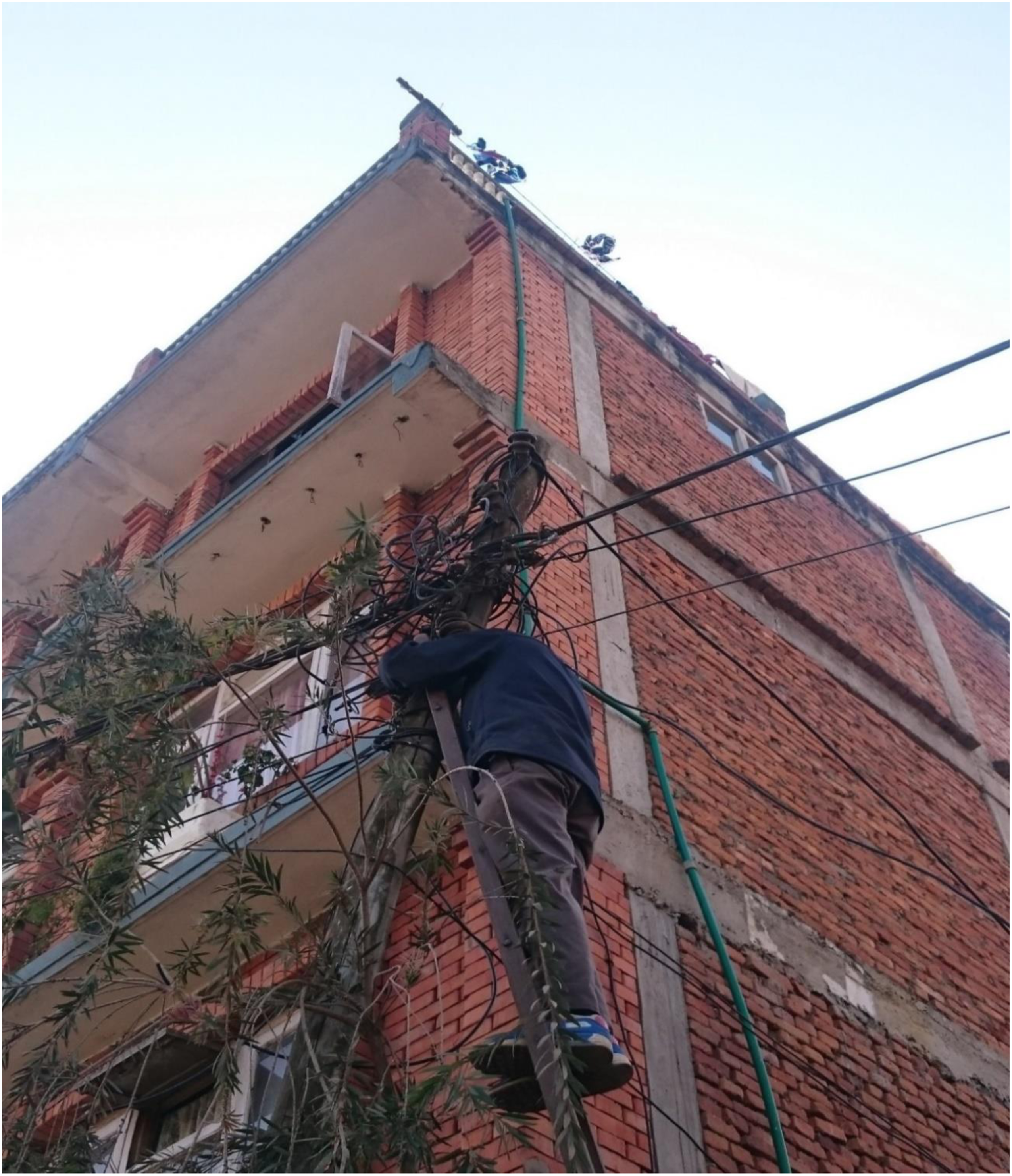
The jobs described show that the day-to-day line work always requires social labour alongside technical work, such as planning with customers and taking on extra odd jobs for them. Social reproduction theory of infrastructure as an analytical lens helps to reveal the sociality of otherwise technical infrastructural work, which in turn represents a broadened perspective on “on-the-ground” reproductive labour processes that keep infrastructure’s material constituents together. As the next section shows, the organization of these labour processes is also essential to understanding the social reproduction of infrastructure.
Sociotechnical unpredictability against bureaucratic simplification
Out of a total of five jobs attempted on the day described, four had unforeseen challenges connected to them. On two other jobs the houseowner was not at home and a third customer had not bought the necessary supplies. Although this was a higher rate than usual, these kinds of difficulties were quite common. The fact that customers must provide most of the supplies needed to complete various jobs makes for a particularly unpredictable stage in the process. If the customer turns out not to have bought what is required, the electricians are left with the option to wait for the supplies, or simply leave for another job. If so, they must make the same trip another day. Since they only have one truck and a large area to cover, they often spend a considerable portion of the day driving from one location to another. Yet bringing all the equipment with them in the truck was not an option either. Mukesh explained that the truck they had was not fit for that purpose, neither in size nor design (the equipment in the back would be exposed to the weather), nor did they have the storage space for all the materials at the office. Another challenge was the lack of housing addresses, which frequently delayed repair work.
Finding the right house often took a considerable amount of time. Apart from the neighbourhood (tol) name and number, a map of the area (drawn by the customer) was all they had to go by. Since all three of the electricians lived in the area around Lubhu, they all had substantial knowledge of area names and layout, which was instrumental in finding the right place. Having found the right place, there was often much room for misunderstanding regarding which house was the one they were trying to reach. In the day described earlier, on one job they had narrowed the location down to one of two houses, yet neither the small group of customers hanging around the shop in front of one of the houses nor the people living there were certain which house was the source of the complaint. Thus, they moved on. Sometimes, they were simply not able to find the house in question at all, usually with Saroj and Ram calling Purna to hurry up when he stuck around for another minute to ask just one more person if they knew anything about a house that had problems with its electricity.6
The electricians always leave the office with a bundle of white paper notes. These are the complaints that have been selected for the day. The concern with keeping driving and waiting time to a minimum has to be balanced against the need to find jobs that they could start quickly. Abandoning one job usually entailed more driving to reach the next, and taking the same route on another occasion to complete the job just abandoned. Yet even waiting for a customer promising to arrive soon was an uncertain prospect. The later it was in the day, the less flexibility there was, since deciding to go to a new job so late might leave them with too little time to complete that one as well. Taking lunch when they otherwise would have had to wait was therefore efficient use of time. They could not do the job at hand, so they did the one thing they were obligated to do in a working day that did not entail being on a job.
Because of the way their working days are set up, being overly concerned with efficient time use would be the source of pointless stress. The truck’s arrival time in the morning is a prime example. Essentially, no one can know exactly when Mukesh will arrive, since both his departure time and the traffic vary every day. While it would be in everyone’s interest to have a fixed time, making that happen was another matter. Yet it is not as though the time they use on different jobs is of no concern to them (despite claims from some locals to the contrary, detailed later). If time use were of no concern, there would be no reason to abandon jobs where they had to wait before starting work, like they did in when the owner was not at home. It may be counterintuitive to think of these electricians as bureaucrats, but there is no reason to assume that bureaucracy is something that happens only in an office. As David Graeber analogously points out, police are essentially street-level bureaucrats with weapons, spending most of their time making sure that the rules are followed, and on paperwork, rather than catching violent criminals (Graeber, 2015: 73–4). The electricians are similarly tasked with making sure the NEA’s rules and regulations are followed – in a system where they must do the service work themselves, even if people with similar technical proficiency might have been able to repair a connection or a meter error. The seal plier mentioned earlier is in this way a slightly more elaborate version of a signature. As with a form, a meter is not usable before it is officially signed and sealed by the right person.
Just as for the river pilots Bear describes (2015: 129–49), it was Purna’s skill and experience that made the dangerous practice of working without turning off the power to the main line an acceptable risk (to put a more positive spin on Ram’s comment of Purna’s fearlessness deriving from old age). However, the margin for error was slim, and the consequences of a mistake would be brutal. Yet it is worth considering whether I was simply exaggerating the real dangers involved. The electrician trio never mentioned any accidents that had happened at the Lubhu office, and the NEA electricians did not emphasize danger or bravery in their work, in contrast to the explicit masculinity of those who braved the dangers of the Hooghly river (Bear, 2015: 63–4, 154). Still, they were aware of the risks involved and accidents that had occurred to NEA electricians elsewhere. If anything, they practised a kind of “modest masculinity.” Despite keeping up with all repairs being an unfulfillable goal in practice, they in effect accepted continuously compromising safety to get as much work done as possible, thus disregarding dangers and prioritizing “current demands.” Coming back to the gendered labour aspects of social reproduction theory, while it seems clear that the acceptance of danger stems from a tacit notion of masculinity, the gendering of this labour goes both ways, simultaneously contributing to the exclusion of women. A contrasting example to situate difficulties a female NEA electrician might face would be hard to find, however, for just this reason.
If anyone needed a reminder of the dangers involved in taking shortcuts in electrical work, it came not long after Purna retired. On a job at the edge of the valley-side, one of the newly transferred electricians was cutting the cable that ran from the nearby utility pole to an electricity meter inside a rickety brick house. The cable had short-circuited from water seeping through its cracked plastic cover and had to be replaced. The new electrician nearly got shocked when he cut through the cable as far as the neutral wire, upon which the wire cutter sparked violently and flew out his hand, leaving a burn mark in its metal. Luckily, that was the only thing that was left with any physical marks. It was the first time I saw an incident like this, despite being with the team on the job on and off for several months. With a mix of sympathy and exasperation, Saroj admonished his new colleague to “please be careful” (hos garnus).
Both for the Hooghly river pilots in Kolkata and the Lubhu electricians, the need to keep going despite a lack of resources makes necessary a “conduct of productivity” that “supports the continuation of dangerous work practices” (Bear, 2015: 131). This entailed taking shortcuts where possible – compromising safety. Yet this was hardly visible from outside, and a combination of prejudice against Nepali state employees and categorizations of work contributed to condemnation of the electricians’ work from several customers.
Work ethics, state and infrastructure in Nepal
Once, when I was heading to the NEA office, a man with whom I was, at the time, scarcely acquainted, volunteered his opinion on the people who work at the office. He was a weaver who was paid a fixed price per metre, work referred to as kaam, as opposed to having a jagir, denoting a job with fixed pay and working hours. Note the difference in phrasing of “doing” kaam and “having” a jagir here. Kaam is something you can both “have” and “do,” whereas a jagir is something you can either “have” or metaphorically “eat” (khaanu) – further strengthening the impression that a jagir involves less work and more privilege.7 The weaver made his accusations while sitting outside the factory where he was working during a blackout. His looms stubbornly refused to operate without electricity. Sitting next to two colleagues, he launched into a 5-min tirade about the employees at the Lubhu office and the district office in Lagankhel. In addition to the somewhat common accusations of lethargy and incompetence, he also claimed that the electricians do no work during the day so they can work at night and get “bonus” pay instead.
While I cannot speak for Lagankhel, in Lubhu this is patently false. However, this was only one of several such statements I heard about the NEA and other state employees. A common feature among them is that the accusations against the workers seem to be of secondary importance to the poor quality of service. As such, the reasoning is that “the proof of the pudding is in the eating” – surely the number of blackouts and years of load shedding must be due to laziness and incompetence. Granted, it seems the NEA’s troubles in the past are due to less-than-stellar management. Elements of audit culture (see Strathern, 2000) were crucial in instilling a “conduct of productivity” among the river pilots in Kolkata. In a sense, this is exactly what many Nepalis claim that government employees lack. However, as I have shown regarding the Lubhu electricians, there is every indication that they work as hard as they can, despite lack of workers, despite lack of safety equipment, and despite not having the time to use safety equipment even if it were available. Nor is it as if bunking off was acceptable within the office, as was made clear in one heated meeting convened to address the fact that some of the administrative staff had been consistently leaving early, while others were still obliged to work the regular hours from 10 a.m. to 7 p.m.
The unreliability of the electricity grid reflected the shifting circumstances of repair work, which again gave people the impression that NEA workers were unreliable. Yet the repair work that happened in between this conclusion of unreliability was a “black box.” It was left unexamined and rather inferred from the two other elements – even though this meant that the cause (workers’ unreliability) was deduced from the effect (grid unreliability). The opening of the black box (the work process) through the vignette of a day’s work reveals that grid unreliability has no one simple cause. One might well disagree with the amount of freedom someone has to bend or subvert the rules within a given bureaucracy (see Gupta, 2012: 24), but some decision-making leeway seems entirely necessary for a system that revolves around people to function (following Bierschenk and Olivier de Sardan, 2019). Neither people, their circumstances, nor their reasoning, are static. Therefore, such systems need to be sufficiently open-ended to deal with the unpredictable and diverse nature of people: “Formal order … is always and to some considerable degree parasitic on informal processes, which the formal scheme does not recognize, without which it could not exist, and which it alone cannot create or maintain” (Scott, 1999: 310). In contrast to James Scott’s focus on state simplification processes as inimical to the reproduction of metis – “the kind of knowledge that can be acquired only by long practice at similar but rarely identical tasks, which requires constant adaptation to changing circumstances” (1999: 177–8) – we see here an example of metis effectively employed within a state structure. Indeed, the electricians’ work seemed positively marinated in metis – despite electrical work otherwise being highly technical and formulaic. The skills represented by metis are yet another humble part of the social in a social reproduction theory of infrastructure that must be maintained, lest the capacity to keep infrastructures from falling apart weakens.
The social reproduction of infrastructures
The work of the Lubhu electricians was not given high priority by the NEA, as is evident from the lack of both equipment and “manpower” (using the English word) for repair work. On the very first day I was with the electricians in the field, they repaired part of a line going out of Lubhu. The cable had burnt out through short-circuiting, but before they could remove the fried pieces of cable still clinging to the utility pole, Ram had to scour the neighbourhood in search of a wrench to borrow. The sparse equipment they had access to did not include a wrench big enough to loosen the nut holding the cable in place. Luckily, he found one nearby. Ram later made his frustrations about the working conditions clear when he told me that there were not enough people to manage the area of the Lubhu office. Three people were not enough, and they lacked the equipment to do their job properly. They should demand more people, but there was no point since there were none to spare. Several of the smaller tools they used, such as screwdrivers and pliers, the trio had bought out of their own pockets, since even these were not easily forthcoming. Moreover, it would not necessarily be enough to have one or two more workers if they were not provided with another truck. The sheer size of the area they were servicing required them to be mobile – a reminder that infrastructures are layered (Bowker and Star, 2000: 33) – the repair of an electricity grid also depends on road infrastructure.
Combining social reproduction theory with Jackson’s “productivist bias” (Jackson, 2014: 226) opens the way for a social reproduction theory of infrastructure: a theory of sociotechnical reproduction that includes the labour dispensed to (re)produce the infrastructural networks that buttress capitalist production cycles, the reproduction of things, and thus the reproduction of people. The reproduction of people and things are fundamentally different in important respects (see Martin, 2014), but they seem to have in common that they are undervalued. Jackson accurately identifies a “productivist bias” through his argument for a rethinking of repair, but he could well have expanded his critique further, to a conceptual level as well. The point that the construction of relatively new structures is given disproportionate amounts of attention is well taken, yet ironically, calling this a productivist bias simultaneously places maintenance and repair outside the realm of “the productive.” Jackson thus continues the very tendency he tries to counter. Going beyond this would enable asking other questions, such as: why is it that repair and maintenance are not seen as “productive”? A social reproduction theory of infrastructure would open the way for a critical anthropological investigation of infrastructural labour that is “analytically hidden by classical economists and politically denied by policy makers” (Bhattacharya, 2017: 2). This case has revolved around repair and maintenance, but the social reproduction of infrastructure need not be tied to this theme alone, opening up avenues for more research on other aspects of infrastructural functioning that have hitherto been undervalued or overlooked – for instance gender aspects more broadly. Studies of labour, by contrast, are often sensitive to its gendered aspects, even when not foundational for the analysis. Hirslund (2019) and Hoffmann (2014) provide strong examples from Nepal. The anthropology of infrastructure may well profit from following this example.
I have argued that anthropologists tend to engage infrastructural repair from indirect or distanced viewpoints but following the work of the NEA electricians shows that scholars are not alone in this. The Nepali public does so too. Yet while scholars have described maintenance and repair in a “celebratory tone” (Barnes, 2017: 147), the NEA’s customers expressed dissatisfaction at the work being done. Kaam as a work category juxtaposed to jagir distils established modes of engagement with, and perceptions of, the state in Nepal. By extension, people’s impression of those holding state jagirs also fostered negative stereotypes of infrastructure workers. From the outside, NEA electricians could seem like a privileged group of unreliable slackers. It looked very different from the inside.
A Norwegian deputy director of a Nepal-based hydropower developer remarked that, given the state of the Nepali grid, he was sometimes surprised that it functioned at all. The explanation is in no small part due to the work of people like the quartet I have described here, who do the unenviable work of urgently propping up a frayed system of wires that looks more likely to decay further rather than improve – while simultaneously being regarded as incompetent until proven otherwise by a public that has little trust in state employees. This is a reminder that repair is a part of life that is insufficiently valued. It entails not only that “people are infrastructure” (Simone, 2004), but that infrastructures are made of people. The work put in by multitudes of ordinary people leading hard lives is as fundamental to electricity infrastructure as the copper wiring cajoling the wild current into the right plug at just the right intensity, so others can continue taking their electrified lives for granted.
Footnotes
Acknowledgements
I thank Elisabeth Schober and Theodoros Rakopoulos for their support and intellectual generosity, as well as for arranging a PhD course and subsequent workshop at the University of Oslo from which this article profited greatly. At that workshop, Charlotte Bruckermann and Luisa Steur gave generous and stimulating comments on an earlier version of the article. Thanks also to Keir Martin for arranging an article publication workshop at the University of Oslo. The article has also benefited from comments on paper presentations at the Britain-Nepal Academic Council’s “Nepal Study Days” at Durham University and also comments after presenting to the Social Anthropology Research Group in Durham. Most recently, my thanks to Chris Henke for very useful comments on a full draft of the article, as well as three anonymous reviewers for their very helpful and constructive feedback.
Declaration of Conflicting Interests
The author(s) declared no potential conflicts of interest with respect to the research, authorship, and/or publication of this article.
Funding
The author(s) disclosed receipt of the following financial support for the research, authorship, and/or publication of this article: This work was supported by the doctoral fellowship grant at the University of Oslo. Fieldwork for this article was conducted from August 2016 to August 2017.
