



Abstract
This article discusses the experiences of high-level managers at a South Korean conglomerate named ‘Sangdo’ who worked within the corporate group’s head office under the owner-executive family. These highly credentialled professionals were attracted to the idea of working directly under or alongside an elite, wealthy corporate dynasty who both owned the conglomerate and were its top executives. Rather than seeing this as a site of inherent conflict between the familial and the professional, I describe how the idea of working alongside and for such elites was enhanced by a ‘dynastic aura’. Through the concept of dynastic aura, I highlight how, in South Korea, families that own business groups are objects of public fascination, particularly as indicators of the future of the economy. In the context of Sangdo, I describe how managers were drawn to the potential of working with a new generation of Sangdo ownership, who sought to centralize and systematize expertise within a holding company. I show how this aura figuratively wore off for managers as they came to understand that ownership was just as entangled in the corporate form – not necessarily above or outside of it – as they were. The article highlights how certain aspects of kinship (such as dynasties and generational succession) still animate capitalist labour, even for non-family members. Additionally, the article calls attention to the way that actors engage with and understand powerful actors in their own right, going beyond accounts of anthropologists’ own direct encounters with the powerful.
Anthropological studies of corporate ownership have hewed closely to aspects that intersect with the field’s most inalienable object: kinship (Hamabata, 1990; Kim, 1992; Lima, 2000, Marcus, 2000; Marcus and Hall, 1992; Sklair, 2018; Yanagisako, 2002). 1 Moving beyond tropes of family business as a purely affective or intimate realm counterposed to a modern, professional management, this oeuvre has remarked how cultural forces and narratives around kinship ‘incite and shape capitalist production and capitalist accumulation’ rather than standing outside of them or being merely affected by them (Yanagisako, 2002: 4). Summarizing his work on American dynasties, George Marcus (2000: 10) goes further to describe the ‘deep legacies of dynastic subjectivity’. These cultural legacies extend into popular culture as well, where ‘the power of the name and identity … can revive family aspirations in ways and locations unexpected’ because such narratives can lend ‘moral stature to money’ (Marcus, 2000: 27).
Tensions around succession, inheritance and control among consanguineous family members have lent themselves naturally to many anthropological analyses and insights, however, if we are to take kinship and other cultural forces and narratives more seriously in their articulation with capitalism, then we must also extend analysis beyond immediate kin relations, to their impact on other corporate or capitalist actors and to organizational forms. These concerns go beyond what we might imagine as the use of kinship for corporate control; likewise, they should also go beyond neo-Orientalist tropes which explain patterns of capitalism through superficial recourse to cultural tradition (such as Confucianism in East Asia). Rather, it is worth understanding what certain kinds of kinship idioms do in animating or shaping capitalist spaces and projects. For example, Annelise Riles (2004: 400–1) reported that Japanese bankers referred metaphorically to the central bank, the Bank of Japan, as ‘our mother’. According to Riles, private banks and the central bank had such a close relationship that it was difficult to ethnographically identify the relationship at all, in much the same way Japanese mothers and sons had unspoken, intimate relations. In this article, I focus on one dimension where cultural ideas of kinship and real kin intersect: managers who worked under dynastic family members in a South Korean conglomerate. I describe how proximity to such dynasties, as embodiments of corporate power, served as an aspirational site for professional middle classes to animate otherwise normal corporate work.
Nowhere seems as sharply defined by both dynastic corporate legacies and large corporate organizational forms as contemporary South Korea. On the one hand, large industrial conglomerates, qua dynastic entities, have been continuously owned and managed by members of singular family lineages, many of whom trace their origins to the post-Korean War period (1950–53) of drastic economic change (though some go back further to the Japanese colonial period). Today, male chairmen, their wives, relatives and descendants comprise most of the list of the wealthiest individuals in South Korea, in part by maintaining complex and difficult-to-trace shareholding ties that grant them degrees of control within such groups. On the other hand, the conglomerates, qua organizations, employ tens or even hundreds of thousands of employees, are regulated by multiple state agencies, and are fully imbricated in systems of international finance and global extraction and production. Brand-name conglomerates like Samsung, Hyundai or SK remain key objects of public commentary, middle-class employment aspiration, and urban presence, marked by sprawling glass towers across key districts in Seoul. Such organizations have been the subject of anthropological consideration before in ways that foregrounded the new middle-class white-collar workers (Janelli and Yim, 1993) and historically linked dynasties (Kim, 1992). Janelli and Yim’s work, set in the 1980s, largely saw the relationship between owners and workers as a story of hegemony, marked by attempts to control from above, and attempts to resist or critique from below. 2 Today, a new generation of owner-executive (the so-called samse or third generation) has emerged alongside aspirational professionals who may share similar goals to modernize aspects of the South Korean corporate world, differentiate from the past and find meaning in work. While owning families remain on the landscape, ownership and white-collar workers are both so entangled in organizational life that it is difficult to separate them into competing forces. This is captured in the term chaebol – the conventional reference for family-owned conglomerates – which refers ambiguously either to a unique South Korean organizational form or the intergenerational families that own and manage them.3
This article is based on fieldwork in one such conglomerate, pseudonymously named the ‘Sangdo Group’. The Sangdo Group is an industrial conglomerate involved in metal and steel industries with roughly a dozen subsidiaries and thousands of employees in South Korea and around the world. It is also owned and led by direct family members descended from the founder, as well as a few of their spouses. My ethnographic account describes how highly credentialled professionals in the Sangdo holding company (the head office) were attracted to the idea of working directly for or alongside the elite, wealthy dynastic family who both owned the conglomerate and worked as its highest-level executives. I foreground how Sangdo’s dynastic family shaped not only the organizational environment and historical narrative of the conglomerate, but also intersected with the career aspirations of managers at the top of the conglomerate who contributed to elaborating managerial projects of the third generation of the ownership. 4
To do so, I develop the notion of a ‘dynastic aura’. By dynastic, I refer to named family lineages that can claim historical status, fame or wealth and who can maintain intergenerational succession into the present. By aura, I refer to a cultural category that is framed as unique, special and rarefied. In contrast to charisma, which is more narrowly understood as a kind of rhetoric linked to an individual person for political purposes (such as coercion), aura signals the ways fame, celebrity or reputation can surround categories of people or things. Auras are as much enacted, produced or imagined by others as they are an emanation from a person. 5 Multi-generational corporate dynasties in South Korea are imbued with a kind of class-celebrity aura, through their super-elite lifestyles, secretive private lives, and occasional tabloid stories. They are in many ways diametrically opposed to quainter notions of ‘family business’.
Members of conglomerate-owning families can possess the highest forms of social distinction in South Korea: inherited wealth, overseas education, multilingualism, real estate possession, corporate titles, marriage to other business or political elite families and, in some cases, deep hereditary legacies. For example, Choong Soon Kim’s ethnography (1992) of the South Korean Poongsan Corporation describes how the chairman, Ryu Chan-u, linked his company’s mission to his own lineage, which dated back to a famous 16th-century Korean (Joseon) official. Such families can also animate internal organizational life, contributing to narratives around corporate history, philanthropy and social contributions, as well as providing a source for management philosophies and corporate culture. Interactionally, there can literally be a spatial aura created around the highest figures, such as chairmen, who might be ushered around by personal assistants or drivers. Those who encounter such exalted figures might halt whatever they are doing to hold deep bows as they walk by.
Aura can also capture the sense of being at the edge of generational change, a temporal motif which often structures ideas about epochal shifts in South Korean social history. As new generations continue a legacy of their fathers or grandfathers and take on key positions, they might also be expected to carve out their own managerial identities through new initiatives, internal culture reforms, or business ventures (akin to Yanagisako’s [2000: 90–2] account of the ‘conundrum’ of the second-generation self-made man in Italy). Many of the high-level managers and other employees in the Sangdo holding company who had joined the company in their mid-career recounted to me how they joined after being head-hunted by a newly promoted third-generation owner-executive. This executive had begun a multi-year effort to grow the holding company and centralize many of Sangdo’s management processes, from human resources (HR) to legal to strategy, in one office. One manager, team manager Jang in HR, who had previously worked at a prestigious multinational conglomerate, told me that he joined Sangdo after personally speaking with the third-generation owner-executive during his interview and was inspired by his new vision for the conglomerate and for HR specifically. Jang even professed to having taken a pay cut to work at Sangdo (a domestic conglomerate) instead of at a cushier Korean branch of a Western company, where the pay would be higher but the work simpler. Similarly, team manager Park in public relations (PR), who had been recruited from another conglomerate, was able to work directly with the owning family to translate their tastes, vision, values and history into rebuilding the Sangdo brand; she was also one of the few female team managers in the male-majority group, another mark of a changing office culture. As part of the new vision for Sangdo, managers in specialist areas like Jang’s and Park’s were deputized to develop and carry out projects that would centralize, systematize or update managerial processes across the group’s subsidiaries. Managers would have a wider managerial scope over a conglomerate through the holding company and proximity to the ownership, who could in theory break through the complex politics and red tape typical of hierarchical and bureaucratic organizations because of their higher claims to both the organization’s identity and financial ownership.
Aura is a useful concept to think with because it can also capture how power or potency can diminish the closer one gets. Assistant manager Baik on the Sangdo strategy team was shocked when, during a meeting, he witnessed two (non-family) subsidiary CEOs refuse a directive by the Sangdo chairman to institute a new production system in their factories on account of it threatening their revenues. To Baik, it signalled that the subsidiary CEOs held the real ‘power’ within the conglomerate as they were not afraid to speak up to the chairman. He eventually transferred to one of the subsidiaries where he would work more on the front lines of international sales. Similarly, junior employee Mina was hired out of a top university to boost early-career women in the conglomerate; after a few years, the third-generation owner personally helped her transfer to a new marketing position in a subsidiary. She soon became disillusioned when the subsidiary showed no interest in marketing or advertising, and where there were no female workers outside of secretarial workers. She eventually left Sangdo completely to restart her career in a different field. In this vein, the ethnographic tension I describe in this article emerges in the gap between the promise of working with corporate owners and the disillusionment around the limits of ownership power in the organization. The vicissitudes of personalities, organizational politics and workplace cultures revealed that ownership was not as powerful as some had thought.
Chaebol or conglomerate families are a perennial topic of public news and criticism, particularly over the misuse of elite privilege, ranging from topics of nepotism and slush fund spending to political interference and ‘power-abuse’ (gapjil). For some, these kinds of incidents bring shame to South Korea’s (lack of) economic development and occasionally prompt calls to sever chaebol families completely from conglomerates themselves. Critical coverage however elides the degree to which regular employment positions at chaebol organizations are still widely desired among the middle classes. This is because corporate positions are not just valued for their economic benefits alone; they convey a host of diacritics of social and economic mobility, like working in a strategy department, in Seoul, on a top floor, while speaking English, with good benefits, etc. The offices where members of the family usually work as executives or chairmen, once known as ‘secretariats’ (biseosil), play into these prestige categories as well. Secretariats, today existing in the form of holding companies or large strategy offices, represent a twin apex in this sociocultural-corporate hierarchy: such offices are usually ‘above’ other subsidiaries and units in a conglomerate, such that they manage or control others; and they are also most physically proximate to those with many forms of social distinction themselves, owner-executives. They are also the most difficult sites for both the public and even internal actors to access, adding to their appeal and mystique.
My initial goal during fieldwork in Seoul across 2013 and 2015 had been to avoid such high-powered contexts. I was interested in more generic white-collar office relations among teams amidst changing technologies of communication. This was deliberate, aiming to move away from the outsized attention that owning families (and the chaebol phenomenon) receive in studies of South Korean political economy. However, despite efforts to make connections with corporations purely through interviews and networking, my only invitation to conduct longer-term fieldwork inside a company came via an owner-executive family member at Sangdo who shared an American alumni connection. This was a double-edged sword, as I found an ideal site for fieldwork but one placed precisely within the complex world of the holding company. My desk as an intern on the HR team was located just down the hall from the third-generation owner-executive’s office and surrounded by managers and employees who had survived many years in Seoul’s corporate world. Elsewhere, I have focused on generic aspects of the Sangdo workplace, highlighting workplace conflicts while minimizing mention of the ownership (e.g. Prentice, 2019). This was deliberate, in order to not locate ownership influence or authority as the ultimate source of control. By not directly addressing the ownership, I was attempting to write about office-place issues that they might find relevant as readers, as a sort of indirect return-gift for allowing me to work at Sangdo for one year.
In this context, my analysis here focuses not on what kind of power family ownership actually possessed, but rather what kind of power they were seen to have. Seen from the perspective of the average person, conglomerate-owning families are certainly powerful. However, seen from the perspective of other employees or managers (who also have some forms of distinction and workplace power of their own), the power of conglomerate-owning family members was of a different quality: it was premised on their abilities to effect things within the organization in the ways others could not. This is similar to Alfred Gell’s notion of a magic-standard which he defined as ‘a means of securing a product without the work-cost that it actually entails’ (Gell, 1992: 58). In South Korean popular culture, for instance, a chairman is often depicted as having the power to execute major decisions through a single phone-call. In real life office culture, the aura of dynastic ownership in South Korea can make ownership appear super-organizational, with the ability to carry out sweeping new projects while pushing through intra-office politics. I suggest however, that close encounters can reveal the limits of such images: the Sangdo owner-executives were involved in many aspects of conglomerate management, however this made them more entangled in office-level issues, not less. High-level managers, in turn, also became involved in the other aspects of ownership activity beyond corporate change. In making this case, I am combating the tendency to ‘sociologize’ the corporate elite as powerful by recourse to their positions in set societal, organizational or wealth hierarchies. As I discuss, many of their powers to attract elite employees into the company did not necessarily translate into sweeping organizational change; in fact, it revealed how entangled ownership was in organizational life and politics. Ultimately, this kind of ethnographic account – one that attempts to convey the perspective of the powerful from the perspective of those who work with them – allows us to see the putatively powerful otherwise. 6
Encountering aura in the Sangdo tower
Inside the 40-storey Sangdo corporate tower, the only areas open to visitors were the café, museum and auditorium. The museum was essentially a small exhibition area displaying different artifacts of Sangdo’s history: a global map of its offices, pictures of workers, different samples of key Sangdo industrial products, and an enlarged graph showing the group’s up-and-up revenue growth over the past half-century. Some graphics overlaid the group’s success onto the nation’s, describing Sangdo’s success as the ‘cornerstone of national economic development’, a common narrative among large industrial groups. Interspersed among the company artifacts were images of the founder and a previous chairman, father and son. Personal, family pictures were arranged in a photo collage on one side of the museum. Inspirational messages and artful portraits of the two men hung from banners. The tower’s café itself had a recreated bookshelf featuring the founder and previous chairmen’s collection of business books in Korean and English. In spaces reserved for employees, private possessions from the owning family were also on display. Lining the walls of an upper floor, only visible to employees or authorized visitors, were large works of modern art alongside sculptures, vases and other decorative objects. And in meeting rooms and employee areas in subsidiaries throughout the Sangdo tower were paintings and sculptures from the family’s art collection.
Such spaces and artifacts contributed to the aura around the owning family as not only central to the founding and corporate culture of Sangdo, but one with extra-economic value and sentiment. The words of the current chairmen, for example, were regularly featured in the company magazine, urging employees to do their best while confronting economic challenges. The chairman was also the source of the annual variable bonus rate for employees. Such traces of a benevolent elite were certainly part of an effort to confirm their symbolic positions in the group by situating them as the heart and spirit of Sangdo, thus making them inseparable from the organizational form (while also distancing themselves from the more unseemly aspects of either their global capitalist production or domestic labour politics; see also Sklair, 2018). At the same time, such artifacts were internally directed and addressed to Sangdo’s many thousands of employees. In this sense, they were part of an appeal to the subjectivities of regular employees, who were not just working at a ‘steel conglomerate’ but working under leaders with historical legacy, who had grand visions for the future, and who exhibited upper-class tastes in their personal lives. Part of the appeal of conglomerate family leaders, then, is the inclusion of others, however indirectly, within their personal spheres. For most employees, this is a fictive claim – by virtue of their contiguity at a Sangdo subsidiary or by working in the Sangdo tower, they could partake of the chairman’s or owning family’s legacy. (Such social facts could be referenced when, after a team-sponsored dinner, employees might jokingly thank the absent chairman for buying the meal.)
Managers and employees in the Sangdo holding company below the chairman’s floor at the top of the tower had more direct engagement with family executives. They were responsible for managing, translating and protecting this aura both inside and outside the group. For instance, members of the PR team fielded press calls and managed news articles about both the group and the family. Together with the PR team, the HR team helped to create a set of unique company core values (haeksim gachi), that were based on the owning family’s own set of unique values. These were converted into discrete sets of behaviours printed on leaflets that employees were meant to learn and adopt in their daily tasks. A separate investment team handled overseas investment projects on behalf of the ownership’s financial capital. And a small general affairs team, which nominally took care of office administration tasks, also managed various personal affairs for the ownership, such as keeping track of their real estate properties and their art collection, as well as putting on personal events, discussed further later. One junior employee in general affairs, who used to be an assistant for a film star, largely served as a direct personal assistant to members of the family. While there was an official CEO at the holding company, all the teams reported to the chairman or third-generation executive.
The work of the holding company was not in the service of promoting the aura of a specific person. Many of the teams (or departments) were either created or expanded by a third-generation owner who had been promoted to a key executive position with plans to change the internal management structure and external image of Sangdo. That owner is part of the so-called ‘third generation’ (samse) (and increasingly fourth generation) of conglomerate family owners in South Korea who are the direct descendants of founders. Today these heirs, between 30 and 50 years old, have moved up through their groups along special paths beginning with a lower-level position in order to gain experience and earn their own reputation within the business (if they are involved in corporate life at all). Their successes and failures at different stages (say, by leading a new overseas venture) are keenly followed internally and in South Korean business media as indicators of whether they have the leadership qualities to be picked to succeed as a chairperson in the future (see Figure 1).
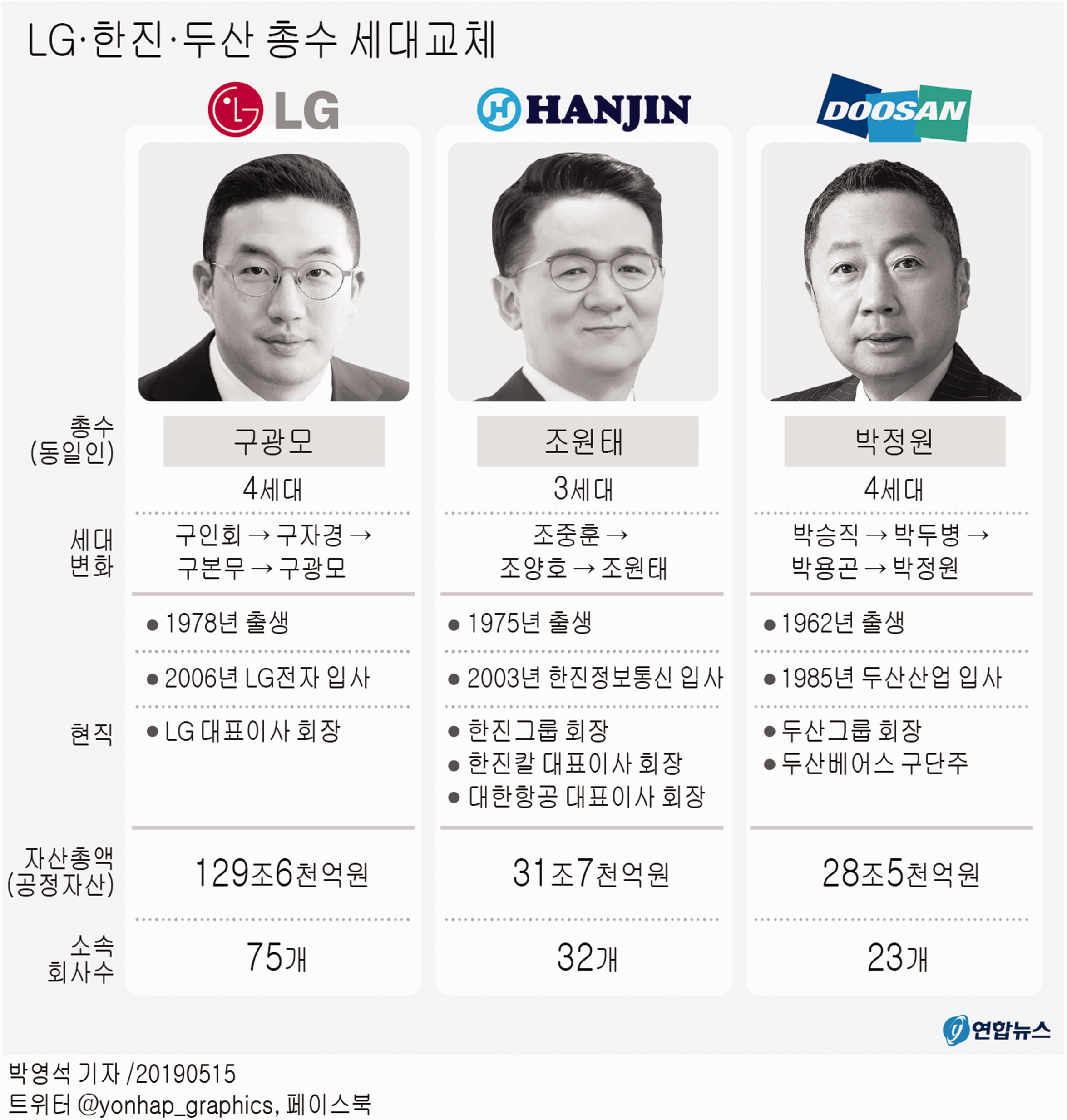
A newspaper depiction of third- and fourth-generation conglomerate family members who have recently become chairman at three conglomerate groups: LG, Hanjin and Doosan. The graphic, titled ‘Generational shift in top leadership'’, elaborates (along the left axis) a comparison of their key qualities including: their generation, their lineage, career titles and progression, personal assets, and the number of companies they are in charge of.
Though not the most senior member of the holding company at the time, the third-generation owner was personally involved in recruiting experienced managers and executives from outside the company and interviewing new university graduates who might start their careers there. Up until the 2010s, the holding company had had a limited managerial role in the Sangdo Group, existing largely as a financial reporting vessel and office of the chairman. 7 However, the third-generation owner led the expansion of teams (like HR, legal, strategy, performance, and PR) and the hiring of experienced managers from other conglomerates or consulting firms. Each of the teams was involved in taking on new managerial roles within the holding group, which was generally referred to as ‘systematization’ (siseutemhwa). Though this approach was never made explicit in any documents I came across, teams across the holding company were in the process of developing new systems (or projects) of reporting and creating shared standards under their respective departmental domains that would integrate the largely separate and autonomous worlds of the Sangdo subsidiaries.
This systematization was most evident in the redesign of the Sangdo brand. With the hiring of new marketing managers in the PR department, the third-generation executive had engineered a widescale rebranding effort, starting with the Sangdo Group corporate identity. The executive oversaw the redesign of the logo and brand look, as well as individual company websites, the conglomerate magazine, and branded paraphernalia, like business card holders, office supplies, and company pins. New templates were added to PowerPoint designs that featured graphics of metal and fire, rather than the stolid corporate blues favoured by many blue-chip manufacturing companies. Visual motifs were markedly fashionable and demure – often all black, with black lettering or embossed symbols that did not call immediate attention to themselves as corporate objects. Many of the items did not even have the company name on them at all, signalling a nod to higher-end consumer tastes, rather than company display. These design elements were parlayed into sleek new brand promotional videos that played in elevators and on screen displays. Professional photographs of the Sangdo tower and Sangdo’s many factories echoed the romantic mid-century industrial photography of Maurice Broomfield. Likewise, the company magazine featured custom designed artwork and snappy copy, with the help of an outsourced writing and graphics team. Sangdo may not have been a household name in South Korea, but its redesigns reflected an awareness of aesthetic distinctions. These also differentiated from previous internal productions which focused on celebrating and documenting employee culture, such as by featuring an employee on the cover of each magazine. The branding efforts signalled an awareness of more recent Western business trends that have moved away from defining and managing a specific ‘corporate culture’ towards the more diffuse idea of values and qualities of lifestyle branding (Krause-Jensen, 2011). While the branding projects did not overtly reference the ownership and were carried out by many professional experts, employees could cite them as products of the third-generation owner-executive’s new initiative.
In contrast to American workers who might want to empower themselves by thinking like owners (Souleles, 2020), managers and other employees at the holding company did not overly identify with either the culture of the owners or the corporate brand in the ways that other employees were meant to (i.e., by fully living by the company values). Part of the reason is that many had already been partially socialized into elite worlds themselves (the holding company employees were generally recruited from elite Seoul universities or from other prestigious conglomerates). Moreover, as subject-area experts with certifications in accounting or consultant backgrounds, holding company managers might have seen themselves more like socio-technical translators between the family and the group generally, and the projects of the third-generation executive more specifically. Some of these projects translated well without significant obstacles, such as the suite of branding projects discussed above. Those were ostensibly successful in part because there had been almost no branding or marketing within other subsidiaries to begin with. Subsidiary employees I knew in the Sangdo tower appeared happy to have new gifts for clients, new advertising and modern office décor that was subsidized in large part by the holding company. However, the ability to translate ownership across the conglomerate was met with greater pushback in other departments and areas where subsidiaries themselves claimed actual expertise, as I describe in the next section.
An office of experts and experiments
One of the appeals for managers at the holding company was the ability to have a wider scope of work and be considered as an expert leading the conglomerate in a new direction, rather than a manager with a narrow remit focused on one subsidiary or task. Indeed, by virtue of the corporate structure, the holding company technically owned Sangdo’s various subsidiaries, which were obligated to report to the holding company departments on various issues, from quarterly performance reports to annual strategic plans. However, because their remit was purely financial and a seeming test-case for the third-generation executive, vertical connections between any subsidiary and the holding company were otherwise relatively thin. Many subsidiaries had their own systems, made their own investments, and cultivated their own workplace cultures distinct from each other. In certain cases, they could refuse orders to cooperate or at least not participate in group-level projects. For the holding company, then, developing new projects that would sweep across the internal structure of the conglomerate proved a dense thicket. In fact, the experts in the holding company often ended up acting upon themselves as much as other subsidiaries.
When I went to lunch one day with manager Kwon from the strategy team, I asked him what he thought about a new HR programme in the holding company called DRIVE (a pseudonym for a new work-tracking system). Kwon scoffed slightly at the question, noting that everything the HR team was doing was just an ‘experiment’ (silheom) that was being tested in the holding company. Indeed, DRIVE was a radical new programme, meant to transform how workers recorded their tasks and how they would be evaluated for them. It was being launched first in the holding company with the assumption that upon its success, it would be disseminated to the subsidiaries.
Though not directly created by the third-generation owner-executive, DRIVE was a plan that was linked to the third-generation owner’s desire to create more opportunities for individual merit and rewards; to that end, a more ‘accurate’ work-tracking system would be needed. The system was developed by the new experts brought in to make HR more like a consulting group premised on effecting corporate change than a personnel management group. In the year I was with the team, which had been expanded to eight members from three a few years prior to my arrival, they launched new projects that targeted benefits, executive pay, promotion, employee engagement, internal training and education, and labour statistics, among other projects. However, many of these projects were limited in scope to collecting data, recommending shared standards and working on the outskirts of HR management, such as recruiting or executive evaluation. They had little remit to impose changes onto individual HR departments themselves. As a result, some of the projects had to be pilot-tested on the holding company staff before they could be shared with subsidiaries.
DRIVE was a significant project that involved reimagining how workers thought of their tasks, how tasks would be recorded, and how team managers would evaluate them. Created on an internal software system (ERP), it was meant to minimize the gap between the recording of work and work itself, not unlike how financial numbers and inventory are closely tracked (see Chong, 2018). The HR managers saw this as a more modern development, achieving a certain kind of managerial ideology of a one-to-one fit between work and documentation. In reality, DRIVE involved a complicated set of rules, buttons, procedures and terms, that represented how HR managers saw work (as individual projects that could be broken down into separate tasks). Without going into the details of the system, it is worth noting that DRIVE required a manual and training sessions for both managers and employees to learn to use it. Even though it was meant to clearly reflect manager–employee relations (in which employees do a project and managers evaluate it), it actually added more tasks, checks and reports to monitor – tasks which even other managers and employees in the holding company often ignored as they saw them interfering with their own work.
While the DRIVE programme was being piloted within the holding company, the HR team manager Jang began to share details of the programme with two of the major Sangdo subsidiaries, Sangdo First and Sangdo South. In one presentation to Sangdo First, the team manager shared details about the new programme with an executive, adopting an obsequiously respectful and cheerful demeanour as he spoke glowingly of the new programme’s features, careful not to insult the subsidiary’s existing evaluation programme. The executive, who had not worked in HR, gave it a lukewarm reception. Later, Jang told me that the purpose was not to try to sell him on it at that time, but to get them to implement it over time, perhaps after other subsidiaries. Sangdo South, on the other hand, was more receptive to DRIVE but decided to implement its own version of the programme. It was not a direct copy but was renamed and adapted to their organization. Jang acknowledged later that by letting them adapt it, it would not be seen as the holding company forcing it upon them directly.
The DRIVE programme was still being tweaked by the time I departed in 2015. However, the friction encountered in its implementation revealed how difficult it was simply to implement a radically different evaluation system of office work onto both themselves and subsidiaries, especially one that would be tied to individual evaluations, promotion trajectories and bonuses. Where the HR workers might have had the benefit of knowing the third-generation owner supported the project, they were otherwise exposed as insider-strangers, subject to those who personally outranked them, but in subordinate companies. (Jang described this to me once as the holding company being in a ‘step-mother’ role.) In reality, for all its new conceptualizations around the recording of work, DRIVE was rather basic as a technology, created through a simple ERP application with in-house IT workers. In contrast, the large subsidiaries that were seen to be in need of modernization, actually had their own professional human resources management systems (HRMS) purchased from large IT companies like Microsoft or SAP, which had cost millions of dollars to implement and which tracked thousands of employees.
In the year after I left Sangdo, team manager Jang and another manager in HR were transferred from the holding company to lead the HR department at one of the large subsidiaries. At the subsidiary, they would directly oversee an organization of thousands of employees and, in theory, have a greater impact through the programmes they managed. While the exact reason for their transfer was difficult to ascertain, I suspected it was to be closer to an actual organ of organizational power and away from the politics of the holding company where they would always be in an ‘experimenting’ role, competing with other experts who were also doing the same thing. At a subsidiary, they would also be physically farther from the everyday realities of the owners-executives’ lives which also crept into their managerial work.
Dynastic realities
One day during my fieldwork, all employees received a somewhat neutral memo via the company intranet about appropriate office conduct and dress. The list of bullet points included general reminders on when men had to wear ties, when they could don short sleeves, and how they should present in meetings with clients or suppliers. One peculiarity of the memo was a note saying that employees should not wear their Sangdo company jackets in public. This was peculiar precisely because the jackets had been supplied by the company. The Sangdo jackets, unlike more conventional Korean company jackets which are typically rather bulky canvas bomber jackets adorned with large company logos, were actually stylish, at least in comparison. Everyone in the tower was given one for free, men and women, and employees voluntarily wore them over their business attire in and out of the office from the fall to spring.
The jackets had been the creation and promotion of the third-generation family owner-executive as part of the branding efforts. The moratorium on wearing the cold-weather jacket outside was a surprise to me, but not to my teammate in HR, Ki-ho, a junior employee whose desk was adjacent to mine. Despite the memo being anonymous, he knew from experience that the directive came from a second-generation owner in a different executive position. Explaining this fact to me in a hushed whisper, he pointed to the ceiling to indicate it came from above on the chairman's floor. Ki-ho had a hunch that this particular owner-executive did not like the look of employees wearing puffer jackets over their business formal wear. By pointing upwards, he was also implying that it was a dispute among family members that employees best not make mention of.
Ki-ho was familiar with this particular owner because they would often walk through the office doing impromptu visual checks on employee desk areas. When their voice could be heard coming down a hallway, employees might straighten documents, clear desks, and hide extra pairs of shoes under their desks. The owner would visually inspect desks for personal items out of place, dust gathering on tops of computers, and documents not stacked properly or in too great a quantity. A co-worker who had worked in other companies admitted that he had never worked at an office with such ‘clean’ (paper-free) desks before. The loose handling of documents and visually shabby presentations (even as an index of intensive work) in the office were taken to be signs of disregard not just for the company, but seemingly for that owner’s space.
Other personal tastes and styles of the owners were integrated into company life but in ways that did not necessarily align with new managerial projects. For instance, the owning family was a patron of classical music. 8 Western classical music has long been associated with modern taste and class distinctions in South Korea (Harkness, 2012). The owners were on the board of a national classical music society and sponsored classical music events at the national music centre. One member of the family put on quarterly lectures in the corporate tower on classical music topics, lectures taken to regional offices as well. These lectures were widely advertised to all the employees of every subsidiary, and younger employees dutifully attended to fill seats in the Sangdo auditorium. The three lectures I attended during my time at the company as an employee involved videos of Western musical pieces with occasional performances by South Korean musicians. Employees in attendance, most of whom were young and male, would listen diligently, but no one ever seemed to be particularly interested in the content of the lectures. The lectures were seen as events that were good to do as a matter of corporate duty. This is not to say that employees were not interested in elite activities; however, most young male employees would have been more interested in conventional middle-class consumer activities like travel and fashion, not the erudite European tastes of the ownership. (And most upper-level managers seemed to find legitimate excuses not to attend the lectures.)
Some events brought employees into the fold of the owners’ social circles more intimately. As mentioned, I shared an American alumni connection with one of the owners. On one occasion, I found myself in attendance at the same event at a fancy hotel in downtown Seoul (one of the few points of mutuality between us). However, going as an ‘American PhD student’ from the university, not a corporate employee, I was surprised to find co-workers from the Sangdo PR and general affairs team manning the registration table. This included some junior employees who might be expected to lend a hand at such events, but I also saw a few more senior managers who were in charge of registering alumni into the event. Taken aback by the fact that I knew the employees, I attempted to play both roles to minimize the fact that our roles were temporarily reversed. At a similar occasion, a family-sponsored event at a large concert hall in Seoul, I saw employees from the IT subsidiary deputized to help. Such workers, who had degrees in computer science, were working as ushers and ticket-takers, appearing as unmarked employees of the event hall, not even Sangdo employees. Both of these events (alumni meeting and concert) were in the service of the owners’ own positions within their elite social circles, not in the direct service of corporate philanthropy or PR.
Dynastic auras and corporate life are of course interwoven, but it is worth noting a distinction between working for an owning family as an organizational agent versus working for an owning family on things that might be irrelevant or even counter to organizational needs. This distinction could be evident with activities that were overtly personal, but with projects that blurred the line between a personal (pet) project and an organizationally relevant one. For instance, while working, I was asked by one owner-executive to help update the English translations of Korean job titles across the entire conglomerate. This was technically an HR task and involved systematization across subsidiaries, but it was also a project emerging from the minor concerns of one owner-executive having to do with the outward look of Sangdo business cards in encounters with foreign businesspeople (quite rare for many office functions). Nevertheless, for my final month at Sangdo I worked on developing a new unified system of English titles. Translating all the possible titles turned out to be not so much a linguistic problem as a political one. Altering titles in English, especially for executives who each had particular titles (such as ‘vice chairman’ or ‘senior executive’) meant potentially encroaching on the relationships with other subsidiaries. Team manager Jang, sensing the complicated politics of even this simple translation request, took over my work and developed a final report that threaded the needle between answering the owner-executive’s requests for a unified system, while being conscious of the titles for each of the executives in the subsidiaries.
Being deputized for certain kinds of unexpected tasks is not uncommon in white-collar offices in South Korea, where job descriptions can be very general and one way of blending in is to sacrifice one’s personal time in order to earn one’s keep. Presumably such sacrifices lead to recognition, inclusion or personal favours later on. At times in the holding company, executives, managers, or even junior employees could spontaneously be called down to lunch or dinner with a member of the ownership. In one instance, I was abruptly called down to a fancy Italian restaurant near the company building and was encouraged to drink wine at lunch, while one owner regaled us with personal stories. It seemed that one or two of the managers at the lunch were somewhat regular invitees; and it was quite strange to see them outside of their normal ‘expert’ zone, subordinate and attentive to the owner. While the stakes were relatively low for me as an outside observer, I imagined that it was riskier for other managers and executives to refuse or say the wrong thing, which could portend a negative outcome at some future promotion meeting. As an employee, I had learned not to ask too directly about opinions of the owners – for fear that it might be overheard or that it would put employees in a difficult position.
While the aura of being part of a ‘new generation’ of Sangdo leadership was powerful, at least in terms of hiring narratives and exposure to elite worlds rarely seen by conventional office workers, the intertwining of familial and work activities created a complex topography for employees in the holding company to navigate. This is not simply to reaffirm a point I wrote of at the beginning of this article, that familial and professional activities are inherently ill-fitting. Rather, it suggests that there is a gap between the aura or mystique of a generational shift in an abstract, promissory sense (at Sangdo, in South Korea) and the realities of working closely with real persons, whose personal lives are also complexly intertwined with the organizational form and organizational politics. There were occasional breaches that reified ‘familial’ and ‘professional’ differences, as well as covert intra-familial conflicts, but equally importantly, I would suggest, the work of socio-technical translation of the owning family’s will to a (new) organizational reality was much more difficult than newly hired managers assumed.
Conclusion
This article has explored how expert managers came to interact with elite owners who had claims to a dynastic corporate lineage in South Korea. I have argued that part of what makes working near owner-executives appealing is the idea that they have super-organizational abilities to influence or control a large conglomerate based on their dynastic legacies and the narratives surrounding new generational leadership. I have shown that, for many managers, the aura that inspired them to join Sangdo’s growing holding company – to be part of the centralization and systematization of Sangdo – wore off as they confronted owner personalities, personal projects, and the stickier realities of organizational politics.
What is hidden from public view is often prefigured as something possessing what Grey and Costas (2016: 56) have described as an organization’s ‘mysterium’, which can ‘stimulate a certain excitement and aura’. In the context of South Korean conglomerates, we might imagine that the truly powerful sit on the top floor or behind closed doors where they wield their exclusive power. Employees I met from other subsidiaries or conglomerates suspected I would be doing some sort of exposé on the ‘secrets’ of the Sangdo owning family by virtue of my proximity. Even I at times wondered whether I would encounter the font of corporate secrets in an executive’s office or written on a document somewhere, an organizational version of ‘ethnographic seduction’ (Osburg, 2013; Robben, 1996). However, as I have described in this article, what is most often found behind closed doors is not corporate power laid bare, but the lifestyles and personalities of the wealthy. These are distinct from corporate life, but interwoven in many aspects of it, from class-cultural events to administrative projects.
Aura can animate certain kinds of actors as more agentive (that is, powerful) the further we are from them. This bears importance for the future of studying up. In Laura Nader’s seminal account, studying up reflected studying powerful institutions such as insurance and banking, because ‘such institutions and their network systems affect our lives and also affect the lives of people that anthropologists have traditionally studied all around the world’ (Nader, 1972: 293). However, her account also slips into notions of ‘up’ meaning the study of elite and powerful people. Nader notes: ‘the powerful are out of reach on a number of different planes: they don’t want to be studied; it is dangerous to study the powerful; they are busy people; they are not all in one place, and so on’ (1972: 18). This has importance for how anthropologists, in seeking to study power, may conflate a lack of access to powerful institutions with the study of powerful persons, even attributing such lack of access to their powers. 9 To understand entities like South Korean conglomerates, it is certainly necessary to include a study of owners, but it is equally important to study how ownership power (or corporate power in general) is projected or imagined ethnographically.
While it may be axiomatic for anthropologists concerned with power to be oriented towards critiquing it (see Ortner, 2016), it is worth highlighting in closing that certain kinds of power relations are also sources for establishing social relations, particularly within complex or competitive labour economies. For instance, hierarchical working relationships in South Korea, even when structured by certain kinds of interpersonal asymmetries, are premised on exchanges of sacrifice and reward over one’s career (such as a boss who might reward a subordinate for working long hours on their behalf). The issue is not that one is in a power relation at all, but whether one’s connections are good ones or not. That is, whether one’s sacrifices for one boss or line will pay off in the future – such as junior employees who might aspire to be like the managers, executives or owners they work for. For the upper-level managers at Sangdo who worked under owner-executives, they found themselves in a putatively powerful line as experts within the holding company. Such proximity promised greater organizational power and their own chance to cut through the complications of South Korean corporate life, one way of escaping the complications of capitalism albeit from inside(cf. Miyazaki, 2006: 151); however, for many, such connections only entangled them further within it.
Footnotes
Acknowledgements
This article is dedicated to the late Roger Janelli whose ethnography on South Korean corporate life originally motivated my doctoral research and whose depth, breadth and insights continue to offer a model of exemplary scholarship. Juan Manuel del Nido offered early encouragement while Monika Chang offered help in the final stages. I would also like to thank the special issue editors Matthew Archer and Daniel Souleles for organizing this special issue and inspiring me to write an article on ownership. I would also like to thank two anonymous reviewers who pointed me in very fruitful directions and helped sharpen my arguments.
Declaration of conflicting interests
The author(s) declared no potential conflicts of interest with respect to the research, authorship, and/or publication of this article.
Funding
The author(s) received no financial support for the research, authorship, and/or publication of this article.
