




Abstract
If there are any charitable, philanthropic, or welfare-state activities in the de facto states of insurgent armies, they are generally interpreted in terms of utilitarian motives and the self-legitimation of military elites and their business associates. However, development and philanthropy in the Wa State of Myanmar have more extensive purposes. We argue that a framing of care rather than of governance allows for ethnographic attention to emerging social relations and subject positions – ‘our people’, ‘the vulnerable’, and ‘the poor’. In this article we describe ‘communities of care’ by analysing public donations, development assistance and independent philanthropy in the Wa State as categories of care that each follow a different moral logic, respond to different needs, and connect different actors and recipients. Zooming in on the ways in which communities of care reproduce moral subjectivities and political authority allows a re-imagining of everyday politics in the de facto states of armed groups, no longer wedded to notions of control, legitimacy, and ‘rebel governance’.
‘Charitable donations always come from people who have personal connections and private interests’, a sceptical department head in the Wa State of Myanmar declared in an interview with one of us – ‘everyone has their own motives’. Local officials are quick to dismiss the charitable intentions of outsiders who come to the Wa State: development assistance is seen as a pretext for meddling in local politics and gaining influence, and donations by individuals are seen to smooth over business interests in the Wa region. At the same time, officials acknowledge their need to provide for the people of Wa State, not simply for legitimacy-building but as a moral obligation. Hence, while scepticism prevails, officials also appeal to international organisations and private businessmen for assistance, navigating the fine line between suspicion of outsiders’ motives and the need to engage and provide. These uncertainties are compounded by the ambivalence of this polity: the Wa State is a de facto autonomous region on Myanmar’s border with China, controlled by the United Wa State Army (UWSA), the largest ethnic armed group (EAG) in Myanmar. An uneasy stalemate has prevailed since a ceasefire was signed with the Myanmar military in 1989, and countless peace negotiations to integrate it into the Myanmar state have failed. The Myanmar government has no jurisdiction within the Wa State, with the UWSA running its own military, government apparatus, external affairs, economy, and justice system. Thirty years without the outbreak of armed confrontation are testament to the relative stability of the Wa political project, sustained by a mix of careful diplomacy, accruing capital through the shadow economy, and maintaining political and military cohesion.
The few analysts writing about philanthropy among Myanmar’s other EAGs share similar suspicions: donations for schools, hospitals and infrastructure by local elites are readily explained as performances and calculated gifts (Chin, 2009: 154 ff.; Ford et al., 2015: 33–7). Alternatively, the minimal provision of social services in areas controlled by an armed group has often been presumed to be a form of ‘rebel governance’ in the political science literature, regarding philanthropy as a technique of ‘rebel rulers’ for buttressing governance, instrumentally accruing political legitimacy to the armed group (Jagger, 2018; South, 2017). But while self-interest and legitimacy-building are part of philanthropy in the Wa State, they are not the entire picture. Studying this requires attention to the totality of various levels and forms of local charity that exist in the Wa State of Myanmar – public donations by local elites, development assistance by international agencies, and independent philanthrophy by religious charities, companies, and individuals. Here, the micro-socialities of giving and the relations between categories of social and political actors allow a departure from instrumental analysis of philanthropy as utilitarian commercial self-interest and the building of insurgent legitimacy.
Based on long-term ethnographic fieldwork in the Wa State of Myanmar 1 we examine these three different forms of charity – public donations, development assistance, and independent philanthropy – and how they shape relations between elites, businesspeople, ordinary civilians, and development organisations. We argue that emergent contested and overlapping communities of care, beyond producing legitimacy for leaders, redefine moral subjectivities and constitute political authority. At the heart of the respective communities of care we describe the emerging subject positions of ‘our people’, ‘the vulnerable’, and ‘the poor’. In the Wa State, governance is not simply top-down or limited to the exercise of public office: philanthropy and social services are distributed among a wide series of actors, each with their own objectives and modes of operation. Philanthropic and development practices together enact and alter social and political relations, creating overlapping relations of obligations and reciprocities that implicate leaders, everyday people, businessmen, charitable organisations, and non-governmental organisations (NGO) staff. We distinguish local efforts, including public donations and independent philanthropy, from the philanthropic work done by outsiders, including activists, NGOs, and UN organisations, and discuss the synergies and contradictions between both. Among the local efforts, we focus in particular on two kinds of philanthropy: public donations and women’s activism. Intriguingly, there appears to be an informal division of labour separating these forms of philanthropy: public donations are given by men for infrastructure projects or disaster relief – projects that are of direct relevance to the military state, and/or organised by government offices – while women’s activism is often voluntary care work, organised by personal contacts (much of it through social media) outside the institutions of the military state. Before we discuss the specific nature of these different forms of charity, we outline our framework of communities of care and offer a brief introduction to public services in the Wa State of Myanmar.
Communities of care
Literature on state formation in contemporary Myanmar also focuses on the long history of revolt and rebellion among the 30–40% of ethnic minorities at the peripheries of Bamar-dominated society, with studies focused on the colonial legacies of conflict (Steinberg, 2001; Taylor, 2009), histories of ethnonationalist ideologies and struggle (Sadan, 2016; Smith, 1999), and its political economy (Jones, 2014; Meehan, 2011; Woods, 2011). More recently, state–society relations have widened beyond pro-democracy activism to focus on religious groups (Schober, 2010), environmental and social causes (Kiik, 2016), corporate social responsibility projects (Strasser, 2017; Tang-Lee, 2016), humanitarian groups and the work of foreign NGOs (Watanabe, 2019). There has also been a recent shift in political science studies of civil war towards ‘rebel governance’, or the study of how non-state armed groups, rather than simply fighting, administer and rule their territories in a search for legitimacy and control. This literature, led by Arjona et al. (2015), Lidow (2016) and Mampilly (2011), among others, notes that the previous ‘greed-vs-grievance’ models for studying civil wars of Paul Collier and colleagues (e.g. Collier and Hoeffler, 2004) was overly focused on violent predation, recruitment, and extraction, ignoring the fact that the majority of interactions within rebel areas are non-violent.
However, the umbrella term of rebel ‘governance’, even as it adopts a capacious definition of ‘the range of possibilities for organization, authority, and responsiveness created between guerillas and civilians’ (Kasfir, 2002: 4, also cited in Mampilly, 2011: 4), retains instrumental implications, with rebels assumed to be seeking control, legitimacy, and the support of civilians (Worrall, 2017). This also presupposes an undefined mass of ‘the governed’ acted upon by ‘rebel rulers’. Our decision to pay attention to ‘communities of care’ – that is, social groups united by shared practices of attending to and caring for others – avoids the presuppositions of an instrumental accrual of political legitimacy in rebel governance, instead bringing together an assemblage of different actors and multidirectional relations. Here we emphasise the emergence of moralities through social action, recognising how moral logics are entangled in multivalent social relations and thus cannot be described by one rationality alone (as they indeed are in the rebel governance literature). We focus on empirical practices of philanthropy to capture the meanings of authority, to analyse the relations between ordinary people and elites, and to demonstrate the complexities of the moral terrain on which communities of care are based. The core questions that motivate our enquiry are: why do people care for others in the public realm, and what types of subjectivities and relations are produced?
If, traditionally, ‘care’ has been researched in relationship to kinship, anthropologists have recently pointed to the central importance of care for social organisation in general (Johnson and Lindquist, 2019; Thelen, 2015; Ticktin, 2011). In doing so, they are influenced by the work on care done by feminist philosophers, in particular, who have defined ‘care’ very broadly beyond domestic labour, 2 and have argued for its central importance to questions of political engagement (Held, 2005), both in an evaluative (that the work of care has been often overlooked) and in a normative sense (assumptions that care should motivate action). Tatjana Thelen (2015: 500) argues that while care is often examined though kinship in the domestic sphere, extending its scope to the public sphere of economics, politics, and humanitarianism, can allow for a reconceptualisation of social organisation: care, as the act of attending to significant others, and as the process of creating, maintaining, and dissolving significant relations, is thus essential to social organisation. Different forms of care are extended to different categories of others: from relatives, to ‘one’s people’, to ‘someone in need’. Care, in turn, affirms emergent subject positions: transforming a stranger into someone familiar, creating hierarchy or exclusion, or entangling subjects in relations of obligation and reciprocity. But caring for others does not necessarily make them familiar. Particular forms of care, therefore, correspond to particular self–other relations.
First, communities of care encompass a variety of relational stances. Instead of starting off from certain actors and their structural or institutional positions, our analysis focuses primarily on the quality of relationships, pre-existing and emergent that include those of recipients, cross-border activists, businesses, international organisations – besides, underneath, and sometimes on top of governors and governed. Communities, networks, and individuals are entangled and interpellated in different ways, called into different yet simultaneous subject or donor positions, as providers or recipients.
Shifting evaluations of need and responsibility create overlapping categories of people and positions of actors, as well as contesting simple binaries of ‘insiders’ and ‘outsiders’, ‘rebels’ and ‘civilians’, or ‘donors’ and ‘recipients’. This is our second point: caring transforms strangers, embedding them in new relations of exchange, obligation, and patronage by producing subjects, donors, and beneficiaries. Caring also fails, where subjects spurn or reject relations of reciprocity. Like hospitality (Herzfeld, 1987) and humanitarianism (Fassin 2012), care enables a processual view on the formation of moral subjectivity through social action, instead of an abstract discussion of moral ideals.
Finally, caring is a performance enacted by actors through practices, with an audience in mind. One must not only do good but also be seen to be doing good, managing the complex politics and perceptions of motives that surround these practices. The notion of performance and audience allows for the mutual interaction of practices of care, as models from other places are imitated and adapted in the local context, and ideas and standards of philanthropy incorporated from other actors and performances.
Public services provision in Wa State
The Wa State was formed in 1989 when the Communist Party of Burma (CPB) splintered into a series of EAGs. A prior history of autonomy in the Wa hills ended in the 1950s with the incursions of the Kuomintang from China, and the subsequent arrival of the CPB in the Wa hills in the late 1960s, enlisting Wa soldiers into its ranks for raids into Burma Army areas throughout the 1970s and 1980s (see Lintner, 1994). Wa military commanders grew tired of war casualties and rampant poverty in the area, finally mutinying against the Burman CPB leaders in 1989 and forming the UWSA. It signed a ceasefire almost immediately with the Myanmar government, and set about consolidating its military and economy mainly through the opium trade. With a population of around 450,000, and two non-contiguous territories on the Chinese and Thai borders, it soon amassed the largest non-state army, estimated at around 30,000 soldiers today. Opium was banned in 2005 following international pressure, and rural inhabitants lost the cash crop which had supplemented their subsistence food gaps, requiring international assistance in crop substitution (Milsom, 2005; Renard, 2013). NGOs began work in Wa State from the late 1990s up till the mid-2010s with Myanmar government permission.
Relations between the Myanmar government and the UWSA deteriorated from 2004 and, while the UWSA demanded a Wa State in a federal union, it was only recognised as a Self-Administered Division in the 2008 Constitution. Talks broke down and the UWSA still refuses to sign the latest 2015 Nationwide Ceasefire Agreement, despite negotiations organised by Aung San Suu Kyi’s National League for Democracy government and facilitated by China (Ong, 2018). Its location on the Chinese border and its communist legacy mean that the Chinese currency, Chinese mobile networks, and Chinese as an administrative language are used in Wa State. The UWSA now runs an administration with seven main departments, including a Political Works Ministry responsible for a wide range of tasks from education, to the arts to veterans’ welfare, to culture and propaganda. The health and education bureaus are housed under this department, with an official policy that 5% of revenue at all levels of government (central, district, and township) should be invested in education, and another 5% in health care, though this is not carefully followed in practice.
Despite the supposed hierarchical and top-down governance structure of the UWSA (e.g. Kramer, 2007), services are often decentralised, with townships expected to raise their own revenues for services through corporately owned commercial enterprises, or taxation of plantations and mines in their areas. A township official explained: ‘If [the central authorities] do not provide funds, how can they have the audacity to tell others how to run their areas?’ Large public expenditures were generally not funded by government budgets, instead coming from the personal wealth of army commanders and government leaders.
It is in this capricious space beyond the Myanmar state, in a region controlled by an autonomous armed group, seeking to provide a bare minimum of services for its people without a centralised governance system, that we locate philanthropy in Wa State. While there is little that resembles ‘civil society’ in Wa State, a host of actors conspire to provide social services – local leaders, local and foreign businessmen, military commanders, groups of civilians and associations, corporations, and international organisations. Within this complex cross-border web of relations, the dynamics of care play out – the production of subjects through these relations, and the moral and performed dimensions of care for audiences.
Public donations
Donations to public causes and service provision is a key part of politics in Wa State. Much of the infrastructure is paid for by the personal donations of the elite, and local ‘big men’, such as a district head, typically brag to visitors and point out the schools or government buildings they have built. Public–private distinctions are murky in the Wa State, and the finances of the UWSA are often indistinguishable from the personal businesses of Wa leaders, a phenomenon commonplace across Myanmar (MacLean, 2008; Woods, 2011). Names of various UWSA-linked companies appear sporadically in the news media (see Meehan, 2011), often funding large infrastructural projects such as roads, dams, and bridges. While projects are officially built by the UWSA’s Ministry of Construction and funded by the Ministry of Finance, it is commonly said that they are paid for from the pockets of members of the Wa elite, in particular the relatives of UWSA Chairman Bao Youxiang who hold central positions in the army and administration. Perhaps the biggest donor in the Wa State is the infamous Wei Xuegang, member of the UWSA Politburo, and reportedly one of the largest drug kingpins of Southeast Asia (Chin, 2009: 154; Lintner and Black, 2009: 61–72). Allegedly, his companies have reinvested profits from the drug trade into extractive, plantation, manufacturing, and construction industries all over Myanmar (Meehan, 2011: 392).
Road construction is seen as an essential part of the development of Wa State, facilitating the mobility of leaders, troops, and people, and transporting cash crops such as rubber and sugarcane to neighbouring markets. Ambitious infrastructure projects, including a new sewage system for the capital, Pangkham, began in 2012 and were completed in 2019, just before the 30th anniversary of the establishment of Wa State and the UWSA. Two separate companies owned by Wa leaders took on the impressive construction of two main highways through the hills of Wa State, one from Pangkham to Man Xiang near the Salween, and the other up north to Mengmao and Namtit. Other shorter roads in Mong Pawk district and Longtang township were built by local leaders, facilitating trade and tourism from neighbouring regions of China and Myanmar. Road building is a service provision that buttresses the legitimacy of the UWSA, offering narrative promises of development (Harvey and Knox, 2012) juxtaposed against that of the Myanmar government, where roads in neighbouring areas of Shan State were narrower and often fell into disrepair. Local leaders commonly claimed credit for these roads, and higher leaders would commonly point to the most powerful commanders when asked how major roads had been financed. In this sense, ‘donations’ of the elite were not merely philanthropic gestures and a demonstration of capabilities, but part of a larger providential ethic of care/charity for the people.
During the summer of 2017, a new ‘martyrs’ memorial’ was being planned at the ‘0 kilometre’, where the roads toward Longtang, Wangleng, and Taoh Mie districts meet. Village officials were asked at district-level meetings to donate some money, either through the resources of their village or through donations from their villagers. Even though some village officials complained in private about this burden, they were ultimately obligated to follow orders and deliver at least minor donations from their villages. Prior to this, martyrs’ memorials had been built in Mongpawk, Ai Cheng, and Pangkham townships to commemorate battles fought against the Myanmar military during the CPB period.
Donations from leaders and ordinary people are voluntary in principle, but many private actors are cajoled into giving money through enactments of moral obligation. In the summer of 2015, local governments in Mengmao county were approached to support the victims of a flood in the Southern Command. When approaching Chinese businessman in the county seat, the officials of the county office hinted at an amount of money that he should donate. Though such demands were often made in banter, ‘You are a big Chinese boss, surely you will have compassion and give a little bit more?’ – it was clearly implied that the Chinese bosses had to donate at least an appropriate amount so as to please the officials and make sure they stood on good terms with the local government. When they refused or stonewalled, gossip spread about their inability to ‘be [moral] people’ (bu hui zuoren). The Wa State has even organised public donations for the floods and natural disasters in China, including the Sichuan earthquake of 2008, floods in Yunnan in 2010, and the Yunnan earthquake of 2014.
While public donations by the Wa elite and their business allies are criticised as thinly disguised self-legitimation and self-interest, ingratiating themselves with the population while concealing their involvement in the narcotics trade (Lintner and Black, 2009), providing for ‘the people’ is an essential to the constitution of political authority – partly because the Wa administration is relatively inefficient. Public donations bring strangers into relations with one another as members of ‘the people’. Elites become leaders, and ordinary people become followers, enmeshed in relations of care and reciprocal obligation. The opposition between ‘leaders’ and ‘people’ is reified in public assemblies and in propaganda and everyday discourse, with an expectation that the former should care for the latter. 3 These expectations become clear in everyday acts of moral censure, such as ‘this leader is no good, he has never done anything for his people’, whereas other leaders are praised for ‘taking care of the people’ (priex ren pui hon). Both the general attitude of a leader (being benevolent or feared) as well as particular actions (such as providing for followers) are judged in relationship to whether or not he cares for others. 4
Leaders themselves take pride in their efforts for the people and present themselves as benevolent and caring authorities. One of the authors (Hans Steinmüller), for instance, often heard a story told about the head of Mengmao county, who cried in a public assembly when one bridge on the road from Taoh Mie to Saopha was washed away by rains, and promised he would do everything in his power to have the bridge rebuilt as soon as possible. However cynical some members of the elite might be, a discourse of moral obligation is enacted, according to which leaders have to work ‘for their people’: it is invoked in the programme of Wa State TV, on the memorial inscriptions of bridges and hospitals, in the documents issued by the central government, in the speeches of government officials, as well as in private conversation, where leaders are assessed in this regard – while some are liked and others are feared, all are expected to provide for those under them, with accusations of stinginess and withholding being one of the most morally damaging forms of criticism.
The view from the outside, by observers and aid workers, is critical of such public efforts, pointing out that Wa leaders often ‘did not have their people’s best interests in mind’ (Renard, 2013). Yet this assessment ignores the extent to which public services and infrastructure rely on private donations. It also ignores the symbolic moral discourse that surrounds these donations: in government declarations, on Wa State TV, as well as lists of donors that are published or inscribed on public works. These donations are presented as a contribution and gift for the good of ‘the people’ in the Wa State. Real and imagined audiences exerted normative pressures regarding ‘face’ and reputation on mid-level commanders and business associates, as well as ordinary people, motivating them to perform donations. Yet whatever the individual motivations of people are to give, they certainly do, and sometimes lavishly. With a few exceptions (such as donations for disasters in China), the donations collected and distributed within the military state are directed to ‘our people’; that is, an emic category of ‘the people’ of the Wa State, moulding strangers into a community of care. Public donations appear to build ‘regime legitimacy’ as asserted in the rebel governance approaches, but they do so via different communities of care.
Development assistance
Alongside the public projects of Wa ‘big men’ and the efforts of the UWSA administration, a group of international organisations operate in Wa State, providing basic social services to the populace. When the UWSA announced plans from 1990 to eventually ban the growing of opium, the United Nations’ Office on Drugs and Crime (UNODC) began work in Wa State in 1995, expanding to the entire region by 2003 under the Kokang and Wa Initiative (KOWI) (see Renard, 2013). With the eradication of opium growing in 2005, KOWI brought together four UN agencies and other international NGOs to support crop substitution and sustainable development across the fields of food security, livelihoods, health care, and education. When the US cut funding for UNODC in 2008, the project was closed, but up to nine other organisations continued to implement development projects across Wa State. By 2012, following funding shortages and worsening relations between the UWSA and the Myanmar government, only three organisations remained, with vastly reduced operations: the United Nations World Food Programme (WFP) and Malteser International, which operate in Myanmar and send their employees from there, and the NGO Health Poverty Action (HPA), funded by the British Department for International Development, operating from regional headquarters in Kunming, China.
UWSA leaders at different levels had varied responses – central officials, including the Vice-Chairman, explicitly and repeatedly requested international assistance through development, while local officials at the township and district levels were less keen, worried that NGOs would exert political influence themselves. They were seen as working for the public good (gongyi), yet not regarded as indispensable. Some organisations – in particular HPA – over time became trusted as ‘familiar strangers’, operating alongside the UWSA adminstration’s work units, sharing the burden of local social services. Other organisations struggled at times to work with UWSA authorities. Ronald Renard, himself the UNODC Wa project manager in 2006–7, describes instances where local UWSA commanders arrested UNODC staff, appropriated equipment, and pressured NGOs for funds or control of project budgets (Renard, 2013: 168–71).
NGOs introduce their own specific categories, discourses, and bureaucratic procedures: using donor money, accountability in expenditure and distribution was crucial, with tenders for purchases and post-distribution monitoring and evaluation. NGOs explicitly directed programme interventions towards the ‘poorest of the poor’, using ‘Vulnerability Mapping’, ‘Needs Assessments’, and surveys to identify and target the most ‘vulnerable’.
5
In the work of the WFP and HPA in the Wa State, targeted (and not blanket) distributions require extensive survey work to quantify need and vulnerability in statistical form – demonstrating that particular townships and villages were more food insecure or vulnerable in terms of livelihoods than others. The first author (Andrew Ong), who did long-term fieldwork in the offices of WFP, frequently witnessed the details of this process: surveys enumerated household income, livestock, agricultural yield, and food diversity, colouring townships red, orange, yellow, and green as NGOs searched for the ‘poorest of the poor’. Vulnerability, according to these metrics, was offset by the presence of ‘coping mechanisms’ – borrowing, or the availability of waged labour – while worsened by ‘shocks’ such as crop infestations, drought, or landslides. ‘But there is so much variation, and one village might differ greatly from the next because of soil quality or access to water’, an aid worker in Pangkham explained: This means on the township level averages, things may look better than they are. But we know which areas are the poorest, even if sometimes the survey doesn’t reflect the reality. So we have to keep documenting the most vulnerable to justify our decision to distribute there. Local leaders don’t like this picking and choosing.
Another disparity lay in understandings of community development, where the participatory and consultative principles of NGOs were often lost on township and village tract officials. 6 When asked to contribute under the ‘ownership’ models of NGO projects, a village leader replied: ‘If you are here to build a school, you should just build it, this is your job. Why are you asking us to provide sand and building materials, as well as labour?’ Finding local partners for collaboration, as is ‘best practice’ for NGOs, was often impossible, since local authorities saw clear lines of distinction between work responsibilities. The Wa authorities understood philanthropy as a top-down enterprise of patronage: the people in this way does not require any input from the recipients, but instead accentuates the charity and authority of the giver, and reinforces hierarchical relations with the beneficiaries. On the other hand, the NGOs created a particular type of subject – vulnerable beneficiaries who were aware of their own role in participating in specific community endeavours – regardless of pre-existing local community dynamics and norms of reciprocity and communal obligation.
A third disparity pertained to the sustainability of systems and social services, which was, at least in principle, more central for NGOs than the construction of visible infrastructure. This ran against the preference for grandeur and ostentation in the philanthropic projects sponsored by the Wa elite, as perceived by one UN official, for instance: ‘the Wa are very much influenced by China, they want to make big projects. It is very difficult to make them understand community development’ (Kramer, 2007: 32). School and hospital buildings, dams, and roads were financed more readily than supplementing teachers’ meagre salaries 7 or keeping rural clinics well stocked. Local officials often made material requests – such as for the construction of schools and houses – which it was often not possible to fulfil through narrow NGO mandates. By contrast, they rarely made requests for technical assistance to revamp systems, for skills training, or for help in governance practices. In the case of one NGO, which provided training for local staff whose job was to dispense medicine at village clinics, trained staff often ran away. Temporally sustained care, or a long-running project such as annual training or the maintenance of clinics, was less visible, but had a higher potential for transforming social relations between outsiders and locals, and hence was perceived as more of a threat to or concern for certain Wa leaders and their own relations with ‘their people’.
These incongruent logics of care (centring on different understandings of project implementation, community development, and sustainability) were exacerbated by the new webs of relationships that were being re-drawn as external NGOs entered Wa State to work. Through local NGO staff as increasingly familiar intermediaries, Wa leaders were brought into discourses of development and mediated relations with distant international community higher-ups in Yangon. But the kind of assistance provided in the Wa State frequently changed according to political situations and donor funding priorities. Bosses based in Yangon remained faceless and their policy rationales opaque, their decisions and constraints conveyed through on-the-ground implementation by local staff in Wa State – staff whose subjecthood was ambivalent. While these staff shared general features of co-presence and cultural nearness, their decision-making was limited and semi-autonomous, meaning that they always remained partially estranged, inihibited by the constraints of ‘headquarters’. Wa leaders found it hard to reconcile the familiarity of the local NGO staff with the withholding or denial of requests (often due to mandate incompatibilities, such as a medical organisation unable to construct schools): ‘But you can see that these are our needs, why do your bosses not understand?’
Development assistance, then, created a parallel track of social service provision, operating through different logics of care, and making determinations on what social issues were to be branded as problems to be solved, inadequacies to be improved upon. Wa elites and people were drawn into new relations as partners and beneficiaries, expected to understand and respond to logics of implementation, community development, and sustainability. They were exhorted to participate in this social care, performing solutions dictated by the discourses and standards of international development. From the perspective of donors, Wa elites and people were ‘bad’ partners and beneficiaries: they rarely emphasised their need for assistance during targeting surveys – ‘If you provide [rations] this will be good, but if you do not we will carry on as usual.’ Leaders also failed to implement development projects in a participatory manner, and did not often show much enthusiasm for interventions, all this despite the obvious poverty in rural areas. They did not speak or perform development-sector languages and registers of ‘need’. Despite this, a cross-boundary community of care was being created – with aid workers who were near-strangers, and with the new audiences, bosses and distant-strangers of the international community in Yangon – incorporating Wa State into the world of development and underdevelopment, producing categories of ‘vulnerable’ subject populations.
Independent philanthropy
Beyond the military state and international organisations, a number of individuals and organisations carry out charitable work in the Wa State, including business enterprises, religious organisations, private individuals, and the local women’s association. These groups engage in the work of social care, not guided by overarching developmental plans, but in an ad hoc fashion where need arises, navigating relations between ordinary people as recipients and themselves as moral actors.
Wa State’s adjacency to China, and the manifold relationships of cooperation and support across the border, have made it an attractive place for speculative investment from Chinese companies. Visitors arrive in Pangkham from as far away as China’s east coast cities, engaged in mining, plantation economies (rubber and sugarcane), businesses and trade, casino and hotel management, and the narco-economy, reliant on existing networks of acquaintances and entreprenuers, but also on the goodwill and favour of UWSA leaders. While Chinese companies operating in the Wa State sometimes donate to public projects to improve infrastructure, they also mobilise independently for charitable causes through one-off or regular donations.
Tin mining is a booming business in Man Xiang district, estimated to account for 95% of Myanmar’s tin production in 2016 (Martov, 2016). Elsewhere in the Wa State are smaller iron ore, gold, and rare earths mining operations. Chinese companies were either run by small groups of shareholders or a single mining boss with capital from China. Other companies run ore processing plants or supply machinery and transport services for selling tin ore in the Yunnan market. The large amounts of wealth associated with mining meant that obligations to ‘give back’ were imposed on these wealthy profiteering strangers. At the peak of the tin boom in Wa State in 2016, ownership rights to land and mining concessions in Man Xiang areas had become especially precarious for outsiders lacking strong connections to powerful Wa elites, given the chaotic twirl of roughly a dozen companies running hundreds of mine shafts in a small area. Even with contracts and ‘legal rights’, Chinese companies, as outsiders, relied on the Justice Department of Wa State and brigade commanders of the UWSA for the enforcement of these contracts. Wa leaders often evicted Chinese owners and took over mines for themselves. This precarity meant that Chinese companies and bosses ingratiated themselves with Wa elites to retain assurances, by showing themselves as entities operating according to local moral rules.
Aside from mining, Chinese companies also invest in local retail, entertainment, and restaurants. One of the largest investments came in 2015 from the Chinese Yucheng group, an internet-based peer-to-peer lending scheme that defrauded nearly a million Chinese investors of US$7.6 billion (Rauhala, 2016). Yucheng approached the Wa government, intending to build a special economic zone in the remote Aicheng district of the Wa State, leading to the formation of a small town in the mountains that included luxury mansions, a hospital, and public squares. At the same time, the Yucheng group took over several hotels and started to build new residence complexes in Pangkham and Nandeng district. Similar to other Chinese businesses that had donated at a smaller scale, the Yucheng group also funded schools and hospitals in the Wa State, and made donations to flood victims in South Wa. As in the case of the mining bosses, such donations by Chinese companies were not selfless: Wa elites saw them as an attempt to smooth business relationships with their administration, but also accepted them as showing the moral respect due to their authority. By early 2016, China clamped down on the fraudulent scheme, arresting its leaders and freezing its assets all over China and the Wa State. Only the half-finished hotels and hospitals left by the Yucheng group remind the visitor today of the brief episode of boom-and-bust investment, and most of Yucheng’s donations have been forgotten: such philanthropy is obviously associated with utilitarian motives and recognised as such. Even so, philanthropy can be an important element in the exchanges between investors and their patrons in government and army.
Various religious associations active in Wa State are also engaged in philanthropy, in particular Christian churches and associations. Christian churches raise money for schools, and the Wa Baptist Church runs an orphanage in the county seat of Mengmao. Supporting the Christian networks are missionaries who come across the border from China, or from Kachin State to the north. These links to outsiders result in some resistance from local and central Wa authorities, with religiously motivated charity sometimes criticised by the Wa State authorities as a pretext for missionary proselytising and the attempt to gain political influence.
In June 2018, Chinese missionary David Cao was arrested by Chinese authorities in Yunnan Province and jailed for seven years for ‘facilitating the illegal crossing of borders’ (Lintner, 2018). With funding from the US, he established 16 schools, with nearly 2000 students each year, in Wa State. This led to a crackdown on Christians across Wa State in September the same year, supposedly upon the request of China. Hundreds were jailed while ‘investigations’ were ongoing, churches were damaged and closed all over the region, and many missionaries were detained or returned to China. A senior Wa official suggested that missionary groups had been tolerated for ‘doing good’, but that concerted proselytising had ‘crossed a line (taiguofen), and in this case we had little choice’. In reality, crackdowns on missionaries and increasingly influential Christian groups had occurred previously. Charity and religious freedom was accepted, but the proportion of Christians in society, in the Wa authorities’ view, should not be increasing over time as an effect of proselytisation. In the Southern Command, Christian churches (mainly from Hongkong and Taiwan) operate more freely and have done a lot of work during the resettlement programmes; Christian missionaries and pastors also face less resistance there than in North Wa.
Some individual philanthropists operating in the Wa State are also inspired by Buddhist ideals, ‘merit-making’ ideals which have also played a very important role in Chinese philanthropy in the last decade (Weller et al., 2017). Theravada Buddhist communities collect alms, with which they fund their monasteries. Aside from these religiously inspired philanthropists there are also many independent philanthropists active in the Wa State today, most of them from China. They generally work on the basis of personal contacts – some of them are ethnic Wa from across the border in China, and others have carried out similar philanthropic projects in China. Their projects in the Wa State are often spontaneously organised, either for particular relief missions, or for one-off donations to particular communities or schools in the Wa State.
Li Juan, for instance, is a Chinese jade trader from Lincang, the capital of a Chinese district bordering the Wa State, who grew up in Lashio in Myanmar and speaks fluent Burmese. Following her divorce, she lives with her son at her parents’ home in Lincang and does much of her advertising and trading online, selling gem stones and jewellery in addition to jade. With the wealth accrued, Li Juan has organised various rescue trips and independent philanthropy in the Wa State, after learning about poverty there from friends. In April 2017 she spontaneously organised a truck full of school clothes, school bags, and medicine for a township in Wa State, whose township head was a brother of a childhood friend from Lashio. She had no ostensible business interests whatsoever, and her stated motivation was simply to do something about the ‘poverty’ (pinqiong) in the Wa hills and to help ‘the poor’ (pinkun de laobaixing, pinmin). She mobilised friends and business partners to donate to the poor in the Wa State, using brief reports and pictures forwarded in group messages on the Chinese social media app Wechat.
One of us observed such a rescue trip in spring 2017 when an 8-year-old boy had been bitten by a large poisonous snake in a village near the Chinese border. The family was very poor, and the local headman advised Steinmüller that they would be unable to afford hospital fees. Both the headman and a UWSA official who was in the village decided not to transfer the boy to a hospital. But upon sending pictures of the snakebite via mobile phone to Wa friends in China, Steinmüller was told that the boy would need hospital treatment as soon as possible. Two Wa businesswomen from China offered to help with the transfer to a hospital in nearby Lancang, and immediately started mobilising via Wechat. Within hours, they had collected donations from dozens of friends and acquaintances, and transferred the donations via Wechat to Steinmüller, who helped organise the transport of the boy and his father to Lancang.
Independent philanthropists and donors from China also frequently reproduce a paternalistic discourse on the backwardness of the Wa State, comparing it with China of the 1970s or 1980s. This general trope is often related to the practice of philanthropy: the people of the Wa State still don’t have the ‘awareness’ of appropriately saving and investing, or caring about hygiene standards, let alone of giving anything for philanthropic purposes. Yet individual donors often see their own efforts as helping the overall development of the Wa State, motivated by a generalised sense of care for ‘the poor’: the donors would thus emphasise their own sympathies with the misery of the ordinary people, specifically the children and orphans, of the Wa State. In the words of one Chinese philanthropist, ‘war and drugs have brought so much misery to the Wa hills, but the children are innocent – we can only provide some human care (rendao guanhuai), and hope things will change in the future’.
In the activities organised, local governments formally thank donors in ritualised expressions of gratitude and obligation; school children line up to say ‘thank you’ when they receive a new school uniform or a school bag. A few days after the child who had been bitten by a snake returned, together with his father, from the hospital in China, two women who had organised the spontaneous collection of donations in China visited the village in the Wa State. The village headman and the district governor met them in the village, making the father and the child wash the hands of the women to show gratitude, repeatedly scolding the father and the child for its insufficient expression. In such ways, the logics of emergent individual philanthropy mingle with the logics of care: local leaders take on the ‘poor child’ as one of ‘us’, enforcing symbolic gratitude on behalf of the community, while the independent philanthropists see their intervention as a response to generalised poverty and need.
The same constitution of moral subjectivities can be seen in the Wa Women’s Assocation, the most influential local charity. Comprised of members who are largely the wives and daughters of leading army commanders and businessmen in the Wa State, the Wa Women’s Association is autonomous from the administration. As women they are broadly excluded from the military and politics – aside from the ubiquitous ‘women’s officer’ at every government level, few women in the Wa State take up overt political office; yet their position as kin allows them the social standing to take on these roles. The association receives little funding and oversight, operating independently as long as its activities do not run up against the Wa authorities. Because most leading members are wealthy and send their children to study in China, Myanmar, and Singapore, they travel frequently outside Wa State, an exposure that makes them concerned about the image Wa State projects to the outside world. A gendered division of labour emerges where women are responsible for the logistics of hospitality and care, even if the financial resources come from male-dominated households.
The Wa Women’s Association established a ‘women’s home’ in Pangkham in the 1990s to receive orphans, whose parents were killed in UWSA battles with Shan militias (reportedly 2000 Wa soldiers lost their lives in these battles in the 1990s). Ironically, the women who run the orphange are the wives and daughters of the very same army commanders who ordered the orphans’ parents into battle. But in recent years, the women’s association has become active in other forms of philanthropy by linking up and coordinating many of the philanthropic activities taking place in the Wa State. In 2016, the women’s association announced the establishment of a ‘Wa State Charity Association’, with which all individual philanthropists should register. Since then, the women’s association has collaborated with independent philanthropists (including companies and religious organisations) as well as with the development organisations active in the Wa State (in 2018, for instance, it helped in the distribution of WFP school meals).
The women’s association of the Wa State can be compared to women’s charities elsewhere in Myanmar, as described in Jessica Harriden’s (2012) book on the changing status of women and the rise of gender-based activism in Myanmar. While Harriden focuses mostly on government-backed mass organisations, the role of Aung San Suu Kyi, and expatriate women’s associations, there are still striking similarities with the Wa Women’s Association in the manner in which women take over the stereotypical task of ‘care’ in a military state, for example, for orphans, for the poor and ill. Rather than the mass organisations Harriden focuses on, the various women’s organisations of Myanmar’s ethnic armed groups are closest in structure and purpose to the Wa State’s women’s association: for instance, the Karen Women’s Organization (KWO), the Ta-ang Women’s Organisation (TWO), and the Kachin Women’s Association of Thailand (KWAT).
This coordination (and gendered) work of the women’s association borrows registers and logics of philanthropy from external discourses as it brings together a different set of actors, enabled by the women’s mobility. As the female members of the Wa elite, many have enjoyed a Chinese education, and retain networks of classmates, friends, and business partners from China. When presenting their work (in Chinese) through online Wechat discussions with Chinese friends, or vis-à-vis the Wa State authorities, they deploy the same words commonly used for philanthropy in Chinese (e.g. ‘cishan’ – philanthropy, or ‘gongyi’ – public good). These draw on similar implications in the People’s Republic of China, where such action is sanitised as ‘doing good’ rather than challenging or criticising political authority. Yet these separate realms of involvement perpetuate gendered divisions, further entrenching women’s lack of influence in policy implementation in the health and education sectors.
As a largely elite organisation, the Wa State Women’s Association is entirely based on voluntary participation: shielded by their powerful kin, there is very little social pressure on them to donate, in any case far less than on male leaders donating for public works. The women’s association is loosely connected to the ‘women’s officers’ who exist at every government level (a legacy of communist institutions) and not officially a government institution. Here, a new discourse of care emerges, an amalgamation of the logics of external donors and development organisations, the hierarchical sense of providing for the people among Wa leaders, and philanthropic registers in Chinese public discourse. The people cared for here are not simply ‘our own people’ (as they are in the first type of care discussed here), but all those who are perceived as needy and poor, no matter to which group they belong.
Independent philanthropy organised by Chinese businesspeople, activists, and the women’s association, thus creates its own communities of care, motivated by different moral discourses, including abstract notions of development and good deeds. While philanthropists might be accused of ‘ulterior motives’ (in particular when they have business interests in the Wa State, or if their activities are one-offs with little long-term investment), they also bring together different sets of actors into communities defined by care, in this case, care for ‘the poor’.
Conclusion
In this article we have described three different communities of care in the Wa State: public donations, development assistance, and independent charity (see Table 1). In all three we have identified particular combinations – of donors, registers, social organisation, motivations, purposes, and recipients – characterised by particular relations of giving, emergent moral subjectivities, and performances for audiences. Public donations generally operate according to logics of authority within the military state: service provision largely relies on the personal donations of the elite. Beyond that there are also campaigns for charitable causes (such as for flood victims) organised by government offices, ostensibly to build solidarity among a community of care under the authority of the UWSA. The members of this community are ultimately transformed into ‘our people’, and the motivation for giving is primarily the development of infrastructure within a larger enterprise of state-building and ethno-nationalism.
Three different communities of care.
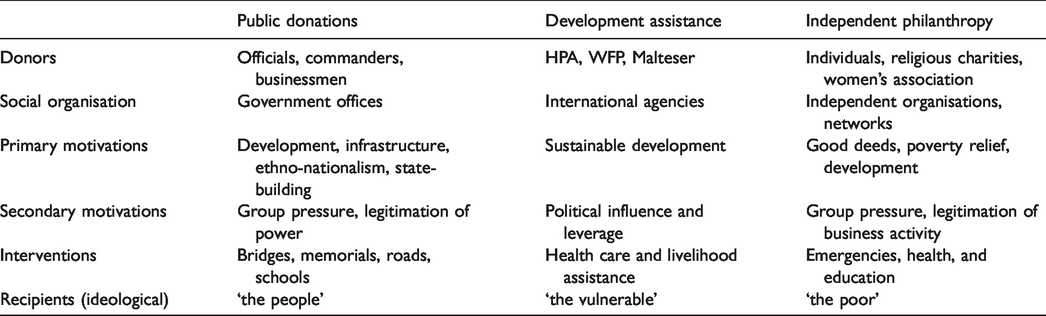
International agencies work on a very different basis. Their primary motivation is to further sustainable development in one of the poorest regions of Southeast Asia. If the Wa elite and their business partners are accused by outsiders of trying to legitimise their rule through giving, international agencies are also suspected of having ulterior motives (in particular by the Wa elite) – foisting a liberal Western human rights agenda and ‘good governance’ on the Wa, as well as gathering intelligence on illicit activities. The justification of care that international agencies use, and the targets of intervention, are specific: sustainable development, as an abstract ideal, justifies particular forms of assistance and development aid that are directed at ‘the vulnerable’. These subjects are not members of a particular ethnic group or a nation, but representatives of an abstract category of identified vulnerability whose existence justifies the presence of the international agencies.
Independent philanthropy in the Wa State, in particular the charitable efforts of individuals, religious charities, and the women’s association, operate within personal networks, with a primary motivation of a personal moral ideal of doing good, influenced by external discourses of philanthropy. Such individuals and organisations are accused of secondary motivations – in particular the legitimation of business activity and smoothing of relationships. ‘The poor’, in the context of independent philanthropy, become primarily a moral category, unlike with the development agencies where they are undifferentiated beneficiaries of a technical intervention. The forms care takes are decided through personal relations and networks, rather than determined by bureaucratic and managerial assessments. In the three different forms of philanthropy, we see three different moral subjectivities produced: all are fundamentally ‘the people’, but whereas in the first ‘our people’ is a referential category, in the third, ‘the people’ operate at a more generalised level. (See Table 1 for a systematic overview of the three different communities of care.)
The three different communities of care that we have described here are not monolithic and independent of each other. As we have pointed out, sometimes they are compared with each other: representatives of development organisations and independent philanthropists to some extent have to adapt to the patronage logics of the Wa elite to operate in the Wa State. Confidentially and in private, the same development workers and philanthropists sometimes criticise the ‘backwardness’ of Wa ‘big men’ networks. Some members of the Wa elite – women in particular – are in fact receptive to such criticism, and in the Wa Women’s Association attempt to create new forms of local philanthropy. Even though this space for change is limited, it is not inconceivable that other actors – such as army commanders or local officials – are also sometimes inspired by a different logic of care, for instance that promoted by the individual philanthropists from China. Ordinary people in the Wa State generally have little awareness or expectation of development aid or philanthropy, yet are audiences that critically assess the efforts of the Wa elite in providing for public infrastructure. People pass judgement on how much particular leaders have given, and if praise is common, it is also often accompanied by the deference to the power of particular individuals, as well as criticism of those who withhold.
By conceptualising philanthropy in terms of care rather than governance in an insurgent space, we open a space for understanding life in areas under non-state armed groups outside of the common registers of ‘rebel governance’, of control, the accrual of legitimacy, and calculated instrumentality. Instead of utilitarian motives, an ethnographic approach to philanthropic acts uncovers the contested logics of care and processes through which moral subjectivities and authority are produced. Interactions and influences between the moral discourses and logics of different actors, shape the ways in which formulations of people and care change over time. Considered interventions that seek to engage meanginfully with rebel authorities and local communities need to start from an understanding of the intersections of moralities, subjectivities, and relations that emerge when local actors care for others.
Footnotes
Declaration of conflicting interests
The author(s) declared no potential conflicts of interest with respect to the research, authorship, and/or publication of this article.
Funding
The author(s) received no financial support for the research, authorship, and/or publication of this article.
