



Abstract
Research on strategic ignorance tends to focus on the deliberate manufacture of non-knowledge as a tool of governance. In contrast, this article highlights the ‘banal’ workings of wilful blindness, how it can become a normalised part of corporate routine. It examines the diverse dynamics of wilful blindness that became visible in the planning and implementation of a mega oil development project in Timor-Leste, including spatial distancing, denial of moral implications, and the production of effervescent moments of collective solidarity. It concludes that affective states are key in the normalisation of wilful blindness, which operates at the unstable boundary between intention and affect. An emphasis on wilful blindness helps us to bridge the gap between political economy approaches that emphasise the disruptive impact of resource abundance, on the one hand, and anthropological approaches that highlight the social logics and ethical evaluations of main actors involved, on the other.
Keywords
Responding to criticisms of a controversial mega oil infrastructure scheme initiated in 2011, employees of Timor-Leste’s national oil company maintained that they were ‘just doing their job’ by implementing a government plan. The so-called Tasi Mane project is a gigantic state-led development scheme that is aimed at building a petroleum infrastructure along Timor-Leste’s south coast, including artificially designed cities and a 160-km-long highway. The project has fuelled a range of criticisms, from it being economically unviable, socially and environmentally damaging, to it compounding the adverse effects of oil dependency. It was remarkable to see that many professionals working in the oil company were aware of these critiques, even agreed with many of them, yet in crucial moments of interaction with residents affected by the infrastructure, they appeared to switch off this awareness and supported the project. 1
How, then, do people manage to detach themselves from uncomfortable knowledge or concerns about the consequences of their actions? How is ignorance created in the self and in others? The topic of non-knowledge has gained increasing attention in recent years, with scholars pointing out that ignorance, not just knowledge, can be a powerful political resource and technique of governance. While this is a crucially important insight, the emphasis on the role of ignorance as a tool for the wielding of political power only captures one dimension of wilful blindness – its most strategic aspect. Less attention has been paid to the ‘banal’ workings of wilful blindness, to how it can become a normalised part of corporate or state governance.
Examining various instantiations of wilful blindness in the history, planning and implementation of the Tasi Mane project in Timor-Leste, this article suggests that in most cases, doubts or concerns were ignored for rather ‘banal’ reasons, not because they were part of an ill-intentioned master-plan. Ignorance emerges not just as ‘strategy’ (see also Stein, 2020, this issue) but also as a form of ‘praxis’ (Anand, 2015: 309). Here I follow Hannah Arendt’s (1994 [1963]) use of the term ‘banal’, describing ordinary and routine actions that are not reflected on even when they can have serious (even horrific) consequences. However, in contrast to Arendt’s description of the cold rationality of bureaucratic processes, I also show that these dynamics are not necessarily detached from emotive states, and thus I seek to draw out the affective dimensions of how wilful blindness can be normalised.
I do this first, by discussing some key approaches in the growing literature on the production of ignorance, pointing out that the over-emphasis on the ‘strategic’ nature of ignorance tends to give the impression of stability, thereby underestimating its internal fragility and the significance of affect in the maintenance of non-knowledge. This is not to deny that wilful blindness in Timor-Leste can be strategic – I will discuss ‘strategic denial’ when analysing the history and geopolitical context of the Tasi Mane project. However, this analysis must be expanded by an examination of less strategic normalisations of wilful blindness – for example through the spatial, emotive and epistemic disconnect between those implementing the project and those affected by it. This will be followed by a consideration of how pragmatic reasoning and affective states are interwoven so as to allow oil company employees – in key moments – to suppress the doubts they have about the infrastructure scheme. An investigation of the various forms of ignorance at play in Timor-Leste’s oil industry, allows me to develop the concept of wilful blindness beyond its strategic use.
Wilful blindness beyond strategy
Apart from philosophy, history of science was one of the first disciplines to take the study of ignorance seriously, and to highlight the connection between non-knowledge and power. As a counterpart to ‘epistemology’, Proctor (2008: 27) coined the term ‘agnotology’ to describe the study of the production of ignorance, focusing primarily on the role of ignorance in the study of science. While agnotology recognises the diverse forms ignorance can take (Proctor, 2008: 4), Proctor’s initial interest in ignorance stems from his analysis of how the tobacco industry deliberately manufactured doubt about the hazards of smoking (Proctor, 2008: 11; see also Kirsch, 2020, this issue). This led to a more broadly conceived examination of how the private sector uses science strategically to manufacture ignorance, for example about climate change.
The study of ignorance has since gained significant attention in sociology and, more recently, anthropology. As we indicated in the introduction to this special issue, two key ideas re-appear in this burgeoning field of study. First, there is the argument about the ‘creative’ powers (Højer, 2015: 575; Pedersen, 2017: 88) or ‘generative effects’ of ignorance (McGoey, 2007: 11). Ignorance is not just a ‘void’ (Proctor, 2008: 2), not the inverse or binary opposite of knowledge, but ‘its ally and twin, amplifying itself indefinitely in tandem with the development of new “truths”’ (Davies and McGoey, 2012: 79, drawing on Nietzsche; see also Chua, 2009; Kirsch and Dilley, 2015: 4; Mair et al., 2012: 16). As Kirsch and Dilley (2015: 4) put it, in order to avoid reifying ignorance as a ‘thing’ or ‘being’, it needs to be understood as ‘more than just a residual category of “knowledge” but something that has palpable effects in the world’. The effects of ignorance can be both negative and positive, or even ‘virtuous’ (Mair et al., 2012: 18; Proctor, 2008: 4).
Rather than seeking to define what exactly constitutes ignorance and related forms of ‘non-knowledge’, McGoey stresses that we should examine the production of ignorance, its political and social effects, and ‘the constant policing of boundaries between the known and the unknown’ (McGoey, 2007: 13; see also Proctor, 2008: 3). I would like to add to this that there is a need to pay attention not just to the ways in which the production of ignorance and knowledge intersect, but also to changing levels of intentionality in relation to ignorance, to the rhythms that allow it to ebb and flow, and to the emotive states that boost, maintain or undermine diverse forms of wilful blindness.
The second key idea that re-appears in the growing agnotology literature is based on an expansion of the Foucauldian analytical perspective that associates knowledge and power. Drawing on, and in contradistinction to Foucault, scholars have emphasised that ignorance can be an equally powerful tool for governance (e.g. Anand, 2015: 309; Graeber, 2015: 55; Kirsch and Dilley, 2015: 23; Mathews, 2005; McGoey, 2007: 1, 8), or a source of ‘symbolic capital’ (Gershon and Raj, 2000: 3), and that studying the production of ignorance can help to formulate a political critique of relations of power (Mair et al., 2012: 13; see also Mathews, 2005). Under the helpful rubric of ‘strategic ignorance’, McGoey and colleagues (McGoey, 2007; see also Davies and McGoey, 2012) expanded the study of non-knowledge in science to the study of how institutions (governments, international organisations or corporations) use ignorance as a strategic tool of governance. When ignorance is highly strategic, it ceases to be ignorance and turns into deceit or denial.
For some scholars (e.g. McGoey, 2007: 11), the social and political usefulness of ignorance and its generative effects go hand in hand. For others, ignorance is a ‘peculiar infrastructure in its own right […] defined as a ground from which both knowledge and lack of knowledge come into being’ (Pedersen, 2017: 91); as such it can be fundamentally ‘non-strategic’ (Pedersen, 2017: 89). Little attention, however, has been paid to the interplay between the strategic and non-strategic productions of ignorance; to how blindness moves from being a strategy to being praxis. 2
Key to understanding how ignorance can be the product of deliberate and wilful action in one instance, and a normalised ‘way of doing things’ in another, is to analyse the ways in which forms of non-knowledge become associated with particular affective states. 3 Among many others, these can include doubt and uncertainty that undermine ignorance, hope and intimacy that promote acquiescence, or anger and indignation that fuel and energise wilful blindness. Hence the next section discusses various forms of wilful ignorance, from strategic denial, the projection of ignorance onto others, to suppressing doubt as normalised routine. These processes will be discussed while paying special attention to the ways in which affect shapes the production, fluctuation and transformation of wilful blindness in Timor-Leste’s burgeoning oil industry.
Strategic denial
Governance of Timor-Leste’s natural resources has involved elements of strategic ignorance. This includes both the oil-profit-driven wilful blindness of the Australian government with regards to human rights abuses carried out during the Indonesian occupation of East Timor (1975–99), and the failure by Timor-Leste’s independent government to acknowledge the uncertainties involved in producing resources onshore. 4
Construction related to the Tasi Mane project began in 2015 and was to be completed by 2020. 5 It was launched in 2011 as part of the government’s Strategic Development Plan (SDP) with the goal of transforming the south coast into ‘the backbone of the Timor-Leste petroleum industry’ (SDP, 2011: 138). Plans for the project include three industrial clusters. In the Suai region, at the western end of the projected highway, the planned scheme stipulates the building of a supply base, including a port and an international airport. In the area of Betano, located on the midpoint of the new highway, plans include an industrial park housing an oil refinery and a petrochemical plant. In Beaço, in the east, plans include an industrial complex for an LNG (Liquefied Natural Gas) plant, and a pipeline for natural gas. Moreover, there were plans for three ‘new cities’ to administer these projects, and a large multi-lane highway connecting the three industrial clusters (SDP, 2011: 139). The Ministry for Petroleum and Mineral Resources is the main force behind the project, and has charged the national oil company Timor Gap with its implementation. This mega-scheme is envisioned to facilitate post-conflict reconstruction, enable economic development, and provide new employment opportunities. It has also been subject to severe criticism from many different angles.
One of the main criticisms of the Tasi Mane project involved serious doubts about the origin and availability of oil and gas deposits to be produced in the scheme. Timor-Leste has a resource-sharing agreement with Australia over several offshore fields, which are however close to depletion (La’o Hamutuk, 2015). Studies are currently being carried out about the viability of onshore resources located along Timor’s south coast, however during Portuguese colonial times these were deemed to be economically unviable (Charlton, 2002: 352). Industry experts told me that it might take years until results from current surveys produce results. The country’s most promising oil and gas reserves, estimated to be worth more than US $40 billion, are located offshore in the Timor Sea and include Sunrise and Troubadour gas and condensate fields, collectively known as ‘Greater Sunrise’. They lie about 450 km north of Australia and 150 km south-east of Timor-Leste and when the Tasi Mane project was initiated, these reserves were subject to a long-running legal dispute with Australia, connected to the question of boundary delimitation (Figure 1).
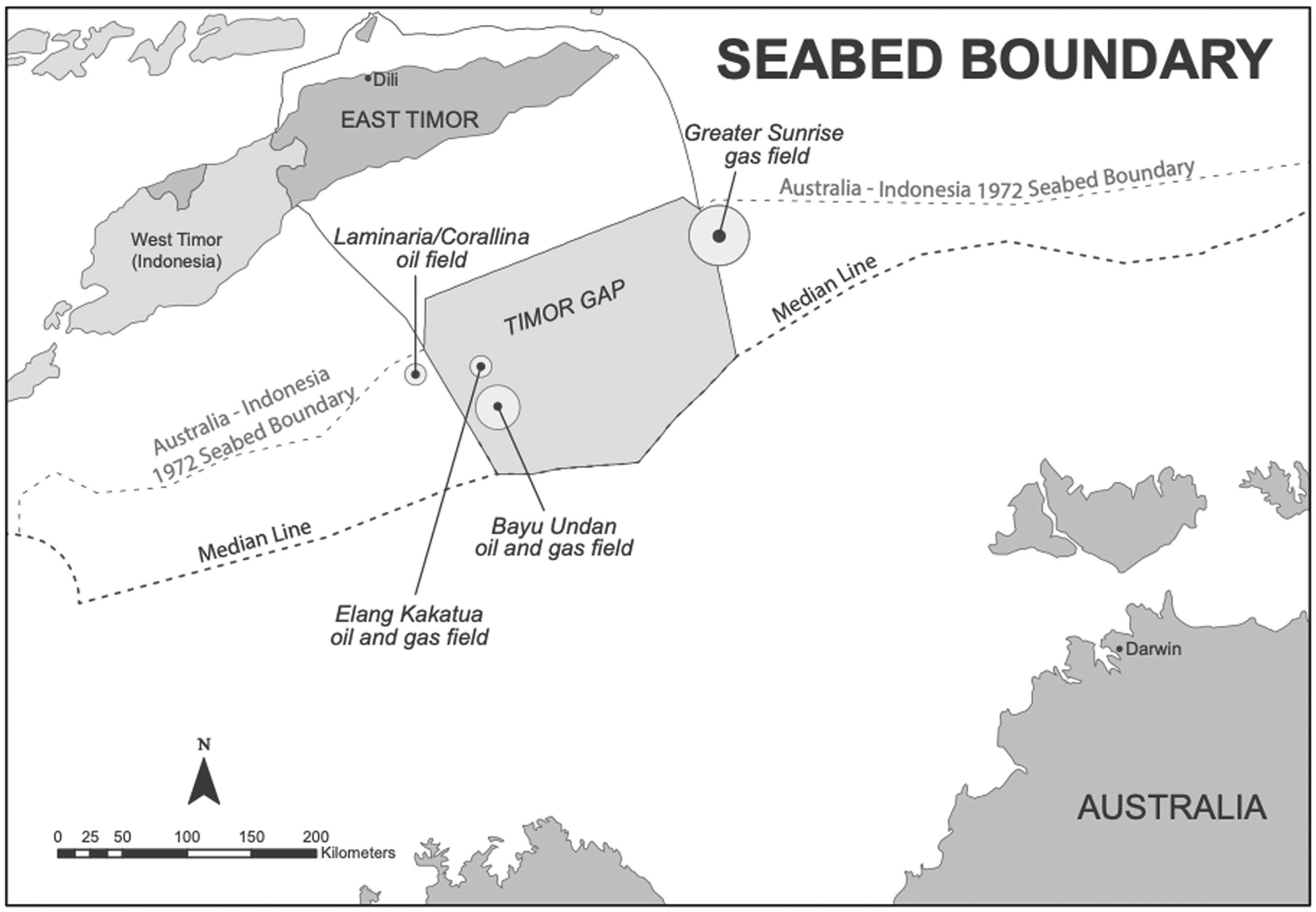
Contested oil and gas in the Timor Sea
In an interview in 2015, a senior employee of Timor Gap was incredulous at the government’s proposal to go ahead with the Tasi Mane project without knowing whether the legal dispute with Australia would be resolved. He argued that: The government is doing things the wrong way around. They should first be doing studies to see whether we have viable resources, then they should be building an oil refinery and LNG plant. […] They are making plans to construct an LNG plant and a pipeline, but Australia might never agree to give up Greater Sunrise.
This supposed blind-spot was both affective and strategic. Strategic because it presented a way of putting pressure on Australia with regard to the southern seabed boundary. Affective because this dispute evoked strong feelings of injustice and indignation among East Timorese politicians and citizens, because of its connection to the Australian government’s wilful blindness towards human rights abuses carried out by the Indonesian military in East Timor. In order to put this into perspective, a brief historical excursion is warranted.
Indonesia launched a full-scale military invasion of the Portuguese Timor in 1975, which lasted 24 years and led to the loss of around one quarter of the East Timorese population and to severe human rights abuses. Woolcott, the Australian ambassador to Jakarta, used the offshore resources as a main reason to plead in favour of East Timor’s ‘integration’ into Indonesia, arguing that it was easier to negotiate with Indonesia than with Portugal about a seabed border (Aditjondro, 1999: 18). In December 1978, Australia’s Foreign Minister Andrew Peacock controversially announced Australia’s de jure recognition of Indonesia’s annexation of East Timor – the only Western country to do so. Recently declassified communications show that the Australian (and US) government ‘deliberately lied about their knowledge of Indonesian annexationist plans in East Timor and secretly assisted the invasion in December 1975 to protect their economic and strategic interests’ (Galway, n.d.: 1).
Of course, not all members of the Australian government were truly ignorant of what was happening in East Timor during the Indonesian invasion, but the moral and political implications of this knowledge was denied. Kim McGrath found an example of this in the archives when examining recently declassified government cables. In 1976, a memo was sent by East Timor’s pro-independence party, Fretilin, to the Australian embassy in The Hague, describing events in East Timor under Indonesian military occupation, including the torture and rape of captured populations. Someone at the embassy had underlined this part and written in the margins, ‘Sounds like fun’ (McGrath, 2017: 102). A later comment read, ‘Sounds like the population must be in raptures.’
In direct contrast to the strategic ignorance of the East Timorese politicians pushing for the implementation of the Tasi Mane project, the scribbling by this Australian official, who treated the subject with offensive humour, suggests an insensitivity and blindness to the plight of the Timorese population. There is no attempt to deny the facts or their conventional interpretation – as Cohen (2001: 7–8) describes in cases of ‘imploratory denial’ – but their psychological, political, or moral implications are denied and minimised. Ignorance was deliberately manufactured as strategic tool for economic profit. There was a clear awareness of the suffering endured, but a refusal to recognise it fully.
In 2018, Timor-Leste – by then an independent country – successfully won the right to set the southern seabed boundary with Australia along the median line, placing the majority of Greater Sunrise in East Timorese sovereign waters. It was a result of a long-standing campaign and legal battle and presented a major success for Timor-Leste. It could have appeased some of the most ardent critics of the Tasi Mane project, yet disagreements erupted about the location for the processing of LNG from Greater Sunrise. Proponents of the project from East Timorese government circles insist on building an onshore LNG plant along Timor-Leste's south coast, while the oil companies with the development rights prefer to process this in an existing LNG plant in Darwin.
The Tasi Mane project must hence be seen as part of a broader governmental strategy to force Australia’s hand in these negotiations. An East Timorese politician whom I interviewed in 2015 stressed that building an oil infrastructure along the south coast was a way of signalling to Australia that Timor-Leste was ready to develop its own oil and gas industry – it was a way of asserting Timor-Leste’s sovereignty. 6 The wilful blindness concerning the viability of the Tasi Mane project was part of a strategy to strengthen Timor-Leste’s bargaining position in negotiations with a more powerful neighbour, but it was also fuelled by a deeply felt sense of injustice.
Epistemic disconnect
Social disconnect facilitates implicatory denial and diminishes empathy, because it involves a particular way of seeing without recognising. As Honneth (2008: 59–60) has pointed out, such ‘forgetfulness of recognition’ can be caused by reifying social practices that prevent individuals from recognising others as subjects. As the following two examples will show, epistemic disconnect can be produced by actual physical or spatial distance, or by a mental distance created through specific techniques of differentiation.
Sitting in a café in Dili, Timor-Leste’s capital city, in May 2015, I became aware of three people at the table beside me talking loudly about the petroleum development project in Suai. The group consisted of two foreigners (a man and a woman) and one Timorese man who were discussing investment ideas in the region. The woman, charismatically directing the conversation, had taken a piece of scrap paper and was jotting down some drawings. ‘Here is the airport’, she said, casually adding another stroke to the piece of paper, ‘and this is the oil rig’, pointing to another section on the paper (presumably at Bayu Undan located offshore to the south of Suai). The group discussed plans to develop the tourist industry, most notably plans for an Australian cruise ship company to stop in Suai, thus oddly combining oil development with tourism in one site. The woman exclaimed somewhat grandly, ‘I want a brewery!’ All of them laughed. ‘We could call it “Timor Beer”’. ‘We can have a restaurant here’, she continued, adding some more casual strokes to the sheet of paper in front of them, ‘with traditional roofs.’ The woman then proceeded to suggest that the three of them fly to Suai by privately hired airplane the next day to have coffee there and then return to the capital city.
Remarkable about this conversation was the ability to disconnect the region entirely from the people living there – revealing a particular way of seeing. In this vision, the south coast quite literally became a white piece of scrap paper that could be populated with ideas and projects – detached from anything already in existence there. This kind of disconnect between local realities and the vision from above is reminiscent of James Scott’s Seeing Like a State (1998). Although Scott does not use the term, his analysis of how governments project their high modernist visions while ignoring local realities, is in many ways an examination of wilful blindness. The corporate and government vision of Timor-Leste’s south coast (and other special economic zones, see Meitzner Yoder, 2015: 317) is based on the exclusion of grassroots knowledge and of the active participation of local residents. As Hannah Appel (2012: 439) reminds us (with regard to oil development in Equatorial Guinea): Marketization is made possible through work to deny the web of sociopolitical relations required for hydrocarbon extraction and production, thus allowing the commodity (and the companies producing it) to appear as if separate from the broader social context within which they operate.
The described conversation suggested not just epistemic disconnect, but – as with the Australian diplomats described earlier – also emotional detachment. However, the level of intentionality appears to be weaker in this case. While ignorance of realities on the ground might be part of a broader corporate strategy, the ignorance is not consciously employed as a geopolitical manoeuvre. The blindness of seeing like a state (corporation or investor) has instead become a naturalised part of the job. The infrastructure and the spatial distance between investors and local residents facilitate this normalised disconnect; a process of disentanglement that leads to the ‘intentional abdication of responsibility’ (Appel, 2012: 442). Such disentanglement was less straightforward for the Timorese professionals who were charged with implementing the Tasi Mane project and were regularly interacting with local residents. Here, a main technique for achieving distance was to produce ignorance, not in themselves, but in those affected by the project.
On a rural stretch of the south coast, on the way to a meeting between the national oil company and ‘affected community’ members (kommunidade affeitadu) in 2015, we were overtaken by an impatient convoy of white SUVs and pick-up trucks with blinking lights and honking horns. The posse from Timor Gap had arrived in Suai the night before, and they were also making their way to the community consultation (sosialisasaun). 7 Upon their arrival, the young urban Timorese professionals of Timor Gap set up a table at the open meeting hall, installed microphones and speakers, a front desk covered with woven cloth, and multiple chairs. Local residents had started to gather under the shade of a gigantic banyan tree that stood impressively beside the meeting hall and were observing the city folks from a safe distance. The local residents with their simple dress stood out sharply against the Timor Gap employees, all dressed in blue jeans, trainers and green or blue polo shirts. 8
The Tasi Mane project was introduced through passionate speeches in Timor-Leste’s national language Tetum, with charismatic Timor Gap employees telling the audience that they were lucky to have the project being implemented in their region. Lengthy presentations followed, providing detailed information about the project, including ‘risks and hazards’. Unlike the ‘one-message’ slide culture Stein (2020, this issue) describes among German management consultants whose aim it was to convince their clients to invest, slides of Timor Gap employees were highly complex, densely written, and contained many foreign loan words; some were entirely in English, a language that only few people understand along the south coast. The complex slides may have been aimed at impressing the audience so that they would accept the project. They also contained high levels of technical detail, as well as a lot of business-speak, such as ‘high skill’ and ‘low skill’, ‘flow diagrams’, ‘evaluations’, ‘pipeline right of way’, or ‘memorandum of understanding’. 9 Throughout the presentations, the highly professional Timor Gap employees were clearly in control of the situation; they established their authority through the use of complex technology, dress and specialist language. However, they made a sustained effort not to do so in a condescending way, as was evident from their tone of voice and their respectful interactions with the audience.
Using complex and inaccessible language was a recurring practice throughout the socialisation events I attended: authority was established by presenting dazzling information about the project, solidifying this effect by using phrases such as ‘regulations, standards, and codes’ or ‘terms of reference’ that uphold an abstract regulatory system. Consultations often lasted several hours and included a number of presentations by highly skilled specialists, who provided technical details about oil and gas extraction in general; and little information about the consequences the project would have for local people.
Unlike the spatial distancing through enclaves and zoning (e.g. Appel, 2012), that easily takes place when oil companies are dominated by expats, the Timor Gap employees I spoke to (all of whom were East Timorese), stressed their closeness to the local population – both in interviews with me and in the ways they greeted and interacted with the affected population. They were pleased that they were consulting with local people, rather than just implementing a project without local interaction. Nevertheless, they also actively created distance and at times fell into a moralising or frustrated tone of voice, especially when faced with questions about compensation payments for land. Many of these foreign-educated employees were proud of their technical knowledge and keen to appear professional. Although I do not think that they produced their presentations in bad faith, the technical details of the slides ended up alienating the audience, and had the effect of obscuring rather than illuminating the reality of the project. As a member of the audience who was affected by the project told me afterwards, ‘Why don’t they talk in a language we understand? I still don’t know what will happen to my land.’ An older woman who had come to one of the presentations told me afterward, ‘We are ignorant (beik); we don’t know/understand.’ Looking at the project from the perspective of those affected by it, yet unable to influence its implementation, the plans looked inscrutable. The meetings left affected communities painfully aware of their exclusion from the kind of education that would allow them to understand the project; the ‘socialisation’ events produced a feeling of ignorance in people. The consultation made people aware of their ignorance with regard to the technical detail of the project – and this awareness, and possibly related feeling of inadequacy, may have discouraged them from raising valid concerns.
Ignorance was thus wilfully (though not strategically) produced in affected residents in order to advance the implementation of the project, while maintaining the impression that locals were consulted. The Timor Gap employees gained authority via the mobilisation of a stereotypical binary distinction between ‘modern’, ‘educated’ city dwellers and ‘backward’, ‘uneducated’ rural people – a dichotomy that is common across Southeast Asia. However, being ‘ignorant’ (beik, which also means ‘uneducated’ or ‘stupid’) is also associated with the sacred/ritual powers of the ancestors. In contrast to outsiders associated with worldly affairs, ritual authorities were often ‘represented as “stupid and ignorant” (beik nor bodu), fixed in place and committed to a constant vigil over rock and tree’, yet during the national struggle for independence, ‘stupidity has come to signify a mode of popular political participation in the nation’ (Traube, 2017: 51; see also Chua, 2009). Hence local residents’ self-identification with ignorance might also be read as a critical commentary on the devaluation of their knowledge.
Pointing out how ignorance is often invoked as a mark of ‘moral failure’ of populations, Piers Vitebsky (1993: 101, 104) stresses that ignorance is unstable because it is attributed to persons ‘in the context of their relations to other persons’. As the Tasi Mane community consultations show, it is easier to maintain one’s own blind spots if one’s interlocutors are defined as ignorant. The stability of wilful blindness thus depends in part on the (in)stability of the fields of power within which it operates. The production of ignorance as a category of ‘moral failure’ can also be used to reinforce existing inequalities.
Pragmatic and affective blindness
In July 2015, Timor Gap, Timor-Leste’s national oil company, set up a meeting in Betano in order to share information about the plans to build an oil refinery there. A marquee had been constructed next to a house in the hamlet of Selihassan, several metres away from the sea. It was a dry, hot day, and small waves were splashing gently against the shores. Many people were attending and not everyone could find a place under the marquee, so some attendees found shade under the palm trees that were covering the shoreline. A Timor Gap employee started his speech about the oil refinery by invoking a powerful visual image of the overwhelming beauty of the night sky. He told the audience that he had slept in the highlands the night before. In the evening, he had looked up into the sky and saw it alight with hundreds of stars. On a large screen, he projected a photograph of a glittering oil refinery full of lights, continuing, ‘When the oil refinery is built here, I will not just look up and see stars – I will also look down to the sea, and I will see this place will be lit up like the stars in the sky’. What followed was a passionate speech telling the audience about the development the refinery would bring. Metaphors of light and darkness were frequently evoked to signify progress and modernity.
The day before, I had interviewed employees of Timor Gap – including the man who had invoked images of the night skies in Betano. During the interview, it was explained that a pipeline would accompany the highway from Suai to Betano. Oil would be brought by boat to Suai and then pumped to Betano, where it would be refined; subsequently, it would be brought back by pipe to Suai, where it would be exported. ‘If the oil refinery is to be built in Betano, why not bring crude oil directly by boat to Betano?’ I asked, remembering some of the concerns and fears local residents had about the idea of a highway and pipeline going through their fields and settlements. One of the men responded (in English), ‘Precisely. I had the same question … but we are just implementing the plans that the government has made. You have to ask the government this question; we can’t tell you why.… I am just doing my job.’ Another employee added, ‘It’s a political decision. We are just here to set the terms of reference.’
In other interviews with well-educated and highly skilled professionals working in Timor-Leste’s oil and gas industry, this pattern re-emerged. Employees would identify problems with the Tasi Mane project themselves, and several of the people I spoke to did reflect critically on what they were doing; they were worried about some aspects of their work, they were keen to distinguish between the land acquisitions for the project and land grabs during the Indonesian occupation, and they really wanted the project to benefit local people. Timor Gap employees I interviewed were thoughtful, empathetically identified with local residents and were concerned with their wellbeing. They critically reflected on and expressed doubt about the benefits of the Tasi Mane project. Yet when it came to moving the project along, many of them side-lined this doubt. Swept up in the hopeful enthusiasm of the speeches during socialisations, they were able to push critical reflections aside. One might say that some of these employees were in a ‘divided state’ (Tuckett, 2011: 62), where ambivalent or conflicting thoughts can reside in the mind, without having to be realised or activated in crucial moments. It is also possible that the process of side-lining doubt itself ended up strengthening their conviction and dedication to the cause of development (cf. Pelkmans, 2013: 27). There are rhythms to wilful blindness, and the people I spoke with moved in and out of wilful blindness with varying degrees of intentionality.
As mentioned earlier, a key concern raised by Timor Gap employees with regard to the Tasi Mane project related to the source of oil and gas due to the uncertainty of onshore viability and legal uncertainty regarding the offshore sources at the time the project was initiated. One high-level professional involved in the consultation for the refinery in Betano told me that he had no idea where the crude oil for the refinery would come from. He added: ‘I ask myself where the oil is going to come from. But we are just here to implement the government’s plans.’ ‘The government’ became a kind of disembodied entity – a higher authority to whom ultimate responsibility for the success of the project could be attributed.
This issue also arose during the consultation in Betano, when a non-governmental organisation (NGO) worker critically asked: ‘Recent studies indicate that Bayu Undan is nearly depleted. Why are you building a refinery here if we are running out of oil?’ 10 In response to this question, a high-level Timor Gap employee gave a passionate speech about how it was the company’s national duty to develop the nation. The rumours that Timor-Leste was running out of oil were lies that ‘foreigners were spreading’. The employee added, ‘People who say we don’t have enough oil do not want us to develop.’ The atmosphere in the room was tense, and people seemed to listen with strained enthusiasm to the way this speaker connected the oil refinery to Timor-Leste’s struggle for independence. References were made to the fact that Australia had been spying on the East Timorese government during the oil negotiations in 2005. People were asked to give up their land as a nationalist sacrifice (see also Bovensiepen, 2018). Even if only temporarily, these arguments seemed to erase the doubts and concerns of the audience and speakers alike. 11
One way in which petroleum professionals side-lined their doubts about the Tasi Mane project was to refer to somewhat formulaic phrases like ‘doing their job’ and attributing ultimate authority over the project to the government. Another strategy to produce ignorance, eliminate doubts, and avoid scrutiny of the project was to appropriate legitimate critiques of Australia’s foreign policies and turn this critique towards those sceptical of the project in their own country.
In speeches and interactions with the local population, critics of the project, including NGOs, were accused of collaborating with foreign powers to prevent progress, modernity and development in the country. In these cases, blindness was produced not by coldly following administrative routines, but through passionate speeches and the excitement and euphoria that these group events were able to generate. There is a ‘pulsating quality’ (Pelkmans, 2017: 122) to wilful blindness, which can be energised through effervescent moments of collective sociality or through confrontation with a common enemy. The pragmatic ignorance of ‘doing one’s job’ received occasional boosts through moments of affective collective solidarity.
Conclusion: on the affective banality of wilful blindness
This article has shown that the production of ignorance depends on the level of affective and epistemic disconnect and the degree of wilfulness involved. The most stable form of wilful blindness described in this article involved Australia’s foreign policy position, combining a high degree of strategic wilfulness with a high level of disconnect or ‘blindness’. This contemptuous ‘ignorance’ ironically signalled having knowledge, knowledge that was being denied for strategic purposes. When wilfulness was less strategic, we also found wilful blindness to be less stable. This was particularly clear among Timor Gap employees, who side-lined their concerns when interacting with local communities, yet in other situations reflected with concern about the feasibility and effect of the project. These less stable forms of wilful ignorance required energising boosts to be sustained; boosts that were provided during euphoric speeches by national or corporate leaders, and through the sense of unity created by identifying a common enemy such as Australia. Finally, when ignorance and passivity was produced in others, wilful blindness took on a dual character. During the so-called socialisation events, the Timor Gap employees were able to control the situation and establish their expert authority, giving presentations that produced a sense of ignorance in the very people they set out to inform. Implementing the Tasi Mane project required oil company employees to be blind to the effects of their actions while simultaneously blinding local residents to the full details of the plans they were set to implement.
Hence, this article has identified three different forms of wilful blindness. The first refers to a process of detachment by which aspects of reality become or remain ‘invisible’; the second refers to producing ignorance in others as a means of obfuscation; and the third refers to a side-lining or marginalisation of uncomfortable knowledge through a process of reasoning, routines and collective solidarity. Much of the literature on strategic ignorance focuses on the first kind, and less attention has so far been paid to the dynamics of the second and third types. By broadening our scope and paying attention to these other forms of wilful blindness, this article has illuminated the dynamics of ignorance that are not part of a strategic master-plan, but become part of the naturalised or ‘banal’ ways of following bureaucratic procedures. The selective application of recognition and the oscillation between epistemic and emotive entanglement and disconnect, illustrates that there is no sharp dichotomy, but a dynamic interaction between strategic and non-strategic forms of wilful blindness.
Although the literature on strategic ignorance emphasises the dynamic relationship between knowledge and ignorance, it does not pay much attention to the factors that animate such dynamism, nor is there much reflection on the more ambivalent and unstable forms of ignorance. By looking at the fluctuations of intention and ignorance, we get a more nuanced picture of the oil industry and the kind of dynamics that underlie the manufacture and maintenance of wilful blindness. Hence, the process via which wilful blindness becomes institutionalised (its ‘banality’) is not necessarily characterised by an absence of emotion but can be enabled by affective states, such as ascribing responsibility to higher powers, identifying a common enemy, or wrestling with, overcoming or side-lining doubt.
The gradually growing interest in studying resource elites produces a conundrum of whether to describe experts’ deliberations (or lack of deliberation) about the context and consequences of their industry as ethical, deceitful, or simply pragmatic. The concept of wilful blindness is helpful here because it allows us to move beyond a mere focus on people’s own rationalisations and pay critical attention to the political and economic entanglements of wilful ignorance within the geopolitical contexts in which it emerges. Elucidating how ignorance is produced and policed helps us to bridge the gap between political economy approaches that emphasise the disruptive impact on resource abundance (e.g. Karl, 1997) on the one hand, and anthropological approaches that highlight the social logics and ethical evaluations of main actors involved (e.g. Smith and High, 2017) on the other.
Hannah Arendt used the term ‘the banality of evil’ not to describe Eichmann’s actions or the ideology underlying them, but ‘a specific quality of mind’ (Villa, 2000: 74, italics in original). This quality of mind was ‘thoughtlessness’ (Gedankenlosigkeit) and a certain ‘remoteness from reality’ (Villa, 2000: 75) rather than depravity or wickedness of character. A crucial insight here is that the absence of thought can itself be harmful (or even evil). Thoughtlessness, it strikes me, is not the absence of thought, but a shift of vision whereby the focus on bureaucratic procedures entails the side-lining of reflections on the human cost and consequence. As the examples in this article have shown, the ‘pragmatism’ of resource elites presents a form of thoughtlessness.
The focus on ‘doing one’s job’, following procedure, or stressing the limitations of one’s own ability to act tended to lead to an ignorance of the social and political consequences of extraction. Kirsch (2020, this issue) similarly describes how the focus on ‘scientific objectivity’ by an environmental sociologist made him blind to the social and political consequences of his research as a consultant for Exxon. Rajak (2020, this issue) highlights how ‘techno-optimism’ allows extractive companies to rebrand themselves as proponents of sustainability without changing their business model. The solidarity produced by appeals to the resistance struggle against Indonesia, the identification of a common enemy and pragmatic rationalistions allowed East Timorese extractive elites to side-line their doubts about the viability of the Tasi Mane project. The oscillation between a work routine and more emotionally charged collective gatherings can foster wilful blindness and may lead to its institutionalisation. All these examples show that thoughtlessness is not – as Hannah Arendt seems to imply – a stable state of mind; instead it needs to be actively, and at times affectively, achieved.
Footnotes
Acknowledgements
I presented this article at a conference on ‘Energy Ethics’ organised by Mette High and Jessica Smith in 2016, and at the symposium ‘Ethnographic Approaches to Wilful Blindness’ that took place in 2018 and would like to thank all participants for their feedback. Thanks also to Jon Mair, Mathijs Pelkmans, Laura Meitzner Yoder, Liana Chua and Hans Steinmüller for their constructive criticism, and to the research participants for sharing their time.
Declaration of conf licting interests
The author(s) declared no potential conflicts of interest with respect to the research, authorship, and/or publication of this article.
Funding
The author(s) disclosed receipt of the following financial support for the research, authorship, and/or publication of this article: The research on which this article is based was funded by the Economic and Social Research Council of the UK (grant number: ES/L010232/1).
