




Abstract
Background:
Social participation activities, an important area of occupation, have been effective in reducing social isolation and loneliness. However, most attendees are women, warranting the need to explore older men’s social participation needs.
Methods:
Qualitative methods, including interviews and a collaborative workshop, were used to explore the research aim. Public involvement included establishing partnerships with six staff from four community organisations and twelve older men. The project was informed by a steering committee. The steering group offered insight into all aspects of the research except analysis, which was performed thematically.
Findings:
Intergenerational engagements and the appropriate environment to establish connections with their communities were highlighted as beneficial to men. However, there is a lack of appropriate local spaces to connect communities through social participation. This suggests the need for occupational therapists to diversify their roles, moving beyond the individual and into community development.
Conclusions:
Occupational therapists’ unique and varied skill set, including the understanding of the profound impact of the environment on occupational engagement and, thus, well-being would offer valuable contributions to community development roles, including the built environment to ensure all communities have places for connection where individuals of all ages can thrive.
Keywords
Introduction
The profession of occupational therapy believes activity and occupational engagement are instruments of health and well-being (Wilcock, 2015). This includes social participation, chosen social occupations shown to positively impact physical and mental health with evidence of reduced mortality risk, and subjective indicators such as improved quality of life (Leone and Hessle, 2016). Evidence also suggests that group social participations are most effective in reducing social isolation and loneliness (SIL) in older men (Milligan et al., 2015). However, there are criticisms that the landscape of community offerings are feminised with suggestions that most group attendees are female requiring consideration to gender-specific interventions and how best to engage men, thus promoting social inclusion (Collins, 2018; Devine et al., 2017).
Social participation is an occupation, which involves connections and interactions with other individuals and the wider community, thus requiring appropriate community spaces to foster engagement (Lewis and Lemieux, 2021). The reciprocal interactions which occur during social participation allow the opportunity for creating connections through occupations, which has been shown to support self-worth in older men thus reducing feelings of SIL (Ratcliffe et al., 2023). This complex network of transactional relationships situated in the environment emphasises the important nature of the characteristics, abilities, values, needs and cultural components of individuals and communities through occupation, which shares similarities with an asset-based-approach (Foot, 2012; Wildman et al., 2018).
An asset-based approach attempts to create a balance between meeting needs and nurturing strengths and resources of the communities and the people who live in those communities. Asset-based approaches are gaining recognition as an ideal method for addressing public health challenges by improving the well-being and health of populations by harnessing and building upon the unique capacities of personal and community resources (Foot, 2012). Occupational therapists’ unique and varied skills are well suited to enhancing an asset-based approach through analysing and utilising the strengths of an individual, the environment and community where people live and function (Royal College of Occupational Therapists, 2021).
The environment
The concept of ‘therapeutic landscapes’ explores the contribution of the environment, the ‘healing sense of place’, and the importance of understanding the physical and social health-promoting qualities and subjective experiences and interpretations of a space (Bell et al., 2018). Thus, therapeutic landscapes, or enabling spaces, imply that a structure can provide intention, motivation, felt value, belonging, purpose, engagement, social capital and enhanced well-being.
The importance of therapeutic landscapes and the profound symbiotic relationship between person, place, and occupational engagement is at the core of occupational therapy’s values with all practice models emphasising this integral nature of occupational engagement. In particular, the Canadian Model of Occupational Performance and Engagement (Townsend and Polatajko, 2007) includes institutional, environmental and cultural factors as necessary considerations which influence health outcomes and contribute to identity, well-being, and meaningful interactions.
The experiences of built and natural landscapes alter as people age, and therefore, developing communities which meet the needs of all generations is a significant priority. Social policy should urge localities to create substructures which encourage and facilitate the interaction of older people with their communities (Phillipson, 2015). Gilroy (2008) posits that because older people are often situated within their environments, the interplay between self and place is heightened. Therefore, the two sectors of ageing and planning should increase collaborations to ensure the constructed environments where people of all ages live are places to participate and flourish (Firestone et al., 2018; Gilroy, 2008; Lauckner et al., 2019; ). Additionally, quality of life research suggests older people are best supported by enriched places which allow for interactions and shared experiences across generations, advocating for a redirection in public policy and urban design which promotes the intergenerational nature of human interaction (Biggs and Carr, 2015). An intergenerational policy shift suggests that age-friendliness is inherently friendly for all as it promotes the psycho-social and physical well-being of community members throughout their life cycle (Scharlach, 2009).
Ageing discourses
As mentioned, occupational therapists’ believe in the value of occupational engagement as catalysts of health and well-being with the appreciation of the natural alterations which occur throughout the life course and the allowances/adaptations this necessitates (Wilcock, 2015). This is in opposition to some of the dominant theories on ageing. For example, the disengagement theory of ageing which suggests that ageing is an inevitable, shared withdrawal between the ageing person and their community (Cummings and Henry, 1961). Disengagement theory proposes that older people should simply relinquish their occupations and remove themselves from their communities rather than viewing this life-stage as an opportunity for growth and development. In contrast, Havighurst’s (1961) and Rowe and Kahn (1997) propose that older people should remain active, maintain social ties, and embrace productive roles in society. Rowe and Kahn’s (1997) theory of successful ageing (SA) outlines three components to age well: high cognitive and functional capacity with low probability of disease, which may not be realistic.
Although disengagement theory has been largely discounted and SA has faced criticism, it has remained the dominant conceptual framework of ageing studies for some time (Liang and Luo, 2012; Oró-Piqueras and Falcus, 2018). While these theories may offer some value, they also shape cultural perspectives and may have unintentionally promoted negative views of ageing, which have permeated attitudes, social perceptions, and self-perceptions through the media, marketing industry, and social constructs which often portray older people as being ‘helpless’ and ‘unhealthy’ (Flores-Sandoval and Kinsella, 2020). The recent emerging theory of harmonious ageing posits a collective approach of complementary coexistence of body and mind, activity and disengagement, family and social relations, and the appreciation of the uniqueness of ageing, which offers both challenges and opportunities for the individual and society (Liang and Luo, 2012). This theory resonates with the profession of occupational therapy by appreciating the dynamic nature of ageing whilst also supporting the understanding of the value of engaging in occupations and social participation activities.
In summary, social participation activities have been shown effective in reducing SIL, especially when utilising an asset-based approach. As occupational therapists work across a range of health and social care services, they are uniquely placed to tackle the complex dilemma of SIL, thought to be a particular challenge for older men and serve as valuable contributors in community development roles. For example, working with populations (as well as individuals) to improve facilities, build community connections and improve health outcomes. Therefore, the aim of this article is to illuminate good practice for combating SIL (drawing on the findings of a broader study with older men) while highlighting the need to diversify occupational therapists’ roles. This can be done by moving away from purely individual interventions into community development roles and serving as a bridge between the two sectors of ageing and planning to improve community occupational engagement, intergenerational opportunities and the creation of therapeutic landscapes.
Methods
This is a qualitative study using multi-methods conducted under the lens of an interpretive/constructionist paradigm as part of a wider research project aiming to understand older men’s occupational engagement to combat SIL. Valuing public involvement, a steering group guided the project, and partnerships were created with older men and community organisations exploring the research aim in three phases: foundations, conversations, and collaboration. Cumulative understanding came from this layered approach, and co-production methods allowed for enhanced credibility and transferability. To the author’s knowledge there is a paucity of studies which include both participants of social activities and the providers.
Scoping available community social participation activities and creating partnerships in phase one laid the foundation for conversations which involved interviews with twelve older men and six staff members across four organisations in phase two. A collective workshop was the third collaboration phase (including staff and older men) led by a facilitator with links to a partner organisation. This occurred a year after initial interviews, led by the findings from phase two and based on ideation methods where participants co-produced their ideal ‘place’ for occupational engagement. This allowed for a human-centred approach aligning with an asset-based-approach which enhances public health interventions (Foot, 2012). Recruitment was purposeful and used snowball sampling. Inclusion criteria for older male participants were broad to ensure inclusivity. Specifically, to be a male over 65 years of age, residing in the Tyne and Wear locality. Although an ethnically diverse sample was desired, all participants considered themselves to be white British. Participant characteristics can be viewed in Tables 1 and 2.
Older men participants.
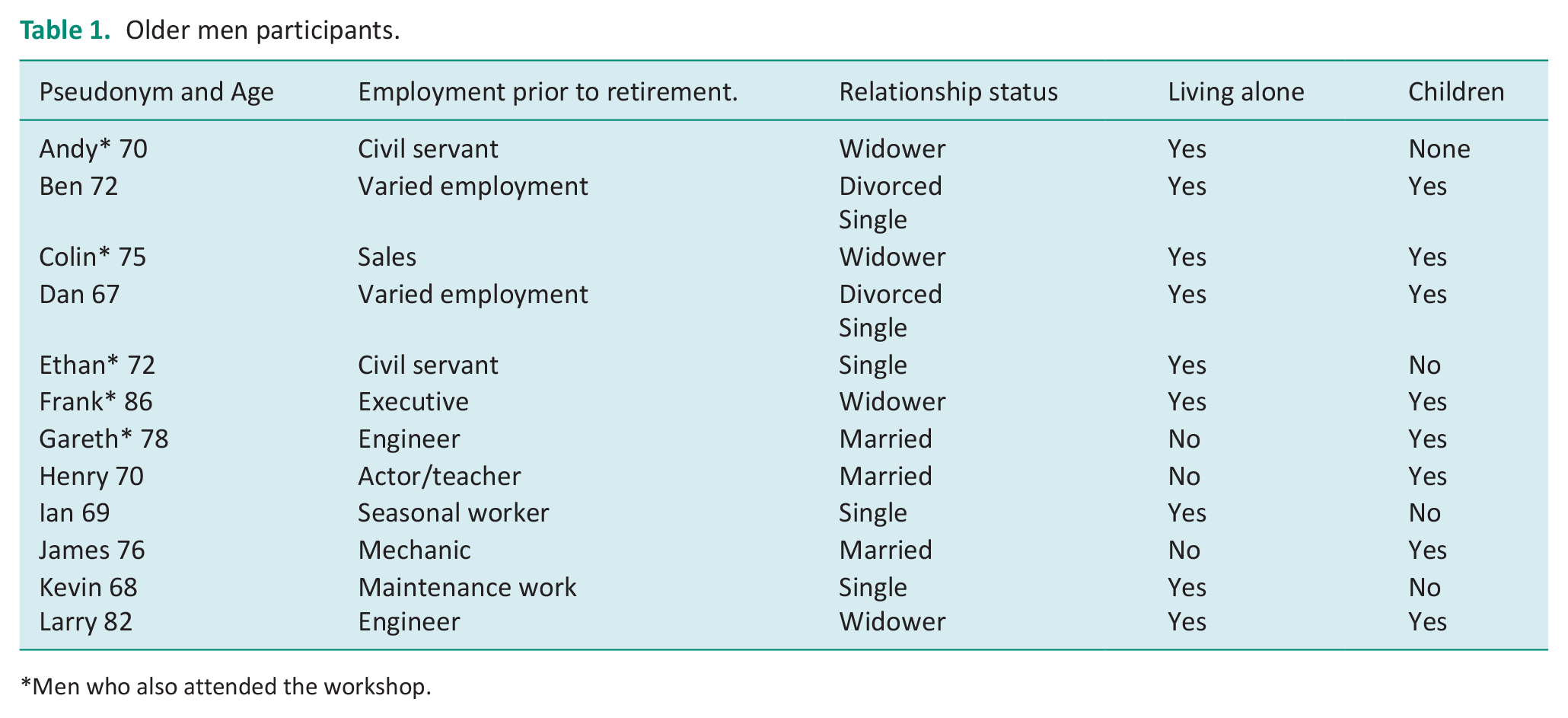
Men who also attended the workshop.
Organisational participants.
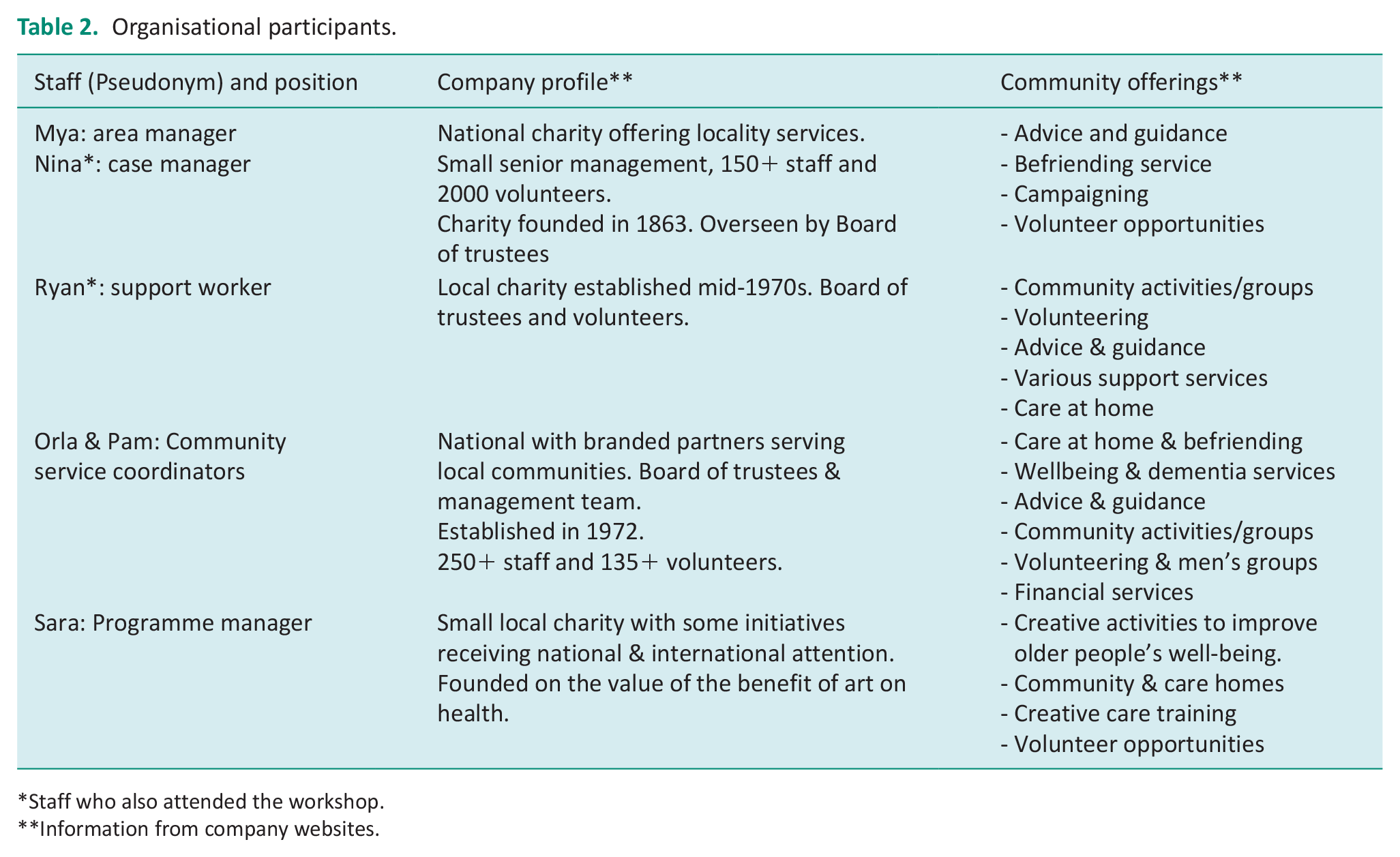
Staff who also attended the workshop.
Information from company websites.
Ethical approval was granted through Northumbria University’s ethics committee in the Health and Life Science department. Given the participatory nature of the research, ethical principles for community-engaged research projects, as articulated in the Belmont Report, were followed (Bromley et al., 2015). To ensure public and patient involvement, a steering group comprised of three men (service users, organisation director and project lead) guided the project throughout its duration. This included (but was not limited to) offering male perspectives, shaping interview questions and planning/implementing the workshop.
Given this research was conducted during COVID-19 restrictions all research activities (interviews and the collaborative workshop) took place through Zoom Communications or on the telephone. The first author (a qualified occupational therapist) conducted all interviews, which were mostly individual; however, two dyadic interviews took place with staff for the purpose of time efficiency. Interviews lasted an average of one hour and were audio recorded and transcribed verbatim. Analysis was inductive and iterative and used a thematic framework including familiarisation (reading and re-reading the transcripts), generating initial codes (identifying and assigning nodes using NVIVO software), constructing themes (grouping codes/nodes), with all authors reviewing and refining final themes (Nowell et al., 2017).
Findings
Three overarching themes were identified in the findings from the interviews with older men and community organisation staff, as well as the collaborative workshop. These three themes comprised: Connections, Creating community, and Therapeutic landscapes.
Connections
This theme highlights the sense of community, belonging, mutual support, and the places where connections are fostered and reciprocated as valued by the twelve older men during their interviews. The profound influence of place was discussed by all of the men. For example:
“the environment around you where you live, what you see etc. has a big impact” (Ian).
There was expressed nostalgia for feelings of connection with neighbours:
“There used to be more of a community spirit, and you knew everybody up and down the street” (James).
Some of the men described how their neighbourhoods have decreased prospects for connection simply because people do not seem to establish roots anymore.
“It’s quite a transient community. Just a couple doors down I noticed a removal van appeared and then the next day another, and a new family had moved in, and you see quite a lot of for sale signs” (Gareth).
Three of the men explained that the closing of small, housing estate-specific community centres (local neighbourhood spaces) exacerbates the decline in opportunities to engage and participate in shared occupations with members of their communities. For example:
“We had a club on the estate, you know a residents club. I was on the committee, and we had a thriving group. Um, when did it close, must have been about 5 years ago. A real shame. I miss that” (Larry).
This illuminates how neighbourhood design serves as either an enabler or barrier to engagement. The men emphasised the difficulty in finding places suitable to create connection with a seeming lack of available spaces for social participation activities:
“I was concerned that there are not enough venues for people just to go along and meet. Used to be a centre where I live and that closed down” (James).
Staff highlighted the inequitable distribution of community venues across localities and lack of inviting places which complicate delivering social occupations at a local level:
“Certain parts of the borough are difficult, more difficult to access, with less facilities” (Pam). “It’s to do with the ambience of the place, isn’t it, you know you’re inviting people around for a social group and some rooms are very bleak and you know, unattractive, where you want somewhere where people can come and sit comfortably” (Orla).
When male participants were asked what social participation offerings they would be interested in attending and if age or gender mattered, nearly all the men (11 out of 12) expressed the value in occupational engagements with a wide age range. Several men discussed their desires for intergenerational activities and missing the company of younger people but felt there was a lack of opportunities or places for engagement:
“Oh yeah, yeah, yeah, I miss that (intergenerational engagement) hugely, absolutely” (Ben). “Yeah, a mixed age range, I get stimulated by young people. But they (intergenerational groups) don’t exist” (Colin).
However, several men are currently enjoying intergenerational activities and stated:
“I’m with the children so I’m seeing things all the time like new. I try to get on their level as well. I mix in quite easy with children, I’m just a big child me self (laughing)”, (Henry) “More, natural, more fun, less stereotyping” (Ian).
The concept of connection for the men seems to be situated within the environment. Place serves as an enabler to their occupational engagement, whether this was their immediate neighbourhood or spaces where groups were held, it seemed to be the deeper connection to their community, which is valuable. Without appropriate spaces for group activities, the men appeared disconnected, especially to the range of ages and generations of their fellow residents. There seemed to be a consensus that declining community cohesion and feelings of disconnection are manifesting due to the lack of appropriate environments where individuals could come together in shared occupations and social participation.
Creating community
Through the interviews with six staff, discussions indicated that through place men can be drawn into an activity in a way which bypasses their potential perceived notions or barriers about what they think they will or will not enjoy. Ryan stated: ‘it’s getting that road in to go on their own for the first time’. That road in is through place:
“Men were far more likely to get involved if they could come and see what was happening” (Sara).
Creating appropriate therapeutic landscapes is critical to engagement, Sara explained: ‘to be able to offer the visual distraction from the normal and the everyday’. Yet staff lack control over the environment, with most activities held in community venues, which are often not owned or operated by the organisations and not always considered ‘local’ to men, which highlights the variable perception of ‘local’. For example:
“Some people will only travel within a certain area they want to go to things that are within walking distance. Most people want to be where they live, which makes sense” (Orla).
Communities encompass all ages, and it was positive that staff view intergenerational occupations positively:
“One of my favourite ever sessions, was running a walking football session, during half term and there were these youngsters on half term holidays. ‘Mister can we join in’, and it was brilliant, you know. The children must have been about 8 or 9, and it was just a really good match. They loved it! That’s the joy of the job sometimes” (Ryan).
However, only one of the organisations is running intergenerational activities which are well attended and successful:
“older people are just children, who got older. They’ve got all that knowledge and children are naturally curious and love listening to stories. It’s a match made in heaven. Why would you not want to do it?” (Sarah).
The staff working to engage older men highlight place as crucial to engagement. However, there is a lack of adequate and available community spaces which serve as an ‘in-road’ to engagement and that are considered ‘local’ to communities which would allow for intergenerational offerings.
Therapeutic landscapes
All participants (the older men and community organisation staff) cited place as a vital component for their social participation with a mutual, multifaceted understanding that encompasses both psycho-social and physical dimensions of the environment, thus a therapeutic landscape. This was further explored at the workshop with place being seen as an architect of purposeful activity, which should be inclusive and intergenerational. Additionally, the concept of ‘local’ was explored. Perceptions of ‘local’ are individualised, with some men viewing community spaces which are just a couple of miles away as not in their community.
“I used to walk just walk around the corner to the community centre. I tend to not like travelling” (Larry).
There was agreement that housing estate-specific community centres are important places for creating a cohesive community. For example:
“to emphasise, we used to live on (estate name) and that was built in the 1950s/1960s and the developer put a community building there, but the estate we live on now, that was built in the 1980s, late 70s, there’s nothing here at all” (murmurs of agreement as spoken during the workshop) (Gareth).
The workshop further enhanced findings of how critical place is as an enabler for engagement. The varying concepts of ‘local’ emerged, which highlighted the importance of people’s constructed worlds for connections. For example, some of the men viewed ‘local’ as directly on their estate (neighbourhood), whereas others view ‘local’ as the wider locality where they lived.
Discussion
Occupational therapists are skilled at analysing activity and understanding how engaging in meaningful occupation (social participation) serves as a catalyst for health and well-being with the environment as a key enabler. This research has illuminated the benefits of social occupations for reducing SIL and the valuable contributions occupational therapists could play in community development. Occupational therapists work across a range of health and social care services, and their diverse skill sets are uniquely placed to tackle the complex problem of SIL (Collins et al., 2020), enhance community connections and ensure therapeutic landscapes are plentiful.
The importance of place for engagement was discussed by all participants of the project (men and staff) with the older men expressing their desire for community spaces which are inclusive, intergenerational and defined by individual perceptions of ‘local’. All of the male participants lived in housing estates, that is, urban neighbourhoods on the outskirts of a city. The importance of housing estate-specific community buildings was highlighted as significant social places for residents, especially older people, to cultivate a sense of connection and community.
The decline in feelings of community cohesion is detrimental to occupational engagement because neighbourhoods are important social places for positive ageing and should cultivate a sense of belonging and connection, thus reducing SIL. Gale et al. (2011) suggest that people with perceptions of social support in their neighbourhood reported higher levels of well-being. This social support should adopt an intergenerational policy shift with suggestions that age-friendliness is inherently friendly for all as it promotes the psycho-social and physical well-being of community members throughout their life cycle (Scharlach, 2009). This reflects the desires of the older men partnered with this project and suggests developing spaces that meet all generation’s interests is an important goal for social and economic policy (Gilroy, 2008; Phillipson, 2015). Occupational therapists should serve as consultants within this policy shift, given their range of expertise and skills surrounding appropriate functional environments and the intergenerational nature of working in health and social care positions.
The seeming lack of community connection which the male participants articulated experiencing may be the result of dominant socio-cultural theories of ageing, (disengagement theory, SA), which although may offer some value also shape cultural perspectives and may unintentionally promote negative views of the ageing process, thus casting a shadow across society in the form of ageism (Flores-Sandoval and Kinsella, 2020). More importantly, none of the frameworks resonate with the values and aspirations of the men partnered with this research. Rather, the male participants’ experiences share similarities with the model of harmonious ageing (Liang and Luo, 2012) which emphasises the collective opportunities for the individual and society. For example, the older men and organisation staff in this study expressed a need for further inclusive intergenerational activities embedded in the community. The authors suggest that a shift away from these binary discourses towards adopting the model of harmonious ageing (Liang and Luo, 2012) is necessary to alter society’s view of ageing, thus impacting an older person’s sense of belonging. This attitudinal shift should come from systemic structures within which health practitioners, academics and educators are situated, consequently exhibiting influence over perceptions both individually and at community level (Flores-Sandoval and Kinsella, 2020). The findings of this study demonstrate the importance of connections, creating community and therapeutic landscapes. Given occupational therapists consider the person, occupation and environment and are equipped with unique skills, they may be valuable contributors to promoting an alteration of ageist perceptions, enhancing intergenerational connections and developing more cohesive community practice (Galvaan and Peters, 2017; Hyett et al., 2016; Lauckner et al., 2019; Wilcock, 2015).
The information from all participants involved with this project indicates that the main facilitator for social participation is through community spaces which offer stimulating activities and allow for role renewal while building reciprocal relationships. Social participation and cohesive communities are known to be sustainable responses to SIL through focusing on community development (Devine et al., 2017). Indeed, occupational therapists can offer these stimulating activities and understand the value of occupations serving as a conduit to foster connectedness to the broader community while affirming the worth of the individual (Hammell, 2014; Lauckner et al., 2019). Therefore, occupational therapists should be supported to further develop their skills and knowledge to increase roles within community development (Irvine-Brown et al., 2021). Regrettably, restrictive delivery parameters, inadequate funding for population health initiatives and limited community development curriculum serve as barriers to community development practices being included as mainstream Occupational Therapy roles (Gillen and Greber, 2014; Hyett et al., 2016; Scaffa and Reitz, 2013).
Although the term ‘asset-based approach’ was not used, participants described all the components as valuable to them. That is, recognising and harnessing the unique capacities within their community groups, which allows opportunities for individuals to feel they are integral to the success of activities, providing a sense of belonging, purposefulness, and connection, thus reducing SIL (Foot, 2012). Asset-based approaches, which analyse and utilise the strengths of an individual, the environment and community where people live and function, are inherent within the standards of Occupational Therapy practice (Royal College of Occupational Therapists, 2021). Therefore, occupational therapists should be supported to further develop their skills and knowledge to increase roles within community development (Irvine-Brown et al., 2021).
Participants emphasised the need to feel a sense of community and belonging within the places where people live. Indeed, this is an important determinant of physical and mental health and supportive of occupational engagement (Thompson and Kent, 2014). Neighbourhoods which support social interactions offer heightened collective identity, stronger community bonds and decreased feelings of SIL (Gale et al., 2011). This suggests the two sectors of ageing and planning should increase collaborations to ensure communities are liveable for all ages (Firestone et al., 2018). People live in a constructed world, and community development has been identified as an important area of practice for occupational therapy (Lauckner et al., 2019; Wilcock, 2015). Occupational therapists’ could serve as a bridge between sectors to ensure the constructed environments where people live are places to participate and flourish. Thus, supporting individuals to embed into the social fabric as cohesive components which requires a shift from the individual to collective considerations so that future generations can create and maintain social inclusion.
This participatory research with community organisations and older men has highlighted the importance of the environment on occupational engagement, community connections and reducing feelings of SIL. Additionally, findings suggest an attitudinal shift on ageing is necessary across society and that adopting more contemporary theories and an asset-base approach may support a more intergenerational agenda. Occupational therapists’ unique and varied skills are well suited to community development roles and should serve as consultants within other disciplines such as planning, policy, and social inclusion initiatives to ensure the constructed world is a place where people of all ages can thrive.
Strengths/limitations/recommendations
This article reports several findings from a larger research project which offers insight into community organisations’ experiences of delivering activities and older men’s perceptions and preferences of engaging in social participation activities within the North East England. This research addresses the lack of previous studies that include providers of community activities and participants in such a participatory, multi-method manner.
Inclusivity is a strength of the project given the broad recruitment criteria as well as triangulation through multiple data sets across multiple methods (interviews with staff, older men and a collaborative workshop). Collaborative methods have ensured that research has been ‘with’ people rather than ‘on’ people. However, the project did focus on a small sample of older men’s perspectives, and the topic of community development would benefit from a more diverse population (gender/age/ethnicity). Additionally, the views of occupational therapists would be very welcome to further the conversation about the role occupational therapy should have in developing and constructing communities. Specifically, future research could include interviews and/or surveys with occupational therapists’ views on their role within community development.
Although the project focuses on older men, combating SIL within society transcendences generations and gender. This research emphasises the power of people coming together in collective occupations and social participation, and findings may offer transferability in practice given that occupational therapists work with people of different ages.
Conclusions
The environment is a crucial component for fostering social participation activities and creating cohesive communities to reduce SIL. Occupational therapists’ skills are well suited for working with individuals but also for developing community connections. This can be achieved through embracing contemporary theories which value the dynamic nature of ageing and dismantling ageist attitudes. Additionally, it would be beneficial to increase the role of occupational therapists in supporting the planning of the physical construction of communities, serving as a bridge between planning and health/ageing services to ensure people’s constructed worlds are places of intergenerational connections and social inclusion.
Key Findings
The environment is crucial for social participation to alleviate social isolaton and loneliness and connect people to their community.
Occupational therapists should have enhanced roles in community development and planning of the built environment.
What the study has added
An argument for occupational therapists’ expertise being valued to reduce SIL and connect communities by diversifying their roles to include community development and consultation with other disciplines to enhance community connections.
Footnotes
Acknowledgements
The authors would like to acknowledgement the steering group which guided and supported the project. A special thanks to all participants for their time and sharing their experiences. Many thanks to the research development fund for making this research possible.
Research ethics
This project was reviewed by the Ethics Committee at Northumbria University’s Health and Life Science department. Submission reference 19118.
Consent
Informed consent was obtained from all participants verbally. Consent was not obtained in writing because the research was conducted during the response to COVID-19, which did not allow in-person research.
Patient and public involvement data
Public and patient involvement in the research was included in the planning, progress and conduct of the research. This was achieved through a steering committee that advised and supported the development of the research query, interview questions and the collaborative workshop. Involvement in the workshop was both development and delivery. It has not been included in the analysis or reporting.
Declaration of conflicting interests
The author(s) declared no potential conflicts of interest with respect to the research, authorship, and/or publication of this article.
Funding
The author(s) disclosed receipt of the following financial support for the research, authorship, and/or publication of this article: This project was funded by a research development grant.
Contributorship
For multi-authored papers, this statement should outline what each party contributed to the authorship of the paper. Authors should be identified by their initials. An example is shown below.
KC: conceptualisation, ethics, methodology, formal analysis, data curation, writing-original, project administration. TC: conceptualisation, ethics, methodology, writing-review and editing, supervision, funding acquisition. SC: supervision, writing-review and editing. GMW: supervision, writing-reviewing and editing.
