




Abstract
Introduction:
Retirees undergo role transition after leaving their job. Hence, occupational therapists may assess retirees’ roles to identify their current roles’ satisfaction and anticipation. As Malaysian culture and language differed from the origin of the Role Checklist, this study aimed to translate and validate the Role Checklist into the Malay version cross-culturally.
Methodology:
A forward–backwards translation was conducted, followed by pilot testing among 9 experts and 20 retirees. A cross-sectional study was done among 122 Malaysian retirees to identify the translated instrument’s test–retest reliability, discriminant and convergent validity.
Findings:
The Role Checklist – Malay achieved almost perfect Average Content Validity Index (0.95–0.98) and Average Face Validity Index (0.92–0.96), good to excellent test–retest reliability with intraclass correlation coefficients = 0.654–0.976, and moderate to perfect agreement of Cohen’s kappa (0.620–1.00). Additionally, there were significant differences in the total number of roles (p < 0.001) and total desired future roles (p < 0.001) between retirees living in the community and institution. The total number of roles was positively correlated with the SWLS – Malay (rs = 0.593, p < 0.001), EQ-5D-3L – Malay (rs = 0.366, p < .001) and MSPSS – Malay (rs = 0.314, p < 0.001).
Conclusion:
The Role Checklist – Malay was a valid and reliable instrument among Malaysian retirees.
Introduction
Roles determine who a person considers themselves based on their occupational background and future aspirations (American Occupational Therapy Association, 2020). Following retirement, retirees undergo role transition, especially concerning work and productivity (Bordia et al., 2020). As a result, new roles may emerge to fill the gaps left by the previous roles. However, the emergence of new roles may affect the retirees’ well-being (Wang and Shi, 2014).
Occupational therapists’ in-depth understanding of the retirees’ roles was crucial to identify the retirees’ individualised needs to empower engagement in meaningful occupations and establish active ageing (Eagers et al., 2018). However, the nature of roles may vary according to different contexts and cultures (Guidetti et al., 2019; Park and Lee, 2022, Polatajko, 2007). Hence, there was a need to assess the retirees’ roles according to their context and culture.
The Role Checklist version 3 (RCv3) was a recent instrument to measure an individual’s roles (Scott et al., 2017). It was initially developed by Oakley et al. (1986) to identify an individual’s occupational performance through role incumbency and value. The RCv3 has established its validity, feasibility, utility and reproducibility (Scott et al., 2017, 2019). The RCv3 consists of three components: (i) role incumbency (current roles); (ii) perceived performance (satisfaction with current roles) and (iii) volition (desired present/future roles). The roles were assessed individually according to the category given in the RCv3, including student, worker, volunteer, caregiver, home maintainer, friend, family member, religious participant, hobbyist/amateur and participant in organisations.
The RCv3 was translated into Arabic (Abu Tariah et al., 2022). The content validity was evaluated by occupational therapists, whereas the face validity was evaluated by clients with stroke, burn injury, hand injury, spinal cord injury and orthopaedic conditions (Abu Tariah et al., 2022). The RCv3 successfully represented the International Classification of Functioning, Disability and Health categories of participation among the general adult population across Japan, Norway, Sweden, Switzerland, the United Kingdom and the United States (Meidert et al., 2018).
The RCv3 was also used in other populations such as young adults with Down syndrome (DS) and older adults (Park and Lee, 2022; Williams et al., 2022). Young adults with DS reported high satisfaction with their current roles and expressed their interest in developing an intimate relationship (Williams et al., 2022). On the other hand, older adult greatly valued their roles as family members, housekeepers and guardians (Park and Lee, 2022). Therefore, the perceived roles and their importance may vary across different populations.
Study objectives
The study was initiated mainly because of the lack of instruments available in the Malay language to assess individualised roles. Hence, this study was conducted to translate and validate the RCv3 into Malay cross-culturally. The translated and validated version of RCv3 may be fully utilised in the Malaysian clinical or retirees-related association setting to enable engagement in meaningful activities and foster active ageing.
Methodology
This study adopted and adapted the guideline by Sousa and Rojjanasrirat (2011), consisting of three main phases: (i) translation phase, (ii) pilot testing and (iii) validation phase. Once the RCv3 was purchased, the first author requested and subsequently acquired permission to translate and validate the RCv3 from the University of Illinois. The flow of the translation process is shown in Figure 1.
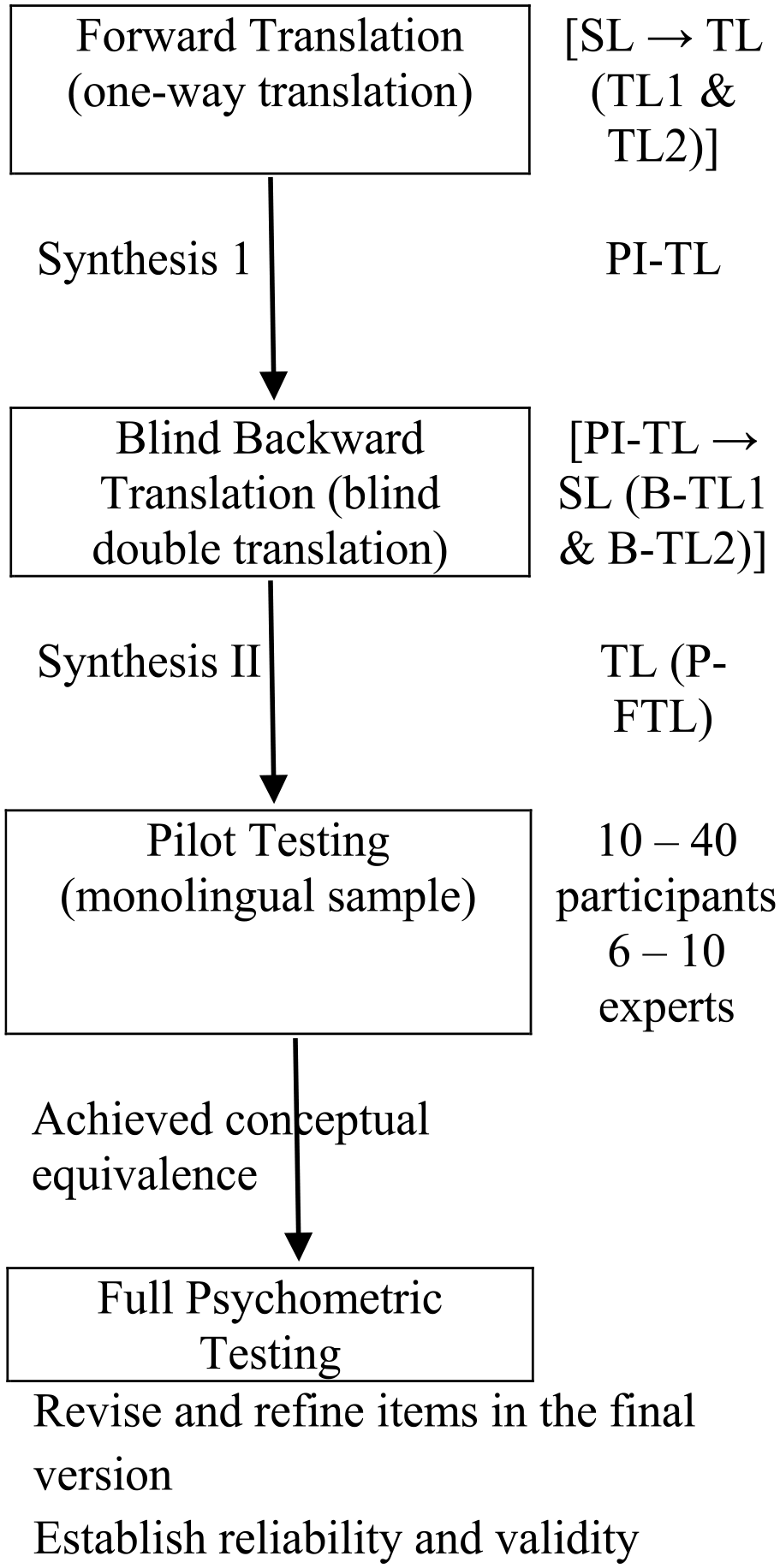
The flow of translation, adopted and adapted from Sousa and Rojjanasrirat (2011).
Translation phase
Forward translation
The original version of the Role Checklist was forward translated from English to Malay by two independent translators (T1 and T2). T1 was a certified translator by the Malaysian Institute of Translation & Books, while T2 was an occupational therapist. Both versions were harmonised through discussions between translators and the research team, and a preliminary version of the Malay Role Checklist (P-FT) was produced.
Backwards translation
The P-FT was backwards translated into the original language (English) by two other independent translators (T3 and T4). T3 was a certified translator by the Malaysian Institute of Translation & Books, while T4 was an occupational therapist. Both backwards translated versions were compared with the P-FT and the original version. Discrepancies were discussed and achieved consensus among all authors, and a pilot version of the Malay Role Checklist (Pilot Role Checklist – Malay) was produced.
Pilot testing
Content validity
The Pilot Role Checklist – Malay was evaluated by nine occupational therapist clinicians and/or academicians. Each item was evaluated for its relevancy, clarity, simplicity and ambiguity using a four-point Likert scale: (i) irrelevant/no clarity/not concise/ambiguous; (ii) need modification; (iii) relevant/clear/concise/ no ambiguity but need slight modification and (iv) very relevant/clear/concise/no ambiguity. Items rated with one or two were counted as disagreement, while three or four were counted as agreement. Data were analysed using Microsoft Excel 2019 to calculate the Item Content Validity Index (I-CVI), Average Content Validity Index (Ave-CVI) and modified kappa (k*) agreement.
I-CVI was utilised to assist in revising, deleting or substituting items, whereas Ave-CVI depicted the overall instrument’s content validity (Almanasreh et al., 2019; Polit et al., 2007). Almanasreh et al. (2019) recommended calculating Ave-CVI by calculating the average I-CVI values to focus on the items’ quality instead of the experts’ performance. The item would be revised if the I-CVI is lower than 0.78 (Polit et al., 2007) and the acceptable Ave-CVI ranged from 0.8 to 0.9 (Almanasreh et al., 2019). Additionally, the modified kappa value agreement was calculated to adjust the values of I-CVI for the probability of chance agreement (Polit et al., 2007). The modified kappa values were categorised as follows: 0.40–0.59, fair; 0.60–0.74, good; and >0.74, excellent (Almanasreh et al., 2019; Polit et al., 2007).
Face validity
The Pilot Role Checklist – Malay was distributed to 20 Malaysian retirees, through online in Google Forms, aged 60 years and above, and can understand and answer questionnaires in the Malay language. Each retiree evaluated their comprehension, doubt, and the item’s clarity and brevity using a four-point Likert scale adopted and adapted from Yusoff (2019): (i) incomprehensible/unclear/complicated and not concise/ambiguous; (ii) need significant modification; (iii) need minor modification and (iv) comprehensible/clear/concise/no ambiguity. Items rated with one or two were counted as disagreement, while three or four were counted as agreement. Data were analysed using Microsoft Excel 2019 to calculate the Item Face Validity Index (I-FVI) and the Average Face Validity Index (Ave-FVI). The acceptable I-FVI and Ave-FVI ranged from 0.80 to 0.83 (Yusoff, 2019).
The clarity of each item was improved following the pilot testing. As a result, the final version of the Role Checklist – Malay was produced.
Validation phase
The Role Checklist – Malay, Malay version of the Satisfaction with Life Scale (SWLS – Malay), Malay version of EQ-5D-3L (EQ-5D-3L – Malay) and Malay version of the Multidimensional Scale of Perceived Social Support (MSPSS – Malay) were distributed to 122 purposively recruited Malaysian retirees, currently aged 60 years and above, living both in the community and institution and can understand and answer questionnaires in the Malay language. The retirees were recruited in collaboration with several retirees’ associations in Malaysia and the elderly care home (Rumah Seri Kenangan).
The Role Checklist – Malay was re-administered 2 weeks from their first administration. Data were analysed using the Statistical Package for the Social Sciences version 26 to analyse the reliability and validity.
The test–retest reliability was analysed using the intraclass correlation coefficients (ICC) for continuous data (total number of roles, total desired present roles and total desired future roles) and Cohen’s kappa (k) for categorical data (current roles and satisfaction with current roles). The ICC was categorised as follows: ⩽0.40, weak correlation; 0.41–0.60, moderate correlation; 0.61–0.80, good correlation; and 0.81–1.00, excellent correlation (Maior et al., 2021), whereas the Cohen’s kappa agreement was categorised as follows: 0.01–0.20, none; 0.21–0.39, minimal; 0.40–0.59, weak; 0.60–0.79, moderate; and 0.80–0.90, strong; >0.90, almost perfect (McHugh, 2012).
The discriminant validity between retirees living in the community and institution was analysed using the independent t-test and Mann–Whitney U test to identify the significant differences in their total number of roles, desired present roles and desired future roles. This study hypothesised that there was a significant difference in the total number of roles, desired present roles and desired future roles among retirees living in the community and institution.
The convergent validity between the Role Checklist – Malay (total number of roles) with the total score of SWLS – Malay, the overall score of EQ-5D-3L – Malay and the total score of MSPSS –Malay was analysed using Spearman’s rho(rs) correlation. The total number of roles portrayed the retirees’ level of participation that was hypothesised to be correlated with retirees’ life satisfaction, perceived health and well-being and perceived social support. The correlation was categorised as follows: 0.01–0.19, no relationship; 0.20–0.29, weak relationship; 0.30–0.39, moderate relationship; 0.40–0.69, strong relationship; and ⩾0.70, very strong relationship (Dancey and Reidy, 2004). The total score of SWLS – Malay indicated the retirees’ satisfaction with life. The higher the score, the higher the satisfaction with life. In addition, the overall score of EQ-5D-3L – Malay was the retirees’ perceived health and well-being, whereas the total score of MSPSS – Malay indicated the retirees’ perceived social support from their significant others, family members and friends. The higher the score, the better the perceived health and well-being and perceived social support, respectively.
Findings
Translation phase
Both forward and backwards translation versions had no major issues during the translation process. The sentences in the RCv3 were simple and easy to be translated and retain their meaning in the Malay language. Nevertheless, there were discrepancies in translation due to the sentence structure in the Malay language and the translator’s style.
Pilot testing
Content validity
All items achieved perfect agreement on the relevancy of the item except items 8 and 9 with I-CVI, 0.89 for both items. No items were eliminated or revised for their relevance. For the items’ clarity, simplicity and ambiguity, the I-CVI ranged from 0.67 to 1.00, with Ave-CVI ranging from 0.95 to 0.98.
Face validity
The items’ comprehension achieved an almost perfect agreement with I-FVI ranging from 0.85 0.95. Additionally, the items’ clarity, brevity and doubt achieved an almost perfect agreement with I-FVI ranging from 0.85 to −1.
Validation phase
Demographic characteristics
The mean age of retirees in this study was 68.45 years, with the majority of the retirees being female (61.5%), Muslim (84.4%) and Malay (83.6%). More than half of the retirees (54.1%) received secondary to tertiary education. In addition, most retirees were currently living in urban areas (59%) without any dependents (92.6%). Moreover, the retirees’ age and gender distribution were not significantly different between the retirees living in the institution and the community.
Work history
The mean retirement age was 56.89 years, with almost half of the retirees being previously self-employed (49.2%) and having no retirement scheme (33.6%). Additionally, half of the retirees had poor financial status. However, only one-tenth of the retirees desired to unretire and back to work either full time or part time (10.7%). However, the distribution of retirees’ work history was significantly different between the retirees living in the institution and community.
Medical status
Almost all retirees had hypertension (91%), and most retirees had high cholesterol (69.7%) and diabetes mellitus (51.6%). Additionally, almost two-tenths of the retirees had a heart problem (19.7%), and a few retirees had lung problems (1.6%), depression (1.6%) and anxiety (2.5%). Moreover, the retirees’ health status distribution, specifically hypertension, heart and lung problem, depression and anxiety, were not significantly different between the retirees living in the institution and community. The retirees’ demographic characteristics are shown in Table 1.
Demographic characteristics of retirees (n = 122).
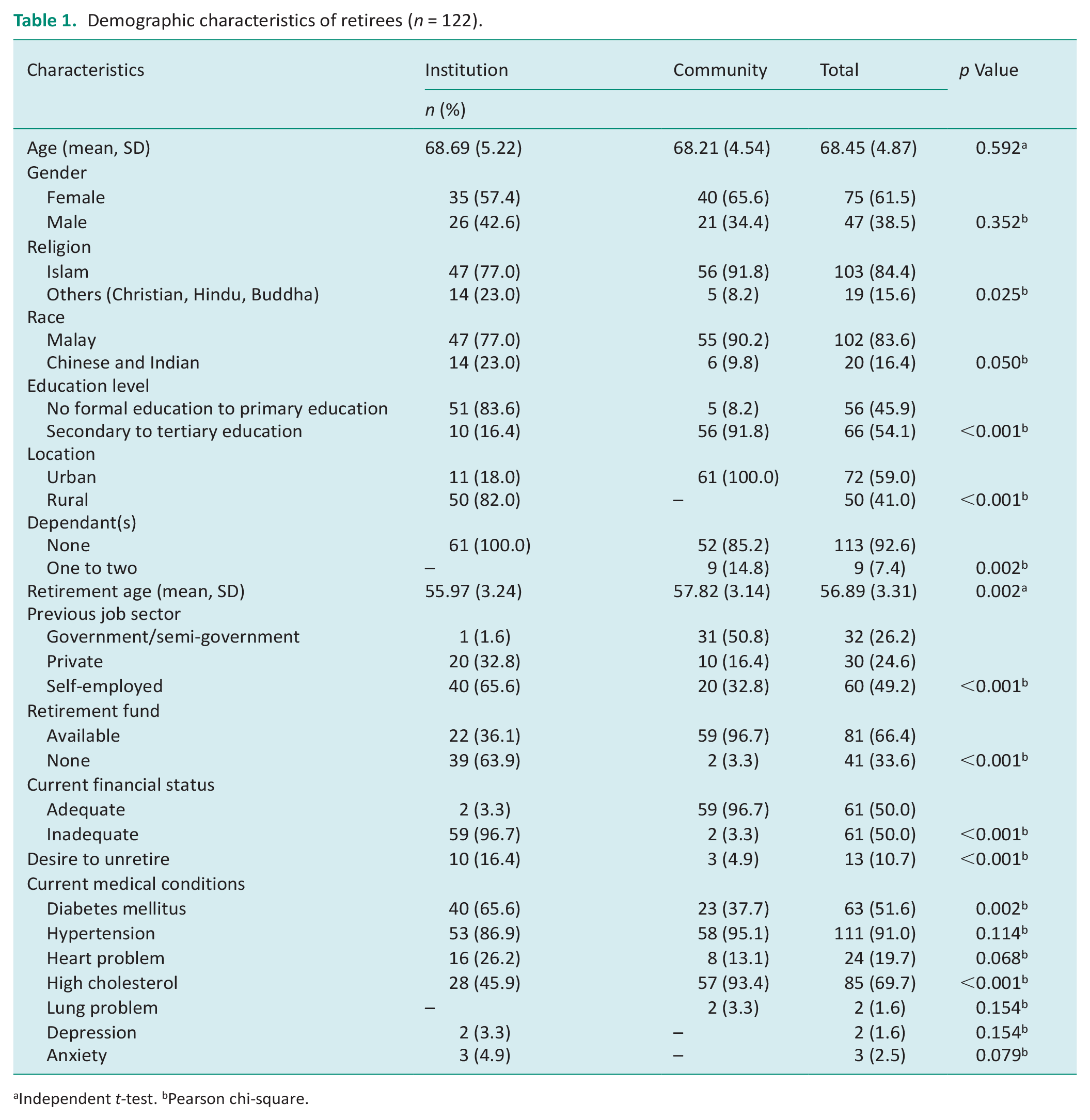
Independent t-test. bPearson chi-square.
Reliability
Test–retest reliability
Following the second administration, there were five dropouts. Hence, 117 retirees were eligible for test–retest reliability analysis. The instrument achieved excellent test–retest reliability for the total number of roles with ICC = 0.976; 95% CI (0.965–0.983). The total desired present roles achieved good test–retest reliability with ICC = 0.654; 95% CI (0.501–0.760), whereas the total desired future roles achieved excellent test–retest reliability with ICC = 0.932; 95% CI (0.902–0.953). The Cohen’s kappa agreement for the current roles ranged from 0.690 to 1.00, while the satisfaction with current roles ranged from 0.620 to 1.00.
Validity
Discriminant validity
There were significant differences in the total number of roles (p < 0.001) and total desired future roles (p < 0.001) between retirees in the community and institution, whereas there were no significant differences in total desired present roles (p = 0.974). The results are shown in Table 2.
Significant differences in the total number of roles and desired present and future roles among retirees living in the community and institution (n = 122).
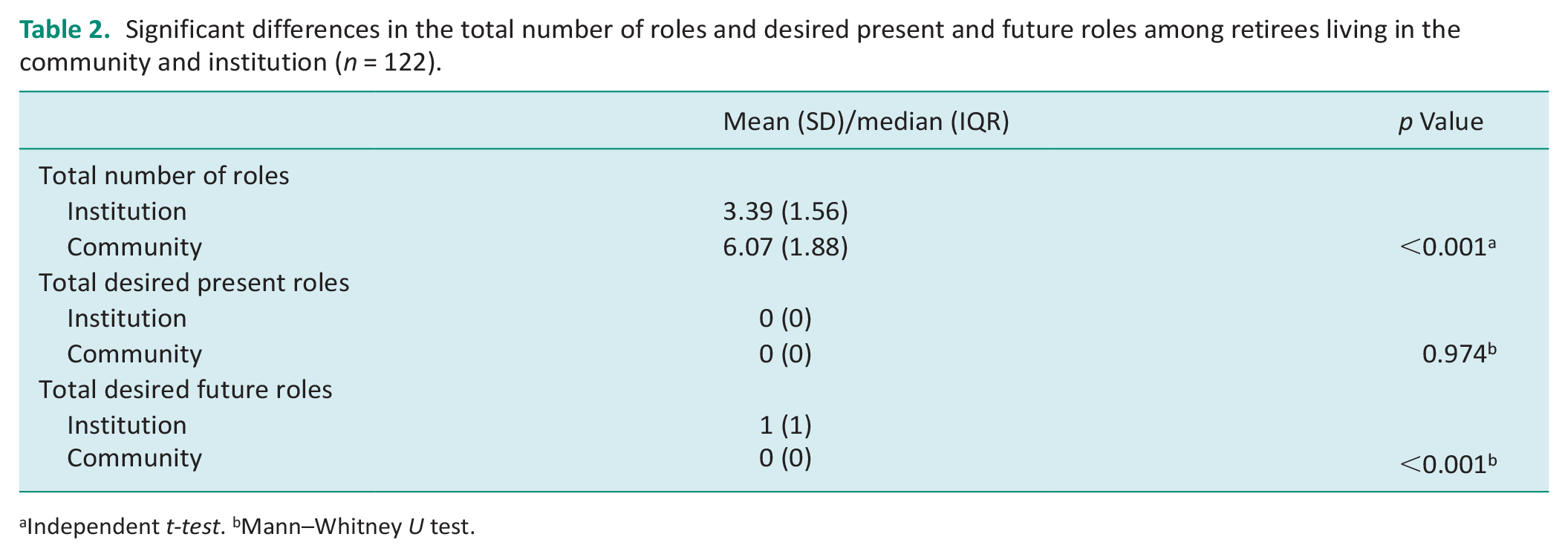
Independent t-test. bMann–Whitney U test.
Convergent validity
Out of 122 retirees, there were five missing data for the total score of SWLS – Malay, and two missing data for the overall score of EQ-5D-3L – Malay and total score of MSPSS – Malay, respectively. However, there was a statistically significant, moderate to strong, positive relationship between the total number of roles and the total score of SWLS (n = 117; rs = 0.593, p < 0.001), the overall score of EQ-5D-3L (n = 120; rs = 0.366, p < 0.001) and the total score of MSPSS (n = 120; rs = 0.314, p < 0.001).
Discussion
This study aimed to cross-culturally translate the RCv3 into the Malay language according to the scientific guideline (Sousa and Rojjanasrirat, 2011) and identify content validity, face validity, test–retest reliability and discriminant validity of the Role Checklist – Malay. There were no significant issues during the forward and backwards translation process. Minor disagreement was resolved through discussion among all authors and translators.
The Role Checklist – Malay achieved almost perfect Ave-CVI and Ave-FVI, indicating that this instrument had achieved linguistic and cultural appropriateness among the Malay retirees and semantically equivalence to the original version (Almanasreh et al., 2019; Polit et al., 2007; Yusoff, 2019). Furthermore, the establishment of both content and face validity depicted that the Role Checklist – Malay’s items adequately reflect the domain and the operational definition of retirees’ roles, satisfaction with roles and desired present and future roles (Almanasreh et al., 2019; Yusoff, 2019).
Additionally, this study established the stability and reproducibility of the Role Checklist – Malay with good to excellent ICC and moderate to perfect Cohen’s kappa agreement. Previously, the original RCv3 had established test–retest reliability for current roles with kappa values ranging from 0.74 to 1.00, while the desired future roles achieved kappa values ranging from 0.44 to 1.00, and the satisfaction with role achieved a strong to an almost perfect agreement, ranged from 0.77 to 0.98 (Scott et al., 2019).
The Role Checklist – Malay established preliminary discriminant validity between the number of roles and desired future roles among Malaysian retirees living in the community and institution. Hence, this study found that retirees living in the institution had fewer roles and desired future roles that warrant future studies on their satisfaction and quality of life as these findings may reflect their engagement level, motivation to participate or unfulfilled roles that may lead to other occupational issues such as occupational deprivation, injustice and alienation among institutionalised retirees. On the other hand, no previous study established discriminant validity of the Role Checklist among retirees living in the community and institution.
Additionally, the number of roles among retirees was significantly correlated with their satisfaction with life, perceived health and well-being and perceived social support. Several studies found that engagement in various roles such as family members, friends, volunteering and organisation participation may influence life satisfaction and social support following retirement (Al-Khraif et al., 2019; Antunes and Moré, 2021; Chen et al., 2022; Haslam et al., 2018). However, the number of roles following retirement’s correlation with the perceived social support was ambiguous as there was no significant difference in social support between pre- and post-retirement despite the transition of the retirees’ roles (Saligram and Venkatesha Murthy, 2022). Additionally, as there was a limited direct correlation between the number of roles and perceived health and well-being, the number of roles engaged among retirees may be associated with active ageing, which was directly associated with perceived health and well-being (Kumari and Sharma, 2022; Petrová Kafková, 2018).
Establishing a valid, reliable and culturally appropriate measure of roles’ participation, performance and satisfaction among Malaysian retirees will increase the comprehensiveness of the client-centred approach among Malaysian occupational therapists. Furthermore, Malay-speaking retirees may better understand the instructions and questionnaire and accurately reflect their perceived roles’ participation, performance and satisfaction.
Limitations
The homogeneity of this study’s samples that the Malay Muslim dominated implied a poor generalisation to other subgroups of Malaysian as Malaysia is a multicultural country. Additionally, the difference in the retirees’ current roles and desired future roles may be attributable to other factors that warrant future study. Besides, this study could not establish a criterion equivalence as Sousa and Rojjanasrirat (2011) outlined, as this study’s data collection excluded the original version of the RCv3 which is essential to establish criterion equivalence.
Conclusion
The Role Checklist – Malay had established good reliability and validity. Therefore, future utilisation of the Role Checklist – Malay among Malaysian retirees can be explored to enhance the understanding of their roles or participation and facilitate the client-centred practice among Malaysian retirees living in the community and the institution.
Key findings
The Role Checklist – Malay is valid and reliable.
Retirees living in the institution had fewer roles and desired future roles than retirees living in the community.
There were significant correlations between retirees’ total number of roles with their satisfaction with life, perceived health and well-being and perceived social support.
What has the study added?
This study has established the validity and reliability of the Role Checklist – Malay to assess retirees’ current roles and satisfaction with their roles.
Footnotes
Acknowledgements
This is an authorised translation of a copyrighted work. Sale or distribution of this translation without the express written consent of the Board of Trustees of the University of Illinois is strictly prohibited. The authors would like to thank the Faculty of Health Science, Universiti Teknologi MARA, Puncak Alam Campus for the facilities and support.
Research ethics
This study was approved by the Universiti Teknologi MARA (UiTM) Ethical Committee, reference no: [REC/12/2020 (MR/4360]. All data were collected and used for research purposes only, and the confidentiality of the respondents was guaranteed and protected.
Consent
Not applicable.
Patient and public involvement data
During the development, progress and reporting of the submitted research, Patient and Public Involvement in the research was included in the conduct of the research.
Declaration of conflicting interests
The author(s) declared no potential conflicts of interest with respect to the research, authorship, and/or publication of this article.
Funding
The author(s) disclosed receipt of the following financial support for the research, authorship and/or publication of this article: This study was funded by the Fundamental Research Grant Scheme [Reference No.: 600-IRMI/FRGS 5/3 (296/2019)]. The first author was funded by UiTM Endowment Scholarship.
Contributorship
MQMS researched literature and seeks permission to translate the instrument. MQMS, AZCD and QTSM discussed and finalised the procedure in this study. MQMS, QTSM and NFAMR collect and analyse the data. AZCD, AD and RT supervised the translation and validation process. MQMS wrote the first draft of the manuscript. All authors reviewed and edited the manuscript and approved the final version of the manuscript.
