




Abstract
Background:
Access to housing for people with intellectual disabilities is often constrained by lack of choice, control and can often be inappropriate or unsafe. To enable people to remain at home and participate in their occupations, a collation and review of theories and models supporting good home environment design offers a view from which practice could be advanced.
Method:
A scoping review was used to map the literature on theories and models on home environmental designing, which can have influence on the occupational performance and participation of people with intellectual disabilities. The theories and models found were analysed using the lens of the Person-Environment-Occupation-Performance model.
Results:
Four themes supporting the understanding of environmental home design that can influence participation and well-being were found. These were offering safety and comfort; providing control and choice to manage stress; offering skill acquisition for continued learning and interest; and the person–environment interaction for function and participation. The themes are discussed in relation to participation in occupation and well-being for people with intellectual disabilities.
Conclusion:
The study contributes knowledge to practitioners and stakeholders on theories and models of home environment design which could support the occupational performance, participation and well-being of people with intellectual disabilities.
Keywords
Introduction
Our homes can be a significant physical, psychological and spiritual place in our lives (Nagib and Williams, 2017). For people with intellectual disabilities, access to appropriate homes is constrained by lack of choice and control in terms of dwelling, affordability and the requirement for home modifications to support ongoing needs (Owen and McCann, 2017). Many amongst this population may also be autistic or have physical disabilities and associated comorbidities, presenting with complex home environmental design needs that influence their well-being.
The closure of long-stay institutions in the United Kingdom has seen the implementation of different housing models for people with intellectual disabilities. These models include in-house staffing support in small group homes, or supported living, enabling people to live on their own or with others. Limited affordable housing means shared supported housing is the prevailing option but is associated with lower quality of life outcomes for people with complex needs (Bigby and Beadle-Brown, 2016). This and poorly integrated support have led to inappropriate and unsafe housing choices (Casson et al., 2021), causing isolation, poorer health, poverty and abuse (Simplican, 2019).
The Homes and Communities Agency (HCA) which regulates registered providers of housing for vulnerable people asserts that supported housing must be (re)designed to enable residents to adjust to or enable independent living (HCA, 2014). This sits well with the recent Department of Health (2022) action plan, ‘Building the right support’, aimed at keeping people with intellectual disabilities safe – living a full, supported life in their homes and communities. This plan follows in the wake of the ‘Transforming Care’ agenda in 2010 (National Health Service (NHS) England, 2017) which maintained that people with learning disabilities should be housed within their community to get support and maintain relationships. Unfortunately, many people with intellectual disabilities are inappropriately hospitalised due to lack of suitable housing (MENCAP, 2023), with little change in inpatient numbers since 2010 (NHS Digital, 2022).
The wider environmental context for people with disabilities
Disability theories and models have contributed and provided context to the sociocultural conditions in which people live their experience of disability and to the current provision of care to people with disabilities (Berghs, et al., 2016). The social model of disability (Oliver, 1983) promotes inclusion and social integration; driven by the idea that disability is created by societal and physical environmental barriers rather than impairment. It provides a counterbalanced view to the medical model which addresses the treatment and intervention of the condition or disability to rectify the problem within the person. However, the social model has been criticised for presenting disabled people as one collective group, unrepresentative of different experiences (Shakespeare, 2010); whereas diversity and intersectionality of race, gender, sexuality and age mean that people’s needs and lives are more complex (Crenshaw, 1989; Oliver, 2013). The model, however, has paved the way for the human rights model of disability (United Nations, 2006), whereby the impact of impairment in the lives of people with disabilities is acknowledged as a natural aspect of human diversity which places accountability on governments to act in supporting the rights of people with disability to be included in their communities (Degener, 2016).
The Person-Environment-Occupation-Performance (PEOP) model (Baum et al., 2015) was used to frame this scoping review because it brings together the social and the medical model. The PEOP places equal emphasis on the person and their environment, proposing that when there is a person–environment fit in supporting one’s valued occupation, success in occupational performance is promoted, leading to participation and well-being (Sood et al., 2014). The features of the environment within this model extends beyond the physical context and includes cultural, social support and attitudes, legislation, economics, health education and public policy, and use of technology (Baum et al., 2015). The PEOP also aligns with the International Classification of Functioning, Disability and Health (ICF) (World Health Organization (WHO), 2002) which situates disability in the interaction between the person within the context of their environment to address health in activity performance and participation. Arguably, it does classify individuals according to disability and should therefore be used critically (Hammell, 2004). However, it offers a global approach for use of formulating and planning policy in health and a framework for interdisciplinary research (WHO, 2011). The PEOP, like the ICF, emphasises health and functioning and offers a means to consider the interplay between the individual, their environment and their occupation in a framework that supports communicating this.
Occupational therapy in relation to housing and people with intellectual disabilities
Occupational therapists work with people to enhance their ability to perform and participate in occupations or activities that they want to, need to, or are expected to do; or by modifying the occupation or the environment to support their engagement in their homes and communities (World Federation of Occupational Therapists, 2018). They are strong proponents of the concept of occupational justice, which proposes that everyone, no matter their differences, has the right to benefit from equal privileges for diverse participation in occupations that support their health and social inclusion (Hammell and Iwama, 2012). A focus, thus, for occupational therapists is to enable, mediate and advocate for environments which provide opportunities for people to participate meaningfully within and outside their homes (Hocking, 2017).
There is literature regarding the home environment and its effect on the occupational participation of people with intellectual disabilities. Nagib and Williams (2017) emphasised the impact of the sensory environment and how sensory overstimulation can affect those with noise or visual sensitivity, highlighting the importance of home modifications such as soundproofing, lighting or reorganising spaces. Krieger et al. (2018) found that providing security, agency and control over the home environment can support the participation of autistic adolescents. These studies suggest the diverse ways in which a home environment can be adapted and that designing the right home represents an important skill to enable people to remain at home and participate in their daily occupations. Occupational therapy discourse is arguably vital in shaping the ‘home environment design’ processes (Lo Bianco et al., 2020). In this paper, the term ‘home environment design’ will be used to encompass the assessment of a person’s housing needs and home design and adaptations.
There is growing interest from other disciplines involved in home environment design that have a functional and social impact on peoples’ lives (DuBois et al., 2017). This includes architects (Pomana, 2014) who plan and design spaces for everyone, including people with disabilities (Nagib and Williams, 2017). This has seen an emergence in studies related to the designing of educational environments (Ghazali et al., 2019; Mostafa, 2014; Mullick and Khare, 2008), supported living accommodation (Kanakri, 2013) and outdoor spaces (Gaudion and McGinley, 2012). Although these studies have added to the importance of design and guidelines (Gaudion et al., 2015), there has been limited focus on the consideration and application of theories related to home environment design to support participation and well-being of people with intellectual disabilities. Indeed, Stevens et al. (2019) posit that architects today still rely heavily on intuition in well-being-related design requests.
A review to capture specific knowledge across multidisciplinary literature will allow researchers, practitioners and stakeholders such as commissioners and policymakers to have oversight of different theoretical angles to consider complex issues (Nilsen, 2015). The aims of this scoping review was to evaluate the selected theories and models to inform home environment design in relation to occupational performance, participation and well-being for people with intellectual disabilities; and to identify areas for further research. In this scoping review, a theory is defined as a means of describing and explaining a specific realm of thinking (e.g. human behaviour or environment design), which helps to predict why certain elements lead to certain outcomes (Appel-Meulenbroek and Danivska, 2021). Models are also considered in this scoping review, adopting Nilsen’s (2015) assertion that models are theories but more descriptive of certain observations and that they demonstrate the use of a theory.
Method
This scoping review adopts a process of ‘mapping’ or summarising the extant literature to convey the breadth and depth of this field (Levac et al., 2010). The review used Arksey and O’Malley’s (2005) framework of identifying the research question, identifying relevant literature, selecting literature, charting the data and collating summarising and reporting the results. The authors have engaged with each stage in an iterative way to ensure a thorough process. The PRISMA extension for scoping reviews (PRISMA-ScR; Tricco et al., 2018) was used as a framework for preferred reporting items in the current scoping review.
Identifying the research question
The research question was identified after exploring the literature related to the fields of occupational therapy, intellectual disabilities and home environment. A gap in the knowledge was identified around home environment theories and models related to intellectual disabilities. The research question developed was as follows: Which environmental home design theories and models can support the occupational participation and well-being of people with intellectual disabilities in their homes?
Identifying the relevant literature
Table 1 outlines the search criteria and search terms used. There were no date restrictions imposed on the search to ensure all relevant theories and models published could be included irrespective of date. To account for changes in attitudes to the social model and the human rights of people to participate effectively in their homes and communities, the PEOP model was used to frame and support data extraction to reflect a more combined biopsychosocial approach. The PEOP considers the components and interaction of the person, environment/intervention and outcomes of occupational performance and participation. A search strategy was conducted within EBSCOhost in AMED, APA PsycINFO, CINAHL Plus and Medline databases using Boolean operators (outlined in Table 1). Grey literature searches were conducted on Google Scholar, the Royal College of Occupational Therapists, Challenging Behaviour Foundation, Mencap and ArchDaily. A further MeSH (Medical Subject Heading) search was conducted in the combined PubMed and Scopus electronic databases (Table 1). The search strategy and search terms were agreed by all authors.
Search criteria and search terms.
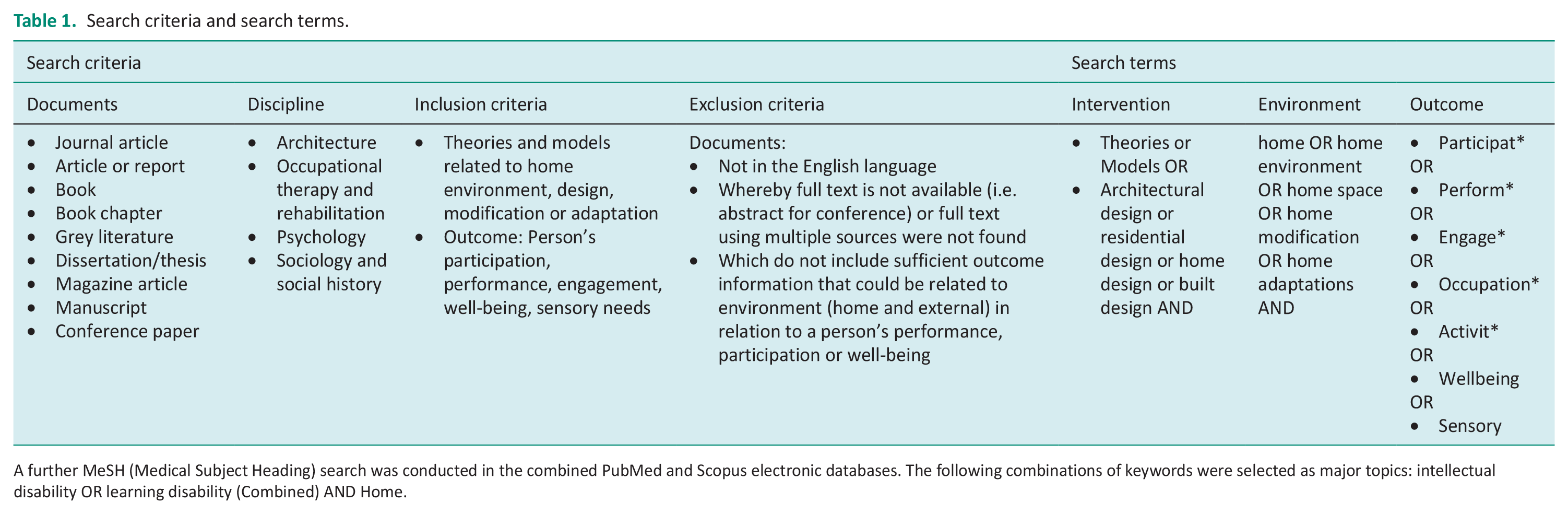
A further MeSH (Medical Subject Heading) search was conducted in the combined PubMed and Scopus electronic databases. The following combinations of keywords were selected as major topics: intellectual disability OR learning disability (Combined) AND Home.
Literature selection
A process of selection was conducted by the main author who read relevant abstracts, based on titles of selected literature and a further selection process from reading full texts. Further hand searching using the reference lists of documents relevant to the topic area was conducted and the same process of selection applied. Selected literature was discussed amongst all authors before inclusion and any duplications removed. Full-text screening was performed by the first author and the theories and models were selected on the basis that their key principles described a relationship between the designed environment, the person and either their participation in occupation or well-being. Any conflicts were resolved by consensus with all authors.
Charting the data
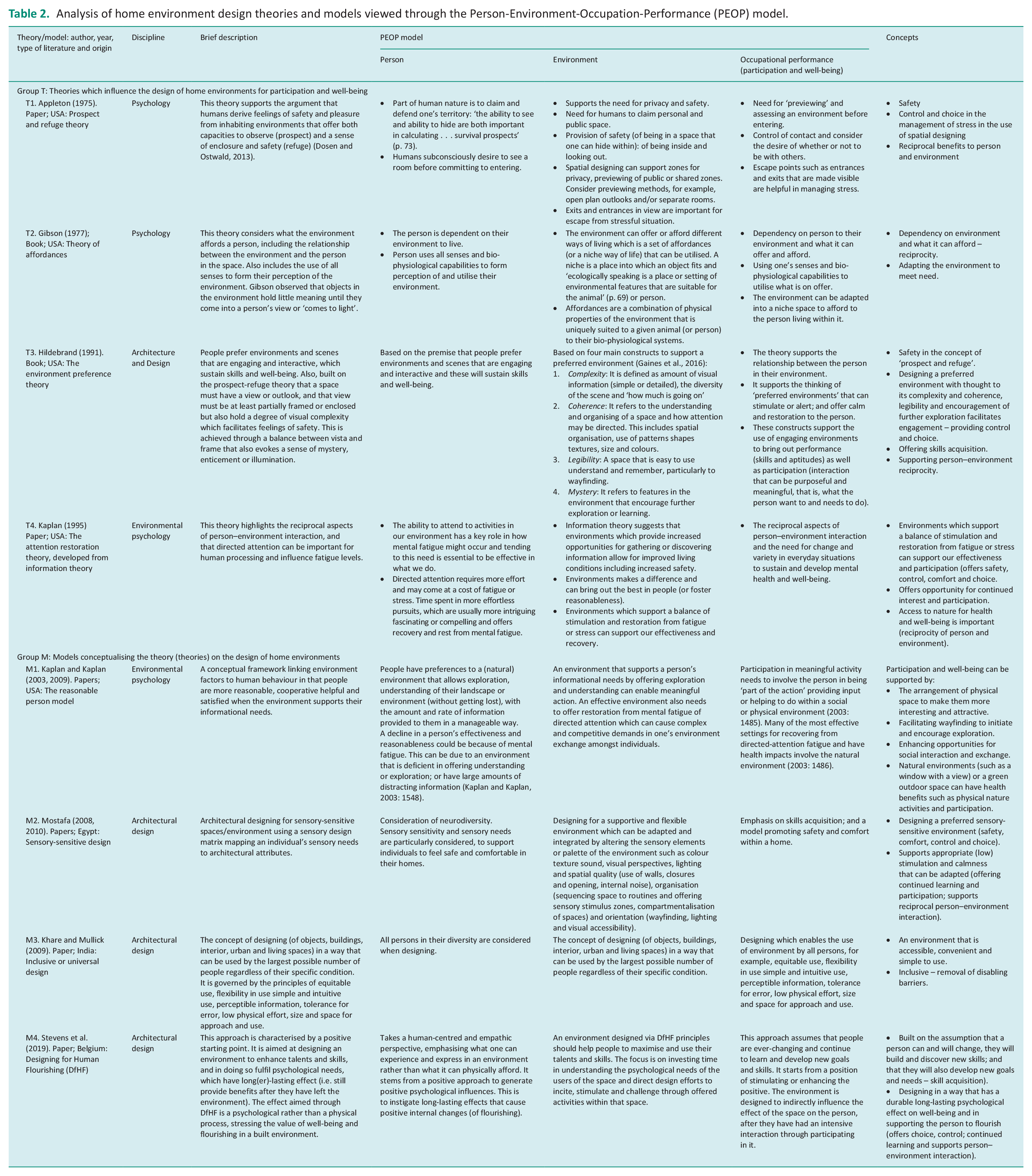
Literature information which met the search criteria was extracted for analysis. Information included the author, year, country of origin, type of literature; theories and models; discipline; and a brief description of the theories and models. As the PEOP model (Baum et al., 2015) was used as a lens to support this review question, information from the literature was extracted and grouped within the model’s components of the person, the environment and the interaction of these aspects on their performance, participation and well-being in occupation (Table 2).
Analysis of home environment design theories and models viewed through the Person-Environment-Occupation-Performance (PEOP) model.
Collating, summarising and reporting the results
A narrative synthesis (Popay et al., 2006) was used to analyse the data. The preliminary synthesis involved describing each theory or model in a ‘textual summary’ for each selected document. The first author then completed the data extraction, content analysis and thematic development, whilst checking with the other authors for accuracy and consistency. The components of the PEOP (the person, environment and performance) were used to support the extraction and categorisation of data into themes. The key tenets to each theory and model related to home environment design are summarised in Table 2 and the themes reported in the results. A schematic diagram was developed (Figure 2), illuminating how the theories and models related to home environment design situate within the PEOP model to support occupational performance and hence, participation and well-being of people.
Results
The literature searches yielded 310 results, based on titles and abstracts. The MeSH search on PubMed and Scopus yielded 72 results, but none of these were found relevant for inclusion following a screening of the title and abstracts. Hand searching was conducted, using references from books and papers found, adding another 30. The PRISMA diagram (Page et al., 2021) (Figure 1) outlines the selection process and outcome. A total of eight documents were included in the final review.
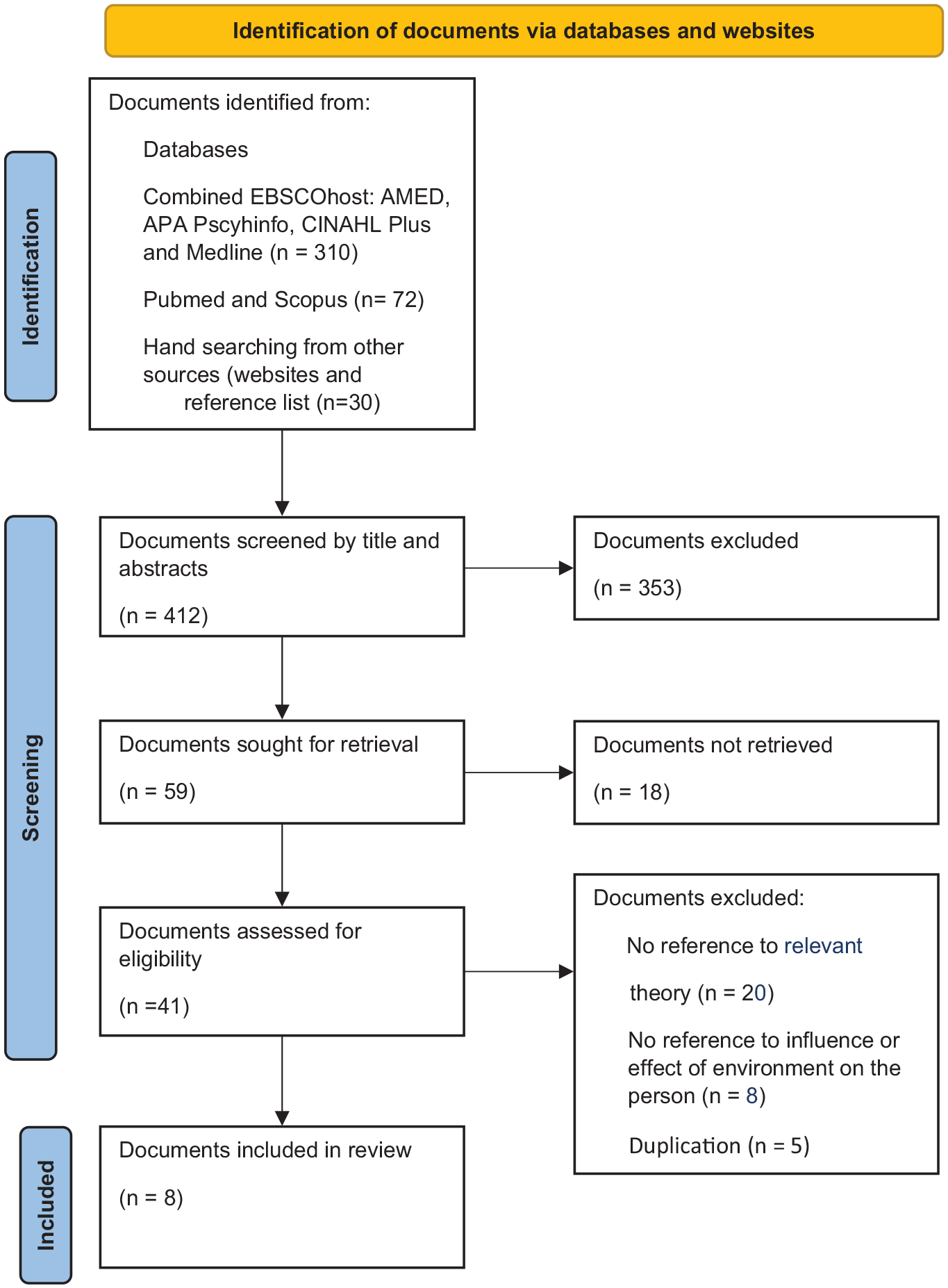
Preferred Reporting Items for Systematic Reviews and Meta-Analyses (PRISMA) diagram (Page et al., 2021) illustrates the search process and outcomes included in the scoping review (Moher et al., 2009).
Results summary
The theories and models selected focused on environmental design (architectural characteristics such as use of space, design and the influence of the built environment on behaviour). This is related to the external physical or built environment. Four theories and four models were reviewed. The theories were as follows: (T1) Prospect and refuge theory (Appleton, 1975), (T2) Theory of affordances (Gibson, 1977), (T3) Environment preference theory (Hildebrand, 1991, 1999) and (T4) Attention restoration theory (Kaplan, 1995, 2001). The models reviewed provided insight into how design theories could be conceptualised for home environmental designing. These were as follows: (M1) The reasonable person model (Kaplan and Kaplan, 2003, 2009); (M2) Sensory-sensitive design (Mostafa, 2008, 2010); (M3) Inclusive or universal design (Khare and Mullick, 2009) and (M4) Designing for Human Flourishing (DfHF) (Stevens et al., 2019).
The analysis of the theories and models, charted in Table 2, led to four overarching themes for considering good home environmental designing. These were as follows:
Offering safety and comfort (T1, T3, T4, M1, M2).
Providing control and choice to manage stress (T1, T3, T4, M1, M2, M3, M4).
Offering skill acquisition for continued learning, interest and participation (T2, T3, T4, M1, M2, M4).
Supporting person–environment reciprocity for participation and well-being (T1, T2, T3, T4, M1, M2, M3, M4).
Theme 1: Offering safety and comfort
A key principle underlying many of the theories and models (T1, T3, T4, M1, M2) was that homes are designed primarily to offer safety and comfort to their resident(s). Appleton (1975) (T1) posited that to identify the elements in the environment which satisfy our survival needs, ‘humans look for potential habitats to observe and hide whilst also providing a source of aesthetic satisfaction’ (p. 73). Hildebrand (1999) (T3) developed this further, referring to the concepts of refuge and prospect as opposing; ‘refuge is small and dark, prospect is expansive and bright’ (p. 22), suggesting that when we move from ‘darker to lighter. . . we will be able to see without being seen and will ensure ourselves relative safety during exploration’ (p. 54). Kaplan (1995) (T4) explained that an enclosed space will evoke a sense of safety and relaxation, whilst an added view to that space can add stimulation. Mostafa (2010) (M2) further proposed that living with others may enhance the need for privacy and if a building is designed sensitively, a conducive environment can be created, assisting residents to ‘escape when stressed, and allow the management and development of coping skills’ (p. 45).
Theme 2: Providing control and choice to manage stress
Appleton’s (1975) (T1) and Hildebrand’s (1991, 1999) (T3) theories proposed that a home environment should allow control, by offering a view or ‘prospect’ so that ‘inhabitants can contemplate before venturing out to open or social spaces’. Hildebrand (1999) theorised that degrees of prospect and refuge within a built environment can be tailored to suit a resident’s mood. In relation to individuals who may have sensory processing issues, Mostafa (2010) (M2) advocated the need for having a ‘refuge’ for managing stress, with considerations of ‘exit/escape routes from managing the assault of overwhelming sensory experiences’ (p. 45).
Hildebrand (1999) used the construct of ‘legibility’, defined as a space that is easy to understand and remember using skills such as navigation and wayfinding (finding a desired location and making your way back to the point of origin). This is also emphasised in Mostafa’s (2010) sensory-sensitive model (M2) and Kaplan and Kaplan’s (2009) reasonable person model (M1) which state that ‘people resonate to environmental cues that facilitate their understanding of a situation, but they particularly prefer environments that support their ability to explore without becoming disoriented and that motivate them to explore further’ (p. 331).
Theme 3: Offering skill acquisition for continued learning, interest and participation
Kaplan and Kaplan (2003) (M1) posited that ‘people are attracted to environments that permit exploration. . . as this provides a potent means of achieving understanding’ (p. 1485), albeit acquiring information at their own pace. Both they and Hildebrand (1991) (T2) advocated for environments that invite exploration by offering ‘discoverability’ to another area within the home to encourage curiosity and participation. Mostafa’s (2010) model (M2) placed emphasis on flexible environments, supporting adaption and integration, by altering the sensory elements (acoustics, illumination, colour, textures) of the space to support one’s functioning and participation. They suggested ‘compartmentalisation of spaces for specific purposes or occupations to support the sequencing and organisation of daily activities and zoning of sensory stimulus, reflecting the daily routine of users’ (p. 43), avoiding high stimulus areas such as the bathroom and kitchen during most of the day to ensure a calmer, smoother flow of routine.
The model of DfHF (Stevens et al., 2019) (M4) approached the user-resident ‘as an active person who wants to participate in suitable activities, and genuine interest from the involved designer in what can help the user to flourish’ (p. 398). This model aims to design activities within environments that assist people in training and developing their communication or life skills, long after leaving that environment. This will mean identifying existing skills of the users, anticipating their changing needs and finding heterogeneity within the group to ensure inclusive designing.
Theme 4: Supporting person–environment reciprocity for participation and well-being
This theme is woven through all the theories and models. Specifically, Kaplan’s (1995) (T4) attention restoration theory stressed the reciprocal aspects of person–environment interaction and the need for change and variety in everyday situations to sustain and develop mental health and well-being. Gibson’s (1977) theory (T2) explained that ‘the physical environment is a relatively stable arrangement of shapes and forms that make up the volume of a space’ (p. 69) and that a home space can be adapted and made into a ‘niche’ space to ‘afford’ the person’s needs. Hildebrand’s (1999) construct of ‘coherence’ (T3) furthered this, supporting how environment designing can direct our attention through use of spatial organisation and visual patterns of brightness, texture lines, colours and shapes. Kaplan and Kaplan (2003) (M1) also suggested that the arrangement of physical space can make an environment more interesting and enhance opportunities for social and interactional exchange. They particularly advocated environments that offer ‘access to nature activities with its restorative properties and health benefits e.g. a window with a view or green outdoor space’ (p. 1486).
Stevens et al.’s (2019) DfHF model (M4) highlighted that people are rediscovering well-being in the meaning attributed to their home environment: ‘the design, look and feel of where we live is also a place to express who we are’ (p. 393). They posited that people want their environment to meet their expressions of emotions and ‘afford’ experiences rather than simply address physical demands. An example being a walkway through various communal spaces to encourage social interaction before reaching a destination. The person–environment reciprocity is also evident in Mullick and Khare’s (2008) and Khare and Mullick’s (2009) concept of inclusive or universal design (M3). They suggested that it is possible to design supportive and inclusive environments that are beneficial for all, which can offer ‘structure, clarity, predictability and safety . . .to improve performance to all who use it’ (Khare and Mullick, 2009: 72).
Viewing the results through the PEOP model lens
A schematic diagram (Figure 2) illustrates where the theories and models in this review situate within the PEOP model (Baum et al., 2015) where the person and their environment are both important. All resulting four themes have aspects which sit within the ‘person’ and ‘environment’ component of the PEOP model. This demonstrates that all themes can have some influence on a person’s responses to occupational performance in their home environment and contribute to their participation and their well-being.
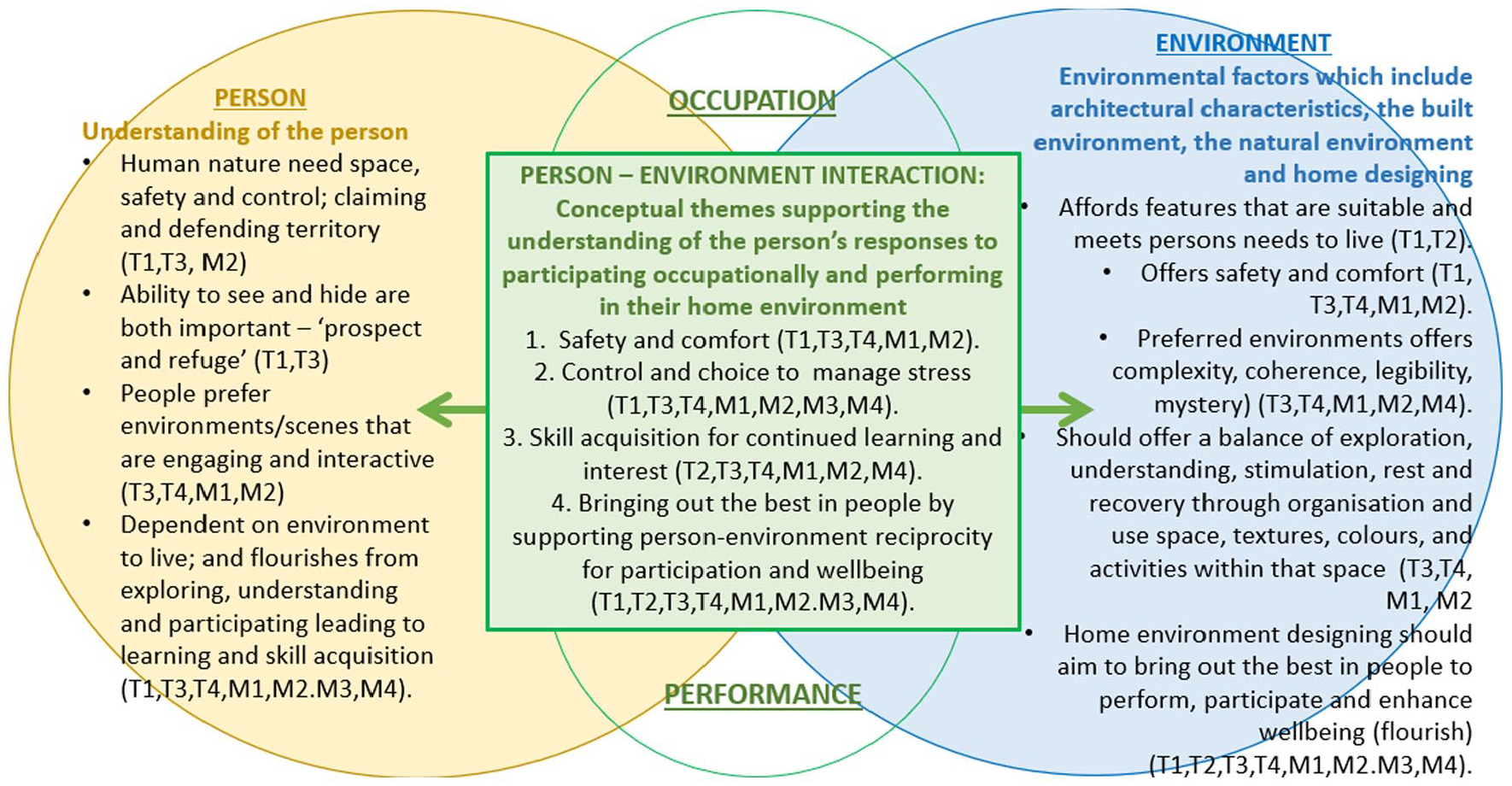
The results viewed through the Person-Environment-Occupation-Performance (PEOP) model (Baum et al., 2015) illustrate the position in which the theories and models situate within the PEOP model. The conceptual themes from these theories and models illustrate the interaction between the person and their environment and the influence on a person’s occupational performance and participation at home.
The four themes reflect an understanding of how home environmental designing with an inclusive perspective, can support people to use their capabilities to learn and adapt to different situations and environment (Shum et al., 2016). Balancing the demands from the environment to the individual’s motivation, values, culture, interests, health and social situation is essential to further performance and participation, whereby occupational therapists are skilled and well-positioned to support.
Discussion
This scoping review has revealed theories and models supportive of good home design for people with intellectual disabilities, which offer safety and comfort; control and choice; skill acquisition for continued learning; and the reciprocity of person and environment. This discussion is focused on how these themes can contribute to our understanding of good home environment design for people with intellectual disabilities.
Safety, comfort, control and choice
The first two themes are intertwined in the support of people in shared homes to have choice regarding their living accommodation. The proposal that a living space should have a view or outlook/prospect (Hildebrand, 1991) can be applied to a group home, where people may have their own refuge spaces (bedrooms) which open into communal areas. Areas of refuge and prospect are needed together to offer spatial dimension, access to natural light and views that can elicit reactions such as happiness or excitement. Providing access between private refuge spaces (bedroom) and internal areas of prospect (e.g. the use of an open plan concept, ceiling heights with multilevel areas for visual scanning or a transparent pane as a ‘lookout’ in a door) could support the sense of safe transitioning from one space or activity to another, and offer periods for adjusting (Gaines et al., 2016). These can be brought together using architectural and natural elements in an environment, but also recognising that a high level of complexity and controlled order is required and is still to be tested for home environments (Dosen and Ostwald, 2016).
A challenge in interacting with other people is having the means to maximise control and manage desires to socialise or to avoid others as needed. Appleton (1975) proposed that part of human nature is to claim and defend one’s territory. In today’s material world, this may mean marking out home-territory with the display of personal objects, positioning of furniture, use of colour, shapes and textures according to personal aesthetics, and barriers such as walls. By having internal choices and control, residents may also experience greater well-being (Gaines et al.,2016). Being able to see a room clearly before committing to enter, or having visible exits and entrances, can support this need for control. Skills such as wayfinding or navigating from space to space can also prove challenging for people with intellectual disabilities and adopting visual cues and clarity will ensure inclusivity (Mostafa, 2010). Here, well-designed home environments can ease anxiety and stress by containing distinct features such as the use of space or colour zoning that aid in wayfinding (Herzog and Leverich, 2003). Mostafa (2010) suggested using tools such as signage with visual symbols or pictures to aid accessibility. The complex organisation of spaces, to allow for areas and degrees of (movement between) prospect and refuge, may offer viable de-stressing strategies for people with intellectual disabilities and facilitate safe exploration of their environment to enable meaningful participation (Kaplan and Kaplan, 2003).
The planning of spatial concepts and dimensions, access to light and views, consideration of personal aesthetics such as colour, shapes and textures, are all important areas to consider for the those who work to design and build homes for people with intellectual disabilities. The issue of safety for any group with complex needs or behaviours that challenge is an important factor in the consideration of risks to self and others (Mostafa, 2010). This may mean considering the robustness, use of and access to equipment, with possible use of safety-devices such as guards and tamper-proof switches, and the consideration of these in terms of personal aesthetics (choice) and comfort in one’s home. These highlight the need for joint working between housing providers, architects, builders, support providers, and health and social care professionals including occupational therapists, to meet the home environment needs of people with intellectual disabilities.
Skill acquisition for continued learning and interest
Mostafa’s (2008) sensory design model focused on creating a ‘sensory-sensitive’ environment which facilitates skill acquisition and learning in a safe space. For people with intellectual disabilities who may struggle with routine and focus, Mostafa (2010) suggested the compartmentalisation of spaces for specific purposes or occupations to support the organisation of routines, the sequential order of daily activities and zoning of sensory stimulus. They believed spaces could be designed to serve one activity, with avoidance of multifunctional spaces with high stimulus to enable better performance.
Henry (2011), however, argued that the skills and benefits of well-being acquired in a safe, zone-defined and low sensory stimulus home environment may not be easily transferred to other environments. Kaplan and Kaplan (2009) also proposed that being effective in one’s environment requires a grasp of a larger pattern of information, created from the separately experienced smaller units of information. As a person’s internal model develops, they may grasp the relationship between their environment and be more prepared for similar experiences in other environments, but this will take time as this exploratory preparation must be practised repeatedly to familiarise to different environments. One could thus infer that if individuals form strong bonds to carefully sensory designed home environments, it may be harder to participate in their less predictable community environments. Simplican (2019) suggested a graded approach, whereby ‘other-environment preparedness’ is supported so that the person can be safe and still be themselves. Another alternative is to design environments inclusively as suggested by Khare and Mullick (2009); for example, designing for someone with a permanent disability could also benefit someone with a temporary disability. This does not mean designing one thing for all people but designing a diversity of ways for everyone to participate in an experience with a sense of belonging (Shum et al., 2016) and thus, reflect how diverse and different people really are. Unfortunately, inclusive home environmental designing homes for people with intellectual disabilities is still poorly supported, resulting in unsafe housing, poorer health and long-term hospital stays when their homecare arrangements fail (MENCAP, 2022).
Person–environment reciprocity
The complexity of a space involving spatial organisation and visual patterns (brightness, colours and shapes) influences our feelings of safety and participation (Dosen and Ostwald, 2013). These could be graded in a spectrum from low stimulation to increasingly complex sensory information; or adapted to suit the individual’s level of arousal or sensitivity (Gopal and Raghavan, 2018). This is relevant when designing spaces for people with intellectual disability, some of whom have sensory processing challenges (hypersensitivity).
Kaplan and Kaplan (2009) emphasised the need for environments which balances stimulation and restoration from fatigue or stress. An environment that supports participation should rejuvenate depleted resources, balanced with opportunities for the user to participate in activities that will increase self-reliance and the acquisition of learning new skills (Gaines et al., 2016). Gopal and Raghavan (2018) further suggested the grading of daily activities which are varied and changing, or the provision of a sensory-rich environment (or activities within) that is enough to entice or engage effortless attention but also allows rest. Kaplan and Kaplan (2009) advocated access to the nature or scenery (e.g. view of a green space or aquarium) as a conducive means to supporting this type of attention. These concepts could be incorporated into home designing interventions by occupational therapists who have expertise in the assessing one’s sensory processing needs, in analysing and grading activities to suit; and in adapting or modifying the environment to optimise capabilities. Indeed, Stevens et al.’s (2019) DfHF model, underpinned by the concept of ‘humane architecture’, which focuses on skill development and personal experiences, means that architects are having to design more empathically, with the consideration of peoples’ well-being (or human flourishing) at its centre.
Implications for practice and future research
The findings of this scoping review explain various theories and models related to home environment designs which should underpin home designing interventions for people with intellectual disabilities. This knowledge could help occupational therapists and others to consider aspects of a well-designed home which facilitate performance, participation and well-being of people with intellectual disabilities. This may contribute towards sustained and successful home living and increase their chances of staying within their community. This review lends to further research questions such as how do current home environment design (assessments, modifications or design) interventions support performance and participation in occupation for individuals with intellectual disabilities; and do they further well-being and a sense of belonging within peoples’ homes and communities? Additionally, there is a need to explore professionals’ understanding and application of these theories in practice. Gaudion et al. (2015) advocated that to explore the experiences of individuals, a triangulation of diverse views and experiences from multiple informants (the person, their support network; the architect or builder services; and health professional) is needed. This can lead to improved solutions and an inclusive design approach.
Limitations
This review was limited to English language documents due to lack of a translation service. The remit of a scoping review did not require quality appraisal and levels of evidence; thus, a range of documents have been included. Including more (multi-professional) reviewers in the process may have added alternative perspectives and a difference in the selection of documents. It is acknowledged that this scoping review is limited in this context as the authors have health professional backgrounds and the review is skewed towards this perspective as a result. Whilst the theories and models included offer theoretical concepts that support good home environmental design that could benefit stakeholders involved in the care and housing for people with intellectual disabilities, they cannot offer a full explanation about the influence of the home environment on people with intellectual disabilities, as we are unable to cover all theories and models that explain the complexity of human behaviour. Caution is also advised when considering these findings in the context of different global political and sociocultural structures.
Conclusion
When considering individualised home environment design, it is important to understand that disability is experienced as a dynamic interplay between impairment and a person’s environment, in the context of wider political and sociocultural attitudes; and the effect of this on the inclusion of people with intellectual disabilities. Providing appropriate and safe housing is essential to supporting the participation, health and well-being of people with intellectual disabilities. This study has scoped the literature on theories and models which can inform good home environment designing in relation to the performance, participation and well-being of people with intellectual disabilities and suggested further areas for research.
Key findings
Home environments for people with intellectual disability should be designed to offer
Safety, comfort, control, choice and skill acquisition; and
Support reciprocal person–environment interaction for participation in occupation and well-being.
What the study has added
This study contributes knowledge to practitioners and stakeholders on the theories and models of home environment design which support the occupational performance, participation and well-being of people with intellectual disabilities.
Supplemental Material
sj-docx-1-bjo-10.1177_03080226231183291 – Supplemental material for Home environment design theories and models related to the occupational performance, participation and well-being of people with intellectual disabilities: A scoping review
Supplemental material, sj-docx-1-bjo-10.1177_03080226231183291 for Home environment design theories and models related to the occupational performance, participation and well-being of people with intellectual disabilities: A scoping review by Audrey Su Lin Yong, David Haines and Leonard Henry Joseph in British Journal of Occupational Therapy
Footnotes
Acknowledgements
We would like to acknowledge the authors of the selected theories and models for sharing their knowledge and work.
Research ethics
Ethics approval was not required for this study.
Consent
Not applicable.
Patient and public involvement data
Using the development, progress, and reporting of the submitted research, Patient and Public Involvement in the research was not included at any stage of the research.
Declaration of conflicting interests
The author(s) declared no potential conflicts of interest with respect to the research, authorship, and/or publication of this article.
Funding
The author(s) declared no financial support for the research, authorship, and/or publication of this article.
Contributorship
AY researched literature and conceived the study. AY, DH and LJ were involved in protocol development and data analysis discussing method/methodology/data analysis. AY wrote the first draft of the manuscript. All authors reviewed and edited the manuscript and approved the final version of the manuscript.

Supplemental material
Supplemental material for this article is available online.
References
Supplementary Material
Please find the following supplemental material available below.
For Open Access articles published under a Creative Commons License, all supplemental material carries the same license as the article it is associated with.
For non-Open Access articles published, all supplemental material carries a non-exclusive license, and permission requests for re-use of supplemental material or any part of supplemental material shall be sent directly to the copyright owner as specified in the copyright notice associated with the article.
