




Abstract
Introduction
Older persons with cognitive impairment have often been disregarded in providing information on their own perceptions. This study explored the number of relevant everyday technologies and the ability to use everyday technologies as perceived by persons with cognitive impairment in comparison with their proxies’ estimates using the Short Everyday Technology Use Questionnaire.
Method
In this cross-sectional study, persons with cognitive impairment (n = 21) and their proxies (n = 21) were interviewed on separate occasions with the Short Everyday Technology Use Questionnaire, which measures the number of relevant everyday technologies and the ability to use everyday technologies. The data were analysed with t-tests, z-comparisons, and Fisher’s exact test. The level of significance was set at p < 0.05.
Results
At the group level, no significant differences were found between persons with cognitive impairments’ perceptions and their proxies’ estimates regarding the number of relevant everyday technologies or the ability to use everyday technologies.
On the individual level, significant differences were found in the ability measures within four out of the 21 dyads.
Conclusion
The persons with cognitive impairment and their proxies verified each other’s responses, providing evidence that persons with cognitive impairment should be the primary source for information about their own everyday technology use.
Introduction
As a consequence of their disability, older persons with cognitive impairment (PwCIs), for example due to dementia, have often been disregarded when it comes to providing information regarding their own perceptions concerning their daily lives (Nygård, 2006). Instead, in both research and practice, proxies’ opinions and/or observations by health care professionals have been seen as more valid (Hubbard et al., 2003; Nygård, 2006). Although over the past 2 decades the inclusion of PwCIs has increased in research, which is important when discussing their daily life and their own care (Digby et al., 2016), it is still common to include proxies or health care professionals as informants in studies of PwCIs (Bartlett et al., 2019). This study will therefore explore the agreement between PwCIs’ self-reports and proxies’ reports on the use of everyday technologies (ETs) (such as household appliances, ATMs, and smart phones) that are an inevitable part of today’s daily life. Their (potential) agreement can provide a consensus on issues in everyday life that in turn can be important in planning for successful interventions together with PwCIs and their proxies.
Background
The concept of ETs is defined as a variety of digital as well as analogue electronic, technical, and mechanical pieces of equipment that commonly exist in people’s everyday life, both in their homes and in the community (Nygård and Starkhammar, 2007). In this study, ETs also refers to the services accessed through the technical equipment, for example internet banking or sending text messages (Table S1). The increased use of ETs, such as different kinds of phones and computers, that we encounter in everyday life has affected many activities of daily living (ADL) in the home and in society (Emiliani, 2006). Having difficulties in ET use may imply hindrances in activities (Malinowsky and Larsson-Lund, 2014). On the one hand, ETs can enable daily activities, but might on the other hand make them more complex and demanding by requiring digital skills and a need for new procedures (Patomella et al., 2013). PwCIs who live at home have been found to perceive difficulties in the use of both digital and analogue ETs (Malinowsky et al., 2012). Moreover, both the number of relevant ETs and the perceived ability to use ETs have been shown to be useful for predicting the need for support in daily life among older persons (Ryd et al., 2017). Therefore, in order to support PwCIs’ ADL, including instrumental activities of daily living (IADL), it is important to evaluate not only the performance of activities but also their ability to use ETs (see for example Bartels et al., 2020). One tool for investigating ET use is the interview-based Short Everyday Technology Use Questionnaire (S-ETUQ) (Kottorp and Nygård, 2011).
In order to maintain a focus on PwCIs’ situations and experiences, it is important to carefully consider when it is essential to include a proxy. Including proxies in data collection concerning PwCIs can facilitate the process if the PwCIs have difficulty reasoning about abstract questions and reflecting on their impairments (Hubbard et al., 2003). Also, a proxy can be a support and/or respond instead of the PwCI. Because there is evidence of impaired insight among PwCIs, the perspective of a proxy might be important. However, the use of proxy estimations might lead to self-ratings being overlooked as the primary source of information. Also, the agreement between self and proxy estimations can vary, which may indicate that the estimates cannot be regarded as equivalent and might therefore not be interchangeable (Römhild et al., 2018).
Martyr and Clare (2018) compared proxy-rated functional ability (for example time orientation, communicational skills) with self-ratings of performance among persons with early-stage dementia and suggested that self-ratings might offer a more accurate estimate compared to objectively assessed performance. A comparison of the agreement between observations of ET use made by occupational therapists and self-reports of older persons with dementia, those with cognitive impairment, and those without cognitive impairment showed that the self-reported ability agreed to a high degree, over 70% in all groups, with the occupational therapists’ assessment of ability (Malinowsky et al., 2011). However, to our knowledge there is a lack of research on the differences and similarities between PwCIs’ self-ratings and proxies’ estimations regarding ET use.
Even if the existing evidence is inconclusive and sparse, we hypothesised a discrepancy between PwCIs and their proxies in their perceptions of ET use. The hypothesis was based upon the notion that cognitive impairment might interfere with judgement of ability and/or difficulties in proxies being aware of and able to estimate PwCIs’ ET use. At the same time as the perceptions of ET use among PwCIs are investigated, the proxies’ perspective might offer a complementary picture of ET use among PwCIs. These two perspectives might in turn contribute to deepened knowledge on how to assess and provide support to PwCIs regarding ET use in daily life. Hence, the aims of this study were to explore the level of agreement between PwCIs’ self-reports and proxies’ reports regarding the total number of relevant ETs for the PwCIs and the PwCIs’ ability to use these ETs.
Method
Study design and ethics
A cross-sectional, non-experimental design was used. The participants were given verbal and written information about the study on several occasions, and written informed consent was obtained from all participants.
Participants
The participants in the study were PwCIs (n = 21) and their proxies (n = 21). The PwCIs were older adults (66–87 years) with cognitive impairment of different severity due, for example, to dementia, or a subjectively experienced cognitive impairment. The proxies’ (45–86 years) relationships to the PwCIs were either partner (n = 12), adult child (n = 7), or friend/other relative (n = 2). When referring to the pairs consisting of a PwCI and a proxy, the term dyad is used. Characteristics of the participants are presented in Table 1.
Participants’ characteristics.
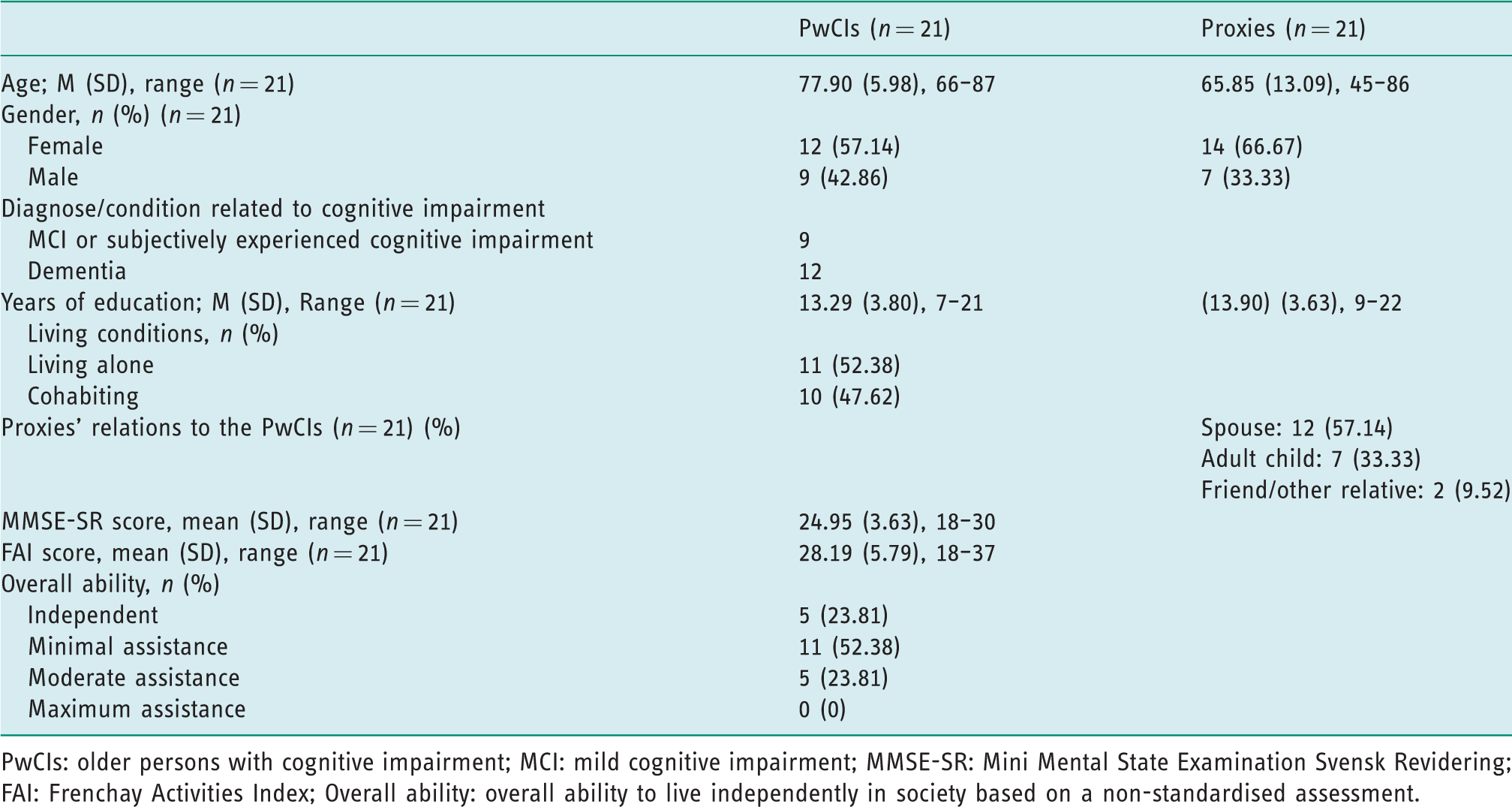
PwCIs: older persons with cognitive impairment; MCI: mild cognitive impairment; MMSE-SR: Mini Mental State Examination Svensk Revidering; FAI: Frenchay Activities Index; Overall ability: overall ability to live independently in society based on a non-standardised assessment.
Inclusion criteria for the PwCIs were (a) age >55 years, (b) use of some ETs in daily life (not being entirely dependent on another person), (c) motivated to participate in the study, (d) any hearing and visual impairments compensated with aids, (e) ability to take part in the interview in Swedish, (f) Mini Mental State Examination Swedish Revision (MMSE-SR) (Palmqvist et al., 2013) score >18 (because scores <18 may indicate that the use of ETs would be less important in daily life because of the disability), (g) diagnosis of cognitive impairment due, for example, to mild cognitive impairment (MCI), dementia, Parkinson’s disease, multiple sclerosis, or stroke (at the earliest 6 months after stroke) or subjectively experienced cognitive impairment. In this study, a subjectively experienced cognitive impairment means that a person experienced a decline in cognition that could not be verified with objective tests or that a memory investigation had not yet been performed. Exclusion criteria were if the cognitive impairment was related to an episode of depression or temporary confusion. No PwCIs were excluded due to these criteria.
The PwCIs were recruited from memory investigation clinics, a traffic medicine centre, and day care clinics in Stockholm, Sweden. Proxies were recruited through recommendations from the PwCIs. Occupational therapists at the different clinics assisted in the recruitment of PwCIs by asking those who met the inclusion criteria if they were interested in participating in the study. Potential participants received oral and written information about the study, and the occupational therapists contacted the research assistant (fourth author), who gathered all of the data. The research assistant contacted the potential participant by phone and repeated the information. For those interested in participating, a time and place for the interview was decided on. In the written and verbal information, it was also requested that a proxy participate in a separate interview. The research assistant asked the PwCI if a proxy could be contacted for inclusion in the study. If so, the research assistant contacted the proxy giving information about the study, and if the proxy agreed then a time and place for the interview was decided.
The inclusion criteria for proxies was an individual chosen by the PwCI who demonstrated some knowledge about the PwCI’s everyday life and was therefore able to answer questions about the PwCI’s ET use. The relationships within the dyads could therefore differ, and the proxy could be for example a partner, an adult child, or a close friend.
Instruments
Socio-demographics, cognition, and ADL
Information about all participants’ gender, age, living situation (only for the PwCIs), years of education, and relationship of the proxies to the PwCIs was gathered in the interview. To further describe the group of PwCIs, the MMSE-SR (Folstein et al., 1975; Palmqvist et al., 2013) and Frenchay Activity Index (FAI) (Holbrook and Skilbeck, 1983) were used in the interviews with the PwCIs (Table 1). The MMSE-SR gives a rough estimate of cognitive functions, such as orientation, memory, and language (Palmqvist et al., 2013). The FAI score describes the frequency with which activities were performed in the previous 3 or 6 months (Holbrook and Skilbeck, 1983). Applying clinical judgement and based on all existing information gathered in interaction with each participant (including the S-ETUQ interviews, FAI, and MMSE-SR), a final non-standardised assessment regarding overall functional level and need for assistance to live in the community was made. This clinical judgement was completed by the interviewer (fourth author) using a set of given criteria regarding overall functional level and independence related to the PwCI’s needs for living in the community using a four-point scale: 1: independent; 2: minimal assistance; 3: moderate assistance; 4: maximum assistance. To clarify, only the PwCIs were evaluated with these assessments, and the outcomes of the MMSE-SR, the FAI, and the non-standardised assessment were only used to describe the sample of PwCIs.
Perceived relevance of and ability to use ETs
The S-ETUQ aims to identify people’s perceptions of the relevance of 32 ETs and their self-perceived ability to use the ETs that are relevant to them (Kottorp and Nygård, 2011). The S-ETUQ is administered in a 20–30 minute face-to-face interview and is a short form of the Everyday Technology Use Questionnaire (Rosenberg et al., 2009). The 32 ETs (Table S1) in the S-ETUQ were systematically selected from the ETUQ to represent a wide range of ETs, including both newly developed and more familiar technological artefacts and systems ranging from very easy to use (for example the coffee machine) to very difficult to use (for example internet banking) (Kottorp and Nygård, 2011). Procedures in developing both the ETUQ and S-ETUQ have been presented in more detail earlier (Kottorp and Nygård, 2011; Rosenberg et al., 2009). The S-ETUQ has been demonstrated to generate person ability measures (as explained in more detail below) of the perceived ability to use ETs that are statistically similar to the ETUQ, thus supporting the validity of the short version (Kottorp and Nygård, 2011). The S-ETUQ also generates a measure of the number of relevant ETs for each person. The number of relevant ETs has, for example, been shown to be sensitive on a group level to differentiate people with MCI from people with Alzheimer’s disease (Ryd et al., 2015). The definition of a relevant ET is that ‘the technology is available to the person and that the technology has earlier been used by the person, is currently used by the person, or is intended to be used by the person’ (Nygård et al., 2016). For each of the relevant ETs, the interviewer documents the participants’ replies regarding perceived ability based on a six-category scale ranging from ‘The ET is used with no uncertainty/difficulties at all’ to ‘The ET is not used even though it is relevant’ (Kottorp and Nygård, 2011) (Table S2). In the present study, relevant ETs refers to the number of relevant ETs reported by each person (sum score measure of maximum 32 ETs). Moreover, in this study we also investigated the relevance for each of the 32 ETs among the participants (a maximum sum score of 21 (the number of dyads) for each of the ETs in the two groups, respectively).
Data collection
Data collection was completed between September 2015 and March 2017 and was performed by the fourth author, an experienced occupational therapist/research assistant who received special training in using the ETUQ by the developers of the instrument. All interviews were conducted in each participant’s home, by their choice. The interviewer collected all information at the same occasion (PwCIs: socio-demographics, cognition, ADL, and the S-ETUQ; Proxies: socio-demographics and the S-ETUQ). The PwCIs and the proxies were not present at each other’s interviews. All interview sessions with the PwCIs followed the same structure, starting with the S-ETUQ, followed by the FAI and MMSE-SR. In the S-ETUQ interview, the PwCIs were first asked about the relevance of the ET, for example, ‘Do you use a mobile phone?’ If they answered yes, then they were asked about their ability to use the ET, for example, ‘How does it work for you, using the mobile phone?’ When the proxies were interviewed, they were asked to estimate the PwCIs’ use of ETs, for example, ‘Does your mother use a mobile phone?’ If yes, they were asked about the PwCIs’ ability to use the ET, for example, ‘How does it work for her, using the mobile phone?’ Based upon the participants’ replies, the interviewer made the scoring.
Data analysis
The data analysis is presented using the two steps of preparatory analysis and primary analysis, both divided into two parts with descriptions of how data on the number of relevant ETs and ability to use ETs were analysed separately. For this analysis, version 3.92.1 of the WINSTEPS software program was used (Linacre, 2017). Also, the Statistical Package for Social Sciences (SPSS) version 25.0 for Windows (Released 2017, IBM Corp., Armonk, NY) and Excel were used. In addition, the web page www.socscistatistics.com was used to perform Fisher’s exact test. The level of significance was set at p < 0.05 for all analyses.
Preparatory analysis
Number of relevant ETs
First, out of the 32 ETs in the S-ETUQ, the total number of ETs perceived or estimated to be relevant at the group level was counted for PwCIs and proxies, respectively. This was also done for each of the participants separately. Secondly, the relevance for each of the 32 ETs was counted and presented in the two groups separately with a maximum sum score measure of 21 (21 PwCIs versus 21 proxies).
Ability to use ETs
The first step was to convert the ordinal raw scores from the S-ETUQ into linear interval-like measures (logits) using a Rasch rating scale model (Bond and Fox, 2007) in WINSTEPS. WINSTEPS generates a person ability measure of the latent variable associated with an individual standard error of each of the generated S-ETUQ measures, two per dyad (one self-report, one proxy report). The person ability measure is defined as the perceived ability to use ETs (PwCIs’ perceived ability vs. proxies’ estimates). The higher the measure (expressed in logits), the higher the ability to use the ET was perceived or estimated, and the lower the measure the lower the ability to use the ET. This specific process of data analysis has been described in detail previously (Kottorp and Nygård, 2011). The S-ETUQ data demonstrated acceptable psychometric properties, and the generated person ability measures (Malinowsky et al., 2011) for this sample were therefore determined to be valid for further statistical analyses. The distribution of the person ability measures was checked for normality using the Kolmogorov–Smirnov, Lilliefors Significance Correlation, which confirmed the normal distribution, and thus parametric tests were used in the following analyses.
Primary analysis
Number of relevant ETs
An independent samples t-test was performed to compare the total number of relevant ETs between the PwCIs and the proxies. To visualise the similarities and differences between the reports of relevant ETs among the PwCIs and the proxies, the number of relevant ETs was evaluated in six topic areas (Table S1): information and communication (15 ETs), household (7 ETs), economy and purchasing (3 ETs), accessibility (3 ETs), travel (3 ETs), and maintenance and repair (1 ET).
The number of relevant ETs was compared within each dyad using Fisher’s exact test. Fisher’s exact tests were also used to systematically compare the sum score measure (maximum score 21) of the relevance for each of the 32 ETs between the PwCIs and the proxies.
Ability to use ETs
On a group level, an independent samples t-test was performed to compare the S-ETUQ person ability measures of the PwCIs with those of the proxies. The S-ETUQ person ability measures were then compared for each dyad using standardised difference z-comparisons. The interpretation of the z-scores was based on the criterion that the differences in measures within each dyad should be greater than ±1.96, corresponding to a 95% confidence interval (Cohen, 1988), and thus demonstrating a statistically significant difference between their measures. By going back to the raw data, factors related to personal characteristics and ET raw scores could be examined to determine if they affected the ability measure.
Results
Comparisons of the numbers of relevant ETs
When comparing the PwCIs’ perceived number of relevant ETs with the proxies’ estimates, a non-significant mean difference was demonstrated on the group level (Table 2). As visualised in Figure S1, however, there was a wider range in the number of relevant ETs among PwCIs than among the proxies’ estimations. Figure 1 shows that the PwCIs’ perceived number of relevant ETs in each of the six topic areas and the proxies’ estimates were highly similar.
Results of the t-test when comparing PwCIs and proxies regarding both the number of relevant ETs and the ability to use the ETs on the group level. There were no significant differences in mean values.
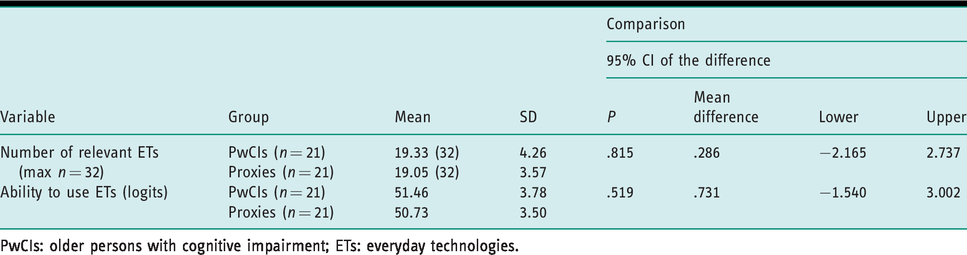
PwCIs: older persons with cognitive impairment; ETs: everyday technologies.
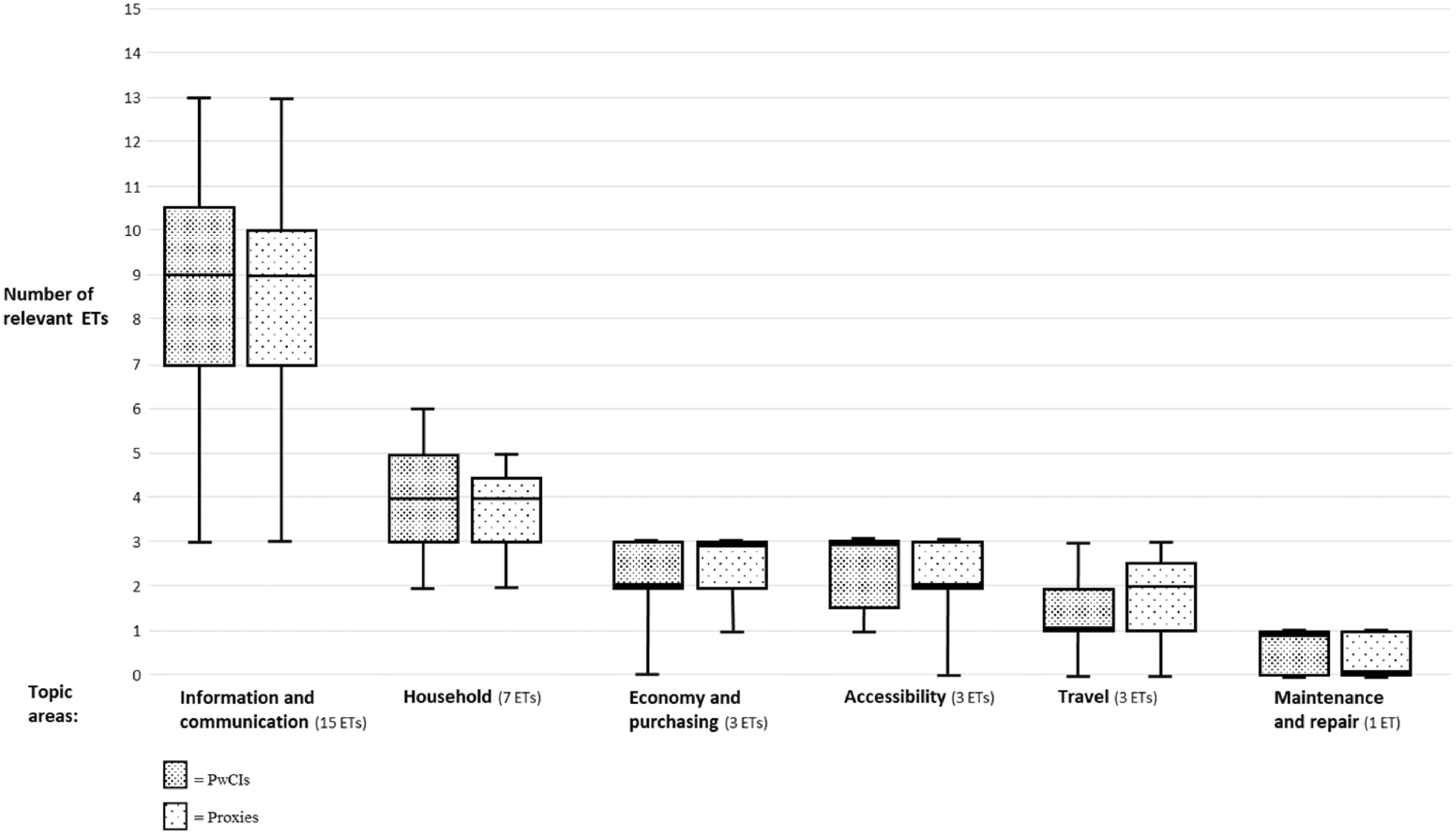
Comparison on the group level between PwCIs’ perceptions and proxies’ estimations regarding the number of relevant ETs, here divided into the six topic areas consisting from 1 to 15 ETs each (32 ETs in total).
On the individual level, on average the PwCIs perceived 1.8 more ETs as relevant than their proxies estimated, but no significant differences were found concerning the number of relevant ETs within any of the 21 dyads.
When examining the sum score measure of relevance (maximum 21 for PwCIs and proxies respectively) for each of the 32 ETs as reported by PwCIs vs. proxies on the group level, no significant differences were found.
Comparisons of the perceived ability to use ETs
When comparing the PwCIs’ perceived ability to use ETs with the proxies’ estimates on a group level, a non-significant mean difference was demonstrated (Table 2). As visualised in Figure 2, the mean ability measure among PwCIs was slightly higher than the estimates of the proxies. Also, there was a wider range among the PwCIs’ perceptions regarding their ability to use ETs compared to the proxies’ estimates.
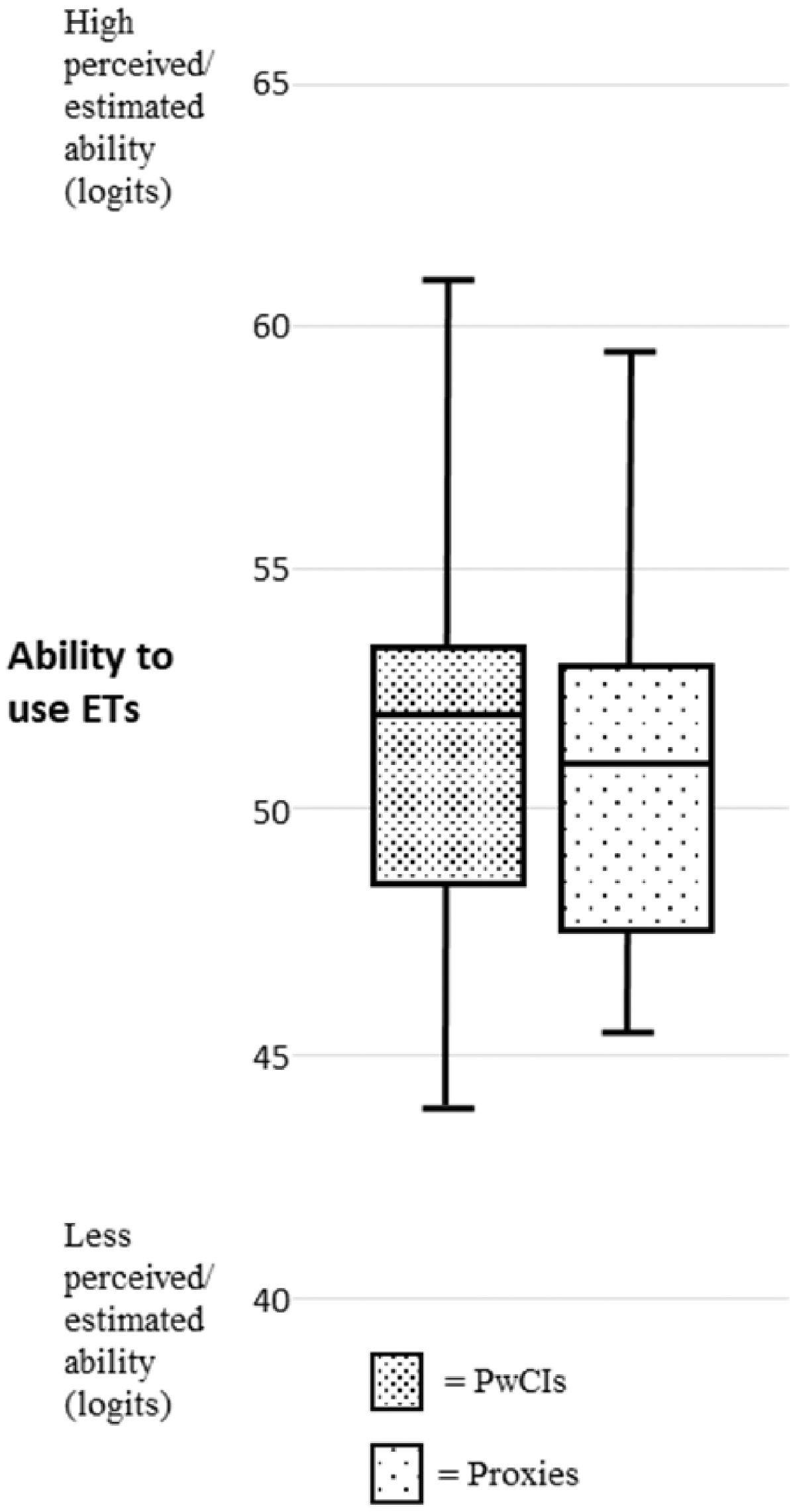
Comparison on the group level between PwCIs’ perceptions and proxies’ estimations regarding the ability to use ETs.
The ability measures within each dyad showed no significant differences within 17 of the 21 dyads (81%). However, the ability measures for four dyads (19%) were found to significantly differ, with z-values between −2.68 and 2.84. In these four dyads, three of the PwCIs perceived higher ability to use ETs than their proxies estimated, and one proxy estimated the PwCI to have higher ability to use ETs than the PwCI perceived. An in-depth analysis investigating possible explanations was conducted to identify factors behind the differences in these four dyads by comparing their individual demographics (for example age), their relationships (for example partner, adult child), and their level of S-ETUQ measures and the differences between them (for example written comments from the interviews). No characteristics were found that could explain the significant differences in these dyads.
Discussion
The aim of this study was to explore the level of agreement between PwCIs’ self-reports and proxies’ reports regarding the number of relevant ETs and the person measure of ability to use the ETs. No significant differences, either on the group level or the person level, were demonstrated between the PwCIs’ perceptions and their proxies’ estimations regarding the number of relevant ETs. Further, the study showed no significant differences on the group level between the PwCIs’ self-perceived ability to use ETs in comparison to their proxies’ estimates. The PwCIs in general perceived their ET use to be similar to their proxies’ estimations, and thus they verified each other’s responses. These findings therefore also provide evidence for alternate forms reliability (Portney, 2020) of the S-ETUQ (PwCIs’ self-perceived abilities and their proxies’ views on their abilities). This means that there is a high likelihood that similar answers will be obtained with the S-ETUQ regardless of whether PwCIs or their proxies are asked. With that said, we want to emphasise the importance of retaining PwCIs as the primary source of personal information regarding ET use. Previous research has shown rich and nuanced results based on the experiences and reflections from PwCIs regarding their ET use (for example Jakobsson et al., 2019). However, the analysis also showed a significant difference within four of the 21 dyads (19%) when comparing the PwCIs’ perceived ability to use ETs and the proxies’ estimates. We cannot currently identify any clear patterns for what caused these dyads to describe ET use differently. However, these findings indicate that it sometimes may be difficult for PwCIs and/or proxies to report on the ability to use ETs.
The present study is the first to use the S-ETUQ in interviews with proxies by asking them to estimate the relevance of ETs and the ability to use ETs for a significant other with cognitive impairment. Our hypothesis, that there is a difference between PwCIs’ perceptions and their proxies’ estimations, was based on the assumption of it being challenging or problematic for proxies to have knowledge of the PwCIs’ ET use. In addition, we assumed that the cognitive deficits could potentially have some impact on PwCIs’ ability for self-assessment. However, our hypothesis was not verified on a general level. Rather, the findings demonstrated a high degree of agreement between the PwCIs’ self-reports and the proxies’ reports, especially when it comes to the number of relevant ETs. The consistency in the result may reflect that the perceptions vs. estimates in the S-ETUQ interview were given in structured conversation with concrete information where the participants themselves did not do the scoring. The fact that IADL functions might be impaired in the early stages of cognitive decline, even before a diagnosis of dementia is established (Luttenberger et al., 2016), and that the individuals are often aware of this happening, may have contributed to making it easy for the PwCIs to describe their ET use. Also, the concrete nature of the questions on ET use in the S-ETUQ might make it easier for both PwCIs and proxies to report ET use than questionnaires that ask more general questions about functioning (Nygård et al., 2015).
When comparing the number of ETs perceived as relevant by PwCIs with the proxies’ estimates, no significant mean differences were demonstrated on the group level (Table 2). Also, when dividing the ETs into topic areas (Figure 1), all boxplots indicated similar sum score measures for the number of relevant ETs between PwCIs and proxies. However, as visualised in the boxplot (Figure S1), there was a wider range in the number of relevant ETs among PwCIs than among proxies. This may indicate that the PwCIs’ perceptions of their ET use are more insightful than the proxies’ and that proxies’ insights into the PwCIs’ ET use may not be as detailed.
In earlier reports, family proxies have been seen as more reliable than PwCIs due to PwCIs’ cognitive deficits being assumed to lead to incorrect estimations of their own abilities (Østbye et al., 1997). Turning to proxies for information is still a common practice. However, current research points to the importance of asking people themselves (Novek and Wilkinson, 2019). This is partly because PwCIs can speak for themselves (Cridland et al., 2016) and partly, as Murphy and colleagues (2015) argue, because research on PwCIs focuses on their (eventual) shortcomings and thus it is very important to emphasise how valuable their personal contributions to research are and thus the importance of including them as the primary source of information. If the individual’s opinion is missing, there is a risk that important personal details will be lost when evaluating ET use.
In the present study, the relationship between the PwCIs and the proxies was considered close, meaning that the proxies had insight into the PwCIs’ daily lives. Regardless of relationship type (spouse, adult child, or friend/other relative), the proxies could make fair estimations about their relatives’ ET use. Even though the present study did not seek to compare different kinds of relationships, other studies have investigated such parameters and found that the kinds of relationships between the PwCIs and the proxies might have an effect on the outcome (Morrell et al., 2019). Spouse proxies have, for example, been shown to score ‘quality of life’ higher than other proxies such as adult children (Lin et al., 2017), which may indicate that the participant–proxy relationship can affect the results in studies of PwCIs. Further, other factors may affect the proxy estimations; for example, Buchanan and Loveday (2018) question the reliability of single individual proxy ratings due to both over- and under-estimations.
To increase our knowledge about how and if the kind of relationship affects proxy estimations about ET use, further research is needed. Martyr and Clare (2018) showed that self-ratings among people with early-stage dementia were more accurate than the proxy ratings (spouses or adult children) when compared with objectively assessed functional ability; thus, they suggested that self-ratings might offer more accurate estimates. Another study, focusing on self-ratings and proxy (professional care providers) ratings of ADL in PwCIs living in nursing homes showed that those with higher MMSE scores could assess their ADL with reasonable accuracy but that proxies’ estimates might be closer to the actual status assessed by professional care providers among those with lower MMSE scores (mean 13.0) (Macháčová et al., 2018). In the present study, regardless of the PwCIs’ MMSE-SR score, there was a high agreement between PwCIs’ perceptions and proxies’ estimates. However, it is worth noting that all PwCIs had relatively high cognitive function. In a longitudinal study in which persons with a cognitive impairment were followed for 5 years, it was found that participants who developed dementia during those years also had increasingly impaired ability to use ETs over time (Hedman et al., 2018). However, the participants in the longitudinal study still had the cognitive capacity to account for their ET use after their dementia diagnosis, which was also seen in the present study. Despite this, it is likely that the ability to accurately describe one’s ET use decreases with extensive cognitive impairment. At the same time, the use of ETs might be less relevant or not relevant at all for persons with severe dementia.
Interestingly, when clinical professionals such as occupational therapists ask clients about ET use, it is also possible to get valuable information about the clients and their proxies’ roles and how these have changed over time, such as when disability enters the lives of the dyad. This information then makes it easier to provide individually tailored support (Rosenberg and Nygård, 2017). For couples living together, the everyday occupations also tend to transform from ‘I do’ into ‘we do’ when one of them suffers cognitive impairment such as dementia (Vikström et al., 2008). This may also have been the case in the present study. When performing occupations together side by side, this creates a transparent insight for the proxies into the PwCI’s actual ET use, but it might also make it more challenging to distinguish the ability of one part from that of the other, as the ETUQ requires. Even though the current study shows that PwCIs and proxies verified each other’s responses, we want to make clear that their separate information is not to be considered interchangeable (Römhild et al., 2018). That is, when investigating ET use in everyday life, we emphasise that there are situations when including both PwCIs and proxies are fruitful and sometimes a prerequisite for the PwCIs to feel safe and supported, and the double perspective might create a wider picture of ET use among PwCIs. Because the present study demonstrates that the PwCIs had the ability to describe their ET use themselves, we argue that it is reasonable and important to focus on the individual’s subjective perceptions as the primary source of information concerning their ET use in research and practice. Investigating PwCIs’ opinions about their everyday life goes in line with striving towards high-quality person-centred care.
Limitations and recommendations for future research
This study involved a small sample of PwCIs (n = 21) and their proxies (n = 21), and thus the results might not represent the larger population. Despite the small sample, the size is seen as effective (VanVoorhis and Morgan, 2007), with a variation in characteristics (for example age, cognitive status, and relationship) as presented in Table 1. However, proxies’ estimates have not been used before in the S-ETUQ (nor in the ETUQ), and thus more research is needed to determine if the results from this study are representative of other and larger samples. Because the scoring in the S-ETUQ was performed by a single interviewer (CBO), the first author (EJ) managed and controlled all raw interview data and made comparisons between scorings and the interviewer’s written comments to make sure the scorings were correct. In consultation with the interviewer and last author (CM), minor changes were made in a few cases.
Future research with a larger sample is needed to explore the reasons for differences within some dyads and how/if the type of relationship between PwCIs and proxies affects the outcome. For example, we do not know how well other proxies who are not as close to the PwCIs, such as professional proxies, are able to estimate PwCIs’ ET use. Further research, such as longitudinal studies investigating self-ratings vs. proxy ratings of ET use over time, could establish whether the level of accuracy between them remains as cognition declines. At the same time, it is important to keep in mind the risk of over- and under-estimations among both PwCIs and proxies.
Because the focus in this study was the comparison between the perceptions of the PwCIs and their proxies’ estimates, we did not divide the PwCIs into different diagnostic groups (that is, dementia and mild cognitive impairment), but doing so might be interesting in a larger sample. Another aspect of interest in future research would be to complement the self-reports and proxy ratings with performance observations (Bartels et al., 2020), which might be supplemented with information from an occupational therapy perspective.
Conclusion
This study shows that our sample of PwCIs’ perceptions of their ability to use ETs and the number of relevant ETs strongly agree with their proxies’ estimations. We interpret the high level of agreement between PwCIs and proxies as verifying each other’s responses. This indicates that PwCIs should be the primary source for information about their ET use and that it is important to involve PwCIs in investigations that concern their lives, both in research and in clinical work. Using interview tools such as S-ETUQ in communication with PwCIs and/or their proxies may thereby facilitate a person-centred approach in occupational therapy practice.
Key findings
There was a high agreement between the PwCIs’ self-reports and proxies’ reports on the number of relevant ETs. Within 81% of the dyads there was a high agreement between PwCIs’ self-reports vs. proxies’ reports regarding the ability to use ETs.
What the study has added
This study shows that PwCIs’ self-reports and proxies’ reports regarding ET use verify each other’s responses, indicating that PwCIs should be the primary source of information about their own ET use both in research and in clinical work.
Supplemental Material
sj-pdf-1-bjo-10.1177_0308022620954117 - Supplemental material for The use of everyday technology; a comparison of older persons with cognitive impairments’ self-reports and their proxies’ reports
Supplemental material, sj-pdf-1-bjo-10.1177_0308022620954117 for The use of everyday technology; a comparison of older persons with cognitive impairments’ self-reports and their proxies’ reports by Elin Jakobsson, Louise Nygård, Anders Kottorp, Cecilia Bråkenhielm Olsson and Camilla Malinowsky in British Journal of Occupational Therapy
Footnotes
Acknowledgements
We wish to thank all the participants who contributed so generously to making this study possible. We also wish to thank the occupational therapists who helped with the recruitment of participants.
Research ethics
Approval for the study was granted by the regional ethical committee in Stockholm (Dnr. 2012/2031-31/5) before the study was initiated. This study is designed and conducted to achieve a high degree of validity as well as reliability focusing on the participants’ reports. Throughout the process, ethical discussions between the authors have been conducted to maintain focus on the participants’ perceptions vs. estimations.
Consent
All participants provided written informed consent to be interviewed for the study.
Contributorship
All authors contributed to the design of the project. Cecilia Bråkenhielm Olsson administrated the data collection. Elin Jakobsson and Camilla Malinowsky carried out the statistical analysis, and all authors interpreted the data. Elin Jakobsson researched the literature and was responsible in writing the manuscript in close collaboration with Camilla Malinowsky. All authors reviewed and edited the manuscript and approved the final version.
Declaration of conflicting interests
The authors confirm that there is no conflict of interest.
Funding
The authors disclosed receipt of the following financial support for the research, authorship, and/or publication of this article: This study was funded by the Doctoral School in Health Care Sciences (FiV), the Swedish Council for Health, Working Life and Welfare (FORTE), and the Swedish Research Council (VR).

Supplemental material
Supplemental material for this article is available online.
References
Supplementary Material
Please find the following supplemental material available below.
For Open Access articles published under a Creative Commons License, all supplemental material carries the same license as the article it is associated with.
For non-Open Access articles published, all supplemental material carries a non-exclusive license, and permission requests for re-use of supplemental material or any part of supplemental material shall be sent directly to the copyright owner as specified in the copyright notice associated with the article.
