




Abstract
Introduction
Narrative storytelling is a relational process. While interest in storytelling in brain injury rehabilitation is increasing, little attention has been directed to the interpersonal relationships experienced through storytelling. As part of a larger study exploring narrative storytelling, this paper reports on the intersection of experiences between those sharing their story and those listening to the story.
Method
A qualitative grounded theory approach informed all stages of the study. In-depth interviews were conducted with adult storytellers with severe acquired brain injury and facilitators of a storytelling advocacy programme.
Findings
Analysis of the intersection of data from 28 transcripts of interviews with eight storytellers and six facilitators was conducted. Two key relationships emerged to be central to the storytelling experience: (1) a collaborative partnership between the storytellers and the advocacy organisation, and (2) an intentional story-sharing relationship between the storytellers and facilitators. The advocacy context of helping others through story-sharing was central to the meaningfulness of the experience.
Conclusion
Narrative storytelling is a social relationship experience with much potential for building relationships in rehabilitation. Sharing stories of lived experience of disability presents an opportunity for meaningful occupational engagement, enabling social connectedness and contribution to society.
Keywords
Introduction
Narrative storytelling is an interpersonal exchange between a person telling a story and a person listening to a story (Riessman, 2003). It is a relational experience, underpinned by a social-constructivist framework (Gergen and Gergen, 2014), with a temporal structure of a beginning, middle and end (McAdams, 2001; Mattingly, 1994; Polkinghorne, 1996). The temporal structure or plot of storytelling is defined as the narrative, while stories, storytelling, life stories and personal stories refer to the relational experience of telling and sharing life experiences (Polkinghorne, 1996). Narrative storytelling is recognised as a meaning-making process, drawing upon the temporal structure to integrate past experiences with the new, creating coherence (Adler, 2012; McAdams, 2001). In the healthcare context, narrative storytelling supports transformative growth following trauma or disruption to the life narrative (Kaufman, 1988). Narrative approaches include: life stories, life thread model (Ellis-Hill et al., 2008), therapeutic employment (Mattingly, 1994), writing, song-writing, digital storytelling and web-based storytelling. Telling and sharing stories facilitates a shift to more ‘agentic’ narratives (Polkinghorne, 1996), creating new stories or possibilities (Mattingly, 1994). More specifically to occupational therapy, narrative storytelling has theoretical foundations in occupational science, recognised as an approach to enabling experiences of ‘being’ through meaningful occupational engagement (Christiansen, 1999; Townsend and Polatajko, 2013).
This study sought to better understand the experience and impact of narrative storytelling following acquired brain injury (ABI). ABI is an acquired neurological disability resulting in physical, cognitive, communication and emotional changes impacting life roles and meaningful occupational engagement (Ponsford et al., 2013). Adapting to life following ABI is a complex and lifelong process, and despite the concerted efforts of holistic rehabilitation, loss of identity and social isolation remain a significant challenge (Douglas, 2019; Ownsworth, 2014). Narrative storytelling is gaining interest as an approach to supporting positive identity growth following ABI (D'Cruz et al., 2019b); however, few authors have directly examined the use of narrative storytelling in ABI rehabilitation. A first stage of this study was to explore the experience of narrative storytelling from the perspective of storytellers with ABI. Storytelling was found to be a positive experience for the storytellers. Consistent with the advocacy context of the storytelling programme, the storytellers were primarily motivated to participate in the storytelling to help others through sharing their story. However, they also found the experience to be personally beneficial, reporting experiences of feeling heard and releasing emotion (D'Cruz et al., 2019a). Building upon these findings, the present study explored the perspectives of the storytelling facilitators. By analysing the intersection of data between the storytellers and facilitators, we sought to better understand the relational nature of storytelling, in particular the influence of the facilitator role upon the storyteller experience.
Method
Design
This study was guided by constructivist and interpretivist paradigms and qualitative research methodology (Liamputtong, 2012). Given the relational nature of storytelling as a psychosocial construction (Gergen and Gergen, 2014; McAdams, 2001) and the researchers’ interest in seeking more than one perspective, a constructivist grounded theory method was chosen (Charmaz, 2013).
Procedure
The following description outlines the process of research relevant to the findings reported in this study. A full description of the research methods can be found in an earlier publication (D'Cruz et al., 2019a).
Participants, both storytellers and facilitators, were recruited from an advocacy organisation in Australia that facilitates storytelling workshops for adults with disability. The workshops involve one-to-one story-sharing between storytellers and facilitators, in which storytellers share their personal life story. Through the production and sharing of personal narratives, the organisation seeks to advocate for the rights of young people residing in nursing homes or at risk of entering nursing homes. The overall aim of the organisation is to prevent young people with disability from being forced to live in nursing homes. While the organisation’s aim is explicitly communicated to the storytellers, and the focus of the storytelling is steered towards the issue of young people in nursing homes, the storytellers are encouraged to share their personal life story. The produced stories are digital stories or written profiles. Digital stories are a 5–10-minute co-constructed digital clip narrated by the storytellers, while written profiles are a third-person account of the storyteller’s story, with a photograph of the storyteller, in an electronic or paper document.
Research participants included storytellers and facilitators. Storytellers were adults living with non-degenerative ABI who had previously participated in a storytelling workshop and were able to provide informed consent. The selection criteria were inclusive of any age within the adult range of 19–65 years, sex, severity of ABI, living situation and time since injury. Consistent with the characteristics of people living with ABI, storytellers with cognitive and/or communication impairments were not excluded. Facilitators were eligible if they had previously facilitated a storytelling workshop. No limit was placed on age, gender, professional background or facilitation experience.
Semi-structured, face-to-face interviews were the primary form of data collection with both groups of participants. Interviews were transcribed verbatim and descriptive demographic information was collected. All participants gave written consent prior to participation, pseudonyms were ascribed and approval was granted by the University Human Research Ethics Committee (HEC16-085). Each interview was conducted by the primary author in a location chosen by the participant, and lasted approximately 1 hour. Each storyteller was interviewed at least twice, while one interview was sufficient with each of the facilitators, except in the instance of one participant who was interviewed twice.
Written transcripts of 21 recorded storyteller interviews and seven recorded facilitator interviews were analysed following constructivist grounded theory methods (Charmaz, 2013). In total, 28 transcripts were analysed with the use of NVivo software version 10, along with member-checking documents, personal narratives, memo writing and the researcher’s reflective journal. The primary researcher coded all the transcripts, 50% of which were verified by the other two authors. Data analysis followed the constant-comparative method as outlined by Charmaz (2013). The storyteller and facilitator data were analysed separately using initial and focused coding, while axial and theoretical coding enabled broader conceptual analysis of the data, and a focused exploration of the intersection of the storyteller and facilitator data. Additional member-checking interviews were conducted with four storytellers to further explore their relationship experiences with the facilitators. At this point no further categories emerged, and it was decided by all three authors that data saturation had been achieved.
Findings
Eight storytellers with severe ABI (five female, three male) and six facilitators (five female, one male) participated in this study. Participant demographics are outlined in Table 1.
Participant demographics.
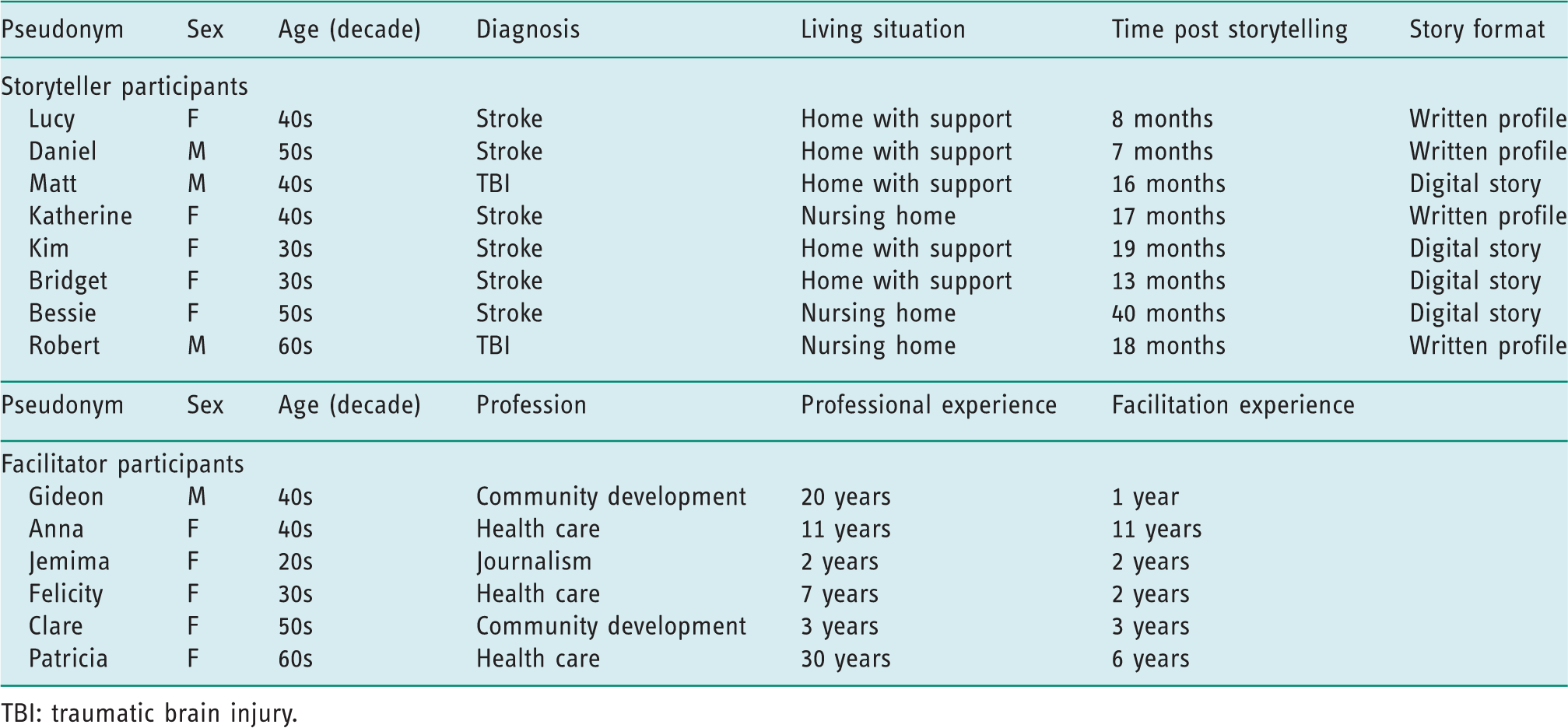
TBI: traumatic brain injury.
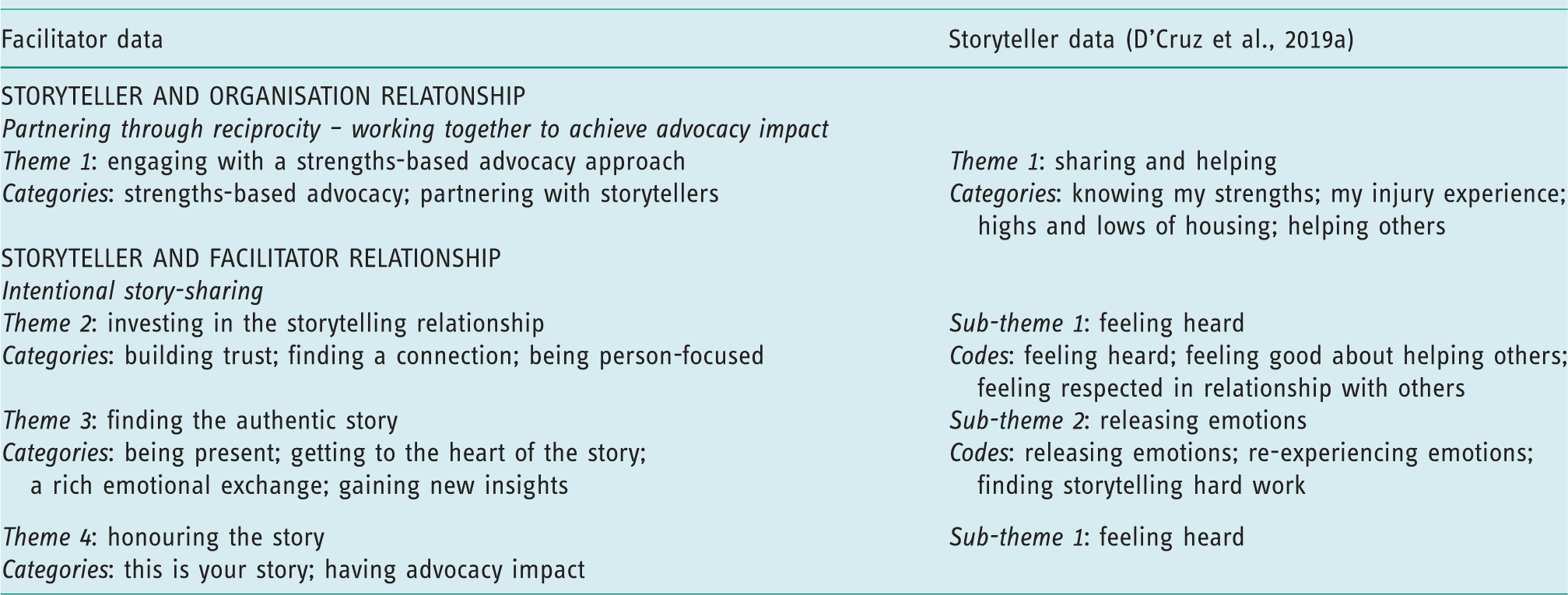
The findings of this study provide insights into narrative storytelling, as part of a storytelling advocacy programme, informed by the intersection of experiences between the storytellers and facilitators. Two key relationships emerged to be central to the storytelling experience: (1) between the storytellers and the organisation (partnering through reciprocity: working together to achieve advocacy impact) and (2) between the storytellers and the facilitators (intentional story-sharing). The following findings, drawn from the perspectives of both the storytellers and facilitators, are presented within the framework of these two key relationship experiences. See Table 2 for a summary of the thematic research findings.
Relational space thematic findings: intersection of storyteller and facilitator data.
Partnering through reciprocity: working together to achieve advocacy impact
Central to the storytellers’ experiences was their partnership with the organisation: a mutually beneficial partnership characterised by reciprocity. This partnership was informed by the advocacy mission of the organisation and founded on a shared vision to use stories of lived experiences to create change for young adults with disability living in nursing homes. Of significance to this partnership was the person-focused and strengths-based approach of the organisation, which recognised the capacity of the storytellers, valued their contribution and engaged with them respectfully. As shared by Felicity, one of the facilitators: ‘The main mission [of the organisation] is to make sure that the storyteller is comfortable and we never do anything or we’ll never work in a way that was not aligned with what they want’. This view of working together in partnership was endorsed by the storytellers, who described their experience of the partnership as collaborative and built upon trust. When reflecting upon her partnership with the organisation, Kim, a storyteller, shared, ‘they haven’t broken a promise … I feel respected’. For Daniel, respect was experienced when the organisation arranged and paid for his transport to and from the storytelling workshop. He said, ‘That made me feel needed’. Anna, one of the facilitators, further explained how the organisation recognises the contribution of the storytellers as informing their advocacy work. In this context of reciprocity, Anna described the partnership ‘as more of a collaboration than anything else’. Bridget, a storyteller, reflected that her experiences of ABI are a resource that she can share with the advocacy organisation. She said, ‘I am happy to have this opportunity to help … I’ve always felt like I would like to help but this experience has given me more time and more opportunity’.
While not intense in frequency, the storytellers also spoke positively of the organisation’s commitment to maintaining their partnership. Storytellers shared examples such as the organisation seeking permission to use their story on new advocacy campaigns, giving feedback on the continued use of their story, or asking the storytellers to share their story again for a different advocacy purpose or audience. The storytellers also talked about being invited to annual meetings and community forums, or contributing to Royal Commissions. Daniel explained, ‘I go to the AGM [annual general meeting of advocacy organisation] every year and the workshop at the headquarters every year. And I would like to continue on with other work that I could with them’. The storytellers valued this contact, which contributed to their respect for, and trust in, the organisation, and served to maintain their sense of purpose as active contributors to the organisation’s advocacy mission.
Intentional story-sharing
While the storytelling intent was for advocacy impact, the experience of sharing their story was deeply personal for the storytellers. The following themes, drawn from the storyteller and facilitator data, provide insights into the intentional nature of the story-sharing relationship between the storytellers and facilitators.
Investing in the storytelling relationship
This theme describes the initial phase of relationship-building between the facilitators and storytellers. The facilitators sought to build a relationship with the storytellers that enabled the storytellers to share their story and to feel valued and heard. Daniel, one of the storytellers, described the way that the facilitator engaged with him. He said, ‘I think he just engaged me as a person. He treated me like a human being. I think he listened well’. Similarly, Patricia, one of the facilitators, reflected, ‘I think it is just relief isn’t it, to talk about something and think that somebody is actually listening to you’. Consistent with the person-focused approach of the organisation, the facilitators invested in creating environments for comfortable story-sharing that met the unique needs of each storyteller. The facilitators also invested time in building trusting relationships. ‘In this kind of work we give ourselves that time to build those relationships, which is important’ (Jemima, facilitator). Bridget, one of the storytellers with dysarthria, described how she felt supported in her communication. She said, ‘They weren’t condescending. They have patience. Supportive … allow you to communicate’. The facilitators acknowledged the responsibility of facilitating storytelling and valued the opportunity afforded by the organisation to respectfully and authentically listen to each story. In addition, they recognised the value of the strengths-based nature of the facilitation role, which enabled them to focus on the whole person sharing the story and not the impairment or disability.
The relationship between the storytellers and facilitators was also fostered through personal sharing by the facilitators. While mindful of professional boundaries, the facilitators reflected that the person-focused approach of the organisation enabled them to connect more personally with the storytellers. As shared by Clare, a facilitator, ‘Sometimes that is also sharing some of your personal stuff too. I think they [storytellers] realise that you’re human – helps them relate better’. The facilitators described what Gideon labelled ‘looking for clues as to what we have in common’ as part of this process of connecting with and sharing in dialogue with the storytellers. Upon further exploration, each facilitator had different points of connection with the storytellers that reflected their own experiences, such as: having friends or family with disability, having allied health expertise, or being at a similar life stage. The facilitators felt this point of connection with the storytellers strengthened their relationship and helped to build trust and familiarity.
Finding the authentic story
This theme describes the process of building upon the initial rapport, facilitating the storytellers to engage in deeper personal story-sharing. The facilitators recognised the importance of showing interest, curiosity, and a commitment to listen and understand the life world of the storytellers. Patricia, a facilitator, shared: It’s a genuine sense of wanting to know. And I think we all do. We really care about where people are at and about them getting somewhere better. So it’s a kind of curiosity. There’s a kind of compassion … you need to listen and reflect. And self-awareness.
The facilitators also recognised the intensely emotional nature of deeper story-sharing for both the storytellers and facilitators. Patricia shared, ‘Sitting there and listening and that being kind of my sole purpose, just allowed me to feel a lot more’. The facilitators described gratitude for the experience of feeling emotions with the storytellers, while also acknowledging the challenge of coping with these emotions. Gideon shared, ‘I think a good interviewer is someone who can relate emotionally, have a high EQ [emotional quotient] at least but it’s fraught with problems as well because once you engage with someone’s life it’s very hard to unplug’. Jemima talked about ‘that balance between building rapport with the person and not just being an emotional wreck’. However, mostly the facilitators talked about what they gained personally from engaging in emotional work with the storytellers. Anna shared, ‘When I feel drained it is more because I have invested myself. I have had to be really attentive to everything – it hasn’t taken something from me. It is more that I have given something’. She went on to say, ‘When I am hearing someone’s story I am learning from their story and I am valuing what they are saying’.
Honouring the story
This theme captures the process of creating the story end product and taking it back to the storytellers for review before finalising and sharing more widely in the community. Central to this experience for each of the facilitators was ensuring that the end product celebrated each storyteller and honoured their story. Anna, one of the facilitators, reflected, ‘I want whatever we produce to be something that the storyteller can actually be proud of showing other people and be happy to show other people’. The facilitators spoke passionately about ensuring they captured the essence of the storyteller in their story. While the digital stories are a first-person narration by the storyteller, the profiles are written in the third person, or as described by Gideon, ‘Through the eyes of others’. Reflecting upon the writing process, Patricia said, ‘I am primarily respecting the words – you know, the person that I’m writing about – there’s a lot of integrity … I’m trying to stay true to the person who has given us their time and told us their story’. Similarly, Felicity shared, ‘I wouldn’t want the storyteller to ever feel like they had provided us something and been so open with us and then we used it in a way that was not true to them’. Consistent with this aim, the storytellers spoke of their experience of hearing or seeing their story for the first time and being struck by the authenticity of their story. Daniel, one of the storytellers, commented: I think his [facilitator] role was to get a sense of my story. And put it on paper and he did an excellent job … I think it would have been degrading to have it shabbily done … Finding those correct words, they don’t have to be longwinded or long words, just the correct words.
Discussion
The findings of this study are grounded in the experiences of the storytellers and facilitators. Building upon earlier work that focused solely upon the experiences of the storytellers (D'Cruz et al., 2019a), the unique contribution of this study is the insights gained from analysing the intersection of data from both groups of participants. Central to the storytelling experience were two key relationships: an enduring and collaborative partnership between the storytellers and the organisation, and an intentional story-sharing relationship between the storytellers and facilitators.
Recognition of the centrality of relationships to the storytelling experience affirms the constructivist view of story-sharing (Gergen and Gergen, 2014). However, the significance of this finding comes to attention when considered in the context of the social isolation frequently experienced by people with ABI. As outlined in the introduction, acquired disabilities such as ABI interrupt lives, disrupting and often fracturing social relationships (Douglas, 2019; Levack et al., 2010). In a qualitative exploration of friendship experiences of 23 adults with severe brain injury living in the community, Douglas (2019) reported that 61% of participants had no friends outside family and paid carers. Access to meaningful social relationships and participation is even more restricted for many young adults with ABI who are placed in nursing home accommodation (Barry et al., 2019; Colantonio et al., 2010; Levack and Thornton, 2017; McMillan and Laurie, 2004; Persson and Ostwald, 2009; Winkler et al., 2010, 2012). While holistic ABI rehabilitation seeks to support survivors to reintegrate back into their community and experience social connectedness, evidence suggests that loss of friendships remains a key challenge for ABI rehabilitation (Douglas, 2019). The findings of this study emphasise the potential contribution of narrative storytelling in enabling positive relationship experiences for storytellers.
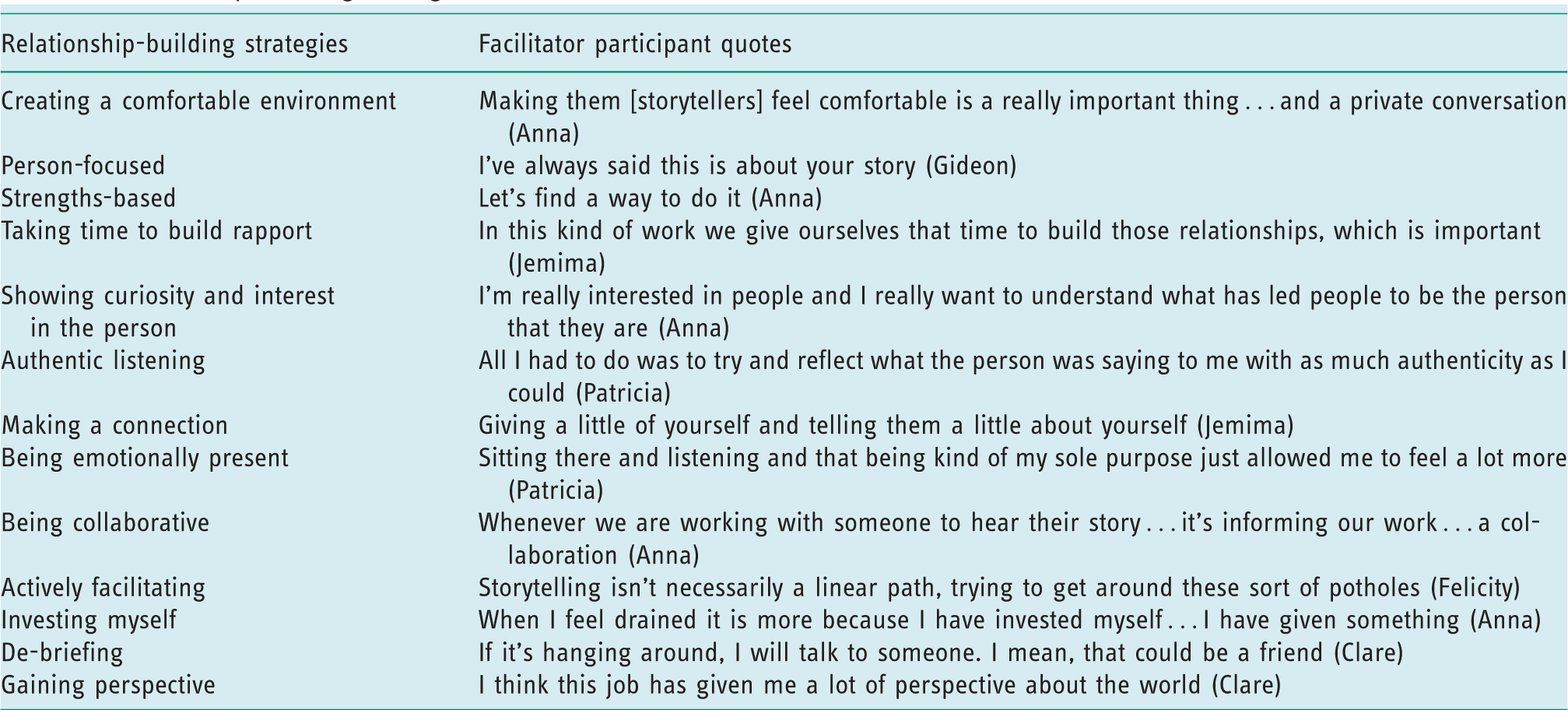
Consistent with the client-centred foundation of occupational therapy (Townsend and Polatajko, 2013), the facilitators engaged respectfully and authentically with the storytellers. As outlined in Table 3, they invested time to build relationships, showing genuine interest and curiosity in the storytellers, listening intentionally and making a personal connection. The storytellers valued this person-focused engagement, a finding supported by previous research exploring preferred qualities of health professionals, from the perspective of clients and families (Bright et al., 2017; Terry and Kayes, 2019). The facilitators in this study also adopted a strengths-based approach that fostered collaboration with the storytellers, as opposed to ‘doing to’ or an imbalanced power relationship. While occupational therapists espouse ‘equal’ relationships with clients, as informed by principles of client-centred practice, evidence suggests that this can be challenging (Sumsion and Smyth, 2000), especially in the context of neurological rehabilitation, in which cognitive and communication impairments have been identified as barriers to person-centred partnerships (Conneeley, 2004; Doig et al., 2008). In this study, the facilitators highlighted the complexity of facilitation, recognising the importance of actively working with the storytellers to maximise their engagement and adopting a ‘let’s find a way’ approach to navigating cognitive and communication barriers. While not always practical in a clinical context, the facilitators also noted the value in being present ‘to truly listen’ to the stories shared, working in a role that did not require them to act on the information, but rather their sole purpose was to listen. In this sense, narrative storytelling acted as a springboard for personal and emotional information sharing, fostered through person-centred facilitation.
Relationship-building strategies drawn from facilitator data.
In addition to the positive relationship experience between the storytellers and the facilitators, the partnership between the storytellers and the advocacy organisation was of key importance. In particular, the storytellers appreciated the enduring nature of this partnership and the way in which the organisation sought and valued their contribution. The storytellers experienced validation and a sense of achievement in this productive role of sharing their story to help others (D'Cruz et al., 2019a), which was further reinforced through their partnership with the advocacy organisation. This finding extended upon the findings of our recent scoping review of personal narrative approaches in ABI rehabilitation (D'Cruz et al., 2019b), in which opportunities to share stories and make a public contribution were valued, although only evident in four of the 12 retrieved articles. Enabling clients to engage in meaningful and purposeful occupations is central to occupational therapy practice (Townsend and Polatajko, 2013), founded on an understanding of the relationship between occupational engagement and wellbeing (Wilcock, 2006). Furthermore, the partnership between the storytellers and the advocacy organisation was founded on a view of the storytellers’ lived experiences of ABI as a resource of knowledge, enabling a strengths-based partnership, further validating the capacity of the storytellers.
Clinical implications
While this study was not conducted in a clinical setting, the findings have clinical practice relevance. Building positive therapeutic relationships with clients and supporting social connectedness is central to health care practice, especially in the context of ABI rehabilitation. The findings of this study recognise opportunities for positive relationship experiences through engagement in narrative storytelling. In addition, the freedom experienced by the facilitators in this study to authentically listen to the stories shared by the storytellers challenges the practice of health professionals, who may at times be directed away from listening to focus more on information-gathering as determined by a structured process. The findings posit the possibility of dedicating time to authentically listen and invest in rapport-building, through narrative approaches. Consistent with the findings of a recent study exploring engagement in goal-setting (Prescott et al., 2019), listening in this manner may indeed be beneficial for better understanding the needs and wishes of clients to guide more meaningful goal-setting, in addition to building a constructive therapeutic relationship. Drawing upon our understanding of the complex and chronic experience of social isolation for survivors of ABI, narrative storytelling is an accessible addition to holistic rehabilitation programmes seeking to build positive relationship experiences and successful community re-integration.
Strikingly, in this study the storytellers talked positively not just of their relationship with the facilitators, but also their partnership with the advocacy organisation. This partnership was characterised as enduring and founded on reciprocity in working together to share stories of lived experience. While not all clinical settings have the organisational structure to replicate such a partnership, the study findings encourage consideration of ways to create enduring partnerships with clients that are respectful and purposeful. Possible options may include consumer advisory boards, prolonged engagement research operating in parallel to clinical programmes, or collaborations with clients on conference presentations. In the context of this study, infrequent but meaningful contact was sufficient to preserve this productive partnership over time. Further, the respectful, strength-based partnership between storytellers and the advocacy organisation influenced the person-centred approach employed by the facilitators, suggesting the importance of organisations taking the lead in person-centred practice.
Quality
The research quality and trustworthiness was considered at every stage of the planning and implementation of this qualitative study (Liamputtong, 2012). Triangulation of data was achieved with two participant groups, multiple research interviews, and inclusion of other sources of data such as personal narratives, memo writing and the researcher’s reflections. Multiple interviews also enabled prolonged engagement. The documentation of the research process and the use of participant quotes ensured thick description, contributing to the trustworthiness of the findings. Given the researcher’s interest in better understanding narrative storytelling from the perspective of both storytellers and facilitators, and the subsequent need for in-depth conceptual analysis of the intersection of the participants’ experiences, reflexivity was integral to the research process. Journaling and diagramming assisted in this process.
Limitations
While it was important to seek the views of storytellers and facilitators, enabling analysis of the intersection of data, participants were recruited from only one organisation, limiting the generalisability of the findings. Further, the storytellers had all sustained severe ABI, thus their experiences cannot be generalised to those with mild or moderate injuries. Time post-injury ranged from 3–18 years, so their experiences were reflective of considerable lived experience of ABI. While the findings have clinical relevance, it should be acknowledged that the study was conducted in the context of a community-based advocacy organisation. A key strength of this study is the richness of the data collected through in-depth interviews, resulting in a total of 28 interview transcripts, across the two participant groups. Seeking the views of two participant groups contributed to the quality of the produced data; however, analysis of the intersection of data was a complex process requiring expert guidance from the more experienced members of the research team.
Conclusion
This study sought to better understand the subjective experience of narrative storytelling in the context of an advocacy storytelling programme. The focus of this paper was upon the intersection of data from the storytellers and facilitators, revealing the importance of relationships to the storytelling process. Narrative storytelling enabled positive relationship experiences and opportunities for social connection between the storytellers, the facilitators and the advocacy organisation. The findings of this study affirm the potential contribution of narrative storytelling in ABI rehabilitation in addressing the loss of social relationships, especially in the context of storytelling programmes in which lived experiences of disability are valued and embraced.
Key findings
Narrative storytelling is a social relationship experience with potential for building relationships in rehabilitation. Sharing stories of lived experience is an opportunity for meaningful occupational engagement and social connection.
What the study has added
This study provides insights into the relational nature of narrative storytelling, emphasising the significance of relationships at an organisational level, and between storytellers and facilitators in story-sharing.
Footnotes
Acknowledgements
Sincere thanks are extended to the participants of this research, who generously shared their experiences.
Research ethics
Ethical approval was obtained from the University Human Research Ethics Committee, La Trobe University, Melbourne, Australia, 2016 (HEC16-085).
Consent
All participants provided written informed consent to be interviewed for the study.
Declaration of conflicting interests
The authors declared no potential conflicts of interest with respect to the research, authorship and/or publication of this article.
Funding
The authors disclosed receipt of the following financial support for the research: This work was supported by a postgraduate doctoral scholarship made available through La Trobe University and Summer Foundation Research Partnership.
Contributorship
Kate D’Cruz, Jacinta Douglas and Tanya Serry were involved in the design of the study and applied for ethical approval. All authors contributed to the thematic analysis of the collected data, reviewed and edited the manuscript, and approved the final version.
Kate D’Cruz conducted the research interviews and wrote the first draft of the manuscript.
