




Abstract
This paper discusses knowledge sharing through scenario development as applied in the interdisciplinary and international research project uVITAL. It focused on user-oriented upgrading of the social housing stock. The aim was to gain deeper insights into the specificities and commonalities of the four country case studies involved. Two online workshops, which included various steps for scenario development, were particularly important during the COVID-19 pandemic when face-to-face exchanges were not possible. A Miro whiteboard was very useful as a technical communication and collaboration tool. This paper outlines the benefits and challenges of scenario development to facilitate communication and collaboration between researchers from different disciplines and national and cultural backgrounds, particularly in online and hybrid settings. The well-structured process of scenario development was an important step in the project, moving from passive to active knowledge sharing. This included issues of content, geographical and cultural diversity and methodological openness.
Keywords
Introduction
In interdisciplinary teams, knowledge sharing is a prerequisite for goal-oriented collaboration. It adds value to research by bringing together various perspectives to support mutual learning and additional insights. We understand interdisciplinarity in the sense of involving ‘intentional collaborative actions that are applied by researchers in at least two different disciplines to achieve a shared research goal about a common subject’ (Lawrence 2021, 2). Interdisciplinary collaboration can create an inspiring scientific environment, leading to advances in knowledge. However, it involves time and resource-intensive exchanges to find a common language, to reach acceptance and openness (Kabisch 2014). Diverse native languages, translation difficulties, different meanings of terms and concepts, and subject-specific terminologies can lead to confusion and misinterpretation.
These challenges can be even greater in international collaborative research teams, which involve ‘researchers from various countries and institutions, who share a common goal and the responsibility for achieving it’ (Carr et al. 2013, 94). Although face-to-face collaboration ‘is generally considered a gold standard of communication’ (ibid., 96), it is not always feasible, especially when the research team members are located in different countries. Such a gold standard has been unattainable in recent years due to the COVID-19 pandemic. Consequently, research had to be redesigned, and for collaborative studies, physical meetings were replaced by online formats or cancelled. This led to academic work routines changing due to increased home office activities, affecting collaboration (Köpsel, de Moura Kiiper, and Peck 2021). Furthermore, new scientific challenges emerged, such as limitations on empirical research, which can result in a limited generation of evidence (Otto and Haase 2022). According to Hasan et al. (2023, 2), there are not many studies that describe the process of collaborative work in an online setting.
In a systematic literature review on international research collaborations, Wöhlert (2020, 187f.) found that in most studies, communication is used for information distribution and project coordination. Importantly, less attention is paid to (active) knowledge production, team building and communication practices themselves. Other studies have shown that collaborative scenario development can promote knowledge sharing and integration, leading to better shared understanding in interdisciplinary research contexts (e.g. Bennett and Zurek 2006; Priess and Hauck 2014; Kröger and Schäfer 2016; Zaunbrecher et al. 2017). However, studies using the scenario approach as a research method tend to focus on its outcomes or products (e.g. Mete and Xue 2021 in the field of urban planning and housing studies). As a result, scenario development itself is poorly recognised as a practice for knowledge sharing and communication between researchers. Priess and Hauck (2014) point out that it is not only the scenario as a product that is important but also the process by which scenarios are developed (see also Kröger and Schäfer 2016).
Based on insights from the literature, the following research question emerged: How can the scenario approach increase knowledge sharing and communication in interdisciplinary and international research projects?
We describe our experience with scenario development within the framework of the interdisciplinary and international research project uVITAL. It studied the user-oriented upgrading of the existing social housing (SH) stock by comparing four national and cultural contexts from Germany, the Netherlands, the United Kingdom and Brazil (Soliman-Junior et al. 2022a; Soliman-Junior et al. 2022b; Awwal et al. 2022; van Oel et al. 2023; Kowaltowski et al. 2023; Kowaltowski et al. 2024; Pößneck and Kabisch 2023, 2024).
The paper focuses on knowledge sharing through scenario development within a research project affected by COVID-19. We highlight the benefits and challenges of scenario development, particularly for online and hybrid international collaboration. In the following section, we look at the challenges of knowledge sharing and communication in interdisciplinary international research projects. Afterwards, the uVITAL project is briefly presented. We then discuss the function of scenarios as a communication tool. After presenting the chosen scenario approach (2 × 2 matrix technique), we describe the steps of scenario development as carried out in the uVITAL project. This is followed by a presentation and discussion of the findings and conclusions.
Challenges of knowledge sharing and communication in interdisciplinary and international research projects
Interdisciplinary and/or international research poses many challenges resulting from the embeddedness of team members in different disciplinary, institutional and cultural contexts (e.g. Brewer 1999; Carr et al. 2013; Pischke et al. 2017; Schönenberg et al. 2017; Danermark 2019; Wöhlert 2020; Dusdal and Powell 2021; Elixhauser et al. 2024). This is exacerbated by structural challenges, such as time constraints due to limited project duration (Dusdal and Powell 2021, 242).
Successful collaboration requires sufficient time and opportunities to build trust, respect and mutual understanding. Good communication between international researchers from different backgrounds is therefore essential and is, at the same time, ‘a scientific and practical challenge in its own right’ (Schönenberg et al. 2017, 179). This starts with semantic challenges posed by different native languages, even though English is often used for project collaboration. Researchers should be aware of differences in language skills and semantics (Wöhlert 2020, 162f.). Schönenberg et al. (2017, 181) developed ‘internal scientific communication at regular workshops […] to create trust and respect’ in their large research consortium. These face-to-face meetings, where ‘meanings’ rather than theoretical concepts were discussed, turned out to be ‘learning events’ within the project. Danermark (2019, 375) emphasises ‘the ability to learn’ as an important factor for successful collaboration.
Elixhauser et al. (2024) discuss structural as well as ontological, epistemological and methodological challenges associated with collaborative research. ‘Both ontological and epistemological aspects must be addressed at all stages of the interdisciplinary research process’ (Danermark 2019, 380) to overcome boundaries. In interdisciplinary research collaboration, divergent world views clash and can cause failure (ibid., 371). Different cultural and academic backgrounds, a variety of research experiences and different methodological approaches require harmonisation (Dusdal and Powell 2021). Collaborative attitudes can facilitate interdisciplinary collaboration to meet these challenges in the following ways (Elixhauser et al. 2024, 3ff.; see also Danermark 2019, 374ff.):
Reflexivity, open-mindedness and tolerance for different disciplinary approaches Equality across disciplines and mutual respect to overcome disciplinary and knowledge hierarchies Discussion of key terminologies and research concepts used by the collaborating disciplines
All of this requires a relationship of trust and personal contact between the scientists. During the COVID-19 pandemic, achieving interdisciplinary and international collaboration was therefore even more challenging (Köpsel, de Moura Kiipper, and Peck 2021). Face-to-face meetings had to be replaced by online events, adding to already existing communication challenges. Technical problems when using virtual technologies can hinder or disrupt the exchange.
In a virtual context, limited perception of participants’ facial expressions and emotional responses can affect trust building (Carr et al. 2013, 101f.). This may cause miscommunication and misinterpretation of messages. Especially in the context of large online group meetings, with numbers adding up to over ten people, it is very difficult to gauge personal expressions. Furthermore, time differences may further increase miscommunication, particularly in the presence of online communication overload at the end of the day (Lal, Dwivedi, and Haag 2021). In the following section, we reflect on the challenges we faced in our international and interdisciplinary collaboration.
The uVITAL research project
The acronym uVITAL 1 stands for ‘User-Valued Innovations for Social Housing Upgrading through Trans-Atlantic Living Labs’. The purpose of the project was to actively involve social housing (SH) residents in the refurbishment of their homes by setting up living labs and using visualisation tools (e.g. virtual reality). The central research topic ‘SH upgrading’ is very complex, combining social, technological, environmental, economic and political aspects, and varies from country to country.
The project was funded by the Trans-Atlantic Platform for Social Sciences and Humanities (T-AP), under the call on ‘Social Innovation’ and involved partners from Brazil, the Netherlands, the United Kingdom and Germany. As a multidisciplinary project, the researchers came from different backgrounds, i.e. architecture, engineering, psychology, sociology, and geography – combining design studies and social sciences. See Figure 1 for an overview of the partner institutions and locations. The research team was composed of senior scientists as well as early career researchers and doctoral students. While some researchers already knew each other before the project, others did not.
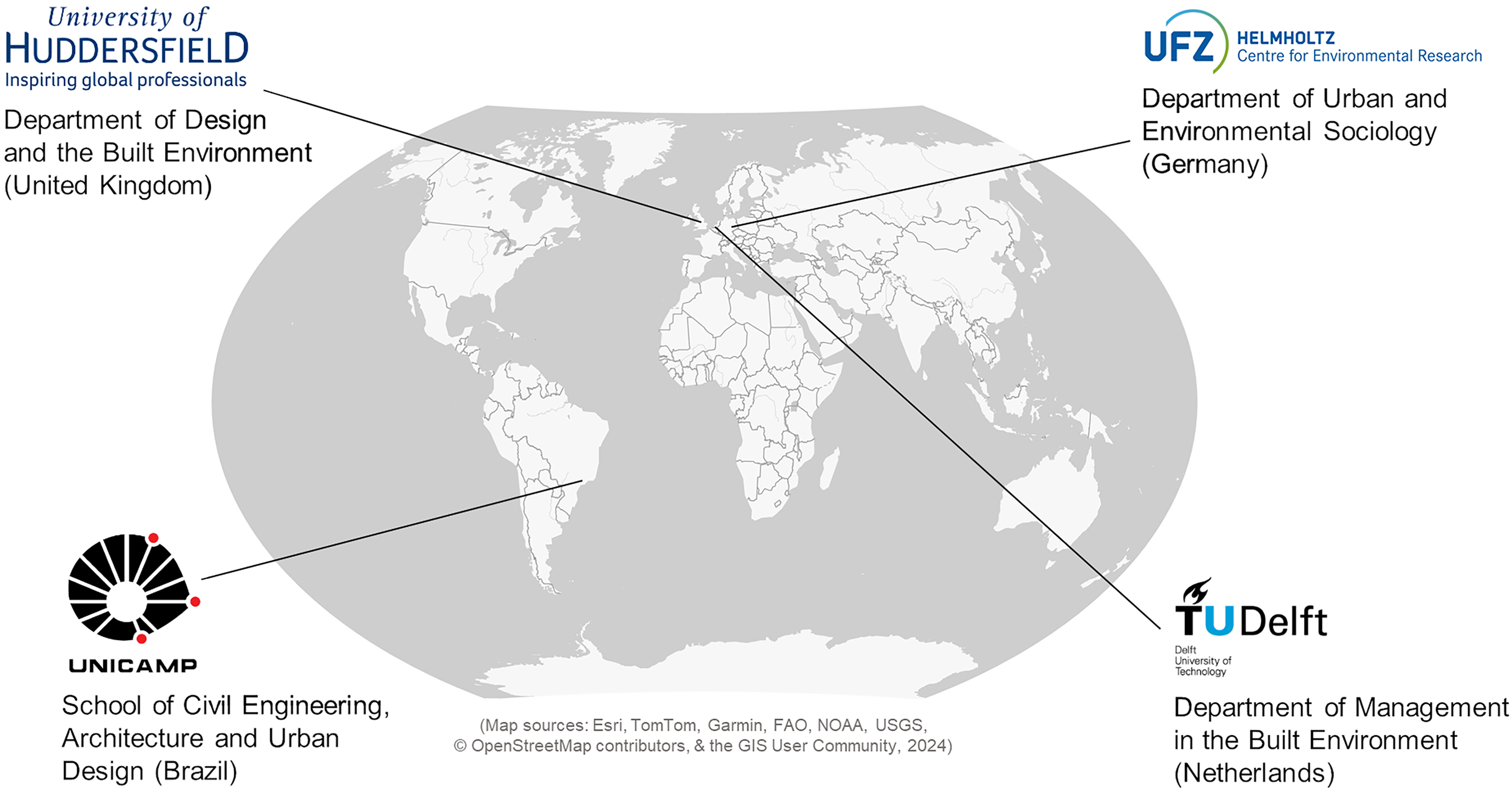
Partner institutions of the uVITAL project and their locations.
Soon after the start of the project in 2020, COVID-19 spread around the world. The four project countries were exposed to the pandemic waves at different times, to different degrees, and responded to the pandemic in different ways. The intended case study visits and face-to-face meetings, including the kick-off event, could not be carried out as planned. Communication was mainly conducted by email and online data sharing, as well as online meetings, internal webinars, and participation in international and interdisciplinary online or hybrid conferences. The exchange was more passive, without interactive elements of knowledge sharing. The above conditions severely limited the project partners’ ability to get to know and understand each other's local conditions and disciplinary backgrounds.
The collaboration between social sciences and design studies in an international context – like in the uVITAL project – was very ambitious, because concepts, methods and scientific language are different across the two domains. The consensus on a common research goal and case study areas for empirical analysis did not a priori coincide with a common, detailed understanding of scientific worldviews and methodological designs.
There are not many studies reflecting interdisciplinary and international collaborations in the social sciences (Dusdal and Powell 2021, 236). Between social sciences and design studies, there is, to our knowledge, even less evidence. Whereas social science studies refer to the behaviour, acting and decision-making of social groups, design studies prioritise the creation of material structures to improve living conditions, often using participatory methods. Both approaches sometimes use completely different methods, but some similar tools. Hence, the cooperation promised innovative insights.
The uVITAL project plan included a work package called ‘Development of Scenarios’. A key objective was to develop scenarios in the context of SH upgrading to create a common understanding of the main concepts beyond cultural and national contexts. Thus, the development of common scenarios was one important part of the overall project. Furthermore, the main purpose of the scenario approach was to share knowledge and facilitate communication between the scientists involved in the project, not to advise policy or support decisions in the context of SH upgrading.
During the research, it became clear that each discipline had its own understanding of what a scenario is. For the architects and designers, developing scenarios meant designing alternative solutions (e.g. different design options for playgrounds). For the sociologists and geographers who organised the scenario workshops, scenarios presented alternative futures for a particular issue or urban visions for designing desirable cities. These different understandings, in turn, showed that there was no common approach to scenario development among the team members. To overcome this, we used a meta-level approach that would allow different perspectives to be included.
The collaborative scenario development was particularly important for the progress of the research project. The COVID-19 pandemic, which lasted for two of the three years of the project period, prevented face-to-face meetings and visits to the case study areas during this time. The scenario workshops allowed us to be together virtually and have a focused discussion.
Scenarios as a communication tool
Developing scenarios has gained increasing importance since the 1950s, when they were used as a method for strategic military planning. Currently, scenarios are used in different disciplines, mainly in future and foresight studies, but also in a wide range of other contexts, including urban and regional planning, strategic business planning, public policy-making, and sustainable development (Jarke, Bui, and Carroll 1998; Kosow and Gaßner 2008; Amer, Daim, and Jetter 2013).
The concept of ‘scenarios’ is associated with future thinking or ‘what if’-questions. Many authors note that there is a multitude of definitions of the term ‘scenario’, which also vary according to the discipline (Greeuw et al. 2000; Rotmans et al. 2000; Bradfield et al. 2005; Bishop, Hines, and Collins 2007; Garb, Pulver, and VanDeveer 2008; Kosow and Gaßner 2008). In this paper, the following definition is adopted: ‘Scenarios are descriptions of journeys to possible futures. They reflect different assumptions about how current trends will unfold, how critical uncertainties will play out and what new factors will come into play’ (UNEP 2002, 320).
Scenarios can fulfil a variety of functions. Kosow and Gaßner (2008, 18–20) divide them into four groups: (1) explorative and/or knowledge function; (2) communication function; (3) goal-setting function; and (4) decision-making and strategy formation function. Here, we focus on the knowledge and communication functions.
Scenarios are used to generate and share knowledge, not only about the future but also to understand the present and its complexity. By analysing key drivers, actions and their interrelationships, they help to identify dilemmas and constraints and to deal with uncertainties. Scenarios are therefore a way of structuring our thinking (Greeuw et al. 2000; Wright, Bradfield, and Cairns 2013). Furthermore, they are useful for ‘expand[ing] our mental model beyond the conventional thinking’ (Rotmans et al. 2000, 811). In the context of interdisciplinary collaboration, scenario development can be a means for integrating knowledge (Bohensky, Butler, and Mitchell 2011; Priess and Hauck 2014; Kröger and Schäfer 2016). The process helps to examine assumptions, explore knowledge gaps and bridge epistemologies (Bennett and Zurek 2006).
Scenarios also serve as a tool for internal or external communication, or both. They promote the exchange of ideas, the building of networks and facilitate the dialogue between stakeholders from different disciplines (Jarke, Bui, and Carroll 1998; Garb, Pulver, and VanDeveer 2008). Thus, scenarios can be understood as boundary objects, as they help to connect different social worlds (Garb, Pulver, and VanDeveer 2008; Bohensky, Butler, and Mitchell 2011; Kowalczewska and Turnhout 2012; Lebel 2013; Bowman 2016; Kröger and Schäfer 2016; Sarkki et al. 2020). Boundary objects are ‘a sort of arrangement that allows different groups to work together without consensus’ (Star 2010, 602).
The process of scenario development itself can be a form of mutual learning (Rotmans et al. 2000; Greeuw et al. 2000). A frequently used participatory method to involve a range of stakeholders is the scenario workshop (Rotmans et al. 2000; van’t Klooster and van Asselt 2006; Priess and Hauck 2014; Maiullari and van Timmeren 2017; Sarkki et al. 2020). In cases where only scientists participate in the scenario development, the ‘interdisciplinary composition is of importance’ (Kosow and Gaßner 2008, 41) to bring different perspectives together.
Scenario development using the 2 × 2 matrix technique
Various scenario types and techniques exist. There have been several attempts to classify them (see, e.g. Greeuw et al. 2000; van Notten et al. 2003; Börjeson et al. 2006; Bishop, Hines, and Collins 2007; Kosow and Gaßner 2008). Relying on the literature, a very rough distinction can be made between, for example, explorative and normative or quantitative and qualitative approaches.
Explorative scenarios (also known as descriptive scenarios) explore possible future situations, irrespective of whether they are desired or undesired (Greeuw et al. 2000, 8; Rotmans et al. 2000, 812). They aim to answer questions like ‘What can happen?’ (Börjeson et al. 2006, 727). The present is taken as the starting point from which to explore development paths and key factors leading to possible futures. Normative scenarios respond to questions like ‘How can a specific target be reached?’ (ibid., 728). Qualitative scenarios are appropriate when cultural, political or institutional dimensions are considered and when human values or emotions play a role. They are used when data is missing or the quantification of information is not possible. Quantitative scenarios tend to be highly formalised. They are usually based on computer models and are often used in the energy, business and technology sectors (Greeuw et al. 2000, 8; Rotmans et al. 2000, 812; van Notten et al. 2003, 431). It has to be stated that strict distinctions between scenario types are often broken down in practice (e.g. van Vliet and Kok 2015; Mete and Xue 2021).
Quite popular and often applied – although sometimes slightly differently – is the qualitative scenario-axes technique using a 2 × 2 matrix with strong intuitive elements. The scenario process is inherently subjective. Insights that arise from the scenario process itself, which is also a learning process, are usually more important than the content reliability of the end product (Bradfield et al. 2005, 806).
The general aim of the 2 × 2 matrix technique is to identify the two most impactful and uncertain key drivers regarding the scenario issue, plot them on two axes and, based on this, develop four distinct scenarios in an exploratory manner (Schoemaker 2004; van’t Klooster and van Asselt 2006; Amer, Daim, and Jetter 2013; Ramirez and Wilkinson 2014; van Vliet and Kok 2015; Rhydderch 2017). Figure 2 shows a schematic representation of a 2 × 2 matrix.
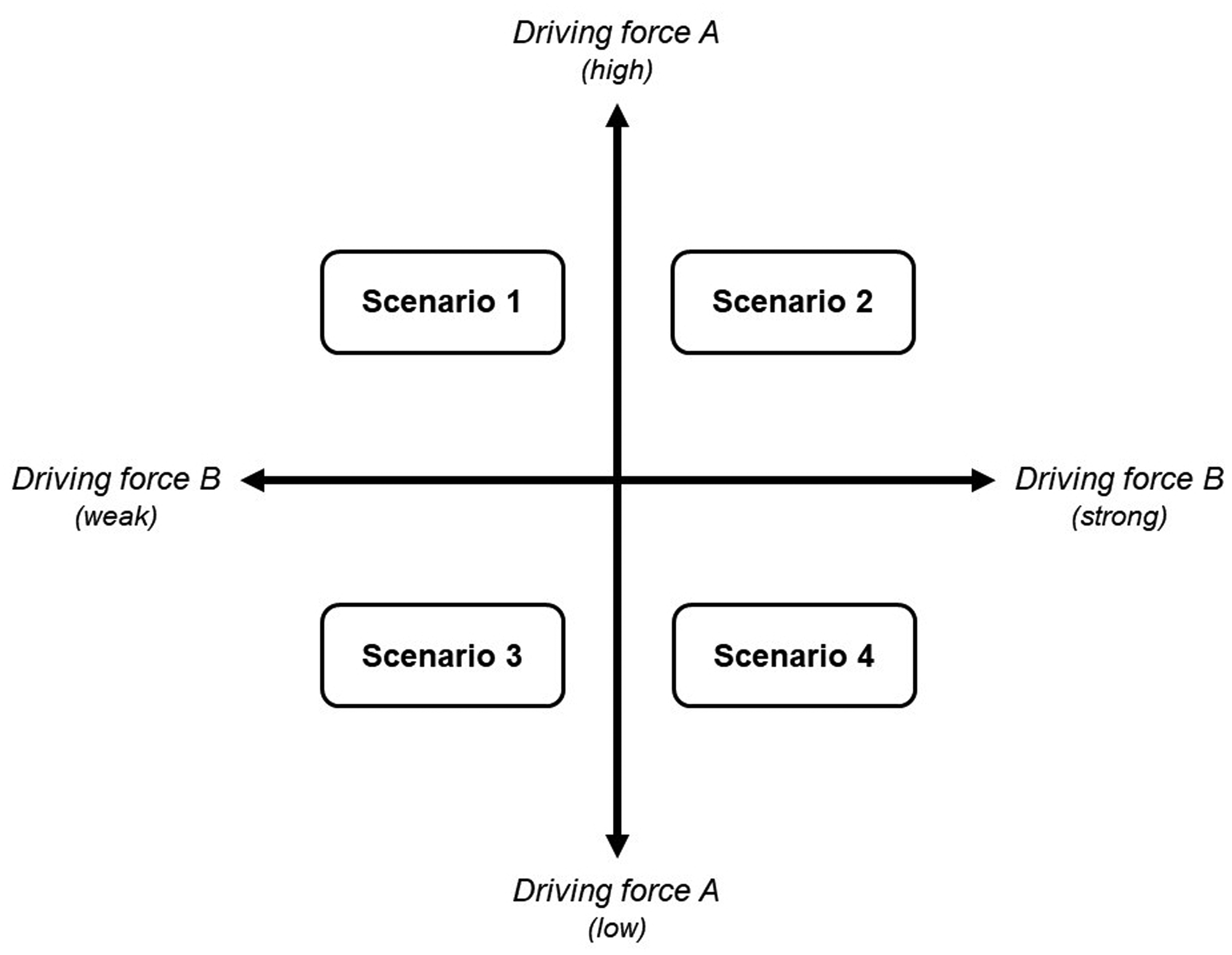
2 × 2 matrix (based on van’t Klooster and van Asselt 2006, 18; Rhydderch 2017, 3).
An important step is the identification of driving forces and factors that influence the future of the respective scenario issue. This can best be done by using the so-called STEEP framework, which stands for social, technological, economic, environmental and political elements (Schoemaker 2004, 285; Bradfield et al. 2005, 809; Rhydderch 2017, 8). In some cases, it is expanded with legal dimensions and is then called PESTEL (political, economic, social, technological, environmental and legal elements; Wright, Bradfield, and Cairns 2013, 634).
The outcome of the process is a set of four scenarios in narrative form, usually each with a short and catchy title, and sometimes supplemented by visualisations (Bradfield et al. 2005, 809; Rhydderch 2017, 10).
Scenarios developed by using the 2 × 2 matrix technique are mostly very simplified and therefore criticised (Schoemaker 2004; Ramirez and Wilkinson 2014; Sarkki et al. 2020). Nevertheless, the creation of scenarios by diverse stakeholders with different knowledge and expertise helps to increase the richness of the scenarios (Rotmans et al. 2000, 813).
Scenario development in the uVITAL project
The uVITAL project framework differs from most scenario studies in three ways: First, the composition of the team combined social sciences and design studies, which is a quite unique setting. Second, we looked at four different case studies in four different countries, rather than one common case. Third, most of the researchers were not familiar with the scenario development process. Additionally, COVID-19 restrictions forced us to conduct the scenario development workshops online only.
Rhydderch (2017) provided in a toolbox easy-to-follow instructions for how to apply the 2 × 2 matrix technique in a workshop setting. They are mainly based on Schwartz (1991). Figure 3 shows a diagram of the steps described by Rhydderch (2017) and their implementation in the uVITAL context. The scenario exercise promoted in-depth and ‘out-of-the-box’ thinking through a structured procedure with concrete tasks. As no one in the team was an expert in scenario development, we started the process in a very pragmatic way. Consequently, it became more and more of a communication tool and a means of sharing knowledge among the researchers involved in the project.
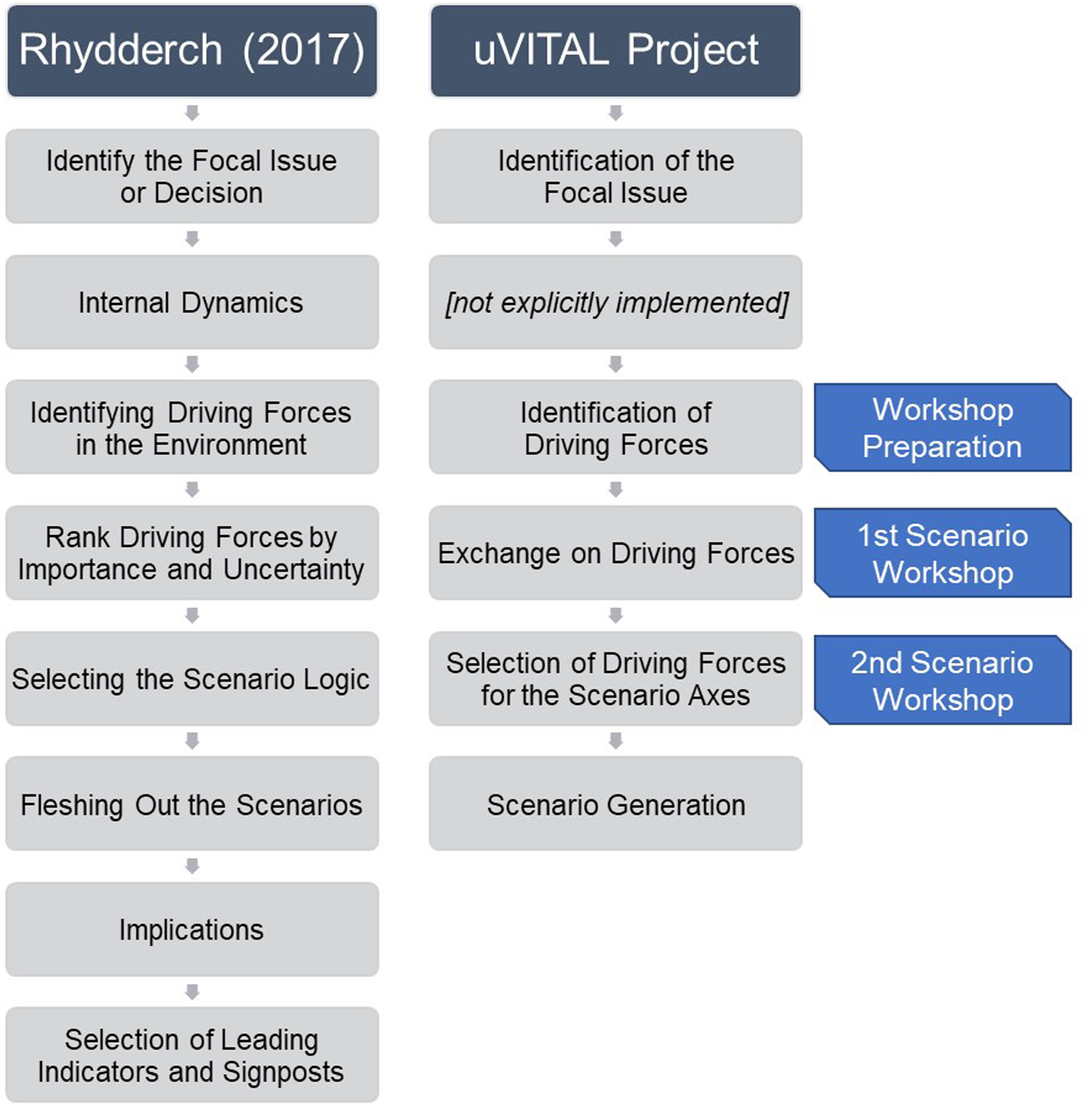
Steps for scenario development described by Rhydderch (2017) and their implementation and adaptation in the uVITAL project.
Identification of the focal issue
The identification of the focal issue for the scenario development within uVITAL resulted from the overall project goal, i.e. user-oriented SH upgrading. It needs to be emphasised that the SH systems and upgrading of the four case studies differ considerably, especially when considering the transatlantic divide between the participating European countries and Brazil (Kowaltowski et al. 2024). At the beginning of the project, we conducted extensive literature reviews on the main concepts related to this topic. We also had regular online meetings to share knowledge in a more passive way. The insights gained from this process, together with our experiences from the specific case studies, constituted the knowledge base and input for the scenario development. The following guiding questions were used to develop qualitative, explorative scenarios: What will the future of social housing upgrading look like? What conflicts and challenges might arise, and what opportunities? We pursued the idea of how to strengthen user-oriented SH upgrading. We shared our knowledge about conflicts and constraints, but also about new opportunities.
The scenarios should be on a meta-level to force the participants to think beyond their national contexts and to identify factors that may have an impact on all case studies in the future. The originally proposed time horizon was the year 2050, as this is also a milestone, e.g. for achieving EU climate neutrality, which has implications for housing stock upgrading. The time horizon was then changed to the year 2030 because the participants were better able to imagine the developments that might take place by then. Furthermore, 2030 is the time horizon to fulfil the global Sustainable Development Goals.
Workshop preparation and identification of driving forces
The scenario development process was organised in two online workshops with representatives from all four country teams via the videoconferencing platform Webex. To promote interactivity, a Miro digital whiteboard was used as an online tool. The workshop organisers created a board with a specific layout for the scenario development. User-friendly visualisations (e.g. multicoloured sticky notes) and the ability to make changes in real-time (e.g. writing text, creating elements and moving them around) encouraged exchange and discussion among the participants. The workshops were video recorded. People with different disciplinary backgrounds from the four different institutions and countries actively participated in each session (12 people in the first round, 13 in the second). This required intensive preparation and well-structured moderation.
In advance of the first scenario workshop, all participants received extensive information on the theoretical background of the selected scenario approach. Additionally, the scenario-axes technique was explained and proposed for use in the uVITAL project. All this was outlined by the workshop organisers.
Each country team was asked to identify driving forces influencing the upgrading of SH today and in the future. The participants were requested to detach themselves from their own national contexts and rather think on a global and more abstract level. For this purpose, the researchers applied the STEEP framework for structuring. Up to three factors should be selected per STEEP category (i.e. social, technological, environmental, economic, and political).
First scenario workshop: exchange on driving forces
The first online workshop took place in December 2021. After a short introduction by the workshop organisers, the participants were divided into groups according to their institution. During these sessions (10 minutes), they prepared to present their collected driving forces to the whole group. The presentations and brief explanations of each selected factor followed. The driving forces within the STEEP categories were then clustered thematically (for the example ‘social’ see Figure 4) and discussed in terms of their importance. Here it became clear that the priorities had been set differently by each team.
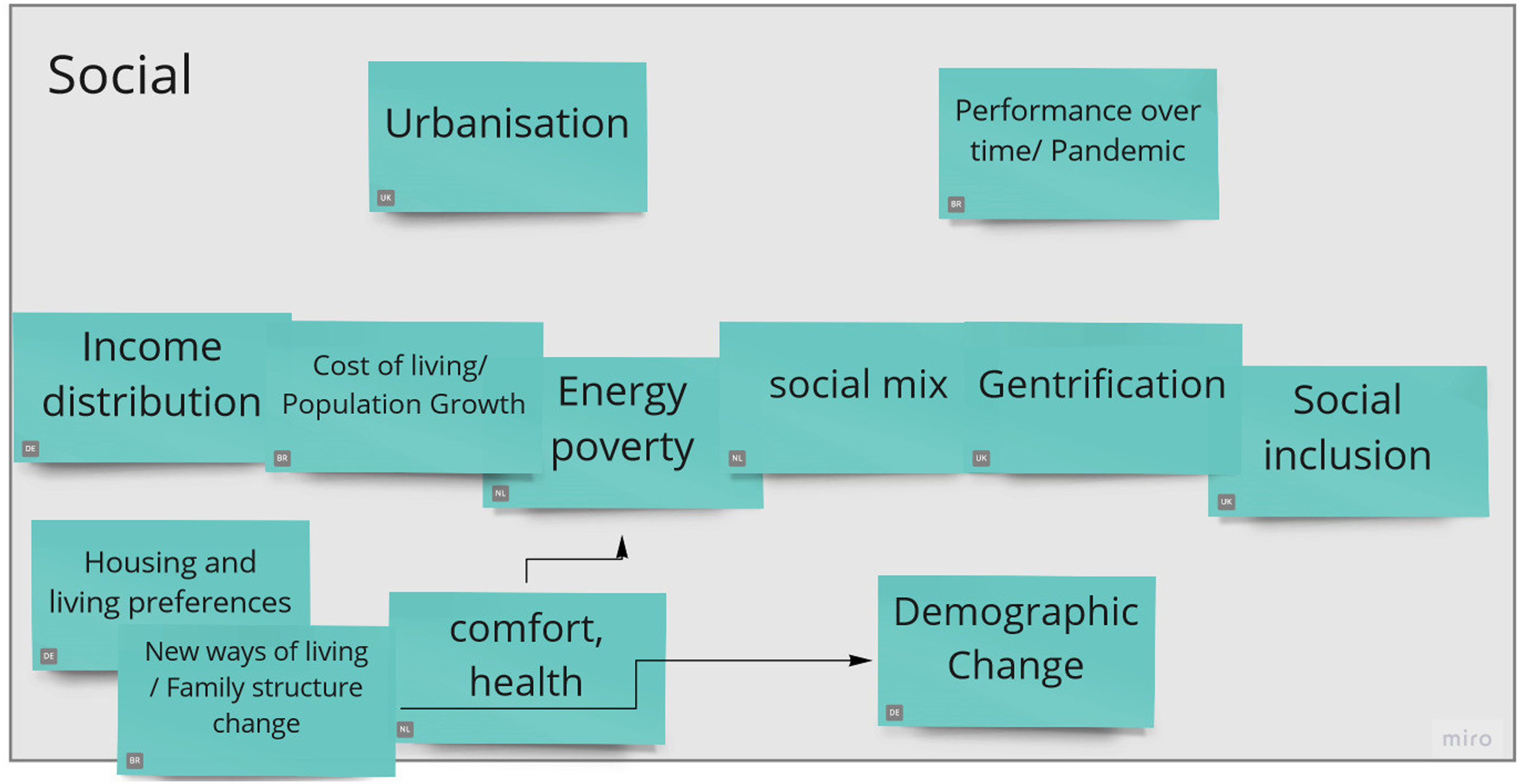
Thematic clustering of driving forces within the category ‘social’ (screenshot of the Miro board).
Nevertheless, one driving force mentioned by all teams as being very impactful was ‘climate change’ (category ‘environmental’). Other important aspects that were emphasised are in some way related to the topics of climate targets (political), housing affordability (economic) and health issues (environmental).
Afterwards, the workshop organisers provided a summary of the debate. For further discussion, they developed a draft diagram of the clustered driving forces and their interconnections. All participants were given extensive homework to complete before the next workshop. Part of the homework was for everyone to review the diagram and verify what are causes and what are effects. Each country team was also asked to think about the impact and uncertainty of each driving force regarding the future of SH upgrading.
Second scenario workshop: selection of driving forces for the scenarios axes
The second scenario workshop was organised shortly after, in January 2022. Based on the results of the first workshop, the participants jointly prioritised the driving forces, but new ones were also added during the discussion (Figure 5). Then, those with a major impact on SH upgrading in all four countries were selected. They were not necessarily the most uncertain driving forces, but they were identified as particularly important in the project context. These driving forces were then used to construct the scenario axes of the 2 × 2 matrix.
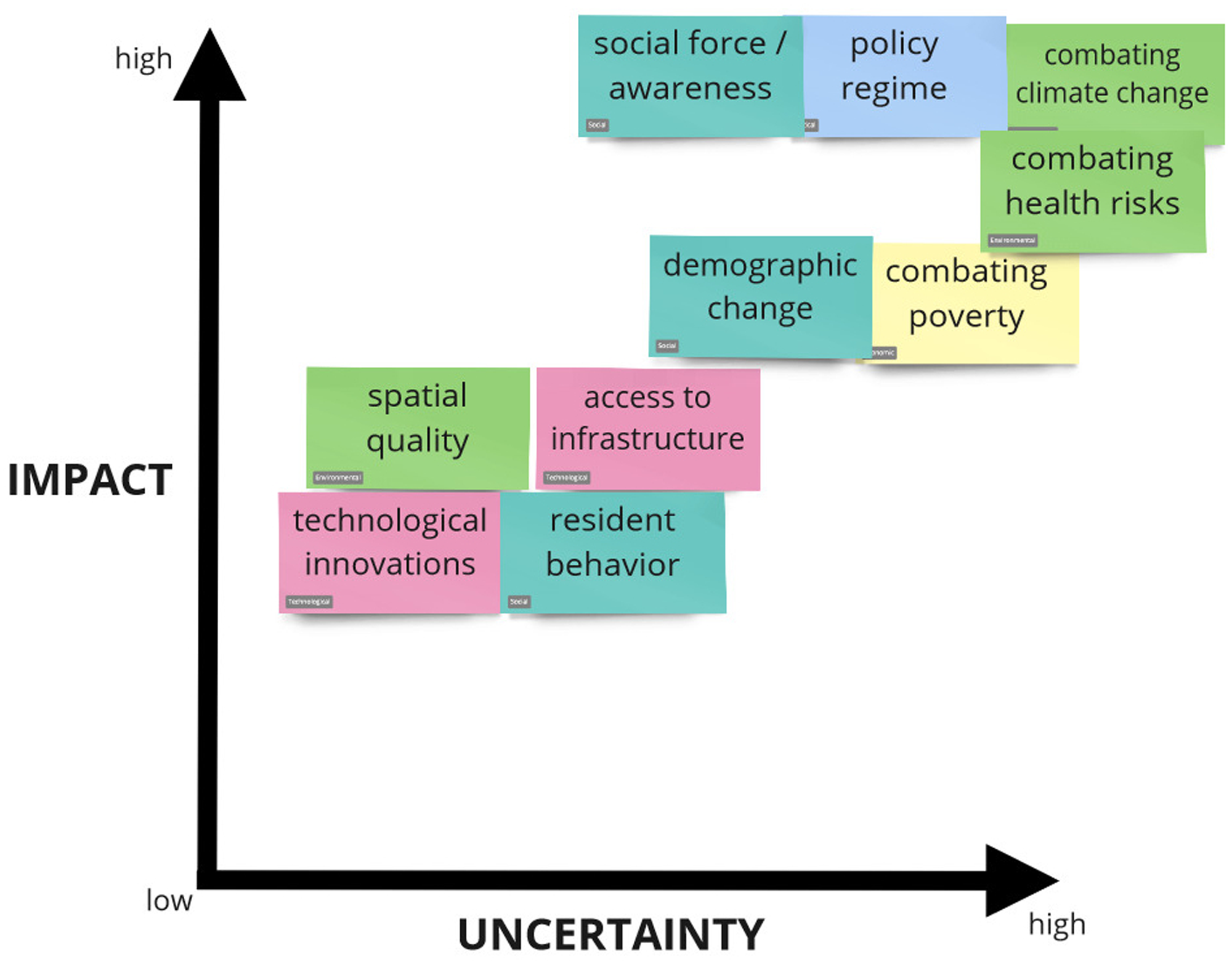
Prioritisation of driving forces from different STEEP categories (screenshot of the Miro board).
While the participants were able to agree on one axis relatively quickly (‘policy regime’ with the two dimensions ‘welfare vs. neoliberal’ on the vertical axis), there was no consensus on the second (horizontal axis). Various suggestions were made, e.g. ‘climate action’ or ‘technological innovations vs. resident behaviour’ (Figure 6). The examples ‘policy regime’ (vertical axis) and ‘technological innovations vs. resident behaviour’ (horizontal axis) were used to start collecting the main characteristics of possible scenarios and to demonstrate how to ‘flesh out’ the scenario quadrants.
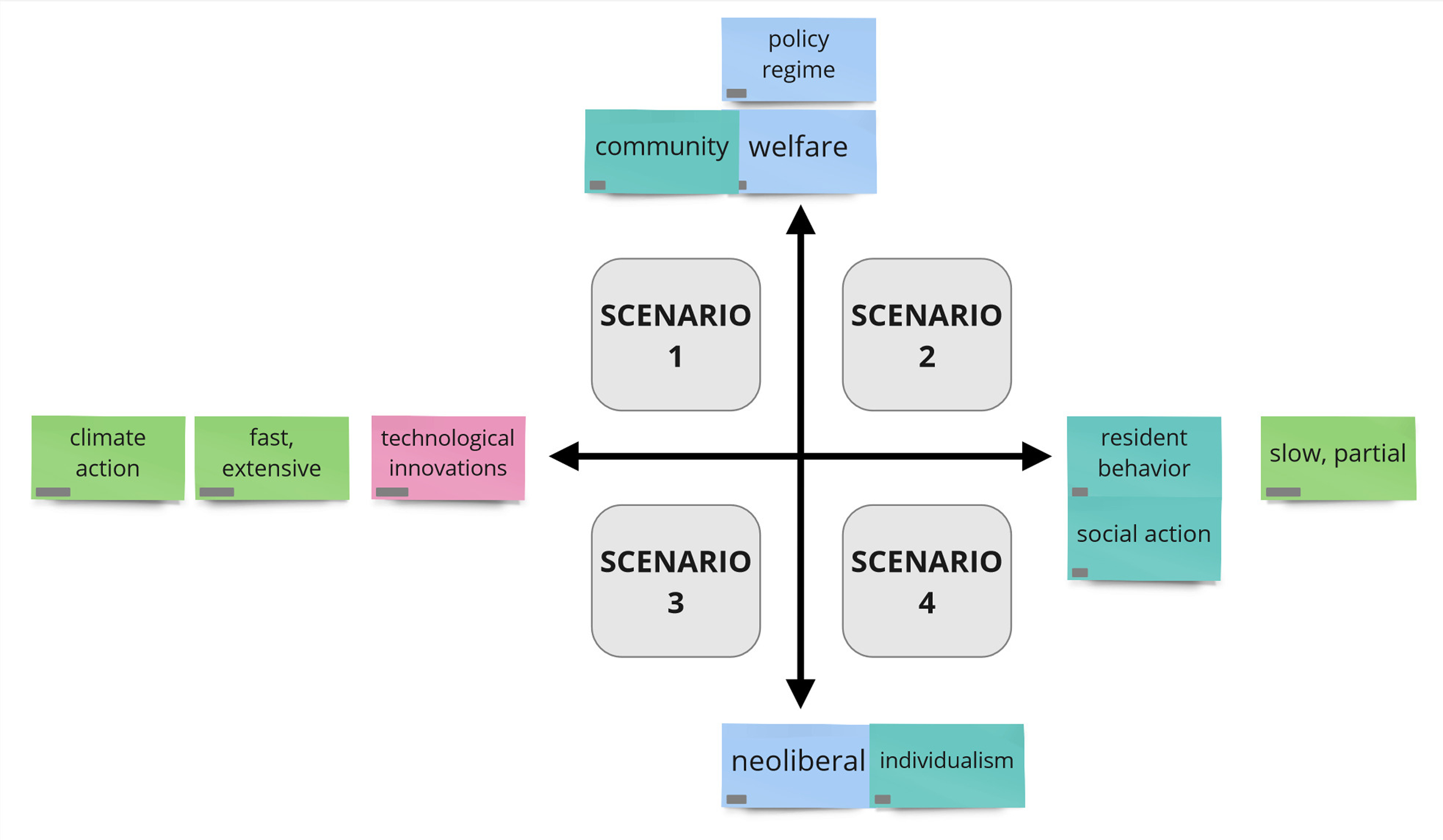
Selection of driving forces for the scenario axes (screenshot of the Miro board).
It was further agreed that the driving force ‘climate change’ should appear in the scenario matrix, but not in the form of a separate axis. One suggestion was to visualise the impacts of each scenario on climate change as a third dimension or framing through a ‘heat map’ in the background of the scenario scheme.
Scenario generation
Following the second scenario workshop, the scenario generation started. Using the organisers’ written summary of the results of the second workshop, each country team developed one scenario scheme with short, written descriptions of the four scenarios included. This was done in an exploratory manner and at a meta-level, beyond the specific national case study contexts. After the draft scenarios were completed, the different schemes were compared and reviewed to analyse whether and how they could be combined into a single scheme. Based on this process, the workshop organisers drafted general scenario descriptions combining the main aspects of the specific scheme developed by each institution. It was up to each team to decide whether or not to develop country-specific scenarios.
Findings and discussion
The following section discusses the benefits and challenges of the chosen scenario approach for facilitating knowledge sharing and communication in the international and interdisciplinary project uVITAL affected by the COVID-19 pandemic.
Benefits of the collaborative scenario development
Structured process
The scenario development benefited from the 2 × 2 matrix technique through a structured procedure with clear tasks. It helped the participants, generally unfamiliar with this type of scenario development, to focus on the common goal and the responsibility for achieving it. The STEEP framework was useful for collecting driving forces outside one's own area of expertise and thinking about their impacts both specifically and in a broader context. For example, social scientists had difficulty finding driving forces for the category ‘technological’ and were forced to think beyond their usual disciplinary context. During the discussion, the participants could support each other by providing explanations of terms or concepts central to their own fields of research, in situations where others were not familiar with them. This made our interdisciplinary collaboration much more effective (Danermark 2019, 376; Elixhauser et al. 2024, 3). In the second workshop, for instance, there was an intense exchange among the participants about the characteristics of a social welfare system versus a primarily neoliberal, market-driven system. In this way, the process promoted mutual learning.
Scenario approach as a boundary object
Although the team members had different meanings of scenarios, a common understanding of the research issue (SH upgrading) and the respective priorities in each country was created. Rather than emphasising how the scenarios (as products) function as boundary objects, we focused on the process itself. The scenario approach was used as a tool to enhance comprehensive communication and knowledge sharing among the workshop participants. In our case, driving forces such as ‘climate change’ and ‘demographic change’ also served as boundary objects for the discussion since all participants were familiar with them, but the characteristics differed depending on the individual case (for similar experiences see Kröger and Schäfer 2016, 78).
Move from passive to active knowledge sharing
The scenario development was embedded in an overall project process consisting of online meetings with presentations, brainstorming sessions and webinars where everyone contributed with knowledge sharing from their own perspective. The structured process of scenario development presented an important step forward, towards intensified knowledge sharing. This included both content-related aspects and methodological openness to different disciplinary understandings of scenarios. It raised awareness of the local case studies, which was a good prerequisite for the site visits that could be carried out at a later stage of the project.
A better understanding of geographical and cultural differences
The collaborative scenario development supported the identification of commonalities and differences between the specific case studies and how they are affected by the selected driving forces. By applying an exploratory scenario approach in an interdisciplinary and international setting, we gained a more nuanced understanding of the key drivers behind SH upgrading processes in each country. The transatlantic divide between the European countries and Brazil was repeatedly highlighted in the discussion. In Europe, for example, energy issues (e.g. energy efficiency) have a very high priority and are linked to specific carbon emission reduction targets. Whereas in Brazil, there are no mandatory obligations in this regard.
Knowledge sharing in times of COVID-19
The online scenario workshops consisted of an important activity to continue our collaborative work and exchange in times of the COVID-19 pandemic when in-person interactions were not feasible. The workshop format with a fixed programme forced everyone to contribute, encouraged interactivity and fostered a very productive interdisciplinary and transnational exchange. This was additionally supported by actively using an online collaboration tool for visualising the brainstorming and discussion results (i.e. the digital whiteboard). It was also very helpful in overcoming translation difficulties and semantic challenges.
Challenges of the process of scenario development
Despite the benefits discussed above, the following challenges in using the scenario approach became apparent:
‘Out-of-the-Box’ thinking
A major challenge for all participants was to think ‘out of the box’ during the exploratory scenario development. That means detaching oneself from the context of the specific case studies, the current situation and the disciplinary anchoring. For example, it was initially difficult to imagine how SH upgrading would unfold under a completely different policy regime. This finding is in line with the study results of Kröger and Schäfer (2016, 73), who identified stimulating creative thinking as ‘one of the most difficult challenges of scenario development’.
Disciplinary embedding
Despite the willingness to reach a consensus on the creation of common scenarios, the scenario development process was influenced by disciplinary anchoring and expertise. For instance, in addition to the shared agreement to place ‘policy regime’ on the vertical scenario axis, all four partners chose different driving forces on the horizontal axis. The UK partners from the Department of Design and the Built Environment, whose work deals extensively with energy efficiency in SH upgrading, focused on ‘technological development’ (high vs. low). The German project team from the Department of Urban and Environmental Sociology chose ‘climate action’ (fast, extensive vs. slow, partial).
Intensive preparation
The collaborative scenario development and the success of the workshop sessions heavily depend on a comprehensive workshop organisation and intensive preparation by the participants, i.e. doing their homework according to given tasks. The workshop participants agreed that the scenario approach – due to its good transferability – should be used for other research issues and questions within the uVITAL project. However, even with a less complex and easy-to-use method such as the 2 × 2 matrix technique presented here, the time and organisational effort should not be underestimated.
Overall takeaways
We have been able to overcome key challenges of interdisciplinary cooperation through a collaborative attitude of all workshop participants. With reference to Danermark (2019) and Elixhauser et al. (2024), we emphasise the need for openness to other disciplines and that no discipline should take precedence over another. We were able to achieve this because we agreed on a methodology (scenario development) that is used in different disciplines, but we applied a specific approach that most of the researchers in our project team were not familiar with. Thus, each scenario workshop was a ‘learning event’ (Schönenberg et al. 2017, 181) within the uVITAL project.
In many scenario studies, the communication function is only an addition, but usually not the main purpose (Kosow and Gaßner 2008, 101). Once the focus shifts to communication between the researchers involved, the process of scenario development becomes more relevant than the final outcome. We think that more attention should be paid to the process, especially in interdisciplinary collaboration (see also Priess and Hauck 2014). Reflecting on the scenario development also helps to better understand the ontological and epistemological assumptions underlying the final scenarios.
We would like to share the following lessons learned with future interdisciplinary and/or international research teams when using the scenario approach as a communication tool: First, it is essential to structure the scenario development process well and allow sufficient time for discussion. Second, in order to create an atmosphere of respect and trust, it is helpful not to organise scenario workshops right at the beginning of a collaborative research project, but to have had opportunities to exchange and get to know each other beforehand. Third, the scenario process works well in an online setting if there is a clear agenda and visualisation tools are used. Fourth, progress in communication through scenario development can only be achieved by stepping out ‘of one's disciplinary comfort zone’ (Elixhauser et al. 2024, 5).
Conclusion
The experienced scenario development process opened new avenues towards knowledge sharing and mutual learning. We started to use the scenario approach as a research method and it became an efficient communication tool. The scenario workshops enabled us to recognise that we had different assumptions and understandings, which in turn supported further project activities. The focus of the scenario development was on the process itself rather than on the final scenarios as an outcome. We concentrated on a very intensive exchange about the focal issue and the driving forces to integrate our different disciplinary, institutional and specific case study knowledge. In particular, we discovered the value of a structured process with clear tasks that allowed us to use the scenario approach as a boundary object. This was a shift from passive to active knowledge sharing, which led to a comprehensive understanding of geographical and cultural differences. Finally, we found a suitable way to carry out our project within the constraints of COVID-19. In terms of the research question set out in this paper, we summarise that these benefits provide evidence of how the scenario approach can increase knowledge sharing and communication in interdisciplinary and international research projects.
Nevertheless, a pre-existing common ground is needed when applying scenario development in multidisciplinary groups. Although we were only able to meet online in the beginning, we already had several opportunities to start creating shared knowledge. Therefore, the scenario workshops were not a ‘starting from scratch’ activity. Instead, they allowed us to build on previous discussions and exchanges, and on an already established relationship of trust and respect within the team.
The benefits and challenges of using the scenario approach in the context of an interdisciplinary and international research project were identified. The scenario development was a successful exercise for challenging the participants’ creative thinking and fostering an in-depth knowledge exchange. The main goal, a common understanding of SH upgrading beyond national and disciplinary boundaries, was largely achieved. Therefore, scenario development is a productive means for knowledge sharing by members of interdisciplinary and/or international research teams.
Footnotes
Acknowledgements
We thank all the workshop participants for their extensive contributions.
In addition, we are very grateful to the two anonymous reviewers for their comments and suggestions to improve the paper.
Declaration of Conflicting Interest
The authors declared no potential conflicts of interest with respect to the research, authorship, and/or publication of this article.
Funding
The research was funded by the Trans-Atlantic Platform for Social Sciences and Humanities (T-AP) under the call on‘Social Innovation’. The German uVITAL part was supported by the German Federal Ministry of Education and Research (BMBF, DLR-PT) [grant number 01UG2025]. The UK uVITAL part was supported by the Economic and Social Research Council (ESRC) [grant number ES/T015160/1]. The Brazilian uVITAL part was supported by the São Paulo Research Foundation (FAPESP) [grant number 2019/02240-5]. The Dutch uVITAL part was supported by the Dutch Research Council (NWO) [grant number 463.18.219].
