



Abstract
Among the most widely promoted examples of fossil folklore is a supposed link between the Central Asian horned dinosaur Protoceratops and the griffin, a gold-guarding mythical creature combining features of lions and birds. First proposed in the 1990s, this geomyth postulates that tales of Protoceratops fossils were transmitted westward along trade routes from Asian gold mines to inform griffin lore among the ancient Greeks. An evaluation of the Protoceratops–griffin link, however, finds it uncompelling. Not only does it ignore established histories of griffin art and myth, but no convincing connections occur between Protoceratops and central aspects of griffin lore, such as gold guarding. In fact, Protoceratops fossils occur hundreds of kilometres from the nearest gold deposits, subverting suggestions that they inspired the griffin's association with gold. Interpretations of ancient literary references to griffins as pertaining to Protoceratops are unconvincing, and suggested anatomical similarities between griffins and Protoceratops are selectively identified. We regard the Protoceratops–griffin link as an ‘ex post facto geomyth’: an effort to find significance in superficial, inconsequential readings of geological phenomena and mythology. We posit that the allure of ancient cultures sharing our modern fascination with dinosaurs has denied this idea due scepticism.
Introduction
Fossils have been used as decorative items, talismans and inspiration for myths and legends since Palaeolithic times (Oakley 1965; Buffetaut 1987; McNamara 2020). Well-known examples of fossil geomythology include the modification of British ammonites into ‘snakestones’, sharks teeth being regarded as snake tongues, and ‘winged’ spiriferid brachiopods being labelled as ‘stone swallows’ in historic China (Oakley 1965; Bassett 1982). Such folklore is evidenced by fossil specimens within archaeological sites as well as historic documents and artworks, but not all fossil geomythology is so materially demonstrated. Some of the most famous links between fossils and myth have a more inferential and speculative basis: connections between extinct species and legendary creatures hypothesised through details of geography, history and anatomical similarity.
One of the most famous examples of such ‘inferential’ geomythology seeks to explain the griffin, the ancient Afro-Eurasian bird-lion chimaera, as being inspired by fossils of Protoceratops, a Mongolian, Late Cretaceous dinosaur of the ceratopsian (horned dinosaur) group (Figure 1). This suggestion has been solely developed by classical folklorist Adrienne Mayor, a seminal figure in the discipline of geomythology who has proposed numerous examples of pre-scientific cultures incorporating fossil bones into folklore (Mayor 2000, 2007, 2011). Mayor's griffin research, which began in the late 1970s, draws particular attention to possible fossil-inspired development of the griffin among the ancient Greeks and has probably become her best known contribution to geomythology. Her explanation of griffins as ancient interpretations of dinosaur bones contributes to a body of work that has, perhaps more than that of any other modern scholar, focused academic and public attention on links between geology and myth.
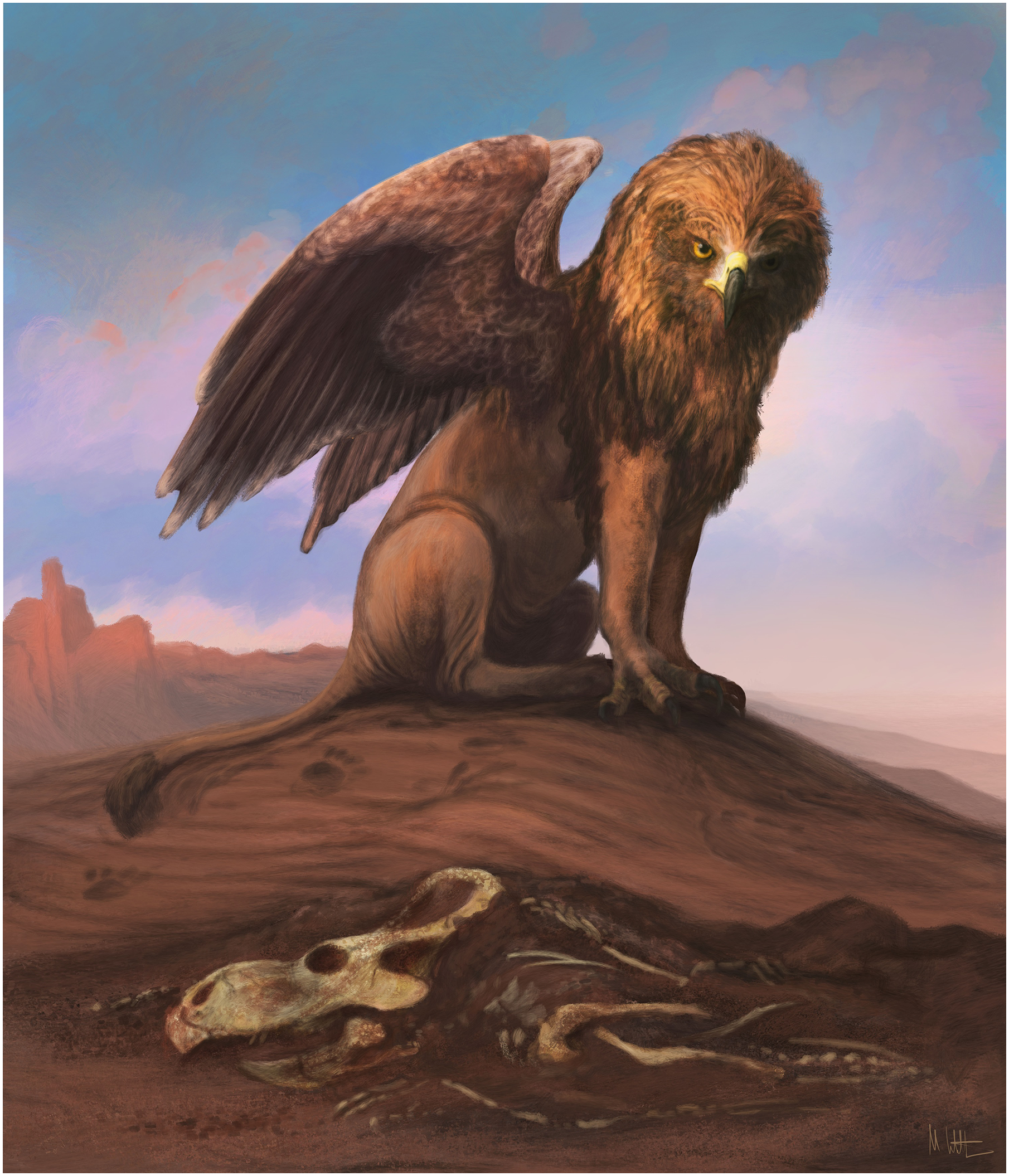
The Protoceratops-griffin geomyth. The idea that fossils of Mongolian horned dinosaurs inspired or influenced the mythology of the griffin, ancient chimaeras of birds and lions according to conventional archaeologists, is one of the most popular and promoted examples of fossil folklore in modern times. This idea, first proposed in the early 1990s, has received little in the way of academic scrutiny, however.
Mayor's griffin geomyth has been outlined in several publications. The earliest was a brief discussion in a 1989 Cryptozoology paper entitled ‘Paleocryptozoology: a call for collaboration between classicists and cryptozoologists’, followed by a two griffin-focused articles of largely similar content: a 1991 paper in Cryptozoology (‘Griffin bones: ancient folklore and paleontology’) and, later, the Folklore piece ‘Griffins and Arimaspeans’ (Mayor and Heaney 1993). Shortly after, a dinosaurian origin for griffins was a major component in Mayor's influential book The First Fossil Hunters: Paleontology in Greek and Roman Times, initially published in 2000 and later in a revised 2011 edition. The concept was reiterated again, unchanged, in 2022 via publication of an 1989 letter outlining Mayor's idea to a palaeontologist (Mayor 2022).
Over 30 years on from its initial proposal, Mayor's griffin geomyth has been viewed favourably by academics in disparate disciplines (e.g. Dodson 1996; MacLeod 2000; Ruscillo 2003; Lyons 2009; Sax 2013). It has also received widespread promotion and acclaim outside of academia. Early coverage was limited to niche media, including 1994 issues of the UK children's magazine Dinosaurs! (issues no. 44 and 66) and the American periodical Archaeology (Vol. 47, No. 6). It would later appear in Fortean Times (Way 2003) and influence science fiction and fantasy artist Wayne Barlowe to draw a lion-bodied, feathered-winged griffin with a Protoceratops head in his 1996 book Barlowe's Guide to Fantasy (Barlow and Duskis 1996).
Later, the Protoceratops–griffin geomyth went more mainstream. It appeared in documentaries by major television networks, including the History Channel's 2004 Ancient Monster Hunters and the BBC's 2011 Dinosaurs: Myths and Monsters. In 2007, it formed the basis for a temporary exhibit at the American Museum of Natural History (AMNH), Mythic Creatures: Dragons, Unicorns & Mermaids (Summer 2007; Lyons 2009), reportedly one of the most popular in the museum's history (Lyons 2009). Mayor's investigation into griffin lore even inspired a National Geographic book for young readers: The Griffin and The Dinosaur: How Adrienne Mayor Discovered a Fascinating Link Between Myth and Science (Aronson and Mayor 2014). This short volume combines Mayor's life story with a concise summary of her Protoceratops geomyth arguments, framing the narrative as a personal quest to resolve griffin origins and emphasising her non-academic, ‘outsider’ status at the start of her griffin studies.
Today, Mayor's link between griffins and dinosaurs is one of the most widely touted examples of geomythology. For all its popularity and appeal, however, several aspects of Mayor's griffin work can be considered unorthodox. The very linking of a dinosaur with ancient mythology is unusual as few compelling, materially-evidenced examples of Mesozoic reptiles informing folklore are known (Bassett 1982). This novelty may factor into the popularity of Mayor's geomyth and she emphasises this uniqueness in her work. She introduces her studies as a ‘contradiction [of] another institutional myth of modern paleontology, that no serious consideration of vertebrate fossils could occur in classical antiquity’ (Mayor 2000, 6). She is similarly dismissive of the griffin's traditional interpretation as a chimaeric creation, writing that ‘This animal was no simple composite’ (Mayor 2000, 16). By forging new links between fossils and folklore, she sought to ‘rescue the ancient Greeks who found, even searched out, those big bones from the modern scholar's condescending charge that the Greek's interpretations of prehistoric remains was “primitive, ignorant, unenlightened, unscientific”’ (Mayor 2022, 121).
It was perhaps this unconventional quality that saw Mayor's work on the griffin enter the world through a peculiar avenue, cryptozoology, within which Mayor presented her research as pioneering a new subdiscipline: ‘paleocryptozoology’ (Mayor 1989, 1991, 2022). Cryptozoology is usually concerned with evaluating evidence for the existence of controversial living or recently extinct animals (Heuvelmans 1982) and, today, it struggles for credibility among academics. In the 1980s and 1990s, however, cryptozoology was on the cusp of becoming a legitimate scientific field, culminating in the establishment of the (now defunct) International Society of Cryptozoology (ISC) in 1982 and a peer-reviewed journal, Cryptozoology. This was where Mayor first published her griffin geomyth, hoping that ‘paleocryptozoology’ would prompt new interdisciplinary research using ‘evidence gathered from palaeontology, classics, ancient history, archaeology, geology, and folklore’ (Mayor 1990, 110).
This cryptozoological angle to geomythology and the term ‘paleocryptozoology’ have not endured, perhaps because the association of folklore and fossils does not entirely fall within traditional cryptid research (Acorn 1992). Aronson and Mayor (2014) nevertheless portray Mayor's griffin work as the establishment of a new field: ‘Mayor's detective work … helped create a new science in which experts match myths and fossils’. The validity of this claim is questionable as connections between fossils and folklore have been explored by palaeontologists and folklorists for centuries (e.g. Howorth 1887; Abel 1914, 1939; Colbert 1936; Oakley 1965; Bassett 1982; Buffetaut 1987). Geologist Dorothy Vitaliano coined the name for such studies, ‘geomythology’, in 1968, a term which encompasses ‘the geologic application of euhemerism… [finding] the real geologic event underlying a myth or legend… thus [converting] mythology back into history’ (Vitaliano 1968, 5).
Neither the subject matter nor its association with (what is now) a ‘fringe’ discipline are the most unusual aspects of the dinosaur-griffin origin story, however. More remarkable is that its widespread popularity and promotion has occurred without any material evidence for a connection between griffins and Protoceratops. Mayor (2000) states that her search to find the fossils behind the griffin was catalysed entirely by her impressions of griffin art. When confronted with their sculpted forms in Greek museums, she was impressed by ‘their powerful beaks, empty eye sockets, leathery necks, and bumpy skulls’ and ‘was struck by a sense of déjà vu— they seemed so prehistoric’ (emphasis taken from text; Mayor 2000, 18). The subsequent arguments linking Protoceratops to these ‘prehistoric’ beings draw on details of history, geography, palaeontology and classical literature, but are entirely conjectural. Even more curious is that, in the last three decades, and across multiple publications, neither Mayor nor other researchers have provided any significant new evidence supporting this proposal, and the case made today is identical to that first published in the early 1990s. The deficiency of compelling arguments for this proposed link between a Central Asian dinosaur and cultures of the eastern Mediterranean makes it, at best, a far-reaching speculation; an interesting idea in need of supporting data from archaeological, palaeontological or historic sources.
The logic of the Protoceratops–griffin geomyth has been critiqued by researchers from disparate disciplines. Writing in Cryptozoology, Acorn (1992) argued that Mayor overlooked the obvious living animal anatomy and fantastical qualities of griffins, particularly drawing attention to their hexapodal configuration: ‘no vertebrate animal, living or extinct, possesses both wings and front legs… The griffin is, after all, a legend, and as such it is bound to be characterised by zoological inaccuracies’ (132). Archaeologists and art historians have also expressed scepticism. Boardman (2002) questioned whether Mayor was ignoring the historic ambiguity and nuances of ancient griffin art, artistry and folklore, and Lymer (2018) disagreed with Mayor's portrayal of the spread of griffin culture, concluding that her proposal ‘is not borne out by a closer examination of the art, historical and archaeological evidence from ancient Greece or Central Asia’ (Lymer 2018, 13).
Some palaeontologists are also unpersuaded. Lyons (2009) writes that Paul Sereno considers Mayor's ideas ‘sophomoric’ (182), challenging her perceptions of geography, as well as her grasp of how fossils are found, identified and interpreted. Lyons (2009) furthermore reports that Mark Norell, who co-curated the 2007 AMNH geomythology exhibit mentioned above, also doubts the Protoceratops–griffin geomyth, and that he suspects most palaeontologists do as well (184, 189). Retrospectively, Norell regards the Mythic Creatures exhibit as entertainment more than education, but entertainment that, by virtue of being located next to fossil halls reflecting conventional science, may lead to greater learning and knowledge (Lyons 2009). In an online blog article, one of us (MPW) provided a lengthy criticism of the Protoceratops–griffin geomyth, noting multiple issues relating to its consideration of geography, history and palaeontology (Witton 2016). To our knowledge, Mayor has only once, briefly, published a response to any of the concerns raised about her idea (Mayor 1992; responding to Acorn 1992).
There is obvious tension between the speculative heart of the Protoceratops–griffin connection and the criticisms directed towards it. Whether sceptics approach the idea from cryptozoological, archaeological or palaeontological perspectives, Mayor is charged with not engaging with material truths of history, geology and other relevant fields. Undoubtedly, reasoned speculation and logical inference are essential to all historical analyses, including geomythology, and the veracity of some claims will always remain subjective. This fact does not shield geomyths from critique and analysis, however. The folklorists, archaeologists, geologists and palaeontologists who contribute to this discipline have long sought to substantiate and falsify geomyths using a variety of methods, such as obtaining precise dates for geological phenomena linked to myths (e.g. Vitaliano 2007), critiquing interpretations of ancient texts (Boardman 2002; Radner 2007; Lymer 2018) or simply calling out unduly speculative ideas (Aguirre and Buxton 2020). Indeed, the cross-disciplinary nature of geomythology surely makes it especially reliant on analysis from varied contributors as its constituent fields demand a richness of specialist knowledge rarely held by single individuals. As articulated by W. Bruce Masse and colleagues (2007): The process of extracting from myth such records of natural events and processes in most cases will not be easy. It will require the application of a number of geological, astronomical, and archaeological tools, as well as those from the cognitive sciences, history, and the humanities… Not all myths are amenable to such analysis, and fewer still provide the details necessary to identify actual geological processes. (Masse et al. 2007, 25)
The Protoceratops–griffin geomyth examined
Griffin origins, fossil influences and the overlooked griffin-like creatures of pre-classical cultures
Mayor's griffin geomyth is built on a complicated and multifaceted argument (Mayor 1989, 1991, 2000, 2011, 2022; Mayor and Heaney 1993), the nature of which renders some passages confusing or even contradictory. This concerns elements as basic as the exact relationship between Protoceratops and griffins. The idea is generally discussed as Protoceratops inspiring the very creation of these mythical creatures, but the actual connection is differently stated throughout Mayor's work.
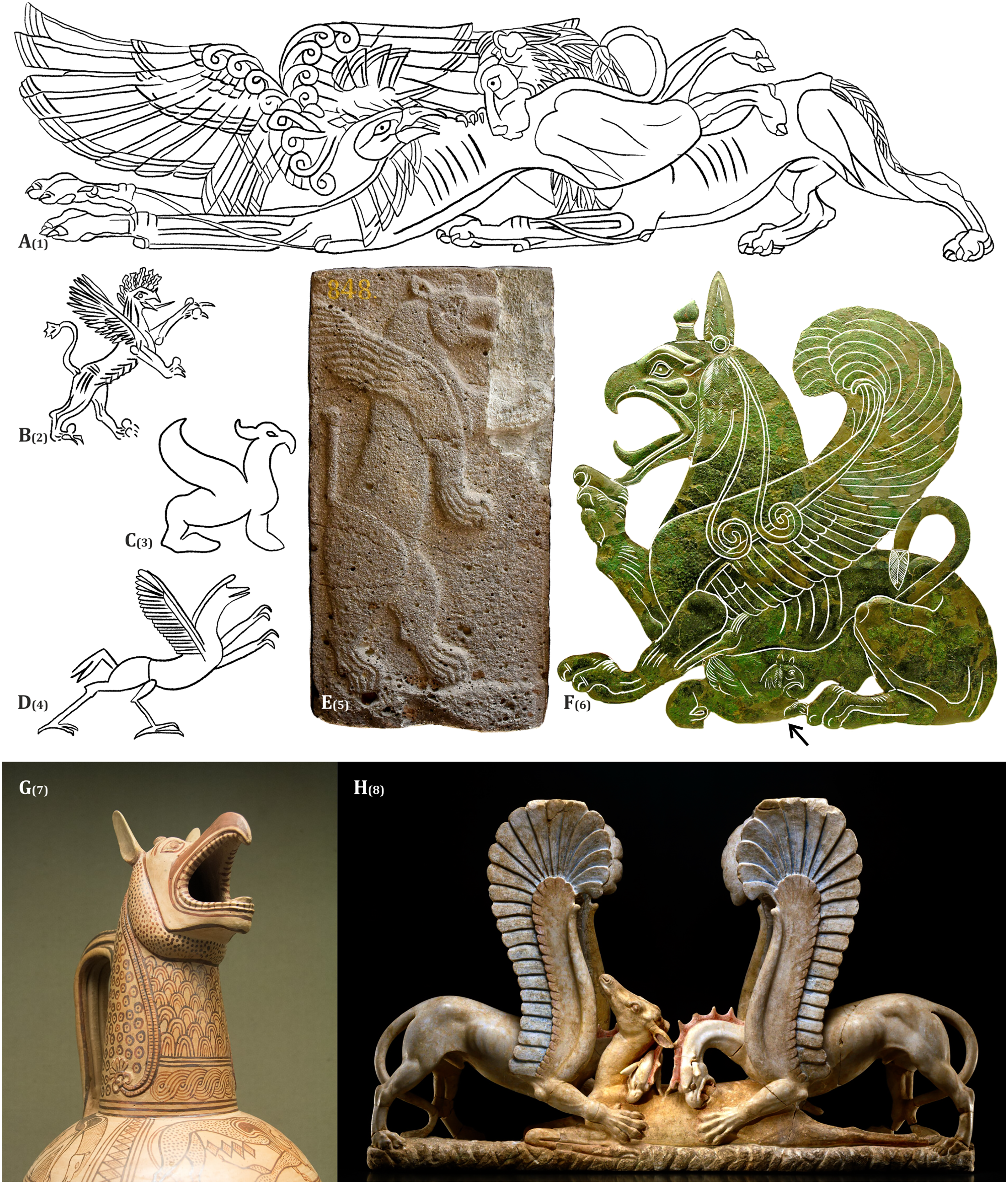
At times, Mayor links Protoceratops with the origin of griffins. In her 1993 Folklore article, she speaks explicitly of ‘the griffin's origin as fossil-inspired folklore’ (Mayor and Heaney 1993, 53, emphasis added) and both editions of The First Fossil Hunters state that griffins are ‘the earliest documented attempt to visualise a prehistoric animal from fossil remains’ (Mayor 2000, 2011, 22). The same works discuss how the griffin's appearance is ‘prehistoric’, implying an influence from extinct animals into their design (Mayor 2000, 18). These statements suggest that Mayor sees fossils as playing a role in the conceptualisation of the griffin itself, demanding that the geomyth extend to the oldest griffin-like imagery of 4th millennium BCE Asia and Egypt (Figure 2A; Frankfort 1937; Phillips 1955; Goldman 1960; Wyatt 2009; Lymer 2018).
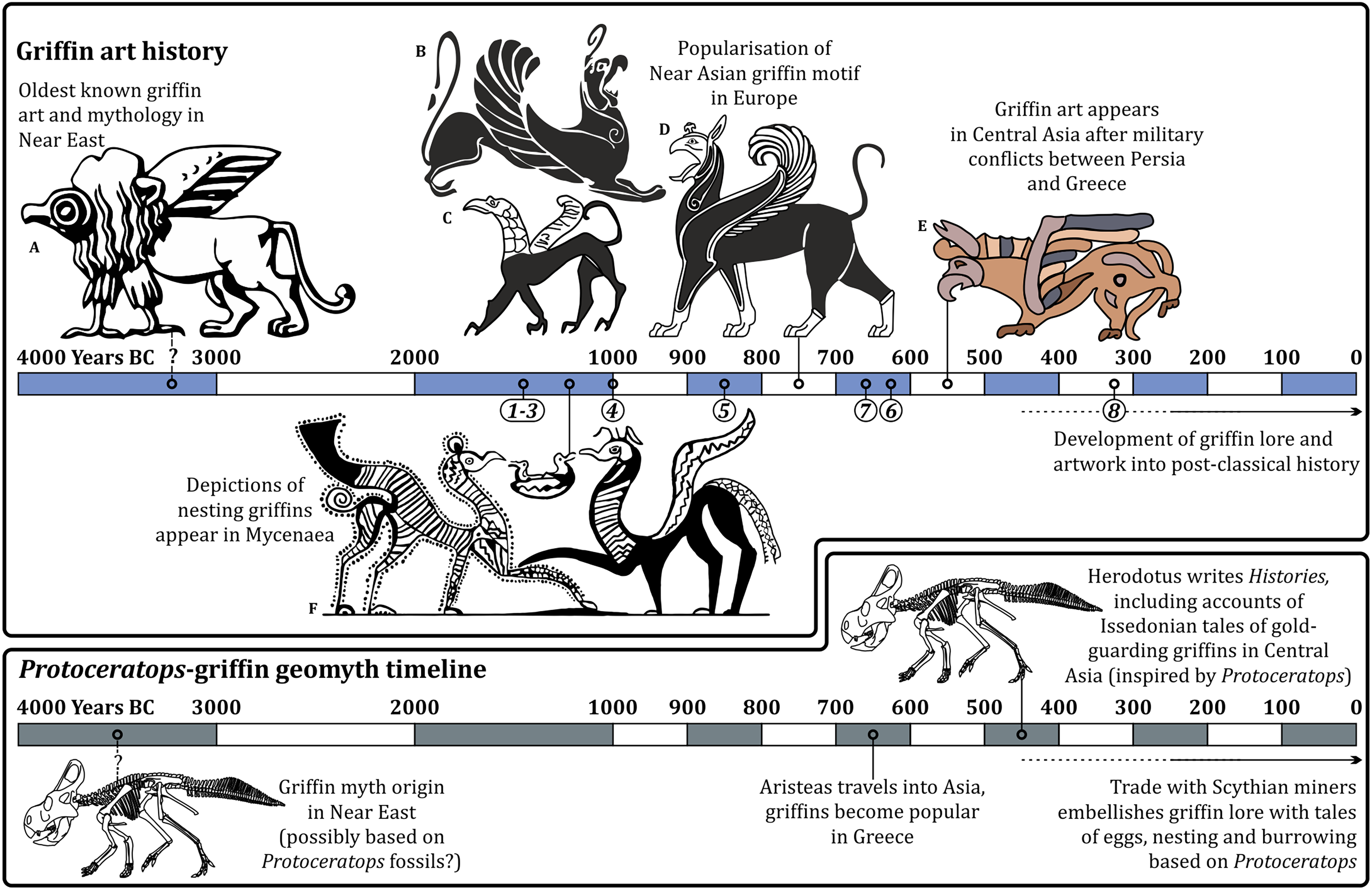
Overviews of griffin art history and the chronology of the Protoceratops-griffin geomyth. Numbers in circles denote images in Figure 6. (A) one of the oldest known griffin artworks, from 4th century BCE Mesopotamia; (B–D) griffins from Greek vases; (E) Central Asian griffin from Pazyryk kurgan 1, late 4th-early 3rd century BCE; (F) depiction of griffins nesting from a 12th century BCE vase, a behaviour linked to post-7th century BCE knowledge of Protoceratops by Mayor but pre-dating alleged Greek knowledge of this fossil by centuries. (A) after Frankfort (1937), (B–D) after Boardman (1998), (E) redrawn from photographs and drawings provided by Dr. Kenneth Lymer; (F) after Rutter (2014).
However, the overwhelming focus of Mayor's work is not griffin origins by way of dinosaur bones; it is how Classical Greeks married tales of Asian fossils with already-known griffin imagery (Figure 2). She recounts that 5th century BCE texts tell of Greek explorers hearing tales of vicious, gold-guarding monsters living in deserts to the northeast of Greece from the Issedonians, nomadic inhabitants of Scythia who mined and traded gold in central Asia. From these, Mayor posits that Issedonian prospecting took them to Protoceratops localities in Mongolia and China, and that they interpreted these fossils as the remains of winged, beaked quadrupeds. When these tales reached the Greeks, they equated them with the griffin artwork already familiar to them from other sources. In her own words: The Issedonian folklore about the life and fate of the remarkable animals they came across or heard about near the gold-prospecting areas must have been passed along to neighboring Scythian tribes-reaching the Black Sea Scythians through a series of seven interpreters, according to Herodotus (4.24). Once it reached Greece and Rome, such folklore was almost certainly associated with images of beaked quadrupeds already known from Near Eastern art; popular Scythian representations of griffins reinforced the tale. As trade expanded with Central Asia, the modest set of folk motifs attached to the Asian gryps-animal was probably kept vital by contemporary travelers who verified the striking image of the griffin by direct observation of fossils, hearsay, and information about desert gold-mining. (Mayor 1991, 36)
Mayor therefore places Protoceratops as inspiration for griffins, but her arguments only explain how dinosaur fossils may have influenced griffin development. Some unclarity is expected in any investigation of cultural events that took place thousands of years ago, within which distinguishing inspiration from influence is often challenging. However, this question is a non-trivial matter in framing the Protoceratops–griffin geomyth as the historic and geographic gulfs between Protoceratops originating griffin culture, or merely exciting Greek interest in these creatures, are substantial. One requires knowledge of Protoceratops in 4th millennium BCE southwest Asia and northeast Africa; the other necessitates awareness of horned dinosaurs in southeast Europe thousands of years later.
This indecision has a number of consequences for Mayor's argument, none more egregious than its non-engagement with the oldest griffin-like imagery and folklore from the Near East and Egypt. Griffin-like monsters are some of the oldest known mythological creatures (Sax 2013) and, although not labelled ‘griffins’ in their respective cultures (Boardman 2002), they were regular artistic components in many southeastern Asian and Mediterranean civilizations by the 4th and 3rd millennia BCE. The exact origins and cultural roles of these winged quadrupeds is uncertain, but their abundance implies societal importance (Wyatt 2009; Sax 2013; Lymer 2018). A number of different ‘griffins’ are recognised from this era, varying in their combinations of feline and avian anatomy (Figure 2). Each seems to have unique origins, genealogies and societal significance (e.g. Goldman 1960; Boardman 2002; Wyatt 2009; Gane 2012; Lymer 2018).
Mayor (1989, 1991, 2000, 2011) acknowledges this deep history: ‘creatures combining the features of birds and mammals had appeared in Near Eastern art as early as 3000 B.C., and peacock-headed griffins can be seen in Mycenaean art of the Greek Bronze age (ca. 1200 B. C.)’ (Mayor 2000, 24–25). Little else is said on this matter, however. In 1993, Mayor simply states ‘…We have no way of knowing what kind of folklore, if any, was attached to these creatures’ (Mayor and Heaney 1993, 41) and, later, she laments ‘there was no way to know what kind of stories, if any, correspond to those images’ (Mayor 2000, 25). This overlooks a body of work that explores the cultural significance of early griffin-like animals and the evolution of their chimerical makeup (e.g. Frankfort 1937; Phillips 1955; Goldman 1960; Hopkins 1960; Wyatt 2009; Gane 2012; Lymer 2018). While no written accounts of them exist before the 5th century BCE, some pre-classical era lore is known, such as that of the griffin-like Babylonian deity Anzû, a lion-headed eagle killed by the deity Ninurta after stealing the tablets of destiny (Figure 3; Phillips 1955; Wyatt 2009; Gane 2012; Sax 2013). By failing to integrate Protoceratops with these earliest occurrences of griffin-like creatures, from within which the Greek griffin undoubtedly arose (Boardman 2002; Lymer 2018), notions that this creature is ‘the earliest documented attempt to visualise a prehistoric animal from fossil remains’ are left entirely unevidenced.
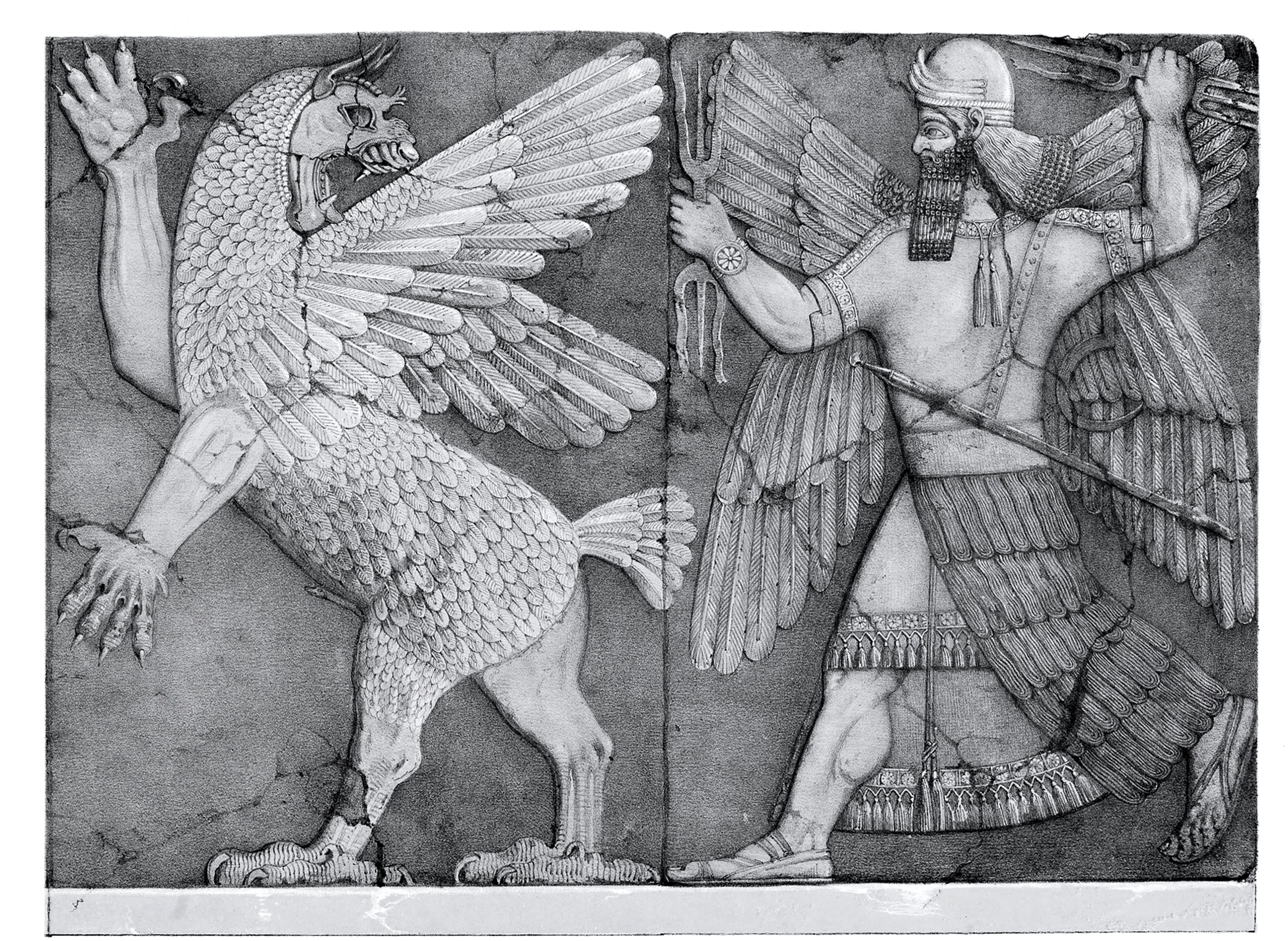
Griffins and their variants are among the oldest of mythological creatures, with numerous types developed among cultures of the pre-classical Near East. The significance of early griffin-like creatures is still a matter of contention, but some of their mythology is known. A well-known example includes the monster depicted in this 9th century BCE relief, Anzû or Tiamat, being pursued by the deity Ninurta or Marduk. The Protoceratops-griffin geomyth has no explanation for these artworks or their associated lore, despite suggestions that dinosaur fossils may have directly influenced griffin designs. Illustration by L. Gruner, from Layard (1853).
Mayor's better substantiated contention, that Protoceratops aroused Greek interest in griffins via contact with cultures from Central Asia, is also problematic as it directly contradicts historic and archaeological data (Figure 4). Greek culture was strongly influenced by the Near East during the 8th century BCE and their art adopted many decorative motifs from this region, including griffins, lions, sphinxes and lotuses (e.g. Phillips 1955; Goldman 1960; Hopkins 1960; Tartaron 2014; Lymer 2018). Details of Greek griffin artwork corroborate this history, being crafted within the traditions of Near Eastern griffins (Boardman 1998, 2002) and not, as might be predicted by Mayor's proposal, incorporating the bovid- or-cervid influenced griffin anatomy characterising examples from Pazyryk tattoos (Lymer 2018). Indeed, griffin art probably arose in Central Asia after it became fashionable in Ancient Greece, the eastward spread of the Achaemenid Persian empire likely introducing the griffin motif to the region from the 6th century BCE (Lymer 2018). The famous gold from Scythian burials in the Pontic–Caspian steppe featuring griffins are thought to have been produced by Greek artisans for trading with the Scythians (Piotrovsky 1975). Mayor's suggestion that Greek griffins were influenced by Asian cultures inverts this documented history.
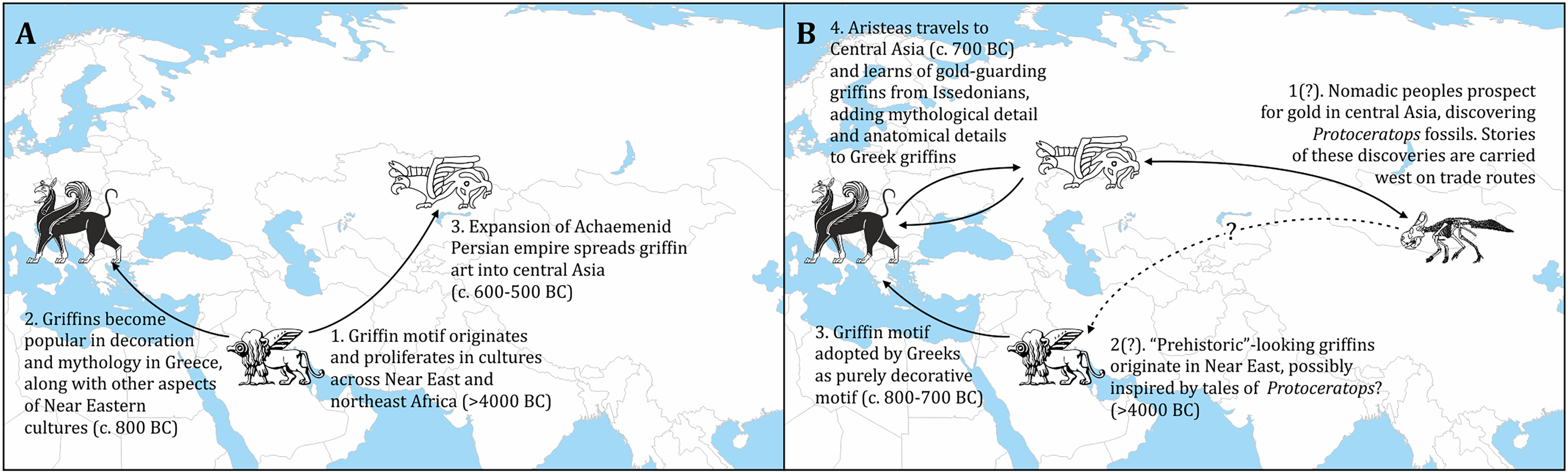
Geographic spread of griffin art according to archaeological convention (A) and the Protoceratops-griffin geomyth (B). In conventional history, the griffin motif radiates into European and Central Asian cultures from its point of origin in the Near East and Egypt. Invoking Protoceratops as a griffin source or popularising agent requires Central Asian cultures to have been aware of griffins earlier than archaeological evidence suggests, and to have been transmitting tales of dinosaur fossils across Asia and eastern Europe. (A) based on Lymer (2018); (B) based on Mayor (2000, 2011).
The griffin in Greek literature, and its relation to dinosaur fossils
The core of Mayor's arguments are drawn from classical texts, including the oldest written account of griffins in Herodotus’ Histories. This series of fifth century BCE books documents Aristeas’ travels in desolate lands far to the northeast of Greece, whereupon he encountered tales of griffins. They are only briefly mentioned in this work, once in Histories 3.116 (following translations by Godley 1920): But in the north of Europe there is by far the most gold. In this matter again I cannot say with assurance how the gold is produced, but it is said that one-eyed men called Arimaspians steal it from griffins. …it is from the Issedones that the tale comes of the one-eyed men and the griffins that guard gold; this is told by the Scythians, who have heard it from them; and we have taken it as true from the Scythians, and call these people by the Scythian name, Arimaspians; for in the Scythian tongue “arima” is one, and “spou” is the eye.
Some details of griffin natural history and Protoceratops fossils are similar, but these accounts do not persuasively link the two entities. Chiefly, too much doubt and disagreement exists over interpretations of Histories to draw specific conclusions about geography and the precise identities of the griffin animals. Although generally thought to have some factual basis, the location and authenticity of the lands explored by Aristeas have not been established with certainty. In part of his response to Mayor's griffin geomyth, Boardman (2002) notes that ‘For the Greeks, the distant north and distant east were much the same thing’ and Lymer (2018) agrees, listing the possible locations of Aristeas’ travels as the Carpathians, the Urals, Western Siberia or Central Asia. He further notes that another early griffin text, the 5th century BCE Prometheus Bound, locates griffins alongside a river of gold belonging to the god Pluto, firmly placing them in a fantastical setting (Lymer 2018).
A additional issue, raised by Bolton (1962) and Boardman (2002), concerns the very identification of Histories’ gold-guarding monsters. The label of ‘griffins’ was given to them by Aristeas and their local name was never recorded (Bolton 1962). Several other myths about gold-guarding creatures existed in Central Asia during classical antiquity, including gold-guarding ants and giant birds, such as the roc (Erman 1846). The possibility exists, therefore, that Aristeas introduced griffins into lore that they were not originally part of (Bolton 1962; Boardman 2002). Indeed, tales of gold-guarding ants are somewhat authenticated through marmots, large burrowing rodents found widely across Eurasia and North America. In some parts of Asia, marmots dig into gold-bearing earth and deposit the nuggets in their spoil heaps, a behaviour that may have originated tales of gold-guarding Central Asian creatures (Peissel 1984; Boardman 2002).
More concerns arise when we consider the details of anatomy and lifestyle ascribed to griffins in pre-mediaeval works. Clearly, very few can apply to Protoceratops as features like feathers, colouration, and wing membranes are not based on horned dinosaur skeletons, and the behavioural reports obviously reference living beings, whether real or imaginary. No references are made to griffins being found deceased, or to bones of any kind. Mayor's more compelling investigations into ancient geomythology typically mention bones that can be interpreted as fossils (e.g. Mayor 2000, 2011), but they are absent here.
Perhaps only one griffin behaviour, nesting, is undoubtedly inferrable for Protoceratops given that this dinosaur is famously known from localities rich in dinosaur eggs (Fastovsky et al. 2011; these are now known to have predominantly belonged to the maniraptoran dinosaur Oviraptor rather than Protoceratops; Zelenitsky and Therrien 2008). This sole similarity among otherwise incompatible accounts does not suggest that these ancient stories capture observations of Mongolian and Chinese dinosaurs, however. Indeed, the significance of later classical sources mentioning nesting griffins is undermined by a 12th century BCE Mycenaean vase that depicts griffins feeding nestlings (Popham and Sackett 1968) (Figure 2F). Mayor (2000, 26) mentions this image but focuses on its ambiguous mythological significance, omitting to mention that it demonstrates Greek art of nesting griffins hundreds of years before any contact with Scythian cultures and their purported knowledge of Protoceratops.
Mines, gold and geography
The gold-guarding behaviour ascribed to griffins by Aristeas is an important pillar of the Protoceratops–griffin geomyth. Mayor explicitly links Protoceratops fossils with alluvial gold deposits, reasoning that prospecting for gold is how the Issedonians discovered these dinosaurs and developed the stories that became linked to Greek griffin myths. As evidence of this co-occurrence, Mayor (1991, 1994, 2000, 2011; Mayor and Heaney 1993) presents maps showing the overlap between gold fields, Cretaceous fossil deposits and Scythian trade routes (Figure 5). By seemingly aligning these historic sites with Protoceratops fossil localities, these maps add much credibility to Mayor's arguments. At face value, they suggest that ancient travellers in Central Asia could not have missed dinosaur bones when prospecting for gold.
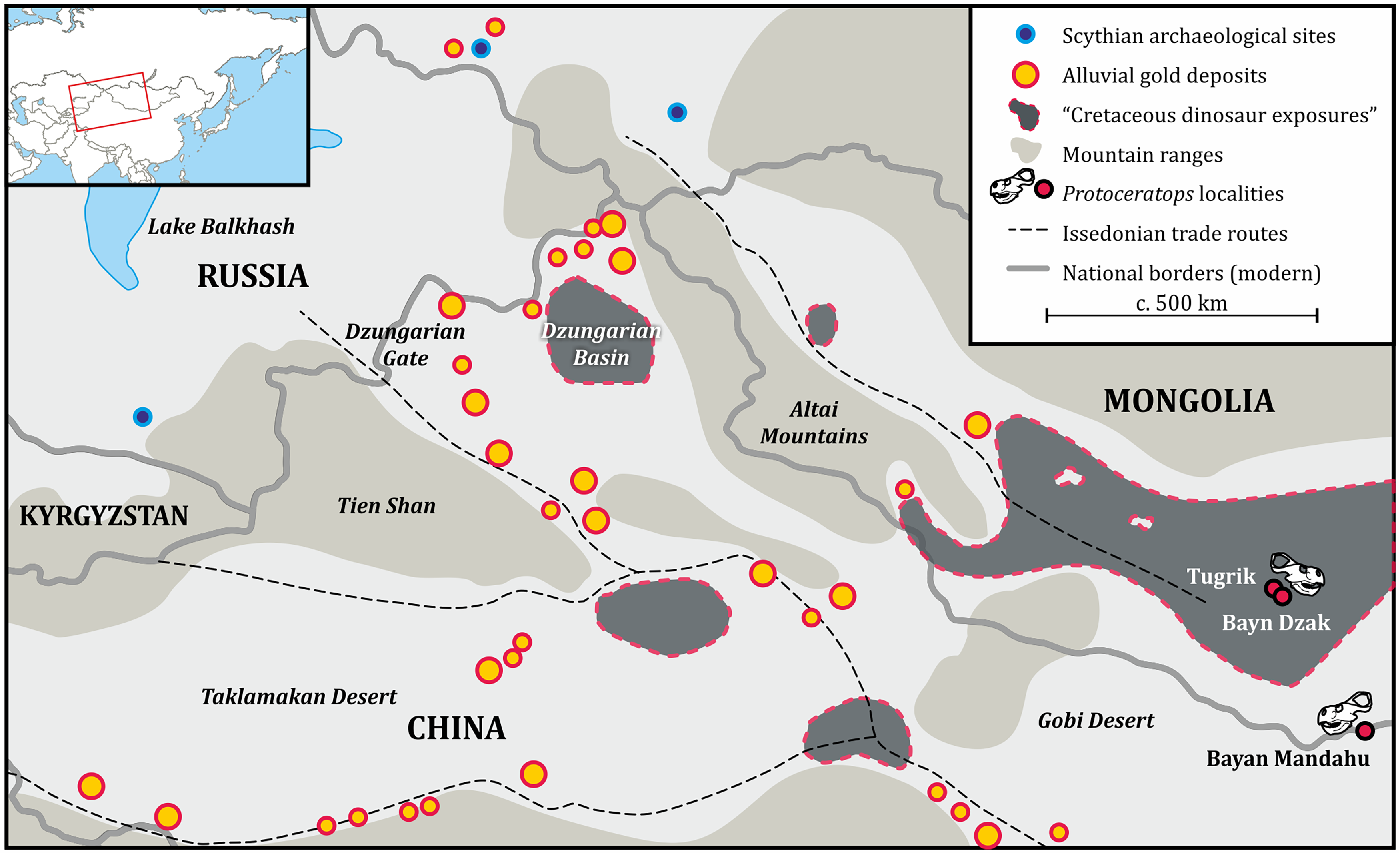
Distribution map of alluvial gold deposits, Issedonian trade routes and Cretaceous dinosaur fossil localities, redrawn from Mayor and Heaney (1993). Protoceratops localities have been added; note their occurence hundreds of kilometres away from gold deposits.
However, these same maps also overlook elementary components of palaeontological science. They purport to show how Cretaceous fossil sites occur extensively across Central Asia, but their depictions of vast fossil beds are essentially meaningless if one is looking to link one taxon, Protoceratops, with Scythian mining sites and trade routes. Protoceratops fossils occur in just a few localities in the southernmost region of Mongolia (specifically, the Djadokhta Formation) and northern China (the Bayan Mandahu Formation) (Andrews 1926, 1932; Fastovsky et al. 1997; Lambert et al. 2001; Dingus et al. 2008). Both sites are several hundred kilometres east of the nearest alluvial gold deposits identified on Mayor's maps (Figure 5). Indeed, with most of the mines west or southwest of the Altai Mountains, Scythian traders would only encounter Protoceratops fossils if they travelled hundreds of kilometres away from their most productive gold sources (Figure 5).
Nor does the well-documented geology of Protoceratops localities mention any trace of gold, either as surface debris or as buried elements (Andrews 1926, 1932; Fastovsky et al. 1997; Dingus et al. 2008). As one of the few physically testable predictions made by Mayor's hypothesis, the absence of gold at Protoceratops field sites is a clear problem. She accordingly invokes desert storms as transporting agents, imagining that wind-blown metals would create ‘a chance find of a gold particle lodged in among petrified dinosaur eggs’ (Mayor 2000, 45). This scenario is not only challenged by seasons of Mongolian fieldwork but also the physics of aeolian sedimentation. Mayor suggests that ‘A sand blizzard in the Gobi can transport pebbles the size of silver dollars!’ (Mayor 2000: 45), without any evidence that said storms can move gold nuggets hundreds of kilometres. The specific gravity of gold, 19.3, precludes wind transportation for anything above microscopic particles (Smith et al. 1993) and it is implausible that larger pieces would be rolled hundreds of kilometres by wind and gravity. Invoking weather conditions to bring gold and Protoceratops together is surely special pleading and brings an unfalsifiable quality to evidencing the Protoceratops–griffin geomyth.
Griffin form and Protoceratops
The catalyst of Mayor's interest in Protoceratops is her proposal that Greek griffins have a ‘prehistoric’ appearance that matches the basic anatomy of early horned dinosaurs (Mayor 2000, 2011, 2022). Precise anatomical congruence between fossils and mythological beasts is not needed to substantiate geomyths, as is evidenced by Pleistocene horse and primate teeth being interpreted as dragon remains, shark teeth being snake tongues, and mammoth bones being ascribed to unicorns and giant humans (Oakley 1965; Buffetaut 1987; McNamara 2020). However, much emphasis is placed on the supposed griffin-like anatomy of Protoceratops by Mayor, presumably because no artefacts, documents or other forms of material evidence otherwise directly connect these entities.
We find many issues with Mayor's consideration of Protoceratops and griffin anatomy, beginning with the notion that griffins are ‘prehistoric’ in appearance. Mayor qualifies this term by describing the most ancient-looking griffins as ‘bulky, brutish, leathery beasts’, ‘older, uglier’, ‘lizard-like’, and ‘so dogged, ponderous, so … reptilian, so antediluvian, yes, so prehistoric’ (Mayor 2022, 126–7). Such comments suggest a cliched idea of what constitutes a ‘prehistoric’ animal, recalling early- and mid-20th century portrayals of dinosaurs over the reality of the fossil record. Are the extinct birds and small, furry mammals that lived millions of years ago not also ‘prehistoric’? Are living elephants and rhinos, animals that are expressly non-prehistoric, not bulky and leathery? And why do griffins exude ‘prehistoric’ qualities more than the likes of sphinxes, rocs, sea monsters or other mythological creatures?
Mayor also generalises griffin form in a way that enhances comparison to Protoceratops, but overlooks important artistic variations within griffins and similar creatures (Figures 2, 3 and 6). In doing so, she erroneously identifies creatures such as Pazyryk winged lions (Figure 7C), as griffins (see Mayor 2000, Fig.1.3; this error pointed out to us by Lymer, pers. comm. 2024). Today, the most familiar griffin types are ‘bird-griffins’, winged creatures with leonine bodies and raptorial bird heads, but many other forms of griffin-like beasts exist, including wingless sphinxes (a human head on a recumbent lion), bipedally standing winged lions with human heads, winged humans with avian heads, winged lions, long necked ‘lion-griffins’ (sometimes called ‘lion-dragons’), and lions with avian heads, wings and forelimbs (Frankfort 1937; Goldman 1960; Boardman 2002; Wyatt 2009; Gane 2012). Each of these are distinguished by different proportions and configurations of wings, necks, teeth, claws, tails, ears, horns, crests and manes. The incorporated animal species differ as well. Bird-griffins may have eagle, peafowl or falcon heads, as well as a variety of big cat species reflected in their bodies and limbs. Tails may be of either avian or felid identity, and necks can be long and bird-like, or short and leonine. These griffin permutations are not considered in depth in any of Mayor's writings, other than to identify the ‘heavier, short-necked earth-bound’ morphs as especially ‘prehistoric’ in nature (Mayor 2000, 17–18). Critically, no explanation is provided for why Greek griffins became decidedly less Protoceratops–like over time, developing longer necks and longer ears (Boardman 2002) during the period when tales of Mongolian fossils were supposedly actively influencing their appearance.
Variation in griffin form: note the contrasting proportions, limb types, head shapes, and cranial ornamentation. Numbers in parentheses denote position in the timeline shown in Figure 2.
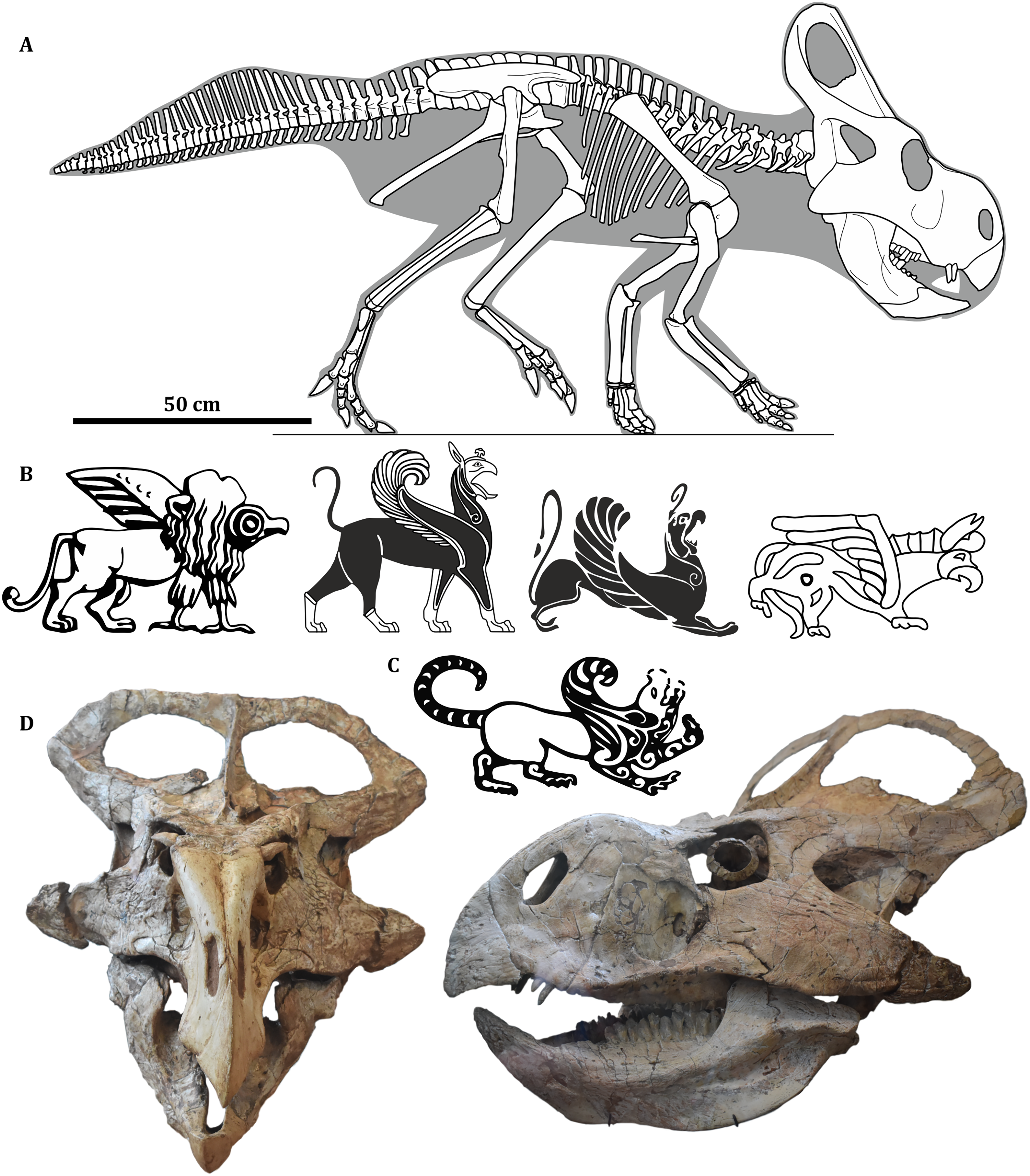
The anatomy of Protoceratops andrewsi compared with griffin art of various cultures. (A) Skeletal reconstruction of an adult P. andrewsi; (B) griffin art from Mesopotamia, Greece and Central Asia. Note the position of the wings – are these likely to be confused with Protoceratops cranial frills or scapulae? – as well as many other obvious differences in head, limb and tail anatomy; (C) Pazyryk winged lion tattoo identified as a griffin by Mayor (2000), 5th century BCE; (D) Protoceratops andrewsi skulls in anterior and anterolateral aspect, showing their ornament (cranial frills and jutting jugals, or ‘cheeks’), neither of which matches the vertically projecting crests and ears of griffin art. See Figure 2 for sources of artwork in (B); (C) after Rolle (1989).
Even using an idealised griffin form, the similarities between Protoceratops and griffin anatomy are limited to their beaks and quadrupedal stances (Figure 7). Finding additional, more significant resemblance between them is difficult as griffins possess no characteristic Protoceratops features. The latter are distinguished by a cranial frill, which projected backwards from the head of horned dinosaurs, not upwards, like griffin crests and ears (Figure 7D). Unlike most griffins, Protoceratops were also not toothless; they had densely packed cheek teeth behind their beaks. Most griffin art shows either toothless jaws or dentitions recalling those of carnivorous mammals, neither condition matching the jaws of horned dinosaurs. Ceratopsians also had shorter forelimbs than hindlimbs, ending with relatively stout, blunt claws on both hands and feet. These are to be contrasted against the more proportionate, often strongly-clawed limbs of griffin imagery. Finally, the tail skeleton of Protoceratops is proportionally deep and narrow, and nothing like the obvious cat- or bird-like tails of griffin art. Mayor (2000, 2011) suggests that the fossil influence on griffins has been overlooked because scholars have used an overly narrow ‘search image’ to find the inspiration for their appearance, but Protoceratops only begins to match griffin form if we widen that search to the most general anatomies: four-limbed animals with a beaked jaw.
Just as there are few Protoceratops features in griffins, Mayor struggles to identify griffin anatomy in Protoceratops. She posits that misidentifications of broken fossils might explain anatomical deviances, or else that corruptions or embellishment of stories passed over great distances might explain other inconsistencies. Griffin horns and ears could reflect broken skulls, and wings might be damaged frills or misidentified shoulder blades. We regard this as more special pleading. Mayor's contention that griffin wings are mistaken interpretations of Protoceratops frills, for example, overlooks the fact that griffin wings are clearly set on their shoulders, often-well separated from their heads by long, slender, frequently maned necks (Figures 6 and 7). Indeed, griffin wings are so hard to explain that Mayor wonders if they were added to griffins without fossil reference, perhaps to augment their bird-like features or add ‘divine’ qualities (Mayor 1991, 2000, 2011). These concessions that broken fossils, misinterpretations and artistic licence are essential to linking Protoceratops and griffins are contradictory and self-defeating. Mayor's thesis posits that griffins and Protoceratops are folklorically connected precisely because they resemble one another, but if damaged, imperfectly-known or creatively augmented Protoceratops fossils are needed to explain major parts of griffin anatomy, then surely they do not resemble one another much at all?
Attempting to inject Protoceratops qualities into griffins also requires us to ignore the many closely observed features of living animals captured in ancient griffin art. Most griffins are not compiled from ‘generic’ animal parts but with precisely-rendered anatomy that can be easily identified to zoological sources. Leonine influences are obvious, including paws with distinctive thumbs and large, padded, clawed digits, as well as long, slender and upcurved tufted tails. Additional lion features include hairy manes, as well as their overall proportions and musculature. Many griffins have feathers and beaks that recall specific birds, such as roosters, falcons or eagles (Phillips 1955; Goldman 1960). These features immediately signify their taxonomic identities even through artistic stylisation and strongly evidence griffin origins as chimaeras of living species. Mayor dismisses the notion that griffins were a ‘simple composite’ (Mayor 2000, 16), but such carefully drawn animal body parts match the anatomy of real animals so closely that no other explanation seems necessary.
Ignoring the fidelity of ancient griffin art is interesting in light of Mayor's keenness to champion the interpretative abilities of the Scythian nomads. She suggests that they were sharp anatomists with a good comprehension of dinosaur anatomy, an ability that allowed them to describe Protoceratops in sufficient detail for it to influence griffin mythology. However, this view is also contradictory. Knowledge of most of a Protoceratops skeleton would be needed to appreciate their status as a four-legged beaked animal and, to substantiate Mayor's hypothesis, we must assume that Scythian miners were familiar with this entire body plan. However, the griffin-Protoceratops geomyth also requires imperfect knowledge of horned dinosaur form to permit errors in interpretation, thus allowing cranial frills to become wings, broken skulls to become crests and so on. This inconsistent logic is highlighted by Mayor's assertion that the nomads were familiar with raptorial birds, and that this gave them insights into the appearance of bird-like creatures, such as griffins and Protoceratops (Mayor 2000, 45). How, then, would they also mistake the scapulae of quadrupedal animals for ‘an anatomical anchor for wings, [to which] artists added stylized wings as the story was passed along’ (Mayor 2000, 49)? Whether these ancient denizens of Central Asia had a good grasp of animal anatomy or not seems to depend on what is required of them in different parts of the Protoceratops–griffin geomyth.
Further concessions to the anatomical incongruence between Protoceratops and griffins sees the introduction of other extinct animals into the geomyth (Figure 8), the disparate anatomy and geography of which sheds light on the methodology employed when identifying Mayor's griffin sources. Before Protoceratops, two other species were considered as inspiration for the griffin. The first suspect was not a dinosaur or even a beaked animal, but the large, horned, Afro-Eurasian giraffid Samotherium. Though present in the eastern Mediterranean and thus potentially accessible to the oldest griffin societies, Samotherium was rejected as a griffin source for not having a beak (Mayor 2000, 2011; Aronson and Mayor 2014). The second was another horned animal, the gigantic North American dinosaur Triceratops. Although sporting a beaked jaw, this taxon was rejected for not existing in Europe or Asia (Aronson and Mayor 2014; Mayor 2022). Both of these suggestions pre-dated Mayor's studies of Central Asian gold deposits, which eventually led to her discovery of the hornless, small-bodied ceratopsian Protoceratops in Roy Chapman Andrews’ book On the Trail of Ancient Man (1926). Samotherium, Triceratops and Protoceratops differ markedly in size, appearance and geographic location, and it is not clear to us which shared features saw them shortlisted as possible griffin source fossils. Is it not significant, for instance, that only Triceratops and Samotherium have horns above their eyes, while only Protoceratops and Triceratops have cranial frills? How could a fossil mammal be the source of griffin eggs and nests – or, for that matter, how could Triceratops, a species for which no egg fossils are known?
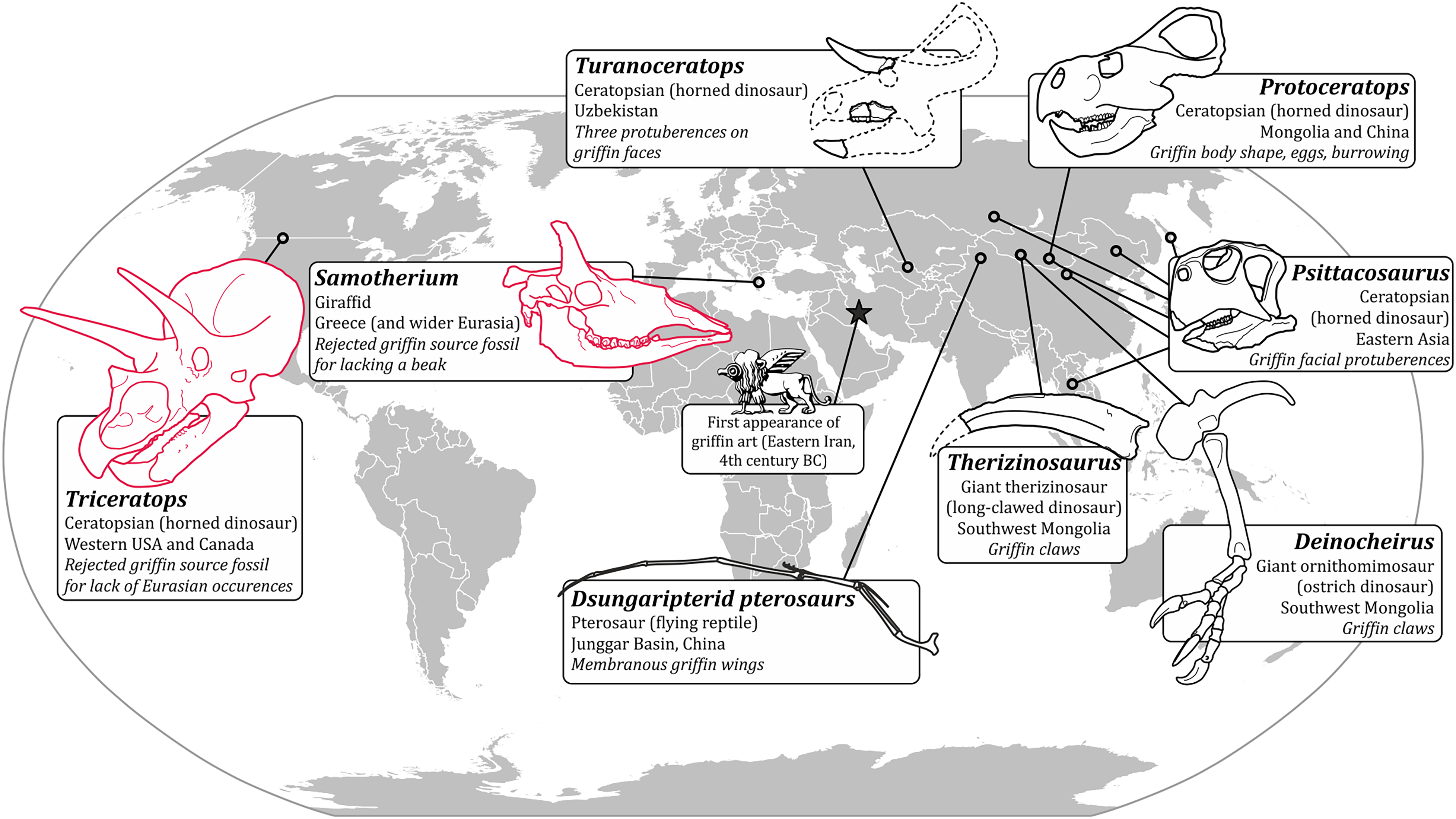
Mayor’s additional source fossils for griffin lore, including investigated but rejected taxa for geomythological involvement with griffins (Triceratops and Samotherium). Text in italics outlines Mayor’s proposed contribution of those fossils to griffin appearance. Illustrations of skull fossils are included to highlight the contrasting anatomy of these alleged source genera, which only deepens if postcranial remains are considered. The lack of geographic and anatomical constraint in choosing possible griffin source fossils does not imply rigorous criteria for their identification.
Later, even with Protoceratops as the principle reference animal, Mayor (2000, 2011) added further Mesozoic reptile inspirations to griffin lore (Figure 8). She cites griffin claws as referencing the enormous unguals of the theropods Therizinosaurus and Deinocheirus, invokes the ‘prominent jugals’ of another early horned dinosaur, Psittacosaurus, to explain griffin facial protuberances, and links the membranous wings of griffins with those of dsungaripterid pterosaurs (flying reptiles). In the second edition of The First Fossil Hunters, she further alludes to the then-recent discovery of what she described as a ‘three-horned’ Uzbek dinosaur Turanoceratops as accounting ‘for the three protuberances on the heads of many griffins in ancient art’ (Mayor 2011, xix). No complete skull is known for Turanoceratops, a genus known from paltry remains, but it likely only possessed two brow horns (Sues and Averianov 2009).
That so many extinct species are drawn into Mayor's griffin geomyth implies a scattershot, unrigorous quality to identifying her potential source fossils. While some species listed by Mayor are found in Central Asia, many do not occur close to the gold fields in her maps (Figure 8) and most are, judging by modern experiences, rare fossils unlikely to be encountered in abundance by prospecting miners. Nor do her suggestions consider the preservation styles of the fossils in question. No wing membranes have ever been found in Asian dsungaripterids, for instance, and the inference of such structures from bones alone requires, at least, complete knowledge of a pterosaur wing, along with advanced understanding of comparative anatomy. By speculating so broadly about other animals that might have contributed to her geomyth, Mayor only dilutes the anatomical and geological importance of Protoceratops to griffin lore. This further exposes the unfalsifiable logic of her arguments, as the anatomical inconsistencies in her geomyth are explained away through not only imperfectly preserved fossils and human error, but also expanding pools of reference species.
Protoceratops preservation and accessibility to ancient nomads
Finally, we turn to assertions concerning the visibility of Protoceratops fossils to the nomadic parties meant to have encountered them thousands of years ago. Mayor (2000) describes Protoceratops fossils as ‘constantly emerging, fully articulated skeletons of beaked dinosaurs’ (43) and notes that Protoceratops skeletons are found ‘standing’ in bipedal and quadrupedal poses, possibly accounting for variance in artistic depictions of griffin stances (48). She implies a scenario in which gold-prospecting nomads encountered abundant, largely exposed skeletons lying around in plain view, enabling direct and clear observations of Protoceratops anatomy.
There are several issues with this. That Protoceratops specimens are abundant and sometimes conspicuous in their respective localities is a well-established fact (Andrews 1926, 1932; Fastovsky et al. 1997; Lambert et al. 2001; Dingus et al. 2008) but the amount of visual information provided by these naturally weathering specimens is overstated. Written accounts, field photographs and film footage of Djadokhta Formation palaeontology from the AMNH's Central Asiatic Expeditions during the mid-1920s give an idea of how Protoceratops fossils were originally observed in the field (Granger and Gregory 1923; Gregory 1927; Andrews 1926, 1932), and we refer to these over modern experiences because fossil poaching of Mongolian dinosaur beds has reduced their fossil richness (Currie 2012; Fanti et al. 2018). Contemporary fieldwork in these regions may, therefore, not accurately replicate the conditions of the early 20th century or, for that matter, those of antiquity.
Preservation within a soft, weakly cemented sandstone permits the harder-wearing bones of Djadokhta Formation Protoceratops to emerge prominently from their supporting matrix, although rock still clings to the bone surfaces of even well-exposed specimens and obscures major anatomical features prior to preparation (Gregory 1927). The friable sandstone can be removed from these fossils using fine tools or even fingers, but many specimens are beyond such superficial preparation as they are buried more extensively. AMNH field photographs and archive footage show that both isolated skulls and complete specimens required excavation to reveal their full extent and that, prior to this, only small portions of bone were visible (Figure 9). Once exposed, Protoceratops fossils are delicate. Andrews (1926) wrote of the vulnerability of Protoceratops bone once liberated from its matrix, detailing how collecting a large number of specimens exhausted his expedition's flour and fabric reserves as they sought to create enough plaster and burlap to protect their discoveries.
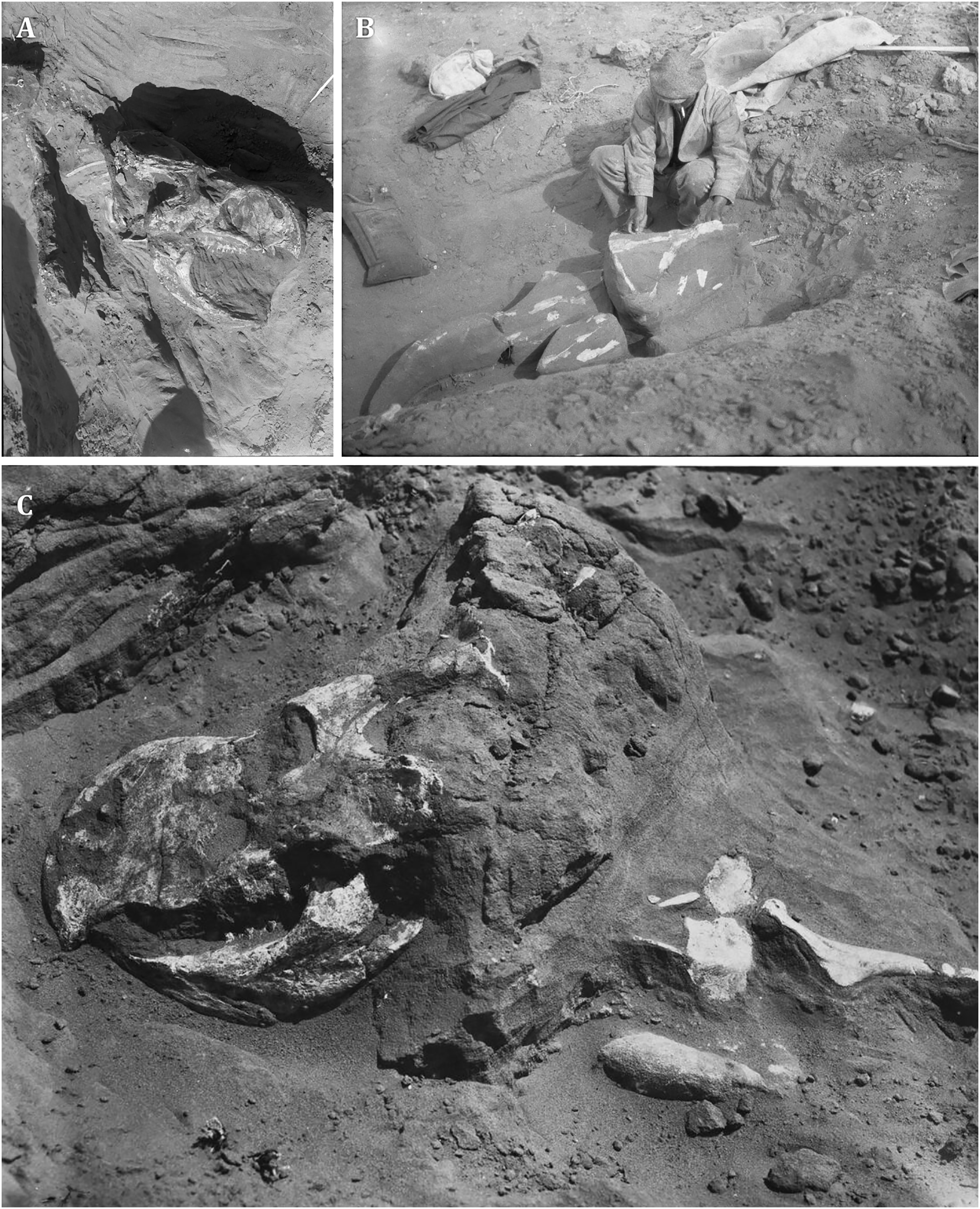
Photographs of Protoceratops andrewsi discoveries made during various seasons of the American Museum of Natural History’s Central Asiatic Expedition. Titles as given by the AMNH Library: (A) ‘Djadochta Beds showing skull and jaws of Protoceratops found by A. Johnson, Mongolia, 1923’; (B) ‘Buckshot taking out complete dinosaur, Mongolia, 1925’; (C) ‘Dinosaur skull, Shabarahk Usu, Mongolia, 1925’. Each of these specimens were excavated to some degree before their photographs were taken, film of which can be seen at https://digitalcollections.amnh.org/asset-management/2URM1T50Z29. Images from the American Museum of Natural History Library, used with permission.
The conditions described here for Protoceratops are not unusual in context of other Djadokhta fossils (see comments, for example, by Osborn 1924) or, indeed, for dinosaur fieldwork in general. They challenge the romanticised idea of Protoceratops skeletons lying around awaiting casual perusal by passing gold miners and suggest, on the contrary, that Scythian nomads would have seen little of Protoceratops fossils unless they, like modern palaeontologists, actively located, excavated and prepared their fossils. We question whether partially-glimpsed portions of Protoceratops bone would have even seemed remarkable enough to garner attention from ancient observers, as it is only with certain knowledge and experience of fossils that trained palaeontologists are able to discern the remains of many extinct organisms in the field. We agree with Sereno's succinct critique of Mayor's griffin geomyth (in Lyons 2009): …fossils like dinosaurs are not ‘easy’. ‘They are complex to the eye, impossible to extract from the ground, difficult to determine what is bone and what is not.’ Inexperienced paleontologists will often destroy the very fragile fossils before they remove something from the ground like a Protoceratops skull. (Sereno, quoted and paraphrased in Lyons 2009, 183)
Protoceratops, griffins and the materiality of geomythology
We approached the Protoceratops–griffin geomyth by asking whether it was contradicted by established aspects of history, geography and palaeontology, and whether it forms a cogent connection between myth and Asian horned dinosaur fossils. Against these criteria, we deem it deeply flawed. It is inconsistent with archaeological data, overlooks a large body of work on the cultural significance of the griffin motif, makes errors in considerations of geology and geography, and relies on a questionable and selective reading of literary sources and fossil anatomy. No logical chain of inference connects Protoceratops, or any other extinct Asian reptile, with ancient griffin folklore. The entire concept is best considered an ‘ex post facto geomyth’ (Vitaliano 1968, 6): an effort to find significance in superficial, ultimately inconsequential coincidences between details of geology and mythology.
The cryptozoological beginnings of the Protoceratops–griffin geomyth are of interest in light of the issues that we identify here. Mayor writes that she distanced her griffin investigations from cryptozoology when she came to understand that cryptozoologists ‘would be most pleased if I could prove that the griffin was a relict animal that actually – perhaps even recently – preyed on Scythian horses’ (Mayor 2022, 133). Despite this, she has continually referred to the griffin as a ‘cryptid’ (Mayor 1989, 1991, 2022), and her determined efforts to uncover griffin origins among fossils recalls the assumption of many cryptozoologists that reports of unknown animals and monsters must have bases in undescribed species rather being purely fantastical. Mayor (2000) has not hidden her philosophy: ‘The mind-boggling fossil remains of alien creatures have always demanded answers, and … curious observers will always strive to provide them’ (51).
If, as we posit, Protoceratops is so weakly linked with the griffin, why has this idea had such appeal? This question, a topic deserving dedicated analysis, does not only concern Mayor's Protoceratops investigation as some of the most repeated geomythological connections of modern times are of similarly immaterial nature. They include proposals that dinosaur fossils inspired Chinese dragons (e.g. Needham 1959; Dong 1988; Sarjeant 1999; Spalding and Sarjeant 2012; Rieppel 2019) and that cyclopes stemmed from discoveries of extinct elephants (Abel 1914, 1925, 1939; Mayor 1991, 2000, 2011; Mayor and Heaney 1993). In both cases, these geomyths are substantiated only by vague anatomical congruence between certain fossil species and mythological creatures from the same geographic regions.
Perhaps the widespread acceptance of these geomyths is partly explained by dinosaurs, mythology, and ancient history being very popular topics. Famous dinosaurs like Protoceratops are primed to become geomythological ambassadors and bring geomyths into magazine articles, books and museum exhibits, no matter how robust the underlying ideas may be. Furthermore, the idea that dinosaurs may have been discovered and interpreted thousands of years before their scientific recognition in the 19th century feeds into another widespread, if sometimes problematic idea: that pre-modern societies were far more advanced in their understanding of the natural world than is generally appreciated. Such beliefs are ubiquitous around certain topics in archaeology and human history and manifest themselves as ‘alternative histories’ and pseudoarchaeology in their most egregious forms (Derricourt 2012; Bassett 2013).
A willingness to assign modern attitudes and knowledge to past cultures may also play a role. If we think dinosaurs are important today, surely they were also important in the past? Mayor's Protoceratops geomyth exemplifies these views, not only implying a capacity to locate and excavate Mesozoic reptile fossils comparable to that of modern times, but also populating her hypothesis with spectacular species from the mainstream ‘canon’ of palaeontology: Protoceratops, Triceratops, Deinocheirius, pterosaurs and so on. Once again, we contrast this with fossil folklore based on physical evidence, which generally involves comparatively unspectacular, often taxonomically obscure species of extinct shellfish or less remarkable fossil mammals. When constituted without direct guidance from historic or archaeological evidence, geomythological connections are seemingly crafted through the lens of popularised palaeontology. Here, we find more parallels with the cryptozoological roots of Mayor's griffin work. Just as some geomythologists may invoke popular fossil reptiles in their investigations, cryptozoologists frequently identify cryptids as surviving members of well-known extinct species, often understood through popular and sometimes outdated portrayals of the past (Loxton and Prothero 2013; Naish 2016).
Scholarly attitudes may also play a role. As noted in our introduction, geomythologies can be difficult to evaluate because they draw on such disparate fields of expertise, and the discipline itself is not populated with a large suite of practitioners. Under these conditions, ideas both commendable and questionable proliferate with equal ease. Some geomyths are even entertained in the face of contradictory data. A useful case study in this regard concerns the aforementioned connection between cyclopes and fossil elephants. The modern, seminal take on this subject was crafted by Austrian palaeontologist Othenio Abel who, in several influential works (Abel 1914, 1925, 1939), connected the skulls of the Sicilian dwarf Pleistocene elephant Palaeoloxodon falconeri to the cyclops myths of the ancient Mediterraneans. Abel reasoned that elephant skulls have a conspicuous, eye socket-like conjoined nasal passage that gives their cranial osteology the superficial appearance of a single, large orbital opening, the likes of which could have inspired cyclops form. This observation was not novel to Abel, but his work became so influential because he claimed that the Greek philosopher Empedocles identified elephant fossils as cyclops bones 2500 years ago. Mayor (2000, 2011), however, exposed Abel as a misleading source of cyclops lore, showing that his Empedocles tale had no basis in any surviving records. Without his literary evidence, Abel's geomyth becomes baseless: elephant fossils and myths of one-eyed monsters exist all over the world, and there is no evidence from historic texts or artwork that makes their connection in Sicily particularly notable or important (Aguirre and Buxton 2020). Mayor, however, not only excuses Abel, but vindicates him, and used the elephant-cyclops geomyth to justify her own studies: It would be easy to see Abel's misinformation about Empedocles as a deliberate hoax, but I think Abel elaborated on Empedocles’ genuine insights about primeval life-forms out of a desire to fill in that disturbing blank in the ancient record… namely, the absence of any surviving philosophical theories to explain big fossil bones. (Mayor 2000, 8)
This eclipsing of better substantiated geomythology has affected the griffin as well. Howorth (1887) noted that objects identified as ‘griffin claws’ were common in the collections of European churches during the Middle Ages, their actual identities mostly being bovid horns, but sometimes being the fossil horns of Pleistocene rhinoceroses. He tied these to stories of giant bird bones, actually remains of Pleistocene mammals, washing up on Siberian coasts, agreeing with an earlier proposal by Erman (1846) that they may relate to Herodotus’ accounts of gold-guarding griffins (gold-bearing gravels beneath the Pleistocene outcrops being the source of gold in this interpretation). Erman and Howorth can be accused of projecting Herodotus’ stories of griffins into these tales because, locally, Siberian people regarded these bones as belonging to giant birds, not winged leonine creatures (Erman 1846) but, whatever their folkloric origin, these interpretations are at least based on physical specimens, and not hypothetical historical scenarios. Mayor (2022) augments this fossil folklore with mentions that some ‘griffin eggs’ (actually ostrich eggs) held in European church collections during the Middle Ages were joined by dinosaur eggs from Central Asia. To our knowledge, no details of these fossil eggs have been published but, if valid, they join extinct rhinoceros horns labelled as ‘griffin claws’ in presenting a material griffin geomythology.
Ultimately, any discussion about certain geomyths ‘overshadowing’ others cycles around to the distinction between materially-evidenced history and that based on speculation and inference. Should these geomyths be ‘equal’ in academic and public standing? When, for that matter, does a necessary degree of geomythological inference tip over into unreasonable speculation? Such a boundary is surely blurred and ill-defined, but our study shows that one must exist: the deep flaws in the Protoceratops–griffin geomyth directly result from unbridled, sometimes unfalsifiable conjecture creating far-reaching and unlikely scenarios. There is nothing inherently implausible with the idea that ancient peoples found dinosaur bones and incorporated them into mythology, be that of the griffin or any other folkloric creature, but such examples must be rooted in realities of history, geography and palaeontology if they are to rise above the level of mere possibility.
Footnotes
Acknowledgements
We thank Richard Fallon and Eddie Guimont for their invitation to contribute to this volume and their editorial handling of our paper. We are also grateful to David Hone for discussions of Mongolian fieldwork and to Chris Manias for providing a review and discussion of our manuscript. An anonymous referee, through disagreeing with our conclusions, helped us to sharpen and refine our arguments. The American Museum of Natural History Library is acknowledged for their generosity regarding the use of photographs in  . Finally, we thank Dr. Kenneth Lymer for providing detailed insights on griffin art history as well as his generosity with providing artwork for reference in the creation of our figures.
Declaration of conflicting interests
The authors declared no potential conflicts of interest with respect to the research, authorship, and/or publication of this article.