




Abstract
In this paper I present the well-known German literary giant Johann Wolfgang von Goethe (1749–1832) as a heterodox thinker in palaeontology. In Britain, Goethe is best known as a poet, playwright and man of letters, despite producing substantial and detailed scientific studies to which he occasionally attached highly controversial interpretations. In his scientific studies and perhaps especially in palaeontology, Goethe was at times orthodox and at other times highly heterodox. His fundamental project was to comprehend the unifying principle within all nature and in that respect he was one of the early, great holistic thinkers. Goethe proposed a theory of a dynamic unifying ‘type’ for both plants and animals, working together with an inherent creative drive, which he believed was present in all nature. Here I show how he used this model to interpret the morphologies of extinct Plio-Pleistocene mammals such as the aurochs and giant sloth, and also demonstrate how Goethe's dynamic thinking led to some tentative pre-Darwinian transformationist (‘evolutionary’) propositions.
Keywords
If I ever lie contented on a bed of sloth,
May I be done for then and there!
If ever you, with lies and flattery,
Can lull me into self-complacency
Or dupe me with a life of pleasure,
May that day be the last for me!
This is my wager!
(J. W. v Goethe. Faust I. IV L.1692–1698; trans. Atkins 1984)
The quotation is from Johann von Goethe's Faust. With these words, the eponymous protagonist sets out the terms of his bargain with Mephistopheles. If Mephistopheles’s gifts of power can bring him to a state of inner satisfaction, such that Faust no longer feels the urge for creative struggle, at that moment his soul will be forfeit.
This in essence, sums up one aspect of Goethe's understanding of the human condition (FA, 1, 7:57, 1112–17). 1 For Goethe, dissatisfaction and striving for meaningful existence in the world are the stuff of human experience, but humans are not alone in their striving because the drive for change and improvement can be found in nature itself, though perhaps in less poetic expression (Cornell 1990; Tantillo 2002, 58). Goethe's understanding of nature's striving as a force for change was inspired by Johann Friedrich Blumenbach's Bildugstrieb: an idea of a ‘formative force’ or ‘impulse’ introduced in Über den Bildungstrieb und das Zeugungsgeschäfte (‘On the formative drive and the processes of generation’; Blumenbach 1781). Blumenbach was one of the leading pioneers in German comparative zoology and anthropology, and his correspondence with Goethe between 1783 and 1829, was frequent and well documented. Goethe supported Blumenbach's notion of nature's driving force because it bolstered his own theories of metamorphosis. He wrote a short essay making a distinction between a ‘vis essentialis’ (vital force) and an epigenetic nisus formativus: ‘formative impulse’ or ‘drive’ (Goethe 1820). He argued that the implication of ‘force’ was too ‘mechanical’ and did not adequately express the adaptive possibilities of living organisms, while ‘formative impulse’ allowed nature a degree of creative freedom, as long as it was understood together with a concept of metamorphosis: ‘I will go so far as to assert, however, that when an organism manifests itself we cannot grasp the unity and freedom of its formative impulse without the concept of metamorphosis’ (Goethe 1820). For Goethe, nature's creative striving developed together with its metamorphic capacities. Furthermore, the idea led him quite naturally to conceptualise the possibility of transformation of species and evolution.
From Faust we learn that ‘sloth’ in the sense of ‘creative laziness’ was a grave offence; but ironically, Goethe also wrote an essay on sloths, in the sense of the xenarthran mammals, and presented them as creatures that were a long way from being creatively slothful. Instead, the essay introduces an inspired vision of an ancient Megatherium, an extinct ground sloth, channelling its creative drive into its own evolution. In the same essay we find how the original reconstruction of the iconic Megatherium americanum, an inhabitant of the geologically recent Plio-Pleistocene period, stimulated Goethe's heterodox imagination to bring forward an idea of species change, based on an inner impulse to strive and evolve. Here I discuss two of Goethe's palaeontological commentaries and show how he can justifiably be thought of as a heterodox thinker in palaeontology, both in his own time and in ours.
Goethe's transformist ideas
Goethe's notions of evolutionary transformism were not derived from studies of fossils. Not unusually for the time, his theories were initially formulated from observations of the growth and development (ontogeny) of extant, living individuals. In his most popular scientific study Versuch die Metamorphose der Pflanzfen zu Erklären (‘An essay to clarify the metamorphosis of plants’) he described the morphological changes as plants emerge from seed and develop further into flowering and fruit bearing stages (Goethe 1790). From his observations he proposed that the various plant organs and structures could all be regarded as different expressions of a moving metamorphic ‘type’ structure which he called ‘leaf’. This, however, was not to be understood as a foliar leaf, but rather as a mobile, plastic principle that could work through matter and bring about the various botanical forms and organs. Furthermore, from comparative observations of the morphology and ontogeny of multiple plant genera, Goethe came to the idea of a perceptible unity of type in the diversity of plants (Goethe 1790). He made a similar, but less successful attempt at discovering a mobile ‘type’ principle in animals (Goethe 1795) but was unable to formulate a concept that could encompass all the different animal structures and groups. In the end, he focused his attention on vertebrate osteology and in Outline for a General Introduction to Comparative Anatomy (Goethe 1795) proposed the ‘type’ as a ‘comparative canon’ (Vergleichungsskanon), a mental image derived from multiple observations and comparisons and held in the imagination. The purpose of this idealised comparator was to serve as a stabilising idea to which at least vertebrate animals could be referenced. Goethe did not extend his studies to the invertebrates with the same commitment.
In his later essays, and especially in his palaeontological studies, we can see how Goethe understood the vertebrate type as working with a dynamic formative principle bringing about metamorphosis, through both ontogeny and also through species change. This is because concurrently with Goethe's radical thinking on nature's metamorphic striving, mounting palaeontological evidence throughout the eighteenth century enabled him to make the conceptual leap from ontogenetic development to species change. Goethe speculated on species development and transformation in a rather novel way and his understanding of the processes that drove evolutionary change were quite idiosyncratic and heterodox, as we shall see (Goethe 1817).
How far Goethe took his ‘evolutionary’ ideas is contentious. Some scholars have argued for Goethe as an unambiguous forerunner of Charles Darwin, alongside transformationist-evolutionists such as Jean-Baptiste Lamarck, Erasmus Darwin, Geoffroy de Saint Hilaire and others (Fritzman and Gibson 2012; Richards 2017). Ernst Haeckel and even Charles Darwin recognised Goethe as ‘an extreme partisan’ with respect to the transmutation of species. Haeckel had corresponded with Darwin and encouraged Darwin to embrace Goethe as a fellow transmutationist (see Haeckel 1866 2: dedication). More recently Astrida Orle Tantillo (2002) and especially Robert Richards (2017) have given accounts that favour Goethe as a pre-Darwinian evolutionist.
However, as Richards points out, there were those such as Manfred Wenzel and George Wells who disagreed. In Wenzel's opinion, ‘An evolutionism … establishing an historical transformation in the world of biological phenomena over generations lay far beyond Goethe's horizon’ (Wenzel 1996). Wells was convinced that Goethe ‘was unable to accept the possibility of large-scale evolution’ (Wells 1978). Nevertheless, most scholars concede that Goethe acknowledged species transformation to some degree and it is certainly hard to dispute that he recognised species change within related genera, over short time periods. This is particularly evident in his essay on the fossilised aurochs (Fossiler Stier, FA 1.24:558).
Throughout his extensive works, Goethe was never fully explicit about the implications of ‘metamorphosis’ as he saw it. There are even hints that he thought full acceptance of nature's metamorphic capacities could be ‘dangerous’. In one essay, ‘Problems’(written in 1823), he states that metamorphosis as a general natural principle is an ‘honourable’ idea but at the same time ‘a dangerous gift from above’ because it can lead to ‘formlessness and the destruction of knowledge’ (FA, I, 24:582). Similarly, in Die Absicht wird eingeleitet (‘The purpose is introduced’), one of the opening essays from Goethe's Zur Morphologie (‘On morphology’), he wrote: What has just been formed is instantly transformed, and if we would arrive, to some degree, at a vital intuition of Nature, we must strive to keep ourselves as flexible and pliable as the example she herself provides (trans. Mueller in Goethe 1952).
However, Goethe also thought that any impulse for change needed to act together with an opposing force that would restrain the creative urge. He envisaged this counterforce as a ‘specifying impulse’ leading to ‘the stubborn persistence of things that have finally come into being’ (FA I.24:582–830). His idea was presented as a ‘principle of compensation’ or natural budgeting. Goethe proposed that the material ‘budget’ of an organism acted as one of the constraints regulating nature's drive towards change. Malleable and uncontrollably creative nature, despite itself, needs to work within physical and physiological constraints and Goethe envisaged nature's budgeting as an equalising principle. For example, if an animal amplified the development of one bodily part, that development was compensated by the underdevelopment or restraint of another part of the body. ‘As it is, for example, in the giraffe, the neck and extremities are favoured at the expense of the body, while in the mole it is the reverse’ (Goethe 1795). Thus, nature possessed creative freedom, but only within a constraining framework of a budget. Goethe wrote that ‘no addition can be made to one part without a subtraction in another’ (FA I.24:233).
Goethe's transformism was clearly different from Darwinian conceptions because he was not searching for an evolutionary ‘mechanism’. Instead, he was proposing a rather more aesthetic, dynamic and holistic explanation of diversity. For Goethe, transformations of species as explanations of changes in living forms over time were self-evident because, as far as he was concerned, nature's malleability and creative strivings could lead nowhere else but to variety and change (Jenner 2022). It was the dynamics and creativity of change that mainly interested Goethe and thus his views on evolutionary transformations were heterodox, even in comparison to other transformationist views of his own time. His ideas diverged significantly from the main explanations of organic form in the late eighteenth century: for Goethe, morphological variety and change in organisms were not the mechanical responses of living creatures to environmental changes, as attested to by Lamarckism, nor the teleologically driven differences in design emerging from natural theology. Although somewhat aligned with ideas found in continental Naturphilosophie, Goethe's transformism was mostly linked to his explorations of the different ways nature and human beings generate and transform themselves, and how creativity itself exists within the world. This major theme of essential creativity runs throughout Goethe's corpus of literary and scientific works. For Goethe, evolutionary changes were brought about by a will-filled, creative striving. This force of change existed in all living individuals and even to a lesser but nevertheless significant degree, in the non-living world, where Goethe identified a ‘drive’ within amorphous substances to take on coherent forms (Tantillo 2002, 134–142). Goethe's nature embodied a universal craving for creation, formation and change, and he wanted to build an entire world-view based on the way he himself defined the concept of morphology: as nature in eternal formation and transformation (FA. I.24: 546). As Richards correctly argues, transformationst-evolutionary ideas were completely in keeping with Goethe's vision of a dynamic, continuously changing natural world (Richards 2017).
The rest of this article reveals Goethe the polymath as, among many other things, a palaeontological enthusiast. I discuss two of his less well-known palaeontologically themed essays, on the fossilised remains of a Pleistocene aurochs (written in 1822 and 1824), and a commentary from 1821 on Christian Pander and Eduard d’Alton's Die vergleichende Osteologie (‘Comparative osteology’) (Pander and d’Alton 1821–1838).
Goethe's interest in palaeontology
Before there were dinosaurs there were mammals, at least in the timeline of palaeontological research. Ancient mammals were already known long before Richard Owen named the Dinosauria in 1842 and it was only after 1842, that the ‘terrible lizards’ officially became the most fearsome creatures to walk the earth (Owen 1842). Within Goethe's lifetime, another group of extraordinary animals had been causing a public sensation: the Plio-Pleistocene mammalian megafauna. These extraordinary animals included many startling and (at least to public perception) ferocious creatures: mammoths, cave bears, ancient aurochs and giant sloths.
In the late eighteenth century, palaeontology as a formal science was just taking shape. Geologists were beginning to describe and map rock formations, to recognise fossils as the remains of extinct creatures and to develop a greater awareness of the ancientness of the earth (Anthony 2021). 1774 has been cited as the ‘watershed date’ for palaeontology as a modern science, following the publication of Johann Friedrich Esper's Ausführliche Nachrichten von neuentdeckten Zoolithen (‘Reports on newly discovered Zooliths’) (Rupke 1983). Among other studies, Esper examined the Gailenreuther Höhle near Muggendorf, systematically describing and illustrating a variety of mammalian fragments from the cave system and also adding some careful comments on the possibility of their extinctions (Heller 1972). At the time, Goethe was a young man of twenty-four and had already caused a sensation with the publication of his first novel, The Sorrows of Young Werther (written in 1774). As geology and palaeontology began exposing huge temporal vistas in need of explanation, Goethe's interest in earth's history also grew, and even whilst creating great works of literature he began to participate fully in the development of the earth sciences.
In the larger context of scientific progress, Goethe can be tricky to pin down. He produced numerous scientific writings, based both on his own research, as well as commentaries on the works of others. However, in public perception his literary works always overshadowed his scientific works even though Goethe himself made the astonishing claim that scientific study was more important to him than the plays, novels and poetry for which he is best known. This shows just how seriously he took his involvement in ‘natural philosophy’ (FA II.12: 232,320). Nevertheless Goethe remained a scientific dilettante in the eyes of many academic contemporaries and the nineteenth-century naturalist Thomas Huxley, one of Goethe's sincere admirers, wrote an incisive explanation as to why this might be the case: Unfortunately for Goethe's credit with his scientific contemporaries … he did not come forward as a man of science until the public had ranked him among the men of literature. And when the little men have thus classified a big man, they consider that the last word has been said about him; it appears to be thought hardly decent on his part if he venture to stray beyond the speciality they have assigned to him (Huxley 1894: 289).
At times, Goethe hovered on the periphery of science, and at other times involved himself fully in the scientific debates of his time. Particularly in geology and palaeontology, he was orthodox in his practice and collaborations with scientific colleagues, but heterodox and innovative in his thinking and writing. In 1775, he was invited to the court of Duke Carl August (1757–1828), where he joined the privy council in 1776. One of his first official duties was to reopen the copper and silver mine at Ilmenau. As superintendent of mines, he undertook studies of geological formations and developed a passion for collecting mineral specimens and fossils. Keenly aware of the importance of classifying specimens correctly, he contacted expert mineralogists at the Freiberg Mining Academy (founded 1765) and became an enthusiastic and knowledgeable collaborator with leading scientific scholars (Hamm 2001).
Goethe promoted the cataloguing of collections so that they could be made generally available as public displays (Hamm 2001). In 1779 he persuaded his benefactor Duke Carl August to found a mineral and fossil collection at the University of Jena, inviting Johann Georg Lenz (1748–1832) to curate the collection. 2 He urged that special emphasis be laid on fossil material (Lenz 1783). Lenz noted the value of certain fossils in the collection, such as the well-preserved remains of a Permian ray-finned fish Palaeoniscus cf. freislebeni and other historically important specimens previously depicted by J. J. Baier in his Orictographia norica (Lenz 1783).
From the late 1770s onwards, in addition to promoting public displays, Goethe amassed an extensive collection of his own. He was an obsessive collector, and the results of his efforts comprised one of the most notable private geological collections in Germany, valued at about one third of Goethe's estate (Hamm 2001: 277 footnote 4). It contained around 100 fossil specimens from the Thuringian quaternary travertine, a dense banded Pleistocene deposit yielding the remains of ice age mammals (Schäfer et al. 2007). Goethe's mammal specimens included Palaeloxodon antiquus (straight tusked elephant), Dicerorhinus kirchbergensis (=Stephanorhinus kirchbergensis; extinct two horned rhinoceros), Bison priscus mediator (steppe bison), Equus taubachensis (Late Pleistocene horse), Ursus arctos priscus (steppe brown bear), and Cervus elephus acoronatus (extinct red deer). Among his non-mammalian specimens, he acquired the fossilised egg of an ancient crane, Grus grus. 3 Goethe valued his specimens for their epistemic worth not their monetary value and had every intention to publish his collection. 4 He wrote to Carl Caesar von Leonhard, editor of the Taschenbuch für die gesammte Mineralogie (‘Journal of general mineralogy’), on 8 January 1819 with this task in mind. 5 However, as with many of Goethe's projects, the manuscripts were begun but not finished when other interests and responsibilities took precedence.
Goethe's specimens were the empirical evidence on which he based his theories of the natural world on a grand scale. As a holistic thinker, he was concerned with how observable details fitted into the big picture of nature and how ancient forms could be integrated into the natural scheme on a larger timescale. In the 1820s, Goethe published two notable essays with palaeontological themes: Die Faultiere und die Dickhäutigen (‘Sloths and pachyderms’), which featured the Megatherium, and Fossiler Stier (‘The fossilised bull’). Fossiler Stier was written in 1822, and the related Zweiter Urstier (‘The second primeval bull’) added in 1824. The main study of 1822 centred on comparisons of several Pleistocene aurochs fossils with different breeds of modern, domestic bulls. Citing previous work by F. H. W. Körte and Georg Friedrich Jäger, Goethe provided his own observations on a new Thuringian specimen from Hassleben. This specimen had great importance for Goethe, because it became the holotype used in the formal description of Bos primigenius by Ludwig Heinrich von Bojanus (1827). Goethe commissioned precise drawings of the Hassleben specimen to be sent to Bojanus who then based his descriptions of Bos primigenius almost entirely on that specimen (Daszkiewicz and Samojlik 2019). In addition, Goethe lent his support so that the specimen could be put on public display at the Jena Osteological Museum (6 September 1821).
Goethe's Fossiler Stier (FA I.24; 554–560) outlined the morphological changes that he supposed occurred as the ancient aurochs gave rise to modern breeds of domestic cattle. Goethe explicitly proposed a continuous line of descent between the ancient and modern animals and the essay is interesting because it provides an insight into where he placed his explanatory priorities as regards evolutionary transformations. Goethe was not interested in investigating the fact of change in an evolutionary scenario which, for him, seemed self-evident. He was more interested in understanding the complexity of the big picture, the ‘whole’ within which change takes place and of which it was an aspect. His explanatory goals were therefore different and arguably more far reaching than those of Charles Darwin. Goethe did not advocate random change or any process of natural selection. For him nature was not a randomly operating mechanism but instead fully alive with creative possibility. Both organic and inorganic nature, living and non-living, were permeated by a will-filled drive towards creative change. In addition to the formative principle working against the resistance of the compensation principle, there was a progressive aspect to Goethe's evolutionary development: his natural world was striving towards an ideal goal of flourishing, harmonious, aesthetic perfection. Nevertheless, he allowed that even for nature this was an ideal. As we shall see later, nature did not always succeed in attaining aesthetic harmony; occasionally she overshot herself and created extreme creatures or ‘monstrosities’ (FA I.24:462).
In Fossiler Stier, Goethe cast an aesthetic eye over the morphologies of extinct wild aurochs and modern domestic cattle. He described changes in the skeletal form that took place as the latter descended from the former and judged them like works of art. For example, he noted the change in eye position in the modern domesticated bull compared to the ancient aurochs. In the ancient aurochs, the eye appeared to be driven far out to the side, giving it an immense outwardly oriented sensitivity and a ‘wild-eyed’ appearance. In contrast, the domesticated animal, whose eyes seemed to be drawn closer inwards, acquired a more internally reflective and docile appearance. This Goethe interpreted as being connected to the taming of the ‘vita propria’ in the ancient beast.
Even though Fossiler Stier explicitly assumes species transformation, it steers away from any direct discussion on transformationist interpretations and instead focuses on highlighting how nature strives over generations to create harmonious, aesthetically pleasing forms. Goethe particularly discusses the curvature of the horns, which simultaneously appear both fixed and elegantly mobile. When we have now seen from what ran previously that nature, out of a certain serious, wild concentration, turns the horns of the primal bull towards itself, and thereby deprives it to a certain extent of the weapon which it requires in its natural state (FA I.24:558; trans. G. Ricketts, pers. comm).
The general assumption at the time was that the horns of wild bulls functioned purely as weapons. Our present-day view is slightly different, and horns are thought to have other functions as well, such as display, thermoregulation or as ‘tools’ for rooting in soil, creating wallows or stripping bark off trees. For Goethe, the interpretation of horns as weapons was also too limited and in his essay he argues that the inward curvature of ancient aurochs horns precluded their usefulness as weapons. As an alternative interpretation he presents nature as an artist who can at times override the useful in favour of the beautiful. Thus, Goethe does not connect the curvature of the horns to the requirements of survival but to an intrinsic aesthetic quality within nature. This aesthetic drive strives to produce curved structures, which can then be appreciated by human beings for their beauty.
In developing this theme further, Goethe refers to William Hogarth's analysis of the aesthetics of curved lines in The Analysis of Beauty (Hogarth 1753), maintaining that nature creates its own art. He imagines that Hogarth could have arrived at his own idea of the horn's beauty from seeing it as the symbolic ‘cornucopia’ in the art of classical antiquity (FA I.24:558). Having discussed the pleasure that human beings derive from natural curved structures, Goethe goes on to say that, after domesticating the wild aurochs, cattle breeders were quite properly concerned to maintain the aesthetics of the horns. Breeders would struggle to prevent horn degeneration and the appearance of malformed, less appealing structures that domestication could potentially bring about. Because these beautiful structures in their natural state, often degenerate, and the horns protrude unevenly forward, backwards or downwards, and such a formation is unpleasant for connoisseurs and animal lovers, and must be avoided as far as possible (FA I.24:558; trans. G. Ricketts, pers. comm).
As a way of overcoming this problem, Goethe's essay proceeds to describe the horn brace, a device for repositioning deviations in horn structure. Thus, Goethe thought, human invention could ennoble domesticated animals, prevent them from degenerating and by reshaping their horns, lead them to conform to a natural universal aesthetic. In this way, humans could perfect the art of nature through their own art.
Fossiler Stier communicates some of Goethe's heterodox ideas about natural and human aesthetics, as well as tentatively supporting a theory of descent. Goethe's suggestion is that nature and human beings have similar aesthetic sensitivities and that humans can both participate in the evolution of nature and help to perfect it. To enhance the public display at the museum in Jena, Goethe acquired a horn brace to show alongside the Hassleben aurochs holotype. Thus he hoped to promote his ideas by giving the public an opportunity to engage directly with artefacts in museum displays, as well as through his writings.
Ancient giants
Another of Goethe's essays with a palaeontological theme is Die Faultiere und die Dickhäutigen, abgebildet, beschrieben und verglichen von Dr. E. D’Alton (‘Sloths and Pachyderms, illustrated, described and compared by Dr. E. D’Alton’) and includes a commentary on Pander and d’Alton's Die Vergleichende Osteologie (‘Comparative osteology’) (1821–1838). Here Goethe provides a comparison of sloths, ancient and modern, and recounts the evolutionary trajectory of the sloth as an imaginative fable.
The palaeontological background to the essay begins with the discovery of first extinct giant ground sloth to be scientifically studied. The specimen was discovered in 1788 near Rio Luján, west of Buenos Aires and comprised a nearly complete skeleton minus the tail. At the time, this region of South America belonged to the Viceroyalty of Rio de la Plata, and was under the rule of the Spanish monarchy. Consequently, this impressive and valuable specimen was quickly transferred from South America to the Royal Cabinet of Natural History in Madrid (Piñero 1988). In 1795 Juan Bautista Bru de Ramón, the Royal Cabinet's ‘Artist and First Dissector’ was assigned to describe and mount the specimen. Bru was a skilled scientific illustrator in the days before photography, when detailed drawings provided the essential anatomical records of all important specimens. In addition to describing and illustrating, Bru's major achievement was to make a freestanding, three-dimensional mount of the specimen (Figure 1). Thus, the giant ground sloth entered the annals of history as the first specimen to be publicly exhibited in this way (Argot 2008). Sadly, Bru's detailed descriptive and illustrative work was largely overshadowed by the later involvement of Georges Cuvier. Although Bru devoted four years to studying the Luján Megatherium, it is unclear why he did not publish his monograph immediately. Consequently, when a representative of the French government working in Santa Domingo acquired a set of proofs of Bru's monograph he passed it to the Institut de France. There, Cuvier read the proofs and without seeing the actual fossil, wrote a brief article in the journal Magasin Encyclopedique, naming the creature Megatherium americanum (American giant beast) (Cuvier 1796). Bru eventually sold his monograph and illustrations to a publisher, and a translated version appeared in a widely disseminated booklet together with Cuvier's Megatherium article in 1804, five years after Bru's death.
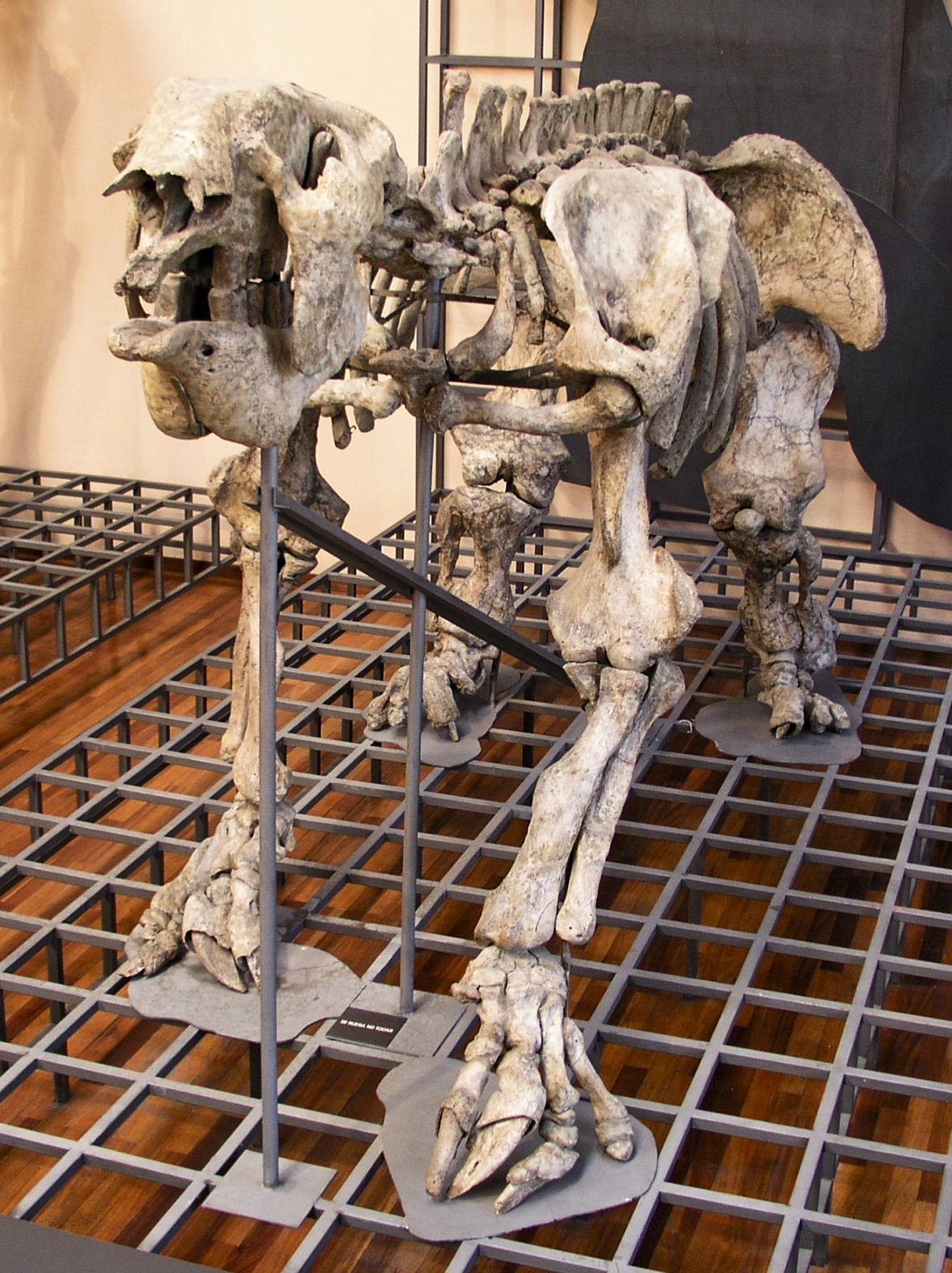
The giant ground sloth Megatherium americanum as currently displayed in the Museo Nacional de Ciencias Naturales, the Royal Cabinet’s successor in Madrid. The fossil has been remounted since Bru’s day but has been on public display almost continuously for 218 years. Credit: Xauxa Håkan Svensson. CC BY-SA 3.0.
The sloth as an icon of transformational thinking
The Madrid Megatherium was one of the first museum reconstructions of a large extinct vertebrate and captured the popular imagination. Amongst those who visited the specimen were Russian embryologist Christian Pander (1794–1865) and German engraver Eduard Joseph d’Alton (1772–1840) (Riha and Schmuck 2012). In 1818, Pander and d’Alton undertook a year-long research trip through European natural history collections aiming to produce a multi-monographic work on comparative osteology, Die Vergeichende Osteologie der Säugetiere (‘Comparative osteology of the mammals’) (Pander and d’Alton 1821–1838). Pander specifically chose d’Alton as a colleague and illustrator, having worked with him during his doctoral studies, when the artist created beautiful copper plates for Pander's dissertation. Together, they visited the Madrid museum, and devoted a substantial part of their first volume to a discussion of the Megatherium and its smaller, modern relatives. They made systematic comparisons of Megatherium (Figures 1 and 2) with two extant forms: the three-toed maned sloth Bradypus torquatus (also known as the Ai) and the two toed sloth, Choloepus didactylus (also known as the Unau) (Figures 3 and 4). Their comparisons were used as evidence to substantiate an evolutionary theory, which they outlined in the introduction to the first volume of Die Vergeichende Osteologie (Pander and d’Alton 1821). There, they described how all living creatures descended from extinct ancestors, now only represented by fossils. They proposed ‘an unbroken evolutionary sequence’ as a continual transformation of animals in response to varying environments (Pander and d’Alton 1821: 6). For Pander and d’Alton, the environment was the key driver for evolution. The differences in formation of fossil bones in comparison with those of still-living animals are greater the older the rock formations in which they are found (with the fossil remains of the most recent formations quite similar to the structures of living animals). This common observation supports the assumption of an unbroken train of descent [eine ununterbrockenen Folge der Abstammung] as well as of the progressive transformation of animals in relation to different external conditions. The observation that animals during the last millennium have reproduced with specific similarity in no way contradicts the theory of a general metamorphosis; rather such an observation only demonstrates that during this time no significant alteration in the external conditions of development has occurred’ (Pander and d’Alton 1821: 6; trans. Richards 2017: 233).
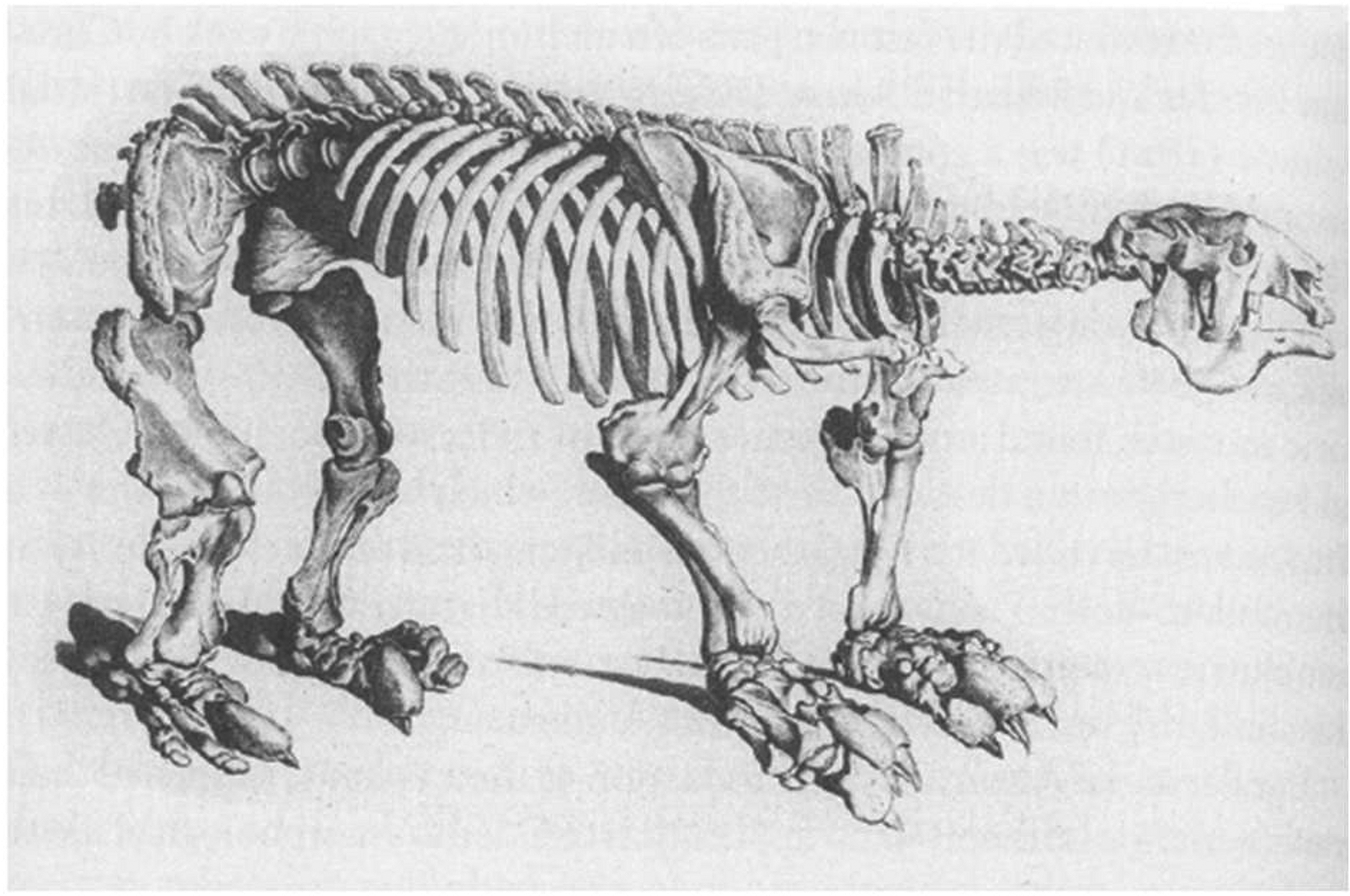
Edouard D’Alton’s illustration of Bru’s reconstruction of Megatherium, in the Royal Cabinet, Madrid. Image from Pander and d’Alton (1821).
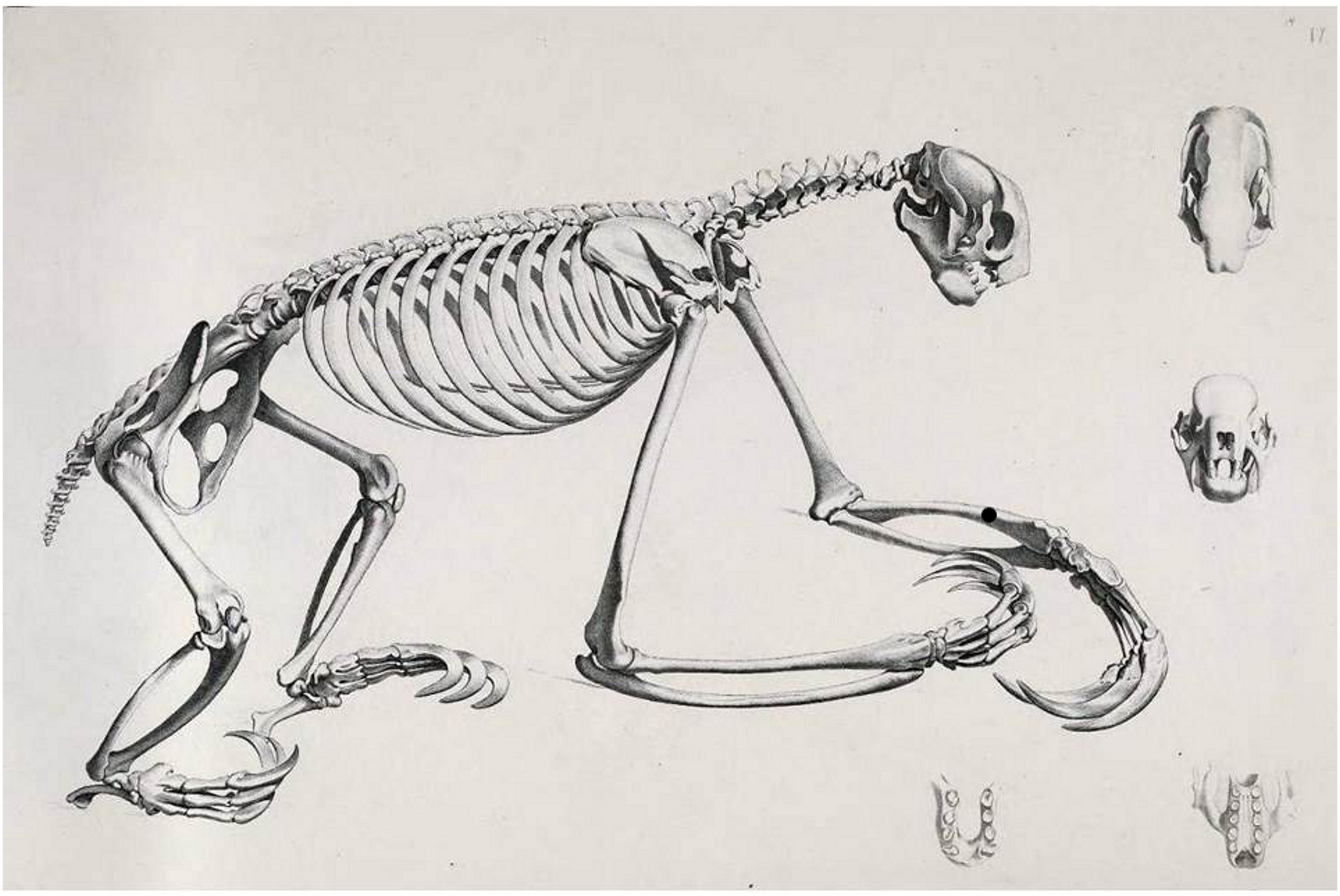
Edouard D’Alton’s illustration of the three toed sloth (or Ai). Note the tiny head and disproportionately long forelimbs, which inspired Goethe’s rather harsh judgment on the animal (see text). Image from Pander and d’Alton (1821).
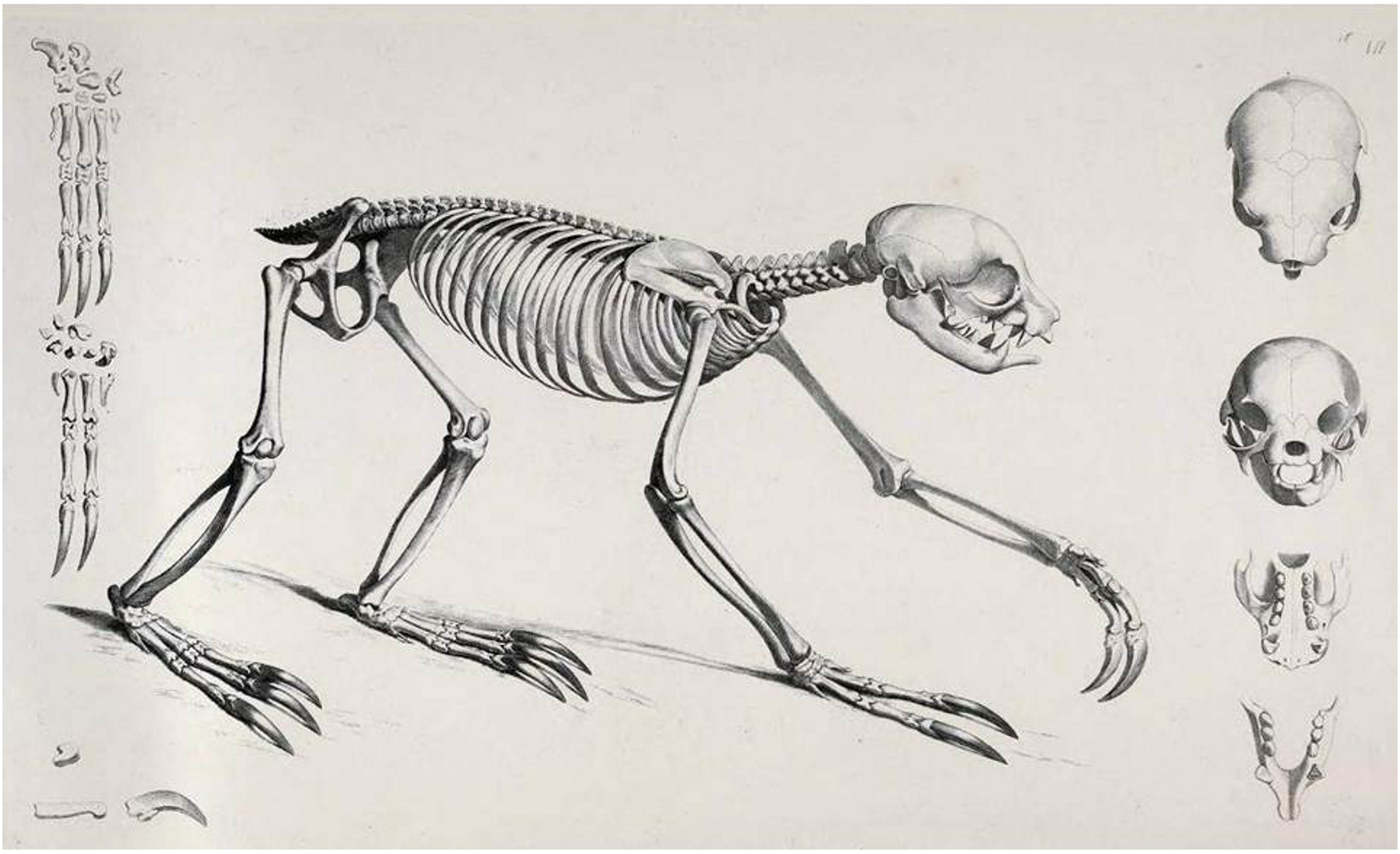
Edouard D’Alton’s drawing of a two toed sloth (or Unau). Image from Pander and d’Alton (1821).
As Richards points out, the final sentence in this citation is both an acknowledgement of Goethe's theory of transformation through metamorphosis and a counterargument to one of Cuvier's evidential objections to Lamarckian species change (Richards 2017). Cuvier argued against transformation of species drawing on evidence from ancient mummified animals from Egyptian tombs, which were not significantly different from modern forms. Cuvier was thus promoting a theory of stability of forms over time and, for him, the Megatherium was merely an anatomically similar predecessor of extant sloths, not an ancestor (Cuvier 1805). In contrast, Pander and d’Alton argued that the reason ancient Egyptian forms had not changed was because the environment had not changed sufficiently since Egyptian times, precluding any need for species change.
Pander and d’Alton provided evidence from both embryology and comparative anatomy to support their conclusion, that the animal kingdom is a continuous physical succession of species. The description of the giant ground sloth is found towards the beginning of Die Vergeichende Osteologie because of its importance for the authors in promoting their theory of species change. They show how despite the obvious external differences between the sloths, the Megatherium being large, robust and terrestrial while modern sloths are smaller and mostly arboreal, certain skeletal features unite them into a ‘type’. Pander and d’Alton explain the differences between ancient and modern sloths as responses to environmental conditions such as reduced food supplies over time, leading to a reduction in body size and the tendency towards slower movements. The extreme size of the limbs was explained as a ‘compensation’ for slow movement (rather like a means to concentrate excess energy which was not going into movement). Once again, here, we have a reference to the ‘compensation principle’, one of Goethe's main theories of animal form. For Pander and d’Alton, the Megatherium was clearly an ancestor of the extant sloths, not merely an anatomically similar predecessor, as proposed by Cuvier. Furthermore, throughout their account Goethe's influence is tangible, with references to many of his theories such as ‘metamorphosis’ and the ‘principle of compensation’.
Goethe's involvement
Pander and d’Alton presented their theory of animal evolution as an application of Goethe's morphological ideas. It was d’Alton particularly who came under Goethe's influence between 1808 and 1813, while living near Tiefurt. Goethe and d’Alton developed a long-standing correspondence and Goethe appreciated d’Alton as a talented artist and capable scientist (Eckermann 1825). It was no surprise, therefore, that in 1822 d’Alton sent copies of the first two volumes of Die Vergeichende Osteologie to Goethe for review (Goethe 1821) or that in the first review Goethe, wrongly, attributed authorship of the book exclusively to d’Alton.
Goethe's main interest in the work was d’Alton's illustrations which were three-dimensional, true-to-life and rather more dynamic than previous diagrammatic illustrations, such as those of Bru and Cuvier (Cuvier 1796, 1805). D’Alton included detailed representations of whole skeletons and individual bones from different perspectives and Goethe commented on the presentation of the three kinds of sloth skeletons in juxtaposition (Figures 2, 3 and 4) because exhibited thus, they revealed to his keen eye, the ‘eternal mobility of all forms’ (die ewige Mobilitaet aller Formen) (FA, I, 24: 546). Goethe commented on Pander and d’Alton's work in his essay Die Faultiere und die Dickhäutigen (1821) (FA, I, 24: 545–548). He wrote that '[w]e are in perfect agreement with the authors as concerns the introduction’— in which they expressed their view of species transformation. ‘We share with the authors the conviction that there is a general Type, as well as of the advantages of a meaningful juxtaposition of a sequence of forms; we also believe in the eternal mobility of all forms in appearance’ (FA I, 24: 545).
However, Goethe did not completely agree with the assertion that evolutionary transformations were simply due to changes in environment. Re-iterating the persistence of type, and taking the sloth as the example, he wrote that the sloth ‘presents us with three varieties [i.e. the two extant sloths and the extinct Megatherium] which in the proportion of their limbs have no similarity, and furthermore … have no similarity in shape at all. Yet they nevertheless have a similarity of parts [which may be found within the form of the skeleton] and here we repeat Troxler's words: ‘The skeleton is the most important and significant physiognomic sign of all, that a creative spirit and a created nature infused into early life’. This suggests that Goethe believed the animal type expressed itself most fundamentally through the skeleton and that the activity of the creative spirit could be seen in the diversity of variations in the proportions of the type skeleton. Furthermore, he proposed that these metamorphoses could occur through descent (FA I, 24:545–546). Goethe believed that the animal's Geist (the inner spirit) was the force propelling evolutionary transformation. Nature's urge to change could provide an animal with the inner power to transform itself and create new species, while at the same time maintaining the most typical characteristics, which would be discoverable in the animal's skeleton (Goethe 1821).
The ancient sloth’s Faustian strivings: A poetic fable
Goethe's imagination was deeply affected by d’Alton's images (Figures 2, 3 and 4), so much so that he was inspired to write a visionary ‘evolutionary fable’ describing the metamorphic trajectory of sloths, from Megatherium into the modern sloths. Goethe imagined a giant sloth-like creature as a whale-like animal. This large aquatic creature, a ‘colossal spirit’ (ungeheuerer Geist) wilfully ‘launched itself’ out of the sea onto a warm, dry gravel shore (FA I.24:547). The creature thus actively chose its new environment and then had to face difficult challenges because it had lost ‘the advantages of a fish’ (i.e. the capacity to move through water using small paddle like limbs) (FA I.24:547). 6 Nevertheless, the animal chose to face the hardships of terrestrial life, in which it was initially disadvantaged and maintaining its large size, began to develop limbs. Its displacement from its natural marine niche created the essential inner turmoil which promoted striving and drove it and its descendants to ‘will’ themselves to change. To support the burden of its weight on land, the animal developed large limbs and the limbs were passed to the descendants. Subsequent generations then further refined their morphologies, striving further against the resistance offered by land.
Having described his vision of transformation, Goethe abruptly shifts the emphasis of his fable to reveal how nature's drive to create does not always result in harmoniously proportioned creatures. Instead, it sometimes leads to extreme and aesthetically unbalanced anatomical enhancements. In the sloth fable, some descendants of the original ‘giant aquatic spirit’, in their impatience to overcome the challenges of land, overcompensated and produced excessively long limbs (ungeheure Hülfsglieder). Stretching further, these creatures produced huge claws in a gesture of extreme expansion ‘without limits’ (scheint keine Grenze zu haben) (FA I.24: 547). Similarly, the cervical (neck) vertebrae of these creatures multiplied and deviated from the usual number of mammalian neck vertebrae: the usual seven vertebrae became eight or even nine cervical elements. Naturally, such exaggerations required a compensatory reaction and the heads of these animals became ridiculously small with virtually no room for a brain. Here we see once again a reference to Goethe's ‘compensation principle’: the physical and physiological budget within which change must take place. The creature he describes had attempted to overcome too much too quickly, and not only failed to deal with the original problem of terrestrial living but created additional problems for itself. With limbs too long to be of any use on land, the animal had no choice but to reduce its body size and take to the trees. Goethe presents the arboreal three toed sloths, the Ai (Bradypus spp.) (Figure 3) as the descendants of these odd animals. For Goethe the ancestors of the three toed sloth were a kind of counterspirit (Ungeist) that through impatience developed an absurd, aesthetically displeasing morphology (FA I.24: 547–548).
However, Goethe also describes how another descendant of the original Megatherium was more self-controlled in dealing with the challenges of land. These others developed limbs that were less extreme, and body proportions that were more harmonious (less exaggerated), allowing for greater liberation and a less limited existence. These were the two toed sloths, the Unau (Choloepus spp.) (Figure 4). This is how Goethe described the Unau: ‘On the other hand, it is remarkable how in the Unau the animal drive has controlled itself more, has dedicated itself closer to the earth and accommodated itself to it and has developed towards the mobile ape-genus; as indeed one finds among the apes several, which could point to it.' (FA I.24: 548; trans. Tantillo 2002: 122). 7
In its time, this fable was revolutionary. It explicitly spoke of a vertebrate animal emerging from water and diversifying in different ways. It steered away from any ideas of spontaneous generation or special creation and promoted a metamorphic way of thinking. It also revealed much about Goethe's views on the workings of nature, especially his opinion that the inner drive to reshape morphology need not always produce a positive progression. In the sloth fable he also tried to show that the way something is done is as important as what is done. The two toed sloth recognised the limitations of its striving, was more circumspect, less arrogant and therefore achieved a ‘higher’, more balanced existence than the three toed sloth which, struggling impatiently, fell into excess. For its restraint, Goethe regarded the two toed sloth as a modest success while the morphological hubris of the three toed sloth led to its aesthetic degeneration.
The story of the sloth ends on a quick but very interesting conclusion, as noted by Tantillo. Having mentioned the similarity between the more harmonious two toed sloth and apes (see quotation above, FA I.24: 548), Goethe extends the thought and makes an audacious suggestion about the possible continuum of primate evolution towards a human like form. Still referring to the animal spirit, the quotation translated above ends with the curious reference to development ‘towards the mobile ape-genus; as indeed one finds among the apes several, which could point to it’. Tantillo interprets this as a suggestion that there are those among the apes that could ‘point to’ a more composed animal spirit with a great destiny yet unfulfilled. This could be a subtle and provocative reference to the possibility of higher forms emerging from primate-like creatures by a process of self-transcendence (Tantillo 2002). Nevertheless Goethe did not believe that destiny was pre-ordained. For him, there was no predetermined cosmic design in nature, only potential and the possibilities that it offers. And it is the expression and fulfilment of that potential that leads to Charles Darwin's ‘endless forms’. However, it must be added that, as in the case of the sloth, for Goethe these forms need not always be ‘most beautiful’ (Cornell 1990: 489–490). 8
Goethe's heterodox metaphor
If one lays sole importance on correct phylogeny and the contemporary interpretation of fossils, then Goethe's fantastic tale can too easily be dismissed. But that would be to ignore its value as a symbolic vision of evolutionary development. 9 It is a most imaginative account that employs metamorphic thinking to describe how aquatic creatures, rather like whales, transformed into giant land mammals and then by the differential implementation of their Faustian ‘will to create themselves’, evolved into two morphological types of small, arboreal creatures. Goethe freely admits that his poetic vision is a fanciful suggestion, a metaphor to show a picture of realised potential and the outcomes of nature's will-directed strivings. He wrote that ‘[o]ne may permit us some poetical expression since prose would in no way be adequate’ (FA I.24: 547) because he rightly felt that some ideas touch readers more deeply if presented as imagined. 10 I believe this may be one of the earliest modern evolutionary tales in which there is an explicit account of species transformation. Here I use the word ‘modern’ in the sense that it is connected to the scientific approach of observing and interpreting nature that was developing in Goethe's time. It is a heterodox presentation of how animals evolve, but with a timeless symbolic meaning.
Footnotes
Acknowledgments
The author would like to acknowledge the Ruskin Mill Centre for Research for continuing to support her projects and the staff of the Ruskin Mill Field Centre for their encouragement and patience. She would also like to thank Richard Fallon, Edward Guimont and three anonymous reviewers for their comments, and to thank Mike Benton for his help and support of the author’s work. The author also wishes to thank Graham Ricketts for his invaluable assistance with translations.
Declaration of conflicting interests
The author declared no potential conflicts of interest with respect to the research, authorship and/or publication of this article.
Funding
The author disclosed receipt of the following financial support for the research, authorship and/or publication of this article: This work was supported by the Ruskin Mill Centre for Research.