




Abstract
The institution that was the Junior Art Department (JAD) and its role in teaching children who went on to have successful careers in the arts, crafts, and design in mid-twentieth century Britain have been little documented. Here I recall the nature of JADs in the United Kingdom during the postwar period, with the Sheffield Junior Art Department as a case study. I characterise the JAD movement in the context of British education at the time. I discuss the artists and craftspeople the JADs encouraged and the student–teacher relationship it engendered. I record Sheffield Junior Art Department, how it and its teachers influenced the pupils who passed through it and how in turn the school influenced its teachers’ careers both teaching and making craftwork in mid-twentieth-century Britain. I hope that this essay might contribute to debates on the values both of the specialist teaching of gifted pupils and of the arts and crafts for everyone.
Introduction
An institution existed in Britain in the mid-twentieth century specifically to teach arts and crafts to gifted schoolchildren: The Junior Art Department (JAD). The JADs produced a good number of craftsmen and women, designers, and artists from a relatively small intake of pupils. they permitted the children – and their teachers – to learn from many working craftspeople and artists. They were introduced to arts and crafts in a fashion that can hardly occur in a generalist secondary school. The way that the JAD brought school-age children in to the ‘family’ of older students and of active practitioners of the crafts and arts they were being taught was something valuable that was lost when these schools were closed. Of course, it is very difficult or impossible to do that for every child, and it goes against the spirit of comprehensive education for all, so we can understand why it was sacrificed on that altar, but in terms of educational theory, there is a debate one can have about the advantages of taking gifted children with any gift – whether it be arts and crafts, music, or mathematics and sciences – and putting them in an environment where they see adults doing those things with excellence. That was done centuries ago with apprenticeships in the studios of great artists, for instance (Macdonald, 1970). And across in the sciences, consider Marie Curie’s approach to schooling her children, which was to set up a small school and do it herself with her university colleagues (Reid, 1974); her daughter famously went on also to win a Nobel prize, as she had.
British arts and crafts education in the mid-twentieth century
In the medieval world, a master craftsman would provide apprenticeships to young men, giving formal training in a craft that would often be certified by a guild. The Arts and Crafts Movement, The medieval craftsman was free in his work, therefore he made it as amusing to himself as he could; and it was his pleasure and not his pain that made all things beautiful that were made, and lavished treasures of human hope and thought on everything that man made, from a cathedral to a porridge-pot. Come, let us put it in the way least respectful to the medieval craftsman, most polite to the modern “hand”: the poor devil of the fourteenth century, his work was of so little value that he was allowed to waste it by the hour in pleasing himself – and others; but our highly-strung mechanic, his minutes are too rich with the burden of perpetual profit for him to be allowed to waste one of them on art: the present system will not allow him – cannot allow him – to produce works of art.
Out of the Arts and Crafts Movement, critical of art education based on abstraction without practical crafts, there grew education reform, and arts and crafts began to be taught together in art schools, some of which were called a School of Arts and Crafts. It is in this context that the Junior Art Department came about in the middle of the twentieth century, to attempt to fulfil the great need for craft education for school-age children in Britain.
1
As Pevsner (1937, p. 218) put it: as things are to-day, the future skilled worker and designer enters his trade provided only with what the elementary school has given him. In some cases he may pass three years in the junior art department of an art school between form-room and bench. There are great possibilities in the system of full-time junior courses, although they have necessarily to consider rather the worker’s than the designer’s outlook. For the training of taste and appreciation they could be invaluable, if handled in the right spirit by the right men, Their importance is all the more evident in England, because an essential and well-known difference between the English system and that in most Continental countries is that England has no compulsory continuation schools. It depends on the personal goodwill of the employer whether a youth gets an afternoon or a day off for improving his taste and his knowledge of his trade in general, or whether, if he feels a desire to do so, he has to go to evening classes after the day of his day’s work.
A few years later, Gray (1946, p. 59) noted the influence of the JAD on the state of the design profession in Britain: when the need for designers was beginning to be felt, these were selected, except in rare instances, from among the existing staff, and were usually some boy or girl with an aptitude for drawing who had come into the factory as a child. Conditions to-day are little, if at all, different; most manufacturers recruit their design-room staff as part of a general intake of young people at about the age of fourteen, when they leave elementary school. The principal and almost the only exception to this practice is where there is a Junior Art Department in the district. In such cases, from the ages of thirteen to fifteen, or sometimes from fourteen to sixteen, children can obtain some limited training specially adapted to the needs of local industries. As a result, while the general run of employed designers and their assistants have some technical knowledge, they have little artistic ability, no general culture, and no knowledge of conditions or developments outside their immediate environments. It is not surprising that the work of the average design room is that of copyists and adapters, who are encouraged to spend their time imitating the products of their competitors or transcribing the ideas handed down from the manager or sales staff. It is true that there are a few manufacturers who have engaged designers of experience and standing, either as full-time members of staff or on a part-time consultancy basis. There are others who include designers, with other technicians, on their boards of directors. The products of these firms are usually easily distinguished from those of their competitors.
Macdonald (1970, p. 309), looking back, commented on how the educational situation had improved: The art/craft teacher was not very common until after the second world war. From 1948 all graduates of Schools of Art had produced practical craftwork during their training, and from the same date artistic crafts were encouraged in the grammar school by the introduction of practical crafts into the examinations for the Cambridge School Certificate. The London, the Southern, the Welsh, and the Associated Boards for the General Certificate of Education now run such examinations and thousands of children have benefited.
Sheffield Junior Art Department
Some of the pupils who passed through the Junior Art Department at Sheffield (1929–1958; see Figure 1) have given their impressions of what it was like to attend this school.
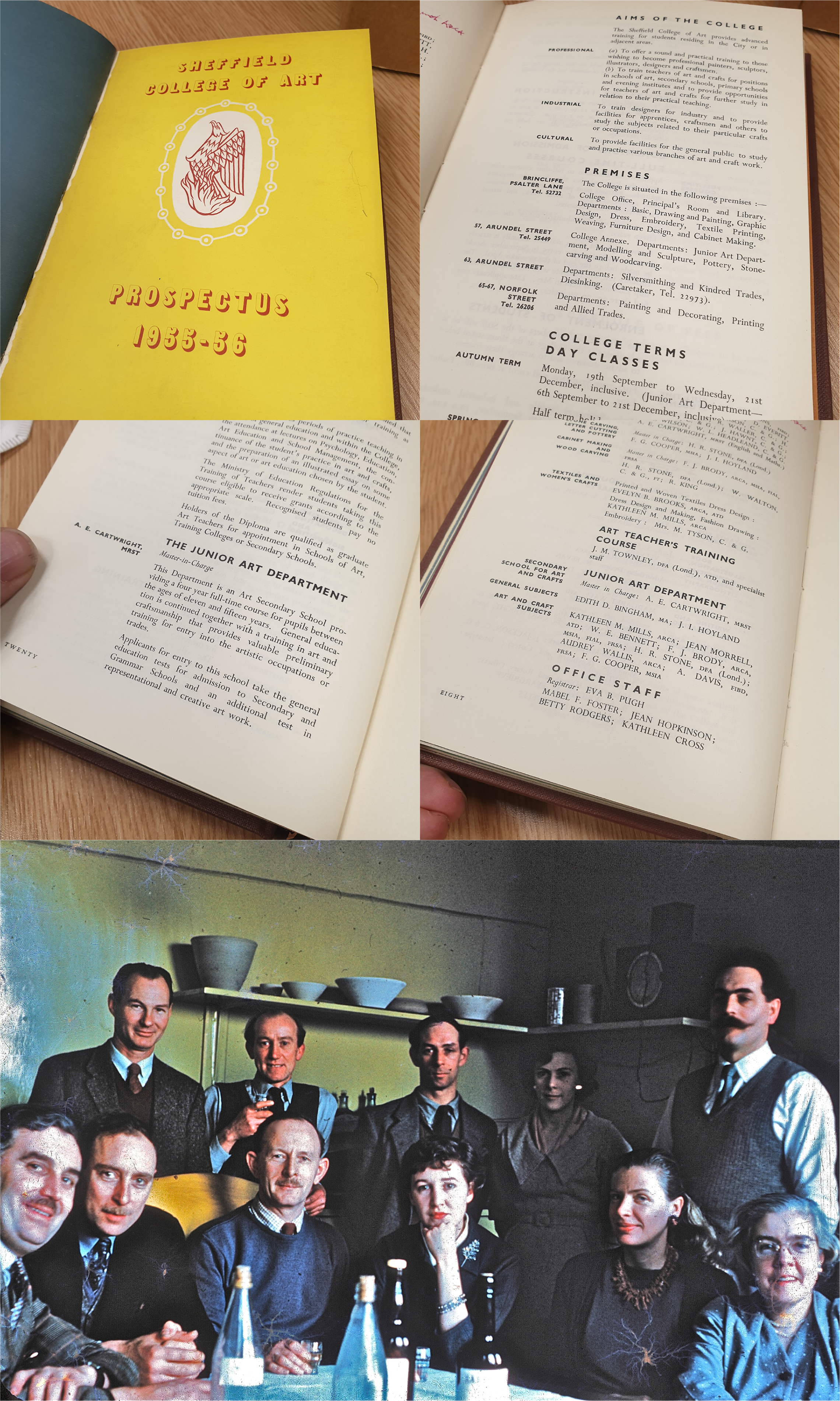
(top) Sheffield Junior Art Department; information from the 1955–1956 prospectus for Sheffield College of Art. ‘This department is an Art Secondary School providing a four-year full-time course for pupils between the ages of eleven and fifteen years. General education is continued together with a training in art and craftsmanship that provides valuable preliminary training for entry into the artistic occupation or trades’. Note the badge of the phoenix rising from the flames; the college had been bombed out in 1940. (bottom) The Junior Art Department at Sheffield in the mid-1950s. My parents Jean Morrell (Cartwright) and A. Edward Cartwright are seated together front centre. Other staff members probably present in the picture included Kathleen M. Mills, Edith D. Bingham, J. Irwin Hoyland, W. E. Bennett and F. J. Brodie.
A magazine interview with Corin Mellor (Mellor, n.d.) asked: ‘How did your father, David Mellor, first start working with metal?’ Corin Mellor: There’s both a historic and family connection. Firstly David Mellor grew up in Sheffield, a town with a long history of steel manufacturing, and this must have had an influence; his own father worked in metal with the Sheffield Twist-Drill company and they made things together from an early age. He was also lucky in that at the age of 13 he got to go to Sheffield Junior Art Department, an institution set up to train working-class kids in art and metalwork.
Terence Wilson wrote (Wilson, n.d.) The accommodation in Arundel Street, opposite the old School of Medicine at the end of Surrey Street, became The Junior Art Department (JAD) offering 11-year-old pupils a grammar-school education. The curriculum comprised English language, French, mathematics, geography, and history, with painting and crafts high on the agenda. For two hours a day (four hours a day in the fourth year) pupils had painting and drawing. There was pottery, woodworking, and silversmithing in the workshops adjacent to the burnt-out Art School, painting and decorating was carried out in rooms in Norfolk St. Pupils wore a green school uniform with a brightly embroidered oval badge on the pocket depicting a phoenix rising from the flames. At the end of the fourth year, JAD students matriculated up to Brincliffe, Psalter Lane where they were taught anatomy, life-drawing, and architecture.
And from Keith Oakes (Oakes, n.d.) ‘When I was eleven, I managed to pass the entry tests into the Junior Art Department of the Sheffield College of Art. All subjects taught included some form of Art, Maths and English Language being the only exceptions. The school building was pulled down in 1953 to make way for an extension to Sheffield Polytechnic, so we were moved to Brincliffe Grammar School, where we were able to take GCE ‘O’ levels’.
John Hoyland, who attended from 1946 to 1951, recollected the emphasis on crafts ‘I was very interested in silversmithing for a while. My mother still has evidence of it with my silver tureen server’ (Hoyland, 2005).
Derrick Greaves (1999) recalled: At that time … there was an art school practically in every city,…, but there were also these places called Junior Art Departments, JAD, in Sheffield, … I went there in the first place out of my choice, … they sent a form to my parents to say, ‘What sort of school would your boy like to go, what would you like him to go on to?’ … I said, … I want to go to this place that I’ve heard of which is the junior art school, the Junior Art Department. Because, they draw a lot there, you know, they, they do things like, object drawing and imaginative drawing…and you also get some sort of general education. And my parents’ attitude was that, ‘Oh we, you know, it sounds terribly posh, you mustn’t, you know, put that down…’ But I, I was adamant. I was ten, and I was quite adamant that I wanted to go. So they put that down,…And I fortunately got the exam and went to the Junior Art Department … during the time that I was there I began to realise that perhaps I was different, because I met the boys and girls that I knew who had gone on from my council school to [ordinary secondary schools] and it looked terribly dull to me, that … I was having a high old time at the Junior Art Department.
From these recollections, and from the fact that those reminiscing went on to successful careers, we gain the impression of an institution that achieved what it was set up to do: to give children with artistic abilities a good grounding in arts and crafts.
The rise and fall of the Junior Art Department
Junior Art Departments of art colleges that otherwise offered tertiary education were a feature of art and design education in mid-twentieth-century Britain (Meyer, 1988); that in Sheffield had been established in 1929. They offered vocational training for careers in manufacturing just as much as – or more so than – a step to a career in the fine arts (Rodway, 1935). The Junior Art Department can be seen in part as a 20th-century continuation of an ideal springing from the 19th-century Arts and Crafts movement of the Unity of Art (Harrod, 1999), concerned especially to raise the status of crafts and the craftsman, of work conceived and made by the same person, ‘opposing the hierarchy in which the arts were arranged in late-Victorian Britain: Painting and sculpture at the top as fine arts; architecture somewhere in the middle, less artistic but still with high professional status; and the decorative arts at the bottom, their status low both artistically and professionally. They argued that, in the Middle Ages, this hierarchy had not existed; and that in their own day, painters, sculptors, architects, and decorative artists should be on an equal footing again’ (Crawford, 1997). The numbers of pupils passing through this cog in the education system were never very great. Meyer (1988) noted that ‘As a rule, junior art departments would consist of between forty and seventy boys and girls’ and that ‘By 1930 there were 36 duly recognised departments, with a total of 1150 boy and 800 girl pupils, and by 1938 there were 41, with 1400 boys and 1080 girls’. Rodway (1935) writes that ‘Pupils admitted under school-leaving age are usually in a full-time junior art department for a minimum period of two years, and the contact of these with, among others, specialist trade teachers during the most impressionable years can, if considered in relation to selection prior to entry, be properly regarded as of great value and importance to industry’. He further noted that ‘The success achieved in those relatively few centres, in which junior art departments are maintained, in selection and training and the securing of the satisfactory absorption of young people into progressive employment has been sufficiently marked to justify the establishment of a greater number of such departments throughout the country as a whole’.
In Stoke on Trent, the potter Gordon Forsyth set about ‘reorganising the existing art schools on purely industrial lines. Up to that time people had been rather inclined to regard the art schools of the Potteries as being much more concerned with the fine arts than industrial requirements’ (Anon, 1930). He established a Junior Art Department in 1925, which ‘aimed to raise the standards of apprenticeships by producing artistically educated men and women suitable for employment in the pottery industry’ (Buckley, 2007). In a lecture on the situation in Leicester, ‘Co-Operation Between Manufacturers And Art Schools With Special Reference To The Hosiery And Knitted Fabric Industry’ Holmes (1937) ‘tried to show the co-operation that exists between manufacturers and the College of Art with relation to apprentice training, outside activities, pre-apprentice training, and the selection of suitable students from junior schools’. The chairman opened the subsequent discussion of the lecture with the remarks You have heard a well thought-out and considered scheme for the education of the young people of Leicester, beginning with the elementary school which takes account of other than book-learning by affording opportunities for those who have skill with hand and eye, stage by stage, from the elementary school to the junior art department or to the junior technical school, and thence to the college of art. All that we should seek in a properly co-ordinated and designed system of education in order to make the best of the human material that is given us and apply that material to industry is to be found in Leicester.
But the beginning of the end of the Junior Art Department as a feature of the mid twentieth century British education system dates to not long after it began. Meyer (1988) points out that while the 1926 Report of the Consultative Committee on the Education of the Adolescent had been supportive of the then incipient Junior Art Departments, the 1938 Report of the Consultative Committee on Secondary Education was not so enthusiastic. Although ‘much of the relevant evidence given to the Committee had been “tinged by satisfaction with the present and optimism for the future”. The Committee felt that thirteen was too early an age of admission and expressed concern about the adequacy of the general education component of the course. Moreover, the small size of the junior art department was “a serious disability” since it hampered the development of a healthy corporate life and thereby aggravated the “aloofness from ordinary worldly affairs which is so often characteristic of those who follow artistic careers”; shades of Pevsner, quoted above. As a “far more suitable alternative” to the junior art department, the Report suggested that boys and girls who required a general artistic training should first attend a secondary grammar school “with a sympathetic leaning towards art teaching” and should then go on to full-time attendance at an art school'. Following this, the 1943 Report Of The Art Education Committee of the Royal Society of Arts (Milne et al., 1943) contained a variety of recommendations. Although ‘The Committee would regret to say anything that would limit or in any way injure the activities of the Junior Art Department, but on the contrary would like to see the new secondary education within the new educational framework extending the functions of the Junior Art Department’, the committee’s recommendation was ‘That full-time art education should be carried on in schools and colleges specially organised for this purpose, and that existing Junior Art Departments should be organised as Art Secondary Schools’. This on the surface seems a positive recommendation, but, as we have seen, the re-organization that eventually came in the late 1950s did not extend the functions of the Junior Art Department, but killed it off.
My parents’ art and craft teaching and making careers
Both my parents taught at Sheffield Junior Art Department (Figure 1). My mother began her teaching career in Sheffield junior art department (Figure 2) before going on to head an art department in a generalist secondary school. My father, on the other hand, headed the Sheffield junior art department after a number of prior teaching positions, and afterwards ended his career in crafts teaching in generalist secondary schools and adult education.
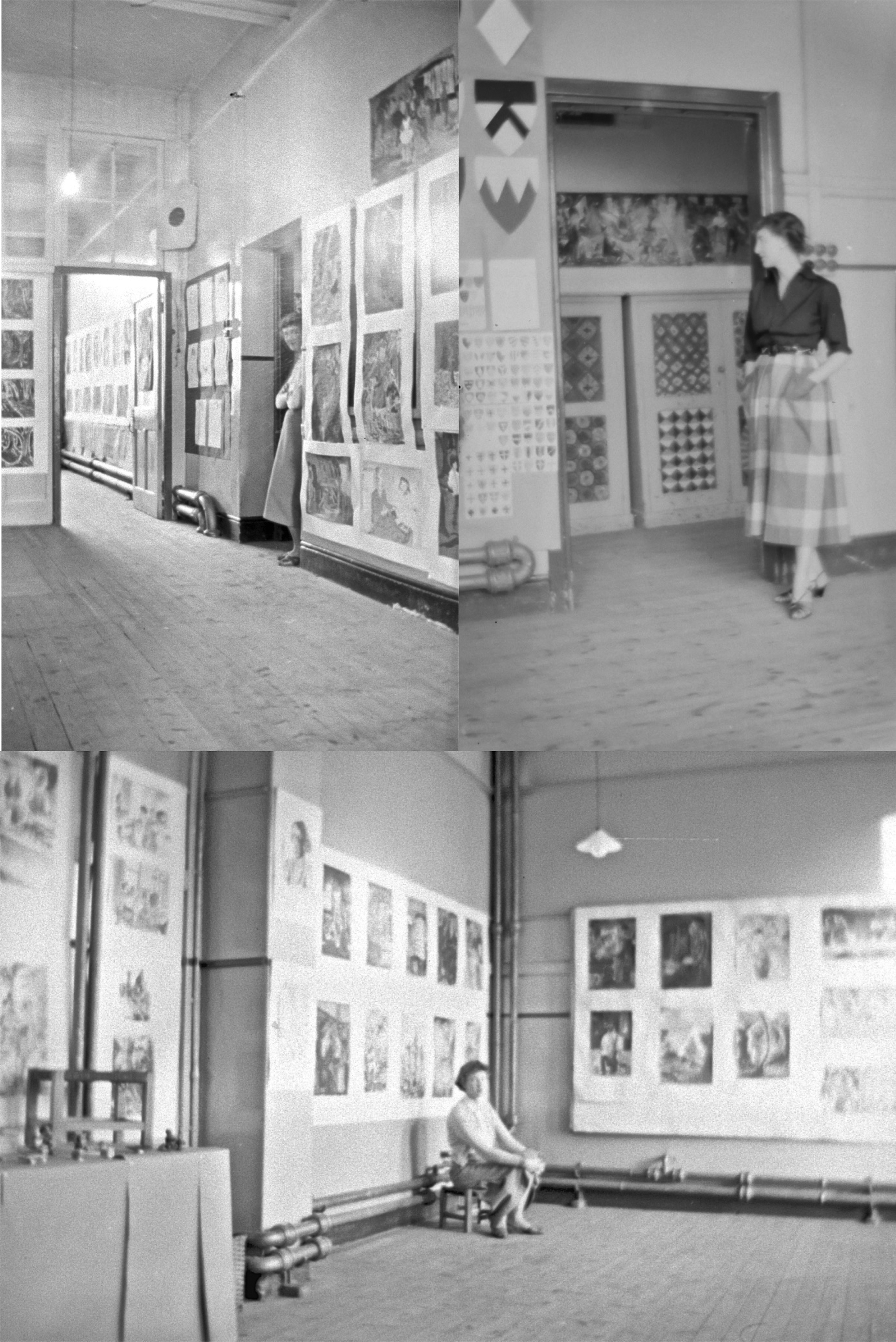
Sheffield Junior Art Department (JAD) art exhibitions in the early 1950s. My mother is the figure seen in the three images.
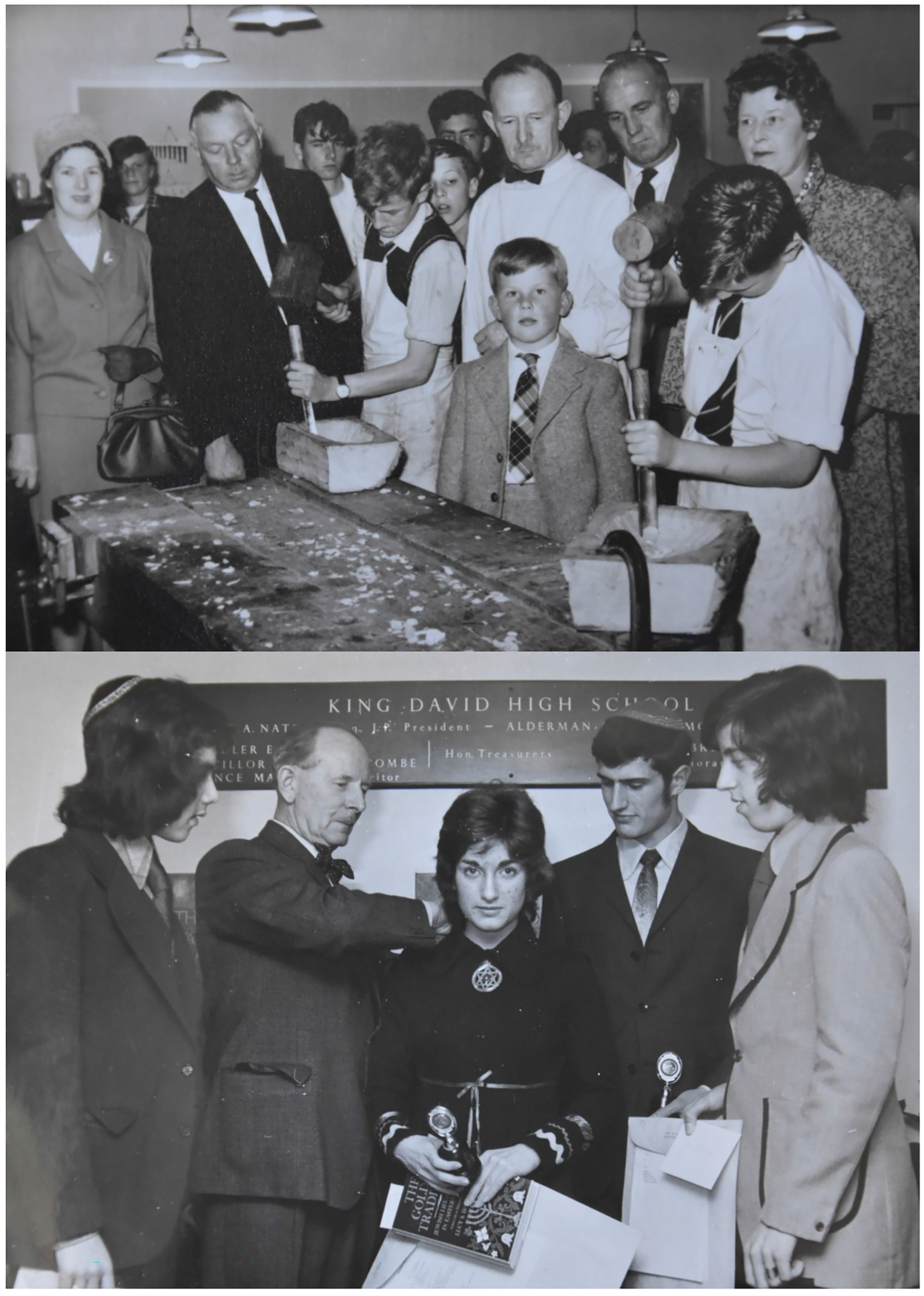
(top) Teaching boys the rudiments of wood carving. My father is in the bow tie. (bottom) My father made some pieces for the school of his last teaching position at King David High School in Manchester, including a menorah. Here he is affixing to a pupil at a prize–giving ceremony a Star of David pendant of his design.
My father was Master in Charge of the Junior Art Department at Sheffield College of Arts for thirteen years from 1945, and my mother taught there for eight years from 1950. Both my parents moved to other teaching posts when it was dissolved in July 1958. The Junior Art Department was incorporated into a new grammar school, Brincliffe Grammar School, which itself only lasted seven more years and closed in 1965. In 1969 the College of Arts in turn merged with the College of Technology to become Sheffield Polytechnic, which later became Sheffield Hallam University. My father had gone in 1958 to Corpus Christi School, Nottingham, then in 1962 to Kings Hill School, Lichfield, from where he subsequently moved in 1965 to King David High School in Manchester, where he ended his full-time teaching career in 1975 (Figure 3). He continued teaching ‘night school’ evening jewellery and silversmithing classes to adults (Knott, 2014) for more than a decade in the famous Toast Rack building of Manchester Polytechnic. My mother left Sheffield for Whalley Range Grammar School for Girls in Manchester, where she become head of art in 1967. She taught there until she retired in 1995. For a number of years after that she continued examining art for the Joint Matriculation Board.
During and following her time in Sheffield, throughout the 1950s and 1960s, my mother was very active as an artist and craftswoman. In Figure 4 I show examples of pieces of hers, designs, and correspondence with two of the galleries that showed her work, the Bluecoat Centre in Liverpool and the Midland Group in Nottingham. My father showed work at the same galleries. My parents kept the family home in Heaton Moor, Greater Manchester, in a way that reflected their artistic visions as a sort of arts and crafts home, with found natural objects like feathers, stones, shells, alongside furniture, – much of it my father’s pieces – ceramics, glass, pictures in the large Victorian house with white walls to give light and space in a way that created a harmonious whole. While both my parents’ works are clearly of the mid-twentieth century British school, and they both referenced nature for their art, their styles differ. My father, who was active from the 1930s through to the 1980s, favoured working with mixed materials: silver and copper or brass; wood and metal; nacre and metal. He made jewellery but also carried out other silversmithing work of cups, tankards, alongside wooden furniture, sculpture and toys (Figure 5). My mother stuck to jewellery. She was one of the new generation of women who did not give up their jobs on marriage, as previous generations had done, and as many of her own cohort still did. A fellow student at Manchester College of Art wrote to her in 1962 from Australia ‘I don’t know that a great deal has happened unless you count being married and having two children…. Last time I wrote to you I was a poster designer, since then I have worked as a fashion illustrator and designer in a fashion salon and as jewellery designer for Sydney’s most exclusive jewellers. I loved that job…. Now only a housewife till Maxine is older. There it is in a nut shell’. My mother, unlike her friend, did not become ‘only a housewife’ when I, her first child, was born, but she did more or less cease her jewellery work and concentrate on teaching.
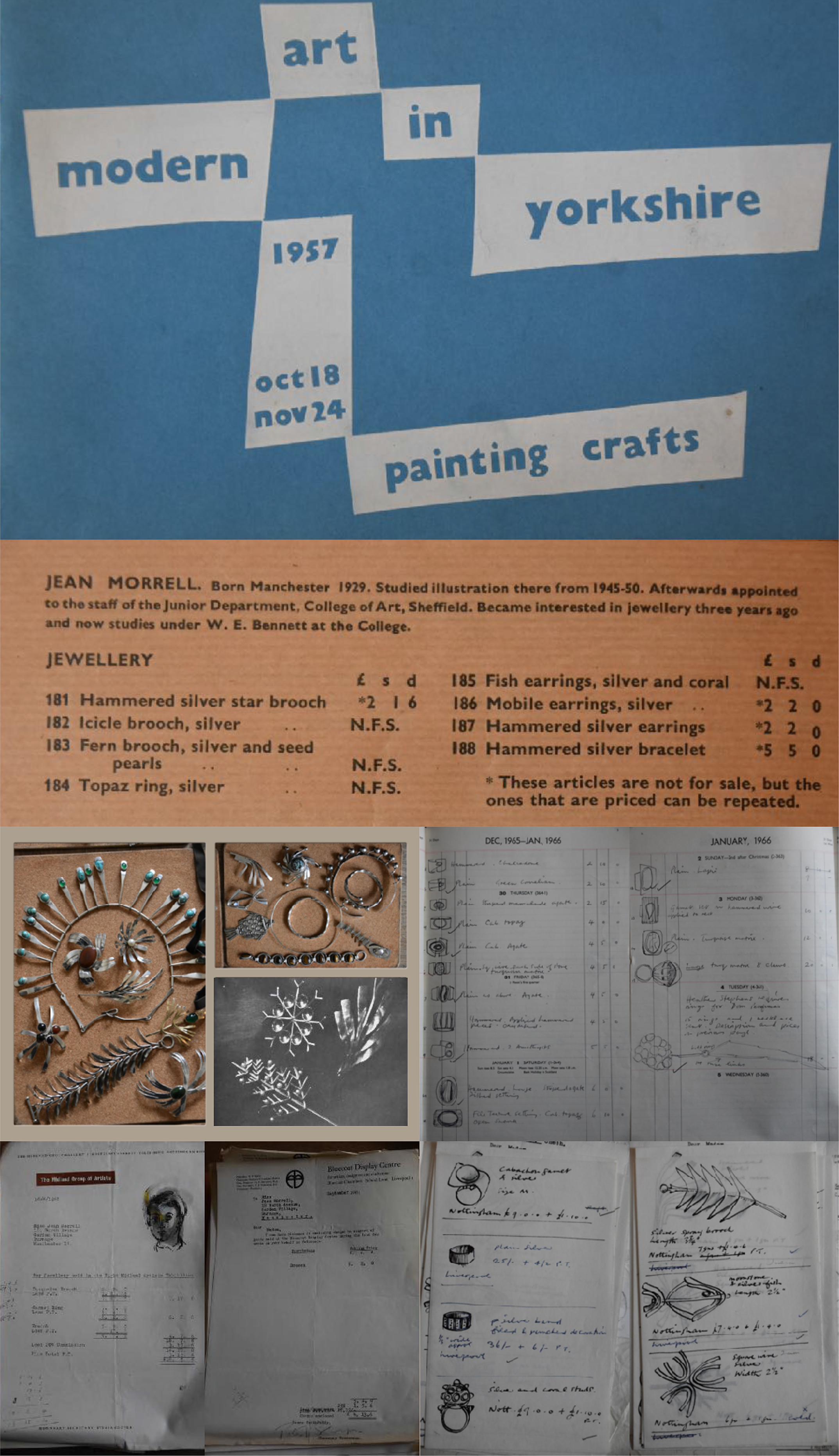
(top) At Sheffield my mother began to design, make, exhibit, and sell jewellery, such as at the 1957 Modern Art in Yorkshire exhibition in Wakefield. (bottom) Some of my mother's designs and sketches and correspondence with two of the galleries that showed her work, the Bluecoat Centre in Liverpool and the Midland Group in Nottingham. My mother, Jean Morrell Cartwright (1929-2019), was the daughter of a Manchester architect who encouraged her in an art career. After Withington Girls' School she graduated from Manchester College of Art, and in September 1950 took up a position as an art teacher in the Junior Art Department at Sheffield College of Arts and Crafts. There under the tutelage of staff at the senior department she began to design and make silver and gold jewellery.
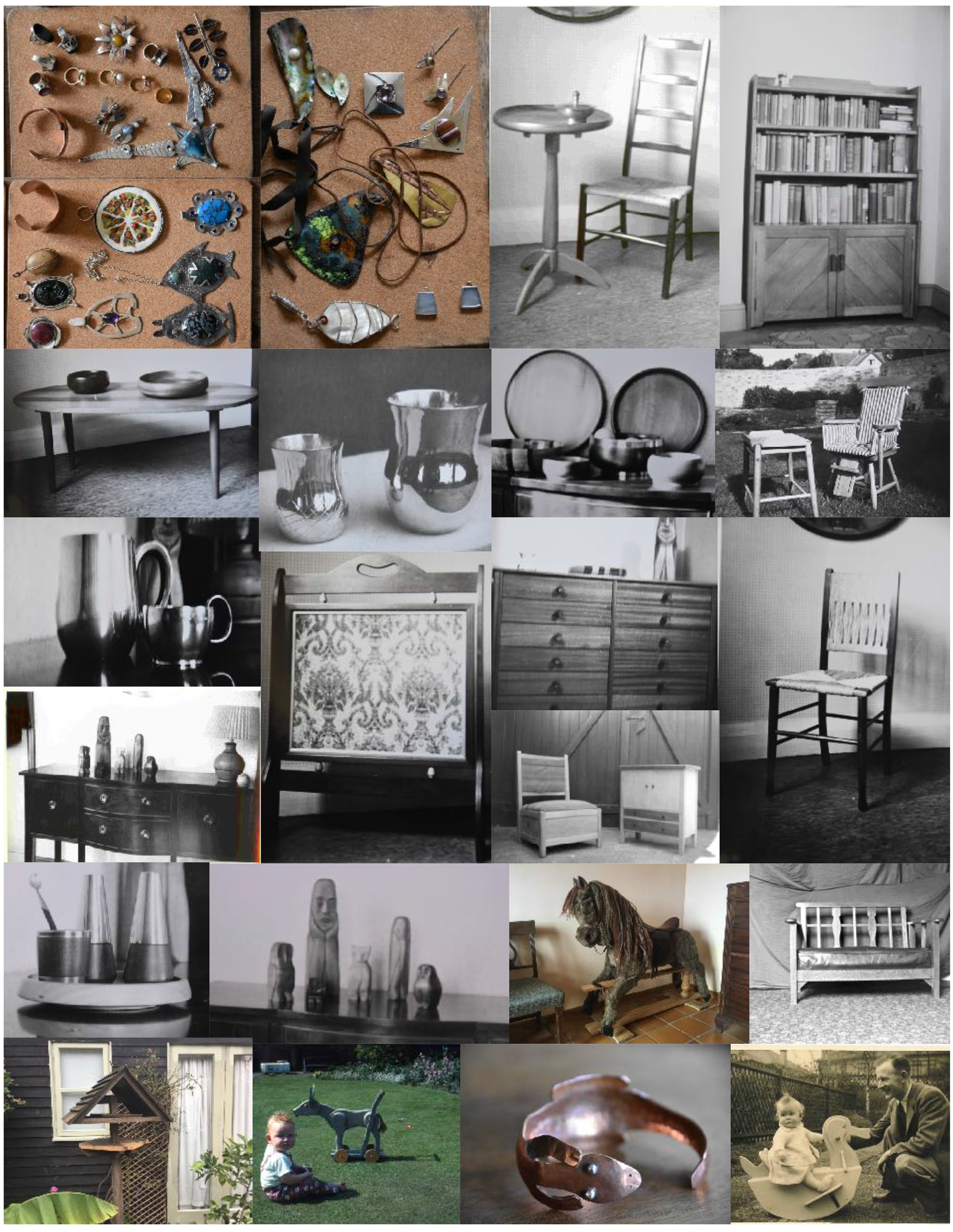
Examples of my father's works, ranging over silver, gold and copper jewellery, enamel pieces, wooden furniture, wooden bowls, wood sculptures, wood and metal cruets, wooden toys including a rocking horse, a fire screen; even a bird–table. My father, Albert Edward Cartwright (1910–2002), was born in Bermondsey, London (Cartwright, 2003). In 1922, aged twelve, he entered Lord Wandsworth Agricultural College in Hampshire – today Lord Wandsworth College – a then newly founded school for orphans (Cartwright, 2021). There, alongside academic subjects, he received extensive training in crafts under the inspirational headmastership of Lieutenant Colonel William Julyan, who remained his lifelong mentor. By the time he left school in 1929 he had designed and made pieces such as a wooden lectern, which was still being used by the school when he last visited in the 1990s. On leaving school he attended Southampton University College, as it was then (today Southampton University) and on graduation in 1931 began teaching, initially at Bridlington School in Yorkshire. He taught handicrafts as well as other subjects including physics and mathematics, at Bridlington School, and subsequently at Queen Elizabeth's Grammar School, Ashbourne; at King Edward VI school, Chelmsford; at the Birkenhead Institute, and at Risley Hall School, Notts. He also began to design and make furniture, to produce wooden and metal works, to work in silversmithing and to create jewellery. In 1945 he was appointed to Sheffield College of Arts and Crafts as Master in Charge of the Junior Art Department (Figure 1).
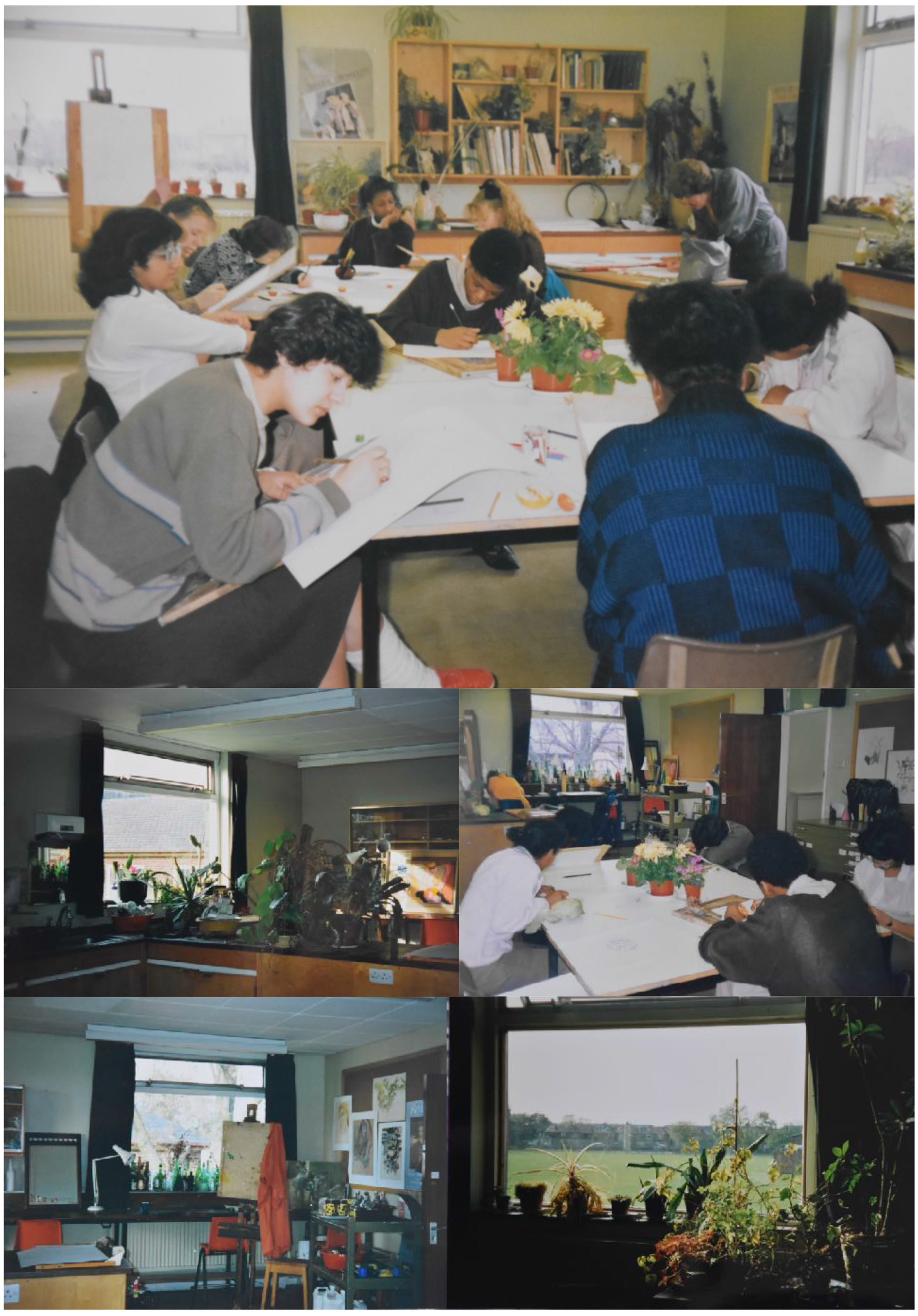
Whalley Range art room in the 1980s. My mother is at upper right. A pupil recalled in a 1981 letter to my mother ‘I remember your Art Room, you and your lessons with great clarity and have never ceased being grateful for the visual perception which I maintain you gave me. I don't know if you ever realised that my first term at Whalley Range was torture to me: I hated the place and the first weeks there the only place I found my peace was in the Art Room. I suddenly realized one day, in the middle of a painting, that I had forgotten about my problems. I never ceased to be grateful. Do you still have Vogue in the Art Room? And the glass trough full of pebbles under water? And the green pepper cut in half?'
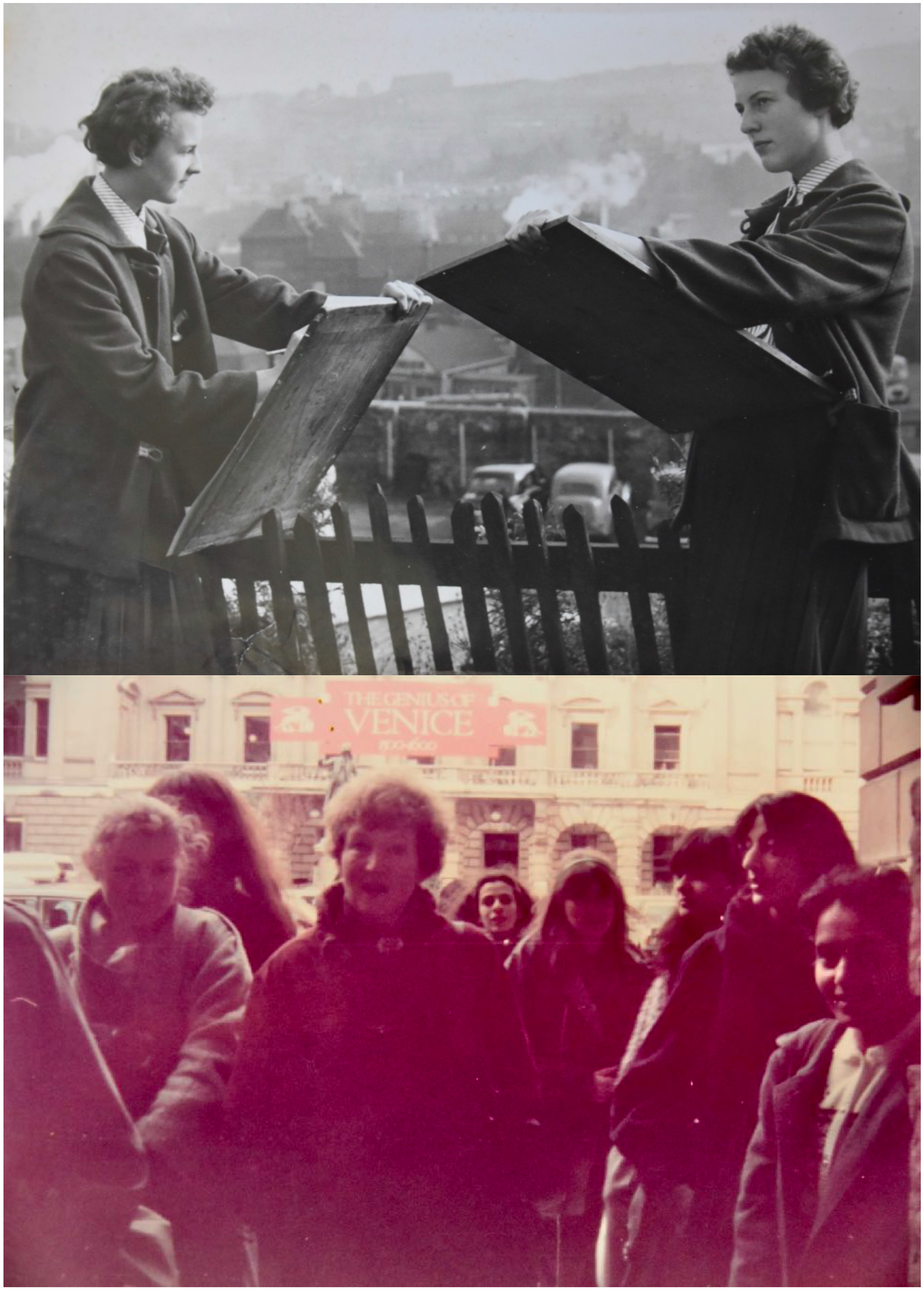
My mother (top) sketching with another girl in the 1940s and (bottom) taking pupils in the winter of 1983-1984 to The Genius of Venice exhibition at the Royal Academy of Arts.
For both my parents, teaching was not their job; it was their vocation. They dedicated their professional lives to craft and art education. A 1998 article in the education section of The Guardian newspaper (Moore, 1998) interviewed my mother and stop-frame animator Jackie Cockle, a former pupil of Whalley Range, the school she had moved to after Sheffield. Jackie Cockle: The art teacher at Whalley Range, Mrs Cartwright, stood out from the other teachers. She was very stylish and she had her own sense of calm. The art room was light, airy and full of interesting things and objects to inspire (Figure 6). It was a haven for me. I loved the way Mrs Cartwright taught. She was very open. I felt she never tried to push me, instead she gently guided. She’d point out things and I’d say: ‘Oh yeah! why didn’t I think of that?’ She was very sensitive which I found encouraging. She wasn’t trying to mould me into something she wanted me to be but allowed me flourish as myself. By the time I was doing my art A level, I was starting to draw in a stylised way; that was the direction I naturally leaned towards. Again, instead of trying to make me draw in a naturalistic way, she gave me the environment to flower. After our A levels there was a huge push towards encouraging us to go to university and particularly to teacher training college. I wanted to go to art college. Everyone else reacted with horror but Mrs Cartwright was excited. She encouraged me to have the courage of my convictions and go to art school. I remember her saying she was sure I’d make a career out of it. I like to think I’d still have done what I have without her but I wonder. It was really good to know someone had faith in me. I went to Manchester College of Art in 1950. I spent most of my art college years smoking and drinking coffee in cafes! I’ve always loved teaching but I didn’t think I would. I’d done a teacher’s diploma so I got a job in Sheffield teaching specially gifted pupils. I found you could teach people to enjoy art without making them believe there is only one way. Whalley Range was very formal in those early days. You say Jackie didn’t know my first name, well I didn’t know the names of some of my colleagues! We had one smoking staff room which all the younger and less authoritarian teachers (such as myself!) crammed into. We sat in a circle smoking away. I’m really proud of Jackie, what she’s achieved is amazing. I remember her as a reserved but very pleasant girl with a lot of talent. I never interfered with her way of working, I would just offer advice which she would always take. I did encourage Jackie and other talented pupils to go to art college and at first the headmistress was unenthusiastic about it. I remember her saying to girls: “You’re not going to waste your brains are you?” But later she was very supportive of me; proof that you can change people’s perception of art college!
My parents did what many craftsmen and women did in twentieth-century Britain: They combined their craftwork with another job. In the case of my parents that was as teachers of crafts and arts; alongside designing and making their own works, they were also teaching succeeding generations of artists and craftspeople. As my father was in charge of Sheffield JAD and my mother was teaching there when the impressions of pupils quoted above were formed, we may conclude that their teaching left a positive mark on those pupils, many of whom went on to notable careers in the arts and crafts. As for how they were affected by their time at Sheffield JAD, they both became interested in silversmithing and jewellery making because of Sheffield. They took with them to subsequent teaching posts specialist knowledge they had gained in Sheffield; my mother continued to offer a silversmithing option to her advanced pupils at Whalley Range, and my father taught it to adults as an evening class.
In conclusion
The Junior Art Department is an important but overlooked institution, reflecting the broader arts, crafts, and design cultures in the United Kingdom. There is remarkably little information available on these junior art departments. Many ex-polytechnics turned universities had them. Sheffield’s ended up in some sense as ‘part of’ Sheffield Hallam University. Unfortunately, their records from this time period are very sparse; amongst other things, the bombing of the art college and the subsequent distribution of its various functions across the city certainly did not aid record-keeping and much was lost as the college moved to the Psalter Lane site and out of local authority control. Moreover, freeing up storage space was seen as a more valuable commodity than long term preservation of records. It is a shame how the art colleges have not looked after their own records, leaving the historian limited easily accessible evidence.
I should not like to give the impression that the Junior Art Department at Sheffield, or Junior Art Departments more generally, were faultless institutions. There are valid criticisms to be made. Paine (2000) makes this important point: These schools were in fact mostly junior departments of senior art schools, with a broad subject curriculum, but giving nearly as much time to the study and practice of art as to the study of the other subjects jointly. During the forty years of their existence, they were the only available source of early art training in the country, apart from one or two private art schools for those who could afford them. The focus of the teaching was on drawing of a fairly traditional approach, involving the study of form, tone and geometry, and applied to lettering, design, modelling and commercial art, with selected craft work according to local strengths. It was intended to prepare students for relatively modest employment in industry. Admission criteria implied that a high potential in art compensated for an assumed lower academic ability, unlike in the more recent American model. Students who were more intelligent astutely concealed that ability on entry, grasping the best aspects of the art tuition, evading entrapment into lesser employment and pursuing their future as artists.
But, as we have seen, there are also advantages to such selection for innate talent. The junior art department at Sheffield was in existence for just twenty-nine years, less than three decades. It had a tiny number of pupils. It is remarkable that some of its pupils went on to national prominence. John Hoyland (1934–2011) was one of Britain’s leading abstract painters. Derrick Greaves (1927–2022) was also a prominent British artist. David Mellor (1930–2009) was one of the best-known designers in Britain. The number of people who went through Sheffield JAD and later carried on to eminent careers in the arts and crafts indicates that it was a successful way to educate children with this gift. The decision to eliminate these schools rather than to morph them into Art Secondary Schools seems to have thrown the baby out with the bathwater.
Footnotes
Acknowledgements
I thank Simon Quinn, librarian at Sheffield Hallam University, for his help in uncovering what records there are of Sheffield JAD at that institution, Christine Audoire and Jacky Ridsdale for their memories of Sheffield JAD and Angus Stokes for putting me in touch with them.
Declaration of conflicting interests
The author declared no potential conflicts of interest with respect to the research, authorship, and/or publication of this article.
Funding
The author received no financial support for the research, authorship and/or publication of this article.
