



Abstract
In 2019 the Polish Cliff Mission cleaning the slopes above the temple of Thutmose III at Deir el-Bahari discovered a foundation deposit of Thutmose II perhaps related to an unfinished rock tomb of an inverted T-shape, or to a simple rock sanctuary nearby. Further works in front of this have revealed a huge man-made accumulation of stones and debris topped with a platform. The excavated place is axially connected with the cult chapel devoted to Thutmose I and II within the temple precinct of Thutmose III. The existence of the tomb of Thutmose II nearby seemed not to be excluded, and indeed a tomb was planned there, with an (only begun) entrance situated just behind this chapel. Other hints suggest that the tomb of Amenhotep I may have also been located in the area of this temple called ‘Holy Horizon’. A common cult place of Amenhotep I and Thutmose III is attested there, too.

The Polish Cliff Mission directed by the present writer started its archaeological works in 1999 on a ledge in the cliffs about 60 m above the temples of Hatshepsut and Thutmose III at Deir el-Bahari (fig. 1). 1 Today we call this thus far unnamed place ‘Gebel Ragab’ (fig. 2) in recognition of our friend and chief worker Ragab Ahmed Yassin, who passed away in December 2022, but without whose technical skill no work in this extremely difficult and near inaccessible area 2 could have been done. In 2014 we started the cleaning works on the slopes directly surrounding the temple of Thutmose III, moving southwards. It was during the February–April 2019 season that, in a corner of rock formation right above the southernmost part of the temple, the Mission discovered an atypical foundation deposit dated by ceramic evidence to the reign of Thutmose III. 3 However, all the elements of the deposit allude to the last two titles and names of Thutmose II.
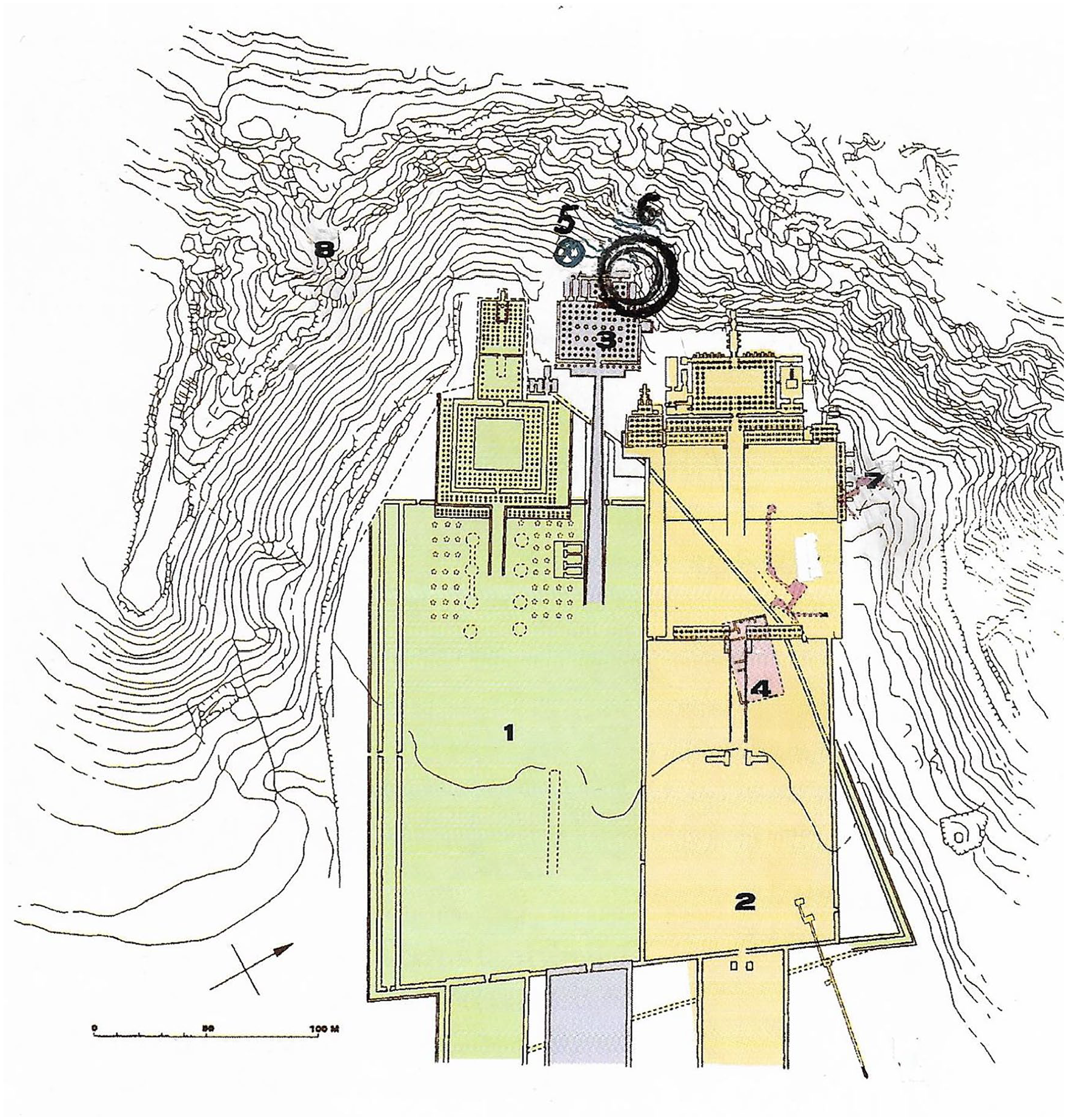
General scheme of Deir el-Bahari: 1. Temple of Mentuhotep II 2. Temple of Hatshepsut 3. Temple of Thutmose III 4. Temple of Amenhotep I 5. Planned tomb of Thutmose II 6. Hypothetical location of the tomb of Amenhotep I 7. Tomb of Merytamon 8. Royal Cache (= tomb of Ahmes Nefertari) (plan adapted by A. Niwiński, based on Pawlicki 2000: 25 fig. 16).
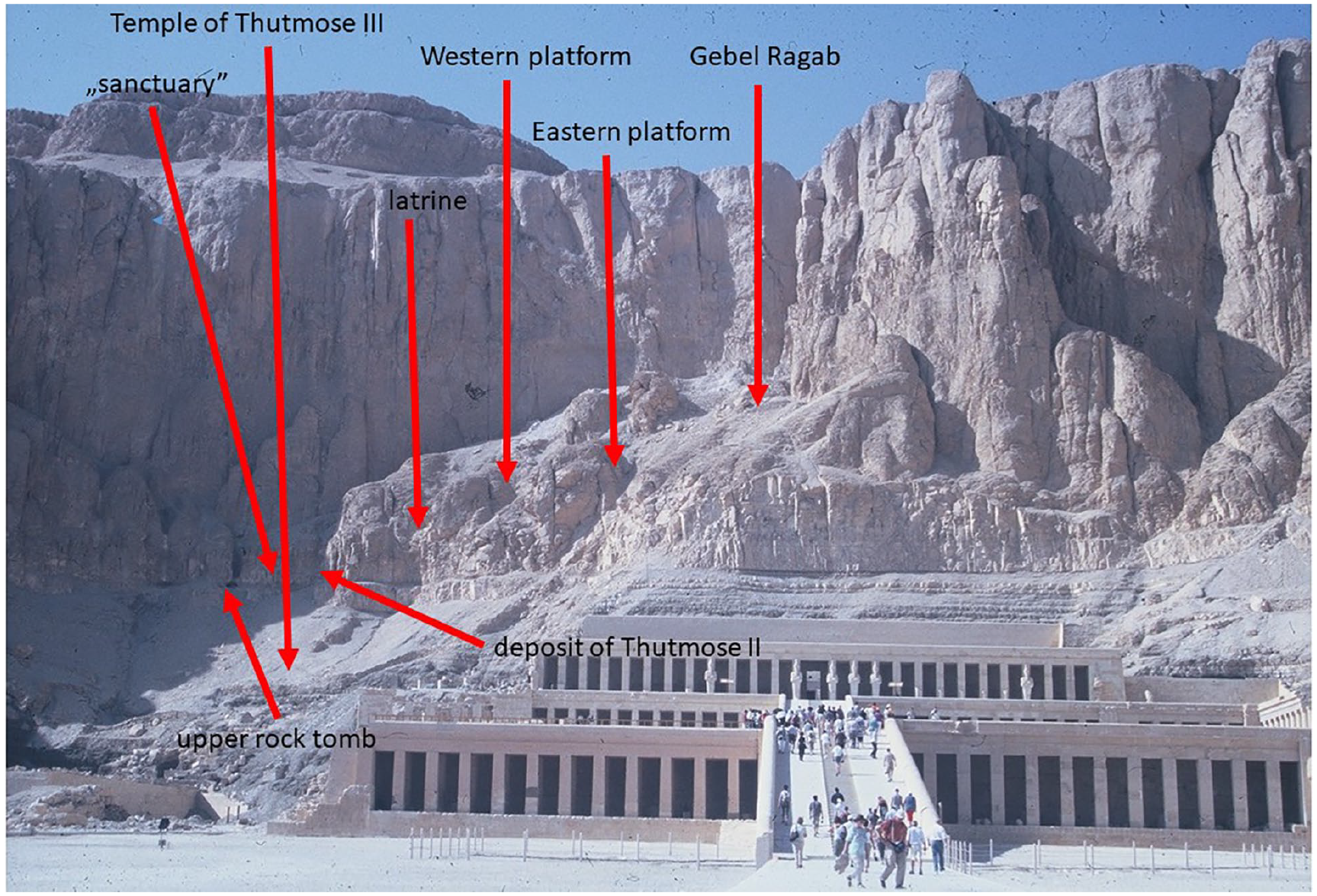
The area of the activity of the Polish Cliff Mission at Deir el-Bahari (photo: A. Niwiński).
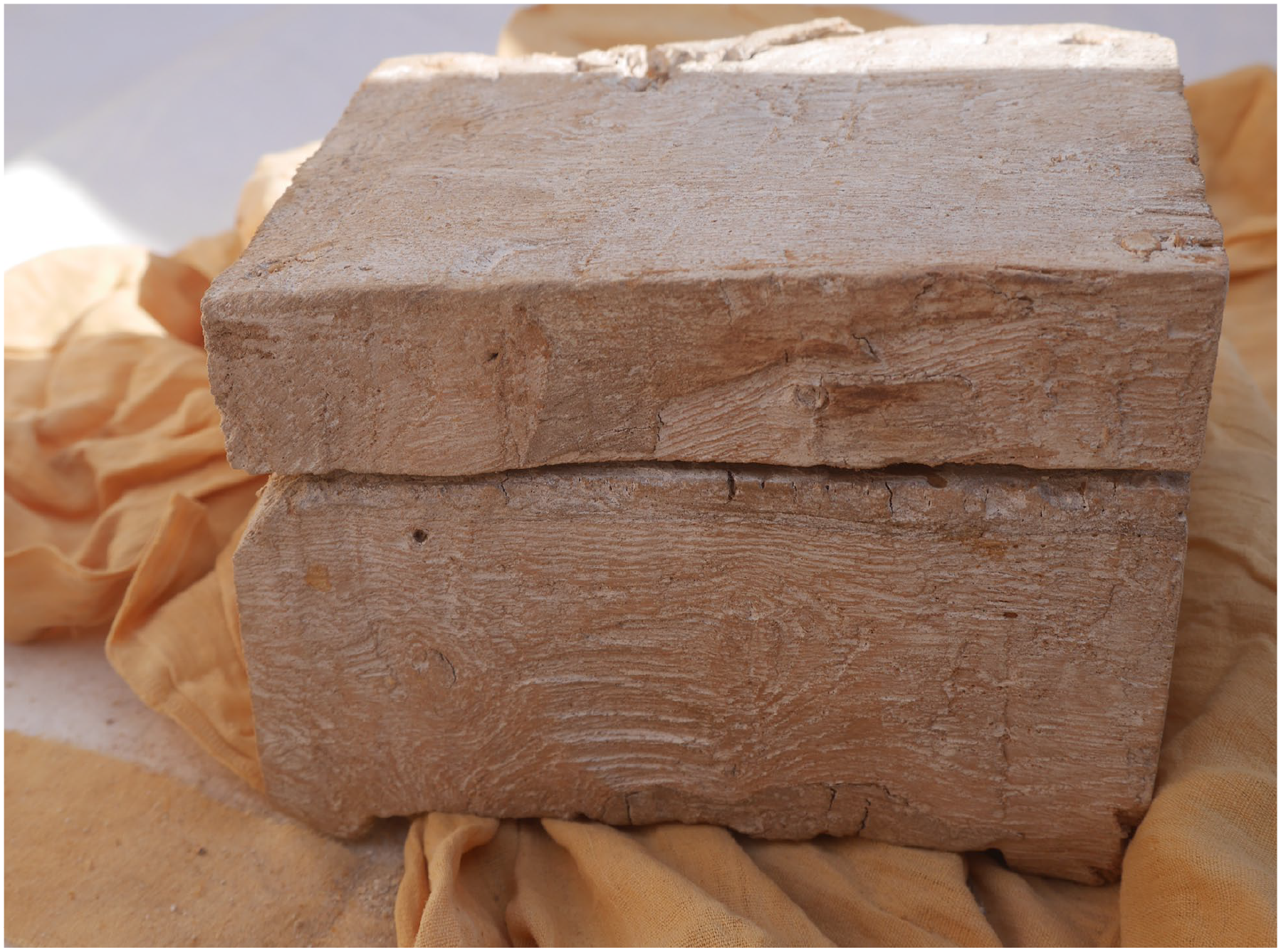
The main part of the deposit was closed in a stone chest consisting of a 46 by 42 by 38 cm limestone rectangular box and a sandstone lid fixed on the box with mortar (fig. 3). The joint of the two parts was masterly camouflaged with mortar so that it appeared to be a stone block, only differing from the neighbouring limestone rocks by its uniform shape. The stone chest 4 contained the remains of a goose and a goose egg, each wrapped separately in linen, and a third object, also wrapped and additionally bound with a linen ribbon (fig. 4). This turned out to be a rectangular wooden box of rather rough execution and undecorated (fig. 5). This contained a smaller egg also wrapped in linen; the size of the egg (5.8 cm long) strongly suggests that it is an ibis egg.
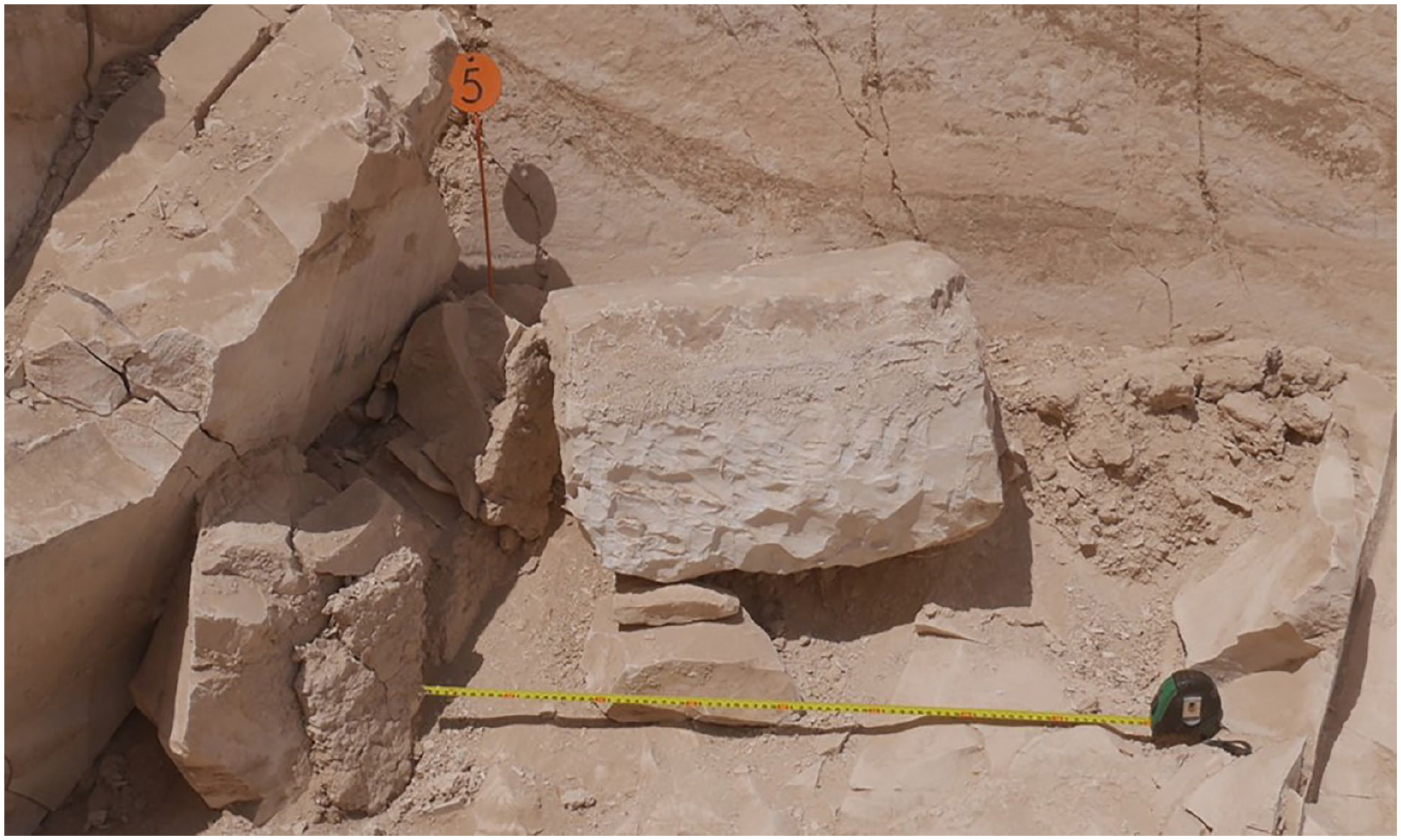
The stone chest containing one part of the foundation deposit of Thutmose II (photo A. Niwiński).
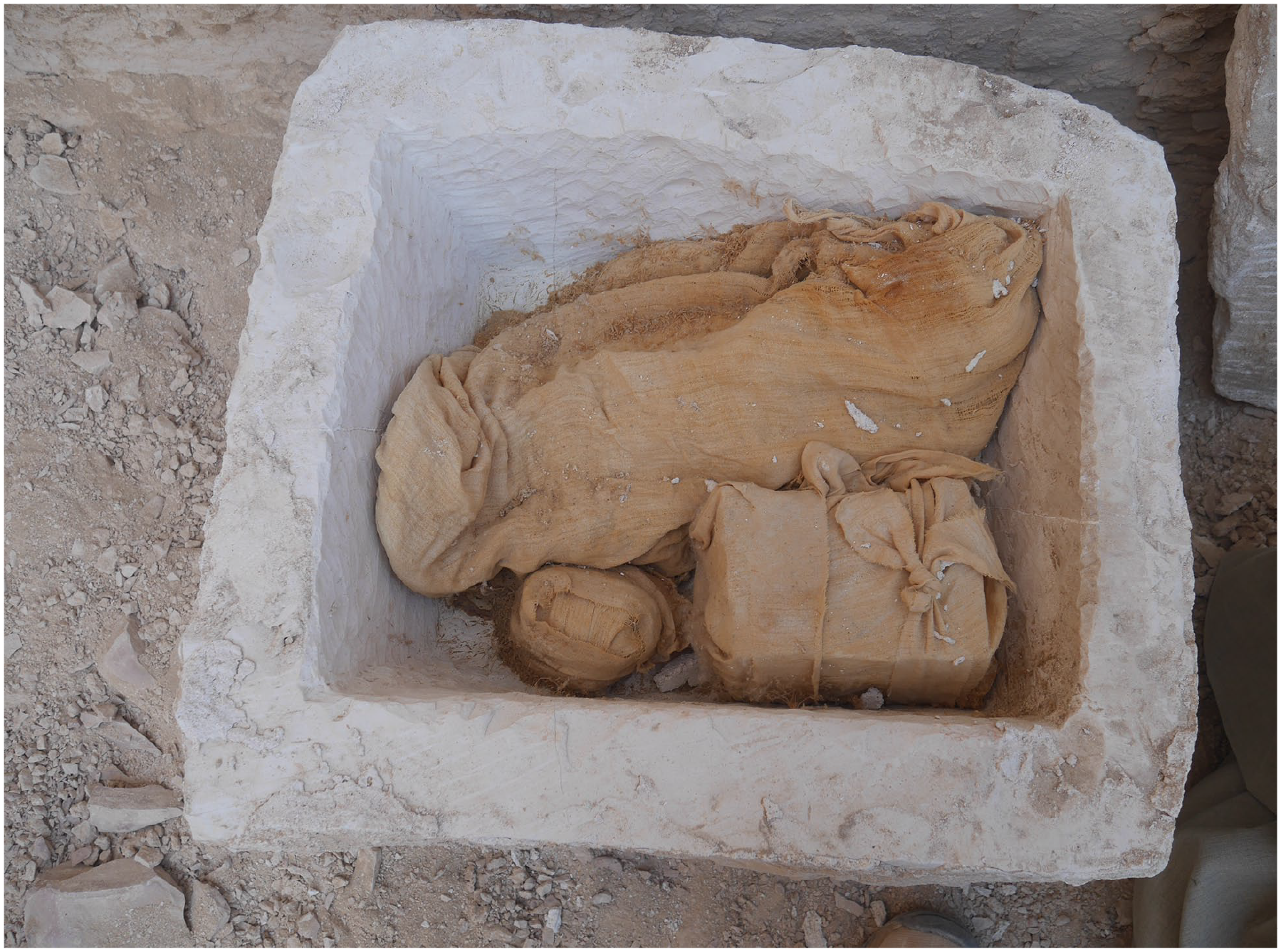
The contents of the stone chest (photo A. Niwiński).
The wooden box containing the ibis egg (photo A. Niwiński).
Beside the stone chest, another linen-wrapped package was discovered, squeezed into the fissure between the formations of the limestone rock and camouflaged with dust. Next to this, a miniature pottery bowl was placed (fig. 6) that is very typical of the foundation deposits of Thutmose III. 5 These two objects may have been intended to be placed in the stone chest as well, as there was enough room within for them, however, because of unknown reasons, they may have been brought after the chest had been sealed. This package, wrapped in three separate pieces of linen, contained a wooden box, ellipsoidal in shape and partly painted in white with a scarab carved upon its lid (fig. 7). The box had evidently been re-used; only one wooden peg of the original three for closing the box was still in position, and thus the box could be opened without any difficulty in the field. Inside the box, another object wrapped in a very special kind of delicate thin linen was found, kept in position on two sides by small rolls of coarse linen. On the top of the central package lay a small fragmentary cubic object of blue-green faience (fig. 8); this turned out to be a broken part of one of four supports of the temple-shaped faience chest found inside. This small, 8 cm long chest (fig. 9) representing the hn-type, 6 known from iconography 7 but unknown in 3D form, was also re-used. Besides its broken foot found inside the wooden box, another foot is missing and there are traces of dust within the carved details of the decoration covering its lid and four walls. The object and its decoration remain unique, as no parallel piece is known thus far.
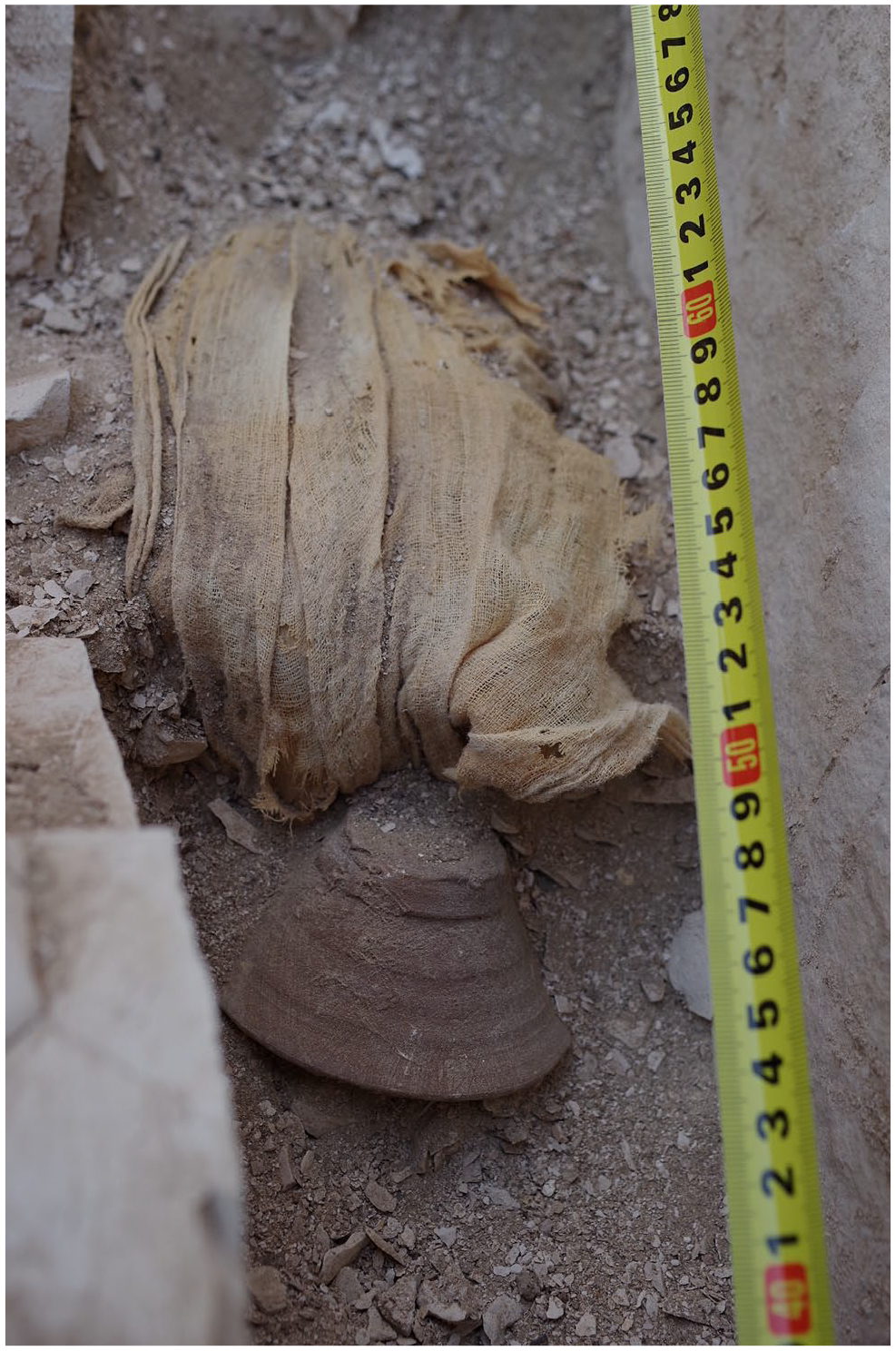
The second part of the deposit found near the stone chest (photo: K. Zachert).
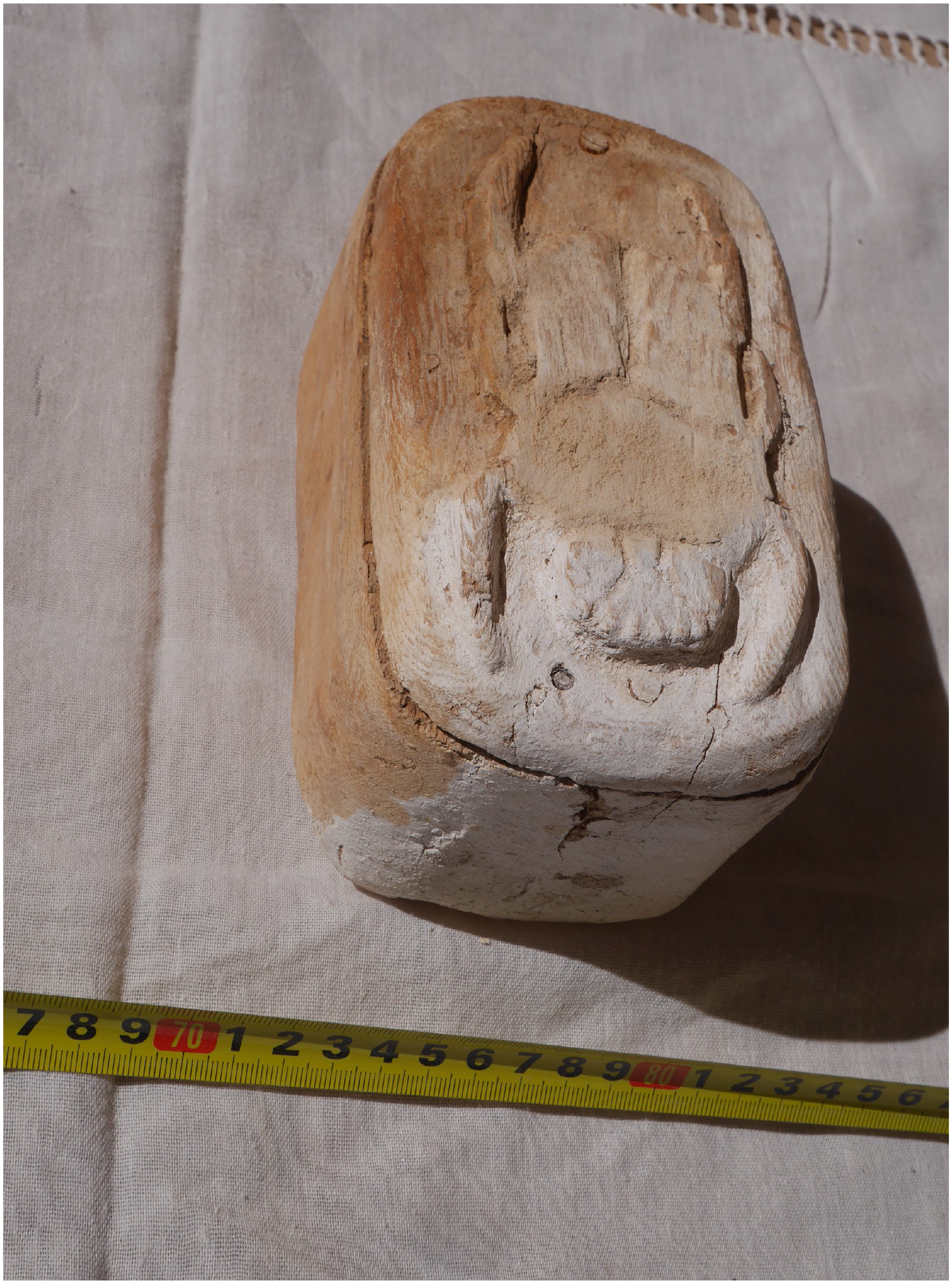
The wooden ellipsoidal box found inside the linen wrappings (photo: A. Niwiński).
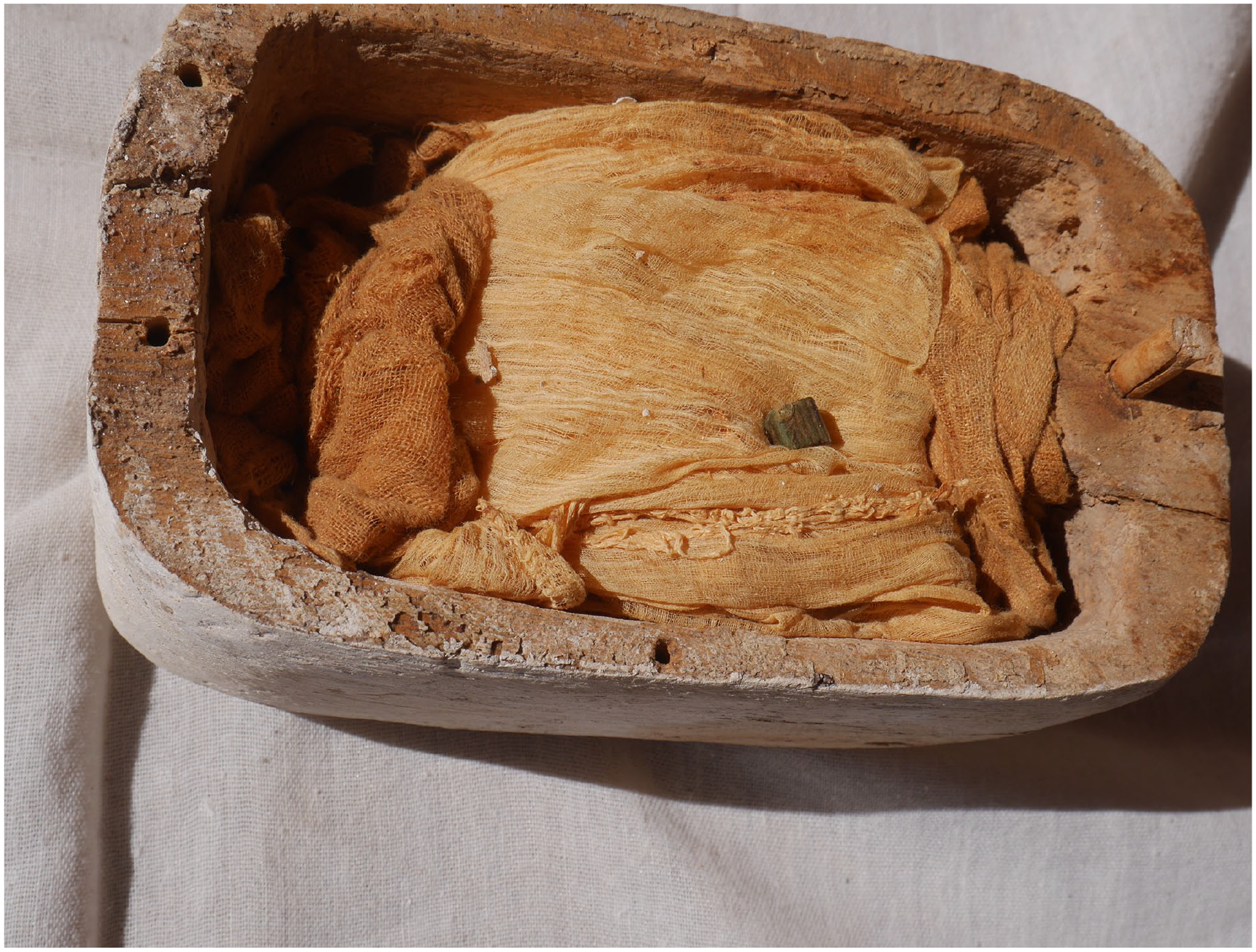
The contents of the wooden ellipsoidal box after the removal of the lid (photo: A. Niwiński).
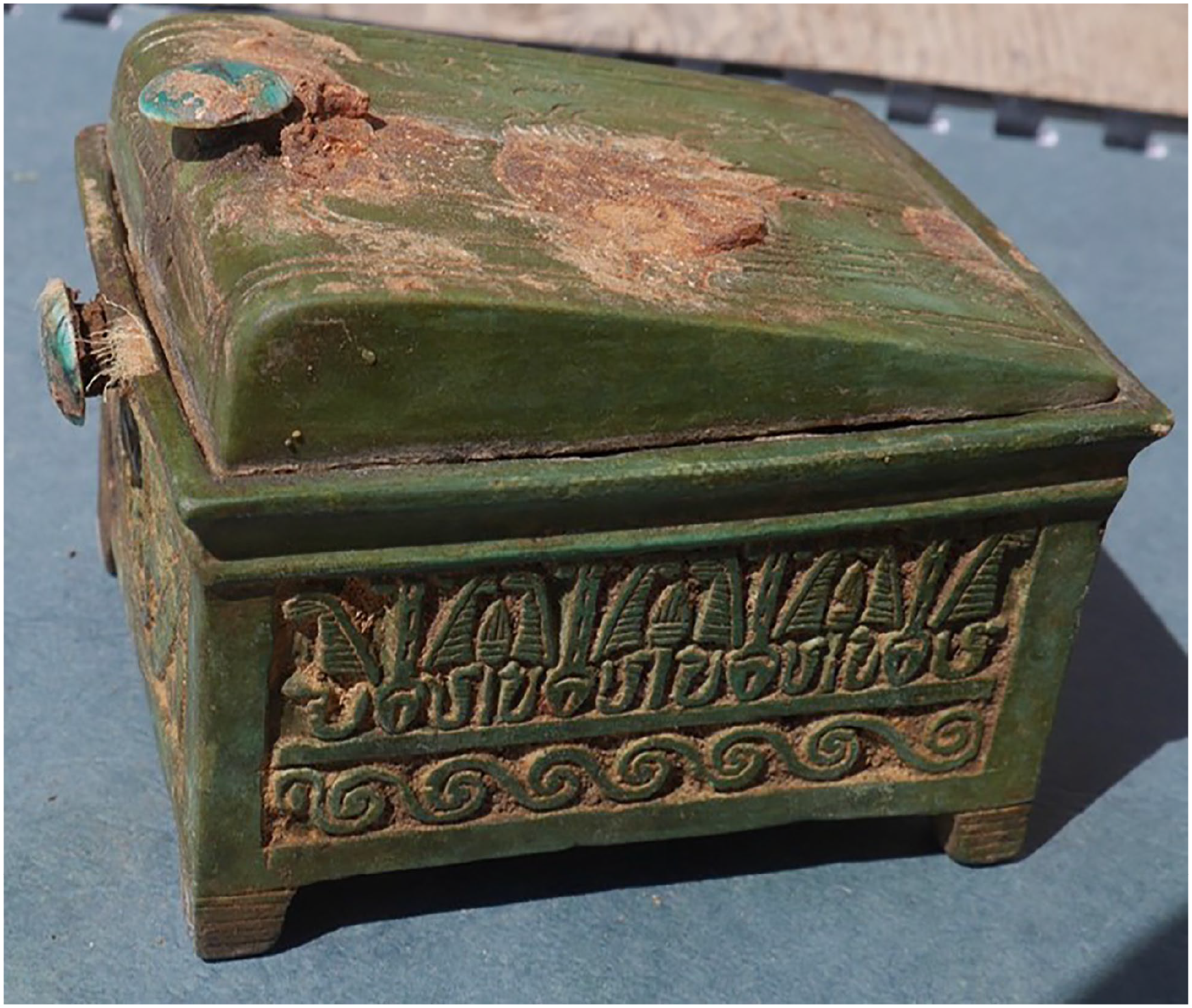
The faience chest found inside the wooden ellipsoidal box (photo: A. Niwiński).
On the top of the chest’s lid, the sema-tawy symbol is represented (fig. 10), and the winged solar disc is depicted on the front of the lid. The frontal wall of the chest contains in its centre the first cartouche name of Thutmose II placed between standing lion-headed winged personifications protecting the shen-eternity signs (fig. 11); one can interpret these figures as Isis and Nephthys. On the back wall of the chest is a stylized representation of a falcon with outspread wings (the shape of which is atypically adapted to the right angle corners of the walls) and holding the eternity shen-signs in its claws (fig. 12). The two side walls of the chest are decorated with similar motifs: at the bottom a spiral-shaped ornament is depicted, above the sky-sign is probably represented, surmounted by groups of four symbolic signs: the nefer-hieroglyph between the maat feathers and cobras; these groups are separated by floral motifs of lotus bud.
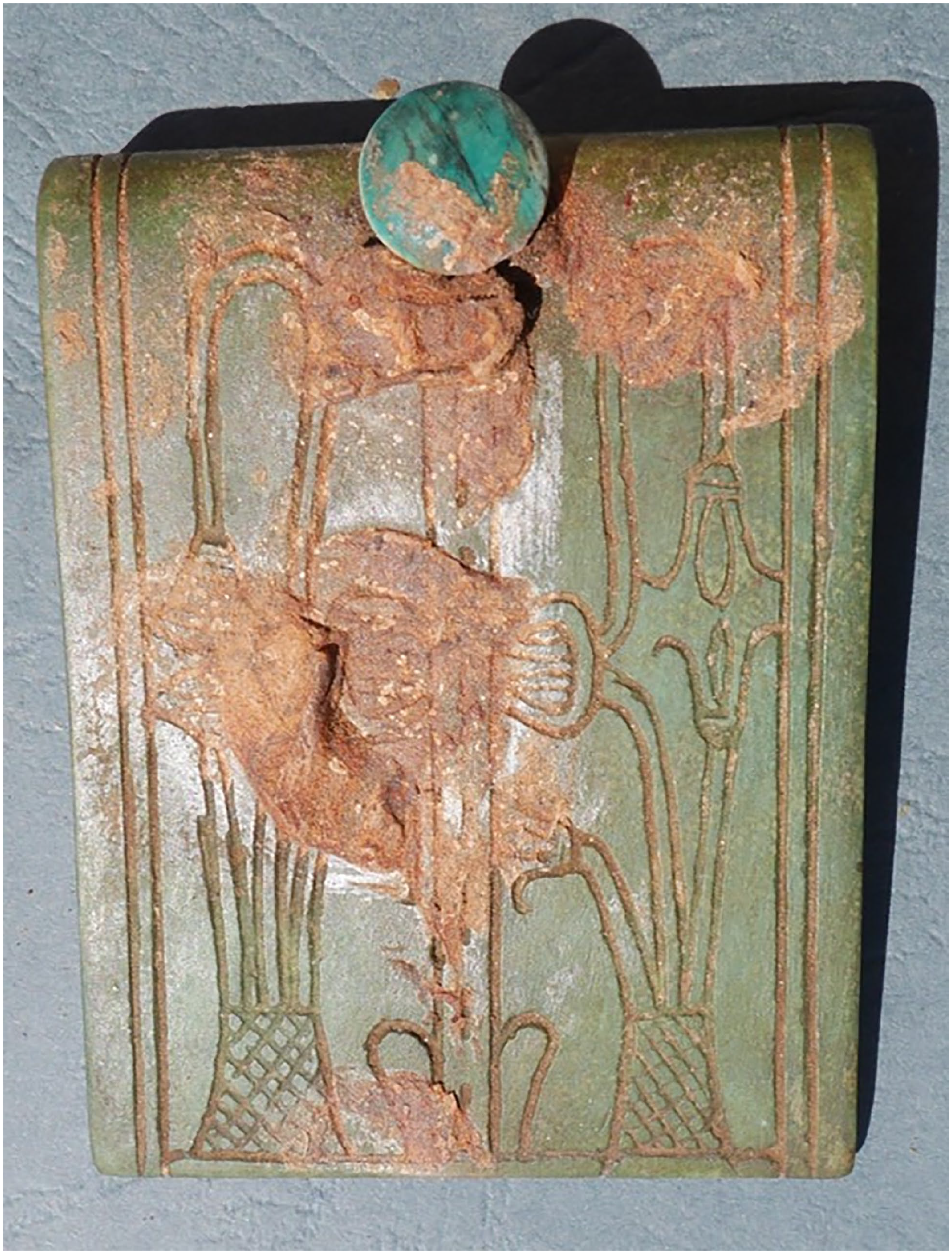
The decoration of the lid: the sema-tawy symbol and traces of mud seals (photo: A. Niwiński).
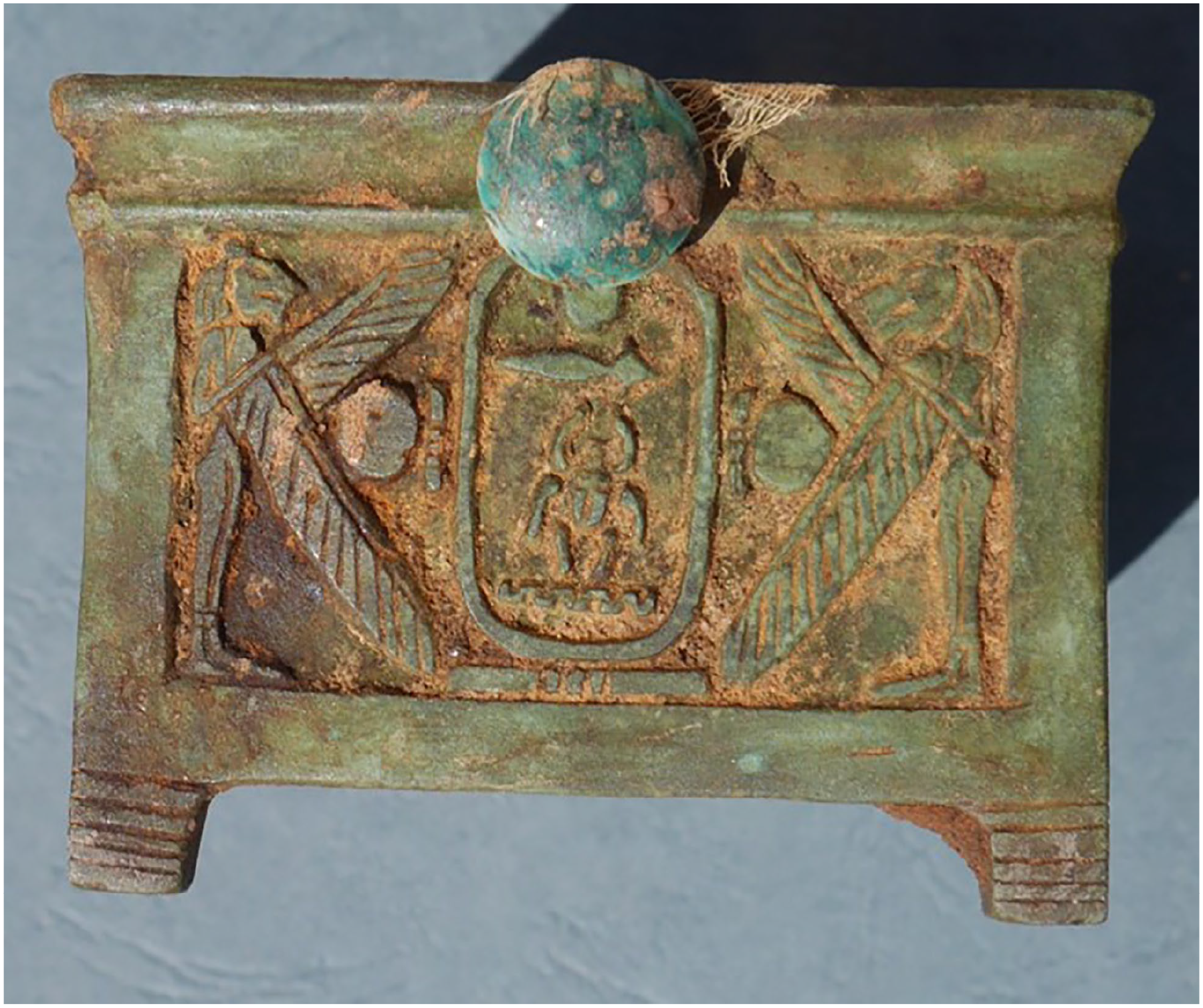
The decoration of the frontal wall of the faience chest, with the cartouche name of Thutmose II (photo: A. Niwiński).
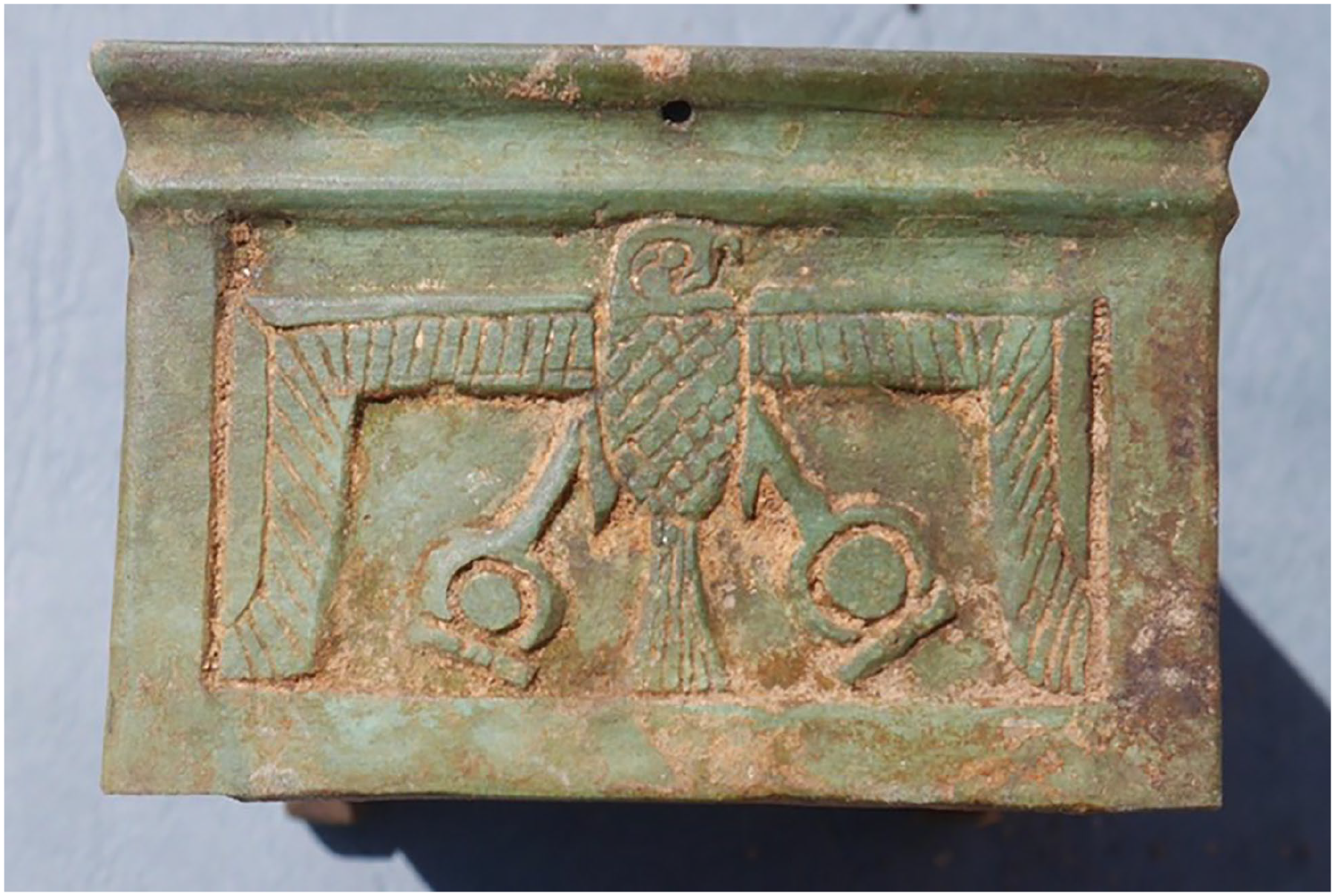
The decoration of the back wall of the faience chest (photo: A. Niwiński).
The faience chest may have originally contained small precious objects (jewellery?) and was provided with a sophisticated closing/protection system: a linen thread or thin metal wire was led through tiny holes, bored both in the box and lid, and twisted around the round decorative pivots attached to the top of the lid and to the front of the box. The endings of the thread may have been covered with a mud seal; the remains of mud on the lid can probably be interpreted as traces of seals, made, however, only during the first use of the chest. Inside the chest was a bundle of coarse linen containing something within. The linen must have originally been wet, because the bundle retained the rectangular shape of the inside of the chest, into which it was squeezed. As it turned out, the linen package filling the chest contained a beetle (scarabaeus sacer), no doubt still alive when closed in the container (fig. 13).
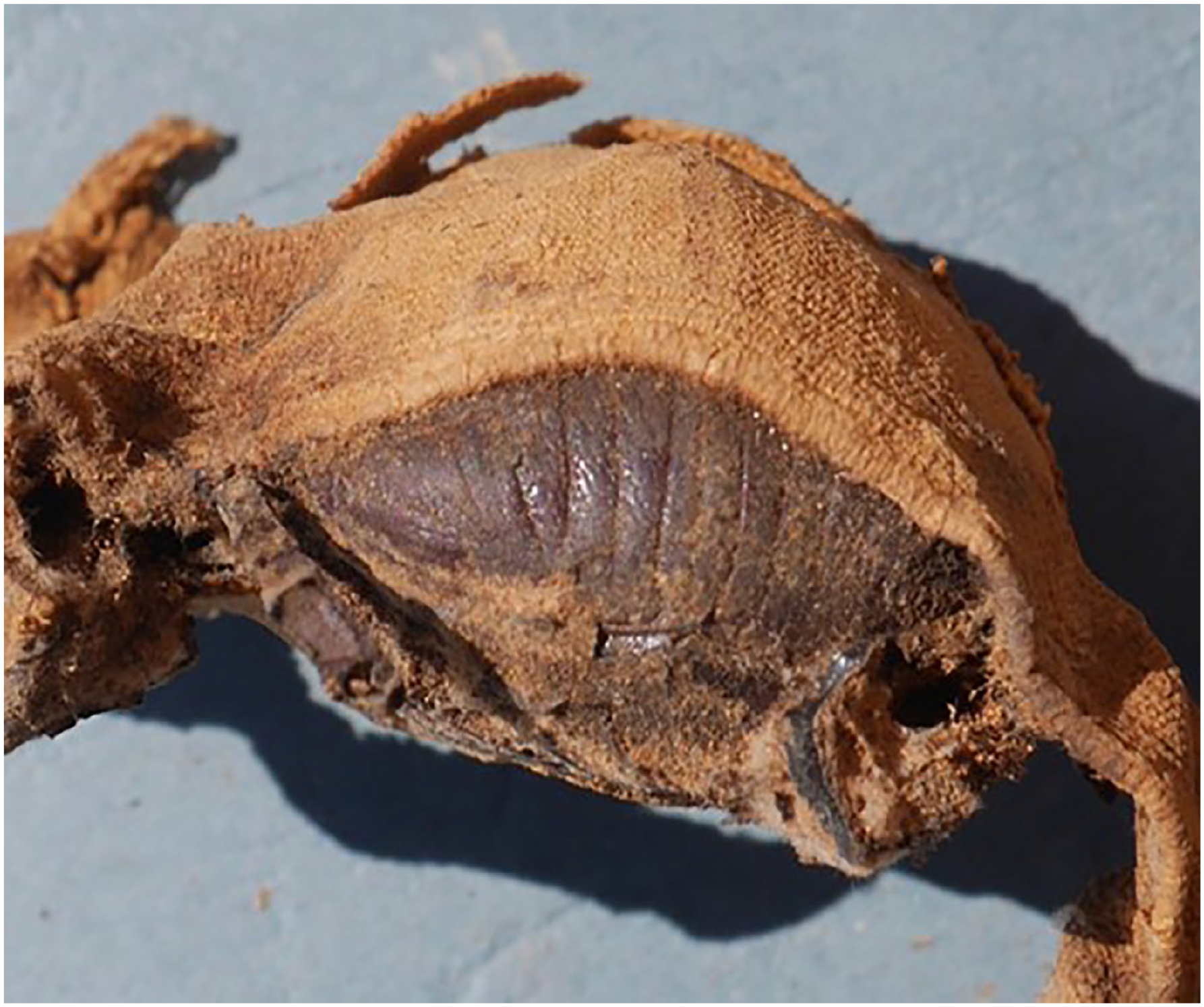
The content of the faience chest: the scarabaeus sacer beetle wrapped in (originally wet) linen (photo: A. Niwiński).
The symbolism of the whole deposit seems apparent. The faience chest with its decoration and contents alluded to the fourth royal protocol name of Thutmose II. The title: ‘King of the Upper and the Lower Egypt’ is suggested here by the sema-tawy symbol, the first cartouche name is found on the box, and the scarab as the great form of Ra is its material repetition. The contents of the stone chest seem to create a rebus-like allusion to the fifth protocol name of Thutmose II. The goose egg can be understood as a material replacement of the hieroglyphic word for ‘son’, and the phonetic value of the word ‘goose’ was very close to the sound of the word ‘Ra’. The cartouche name: Thoth is born is alluded to here by the egg of the ibis; the ibis being the sacred form of Djehuty.
The foundation deposit seems to be in a direct relation with an unfinished rock tomb (fig. 14) of the inverted T-shape 8 , or with the simple or incomplete construction cut in the cliff (fig. 15; the position, cf. fig. 2), situated on the same level and a few metres to the west of the spot where the deposit was found. This construction consisted of three elements: five very irregular ‘steps’ of an altogether height of 1.80 m9 leading to a single ‘room’ that was 2 m long and 0.8 m wide, however without any entrance. 10 Directly above this ‘room’ (140 cm above its bottom), a niche measuring 90 cm high, 35 cm wide and 30 cm deep was cut into the limestone formation; the walls of the niche are not smoothed out.
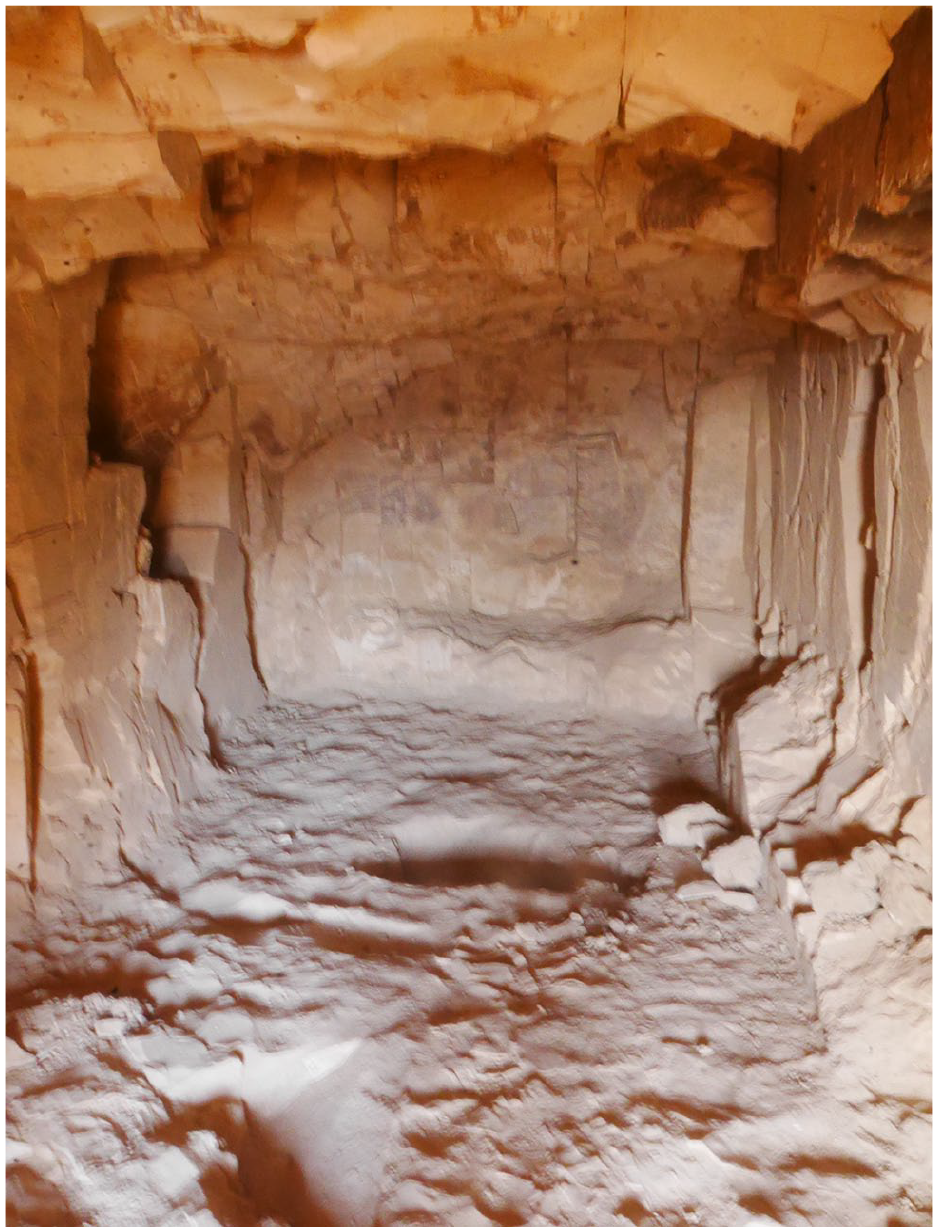
The upper tomb (of Thutmose II?): the inside of the longitudinal part (photo: A. Niwiński).
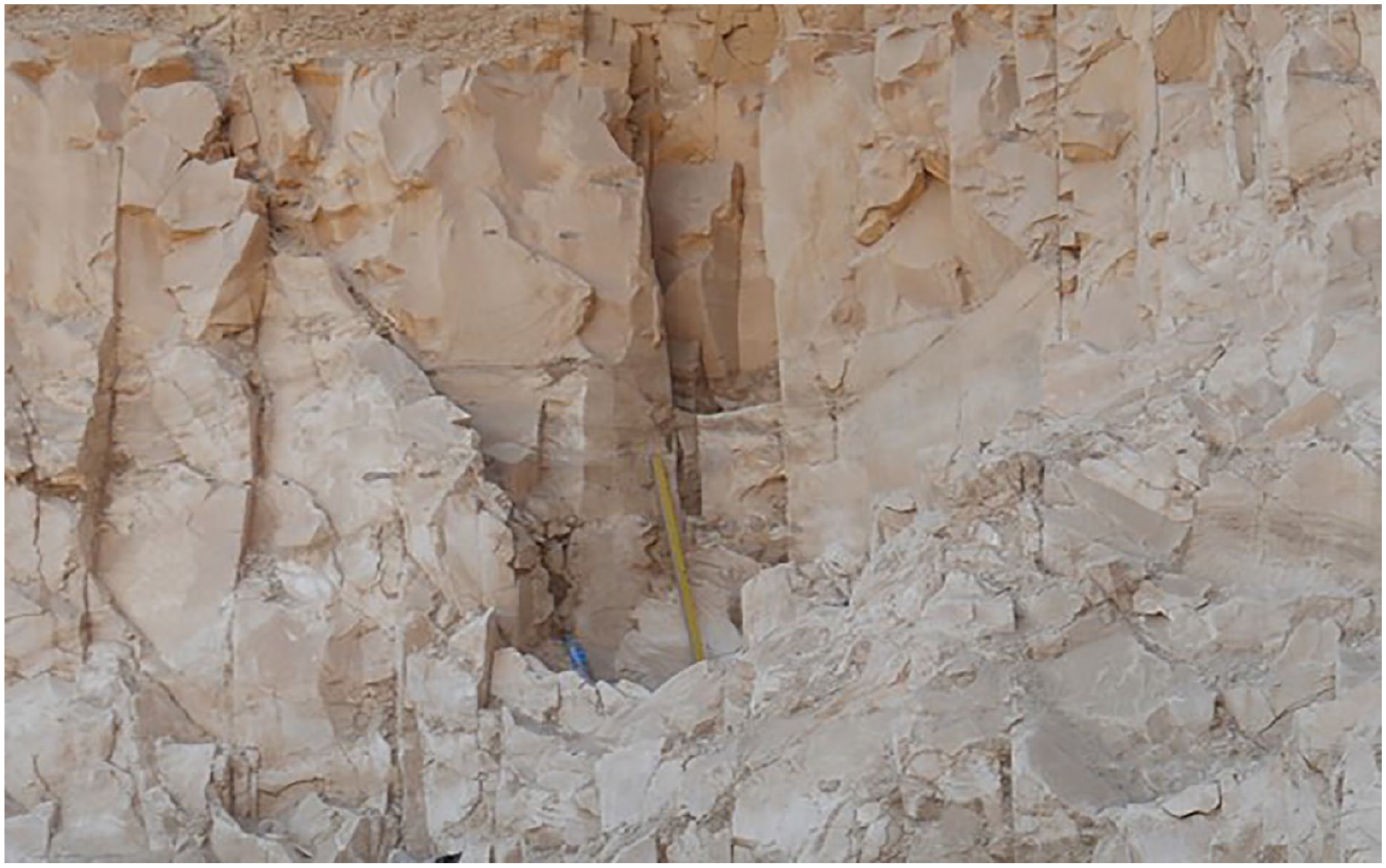
The ‘sanctuary’ discovered near the deposit: a niche and small ‘room’ underneath (photo: A. Niwiński).
What function did this structure, that seems to be unfinished, or of temporary character only, serve? The location of the whole complex in the very centre of the western cliff ‘curtain’ of Deir el-Bahari is strongly suggestive of having a funerary purpose. It is worth quoting here the conclusion of Luc Gabolde’s study devoted to Thutmose II: L’absence de tombe avéré, alliée au fait qu’aucune trace de matériel funéraire, sarcophage, canope, statuette, ouchebti ne soit parvenue jusqu’à nous, permet de supposer que la sépulture de ce roi reste encore à découvrir dans la nécropole thébaine, et puisque sa momie n’est toujours pas identifiée, que sa dépouille mortelle y repose encore.
11
The simplicity of the construction detected by the Cliff Mission seemed, admittedly, to be far away from the expected royal standard of any funerary monument, but the localization of the structure in the vicinity of the royal temples of Mentuhotep II, Hatshepsut and Thutmose III strongly supported the idea that the whole arrangement may have been related to the tomb of Thutmose II. In this context, in addition to the deposit bearing the name of that king, it is worth noting that on the axis of the rock ‘sanctuary’ with the niche, a chapel (room G, cf. fig. 22) was once situated being the southernmost room and the only one of the temple of Thutmose III where the name of Thutmose II appeared in the decoration. 12
The whole area between this temple and both the rock tomb and the ‘rock sanctuary’ designated by the deposit of Thutmose II was found densely filled with rubble and a number of large limestone fragments of rock. In September and October 2019, the Polish Cliff Mission conducted regular excavations there while systematically removing layer after layer of this accumulation of stones and debris. We have descended altogether 18 m down from the level of the ‘sanctuary’, however not yet reaching the bedrock. The continuation of the excavations was done in September and October 2022, and afterwards in February and March 2023 as the work of the joint Egyptian-Polish mission of Zahi Hawass’s Institute of Egyptology, with the author as field co-director. The following observations concerning the funerary architecture of the early 18th Dynasty can be formulated as results of these clearing works:
The uppermost part of the debris covering the corner of the limestone rock formation, including the ‘sanctuary’, consisted of loose rubble and earth of the altogether thickness of 220 cm. This ‘A’-accumulation grew upon a horizontal surface covered with a thin layer of pigeon excrement, strongly suggesting that it lay open for a longer time. The thickness of the ‘A’-accumulation suggests that this was partly of anthropogenic character.
The ‘B’-accumulation underneath is also of anthropogenic character. It consisted of two parts, differentiated technologically, and probably chronologically as well. The ‘B-1’ part was constructed first in the upper part of the rock corner. It had an irregular shape of a supporting mass of small stones fixed to each other with a kind of mortar. This very solid 5 m high construction ended with an upper flat rectangular surface 3 m wide and 4 m long, situated about 5.50 m beneath the niche and 2.50 m beneath the horizontal border between the (upper) limestone- and (lower) slate-formations. As on one of two similar platforms discovered by the Cliff Mission in February 2015, a funerary chapel had once been constructed above the northwestern corner of the temple of Thutmose III; 13 the same function can be deduced for the ‘B-1’ construction. As no trace of such a chapel has been found at this location, it seems uncertain whether the platform was ever used for such a purpose. Most probably the whole area was later completely covered with the ‘B-2’ part of the accumulation. This was constructed with layers of small debris alternately with those consisting of large rock fragments thrown down from the surrounding cliffs. The anthropogenic character of the ‘B-2’ accumulation is proven by small broken faience object fragments dated to the New Kingdom found during the excavations (fig. 16). The cleaning of the area seems to have created strong support for the idea that the tomb of Thutmose II 14 was planned there. Not far from the spot where the Polish Mission stopped the work in 2019, an accumulation of hard debris (similar to the aforementioned ‘B-1’ accumulation) has been discovered during the cleaning. This man-made arrangement was 6 m long and 3 m wide (fig. 17); it seems to have been constructed to protect something situated underneath against rain waters, as the hard debris densely filled any gap and recess in the surface of the slate formation underneath. Immediately to the east of this hard debris accumulation, an ancient wall made of loose medium sized stones (of limestone and sandstone) was discovered. This wall (fig. 18) was situated only 3 m above the floor level of the temple of Thutmose III and precisely on the axis linking ‘Chapel G’ of this temple (dedicated to Thutmose II) and the ‘sanctuary’ above (linked to the deposit of Thutmose II). Behind this wall, traces of works appeared, most probably intended to create an entrance to the tomb, however, only just started and never accomplished (fig. 19). During the same season, an annex room was discovered, situated directly to the south from the southwestern corner of the temple of Thutmose III (fig. 20). The smooth surface of its northern part has been shaped as if a false door or stela was intended there (fig. 21), directed towards the unfinished tomb entrance.
In conclusion, it seems that the tomb of Thutmose II was planned behind the southwestern part of Thutmose III’s temple. This tomb would have played a function as the second tomb of Thutmose III’s father, where his mummified body and tomb furniture would have been transferred from his first tomb. The location of this first tomb is still unknown; however, it seems likely that it may have been situated not far away, in the Deir el-Bahari area. 15 Therefore, the temple of Thutmose III may have played the function of a great monument serving the tomb of Thutmose II.
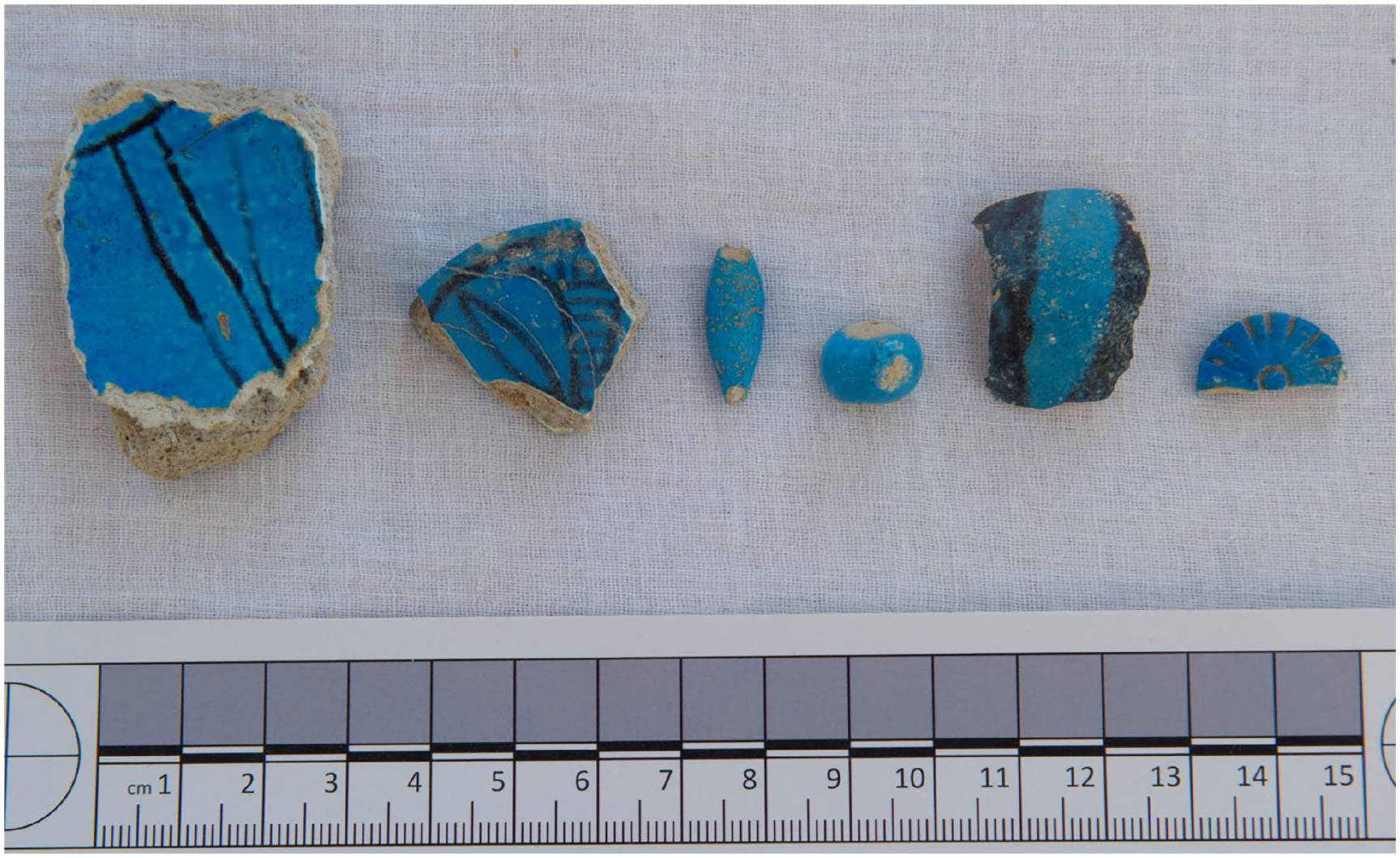
Fragments of faience objects found during the removal of the deep layers of the accumulation of stones and debris in front of the ‘sanctuary’ (photo: M. Garcia-Darowska).
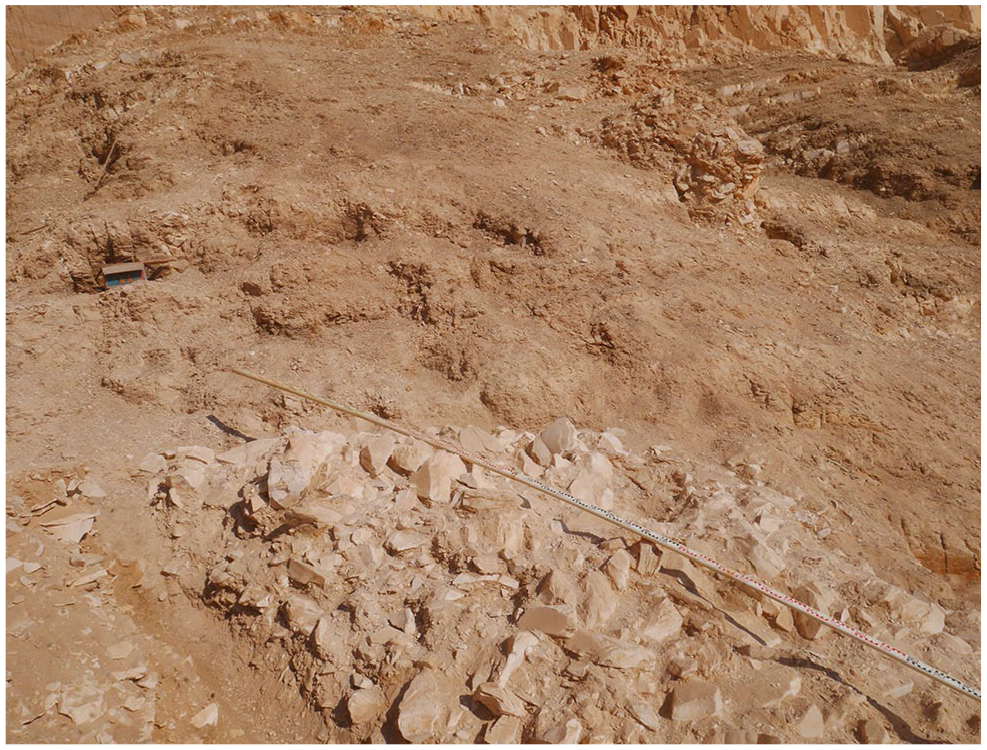
An accumulation made of hard debris (limestone fragments of rock fixed to each other with a kind of mortar) covering a fragment of the slope on the axis of ‘Chapel G’ in the temple of Thutmose III (photo: A. Niwiński).
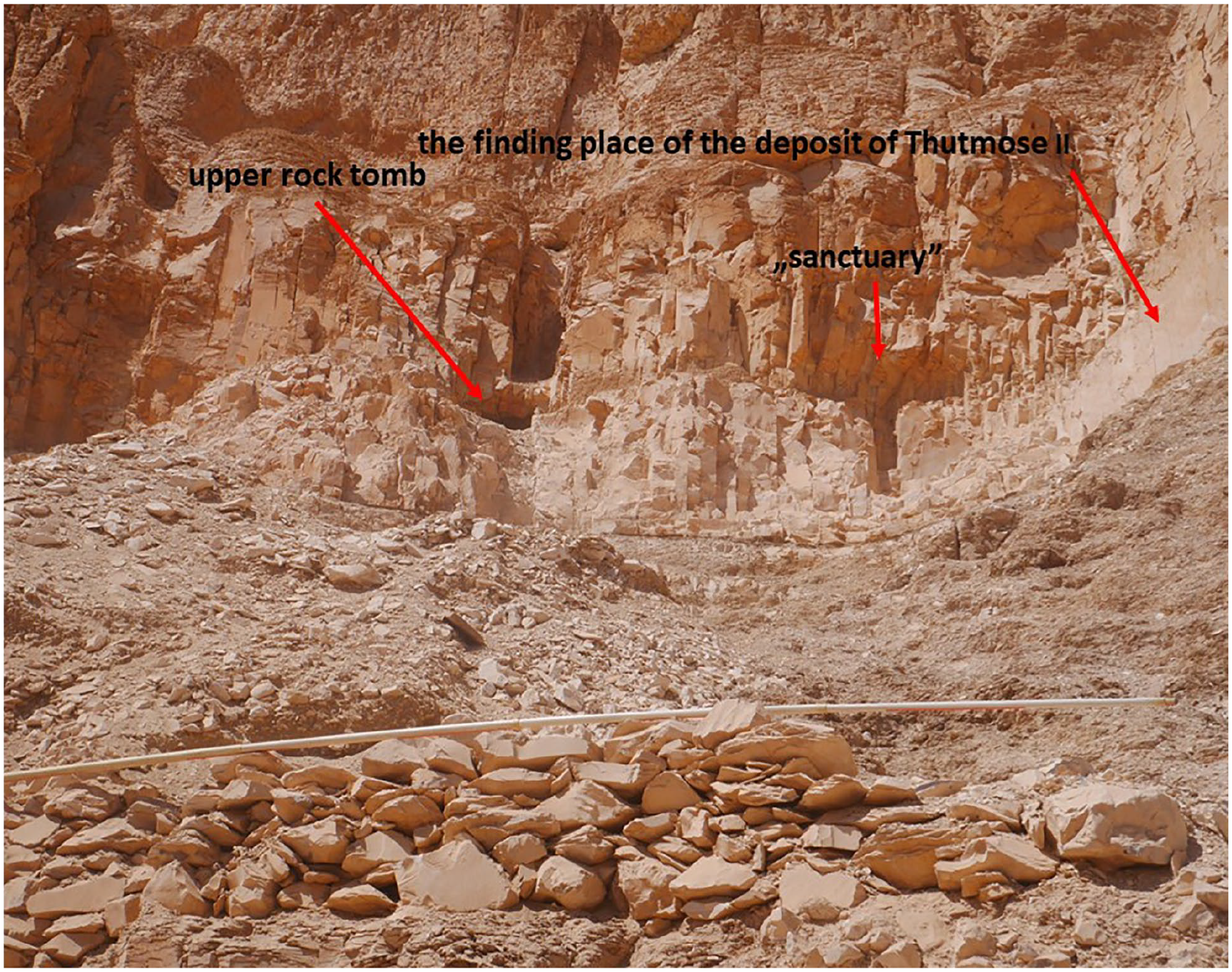
The wall of limestone and sandstone rock fragments discovered beneath the fragment of the slope protected with the hard debris. Behind is the upper rock tomb, the ‘sanctuary’ and the location of the deposit of Thutmose II (photo: A. Niwiński).
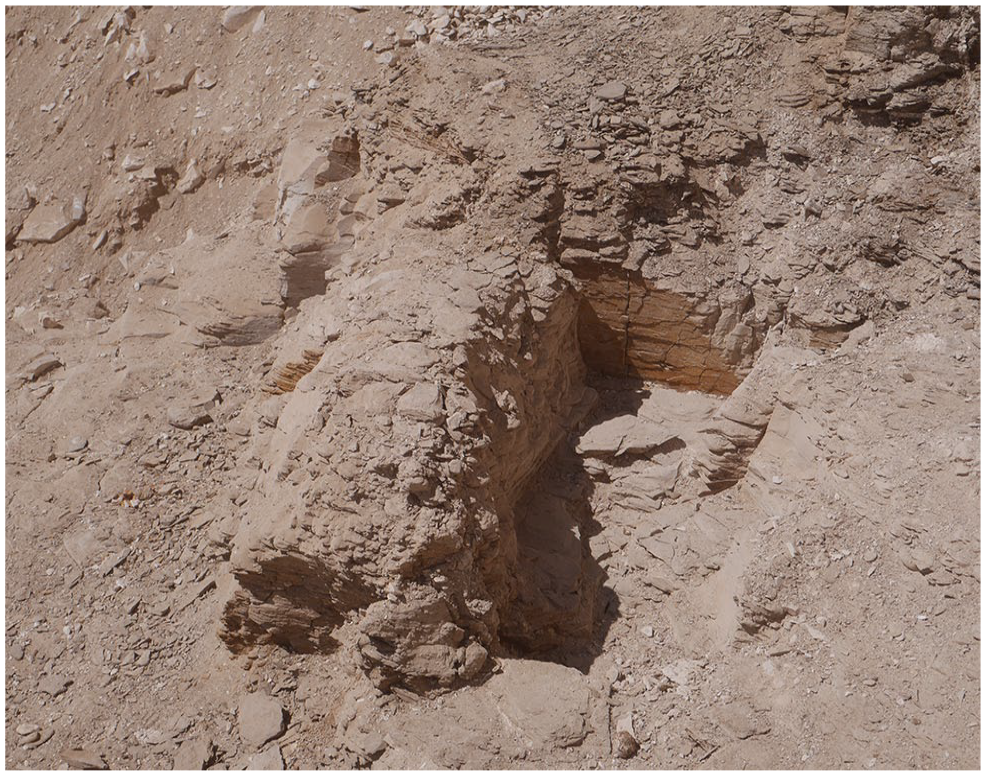
The traces of the works on the tomb entrance. View from the north (photo: A. Niwiński).
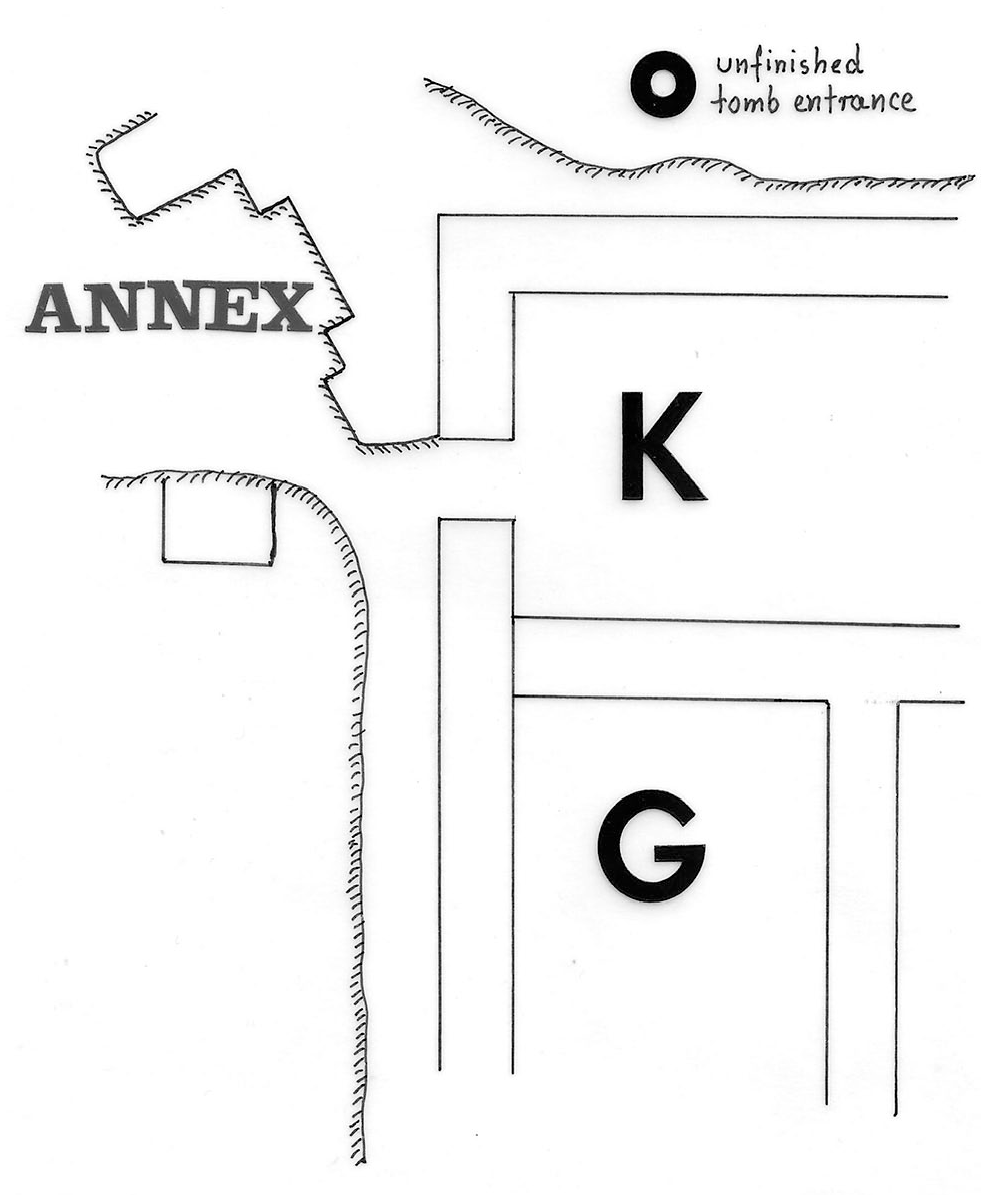
Southwestern corner of the temple of Thutmose III (drawing: A. Niwiński).
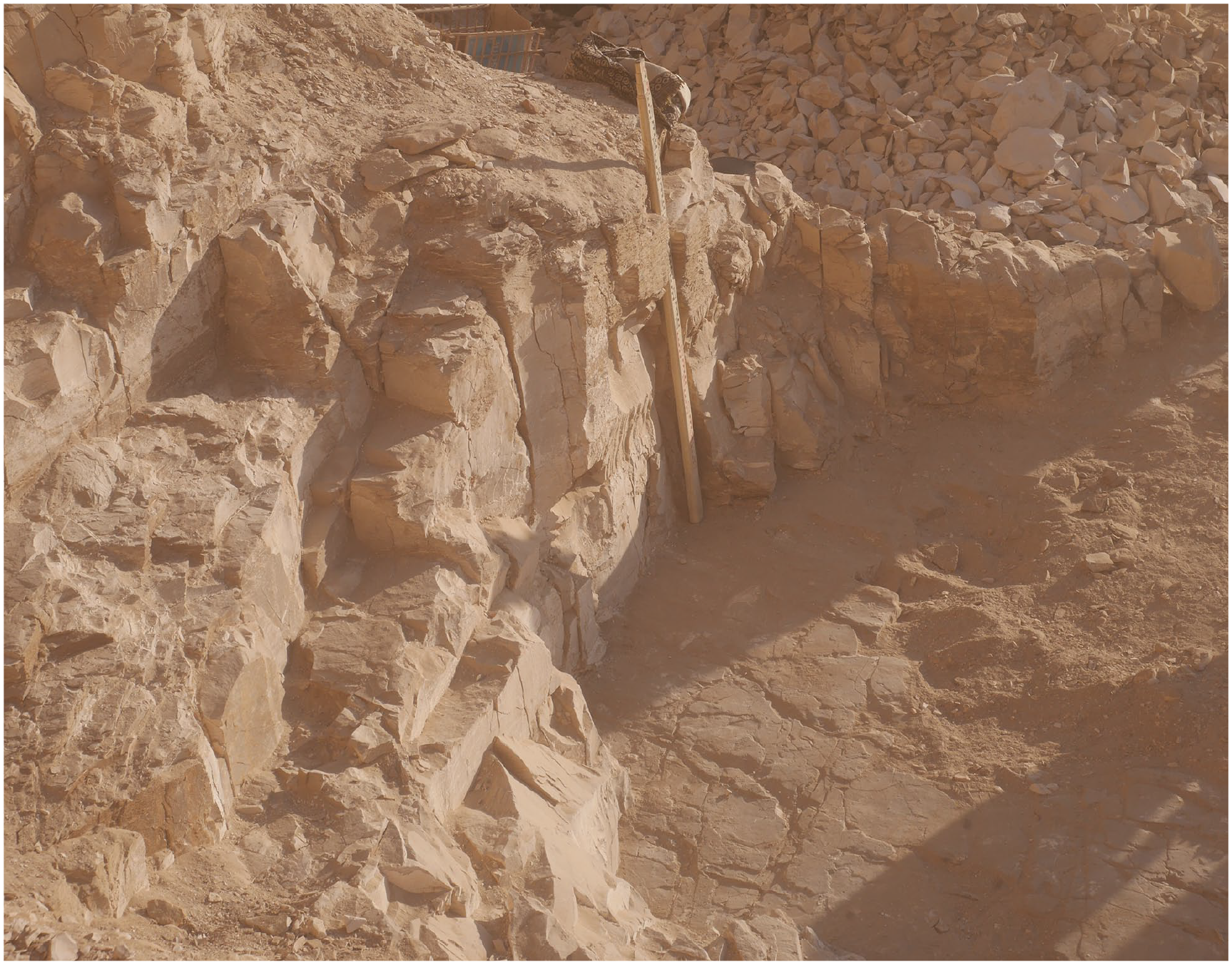
Northern part of the annex room of the temple of Thutmose III (photo: A. Niwiński).
With this in mind, it is worth mentioning some other conclusions as a result of the works of the Polish Cliff Mission from 1999–2015, suggesting an existence in Deir el-Bahari of another royal tomb of the early 18th Dynasty: that of Amenhotep I. This tomb was certainly robbed, as the mummy of the king in his small coffin testifies. His tomb may have been re-used, but part of his burial equipment, including the outer coffin 16 may still be preserved.
A very important hint for the location of the tomb of Amenhotep I in Deir el-Bahari is the nearby location of two tombs belonging: one to his mother Ahmes-Nefertari and another one to his wife Meritamun. Ahmes-Nefertari’s burial was later moved to DB 320 (‘the Royal Cache’), 17 while Meritamun’s tomb was discovered by the MMA Expedition under the leadership of H. Winlock. 18
Another important hint can be seen in the temple of Amenhotep I, discovered by Winlock under the first ramp of the temple of Hatshepsut. 19 The plan of this structure 20 shows its two various axes that roughly match with the position of the two aforementioned tombs, as well as with the spot in the cliffs above the northwestern corner of the temple of Thutmose III, where the Polish Cliff Mission discovered, during the cleaning works done in 2014/15, two man-made platforms separated by a short distance of a dozen metres (as to the position, cf. fig. 2) and situated on the same level corresponding to the base of the limestone formation of the cliffs above the uppermost layer of the Esna-shale formation. The platforms (referred to as the ‘western’ and ‘eastern’ ones) were situated in two neighbouring gullies descending in the direction of the temple of Thutmose III. Both platforms, made of small stones fixed with mortar, had similar sized surfaces: about 3 m in width and 3–4 m in length (which is comparable with the size of the platform discovered below the ‘sanctuary’ connected with the deposit of Thutmose II). On the eastern platform, ruins of a funerary chapel topped with a small pyramid still existed at the beginning of the twentieth century AD, the western one served probably the same function, and constructions of a similar character had once been built on both platforms.
In a distance of 40 human steps towards the south-west from the western platform at the same level, in a place situated behind a bend of the cliff, and thus being obstructed from sight from the corner, an ancient latrine has been discovered (as to the position, cf. fig. 2) offering a semi-circular stone surface on a holder provided with a channel to direct refuse downwards, as well as a vertical wall for urination. It is feasible to suppose that the latrine situated in such an uncommon place may have been made exclusively for the team of the workers engaged in the building operation on the western platform, as it could hardly be accessible from the eastern one. The western platform 21 has been uncovered after the removal of a 6 m thick accumulation of stones and debris (the upper part of this consisted exclusively of fine material: limestone and slate dust). If any structure was built there, it must have been removed before this artificial accumulation of rubble was executed. One hypothesis is that it might have been reconstructed on the eastern platform (built especially for this purpose at a later date than the creation of the western platform. Such reconstruction suggests the importance of the structure built on the western platform, and later reconstructed nearby. A funerary chapel topped with a pyramid with a window in its centre is often represented on coffins of the 21st Dynasty and also in tombs and on papyri of the New Kingdom. 22 It seems that this structure may have constituted a landmark of the Theban necropolis, and a burial chapel of Amenhotep I – the holy patron of the whole necropolis may have inspired an iconographic pattern for all the scenes repeated in the subsequent centuries in funerary material from Western Thebes.
In February 2015 as a piece of experimental archaeology, we measured with a rope the distance from the uppermost part of the Gebel Ragab (the only one suitable to safely walk to) to the level of the western platform: this measured 63 m. This figure corresponds precisely to the ‘120 cubits’mentioned in the Abbott Papyrus as the distance from the ‘high place’ down to the tomb of Amenhotep I. 23 In consequence, it is highly probable that the much disputed ‘high place’ corresponds to the Gebel Ragab, while the tomb chapel of Amenhotep I was a point of reference in the Abbott Papyrus. 24
It seems, therefore, that the Abbott Papyrus is an important source supporting the idea that the tomb of Amenhotep I should be looked for in the area of Deir el-Bahari. Aidan Dodson recently criticised this hypothesis, 25 remarking that the localization of the tomb of Amenhotep I in Deir el-Bahari seems impossible to reconcile with the Abbott Papyrus’ itinerary which places the monuments of Amenhotep I and Mentuhotep II at opposite ends of the commissioners’ tour of inspection. The term ‘itinerary’ in regards to this papyrus was first introduced by Winlock 26 and until now nobody has revised this view. It seems, however, far from being certain. The report of the Abbott Papyrus merely enumerates the tombs visited (by the way not all tombs were royal, as four private tombs were also visited, but their locations are unknown) and these tombs are grouped into two categories: those without pyramids (the only one being the tomb of Amenhotep I) and those with pyramids. Nothing in the text is said about any itinerary of the inspectors, with the exception of the first tomb visited, because it was this first tomb (of Amenhotep I) that had been supposed as violated which must have been verified.
The second part of the passage in the same source says that the tomb of Amenhotep I is to be found to the north of the ‘temple of Amenhotep of the Garden’. The position of the western platform on which the chapel may have been built clearly indicates that the temple with a garden would be the temple of Mentuhotep II. Not only is a garden well attested at the temple, but also the cults of Mentuhotep II and Amenhotep I are closely linked at the site. 27
This cult chapel of Amenhotep (probably joint with the cult of Ahmes-Nefertari and Meritamun) would have been built in the area of Mentuhotep’s temple, after the first temple of Amenhotep I had been destroyed because of the construction of the temple of Hatshepsut. The new cult place of Amenhotep I was given the colloquial appellation ‘temple of Amenhotep of the Garden’, but in the official documents it may have retained the old name Men-isut. The name Men-set (Men-isut) 28 appears, among others, in the list of Ineni 29 and on the statue of Didia, 30 in both cases in the immediate vicinity of the name Akh-isut (the temple of Mentuhotep II in Deir el-Bahari) which suggests the close proximity of the two structures. 31 The same can be deduced from the analysis of the main inscription on Didia’s statue, where the offering formula, besides the divine names of Amun, Mut, Khonsu, Thoth, Maat, Re-Atum, Osiris, Ptah Sokar, Isis, Horus, Anubis and Hathor Djeseru in mentions those of Ahmes-Nefertari, Amenhotep I, Thutmose III and Mentuhotep II.
The statue of Didia also furnishes important proof of the close connection of the cults of Amenhotep I and Thutmose III. On one shoulder of this statue, the first cartouche name of Amenhotep I appears, while on the other is the first cartouche name of Thutmose III. Direct connection of the names of these two pharaohs is testified by a number of other monuments, as well. 32 The building activity of Thutmose III from the very beginning of his independent rule in the 22nd year furnishes several cases of mentioning the name of Amenhotep I as accompanying those of himself. This reflects an extraordinary reverence of Thutmose III for Amenhotep I with whom he felt some special emotional relation. The best evidence of this is the simple fact – commonly known but never discussed – that Thutmose III gave his son and throne successor the name Amenhotep, and not Thutmose which would have been the expected proceeding of naming the son after his grandfather, as done by other Thutmoside pharaohs. However, the joint appearance of the names of these two (and only these!) pharaohs: Thutmose III and Amenhotep I on the coffins of the late 21st and early 22nd Dynasties 33 must rather reflect a common cult place of these rulers somehow connected with Deir el-Bahari, from where almost all these coffins originate.
Since the western platform, on which the tomb chapel of Amenhotep I was probably constructed, is situated above the northwestern corner of the temple of Thutmose III, the area of this temple (fig. 22) appears as a possible place of this cult. The abovementioned Didia – the owner of the statue mentioning both the names of Amenhotep I and Thutmose III – was integral during the post-Amarna restoration works undertaken in many of the Deir el-Bahari temples: Men-set, Akh-set, Djeser-akhet and Djeser-djeseru. The temple Djeser-akhet (‘Holy Horizon’) is commonly identified with the name of the structure built by Thutmose III. Certainly, after the huge construction of Thutmose III had been created, it completely dominated the area between the temples of Mentuhotep II and Hatshepsut. However, the term ‘Holy Horizon’ was known already before Thutmose III’s works, which is attested on Senenmut’s statue, where an epithet ‘Lord of the gods in Holy Horizon’ appears.
34
The expression of plurality seems to be indicative as to more than one cult object being connected with Djeser-Akhet in the period preceding the construction of the temple by Thutmose III. One of these was most probably the chapel of Hathor, and the words of William Hayes can be quoted here: Djeser-Akhet, as it is usually called, we can identify without hesitation as a chapel dedicated primarily to a local form of the goddess Hathor and occupying the central position at the rear of the natural amphitheater of Deir el-Bahari, midway between the temples of Hatshepsut and King Nebhepetre Mentuhotep of the Eleventh Dynasty. Such a chapel was probably in existence before the Middle Kingdom and was evidently much frequented by devout Thebans from the beginning of the 18th Dynasty onward.
35
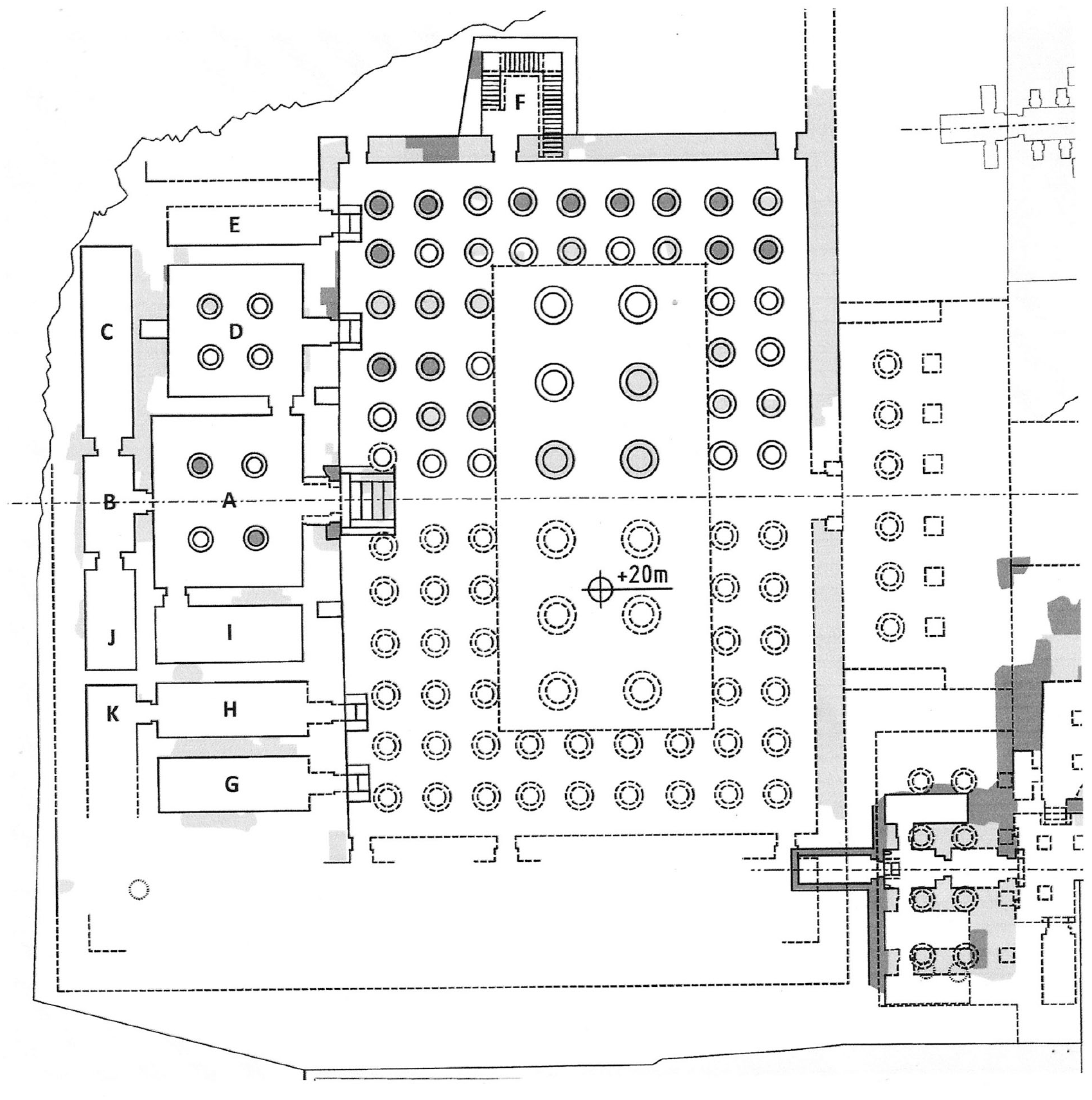
The plan of the temple of Thutmose III at Deir el-Bahari (M. Caban, partially based on plan of R. Czerner, S. Medeksza).
Another cult object connected with Amenhotep I has been suggested by F. J. Schmitz: Nach all’diesen Erörterungen scheint es sich anzubieten, in Djeser-Akhet ursprünglich ein Bauwerk – vielleicht eine Kapelle und / oder ein Barkenheiligtum Amenhotep I zu sehen das schon auf einen älteren Bau der 11. Dynastie Bezug nahm, dann aber von Hatshepsut abgerissen und dicht neben ihrem Tempel in größeren Ausmaßen neu erbaut wurde /…/ Die wechselvolle Baugeschichte des schmalen Gebietes zwischen Ach-isut und Djeser-djeseru dürfte also bestimmt sein durch die Bautätigkeit des Twry unter Amenophis I.
36
It seems also quite obvious that the natural exposition of the slope to the solar rays in the morning made Ra another cult focus at the Djeser-Akhet, which may have been evoked in the name Djeser-Akhet given to a gate in the area of the solar sanctuary of the temple of Hatshepsut. 37 This very important place may have been chosen for the installation of the tomb of Amenhotep I, an idea that seems to be strongly supported by all the above mentioned evidence: the Abbott Papyrus and the new discoveries of the Cliff Mission in 2015.
There is also a possibility that the shaft of this tomb may have given access to the first tomb of Thutmose I, already dead in the period of the construction of the Hatshepsut temple. The axial connection between the cult chapel and the tomb was still of some importance at that time. We cannot exclude that the second corridor was made to end with the burial chamber situated on the axis of the mortuary cult chapel of Thutmose I in the southern part of the Hatshepsut temple. In such a situation, all of the works on the elevated (heret) tomb of Thutmose I would have been executed below the surface, which could well explain the famous words from the biographical inscription of Ineni: ‘I made the -tomb for the King [Thutmose I] and nobody could hear this, nobody could see this’. 39
The tomb had contained the mummy of Thutmose I only shortly before this was transferred to KV 20 by Hatshepsut. However, the tomb Thutmose III intended to provide special protection for may have been regarded not only as the burial place of Amenhotep I but also as the one where his grandfather Thutmose I was temporarily reposing. In this context, the place researched by the Polish-Egyptian Mission, where the tomb of Thutmose II was planned was also very close to the original rocky slope called Djeser-Akhet, and the southernmost chapel ‘G’ of the Djeser-Akhet temple of Thutmose III was located on this axis. Therefore, this temple may have been a gigantic memorial sanctuary devoted to – besides the cult of Amun – the funerary cults of Amenhotep I, Thutmose I, Thutmose II and Thutmose III. At the same time, this temple might have been the common funerary monument serving the royal necropolis of the early 18th Dynasty rulers.
The most intriguing question remains the localization of the camouflaged entrance to the tomb of Amenhotep I (possibly identical to the entrance to the first tomb of Thutmose I). The entrance of the tomb-shaft 40 should not be too far away from the chapel (possibly situated on the western platform), since directly under the platform no entrance was found. The excavations conducted a few metres to the south of the gully situated below the western platform have brought to light three drains cut in the slope. 41 One of them was intended to direct the rain waters towards the north, while the two others would carry the waters towards the south. This arrangement obviously had the purpose of protecting the eastern part of the slope, and one could expect Amenhotep I’s tomb to be on the axis of this protected area. A Saite tomb located there is a late construction and has no relation to these drains that were already long since covered under the same artificial accumulation of stones and debris that was also covering the western platform before the construction of the tomb. The builders of the Saite tomb removed part of this debris accumulation, while exposing the rock surface of the natural slope. This natural slope comes, however, to an abrupt end just under the entrance to the Saite tomb, where the vertically cut rock marks the western border of the area of the temple of Thutmose III; its base surface is 6 m further down.
The same east-west axis continued eastwards from the area protected by the aforementioned drains and first crosses an ‘island’ of sandstone pavement slabs. 42 The existence of this group of valuable stones is strange enough, since most of the remaining slabs were removed for the purpose of reuse after the temple had been ruined by a catastrophic collapse of rocks between the reigns of Ramesses VI and Ramesses IX. 43 The ‘island’ was cleaned and investigated by the Polish Mission in 2015, and a number of observations done then (one slab was artificially reconstructed of several fragments, the guide line carved on this slab doesn’t match the one visible on the adjacent slab, two large hollows are seen between the slabs partly filled with pieces of the slate stone, finally a decorated wall fragment of the temple was found deep under one of the slabs) testify that the northern part of the ‘island’ was constructed secondarily to a camouflage purpose.
The axis continued eastwards after the ‘island’ through the original room ‘D’ of the temple, the function of which has been successfully reconstructed by the Polish Mission of the Thutmose III temple as the chapel of the royal Ka. 44 Besides the general importance of the idea of the royal for the reigning pharaoh, 45 one should evoke the special relation of this idea with Amenhotep I in Western Thebes. 46 In this context one should as well draw attention to the exceptional arrangement of the temple of Thutmose III with its two main processional passages (fig. 22). While the main one passed in the middle of the temple towards room ‘A’ and sanctuaries ‘B’, ‘C’ and ‘J’, the side processional passage lead through the northern part of the Hypostyle Hall to the large room ‘D’ (the chapel of the royal Ka). It is most probable that the entrance to the tomb of Amenhotep I may be imagined somewhere on the axis passing through this chapel. In 2019, the Cliff Mission made a number of borings by means of an electrical drill and long thin bits to check the bedrock along the axis of the side processional passage in its western part. The results are following: while the surface of room ‘C’ and the ‘island’ area revealed the original bedrock, 47 in the area of room ‘D’, the boring drill was sinking without a slightest effort to the depth of some 30 cm under the actual surface and only then was coming across the hard bedrock. In one spot the drill easily reached the depth of 90 cm. The working hypothesis is: the bedrock in the area of the chapel of the royal Ka was artificially lowered by c 30 cm and the removed crushed slate fragments were then redistributed in the room in such a way that the bedrock there looks identical to elsewhere. A temporary removal of the false bedrock may possibly reveal the entrance to the shaft tomb. 48
One new important hint for the presence of a royal tomb in the area has recently been furnished by a hieratic graffito found in the area of the Hatshepsut temple. This graffito dating to the period of the building works on a temple at Deir el-Bahari, probably the Hatshepsut temple, mentions a royal tomb situated ‘to the south’ of the area of the works. 49
The tomb of Amenhotep I, still intact under Ramesses IX, was finally robbed, most probably in parallel with almost all the royal tombs in the Valley of Kings during the period of civil war with the revolted Kushite army led by Panehsy in the year 18 of Ramesses XI. 50 In this context it is worth mentioning a discovery, made in 2000 on the Gebel Ragab by the Cliff Mission, of a bronze handle of a ceremonial royal type dagger of the early 18th Dynasty 51 being an analogy to the one found on the neck of King Kamose and preserved now in Brussels. 52 The dagger together with a string of blue faience beads was brought, probably by a thief, to the Gebel Ragab from below (thus probably from the adjacent area of the temple of Thutmose III), and there disassembled: the precious metals were taken by the thief, and the bronze handle left on the spot. It cannot be ruled out that the dagger once belonged to Amenhotep I.
The tomb was then re-used for somebody important (Herihor?), and finally closed and protected. A part of this protection was the camouflage works on the level of the surface of the shaft entrance (the false bedrock?). The second part of this protection was, to all archaeological evidence, the creation of a gigantic artificial slope made above the tomb’s camouflaged entrance. This artificial slope was a masterpiece work of the ancient Egyptian engineers so successful that even keen observers and experienced archaeologists like Herbert Winlock were duped. 53 Edouard Naville had removed the lower part of this camouflage slope, 54 Jadwiga Lipińska its middle part, 55 and the Cliff Mission, under my direction, its uppermost remains. This gigantic ancient operation is hardly imaginable. In order to realize this task, it was necessary to remove every trace of human activity in this huge area. The chapel of Amenhotep I was removed (from the western platform) and rebuilt nearby (on the eastern one). The temple of Thutmose III was ruined long before and most of its blocks had already been transported elsewhere, apart from some columns and the granite doorway that were left in place and only thrown down to the ground. The columns in the temple of Mentuhotep II were smashed at the height of 1.5 m, the central pyramid completely removed, and the statues in the processional alley thrown to the ground. Only one fragment of the lower part of the ramp leading to the temple of Thutmose III remained untouched. It seems that both the ‘A’ and ‘B-2’ layers of debris discovered by the Cliff Mission during the aforementioned works related to the ‘sanctuary’ of Thutmose II were also a part of the artificial slope, only laid in two various sub-periods of the 21st Dynasty. The whole gigantic operation must have taken many years. The deepest part of the area was that corresponding to the temple of Mentuhotep II, and it seems that the work of covering the whole terrain started there, which corresponds to the layer ‘B-2’ detected by the works of the Cliff Mission in 2019. The other part of the work – the covering of the area of the temple of Thutmose III – was done after some time had passed and a new layer of debris accumulation was then also laid over the southern part of the area (which corresponds to our layer ‘A’).
In this respect, the artificial accumulation of stones and debris on the Gebel Ragab investigated and finally removed by the Cliff Mission in the years 1999–2015 acquired a new interpretation. 56 Being only a tiny part of the whole large scale work, the construction of this artificial mound on an oblique rock surface certainly was a great achievement of the ancient Egyptian engineers. The rocky surface of the Gebel Ragab was a carrier of enormous amounts of water from any potential flash floods flowing down from the high cliffs towering over this ledge on the west and on the north. After reaching the gate-like narrow space between two rocks at the end of the flat surface inclined to the southeast, the masses of water were certainly changing into a kind of waterfall tumbling over the upper part of the slope overhanging the area of the Thutmose III temple. Such waterfalls made, however, no damage to the natural rocky surface, or even to a stone construction (of the funerary chapel of Amenhotep I). It would, however, have been disastrous for the artificial camouflage slope, especially to its upper layers made of small material and dust. Thus, it seems quite understandable that the builders of the artificial slope decided to change the nature of the Gebel Ragab and to stop the waterfall effect in the case of torrential rain that obviously was a periodically observable phenomenon. 57
The graffiti of Butehamun found by the Cliff Mission on the Gebel Ragab 58 attesting several visits of this high dignitary on the spot during the engineering operation there and after its completion 59 suggest that the whole gigantic enterprise may have been done under his supervision. As Butehamun’s activity covers the period from the Renaissance Era under Herihor until the early 21st Dynasty, a hypothesis comes to mind that the tomb of Amenhotep I may have been re-used for Herihor, his son Neferkare Amenemensu, or both. It seems possible that the first part of the huge engineering operation of creating the artificial slope above the whole southern part of Deir el-Bahari started right after the burial of Herihor (in the re-used tomb of Amenhotep I?) which corresponds to our layer ‘B-2’. The accomplishment of this operation may have taken place after the burial of Neferkare Amenemensu early in the reign of Psusennes I, and this would correspond to our layer ‘A’. The re-used tomb was protected with unimaginable skill and the labour of a great number of workmen. The place best protected by the artificial slope was the western part of the temple of Thutmose III. J. Lipińska has calculated that, altogether, an accumulation of 24 m high had been towering above this area 60 including the distance between the pavement of the temple and the top of the artificial slope, later removed by the Cliff Mission. The artificial slope does not exist anymore and the last piece of protection of the alleged tomb of Amenhotep I (re-used for Herihor) seems to be the thin layer of the false bedrock on the area of the chapel of the royal Ka in the temple of Thutmose III under research by the Polish Mission of the Kazimierz Michalowski Center of Mediterranean Archaeology of the Warsaw University.
Footnotes
Funding
The author did not receive funding for this project.
1
On the results of the works of the Cliff Mission in the years 1999–2015, see Niwiński, et al. 2000: 173–179; Niwiński, et al 2001: 221–235; Niwiński 2002: 416–422; Niwiński 2005: 213–222; Niwiński 2007: 1391–1399; Niwiński 2009a: 277–289; Niwiński 2009b: 3–10; Niwiński 2015: 377–391; Niwiński 2017: 457–461; Niwiński 2019: 58–65;  : 1059–1075.
3
4
5
I owe this information to T. Rzeuska from the Polish Academy of Science; the publication of these deposits of Thutmose III is in preparation for print.
6
WB II: 491.
7
For example, from numerous scenes of the Judgment presented on the coffins of the 21st Dynasty.
8
This type of the tomb seems to hint at an 18th Dynasty date. Its location in the area of the temples strongly suggests its original royal function, perhaps related to Thutmose II. Only the longitudinal east-west oriented room, and the central and northern part of the transversal room were cut in the rock; its southern part was not executed, perhaps because of the weak condition of the rock, or because the works were temporarily interrupted.
9
Of which, however, only the highest two (together of the height of 0.5 m) were left above the ‘walking level’; the other three (of the height of 1.30 m) corresponding to the base of the limestone formation built above the thick slate formation, as everywhere in Deir el-Bahari (Niwiński, et al. 2000: 180–181), were covered with an anthropogenic accumulation together with the deposit.
10
The eastern (frontal) wall of this piece in its southern part is only 30 cm high, which makes the act of entry therein easy.
13
14
Some 700 m to the south of Deir el-Bahari, in the area of the ‘last Mentuhotep’s temple’ valley, intensive works (certainly a royal project) can be seen that make the impression of an incomplete construction of a royal tomb showing some characteristics of Hapuseneb’s school, thus, in theory, planned for Thutmose II. Cleaning works preceding a tomb construction were there begun at the bottom of an 11 m deep crevice between two limestone rocky formations. The present writer together with an Egyptian archaeologist, acting for Zahi Hawass, investigated this spot on 10–11 March 2019. In the light of the discoveries in Deir el-Bahari, it seems that this tomb project was given up.
15
This is the conclusion of the recent research of Andrzej Kwaśnica who was an architect long working with the Polish Hatshepsut Temple Mission.
16
Most probably comparable with the huge outer coffins of his wife Meritamun (Winlock 1932: 15–22, pls 18–26), his mother Ahmes-Nefertari and his cousin Akh-hotep (: 3–4, 8–9, pls III, VIII–IX).
17
Aston 2013: 7–20; : 32–38.
18
Winlock 1932, albeit with an erroneous conclusion as to the identity of Meritamun. About this tomb cf. also : 32–38.
21
The photos of this, cf. Niwiński 2017: 459 fig. 6; Niwiński 2020: 1068 .
22
Davies 1938; Faulkner and Andrews 1972: 187; : 63–65.
23
The reference to the passage in the Abbott Papyrus, the hieroglyphic text in the papyrus BM 10221: Peet 1930: 28–45, pls I–V; translations are offered, among others, by Carter 1916: 147; Peet 1930: 37; Thomas 1966: 70; : 174–175.
27
The stela BM 690: Niwiński 2009b: 10 fig. 6; : 173.
31
Therefore, the present writer agrees with W. Helck who proposed to connect the Men-isut temple with the structure discovered by Winlock under the first ramp of the Hatshepsut temple: Helck 1982: 51. This explanation seems to me superior to the one offered by D. Polz who links the Men-isut temple with the ruins discovered in Dra Abu el-Naga: : 108–111.
32
Such are, for example, the texts and representations of both kings in Karnak in the area of the sixth pylon (Barguet 1962: 126). Lana Troy’s comment is worth quoting: ‘Amenhotep I was given special attention at Karnak and possibly Medinet Habu. A cult room at Karnak, as well as a relief fragment said to come from Medinet Habu point to an interest in creating a parallel between Thutmose III and Amenhotep I, using a symmetric composition’ (Troy 2006: 137). Other examples are the reconstruction of Amenhotep I’s colossal statue in front of the eighth pylon at Karnak (Pillet 1924: 78) and an inscription on the lintel of a gate in the temple built on the island Sai (: 28 and photo).
33
A coffin of the late 21st Dynasty from the Bab el-Gasus tomb, now in Amiens, Musee de Picardie: Dautant 2014: 154–155; the coffin of Bakenmut of the early 22nd Dynasty, probably of the reign of Osorkon I, now in the Cleveland Museum of Art, inv. 14.561: : 314–324.
37
Nims 1955: 118; Karkowski 2003: 133, pl. 18; : 113–114.
40
The two tombs known from this period and related with Amenhotep I’s family: the AN-B and the tomb of Meritamun have the shaft entrances.
41
The photo of one of these: Niwiński 2020: 1070 .
42
The photo of these: Niwiński 2019: 62 fig. 42; Niwiński 2020: 1072–1073 figs 11–.
43
The latest hieratic inscriptions recorded in the area of the temple of Thutmose III can be dated to the reigns of Ramesses IV and Ramesses V: Marciniak 1974: 37–39. The Abbott Papyrus was written under Ramesses IX and the tomb of Amenhotep I was obviously threatened at this time by robbers. Situated in the area transformed into a quarry it was theoretically easily accessible. It is significant that the Abbott Papyrus Commission began its visit to the site of a crime just from controlling the safety of this tomb.
46
47
This furnished the negative answer to the suggestion considered before that the entrance to the tomb may be looked for under the slabs of the island: Niwiński 2019: 63; : 1072. Today the present writer is of an opinion that the whole northern part of the ‘island’ was laid down there to camouflage the difference between the original bedrock under the slabs and the artificial one further to the east.
48
Precisely to its lower part; the upper part of the shaft was removed by the builders of the temple of Thutmose III when a platform for the northern part of this temple was cut in the Holy Horizon slope.
49
50
51
Niwiński, et al. 2001: 224 fig. 3. As to the typology of the daggers: .
53
Members of the MMA expedition not only frequented the area just above the ruins of the temple of Thutmose III, but they evidently used one of the Saite rock tombs situated 6 m above the platform of the temple as a resting place. Inside this tomb the Cliff Mission found in November 2015, among others, fragments of newspapers dated to the period of Winlock’s excavations in Deir el-Bahari, fragments of tea packages and charcoal pieces for water pipes. When they were resting in this ‘reading room’, Winlock and his colleagues were sitting about 2 m above a real treasure in the form of limestone and sandstone blocks and their fragments covered with marvellous colourful decoration, which was, however, very well hidden by debris. No evidence of the temple has ever arisen in spite of the fact that the lowest fragment of the ramp leading to the temple has been long known (: 50).
54
Naville 1907; : 61–67.
55
Lipińska 1968: 142; : 10.
56
Until 2014, the artificial ‘mound’ of the Gebel Ragab was preliminarily interpreted as possibly hiding a tomb, and this hypothesis seemed to be apparently supported by numerous ancient robbers’ tunnels made there: Niwiński 2005: 215–218; Niwiński 2007; : 379–380.
57
58
About these graffiti: Rzepka 2000: 183–190; Niwiński, et al 2001: 221–235; : 295–303.
59
As suggested by various positions of the graffiti above the level of the bedrock. In some situations, Butehamun had been able to write his name only before the area was covered with the artificial ‘mound’, the location of other graffiti indicates the surface on which Butehamun was writing, while standing high above the bedrock was covered already with a thick layer of debris.
60
Lipińska 1968: 142; : 10.