




Abstract
To our knowledge, representations of zodiac symbols are unattested in Egyptian rock art. The investigation of a petroglyph at the site of el-Hosh in Upper Egypt has found that it bears a strong resemblance to the zodiac sign of Capricornus, a composite figure combining the head and forequarters of a goat with the body of a fish. The sign first arose in Mesopotamia in the late third millennium BCE, from which it subsequently spread to the Mediterranean region. Following a review of the symbol’s development in Egypt, in which its occurrence on ceilings, coffins, and coins was examined, we are confident that the petroglyph depicts Capricornus and that it was most likely produced during the Graeco-Roman Period. Furthermore, as the figure is related stylistically to a nearby petroglyph of a chameleon, an equally unique subject for Egyptian rock art, the latter can now be dated more firmly to the same era.

Introduction
The ‘goat-fish’, a mythical creature incorporating the horned forequarters of a goat and the torso of a large fish, has long been known from the ancient Near East and Mediterranean regions. It first appeared in Mesopotamia, where it later represented the zodiac sign of Capricornus. There is also sporadic evidence of the sign in Egypt, beginning in the Graeco-Roman Period. Here we present an unusual petroglyph at the rock art site of el-Hosh in Upper Egypt (70 km north of Aswan, on the west bank of the Nile), which depicts a hybrid mammal and fish figure that we propose may also represent Capricornus. Another petroglyph at the same site has been identified previously as a representation of a chameleon, a similarly unique subject for rock art. 1 At the time of publication, the latter could not be dated with confidence but was thought to have been produced during the Dynastic era or later based on its limited weathering and lack of parallels with Predynastic motifs. 2 It was also noted briefly that the petroglyph discussed here may have been produced by the same hand, as it bears several stylistic similarities to the chameleon figure. Consequently, if our proposed identification of the image as Capricornus is correct, both petroglyphs can now be dated more definitively to the Graeco-Roman Period.
The following describes the hybrid image and then evaluates its meaning and purpose in light of the goat-fish symbol in the region, and its occurrence in Egypt, in particular.
Description
The petroglyph in question (figs 1 and 2) is located south-east of the chameleon (fig. 3), on a small hill (Abu Tanqura Qibli), some 200 m west of the Nile. 3 Like the reptile, the image has been roughly pecked into the inclined face of a smooth rock platform, producing a series of meandering lines of irregular width. It measures c. 40 cm long and c. 13 cm wide at the mid-point and appears to have been positioned deliberately to align the animal’s torso with a convex break in the rock-face. A deeply gouged line that sweeps over the figure mirrors the shape of the natural fissure but appears to have been added later as it overlies the tips of the animal’s two horns/ears. The latter are rendered as two solid triangles, the right-hand one wider at the base than the left. The figure’s head displays a short, blunt snout with a small protuberance visible under the chin; the facial area is heavily pecked, but there is no clear indication of eyes. The outline of the animal’s oblong torso extends from the head, horizontally along the back, but gradually tapers upwards on the ventral side. At the posterior end, a small block-shaped projection is embellished with five vertical indentations along its outer edge. Like the chameleon figure, the animal’s torso is covered by a network of cross-hatched lines. Those immediately to the right of its head lack an obvious design, but towards its posterior end they form a more uniform pattern. Finally, at the junction between the figure’s head and torso, two thin lines extend vertically to reach the rock fissure below; these are joined together by a short bar at their upper and lower ends.
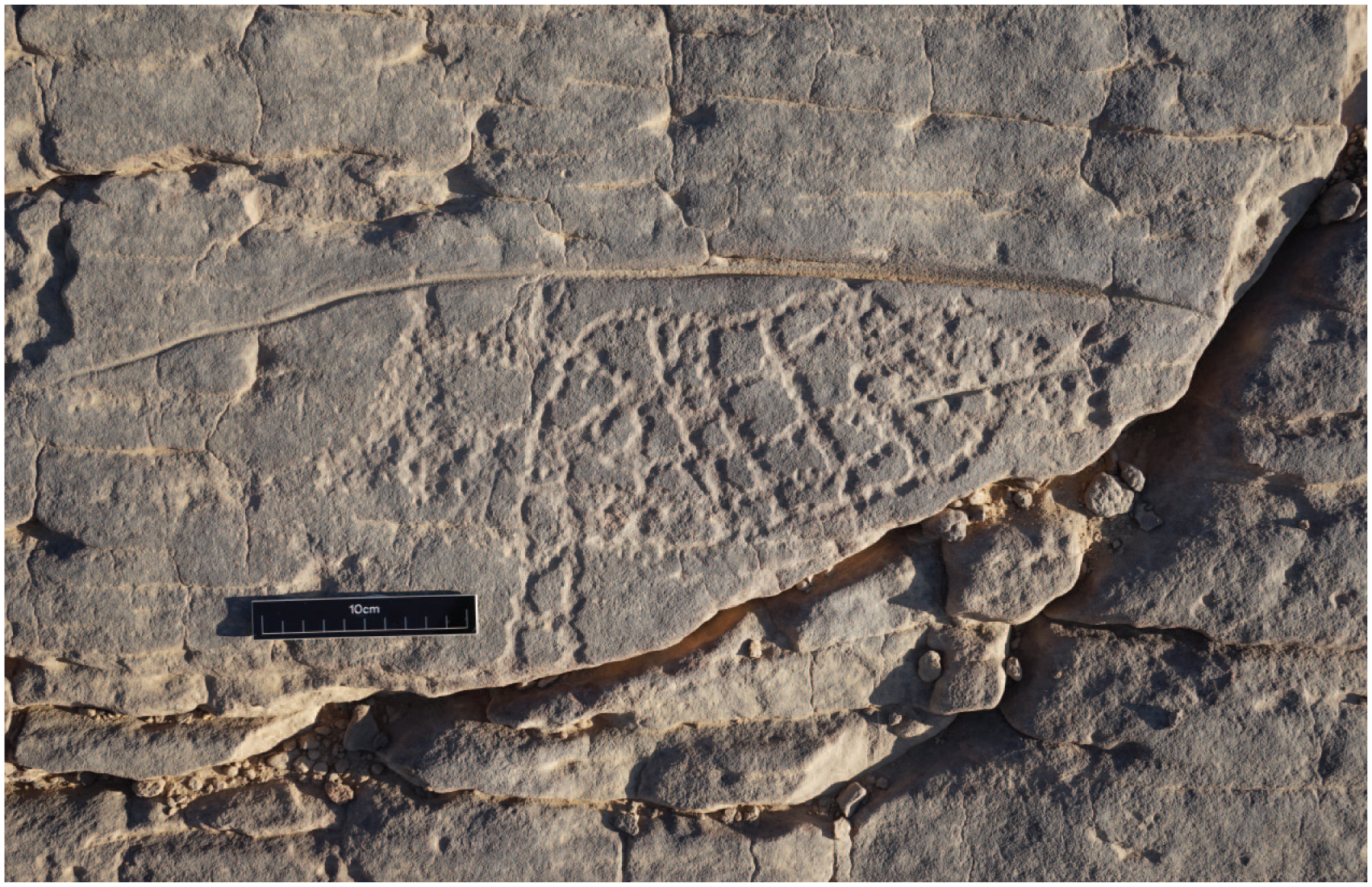
Petroglyph, el-Hosh (photo: authors).
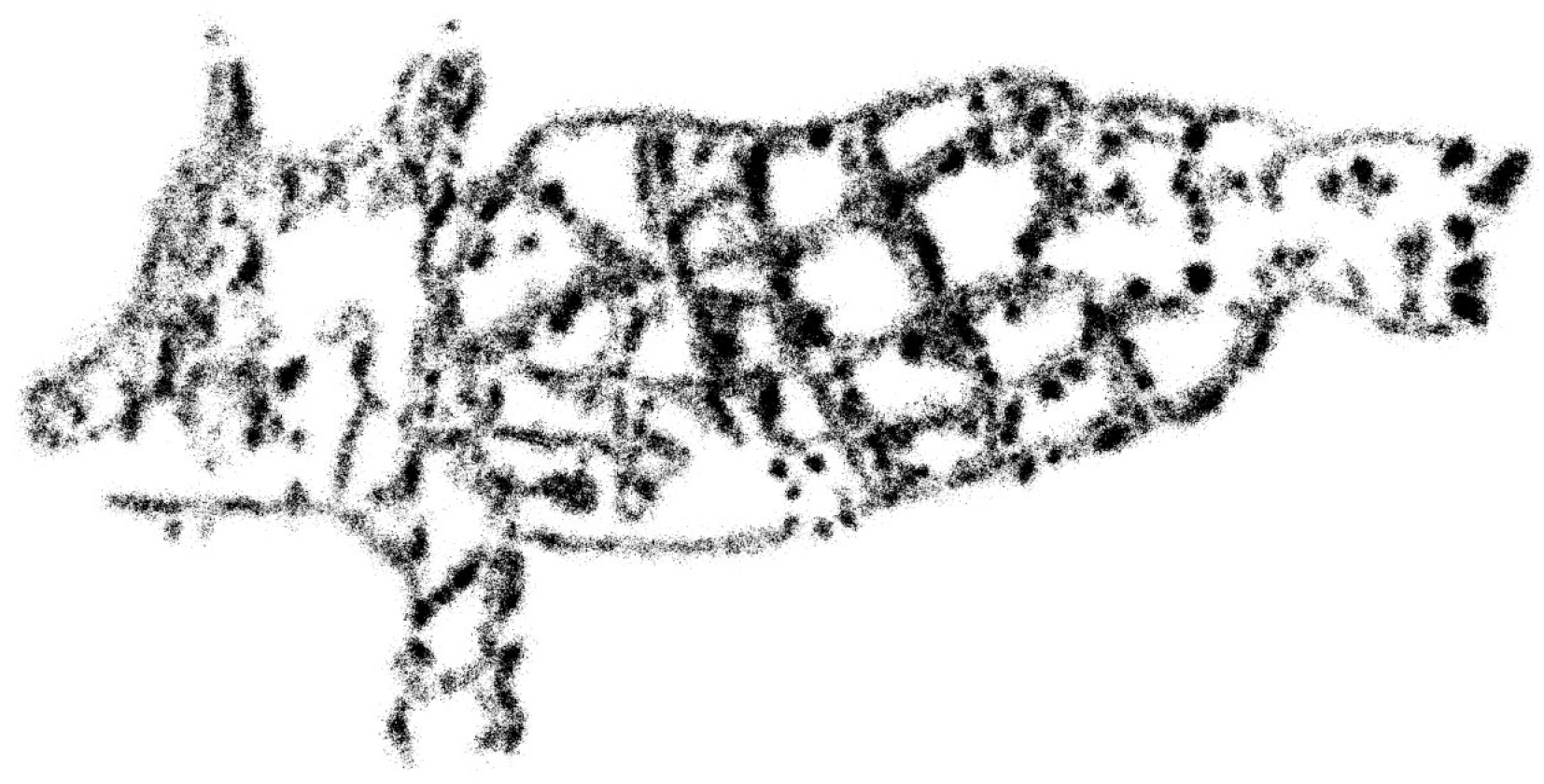
Tracing of petroglyph (drawing: authors).
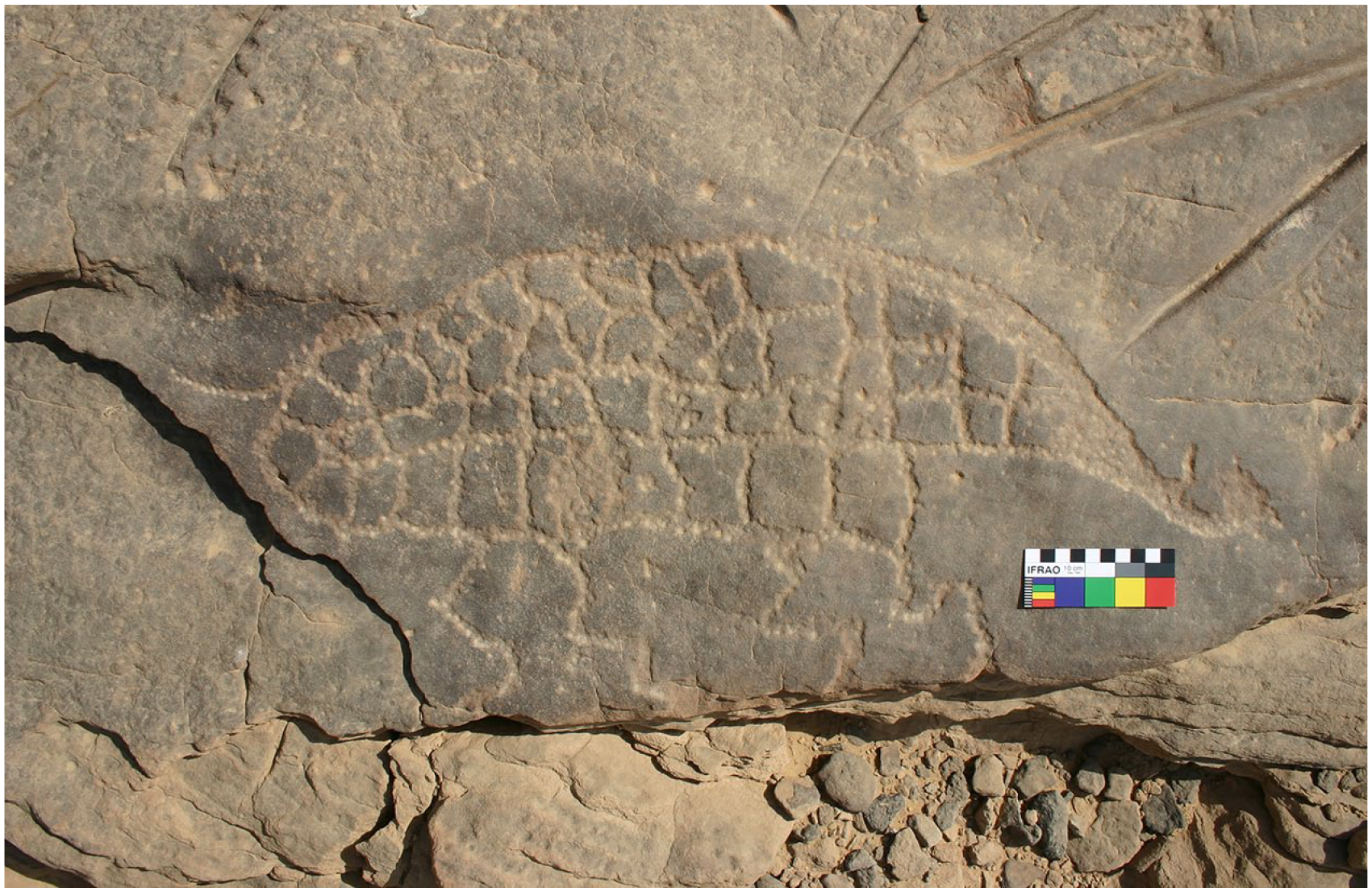
Chameleon petroglyph, el-Hosh (photo: authors).
The petroglyph appears to depict the head of a mammal, with two ears or horns positioned on its crown and a small beard at its chin, to which is attached a scaled, fish-like torso with a fanned tail, and from which extend one, or possibly two, short legs. 4 As the following overview will show, these combined features correspond closely to those of Capricornus. The motif is otherwise absent from the known corpus of Egyptian petroglyphs. Together with the adjacent chameleon image, which is situated on the same panel and also unattested in Egyptian rock art, the two form a highly enigmatic pair.
Background
Mesopotamia
The goat-fish first occurs as a symbol of the Sumerian god Enki (and, later, his Akkadian equivalent, Ea). Enki/Ea was associated with fertility, wisdom, and craftsmanship, but especially with all forms of freshwater. He is regularly depicted as a bearded man wearing a horned cap and a gown from whose shoulders two streams of water gush forth, and in which small fish often swim. The latter have been identified as primarily members of the carp family (Cyprinidae). 5 Physical remains from temple sites have also confirmed that carp were routinely presented to the god. However, his powers were equally manifested in the form of goats, with offering scenes frequently showing goat-bearers in his presence. 6
The composite goat-fish, which encapsulates Enki/Ea’s qualities into a single image, first appears on carved cylinder seals dating from the Ur III, Neo-Sumerian period (c. 2112–2004 BCE), where it either reclines at the god’s feet or, more commonly, is suspended in the air. In these early examples and those that follow, 7 the goat-fish sign incorporates the same basic features: namely, the forequarters of a goat with prominent horns, to which is attached the tapering, scaled body and tail of a carp. The animal can also display a small, tufted beard, and its forelegs can be represented as either outstretched or with one folded beneath it. 8
These same characteristics are found in images carved on kudurrus (aka ‘boundary stones’), inscribed stelae that were produced from the Middle Babylonian Period (c. 1570–689 BCE) onwards (e.g., fig. 4a). 9 In addition to texts that record the granting of land by the king, these objects are also adorned with symbols of the gods, including Enki/Ea’s goat-fish, which were intended to magically protect the stelae and the entitlements they proclaim. 10 The Mesopotamians believed that their deities were manifested in the stars and planets, celestial phenomena that they had observed, recorded, and calculated from as early as the Sumerian Period. 11 For Enki/Ea, this was the constellation of Capricorn, which in the northern hemisphere is visible in the southern sky. 12 Many of the divine symbols on kudurrus thus also represent stars and planets, although arranged according to a descending hierarchy of the gods rather than their physical relationship to one another in the sky. 13 The regular occurrence of the goat-fish on kudurrus consequently signals its connection to Capricorn 14 and indeed it has been proposed that the symbol may have represented the constellation from its earliest occurrence. 15
The motif’s identification with this cluster of stars is confirmed in later texts. In a Babylonian compendium of astronomical knowledge known as mul.APIN (dating from c. 687 BCE, although possibly compiled as early as 1000 BCE), 16 seventeen constellations are named, including that of the suxurmāšu, the ‘goat (suxur)-fish’, which from its placement in the catalogue undoubtedly refers to that of Capricorn. Among the mul.APIN’s comprehensive list are the twelve constellations that by the fifth century BCE were to comprise the zodiac, the constellations that are distributed along the ecliptic (the sun’s path during the year), and through which the sun, moon, and planets appear to move. The zodiac divides this encircling band mathematically into twelve equal parts of 30 degrees each, which we now refer to as zodiacal signs. 17 Capricornus occupied the tenth of the twelve signs, between those of Sagittarius (Par-bil-sag) and Aquarius (Gu.la).

Goat-fish examples: a) Babylonian boundary stone (redrawn from Hinke 1907: fig. 36); b) Osiris chapel, temple of Hathor, Dendera (traced from photograph); c) hypostyle hall, temple of Hathor, Dendera (traced from photograph); d) Ceiling B, Zodiac tomb, Athribis (redrawn from Petrie 1908: pl. XXXVIII); coffin of Soter (British Museum, EA6705; traced from photograph). Drawings: Emily Corbin.
Due to the gods’ association with the planets and stars, the Mesopotamians believed that celestial bodies could impact life on earth, and thus from an early era the stars were consulted to predict and counteract human events, such as wars, and dangerous natural phenomena, such as earthquakes. 18 The practice of astrology thus developed in parallel with astronomy. The precision of the Babylonian zodiac consequently led to the creation of individual birth-charts in which astronomical calculations were used to make long-range predictions about an individual’s future life, with the earliest attested horoscope dating to 410 BCE.
Greece
From the Near East, the zodiac appears to have subsequently entered Greece; however, the degree to which the Greek zodiac was influenced by that of the Babylonians is debated. Nevertheless, it has been determined that, for the most part, the twelve Greek zodiacal signs are direct translations or adaptations of their Babylonian names 19 and among these we find αἰγόκερως ‘Capricornus’. Indeed, in Greek mythology the goat-fish became associated with the god Pan who, while being pursued by the monster Typhon, was said to have jumped waist-deep into the Nile River, causing his lower body to transform into a fish while his upper body took the shape of a goat. 20
Egypt
Astronomy began to increase in popularity in Greece towards the end of the fifth century BCE, 21 but although numerous texts indicate an interest in recording the position of constellations, there is no unambiguous evidence for the zodiac until the third century BCE, much of which comes from Ptolemaic Egypt. The earliest attestations in Egypt are a Greek astronomical text (P. Hibeh 1.27) dated to c. 300 BCE 22 and a Demotic ostracon (Strasbourg 521), which names the twelve zodiac signs, dated to c. 250 BCE. 23 More instructive for the current investigation, however, are zodiacal ceilings found in Egyptian Ptolemaic temples, which illustrated the twelve constellation symbols. These included the temple of Montu and Rattawy at Armant (c. 44–30 BCE) 24 and a circular zodiac ceiling located in an Osirian chapel in the temple of Hathor at Dendera (c. 50–30 BCE). 25 Only the latter monument survives today, where the sign of Capricornus is depicted in a very similar manner to images found in Mesopotamian contexts. Like its Mesopotamian counterpart, the goat-fish has one extended and one folded foreleg; however, extra details have been added. A male personification of the planet Mars holding a was-sceptre rides upon the creature’s back, which displays an unusually long, thin dorsal fin (fig. 4b). It also features a pair of fins on its ventral surface and a small beard on the goat’s chin. Interestingly, the creature’s dorsal fin is similar to that of the Oxyrhynchus fish (Mormyrus kannume), a type of elephant fish that was represented in tomb scenes since the Old Kingdom 26 and was subsequently worshipped from the Late Period and into the Ptolemaic Period.
Roman interest in astrology peaked in the first and second centuries CE and, although it was eventually practised at all levels of Roman society, 27 it was especially significant in imperial propaganda, where horoscopic predictions were used by those in power as evidence of their divine predestination. The first ruler to make extensive use of astrology was Augustus who, despite being born under the sign of Libra, adopted the goat-fish of Capricorn as the symbol of his destiny after becoming emperor in 27 BCE. 28 The reasons for this are debated, but the sign’s subsequent widespread occurrence on coins, gems, ceramics, sculpture, and paintings, and as military insignia, attest to its impact throughout the empire. 29 A late example can be seen on the Gemma Augustea (c. 12 CE), a large onyx cameo, on which Augustus gazes at a floating medallion containing the goat-fish. The creature displays a sweeping ventral fin and its long tail is looped, a Roman innovation that also occurs in other media alongside examples that display the animal’s more traditional short, stiff tail. The first Augustan coins to feature the goat-fish sign, which were struck in 28–27 BCE, depict the short tail as well as dorsal and ventral fins, characteristics that continued to occur on coinage after Augustus’ reign, when subsequent emperors also adopted the symbol as their own. 30 Although Egypt had a closed currency system until the reign of Diocletian (284–305 CE), which prevented the influx of foreign currency, 31 the possibility of a small number of coins struck in Rome entering Egypt cannot be eliminated.Furthermore, during the reign of Antoninus Pius (138–161 CE), a unique series of coins was struck in Alexandria, on which either all twelve zodiac signs were arranged in a ring around a central bust or individual zodiac signs and their associated planets were depicted. 32 The latter included coins showing a bust of Saturn over a loop-tailed Capricorn figure. 33
As in the Ptolemaic Period, Egyptian temples constructed during the Roman era could sometimes include zodiacal ceilings. Many of these survive only in the form of descriptions by early travellers to Egypt (e.g., a ceiling in the temple of Min at Akhmim, dated to 109 CE). 34 However, an in situ block in the temple of Isis at Shenhur (c. 30 BCE–14 CE) 35 shows the goddess Nut stretching her body over an array of stars, among which is a stiff-tailed Capricornus with one folded and one outstretched foreleg near her upper arms. 36 The goat-fish symbol also occurs in the most well-preserved zodiac ceiling (fig. 4c), which adorns the hypostyle hall in the temple of Hathor at Dendera (c. 14–37 CE). Here the creature is depicted with one foreleg folded loosely beneath it and displays a small beard, drooping ear, and upper and lower fins extending from a fish-shaped body that is clearly delineated from that of the goat. A mid-line ridge running the entire length of the torso and tail may indicate that it presents an overhead view. The zodiac ceiling in the hypostyle hall of the temple of Khnum at Esna (c. 41–117 CE) 37 also includes a short-horned, long-bodied goat-fish with both forelegs extended, upon whose back a deity rides through an array of stars. Finally, at the destroyed temple of Khnum at Esna North (now dated to the second century CE), 38 drawings made by Napoleon Bonaparte’s draftsmen in 1798 39 reveal that the creature’s head was arrayed with lyre-shaped horns and ears, its fish torso was clearly differentiated from the goat’s forequarters, and its tail was elongated.
Zodiac ceilings were also incorporated into the decoration of private tombs during the Roman era, attesting to an interest in astrology among the country’s elite. Nine zodiac ceilings are known in the region of Akhmim, six of which are located in four second century CE tombs at the site of el-Salamuni. In each of these examples, the signs are arranged in a circle around a central image that depicts either Isis-Sothis or Harpocrates. 40 However, the most striking ceiling is found in a tomb at Athribis (aka ‘the zodiac tomb’), in which the birth horoscopes of two brothers, Pa-mehit and Ib-pmeny, are represented side by side, the configuration of their signs revealing that they were cast in 141 and 148 CE. 41 The tomb itself is dated to the late second century CE. 42 The signs are laid out in a series of rough registers encircled by a line of Egyptian figures (e.g., solar boats, uraei, ba-birds etc) and texts. 43 Curiously, the head, horns, and outstretched forelegs of one of the two Capricornus signs have been rendered in solid black (fig. 4d). The most unique form of the sign, however, is found on two well-preserved zodiac ceilings in the first century CE tomb of Petosiris at Dakhla Oasis, where in each case the goat’s head sports a single, twisted horn, similar to a unicorn. 44 This feature is lacking in another Dakhla tomb, that of Petubastis, which instead displays all the traditional features of the sign, including a pair of horns. 45
In addition to ceiling decoration, seven surviving coffins from the Roman Period display zodiacal figures on the inner surface of their lids. Five of these examples belong to members of the Soter family, which were discovered in a re-used Theban tomb (TT32) at Qurna in 1820. 46 In each one, the signs encircle a full-length figure of the goddess Nut and, like the ceilings, may include other astronomical signs. An examination of these objects appears to show a change over time from depicting Capricornus with a straight, horizontal tail to a long looping and/or vertically held tail. In the earliest example, that of Kornelios Pollios (British Museum EA6950), 47 which is dated to the end of the first century CE, Capricornus is shown with its head, horns, and legs rendered in solid black, while its fish torso and straight tail are decorated with small dots. This style is repeated in the coffins of his grand-daughter, Sensaos (Rijksmuseum van Oudheden, Leiden AAM 8-c), 48 dated to 109 CE, his grand-son Petemenophis (Louvre E 13048), 49 dated to 116 CE, and an individual named Heter, also from Thebes but now lost, who died in c. 125 CE. 50 In each of these examples, Capricornus is shown with its head, horns, and legs rendered in solid black, while its fish torso is decorated with lines or short dashes. Black-headed goat-fish continued to be included in the zodiacal decoration of other early–mid second century CE coffins, but in these later examples the creature’s tail is elongated. In the coffin of Soter (British Museum EA6705), 51 son of Kornelios Pollos, and his daughter, Kleopatra (British Museum EA6706), 52 the goats’ black forequarters are attached to elaborately coiled fish tails that end in a fringe (fig. 4e). However, whereas the body of Soter’s Capricornus is decorated to resemble scales, that of Kleopatra’s is plain and, surprisingly, also lacks forelegs. The black-headed goat-fish may thus be a Theban innovation, although its occurrence in the ‘zodiac tomb’ at Athribis shows that this stylistic variation was also adopted elsewhere. Finally, a Capricornus found on a coffin fragment from Kharga Oasis belonging to an individual called Senpeteuris (Louvre E 31886) 53 lacks this feature, instead favouring a very detailed representation of the creature’s furry neck and scaled torso with raised tail.
Purpose
A historical review of the Capricornus sign in Egypt reveals that the figure occurred throughout the Graeco-Roman Period and incorporated the same basic features as the original Mesopotamian symbol – namely, the horned forequarters of a goat to which is attached the torso of a large fish. Like the earlier sign, the placement of the creature’s forelegs could vary and it was occasionally shown with a beard. However, during the Roman era, its tail was sometimes lengthened and curled in line with this adaptation introduced elsewhere in the empire. Bearing these features in mind, we propose that the el-Hosh petroglyph – which shows a horned and bearded head combined with a fish-like body and tail – may also represent Capricornus, although rendered in a very rudimentary manner.
If our identification is correct, what could the figure’s purpose have been? As a representation of the constellation of Capricorn, the image may refer to the star system that would have been visible in the southern sky from August to November. Desert peoples have long relied on their knowledge of the stars to guide them when moving at night, 54 and so perhaps the sign relates to relevant navigational knowledge for the el-Hosh region that was left by a traveller. However, rather than a record of astronomical phenomena, the evidence considered here indicates that the image more likely had astrological significance – i.e., its creator has reproduced a zodiac sign that they either understood or had at least witnessed.
Surviving texts reveal that horoscopes were produced for both elite and non-elite Egyptians during the Graeco-Roman Period. 55 For example, the quality of the horoscopes recovered from the site of Oxyrhynchus varies from simple scraps of papyrus to more carefully prepared ‘deluxe’ charts, implying recipients from a range of socioeconomic backgrounds. 56 It was thus not unusual that the archive of a weaver named Tryphon, who lived in Oxyrhynchus in the first century CE, includes two horoscopes (P. Oxy. II 235 and P. Oxy. II 307). 57 These astrological texts do not depict the zodiacal symbols; nevertheless, they attest to a knowledge of the star constellations and, by extension, the zodiac signs. This suggests that the goat-fish and its meaning was understood by a broad cross-section of the population during the Graeco-Roman Period. The petroglyph may thus represent the creator’s general awareness of the zodiac sign.
Alternatively, the figure could simply reflect a passing observation. The goat-fish symbol featured on various monuments and media from the Ptolemaic Period until at least the end of the second century CE, offering many opportunities for it to be observed, although admittedly primarily by the elite members of Egyptian society. The portability of inscribed gems and coinage, however, may have allowed a cross-section of the population to notice the sign especially if, for example, the zodiac series struck during the reign of Antoninus Pius circulated widely. Furthermore, the frequency of the sign’s occurrence on surviving monuments, especially from the Roman Period, may indicate that Capricornus was also reproduced on ephemera that have failed to survive but would have broadened its distribution to all levels of society. It is also significant that the temple of Khnum at Esna, where Capricornus was visible on the ceiling, is just 100 km north of el-Hosh. The curious combination of goat and fish may thus have intrigued a naive observer and inspired its record at el-Hosh, possibly copied directly from a source (such as a coin) but, due to its crude appearance, most likely depicted from memory so that only the sign’s most salient features have been represented (e.g., the figure has only a cursory indication of forelegs).
Date
If a connection with Capricornus is accepted, a Graeco-Roman date for the petroglyph’s production may be possible. Furthermore, the creature’s outstretched tail possibly indicates a period earlier than the second century CE, when the Roman loop-tailed version of Capricornus became popular. It should be noted, however, that it has been proposed that Egyptian knowledge of the zodiac could have come directly from Mesopotamia, rather than via Hellenistic Greece. 58 Joachim Quack observes, regarding the zodiac ceilings at Dendera, that both the goat-fish and the sign for Sagittarius – a scorpion-tailed centaur shooting a bow – ‘are composite beings typical of Mesopotamian iconography and not at home in Egypt’. 59 If the inspiration for the petroglyph came from outside the country, it may thus pre-date the Graeco-Roman Period but, in the absence of further evidence at this stage, we propose that the figure was more likely created between the first century BCE and the end of the first century CE. Significantly, there are other rock art localities at the el-Hosh site that attest to a Graeco-Roman presence. For example, locality 1921 features a group of humans, one of whom wields a spear before a kneeling figure with accompanying Greek script.
Conclusion
A petroglyph depicting a composite creature at the site of el-Hosh in Upper Egypt has been shown to bear a resemblance to the zodiac sign of Capricornus, which has in turn allowed a more confident date to be proposed for both it and a nearby chameleon image that stylistically appears to be executed by the same hand. The previous assessment of a Dynastic or later chronological band for the chameleon 60 is therefore supported but now refined to a later, Graeco-Roman horizon. It should be noted, however, that the style of execution of both petroglyphs is unique and currently cannot be attributed to any known corpus from this period. Therefore, it was most likely the result of the personal choice of the producer rather than conformance to a particular practice at the time.
Footnotes
Acknowledgements
We are indebted to the late Dirk Huyge (1957–2018) of the Royal Museums of Art and History for allowing us to continue fieldwork at el-Hosh. We thank the Egyptian Ministry of Tourism and Antiquities for permission to conduct the 2019 Belgian-Australian Archaeological Mission field season at el-Hosh. Thanks also to Abdel Moneim Said, Director General of the Aswan and Nubia antiquities area, and Mostafa Badawi, Chief Inspector of the Gebel el-Silsila Inspectorate, for their support during the fieldwork. We also acknowledge assistance provided by the Netherlands-Flemish Institute, Cairo, for the submission of our fieldwork application, Kenneth Sheedy (Macquarie University), for numismatic advice, and Emily Corbin (Macquarie University), for preparing the drawings.
Funding
This study was supported by Macquarie University Research Seeding Grant (2019–2020), ‘Nilotic history on the rocks: The Macquarie University mission to el-Hosh’ (no. 95126374), which was awarded to Linda Evans, Yann Tristant, Louise Pryke, Fred Hardtke and Wouter Claes.
1.
See Evans, et al. 2020.
2.
3.
For a full description of the site, see Evans, et al. 2020: 1–2.
4.
There is enormous variability in how mammals are represented in Egyptian rock art dating from the Predynastic Period to the Graeco-Roman Period, and fish are rarely depicted. For example, see: Huyge 1998; Darnell, et al. 2002; Darnell 2013; Ikram 2009a; Ikram 2009b;  .
.
8.
Huxley 1985: 84–85; : 15.
9.
Seidl 1989; Gelb, et al. 1989–1991; .
10.
Seidl 1989: 179–180; : 165–166.
11.
Pizzimenti 2016: 120; /53: 224.
16.
See Koch-Westenholz 1995: 78; : 17.
18.
Huxley 1985: 27; /53: 224.
20.
Dixon-Kennedy 1998: 77–78. In an alternative version of the myth recounted by the Roman senator and astrologer Publius Nigidius Figulus, Pan is given a place in the heavens as Capricorn because of the assistance he provides to the gods after they flee from Typhon to Egypt. : 61–62) has proposed that the myth is a Hellenised version of the Egyptian story of Horus and Seth.
23.
Neugebauer 1943: 121–123; Ross 2007: 13–14. See : 82 for alternative dating.
24.
Huxley 1985: 522; : 721–722.
25.
Lull and Belmonte 2009: 181; see also Park and Eccles 2012; : 63.
27.
Beck 2015: 1634; Hegedus 2007: 7–8; : 125.
28.
Schmid 2005: 19–54; Győri 2014: 43; Magni, et al. 2021: 16. : 62) notes that Octavian may have used the sign as a ‘personal badge’ as early as the late 40s BCE.
29.
Barton 1995: 48–51; Magni, et al. 2021: 17.
31.
Geissen 2012: 561; Carbone and Farrior 2022: 9–11; : 225.
32.
Geissen 2012: 569; Vaneerdewegh 2020; .
33.
Huxley 1985: 166; : fig. 12.
36.
Willems, et al. 2003: 129–132, pls 110–111.
41.
Petrie 1908: pl. XXXVI; Neugebauer and Parker 1969: pl. 51; Venit 2016: 151–154, figs 4.47, 4.48; : 78–81, fig. 40.
44.
See Venit 2016: 165–181, figs 5.16a, 5.23; : 84–87, fig. 42.
45.
See Venit 2016: 158–165, figs 5.8a and 5.8b; : 82–83, fig. 41.
46.
See Riggs 2005: 182–205; Riggs 2006; : 93–95.
47.
British Museum <https://www.britishmuseum.org/collection/object/Y_EA6950> (accessed 29.11.2022). See : pl. 46.
48.
Rijksmuseum van Oudheden <https://www.rmo.nl/collectie/collectiezoeker/collectiestuk/?object=22502> (accessed 29.11.2022). See : pl. 49.
49.
Louvre Museum <https://collections.louvre.fr/en/ark:/53355/cl010031209> (accessed 29.11.2022). See : pl. 47.
50.
Brugsch 1860: fig. 1. See : pl. 50.
51.
British Museum <https://www.britishmuseum.org/collection/object/Y_EA6705> (accessed 29.11.2022). See : pl. 67.
52.
British Museum <https://www.britishmuseum.org/collection/object/Y_EA6706> (accessed 29.11.2022). See : pl. 48.
53.
Louvre Museum <https://collections.louvre.fr/en/ark:/53355/cl010035531> (accessed 29.11.2022). See Neugebauer and Parker 1969: pl. 49. See : 55–57, fig. 18.
55.
Jones 1995: 31; Riggs 2005: 57; : 74–76.
57.
P. Oxy. II 235 refers to Tryphon by name; however, P. Oxy. II 307 is anonymous. See Neugebauer and van Hoesen 1959: 18–20; : 317.