




Abstract
The paper analyses a group of New Kingdom hieratic ink-written labels added to the Middle Kingdom relief figures of offering bearers in the North Chapel of the pyramid precinct of King Senwosret III of the 12th Dynasty at Dahshur. It applies a close observation of the spatial properties of the secondary epigraphy combined with contexts of the Egyptian written culture. To a large extent, it is a beginning, rather than a fixed and detailed outline, of a more differentiated, location-specific interpretation of secondary texts and figures added to the decoration of various parts of the royal pyramid complexes. The interpretation of this specific scene suggests that the visitors articulated their status alongside a personal involvement with this prestigious site by labelling the offering bearers in order to achieve a purposeful revivification, and an arrogation, of the offering scene performance.

Introduction
The pyramid complex of Senwosret III in Dahshur consists of a number of burial and cult places dedicated not only to the king, but also to other members of the royal family. 1 Its central architectural feature is the pyramid of the king and temples and chapels directly related to the royal cult (fig. 1). Irrespective of whether Senwosret III was or was not buried at Dahshur, 2 the sacred spaces evince the concepts of kingship and royal cult from this period.
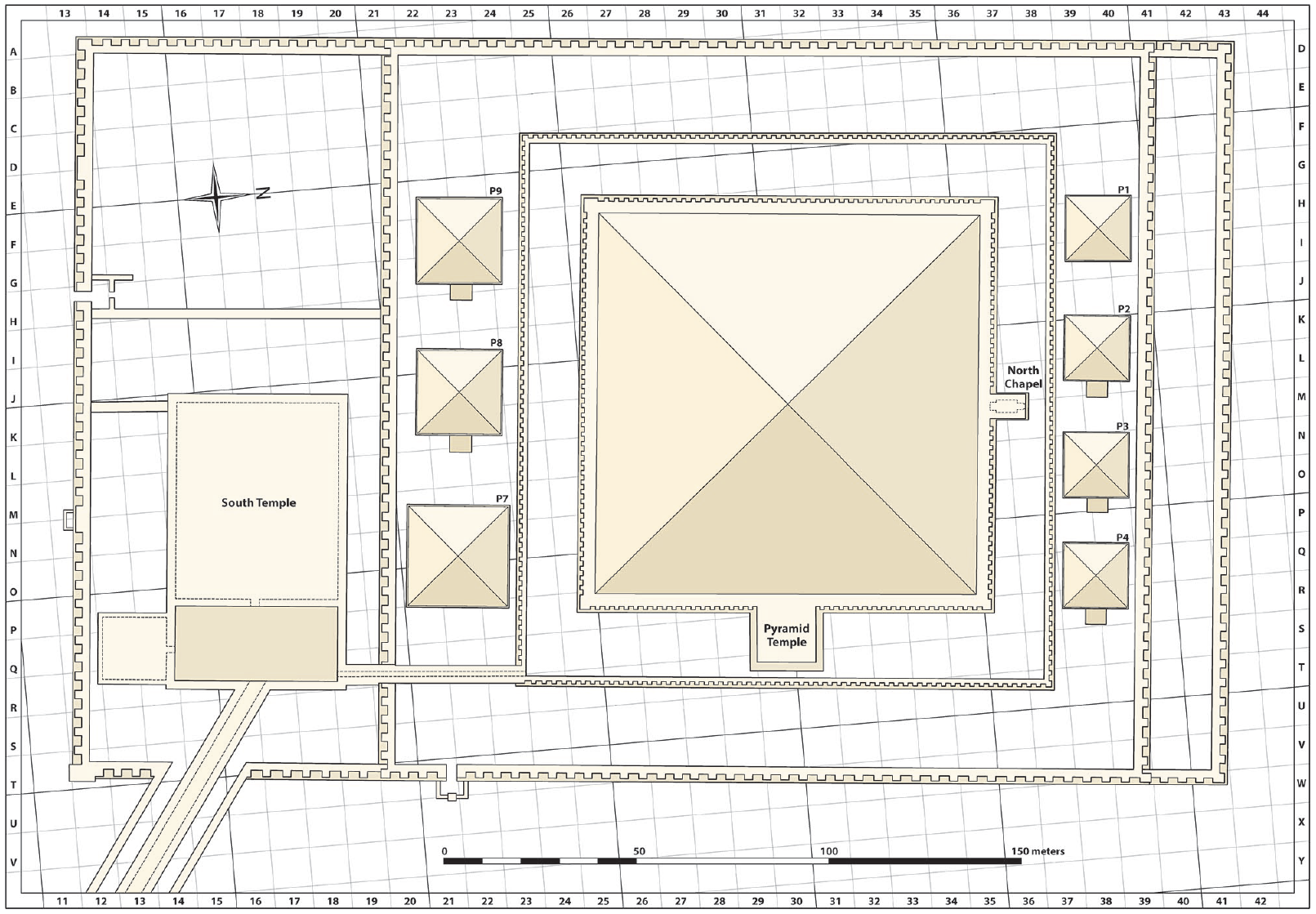
Plan of the pyramid complex of Senwosret III at Dahshur showing the position of the North Chapel (drawing: Sara Chen, © Metropolitan Museum of Art).
The king’s cult places include, at least to present knowledge, the pyramid temple (located on the east side of the pyramid), the South Temple and the North Chapel; the latter two are located, as their names tell, on the south and north side of the pyramid respectively. The South Temple might have been the largest temple building in Egypt predating the New Kingdom. 3 The chapels and temples were the centre of attention of the latter visitors of the pyramid complex, documented in secondary epigraphy. The North Chapel area, with its relatively small space, 4 attracted under 10% of hitherto known secondary epigraphic finds. 5 The larger percentages attested for the larger sanctuaries may appear to correspond with their more extensive decorated interior surfaces; however, it is not clear if more wall surface would have always meant more secondary epigraphic activity. The contents of the decoration (or a perceived importance of the building) might have been just as – or more – important in terms of attracting attention. 6 Eventually, as the reliefs survive only as fragments, constituting possibly less than 10% of the original surface, a significant volume of secondary epigraphy was probably lost.
The remains of the North Chapel were previously uncovered by J. S. Perring in the 1830s, and some fragmentary finds were registered in his and Howard Vyse’s publication. 7 The North Chapel dipinti, or rather demolition dockets, were also already probably among those Perring noted during the 1830s operation. 8 However, apart from two published sketches, there are no further documents pertaining to graffiti coming from the Perring survey and known at present. J. De Morgan did not register secondary epigraphy finds in this area during his 1880s to 1890s excavations. 9
The Metropolitan Museum of Art Egyptian Expedition uncovered a considerable volume of fragments of primary surfaces with dipinti (drawings or texts) as well as incised/scratched graffiti. Surviving fragments of the walls do allow for a reconstruction of the decorative scheme, but still represent only a small portion of the original relief surface. The monumental primary epigraphy from almost all parts of the precinct has a reception history involving 1) its primary Middle Kingdom construction and use; 2) its accompaniment by secondary epigraphy; and finally, 3) its demise, when the relief surfaces were systematically removed during a stone quarrying operation. Builders’ marks are planned to be published separately, and demolition dockets are also a discrete subject. 10
A preliminary observation of secondary epigraphic activity in the North Chapel indicates that, as elsewhere in the pyramid precinct, written and figural epigraphy comes from different phases of development of the pyramid complex and provides useful evidence for the fluctuating use and interpretation of this precinct and its individual parts. In the area of the North Chapel, the traces of secondary activity were identified both on decorated fragments with reliefs and on undecorated stone surfaces: 1) on undecorated surfaces of the original masonry; and 2) on rough surfaces created during the demolition phase when the blocks were cut. Demolition-related dockets were registered in the area in the 2003, 2004, 2005 and 2007 seasons.
This paper focuses on select secondary epigraphic features in the North Chapel, namely the New Kingdom dipinti interacting directly with the primary decoration. The relief decoration marked with dipinti datable to the New Kingdom comes from the registers with offerings and offering bearers (that covered the chapel’s interior walls), as well as from fragments of doorways and possibly also the North Chapel dado. The texts inserted among the figures and signs of the original decoration hold specific interest. The offering bearers with dipinti will be analysed here in detail.
The North Chapel Archaeology, Architecture and Primary Epigraphy
Archaeology
The archaeological situation in the area of the North Chapel is difficult but by no means atypical for this pyramid complex. 11 The chapel was destroyed down to its mudbrick sub-foundation, as were other cult places in the pyramid precinct of Senwosret III. 12 Whilst the sub-foundation marks the approximate size and shape of the building (sub-foundation size about 7.8 x 5.2 m 13 ), reconstructions of its walls are based on a mass of limestone fragments identified in a radius in and around the original building, and in exceptional cases also in the pyramid temple area. All Middle Kingdom reliefs, and pre-destruction New Kingdom secondary epigraphy, had to be reconstructed from such fragments, and large parts of the wall surfaces are of course missing. 14
The presence of fragments from neighbouring parts of the complex may be explained in context of the destruction, as the demolition crews probably moved the material around in the general direction of the causeway that appears to have been used for removal purposes as well. The dispersal of material is not indiscriminate or unpredictably chaotic. It reflects the dismantling process, where each structure would have been gradually disassembled and then stones moved probably in the causeway direction. 15 The demolition process factors include but are not limited to:
Fragments moved during the demolition, most likely to get stones ready for transport away from site. As a result, fragments of one relief were found across the site at multiple locations, intrusive column fragments from the South Temple 16 were found along the causeway, and so on.
Fragments at neighbouring locations overlapping from one location to the other; fragments from the queens’ pyramids and North Chapel fragments appear side by side in the North Chapel area, with very few small fragments from the pyramid temple. 17
The Ramesside Period appears to be the main destruction era. 18 Across the area there is also a dispersal of large amounts of limestone chippings, presumably from this destruction phase of the complex. Above, and on occasion within, the layer of chippings in the North Chapel, there were post-New Kingdom burials, mostly laid in the sand, and some in clay or wooden coffins, plus Graeco-Roman, and possibly also Coptic era burials in simple mudbrick tombs. 19
Architecture and primary decoration
It appears that in its original Middle Kingdom shape, the North Chapel consisted of a single large space. The height of the chapel walls must have been around 3.13 to 3.61 m; however, ‘since the height of the dado is uncertain, the dimension is not secure’. 20 The walls were limestone; it is presumed that there was a false door, made probably of red granite, with an alabaster offering table. 21
The walls of the chapel had registers with decoration in limestone raised relief, a dado underneath, and a kheker frieze at the top of the side walls. The ceiling was vaulted. The granite false door must have been destroyed, with no fragments identified; the limestone reliefs were found in a mass of fragments.
The decoration scheme was focused toward the south wall with the presumed false door of Senwosret III. The wall reliefs on both sides, east and west, were concerned with the cult of the king and included offering rituals, offering processions, offering lists and piled offerings. They display preparation and presentation of offerings, and the grid-like offering list is shown directly in front of the seated king. The king is ‘enthroned in front of an offering table and the royal ka’ 22 stands behind him. Both fecundity figures and offering bearers are seen on the walls, and grid-like offering lists also include small kneeling human figures of the offering bearers. The fecundity figures are located under the king’s throne and face in the same direction as the king, whereas the offering bearers representing officials are coming toward the king. The raised relief decoration was polychrome, both the images and hieroglyphic signs in texts. The background (flat wall surface) was left without polychromy.
The focal point of the scenes is the king (fig. 2), just as the focal point of the entire chapel space was the presumed false door at its end, on the wall adjoining the pyramid. The interior side of the entrance wall, as well as the pivotal wall with the presumed false door had decorated tympana, which were used because of the vaulted ceiling. 23 The vaulted ceiling was covered with stars, yellow against a blue background.
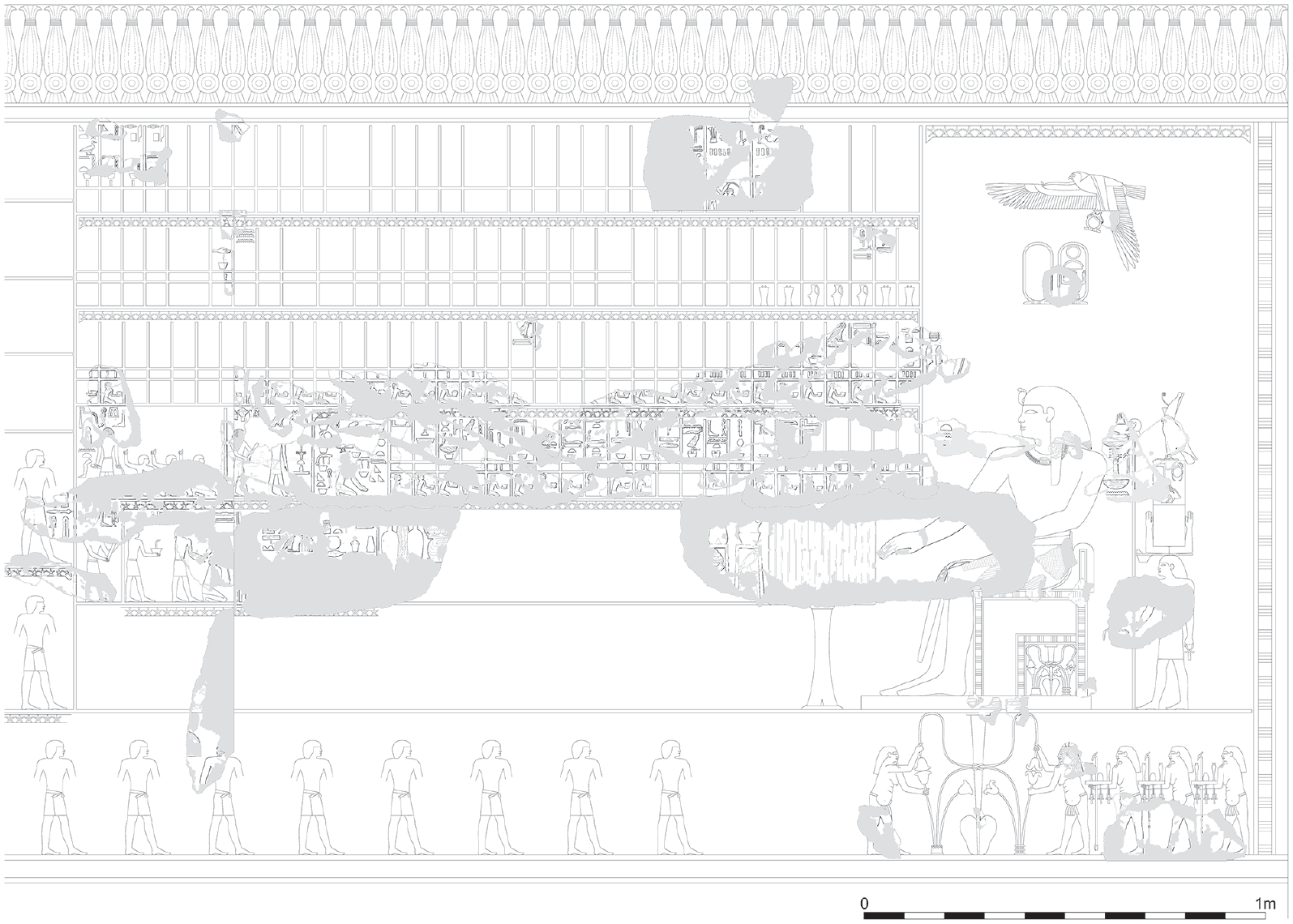
A view of a portion of the reconstructed east wall of the North Chapel (drawing: Sara Chen, reconstruction: Adela Oppenheim, © Metropolitan Museum of Art).
The entrance wall contains slaughtering scenes, and the tympana of both the north and the south wall contain complex scenes of the king and deities: the gods and goddesses are providing for the king in terms of sustenance, but crucially also in terms of protecting his divinely-sanctioned kingship. The east and west walls with both fecundity figures (referring to offerings in the texts) and human offering bearers (with offerings in their hands visually shown) work jointly with the north and south tympana where gods guarantee the king’s dominion as well as sustenance. They ‘summarise the elements needed for the continued sustenance and prosperity of Egypt, the basis for the rule of the pharaoh’. 24 The North Chapel of Senwosret III must have contributed to the ‘integrated narrative’ of kingship and of the commemoration of a specific ruler. ‘Temple decoration reflected this multiplicity of meaning in part through the status of figures that interacted with the king in particular scenes: only deities, deities and human beings, or only humans.’ 25
Two distinct types of human offering bearers are present in the scenes. Small kneeling figures in the grid-like offering list have no further identification apart from which offering are they carrying (they have never had names or titles in either Old or Middle Kingdom tradition), and larger figures below within the offering scenes (which is below and behind the offering lists) are identified by their titles, but – in contrast to earlier Old Kingdom examples – never by their names. 26 This might have been a way of creating an eternal entourage of the king, while avoiding the commemoration of specific figures. As suggested by Adela Oppenheim, the motivation for this shift was likely to be religious, not political, although it ‘had consequences for the high-ranking officials who were no longer commemorated in the pyramid complex’. 27
Just as our understanding of the space and decorative programme of the chapel is based on a complex reconstruction of the wall surfaces, any interpretation of its secondary epigraphic features is dependent on the knowledge of their spatiality and materiality stemming from the same reconstruction. The interpretation begins with the embedding of secondary epigraphy in the primary epigraphy.
Dipinti in the Offering Lists and Scenes in the North Chapel
Ink-written hieratic texts of a probable New Kingdom date in the North Chapel of Senwosret III appear on both chapel walls: on the east wall, among figures facing right, and on the west wall, among figures facing left. As aforementioned, the offering lists on both walls of the North Chapel included the kneeling and unlabelled offering bearers (much smaller than titled, larger offering bearer figures). These were holding vessels with offerings in their hands (fig. 3).
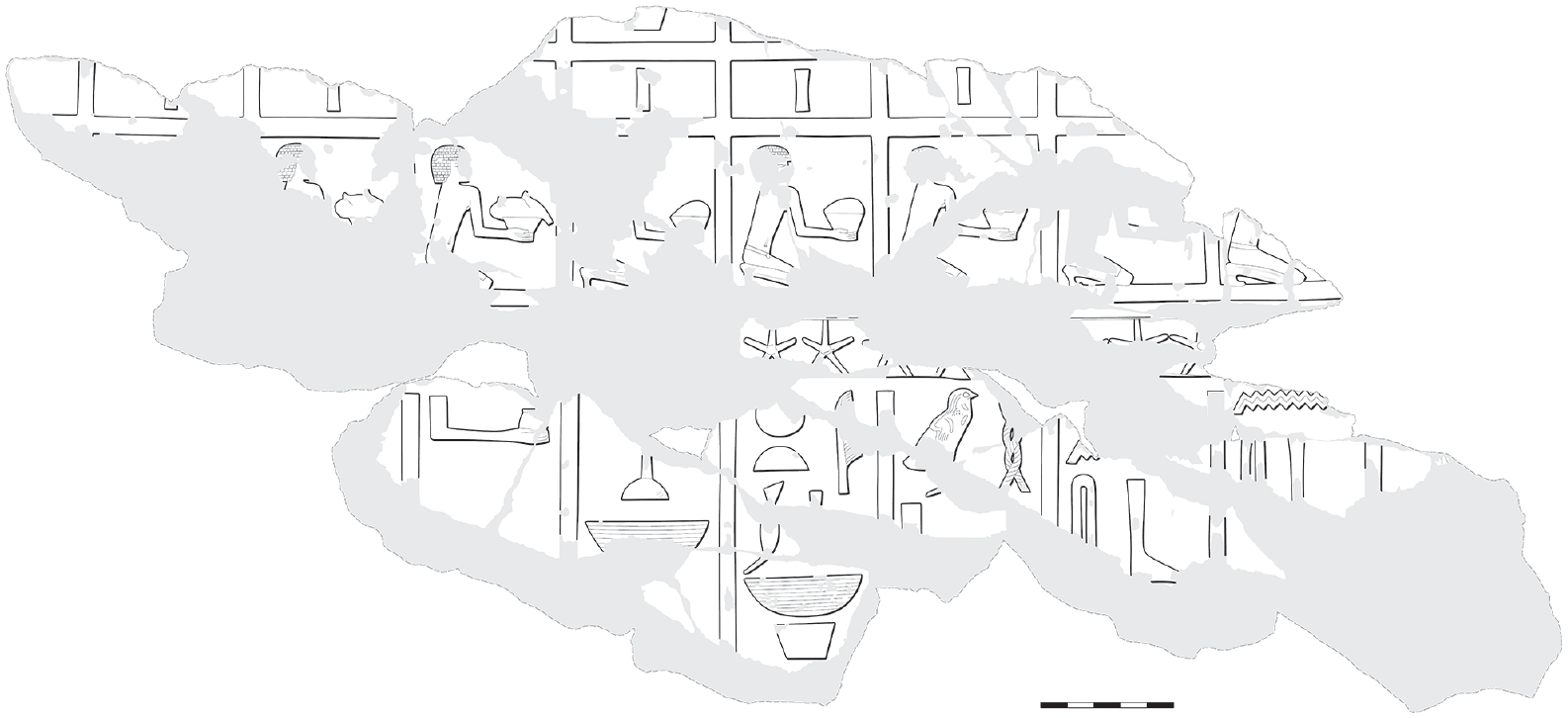
Detail of the grid-like offering list (drawing: Sara Chen, © Metropolitan Museum of Art).
The North Chapel east wall (list and figures facing right) displays secondary epigraphy in the form of dipinti executed in red ink added to the offering list located directly in front of the seated king. They were documented early in the secondary epigraphy study in 2011–2013 and reviewed in 2018 and 2021. These red ink inscriptions are small, and may appear inobtrusive in appearance, but their colour, location on the wall and placement in relation to the primary decoration are of further interest.
Context of the offering list
The offering list fragment no. 04.149 et al. shows seven figures of offering bearers, four of which have surviving traces of a red ink caption (fig. 4). The initial observation in 2011 noted just two, but it is in fact an entire group of four labelled offering bearers, facing the king at the end of the scene. Better storage conditions in a new research centre at Dahshur facilitated a revision of the documentation in 2018 and 2021.
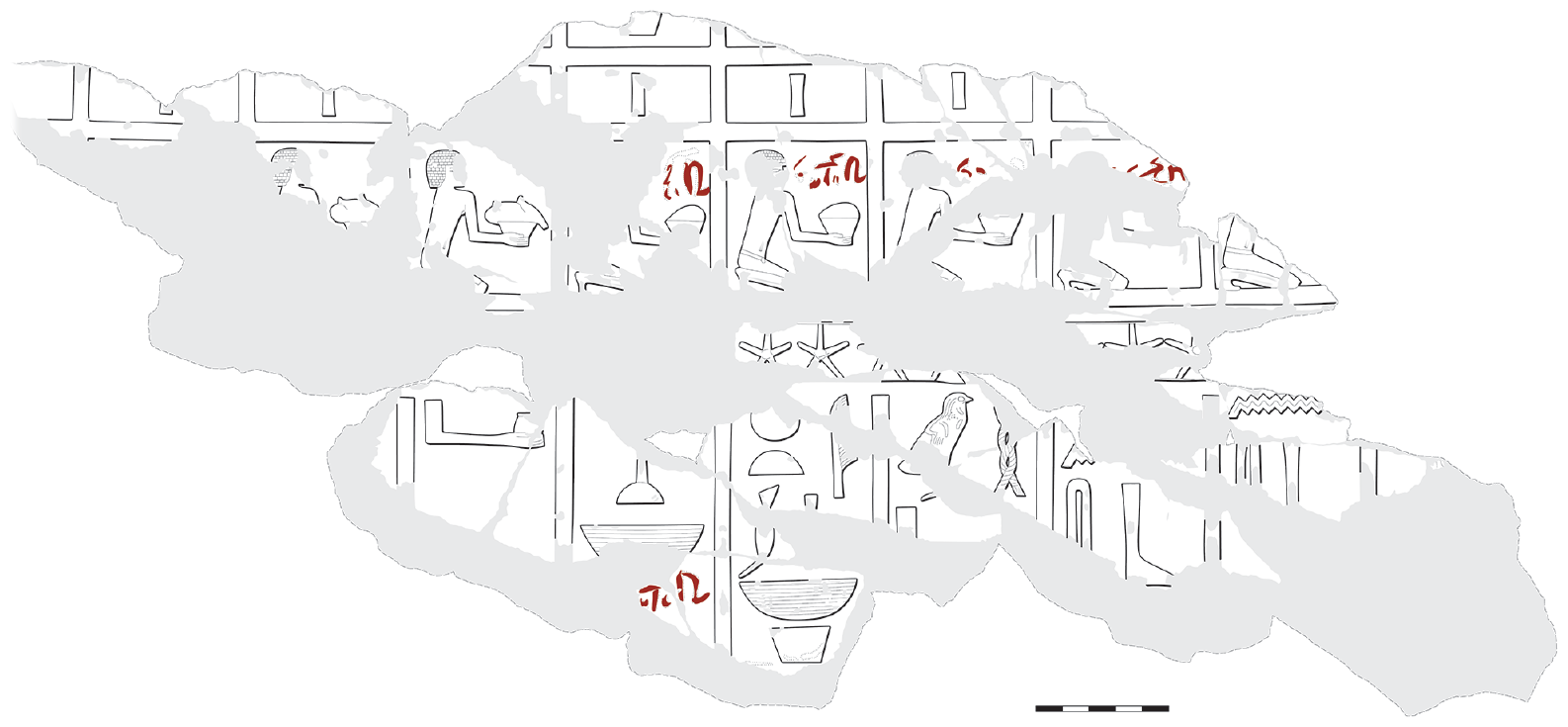
Detail of the offering bearers from the grid-like offering list with outlines of the New Kingdom dipinti (drawing: Sara Chen and the author, © Metropolitan Museum of Art).
The small figures of the offering bearers are often only around 10 cm high, and the hieratic texts added in front of their faces and above the vessel with offerings they are carrying are 1 to 1.5 cm high; the size of the written signs corresponds to texts on contemporary papyri or ostraca. The writers selected just a particular group, as other figures in the same row are unmarked. The labels for their offerings, which may possibly give a clue for their motivation, are not well preserved but can be reconstructed from parallels.
Dipinti
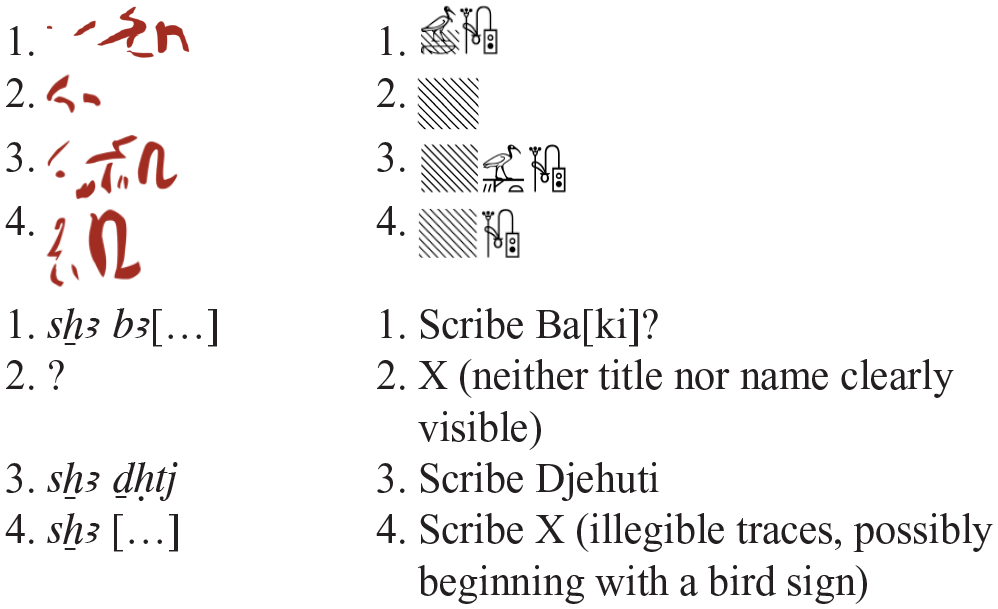
The surviving titles are all of a sẖȝ, ‘scribe’. This occurrence may not surprise in the genre of ‘visitors’ inscriptions’, where the title stood for a shorthand expression of literacy and cultural capital of the writer. The visitors might have held other functional titles including but not limited to that of a ‘scribe’. 28
However, we may need to modify the view of a generic ‘visitor’ behaving uniformly during their visit on a large site such as a pyramid complex. Each location may need to be viewed on its own merit. In this case, the lack of space in the list grid would have demanded a brief text in any event. Whatever other titles these visitors might have had, perhaps they chose to be seen as literati, as ‘scribes’.
Two names were preserved – Ba(ki) and Djehuti. Compare the bird signs: bȝ  , and ibis
  . The reading ‘Baki’ is possible,
29
although a conclusive part of the sign is lost. The horizontal line at the bottom of
. The reading ‘Baki’ is possible,
29
although a conclusive part of the sign is lost. The horizontal line at the bottom of  could be explained as either the feet of the bird, or a ligature with the k sign.
The first name is included in Ranke, PN I, 90.13, the second in PN I, 407.13. If the reading ‘Djehuti’ is correct, then the name following a scribal title also appears on the fragment 04.151(2)+04.450(2):
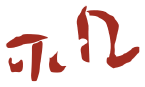
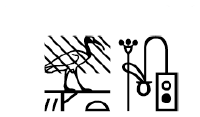
However, compare the palaeography for the Y3 sign:
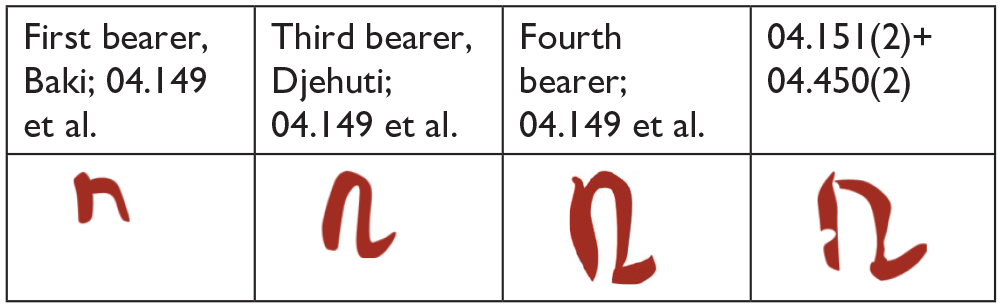
The divergences in writing suggest that we are indeed looking at several hands, and not, for example, a putative case of one scribe labelling several offering bearers at once. That being said, Djehuti, if he indeed signed off in several places, seems to also have varied his handwriting. 30 Alternatively, two scribes named Djehuti (or Djehutimose, etc.) could have been present.
Dating
The palaeography of short texts may not be a reliable criterion; hence the dating is mainly contextual, i.e., in comparison to other secondary epigraphy in the pyramid complex. The textual dipinti on the decorated surfaces of the North Chapel are likely connected with other 18th Dynasty secondary epigraphic production within this pyramid complex. This is based on the Ramesside destruction phase of the temple; however, as the beginning of this extensive destruction was most likely tied to the reign of Ramesses II, dipinti from the Amarna Period or early 19th Dynasty cannot be entirely ruled out.
Location and Placement
The offering list dipinti are distinguished by their location within the pyramid precinct and by their placement on a specific part of the decorated wall. They are found in the vicinity of the figures of the small offering bearers in the grid offering list. From the perspective of preservation of the original decoration, in the case of the fragment group 04.149 et al., the reliefs never had any colour on the background, 31 but only polychromy on the figures.
The placement in close contact with the primary decoration within an offering scene is significant. The red texts inserted in the offering lists may be interpreted as secondary captions (discussed for earlier examples of chapel decoration in the nonroyal context for the Old Kingdom by Julia Hamilton and regarding New Kingdom examples by Chloé Ragazzoli and Alex Den Doncker). 32
It must have required a dedicated attention to insert these small captions into the detailed relief of the offering list. The placement is relatively high on the wall. The suggested approximate wall height of the North Chapel is 3.13 or even 3.61 m, i.e., 6 or 7 cubits. This height was calculated using the following method: the height of the offering bearers’ position above the upper line of the dado (preserved) is 1.209 m, and the height of the dado was initially approximated at two cubits, i.e., about 1 m. 33 There is also a possibility that the dado was even higher, 3 cubits, or 1.5 m. The offering lists with small figures of offering bearers would have thus been located approximately 2.209 or even over 2.7 m above ground. The location of the dipinti would have required, in any event, some support, accumulated sand, or tools, to reach that high on the wall and write neatly into a relief ‘box’ created by the frames of the offering list and in front of the face of a small figure of the offering bearer.
Why would the visitors to the North Chapel have expended such effort and time to get that high on the wall, and carefully add their titles and names to the small figures? They did not ignore the larger offering bearer figures, more easily accessible on the lower portion of the wall (see below), but certainly focused on the smaller figures in the list.
Their reasons may have included the availability of a figure for labelling. For instance, the larger figures were, technically, already labelled with their titles. However, this aspect did not entirely prevent graffiti writers in performing a relegendation (as per Ragazzoli) 34 of titled bearers in the lower registers, nor did it stop the labelling of named and titled figures in New Kingdom non-royal tombs at other sites. 35 Another motivation might have involved the offerings. Since the writers in the North Chapel chose to focus on the small offering bearers in the list, which offerings did they prefer to be seen bringing to Senwosret III? The complete list begins with bread, continues with onions and then meat followed by fowl and baked goods, then by drinks. Out of this selection, they seem to have further selected particular meats in the second row from the lowest in the grid. The reconstruction of offerings 36 would pair the scribes with the following meat offerings:
Scribe Baki (?): liver
X: spleen
Scribe Djehuti: piece of meat
Scribe X: breast meat
Meat and liver appear among offerings attested also as physical objects in tombs. 37 Spleen also occurs on other offering lists. 38 Breast meat, whether from the sternum area, ribs or other parts, is frequently identified not only on offering lists, but also as an actual find in tombs. 39 A royal offering list of a New Kingdom date could also have contained theseofferings in the same or similar sequence. 40 Significantly, Senwosret III is provided with a similar offering selection in the temple at Semna, built and decorated by Hatshepsut and Thutmose III for their deified ancestor, and contemporary to significant dipinti production in pyramid complexes. The offering list at Semna also has the grid-like style. 41 The dedicatory text at Semna mentions ‘striking four times at choice joints of meat for the benefit of the King of Lower and Upper Egypt Khakaure’, 42 and offering bearers in the scene are bringing more ‘choice joints of meat’ 43 for the Middle Kingdom royal ancestor. Although an investigation of parallels between the offering scenes in Dahshur and Semna is beyond the scope of this paper, the coincidence is interesting: could the Dahshur list serve as a model?
Choice pieces of meat, especially beef, were considered luxurious offerings. According to a social history perspective offered by Salima Ikram 44 and elucidating the prestige character of meat offerings, we may suggest that the visitors chose to be associated with luxury offerings that would make them important stakeholders in the cult of Senwosret III.
Nonetheless, it might be also possible they wrote wherever they could reach, as an accumulation of sand might have allowed them to reach this particular section of the wall and not another, and the meat offerings were just one suitable location. Could a comparison with other epigraphic performances in the chapel and the pyramid precinct suggest which interpretation is more plausible, an opportunistic or targeted placement?
Out of the group that labelled the offering bearers, Djehuti might have repeated his title and name in the column of offerings below his colleague (whose name is illegible), but this time next to the offering (text damaged) and not a bearer (fragment 04.151(2)). This dipinto is also placed somewhat lower in the scene.
Within the chapel, there was another incompletely preserved red ink dipinto (fragment 04.208), referring probably to a sẖȝ ỉḳr, or a scribe ( is certain, with a name beginning with an M17
  – Imn-? cannot be entirely ruled out) written in a vertical column on a cone offering within a pile of offerings.
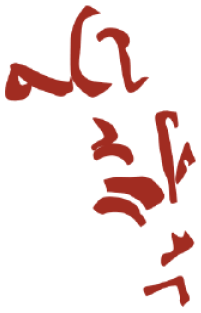
This fragment cannot be located precisely to any position on either wall, but it must have been considerably high, at least as high as the captions on the east wall. 45 This would again suggest a dedicated interest in specific details within the offering scenes, as well as a keen focus on offering scenes generally.
The North Chapel is an offering place par excellence, but offering scenes were targeted also elsewhere in the pyramid complex. A red ink dipinto interacting with offerings is found in the Pyramid Temple (reg. no. 96.184). It is a two-sign brief comment almost hidden in a heap of offerings; it appears to say hrw nfr. 46 Although this dipinto, given its specific content and location in a different part of the pyramid precinct, is not treated here in more detail, its placement within an offering scene may attest to continued interest in the specific setting of offering scenes.

If Theban parallels are taken into account, 47 a reference to a ‘beautiful day’ or day of the feast may imply the timing of some of the visits. If a visit to the precinct coincided with a major festivity (or was motivated by it), especially a major processional feast, then the aspect of communication with the divine world, including saying offering formulae for the deified king and savouring the festive occasion, would stand out as a major incentive. A late Amarna example from TT139, the prayer of Pawah, specifically calls for the protagonist of the graffito to ‘spend a beautiful day in your city’, whilst the text is located close to a banqueting scene. 48 And indeed, as in the case of Pawah, the hrw nfr on fragment 96.184 might have had a polyvalent meaning – referring to the display of offerings, and to a moment of the visit with its writing performance. Yet, the dates for the 18th Dynasty dipinti in pyramid complexes remain ambiguous and the link to festival days is still more tenuous than in the Theban examples. 49
What appears unambiguous is a clear targeting of offering scenes, and specifically images of offerings and offering bearers. In that context, it might be more plausible to suggest that the meat-bringing offering bearers within the offering list grid were also chosen on purpose and not by chance. Labelling them was inconspicuous perhaps, but prestigious due to the high status of the offerings brought to the long-deceased king. Another factor to consider is the role of the north chapels, which traditionally used to cover the entrance to the subterranean chambers and could therefore be seen as places particularly closely related to the king. Yet it is not clear if the 18th Dynasty visitors realised this or, in turn, knew that this was not the case for Senwosret III, although his substructure had already been robbed. 50
Ink Colour
A large percentage of dipinti in the precinct of Senwosret III is written in black ink; red ink appears to have been used in a minority of cases. However, red ink dipinti are concentrated within the offering scenes and lists in the North Chapel, and the hrw nfr text was identified within an offering scene in the Pyramid Temple.
Dipinti located in similar places of immediate proximity to primary decoration were written in red in the temple of Ramesses II at Abydos (they did appear in other temples as well, but a systematic survey is not yet available), probably soon after it began to be used. They would therefore represent Ramesside dipinti in a Ramesside temple, as opposed to most probably Thutmoside dipinti in a Middle Kingdom temple as in Dahshur. Nonetheless, it could be suggested that these less obtrusive texts written in the ambiguous colour red, which were placed in such close proximity to primary decoration, were made less visible to signify a respect for the locus. However, within the precinct of Senwosret III this is not a universal practice. In the North Chapel itself, the Causeway and the Queens’ chapels, we find texts and figures located between figures and texts of the primary decoration and written in black (96.759(1), 96.733+96.1041+96.1386 in the Queens’ chapels – QP 3E tympana; 04.747(1) + 07.306, North Chapel, west wall; 08.852, Causeway). The red texts in the North Chapel contain just the title and name of the writer. The contents may also be the same for a black ink text in the immediate vicinity of the primary decoration, as shown by 96.733+96.1041+96.1386 (scribe Amenemhet, scribe Hatiya).
On the fragments reg. nos 04.747(1) + 07.306, 51 we find traces of three names in black ink, possibly Pay, Baki(?), and Djehuti again, but this time at an unexpected angle to the orientation of the primary decoration, and in black ink. The reading of the first two names is speculative.
Their names are again surrounding a figure of an offering bearer, but in a rather more haphazard manner. This particular fragment comes also from the same area as the previous fragments (i.e., squares M/37 and N/37), and belongs to the depiction of offering bearers (fig. 5).
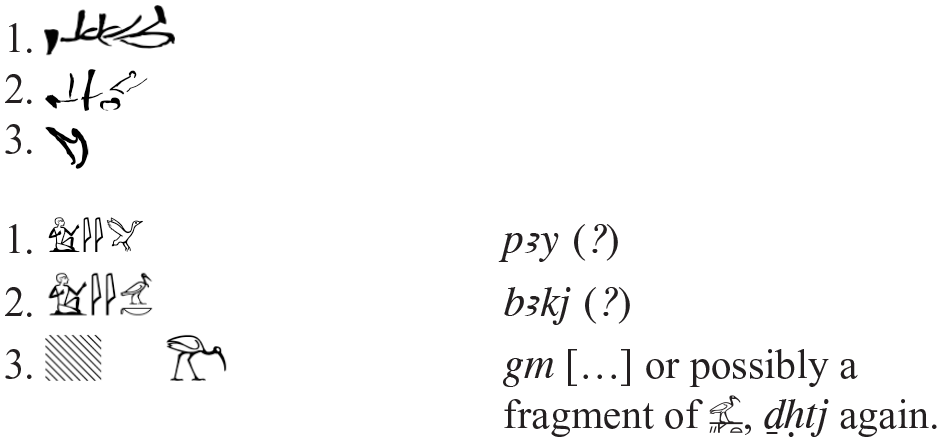
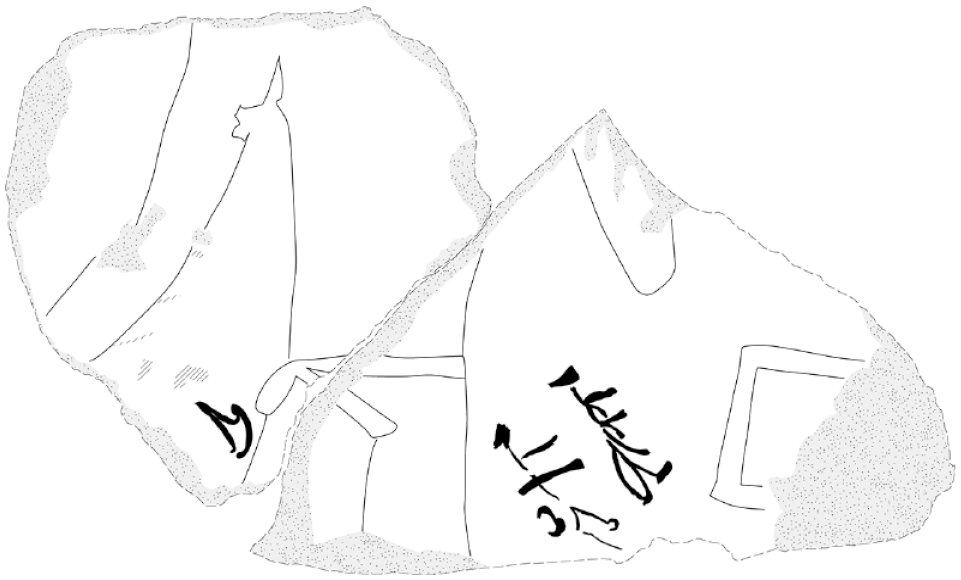
Offering bearer on fragments reg. nos 04.747(1) + 07.306 with New Kingdom dipinti (drawing: the author © Metropolitan Museum of Art).
In this context, the fragments might have been inscribed awkwardly because the writers did not manage to reach the surface conveniently. Yet, the fragments must have been inscribed at the same time – note the angle of writing versus the figure – and the two pieces were not found together. Despite the awkward position of the labels, it is still possible that the relief was inscribed whilst still in its place on the wall. On this occasion, a large figure of an offering bearer was relabelled by the New Kingdom visitors.
From this perspective, it would seem that the colour choice for the secondary epigraphy might have been otherwise motivated or just random. Linking the use of red ink between the temple corpora must therefore remain tentative at best. In a tomb context, it has been suggested that the red ink might have been used to strengthen the message of the text, especially in the liminal context of marking focal points in the tomb space that were reinhabited afresh by the graffito writer. 52 The inscription is in any event a material reminder of a visit by a group of scribes, who had a specific interest in this relief decoration and its purpose.
Scribal Behaviour
The same person could have marked the chapel reliefs at different places. It would imply that Baki, Djehuti and possibly other scribes from their group could have been:
either visiting at the same time and performing a relegendation 53 of the Middle Kingdom reliefs during a single visit, in which they concentrated perhaps on one space or select spaces within the pyramid precinct, where they marked different elements of the primary decoration, but within one scene.
or one or more scribes were involved in a copycat behaviour at different locations at different points in time, observing the results of scribal performance of their predecessors (as did a Memphite scribe Amenemhet in the Step Pyramid complex, very critically 54 ). Interactions among graffiti writers are seen also in Assiut 55 and Thebes. 56
However, the writing of the red captions on the east wall, in exactly the same location next to the offering bearers, aligned with the primary decoration, suggests a rather concerted action of a group of scribes, making option i. more likely. It is possible that we may have evidence of a planned outing (or intentional stopover whilst on other assignment) of a group of scribes who entered the North Chapel to engage in scribal display as well as in an interaction with the site. If they also labelled the larger offering bearer figure in black ink, it might have been an indication of their hierarchy of interest: did the offering list with choice meats rank higher? Labelling of the large figure (or rather figures, the offering bearer would be part of a group) almost looks like an afterthought, after the careful labelling of the kneeling figures in the offering list.
Whilst dipinti clusters are well attested for the ỉw.t pw type within the pyramid precinct (doorframe no. 94.989 and others), the captions cluster within the offering list may be confirming a specific act: a group veneration of the long-deceased sovereign in a location suited to the act – his own pyramid chapel. It would be a reception of the ancient cult site, and a deliberate interaction with a specific location within the pyramid precinct. The placement within the relief would be therefore motivated more strongly by the specific scene content, the veneration of Senwosret III, than by any other possible reason, such as accessibility or convenience.
This devotional element is included in the ỉw.t pw type as well, inextricably linked with the interest in the past. The labelled offering bearers are creating an illustration to the conventional graffiti line: ḏd=f ḥtp dj nsw n kȝ n nswt bitj X ‘And he says: The offering that that king gives for the ka of the king X’
These scribes might have entered in a similar relation with the royal cult site as a later visitor did in an elite nonroyal tomb TT139, when inscribing himself in a major cult scene in the ‘contact zone’ of the tomb. 57 In the royal precinct, the North Chapel might have been considered as the contact zone.
Although these scribal ‘secondary signatures’ could appear also next to figures involved in menial labour in some Theban examples, 58 the re-labelled offering bearers here at Dahshur correspond to captioning of prestigious locations. In private tomb chapels, secondary epigraphy also often interacted with the important scenes.
Most of the visitors’ graffiti, as in the tomb of Antefoker (TT60) and Beni Hassan, are written within scenes of daily life such as travels, crafts, trades, animals feeding, and hunting, or presentations of offerings to the owner of the tomb. These locations could reflect the intended response of the author of the graffito to the deceased’s wish to encourage the visitors of his tomb to take part in his funerary cult.
59
Some New Kingdom examples from Saqqara show that ‘ritual graffiti can be considered as materialization of ritual acts’, including prominently graffitied offering bearers in the tombs of Maya and Meryt and Tia and Tia. 60 In all of the above locations, the visitors identify with participation in the funerary cult and their ‘visit could be read as an activation of the inscriptions and the decorative programme within a specifically Egyptian process’. 61 They inserted themselves in the most important icons 62 of the tomb decoration.
The tomb chapels of the 18th Dynasty are active communication spaces, summing up identity, career, and prestige of the tomb owners and their family. The royal presence was felt in these spaces as well, when the state officials were promoting their closeness to the king and in turn the monarch was promoting his incorporation ‘in the afterlife as the primary guarantor of well-being’. 63 During the 18th Dynasty, the phenomenon of personal piety was developing, but mediators and intercessors were still sought to enable or promote access to the divine. 64
Entering a royal chapel or temple opened another level of access to the divine; the scribes behaved in an earlier royal chapel as they might have had in a private funerary chapel of their own time. The New Kingdom view on the king was that he, especially after his death, stood close to the gods, but he does not, for example, become Osiris. 65 He is in a specific position, but always available as an intercessor, as indeed the continued use of the ḥtp dj nsw formula indicates. 66 In a flipped perspective, from a general world view of maintaining maat, humanity and its concerns are but select elements. ‘Gods, king, humanity, and in a sense the dead, together struggle to maintain the cosmos against a disorder…’ 67 But within this grand discourse, humanity is renegotiating its position, and looking for spaces of communication that go beyond the confines of mortality. Divine temples are not necessarily the main venue to achieve such a communication, 68 but funerary establishments might be.
As most of the graffiti material that interacts with primary decoration is datable, directly or indirectly, to the 18th Dynasty, it coincides with the rise of a new generation of royal commemorative projects: the memorial temples. Although rooted in a previous tradition (the earliest known occurrence of the term ‘mansion/house of millions of years’ goes back to the 12th Dynasty), 69 the New Kingdom memorial temples, the ‘houses of millions of years’, stand out as a distinct category of temple buildings. 70 The construction of early ‘mansions’ of the 18th Dynasty probably coincides with the production of early visitors’ texts in the pyramid complexes, including Senwosret III, 71 yet such coincidences are still of speculative value.
The memorial temples appear to mediate access to royal and divine spheres, and for the elite Egyptians, one way of access was the location of statues in these temples, presumably sanctioned by the sovereign. 72 However, it is not always royal agency that makes the memorial temple spaces into places of contact with the divine. In the environment of New Kingdom memorial temples, labelled figures of dignitaries appear, on occasion with titles, and in the 18th Dynasty (after a Middle Kingdom hiatus mentioned above) exceptionally also with names. Susanne Bickel opined this naming of select officials in select scenes of tribute or sed-festival was an 18th Dynasty ‘adaptation’ and a deliberate one, instigated by the dignitaries themselves. Those dignitaries who were named on the walls of the temples (usually temples definable as ‘memorial’) of their sovereigns were people of high status, who were ‘imposing their introduction into the decoration’, with ‘their hopes for personal expression of prestige and piety’. 73
The same high-status people frequented cult sites of kings of old, and they were accompanied and/or imitated by literati who would normally derive their status from being a dignitary’s retainer (at least some visitors did so: Amunedjeh’s entourage in the Sun Temple of Userkaf), 74 or they might have been themselves in service of the king. References to the king, mostly in the reign of Thutmose III, appear in secondary epigraphy across Dahshur, Saqqara and Abusir. Thutmose III is noted to have been victorious in Djahi and Naharina, and to set up/embellish monuments of Ptah, including in Memphis. 75
In this specific context, the scribes seem to imitate their superiors in the temples (hw.t nṯr) of long-dead sovereigns. However, it is possible to suggest that the literati were developing their own interest in and discourse of representing their status and competence, as they do in many Theban locations, 76 beyond shadowing of their superiors. At Dahshur, they would have adopted the discourse of personal commemoration in a royal sacred space, not by adding a statue or their own figure to the decoration, which they could not do, but by an option available to them: graffiti.
The use of hieratic script in such a sacral context should not surprise either; the communication with the dead regularly featured hieratic, including hieratic script on votive objects. 77 Their surface was saturated with formal sacrality, yet the added feature is in ‘ordinary’ script. In Sylvie Donnat’s view, based on examples of the letters to the dead, 78 this is not devaluing the act of writing, but assigning it a value of communication d’instant, 79 ‘Le hiératique … rend la voix des vivants sur terre, es lié à la temporalité, à l’ici et au maintenant, à la singularité humaine, à son histoire transitoire.’ 80
The effortless merging of the New Kingdom secondary texts within the monumental context of Senwosret’s chapel lends plausibility to Donnat’s view of hieroglyphic and hieratic scripts being closely integrated in one system of communication. Hieratic, in this view, becomes an acknowledged script of devotional (or indeed more generally cultural) practice. 81 However transitory the graffiti writers’ presence might have been, they communicated with eternity. Their audience consisted of Senwosret III, but it also consisted of themselves and potentially their peers who similarly visited the pyramid complex. As the chapel walls were (to a significant extent) probably still standing, some of their texts were at once visible, red on a pale surface among colourful figures, and invisible – small labels relatively high on the wall. As it was a group behaviour, it might well have been the performative act itself that mattered most.
Excursus: Scribe Baki
A writer who presented himself as ‘scribe Baki’ visited also the pyramid complex of Djoser in Saqqara, but unfortunately his handwriting was not recorded by Battiscombe Gunn, the first editor of these texts, who noted only the contents of his dipinto. According to Gunn’s notes, 82 it was originally a long dipinto, with two other scribal names in the vicinity, on the north wall of the south chapel within the precinct. It was characterised as 18th Dynasty handwriting and it is dated to a ‘year 36’, which suggests the reign of Thutmose III. The dating would be in accordance with a significant presence of Thutmoside texts both in the precinct of Djoser and that of Senwosret III. Baki’s text in Djoser’s chapel reads: 1. Regnal year 36, month 4 of Akhet, […]. There came the scribe, child of the Southern CityBaki […]
Baki was also a mobile scribe; 83 he claimed his local identity as a Theban, ‘child of the Southern City’. If he indeed might be the same scribe in Saqqara and Dahshur, he would have acted in the same manner in both pyramid precincts. In the chapel of Djoser, he wrote out the offering formula, in the North Chapel of Senwosret III he would have acted out his veneration of the past king by becoming an offering bearer for Senwosret III.
In many ỉw.t pw type texts, the writers declared that they engaged in reciting the ḥtp dj nsw formula; presumably referring to their own king as a mediator with the gods for the benefit of a long-deceased king, who then could become an intercessor benefitting the visitor. 84 Their intention reads like a mirror statement to the appeals to the living, 85 where the deceased asks for an offering, but also outlines the beneficial things that will ensue for those who will recite the offering formula, including a reference to the historical context: a ‘king of your time’. 86 The performance of an offering (formula) brings the speaker/reader to the orbit of favour of gods, which is perennial, and kings of their age, which is also historical. This interplay of benefactors and beneficiaries has an interesting Middle Kingdom predecessor. A text on a statue located in Sneferu’s valley temple drew attention first to the owner of the privileged space, Sneferu, then to the benefits for those who come and lastly to the statue owner. 87
The examples, from the Middle Kingdom to Ramesside Period, outline that both the present and past sovereign might have acted as intercessors, as indeed could the deceased owner of a statue, tomb or inscription. In this context, Baki, responding to the concept of the appeal in a royal chapel, might have created micro-memorials to himself whilst expecting favours from the past kings.
Regarding an identification of who Baki was, or might have been, it is tempting to suggest that he might have been the overseer of granaries Baki, whose stela in the Museo Egizio (no. 1550) has a disputed dating that does not entirely exclude an 18th Dynasty option. 88 Ignoring for the moment the dating question, and the frequent use of this name, 89 we might want to address why would an elite administrator select only one generic title to proclaim his status. Dignitaries of this ilk, as we know from the case of Amunedjeh (also an overseer of granaries as well as a royal herald), might have also spelled their titles in secondary epigraphy in more detail. It is however possible to consider that ‘Scribe’ Baki might have still concealed his full dignitary role preferring to emphasise his intellectual status and identity, appearing as a leader of group of four literati in the chapel.
In terms of social identity theory, 90 his ‘scribal’ identity would have temporarily interacted ‘with other identities in particular situations’, because he would have opted to emphasise a specific role, even though obviously his putative identity of a literato/intellectual (i.e. scribe) would have overlapped with his identity as an overseer of granaries. But could the ‘scribe’ be the most salient role he chose for the specific location? The 18th Dynasty dignitaries might have opted for an emphasis on their writing skill and writing and reading performance, 91 indicating that Baki indeed might have chosen to be a ‘scribe’ in his dipinto. The scribes are after all often listed as the expected audience of the appeal of the living (because of their reading ability), next to some categories of priests.
Baki could have seen himself as a scribe at the helm of a group of other literati, of a community of practice that negotiated the chapel’s space to participate in a cultic performance. Yet, this is pure speculation – Baki is a frequent New Kingdom name, and it is perhaps more likely that the Saqqara and Dahshur Baki might have been the same person, but much less likely that the dignitary Baki is to be identified with either of them. In any event, Baki and his companions represented their community of practice, but also each of them as individual offering bearers, responding to the cult needs of Senwosret III. Their graffiti reified 92 that space of memory and devotion.
Conclusion
The secondary texts and figures define the New Kingdom use of the North Chapel, interpreted in context of their location in the chapel and of their placement on the wall in relation to the primary decoration. The reading of secondary epigraphy in a pyramid precinct achieves more granularity, implying a focus on a specific space and a specific agenda communicated by the writers and ingrained in that space. Private tombs offer an interesting parallel to this process. 93
The New Kingdom graffiti makers in the North Chapel of Senwosret III did come with an agenda that reflected on the royal cult tradition, whilst they produced added cultural capital serving their own purposes. Did they approach Senwosret III as they would have approached their own king? Or are the present and past royal persons embedded in a more complex communication pattern? The cult of Senwosret III in the 18th Dynasty was established as a royal project, for instance by Hatshepsut and Thutmose III in Semna. An emulation of royal and high elite behaviour may have played a role in developing the visitors’ activity. Moreover, ‘Thutmose III was remarkable in many ways, and his notions of literacy differentiate him… from most other kings of his time. His references to writing are, furthermore, striking in number, allowing us to characterize his unique approach to literacy.’ 94 The king represented himself as a historiographer, writing history on the ished tree leaves with Thoth – interestingly also in Semna. 95
However, against this backdrop of royal historical awareness and intellectualism, the scribes were also building their own communication with Senwosret III, not always using their own sovereign as a point of reference. In the dedicated space of the North Chapel, they entered a royal cult framework by a purposeful gesture of taking active roles in the offering performance. The writers act out the offering formula by selecting and labelling the figures of royal offering bearers. The intention might have been to select the specific offerings, prestigious choice cuts, to enhance their offering performance.
If graffiti in funerary monuments may be considered to provide an answer to the ‘appeal to the living,’ this example is one of the most tangible displays of the interaction with the tomb or chapel space and its owner. The captions in a royal chapel may also be read as an inadvertent reversing of the effort of Senwosret III who might have intended to provide a view on his eternal kingship. Instead, the Thutmoside scribes historicised his offering list by their presence, capturing a moment of commemorative participation in a cult, but also a moment of embodied historical awareness. 96
Their dipinti become ‘prolongation de la voix’, 97 as did other written communications with the dead. But they record also a physical presence in the chapel. Here, more expressively than in other locations, we see the ‘visitors’ who perform – or in any event intend to be seen to perform – the cult of the prestigious tomb owner. They reactivate the content of the primary decoration by a display of their involvement, presence, and self.
Footnotes
Acknowledgements
The Ministry of Antiquities and Tourism, Arab Republic of Egypt; The American Research Center in Egypt; Harris Manchester College and Wolfson College, University of Oxford; Department of Egyptian Art, The Metropolitan Museum of Art, in particular Dieter Arnold and Adela Oppenheim, Jim and Susan Allen; the Lisht/Dahshur field team; colleagues always willing to talk graffiti, in particular Niv Allon, Sara Chen, Rob Demarée, Alexis den Doncker, Elizabeth Frood, Julia Hamilton, Khaled Hassan, Aurore Motte, Chloé Ragazzoli, Lea Rees, Ian Rutherford, Marina Sartori, Nico Staring, Ursula Verhoeven, Hana Vymazalova, and Susanne Woodhouse; the ARCE project research assistant Chloé Agar.
Funding
This research received funding from the American Research Center in Egypt and the Andrew Mellon Foundation.
1.
Arnold, et al. 2002: 60–61. The author would like to acknowledge the collegial help and support of the Metropolitan Museum of Art team, particularly Dieter Arnold, Adela Oppenheim, Isabel Stünkel and Sara Chen, and the colleagues at Dahshur and Lisht. The later history of Dahshur and the precinct of Senwosret III has been discussed with Susan Allen, Christine Marshall and Lea Rees.
2.
For discussion about the burials of Senwosret III, see Wegner 2009: 103–168. For recent views on the cult sites of Senwosret III, see Arnold, et al. 2018: 42–55.
3.
Arnold, et al. 2018. A significant mortuary temple building was included also in the Abydos complex of Senwosret III:  .
.
4.
The chapel was about 5.25 m long (= 10 cubits) and about 3.13 m wide (= almost 6 cubits).
5.
Allen, et al. 2013: 113–141 give approximates for secondary epigraphy distribution based on observations ten years ago; the approximate number at present is around 360 texts and figures, of which the North Chapel hosts under 30.
6.
On the other hand, some parts of the earlier pyramid complex of Djoser are not covered in relief decoration at all, yet attracted a large number of visitors – such as the North and South Chapels of the Step Pyramid complex. The ancient interpretation of their status might have been a reason, but the visitors’ texts do not explain it specifically (the site is given a generic hw.t nṯr label in the New Kingdom secondary epigraphy).
7.
Perring 1842: 57–63, pl. XIII: ‘Pyramids of Dahshoor’, pyramid of Senwosret III identified as the ‘Northern Brick Pyramid’. The plate shows the pyramid, a trench by Perring, and also drawings of reliefs and two hieratic graffiti, one of which is a Ramesside control note: ḥw.t n.t Rʿ-ms-sw Mry-Jmn. The drawings of exteriors of the pyramid also show a pre-Maspero appearance of the pyramid. See also Arnold, et al. 2002: 54–55.
12.
Arnold, et al. 2002: 54–55; .
13.
Arnold, et al. 2002: 55.
14.
Oppenheim 2012; : 21–26.
15.
Personal communication Dieter Arnold and Susan Allen, 2018 and 2021 seasons.
16.
For the structure of the pyramid precinct see updates by Arnold, et al. 2018: 42–55.
17.
Personal communication Dieter Arnold and Adela Oppenheim throughout 2014, 2018 and 2021 seasons.
19.
Early observations of later burials were made also by Perring: see Arnold, et al. 2002: 55. On the post-New Kingdom cemetery overlaying the precinct of Senwosret III, see : 131–170.
21.
Alabaster fragments were found.
28.
A summary by Ragazzoli 2018: 23–36. See also : 37: ‘Used on its own with no other specification of office or rank, sš is not a functional title but refers to a status or an identity.’ This is further illustrated by ‘the case of Amenemhat who signs his graffito (no. 32) with the simple form sš Jmn-m-ḥȝt sȝ Ḏḥwtyms, which is significant since this individual is known to have actually held the functional title of “scribe, counter of the grain of Amun”.’
29.
Cf. Möller II: 18–19.
30.
32.
Den Doncker 2012: 23–34; Hamilton 2016: 50–61; .
33.
Consultation with Adela Oppenheim and Sara Chen, seasons 2018 and 2021.
36.
Adela Oppenheim, personal communication, 2021 season, based on .
45.
Adela Oppenheim, personal communication, 2021 season.
47.
Marciniak 1971: 53–64; .
49.
50.
With thanks to Adela Oppenheim for discussing this aspect.
51.
From square M/37d and N/37b, respectively.
56.
Ragazzoli 2017a: 7–11: the cumulation of secondary epigraphy creates a social space with a cultural capital. See also Frood 2013: 285–318; : 111–128.
57.
Ragazzoli 2017b: 361–362. See now also in detail .
58.
Example from Neferrenpet, Ragazzoli 2017b: .
69.
Earliest known references date to the 12th and 13th Dynasties. 13th Dynasty: Haeny 1997: 89. Amenemhet III, possibly the earliest example (using the ‘millions of years’ designation) hitherto: Ullmann Arnold, et al. 1974 vol I: 73; about the temple, see also Arnold 1979 and.
71.
The first west Theban temples might have been those of Amenhotep I and Thutmose I. Similarly, it is possible that the earliest texts hitherto attested in Senwosret III’s complex date back to Thutmose I, but evidence is debatable as the relevant dipinti are fragmentary.
72.
On the practice of locating statues in varied meaningful locations: Verbovsek 2004 for earlier periods; Kjølby 2007 for New Kingdom. Regarding the agency of statues, see : 3–20.
75.
Unpublished dipinti from the South Temple of Senwosret III, on fragments no. 94.1411, 94.1413, the excavation of the South Temple is ongoing.
76.
Ragazzoli 2017a: 242–244; : 269–323.
82.
Gunn Mss. XIII.4.7, Griffith Institute Archive, University of Oxford.
83.
Mobile personnel included artists and scribes: Hartwig 2004: 25; : 85–101.
85.
For New Kingdom appeal, see the meticulous analysis of appeals and graffiti in Salvador 2012: 55–60; also .
86.
88.
Salvador 2012: part II, 1–2, see also , vol. 1: 44–45.
89.
Noted as frequently used in the New Kingdom by Ranke, PN I: 90,13.
93.
Both in Thebes, Ragazzoli 2017b, and later in Memphite examples, .