




Abstract
This article discusses a fragment of a model of a tower house found on the surface at Kom el-Gir in the central northwestern Delta. The settlement of Kom el-Gir, which was used at least from the Ptolemaic to the Late Roman Periods, showed a dense occupation of tower houses, based on magnetic prospection. A reconstruction of what the house model may have looked like is suggested and the possible uses of such house models are discussed.

Introduction and Context
Tower houses are multistoried buildings on a square or rectangular base. The ground plans are often narrow, giving these tall buildings a slender, tower-like appearance. Such structures were built of sun-dried mudbricks and were equipped with a strong casemate foundation with thick walls. In archaeological contexts, it is often only this casemate foundation that remains. The evidence for tower houses in Egypt are architectural remains, 1 some of which were still preserved multiple stories high at the time of discovery, depictions, 2 textual references, 3 and models of such buildings. 4 It is becoming clearer that tower houses were once very widespread. 5 They were being built from the Third Intermediate Period (c. 1072 BCE) to the Middle Ages. 6 For certain regions of Egypt, particularly the Nile Delta, the evidence suggests this was the dominant domestic house type from at least the Late Period to Roman times. Although the number of buildings documented by excavation or by means of prospection has grown substantially in recent times, examples of models of tower houses are a much rarer find.
A fragment of such a model found during field work at the site of Kom el-Gir, in the central northwestern Delta, will be briefly presented. In November 2013, this fragment (inv. no. KG S 13/1; figs 1–3) was found on the surface of Kom el-Gir, 7 a tell about 4 km northeast of Buto (Tell el-Faracin), in the governorate of Kafr esh-Shaikh. It was a chance find during the clearing of bushes in the eastern part of the tell in preparation for the magnetic survey conducted that season. 8 The piece lay together with modern rubbish amongst the bushes which covered this part of the site. Based on the magnetic survey and a later test excavation, there is a monumental fortified structure in this area, which was tentatively interpreted as a Late Roman fort. 9 While the house model in all likelihood had originally once been set up somewhere in Kom el-Gir, its original context is lost.
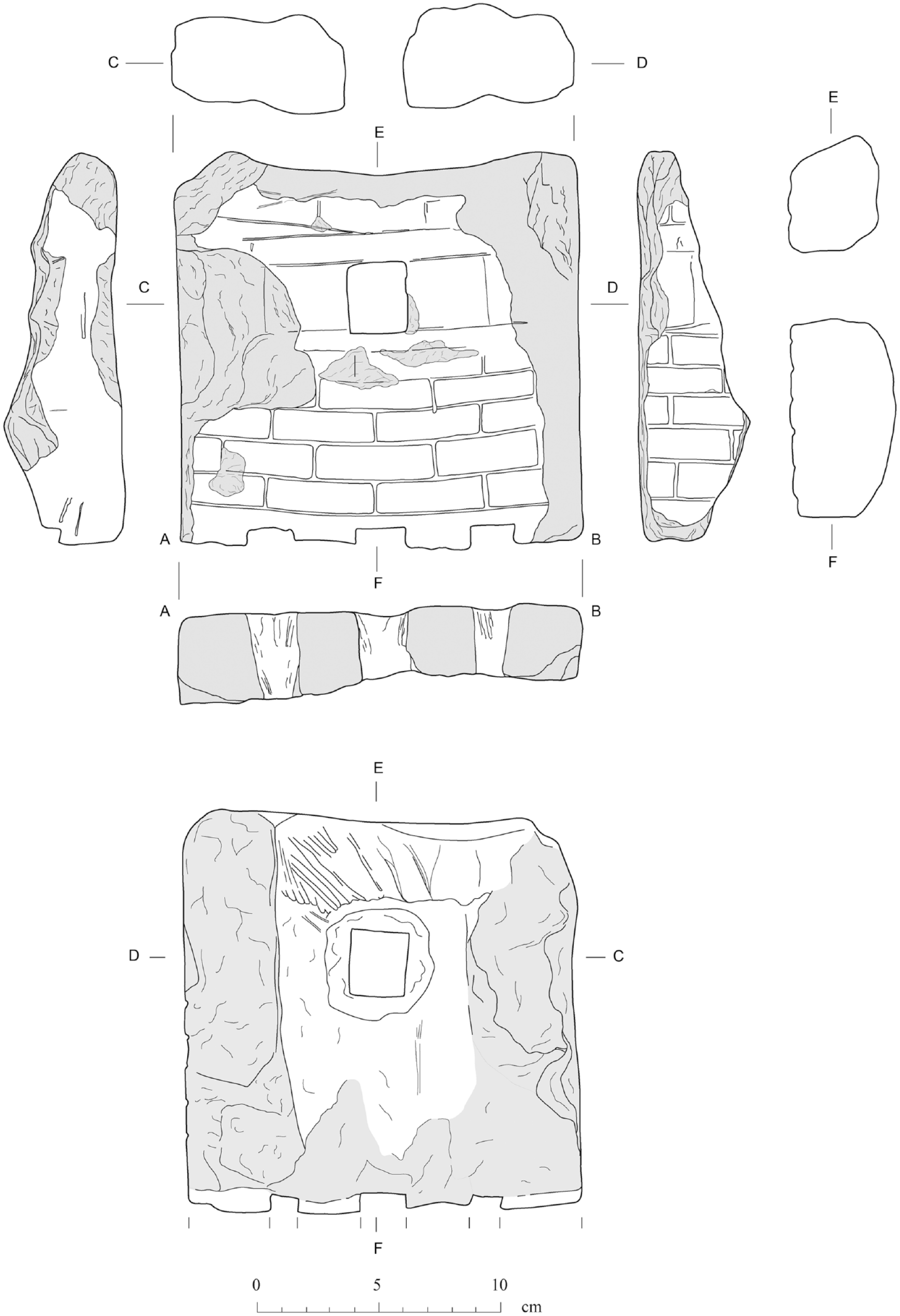
Fragment of a tower house model, limestone, Kom el-Gir, inv. no. KG S 13/1 (drawing: Robert Schiestl and Bettina Kolbe).
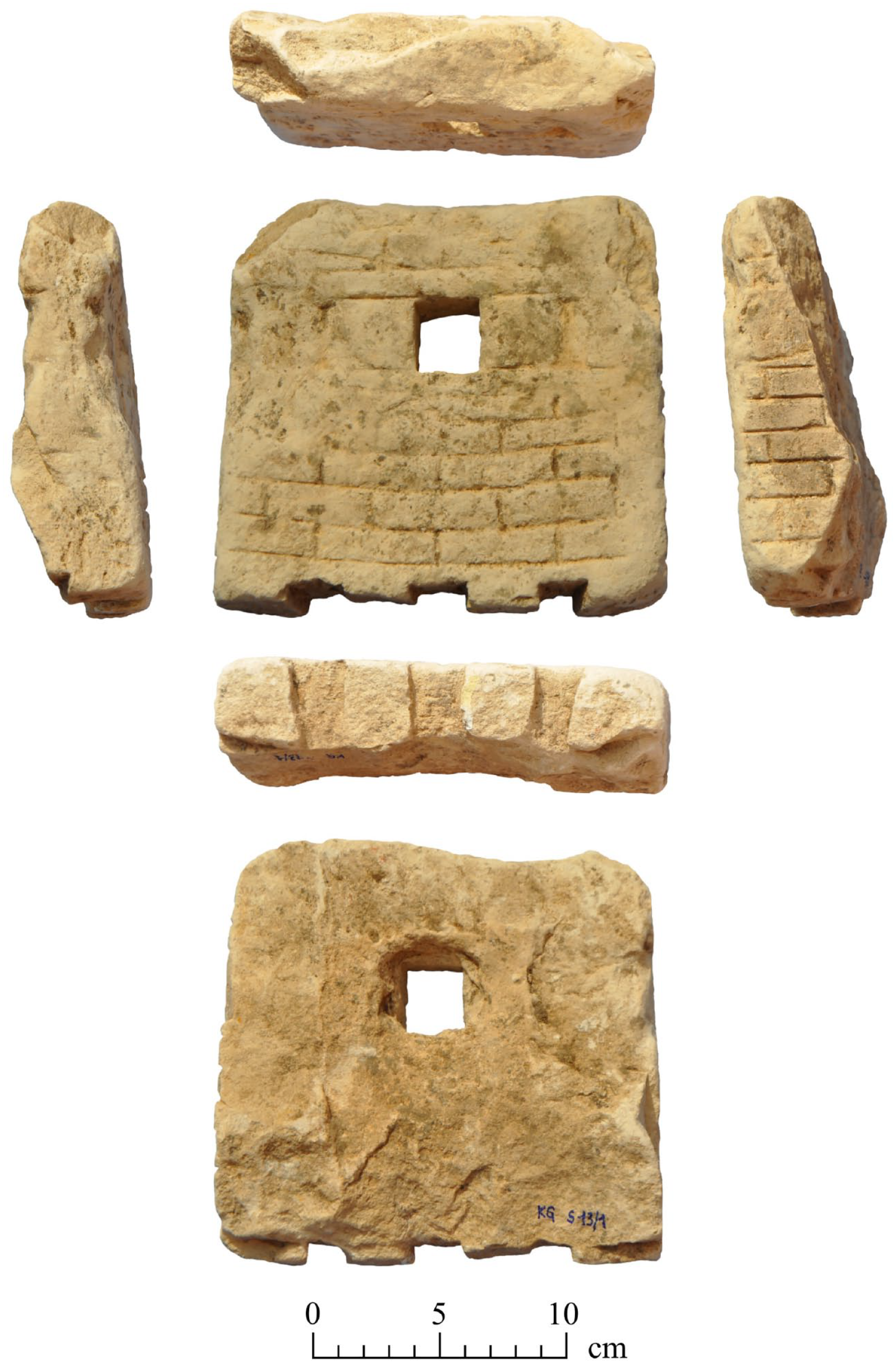
Fragment of a tower house model, limestone, Kom el-Gir, inv. no. KG S 13/1 (photo: Robert Schiestl, DAI Cairo; illustration: Thomas Seidler).
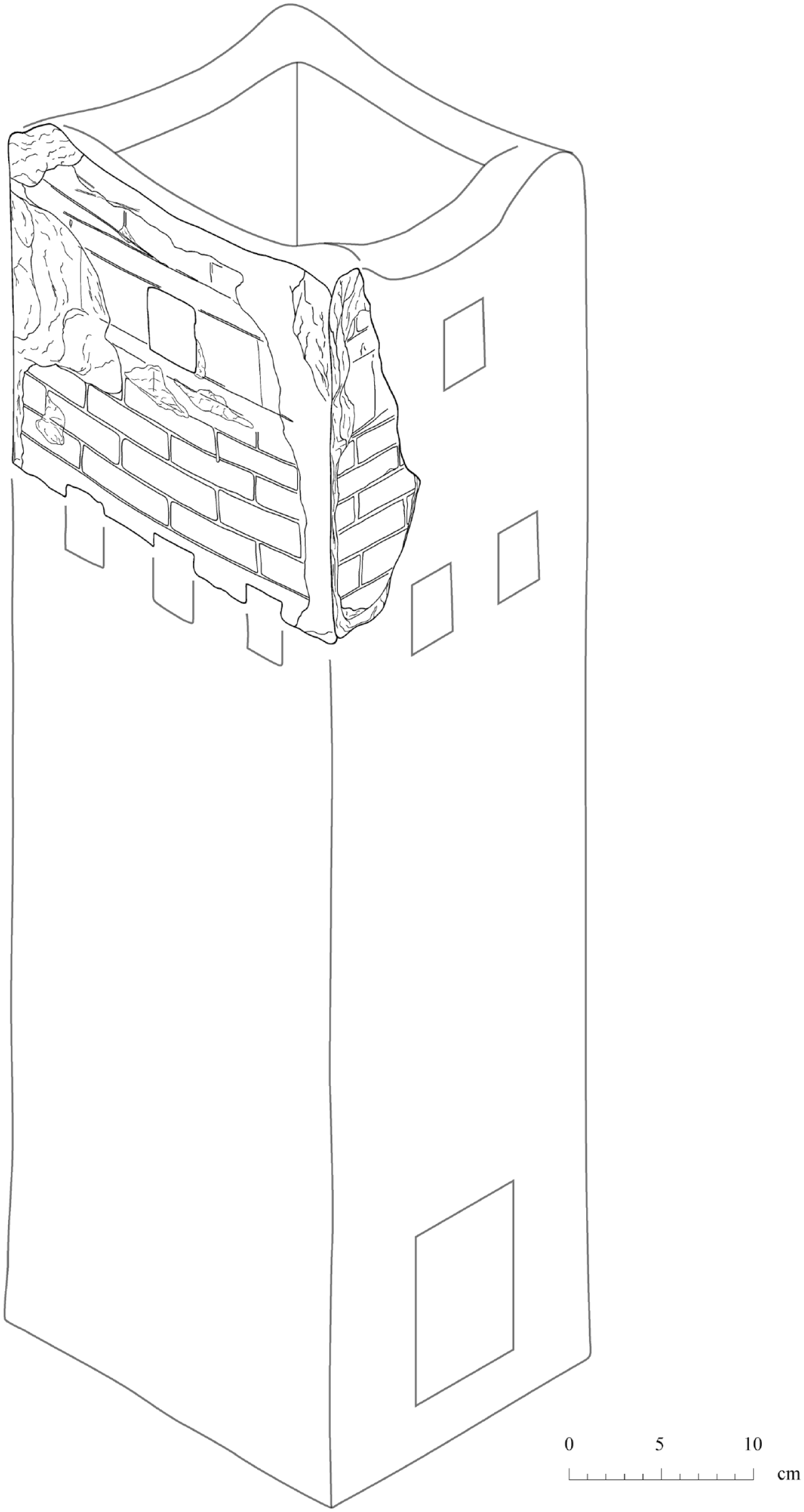
Reconstruction of the tower house model, limestone, Kom el-Gir, inv. no. KG S 13/1 (drawing: Robert Schiestl and Bettina Kolbe).
Kom el-Gir is a site first studied as part of a survey of the region around Buto (Tell el-Faracin), conducted under the auspices of the German Archaeological Institute Cairo (DAIK), 10 and currently being investigated in small scale excavations. The tell is today about 20 ha large and rises to a maximum of about 5 m above the surrounding fields. Based on pottery from the surface and from auger coring, the settlement’s foundation is dated to the Ptolemaic Period and the site was occupied until the Late Roman, possibly Early Arab, Period. 11 Magnetic prospection of the site has provided images with numerous outlines of mudbrick houses, many of which can be interpreted as the remains of tower houses. 12 A large enclosure, provisionally interpreted as a temple enclosure, has been detected in the north of the site, and to its east, a large fortified structure has been discovered by the magnetic survey. A small area of this structure’s southwestern corner tower was excavated in 2019 13 and 2022.
Description and Reconstruction
The fragment shows the building’s roof with raised corners, the upper most floor with a single central window and the upper parts of three windows on the floor below (figs 1–3). The corners and very short sections of the walls around the corners are preserved. The façade displays shallow incisions representing layers of mud-brick construction. Such bricks are also shown on the right lateral wall of the fragment, which represents the façade of the house. The left lateral wall of the house does not show any brick lines at all, suggesting it had been left blank intentionally, most likely to represent the back of the house (fig. 3). Parallels for undecorated, or sparsely decorated, backs are, for example, the limestone house models from Sakha (Xois). 14 The material of the Kom el-Gir model is a soft white limestone, the surface of which is powdery to the touch. The fragment measures 15 cm in height in the middle and 16 cm at the edges with the raised corners. The front is 16.5 cm wide at the top and 17 cm at the base, suggesting a slightly tapering shape. The interior has been roughly hollowed out. The traces of a very fine chisel or drill, with a width of 2 mm, are visible in the interior upper part (fig. 1). The façade’s wall has a thickness between 2.5 and 3.8 cm, while the sidewalls’ thickness is most likely approximately 3.6 cm at the top and 4.2 cm at the base. This created an inner space of about 8 cm width. The depth of this space, that is, how deeply the model was cut out from above, is not clear due to weathering of the lower part of the interior’s surface. Most likely the next floor was also hollowed out, working down from the top. In other limestone models, when windows were open, the interior space had also been carved out. The windows in the row of three were, however, carved from the outside in, as is evident by the funnel shaped section of the aperture. The upper window is completely broken through and measures 2.4 cm in width and 2.9 cm in height. The row of three windows in the floor below had also been broken through entirely; the widths of the windows measure 1.9–2.1 cm. Between the upper window and the lower row of three windows, five horizontal courses of bricks have been incised. The courses are shown as curved, rising towards the corners of the walls. This feature is well known from both actual buildings and models of the Late Period to Roman Periods. 15 These five courses continue around the corner on the right side. The individual bricks on the front have sizes of around 4.2 cm length and 1.2 cm height.
The roofs of tower houses are flat, often surrounded by a low parapet. The parapet’s raised corners are depicted in this model and found occasionally on others, such as the limestone model UC 33427 16 or the terracotta model Louvre E11886. 17 The feature is very frequently shown in depictions of tower houses. 18 Peaked corners on walls surrounding open spaces have a long tradition in Egypt. An early example is the Early Dynastic model of a granary from Helwan. 19 They become a common feature of models of granaries in the Old and Middle Kingdoms. 20 As flat roofs were also used as storage spaces, a likely reason for the construction of raised corners was to protect loose material, which had been deposited in corners by wind. In some Roman depictions, the raised corners are shown more akin to crenelations and are considered a feature of fortification. 21
The reconstruction (fig. 3) serves as an illustration to better understand the placement of the fragment. Based on the blank wall (see figs 1–2), the fragment’s preserved façade is considered the representation of a side wall, as discussed above, with a small section of the front façade preserved, that is, the side where one would place the door. The ground plan could be square or rectangular, but as most better-preserved house models have a square plan, 22 it was reconstructed here as such. The model’s height is speculative. Based on the house model typology established by M. Lehmann, this model falls into her category of type 2. 23 Such models, all made of limestone, generally have three or more stories. The reconstruction here shows four stories, with a resulting height of roughly 54 cm, which falls somewhere between the two examples from Sakha (Xois), which are 40 cm 24 and 78 cm 25 tall.
Dating the Model
As a surface find, the model cannot be dated any closer than the period of use of the settlement, that is, based on current knowledge, the Ptolemaic Period to the Late Roman Period. Refining this date could only be achieved by comparisons with better dated examples; however, no house model has been found in an archaeological context which provides a sound basis for fine dating. 26 The models from Naukratis, of which one fragment seems to be a similar type as the piece discussed here, 27 have been dated to the Late Period, 28 or in Petrie’s words ‘of a tolerably early date probably’, 29 however, the reasoning is not cogent. Generally, published models are provided with dates ranging from the Late Period to the Graeco-Roman Period, while some have suggested narrowing the range down to the Late Ptolemaic to Late Roman Periods. 30 Limestone models are frequently considered earlier than terracotta models, 31 with the suggestion that the former date to the Ptolemaic Period and the latter to the Roman Period, 32 or, the former to the Late Period and the latter to the Ptolemaic and Roman Periods. 33
Uses of House Models
As the model’s interior is hollowed out, it could have served as a receptacle for a very small item. While the function as ‘lamp shrine’, that is an object into which a lamp is placed, has been suggested for numerous house models, 34 only those models with apertures wide enough to place a lamp also have traces of soot inside. 35 In many cases, the apertures into which a lamp could be placed are too small to fit lamps, or the model is solid and there is no opening at all. No traces of soot remain on the interior wall of this model. It has been suggested that in such cases the lamps may have been placed on top of the model. 36 While that remains a possibility, it is also evident that none of the tall limestone house models display traces of soot. Another way of approaching function is looking at whether the objects lend themselves to being moved or not. The groups of small limestone models, 37 and the terracotta models, 38 can be easily carried. Among the tall limestone models 39 are some very large and solid examples. While no weight is provided in publications, it can be approximately calculated based on the measurements: The limestone house models from Sakha (Xois) are 40 cm (JE 50205) and 78 cm (JE 56352) tall and only partially hollowed out (JE 56352) or not at all (JE 50205). Their weight can be estimated as between approximately 10 kg (JE 50205) and 45 kg (JE 56352) respectively. Most likely these objects stood in place and were not often moved around. In addition, the tall and narrow shape may have been prone to falling over and better stood against a wall. The undecorated back side may support setting it up that way. Looking at these objects in an Egyptian tradition, they are possibly related to the long tradition of stands in Egypt. 40 Standing figures of limestone have been found in domestic contexts in the Middle Kingdom, such as in Kahun, 41 and in funerary contexts at Tell el-Dabca (Avaris). 42 They are assumed to have served as lamps or offering stands. Numerous examples of ceramic offering stands from the New Kingdom have been found at Amarna. 43 Of the bowls on top of the Amarna pieces, some contain signs of burning while some do not. 44 The latter examples are considered to have been used for food offerings. In the Amarna cases, a similar distinction has been made between small portable stands and large stands, which were difficult to move and most likely stood in place. 45
While various types of house models are known from different parts of the ancient world and have a long history, 46 such tower house models remain unique to Egypt. The frequent depictions of tower houses in scenes of Egypt outside of Egypt, whether Assyrian or Roman, suggest that such buildings were perceived as remarkable and signified ‘Egyptianness’. 47 Based on prospection at Kom el-Gir, it is clear that this type of building was locally of great importance and such local examples may have served as points of reference for the model. Most models of tower houses have been acquired on the art market and have no archaeological context. 48 Within the very small group with provenances, those from sites in the Delta, such as Sakha (Xois) 49 and Naukratis 50 are notable. As actual tower houses seem to have played a particularly important role in the Delta, 51 models of such houses may also have been more common here.
Footnotes
Acknowledgements
The author would like to thank the authorities of the Egyptian Ministry of Tourism and Antiquities, and the inspectorates at Kafr esh-Shaikh and at Tell el-Faracin (Buto).
Funding
Funding for the field work was provided by the Fritz Thyssen Foundation and the German Archaeological Institute Cairo. Further support for the graphic work was provided by the Alexander von Humboldt foundation.
1.
Arnold 2003; Marouard 2012; Marchi 2014;  : 49–105.
2.
Lehmann and Tallis 2019; : 85–93.
3.
Maehler 1983; : 93–97.
4.
Busch-Sperveslage 2000; Lehmann 2020: 58–85; .
6.
Arnold 2003: 172–179; : 9–11, table 3.
9.
Schiestl and Herbich 2013: 28–29; Schiestl 2016; : 51–55.
14.
Cairo JE 56352, : fig. 1; Cairo, JE 50205, Engelbach 1931: 130.
20.
Winlock 1955: 25, pls 20, 24, 62; New York, MMA 20.3.11 https://www.metmuseum.org/art/collection/search/545281 (accessed 03.09.2022); British Museum EA41573 (accessed 03.09.2022).
24.
Cairo, JE 50205, Engelbach 1931: .
25.
Cairo, JE 56352, Engelbach 1931: figs 1–, pl. III.
32.
E.g., Marouard 2012: .
34.
Petrie 1886: 40, pl. XVIII.3; Engelbach 1931: 129–131; Busch-Sperveslage 2000: 11–26; Lehmann 2020; : 105–133.
46.
48.
Busch-Sperveslage 2000; : 59.
51.
Marouard 2014: 105–133; : 8, table 1.