




Abstract
Knucklebones were ubiquitous objects in the ancient world and they had several meanings, from gaming pieces to oracular dice. The study of a new unpublished decorated knucklebone from Graeco-Roman Egypt with a ‘Baubo’ image of a squatting naked woman, preserved at the Metropolitan Museum of Art in New York, offers the opportunity to explore the variety of contexts of use of decorated knucklebones in this area: from play and divination to Orphic rituals and local religious festivals. Its decorated sides represent three Graeco-Egyptian deities whose meanings and magical interactions can be understood through the comparison with other Romano-Egyptian gaming pieces, terracottas, magical gems and papyri.

Introduction
This article will focus on a very rare stone knucklebone preserved at the Metropolitan Museum of Art in New York. 1 The Metropolitan knucklebone represents three Graeco-Egyptian gods: on the plantar side Isis-Aphrodite, on the medial side Eros, and on the lateral side a bearded character wearing a Phrygian cap and a transparent tunic down to its hips (fig. 1a–d).
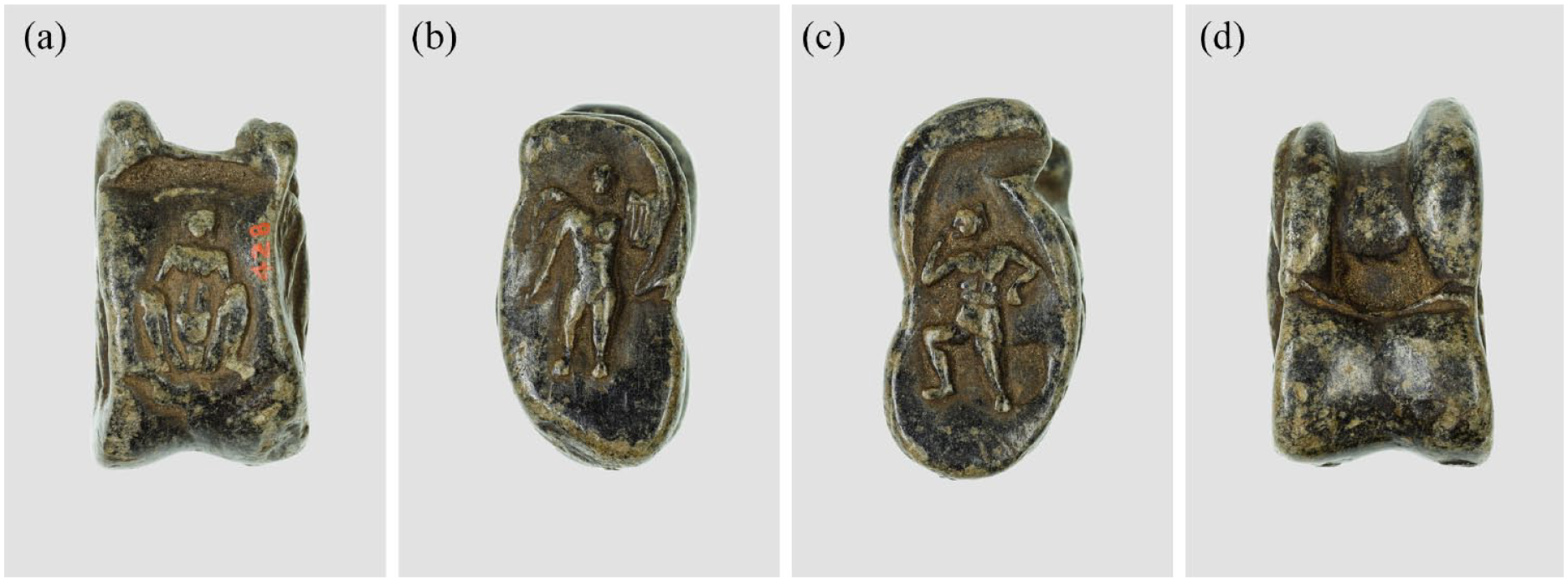
Gabbro knucklebone decorated with the images of a) Baubo/lsis-Aphrodite, b) Eros and c) a bearded figure wearing a Phrygian cap. d) The fourth side is not decorated and is shaped like the dorsal side of a real knucklebone (MMA O.C.428; Metropolitan Museum, gift of the Egypt Exploration Fund).
The main aim of this study is to examine this knucklebone’s iconography and context and to establish its date. However, this article also provides an opportunity to examine the contexts of use of knucklebones in Ptolemaic and Roman Egypt.
Mentioned in ancient sources as α’στράγαλος in Greek and talus in Latin, the astragalus or knucklebone is part of the hind-leg in four footed mammals, such as sheep or goats, and was used as a gaming piece. 2 The object examined in this article is not an actual bone, but a small 3.7 cm long imitation in gabbro stone. While most of these objects do not have any signs or decorations, this one was decorated on three of its four sides; its rear side reproduced a knucklebone realistically but was left undecorated (fig. 1d). The lack of wear and tear on each side attests that it was either not used, or it was not thrown on a hard surface. Indeed, it could have been thrown on a soft surface such as sand. 3
The museum catalogue 4 dates this object to the Ptolemaic Period and lists it as a gift to the Metropolitan Museum from the Egypt Exploration Fund (EEF) in 1906. Unfortunately, no further details regarding this object and its provenance are provided in the EES distribution archive of finds acquired by the Metropolitan Museum.
In the Graeco-Roman world, both real knucklebones and their imitations can be found in various contexts: caves, 5 sanctuaries, 6 graves, 7 houses and cities, 8 which suggests several meanings and contexts of use.
Their use as gaming pieces is attested in Egypt, the Near East and the Graeco-Roman world. 9 Classical sources attest two kinds of games. Skill games used knucklebones as gaming pieces, so their sides did not have a particular value and they could also be easily replaced by other types of pieces or even nuts. 10 In other games, they were used as dice, so the four sides of the knucklebone called dorsal, medial, plantar and lateral 11 were each given a specific numeric value. 12 In Greek and Roman games, the lateral view (Χῖον, one of the narrower sides) was worth one point, 13 the dorsal (ὕπτιον, slightly concave) three points, the plantar (τὸ πρανές, slightly convex) four points and the medial side (τὸ Κῷον) six, because it was the least probable throw; 14 two and five points were excluded. In sets of knucklebones, the different combinations of numeric values were seen as better or worse according to the game rules. In a gambling game of four knucklebones mentioned by Suetonius, 15 the winning throw was called ‘of Venus’ when the dice turned up different numbers (1, 3, 4, 6), 16 while the losing throw was called ‘of the dog’ (1, 1, 1, 1) 17 or ‘of six’, despite the fact that these combinations were more unlikely to achieve. Such names for the throws might have also been used in statue divination. 18
In this article, I will demonstrate that the Metropolitan Museum knucklebone is a rare example of a decorated stone knucklebone in Egypt, and it represents a combination of Graeco-Egyptian deities who received official cults and festivals in Egypt, but also appeared on private magical objects such as gems. I will start by examining knucklebones in Graeco-Roman Egypt, in order to investigate some possible contexts for the use of this knucklebone, and then I will discuss its iconography.
Knucklebones in Graeco-Roman Egypt
Plato famously credited the Egyptians with the invention of dice games, 19 but this may not be entirely accurate. The Egyptians did invent senet, a board game with 30 squares and a variable number of pieces, but the use of knucklebones in board games was a Near Eastern import; they were added as dice to the senet game only in the Second Intermediate Period 20 when they started to be used in pairs as randomising devices as an alternative to the more traditional four throw sticks. 21 However, knucklebones were only rarely associated with senet and the boards themselves almost disappeared in the Late Dynastic Period. 22
From the Ptolemaic Period, there are papyri which confirm that knucklebones continued to be produced and used in Egypt independently from senet. The use of gazelle knucklebones as gaming pieces is attested in three papyri of the third century BC archive of the Carian Zenon, the private secretary of the Ptolemaic minister of finances Apollonios. 23 Cleopatra was also said to entertain Antony with a game of dice which could have been knucklebones. 24 On the contrary, the scarcer attestations of knucklebones in Roman Italy, suggests that this gaming piece remained mainly Greek in its use and rules. 25 Indeed Pollux of Naukratis still describes Greek rules for knucklebone games in the late second century AD. 26 Therefore, it is not surprising that knucklebones survived longer and in a wider range of contexts in a strongly Hellenised province such as Egypt.
Orphic Rituals Involving Knucklebones?
Knucklebones are also mentioned in the Ptolemaic papyrus Gurôb 1 (third century BC), whose content may suggest that they were not only used as dice for games, but also for rituals. The text from papyrus Gurôb 1 was interpreted as an orphic 27 set of instructions for orpheotelestai 28 which included both prayers and practical provisions to celebrate a ritual in honour of the baby Dionysos Zagreus, the son of Zeus and Persephone. 29 According to the myth, the Titans distracted Dionysos with toys and then killed him and dismembered his body. However, Zeus eventually brought Dionysos back to life and incinerated the Titans with his bolt. In the ritual described by the papyrus, the initiate had to participate in an animal sacrifice which represented the murder of Dionysos. 30 The sacrifice was followed by a prayer and a list of sacred objects that had to be put into a basket (kalathos), including knucklebones: 31 ‘A cone, bull-roarer, knucklebones, mirror.’ 32
Clement of Alexandria (150–215 AD) describes a very similar list of sacred objects which includes the knucklebones as a part of a ritual for Dionysos Zagreus. 33 This also suggests that the Orphic (or Eleusinian) rituals attested in the third century BC were still practised in the third century AD and the knucklebones were still used. 34
It is evident from this passage that some knucklebones in Egypt had a ritual and perhaps magical use in Orphic (or Eleusinian) rituals. 35
Decorated Artificial Knucklebones from Graeco-Roman Egypt
Most bone and stone knucklebones were not decorated, but there are archaeological attestations of artificial Graeco-Roman Egyptian knucklebones that bear decoration. The production of artificial knucklebones allowed skilled craftsmen more freedom of artistic expression than with natural knucklebones: two ivory knucklebones were shaped like baboons 36 and gold and bone ones were carved like ithyphallic dwarves with raised arms. 37
Two steatite knucklebones 38 from the Kelsey 39 and Petrie Museums 40 were very similar in size and material to the Metropolitan Museum knucklebone examined in this article. The one from the Kelsey Museum is a valuable comparison because it is the only Egyptian decorated knucklebone with a partially known archaeological context: excavation documentation 41 reports it to have been found in the Fayyum village of Karanis. Both the Kelsey and the Petrie knucklebones have explicit sexual scenes represented on their lateral sides, while an unclear figure is represented on the other side. Their dorsal and plantar sides are left undecorated. The lateral side of the Kelsey knucklebone shows a man kneeling towards a reclining woman, kissing her lips and having intercourse with her (fig. 2, above). The lateral side of the Petrie Museum example represents a woman taken from the rear by a man.
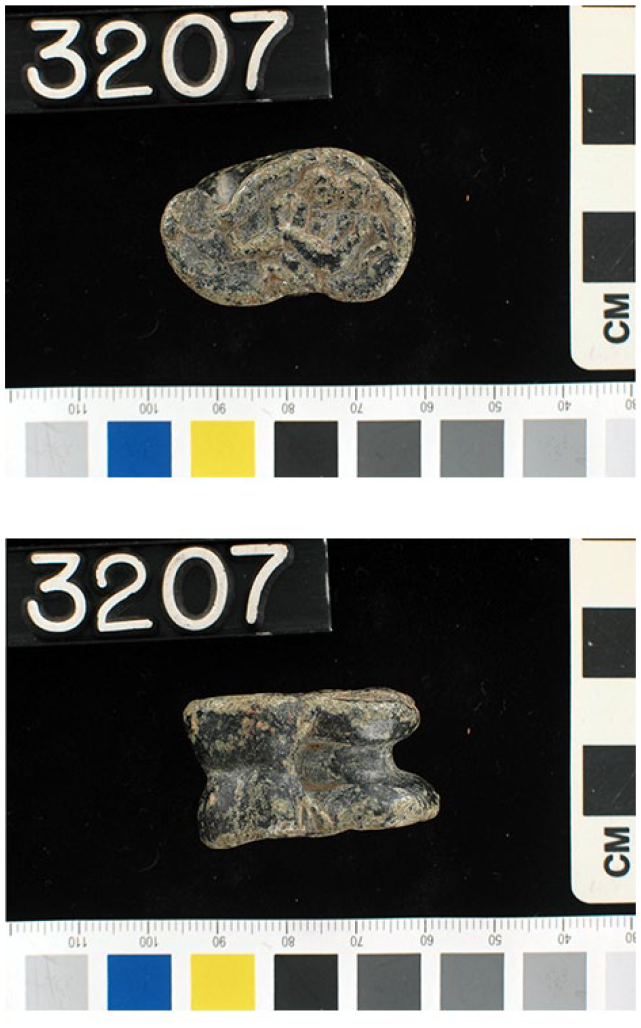
Steatite knucklebone decorated with an erotic scene on the lateral side (above) and with an undecorated dorsal side (below). From Egypt dating to the Roman Period (Kelsey Museum acc. no. 3207; photo: courtesy of the Kelsey Museum).
The Metropolitan Museum knucklebone has an almost identical double in the Basel Museum which represents the same characters on the decorated sides (figs 3, 7, 9, right) and has a dorsal side left undecorated. 42 Despite the similarities, I do not think that the Basel and the Metropolitan knucklebones were part of a set like the baboon knucklebones mentioned above, because they were made of two different stones. Furthermore, the Basel knucklebone appears more worn than the one from the Metropolitan Museum: it has signs of wear and tear and it is chipped in various parts (although some of the chipping damage could be modern). The decoration also seems slightly more schematic than that of the Metropolitan knucklebone.
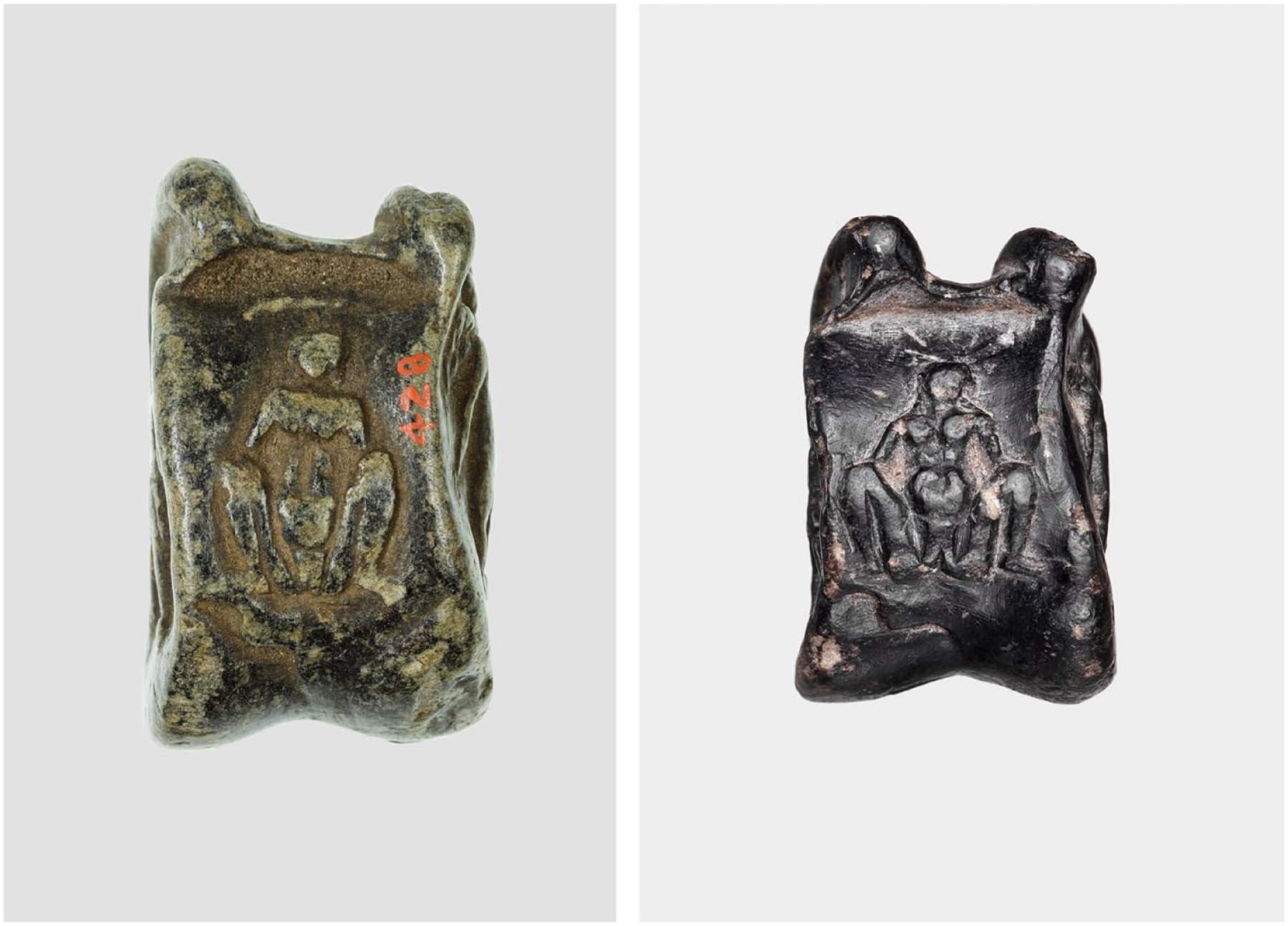
Left: plantar side of Metropolitan Museum gabbro knucklebone; length 3.7 cm x width 2.2 cm. Right: plantar side of the Basel Museum steatite knucklebone; length 3.9 cm x width 2.4 cm (Antikenmuseum Basel und Sammlung Ludwig, inv. BS 1209).
Romano-Egyptian Oracular Dice with Names of Egyptian Deities
The Metropolitan and the Basel knucklebones are almost unique because they represent deities on three sides. This suggests that it was either used to establish a relationship with those deities or to obtain something which was related to the deities’ function. Petitions to the gods through knucklebones are attested in the Graeco-Roman world, and especially in Asia Minor where temple inscriptions preserve prayers pronounced together with the throw of the knucklebones. 43 Statue divination with knucklebones was also practiced and it can be observed in coins. 44
In Graeco-Roman Egypt there are examples of dice with names of deities which could have had a similar function 45 and magical papyri show that sets of three six-cube dice (hexahedra) were more specifically used in the Homeromanteia. 46 Two Roman dice with names of Egyptian gods were interpreted as oracular dice: a limestone hexahedron die with the hieroglyphic names of six Egyptian gods from the Petrie Museum (UC3816), 47 and a limestone icosahedron die with 20 Demotic divine names, from the necropolis of Qaret el-Muzzawaqa (Dakhleh Oasis). 48 The icosahedron was found in a necropolis and so it was almost certainly found in a tomb, although the primary use before its deposition was probably divinatory. 49 The same could be said for the Metropolitan and Basel knucklebones: it is possible that they were found in tombs, but the signs of wear and tear on the Basel knucklebone show that it was originally used, so this excludes the fact that these knucklebones were produced exclusively as funerary offerings.
The comparison with the two oracular dice with names of deities may suggest that the Metropolitan Museum and the Basel knucklebones were also used in the contexts of divination. However, in the Graeco-Egyptian context, it is less clear why these dice were shaped like knucklebones rather than the more common cubic or multi-faced dice. It is worth exploring the possibility that the use and context of these knucklebones may be different from the one of the inscribed oracular dice.
To conclude this preliminary overview, the sources from the Ptolemaic and Roman Period place knucklebones in four possible contexts: play, divination, funerary depositions and Orphic rituals. However, only a detailed analysis of the iconography of the three decorated sides of Metropolitan Museum knucklebone will shed light on its possible context.
The Iconography of the Metropolitan Museum Knucklebone
The interpretation of the context of the Metropolitan knucklebone depends on the identification of its decoration which is made more challenging by the lack of inscribed names. Therefore, I will provide more specific textual and iconographic evidence for the interpretation of each side. A photo of each side of the Basel knucklebone will also be provided for comparison.
Plantar Side: ‘Baubo’ Figure of Isis-Aphrodite
The plantar side of the Metropolitan knucklebone (fig. 3, left) has a representation of a naked woman with a prominent belly, in a squatting position with spread legs. It is unclear whether the figure is giving birth because she is not sitting on a birthing stool. A similar figure is also represented in the almost identical knucklebone from the Basel Museum (fig. 3, right). Unlike the Basel example, the Metropolitan figure seems to be wearing a headdress, perhaps a feathered one.
Childbearing women were only schematically represented in dynastic Egypt and the earliest frontal figures of women with spread legs did not appear until the Late Period. 50 The earliest of such figures were very roughly carved on limestone plaques found in great numbers at Naukratis and Memphis and date between the sixth and the fourth centuries BC. 51 One of these plaques was found near the Great Temenos in Naukratis (fig. 4). 52
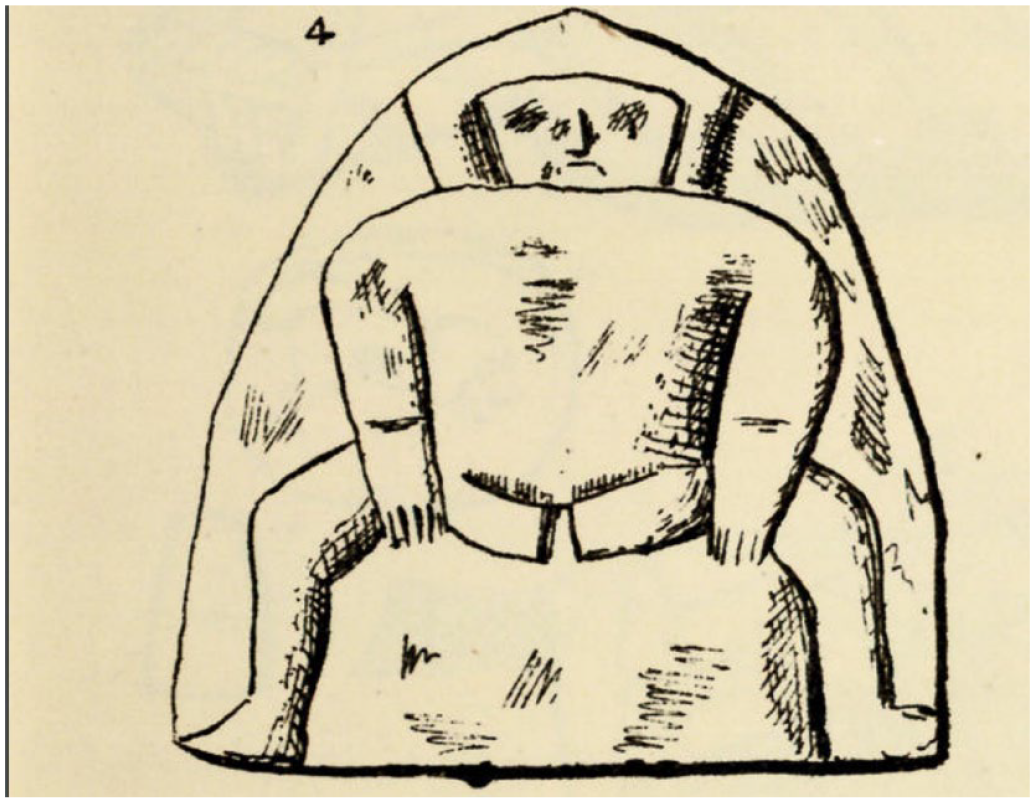
Drawing by W. M. Flinders Petrie of plaque found by the Great Temenos in Naukratis (Petrie, Naukratis I, pl. XIV, no. 4).
Images of childbearing women and women with spread legs also started to be represented on Tanagra-style terracottas produced in Egypt from the Ptolemaic Period. Some terracottas had the attributes of Isis-Aphrodite and had a well-proportioned body. Others had little or no attributes, a plump body and spread legs to reveal the genitals. 53 These elusive terracottas are still commonly called Baubo, the name of an old lady who showed her genitals to Demeter in order to distract her from the pain of Persephone’s loss. 54 The name Baubo is present in the Orphic fragments of Clement of Alexandria and Arnobius which describe the episode of the rape of Persephone. However, Baubo also received a cult in association with Demeter in various areas of the Greek world as shown by both inscriptions and figurines. 55 The reason for calling the Egyptian terracottas ‘Baubo terracottas’ is the gesture performed by these ladies of showing their genitals like Baubo did with Demeter. However, another reason is also the clear connection of some of these Egyptian terracottas with Demeter: there are various attestations of this Egyptian Baubo figure sitting on a boar (fig. 5), 56 a gesture which recalls the wild boars sacrificed during the Greek festival of the Thesmophoria. Both the Eleusinian rituals and the Thesmophoria were celebrated in the Eleusis district of Alexandria, 57 so these terracottas could have been used in such contexts.
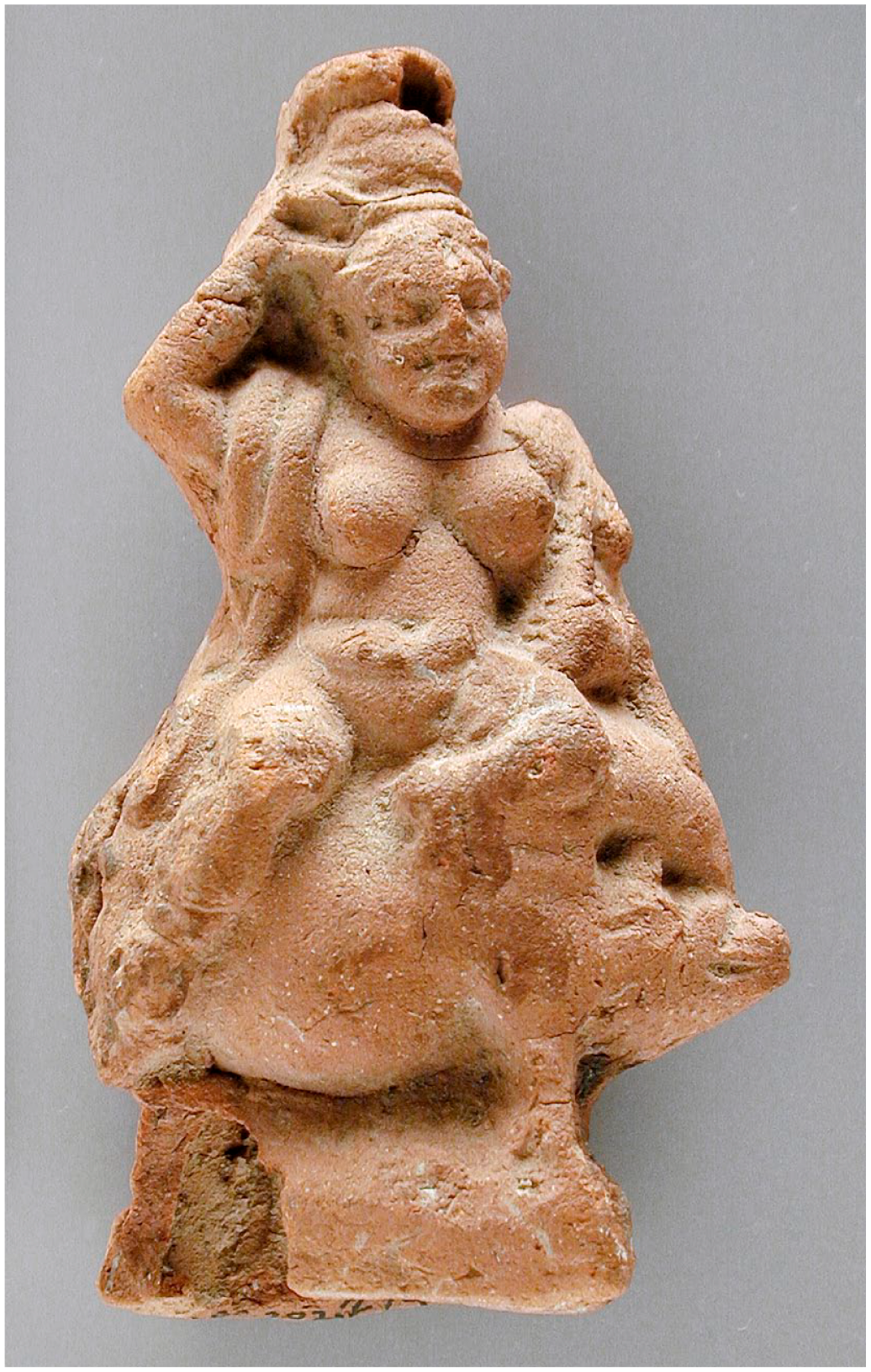
Terracotta representing Baubo sitting on a boar. From Egypt dating to the Graeco-Roman Period (LACMA Museum
However, it is likely that most Baubo figures in Egypt did not have an exclusive connection with Demeter and therefore they cannot be identified with the Classical Baubo. Indeed, the Late Period plaques from which they derive their iconography were much earlier than the Ptolemaic import of the Demeter cults and festivals to Egypt. Moreover, such figures continued to be produced in Naukratis, although in terracotta form rather than plaques. 58 Furthermore, many Baubo terracottas shared attributes with Isis-Aphrodite Anasyrmene (who lifts the skirt) such as the squatting position, the snake anklets and the chest bands. It is clear that the term Baubo cannot be used literally in Graeco-Roman Egypt, 59 but rather as a typological term to define a broad group of representations of women with either a plump or pregnant belly who expose their genitals. This group includes both generic female figures who could be embodiments of abstract ideas (fertility, childbirth, sex) 60 and actual goddesses.
Dasen more specifically interpreted the childbearing woman on the knucklebone from Basel as Omphale, the Lydian queen who subjugated Heracles, swapped clothes with him and held his club. 61 There is a strong link between Omphale and the knucklebones in the Classical world, because Herodotus credits the Lydians with the invention of the game of knucklebones 62 and the image of Herakles also appears connected to knucklebones. 63 Regarding the queen’s connection with the ‘Baubo’ type, Dasen showed 64 that childbearing women on the Roman Egyptian magical gems could be identified with Omphale thanks to the attribute of the club and the association with Herakles fighting a lion on the other side of the gem. She also noticed that the club-holding Omphale in Romano-Egyptian gems and terracottas was no longer just the Lydian queen, but a more powerful goddess who protected female health, especially the one of pregnant and childbearing women. Moreover, on another gem, a Baubo-like female figure washing her genitals 65 could be safely identified as Omphale despite not holding a club thanks to the name Omphale written under her figure. Therefore, it is clear that the identification of such Baubo figures with Omphale could potentially be extended to other amulets and terracottas of women holding clubs (fig. 6) and even some figures on gems and terracottas without clubs.
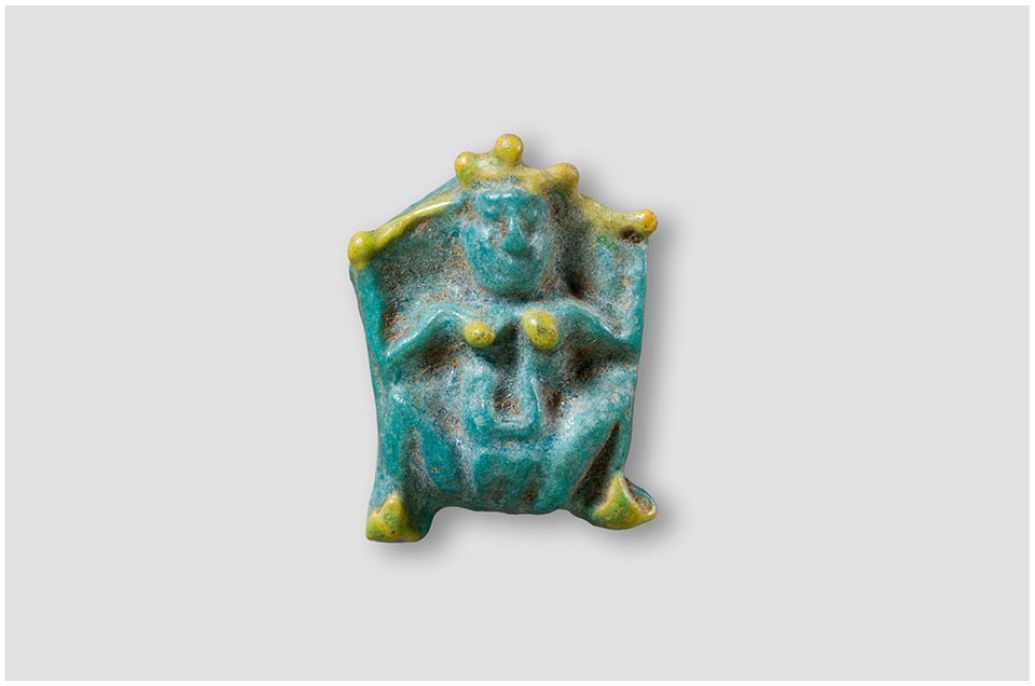
Small Roman Period faience amulet of Baubo-Omphale holding two clubs. The clubs, headdress, breast and feet are marked with a bright yellow colour (Theodore M. Davis Collection, Bequest of Theodore M. Davis, 1915, MMA 30.8.346).
However, the Baubo figure represented in the Metropolitan Museum knucklebone has no attributes nor inscribed names, although a faint line over the head with three vertical lines underneath could represent a feathered headdress, perhaps the feathered crown of Beset, 66 the female counterpart of the dwarf demon Bes, who was sometimes associated with Isis-Aphrodite Anasyrmene. The squatting position is the same one assumed by Roman bronze dice representing generic female figures with spread legs. 67 One bronze example from the British Museum 68 represents a squatting woman in labour with four dots on her front torso: two on her breast and two on her belly. The combination of her squatting legs and arms behind the back recalls the shape of a knucklebone. The use of this die as a knucklebone is also suggested by the fact that the value of four (dots), on the front torso of the woman corresponds with the value of four of the pranes side, the larger frontal side of the bone. Squatting figures shaped like a knucklebone were already known through the baboon and dwarf gaming pieces from Ptolemaic Egypt mentioned above, so these bronze ‘Baubo’ dice seem to be a further development of this idea across the Roman Empire.
The parallel of the bronze ‘Baubo’ dice with the Baubo figure on the Metropolitan knucklebone suggests that the squatting woman in the knucklebone represented primarily an abstract embodiment of sex, fertility and childbirth, with very likely allusions (rather than a complete identification) to Isis-Aphrodite due to her association with Eros and Harpocrates on the other two sides of the knucklebone. Sexuality was an important element of this knucklebone and this leaves us with possible interpretations about its context to which I will return after the analysis of the other two sides.
Medial Side: Eros
The medial side of the Metropolitan knucklebone (fig. 7, left) represents an adult man, standing frontal and naked with wings over his shoulders and holding a lyre on his right side. He wears no hat nor headdress while the Basel example (fig. 7, right) seems to be wearing a soft hat, perhaps a Phrygian cap.
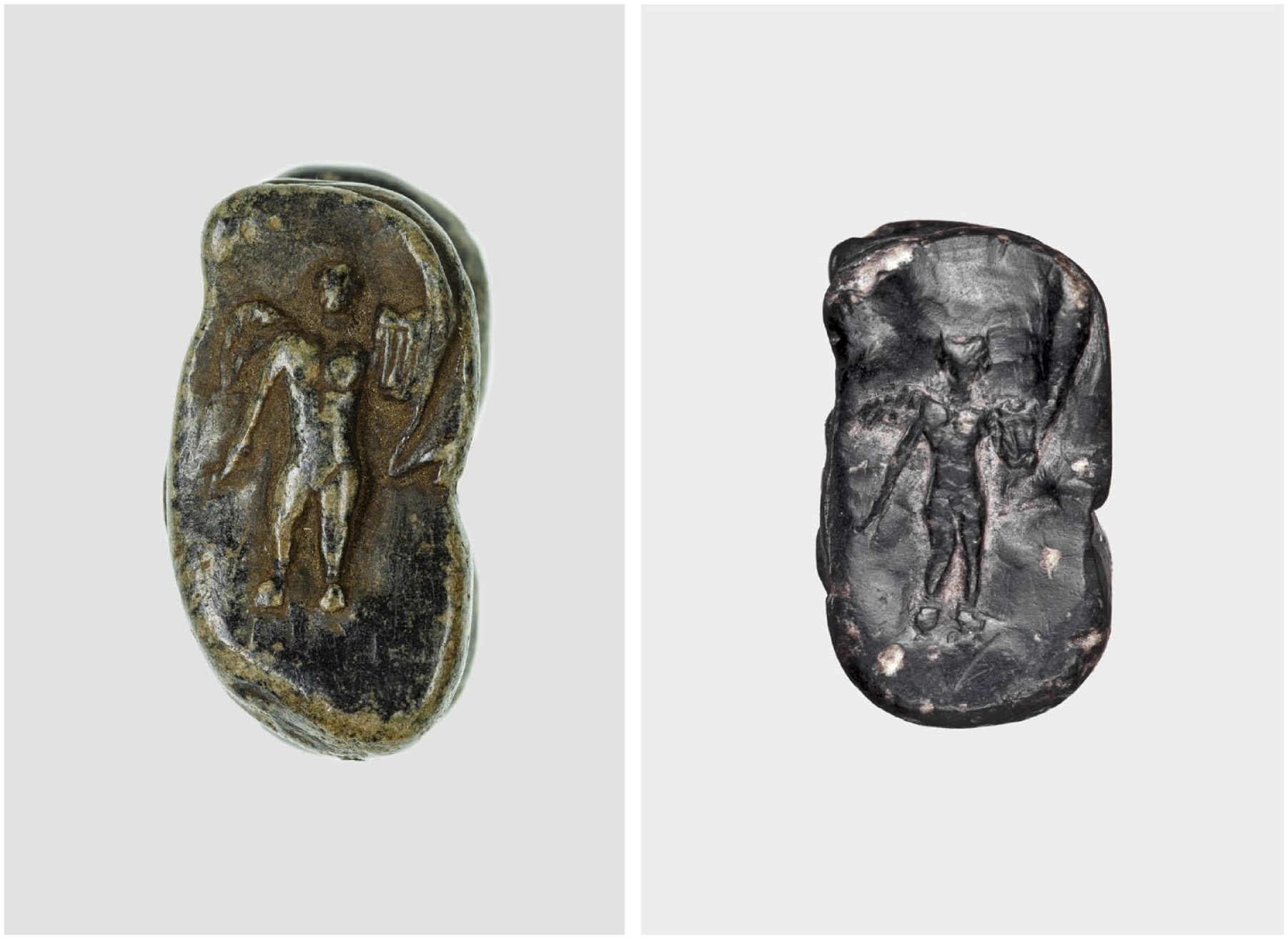
Left: medial side of the Metropolitan Museum gabbro knucklebone. Right: medial side of the Basel Museum steatite knucklebone.
The figure in the Basel knucklebone was interpreted by Dasen as Eros, 69 and this interpretation also applies well to the Metropolitan Museum knucklebone. Not only is the iconography quite clear, but the reasons for Eros to be represented on a knucklebone are also evident: there was a long-lasting association between Eros and the knucklebones in the Greek-speaking world since the sixth century BC. 70 The poet Anacreon said in a poem that the astragali of Eros were ‘madness and uproar’. 71 An image of Eros holding a lyre similar to the one represented on the Metropolitan knucklebone features prominently on a fifth century knucklebone-shaped askos vase produced in Athens (fig. 8). 72
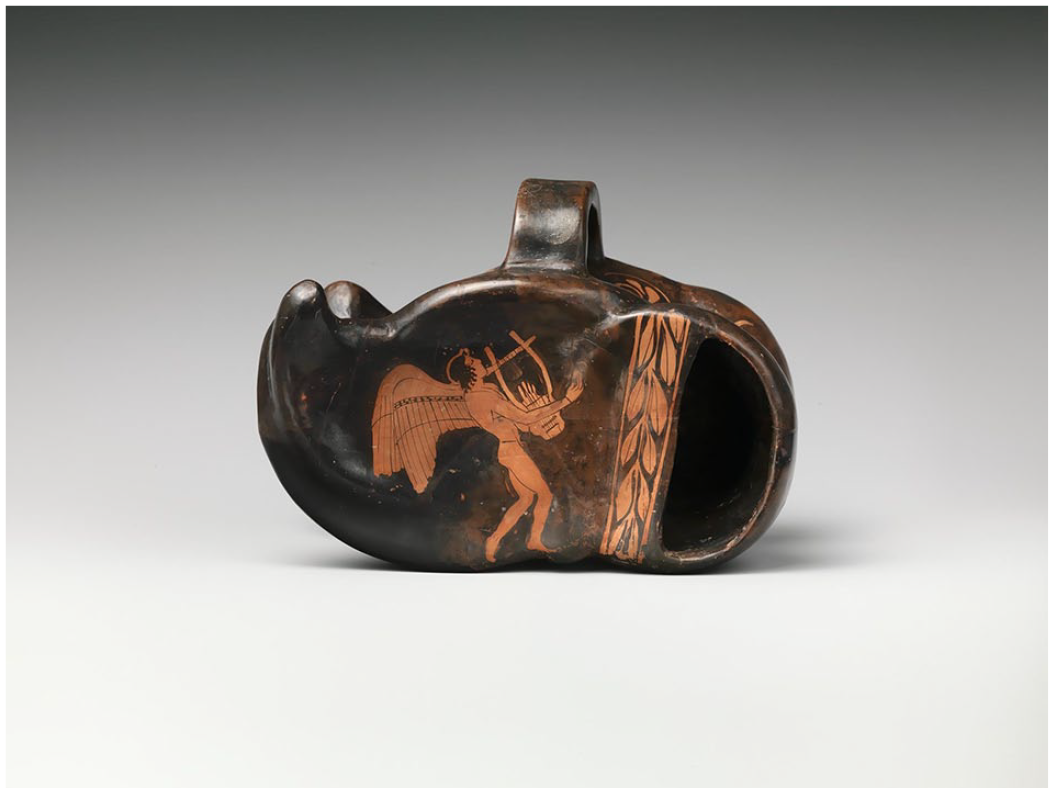
Terracotta vase in the form of an astragal (knucklebone) representing Eros holding a lyre. Attributed to an artist recalling the Painter of London D 12. From Athens, 460 BC (photo credit: Harris Brisbane Dick Fund, 1940, MMA 40.11.22).
In an Attic hydria from the same period, a boy Eros hovers over two girls playing knucklebones, crowning the winner. On a fourth century BC bronze mirror from Corinth, 73 Aphrodite herself is represented playing knucklebones with Pan, while Eros is staying behind her. From the Hellenistic Period, terracotta winged figures of Eros holding bags of knucklebones 74 are also attested.
In a fifth century BC Lucanian bell krater, an ephebos crowns Eros while he plays knucklebones on his own. 75 In the Anthologia Palatina, Eros is depicted as a knucklebone player from the time he was a baby on his mother’s lap. 76 Eros is also described as a young but skilled knucklebone player in Apollonius Rhodius’ Argonautica, a Greek epic poem written in Ptolemaic Egypt. In this episode Eros was not playing alone but against the cup-bearer of the gods Ganymede whom he defeated by cheating, taking all his knucklebones. 77
This episode from the Argonautica was represented in Graeco-Roman art and appears in later authors. 78 In Nonnus’ Dionysiaca, 79 Eros wins against Hymenaios (marital love) instead of Ganymedes who was acting as the umpire. This change in the role of Ganymedes may seem a later tradition, but it connects more directly than Apollodorus with the fifth century vase representation of the ephebos crowning Eros which could be identified as Ganymedes. 80 So, the position of Eros on the winning side of the Metropolitan knucklebone is easy to explain: in both Classical and Hellenistic Greek art and literature, Eros is always depicted as the winner at knucklebones (or kottabos). The position of Ganymedes is more variable: he is either defeated in the ‘Argonautica tradition’ or he is the umpire of the game and the ephebos who crowns Eros.
Lateral Side: Ganymedes or Kronos (in Association with Harpocrates)
The figure on the lateral side of the Metropolitan knucklebone (fig. 9, left) is a bearded man who wears a sort of short and transparent tunic to the hips and is standing on a three-quarter position. He is wearing a Phrygian cap and brings his right hand to his face to cover his mouth with the index finger.
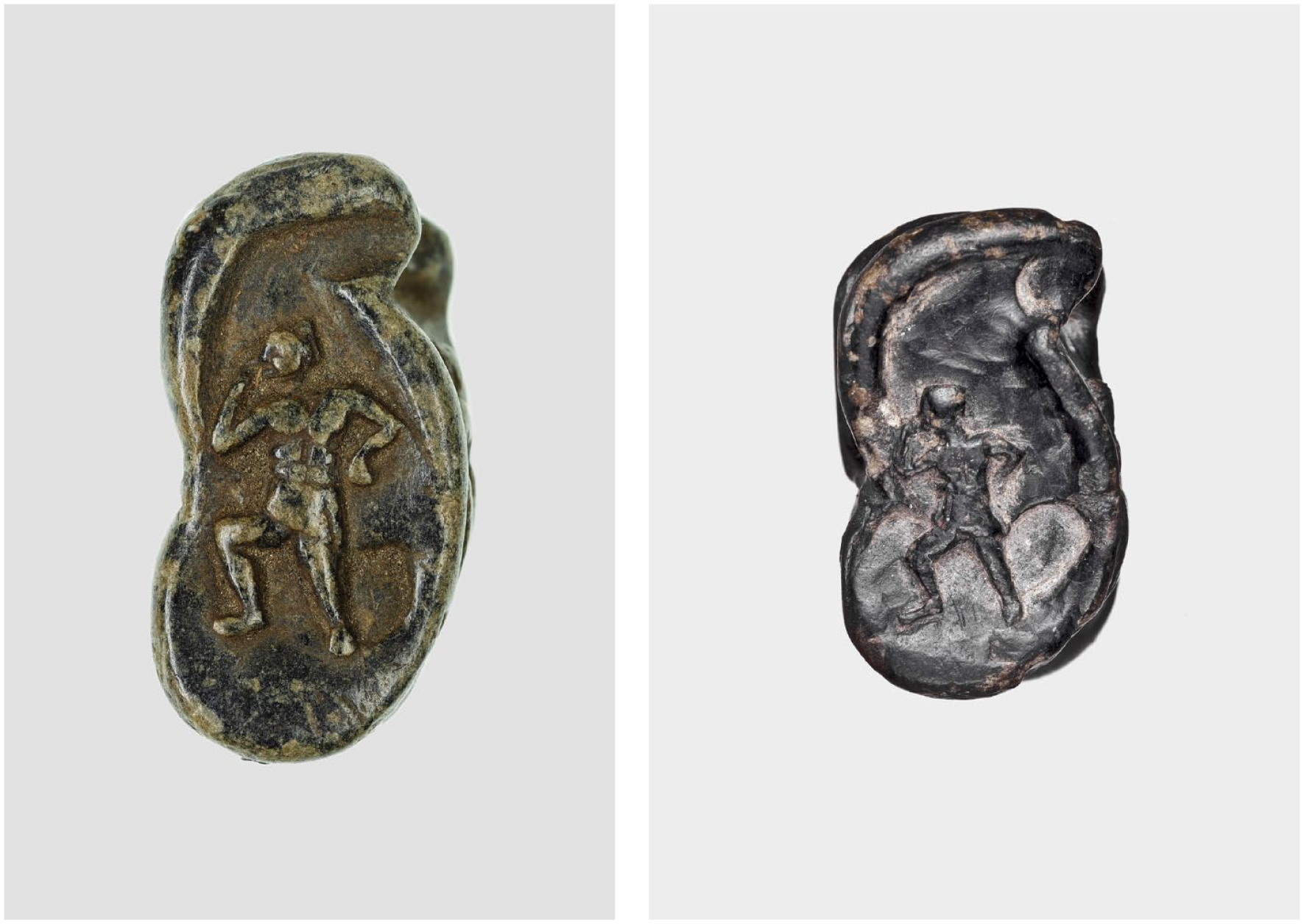
Left: lateral side of the Metropolitan Museum gabbro knucklebone. Right: lateral side of the Basel Museum steatite knucklebone.
Considering that the other two sides of the knucklebone represent divine characters, it is more likely that this third figure was either a god or a mythological hero rather than a worshipper. 81 The cap and the beard may suggest some sort of thematic connection with a knucklebone-shaped bronze ithyphallic dwarf at the British Museum. 82 However, the figure on the Metropolitan knucklebone is not a squatting dwarf with raised hands, he does not have an evident phallus, 83 and he performs the finger to mouth gesture of a solar child-god, which in the Graeco-Roman Period can be often, although not exclusively, identified with Harpocrates. 84 Also, the body position is associated with the child-god: a comparison with Roman magical gems shows that the hand on the hip, the bent knee and three-quarter position are typical of the type of ‘Harpocrates’ sitting on a lotus flower. 85 However, there are evident variations to this type on this knucklebone: the lotus is not represented and the figure is an adult or adolescent figure who is assuming a childish pose. So, while this figure is definitely a manifestation of ‘Harpocrates’, his very unusual adult representation suggests a combination with another adult deity. Interestingly, the figure on the Basel knucklebone (fig. 9, right) is different from this one because, beside the-finger-to-mouth gesture and three-quarter position, it is also a child figure, without beard and with a childish body.
I will give two possible interpretations of the bearded male figure on the Metropolitan knucklebone which will also allow me to discuss three possible contexts of use for this knucklebone.
One hypothesis that can be safely ruled out is that the knucklebone was connected to Orphic rituals, a use that was suggested by the third century BC Gurob papyrus discussed above. If we assume that the Metropolitan knucklebone was used in one of these rituals, the man with the Phrygian cap could represent the young Dionysos before he was killed and dismembered by the Titans. Indeed, as Dionysos Zagreus is a child god himself, his association with Harpocrates would be perfectly plausible. However, in the Metropolitan knucklebone, the figure is not a child-like Zagreus, but a bearded young man. Secondly, it is unclear why the child Dionysos Zagreus should be associated with Eros. 86 Also, according to sources mentioned above, the knucklebone-symbola were not meant to be thrown as dice, but to be hidden in a kalathos basket and possibly after the initiation, stored safely in the houses of the mystai. 87 The three decorated faces on the Metropolitan knucklebone show that it was meant to be thrown and the wear and tear on the Basel one suggests that too.
My first interpretation for this figure is that it represented the immortal cup-bearer Ganymedes. In Roman art, Ganymedes wears a Phrygian hat, like the figure on the knucklebone. 88 The muscular body of the character on the knucklebone presents him as a potentially desirable young man, as in fact Ganymedes is described to be in numerous sources. 89 The presence of Eros on the opposite medial side of the knucklebone creates a direct opposition with the Ganymedes figure. In the Argonautica episode, Ganymedes was an opponent to Eros because he had lost at a game of knucklebones against him and after his loss he was pitied by Aphrodite and described by her as a naïve child as opposed to Eros. However, the two boys are also said to have much in common and the Argonautica author does not even need to explain to his readers why this is the case: they are both a source of love and intense sexual desire. Indeed, Plato uses the example of Zeus’ love for Ganymedes to define the nature of the god’s sexual desire (himeros) and Lucian jokes about how Zeus is so struck with love for him that he lays his godly duties aside to play knucklebones with him. 90 Therefore both Eros and Ganymedes might have been represented on the knucklebone not so much as opponents to each other, but to grant the love and desire they were believed to inspire.
The identification of the knucklebone figure with both Ganymedes and an Egyptian solar child-deity is plausible due to the cup-bearer’s young age and his association with Isis-Aphrodite through Eros. The positive connection with the child-deity also suggests that none of the sides of this knucklebone was a losing one: each one gave some sort of reward, an assigned task or a magical outcome in the context of the throwing game. This ‘win-win’ throw would have been similar to the one proposed by Tait and Minas-Nerpel for the Roman dice with the names of Egyptian gods. 91
Furthermore, there is a second possible identification of the bearded figure on the lateral side which would justify the presence of a more adult version of Harpocrates. On a second century AD Roman magical gem, Harpocrates is represented with an adult body but with a childish pose and is identified by Mastrocinque as the Greek Titan Kronos (fig. 10). 92

Magical gem. Left: Harpocrates-Kronos, -logos. Right: baboon-headed figure riding a lion (Bibliothèque nationale de France, Cabinet des Mèdailles. Inventory 58.2195 ; photo: Serge Oboukhoff © BnF-CNRS-MSH Mondes).
Kronos was not an unusual subject to associate with knucklebones: in the astragalomanteia from Asia Minor, the Titan dictated the outcome of throws in an ambiguous way; sometimes a negative one for eating his own children and sometimes a positive one due to his identification with time. 93 In Egypt, the cult of Kronos was established from the beginning of the foundation of Alexandria. 94 He was particularly worshipped in Tebtunis where he was associated with the crocodile god Suchos 95 and the father of Osiris and earth god Geb, 96 but he was also introduced into Egypt at the same time as Serapis and in close connection to him and the whole Osirian family. 97 Kronos joined the Osirian cycle as an Egyptian re-interpretation as both a solar god and also a personification of endless and cyclical time. 98 A birthday festival in his honour called Kronia was celebrated in Egypt on the winter solstice which was also an essential time for the calendar of the Osirian mysteries and in particular Harpocrates’ birth. 99 Indeed, on the winter solstice Isis had given birth to Harpocrates, according to Plutarch, 100 although earlier Graeco-Roman Egyptian sources associated the winter solstice with his gestation. 101 Mastrocinque provided detailed comparisons with other gems and magical spells to justify the identification of Kronos with Harpocrates on the Roman magical gem CBd-3574, and argued that the gods were combined as two aspects of the same solar deity, an adult one (Kronos-Osiris) and a child one (Harpocrates). 102
The combination of child-god and older god can also be seen in the Fayyumite crocodile versions of Kronos: Kronos-Soknebtynis and Kronos Soknopaious were both worshipped in combination with a younger child-version of themselves. 103
Therefore, this evidence supports the interpretation of the figure on the knucklebone as a combination between the two solar deities Harpocrates and Kronos. If we accept such identification, there is a further possible connection with the Egyptian Cronia/Kronia. Its winter solstice celebration corresponded more or less with the time of the year when the Roman festival of the Saturnalia was celebrated, and indeed at least from a later period, Egyptian Kronia and Roman Saturnalia were probably perceived as the same festival, despite the fact that the Saturnalia in Rome ended on 23 December rather than on 25. 104 If the Egyptian Kronia were introduced by the Ptolemies alongside the cult of Kronos, they might have been initially modelled on the Attic Greek Kronia rather than the Roman Saturnalia, although the Romans believed that their own Saturnalia originated from this Greek festival which equally involved a temporary social reversal for slaves. 105 It is possible that the Egyptian Kronia evolved to be more similar to the Roman Saturnalia, but unlike in other parts of the Graeco-Roman world, the association of Kronos with the Osirian family remained an element of the Egyptian festival: during the main day of the Kronia, a festival to Isis (Kikellia) was also celebrated in Alexandria. 106 Beside the possible identification of Harpocrates with Kronos, there are two other elements which could connect the knucklebone figure with the Kronos and the Kronia/Saturnalia. Knucklebones were at the very centre of this festival’s meaning: they represented a game played during the mythical golden age of Kronos when slavery did not exist, everyone was socially equal and enjoyed peaceful leisure and prosperity. 107 For this reason, during the temporary return to this ‘golden age’, games with knucklebones and dice were allowed for socially sanctioned practices such as gambling. 108 Furthermore, Saturnalia’s knucklebones were a symbol of equality, as both Martial and Athaenaeus stress the fact that during this time of reversal, slaves were finally able to play knucklebones with citizens like equals, 109 all wearing a Phrygian (or liberty) cap which was normally worn only by freedmen. As noticed above, the cap worn by the Harpocrates-Kronos figure on the Metropolitan knucklebone is a Phrygian cap.
The reasons for a possible connection of Harpocrates-Kronos with Isis-Aphrodite are evident as both Harpocrates and Kronos are part of the Osirian cycle. However, it is less clear why Kronos and Eros would appear on the opposite sides of the same knucklebone. 110 This can be further explained through the evidence of Greek magical papyri and other Roman magical gems. 111 When Kronos is either mentioned in spells or represented on Graeco-Roman magical gems, he is presented as an emasculated deity, 112 and therefore is associated with chastity or asexuality, which were the exact opposites of what Eros could offer. 113 However in magical papyri, Kronos is also defined as hermaphrodite, a very positive characteristic in the context of magic. 114 The magical interaction between Eros and Kronos, suggests that the Metropolitan Museum knucklebone was used as a love die. It needs to be stressed that individually, on gems and magical papyri, Eros and Kronos were not exclusively linked with love and sexuality 115 but when together, the two gods seemed to interact in this context. Also, the fact that Eros was represented on the knucklebone holding a lyre rather the usual objects he holds in magical gems (torch, bow or whip), suggests a more conventional interpretation of Eros as the god of love (who wins at knucklebones). 116 On the other side, Kronos’ association with love is also stressed by his identification with Harpocrates. Harpocrates-on-a-lotus-flower had a positive meaning in love magic as suggested by a Roman love gem 117 and a love spell on a magical papyrus. 118 Isis-Aphrodite and Eros were represented together in magical gems 119 and the pair was represented with Harpocrates-on-the-lotus flower in a magical black hematite pendant. 120
As I have shown, the Metropolitan knucklebone shares themes and ideas with the magical gems and papyri, but the representation of Eros with the lyre is associated with earlier Greek traditions. This suggests, in my opinion, an earlier date for the knucklebone than the one of most magical gems, normally dated to the second–third centuries AD. The Metropolitan knucklebone could date to the late Ptolemaic or more likely, to the early Roman Period (first century AD), although there are not yet enough archaeologically provenanced comparisons to confirm this date. The shape of this object as a knucklebone also suggests a different use from the magical gems: its throw aimed proactively for a more immediate outcome, either an oracular answer or a victory against an opponent. Therefore, the interaction of the deities on the Metropolitan knucklebone was primarily associated with the player’s quest for love and sexual gratification, either through magic, or perhaps in more secular terms, through gambling.
Conclusions
The study of this rare decorated knucklebone from the Metropolitan Museum allowed me to explore the use of knucklebones in Graeco-Roman Egypt. In the Ptolemaic Period, knucklebones were no longer associated with the Egyptian game of senet and were played with Greek rules which lasted well into the Roman Period in Egypt.
The Metropolitan knucklebone probably came in a set, like other decorated knucklebones, and as the existence of the almost identical Basel example suggests. The comparison with the Basel example, which shows signs of wear and tear, allows a conclusion that these knucklebones were actually used. It is possible that they were included in a tomb, but they were not produced exclusively as tomb offerings.
The combination of a Baubo figure, Eros and Ganymedes or Kronos (in association with Harpocrates) on this knucklebone had a clear magical meaning in connection with the search for love, sex and perhaps fertility. This interpretation also connects this knucklebone with the two erotic knucklebones from the Kelsey and Petrie Museums mentioned above, although their interpretation will need more study.
The comparisons with the Roman magical gems and magical papyri spells suggest that the Metropolitan knucklebone could have been used as a love die for a private personal use or as a die for gambling against an opponent. The possible presence of a Phrygian capped Kronos figure may allude to the knucklebone games of the Kronia/Saturnalia where this gaming piece might have been used. The Egyptian Kronia/Saturnalia probably looked very different from both the Greek Kronia and the Roman Saturnalia, in a religious and cultic sense because of their links with the Osirian cycle, but in more practical terms, they may have equally allowed a time of social relaxation which involved knucklebone gaming and gambling.
Footnotes
Acknowledgements
I developed this article from a paper presented at the conference ‘Cultural Exchanges in Ancient Egypt’ which I organised with Drs Csaba La’da and Matthijs Wibier at the University of Kent in June 2020. I would like to thank the conference participants for their helpful remarks. I would also like to thank Dr Niv Allon, curator at the Metropolitan Museum, for providing new photos of the knucklebone for this article: this kind gesture during the 2020 pandemic was particularly appreciated.
Funding
The conference ‘Cultural Exchanges in Ancient Egypt’, which allowed me to develop the research for this article, was generously sponsored by the Faculty of Humanities and the School of European Culture and Languages, University of Kent.
1.
Metropolitan Museum, O.C.428. Length 3.7 cm; Width 2.2 cm; Thickness 2 cm.
2.
U. Schädler, ‘Spielen mit Astragalen’, AA 1 (1996), 61−73; J. Dandoy, ‘Astragali, the ubiquitous gaming pieces’, Expedition 38 (1996), 51.
3.
As Minas-Nerpel suggested for her analysis of a Roman icosahedron die. M. Minas-Nerpel, ‘A demotic inscribed icosahedron from Dakhleh Oasis’, JEA 93 (2007), 109.
5.
Thousands of knucklebones were found in the Corycian cave: P. Amandry, ‘Os et coquilles, L’Antre Corycien’, Bulletin de correspondance hellénique, Supplément IX (1984), 347−78.
6.
For knucklebones found in Greek sanctuaries: D. Reese, ‘Worked astragali’, in J. W. Shaw and M. C. Shaw, Kommos IV: The Greek Sanctuary (Princeton, 2000), 398−401.
7.
The Classical tombs of Locri show an anomalous number of knucklebones surrounding the skeletons. B. Carè and B. Elia, ‘Ancora sulla astragalomania a Locri Epizefiri: La documentazione dalla necropoli in contrada Lucifero’, Orizzonti: Rassegna di Archaeologia (2004), 77−91.
8.
S. J. Morewitz, J. Neils, J. H. Oakley, K. Hart, and L. A. Beaumont, Coming of Age in Ancient Greece: Images of Childhood from the Classical Past (New Haven, 2003), 146, 173, 246−7, 277−9.
9.
For Egypt and the Near East: W. Crist, A.-E. Dunn-Vaturi, and A. de Voogt, Ancient Egyptians at Play: Board Games Across Borders (London, 2016). For the Graeco-Roman World: A. Mau, ‘Ἀστράγαλος’, RE 2:2 (1896), 1793–5; U. Schädler, AA 1, 61−73; B. Carè, Astragalomania: New Perspectives in the Study of Knucklebones in the Ancient World (Berlin, forthcoming 2023).
10.
B. Carè, ‘Il gioco degli astragali: Un passatempo tra antico e moderno’, Ludica 15−16 (2009−10), 32.
11.
Dandoy, Expedition 38, 51.
12.
Dandoy, Expedition 38, 32.
13.
Mau, RE 2:2, 1794; Propertius, Elegies 4.9.17; Ovid, Ars Amatoria 2.205, Fasti 2.473.
14.
J. Marquardt, Das Privatleben der Römer, II (Darmstadt, 1886), 850.
15.
Suetonius, Life of Augustus, 71.4
16.
See also Martial, Epigrams 14, 14.
17.
See also Pollux, Onomasticon, 9, 113−14.
18.
Pseudo-Lucian, Amores 16.
19.
Plato (Phaedrus 274d) attributes the invention to the Egyptian god Thoth.
20.
21.
Piccione brings the example of the tomb of Tutankhamun where senet boards were found with both sticks and knucklebones. The knucklebones were introduced in connection with the Near Eastern game of twenty squares. P. Piccione, ‘The Egyptian game of senet and the migration of the soul’, in I. Finkel (ed.), Board Games in Perspective: Proceedings of the Colloquium on Board Games of the Ancient World (London, 2007), 54−63.
22.
Crist, et al., Ancient Egyptians at Play, 62−6.
23.
P. Cair. Zen. 1 59069 (257 BC, Kharabet el Gerza, ancient Philadelphia); PSI IV 331 (257−56 BC, Philadelphia, Arsinoites); PSI IV 444 (also known as P. Cair. Zenon I 59019). Zenon was at first a business representative and private secretary of the dioiketes (minister of finances) Apollonios. Later he became the manager of an estate of Apollonios in Philadelpheia. R. Haensch, ‘Spiele und Spielen im Römischen Ägypten: Die Zeugnisse der verschiedenen Quellenarten’, Revue Archimede 6 (2019), 175−85.
24.
Plutarch, Antony 29.1.
25.
L. A. V. Becq de Fouquières, Les jeux des Anciens : Leur description, leur origine, leurs rapports avec la religion, l’histoire, les arts et les moeurs (Paris, 1873), 352; Carè, Ludica 15−16, 32.
26.
M. Vespa, ‘Knucklebone faces and throws: Play, rules, and rhetorical discourse in Julius Pollux’, Mnemosyne 1 (2021), 1−18.
27.
P. Gurôb 1; Pack 2 2464. J. Hordern, ‘Notes on the Orphic papyrus from Gurôb (P. Gurôb 1; Pack² 2464)’, ZPE 129 (2000), 131−40 (with further bibliography); A. Bernabé, ‘La toile de Pénélope: A-t-il existé un mythe orphique sur Dionysos et les Titans?’, Revue de l’histoire des religions 219 (2002), 341. The authors express a different position on whether this is an Orphic and Eleusinian text or just an Orphic text with parallels to Eleusinian texts.
29.
Diodorus Siculus (Library of History 4.4.1, 5, 4.5.2, 4.6.1, 5.75.4) explains that there were two versions of Dionysos: one son of Zeus and Semele and one older Dionysos son of Zeus and Persephone. There are later sources as well, the most complete is Nonnus, Dionysiaca 4.268, 5.562, 6.155, 10.290.
30.
Levaniouk argued that the killing and consumption of the meat gave the initiate the Titans’ pollution and required a purification; O. Levaniouk, ‘The toys of Dionysos’, HSCP 103 (2007), 164.
31.
Levaniouk, HSCP 103, 166−7.
32.
Hordern, ZPE 129, 139 nn. 29−30.
33.
Protrepticus 2.17.2; see also Anthologia Palatina 6.309.
34.
In Exhortation to the Greeks 2.21, Clement of Alexandria reports that in Eleusinian mysteries, sacred objects are also put into a kalathos. According to Clement, among these sacred objects there is a representation of female genitalia.
35.
A connection with Demeter and Persephone can also be found outside Egypt: for instance, a high number of knucklebones were found in the sanctuary of Demeter and Persephone in Acrocorinth; D. S. Reese, ‘Faunal remains from Greek sanctuaries: A survey’, in R. Hägg and B. Alroth (eds), Greek Sacrificial Ritual: Olympian and Chthonian. Proceedings of the Sixth International Seminar on Ancient Greek Cult, 25–27 April 1997 (Stockholm, 2005), 121–3.
36.
37.
Golden dwarf with raised hands: Geneve Fondation Gandur inv. FGA-ARCH-GR-0080; bone dwarf from Lyon Lugdunum Museum inv. A 1642. Both in V. Dasen, Ludique : Jouer dans l’antiquité (Gent, 2019), 109. Bronze dwarf (unpublished): British Museum inv. 1772,0311.206.
38.
An article on these two knucklebones is in preparation.
39.
Kelsey Museum inv. 3207. Length 3.4 cm; Width 2 cm; Thickness 1.8 cm; Weight 25 g.
40.
Petrie Museum UC44997.
41.
Many thanks to Prof. David Reese for sending me information about this knucklebone.
42.
43.
Most of the sources about the astragalomanteia come from Asia Minor. T. Hopfner, ‘Astragalomanteia’, RE 2:2 (1896), 1793; J. Nollé, Kleinasiatische Losorakel: Astragal- und Alphabetchresmologien der hochkaiserzeitlichen Orakelrenaissance (München, 2007).
44.
In one coin from Samos, two children interrogate the statue of Hera and then cast the knucklebones. M. Dillon, Omens and Oracles: Divination in Ancient Greece (London, 2020), 272 ( .2). A third century AD coin from Ephesos of the Emperor Valerian II represents two nude children playing with astragali with a cult statue of Artemis Ephesia behind them. Karwiese 1218. RPC VI online 5066 corr. (misdescribed as ‘Maximus’). SNG Copenhagen 539.
45.
Joachim Quack has suggested that divination was the purpose of dice with Egyptian deities on them. J. F. Quack, review of M. A. Stadler, Isis, das göttliche Kind und die Weltordnung (MPER 28; Vienna, 2004), AfP 51:1 (2005), 175.
46.
In the Homeromanteia, Homeric excerpts were used as oracular texts and randomly selected through the throw of dice. For Homeric oracular texts associated with the throw of dice see PGM VII, fourth century AD.
47.
Isis, Osiris, Horus, Har-Behdety and Hathor. J. Tait, ‘Dicing with the gods’, in W. Clarysse and A. Schoors (eds), Egyptian Religion: The Last Thousand Years. Studies Dedicated to the Memory of Jan Quaegebeur (Leuven, 1998), 257−64. Many thanks to Prof. John Tait for sending me this article.
48.
Minas-Nerpel, JEA 93, 137–48.
49.
Minas-Nerpel, JEA 93, 148.
50.
A. Nifosi, Becoming a Woman and Mother in Graeco-Roman Egypt (Oxford, 2019), 91−3.
52.
W. M. F. Petrie, Naukratis 1884-5, I, (London, 1886), pl. XIV, n. 4.
53.
On the iconography of all types of Baubo terracottas: Nifosi, Becoming a Woman, 98−102.
54.
The earliest version of this story is in the Homeric Hymn to Demeter: however, in this version the woman is called Iambe and is not explicitly talking about exposing herself. The most complete versions are the fragments from Clement of Alexandria (Exhortation to the Greeks, 2) and Arnobius (Adversus nations, 5.25–26) who attribute such verses to Orpheus.
55.
Terracotta votive from the Sanctuary of Demeter and Kore in Priene (fourth−second century BC): Berlin, Antikensammlung, inv. TC 8612.
56.
D. M. Bailey, Ptolemaic and Roman Terracottas from Egypt (London, 2008), 46.
57.
J. McKenzie, The Architecture of Alexandria and Egypt, C. 300 BC to AD 700 (New Haven, 2010), 34, 64; L. Török, Hellenistic and Roman Terracottas from Egypt (Rome, 1995); Bailey, Ptolemaic and Roman Terracottas, 46.
58.
Bailey, Ptolemaic and Roman Terracottas, figs 3131−2.
59.
V. Dasen, Le sourire d’Omphale : Maternité et petite enfance dans l’antiquité (Rennes, 2015), 2795−8.
60.
See Nifosi, Becoming a Woman, 92−102, 234, for links of these generic female figures to the Dynastic Egyptian figurines.
61.
Dasen, Ludique, 108. See also Dasen, Le sourire d’Omphale, 2541 and V. Dasen, ‘Omphale and Heracles: A knotted life’, Gemmae: An International Journal on Glyptic Studies 3 (2021), 61−82.
62.
Herodotus, Histories, 1.94.
63.
First century BC pot shaped like the head of Herakles containing five knucklebones from Asia Minor (Dasen, Ludique, 104−5) and knucklebone-shaped askos with nodus Herculaneum on its handle (Dasen, Ludique, 96).
64.
Dasen, Le sourire d’Omphale, 2572.
65.
Campbell and Bonner database gem n. 1703 (hereafter, CBd-). For comparisons and interpretation of the Baubo figure washing her genitals see Nifosi, Becoming a Woman, 105.
66.
British Museum inv. 1995,0123.1 and EA37581.
67.
Bronze anthropomorphic die first–second century AD, Fribourg Museum BIBLE+ORIENT, inv. GFig 2000.2, in Dasen, Ludique, 109.
68.
Bronze die in form of squatting figurine with four dots on the belly and breast. British Museum inv. 1975,1103.1.
69.
Dasen, Ludique, 108.
70.
Anacreon, Fragments, 34; Lucian, Dialogues of the Gods, 4.3; Apollonius Rhodius, Argonautica, 3.114; Anthologia Palatina, 12.46−7; Clement of Alexandria, Protrepticus, 2.17.
71.
Anacreon, Fragments, 398.
72.
Metropolitan Museum inv. 40.11.22.
73.
British Museum inv. 1888,1213.1.
74.
British Museum inv. 1868,0705.29.
75.
British Museum inv. 1856,1226.8.
76.
Anthologia Palatina, 12.47.
77.
Apollonius Rhodius, Argonautica, 3.112.
78.
Philostratus the Younger (Imagines, 8) writes in the third century AD and describes a painting which represents this episode from the Argonautica.
79.
Nonnus, Dionysiaca, 33.74. The game is kottabos rather than knucklebones.
80.
As suggested by the British Museum catalogue (see above, n. 74).
81.
This also finds a good comparison with the Egyptian dice with names of gods on each side discussed in 1.3.
82.
The bearded dwarf had raised hands and the skull-cap tied on his forehead. Presented by W. M. F. Petrie to the British Museum in 1891 and published in W. Beauchamp, Catalogue of the Bronzes, Greek, Roman, and Etruscan in the Department of Greek and Roman Antiquities, British Museum (London, 1899), n. 1669.
83.
The natural shading of the stone in the upper part of right leg may suggest the presence of a phallus, but, from a closer observation, it looks like a part of the thigh.
84.
For the typical gestures that allow the identification of child deities see: D. Budde, ‘Child deities’, in J. Dieleman and W. Wendrich (eds), UCLA Encyclopedia of Egyptology (Los Angeles, 2010), 2−3.
85.
This is the most frequent way of representing Harpocrates on magical gems: A. M. El-Khachab, ‘Some gem-amulets depicting Harpocrates seated on a lotus flower: To the memory of my great friend Dr. Alexandre Piankoff’, JEA 57 (1971), 132–45. See for example CBd-533 = inv. EA 56139 (British Museum), third century AD. The identification of this solar child with Harpocrates cannot always be demonstrated. Budde, in Dieleman and Wendrich (eds), UCLA Encyclopedia of Egyptology, 5. I will call this figure Harpocrates although I leave the possibility open for the identification of this figure with other child deities as well.
86.
Eros was associated with Dionysos in Greek love poetry and Platonic philosophy but not in the Orphic context. Anacreon, Fragments, 12, 346, 357; Plato, Phaedrus, 265b.
87.
See 1.1 and for the storage of the toys-symbola in the house: Levaniouk, HSCP 103, 170.
88.
Several examples can be found here: Warburg Institute Iconographic Database <https://iconographic.warburg.sas.ac.uk/vpc/VPC_search/subcats.php?cat_1=5&cat_2=245> accessed 18.05.2021.
89.
Homer, Iliad, 20.232; Pseudo-Hyginus, Fabulae, 271; Diodorus Siculus, Library of History, 4.75; Pseudo-Hyginus, Astronomica, 2.29.
90.
Plato, Phaedrus, 255. Lucian, Dialogues of The Gods, 8.
91.
See 1.3.
92.
93.
See both in Nollé, Kleinasiatische Losorakel, 174, spell no. 50 to Kronos τεκνοφάγος and p. 158, for dice spell no. 63 inscribed on the cell wall of a temple in Antiochia ad Cragum which addressed Kronos identified with Chronos/time as ἀγᾰθός.
94.
J. N. Bremmer, Greek Religion and Culture, the Bible, and the Ancient Near East (Leiden, 2008), 82−3.
95.
Mastrocinque, Kronos, 15.
96.
V. Rondot, Derniers visages des dieux dʼÉgypte : Iconographies, panthéons et cultes dans le Fayoum hellénisé des IIe–IIIe siècles de notre ère (Paris, 2013), 75–80, 122–7, 241–6.
97.
According to Macrobius, the cult of Saturn was closely associated with the one of Serapis and was introduced into Egypt at the time of the Ptolemies. The Egyptians were reluctant to adopt both cults because they included blood sacrifices. Macrobius, Saturnalia, 1.7.15−16.
98.
R. Pettazzoni, ‘Aion-(Kronos) Chronos in Egypt’, in R. Petazzoni (ed.), Essays on the History of Religions (Leiden, 1967), 172−8.
99.
A third century AD papyrus from Oxyrhynchus (P.Oxy.VII. 1025, 275–299 AD) describes it as ‘the birthday feast of Kronos the chief god’ and said it was celebrated in Euergetis. Epiphanios (Panarion 22, 3–11) says that it fell on the winter solstice. See full discussion in Petazzoni, in Petazzoni (ed.), Essays on the History of Religions, 172−8.
100.
Plutarch De Iside et Osiride, 65. See also Macrobius, Saturnalia, 1.18.10.
101.
G. Priskin, ‘The Dendera zodiacs as narratives of the myth of Osiris, Isis, and the child Horus’, ÉNeM 8 (2015), 145.
102.
Mastrocinque, Kronos, 19. Mastrocinque explains the solar nature of Kronos and his combination with Harpocrates on the CBd-3574 magical gem. He makes three points: 1) the magical name (σι)σισρω on the gem (, above) is typical of Kronos gems and meant ‘son of the Ram’, a name which was connected both with the solar god at sunset but also with two Decans of Capricorn in the house of Saturn; 2) the iconography of the monkey on the back of the lion on the other side of the CBd-3574 gem (fig. 10, right) was also associated with other Kronos gems and the cynocephallic monkey represented Capricorn in the house of Saturn while the lion represented the sun god; 3) there is a parallel between the Harpocrates-Kronos in CBd-3574 and PGM IV 985 in which Harpocrates and Kronos were offered the same prayer through their magical names and animal avatars.
103.
G. Tallet, ‘Isis, the crocodiles and the mysteries of the Nile floods’, in C. Giuffrè Scibona and A. Mastrocinque (eds), Demeter, Aphrodite, Isis, and Cybele: Studies in Greek and Roman Religion in Honour of Giulia Sfameni Gasparro (Stuttgart, 2011), 149−50.
104.
Macrobius, Saturnalia, 1.7.15−16 (and see above n. 97). Epiphanius (Panarion, 51.22.5) identifies the Saturnalia with the festival of the winter solstice: ‘This day [of the solstice] called Saturnalia among the Romans, Kronia among the Egyptians, and Kikellia among the Alexandrians, was celebrated by the Greeks on the 8th day before the calends of January’ (December 25).
105.
The Attic festival called Cronia was celebrated in the month of August. Bremmer, Greek Religion, 82−3. The Greek Cronia, according to the second century BC playwright Accius (Annals, 2−7), existed before the Roman Saturnalia being an earlier Greek festival, was celebrated in the month of August and saw a temporary social reversal in the role of slaves. Athaenaeus of Naukratis (third century AD) calls the Roman Saturnalia ‘Cronia’ and explains that the masters’ provision of a meal and a day off duty to the slaves was originally a Greek custom. Athenaeus, The Learned Banqueters, 14.639b. See the Cronia mentioned as Saturnalia in 14.639e. A celebration of Saturnalia in an early context is also attested in Plutarch, Pyrrhus, 20.
106.
Epiphanios, Panarion, 22, 3−11. Petazzoni, in Petazzoni (ed.), Essays on the History of Religions, 178 n. 34.
107.
Athenaeus, Banqueters, 6.267e, 268d.
108.
Martial, Epigrams, 4.14.7−10. Gambling with knucklebones and dice was considered inappropriate in normal times and in some periods; it could have been even forbidden by law: Cicero, Against Catiline, II.10, Letters to Atticus, XIV.5. Plautus (Miles Gloriosus, 2.2) mentions a lex alearia (also read as talaria) which formally forbade dice gaming in Rome, but the reading of the name and meaning of this law is uncertain. The De Aleatoribus passage in Justinian’s Digest, 11.5, suggests that punishment for gambling could be harsh only if it caused violent altercations. This also explains why Cicero, who condemns gambling, also admits to playing with knucklebones (Cicero, De Senectute, 16).
109.
Athenaeus, Banqueters, 14.639c.
110.
I will not consider here the late Orphic fragment, 360 where Eros is mentioned as the son of Kronos because there are many other parallel traditions in Orphic literature about the ancestry of Eros. A. N. Athanassakis and B. M. Wolkow, The Orphic Hymns (Baltimore, 2013), 137–9.
111.
The connection in themes and contents between magical gems and magical papyri is widely accepted and recently discussed by P. Vitellozzi, ‘Relations between magical texts and magical gems: Recent perspectives’, in S. Kiyanrad, C. Theis, and L. Willer (eds), Bild und Schrift auf Magischen Artefakten (Berlin, 2018), 181−253.
112.
The lack of genitals of Kronos is evident in the Roman Harpocrates-Kronos gem mentioned above and it could be argued that the figures on the Metropolitan and Basel knucklebone present no evident genitals either.
113.
In the oracular spell in PGM IV (3086–124), Kronos is threatened with a rib of a castrated black boar. According to Mastrocinque, the castrated boar was Kronos’ magical avatar, and this put him in direct opposition to Eros who was represented on magical gems as a sexually active pig or boar. Mastrocinque, Kronos, 44−8.
114.
In the oracle to Kronos PGM IV 3100 the god was invoked as hermaphrodite (arsenothelys). Mastrocinque, Kronos, 74 and n. 22.
115.
For the broader Gnostic and Orphic interpretations of Eros and Kronos, see M. J. Edwards, ‘Gnostic Eros and Orphic themes’, ZPE 88 (1991), 25–40.
116.
See CBd database ‘Eros’ for comparisons on gems.
117.
Harpocrates on a lotus flower: CBd-534.
118.
‘A praxis known from a papyrus (PGM LXI 1−38) specifies that love charms had to be incised with the image of Horus on a lotus flower and the magical name Abraxas.’ Commentary from CBd-534.
119.
Isis-Aphrodite and Eros: CBd-481; CBd-491; CBd-1364.
120.
CBd-533, third century AD, British Museum inv. EA 56139.