



Abstract
Since antiquity, the tomb of Ramesses III (KV 11) has been among the most frequently visited royal tombs in the Valley of the Kings. It was also one of the first to be described and documented in detail by European travellers in the eighteenth to nineteenth centuries. As large parts of the wall decoration of the tomb, especially in its rear, are now destroyed, the drawings, notes and squeezes of those early researchers who saw the site in its former splendour offer an invaluable resource for the reconstruction of the tomb’s unique decoration programme. The collection, revision, and publication of all relevant archive material concerning KV 11 is an important goal of The Ramesses III (KV 11) Publication and Conservation Project. The following article reports on first and preliminary results from the authors’ research in the archives of the British Library and the Victoria and Albert Museum in London, as well as the Bodleian Libraries and the Griffith Institute in Oxford, carried out in September 2019 and made possible through the Centenary Award 2019 of the Egypt Exploration Society.
Introduction
The Ramesses III (KV 11) Publication and Conservation Project, based at Humboldt University of Berlin, aims to fully document, conserve and publish the tomb of Ramesses III.
1
Along with ongoing archaeological fieldwork and conservation measures, the scientific study of the tomb’s architecture (fig. 1) as well as its textual and pictorial decoration programme form the basis of the project’s research. Since devastating floods destroyed most of the wall decoration in the tomb’s rear compartments and the lower areas of its front part,
2
the accounts of early travellers hold much important information that would otherwise have been lost. Apart from the publications of the Napoleonic, Franco-Tuscan, and Prussian expeditions,
3
most of the documentation work carried out in KV 11 before the tomb was flooded has never been published.
4
Bertha Porter and Rosalind Moss already identified many manuscripts held in archives depicting scenes from KV 11 for the Topographical Bibliography,
5
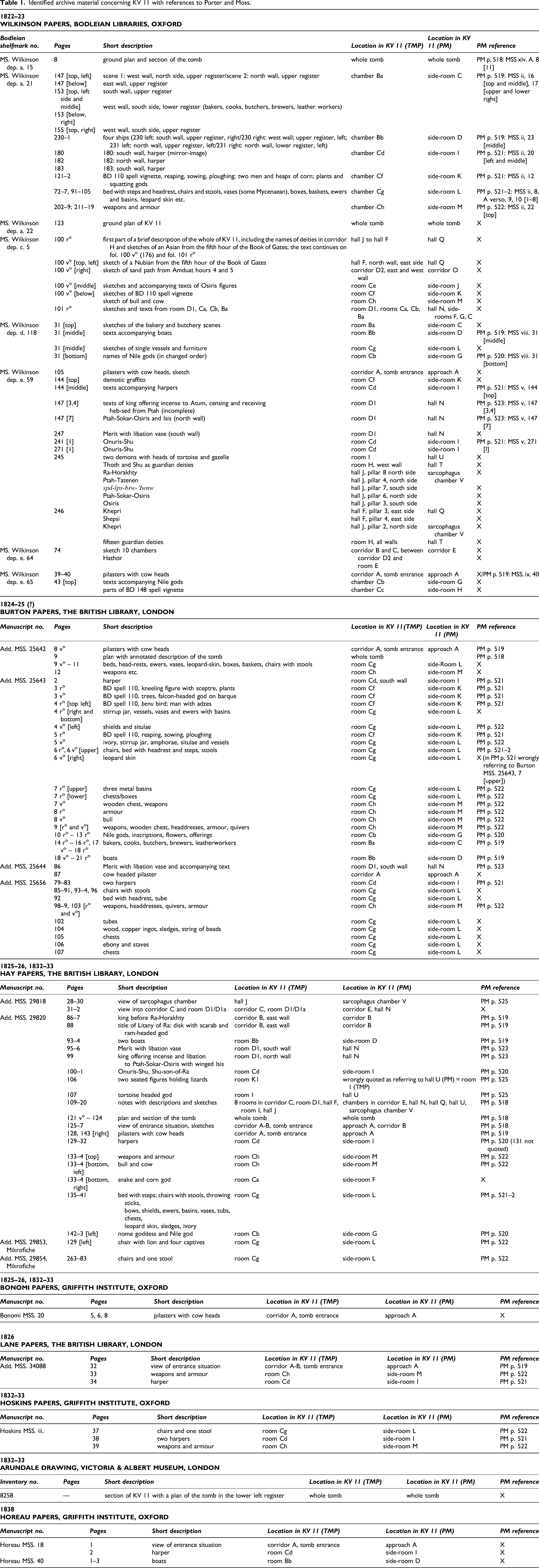
and many additional references were found during our work in the archives of the British Library and Bodleian Libraries, as well as the Griffith Institute and the Victoria and Albert Museum. Ground plan of KV 11 after The Theban Mapping Project.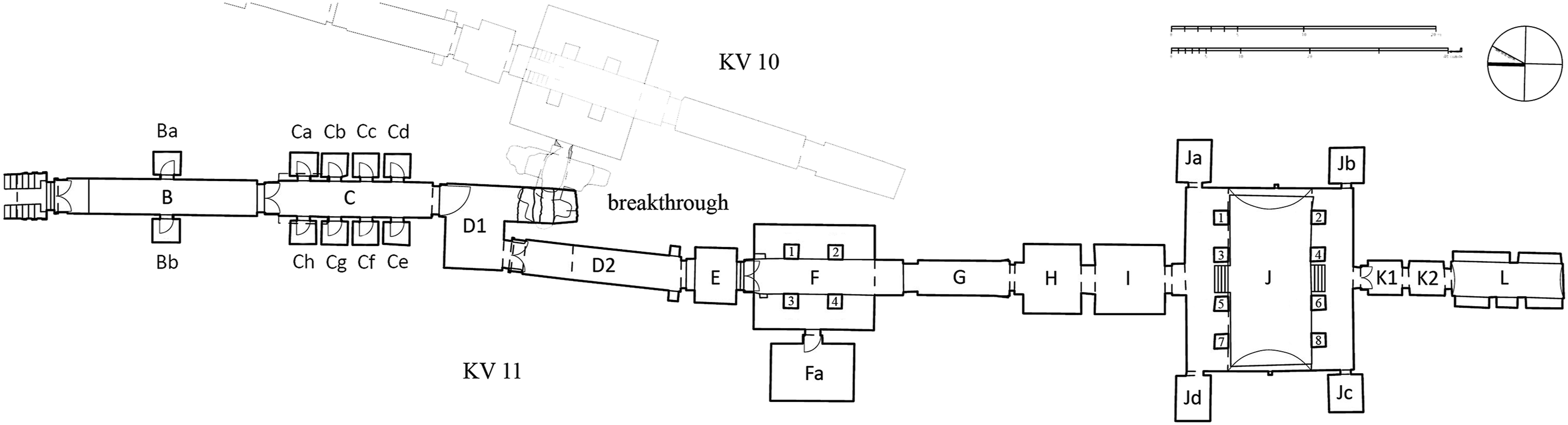
This article aims to present the work carried out in KV 11 by early travellers such as Sir John Gardner Wilkinson (1797–1875), James Burton (1786–1862), and Robert Hay (1799–1863) and his collaborators Joseph Bonomi (1796–1878), Francis Arundale (1807–53), George Alexander Hoskins (1802–63), and Edward William Lane (1801–76), and seeks to demonstrate its importance as a source of information for the reconstruction of the tomb’s decoration programme. The remarkable accuracy of drawings was frequently ensured by the use of a camera lucida, an optical device composed of prisms and mirrors which projects an image of a wall or object on the artist’s drawing paper, resulting in extremely precise sketches that are free of distortion. This is why Robert Hay, for example, praised it as a ‘most correct instrument’, even if he claims to have preferred to sketch freely.
6
Both Bonomi and Lane knew its inventor William Hyde Wollaston, who had patented it in 1806, and Lane had been personally trained in its use by Wollaston.
7
Many of the above-mentioned travellers regularly made use of this visual aid which made it easy to control perspective and proportions. Due to their accuracy, the drawings can be perfectly matched with photographs and photogrammetry-based orthophotos showing the current state of the tomb (fig. 2). Thus, in combination with tracings of the actual remains, it is possible to visualise the walls with their former colourful decoration and to reconstruct scenes which are nowadays partially or completely lost. Composite image of a modern photograph (© The Ministry of Antiquities, The Ramesses III (KV 11) Publication and Conservation Project) and overlapping drawing with camera lucida from the archive of Robert Hay (© British Library Board, Add. MSS. 29820, fol. 139).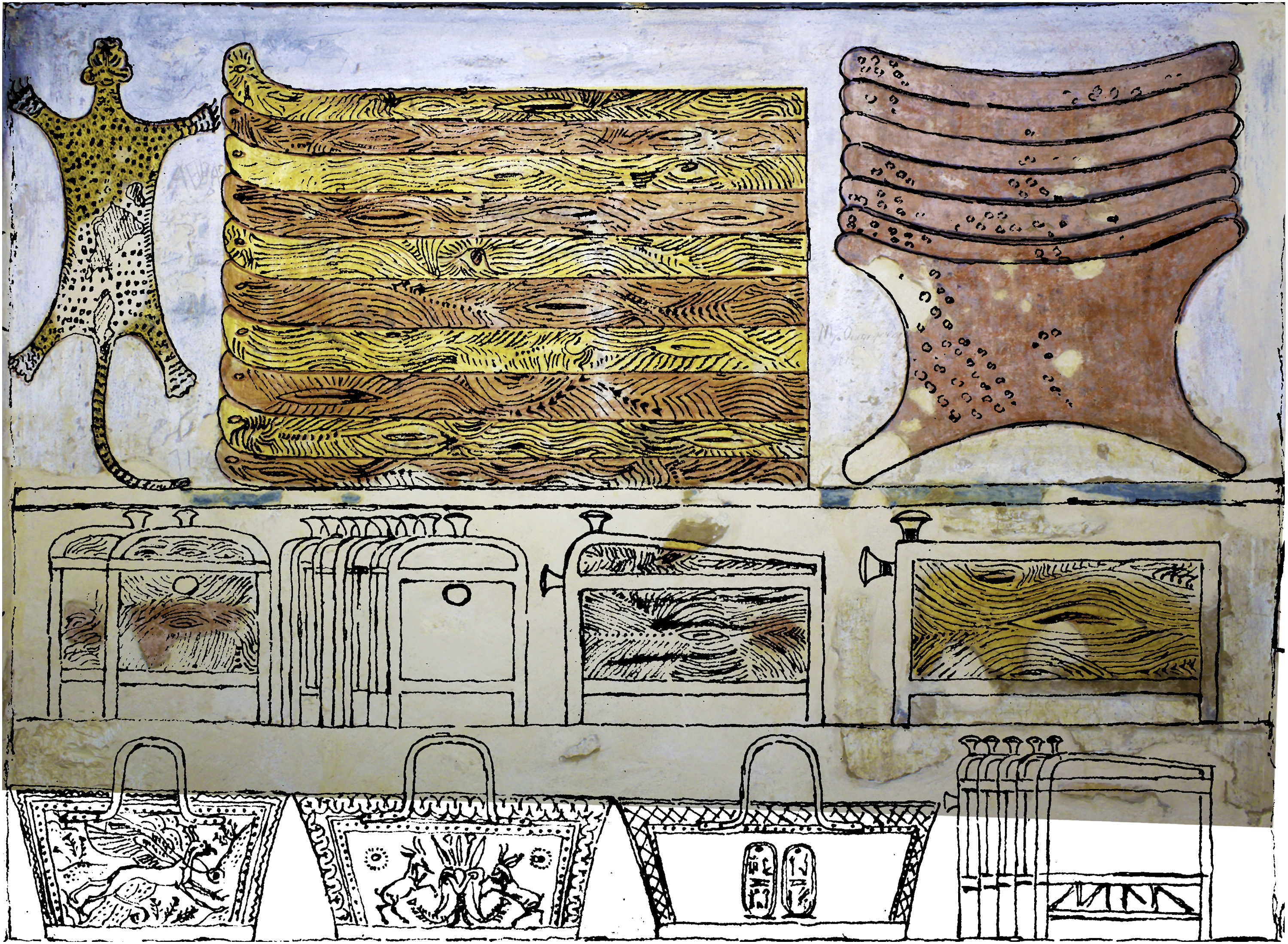
Identified archive material concerning KV 11 with references to Porter and Moss.
Willem Hovestreydt is working on the reconstruction of the tomb’s rear, especially rooms H, I, K1–K2 and L. His first promising results show the value of using archive material in combination with modern state-of-the-art techniques.
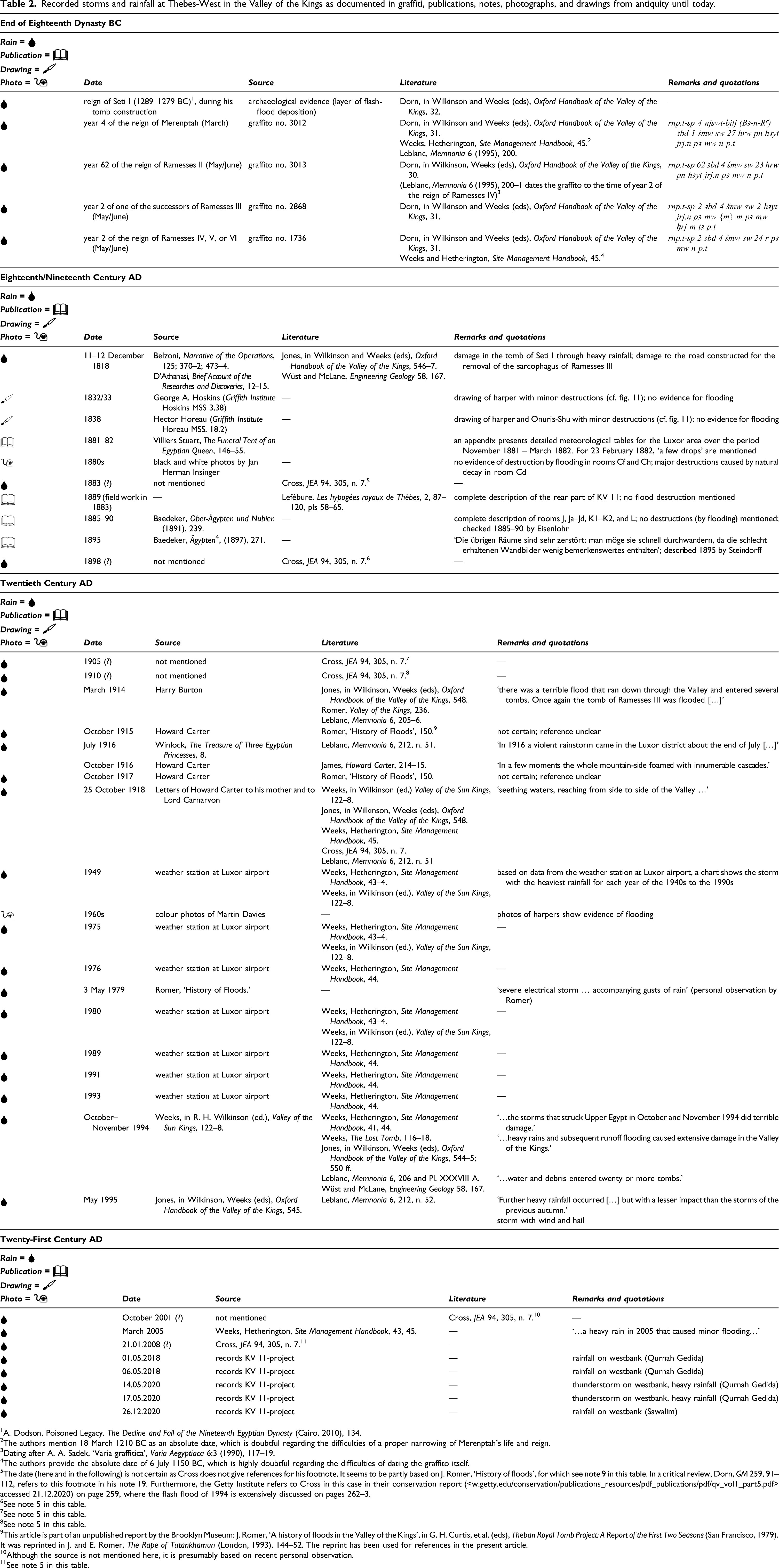
Recorded storms and rainfall at Thebes-West in the Valley of the Kings as documented in graffiti, publications, notes, photographs, and drawings from antiquity until today.
















1A. Dodson, Poisoned Legacy. The Decline and Fall of the Nineteenth Egyptian Dynasty (Cairo, 2010), 134.
2The authors mention 18 March 1210 BC as an absolute date, which is doubtful regarding the difficulties of a proper narrowing of Merenptah’s life and reign.
3Dating after A. A. Sadek, ‘Varia graffitica’, Varia Aegyptiaca 6:3 (1990), 117–19.
4The authors provide the absolute date of 6 July 1150 BC, which is highly doubtful regarding the difficulties of dating the graffito itself.
5The date (here and in the following) is not certain as Cross does not give references for his footnote. It seems to be partly based on J. Romer, ‘History of floods’, for which see note 9 in this table. In a critical review, Dorn, GM 259, 91–112, refers to this footnote in his note 19. Furthermore, the Getty Institute refers to Cross in this case in their conservation report (<w.getty.edu/conservation/publications_resources/pdf_publications/pdf/qv_vol1_part5.pdf> accessed 21.12.2020) on page 259, where the flash flood of 1994 is extensively discussed on pages 262–3.
6See note 5 in this table.
7See note 5 in this table.
8See note 5 in this table.
9This article is part of an unpublished report by the Brooklyn Museum: J. Romer, ‘A history of floods in the Valley of the Kings’, in G. H. Curtis, et al. (eds), Theban Royal Tomb Project: A Report of the First Two Seasons (San Francisco, 1979). It was reprinted in J. and E. Romer, The Rape of Tutankhamun (London, 1993), 144–52. The reprint has been used for references in the present article.
10Although the source is not mentioned here, it is presumably based on recent personal observation.
11See note 5 in this table.
All results in the following are preliminary, reflecting the state of our team’s work up to 2020. 9 Further research will be carried out in the years to come.
Historical background
From 1811, when Muhammad Ali (1769–1849) had become sole ruler of Egypt, several cultural institutions dedicated to the study of ancient as well as contemporary Egypt were founded as the country had become more accessible and safer for Western travellers. This enabled them to remain in Egypt for long periods and thus provided ample opportunities to study and record the antiquities they encountered. 10 Among those travellers were John Gardner Wilkinson, James Burton, Robert Hay, Joseph Bonomi, Francis Arundale, George Alexander Hoskins, and Edward William Lane, all of whom were in contact with each other, working and travelling together in different constellations at different times.
Wilkinson and Burton met in Italy when the former was studying with Sir William Gell in preparation for a prolonged stay in Egypt, and they met again in Egypt after Burton had been part of Muhammed Ali’s Geographical Survey of Egypt in 1822. 11 Wilkinson had already settled in Egypt in 1821 and stayed there until 1833. 12 He moved into TT 83, the tomb of ꜥꜣ-mṯw (Ahmes) in Qurnah, and transformed the ancient tomb into ‘Qasr Wilkinson’, which functioned as a sort of dig house that would welcome generations of Egyptologists, including Edward William Lane, George Hoskins, and Robert Hay. 13 The latter started on a Grand Tour in 1824 and employed the financially troubled Joseph Bonomi the Younger to record the sites he visited, first in Italy and Malta, before they set out for Egypt together and travelled further down the Nile towards Nubia. 14 Bonomi and Hay split up in July 1826 after constant quarrelling about Bonomi’s salary and whether their contract allowed Bonomi to produce drawings for himself. Bonomi then offered his services to Burton instead, whom he supported with the publication of his Excerpta Hieroglyphica. 15 In the meantime, Bonomi’s position as Hay’s assistant had been temporarily taken on by Edward William Lane, whom Hay had met before in Cairo and with whom Burton had travelled up the Nile in 1825. Lane is less known in Egyptology, since his account of Ancient Egypt entitled Description of Egypt remained unpublished until 20 years ago. 16 With his study Manners and Customs of the Modern Egyptians, as well as his translation of One Thousand and One Nights and the publication of the first Arabic-English Lexicon, however, he still remains one of the most influential orientalist scholars today. 17 Bonomi rejoined Hay’s team in 1832, after being promised a higher salary. At that time, the architect Francis Arundale and George Hoskins had become part of Hay’s team as well, and together they produced an impressive archive of drawings, panoramas, squeezes, and notes. 18 The team continued to work, even when Hay travelled to Nubia again in 1833, sometimes accompanied by Arundale, while Hoskins went to Ethiopia. 19 In 1834 however, they went separate ways, with Bonomi and Arundale making their way to Palestine, 20 whereas Hay returned to Britain.
Manuscripts concerning KV 11
Sir Gardner Wilkinson used many scenes from KV 11 in his Manners and Customs of the Ancient Egyptians, but did not attribute them to the tomb precisely. 21 Today, his voluminous papers are held by the Bodleian Libraries of the University of Oxford and comprise a large amount of sketch- and notebooks, papers relating to his travels, his residency in Egypt and various publication projects, as well as personal notes and letters. 22 The references in the Topographical Bibliography refer to an old numbering system when the papers were still held by the Griffith Institute; 23 in the new numbering system of the Bodleian Libraries, references to KV 11 can be found in the manuscripts with the shelfmarks MS. Wilkinson dep. a. 15, a. 21, a. 22, c. 5, d. 118, e. 59, e. 64, and e. 65 (see table 1 for a chronological overview of the manuscripts, including a short description of the content and the precise location of depicted scenes). 24 Additional scenes to the references provided by Porter and Moss (marked with an X in the table) include, among others, a ground plan of KV 11 (MS. Wilkinson dep. a. 22, fol. 123), scenes from the small chambers in the front part of the tomb (dep. d. 118, fol. 31; e. 59, fol. 241; e. 65, fol. 43), as well as scenes from the Amduat (dep. c. 5, fol. 176), the Book of Gates (dep. c. 5, fol. 100, 176), and the Book of the Dead (dep. c. 5, fol. 176; dep. e. 65, fol. 43).
The British Library in London holds the manuscripts of the travellers James Burton, Robert Hay, and Edward William Lane. James Burton’s sketchbooks and drawings refer to KV 11 in Add. MSS. 25642, 25643, 25644, and 25656. Additional to the references published in Porter and Moss, scenes copied from KV 11 are the pieces of furniture from chamber Cg (Add. MSS. 25642, fol. 9v–11; Add. MSS. 25643, fol. 4r, 6v; Add. MSS. 25656, fol. 85–94, 96, 102, 104–7) and weapons from chamber Ch (Add. MSS. 25642, fol. 12). The papers of Robert Hay include drawings of his collaborators Joseph Bonomi and Francis Arundale. A first study of these manuscripts with reference to KV 11 was carried out by F. Mauric-Barberio. 25 Scenes from KV 11 can be found in Add. MSS. 29818, 29820, 29853, and 29854. Additional references to the Topographical Bibliography are a view into corridor C and room D1 (Add. MSS. 29818, 31–2) and the scene of a snake and a corn god in room Ca (Add. MSS. 29820, fol. 133–4). Of the manuscripts of Edward William Lane, another member of Hay’s team, three pencil drawings refer to KV 11, showing a view of the entrance situation, 26 weapons, and armour depicted in room Ch and one of the famous harpers in room Cd (Add. MSS. 34088, fol. 32–4).
The Griffith Institute keeps manuscripts from Joseph Bonomi, George Alexander Hoskins, and Hector Horeau. From Bonomi’s drawings, three illustrations could be newly identified as depicting scenes from KV 11, showing the cow-headed pilasters at the entrance of the tomb (MSS. 20, fol. 5, 6, 8). 27 Hoskins’ drawings (MSS. 3.37–39) show the harpers (room Cd), weapons (Ch), and chairs (Cg). 28 Unrelated to the above-mentioned travellers, the watercolours of Hector Horeau, which detail the entrance situation (MSS. 18.1), the harpers in room Cd (MSS. 18.2), and the boats in room Bb (MSS. 40.2), provide an interesting, colourful insight into KV 11, produced during his visit to Egypt in 1838. 29
Lastly, a more than two metres long section and plan of the tomb of Ramesses III, produced by Francis Arundale, is held by the Victoria and Albert Museum in London and will be discussed in further detail below. 30
Reconstruction of scene parts using archive materials
Demons and deities in the tomb’s rear compartments
While the effects of the floods described above can be observed everywhere in the tomb, the damage is truly severe in the rear parts, specifically from Corridor G down to Room L. Most of the tomb’s decoration was executed in painted plaster relief, and in these parts in particular very little has remained. Nevertheless, traces are still visible where the artisans cut through the plaster into the stone surface, and here and there patches of painted plaster are still in place.
It would be difficult, if not impossible, to reconstruct the decoration of these parts on the basis of the remaining fragments alone, and it is here in particular that the documentation from the nineteenth century is indispensable, the more so because the decoration programme can only be described as highly unusual. In fact, as will be explained below, it is unique for a royal tomb from the New Kingdom. 31
The essential elements of the decoration were already described in 1987 by Wolfgang Waitkus, who based his study on published sources, mainly the notes of Champollion and Lefébure. 32 In 2004, Florence Mauric-Barberio expanded this investigation considerably by utilising the notes and drawings produced by Robert Hay and his assistants, which had remained unpublished until then. 33 Neither of these publications, however, attempted a visual reconstruction of the original aspect of the decoration, although Mauric-Barberio published a view of the still largely intact burial chamber (hall J) by Joseph Bonomi, who was part of Hay’s team of artists. 34
Apparently unknown, even to researchers familiar with the Hay papers, was the existence of a plan and section of the tomb by Francis Arundale, now in the Victoria and Albert Museum, London, which was recently published by Olivia Horsfall-Turner. 35 It is a very large drawing, done in pencil and watercolour on paper, and measuring 214.8 cm × 24.1 cm. The museum acquired it in 1877 from the dealer Robert Jackson, who may have bought it in turn from Hay’s eldest son. 36
Francis Arundale had joined the Hay expedition in 1832, and the drawing was probably made in that year or else in 1833, the year in which he left Egypt. Thus far, the drawing is the only one offering a complete view of the east walls of the tomb in their former state. It does not provide entirely new or unexpected information, but it adds strong support for our sometimes tentative findings, and in many places it confirms what we had already surmised. To illustrate this, two examples are given below.
Room K1
Room K1 is located immediately behind the burial chamber. The reconstruction of the west wall (fig. 3) is based on a drawing by Robert Hay that was obviously made with the aid of a camera lucida. Depicted at the right is a nude standing figure with childlike proportions, depicted frontally. Its feet are shown in a curious foreshortened way which makes them resemble hooves. A small offering table is depicted to its right and to its left are two male figures rendered in a sitting posture, though without seats, a posture described by Champollion as assis en l’air.
37
They are holding lizards in both hands. Provisional reconstruction of the west wall of Room K1 by W. Hovestreydt, based on remaining traces and a drawing by Robert Hay (The British Library, Add. MSS. 29820, fol. 106).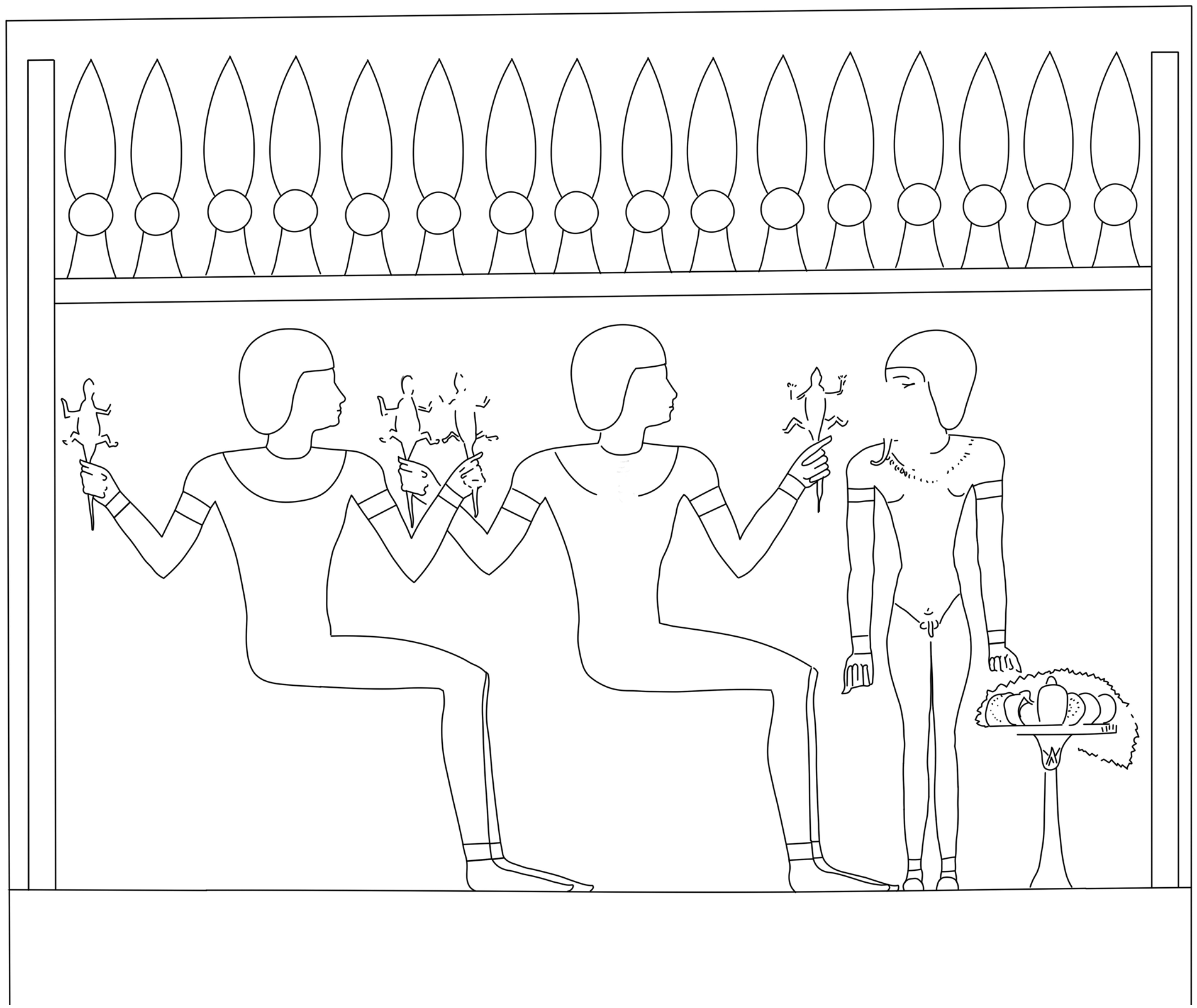
Very little is preserved of the wall decoration, but enough is left to establish that Hay’s drawing provides a perfect fit. Above the figures, there are clear traces of a chapel crowned with a kheker decoration.
Arundale’s rendering of the opposite east wall (fig. 4) shows three figures in a similar sitting posture. The first two are human-headed and they are holding lizards in both hands. The third one has a ram’s head and is holding snakes. They are seated in a similar chapel with kheker decoration. In Room K2, comparable groups of figures were depicted, including a standing female ‘Beset’ figure. Figures like these are known from other contexts and are best described as guardian-figures or ‘demons’.
38
Drawing by Francis Arundale of the east wall of Room K1 (© Victoria and Albert Museum, London, Museum no. 8258).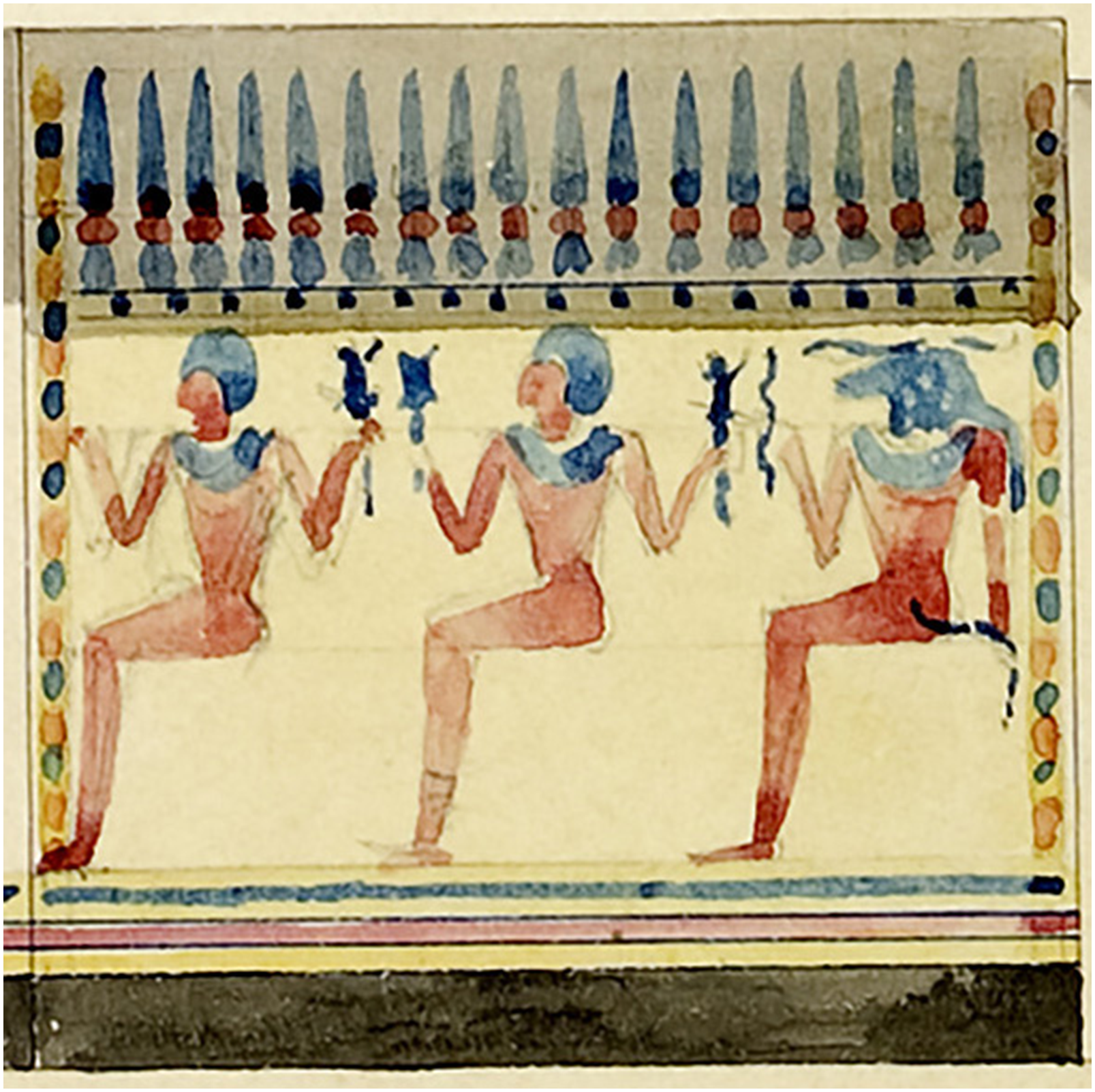
Room I
The second example comes from Room I, immediately in front of the burial chamber. Here, the situation is somewhat different. As can be seen in Arundale’s drawing, the east wall was decorated with a depiction of the Hall of the Double Maat. On the opposing west wall there were four scenes of gods leading the king by the hand. 39 A close parallel to this arrangement can be found in the tomb of Merenptah, and there are parallels in other royal tombs from the Nineteenth Dynasty, as well. 40 The decoration of these walls can therefore be said to conform to a tradition.
Conversely, the north and south walls were decorated with four groups of demons flanking the doorways in this room, and comparable to those depicted in Rooms K1 and K2. Several of them were holding snakes or lizards, but in this case, they were not seated ‘en l’air’, but on cube-shaped thrones. On the east half of the south wall, the decoration showed a group of three squatting demons having, respectively, an antelope’s head, a tortoise in place of a head, and a crocodile head. Drawings of the group were made by Alessandro Ricci,
41
Champollion, and Hay (fig. 5a–c).
42
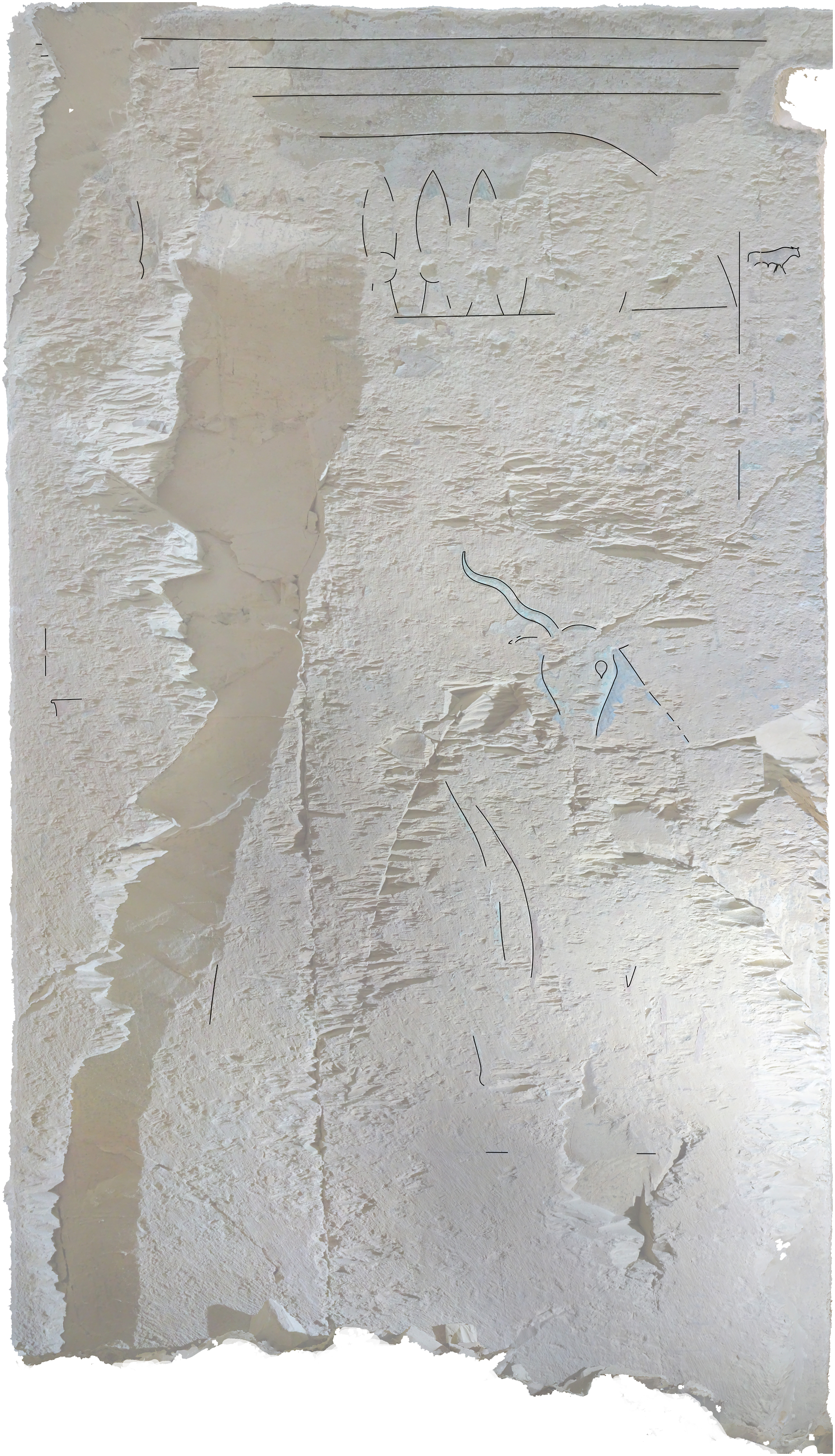
Unlike the first two renderings, Hay gives a sketch of the group as a whole and, in addition, a meticulous camera lucida drawing of the tortoise-shaped head. If we compare the different renderings of the group with the actual traces on the wall (fig. 6), Hays’ sketch, which was done quickly and without much detail, turns out to be the most reliable. There, the tortoise-headed figure in the middle is represented in a slightly different posture, with the legs bent less tightly than in the other two drawings. a) Drawing by Alessandro Ricci, published in H. M. von Minutoli, Reise zum Tempel des Jupiter Ammon und nach Ober-Aegypten in den Jahren 1820 und 1821 (Berlin, 1824), pl. XXI; b) drawing by Jean-Francois Champollion, Notices descriptives, 418; c) sketch by Robert Hay (© British Library Board, Add. MSS. 29820, fol. 112 ro). Orthophoto of the east half of the south wall of room I. Provisional tracing of the remains of the decoration (orthophoto and drawing: W. Hovestreydt).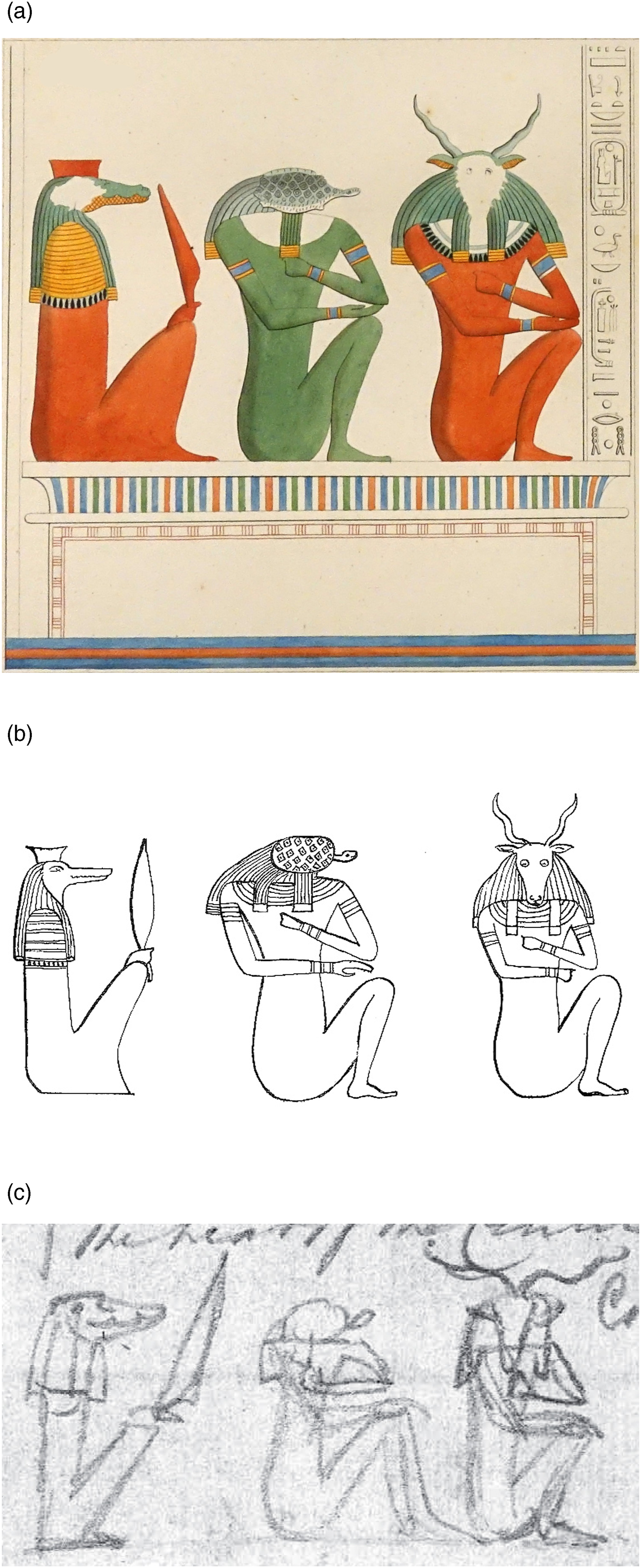
The Hay sketch also provides a striking parallel to a wooden statuette in the British Museum (fig. 7).
43
It is one of a fairly large group of rather similar figures, most of which were found in the nineteenth century in royal tombs of the Eighteenth and Nineteenth Dynasties. Several of them can be recognized among the figures depicted in Rooms I and K1/K2. Other statuettes have parallels elsewhere in the tomb. Specifically, four groups of such figures are depicted in the four corners of the sarcophagus chamber, above the doorways of Rooms Ja, Jb, Jc and Jd.
44
Related groups appear in the doorways leading in and of the burial chamber.
45
No other royal tomb from the New Kingdom has similar representations of these figures on its walls, let alone in the almost life-sized dimensions we encounter in KV 11. The existence of the wooden statuettes suggests strongly, however, that from the Eighteenth Dynasty onwards they were present as sculptures in the round. British Museum EA50704 (© The Trustees of the British Museum).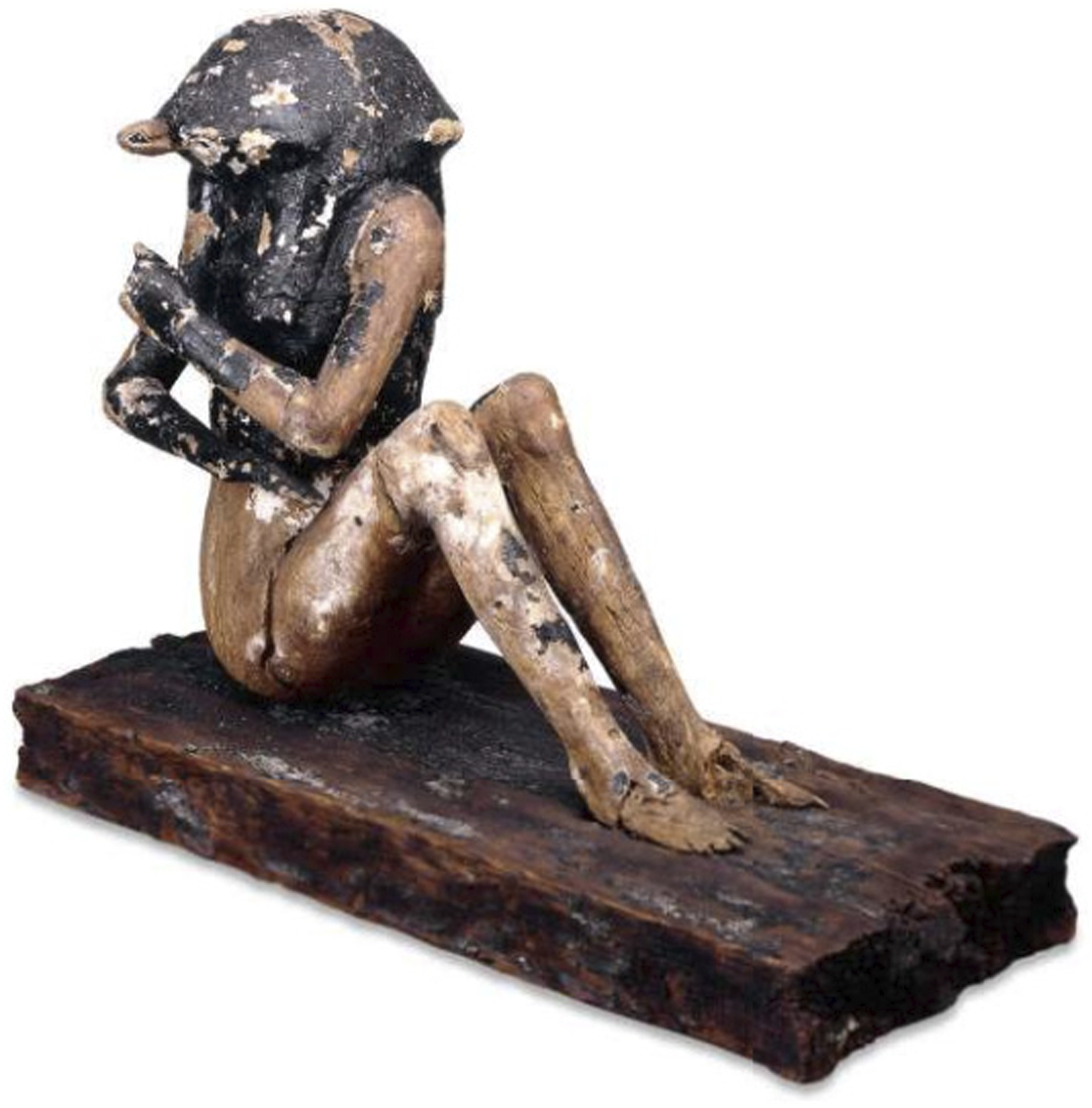
It should also be noted that certain groups of the demons found in KV 11 occur in the tombs of members of Ramesses III’s family. Close parallels to the four groups in the burial chamber can be found in the tomb of queen Tyti, who was great royal wife to Ramesses III (QV 52). 46 Additionally, there are parallels in the tombs of several of his sons: Paraherwenemef (QV 42), Sethherkhopshef (QV 43), and Khaemwaset (QV 44). There are even a few instances in two queen’s tombs from the Nineteenth Dynasty: that of an anonymous queen (QV 40) and that of Sat-ra (QV 38).
Rooms H and L
Arundale’s drawing shows a very different set of figures in rooms H and L. Being divided over these two rooms, north and south of the burial chamber, they fall into two groups. Twenty are depicted in room H, and sixteen in room L. All are clearly characterised as deities, the male gods holding a was sceptre and the goddesses either a was sceptre or a papyrus sceptre. They are standing in chapels shaped as nw shrines, with a small offering table placed in front of them. As was the case with the demons discussed above, both groups are looking in the direction of the sarcophagus chamber, which is thus clearly the focus of their attention. In this case, not only the appearance but also the name of each deity has been preserved, mainly thanks to the notes of Champollion and Lefèbure, to which Wilkinson’s unpublished notes form a valuable complement. 47
There are a couple of parallels in royal tombs from the New Kingdom, though not executed on the large scale we encounter in KV 11. An apparently incomplete version of the 20 deities depicted in Room I can be found in the small burial chamber of Seti II. 48 A full version of the same group of 20, but on a much smaller scale, occurs in the tomb of Ramesses IV, behind the burial chamber. 49
Remarkably, though, all 36 deities from rooms I and L occur in a composition depicted in the tombs of Ramesses VI (KV 9) and Ramesses IX (KV 6), representing the ‘awakening of Osiris’, where they are grouped around the bier of Osiris. 50 The earliest known instance of this composition is found in the Osireion at Abydos, in a relief dating to the reign of Merenptah. 51
It cannot be doubted that the demons and deities described above functioned in a protective role related to the awakening of Osiris, and thus the king. As stated above, the monumental scale in which these figures were executed in KV 11 is unique for a royal tomb from the New Kingdom. In fact, after the New Kingdom, this congregation of gods and demons saw a remarkable renaissance. This is not the place for an extensive discussion, so we can only mention briefly that they occur again in some of the royal tombs at Tanis (Psusennes I, Sheshonq II) as well as on some private coffins from the Twenty-Second Dynasty. In the Kushite and Saite Dynasties, they are found in some of the monumental tombs of El-Assassif (Luxor), such as those of Montuemhat and Padiamenopet, as well as smaller ones such as that of Mutirdis. 52 Variants occur even as late as the first century AD in the temple of Dendera. In recent years, this has attracted much attention and it seems certain that the tomb of Ramesses III will have to play a role in further discussions.
The scene of Merit offering a libation in Room D1
Another unique and unusual scene to be found in KV 11 is that of the goddess Merit offering a libation in room D1. The depiction seems to be without parallels in other New Kingdom royal burial sites. Therefore, it provides new information about the complex system of meanings employed in pharaonic tomb conceptions, especially of the Ramesside Period. The inscription in front of the goddess attests to the strong connection of the tomb with the sanctuary of Heliopolis.
53
Nowadays, the inscription is heavily damaged, especially in its lower part. A proper reconstruction is only possible with the notes of previous visitors to the tomb who saw this passage before its destruction. In another publication, Anke Weber queried whether a quail (G43), an owl (G17), or a wr bird (G36) were depicted.
54
A comparison of several drawings by researchers and travellers (fig. 8), which we were able to collect during our archive research, brings us closer to an interpretation of this scene and its religious meaning. Without doubt, the passage was not clearly legible from the eighteenth century onwards. Drawings by Champollion (fig. 8.1) and Burton (fig. 8.2) show gaps in the text, as do the renderings by Hay (fig. 8.3) and Wilkinson (fig. 8.4). While Champollion marks a destroyed part in the text below the signs for ‘water’ mw (N35A) and in front of r (D21), the quail slides down on the level of plural strokes (Z2) in Burton’s drawing, who also leaves a gap between prj and the ’Iwn pillar. Champollion fills this gap with walking legs (D54), as do Wilkinson and Hay. Presently, traces of this sign are still visible while the other part of the inscription is completely destroyed. From personal observation, it seems quite certain that this hieroglyph was present here (fig. 9).
55
1) Champollion’s sketch (Notices descriptives, 412); 2) Burton’s pencil drawing (© British Library Board, Add. MSS. 25644, fol. 86); 3) watercolour drawing of Hay (© British Library Board, Add. MSS. 29820, fol. 95); 4) sketch from Wilkinson’s notebook (Bodleian Libraries, University of Oxford, MS. Wilkinson dep. e. 59, 247, © National Trust). Drawing of the lower remains of the inscription in front of Merit (drawing: A. Weber).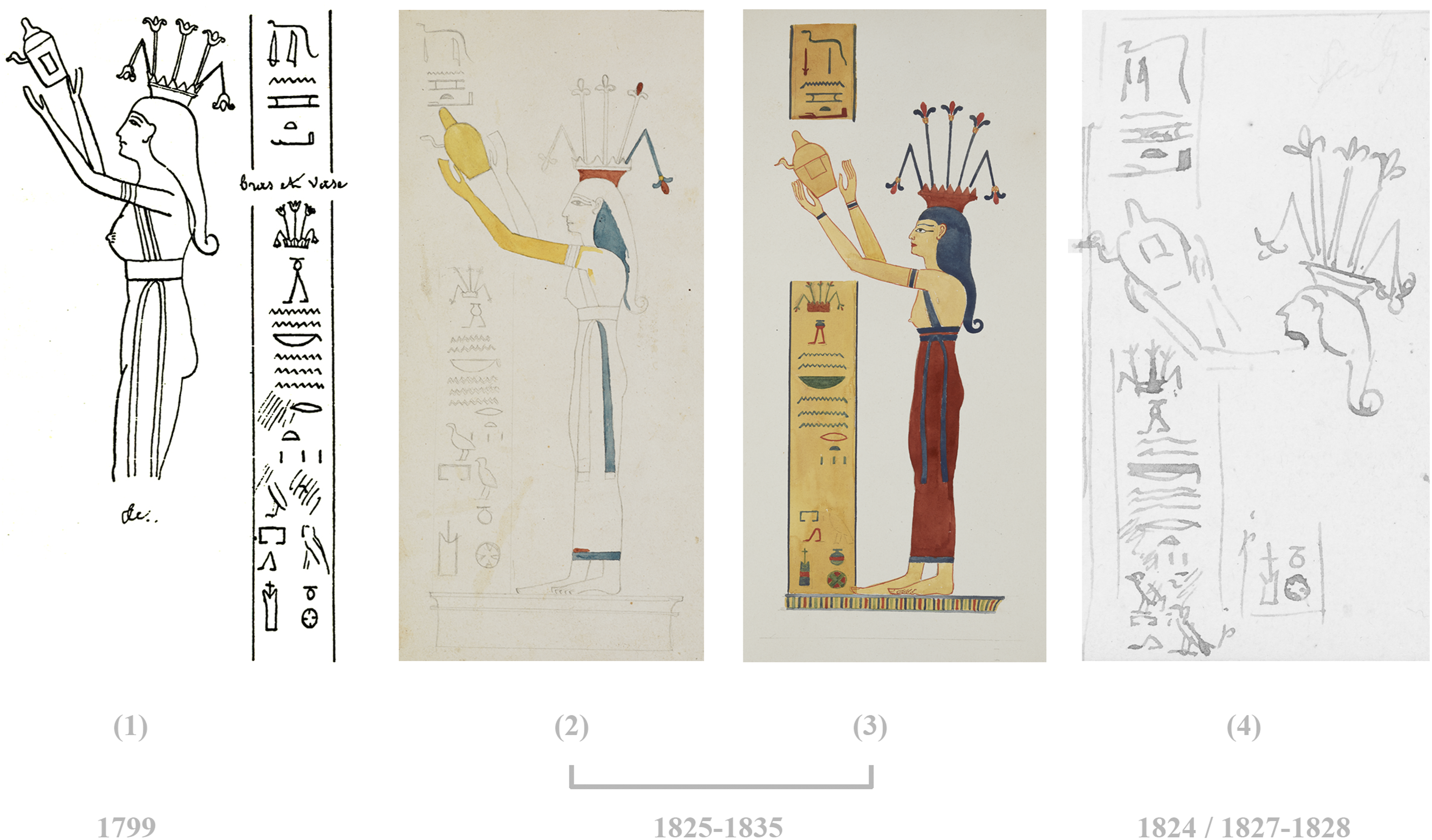
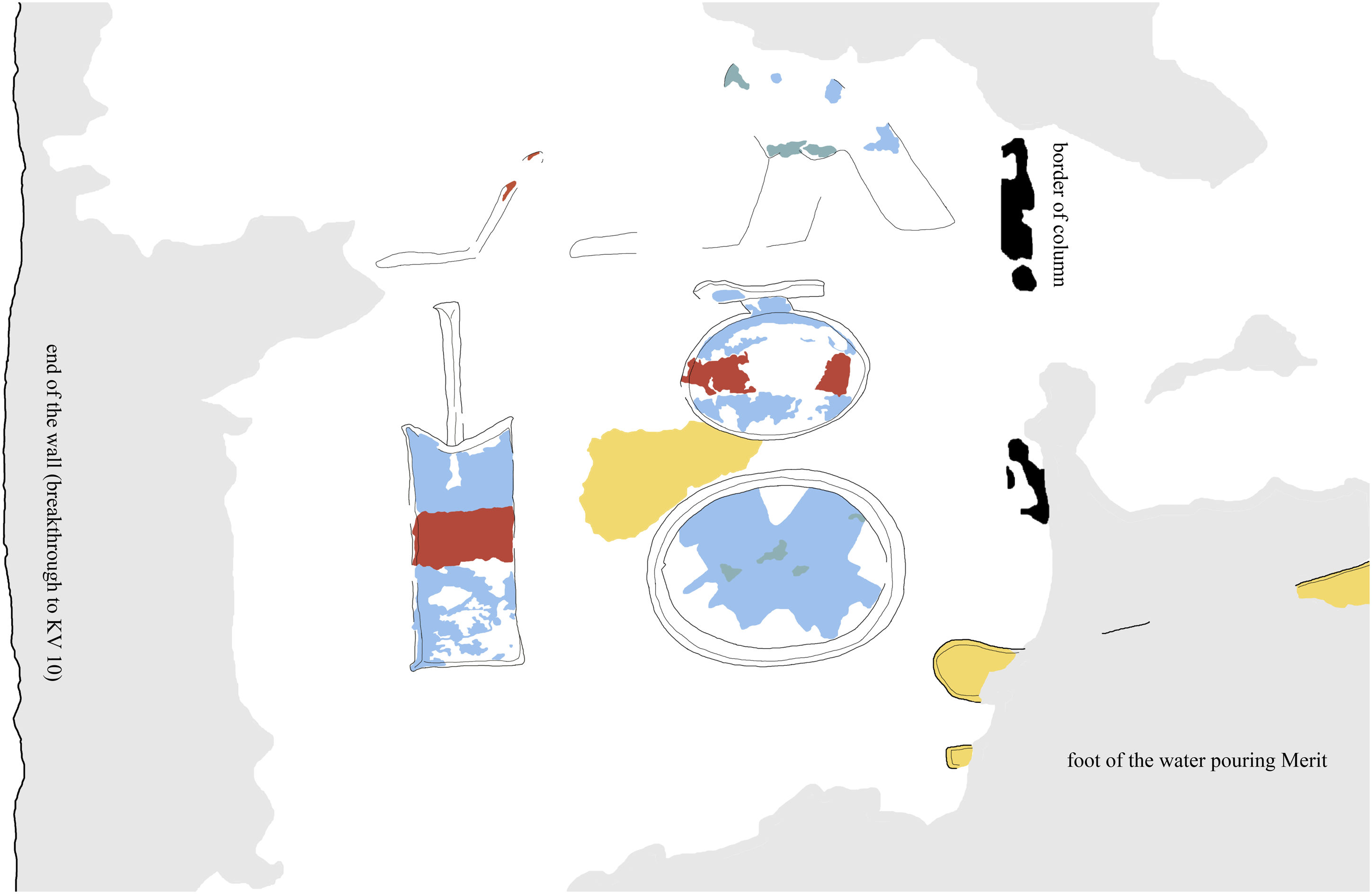
However, Wilkinson drew an Egyptian vulture (G1) to the right of those legs, which leads to even more confusion. Of this bird, nothing is left on the remaining wall. What we can say for now is that the area between mw and ’Iwn must have been destroyed since the time of Champollion and maybe even longer. Comparing the drawings collected during our archive research and considering all possibilities of a proper translation, lead to the conclusion that the two birds which were depicted behind mw and behind prj may have been a wr bird and an owl (G17).
Using the technique of Kopienkritik, a critical analysis of copies, and by factoring in the remaining parts of the inscription, it is at least possible to reconstruct the order of the hieroglyphs closest to the original (fig. 10). Both Burton and Wilkinson only saw the head of the bird which precedes a further gap and the word prj. Therefore, it seems most likely that they only reconstructed the tail to complete the sign as a quail without really having seen it. Another bird with similar features but a different feathertail, however, makes more sense in this place: the swallow, which is to be read as wr. The following owl is clearly visible on a photograph taken by the Epigraphic Survey of the Oriental Institute, Chicago (6506).
56
Because of the lack of any parallels to this scene, it is only possible to provide a tentative suggestion for a new transcription and translation: Reconstruction of the inscription accompanying Merit (A. Weber).
Formerly: ḏd-mdw jn Mr.t šmꜣy.t jnꞽ.n(=j) n=k mw ///rw.t w/m (?) /// prj(.w) m ’Iwn
Words spoken by the Upper-Egyptian Merit: ‘(I) have brought to thee water /// that came out of Heliopolis.’ 57
New suggestion: ḏd-mdw jn Mr.t šmꜣy.t jnꞽ.n(=j) n=k mw [j]r.t wr[.t] prj(w) m ’Iwn
Words spoken by the Upper-Egyptian Merit: ‘I have brought to you water of the great water (author’s comm.: high/flood water) which came out of Heliopolis.’
Since the scene must have illustrated a purification ritual, 58 which corresponds to a libation scene on the opposite north wall, the water from Heliopolis may be interpreted as sacred libation water from the River Nile during the flood season which was previously interpreted as the primeval ocean Nun. The word jr.t eminently supports this thesis. It is also preserved on the Piye-stela (102) which refers to a certain pilgrimage of the king to Heliopolis. There it is written that he washes his face ‘with the water of Nun (jr.t n.t Nnw) in which Re washes his face.’ 59 Thus, the flood waters may have been connected to the primeval ocean and therefore served as a liquid for purification.
Chronology of flooding events in KV 11
In addition to reconstructing the wall decoration of the tomb, the archive material also helps to establish a chronology of the flooding events that caused much of the destruction in the tomb, thus leading to a better understanding of the tomb’s geology.
60
A number of drawings by Lane, Hay, and Horeau
61
and a photoengraving
62
depict the entrance situation of KV 11 in the nineteenth century, filled with rubble that washed down the corridor into the rear parts of the tomb. Since antiquity, several flash floods and rainfall in the wadi and on the westbank were recorded (table 2)
63
by eyewitnesses and researchers.
64
The table clearly shows that storms and rainfall occur periodically. In ancient times, the šmw-season (February–April) is recorded, while spring (March–May) and autumn (October–November) are likewise recorded in more recent times. The tombs were already protected from water intrusion by water drainage patterns and debris accumulations in ancient times, at least until the end of the New Kingdom.
65
The data from the Luxor airport weather station, recording since the 1930s, offer a long-term record of weather conditions, but can only be considered tentatively for the Valley of the Kings, as Weeks and Hetherington already admit.
66
From personal experience it can be stated that the weather differs strongly not only between the Theban east- and westbank but also between some smaller areas and villages on the same side of the River Nile. From the table, it is evident that none of the floods before 1837, when Alexander Hoskins drew the harpers in room Cd (fig. 11, left), caused the current state of the front part of KV 11.
67
It is a similar situation for the rear part of the tomb, which must have been almost fully intact in 1883 when Lefébure was working on his notes on the royal tombs.
68
Fourteen years later (in 1897), the fourth edition of Baedeker traveller’s guide already mentions a severe destruction of the tomb’s rear part and recommends to pass these rooms quickly since there is ‘nothing remarkable to see’.
69
That the rooms were destroyed by flooding events is not mentioned in particular, but implied since the first edition of Baedeker’s Upper Egypt and Nubia from 1891 gives a full description of the rear part.
70
Between 1891 and 1897, Weeks and Hetherington mention only one ‘light’ rainfall without destructive power. It seems rather unlikely that another severe flooding event was not officially recorded, since most heavy rainfalls are mentioned somewhere in traveller reports or other records of this time. During our project’s geological survey of KV 11, Judith Bunbury already concluded that the water masses must have come from the tomb entrance rather than the cracks in the ceiling in the site’s rear sections.
71
A flooding event of this scale, which destroyed nearly all the decoration from corridor G to room L in KV 11, would most certainly have been noted by somebody. Therefore, it seems likely that it was not only one flood that caused the current state of the tomb’s rear part, but the accumulative power of repeated flooding events. One of the most devastating floods must have been the one in 1914, which is explicitly mentioned by Harry Burton, who wrote in March 1914: […] there was a terrible flood that ran down through the valley and entered several tombs. The tombs of Ramesses II and III were both again flooded, the latter blocked again by debris after having been long since partly excavated and made accessible by Salt and Lepsius.
72
Early drawings of the harper on the south wall of room Cd (© Griffith Institute, University of Oxford, Hoskins MSS. 3.38 and Horeau MSS. 18.2) illustrating first signs of destruction in the lower part of the scene.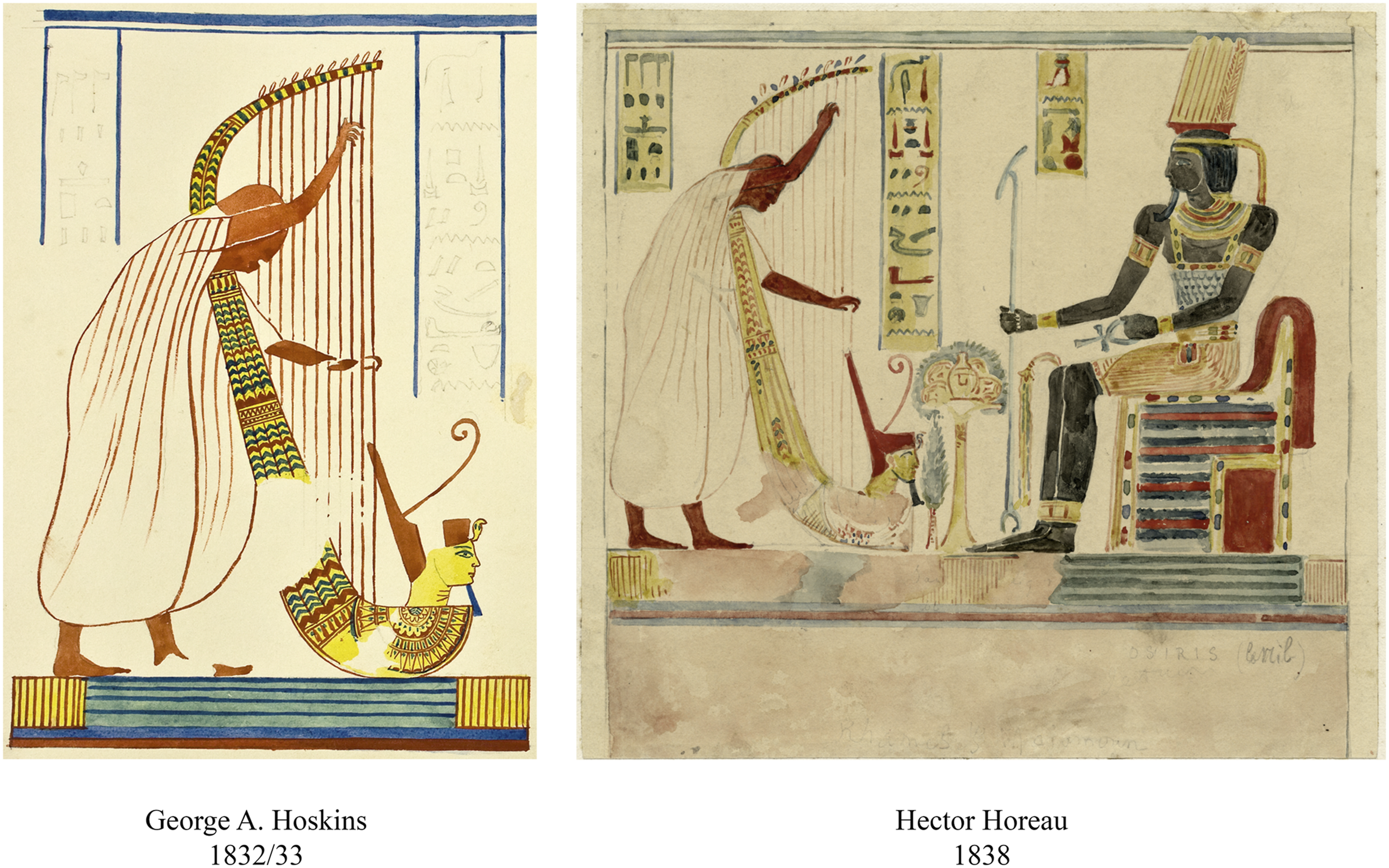
According to Burton, KV 11 was too dangerous to excavate immediately after the flood. Masses of rubble and debris were washed inside the tomb where they partly remain to this day. Between 1883 and 1914, at least one more violent flooding event must have occurred, which contributed to the damage we see in the back of the tomb today. Earlier degradation of the tomb’s front part can be explored by comparing drawings and photographs of artists, travellers, and researchers. With the drawings of George A. Hoskins (1837) and Hector Horeau (1838), it is possible to trace the first stages of the slow deterioration of the lower part of the walls in chamber Cd where the famous harpers are depicted (fig. 11). The front part (corridors B and C) was probably still unharmed by floods at this time and only small parts of the scene were damaged.
Probably in the early 1880s,
73
Jan Herman Insinger produced the first photographs of KV 11 (fig. 12). These already show severe damage in the area of the god’s throne and in the lower part of the harp in room Cd (south wall). The protagonists’ feet and the reed mat have suffered damage as well but are still clearly recognizable. The damage is thus considerably less than in the later photographs of the Oriental Institute Chicago (fig. 12), taken in the 1930s.
74
The Dutch artist and illustrator Auke Tadema and his wife visited Egypt regularly between the middle of the 1950s and the early 1980s.
75
Their photographs of KV 11 were probably made between 1958 and 1960 (fig. 12) and are a fruitful source for our dating attempts. Together with the images from the Oriental Institute, Chicago,
76
they reveal that a flooding event between 1890 and the 1950s caused a high water level even in the eight side-rooms of corridor C. It is impossible, however, that the flood water actually remained stagnant in the front part of the tomb, since the tomb plan steeply slopes downwards and the water would have flooded down towards the rear of the tomb and the breakthrough to KV 10. However, the appended room D1 and corridor D2 do not show evidence of a remaining flood water level which one would expect since the floor level of corridor D2 is increasing. Moreover, the side-rooms of corridors B and C no longer had doors installed by the end of the nineteenth and beginning of the twentieth century that could have held up the water for a certain amount of time. It is much more likely instead, that the relatively permeable Wall Limestone A in the lower part of these rooms absorbed the water and was highly saturated with humidity over a long period of time. The relatively dark line which is presently visible thus indicates the water level, up to which the stone absorbed the incoming water.
77
Furthermore, it is noticeable that there are only minor differences between the photographs of Auke Tadema, Martin Davies, and the ones taken by our project in the last few years, although roughly four decades have passed between the points of time that they were taken. This means that the flash floods which were recorded after 1979 did not cause any further destruction – at least in this area of the tomb. In conclusion, it becomes clear that solely modern flooding events caused the current, poor state of the tomb. This is due to the accumulation of excavation material and flood sediments in front of the tomb which led to a higher ground level compared to the original entrance position at the bottom of the wadi in ancient times, thus increasing the impact of the flood.
78
Compilation of photographs taken by former researchers and our project, showing the increasing degree of destruction in the lower part of the south wall in chamber Cd. a) © Rijksmuseum van Oudheden, Leiden, archive no. 42.a; b) courtesy of the Oriental Institute of the University of Chicago, negative 3395; c) courtesy of Rob Demarée; d) courtesy of Aidan Dodson; e) © The Ministry of Tourism and Antiquities, The Ramesses III (KV 11) Publication and Conservation Project; f) © The Ministry of Tourism and Antiquities, The Ramesses III (KV 11) Publication and Conservation Project.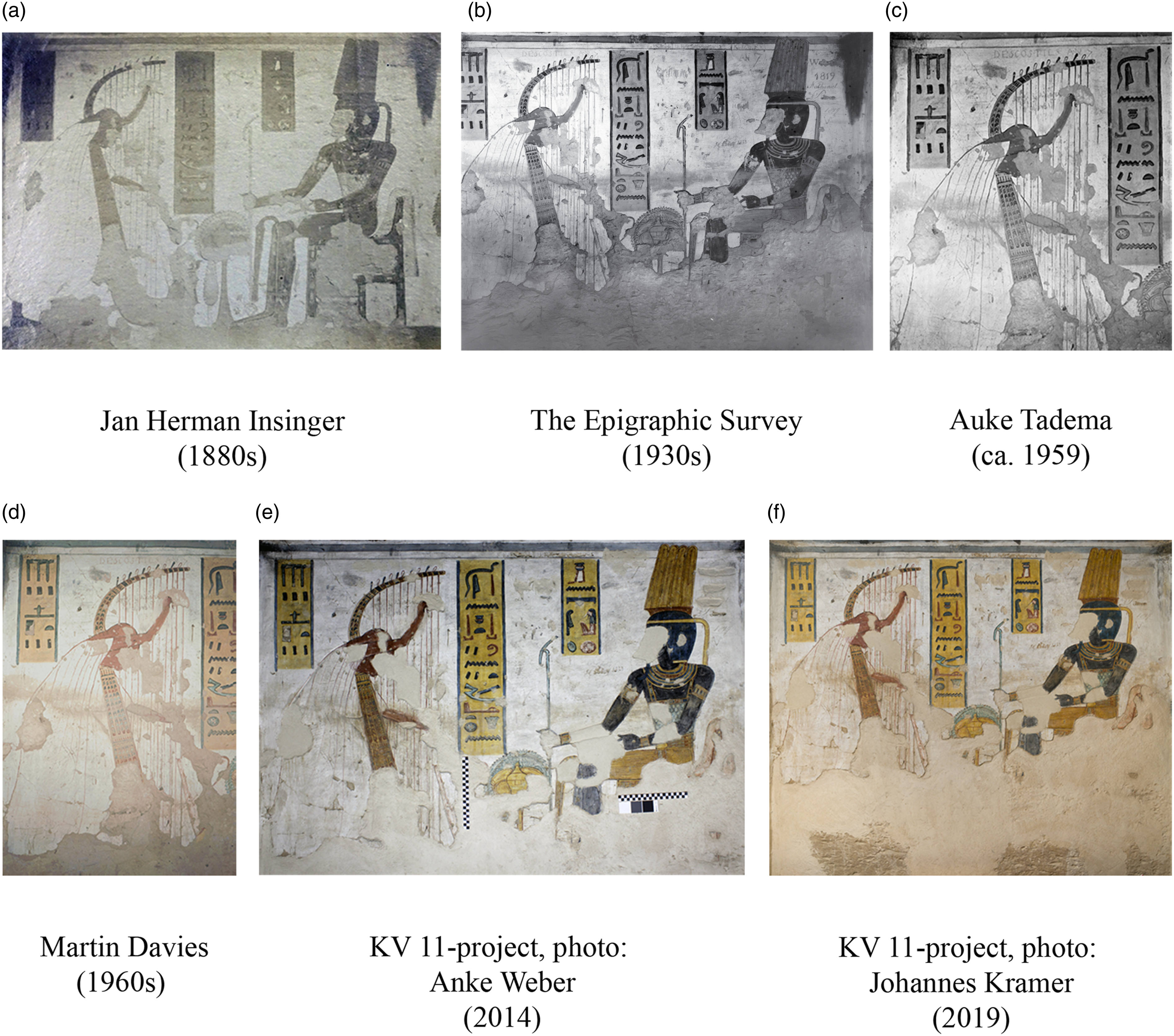
Our team is currently undertaking further research into several flooding events of KV 11 through accurate visual observation of the collapsed stones and the upper sediment layer in the burial chamber. The current floor level of this room lies around 60 cm above the original bottom of the hall.
79
The uppermost layer is formed of a desiccated sediment crust that cracked while drying. By recording all big limestone fragments that fell on top of this layer and observing subjacent impressions in the mud, a chronology of flood streams as well as the collapse of parts of the ceiling, walls, and pillars can be established (fig. 13). The ceiling must have collapsed before parts of pillars 5 and 3 fell down and after the upper sediment layer had completely dried, because no impressions below the architectural fragments were visible in the mud.
80
Parts of pillar 7 must have collapsed while the mud layer on the floor was still moist since mud impressions are found below one of the largest stones. A clearly visible flood stream between pillars 7 and 5 indicates that another flooding event must have occurred after the most devastating floods and brought small pieces of wood and pottery fragments into the chamber. Afterwards, pillar 7 partly collapsed. Preliminary drawing (state: spring 2020) of the floor in hall J of KV 11 showing the sequence of collapse of stones due to their overlapping flood streams (visible through accumulation of stones and debris), and faults in the ceiling (crossing lines) (drawing: A. Weber).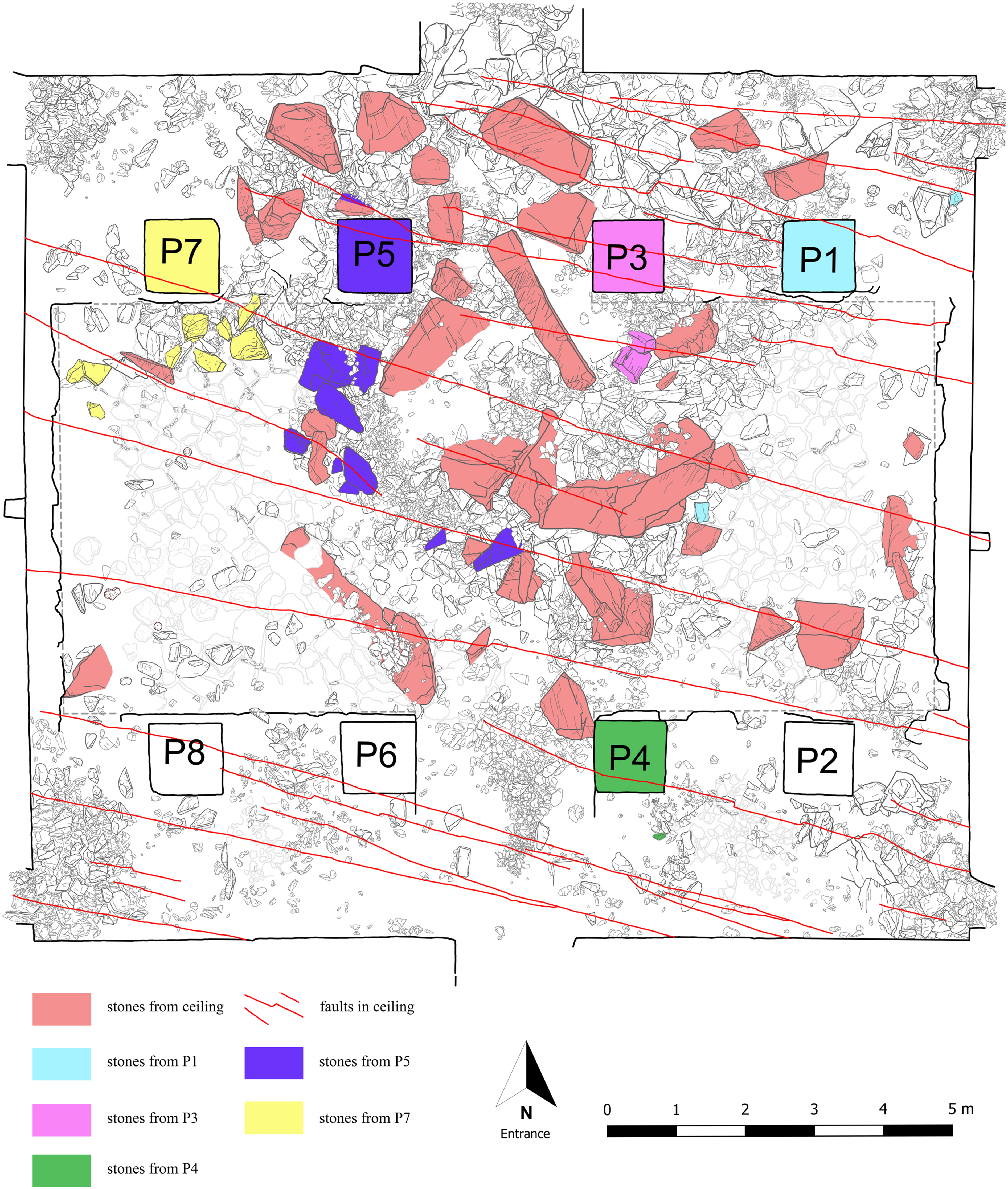
The chronology of the collapsed stones also provides evidence for the static forces at work in the burial chamber. The pillars certainly collapsed after the ceiling. The latter broke along the natural faults (fig. 13) 81 and was already in danger of collapse in the early nineteenth century, long before the devastating flooding events. This means that the collapse of the ceiling was not influenced by the water ingress and was rather predictable.
A drawing with the camera lucida from the Hay archives at the British Library can be dated to the years 1832/33 (fig. 14).
82
On the ceiling above pillars 3 and 4 one may recognise a half-circle-shaped crack that caused the later collapse of a very large stone which is currently situated on top of the sediment layer. The object must have already been in danger of collapse at this point in time. Drawing of the eastern part of the burial chamber by Joseph Bonomi (© British Library Board, Add. MSS. 29818, fol. 28).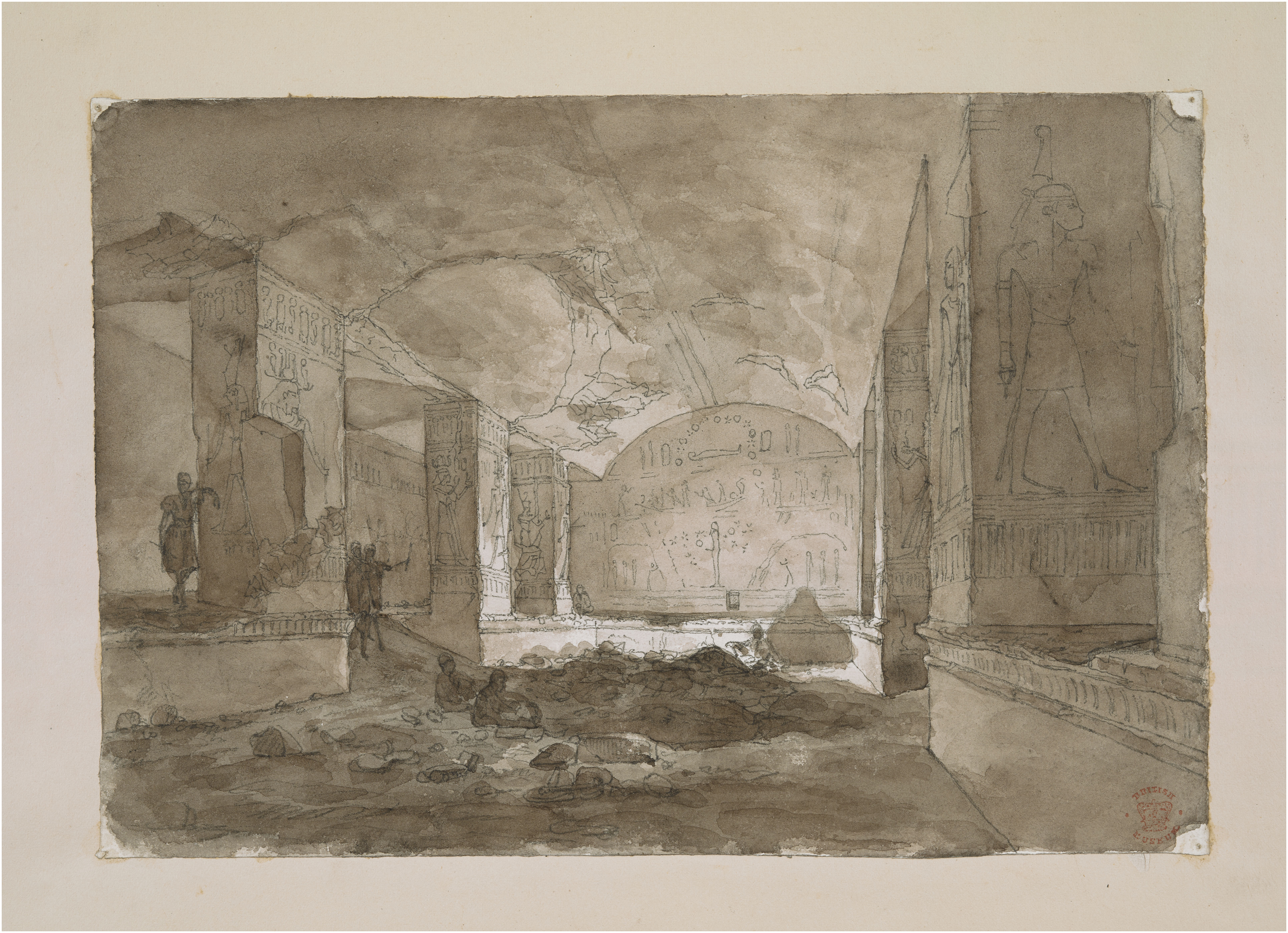
In conclusion, it can be established that several violent floods have occurred since antiquity, but they did not reach the same level of destructiveness as the flash floods of the late nineteenth and early twentieth centuries. The chronology of flooding events for KV 11 will not only be useful for the conservation of this site and other tombs in the Valley, but it may also help to prevent future flooding by developing a Site Management Plan. Even in this regard, John Gardner Wilkinson, James Burton, and Robert Hay carried out pioneering work in taking flood prevention measures with the digging of dikes in front of the tomb of Seti I (KV 17). 83 Currently, the modern flood protection wall installed by the Ministry of Tourism and Antiquities (formerly SCA) is a very useful construction in order to prevent future flooding.
Conclusions
Our research in the archives of the British Library, the Victoria and Albert Museum, the Bodleian Libraries, and the Griffith Institute has brought to light important material about the decoration programme in the tomb of Ramesses III. In combination with modern technologies like 3D modelling, digital drawing, and virtual overlapping of drawings and photographs, these manuscripts prove to be a fruitful source for the reconstruction of the original scene material of KV 11. We are convinced that we will be able to reconstruct almost the entire decoration programme of the tomb’s rear part that is now lost and we are currently developing new techniques to visualise our reconstructions and making them accessible to a broader public. With our ongoing archive research as well as fieldwork in the tomb, we will be able to collate the reconstructions on the basis of small details that still remain intact. Moreover, we will proceed with the geological survey in and around the tomb as well as with the clearance of the tomb’s burial chamber, recording the collapsed parts of the pillars and the ceiling, which promise to reveal further information about the chronology of flooding events.
Footnotes
Acknowledgements
We would like to express our sincerest thanks to the Egyptian Ministry of Tourism and Antiquities (MoTA), the Minister of Antiquities His Excellency Dr Khaled el-Enany, SCA secretary general Dr Mostafa Waziri, Director of Foreign Missions Affairs Dr Nashwa Gaber and the Permanent Committee for supporting our work in the tomb of Pharaoh Ramesses III. We would like to express our gratitude to the Egypt Exploration Society for granting us their Centenary Award and for their kind support. We would especially like to thank former director Cédric Gobeil and new director Carl Graves. Our fieldwork in the tomb was carried out with the generous support of the ARCE Antiquities Endowment Fund. Furthermore, we are grateful to the reviewers of this article for their useful comments. We owe a debt of gratitude to the British Library (London), the Bodleian Libraries (Oxford), the Victoria and Albert Museum (London), the Griffith Institute (Oxford) – here especially to Francisco Bosch-Puche –, the Oriental Institute of the University of Chicago, and the Rijksmuseum van Oudheden (Leiden) for receiving access to their archives and publication permission. We also thank Rob Demarée and Aidan Dodson for entrusting us with the photographs of Auke Tadema and Martin Davies and for granting publication permission. Finally, we would like to thank W. Raymond Johnson, Sue Lezon, and J. Brett McClain for information about the Epigraphic Survey photographs of KV 11 and the correspondence in the Chicago House archives. To J. Brett McClain, we would like to express our thanks for reviewing this article and for providing his valuable comments.
Funding
EES Centenary Award ARCE Antiquities Endowment Fund
