




Abstract
Inscriptions on Early Dynastic ‘oil labels’ that refer to events have long been thought to contain a ‘year-name’ that dated the oil. During the last two decades, new evidence has become available which suggests that such events referred to what had been characteristic for the regnal period of a deceased king rather than for a specific year. The labels were funerary-ceremonial rather than administrative artefacts. In addition, it can now be argued that they were balm labels rather than oil labels. Moreover, high officials of the Early Dynastic court appear to have used the labels increasingly to record their own activities in providing the precious balm.
Introduction 1
The Early Dynastic so-called ‘year’ labels – flat rectangular objects with inscriptions, made of ivory or ebony, varying in size from c. 9 × 7 cm (‘Aha 1’ 2 ) to c. 1 × 1 cm (Engel (2017) 213.4 3 ), and with a hole in the upper right corner – have been known since the end of the nineteenth century. 4 Most of them were found in royal tombs of the First Dynasty at Abydos, and some were discovered in tombs of high officials of the same period at other sites. 5 The labels are generally supposed to have been attached to jars with oil. New finds have been added from time to time, some even quite recently. 6
The inscriptions characteristically contain: firstly, the name of a king, nearly always the Horus-name in a serekh; secondly, the hieroglyph  , ḥꜣ.t
7
– mostly interpreted as referring to oil
8
– with some additional information, often including a quantity; and, thirdly, references to ‘events’, mostly ceremonial or religious activities of the king, sometimes a political event, and additionally economic or administrative activities of high officials.
, ḥꜣ.t
7
– mostly interpreted as referring to oil
8
– with some additional information, often including a quantity; and, thirdly, references to ‘events’, mostly ceremonial or religious activities of the king, sometimes a political event, and additionally economic or administrative activities of high officials.
Figure 1 shows how the structure of the inscriptions gradually evolved from two or more ‘horizontal’ registers towards two or more vertical columns. They will be considered here as consisting of two main sections. For the sake of brevity, the part that includes the ḥꜣ.t-sign – initially the small lower part, later the increasingly larger left part, of the labels – will be called the ‘ḥꜣ.t-section’, although, over time, it also contained the royal name, the names and titles of one or two officials, and signs representing institutions. The other part will be called the ‘event section’. This section – which mostly refers to more than one event – starts from the reign of King Djet with the sign Examples of so-called ‘year’ labels with the names of the First Dynasty kings and, since King Djet, with names of officials.
20
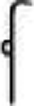 , commonly interpreted as rnp.t (year), to which the labels owe the name ‘year’ labels.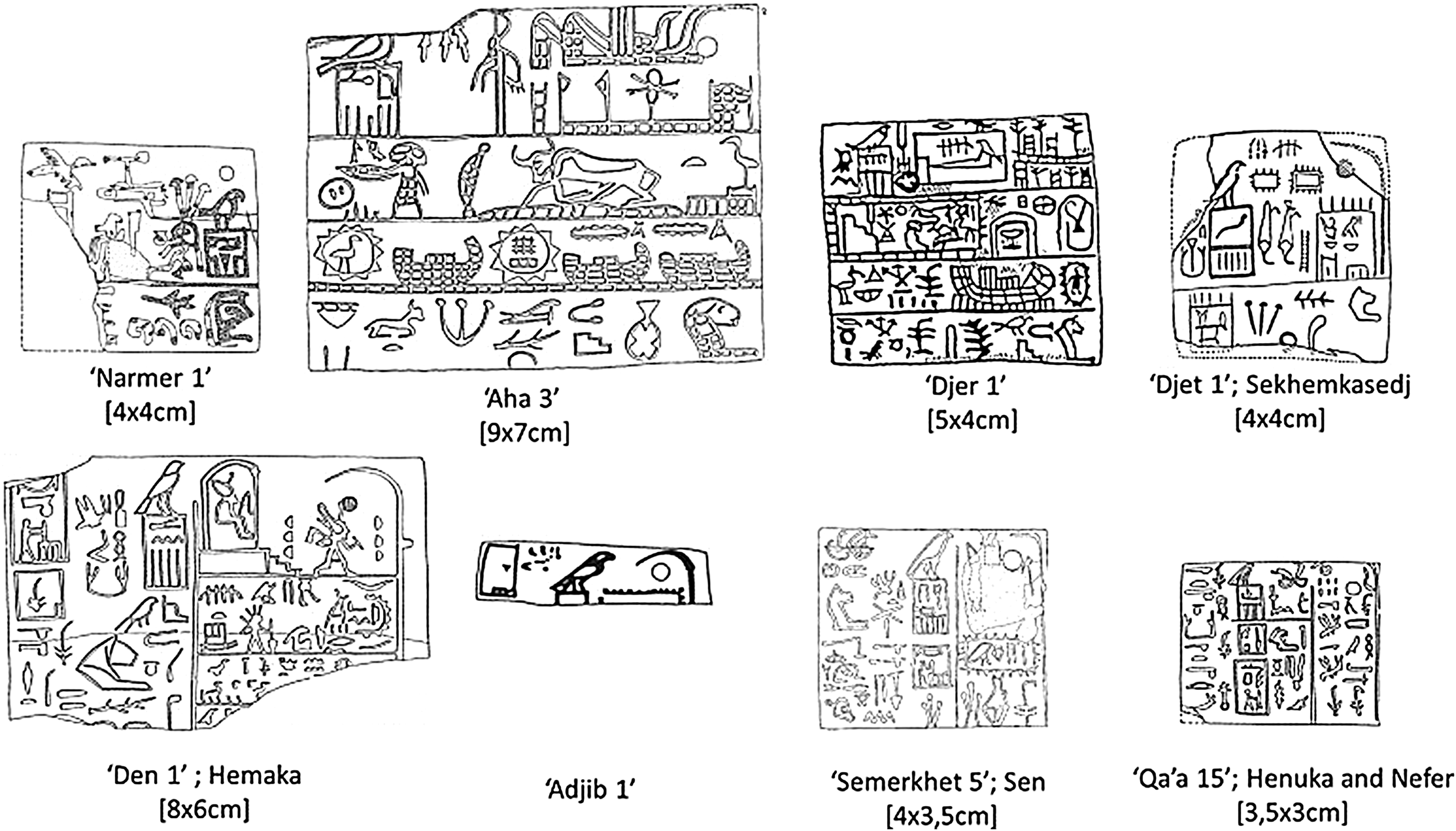
Egyptologists generally assume that the ‘event section’ contained a ‘name-giving’ event, 9 resulting from the administrative wish to be able to identify the production year of the oil. 10 This is not really convincing as no ‘year’ labels are known for wine, a common royal tomb gift as well, 11 and it is not evident why it might have been deemed important to date oil and not wine. 12 Baines remarked already that it is unlikely that they were administrative ‘in a narrow way’, because they are more elaborate than would be needed to identify a year uniquely, and because objects made of ebony and ivory ‘were probably not used for everyday writing’. 13
The inscriptions are the oldest ones known that contain verbs denoting human activities (in the form of ‘narrative infinitives’ 14 ) instead of only names, numerals and nouns, or pictures representing nouns. 15 As such, they might even be viewed as the earliest attempts at ‘history writing’ in the world. The ‘administrative’ interpretation required, however, the assumption that years were given a name immediately at the start of a new year, which would imply that the inscriptions could only have referred to ‘pre-planned’ events. 16 Nevertheless, many scholars remained convinced that the inscriptions indeed referred, partly, to historical events. 17
Despite this ambiguity, no doubts have ever been expressed regarding the hypothesis that at least one of the events on the labels gave a year its name. 18 It will be argued here, that it is now possible to assume that these labels should rather be viewed as ‘regnal’ labels 19 that show events that were remarkable for the reign of a king rather than for a year. Additionally, it will be argued that they became increasingly used, however, by high officials to record their ability to supply the main product required for a royal funeral, namely mummification balm.
The new interpretation offered here was triggered, firstly, by the possibility – existing since 2000, but hardly explored – of comparing information on labels from the reign of King Semerkhet with that on one of the Fifth Dynasty ‘annal stone’ fragments; 21 secondly, by the publication of the large number of labels found in the tomb of King Qa’a, 22 and, thirdly, by rather new research results on predynastic mummification practices. 23
Piquette’s recent dissertation on 427 Predynastic and Early Dynastic labels and label fragments focused on external and material characteristics rather than on the content of the inscriptions. It called for a ‘contextual’ approach and for considering the labels as the result of ‘a meaningful social practice’. 24 It will be suggested here that the subset of c. 105 labels and label fragments 25 that used to be characterized as ‘year’ labels or ‘annalistic’ labels, 26 should be considered, indeed, as ‘funerary’ rather than as ‘administrative’ artefacts. This is not only because they were found in a funerary context and were made of precious materials, but also because of their inscriptions.
Not all of these inscriptions will be discussed – not even all 21 different inscriptions that are more or less completely preserved. 27 The argument will mainly be based on a discussion of three general aspects: 1) the rnp.t-sign, 2) a comparison of ‘events’ on labels and on annal stone fragments, and 3) the ‘hꜣ.t-section’. The conclusion will briefly return to the question of to what extent the inscriptions can be seen as a form of ‘history writing’.
Hieroglyph for year or picture of a tally?
The hieroglyph 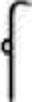 – known from later periods as a determinative or an ideogram for rnp.t, ‘year’
28
– shows a ‘palm-branch stripped of leaves and notched (…) to serve as tally’.
29
The early stage in the development of the hieroglyphic script makes it possible that it was here not yet the hieroglyph, but still represented the object itself: a tally notched to count years.
30
Depictions from the Middle and New Kingdom showing this tally were usually accompanied by texts such as smn.n.i gn.t.k m ir ḥḥ n sdw, ‘I establish[ed] your memory as a celebrator of a myriad of sd-festivals’.
31
That the palm rib was originally especially used to count years, is plausible from its later use as a hieroglyph for ‘year’.
– known from later periods as a determinative or an ideogram for rnp.t, ‘year’
28
– shows a ‘palm-branch stripped of leaves and notched (…) to serve as tally’.
29
The early stage in the development of the hieroglyphic script makes it possible that it was here not yet the hieroglyph, but still represented the object itself: a tally notched to count years.
30
Depictions from the Middle and New Kingdom showing this tally were usually accompanied by texts such as smn.n.i gn.t.k m ir ḥḥ n sdw, ‘I establish[ed] your memory as a celebrator of a myriad of sd-festivals’.
31
That the palm rib was originally especially used to count years, is plausible from its later use as a hieroglyph for ‘year’.
A possible objection might be that several labels show, in addition to the palm rib, also the sp-sign (O50) plus a number 32 which has been called ‘the never failing constituent of the expression for “regnal year”’. 33 One may wonder, therefore, if the sp-sign on labels, when accompanied by a number, should not be regarded as a prelude to naming years by referring to a recurrent activity, like the biennial ‘cattle counts’(ṯn.wt) at the time of the Second Dynasty King Ninetjer. 34
Dreyer was convinced, indeed, that ‘sp 6’ in the ‘event section’ of labels like ‘Qa’a 2’, ‘Qa’a 9’ and ‘Qa’a 15’ (fig. 2a) referred to the ‘sixth’ year in which a wood inspection (mꜣ(ꜣ)) had been performed, whereas Helck translated ‘sp 6’ as ‘six times’.
35
For Dreyer, the fact that three Qa’a labels mention a ‘wood-inspection’ without the addition of sp (like ‘Qa’a 12’ in fig. 2b)
36
was sufficient proof that these three labels referred to the first year of such inspections.
37
a) Label ‘Qa’a 15’ [3 × 3.5 cm]
46
and b) label ‘Qa’a 12’ [3 × 3 cm] (drawing: E.-M. Engel (2017) 212.2).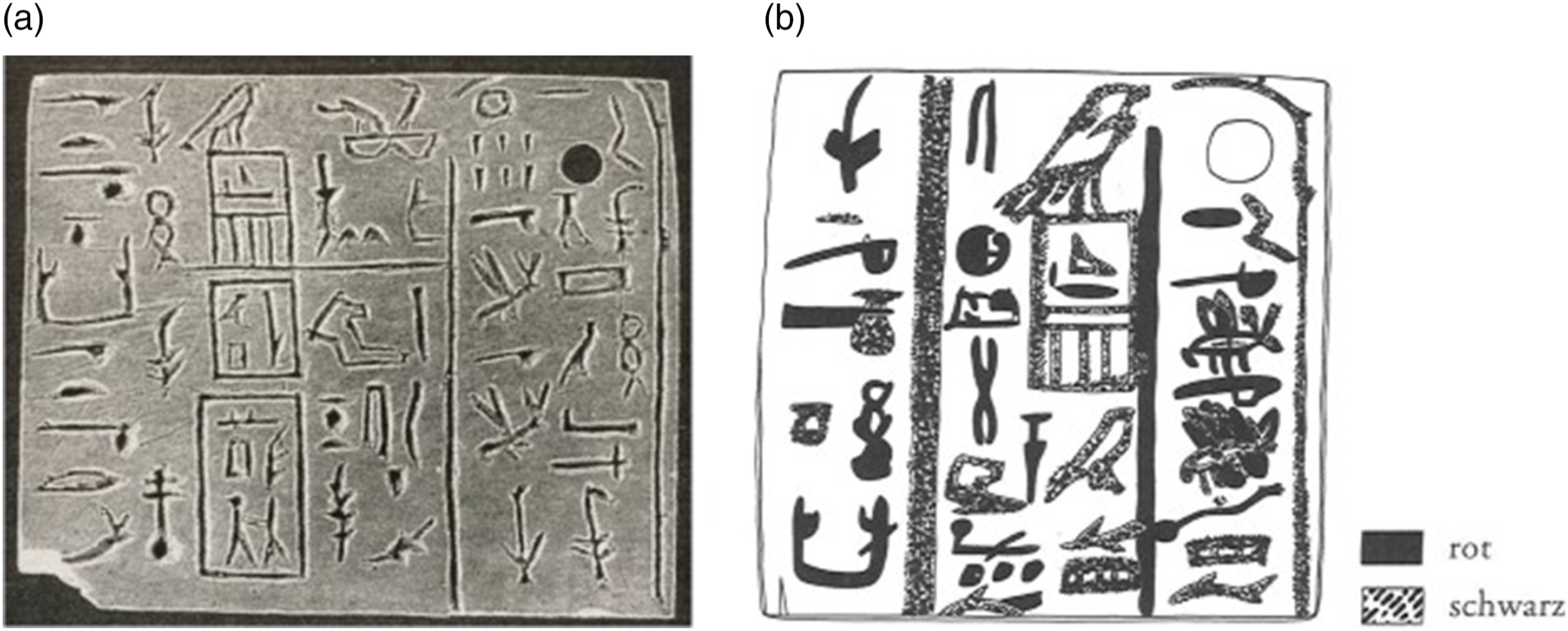
This reasoning is no longer convincing because none of the 54 Qa’a-labels known at present mention a second, third, fourth or fifth time of a wood inspection. 38 In addition, the activities mentioned on the labels without sp and those on the ones with sp 6 were not the same (respectively figs 2b and 2a offer an example of both). 39 Among the 22 Qa’a labels that mention an inspection (mꜣ(ꜣ)) of wood, the four without a sp sign (Engel (2017) 212.1–3 and 212.5) mention ‘the inspection of ḏš wood’. At least thirteen, of the sixteen with sp 6, mention ‘the bringing and inspecting of ḥm ꜥꜣ wood’ (Engel (2017) 215.1–5, 216.3–4, 217.1–2, 218.1–2, 219.4), the remainder refer to the bringing and inspection of both types of wood (Engel (2017) 214.1–2, 219.1). It is more probable, therefore, that sp 6 denotes the number of times that an expedition had been organized to obtain precious foreign wood during the reign of King Qa’a, than that it referred to a year in which this had been done ‘for the sixth time’ (or that the inspection of wood six times during one year would have been the ‘pre-planned’ name of a year).
Therefore, the presence of sp plus a number near the picture of a palm rib on labels cannot be regarded as an indication that the palm rib was already a hieroglyph meaning year. It is quite possible that these Early Dynastic objects show a tally, and therefore indicate a regnal period rather than a year. The next section will argue that this is not only possible, but probable.
‘Year’(?)-labels and annal stone fragments
On the ‘Palermo stone’ and the other Fifth Dynasty annal stone fragments, the rnp.t-sign is visible at the start of each of their ‘year-compartments’ in a way very similar to the labels. 40 The meaning ‘year’ is certain here, because of the added information on the yearly inundations of the Nile in the lower section of these compartments. This seemed to justify attempts to assign specific labels to specific years by comparing them to these year-compartments. 41 That these attempts remained nevertheless rather disappointing seemed understandable, too, because only about one third of the expected original number of year-compartments for the First Dynasty 42 is preserved on the known fragments.
Den’s ‘Sed-festival’ mentioned in the third register of the recto of the ‘Palermo stone’ (see fig. 3a, the small horizontal frame on the left),
43
is the event most often cited as being also visible on a label, namely on ‘Den 1’ (fig. 3b, large frame on top).
44
More events than just this are visible in both cases, however, and they were not the same on both. That is why it has been suggested that only one of the depicted events determined the name of a year.
45
As the stone was made about four centuries later than the label, and most likely with different aims, it might be suggested that differences were just the result of different choices from the recorded events. It would imply the assumption that the Early Dynastic archives that must have been the source for the annal stone contained more events per year than could be copied on labels. However, the increasing width of the year-compartments for later dynasties
47
suggests that, for the period of the First Dynasty, only a few events per year had been recorded in these archives. a) Detail of the ‘Palermo-stone’ highlighting a Sed-festival and a ‘smiting of the iwntjw’ for the reign of King Den; b) the (probably) same events highlighted on label ‘Den 1’.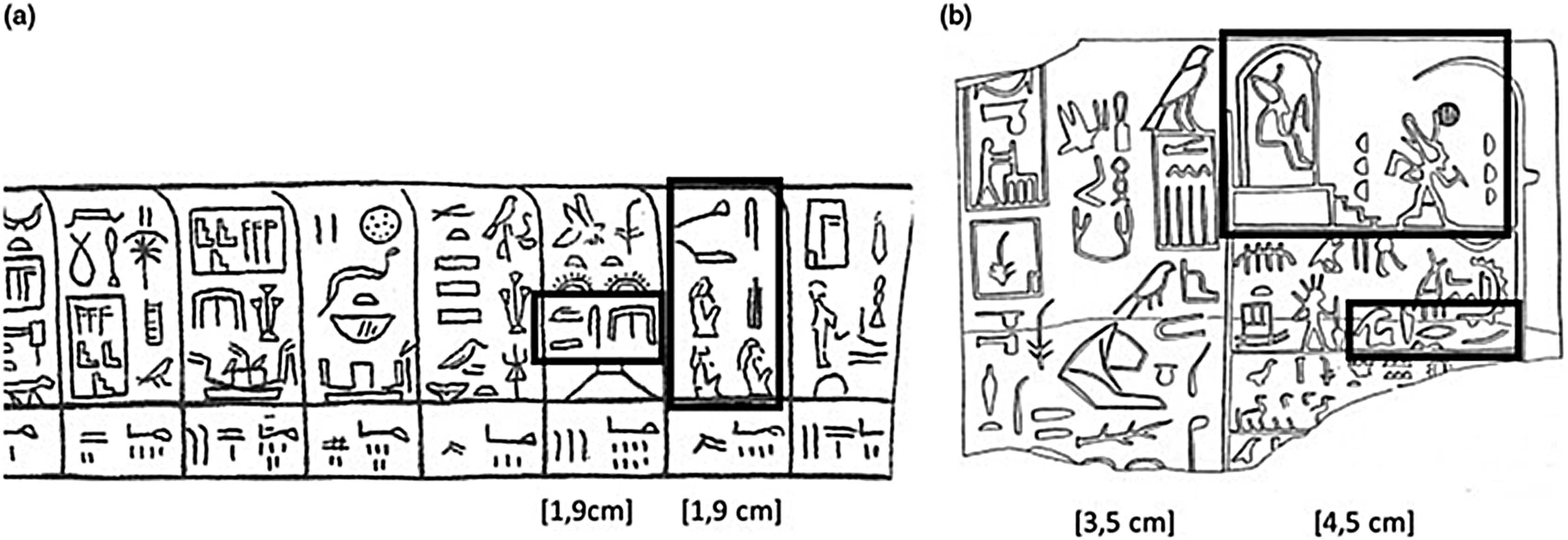
Moreover, yet another objection against the idea that the events on ‘Den 1’ refer to one specific year is possible: the event that has been interpreted as the ‘smiting (sḳr) of the iwntjw’ (fig. 3b small lower frame), 48 is mentioned on the Palermo stone in another year-compartment than the ḥb-sd (fig. 3a large vertical frame). It has to be conceded that only nineteen year-compartments for Den’s reign have been preserved, while he may have reigned for more than 40 years. 49 This implies that it cannot be completely excluded that the ḥb-sd as well as the sḳr iwntjw had each occurred twice during Den’s reign and may have been present together in a year-compartment that was not preserved, but this seems a rather far-fetched possibility.
The period of King Semerkhet on the so-called ‘Cairo Fragment 1’, may be seen as more appropriate for an attempt to try to assign labels to a specific year than the very incomplete range of year-compartments for Den on the ‘Palermo stone’, as Semerkhet’s reign is the only one for the First Dynasty for which all years are preserved. However, these year-compartments have long been thought to be practically illegible. 50 The reason why a comparison is now possible is that in 2000 a drawing of this fragment, made in Cairo in 1948 by I. E. S. Edwards (1909–96), was found and published by Wilkinson, which showed much more than Wilkinson had seen in 1995. 51 Until now, this has not yet led to a detailed comparison with all label (fragment)s from the same period.
The five (nearly) complete labels and five label fragments of the Semerkhet period, known at present, contain two different label inscriptions. One of them is to be found on the labels ‘Semerkhet 1’ and ‘Semerkhet 2’ (fig. 4),
52
that were more or less duplicates of each other, although slightly different in composition. They show Semerkhet’s nb.ty-name Iry and they were found in the tomb of this king in Abydos already by Petrie.
53
‘Semerkhet 6’, that was found in a tomb near Helwan (fig. 4), was yet another such ‘duplicate’
54
and two fragments found in the 1980s in the tomb of Qa’a (‘Semerkhet 7 and 8’) seem to have belonged to yet two more ‘duplicates’. The second inscription is on the two nearly complete labels ‘Semerkhet 3’ and Semerkhet 5’, also ‘duplicates’ of each other. These were found in the tomb of Qa’a.
55
They show a serekh with Semerkhet’s Horus-name, and also – probably on both – a small serekh with Qa’a’s Horus-name near the hole in the upper right corner. ‘Semerkhet 1, 2 and 6’, Semerkhet’s ‘year-compartments’ on Cairo Fragment 1, and the baboon on Cairo Fragment 5 (from: Wilkinson, Royal Annals, figs 4 and 10).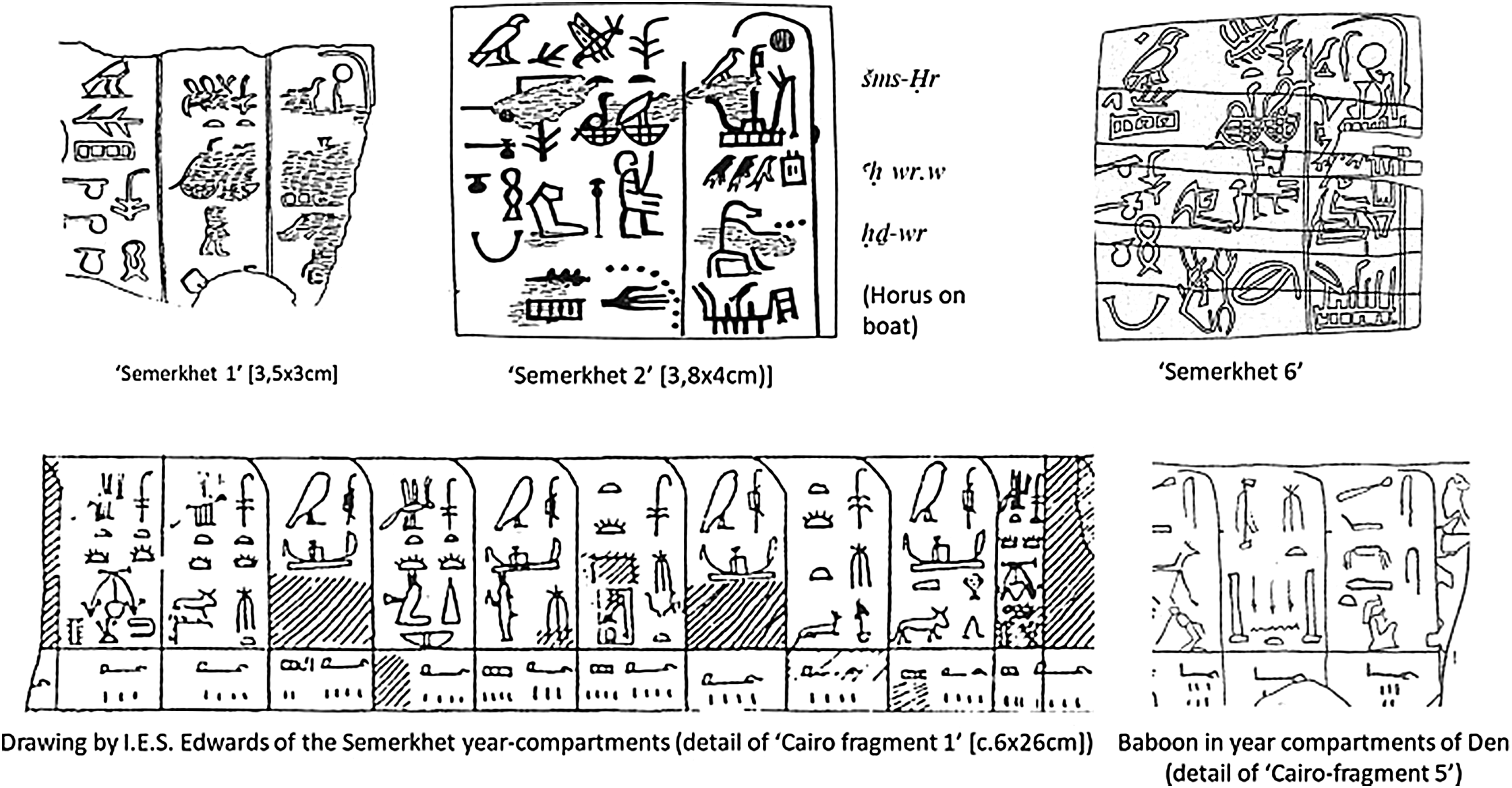
Figure 4 makes a comparison possible of the label-inscription on ‘Semerkhet 1, 2 and 6’ with the Semerkhet section on what is known as ‘Cairo Fragment 1’ of the annal stone.
The top right event on these labels is šms Ḥr, the ‘following of Horus’, probably a journey of the king and his court along the Nile, perhaps related to tax collection and/or administering justice. 56 This event is mentioned four times in the upper part of year compartments on the annal stone fragment, every other year, but it is never accompanied by the sp-hieroglyph with a number. The first conclusion from the comparison in figure 4 may be, therefore, that this ‘šms Ḥr event’ cannot have been a ‘name-giving event’ identifying a specific year.
The presence of the šms-Ḥr-sign on the Semerkhet label may denote instead that during Semerkhet’s reign, the activity of šms-Ḥr was again dutifully performed every second year, as had been the case during the reigns of Aha and Djer, and again during the reign of King Ninetjer of the Second Dynasty. The nineteen preserved year-compartments of Den’s reign on the ‘Palermo-stone’ and ‘Cairo Fragment 5’, in contrast, depict no šms-Ḥr. It may have been a memorable characteristic of Semerkhet’s reign, therefore, that he returned to a tradition which had been neglected under the long reign of King Den, and perhaps also still under King Adjib. 57
The other event in this Semerkhet-label-inscription is denoted by the hieroglyphs for ꜥḥ wr.w (‘shrine of the Great Ones’) followed by a baboon and a boat with a falcon. This puzzling inscription is reminiscent of a relief found beneath Djoser’s Step Pyramid (see fig. 5) showing that the inscription ꜥḥ(-ḥḏ) wr.w and the baboon form a fixed combination. It has been translated as: ‘the plurality of ancestors’,
58
a translation that may find some support in the statue of a squatting baboon in the museum in Berlin bearing the name of Narmer on its pedestal, which may represent Narmer as the eldest ancestor of the First Dynasty kings.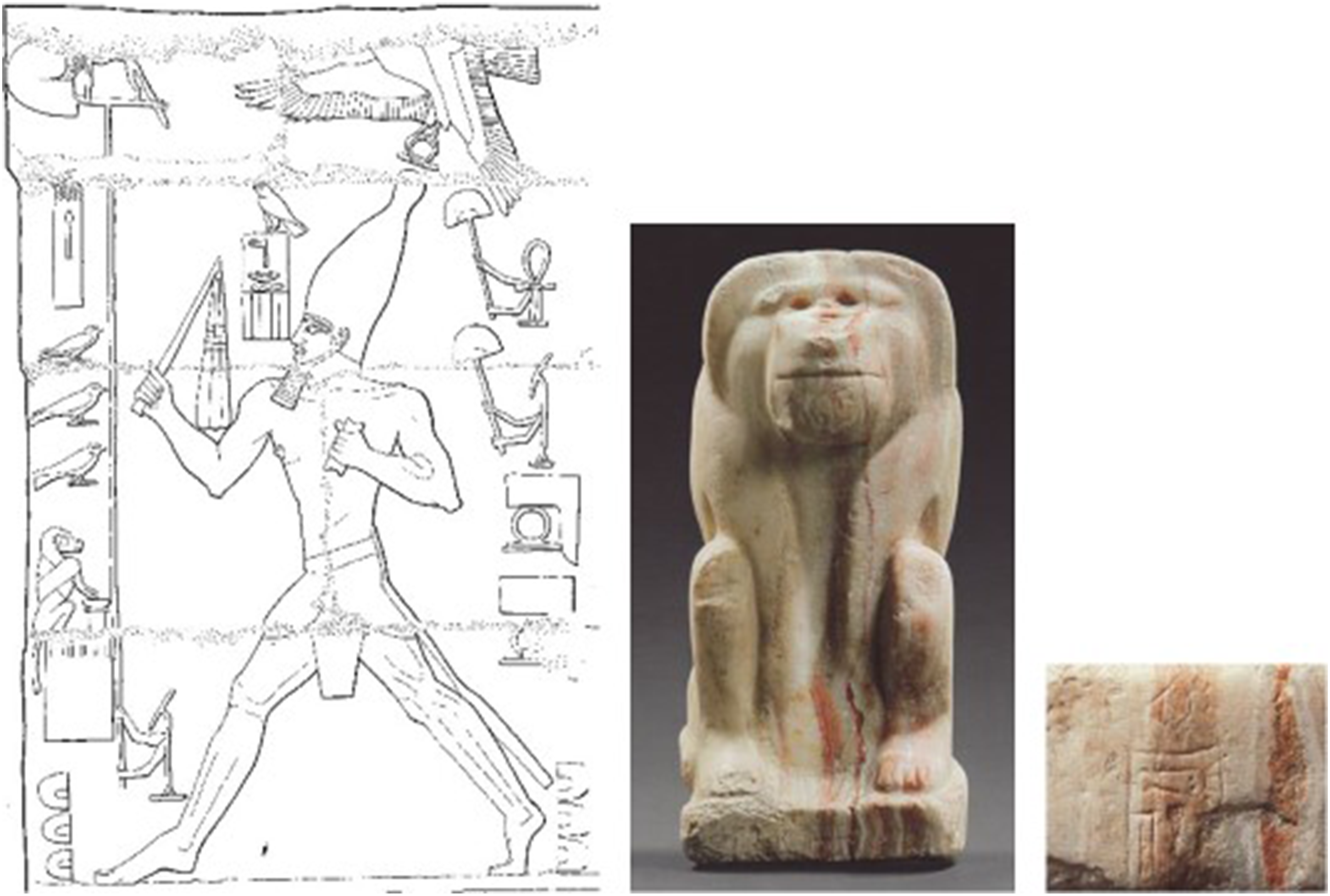
The combination on the label of the phrase ꜥḥ wr.w and the baboon with a boat, could refer, therefore, to one or more visits of Semerkhet to Abydos to honor his royal ancestors. 59
If this had really been a name-giving event for a specific year instead of a remarkable feature of his reign, it is hard to understand why this event would not have been chosen for this year for the annal stone. 60 The two damaged parts on ‘Cairo Fragment 1’ that Edwards had also not been able to read, were evidently not large enough to have contained the cluster of signs involved (see fig. 4). It cannot be completely excluded, of course, that events which had been thought memorable during the First Dynasty were perhaps no longer deemed worth mentioning during the Fifth Dynasty. However, the small ‘Cairo Fragment 5’ (see fig. 4 bottom right), shows in the top right corner of the partly preserved ‘year-compartment’ of King Den that the recording of an event which required the addition of a baboon had been thought still important enough during the Fifth Dynasty to record it in a ‘year-compartment’. 61 Thus, there are several indications that a second conclusion from figure 4 may be that the inscription with the baboon on Semerkhet-labels rather refers to a general characteristic of this king – probably his veneration for his royal ancestors – than to an event that had been characteristic for a specific year.
Figure 6 compares the inscription on ‘Semerkhet 3’ and ‘Semerkhet 5’, with the inscriptions in the year-compartments on the same stone fragment. The upper part of Semerkhet’s fifth year on the stone fragment mentions a ḫꜥ.t nsw, an ‘appearance of the king as nsw-king’. The same event seems also to be visible in the vertical frame on the label, here in the form of a picture of the king with the white crown. In addition, they both show what appears to be a fortress, in the largest of the two horizontal frames on ‘Semerkhet 3’ and in the small horizontal frame in the fifth year-compartment. ‘Semerkhet 3’ and ‘Semerkhet 5’ compared to the year-compartments on ‘Cairo Fragment 1’ of the annal stone.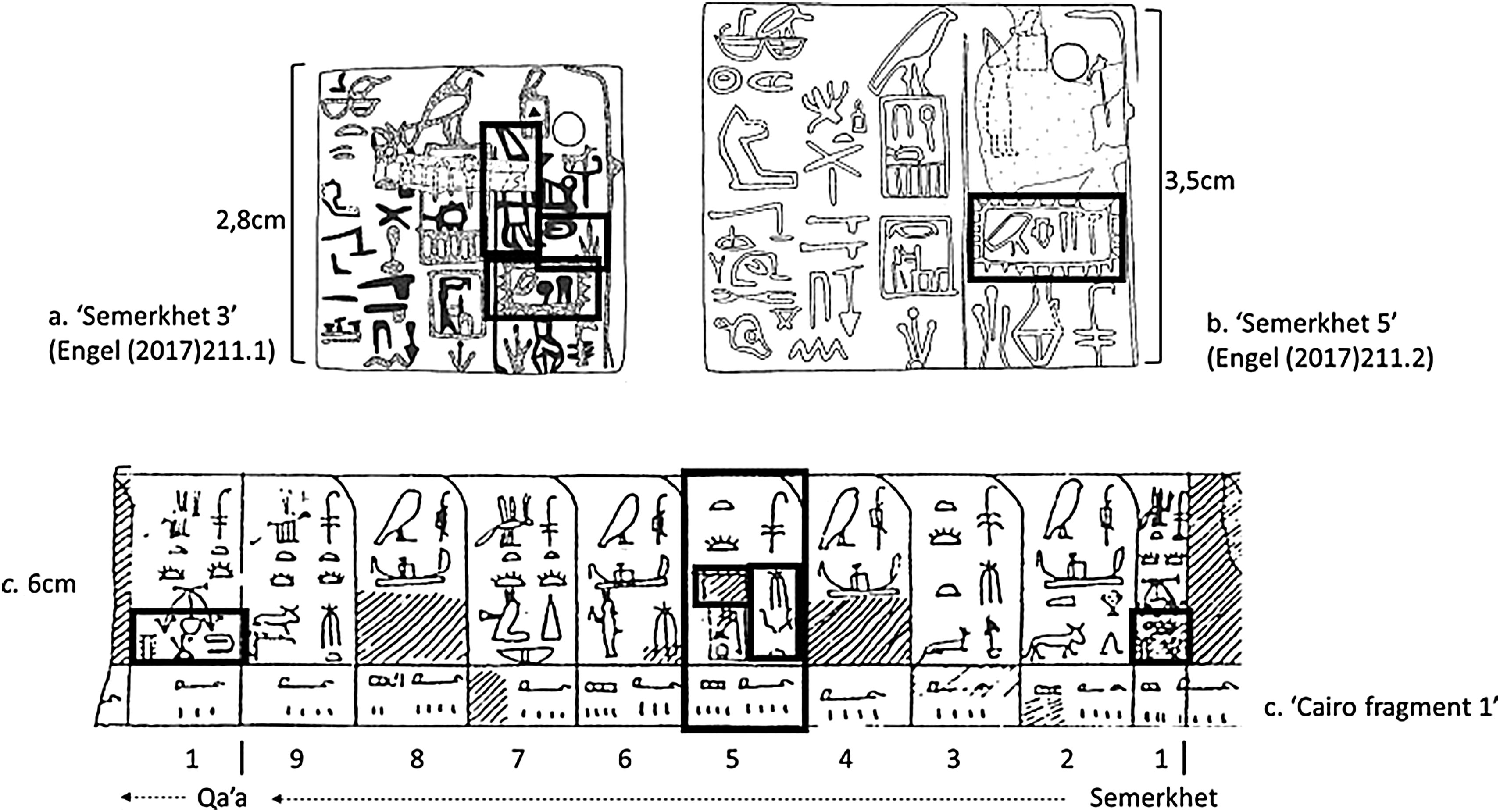
A ḫꜥ.t nsw can be found already in his third year on the stone fragment, however, and no ‘sp 2’ was added to ḫꜥ.t nsw in his fifth year, or on the label, which makes it certain, again, that it cannot have been a ‘name-giving’ event identifying a specific year. It may be argued, instead, that his appearance twice as nsw-king on the stone fragment, during his comparatively short reign, is remarkable. The nineteen preserved compartments of Den mention no appearance at all as nsw-king, only one as bity-king and one as ‘dual king’. In the six compartments where a royal ‘appearance’ was mentioned for King Ninetjer – among the fourteen preserved compartments on the fourth register of the ‘Palermo stone’ – only one was a ḫꜥ.t nsw, one a ḫꜥ.t nsw bity, and no less than four have ḫꜥ.t bity. This warrants the suggestion therefore, that Semerkhet’s appearance twice as nsw-king within a relatively short space of time, was seen as a noteworthy feature of his reign.
As to the presence of buildings on both the labels and the annal stone fragment, an important difference is that there are two buildings in Semerkhet’s fifth year on Cairo Fragment 1 (see fig. 6, below the hieroglyphs for ḫꜥ.t nsw), not just one, as on the label, and that these two are accompanied by the signs for the ‘narrative infinitives’ ms and wp.t (see the small vertical frame in ‘year 5’ in fig. 6). This may refer to the ‘bringing into existence’ of the one and the ‘opening’ of the other building, that is recognizable as the ḥw.t P-Ḥr-msn, an important Early Dynastic institution dating from at least King Djer, that had to supply royal tombs with tomb gifts. 62 In contrast, the building on the two Semerkhet-labels is inscribed with the name Ḥr ib nṯr.w, a name not known from other Early Dynastic inscriptions. The smaller horizontal frame in ‘Semerkhet 3’ in figure 6 shows that this building is, moreover, not accompanied by the signs wp or ms, but by the verb pẖr ḥꜣ, ‘circumambulate (around)’. 63
In the year-compartments of the annal stone fragment, a building plus pẖr ḥꜣ does not occur in ‘year 5’, but in ‘year 1’ of Semerkhet (see the small square frame in this year-compartment in fig. 6). Here it is not combined with the event of an appearance as nsw-king, but with the first of his three appearances as ‘dual’ king. The first year-compartment of his successor Qa’a, on the left side of the same annal stone fragment (fig. 6), shows that a ‘circumambulation’ of what possibly represented the walls of Memphis, 64 was apparently the normal event at the start of a new reign. It was apparently something especially characteristic for the reign of Semerkhet, therefore, that he also ‘circumambulated’ a building named Ḥr ib nṯr.w later during his reign.
Therefore, not only are two of the events on label ‘Den 1’ seemingly recognizable in two different year-compartments on the annal stone. Moreover, a comparison of the ‘event section’ of the inscriptions on Semerkhet labels with the related year-compartments on ‘Cairo Fragment 1’ makes it quite probable that the events represented on these labels were characteristic for a reign rather than for one specific year.
The ḥꜣ.t-section and the analysis of Predynastic mummy wrappings
Not only were the so-called ‘year’ labels more likely ‘regnal’ labels, it is also likely that they were more precisely ‘balm labels’ rather than ‘oil-labels’. It used to be assumed that the ḥꜣ.t-oil to which the labels referred was meant for offerings. 65 Petrie reported that the earth near the entrance of Semerkhet’s tomb – where label ‘Semerkhet 2’ was found – was saturated to three feet (90 cm) deep with an ‘ointment’ that could still be smelled strongly at the time of the excavation; he thought that ‘hundredweights of it must be poured out here’. 66 Such large quantities most likely point to a recurrent offering practice during a long period. 67 As labels were mostly found inside the closed part of the tombs, it is unlikely that the oil mentioned on the labels was (only) used for offerings.
Recent research by Jana Jones and others (2018) has demonstrated that mummification by using balm – not only by natural desiccation and/or the use of natron 70 – was practiced already in the Predynastic Period. 71 Chemical analysis of the wrappings of a predynastic mummy in the Egyptian Museum in Turin (reg. no. S. 293) with a provenance in Upper Egypt (probably Gebelein, Qena or Luxor) and dating to Naqada IA–IIB (c. 3700–3500 BCE) 72 showed the presence of a complex mixture of 1) plant oil/animal fat (96%); 2) aromatic plant extract (3%); 3) plant gum/sugar (0.5%); and 4) conifer resin (trace).
Jones, et al. noted, in addition, that the ‘heated conifer resin’ in the wrappings was ‘non-native’ and most probably imported from ‘the Eastern Mediterranean’. The ‘relative abundances’ of the ingredients were said, moreover, to be ‘typical… [for] mummification throughout much of ancient Egypt’s 3000-year pharaonic history’, 73 although the found percentages did not have to be indicative for the original compositions due to the possibility of chemical changes over time. 74
The single potential direct evidence of mummification during the First Dynasty – a wrapped arm found in the tomb of Djer at Abydos – is no longer extant. 75 However, in the same tomb a cache was found with fourteen vessels ‘caked together by resins and (burnt) linen’. 76 A chemical analysis by Serpico and White of residues in these vessels suggested not only the presence of ‘vegetable oil’ and ‘animal fat’, but also, in one jar, traces of conifer resin (‘probably of Lebanese origin’) and, in another jar, possibly ‘polysaccharide gums’. 77
The presence of linen in the resin on the vessels, as assumed by Petrie, was doubted by them. 78 Their suggestion that the jars contained a ‘food mixture’ is also doubtful, however, because there is no immediately obvious reason for the addition of a tasteless product like gum to a food mixture, as they noted. 79 The presence in Djer’s tomb of ingredients similar to the five or six found in predynastic linen mummy wrappings (as subsumed under the four headings mentioned here above) can rather be regarded, therefore, as an indication for the practice of mummification not only in the Predynastic Period, but also during the First Dynasty.
In what follows, the hypothesis will be tested if the information on our labels also shows similarities to the mixture of ingredients found in predynastic mummification balm. Figure 7 offers an overview, published by Helck in 1987, of the hieroglyphs in the ḥꜣ.t-section of 21 labels and label fragments, arranged chronologically by king.
80
Helck was convinced that ‘es damals noch keine Mumifizierung gab’.
81
Thus, neither the structure of his overview, nor his interpretations of details, can have been biased by the hypothesis that they refer to mummification balm. The information in the columns of his overview will be discussed in three sections, respectively for columns 1–2, 3–7 and 8–10. Where relevant, information from labels not yet known to Helck will be added. Overview of the hieroglyphs in the ‘ḥꜣ.t-section’ of 21 labels (from Helck, Thinitenzeit, 173, with added column numbers and references to electronically accessible illustrations).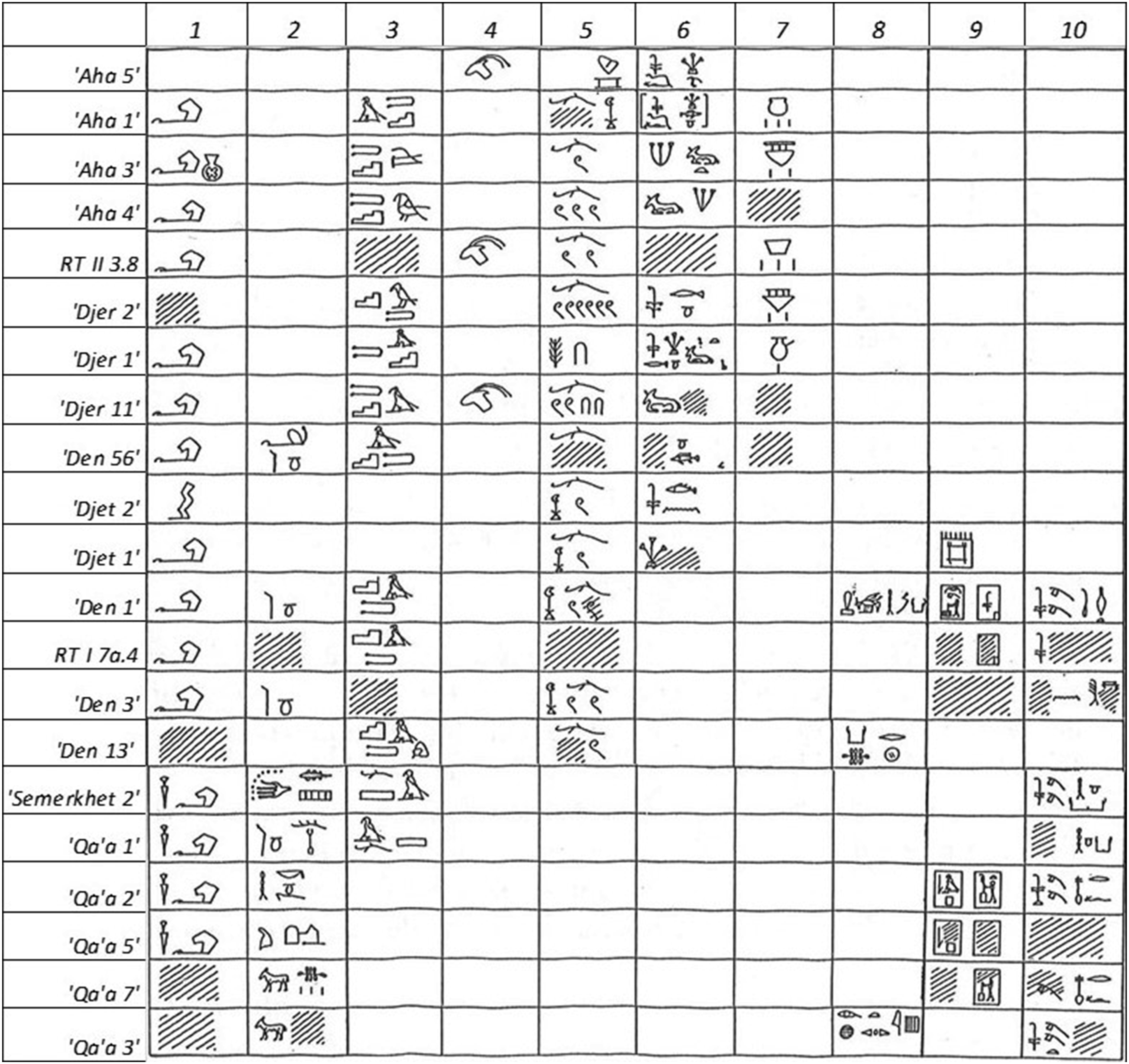
‘Plant oil/animal fat’ and ‘aromatic plant extract’ (columns 1–2)
The ḥꜣ.t-sign in Column 1, denoting ‘the foremost part of’, ‘the start of’ or ‘the best of’, is mostly considered to refer to ‘the best oil’. 82 The proposal by Bardinet to translate it as ‘resin’, 83 is not very convincing, because he refers it to the inscription ḥꜣt.t nt ꜥš next to a picture of dark red bullets in a basket in Rekhmire’s tomb (TT100), c. 1500 years later. Fifth and Sixth Dynasty inscriptions mention ḥꜣt.t nt ꜥš as one of the ‘seven sacred oils’ (see fig. 10). They show vessels that must have contained more or less liquid or viscous products, whereas resin hardens very soon after having left the cones, or the bark, of a conifer.
The hieroglyph for tpy (‘first’) before ḥꜣ.t on the Semerkhet and the Qa’a labels suggests that there was a reason to emphasize the quality of what was already called ‘the best’. This makes more sense in the case of oil than of resin. Domestic oil was a common product in Ancient Egypt. 84 Therefore, tpy will have emphasized that it was really ‘top quality’ domestic plant oil. It may be assumed that the dominant presence of ‘plant oil/animal fat’ in the predynastic mummification balm indicates that this plant oil will also have been domestic oil.
Column 2 shows four instances of the hieroglyphs  for ṯḥnw, Libya(n). The term appeared already earlier on a piece of ivory with Narmer’s name (‘Narmer 4’), where it probably referred to a victory over Libyan people. ḥknw in the ḥꜣ.t-section of labels will rather have referred to Libyan oil. Bardinet has argued convincingly that oil was made of the umbrella pine tree occurring in the Libyan Cyrenaica, about a thousand kilometers removed from Memphis, which did not grow naturally in Egypt.
85
What looks like pḥ, ‘end, back’, on ‘Den 56’, may refer to ‘the most remote’ part of Libya.
86
for ṯḥnw, Libya(n). The term appeared already earlier on a piece of ivory with Narmer’s name (‘Narmer 4’), where it probably referred to a victory over Libyan people. ḥknw in the ḥꜣ.t-section of labels will rather have referred to Libyan oil. Bardinet has argued convincingly that oil was made of the umbrella pine tree occurring in the Libyan Cyrenaica, about a thousand kilometers removed from Memphis, which did not grow naturally in Egypt.
85
What looks like pḥ, ‘end, back’, on ‘Den 56’, may refer to ‘the most remote’ part of Libya.
86
The term ṯḥnw is also known for one of the ‘seven sacred oils’, mentioned on Fifth and Sixth Dynasty ‘ointment-slabs’, 87 as is also the case for ꜥš and ḥknw in this column (see ‘Semerkhet 2’ and ‘Qa’a 2’). Oil made from pine trees has a strong woody smell, indeed. So, ṯḥnw refers here most likely to imported Libyan oil, as an ingredient to be added in small quantities to ḥꜣ.t-oil to improve its smell, instead of being an adjectival qualification of ḥꜣ.t. It should be noted that a sign for fragrance was even explicitly added to the hieroglyph for ꜥš. 88 The mention of precious oils in combination with ḥꜣ.t recalls the very small quantities of ‘aromatic plant extract’ found in predynastic mummy wrappings as additions to comparatively very large amounts of ‘plant oil/animal fat’.
The sign 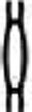 (V27), ꜥḏ, that is present on ‘Qa’a 1’ in addition to ṯḥnw, can refer to animal fat from a mammal or a bird.
89
The labels ‘Semerkhet 5’ (see fig. 6) and Engel (2017) 212.1
(V27), ꜥḏ, that is present on ‘Qa’a 1’ in addition to ṯḥnw, can refer to animal fat from a mammal or a bird.
89
The labels ‘Semerkhet 5’ (see fig. 6) and Engel (2017) 212.1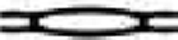 , ꜥḏ. Three other possible references to animal fat are, firstly, the calf in ‘Qa’a 3 and 7’ in figure 7, that is known from later script phases as the determinative not only of bḥš, calf, and wnḏw, dehorned cows, but also of ib(r), ointment. Secondly, the addition of ꜣpd, bird, to mrḥ.t on the rear side of ‘Semerkhet 5’ and on many Qa’a-labels – Engel suggests that, at that time, ‘bird fat’ (perhaps of a goose?) was a normal addition to mrḥ.t, ointment,
90
which itself may have been the term for the combination of ingredients to which the recto referred. Thirdly, column 4 contains likely references to ‘animal fat’, too, as will be argued below. That animal fat or bird fat are not always mentioned on the labels may be due to the fact that it was not a precious ingredient and that it instead was a normal addition to ḥꜣ.t-oil to make it into ointment or balm.
, ꜥḏ. Three other possible references to animal fat are, firstly, the calf in ‘Qa’a 3 and 7’ in figure 7, that is known from later script phases as the determinative not only of bḥš, calf, and wnḏw, dehorned cows, but also of ib(r), ointment. Secondly, the addition of ꜣpd, bird, to mrḥ.t on the rear side of ‘Semerkhet 5’ and on many Qa’a-labels – Engel suggests that, at that time, ‘bird fat’ (perhaps of a goose?) was a normal addition to mrḥ.t, ointment,
90
which itself may have been the term for the combination of ingredients to which the recto referred. Thirdly, column 4 contains likely references to ‘animal fat’, too, as will be argued below. That animal fat or bird fat are not always mentioned on the labels may be due to the fact that it was not a precious ingredient and that it instead was a normal addition to ḥꜣ.t-oil to make it into ointment or balm.
We may conclude that the information contained in the first two columns of Helck’s overview from 1987, in combination with that on labels that were found later, offers sufficient indications that the labels refer not only to ḥꜣ.t-oil, but probably also to an ‘aromatic plant extract’ from Libya and to ‘animal fat’.
‘Plant gum/sugar’ and ‘conifer resin’ (columns 3–7)
Column 3 in figure 7 shows nine examples of a combination of three hieroglyphs which have been read as sṯj ḥr, ‘fragrance of Horus’ (or: ‘royal fragrance’?) 91 , but also as Ṯj.t Ḥr, ‘the Stairs of Horus’, 92 a toponym used for the Cyrenaic (=East Libyan) forest-zone dominated by the Jebel Akhdar (Green Mountain). 93 Bardinet translated this group of hieroglyphs on ‘Aha 3’ (see fig. 7), in combination with the hieroglyphs in column 5 of figure 7, as: ‘(Ointment with) resin and 100 pieces of wood from “the Stairs of Horus”, (products) arriving in Lower Egypt in two boats’. 94
It will be argued however, that the hieroglyphs in column 3 and 5 of figure 7 do not refer to one product (wood from the Stairs of Horus), but to two products (wood and a ‘Stairs-of-Horus-product’), and that the sign for wood in column 5 refers to Eastern Mediterranean rather than to Libyan wood. This would allow a translation like: ‘The best (domestic) oil, “Stairs of Horus”(-product), and 100 pieces of wood; 95 contributed by Lower Egypt (in) two vessels’. 96
A possible candidate for the ‘(product from) the Stairs of Horus’ is the Libyan resin or gum silphium. Silphium became world famous in antiquity for its unique fragrance and sweetness (and as a panacea for all kinds of ailments) following its ‘discovery’ in 631 BCE by Greek colonizers, in the region where they founded the city of Cyrene. Its sweet fragrant gum could be extracted by making incisions in the root. It was even depicted on Libyan coins from the sixth to the fourth century BCE (fig. 8b). Attempts to cultivate it in other parts of the Mediterranean world failed. According to Pliny the Elder (23–79 CE) the plant had nearly completely disappeared by the first century CE, probably due to over-exploitation as well as to an increase in farming goats in Cyrenaica.
97
a) Bud of a waterlily; b) Cyrenaic coin with silphium (sixth to fourth century BCE);
123
c) silphium before and after removal of umbellifers and bracts (Vikentiev, ASAE 56, 12); d) ‘Djet 1’ with two (incised?) roots of Libyan silphium.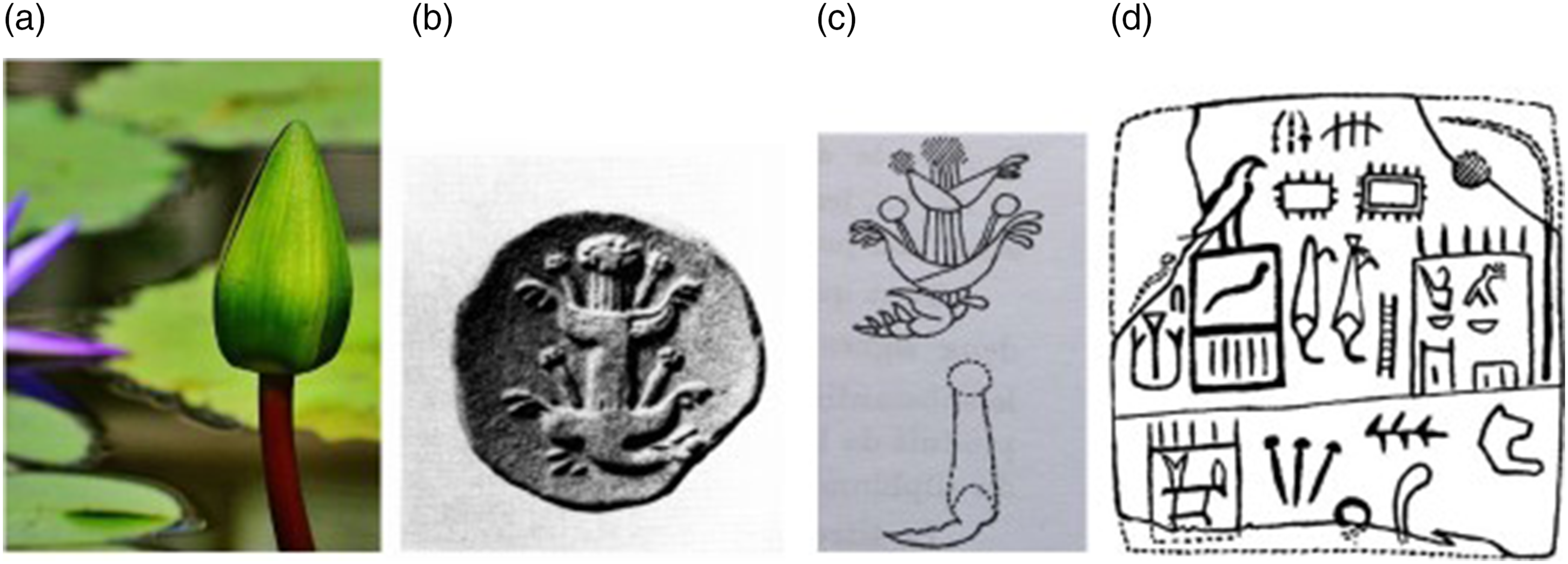
As the conifers, from which the Libyan oil, mentioned in column 2, was made, grew also in this eastern region of Libya, it is quite probable that the Egyptians knew of the existence of this remarkable plant already by the Early Dynastic Period. As the sap of silphium is described as a ‘translucid gum-resin’ which hardens quickly in the sun, 98 it evokes ‘the difficulty of removing melted resin’ from the wooden label ‘Den 1’ which was reported by Petrie; 99 Lebanese resin with its red color will not have been ‘translucid’. The sweetness of silphium recalls the ‘plant gum/sugar’ mentioned by Jones, et al. as the third ingredient in the predynastic mummy-wrappings and of the ‘saccharide gum’ in one of the vessels in Djer’s tomb mentioned above. They concluded in their report that further research was needed, focusing ‘specifically on the sugar/gum component’, for which they had not been able to establish a possible source. 100 This is understandable, if the gum came from a plant that is now extinct.
It may be added that two puzzling objects in the center of label ‘Djet 1’ (fig. 8d) were once interpreted as pictures of the thick root of this famous plant with its aromatic gum, because of the characteristic curving and horizontal growth of its small lower end. 101 Helck preferred to interpret them – in combination with the ms.t sign at the top – as the ‘Geburt zweier Lotosknospenzeichen’, 102 although the ms.t sign stands above what looks like two symbols for fortresses, which makes the ‘bringing into existence’ of these two buildings a more likely interpretation. 103
Figure 8 shows why the older interpretation of these two puzzling objects is more trustworthy. The bud of a waterlily (often called a lotus in Egyptology) 104 (fig. 8a) is not characterized by a stalk growing horizontally right under the bud, as to be seen on label ‘Djet 1’ (fig. 8d) and in the case of the silphium root (see fig. 8b–c).
The provenance of ‘Djet 1’ is unknown, but the similar label ‘Djet 2’, with a more schematic drawing of the two objects (without the horizontally growing root) was found in the large ‘palace façade’ mastaba tomb no. 3504 in Saqqara. This tomb probably belonged to the official Sekhemkasedj, whose name is mentioned on several other objects found in this tomb and also some in Djet’s tomb in Abydos. 105 The inscription of ‘Djet 2’ does not have the ḥꜣ.t-sign for oil, but the wḥm-sign, which has been supposed to refer to ‘repeated pressing’ and, therefore, perhaps to a lower oil quality. 106 The possible presence of silphium-roots on a label found in this non-royal tomb might show that for this funeral, too, a precious – perhaps at that time new – product like silphium was used.
Column 3 includes, for the labels ‘Semerkhet 2’ and ‘Qa’a 1’, a term transliterated by Engel as ḫ.t šj ḥrw, which is also present on ‘Qa’a 12’ and ‘Qa’a 17’ (Engel (2017) 212.1
Column 4 shows for three labels the head of a horned mammal. Kaplony proposed to interpret it as the antelope called nwḏw
109
in order to be able to read the sign as nwḏ, ointment. Helck disagreed, because the horns are not like nwḏw horns (see fig. 9 below right).
110
He did not suggest an alternative, but the horns clearly resemble those of the oryx antelope (mꜣ-ḥḏ; see fig. 9.) The fat ‘young mꜣ-ḥḏ’ and the fat ‘young nwḏw’ in the Sixth Dynasty tomb of Mereruka.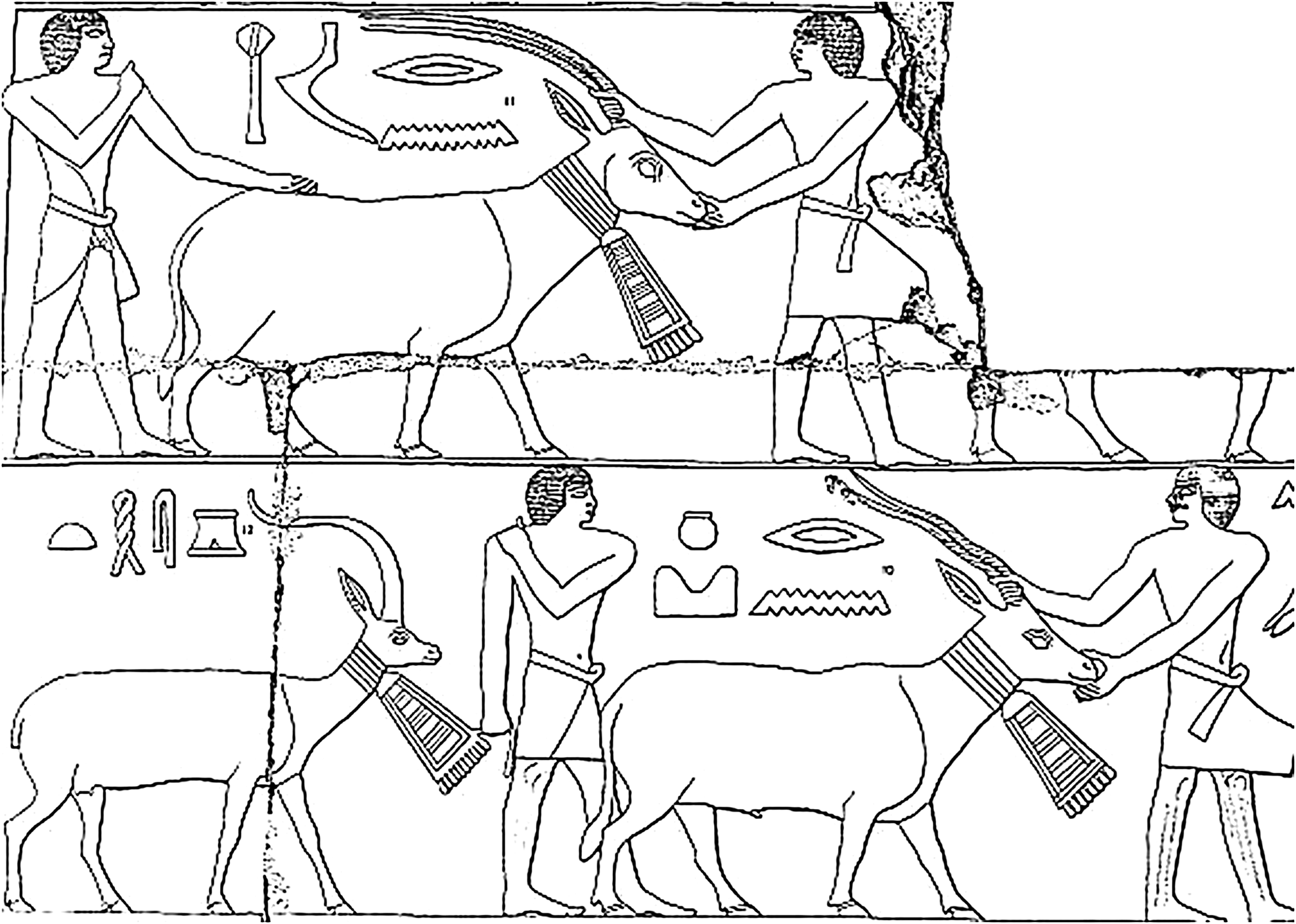
The Wörterbuch added ‘as an animal to be fattened’ to its translation for nwḏw, an addition which again recalls the ‘animal fat’ in the mummification balm found in predynastic mummy wrappings. Figure 9 depicts a particularly fat mꜣ ḥḏ which suggests that also the mꜣ ḥḏ was fattened. 111 This would make it probable that the hieroglyph of the oryx head refers to animal fat as well, which could mean that the ꜥḏ of ‘Qa’a 1’ and the calves of ‘Qa’a 7 and 3’ in column 2 would belong in the same column as the horned animal heads.
Column 5 shows the wood-sign ḫt, often combined with hieroglyphs for ‘hundred’ or even ‘thousand’. The amount of wood involved was apparently something to be vaunted, which suggests that it was precious, imported wood, most likely Lebanese conifer wood (cedar or fir), that was imported into Egypt already by the Predynastic Period. 112
It is possible to produce oil by pressing foliage, roots, and wood of coniferous trees. 113 The character of the vessel discussed in column 9 suggests that the production process of the oil-product that is mentioned on the labels may have involved heating. This recalls the presence of ‘heated conifer resin’ as reported for the predynastic mummy wrappings, because resin dissolves in oil when heated. 114
Column 6 shows combinations of the hieroglyphs for ḏfꜣ (‘provisions’), iw.t or inw (respectively, ‘what has come from’, ‘revenue from’) and šmꜥ and/or mḥw (‘Upper and Lower Egypt’). It has been suggested that this indicates that oil was the main item paid as taxation in Egypt. 115 Even low-status workers received wheat, oil and wine every month to support their families. 116 This indicates that it is possible that the king received domestic oil as tax payment indeed and that this most likely was common oil for daily use in cooking and lighting, rather than ‘ḥꜣ.t-oil’. Given the character and the funerary context of the labels, a mixture of ḥꜣ.t-oil and other ingredients will more likely have been a special, ritual contribution to the royal funeral, and it seems likely that it was designated as having contributed by Upper and/or Lower Egypt for ceremonial reasons. 117
It should be added here, that the sign 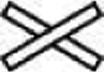 , Gardiner’s Z10, in the ‘ḥꜣ.t-section’ of ‘Semerkhet 3’ and ‘Semerkhet 5’ (see fig. 6) is often read as ḥsb, and translated as ‘accounting official’ or ‘tax official’.
118
This reading ignores, however, the following sign
, Gardiner’s Z10, in the ‘ḥꜣ.t-section’ of ‘Semerkhet 3’ and ‘Semerkhet 5’ (see fig. 6) is often read as ḥsb, and translated as ‘accounting official’ or ‘tax official’.
118
This reading ignores, however, the following sign 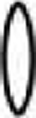 , Gardiner’s V38, known from later texts as a determinative for wt ‘mummy cloth’, which makes it interesting that Gardiner noted that Z10 was an earlier form of Aa2,
  , known as a determinative of wt ‘embalmer’.
119
Therefore, this would rather suggest ‘the one who adds the balm to the mummy wrappings’ as translation for these two hieroglyphs.
, known as a determinative of wt ‘embalmer’.
119
Therefore, this would rather suggest ‘the one who adds the balm to the mummy wrappings’ as translation for these two hieroglyphs.
Column 7 shows that, on most of the earlier labels, the range of products in the upper rows of figure 7 ends with a vessel. This supports the interpretation that the inscriptions indicate a number of ingredients which were mixed into one product.
The officials, the man with the vessel and the mmḏḥ-sign (columns 8–10)
From the reign of King Djet onward, the information in the ḥꜣ.t-section no longer ends with a vessel plus a numeral. Columns 8–10 show that, from then on, information was added about officials and institutions involved in the supply of the oil-product.
Column 8 shows for label ‘Den 1’ the name and the main title of Hemaka, the ‘seal bearer of the bity-king’, whose huge ‘palace façade’ tomb in Saqqara (S3035) with its rich equipment is well-known. 120 The presence of his name can be seen as an indication of the importance of the product mentioned on the label. ‘Den 13’ mentions another title, iry nḫn, ‘guard of Nekhen’, followed by the name Kasa (which occurs also on Den 18 and Den 27). This title nḫn(w) probably also indicates a high function because it is sometimes also found for Sekhemkasedj (although not with the same hieroglyphs for iry nḫn as here), the probable owner of the large ‘palace façade’ tomb S3504 in Saqqara. He may have been Hemaka’s predecessor under Djer and Djet during a period for which the function ḫtm bit is not yet attested. 121
Helck’s overview does not have the name of Sekhemkasedj in column 8, apparently due to the fact that it was not in the ‘ḥꜣ.t-section’ of ‘Djet 1’ and ‘Djet 2’. The names of Henuka and Nefer 122 on the Semerkhet and Qa’a labels are, moreover, not in his column 8, but in column 10, probably because, unlike that of Hemaka, their names appeared always in the leftmost part of the label close to the title in column 10 that was mostly transliterated as mḏḥ-mḏḥ(.w)-nswt. On label ‘Qa’a 18’, not yet known to Helck, the title ḫtm bity appears also on the far left of the label, here with the name of – probably – Henuka. The last cell of column 8 (‘Qa’a 3’) will be discussed at the end of the comment on column 9.
Column 9 shows, on several labels, the picture of a man inside a building pounding or stirring in a large vessel. It is similar to Gardiner’s sign A34, ḫws(i),‘to pound’. 124 Helck interpreted it as an Ölbereitungsanlage/Ölmühle (oil mill) because the representation may refer to the pounding of oil seeds. Endesfelder, however, suggested Salbenküche (ointment kitchen), which supports the interpretation proposed in this article that it is the ‘stirring’ of ḥꜣ.t-oil with other ingredients that is represented. 125
The object inside the upper part of the ‘workshop’ (see column 9 of ‘Den 1’) is often read as nbw, ‘gold’, or even as nbj as used for ‘melting’ of gold and ore. 126 The absence of the characteristic row of hanging beads of the nbw-sign (see also ‘Semerkhet 5’ in fig. 6) and the unquestioned references to oil in the rest of the inscriptions, make these meanings improbable, however. 127 A more convincing reading is Ölpressesack (oil press bag). 128
Oil can be extracted from conifers by means of distillation or by pressure. Pressure could be realized by filling a linen bag or cloth with chopped coniferous wood, foliage and cones, and then wringing it by turning the two loose ends at each side, a method not used to extract oil from seeds. 129 Perhaps this wringing was done while dipping the bag periodically in a vessel filled with heated oil, as heating will have eased the extraction process because resin dissolves in heated oil. 130
Pictures from the Fifth Dynasty tomb of Iymery at Giza and from the Middle Kingdom tomb of the nomarch Khnumhotep I at Beni Hassan demonstrate how an ‘oil-press bag’ was used in later periods (fig. 10a–b). The vessels for the ‘seven sacred oils’ to the right show that these pictures represent the pressing of oil and not, for instance, that of grapes for wine.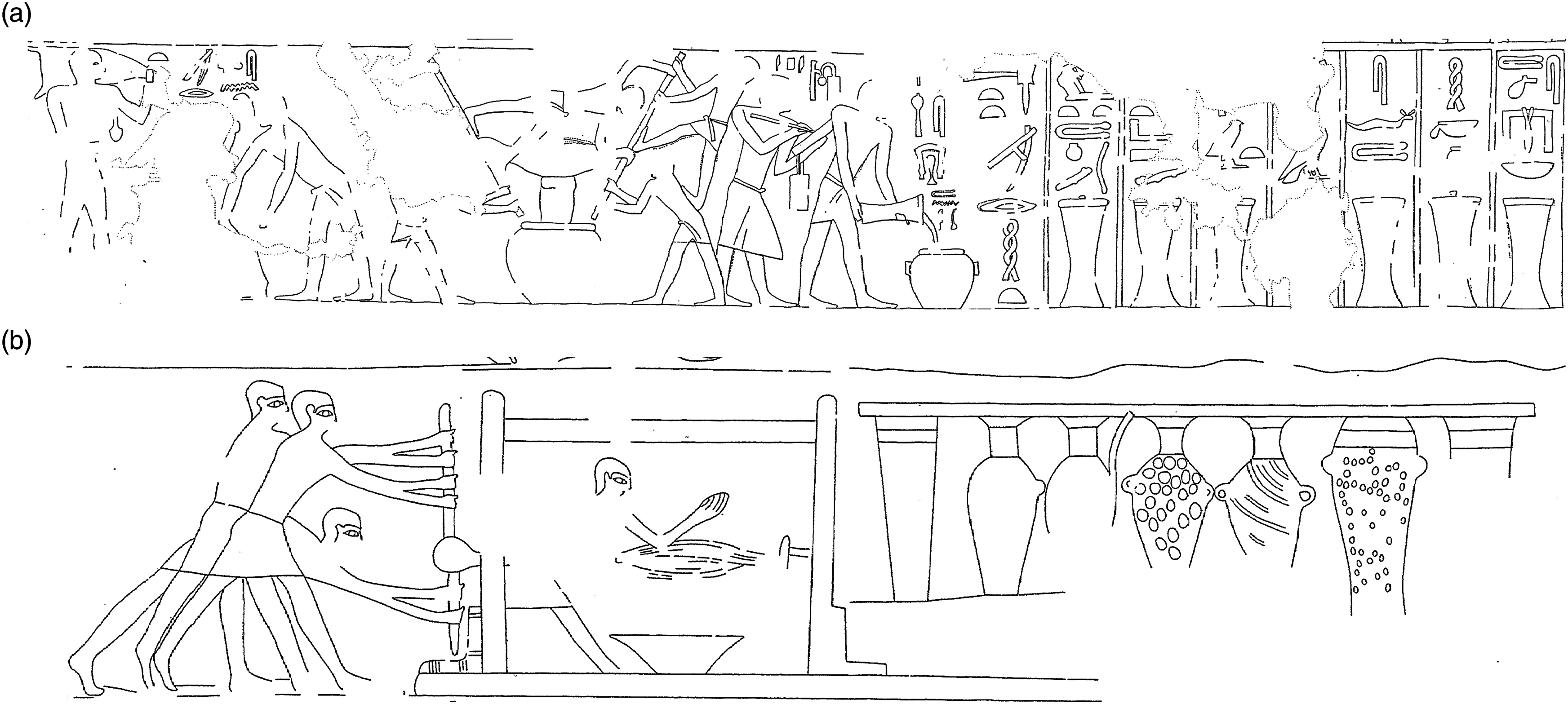
The object below the ‘oil press bag’ on ‘Den 1’ in column 9, which is erroneously often transliterated as mḏḥ, will be discussed in the section on column 10 below.
The addition of a ḥw.t with a nsw-sign to the ‘oil workshop’ on label ‘Den 1’ may indicate that the production process was under the supervision of a royal institution. On later labels, such as ‘Qa’a 2’ and ‘Qa’a 5’, the Salbenküche of column 9 is combined with the ḥw.t P-Ḥr-msn that had to supply the tomb with gifts. 131
The text inside the building with the man and the vessel is: jp(w) mnw, ‘(the building called) “The counting of the god Min”’ or ‘(The building) considered as that of the god Min’, a rather puzzling name. 132 The term appears on no less than sixteen of the ‘Qa’a labels’. The same words can also be found on label fragment ‘Qa’a 3’ in the last line of column 8 in figure 7, but here outside the building and preceded by the hieroglyphs for iri ḫ.t in the upper left corner; these words seem to have preceded a partly damaged title starting with mḏḥ.
Column 10 shows, on many of the later labels, the enigmatic title that is usually transliterated as mḏḥ-mḏḥ(.w)-nswt and mostly translated as ‘the leader of the carpenters of the king of Upper Egypt’, 133 although Helck had suggested that it referred to ‘a master of the royal oil producers or the like’. 134 Since the reign of Qa’a the presence of this title in the ‘ḥꜣ.t-section’ of the labels is mostly combined with the presence in the ‘event section’ of the words mḏḥ-bit-mḏḥ-bit. 135 Before discussing the mḏḥ-mḏḥ(?)-nswt, first the expression mḏḥ-bit-mḏḥ-bit will be discussed, in order to emphasize the difference between the two.
Mḏḥ-bit-mḏḥ-bit was translated by Engel (following Dreyer) as ‘the two carpenters of the king of Lower Egypt’. The fact that these hieroglyphs are in the ‘event section’ suggests, however, that they may rather belong to the ‘event’, which may have consisted of two types of cutting (of wood) for the bity-king as part of the inspection of ḥm-ꜥꜣ and ḏš wood (see fig. 2a–b). 136
Helck proposed to read ḏ and š as a shortened form of šnḏ, the term for acacia-wood. 137 However, as there are two types of wood in Asia Minor that are often called ‘cedar’, the cedrus libani and the abies cilicica, both ḥm-ꜥꜣ and ḏš may refer to Egypt’s coniferous imports from the Eastern Mediterranean. On some labels a š-sign, which may stand for ꜥš, conifer, 138 is present under in(.t) nsw (see fig. 2a).
Wood was used for lining the interior of the royal tombs at Abydos, and there is evidence now, from the analysis of wood remnants from excavations in Abydos, that not only native woods, like acacia and tamarisk, were used to this end, but also precious imported wood from Asia Minor. 139 Besides this, as was argued above, imported wood could be used for oil production. Admittedly, Lebanese jars with an oil-residue were found in the tombs of Djer and Semerkhet, 140 so conifer-oil was also a ready-made import product. Perhaps its domestic production started under King Qa’a, from the parts of the ‘cedar’ wood that were not used for building. The ‘inspection’ of precious wood upon arrival in Egypt as mentioned on Qa’a labels, may have involved making two types of cuts into imported wood, to assess its potential for these two types of ‘royal use’. 141
The main point to be made here is, however, that the second hieroglyph in what used to be transliterated as mḏḥ-mḏḥ(.w) nswt in the ‘ḥꜣ.t-section’ of the label cannot have had the same meaning as the first sign, because these two hieroglyphs are not identical in fact (see fig. 2b above). The first sign is, indeed, the axe mḏḥ,  , Gardiner’s T7, ‘used in battle as well as for hewing wood’. The second sign, however, looks more like a small vessel with a broad strap that may have been used to collect resin or gum.
142
The sign depicted below the ‘oil pressing bag’ in column 9 for ‘Den 1’ (fig. 3b) also resembles a small vessel with a strap more than an axe.
, Gardiner’s T7, ‘used in battle as well as for hewing wood’. The second sign, however, looks more like a small vessel with a broad strap that may have been used to collect resin or gum.
142
The sign depicted below the ‘oil pressing bag’ in column 9 for ‘Den 1’ (fig. 3b) also resembles a small vessel with a strap more than an axe.
If it refers to the collecting of gum, the appearance of this sign on the labels may perhaps explain the lack of other attestations for the (probable) silphium-signs on Djet 2 and Djet 1. This would make it likely that mḏḥ-(…?)-nswt was the title of the official that was on the one hand responsible for the chopping of wood necessary for the production of conifer oil and on the other hand for the supply of ‘plant gum’, the two most precious ingredients necessary for the production of mummification balm. 143 A more probable translation of the function mḏḥ-(…?)-nswt than ‘leader of the carpenters’ might be, then, the ‘royal balm official’ (or, more precisely, the ‘balm official of the king in his role as nsw-king’).
On ‘Den 1’ (fig. 1), Hemaka combined his function of royal seal bearer (ḫtm bit) with that of ‘royal balm official’. On ‘Qa’a 20’, Henuka had been the mḏḥ-(…?)-nswt; on ‘Qa’a 15’, ‘Qa’a 5’ and other Qa’a labels, he and an official called Nefer both had this title. 144 On ‘Qa’a 18’, Henuka was (probably) the ḫtm bit and an official called Senuhor (?) was the mḏḥ-(…?)-nswt. Thus, the office of mḏh-(…?)-nswt was important and apparently close to the high office of ḫtm bit. On ‘Semerkhet 3’ and ‘Semerkhet 5’ (fig. 6) the official Sen seems also to have had both functions (although the additional nsw is missing here) and, in addition, held the function of the ‘embalmer of the mummy wrappings’, as argued above. Thus, these labels show Sen with a string of three titles.
Lastly, it should yet be noticed that, by the reign of Qa’a, the label inscriptions appear to be completely dedicated to activities, institutions and persons related to the supply of the balm, no longer only in the ḥꜣ.t-section, but also in the ‘event section’ that had formerly referred to characteristic activities of the king.
Conclusion
There are sufficient indications that what used to be called ‘oil labels’ or ‘year labels’ were actually ‘balm labels’ and that the inscriptions on them recorded events that had been characteristic for regnal periods. Does this imply that these inscriptions should be seen as the oldest examples of history writing? The answer to this question depends, of course, on one’s definition of history writing, a theme that will not be elaborated upon here. 147 Nevertheless, the existence of an ambition among the Early Dynastic intellectual court elite to give expression, somehow, to their awareness of what was remarkable for their time cannot be doubted. Famous objects like Narmer’s Palette and his decorated mace head show characteristics of Narmer’s reign by means of pictures and symbols, in an artistically admirable way, and these impressive artefacts will most probably have remained in a visible location for at least some time. The tiny labels are artistically poor, but intellectually impressive, because their inscriptions offer the earliest attestations of verbs denoting human activities. This was the first necessary step to make written history possible. Labels were mostly found in tombs, however, and therefore cannot have been meant to be read or seen after the funeral. As such they cannot be regarded as history writing.
The attempts to preserve not only the body, but also the memory of a king in his tomb – by summarizing what had been most characteristic for his reign in script – were not continued in any other way after the First Dynasty, although the Fifth Dynasty annal stone fragments demonstrate that Early Dynastic archives must have continued to be written. An answer to the intriguing question as to why the first step on the way to the writing of history headed down a blind alley, may be found in a shift in the content of the label inscriptions. Gradually more space was dedicated to the activities of high officials for the royal funeral, than to activities of the king during his reign.
From at least the reign of King Djet, names and titles of officials began to appear on the labels. By the time of King Qa’a, not only the ‘ḥꜣ.t section’ but also the ‘event section’ focused on memorable activities of officials. Some labels even showed a ‘string of titles’, as would become common in the inscriptions on stone stelas that are known since the end of the First Dynasty. 148 Whereas the first attempts to characterize the reigns of kings came to nothing despite the new possibilities offered by the use of script, the ambitions of officials to preserve the memory of their own importance to the king would be continued in new and visible forms in stone.
By far not all known balm labels and label fragments could be discussed in this article in terms of the new interpretation offered here, and the last word will not yet have been spoken for many details of the ones that were. The Appendix below intends to be a useful tool for further research into these fascinating objects. 149
Footnotes
Acknowledgments
I am grateful to Jochem Kahl for his comments on my first presentation on labels during a stay as an Erasmus-student in Berlin in 2015, to Massimiliano Nuzzolo and Kathryn Piquette for their comments on my presentation during the International Conference of Egyptologists in 2019 in Cairo, to Olaf Kaper and René van Walsem for their comments on a first complete version of this article, to Elizabeth Bettles for correcting my English and for some useful other suggestions, and to the anonymous reviewers of the JEA for their constructive suggestions for improvements.
Funding
The author did not receive funding for this project

Notes
Author biography
After her retirement as senior lecturer in social-economic history at VU University Amsterdam, Wantje Fritschy studied Egyptology in Leiden and Berlin. She is now an independent researcher with a special focus on aspects of the Early Dynastic Period.
Appendix