




Abstract
More than 4000 graffiti are scattered throughout the Theban necropolis. Among them, around 2500 graffiti can be dated to Nineteenth, Twentieth, and Twenty-First Dynasties. These New Kingdom graffiti were made by members of the community of workmen from Deir el-Medina. Only a small group of no more than 120 graffiti consist of depictions of deities and veneration scenes. The interpretation of graffiti with depictions of Amun-Re on rock surfaces in the Valley of the Kings reveals valuable information regarding their locations. This study thus attempts to identify particular locations in the valley where the workmen of Deir el-Medina venerated Amun-Re in different forms. These spots may have been considered to be of religious significance to the workmen of Deir el-Medina.

Introduction
More than 4000 graffiti are scattered throughout the Theban necropolis. Among them, around 2500 graffiti can be dated to the Nineteenth, Twentieth, and Twenty-First Dynasties. These New Kingdom graffiti were made by members of the community of workmen from Deir el-Medina. Only a small group of no more than 120 graffiti include depictions of deities and veneration scenes.
Gods and goddesses such as Meresger, 1 Thot, 2 and Hathor 3 were repeatedly depicted in many locations in the valleys of the Theban Mountain, but no god is more present in graffiti than Amun-Re, who is depicted in 42 graffiti in the Theban necropolis, 33 of which are located in the Valley of the Kings (see fig. 1). This prominence clearly illustrates the god’s dominant position in Western Thebes. This finding was confirmed by Sadek, whose analysis of religious practices in Deir el-Medina showed that he was the most venerated god. 4 The same result was established by Dorn through the analysis of ostraca stelae left by the workmen of Deir el-Medina in their huts in the Valley of the Kings, near to the graffiti under discussion. 5
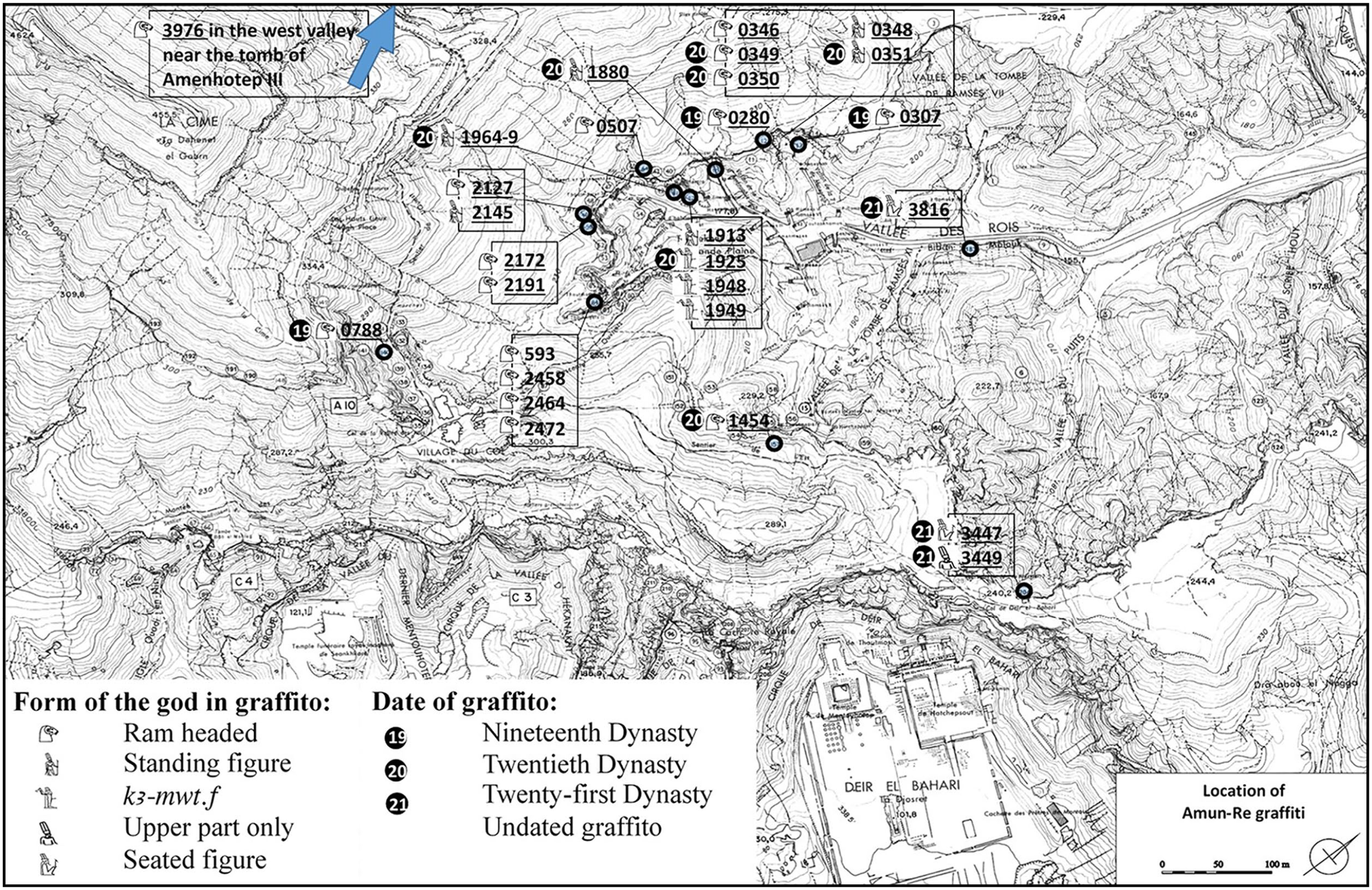
Locations of Amun-Re graffiti in the Valley of the Kings (based on Rzepka, Who, Where and Why, cat. [3.3], map 2 and cat. [7.5] map 2, modified by the author).
The whole territory of Western Thebes was considered divine because of its location opposite the house of the god Amun-Re in Karnak. This area was therefore also designated as ‘who faces her lord’. 6 In addition, the region opposite Karnak and aligned with the axis of the temple was considered a natural continuation of Karnak itself, and named the Great Forecourt of Amun. This included the area of the temple of Seti I in Qurna and extended further into the Theban Mountain, including Dra Abu el-Naga and Deir el-Bahari. 7
The Theban Mountain was thought to be the abode of many deities 8 and formed an important element of the Theban solar religion, as the divine womb of the mother goddess Hathor-Imentet where Amun-Re rests and regenerates . 9 A scene on the west wall in the tomb of Ramose (TT 7) in Deir el-Medina clearly shows the relation between the god Amun-Re and the Theban Mountain. The god is enthroned inside the mountain, followed by the other two members of the Theban triad Mut and Khonsu, being adored by Ramesses II, his vizier Paser, and the tomb owner Ramose. 10
The sacred zone of Western Thebes, which was referred to as the great forecourt of Amun, probably extended into the mountain, as it followed the same axis from Karnak westwards to include the Valley of the Kings. The burial ground of kings of the New Kingdom was a sacred domain with strictly regulated access from the post-Amarna period onwards. 11 It is here that the tomb builders were active and left graffiti with depictions of the god Amun-Re expressing their relation to the main god of Thebes.
Research on graffiti in the Theban necropolis
After most of the graffiti were published 12 there has been an increased interest in their analysis over the last two decades. Despite this, veneration scenes were never the main subject of research. Peden focused only on textual graffiti, 13 while Rzepka mainly studied graffiti with identifiable names (persons with known and datable filiations) and their distribution. 14 Ragazzoli examined graffiti in tombs 15 and the particular case of ‘la grotte des scribes à Deir El-Bahari’, part of another setting than those found in the desert valleys of the Theban necropolis. 16 Only one veneration scene (graffito 1454) attracted interest recently, as it provided an iconographical parallel to O.Birmingham 1969W71. 17
The interpretation of graffiti with depictions of Amun-Re on rock surfaces in the Valley of the Kings reveals valuable information about their locations. This study attempts thus to identify distinctive locations in the valley, where the workmen of Deir el-Medina venerated the different forms of Amun-Re. These sites may have had religious significance to the workmen of Deir el-Medina.
Presentation of the corpus
The 33 graffiti of the god Amun-Re are located in the valley’s sectors A2, A3, A5, A6, A7, A9, A10, and WV A in the western valley. 18 Only sixteen of these 33 graffiti can be precisely dated between the mid-Nineteenth Dynasty and the early Twenty-First Dynasty, thanks to the identification of the graffito-producer (see Table 1). It remains difficult to suggest precise dates for the other seventeen, due to the lack of information included in these graffiti.
Graffiti of Amun-Re in the Valley of the Kings: form, location, and date.
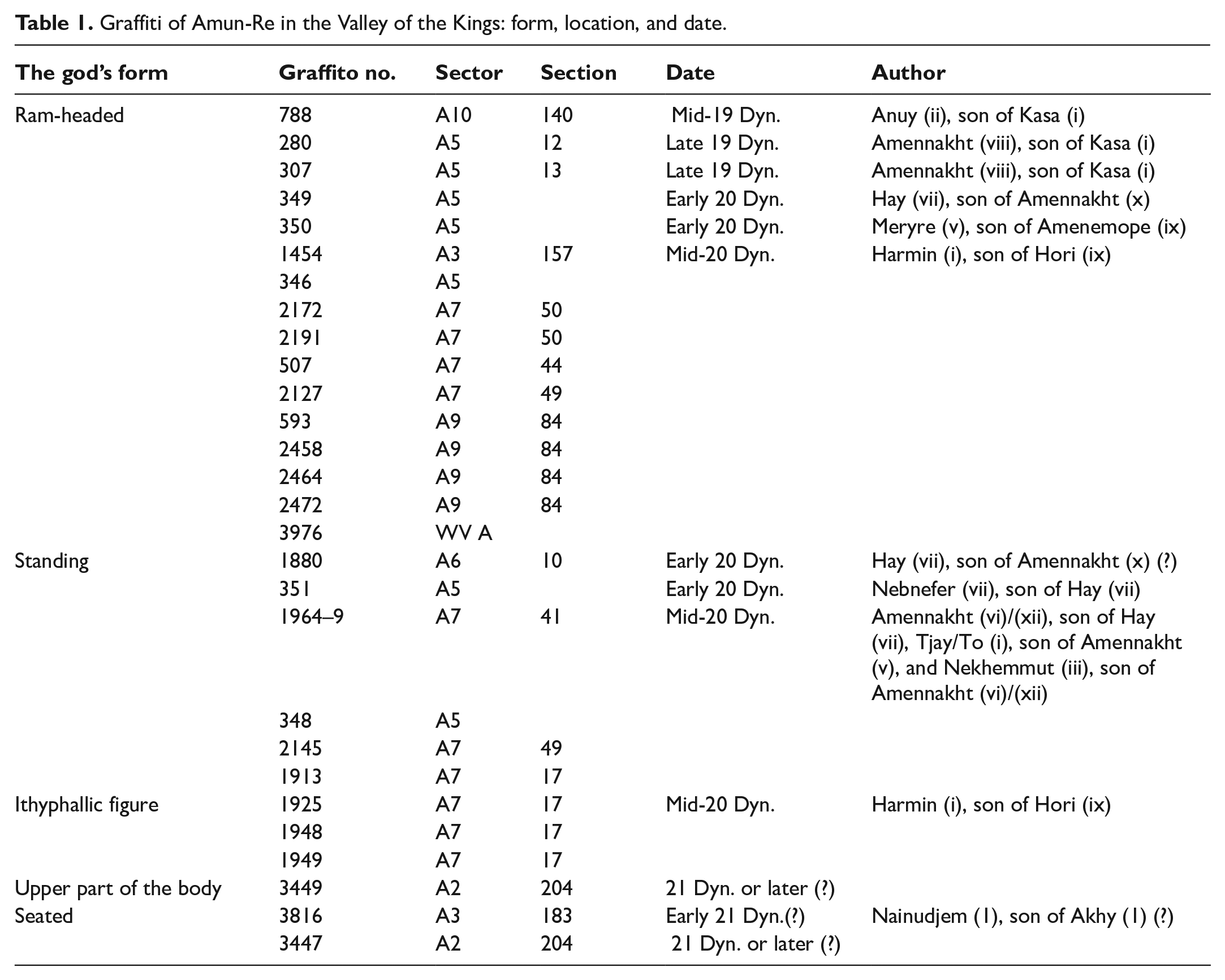
Within the 33 graffiti, the god Amun-Re was depicted in five different forms, either as ram-headed, a standing god, a seated god, the upper part of the god’s body, or as an ithyphallic figure.
Ram-headed Amun-Re
The ram-headed Amun-Re is the most depicted form of the god in the graffiti of the Valley of the Kings. The god is present as ram-headed in sixteen graffiti in six sectors. These graffiti are classified into four types, according to the style. Each of them shares common features; the first type of ram-headed Amun-Re graffiti (fig. 2, type A) depicts the god adorned with the solar disk and uraeus with the name of the god inscribed in one column of hieroglyphs in front of his face. Graffiti of this type are always executed in fine detail and include graffiti 280, 307, 349, 2172, and 2191. The second type of the ram-headed god graffiti (fig. 2, type B) also shows a detailed god adorned with the solar disk and/or uraeus. The main characteristic of this type of graffiti is that the god always rests on a chapel with offerings in front of him. This type includes graffiti 507, 593, 1454, 2458, 2464, and 2472. The third type (fig. 2, type C) records fewer details and is of lower quality than the previous two (A and B). Type C graffiti depict the ram-headed god with neither uraeus nor solar disk and include graffiti 350 and 2127. The fourth type of graffiti of the ram-headed god in the Valley of the Kings (fig. 2, type D) is the simplest and the most crudely done. Graffiti of type D only outline the head of the god with a solar disk and uraeus on top of it such as graffiti 788 and 3976.

Four types of the ram-headed Amun-Re depictions (type A: 2191, type B: 2472, type C: 2127, type D: 788) (drawings of graffiti 2127, 2191, and 2472 after Černý, et al., Graffiti de la Montagne Thébaine; drawing of graffito 788 after Spiegelberg, Graffiti aus der thebanischen Nekropolis).
The earliest graffito of the ram-headed god and of all Amun-Re graffiti in the Valley of the Kings was made during the mid-Nineteenth Dynasty, somewhat contemporary to the depiction of Amun-Re in the tomb of Ramose TT 7 (see above). This graffito is numbered 788 (see fig. 2, type D), in section 140 on the eastern face of the Theban mountain peak (CEDAE sector A10). The eastern peak of el-Qurn was considered a sacred area as demonstrated by the presence of small votive shrines, which were erected there during the Ramesside Period. 19 The rock surface of the eastern face of el-Qurn near the ‘station du col’ also became a place of significant activity for graffiti, with images of gods and veneration scenes. 20 The placement of graffito 788 seems to have been carefully selected, as it is on a rock surface in a corner, overlooking the Valley of the Kings, in an easily accessible area located to the west of the workmen huts at the ‘station du Col’. The graffito is placed on a north-facing surface, a little more than one metre above ground level; it always remains in shade, which creates a sheltered place for venerating the great god. 21 The author of the graffito wrote his name ȝnwy under the image of the god. He was identified as being Anuy (ii), son of Kasa (i), 22 who was active in Deir el-Medina during the reign of Ramesses II as a servant in the Place of Truth. 23
Graffiti 280 and 307 are two other graffiti of the ram-headed Amun-Re in the Valley of the Kings, which were made by Amennakht (viii), the brother of Anuy (ii), son of Kasa (i). 24 Amennakht (viii) held the position of chief sculptor during the late Nineteenth Dynasty. 25 The man is easily identifiable as he wrote his name preceded by the ỉr.n formula, followed by the name of his son and father, in his two graffiti. The chief sculptor Amennakht (viii) made these two graffiti in the valley of the tomb of Merenptah, during whose reign Amennakht (viii) was active. 26 They are placed on the cliff surface beyond the entrance of KV 8 in sections 12 and 13. 27 The graffiti 280 and 307 were applied at the upper end of a gully forming a shrine-like recess. A free-standing rock pillar alludes more to religious architecture. 28 The application of the two graffiti on either side of that gully transformed the landscape into a sacred space. Graffito 280 is in the shade most of the day, as it is located on the innermost wall of the little valley (part of section 12), one metre above ground along with eleven Ramesside graffiti of workmen’s names. 29 Graffito 307 is on the sunny side of the gully (the northern wall of the little valley), one and a half metres above ground, accompanying graffiti of the Nineteenth and Twentieth Dynasties left there by different members of the crew.
The three graffiti of Amun-Re (280, 307, and 788) that were made during the Nineteenth Dynasty share common features such as the solar disk and uraeus. Two of them (280, 307) of the ram-headed Amun-Re type A graffiti also have the name of the author recorded in hieroglyphs under the graffito preceded by the ỉr.n formula, and the ram-headed god is adorned with a small beard. 30 Additionally, graffito 280 shows a nicely executed and detailed offering table in front of the god. 31 The third graffito (788) is a type D ram-headed Amun-Re graffito and the name of its author is also recorded in a hieroglyphic inscription under the god’s image.
Two nicely made graffiti of the Nineteenth Dynasty attracted other workmen to include five more graffiti of the god Amun-Re in the valley of the tomb of Merenptah (sector A5). These were placed on the free-standing rock pillar in the above-mentioned gully. However, this rock was not mapped by Černý. On its surface, there are six graffiti, five of which depict Amun-Re. 32
Inspired by the graffiti of the two brothers Anuy (ii) and Amennakht (viii), sons of Kasa (i), the servant in the Place of Truth Meryre (v), son of Amenemope (ix), 33 who was active in Deir el-Medina during the late Nineteenth and early Twentieth Dynasties, added another graffito. He recorded a type C ram-headed Amun-Re graffito (number 350) on the rock pillar in the gully above the tomb of Merenptah. Graffito 350 of Meryre (v) is lower in quality than graffiti 280 and 307, which may be due to the fact that he was a regular workman (a servant in the Place of Truth).
Attracted by the graffito of Meryre (v), son of Amenemope (ix), another graffito (349) of the ram-headed Amun-Re was added directly above this one on the rock pillar. It was made by the deputy of the left-side of the gang Hay (vii), son of Amennakht (x), 34 who was active in Deir el-Medina from year 14 of the reign of Ramesses III until year 2 of Ramesses V. 35 Graffito 349 of the deputy Hay is a type A ram-headed Amun-Re graffito and very similar in quality and features to the earlier 307. 36
Another undated type B ram-headed Amun-Re graffito (346) was added on the same rock, 37 close to graffito 349 but different in style. It is lower in quality and contains fewer details than the other ram-headed Amun-Re graffiti in the same sector (above the tomb of Merenptah).
To the south of the valley of the tomb of Merenptah, four undated graffiti (507, 2127, 2172, 2191) of the ram-headed Amun-Re were made in the area designated as the valley of the tomb of Seti II (CEDAE sector A7). Two of the four graffiti (2172 and 2191) are located on the wall of the U-shaped section 50 with many Twentieth Dynasty graffiti. Graffito 2172 is placed on the wall of a natural crevice that could have served as a resting place for one workman at a time. The two graffiti 2172 and 2191 are typical type A ram-headed Amun-Re graffiti (see fig. 2), with a small addition in graffito 2172 in the form of two lotus flowers in front of the god. 38
Another graffito of the ram-headed Amun-Re in the valley of the tomb of Seti II is graffito 507. 39 It is a type B ram-headed Amun-Re graffito depicted with a chapel, offering table, and solar disk. In addition, the god Amun-Re is followed by the goddess Meresger, who is also adorned with the solar disk, and the name of the graffito’s author Ramose is inscribed in one horizontal hieroglyphic line under the deities’ depiction. 40 The precise identity of this author is unclear, as only his name appears, with no title or filiation. 41
Graffito 2127 (see fig. 2) is the last graffito of the ram-headed Amun-Re in this sector (A7). It is located on the cliff above the tomb of Seti II (section 49) with late Nineteenth and Twentieth Dynasty graffiti. 42 Near graffiti 2172 and 2191, there is the graffito which is a typical type C ram-headed Amun-Re, showing minimal detail. The image of the god overlaps with the names of two workmen, one of which is Nebnakht who shares the same graffito number 2127 with the image of the ram-headed god. This name (Nebnakht) was common in Deir el-Medina during the Nineteenth Dynasty. 43 The other name that overlaps the god’s image is that of the draughtsman Pentaweret (iv), who was active in Deir el-Medina during the Twentieth Dynasty. 44 However, the two names overlapping with the image of the ram-headed god are dated, the published line-drawings do not allow commenting on the chronological order among the three elements (the names of the two workmen and the image of the god) to date the depiction of Amun-Re.
The cliffs in the gorge below the entrance of the tomb of Thutmose III (CEDAE sector A9) bear the most depictions of Theban deities in the Valley of the Kings. It points to the significance of this place for the workmen of Deir el-Medina, as they left sixteen graffiti of gods and goddesses besides many other Nineteenth and Twentieth Dynasty graffiti. 45 The god Amun-Re is depicted in four graffiti (395, 2458, 2464, and 2472) always ram-headed (type B). All Amun-Re graffiti are located on the same section of a steep vertical wall (section 84), 46 sharing it with the goddess Meresger who is shown as a sphinx with the head of a cobra, resting on a chapel. No other gods are present in graffiti on this wall to the west (right) of the modern steel staircase that leads to the entrance of the tomb of king Thutmose III. 47 Amun-Re is depicted in three of these four graffiti with a small beard. 48 None record a name of an identifiable member of the workmen community, nor a date. But other graffiti on the same wall are dated to the Nineteenth and Twentieth Dynasties, which coincides with all the dates of the ram-headed Amun-Re graffiti ranging from the mid-Nineteenth to mid-Twentieth Dynasties. One can speculate that the four graffiti of the ram-headed Amun-Re in the valley of the tomb of Thutmose III were made during the Twentieth Dynasty as the only dated graffito of the same type (B) in the Valley of the Kings that depicts the ram-headed Amun-Re on a chapel (1454), was made during the mid-Twentieth Dynasty.
Graffito 1454 is located in the area designated as the valley of the tomb of Ramesses XI (CEDAE sector A3), one and a half metres above the ground on a cliff above the tomb of Thutmose IV. In this area only a few inscriptions and drawings were recorded. The nearest graffito is located one and a half metres to the right (graffito 1456, mid-Nineteenth Dynasty). 49 Graffito 1454 is the most complete veneration scene of all the ram-headed Amun-Re graffiti under discussion. It depicts a man kissing the ground before the god Amun-Re. The head of the ram-headed god, who is represented on the left-side of the scene, is type B (adorned with the uraeus and the solar disk; the god resting on a chapel behind an offering table that stands between the god and the man). The prostrating man in turn, is in the centre of the scene; above and behind him there are seven vertical registers of a hieroglyphic inscription, occupying the centre, the top-centre, and the right sides of the scene (see fig. 3). 50
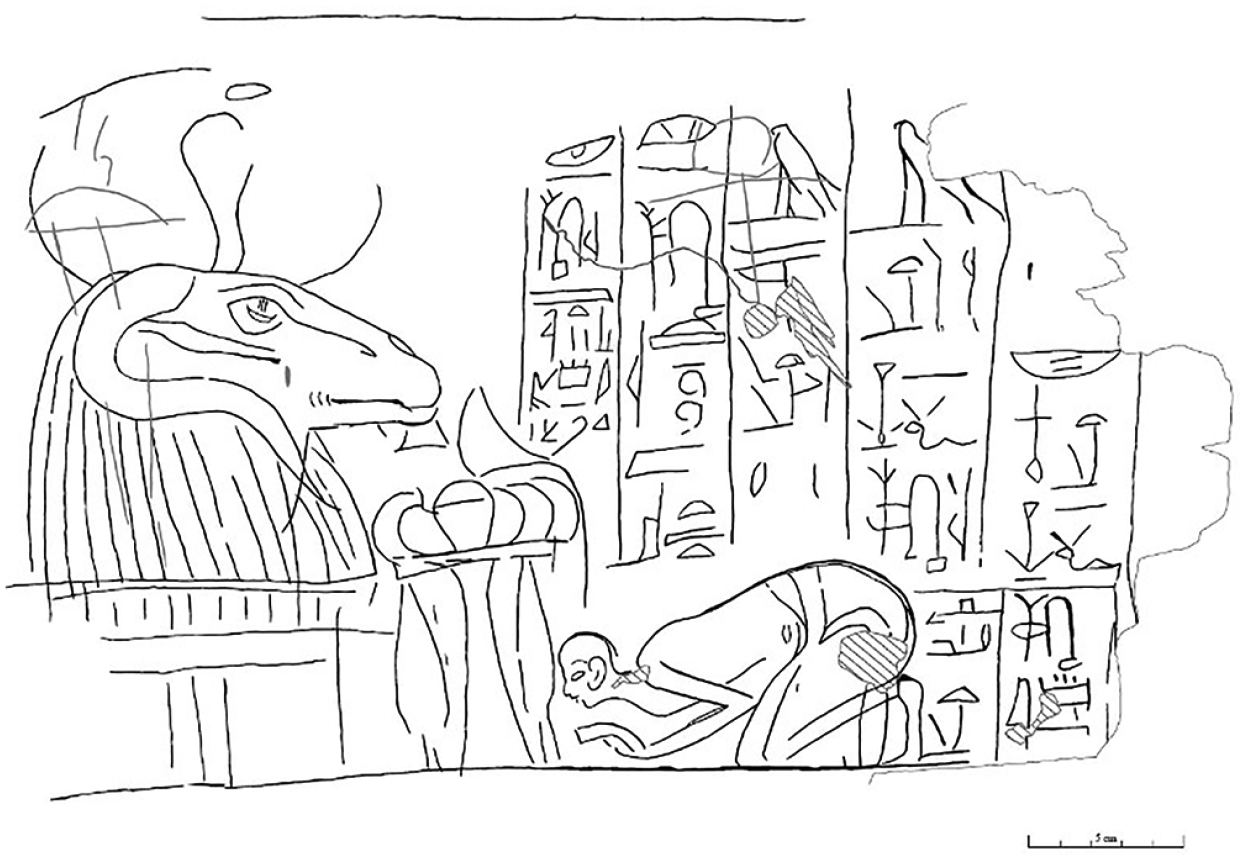
Graffito 1454 (after Luiselli and Dorn, JEA 102, 104).
The image of the god, offering table, man, and dedication text that starts in the second vertical line were made by the draughtsman Harmin (i), son of Hori (ix), 51 who was active in Deir el-Medina during the mid-Twentieth Dynasty. 52 Later on, the scribe Amennakht (v), son of Ipuy (ii), 53 added his name preceded by an ỉr.n formula in the first vertical line of the text, as confirmed by the different orientation, the distinct handwriting (e.g. the m and st signs), and the use of signs (e.g. mȝʿt sign). Due to the space being limited where he wanted to add his name, the scribe Amennakht (v) compressed the signs during the writing process in order to complete his short text. The graffito combines all features that appear in type B graffiti of the ram-headed god, such as the beard, solar disk, uraeus, chapel, offering table, and dedication text. Graffito 1454 is unique in the Valley of the Kings, showing the ram-headed god and an adoring man. 54
Another graffito of the ram-headed god (3976) is located in the valley of the tomb of Amenhotep III. The type D ram-headed Amun-Re graffito represents the only image of the god in the western Valley of the Kings. It is undated with minimal detail and no inscription. 55
Amun-Re as a standing figure
Amun-Re is also depicted as a standing figure in graffiti in the Valley of the Kings. Adorned with a double feathered crown, he appears six times in the sectors A5, A6, and A7, 56 three of which were made by members of the family of Hay (vii) during the early Twentieth Dynasty. 57
Graffito 1880 has the earliest dated attestation of Amun-Re as a standing figure, and it is the only depiction of the god Amun-Re in the valley of the tomb of Amenhotep II (CEDAE sector A6). It is placed on the western part of the cliff above the tomb of Amenhotep II (section 10). This part of the wall does not show many graffiti; a group of fifteen late Nineteenth Dynasty and early Twentieth Dynasty graffiti appears more than two metres away. 58 The scene of a man adoring the god Amun-Re in graffito 1880 was made during the mid-Twentieth Dynasty, as suggested by the dedication text which was made by the deputy of the left-side of the gang Hay (vii), son of Amennakht (x). 59 The veneration scene in the graffito (see fig. 4) represents a standing man, raising his hands, adoring Amun-Re. The standing god is adorned with the double feathered crown and holds the wȝs and ʿnḫ in his hands. The name of the god, Amun-Re, lord of the sky, is inscribed in one vertical line of hieroglyphs in front of his face. A dedication text with names of Hay (vii) and two of his sons, Amennakht (vi)/(xii) and Wennefer (vi), is recorded in hieroglyphs in three columns above the scene. 60 A fourth column is empty due to a natural crack and another column at the extreme right which contains the title ỉdnw for Hay (vii), was added (not in the image, but see below fig. 6). The signs in the text made by Hay (vii) are significantly larger than the same signs in the name and title of the god in the veneration scene. Moreover, the direction of the text should be inverted if the author of the dedication text and that of the scene were the same. It is obvious that the number 1880 of this graffito refers to two graffiti that were made by two different workmen. The first workman made the scene of the standing man adoring the god, and wrote the name of the god, probably during the Nineteenth or early Twentieth Dynasty. Then the deputy Hay (vii) decided to record his presence there by adding his name. He started with the column at the far right of the graffito, where he wrote his title. After, he may have realised the existence of the image of the god Amun-Re, which had been lightly and shallowly scratched. He moved a little to the left to write his name as close as possible to the image of the god (see fig. 4). 61
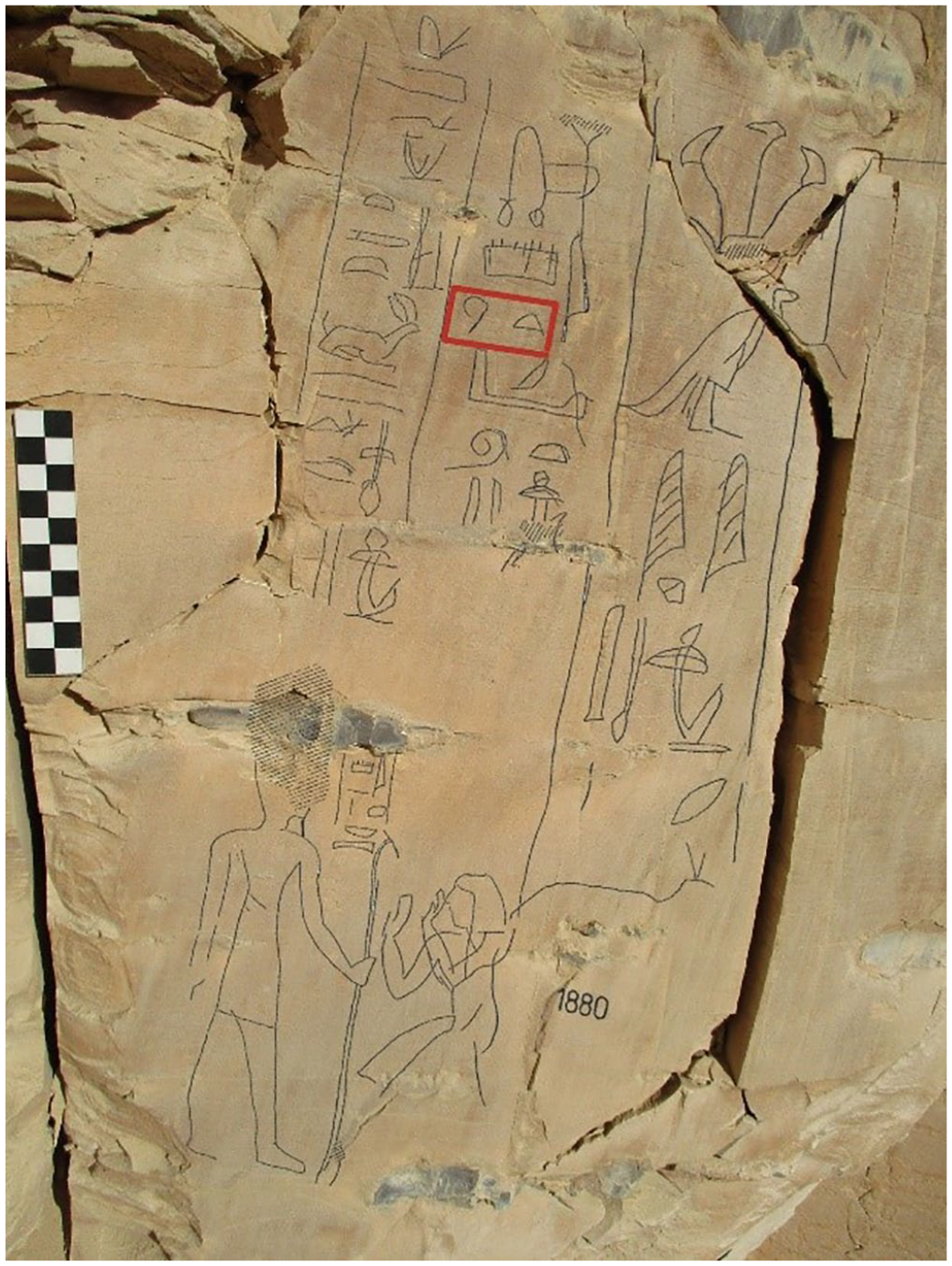
Photo of graffito 1880 (photo: author in 2015) merged with drawing (Černý, et al., Graffiti de la Montagne Thébaine).
The graffito 349 left by the deputy Hay (vii) on the free-standing rock pillar near the tomb of Merenptah in CEDAE sector A5 (see above), attracted another Amun-Re graffito (351) by his son Nebnefer (vii). He was active in Deir el-Medina as a draughtsman during the Twentieth Dynasty, from year 23 of the reign of Ramesses III onwards. 62 Graffito 351 shows the same characteristics as graffito 1880, however excluding the man venerating the god. It depicts the standing god adorned with the double feathered crown and his name, Amun-Re, lord of the sky, in front of his face. Three lines of a hieroglyphic inscription surround the image of the god from the left, top, and right sides. The text on the left is a dedication to the kȝ of the servant in the Place of Truth Hay (vii), while the column on the right is the kȝ of the servant in the Place of Truth Amennakht, who should be either the father (Amennakht [x]) or the son (Amennakht [vi]/[xii]) of Hay (vii). The third text in this graffito is a horizontal line at the top which does not appear in the facsimile of Spiegelberg but is described in his publication. 63 This line contains the name of the author of the graffito Nebnefer (vii) introduced by an ỉr.n formula.
Another graffito of Amun-Re (348) was left nearby on the same rock pillar, 64 in which the god is presented again as a standing figure. The graffito is located directly above graffito 349 of the deputy Hay (vii), but is of lower quality and is less detailed. It depicts the standing god adorned with the double feathered crown and holding the wȝs and ʿnḫ in his hands.
Further to the south in the Valley of the Kings to the north of the tomb of Siptah (CEDAE sector A7) (fig. 4), another graffito (1965) of Amun-Re was made by another son of the deputy Hay (vii) during the early Twentieth Dynasty. Beyond the entrance of the tomb of Maherpra (KV 36), in section 41, the rock surface has no graffiti at eye level or below, but some stand nearly five metres above the modern ground 65 where the lowest graffito can be found. Located approximately seven metres above ground on a flat rock surface with natural borders and facing east 66 is a veneration scene of the standing god Amun-Re consisting of six graffiti.
Six related graffiti (see fig. 5, graffiti 1964–9) were indeed scratched on this part of the wall during the mid-Twentieth Dynasty by three members of the Deir el-Medina community: Tjay/To (i), Amennakht (vi)/(xii), and Nekhemmut (iii). 67 It depicts two men adoring the god, who stands inside a frame, adorned with the double feathered crown, holding the wȝs in his right hand. A short hieroglyphic dedication text in two columns is in front of the god, inside the frame itself. 68 The complete scene was created in several phases.
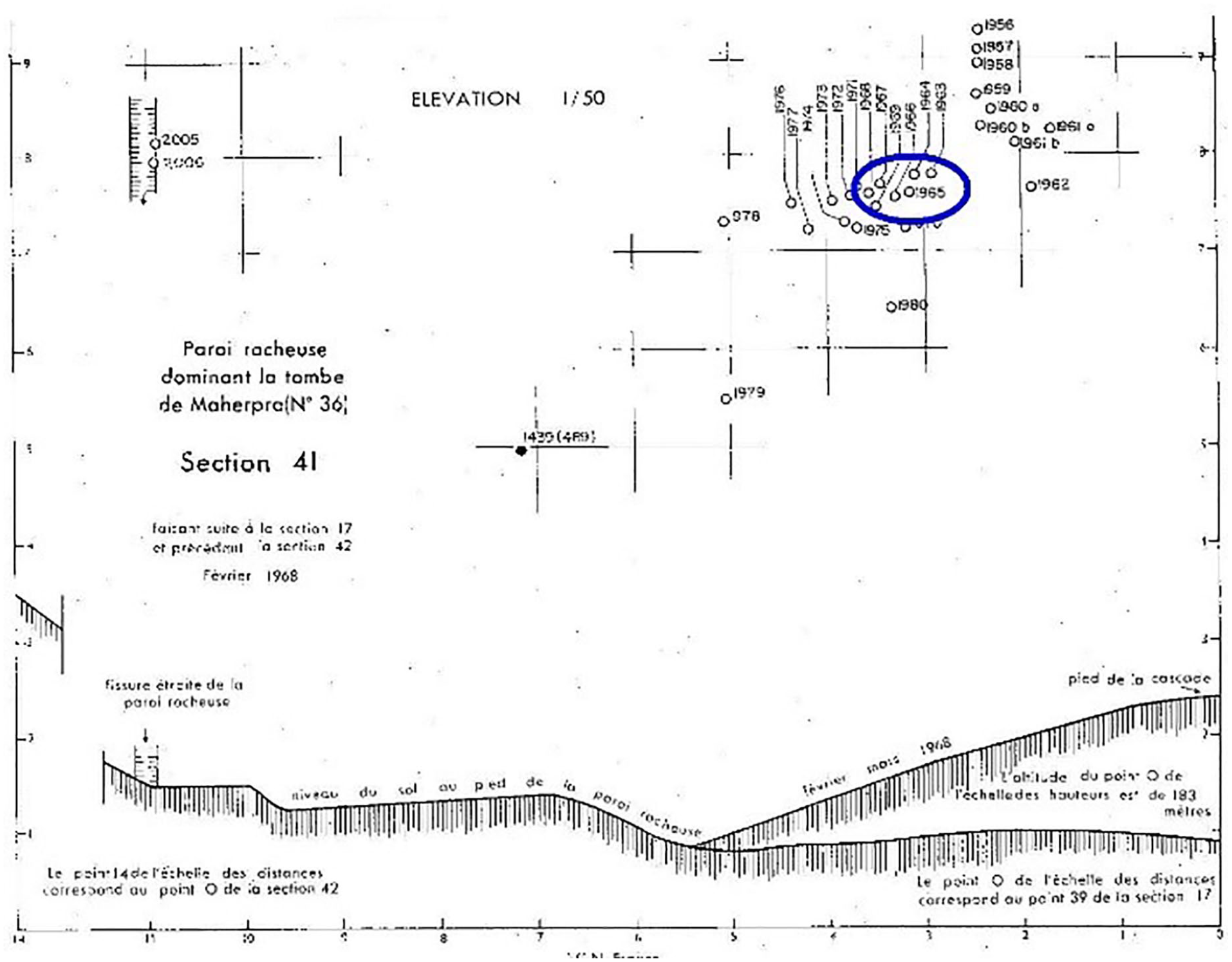
Section 41 specifies the graffiti location (after Černý, et al., Graffiti de la Montagne Thébaine, II1, pl. 34).
The opener of this scene was the scribe Tjay/To (i), son of Amennakht (v), who was active in Deir el-Medina during the reign of Ramesses III 69 (see fig. 5). He left his name in a hieratic inscription (graffito 1964). 70 This graffito was lightly and shallowly scratched on the smooth surface of the wall which showed no other graffito at the time. Then, the main contribution that became the core of the following four graffiti was made by the deputy Amennakht (vi)/(xii), son of Hay (vii). He added a graffito of the standing god inside a frame and his name in hieroglyphs preceded by an ỉr.n formula in two columns (graffito 1965). 71 The scribe Tjay/To (i) came back to the wall after the graffito of Amennakht (vi)/(xii) was made, which overlapped his faint graffito. He made two more graffiti rendering his name (graffito 1967) and a standing man with raised hands adoring the god (graffito 1966). 72 Two more (1968–9) were added later by the draughtsman Nekhemmut (iii), son of the deputy Amennakht (vi)/(xii), 73 who was attracted by the graffito of his father (1965) and added himself as a kneeling figure adoring the god.
This group of graffiti represents the most detailed depiction of the god Amun as a standing figure in graffiti in the Valley of the Kings. It shows most of the features of Amun in this form such as the crown, wȝs, frame, false beard, and dedication text. Only the ʿnḫ and name of the god are missing.
The god Amun-Re is present as a standing figure in two more undated graffiti in that area (CEDAE sector A7). 74 One is graffito 2145 (see fig. 6), which was made by an unidentified workman called Panakht 75 on the cliff wall between the tomb of Bay KV 13 and the tomb of Setnakht KV 14 (section 49) where many Ramesside graffiti have been found. 76 Graffito 2145 depicts the standing god adorned with the double feathered crown, the false beard, and the tail. The god’s name, Amun, lord of the throne of the two lands, is inscribed in front of the god, as well as the name of the workman Panakht, who produced the graffito. The god raises his hands as if he was giving something. This is an exceptional position for the god’s arms in graffiti; this style of raised arms is only attested in this graffito in the Valley of the Kings. The other graffito of the god Amun in sector A7, and the last graffito of the god represented as a standing figure in the Valley of the Kings, is 1913 (see fig. 6). It is located on the rock surface of the wall to the east of the tomb of Maherpra (section 17), 77 where the god appears in three more graffiti. 78 Graffito 1913 is placed less than one metre above the recent ground, which changed several times since antiquity. 79 It depicts the standing god adorned with the double feathered crown and holding a wȝs in his hand. The graffito is not dated and the name of its author is not mentioned. However, the minimalistic rendering of the god as a stick figure suggests that the graffito was made some time after the workmen of Deir el-Medina had left the Valley of the Kings, probably during the Third Intermediate Period or later. It may also have been inspired by the graffiti of Amun-Re kȝ-mwt.f that is already present on the same wall.
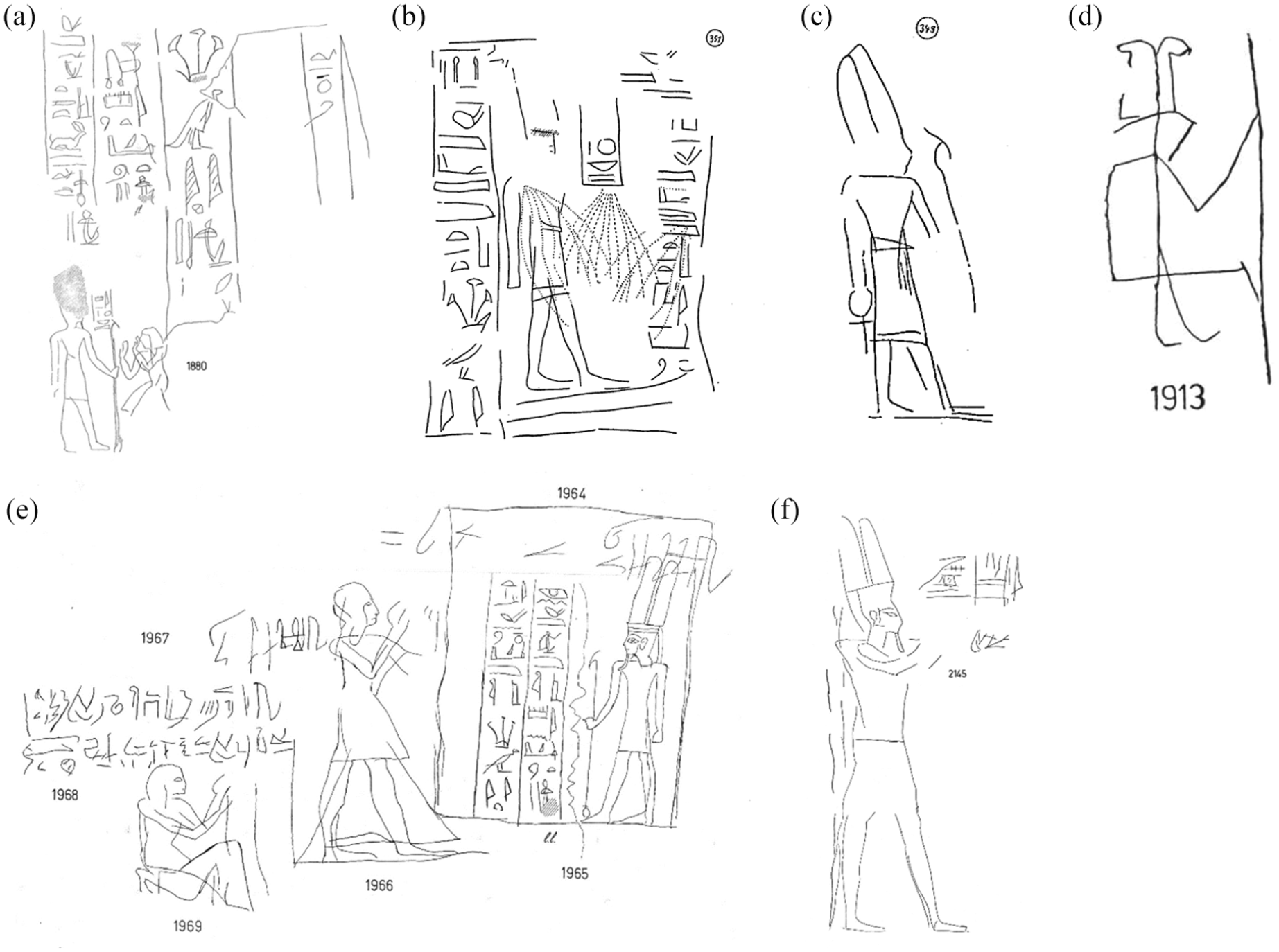
Depictions of Amun-Re as a standing figure (1880, 351, 349, 1913, 1964–9, 2145) (drawings of graffiti 1880, 1913, 1964–9, and 2145 after Černý, et al., Graffiti de la Montagne Thébaine; drawings of graffiti 349 and 351 after Spiegelberg, Graffiti aus der thebanischen Nekropolis).
Amun-Re kȝ-mwt.f
The god Amun-Re is present in three graffiti in the valley of the tomb of Seti II in the form of Amun-Re kȝ-mwt.f that appeared only on the walls of section 17. 80 The three graffiti 1925, 1948, and 1949 of the god in his ithyphallic form – unlike the adjacent graffito 1913 – give the impression of being made by workmen from Deir el-Medina. 81 One of these is graffito 1925. 82 It consists of at least four layers of graffiti overlapping with the most detailed depiction of Amun-Re kȝ-mwt.f in graffiti in the Valley of the Kings. Graffito 1925 depicts the god in his typical ithyphallic form, holding a flail, adorned with a crown – probably the double feathered crown but its top is missing. The god is standing on a dais, being adored by a standing man, whose legs have flaked off. Directly behind this man, Černý saw the name of Harmin, 83 which is mentioned neither in his facsimile nor in Spiegelberg’s publication. 84 I could also not detect it during the survey conducted in December 2015 (see figs 7, 8). The name of Harmin, as recorded by Černý, behind the standing man, is the only text in the graffito that does not overlap with the veneration scene. The placement of the name suggests that he might be the author of the scene. But the fact that the scene is made in visible lines while the name is hardly visible contradicts this hypothesis. On the other hand, the elongated head of the man in the scene strengthens the hypothesis and helps to identify him as Harmin (i), son of Hori (ix), who is known for his elongated head in depictions of himself from other graffiti and ostraca. 85 Harmin (i) was also known to make this kind of graffiti of a man adoring the god Amun. 86
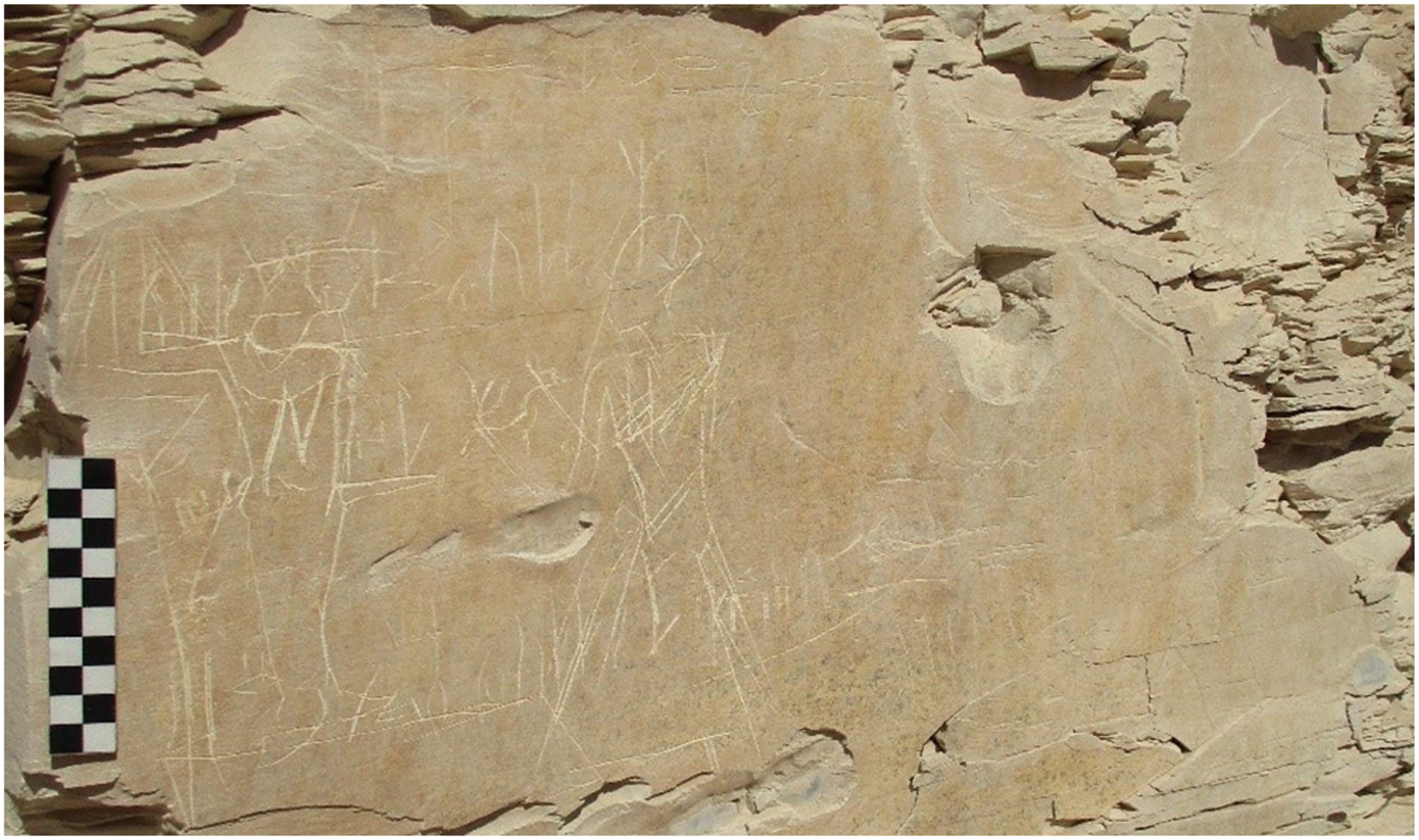
Graffito 1925 (photo: author in December 2015).
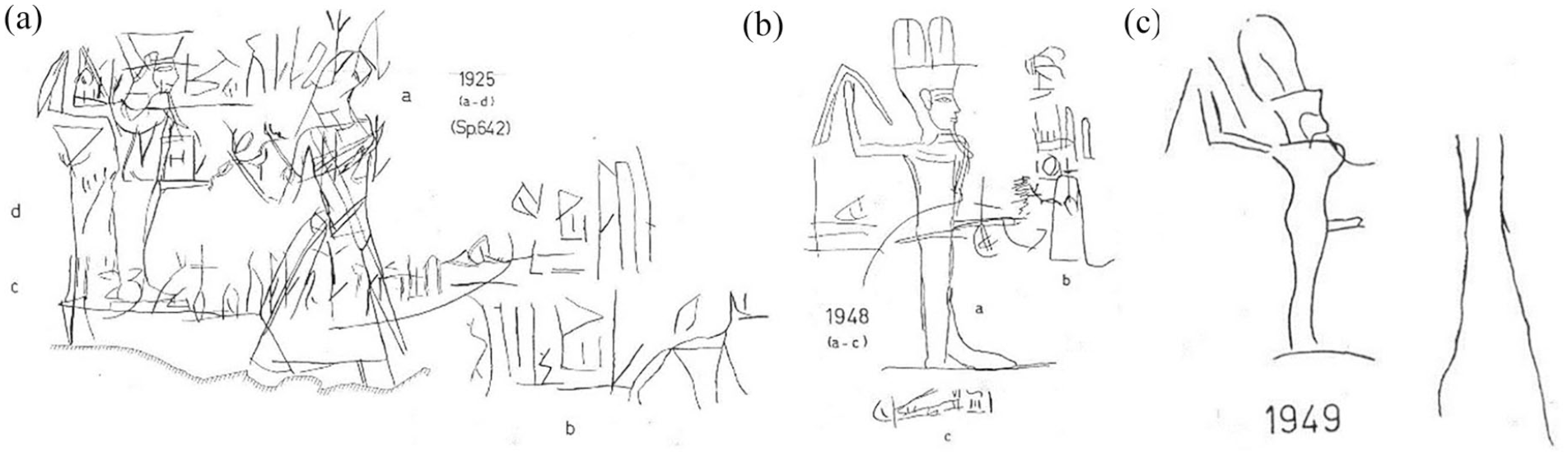
Depictions of Amun-Re kȝ-mwt.f (graffiti 1925, 1948, 1949) (drawings after Černý, et al., Graffiti de la Montagne Thébaine).
The god Amun-Re kȝ-mwt.f is present in another graffito in section 17 in the valley of the tomb of Seti II. 87 Graffito 1948a (figs 7, 8) is an undated graffito, depicting the ithyphallic god holding the flail, adorned with the false beard and the double feathered crown. The name of the god is written in hieroglyphs in one column, while the name of a scribe Nebnefer can be found in a horizontal line written in hieratic overlapping the image of the god.
Lastly, graffito 1949 88 (fig. 8) of the ithyphallic god in the valley of the tomb of Seti II shows fewer details and is of lesser quality than the other two graffiti of Amun-Re kȝ-mwt.f. The graffito is undated and has no text. It depicts the god in the exact same form as the adjacent graffito 1948 (with flail, false beard, and the double feathered crown).
Upper part of the god’s body
Amun-Re is also present in a graffito (3449) in the valley of the shafts (CEDAE sector A2). It is an undated graffito located in section 204, 89 which is close to Deir el-Bahari, at nearly two metres above the ground, and was found along with nine others, including demotic and Coptic inscriptions.
Graffito 3449 depicts only the upper part of the god adorned with the double feathered crown (see fig. 9). It is not very detailed and its execution gives the impression of clearly having been made after the New Kingdom.
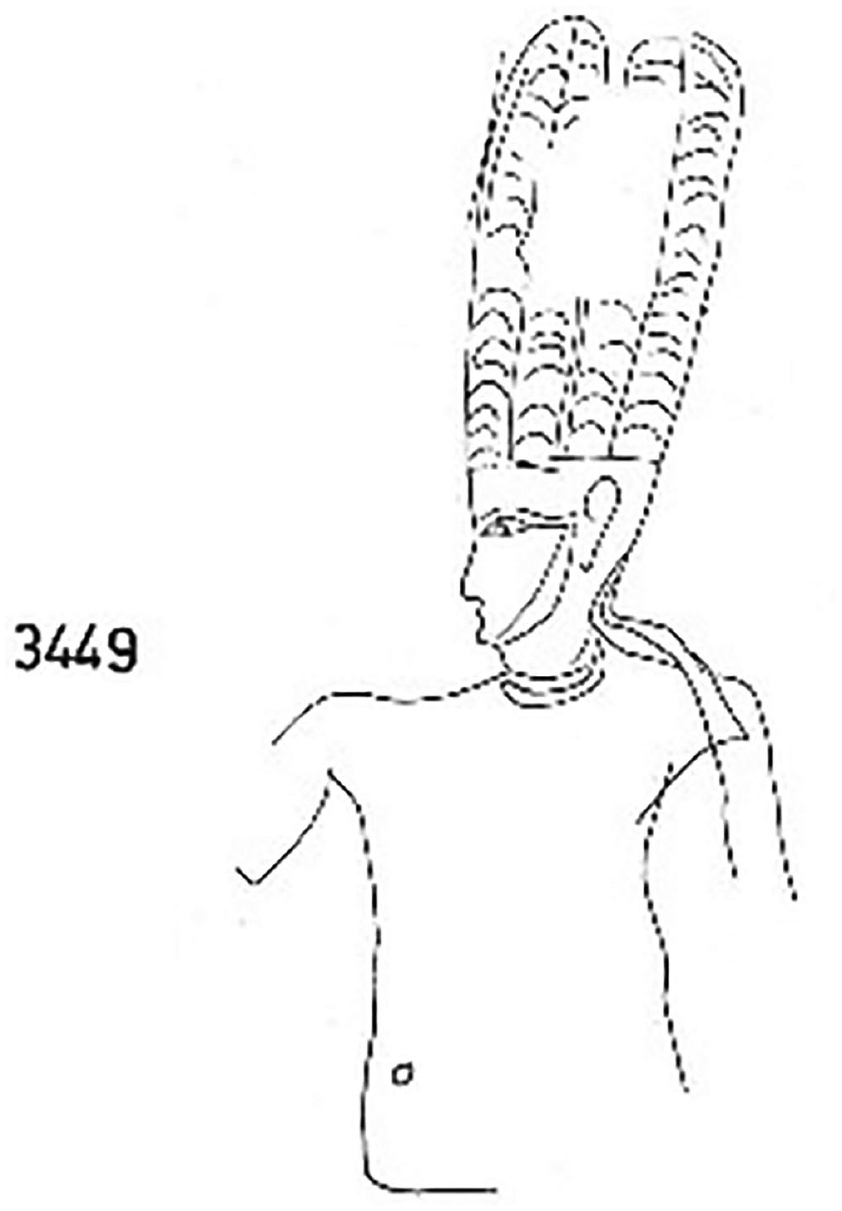
Depiction of the upper-part of Amun-Re (graffito 3449) (after Černý, et al., Graffiti de la Montagne Thébaine).
Amun-Re as a seated figure
The combination of a second graffito (3447) 90 of the god Amun-Re on the wall of section 204 in the valley of the shafts, and of the absence of all other gods and goddesses on this wall, suggest that the place was dedicated to Amun-Re. In this graffito (fig. 10), the god is depicted as a figure seated on a throne in front of an offering table. The god holds the wȝs and ʿnḫ in his hands and is adorned with the double feathered crown. 91 Graffito 3447 is an undated graffito but its style and the execution of the offering table, among other elements, point to a late date, like most graffiti in this part of the valley.
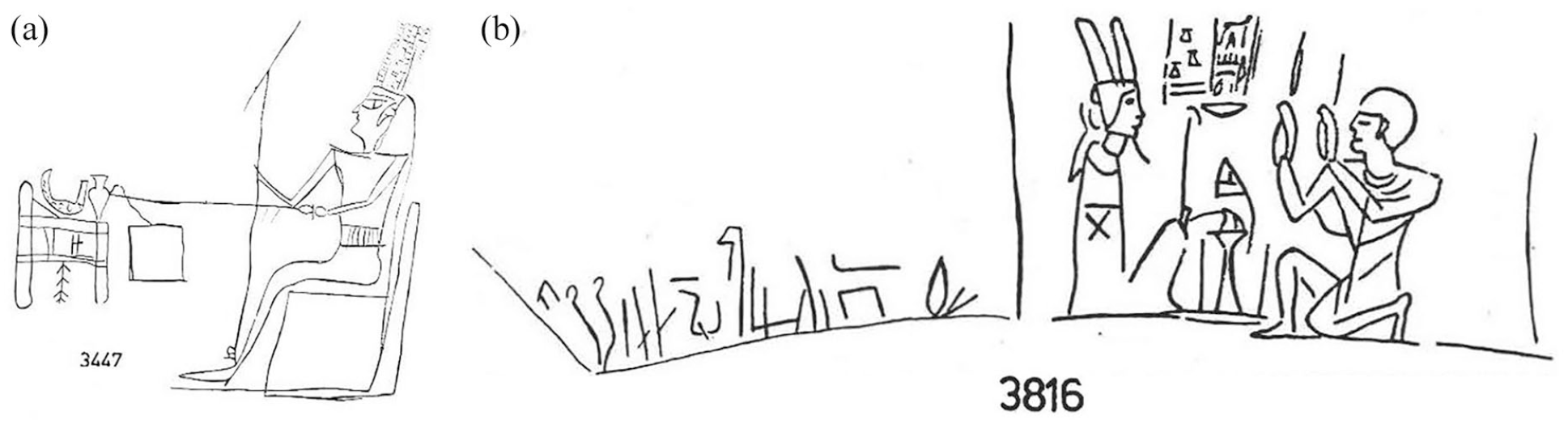
Depictions of Amun-Re as a seated figure (3447, 3816) (after Černý, et al., Graffiti de la Montagne Thébaine).
The last graffito (3816) of Amun-Re in the Valley of the Kings discussed here is located in the valley of the tomb of Ramesses XI (CEDAE sector A3), near the modern entrance of the Valley of the Kings, in section 183. It is accompanied by many graffiti of the Twentieth and early Twenty-First Dynasties. 92 It is also the latest datable graffito of the god Amun in the Valley of the Kings. It was made by the servant in the Place of Truth Nainudjem, 93 who is identified as Nainudjem (1), son of Akhy (1), 94 who recorded his name and title in the adjacent graffito 3817. 95 Nainudjem (1) was active in Deir el-Medina during the early Twenty-First Dynasty and recorded his titles, such as scribe and scribe of the tomb, in his graffiti; little else is known about the individual. 96 Graffito 3816 depicts a kneeling man raising his hands in front of his face to adore Amun-Re. The god is a seated figure and holds the wȝs, in front of an offering table, and is adorned with the double feathered crown and the false beard. The name of Amun-Re, lord of the thrones of the two lands, is written in hieroglyphs in front of his face in two columns. The name of the author of the graffito Nainudjem is written in hieratic behind the seated god in one horizontal line. 97
Graffiti production by the workmen
The corpus of 33 graffiti with Amun-Re depictions in the Valley of the Kings discussed in this study adds to the understanding of the workmen’s preferences in drawing a particular image of the god, the relationship between the quality of a graffito and its author’s occupation and experience, and when the workmen were likely to inscribe graffiti. Sixteen graffiti within the corpus were made by ten identifiable members of the Deir el-Medina community.
The workmen were likely to make graffiti during their rest time and while moving to or from work, 98 as most of graffiti under discussion are located around rest places, where the workmen may have wanted to create focal points for interaction with gods nearby their work locations. The graffito’s author’s experience, skills, and occupation are factors that differentiate the graffiti, in terms of the calibre of the images and inscriptions. The high quality and detailed drawings with fine lines – in the corpus of this study – were made by a chief sculptor 99 and scribes. 100 Other good quality graffiti were made by a deputy 101 and draughtsmen. 102 Among the sixteen graffiti whose authors are known, only two are low in quality. These were made by two regular workmen (servants in the Place of Truth). 103
The corpus shows a development in use of the form under which Amun-Re was venerated with a clear preference of type A and B of the ram-headed god. Type D and A are the earliest attested in the Valley of the Kings, which were later developed into a more elaborated form (type B) that is depicted in graffiti until the late Twentieth Dynasty, besides the form of the standing figure. After the end of the New Kingdom, Amun-Re was venerated in the Valley of the Kings as seen in a seated figure of the god, in the area near Deir el-Bahari (CEDAE sector A2).
One also observes that the workmen made graffiti of Amun-Re in locations with different characteristics. Two of the earliest graffiti with depictions of the god in the Valley of the Kings were placed in a gully above the tomb of Merenptah (CEDAE sector A5). The shrine-like gully with a natural free-standing rock pillar, which stands for most of the day in the shade, offers a suitable space which would allow workmen to gather in front of the god’s images. The seven graffiti of Amun-Re in this location consist only of god’s depictions (not veneration scenes). One can wonder whether the characteristics of the location allowing people to practise veneration could be the reason for this. In other examples, graffiti are made on walls that have a narrow path in front, which does not allow gathering. On such walls, we can find graffiti with veneration scenes of a man adoring the god (e.g. 1454 and 1880). In this case, besides the primary function of the graffito as a focal point, it memorises forever the act of veneration of Amun-Re by a certain member of the crew. Other graffiti of divine depictions and veneration scenes were made on walls that are located in full sun most of the day, such as the area above the tomb of Maherpra (section 17, 41). The landscape and especially the ground level changed in this area several times during antiquity, making it hard to assess the relationship between the landscape, the graffiti and the experience of when they were first created.
Graffiti classification
Dorn developed a classification of Theban graffiti based on two main factors: placement and function. On the basis of its place, graffiti are categorised as path-graffiti, site-graffiti, and graffiti with an aerial view. When divided according to their function, there are graffiti cluster, follower, family, religious, event, and single graffiti. 104
The graffiti under discussion add two more functional categories to Dorn’s classification. First, the Theme opener graffito served as a theme opener and attracted more workmen to produce graffiti with the same theme in a particular area (e.g. 280 and 307). The second is Co-produced graffiti, referring to those intentionally applied by more than one member of the crew. Collaboratively, these additions by different members form one unit (e.g. 1454, 1880, 1964–9).
Placement of graffiti on rock surfaces
The walls with depictions of Amun-Re are classified in three groups according to placement, content, and practices:
- Exclusive location of a god depiction: It is a wall or part of a wall with natural borders, which is only decorated by one image or veneration scene of a single deity. The main graffito then attracted other workmen to register their names beside the god’s image as in graffito 1880, where the deputy Hay (vii) added his name as close as possible to the image of the god. Another is attested in the case of Amennakht (v), who added his name preceded by an ỉr.n formula presenting himself as the ‘co-producer’ of graffito 1454 of Harmin (i). In other cases, it attracted workmen to contribute to the scene by drawing themselves adoring the god in the main graffito, e.g. graffiti 1964–9. The characteristic of this group is that the main graffito did not attract workmen to produce more divine images of the same god or other deities there.
- Depictions of multiple gods on a wall: A wall with several graffiti of deities’ depictions and/or veneration scenes. These walls usually have a graffito serving as theme opener, which attracted more graffiti addressing the same theme to the wall, such as Amun-Re graffito 349 – on the rock pillar in front of sections 12 and 13 above the tomb of Merenptah – that was made by Hay (vii) in the Twentieth Dynasty. It then attracted Nebnefer (vii), son of Hay (vii), to add another image of Amun-Re on the same rock. In all, the surface of this rock was decorated with five images of Amun-Re out of the total six graffiti on the rock. The only other graffito (347) is a workman’s mark. 105
- Deity depictions as part of a multiple themes cluster: A wall with many graffiti of different topics that may overlap a god’s depiction. A good example of this is the cliff above the tomb of Maherpra (section 17). This wall bears seven depictions of the gods Amun-Re (1913, 1925, 1948–9), Meresger (1916, 1918), and Thoth (382) with many other Nineteenth and Twentieth Dynasty graffiti addressing different topics made by various members of the crew.
The Valley of the Kings was the main workplace of the workmen of Deir el-Medina since their task was to construct royal tombs. Members of the crew made many graffiti with depictions of Theban deities in and around work locations. The production of a religious graffito expressed the same motive as that of a stela or an ostracon by workmen. They created focal points for their interaction with the gods within the landscape of the valley, where the setting was different to the one in their home. 106 By inserting graffiti, they marked that particular space as ‘sacred’ in the already sacred landscape of Western Thebes.
Among the 120 graffiti with depictions of gods in the Theban Mountain, Amun-Re is attested in 42 graffiti (33 of which are in the Valley of the Kings). Thus, the god remains the most frequently depicted deity in graffiti by the workmen of Deir el-Medina. This result matches the importance of the god as the great god of Thebes and the main god of Egypt at the time. 107 It also illustrates his popularity in the community of Deir el-Medina, in particular. The reason for the large number of Amun-Re depictions may be that one graffito could attract more workmen – perhaps from the same family or social group – resulting in their additions of more graffiti with depictions of the god.
The workmen of Deir el-Medina created many ways of appropriating the space where they lived and worked, which they were permanently a part of, and which was deeply integrated into their identity. 108 Graffiti were one of their ways of appropriating the space ‘not only by somehow diverting a symbolic name and marking it theirs, but also by shaping the original space with specific footprints that witness their experience of the place’. 109 Graffiti with depictions of the great god served as places of worship and interaction with Amun-Re, who was already believed to be present in the mountain even before a graffito was made. 110 A graffito with the depiction of a god was usually placed on a flat rock surface with natural borders. It marked a place for the presence of a god as a liminal zone connected to divine manifestation. 111
The location of a graffito of Amun-Re is usually either linked to workmen’s rest or workplaces. An example of a graffito linked to a rest place is the earliest graffito of Amun-Re in the Valley of the Kings (graffito 788). It was made on the eastern side of the workmen’s huts (resting place at the top of the Valley of the Kings) on the eastern face of the Theban Mountain peak, which later became covered in graffiti with divine images and veneration scenes. The graffito was placed at a convenient height above ground, always in shade, in an easily accessible area to create an appropriate place for interacting with the god. Locations of graffiti could also be linked to the ongoing work in the valley as in the case of the two graffiti 280 and 307 of Amun-Re. The producer of the two graffiti, Amennakht (viii), was active in Deir el-Medina during the reign of Merenptah and worked on the construction of his tomb. 112 The chief sculptor Amennakht (viii) placed his graffiti on the rock surface of the cliff beyond the entrance of the tomb of Merenptah. The two graffiti attracted members of the crew to add five more with depictions of Amun-Re in this place. Graffiti of Amun-Re further enhanced the transformation of the landscape in a sacred space dedicated to the veneration of the god Amun-Re.
Footnotes
Acknowledgments
I wish to express my gratitude to Prof Andreas Dorn for encouraging my research and for reading and improving this article. Many thanks to Kimberley Watt for correcting my English.
Funding
The author disclosed receipt of the following financial support for the research, authorship, and/or publication of this article: The author’s PhD project is funded by the Department of Archaeology and Ancient History at Uppsala University.
