




Abstract
Egyptian senet boards follow a very consistent morphology that varies in small but notable ways throughout the 2000-year history of the game. A previously unpublished board, in the Rosicrucian Egyptian Museum in San Jose, California, may provide new insight into the evolution of the game in the early New Kingdom. A game table with markings distinctive of the Thutmoside Period, but oriented like Middle Kingdom and Seventeenth Dynasty boards, it is probably a transitional style. It likely dates to the Eighteenth Dynasty before the reign of Hatshepsut, a period to which no other games have previously been securely dated.

Senet: An overview
The game of senet is perhaps the most studied and best understood of ancient board games, and yet much remains unknown about it. Senet is played on a board of 30 squares arranged in a three by ten pattern, usually constructed out of wood, faience, ivory, or a combination of these materials. 1 While a fragmentary board from Abu Roach attests to the presence of senet during the First Dynasty, 2 the earliest complete example can be seen represented in a painting from the Third Dynasty Tomb of Hesy-Re, which depicts senet along with the games mehen and men. 3 Interestingly, no senet boards have been found that unequivocally date to the Fourth through Sixth Dynasties, though tomb reliefs attest to their existence. 4 Game boards with senet on them become greater in number during the Middle and New Kingdoms and increase in variety, with the appearance of game boxes and sometimes the inclusion of other games on the opposite side of the board. 5 By the New Kingdom and perhaps earlier, senet gains religious importance as evidenced by its inclusion in Chapter 17 of the Book of the Dead, where the deceased plays senet against an invisible opponent. The game itself is a reflection of the ba passing through the duat, and is described in such terms in the Great Games Text, connecting the spaces of the individual playing squares to different stages along the journey. The word senet in Egyptian means ‘passing,’ and may refer either to the game’s religious connotation of the ba passing through the duat 6 or to the mechanics of gameplay, where playing pieces passed each other on the board. 7 This was particularly evident during the Eighteenth, Nineteenth, and Twentieth Dynasties, with many game boards found in tombs of the nobility and pharaohs as well as depicted in graffiti on monuments and sketched on limestone ostraca, showing its popularity among all classes of Egyptian society.
Decoration in the playing spaces can be used for dating purposes on some senet boards and indicates the direction of play. Throughout most of Egyptian history, beginning with the Hesy-Re board and continuing into the Late Period, most senet boards indicate that play began in the top left corner of the board and proceeded in a boustrophedon path to the bottom right corner. The final five squares on the board are the most commonly decorated, and the orientation of the decoration used, usually hieroglyphs or pictures of people or animals, indicates the proper placement of the board, with the final squares on the bottom. Based on inferences made from the Great Game Text and the Turin Papyrus 1.775, the squares are discussed in the literature with a numbering scheme in a boustrophedon pattern along the three rows starting with ‘1’ in the top left corner and proceeding to ‘30’ in the corner diagonally opposite. 8 We know from these documents that the position of the most commonly decorated squares on senet boards are situated in squares 26 to 29. Possibly as early as the Old Kingdom, square 26 contained some kind of mark related to goodness, usually nfr or nfrw. Square 27 typically has either an ‘X’ or an aquatic reference, the latter of which being either a single n hieroglyph or mw, though sometimes the god Hapy or a scene with hippopotami is shown. Square 28 always shows a variation on the number three: three simple strokes, three men, three gods, or three ba birds. Square 29, similarly, always carries a variation on the number two, with two strokes, two men, or two gods. 9
During the Middle Kingdom, the final five squares instead appear at the top of the board, indicating that it was played beginning in the bottom right and proceeding to the top left, a 180-degree reversal of the orientation seen during other periods. In addition, the markings in the final five spaces were simple during the Old and Middle Kingdoms, but beginning in the New Kingdom the use of more elaborate drawings and hieroglyphic inscriptions appear in these squares (fig. 1). This elaboration coincides with the increased religious significance of the game during the New Kingdom.
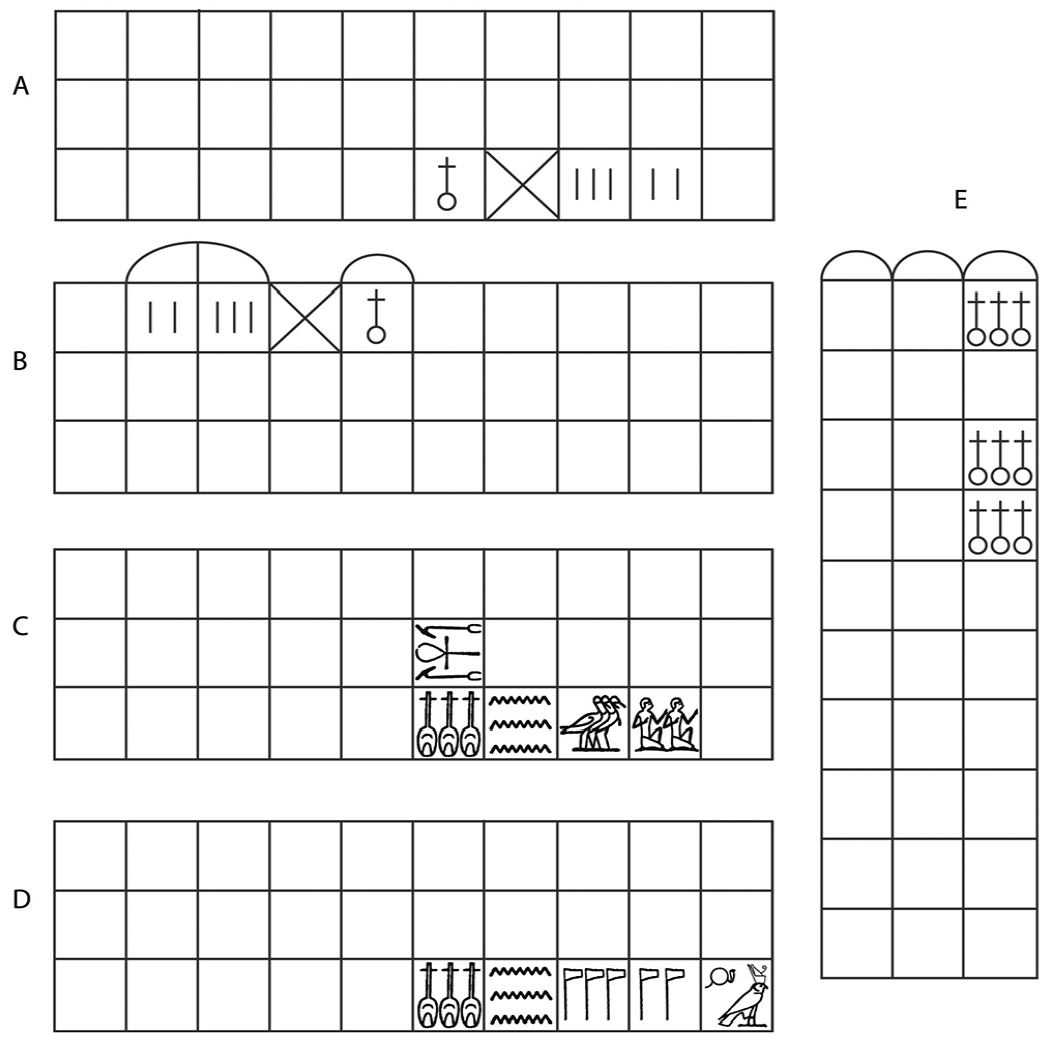
Drawing of changes in typical senet board orientations and decorations. a. Old Kingdom; b. Middle Kingdom to Second Intermediate Period; c. Eighteenth to Nineteenth Dynasty; d. Twentieth Dynasty to Late Period; e. New Kingdom to Late Period ostraca (after Crist et al. Ancient Egyptians at Play, fig. 3.2; drawing: J. Steffey).
It has been regularly claimed that senet was played through to the Roman Period, but the latest dateable boards come from the Twenty-Sixth Dynasty fortress at Tell Defenneh, where three senet games were scratched into terracotta platters (now in the British Museum: EA22323, EA223803, EA223802). 10 The game also appears in the Tomb of Petosiris (Thirty-First Dynasty/Ptolemaic Period) in two reliefs, 11 and graffiti senet boards are reported from the roof of the Roman pronaos of the Temple of Dendera by Piccione, but he did not supply drawings or photographs of them. 12
Though more difficult to date, a plethora of senet patterns have been found as graffiti on monuments dating from the Old Kingdom to the Late Period, and other examples painted or scratched onto ostraca provide further glimpses of quotidian senet play. Furthermore, senet spread beyond the borders in Egypt, and was played in the Levant during periods of particularly strong interaction with their Egyptian neighbors. 13 It was particularly popular in Cyprus, having been adopted into the island’s culture sometime during the third millennium bce. Levantine intermediaries are probably responsible for the game’s transmission, since there is no other evidence for sustained interaction between Cyprus and Egypt at that early period, 14 and the game has been found at sites throughout the Levant. 15 Senet remained popular in Cyprus until at least the end of the Bronze Age, and there are indications that it was still played into the Iron Age. In Nubia, evidence for senet is less obvious, but evidence does exist that it was played there. 16
Because of the lacunae in our understanding of senet, every new addition to the corpus of boards adds a new facet to the history of the game. Since senet was played in one form or another for such a long time, having been played from the Early Dynastic Period until at least the Twenty-Sixth Dynasty, 17 it provides an opportunity to study long-term changes in games and practices related to play. There are many implications for this kind of research relating to social processes, such as cultural transmission, 18 foreign interaction, 19 and social complexity. 20 Any evidence that facilitates research on games and play, which has lagged behind theoretical and methodological advances in archaeological and anthropological work more broadly, will aid in broadening research into this ubiquitous aspect of human life.
A senet board in the Rosicrucian Egyptian Museum
The Rosicrucian Egyptian Museum in San Jose, California has had a wooden senet board (RC 1261, fig. 2) in its collection since 1947, but the board was not included in the two most comprehensive catalogues of senet boards published to date. 21 Nothing is known about the archaeological context in which the board was found. The Rosicrucian Egyptian Museum acquired the object, along with nine playing pieces, at Spink and Son, Ltd in London on 1 August 1947. It was originally part of the collection of Lord Amherst of Hackney. Lord William-Tyssen Amherst, First Baron of Hackney, who was a well-known collector of antiquities, including cuneiform tablets and Egyptian antiquities during the late nineteenth and early twentieth centuries, and is particularly known for encouraging and supporting a young Howard Carter, and arranging for him to excavate with Flinders Petrie in Egypt. 22 He died in 1906, so it must have been acquired by him before then. It is uncertain where or when Lord Amherst obtained this object. Nevertheless, whether Lord Amherst purchased it in an antiquities shop or otherwise, it is unlikely that the original archaeological context was ever recorded due to the lax methods of archaeological excavation during that era. Information about the board must be limited to morphological examinations for the purpose of this note.
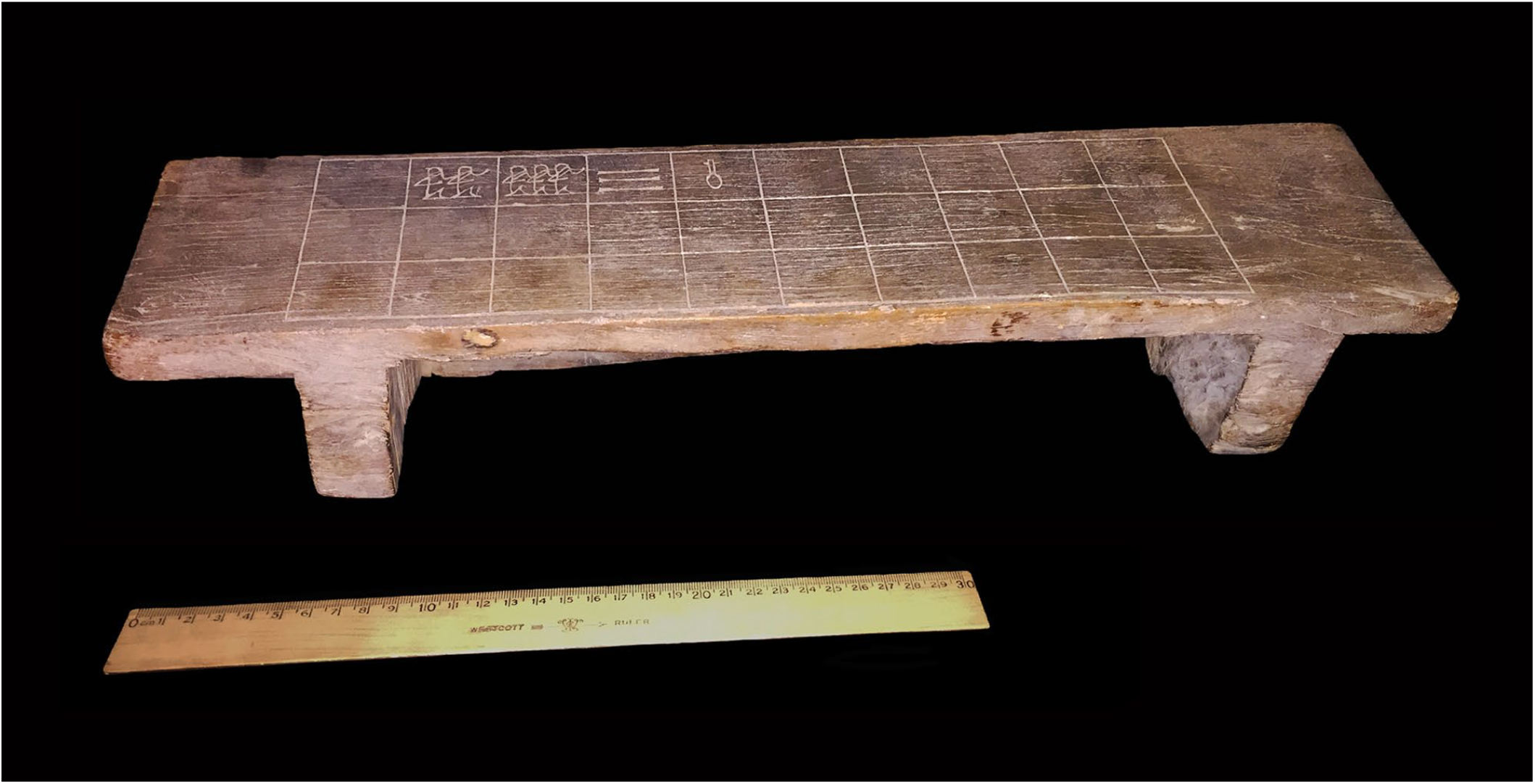
Senet board, RC 1261, in the Rosicrucian Egyptian Museum (courtesy of the Rosicrucian Egyptian Museum, San Jose, California, USA).
The board itself is in the shape of a small table. It is carved from a single piece of wood, which is in a distressed condition. The wood is cracked in several places, separating along the grain of the wood. The top surface of the board is intact, but worn, particularly on the surface of the playing field itself. There are three other components to the object: a panel running the length of the board which, based on the orientation of the hieroglyphs on the playing face, forms the rear side of the table (fig. 3). No hieroglyphic inscriptions appear on the sides of the board. On the inside surface of the panel, the wood is discolored, with darker patches on the surface, as is the underside of the top panel (fig. 4). Perpendicular to this are two rectangular supports that extend across the width of the artifact. Both the back panel and the supports are unevenly broken on the bottom, so that the table can no longer stand upright on its own (fig. 5). There is no evidence that the board was originally painted, nor is there any evidence for pigment inside the incisions making up the senet pattern. There is also no evidence that there was a front panel on the object; the front edge is finished and not broken, and the senet board would be unevenly placed on the top surface if there had been another panel. The table is 32 cm long by 13.5 cm wide and 12.1 cm high.
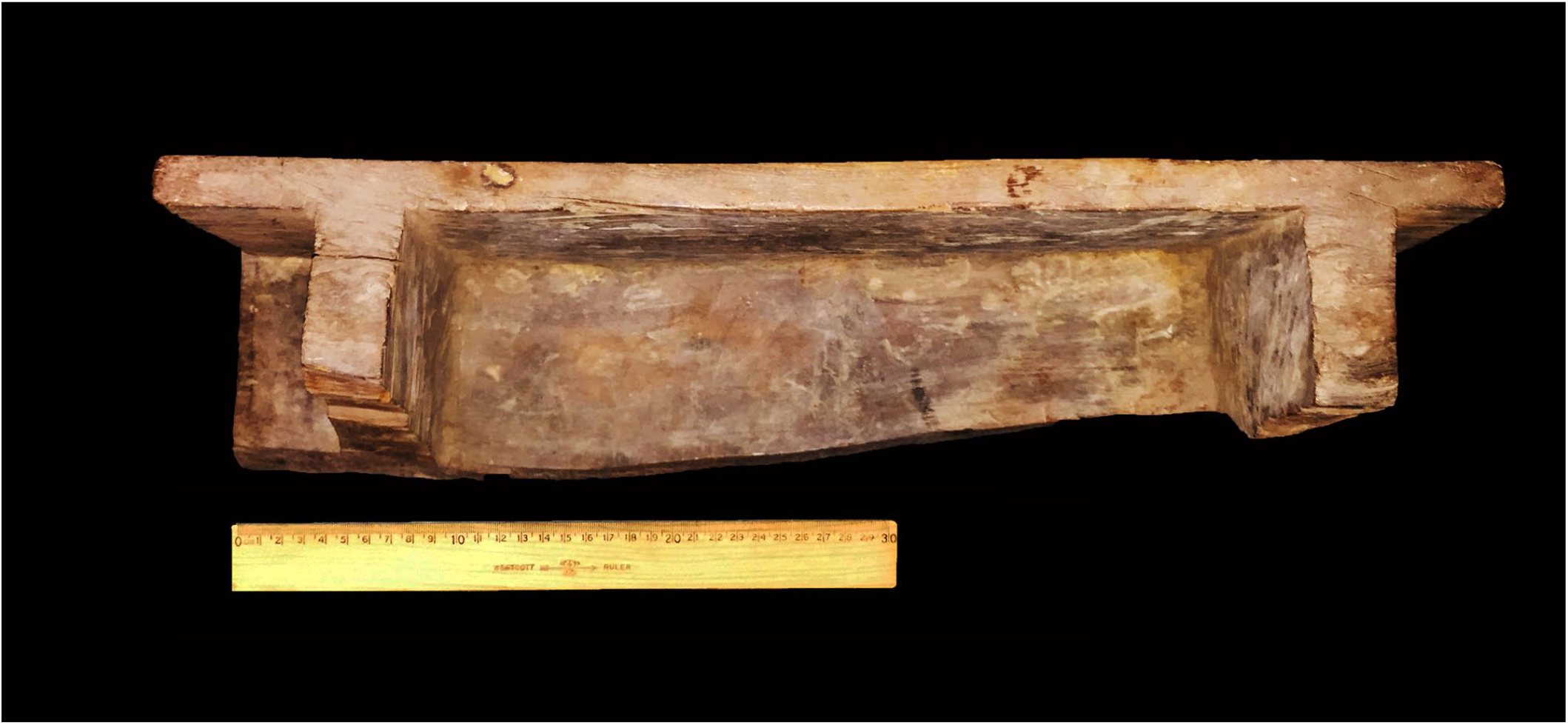
Side view of the senet gaming table, showing the back panel and perpendicular supports (courtesy of the Rosicrucian Egyptian Museum, San Jose, California, USA).
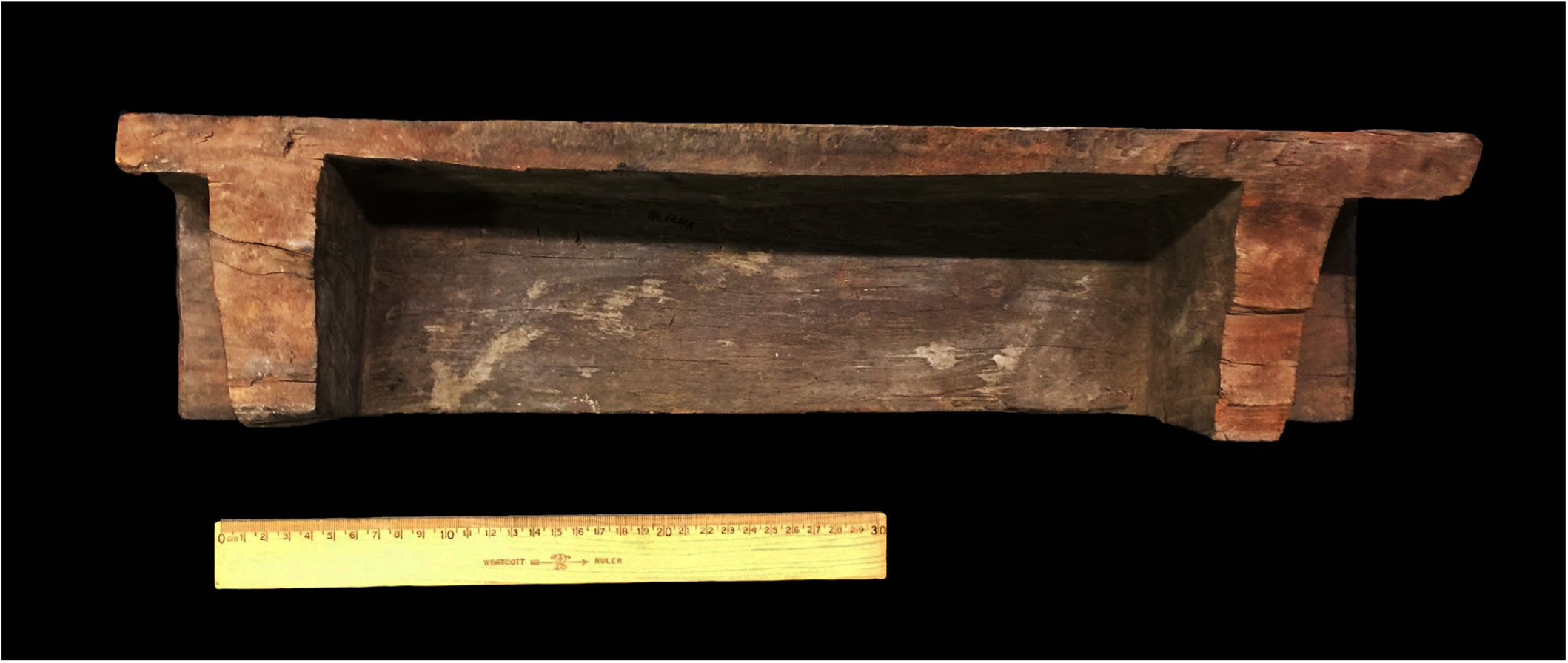
Bottom view of the senet gaming table, showing the underside of the top panel bearing the senet pattern (courtesy of the Rosicrucian Egyptian Museum, San Jose, California, USA).
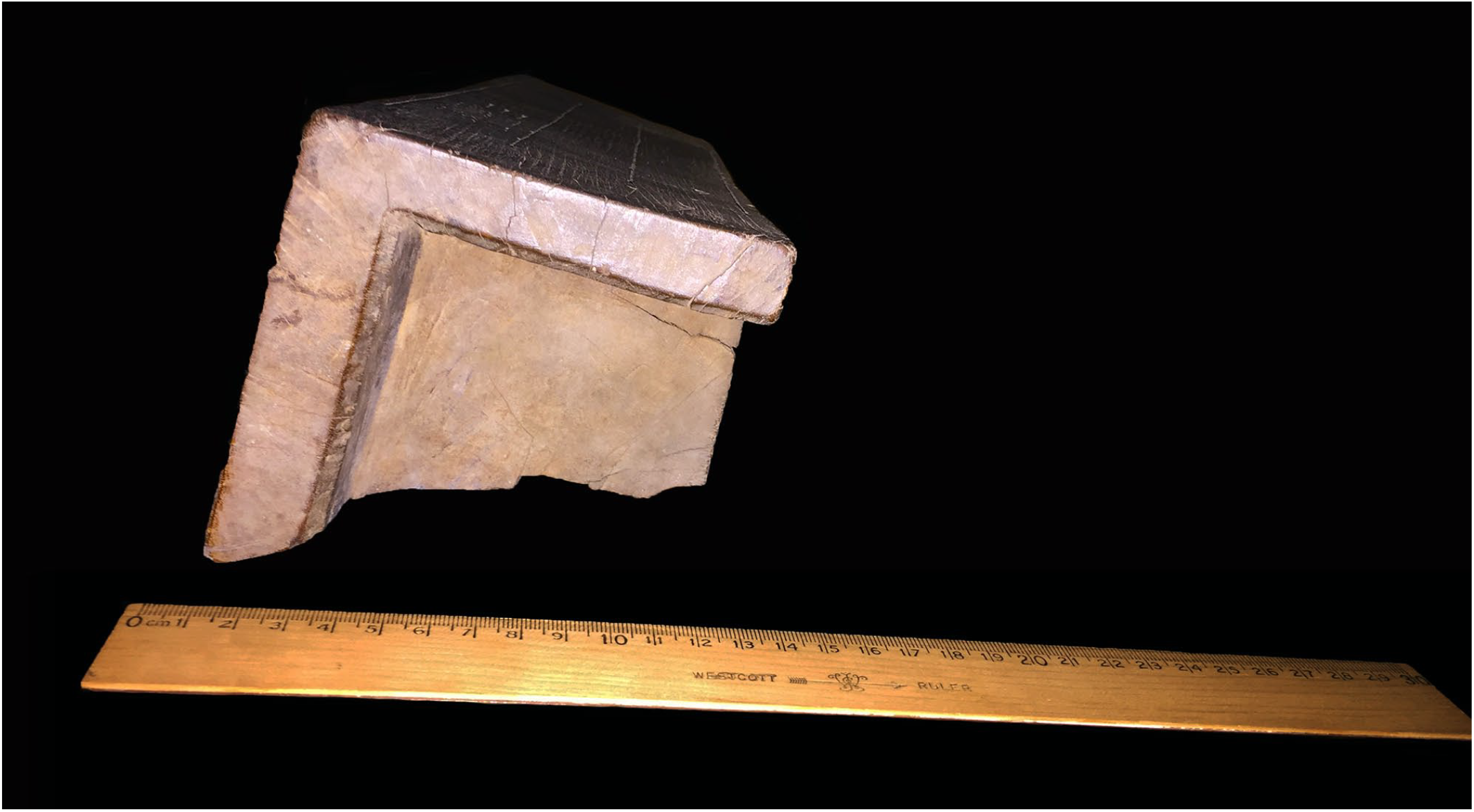
View of the senet gaming table from the left side, showing that it cannot stand upright in its current condition (courtesy of the Rosicrucian Egyptian Museum, San Jose, California, USA).
The senet pattern is carved into the top surface of the table, but it is not laterally centered between the ends, leaving two empty spaces at either end of the board (fig. 6). Four of the squares are marked with hieroglyphs: nfr, mw, three seated men, and two seated men. These signs are executed in cursive hieroglyphic writing, and they conform to one of several variations on the canonical progression of ‘good, water, three, two’ in squares 26 to 29 of senet boards. The incisions making up the signs are executed in such a way that mimics the writing of signs in ink, which may suggest that the person who carved them copied them from a written prototype. The hieroglyphs are drawn so that they are upright when the board is positioned with them at the top left, with the long vertical panel at the back, indicating that the orientation of the board is that seen more commonly during the Middle Kingdom, while the hieroglyphs themselves are more typical of the Eighteenth Dynasty.
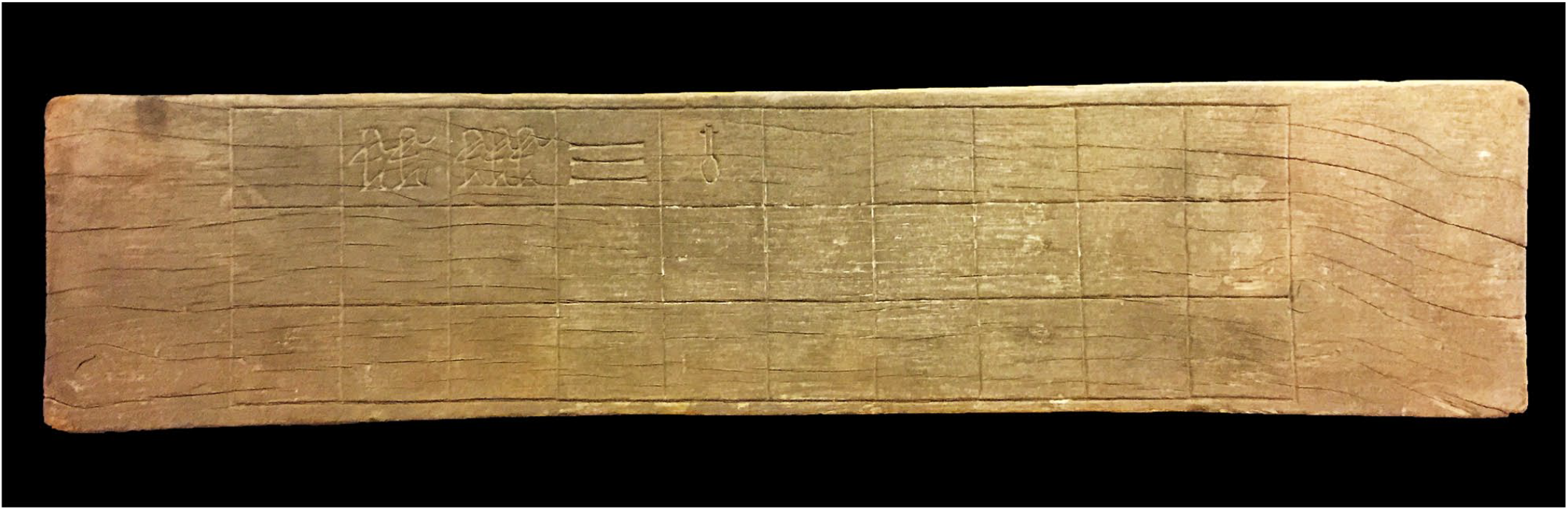
Top view of the senet gaming table showing the gaming pattern (courtesy of the Rosicrucian Egyptian Museum, San Jose, California, USA).
Comparative material
While no other senet boards have exactly the same pattern of markings that the Rosicrucian board contains in squares 26 to 29, there are two boards with decoration that closely reflect that on the artifact in question (fig. 7). The first is currently in the British Museum (BM 21576), which has been identified as a board that was found in the tomb of Hatshepsut. 23 It is a wooden board of box type, with ivory inlays dividing the wooden spaces. Squares 26, 28, and 29 are preserved, with the same cursive hieroglyphs incised in those playing spaces as those that appear on the Rosicrucian board: nfr, three seated men, two seated men, respectively. 24 This board contains the game of 20 squares on the opposite side, a common feature of New Kingdom senet boards. 25
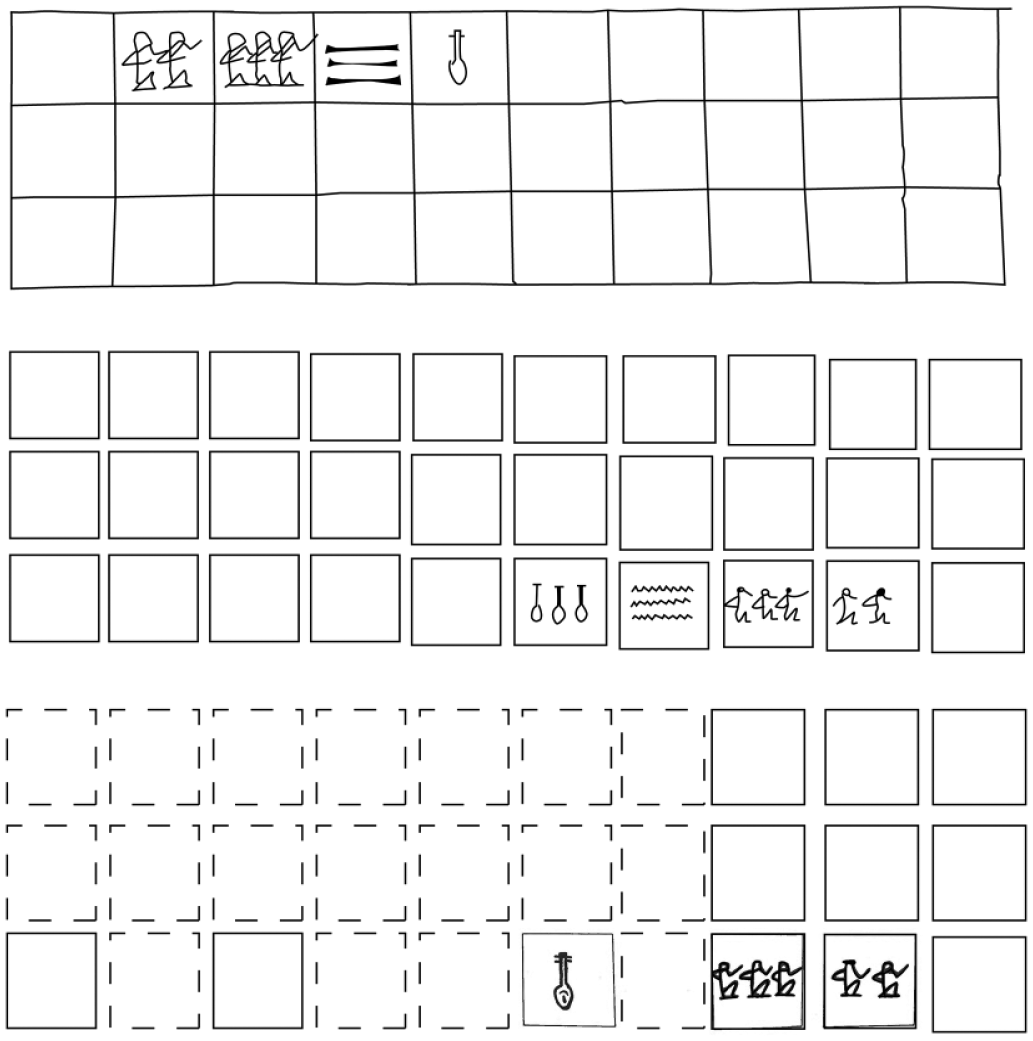
Drawing of the senet gaming table in the Rosicrucian Egyptian Museum (top) and two boards with similar decoration in their playing squares (drawing: W. Crist, after Rijksmuseum van Oudheden in Leiden, AH 34a, Pusch, Senet-Brettspiel, pl. 67 (middle); British Museum, BM 21576, Pusch, Senet-Brettspiel, pl. 67 (bottom)).
The second comparable board, now in the Rijksmuseum van Oudheden in Leiden (AH 34a), has unknown provenance. 26 The offering inscription appearing on the side of the board contains the name of Baky, who Piccione suggests is the same Baky from Tomb 18 at Dra Abu el-Naga, who lived during the reign of Thutmose III. 27 It is also a wooden box with the game of 20 squares on the opposite side. Markings are painted in cursive hieroglyphs in squares 26 to 29 in the following progression: nfrw, mw, three seated men, two seated men. 28
While these two boards offer the closest parallels to markings of squares 26 to 29 on the board, the Rosicrucian senet differs from these two examples in one important aspect, in that it has the Middle Kingdom/Second Intermediate Period orientation with the marked squares at the top left, rather than the bottom right. There are seven other senet boards that hold this orientation, as indicated by the markings in the relevant squares. 29 All of these boards date from the Twelfth to Seventeenth Dynasties. While their orientation is the same as the Rosicrucian board, the markings on these boards are much simpler, with nfr, X, three, and two being the standard decoration for these boards, along with additional markings irrelevant to this artifact. 30
The appearance of senet on a table such as this one is also of note, as it is the only one of its kind to have been found, though similar examples appear in art. Piccione describes three categories of senet boards: slabs, boxes, and graffiti. 31 In essence, this is a slab-style board that has been made into a table, but only one other slab-style game may have been treated in this way, which was found at Tel el-Hisn and dates to the Middle Kingdom. 32 Other gaming tables exist from the Middle Kingdom, but the only surviving examples contain the game of 58 holes, and have zoomorphic supporting legs and feet. 33 Game boards that also have legs in the shape of animals are depicted in paintings in the tombs of Baket III and Khety at Beni Hasan, though some of these scenes seem to show the game of 20 squares. 34 Nevertheless, these scenes imply that tables featured games other than 58 holes. During the New Kingdom, box-style senet boards were sometimes installed in wooden sledges, 35 giving the appearance of gaming tables, such as in the famous example from the Tomb of Tutankhamun. 36
Possible dating
The comparative material discussed in the foregoing section suggests that the senet board in the Rosicrucian Egyptian Museum demonstrates a transitional stage in the pattern of decoration between the Middle Kingdom/Second Intermediate Period and the middle of the Eighteenth Dynasty. The orientation of the board, with the marked squares at the top left, points to an early date. The latest board with the same orientation as the Rosicrucian senet is drawn in ink on the back of a schoolboy’s writing tablet (the ‘Carnarvon Tablet’), now in the Egyptian Museum in Cairo (JdE 41.790). 37 It was found by Howard Carter in Asasif Tomb 9, and dates to the Seventeenth Dynasty. 38 All other previously published senet boards dating later than this board—for which orientation can be determined—show the opposite configuration, with squares 26 to 29 at the lower right.
The two boards with markings that most closely match those on the Rosicrucian senet are both likely dated to the Thutmoside Period, specifically the reigns of Hatshepsut and Thutmose III. Currently, all known senet boards with markings before the reign of Hatshepsut have the more simplistic decoration of nfr, X, three, and two in the relevant squares, whereas during, and especially after, the reigns of these two pharaohs, the decoration in these games becomes elaborated. 39
The fact that the game takes the form of a table also points to an earlier rather than a later date. The evidence suggests that senet tables, and gaming tables in general, were particularly popular during the Middle Kingdom. By the later Eighteenth Dynasty, game boxes incorporated into sledges are the closest analogy to tables. Game tables pictured in art from the Late Period (Neo-Memphite reliefs and at the pyramid of Aramatelqo in Kush 40 ) are copies of Old Kingdom reliefs or are outside of Egypt proper and unlikely to be relevant here.
Considering the morphology of the Rosicrucian senet game, the date range during which people were making similar choices in the design of game boards extends from the Twelfth Dynasty (based on orientation) to the Nineteenth Dynasty (because it is a game box). The end points of this range can be narrowed down further based on the style of the markings in squares 26 to 29. Since the markings do not contain the superfluous ones seen in the Middle Kingdom boards, that period can be eliminated as a possible date. Furthermore, the progression of nfr, mw, three seated men, and two seated men only has parallels in the early Eighteenth Dynasty, specifically the reigns of Hatshepsut and Thutmose III.
This leaves a gap, however, between the last known example of a game with the top left orientation of squares 26 to 29 (Seventeenth Dynasty), and the appearance of this particular style of marking (Hatshepsut), of roughly 70 years. There are currently no senet boards that can be attributed to the period from the reign of Ahmose I to that of Thutmose II. Thus, the evolution of senet boards from the earlier games of the Middle Kingdom—with their simple decoration and top left placement of the marked squares—to that of the New Kingdom—with elaborated decoration and lower right placement of marked squares—is poorly understood. We know that at least during the Seventeenth Dynasty, game boxes and boards with the top left orientation coexisted, as evidenced by the game from the Tomb of Hornakht at Dra Abu el-Naga 41 and the Carnarvon Tablet. There is, however, no evidence for the elaborated decoration seen on the Rosicrucian board during the Second Intermediate Period. These same two boards are the only ones marked from that period, and the Hornakht box only contains m in square 27, and the Carnarvon Tablet has nfr, X, three, two.
It would seem prudent to propose then, that the game box in the Rosicrucian Egyptian Museum represents a transitional form between the top left oriented schoolboy’s tablet and the game box with nearly identical markings from the tomb of Hatshepsut. No other games can be securely dated to the intervening period either through archaeological context or by style alone, so this game is a likely candidate to fill that stylistic gap.
De Voogt et al. have demonstrated that cultural transmission theory provides a framework for understanding change or persistence of variants in material culture, especially pertaining to board games. 42 Using the games of 20 squares and 58 holes as test cases, they found that games are transmitted from one person to another with minimal numbers of changes to the board, in an incremental fashion. 43 Dating the Rosicrucian senet board between the reigns of Ahmose I and Thutmose II fits this incremental model of change. Further research will be necessary to confirm this hypothesis. Since the Rosicrucian board is made of wood, radiocarbon dating could possibly help to determine when this box was made, as was recently done with a senet game in the collection of the Arizona State Museum. 44 Until such analysis is possible, the board demonstrates what may be a crucial stage in the evolution of the senet game in the New Kingdom.
Footnotes
Acknowledgements
Many thanks are due to Julie Scott at the Rosicrucian Egyptian Museum, San Jose, California for permission to publish this artifact, as well as for photographs and providing additional information on the board in question.
Funding
The author received no financial support for the research, authorship, and/or publication of this article.
1.
The most comprehensive synthetic sources on senet are: W. Crist, A.-E. Dunn-Vaturi and A. de Voogt, Ancient Egyptians at Play: Board Games across Borders (London, 2016), 42–80; W. Decker and M. Herb, Bildatlas zum Sport im Alten Ägypten: Corpus der bildlichen Quellen zu Leibesübungen, Spiel, Jagd, Tanz und verwandten Themen (Leiden, 1994), 642–81; A. Hoerth, Jr., Gameboards in the Ancient Near East (M.A. thesis, University of Chicago; Chicago, 1961), T. Kendall, Passing through the Netherworld: The Meaning and Play of Senet, an Ancient Egyptian Funerary Game (Belmont, MA, 1978); W. Needler, ‘A Thirty-Square Draughts Board in the Royal Ontario Museum’, JEA 39 (1953), 60–75; P. Piccione, ‘Review of Das Senet-Brettspiel Im Alten Ägypten’, JEA 70 (1984), 172–80; P. Piccione, The Historical Development of the Game of Senet and its Significance for Egyptian Religion (PhD thesis, University of Chicago; Chicago, 1990); P. Piccione, ‘Review of Bildatlas zum Sport im Alten Ägypten’, JNES 58 (1999), 117–25; P. Piccione, ‘The Egyptian Game of Senet and the Migration of the Soul’, in I. L. Finkel (ed.), Board Games in Antiquity: Papers from the 1990 British Museum Colloquium, with Additional Contributions (London, 2007), 54–63; E. B. Pusch, Das Senet-Brettspiel im Alten Ägypten (Munich, 1979); W. M. Refat, Le jeu de trente cases dans l’Égypte ancienne (PhD thesis, Université libre de Bruxelles; Brussels, 1972); J. Vandier, Manuel d’archéologie égyptienne, 4: Bas-reliefs et peintures, scènes de la vie quotidienne (Paris, 1964), 486–512. See also A. Widura, SpielRäume: Kulturhistorische Studien zum Brettspiel in archäologische Kontexten (Bochumer Forschungen zur Ur- und Frühgeschichtlichen Archäologie 7; Rahden, 2015) for a discussion of senet and the archaeological contexts of games more broadly.
2.
P. Montet, ‘Tombeaux de la première et de la quatrième Dynasties à Abou-Roach’, Kemi 8 (1946), 184–5.
3.
J. E. Quibell, Excavations at Saqqara (1911–1912): The Tomb of Hesy (Cairo, 1913), 18–21.
4.
Graffiti senet boards have been found at several Fifth and Sixth Dynasty mastabas, but they could be much later in date. See Piccione, Historical Development, 46; Piccione, JNES 58, 121. For discussion of Old Kingdom senet scenes, see Piccione, Historical Development, 49–82.
5.
Piccione, Historical Development, 396–446.
6.
Kendall, Passing through the Netherworld, 28–31.
7.
Piccione, in Finkel (ed.), Board Games, 54.
8.
H. Jacquet-Gordon, ‘The Egyptian Game of Draughts’, in A. Piankoff (ed.), The Wandering of the Soul (Princeton, 1974), 116–24; Piccione, Historical Development, 105–19, 191–230, 311–26.
9.
Crist et al., Ancient Egyptians at Play, 53–4; Hoerth, Gameboards, 87; Piccione, Historical Development, 453–7; Needler JEA 39, 70–5.
10.
Crist et al., Ancient Egyptians at Play, 61; W. M. F. Petrie, Tanis Part II: Nebesheh (Am) and Deffeneh (Tahpanhes) (EES EM 5; London, 1888), 74.
11.
Piccione, Historical Development, 184–90; N. Cherpion, J.-P. Corteggiani, and J.-F. Gout, Le tombeau de Pétosiris à Touna el-Gebel: Relevé photographique (Cairo, 2017), 33, 40. One board shows the field of squares with three rows of eleven, and the playing pieces in both are low mounds, more reminiscent of Greco-Roman discoidal game counters than typical conical and spool-shaped pieces from Egypt.
12.
Piccione, Historical Development, 449, 451. Piccione describes these games as rows of holes, a rendering which has not been seen for senet in Egypt. Rows of holes in Egypt can usually be identified as modern games of siga or tab. See Crist et al., Ancient Egyptians at Play, 151–66.
13.
Crist et al., Ancient Egyptians at Play, 69–74.
14.
Crist et al., Ancient Egyptians at Play, 74–7; S. Swiny, The Kent State University Expedition to Episkopi-Phaneromeni (Nicosia, 1986), 32–64.
15.
M. Dunand, Fouilles de Byblos 1933–1938 Tome I (Paris, 1954), 310; M. Dunand, Fouilles de Byblos 1933–1938 Tome II (Paris, 1958), 531, 573, 661; E. Fugmann, Hama: Fouilles et recherches 1931–1938 II.1: L’architecture des périodes pré-hellénistiques (Copenhagen, 1958), 76, 80; M. Sebbane, ‘Board Games from Canaan in the Early and Intermediate Bronze Ages and the Origin of the Egyptian Senet Game’, Tel Aviv 28 (2001), 213–30.
16.
Crist et al., Ancient Egyptians at Play, 67–8.
17.
Crist et al., Ancient Egyptians at Play, 41–64.
18.
A. de Voogt, A.-E. Dunn-Vaturi, and J. Eerkens, ‘Cultural Transmission in the Ancient Near East: Twenty Squares and Fifty-Eight Holes’, Journal of Archaeological Science 40 (2013), 1715.
19.
W. Crist, A. de Voogt, and A.-E. Dunn Vaturi, ‘Facilitating Interaction: Board Games as Social Lubricants in the Ancient Near East’, Oxford Journal of Archaeology 35 (2016), 180–1.
20.

21.
Piccione, Historical Development; Pusch, Senet-Brettspiel.
22.
23.
Piccione, Historical Development, 401.
24.
Pusch, Senet-Brettspiel, 279–80, pl. 72.
25.
Crist et al., Ancient Egyptians at Play, 53, 88–91.
26.
Pusch, Senet-Brettspiel, 265–7, pl. 67a.
27.
Piccione, Historical Development, 409–10.
28.
Needler, JEA 39, 74.
29.
Piccione, Historical Development, 390–6.
30.
Crist et al., Ancient Egyptians at Play, 50.
31.
Piccione, Historical Development, 3–16.
32.
Piccione, Historical Development, 393.
33.
Crist et al., Ancient Egyptians at Play, 105–6.
34.
Crist et al., Ancient Egyptians at Play, 51, 85.
35.
Piccione, JNES 58, 122–3.
36.
Piccione, Historical Development, 13.
37.
Piccione, Historical Development, 396.
38.
Earl of Carnarvon and H. Carter, Five Years’ Explorations at Thebes: A Record of Work Done 1907–1911 (London, 1912), 36, pl. 27.
39.
Piccione, Historical Development, 244–5.
40.
Piccione, Historical Development, 286–8.
41.
G. Maspero, ‘Enquête judiciaire à Thebes au remps de la XXe Dynastie’, Memoires de l’Académie des Inscriptions et Belles Lettres 8 (1871), 78; Crist et al., Ancient Egyptians at Play, 88–9.
42.
De Voogt et al., Journal of Archaeological Science 40, 1715.
43.
De Voogt et al., Journal of Archaeological Science 40, 1726–8.
44.
I. B. Romano, W. J. Tait, C. Bisulca, P. P. Creasman, G. Hodgins, and T. Wazny, ‘An Ancient Egyptian Senet Board in the Arizona State Museum’, ZÄS 145 (2018), 71–85.