




Abstract
The ostracon oBM EA 65597 contains two extracts from The Teaching of Khety, also known as The Satire of the Trades. It was used as a school exercise. On the recto a teacher wrote the first chapter of Khety in a small, neat hand. The text continues on the verso, but written by a student in an inexperienced hand. Various parallels are discussed, including the unpublished ostracon Cairo SR 12191, which joins oDeM 1218. On this ostracon a student has copied part of his master’s text. The discussed ostraca stem from an educational context and give us a glimpse into the didactic methods used in Ancient Egypt.

Introduction
The ostracon oBM EA 65597 contains extracts from The Teaching of Khety (also known as The Satire of the Trades) on both the recto and the verso. It was published by R. J. Demarée in 2002. 1 He states that the ostracon shows three different hands, a conclusion that has been followed by the Egyptological community ever since. 2 In this article a different reading of the last line on the recto is proposed. The observation is made that as a result the ostracon shows only two hands, rather than the three suggested by Demarée. Finally, the social context of the ostracon is examined. It is proposed that the ostracon was used as a school exercise and parallels are discussed.
A different reading
The ostracon oBM EA 65597 dates to the Nineteenth Dynasty and its provenance is unknown. It measures 15 cm in height and 19.5 cm in width, and is inscribed on the recto (fig. 1) with four lines of hieratic script and a date written in red ink. There follow another two hieratic lines, written upside down when compared to the other lines. These are partly written across some vertical lines, which may have been part of an older, original text in columns, possibly Kemyt. On the verso the ostracon contains six lines of hieratic text. Apart from some slight damage, the ostracon is complete.
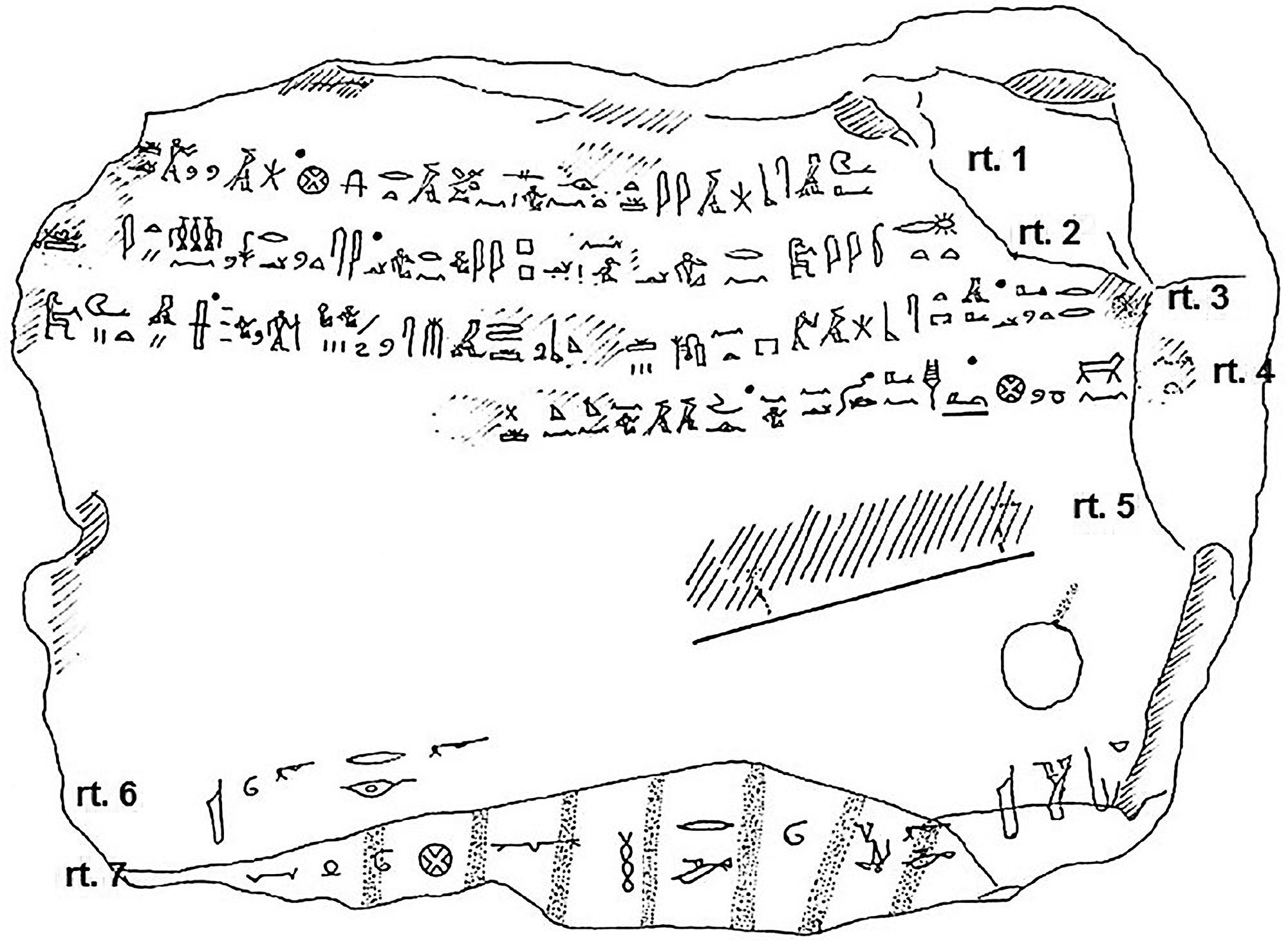
oBM EA 65597 recto (after Demarée, Ramesside Ostraca, pl. 160).
Demarée maintains that the ostracon comprises three excerpts from Khety written in three different hands. According to his transcription of the text, they are the following:
Hand 1 (recto, lines 1–4):
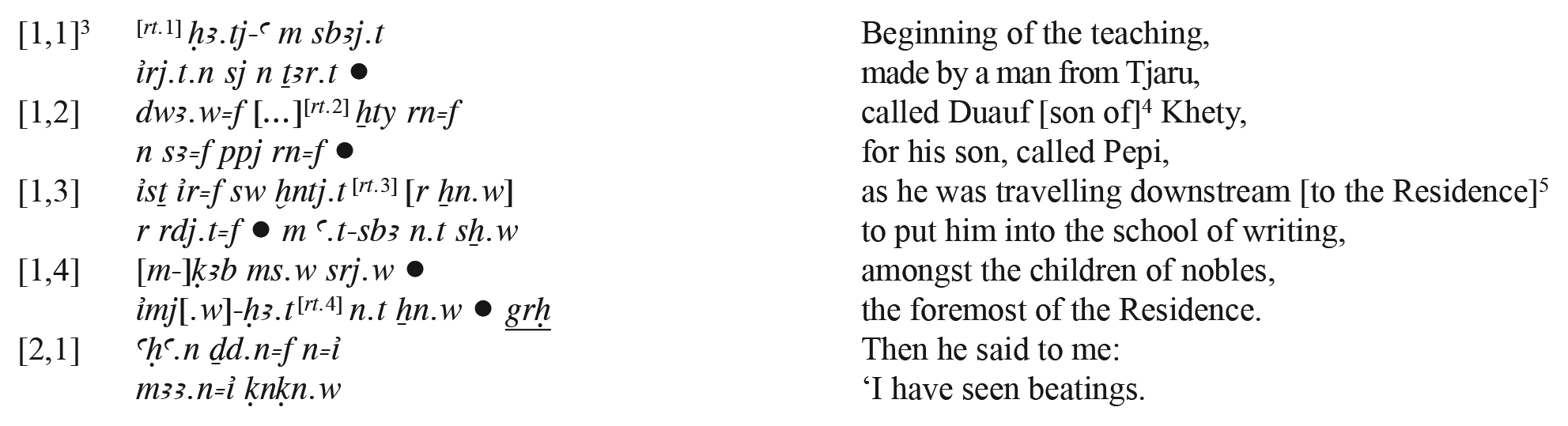
Hand 2 (recto, lines 6, 7):

Hand 3 (verso, lines 1–6):
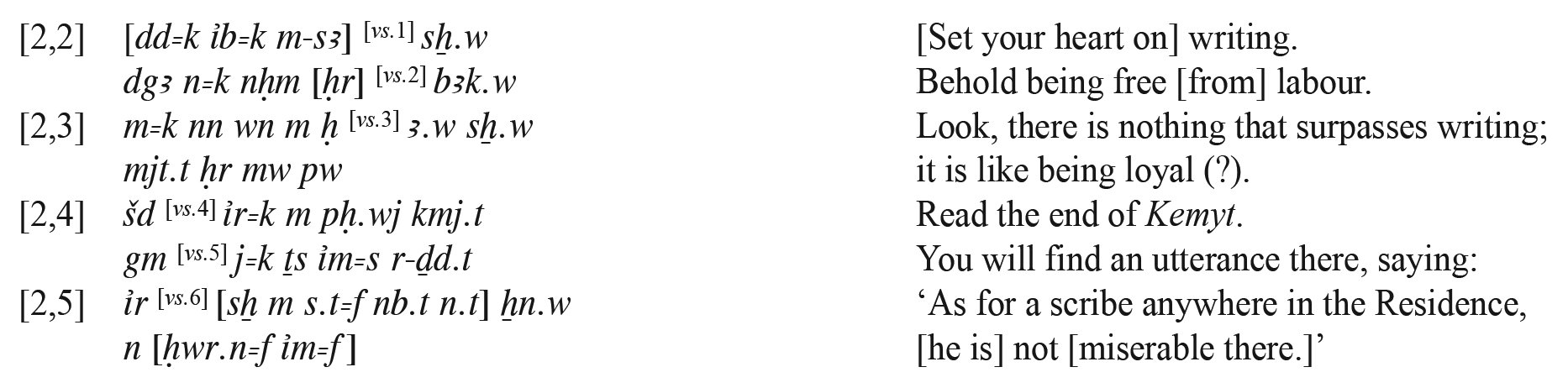
When we take a closer look at the verso, however, there seems to be a problem with this interpretation. There is not enough space at the beginning of verso line six to put an entire [sẖ m s.t=f nb.t n.t] in, even if a large portion of the ostracon was broken off here, creating a lacuna. Also, looking at the hieratic, the signs do not seem to fit Demarée’s transcription. Taking this into account, a different reading of line six on the verso is proposed (see table 1).
oBM EA 65597, verso, line 6.
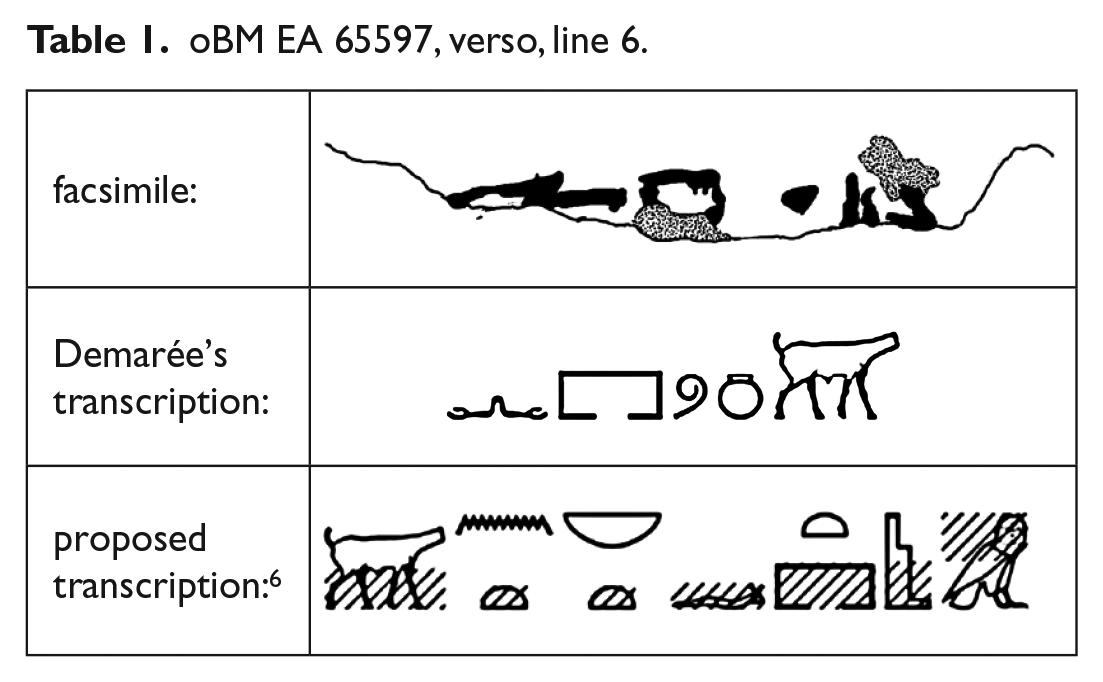
As a result of this new reading, line seven on the recto directly follows after the last line on the verso and continues the text. Thus, the ostracon contains not three, but two extracts from Khety, written in two different hands:
Hand 1 (recto, lines 1–4):
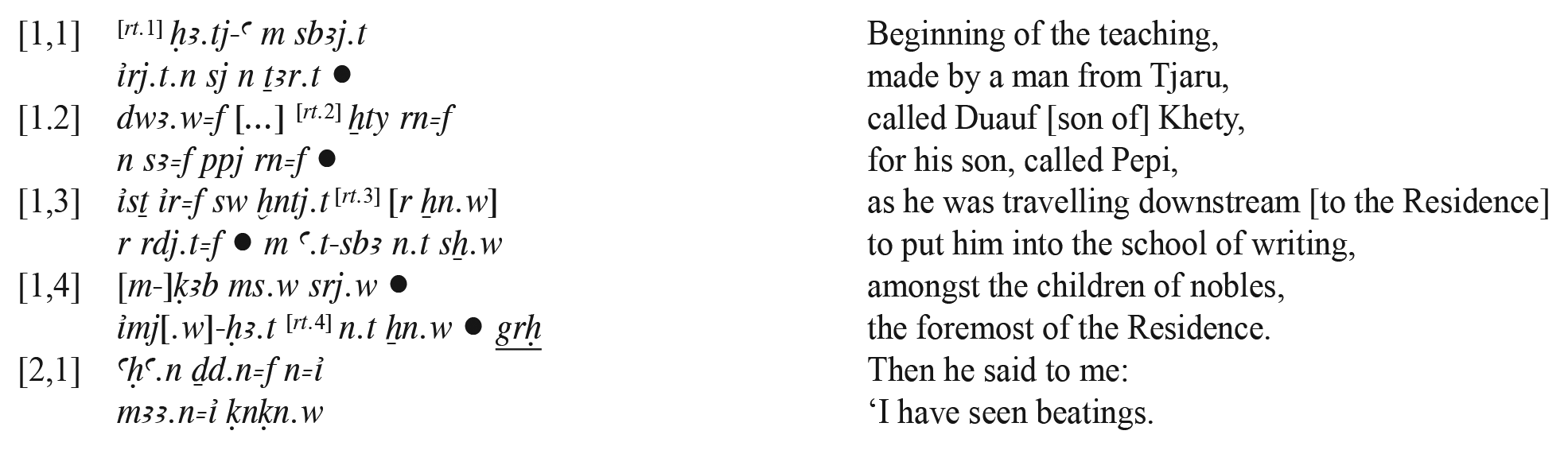
Hand 2 (verso, lines 1–6; recto, lines 6, 7):
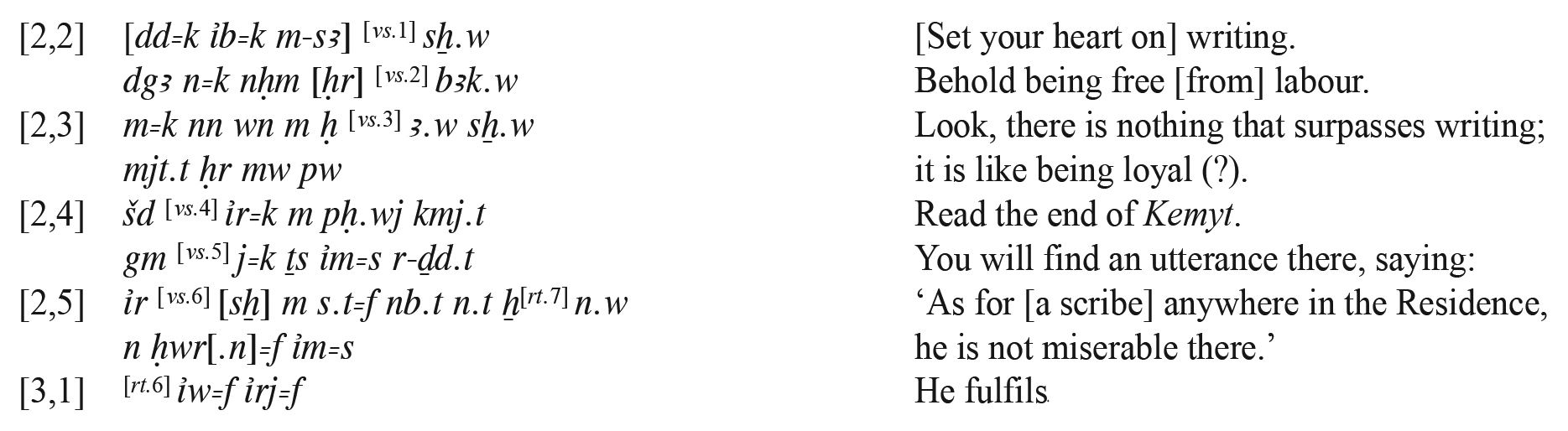
Because the text on the verso continues on the recto (lines 6, 7), it would seem logical that both the verso and the two lines on the recto were written by the same scribe. Comparing the handwriting of both seems to support this conclusion: the signs are approximately the same size. Unfortunately, there are not many signs available for a thorough comparison of the paleography. Fig. 2 contains the signs that appear both on the recto (lines 6, 7) and the verso and were legible enough to include.
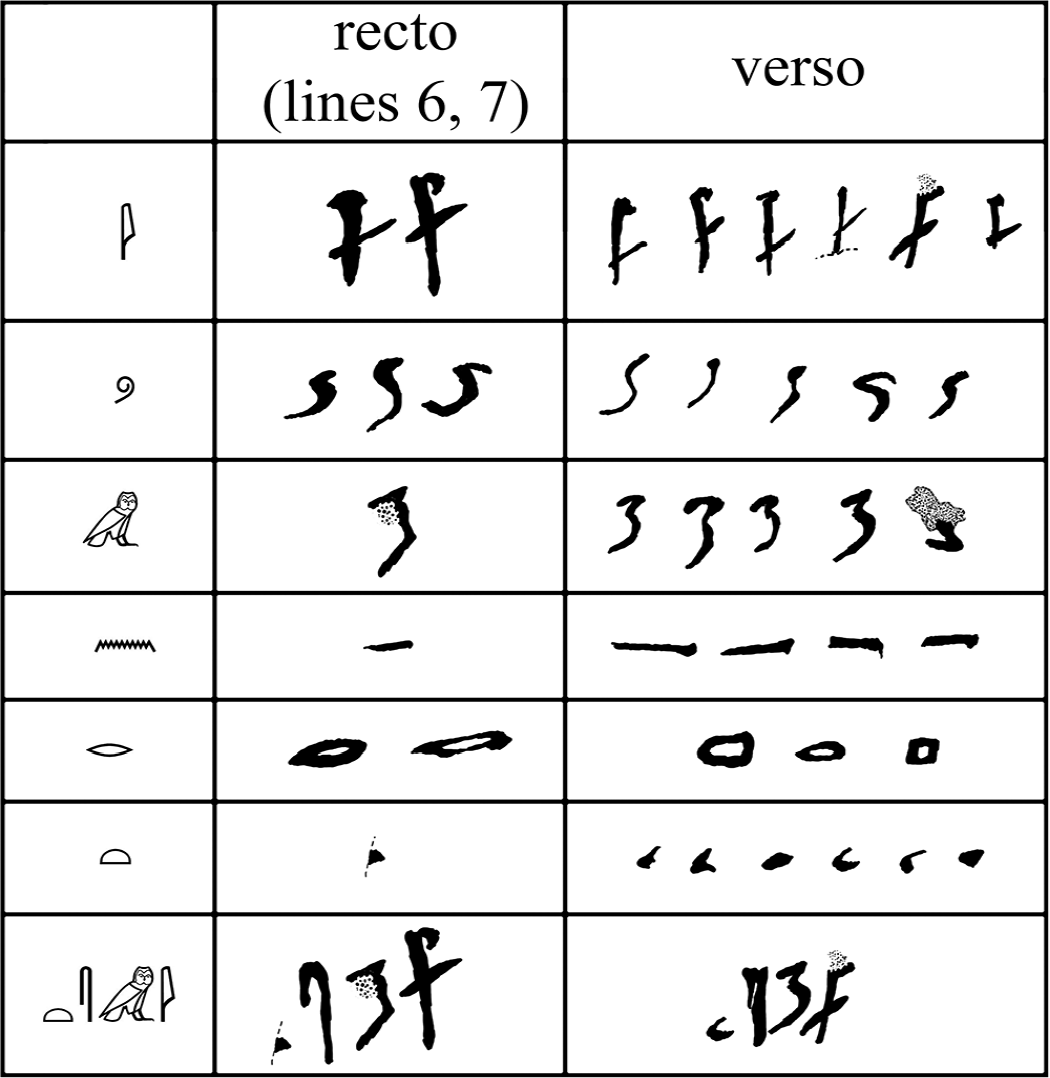
The paleography of the signs appearing both on the verso and the last two lines of the recto.
When comparing the two, there are some slight variations observable in the way the signs are written, but these differences also occur amongst the signs on the verso. Only the r on the recto, line 7 is written noticeably differently to the r’s on the verso. However, this is easily explained. The r in question is written underneath the sign for wr, a swallow (G 36). As a result, this r on the recto is more elongated than the ones on the verso. All in all, the paleography does not contradict the conclusion that the same scribe was at work here. Variations do occur within the handwriting of a single scribe, 7 especially an inexperienced one (see later), and the observed variations easily fall within these parameters.
Thus, the scribe started writing on the verso, at some point realized he did not have enough space to complete the text, cramped in some signs at the end, then flipped over the ostracon on the horizontal axis and continued writing on the recto. There he wrote the text not on the nice smooth surface on which the first scribe wrote his text, but on the fault line at the bottom, probably to make the amount of space between his text on the verso and the two lines on the recto as small as possible.
A school exercise
The two hands are very different; one is clearly practised while the other is not. That hand 2 is inexperienced is easily recognizable: the signs are large, irregular and unevenly spaced. 8 Also, more than once at the end of a line the scribe breaks in the middle of a word and continues writing the rest of the word on the next line. A more experienced scribe would have avoided this as much as possible. Compared with hand 2, the signs written by hand 1 are much smaller, well spaced out and written with a steady hand. I propose we have here the handwritings of a teacher (hand 1) and a student (hand 2).
Thus the ostracon stems from an educational context, and as such the following situation can be reconstructed: the teacher wrote the beginning (chapter one) of Khety on the recto, together with the opening line of chapter two. 9 Then he ordered his student to finish chapter two on the back of the ostracon as a test, to see if his pupil remembered how the text continued. It seems this was the case. The missing [dd=k ỉb=k m-sȝ] sẖ.w at the beginning of the student’s text is most likely due to surface damage and is not an omission by the student.
This interpretation is in line with what we know from other sources. First, students had to memorize texts,
10
as the following, much-cited passage from the Satirical Letter of P. Anastasi I demonstrates: You have quoted me one of Hordedef’s verses, but you do not know whether it is good or bad, or which chapter precedes it and which follows it. You are supposed to be a scribe at the head of his colleagues, having the Instructions (sbȝyt) of every scroll engraved in your memory.
11
Secondly, H.-W. Fischer-Elfert has demonstrated that students were required to prepare one chapter a day.
12
A telling example is oDeM 438.
13
According to Fischer-Elfert’s interpretation of this ostracon, it translates as follows:
14
recto
The scribe Piay speaks to the scribe Amen-mose as follows: ‘A third (chapter) is ready for you.’
verso
Amen-mose: ‘I will do it! See, I will do it, I will do it!’ Piay: ‘Bring your chapter and come!’
15
So the teacher Piay sends an ostracon to his student Amenmose letting him know a third chapter is ready for him to copy. The student Amenmose then sends the ostracon back to inform his teacher he will do it. Then Piay in his turn sends the ostracon back again to instruct his student to come to him, after he has finished his homework.
This is all in agreement with our ostracon: the teacher gave his student the assignment to write one chapter in order to test whether the student had memorized the sequence of the text correctly.
The date
The ostracon also contains a date written in red ink (recto, line 5). As with most literary ostraca with dates, it is written in red, at the end of a chapter, slightly underneath the main text but out of line with it, at an angle. 16 Because the red ink is mostly effaced, the date is illegible and it is no longer possible to make out whether it was written by the student or by the teacher. Looking at dates on other ostraca is no help because there is no consensus that these dates were written by the one or the other. 17 In our case the position of the date, close to the master’s copied passage, and the size of the traces left, comparable to the smaller handwriting of the teacher, would seem to suggest that the date was written by the teacher. Also, in the publication the line indicating red ink has been drawn underneath the date (see fig. 1), implying that in Demarée’s view the writing has the same orientation as that of the teacher. The occurrence of dates on ostraca has been used as proof that they stem from an educational context. 18 This is in line with our reading of oBM EA 65597 as a school exercise. But what does the date indicate? Was it the date when the student handed in his homework? When the teacher had examined the lesson of his student? When the teacher finished his text? Unfortunately, its purpose remains unclear. 19
Parallels
O. LACMA M.80.203.204
This ostracon 20 contains an extract from another literary text, The Instruction of Amenemhat. On the recto, part of Amenemhat (Papyrus Millingen 1.7–2.2) has been written in a practised hand. On the verso the text continues (Papyrus Millingen 2.2–2.7), but written by a different scribe: the signs are larger, inconsistent and much less precise. It seems that this ostracon was used in an educational context. A teacher wrote the first part of the text and then gave his student the assignment to write the following lines, using the same didactic principle as the teacher of oBM EA 65597.
Because the ostracon is damaged at the end of the master’s text and the beginning of the student’s text, it is not possible to say where exactly the master finished his text and where the student started his. The master began a new chapter (Papyrus Millingen 2.2, nhs.n=ỉ etc.) in column eight, using red ink. He wrote another two columns and then ended his text. The student started his text with this very same chapter. Although the beginning of the chapter is now lost, there are still traces of red ink visible on the right-hand side of the ostracon (verso), indicating the start of this chapter. As a result, there is a bit of an overlap between the master’s text and that of his student. Comparing it with oBM EA 65597, where the teacher wrote the opening line of the next chapter as a memory aid for his student, it is possible that the master here wanted to help his student along, and therefore wrote more than just the opening line.
One could argue that this ostracon does not stem from an educational context, but that something like the following could have taken place: a scribe picked up an ostracon discarded by a previous scribe, read the text and, inspired by it, wrote the next lines. Although this cannot be ruled out, the difference in the quality of the handwriting makes a teacher/student scenario more likely. Also, the text is written in vertical columns with dividing lines, which is an unusual way to write literary texts, which were usually written in horizontal lines on ostraca, with the noticeable exception of Kemyt. 21 It has been suggested that the use of vertical columns was utilized in an educational context and helped students when practising their handwriting. 22
UC 31954
Another ostracon, 23 which also contains part of a literary text written in vertical columns, is UC 31954. On this peculiar ostracon, four dividing lines are drawn in black for columns. While the first two lines are straight and neat, the last two have been drawn swiftly and carelessly. The words ḥȝ.tj-ʿ m sb[ȝj.t], ‘Beginning of the Instruction’, have been written in the first column in black. The handwriting is small and neat but stops in the middle of the word sbȝj.t, and the rest of the columns are left blank.
Next to this, the words ḥȝ.tj-ʿ m sbȝj.t ỉrỉ.t.n s n sȝ, ‘Beginning of the Instruction made by a man for his son’, are written, as if the previous text has been taken over and continued. Although this text is also drawn in vertical columns, it is written over the earlier dividing lines, without making use of them. Also, the words are written in red ink instead of the black ink used by the previous scribe. This second scribe seems to have made an attempt to write fully stylized hieroglyphs, but the signs are very large and crudely executed. F. Hagen suggested this ostracon may have been a student exercise. 24 If this is the case, the teacher, who wrote the first signs of the Instruction of a Man for his Son, could have asked his student to continue the opening line, not to see if the student remembered the words correctly (as in the case of oBM EA 65597 and O. LACMA M.80.203.204), but as an exercise in writing a different, more formal script.
Similar examples
Many more ostraca are known which contain the hands of both a teacher and a student. 25 They differ from the ones mentioned here in that the student wholly or partially copied the master’s text instead of continuing it. As a result, these ostraca contain both a master’s copy and a student’s copy of the same text. I. Venturini has collected several of them. 26 To these, the following can be added.
An apprentice’s board from Dra Abu El-Naga
This board 27 contains six columns in total. The first two (columns 1–2) contain the opening paragraph of Kemyt written by the teacher. The student then copied this same passage twice, the second time (columns 5–6) doing a slightly better job than the first time (columns 3–4).
Ostracon University College 31918
This ostracon 28 contains a text belonging to the genre of visitor’s graffiti. The two lines in the middle (lines 3–4) were written first and by an experienced hand. The other three lines are scribbled above (lines 1–2) and beneath (line 6) them and together they contain the same passage, but this time written by a student.
Writing board Ashmolean 1948.91
Both the recto and the verso of this writing tablet 29 contain the opening lines of the Hymn to the Nile, written in two different hands, probably belonging to a teacher and his student. The text on the verso was written first by the teacher and then copied by the student on the recto. Consequently, it is better to alter the designations ‘recto’ and ‘verso’, as employed by previous commentators, and attribute the teacher’s copy to the recto, and the student’s copy to the verso.
To these examples, 30 and the ones already mentioned by Venturini, can now be added an unpublished ostracon. It concerns Cairo SR 12191, a limestone flake, probably dating from the time of Ramesses III. 31 It joins oDeM 1218. 32 Although it is not a direct fit because there are fragments missing in between, it is clear that Cairo SR 12191 (recto) constitutes the upper half of oDeM 1218 (recto). Together they form one large ostracon, whose elongated shape (c. 31.5 cm) and width (c. 10 cm) make it a perfect fit to easily hold in one hand. Both the recto and the verso of oDeM 1218 + Cairo SR 12191 are inscribed with horizontal lines of hieratic, in black ink, with verse points in red. Content-wise the passage belongs to the type of texts known as Miscellanies. 33 Interestingly, part of the text on the recto also appears on the verso, but in a different, unpractised hand. Fig. 3 is a schematic representation of the layout of the ostracon:
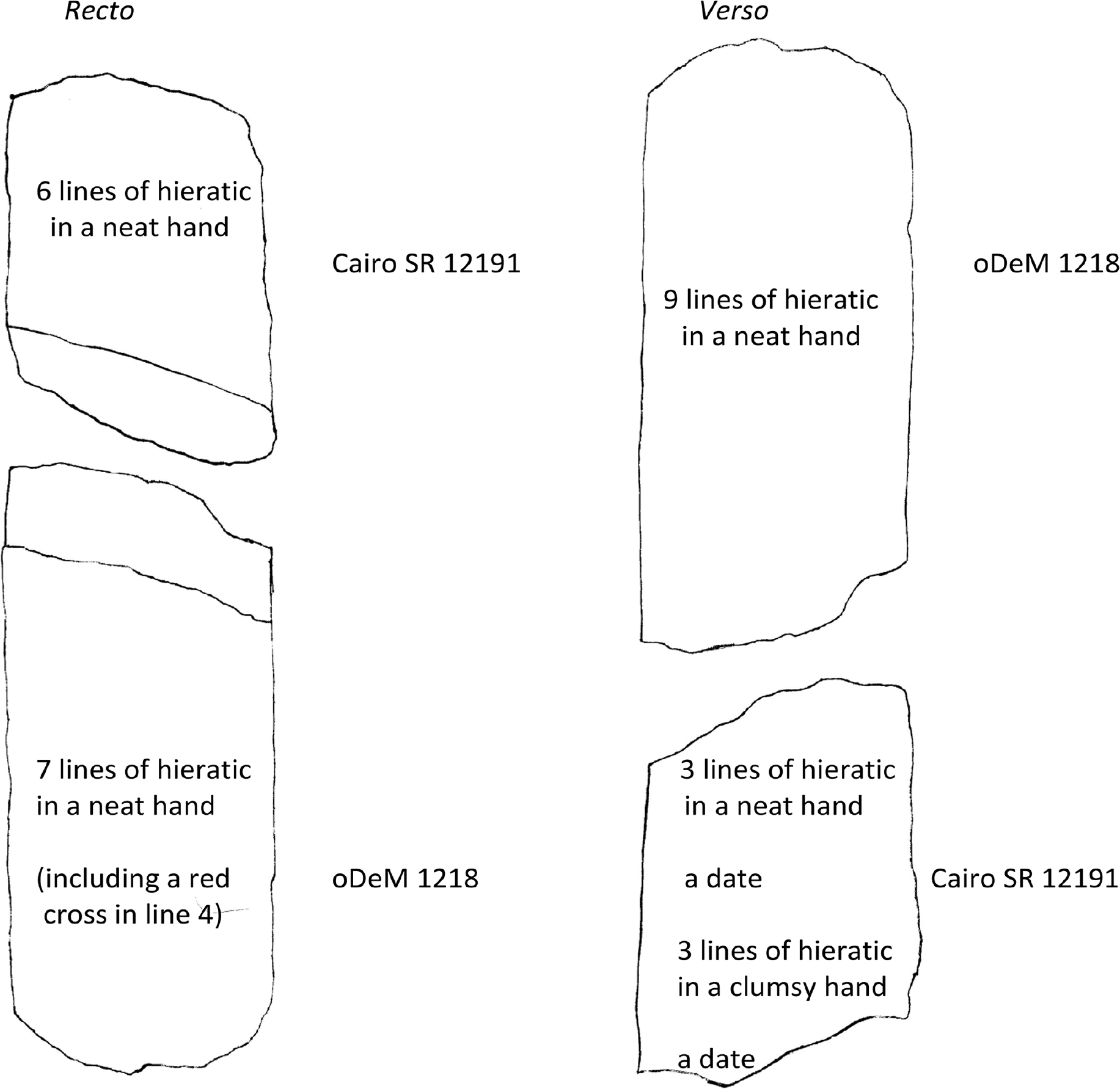
oDeM 1218 + Cairo SR 12191.
The three lines written by the inexperienced scribe are a partial copy of the earlier text (oDeM 1218, recto, lines 4–7, and verso, line 1). The difference in the quality of the handwriting makes a teacher/student scenario most likely, as does the occurrence of dates on the ostracon. As in the examples mentioned earlier, the master first wrote down the text and then the student copied it as a writing exercise. In this case the student copied the text in the blank space left underneath his master’s writing. He only copied part of the text though. Apparently, the teacher did not want the whole text copied but just a part of it. This explains an interesting feature on the recto of the ostracon: a red cross written in the middle of the text, just above line 4 on the recto of oDeM 1218. Posener thought this cross indicated an omission, 34 but now it is clear that this is not the case. The cross was put there by the teacher to indicate the passage he wanted his student to copy, which is what the student then did.
Conclusions
Inspired by the school of Material or New Philology, 35 this article has taken a closer look at the materiality of ostracon oBM EA 65597. Various aspects of this ostracon were analysed and this ‘close reading’ has resulted in a reconstruction of its social context. The piece stems from an educational context and demonstrates the following instructional method: a teacher wrote down part of a text and then the student had to continue this text from memory. Ostracon oBM EA 65597 is a rare example of this didactic approach and therefore it is an important addition to our understanding of educational practices in Ancient Egypt.
More examples are known of a similar but slightly different didactic principle, according to which the student had to copy his master’s text. To the known examples can be added oDeM 1218 + Cairo SR 12191, a partially unpublished ostracon which has an interesting feature not seen before, namely a red cross in the middle of the text, put there by the teacher to indicate the passage he wanted copied by the student. By looking at the material aspects of this ostracon, a social context has been reconstructed, which gives us another glimpse into the educational practices of the ancient Egyptians.
Footnotes
Acknowledgements
I am very grateful to Rob Demarée for pointing out the join of Cairo SR 12191 and oDeM 1218 to me and for his support in the realization of this article. I would also like to thank Jacobus van Dijk and Olaf Kaper for their comments on earlier drafts of the work. I am also grateful to Julia Harvey, who reviewed and corrected my English. Furthermore, I gratefully acknowledge the assistance of Ilona Regulski and Adrienn Almásy of the British Museum, who provided me with a photograph of oBM EA 65597 on which the facsimiles in this article are based.
Funding
The author disclosed receipt of the following financial support for the research, authorship, and/or publication of this article: This work was supported by the Netherlands Organisation for Scientific Research (NWO) [project number 023.008.011].