




Abstract
Quantitative research in the available sources on the pr-ḥḏ in the Early Dynastic period shows that there are better arguments to translate the Early Dynastic term pr-ḥḏ as ‘House of Stoneware’ rather than ‘treasury’. This also helps in explaining the somewhat puzzling double dichotomy of pr-ḥḏ/pr-dšr and pr-ḥḏ/pr-nbw in this period. Moreover, from the results it could be argued that a theory seeing ‘spectacle’ as crucial for state formation in early states is more helpful for understanding the function of the Early Dynastic pr-ḥḏ than a theory seeing the treasury as the centre of the state.
Keywords

Introduction
The hieroglyphic combination,  , is generally translated as ‘treasury’ for all ancient Egyptian periods, and this pr-ḥḏ is generally seen as related to a pr-dšr and to a pr-nb(w). The TLA translates both pr-ḥḏ and pr-dšr as Schatzhaus, and pr-nbw as Goldhaus.
1
The Wörterbuch has Haus des Goldes for pr-nb, translates pr-dšr as ‘das rote Haus’ and adds ‘eigentlich das weiße Haus’ (not Haus des Silbers) to Schatzhaus for pr-ḥḏ.
2
Kahl’s Frühägyptisches Wörterbuch has just Weißes Haus and Rotes Haus (not Schatzhaus) and adds to both, more cautiously, only ‘eine Verwaltungsinstitution’. He does not give the term pr-nbw.
3
However, an inscription mentioning a pr-nbw – mostly disregarded in literature discussing the Early Dynastic pr-ḥḏ
4
– is known already for the Early Dynastic period.
5
, is generally translated as ‘treasury’ for all ancient Egyptian periods, and this pr-ḥḏ is generally seen as related to a pr-dšr and to a pr-nb(w). The TLA translates both pr-ḥḏ and pr-dšr as Schatzhaus, and pr-nbw as Goldhaus.
1
The Wörterbuch has Haus des Goldes for pr-nb, translates pr-dšr as ‘das rote Haus’ and adds ‘eigentlich das weiße Haus’ (not Haus des Silbers) to Schatzhaus for pr-ḥḏ.
2
Kahl’s Frühägyptisches Wörterbuch has just Weißes Haus and Rotes Haus (not Schatzhaus) and adds to both, more cautiously, only ‘eine Verwaltungsinstitution’. He does not give the term pr-nbw.
3
However, an inscription mentioning a pr-nbw – mostly disregarded in literature discussing the Early Dynastic pr-ḥḏ
4
– is known already for the Early Dynastic period.
5
Both Wörterbuch and TLA consider the pr-dšr as the Lower Egyptian treasury for the period of the Old Kingdom. 6 Authors discussing the Early Dynastic pr-ḥḏ are mostly convinced, however, that the pr-ḥḏ and pr-dšr never coexisted during that period, and that the two names just alternated during the first two dynasties. 7 The first occurrence of the common dual term pr.wy-ḥḏ dates only from Sekhemkhet, the second king of the Third Dynasty. 8 Pr.wy-ḥḏ in combination with pr.wy-nbw – ‘als bedeute der Ausdruck “die beiden Silber- und Goldhäuser”’ 9 – is first attested only in the Fifth Dynasty. 10
The translation ‘treasury’ in combination with the absence of a money economy based on minted silver and gold until the Ptolemaic period seemed to warrant the assumption that it was a primary task of the pr-ḥḏ ‘to fill the government coffers with agricultural produce’. 11 However, in recent literature 12 doubts have been expressed that the pr-ḥḏ was really ‘the very centre of the administration that assessed and levied taxation’ in Early Dynastic times. 13 A database of all Early Dynastic inscriptions available on the internet 14 allowed a systematic investigation of all inscriptions mentioning the pr-ḥḏ, which confirmed these doubts. It appeared to offer arguments for the translation ‘house of stoneware’ instead of ‘treasury’, a translation that, as will be shown, also contributes to an explanation for the somewhat puzzling apparent double dichotomy of pr-ḥḏ/pr-dšr and pr-ḥḏ/pr-nbw at that time.
In order to support this translation, the article will first discuss a survey of the characteristics of all known Early Dynastic inscriptions mentioning the pr-ḥḏ, and also its quantitative importance in comparison to that of other Early Dynastic institutions. Second, the pr-ḥḏ and the pr-dšr are compared, showing the untenability of the ‘alternation hypothesis’, further illustrating that in both cases translations other than ‘treasury’ are preferable for this period. Third, the Early Dynastic pr-nbw as well as a ḥw.t nbw will be discussed in relation to the pr-ḥḏ. Fourth, pr-ḥḏ inscriptions will be compared to what will be called ‘domain inscriptions’, for reasons to be explained later.
It will be argued from the results of these comparisons why the pr-ḥḏ can be said to have fulfilled a function in the ongoing social process of state formation during the Early Dynastic period rather than to have been the fiscal centre of the Early Dynastic state.
The pr-ḥḏ and the database of Early Dynastic inscriptions
The ‘Database of Early Dynastic Inscriptions’, online since 2009 15 and updated until at least 2016, 16 covers (1) all known Pre-Dynastic inscriptions, (2) those of the First and Second Dynasty and the reign of Netjerikhet, and (3) those with an uncertain date that might fall within this range. The database was not created to be a corpus of texts, but as the basis for a palaeography of Early Dynastic script. 17 It does not (yet) contain illustrations of the inscriptions, only the sign-codes of identifiable hieroglyphs. 18 It can nevertheless be used for research on the frequency of short textual elements like pr-ḥḏ, pr-dšr and pr-nbw, and for research on ‘external’ characteristics of such inscriptions. Appendix A1 offers the ‘Source numbers’ of ‘pr-ḥḏ inscriptions’ in the database in chronological order, with a summary of the relevant ‘external’ and ‘internal’ information for each. Appendix A2 offers the illustrations arranged according to the source numbers.
The number of preserved Early Dynastic inscriptions mentioning the pr-ḥḏ appeared to be 38: these included 19 seal inscriptions, 12 vessel and 7 label inscriptions; 19 if all known impressions of pr-ḥḏ-seal inscriptions are included the total is more than 60. 20 The number of 38 pr-ḥḏ inscriptions may not seem impressive in comparison to the c.4600 inscriptions in total (c.6200 if all impressions of seal inscriptions are included), 21 but 38 is certainly significant when compared to the number of pr-ḥḏ-inscriptions referred to in the literature, mostly not more than 6 or 7, and never more than 19. 22
All 38 Early Dynastic pr-ḥḏ inscriptions were found in or near royal tombs in Abydos and Saqqara or in top-elite tombs in Saqqara (as is the case for 77% of all c.4600 inscriptions). The funerary character of the preserved sources casts doubts, of course, on the representativeness of the available information on the pr-ḥḏ. It may very well have had functions for the state machinery and the court of the living king not noticeable in funerary material. Given the general scarcity of sources for this early historical period, an attempt to make the most of the available contemporary information seemed nevertheless worthwhile, as the social-political importance of funerary culture for the authority of Egyptian kingship – and in this way for the state – should not be underrated.
The database allows a comparison between the frequency in inscriptions of the pr-ḥḏ and that of other Early Dynastic institutions. It appeared to be one of at least 52 identifiable ‘institutions’, 23 the frequency in the mention of which in the database is on average about 17 times. 24 This is an indication that the Early Dynastic pr-ḥḏ was certainly an institution of some importance, although some institutions were mentioned more often than the pr-ḥḏ, for instance the pr-wr 44 times 25 and the pr-nsw 68 times; 26 it is known, moreover, that the typically Early Dynastic ḥw.t P-Ḥr-msn is mentioned in 62 inscriptions. 27
The earliest found pr-ḥḏ inscriptions are either from the period of the supposed regency of Queen Meretneith for her son King Den, or perhaps even from as early as the reign of their predecessor king Djet, fourth king of the First Dynasty. 28 The latest in the database are from the reign of Khasekhemwy, the final king of the Second Dynasty. The lack of pr-ḥḏ-inscriptions from the long reign of Netjeriket will be discussed in the last section. Given the relatively large number of preserved inscriptions in general from the reigns before Djet, and from the late Pre-Dynastic period, it is not very likely that earlier pr-ḥḏ inscriptions are just accidentally not preserved. 29 The oldest preserved inscriptions mentioning the ḥw.t P-Ḥr-msn and the pr-nsw date from, respectively, the reigns of King Djer and King Djet; only the pr-wr is known already from the reigns of Narmer, Aha and Djer. 30 The formation of an ‘institutional infrastructure’ for the organisation of relations between society and the royal court by means of a state machinery resulted apparently only over the course of time in more institutions thought worthy to be mentioned in script. Early Dynastic ‘state formation’ was clearly a gradual process.
Apart from a pr-ḥḏ, a ḥw.t ḥḏ is also mentioned in the inscriptions. Because it has been assumed that they were in fact the same institution, 31 a search for ḥw.t ḥḏ was added, resulting in four inscriptions. 32 One of them (source no. 0121 from the reign of Narmer) appeared to be in fact a serekh with a mace, as can also be found in source no. 0077, which dates either from the reign of Narmer’s successor Aha or that of Iry-Hor of Dynasty 0. The other three all date from the same time as the appearance of the first pr-ḥḏ inscriptions. It seems likely, therefore, that the name pr-ḥḏ was not yet standardised when it started to appear in script.
The combination with the serekh shows that the mace sign was used as an ideogram added to a king’s name (‘Narmer, King of the Mace’). It is unlikely that the mace in this combination had already the adjectival meaning ‘white’ or ‘silver’. The white-coloured stone of the preserved maces of the kings ‘Scorpion’ and Narmer suggests, however, that this notorious royal weapon may very well have been seen as ‘the White One’ among the regalia. As such, it even occurs already in late Pre-Dynastic inscriptions. 33 It cannot be excluded that ‘House of the Mace’ – or ‘House of the White One’ – is at least as acceptable a translation for the Early Dynastic term pr-ḥḏ as ‘treasury’. It will be argued later in this article that the mace in this combination may be seen, in fact, as a metonym for ‘precious stoneware’.
Pr-dšr and pr-ḥḏ: Alternating names? Or ‘House of Earthenware’ vs ‘House of Stoneware’?
The term pr-dšr is present in only 19 inscriptions (50 if all seal impressions are included): 14 seal inscriptions, 2 vessel and 1 label inscription, one on a stela and one on a statue. It is probably first attested during the reign of king Adjib, the sixth king of the First Dynasty. 34 Appendix B1 presents the source numbers with their main characteristics chronologically, 35 Appendix B2 offers the illustrations for each source.
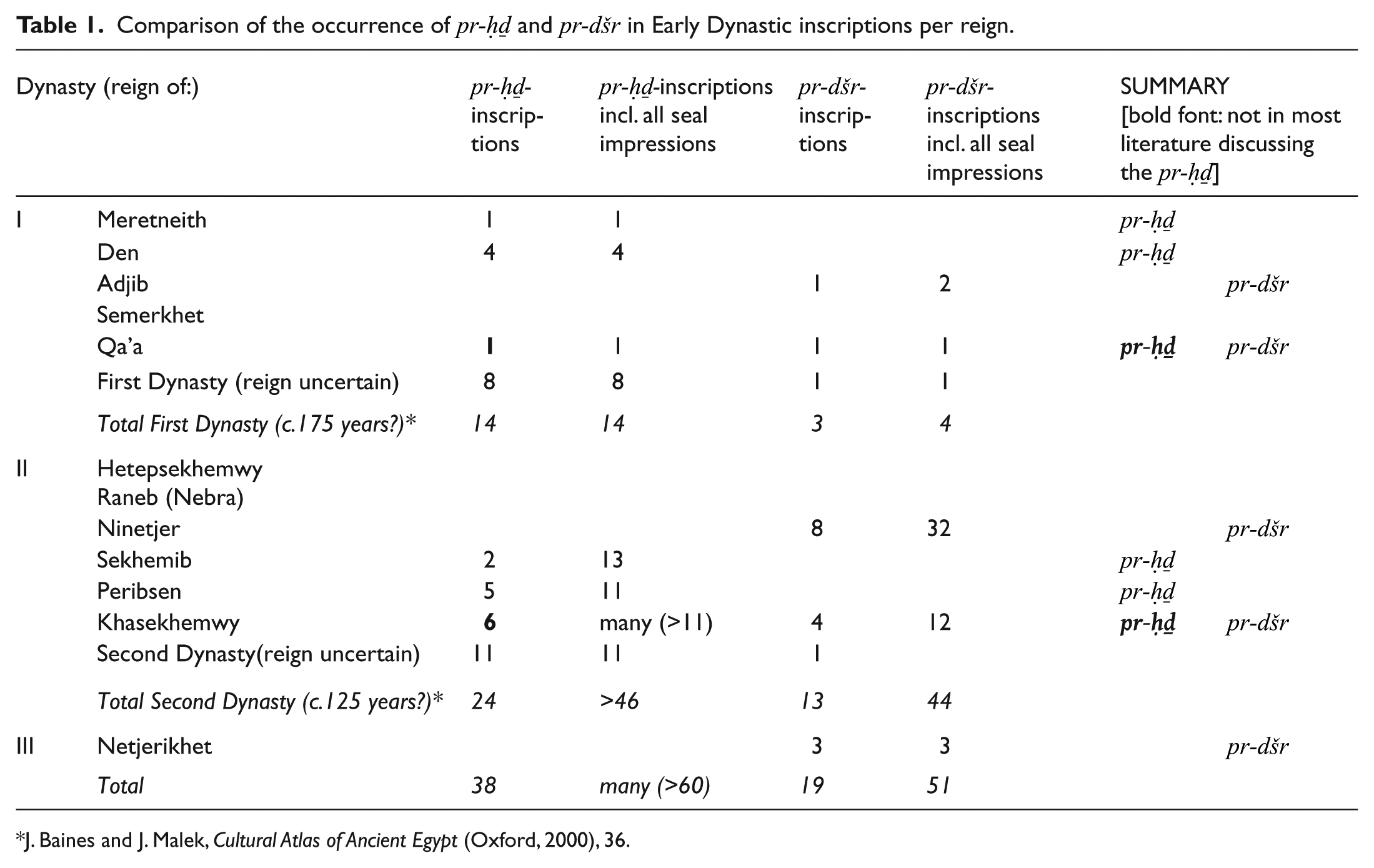
A comparative survey of the preserved pr-ḥḏ and pr-dšr inscriptions per reign is presented in Table 1. It shows, firstly, that for both of them the total number of inscriptions is smaller for the First than for the Second Dynasty, 14 and 24 for the pr-ḥḏ, and 3 and 13 for the pr-dšr, respectively.
Comparison of the occurrence of pr-ḥḏ and pr-dšr in Early Dynastic inscriptions per reign.
J. Baines and J. Malek, Cultural Atlas of Ancient Egypt (Oxford, 2000), 36.
This is remarkable because the total number of all inscriptions that certainly date from the First Dynasty (2208) 36 is much higher than that for the Second Dynasty (1224), 37 and the same is true if the numbers are included that may date from the First (2647) 38 compared to the Second Dynasty (1693). 39 It is also remarkable because general wealth was probably lower on average in the Second than in the First Dynasty. 40 The increased frequencies may be assumed, therefore, to show an increasing importance of pr-ḥḏ and pr-dšr in the developing state, a point to be further discussed in the last section of this article.
Secondly, the two final columns of Table 1 offer a summary of the reigns for which pr-ḥḏ and pr-dšr inscriptions are known. As the entries in bold in the penultimate column refer to inscriptions not mentioned in most existing literature discussing the Early Dynastic pr-ḥḏ, this summary offers, on the one hand, an explanation for the widespread assumption that the names pr-ḥḏ and pr-dšr just alternated in the course of time. It makes visible, on the other hand, why the ‘alternation hypothesis’ is no longer tenable. It appeared to result from the disregard of a label inscription from the time of king Qa’a – published in 1954 but apparently not yet known when the hypothesis was first proposed 41 – which shows without any doubt a pr-ḥḏ and the name of king Qa’a (source no. 1931 in Appendix A2). Since the publication of the results of a re-excavation of Khasekhemwy’s tomb in 2000, it is also certain that pr-ḥḏ and pr-dšr co-existed during his reign. 42 This makes the hypothesis more likely that pr-ḥḏ and pr-dšr coexisted permanently since at least king Adjib, even though their coexistence cannot be proven for all reigns through preserved inscriptions.
The pr-ḥḏ and the pr-dšr were most likely also quite different institutions. The available information suggests that the pr-ḥḏ was primarily responsible for supplying royal tombs with (products contained in) stoneware, and the pr-dšr for supplying them with wine jars made of pottery. It suggests also that the pr-ḥḏ was a more important institution than the pr-dšr.
The first point may not seem very convincing at first, because Appendix A1 contains only seven inscriptions on stone vessels. It is very unlikely, however, that the other five – for which this information is not given – were not made of stone. Their ‘locality’ shows that they belonged to the many thousands of vessels from the First and Second Dynasties transported during Netjerikhet’s reign from the royal tombs in Abydos to the underground galleries near his Step Pyramid in Saqqara, which were all stone vessels. 43
The seven pr-ḥḏ label inscriptions from the First Dynasty mention valuable imported oil, characterised as ḥȝt (‘the best’). 44 As the storage of cosmetic oils and ointments was by far the most important function of stone vessels in Early Dynastic Egypt, 45 these labels had been doubtlessly attached originally to stone vessels as well. In combination with the probably 12 pr-ḥḏ-vessel inscriptions, this brings the connection of the pr-ḥḏ with stoneware already at 50% of the 38 inscriptions.
The remaining 19 were seal inscriptions impressed on clay. Some were flat bag-seals, 46 some had conical forms as used to seal vessels, 47 for many the ‘type of sealing’ 48 is not known. Early Dynastic sealed bags are supposed to have contained primarily agrarian produce like grain or dried fruit. 49 At least one sealed leather bag has been found, however, that contained flint knives and other stone objects. 50 Source no. 2900 shows three impressions of a seal inscription containing a phrase that has been translated as ‘seal (sealer) of the flint knives for all days’, 51 one of which shows even a partly damaged pr-ḥḏ-sign. 52 This is one of three indications that also pr-ḥḏ seal inscriptions can be related to the supply of stone objects to royal and top-elite tombs.
A second indication is the inscription of source no. 2870, 53 which refers to a ‘seal of the alabaster vessels’. 54 This contradicts the assumption that vessel seals were only used on pottery vessels. 55 Thirdly, two seals with Khasekhemwy’s name (source nos 3010 and 3017) were found in the underground galleries near Netjerikhet’s Step Pyramid; it is unlikely that these seals had been used on pottery vessels, as only stone vessels were found in these galleries. 56 It is quite possible, therefore, that also ‘pr-ḥḏ seal impressions’ had been used on seals for stone vessels. These three indications imply that the relation of pr-ḥḏ inscriptions with stoneware may very well have been much higher than 50%.
Of the 19 pr-dšr inscriptions only two were on stone vessels. 57 Furthermore, it is a remarkable characteristic of the 14 pr-dšr seal inscriptions that nine of them refer explicitly to a vineyard (kȝnw, M43). 58 pr-dšr seal inscriptions were often impressed, therefore, on the mud cones used to close the large red pottery vessels known as wine jars. 59 None at all of the 19 pr-ḥḏ seal inscriptions refers to vineyards. One of the three ḥw.t-ḥḏ seals seems to refer to wine vessels (source no. 1185), but this was from a period when the pr-dšr most probably did not yet exist.
The pr-dšr may have been split off from the pr-ḥḏ as a separate institution, primarily to organise the supply of wine and (dried) grapes. The roughly 700 wine vessels in the Pre-Dynastic tomb U-j in Abydos had been imported from Palestine/Canaan. 60 Subsequently, viniculture had apparently started in the Delta. The pr-dšr was therefore probably situated in northern Egypt. Several pr-dšr inscriptions mention a vineyard called grg.t nb.ty (the foundation ‘the Two Ladies’) of unknown location, two (not mentioning the pr-dšr) mention a vineyard of inb.w ḥḏ (Memphis). 61
This does not necessarily imply that the pr-ḥḏ was in the south. 62 It is, in fact, more likely that it was located in Memphis after the royal residence had been established there, because it was apparently a more important institution than the pr-dšr. Not only is it mentioned more often; 63 its functionaries were also sometimes allowed to have their name on objects destined for a royal tomb (see Appendix A1), which was never the case in the preserved pr-dšr inscriptions. It may be expected that this was only allowed in the case of high-status functionaries. A name occurs on at least four pr-ḥḏ inscriptions. 64 Even a ẖry-ʿ (assistant) in the pr-ḥḏ was apparently important enough to be accorded this privilege. 65
Among the pr-dšr inscriptions only an inscription on a statue includes a personal name (source no. 3133), found in Mit Rahina, not in a royal tomb. It mentions a wr iḏ.t (a ‘Great One of the censing‘) of the pr-dšr named Ḥtp-ḏi-f. Incidentally, this makes it probable that the function of a ‘Great One‘ in the pr-dšr had a ritual rather than an economic-administrative character. As it was a task of the pr-ḥḏ as well as of the pr-dšr to supply royal tombs, the wr of the pr-ḥḏ may be assumed to have had a ritual function in royal funerals, too.
Yet another indication for the lower status of the pr-dšr compared to the pr-ḥḏ may be that the pr-dšr was apparently subordinate to the Early Dynastic ḥw.t P-Ḥr-msn. The pr-ḥḏ, in contrast, was probably only subordinate to the pr-nsw. 66 The ḥw.t P-Ḥr-msn was responsible for the organisation of the production and distribution to tombs of a rather wide range of products, such as wine, textiles and (domestic?) oils. 67 The pr-dšr was mentioned in four of the 62 ḥw.t P-Ḥr-msn inscriptions, the pr-ḥḏ never. One more indication for the relative importance of the pr-ḥḏ may be that, like the pr-nsw and the ḥw.t-P-Ḥr-msn, it had its own jar magazine (ḫnt), 68 a term never mentioned in preserved pr-dšr inscriptions. Lastly, not only did the pr-ḥḏ exist earlier than the pr-dšr, it also continued to exist as an important institution into later periods of Egyptian history, unlike the pr-dšr.
Most pr-ḥḏ and pr-dšr inscriptions offer only proof for their role in the supply of tomb gifts. It is noteworthy, therefore, that the inscription on the stela of a man called Sabef from the end of the First/beginning Second Dynasty (source no. 1865) mentions not only the title ḫrp ḥw.t P-Ḥr-msn pr-dšr 69 (‘leader of the pr-dšr of the ḥw.t P-Ḥr-msn’ 70 ), but also the title ḫrp (…) šḥ ḫnt (‘leader of … the cellar of the dinner-hall’), and ḥr.i šštȝ šḥ irp (‘secret adviser of the wine-hall’). 71 This combination of functions in one person makes it highly probable that the pr-dšr supplied wine to the court of the living king as well.
The oldest text with a range of titles mentioning the pr-ḥḏ dates only from the end of the Third or the beginning of the Fourth Dynasty, about two centuries later than Sabef’s stela, coming from the now lost tomb of a high official named Pehernefer. 72 It contained no fewer than 43 titles and starts with six titles belonging to his position as the leader of the pr-ḥḏ. This may be seen as an indication of the primary importance of the pr-ḥḏ by that time. 73 The titles show that a top official involved in the management of the pr-ḥḏ was additionally responsible for the provisioning of the court of the living king.
It also shows that his title wḎ mḏw ḥrj-wḎb (‘the one who gives orders to the distributor of the provisions’) did not belong to his pr-ḥḏ-titles, but that it was one of 14 titles related to his function as ‘leader of the granaries and warehouses’. 74 The distribution of agricultural produce to people involved in the functioning of court and state was at that time apparently not a function of the pr-ḥḏ. 75
The supply of red ‘earthenware’ vessels, often with wine, may have been the most characteristic activity of the pr-dšr, and this was probably clearly visible in funerary ceremonies accompanying the supply of the royal tomb with tomb gifts. It is noticeable that a very large number of nouns denoting ‘something red’ were written as a logogram with the picture of the flamingo, the ‘red one’ among the birds.
76
The feminine variant dšr.t could mean for instance ‘red crown’ or ‘red land’ or also ‘red vessel’.
77
During the Old Kingdom these different nouns mostly showed an appropriate determinative to distinguish them from each other. During the Early Dynastic period, however, the use of determinatives was still optional.
78
The same was apparently true regarding the addition of the t-sign  (X1) in the case of feminine nouns;
79
similarly the indication of a plural might be omitted.
80
(X1) in the case of feminine nouns;
79
similarly the indication of a plural might be omitted.
80
Given the fact that most words in Early Dynastic script are still nouns, names and numerals, 81 and that other word categories, including adjectives (or participles), are still extremely scarce, it seems logical to assume that – similar to pr-ḥḏ – pr-dšr should rather be interpreted as ‘house of “the red ones”’ than as ‘red house’. The translation ‘house of the flamingo’ for pr-dšr does not make much sense; however, a translation like ‘the House of (red) Earthenware’ would make a pr-dšr an understandable complement to a ‘House of (white) Stoneware’, even if the functions of the two were most probably not entirely restricted to the supply of pottery or stoneware.
Pr-nbw (ḥw.t nbw): House of Gold or workshop of precious stoneware?
The term pr-nbw appeared to occur only in source no. 3837, an Early Dynastic stone vessel of unknown date and provenance. 82 Its (probable) variant ḥw.t-nbw 83 occurred in no fewer than 106 inscriptions. 84 The main information has been summarised in Appendix C. Six of these inscriptions – four on ‘oil labels’ and two seal inscriptions – date from the First Dynasty, but for these the reading ḥw.t nbw is doubtful, as they all show more hieroglyphs inside the ḥw.t-sign than the nbw-sign alone. 85
The remaining 100 ḥw.t-nbw inscriptions all date from the Second Dynasty. They were all on calcite-alabaster stone bowls found in the underground galleries near Netjerikhet’s Step Pyramid. In these cases, ḥw.t nbw was interpreted by the excavators as the name of the ‘city’ Hatnub,
86
because a sign that can be interpreted as  (O49) was frequently found next to it. In 2012, the Hatnub Epigraphic Project reported an inscription in quarry P that is probably Early Dynastic, given its high position in the quarry and the use of the Early Dynastic form of the reed-leaf sign.
87
This indicates that exploitation of the Hatnub alabaster quarries had already started before the Old Kingdom. Like the pr-ḥḏ inscriptions, the ḥw.t-nbw inscriptions were moreover often accompanied by what were probably personal names, like ‘Iwf-ḥšy and Ḥm-nfr.
88
The overwhelming majority of the stone vessels were not inscribed. It may be assumed that these persons were responsible for the production of many more bowls than were inscribed with their name.
(O49) was frequently found next to it. In 2012, the Hatnub Epigraphic Project reported an inscription in quarry P that is probably Early Dynastic, given its high position in the quarry and the use of the Early Dynastic form of the reed-leaf sign.
87
This indicates that exploitation of the Hatnub alabaster quarries had already started before the Old Kingdom. Like the pr-ḥḏ inscriptions, the ḥw.t-nbw inscriptions were moreover often accompanied by what were probably personal names, like ‘Iwf-ḥšy and Ḥm-nfr.
88
The overwhelming majority of the stone vessels were not inscribed. It may be assumed that these persons were responsible for the production of many more bowls than were inscribed with their name.
No goldmines have ever been found anywhere near Hatnub. Moreover, the type of necklace represented by the hieroglyph transliterated as nbw was depicted during the Old Kingdom with only the colours blue, green and red, without yellow, the colour for gold. 89 The nbw necklace may have become the sign for gold when gold came to be more widely used as the most precious of the materials for jewellery. It is as unlikely that nbw in pr-nbw and ḥw.t nbw meant gold in the Early Dynastic period, as it is unlikely that ḥḏ in pr-ḥḏ referred to silver.
The Early Dynastic nbw sign was most likely, just like the ḥḏ sign, a metonym for ‘precious stone ware’, originally perhaps primarily coloured stoneware. Pr- (or ḥwt-) nbw may have originally referred to an establishment in the north where stoneware was produced. The beautiful nbw necklace made of precious stone beads may have given it its name, as its most eye-catching product. An expedition in the Eastern Desert north of Abydos and south of Hatnub to acquire such precious coloured stones may have discovered new calcite-alabaster quarries near what came to be called Hatnub. The richness of the quarries may have made it efficient to establish a production centre for precious stoneware on the spot, with a rather independent status and own inscriptions.
This makes probable an interpretation of ḥw.t-nbw as originally an important workshop for the production of precious stone objects, which gave the settlement its name. 90 It is likely that it was subordinate as such to the pr-ḥḏ as one or more workshops producing stoneware objects must have always been connected to the pr-ḥḏ.
Lastly, it should be emphasised that the underground galleries near Netjerikhet’s pyramid contained no fewer than c.40,000 stone vessels, 91 all dating from the First and Second Dynasty, the large majority made of calcite-alabaster, 92 most of them without any inscription. 905 vessel inscriptions were found here, nearly all of them on stone vessels. Only 13 of them were on pottery vessels and these all dated from the period of Netjerikhet’s reign. Remarkably, the database contains only four stone vessels with inscriptions dating from Netjerikhet’s own time, against, for instance, 153 from the time of Khasekhemwy.
The transport of huge numbers of stone vessels from the tombs of Netjerikhet’s predecessors in Abydos to the underground galleries near his Step Pyramid had apparently been a replacement for the production of new stone vessels. For the long period of Netjerikhet, references to the pr-ḥḏ have not been found until now, although they return under his successor Sekhemkhet. It may have been a main task of the pr-ḥḏ under Netjerikhet, therefore, to organise the transport instead of the production of stone vessels, and this would not have required (additional) inscriptions on already existing vessels.
An explanation for the change from the production of new stone vessels to the transport of already existing ones to Netjerikhet’s tomb may be found in a transfer of all stone-processing activities and manpower to the building of the Step Pyramid, Egypt’s first stone pyramid. 93 It is telling that even blocks of alabaster, which had become the material par excellence for stone vessels during the Second Dynasty, appeared to have been used for the building of (at least one of the) rooms under Netjerikhet’s pyramid. 94
The pr-ḥḏ, the ‘domains’ and state formation
The functioning of the Early Dynastic pr-ḥḏ apparently changed in the course of the Early Dynastic period. One important change, the increased number of pr-ḥḏ inscriptions in the Second Dynasty as visible in Table 1 of this article, still awaits discussion. Remarkably, the reverse appeared to have happened with what may be called ‘domain inscriptions’. This section will argue that the combination of increasing pr-ḥḏ and decreasing ‘domain inscriptions’ can be seen as characteristic for the ongoing process of ‘state formation’ in the Early Dynastic period.
What is translated as ‘domain’ is identifiable by the presence of a Mauerkranz (‘wall oval’; Kahl’s sign-code ‘o1’) – or another oval frame (Kahl’s sign-code ‘o4’) – containing a name that often includes the royal Horus falcon. 95 New ‘domain’ names appeared with new kings. Inscriptions containing a Mauerkranz most probably referred, therefore, to estates closely connected to the king personally. This in contrast to the pr-ḥḏ, which had a permanent name. ‘Domain inscriptions’ were moreover always seal inscriptions and never appeared on stone.
An analysis of the c.800 Early Dynastic seal inscriptions known in the early 1960s suggested that ‘domain seal inscriptions’ and what may be called ‘non-domain inscriptions’ were the two main categories of seal inscriptions. 96 Most ‘non-domain inscriptions’ mention persons – kings, princes, functionaries 97 – or institutions occurring only once. 98 The pr-ḥḏ was a ‘non-domain institution’ that was mentioned much more frequently. 99
Of the 151 Early Dynastic inscriptions with the ‘domain sign’ o1, 138 were from the First Dynasty, only 11 from the Second, and 2 from the reign of Netjerikhet, 100 a remarkable decrease in the course of time, therefore, in the observable frequency of an institution for the supply of royal tomb gifts closely connected to the person of the king. It is the relative increase in the mentioning of a ‘depersonalised’, more ‘state-like’ institution as the pr-ḥḏ, that can be seen as characteristic for the ongoing process of Early Dynastic state formation.
Another example of this increasing ‘depersonalised institutionalisation’ may be found in the appearance of the term iš-ḏfȝ in inscriptions. This term occurs only in 20 Second Dynasty inscriptions, six of which are pr-ḥḏ seal inscriptions and one a pr-dšr inscription. Terms like ‘foodstuffs’ or ‘taxes’ have been proposed as translation for ḏfȝ. 101 ‘Provisions for the life in the Hereafter’ may in fact have been meant in the inscriptions on Early Dynastic tomb gifts. The term ḏfȝ alone occurred already earlier in script. 102 An institution handling ḏfȝ, thought worthy to be mentioned in script, came apparently only into existence over the course of time.
It has been supposed that the iš-ḏfȝ was the central Early Dynastic tax institution and that the pr-ḥḏ was subordinate to it. 103 However, since the start of the Old Kingdom the expression iš.ty ḏfȝ pr-ḥḏ appears – which means no doubt the two ‘rooms’ of the pr-ḥḏ, not the other way round – and already during the Second Dynasty a second ‘iš’ of the pr-ḥḏ appeared to have existed, too: in a pr-ḥḏ inscription on a stone vessel from the end of the Second Dynasty an iš-Inpw is mentioned which occurs also in two other ‘non-pr-ḥḏ inscriptions’. 104
It has been supposed that Inpw was perhaps a personal name, as names containing Inpw have been known since the Old Kingdom. 105 The existence of an iš-Inpw makes this less likely. As mummification was already practised during the Early Dynastic period, 106 the word Inpw referred more likely to the priest responsible for the mummification ritual, comparable to the later Anubis-priest. In that case the iš-Inpw of the pr-ḥḏ may have been a ‘room’ for unguent oils necessary for the embalming process, as a complement to the iš-ḏfȝ with the provisions for the Hereafter.
All this is reminiscent of a much later Old Kingdom tomb text wishing the deceased ‘grain from the pr-šnw.t (house of the granaries), clothes and unguent oil from the pr-ḥḏ, and sweet products from the pr-ȝḫ.t (house of fruits)’. 107 This suggests that one of the two iš.ty of the pr-ḥḏ may have been at that time a ‘room’ that stored clothes, the other a ‘room’ for unguent oils. It suggests, moreover, that sweet products like dried grapes, as supplied by the pr-dšr during the Early Dynastic period, 108 were by then supplied by a pr-ȝḫ.t. It shows lastly that the pr-ḥḏ and the granaries were distinct institutions. If grain was used as an equivalent in kind for money, this makes it doubtful that it was the pr-ḥḏ that was comparable to what in later states would be called a treasury.
Stone and Early Dynastic state formation
The view – based on contemporary source material – that the pr-ḥḏ had a special connection with the supply of stoneware has a sounder foundation than the view – based on logic – that it was an institution filling government coffers with agricultural produce. The latter view may have been inspired by a state theory that regards money as the ‘nerve’ of a state, as in the Ciceronian adage pecunia nervus rerum. 109 A state theory focusing on ‘spectacle’ and ‘display’ as the ‘nerve’ of early states may, however, be more helpful for an interpretation of the importance of the pr-ḥḏ for Early Dynastic state formation in Egypt. 110
For the age of pyramid building, it is evident that the use of stone in Egypt’s funerary culture played a central role in asserting the authority of the state. Their building not only had a tremendous impact on state bureaucracy, it was also the sheer size of these monuments of stone – in a society in which mud bricks were the main building material – that displayed the importance of kingship and thus the authority of the state.
Before the building of stone pyramids, the supply of royal tombs with increasing amounts of precious stone vessels fulfilled a similar role. Already the royal tomb in Naqada from the time of King Aha had contained 200 stone vessels. 111 Tomb S 3504 of the top official Sekhemkasedj under the reigns of King Djet and King Den contained c.4000 vessels, c.1500 of which were made of stone. 112 The fact that in Khasekhemwy’s tomb even stone ‘dummies’ were found among its c.10,000 vessels, 113 strongly suggests that it was increasingly the ‘spectacle’ performed in the ritual supply of numerous stone vessels to a tomb, even more than their content, that was vital for the funerary ritual in the Early Dynastic period.
The undoubtedly ritualised transport to the north of no fewer than c.40,000 stone vessels for Djoser’s burial can be seen as the culmination of the importance of ever larger quantities of stone vessels in the Early Dynastic royal funerary ritual. The long row of bearers needed to transfer them from the Nile to the funeral area in the desert must have been an impressive ‘spectacle’ in the landscape, displaying the king’s power to appropriate precious economic resources and manpower. 114
The Early Dynastic pr-ḥḏ was certainly not a state treasury comparable to that of the later European states. Seen from the theoretical perspective of ‘spectacle’ as the ‘nerve’ of early states, institutions like the pr-ḥḏ and the ḥw.t nbw, with their special responsibility for the supply of precious stoneware to Early Dynastic royal tombs, will nevertheless have been important institutions in the process of Early Dynastic state formation in Egypt.
Footnotes
Appendices
Source for all Appendices: Database of Early Dynastic Inscriptions http://www1.ivv1.uni-muenster.de/litw3/Aegyptologie/. For a list of all identifiable signs in each inscription see the field ‘Signs’ in the ‘Signs-part’ of this database.
Acknowledgements
I owe thanks to Ben Haring, Jochem Kahl, Olaf Kaper, Geirr Lunden, Frans Sanders and René van Walsem for their comments on an earlier version of this text, and to Ilona Regulski for answering questions on her database.

2.
A. Erman and H. Grapow (eds), Wörterbuch der ägyptischen Sprache, I (Berlin, 1926–63), 517–8.
3.
J. Kahl, Frühäcgyptisches Wörterbuch. 1.-3. Lieferung, 1 (Wiesbaden, 2002–4), 153–4.
4.
It is discussed in E. Schott, ‘Das Goldhaus in der ägyptischen Frühzeit’, GM 2 (1972), 37–41, 37–8; not by Helck, Wilkinson, Desplanques, Endesfelder, Engel and Papazian (for full titles, see footnotes 7, 12 and 19).
5.
P. Kaplony, Die Inschriften der ägyptischen Frühzeit. Supplement (Wiesbaden, 1964), no. 1071: stone vase RMO Leiden, registration no. F 1965/9.2.
6.
Wb I, 518; TLA lemma pr-dšr, accessed 02.03.2018.
7.
W. Helck, Untersuchungen zu den Beamtentiteln des ägyptischen Alten Reiches (Glückstadt, 1954), 59; T. Wilkinson, Early Dynastic Egypt (London, 2001), 127; E. Endesfelder, Beobachtungen zur Entstehung des altägyptischen Staates (IBAES 14; London, 2011), 108. Only H. Papazian speaks of a ‘seemingly complementary institution’, see H. Papazian ‘The Central Administration of the Resources in the Old Kingdom: Departments, Treasuries, Granaries and Work Centers’, in J. C. Moreno García (ed.), Ancient Egyptian Administration (Leiden, 2013), 71.
8.
M. Z. Goneim, Horus Sekhem-khet: The Unfinished Step Pyramid at Saqqara, I (Cairo, 1957), 14, figs 27 and 28, pl. XXXVII.
9.
Wb I, 518.
10.
S. Desplancques, L’institution du trésor en Égypte des origines à la fin du Moyen Empire (Paris, 2006), 41, 127.
11.
Wilkinson, Early Dynastic Egypt, 125; Papazian, in Moreno García (ed.), Ancient Egyptian Administration, 41–85, 70–1.
12.
E. M. Engel, ‘The Organization of a Nascent State: Egypt Until the Beginning of the 4th Dynasty’, in Moreno García (ed.), Ancient Egyptian Administration, 41–85, 31–2; L. A. Warden, ‘Centralized Taxation During the Old Kingdom’, in P. Der Manuelian and Th. Schneider (eds), Towards a New History for the Egyptian Old Kingdom: Perspectives on the Pyramid Age (Leiden, 2015), 470–95.
13.
Wilkinson, Early Dynastic Egypt, 125.
14.
16.
A search for ‘2016’ in ‘Bibliography’ resulted in one publication (no hits for 2017 and 2018); access 17.01.2019.
17.
I. Regulski, A Paleographic Study of Early Writing in Egypt (OLA 195; Leuven, 2010).
18.
Often in an arbitrary order; see the ‘Signs-part’ of the database (for instance the source nos 4061 and 4063).
19.
A search for ‘(O2)’ resulted in 11 hits (after removal of 71 hits with o2), a search for ‘(O1-T4)’ in 17 hits, and one for ‘(O1)’ AND ‘(T4)’ in seven hits; searches for ‘(T4-O1)’, ‘(O1-T3)’, ‘(T3-O1)’ and ‘(O1)’ AND ‘(T3)’ did not result in hits (after removal of one o1); illustrations in P. Kaplony, Die Inschriften der ägyptischen Frühzeit, III (ÄA 8; Wiesbaden, 1963), nos 290, 751 showed that O1 should have been O2 in ‘Signs’ for source no. 2900, that T4 was partly visible in source no. 2867; O1 and T4 in source no. 1493.
20.
See the ‘Depository-part’ of the database; G. Dreyer et al., ‘Umm el-Qaab, Nachuntersuchungen im frühzeitlichen Königfriedhof, 11./12. Vorbericht’, MDAIK 56 (2000), 43–129, 126 and 128 mentions for source nos 4061 and 4063 ‘zahlreiche Belege’ not (yet) entered in the ‘Depository-part’; assuming >3 impressions for each brings the total of known pr-ḥḏ-seal inscriptions to >60.
21.
The main database contains 4628 entries; the ‘Depository’-part 6188; accessed 17 January 2019 (on 2 March 2018 it was 6177).
22.
Desplancques, L’institution du Trésor, 15 refers to seven Early Dynastic pr-ḥḏ inscriptions; Wilkinson, Early Dynastic Egypt, 127 mentions 6 pr-ḥḏ, and 10 pr-dšr inscriptions; Helck, Thinitenzeit, 189–201 mentions 8 pr-ḥḏ and 7 pr-dšr inscriptions; Endesfelder, Beobachtungen, 107 gives 19 pr-ḥḏ and 10 pr-dšr inscriptions; Kahl, Frühägyptisches Wörterbuch, 153–4 offers a selection of 23 references for pr-ḥḏ and 13 for pr-dšr.
23.
Of the sign-codes in Gardiners category ‘O’ and Kahl’s category ‘o’(= (Parts of) Buildings etc.), the following may indicate an ‘institution’: O1, o1, O2, o2, o4, O6, o6, O7, O8, O10, O11, O19, O20, O21, o26, O36, O51; the attestations in J. Kahl, Das System der ägyptischen Hieroglyphenschrift in der 0.-3. Dynastie (Wiesbaden, 1994) 624–62, for hieroglyphic combinations containing one of these signs show a minimum of 52 for the number of ‘institutions’ with one of these signs in its name.
24.
For instance: (O6) occurs 179 times in the database; Kahl, System, 630 mentions at least six institutions with O6 (ḥw.t) as part of their name; the number of times that these six O6-institutions are mentioned is on average 30: the ḥw.t ẖkr.w (‘O6) AND Aa31’) occurs for instance only once, but the ḥw.t nbw (‘O6) AND S12’) 61 times; the similar average for all 52 ‘O(or o)-institutions’ as identified in Kahl, System, is 17; as it is not certain that two signs occurring in an inscription actually formed a combination, the average may be in fact even somewhat lower than 17.
25.
Resulting from a search for O19.
26.
A search for ‘(O1-M23)’ gave 20 hits; a search for ‘O1) AND M23’ gave 48 hits (after deduction of three cases with ‘o1’ instead of ‘O1’).
27.
E. M. Engel, ‘Das ḥw.t pi-ḥr.w-msn.w in der ägyptischen Frühzeit’, in E. M. Engel, V. Müller, and U. Hartung (eds), Zeichen aus dem Sand: Streiflichter aus Ägyptens Geschichte zu Ehren von Günter Dreyer (Wiesbaden, 2008), 105–26, 119–23.
28.
29.
The sum of the number of inscriptions that could with certainty be dated to the reigns of the kings Narmer (72), Aha (381) and Djer (98) is 551; the similar total for all Early Dynastic kings since Djet is 1964; the total of pr-ḥḏ inscriptions datable by royal name is 19; this makes it not unreasonable to expect about five pr-ḥḏ inscriptions among the 551 from the kings before Djet, if the pr-ḥḏ would have existed already since Narmer.
30.
Engel, in Moreno García (ed.), Ancient Egyptian Administration, 40.
31.
Kaplony, Inschriften, I, XXXII.
32.
Source nos 0121, 1184, 1185, 1216.
33.
Source nos 0074, 0160. 0161, 0167, 0168 of Dynasty Zero.
34.
Although one of the pr-ḥḏ-labels found in the same tomb (S3504) was certainly from the time of Qa’a.
35.
A search for G27 AND O1) resulted in 13 hits, a search for O1-G27 in 10 hits, but source no. 4695 occurs twice, source no. 4754 had o1 instead of O1, source no. 3045 had gm instead of dšr.
36.
This is the result of a search in Date(Period) for ‘dyn.1’ NOT ‘Naqada’ NOT ‘dyn. 2’ NOT ‘dyn. 3’ and ‘Qaa’ NOT ‘(Qaa?)’ (see Index-> Date/Period).
37.
Similar search procedure as for the First Dynasty.
38.
The result of a search for ‘dyn.1’ in ‘Date(Period)’ was 2253; adding the results for entries like ‘Naqada III – dyn. 3’ (see Index, Date/Period) made the total 2647.
39.
Similar search procedure as for the First Dynasty.
40.
Known Early Dynastic Nile heights as mentioned on the Palermo Stone and the related stone fragments were on average much lower in the Second than in the First Dynasty; the number of known heights for the First plus Second Dynasty is concededly only 49, whereas the total number of years for the whole period was certainly more than 321 (Helck, Thinitenzeit, 125); however, both the lowest and the highest known water levels are higher in the 34 years of the First Dynasty for which they are known (out of a total of >194 years) than in the 15 (out of >127) years of the Second Dynasty, too (Helck, Thinitenzeit, 125 and128); in addition, there is no reason to assume that the years with data are a biased selection.
41.
Helck, Thinitenzeit, Wilkinson, Early Dynastic Egypt, and Engel, in Moreno García (ed.), Ancient Egyptian Administration did not mention it; Endesfelder, Beobachtungen, 108 called the occurrence of pr-ḥḏ here ‘unexplainable’, but she remained convinced of the ‘alternation hypothesis’.
42.
Dreyer et al., MDAIK 56, 126–8; three of the six newly found pr-ḥḏ-seal inscriptions – and two of the four newly found pr-dšr inscriptions – remained unpublished (see Appendices A and B).
43.
J. Ph. Lauer, La piramide à degrés. Compléments, III (Cairo, 1939) 1: ‘Découverte des galleries VI et VII remplies de vases de pierre’.
44.
Kaplony, Inschriften, I, 301; see also Wb III, 21: ‘Allgemeines: das Beste des Öls’.
45.
D. Arnold and E. Pischikova, ‘Stone Vessels: Luxury Items with Manifold Implications’, in J. P. O’Neil and J. Allen (eds), Egyptian Art in the Age of the Pyramids (New York, 1999), 121–31, 124.
46.
Source nos 2867, 2869, 2900, 2904, 2906, 2907, 2909, 4063.
47.
Source nos 1201, 1331, 1465, 4061.
48.
To be found in the ‘Depository-part’ of the database.
49.
Kaplony, Inschriften, I, 55.
50.
Kaplony, Inschriften, II, 849 n. 962; the tomb of (probably) the wife of King Aha in Naqada contained c. 120 stone tools, see J. Kahl, Vergraben, verbrannt, verkannt und vergessen: Funde aus dem ‘Menesgrab’ (Münster, 2001), 18; tomb S 3504 contained 676 stone implements, see W. B. Emery, Great Tombs of the First Dynasty, II (London, 1954), 66–8.
51.
Kaplony, Inschriften, III, no. 290.
52.
University College London register no. UC.42976; Kaplony, Inschriften, III, no. 290-A 1910.512b.
53.
Kaplony, Inschriften, III, no. 754.
54.
Kaplony, Inschriften, I, 159 and Kaplony, Inschriften, II, 1186.
55.
Kaplony, Inschriften, I, 50.
56.
This is the result of a search for Date(King)=’(Khasekhemwy)’ AND Locality=’Steppyramid’ AND Type= ‘vessel’ AND Material=‘pottery’; see also footnote 43.
57.
Both not found in the royal and top-elite tombs in Abydos and Saqqara (see Appendix B).
58.
Papazian, in Moreno García (ed.), Ancient Egyptian Administration, 71 mentioned this already for one case.
59.
An exception is source no. 2954, which was impressed on two bag-seals that probably had contained dried grapes (Kaplony, Inschriften, I, 162).
60.
G. Dreyer, ‘Tomb U-j: A Royal Burial of Dynasty 0 at Abydos’, in E. Teeter (ed.), Before the Pyramids (Chicago, 2011), 127–44, 132 mentions residues of the content.
61.
Source nos 2955 and 3160.
62.
It is not convincing to argue that a connection of the pr-ḥḏ with the South and of the pr-dšr with the North is plausible because of the Upper Egyptian origin of the white crown and the (supposed) Lower Egyptian origin of the red crown, not only because of the arguments developed in this article to view ḥḏ and dšr as substantives instead of as adjectives (participles), but also because it is by no means certain that the red crown was seen as a Lower Egyptian crown already in the Early Dynastic period – see S. Hendrickx et al., ‘The Origin and Early Significance of the White Crown’, MDAIK 70/71 (2014/15) 227–38, 229; for instance, it has been shown that in the Pyramid Texts, and even still later, the difference between the white and the red crown was not seen as geographical, but as having symbolic meaning – K. Goebs, Crowns in Funerary Literature: Royalty, Rebirth and Destruction (Oxford, 2008), 175–349. According to the map in J. Baines and J. Malek, Cultural Atlas of Ancient Egypt (Oxford, 2000), 21, stone for the production of stoneware was, moreover, certainly not only available in the South (even alabaster, although it will be argued in the next paragraph that a change was brought about by the discovery of the rich alabaster mines of Hatnub).
63.
See also Papazian, in Moreno García (ed.), Ancient Egyptian Administration, 71.
65.
Source no. 1201.
66.
According to Helck, Thinitenzeit, 193 the pr-nsw was subordinate to the ḥw.t P-Ḥr-msn; the opposite is more likely, as the ḥw.t P-Ḥr-msn disappeared after the Early Dynastic period.
67.
Engel, in Engel, Müller and Hartung (eds), Zeichen aus dem Sand, 114, however, without the addition of the term ‘domestic?’ which was added here because the pr-ḥḏ was probably responsible for the supply of imported oils.
68.
Endesfelder, Beobachtungen, 48 observed that a Krugmagazin is often mentioned on stone vessels of the First Dynasty.
69.
G. T. Martin, Umm el-Qaab, VII: Private Stelae of the Early Dynastic Period from the Royal Cemetery at Abydos (Wiesbaden, 2011), 44 (no. 48) has ḫrp pr-ȝḫ, but pr-ȝḫ is not in J. Kahl, Frühägyptisches Wörterbuch (Wiesbaden, 2002–2004), and the title ḫrp pr-dšr was found once more on a seal impression from the reign of Ninetjer (source no. 2841).
70.
Helck, Thinitenzeit, 229; D. Jones, An Index of Ancient Egyptian Titles, Epithets and Phrases of the Old Kingdom, II (Oxford, 2000), 714, no. 2605 has: ‘Director of the domain “Seat of the Horus with a harpoon” and of the red house’; Engel, in Engel, Müller and Hartung (eds), Zeichen aus dem Sand, 118 agrees with Helck.
71.
Helck, Thinitenzeit, 217, 228–9; similar in Jones, Index, nos 2690, 3289, 1832.
72.
Discussed in Helck, Thinitenzeit, 274–9 (based on its publication by G. Maspéro).
73.
Helck, Thinitenzeit, 216–7 made it plausible that a ‘Titelkumulation’ does not represent a ‘Laufbahn’.
74.
Helck, Thinitenzeit, 275.
75.
This in contrast, therefore, to what was stated for instance in Wilkinson, Early Dynastic Egypt, 127.
76.
Wb V, 487–94.
77.
Wb V, 493–4.
78.
Kahl, System, 105.
79.
Kahl, System, 570 n1101 transliterates T3 without t-sign X1 and without determinative, as ḥḏ.t, the white crown (see source no. 3087).
80.
J. Kahl, ‘Entwicklung der frühen Hieroglyphenschrift’, in W. Seipel (ed.), Der Turmbau zu Babel: Ursprung und Vielfalt von Sprache und Schrift, IIIA: Schrift (Graz, 2003), 127–31, 131.
81.
Kahl in Seipel (ed.), Turmbau zu Babel, IIIA, 127.
82.
A search for ‘O1)’ AND ‘S12’ and ‘O1-’ AND ‘S12’ seems to result in 12 hits, but six had o1 instead of O1, in source no. 1878 S12 was in fact S42, in the other cases O1 and S12 appeared not to belong together.
83.
P. Kaplony, Kleine Beiträge zu den Inschriften der ägyptischen Frühzeit (Wiesbaden, 1966), 151, n176: ‘pr-nb (…) ist gewiss nur Variante zu ḥw.t nb.’
85.
Helck, Thinitenzeit, 174 saw what was read as the nbw sign on ‘oil labels’ as an Ölpress-Sack.
86.
Lacau and Lauer, La piramide à degrés, V, 81.
87.
Pers. comm. by Roland Enmarch, Liverpool University (26 October 2017); for the Early Dynastic reed-leaf see sign M17 in Regulski, A Palaeographic Study, 490–3.
88.
Kahl, System, 506.
89.
Schott, GM 2, 41.
90.
The same conclusion in Schott, GM 2, 41.
91.
Lacau et Lauer, La piramide à degrés, IV, VIII: ‘millions de fragments’; Lauer, La piramide à degrés, 3: ‘30 à 40.000 pièces (…)’
92.
Lauer, La piramide à degrés. Compléments, III, 3.
93.
Similar reasoning in J. Romer, A History of Ancient Egypt: From the First Farmers to the Great Pyramids (Harmondsworth, 2012), 281.
94.
S. H. Aufrère, ‘L’origine de l’albâtre à la Ire dynastie d’après les inscriptions des vases provenant des galeries de la piramide à degrés’, BIFAO 103 (2003), 1–15, 2.
95.
Wilkinson, Early Dynastic Egypt, 119 fig. 4.1, 121–3.
96.
Verschlüsse der Domänenverwaltung and Verschlüsse ausserhalb der Domänenverwaltung; see Kaplony, Inschriften, I, passim (for instance 91, 95, 137, 138).
97.
However, inscriptions mentioning domain functionaries were considered as ‘domain inscriptions’ by Kaplony (see same pages).
98.
Kaplony, Inschriften, I, 162: ‘zahlreichen, aber jeweils nur einmal belegten Amtssiegel’.
99.
Kaplony, Inschriften, I, 154 calls the pr-ḥḏ a ‘häufig genannte[n] Verwaltung’ among the non-domain inscriptions ‘die grundsätzlich von der Domäne getrennt ist’.
100.
The sign o4 occurs seven times in the database.
101.
Kaplony, Inschriften, I, 158; J. Kahl, ‘Zur Problematik der sogenannten Steuervermerke im Ägypten der 0.-1. Dynastie’, in C. Fluck (ed.), Divitiae Aegypti: Koptologische und verwandte Studien zu Ehren von Martin Krause (Wiesbaden, 1995), 172–3.
102.
Searches for (I10) (I9) and (I9) (I10) resulted in 49 hits, 13 of which in the First Dynasty and one even earlier.
103.
Helck, Thinitenzeit, 200.
104.
Source no. 2637 and nos 1883 and 2272, stone vessels from the reigns of Qa’a and Khasekhemwy.
105.
See footnote 62; Ranke, PN, I 39.24–7.
106.
107.
See the second Old Kingdom attestation under the lemma pr-ḥḏ in the TLA (accessed 2 March 2018).
108.
See note 59.
109.
A saying among political thinkers and statesmen of the European Early Modern period, see W. Fritschy, Public Finance of the Dutch Republic in Comparative Perspective: The Viability of an Early Modern Federal State (Leiden, 2017), 3, 6.
110.
B. Routledge, Archaeology and State Theory: Subjects and Objects of Power (New York, 2014), 101, cites M. Foucault who characterised premodern society as a ‘society of spectacle’ where ‘power was what was seen’. The importance of royal ‘display’ for state formation in the Early Dynastic period has been argued also, albeit on other grounds, in L. McNamara, ‘The Revetted Mound at Hierakonpolis and Early Kingship’, in B. Midant-Reynes and Y. Tristant (eds), Egypt at its Origins 2: Proceedings of the International Conference ‘Origin of the State: Predynastic and Early Dynastic Egypt’ (Leuven, 2008) 901–37, 931 by interpreting this mound as an ‘arena … in which the king could make a ritual appearance’ (I owe this reference to an anonymous referee).
111.
Kahl, Vergraben, 16.
112.
Emery, Great Tombs, II, 3.
113.
Dreyer et al., MDAIK 56, 129.
114.
B. Trigger, Understanding Early Civilizations (Cambridge, 2003), ch. 17.
Author biography
After her retirement as senior lecturer in social-economic history (with a personal chair for the history of Early Modern public finance) at VU University Amsterdam, Wantje Fritschy studied Egyptology in Leiden and Berlin. Recently, she obtained her Masters degree. She is now preparing a publication on the so-called Early Dynastic ‘year labels’.